Kawasaki disease is an acute vasculitis of unknown origin, which causes coronary artery lesions leading to ischaemic cardiac disease in about 1–2% of affected patients.Reference Suzuki, Kamiya, Tsuda and Tsukano1 Kawasaki disease has been occurring worldwide for the past four decades. Acute coronary syndrome complicating coronary artery disease is a major determinant of prognosis for such patients and should be prevented if possible.Reference Tsuda, Arakaki and Shimizu2 However, information about acute coronary syndrome caused by Kawasaki disease-related coronary artery lesions in adults is limited compared with our knowledge about the more common acute coronary syndrome due to atherosclerosis.Reference Burns, Shike, Gordon, Malhotra, Schoenwetter and Kawasaki3 However, the number of adults with coronary artery lesions caused by Kawasaki disease is gradually increasing, and they are surviving to an older age. Consequently, a better understanding of the natural history of coronary artery lesions and the clinical features of acute coronary syndromes in this population should not only help to anticipate future cardiac events but also improve their management when they occur.
Patients and methods
We reviewed the clinical features of adult patients with acute coronary syndrome caused by Kawasaki disease-related coronary artery lesions, and included a few patients with presumed Kawasaki disease. We also included acute coronary syndrome due to coronary artery lesions characteristic of Kawasaki disease, even if a history of Kawasaki disease was undocumented. Coronary artery lesions characteristic of Kawasaki disease include giant aneurysms with a diameter exceeding 8 millimetres; coronary artery calcification; segmental stenosis, which implies recanalisation after thrombotic occlusion; and aneurysms involving the left coronary artery bifurcation.Reference Suzuki, Kamiya, Tsuda and Tsukano1, Reference Tsuda, Matsuo and Kurosaki4 Furthermore, Kawasaki disease-related coronary artery lesions usually involve the proximal segments of the major branches and tend to be localised, both the affected areas and apparently normal areas coexisting in the same patient. Acute coronary syndrome implies acute myocardial infarction or unstable angina, and includes sudden deaths caused by acute myocardial infarction. Patients with stable angina, syncope, and sudden deaths due to ventricular arrhythmia attributed to previous myocardial infarction were excluded from this study.
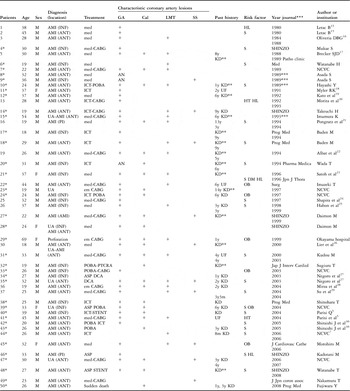
We identified 43 patients who met the above criteria and who were reported in the literature from 37 references between 1980 and 2008 (Table 1). The number of references per decade was: 1980–1989: 7; 1990–1999: 15; and 2000–2008: 15. From 1985 to 2003, three patients were referred to our hospital, and from 1993 to 2005, four patients were treated for acute coronary syndrome in our hospital. Of these 50 patients, 43 (90%) were male and seven (10%) were female. Thirty-five patients (70%) were Japanese. Coronary artery lesions were previously confirmed by selective coronary angiograms in 48 of the 50 patients, and in the remaining two patients with a history of Kawasaki disease, their coronary artery lesions were described in the reference.Reference Parisi, Abbate, Biondi-zoccai, Spina, Savino and Burzotta5 Whether the patients had coronary artery risk factors was recorded in 34 of the references examined and we analysed risk factors in 43 patients. Coronary arterial risk factors in this study included obesity, hypertension, hyperlipidaemia, diabetes mellitus, and smoking. The clinical features of acute coronary syndrome in these patients were analysed with the following results.
Clinical characteristics in 50 patients with acute coronary syndrome.

AMI = acute myocardial infarction; AN = aneurysm; ANT = anterior; ASP = aspiration; CABG = coronary artery bypass grafting; Cal = calcification; DCA = directional coronary atherectomy; DM = diabetes mellitus; em CABG = emergency CABG; GA = giant aneurysm; HL = hyperlipidaemia; HT = hypertension; ICT = intracoronary thrombolysis; KD = Kawasaki disease; med = medication; NCVC = National Cardiovascular Center in Japan; OB = obesity; PI = posteroinferior; POBA = percutaneous balloon angioplasty; PTCRA = percutaneous transluminal coronary rotational ablation; S = smoking; SS = segment stenosis; UA = unstable angina; UF = unknown fever; UN = unknown
*Japanese, **patient with UF and major symptoms (presumed KD), ***Journals written in Japanese
Results
Age and clinical features at the onset of acute coronary syndrome
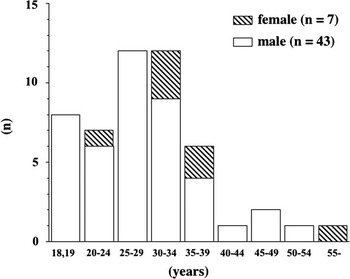
Age at the onset of acute coronary syndrome ranged from 18 to 69 years with a median of 28 years. The number of patients by age at the time of acute coronary syndrome is shown in Figure 1. Of the patients, 45 (90%) experienced acute coronary syndrome when less than 40 years old. The time of onset of acute coronary syndrome was recorded in 25 of the 50 patients, and was from midnight to early morning in 19 patients (76%). Anti-platelet agents were administered in 4 of 50 patients (8%) before the onset of acute coronary syndrome.
Age distribution at the time of acute coronary syndrome.

Of the acute coronary syndrome events, 45 (90%) were acute myocardial infarction, and five (10%) were unstable angina (Table 1). Among the 45 patients, two had progressed from unstable angina to acute myocardial infarction. Symptoms associated with acute coronary syndrome included syncope in four patients and chest pain in 46 patients. In the four patients who had syncope, either ventricular fibrillation or ventricular tachycardia was detected and successfully converted. Premonitory symptoms occurred in only five patients (10%) before acute coronary syndrome. On two occasions, two patients experienced ST-elevated myocardial infarction (patients 9, 26). There were 47 patients (94%) who survived their acute coronary syndrome, and three patients (6%) died. A 26-year-old male patient with a slightly dilated left anterior descending artery died suddenly after complaining of chest pain, and autopsy revealed an acute anteroseptal myocardial infarction caused by the thrombotic occlusion of the left anterior-descending artery. Despite there being no significant localised stenosis, thickening and calcification of the proximal portion of the left anterior descending artery was present (patient 50). A 19-year-old male patient with cardiac failure due to acute myocardial infarction died of recurrent myocardial infarction 26 days after initial onset. Extreme luminal narrowing with severe intimal thickening was observed in the proximal portion of both coronary arteries at the autopsy (patient 6). A 69-year-old female patient died of pneumonia, after an emergency coronary artery bypass grafting and repair of an acquired ventricular septal defect complicating her acute myocardial infarction (patient 29).
There were 27 patients (54%) with an anteroseptal myocardial infarction caused by left anterior descending artery occlusion, while an inferior myocardial infarction due to an occluded right coronary artery was found in 16 patients (32%; Table 1). There were 2 patients (4%) with posteroinferior myocardial infarction caused by occlusion of the left circumflex. The culprit lesion in 39 patients was thrombotic occlusion of an aneurysm, which was gigantic in 36 patients. There were three patients, in whom no aneurysm was seen in the coronary angiograms at the time of acute myocardial infarction, and who had previously documented giant aneurysms or aneurysms in childhood, which had regressed (patients 19, 44, and 50). In the remaining three patients, the existence of an aneurysm in the acute phase was unknown (patients 6, 43, and 49). The culprit lesions of unstable angina were as follows: the left anterior descending artery, two patients; the right coronary artery, 2 patients; and the left main trunk, 1 patient. There were four, out of five, patients with giant aneurysms.
Treatment of acute coronary syndrome
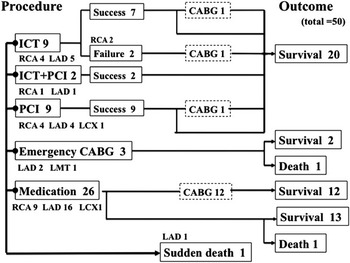
To support left ventricular function, intra-aortic balloon pumping was used in four patients, and percutaneous cardiopulmonary support was provided in one patient. Ventricular tachycardia after acute myocardial infarction occurred in two patients and transient complete atrioventricular block in one patient. Acute coronary syndrome was treated by intracoronary thrombolysis in 11 patients; percutaneous balloon angioplasty was added in two patients, and a stent was implanted in one patient. The procedure was successful in nine patients, and was followed by elective coronary artery bypass grafting in two of the 11 patients (Fig 2). Primary percutaneous coronary intervention was successful in nine patients. Thrombus aspiration was performed in four patients, and percutaneous balloon angioplasty, directional coronary atherectomy, and stent implantation was added in one patient each; percutaneous balloon angioplasty and directional coronary atherectomy were performed in three patients and one patient, respectively; one patient underwent intracoronary thrombolysis immediately after successful percutaneous balloon angioplasty. Coronary revascularisation was successful in all nine patients with primary percutaneous coronary intervention. Elective coronary artery bypass grafting and elective percutaneous transluminal coronary rotational ablation were performed in one patient for each procedure after primary percutaneous coronary intervention. There were three patients who underwent emergency coronary artery bypass grafting; 26 patients took medication immediately after acute coronary syndrome, and 12 patients underwent elective coronary artery bypass grafting.
Treatment and outcome for acute coronary syndrome (ICT = intracoronary thrombolysis; PCI = percutaneous coronary intervention; CABG = coronary artery bypass grafting).

Left ventricular ejection fraction
Left ventricular ejection fraction was measured in 24 patients, acute myocardial infarction in 20 patients and unstable angina in four patients. Among the 24 patients, 11 had undergone either primary percutaneous coronary intervention or intracoronary thrombolysis, and the procedure had been successful in nine. There were 11 patients who underwent elective coronary artery bypass grafting, and three patients who had not undergone coronary revascularisation. In 17 patients (71%), left ventricular ejection fraction was less than 50%. Among the seven patients who had a left ventricular ejection fraction more than or equal to 50%, three were diagnosed with unstable angina.
Birth year and past history
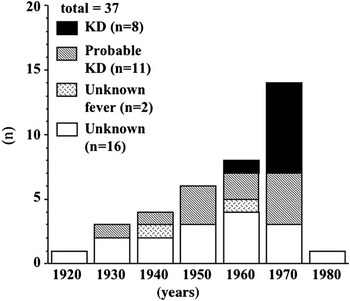
The year of birth was available either in the references or our medical records for 37 patients (75%). The number of births per decade were: 1920–1929, 1; 1930–1939, 3; 1940–1949, 4; 1950–1959, 6; 1960–1969, 8; 1970–1979, 14; and 1980–1989, 1 (Fig 3). Kawasaki disease was diagnosed at the time of the acute illness in 13 patients who were born in the 1960s and 1970s. There were 14 patients with an undiagnosed acute febrile illness with the major symptoms of Kawasaki disease. Otherwise, a history of unknown fever in childhood was recorded in four patients, and it was unknown in the remaining 19 patients.
Birth year and past history in patients with acute coronary syndrome (KD = Kawasaki disease).

In the 13 patients with a history of Kawasaki disease, the age at the onset of Kawasaki disease ranged from 8 months to 13 years, with a median of median 3 years, and the interval from the onset of Kawasaki disease to the onset of acute coronary syndrome was from 10 to 34 years, with a median of 25 years. Coronary artery lesions caused by Kawasaki disease had not been diagnosed in five of the 13 patients until an acute coronary syndrome developed, although the diagnosis of acute Kawasaki disease had been made. The three patients who were previously diagnosed as having coronary artery lesions developed acute coronary syndrome after discontinuing medication. There were two patients who had acute myocardial infarction later, despite their being diagnosed as having apparently normal coronary arteries on an earlier coronary angiogram. In the 14 patients with unknown fever with the major symptoms of Kawasaki disease, the age at the onset of febrile illness ranged from 1 to 9 years, with a median of 4 years, and the interval from the onset of febrile illness to the onset of acute coronary syndrome was from 5 to 48 years, with a median of 20 years. Of the 14 patients, three had been diagnosed as rheumatic fever. The diagnosis of mumps and scarlet fever was made in one patient for each disease. However, on retrospective review, the unknown febrile illness was strongly suspected to have been acute Kawasaki disease.
Incidence of characteristic coronary artery lesions caused by Kawasaki disease
In all, three-vessel disease affected 24 patients, and two-vessel and one-vessel disease involved 17 and 9 patients, respectively. As to the characteristic coronary artery lesions caused by Kawasaki disease, 21 patients (43%) had giant aneurysms with coronary calcification; 19 patients (38%) had giant aneurysms; four patients (8%) had coronary artery calcification; and three patients (4%) had an aneurysm. There were three patients with neither an aneurysm nor coronary artery calcification. However, in one of the three patients, prior existence of aneurysms was confirmed from previous coronary angiograms. The coronary artery lesions are summarised in Table 1. Segmental stenosis, which implies recanalisation after complete occlusion of a major coronary artery, was found in 10 patients (20%), and giant aneurysms at the bifurcation of the left coronary artery were present in 21 patients (42%).
Calcification at the cardiac area on a chest X-ray photogram was detected in five patients. Severe intimal thickening in the coronary arterial wall was found in all eight patients who underwent intravascular ultrasound, and a heterogeneous echo indicating atherosclerotic plaque was detected in two patients with coronary risk factors (patients 35 and 40). In the specimens obtained by directional coronary atherectomy or aspiration, microscopy revealed cholesterol crystals and macrophages in one of these two patients (patient 35). No atherosclerosis was found at operation in one patient (patient 11). At autopsy, both the 19-year-old and 26-year-old male patients had severe intimal thickening of the proximal portion of the major branches, with no apparent atherosclerotic change.
Coincident risk factors for coronary artery disease
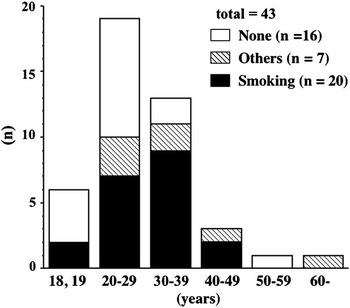
Coronary risk factors were present in 27 (63%) out of 43 patients. Risk factors per patient were one factor in 24, two in 3, and four in 1. Smokers constituted 20 patients (47%). Other risk factors were as follows: obesity, 6; hyperlipidaemia, 3; hypertension, 2; and diabetes, 1. The most common risk factor was smoking, and the number of smokers by age at acute coronary syndrome is shown in Figure 4. There were 18 (78%) smokers among the 23 patients with coronary risk factors and they were less than 40 years old.
Coronary risk factors by age at acute coronary syndrome.

Discussion
Giant calcified aneurysms involving the proximal portion of the major branches were the most common culprit lesions found, and in most cases thrombus formation within the aneurysm precipitated the acute coronary syndrome. Despite the incidence of thrombotic occlusion in giant aneurysms in the late period being low compared with patients with giant aneurysms within the first year after the acute Kawasaki disease, it emphasises that persistent giant aneurysms remain an important risk factor for acute coronary syndrome many years after the acute febrile episode.Reference Tsuda, Kamiya, Ono, Kimura, Kurosaki and Echigo6 The national biennial survey in Japan reported that about one-third of patients with giant aneurysms after the acute illness were female. In this study, female patients with acute coronary syndrome constituted only one-tenth of the cohort. For people under 50 years of age, there is usually a gender bias towards male population in the incidence of coronary artery disease. However, the gender difference in the incidence of acute coronary syndrome in this population may be bigger.
Some patients developed thrombotic occlusion at the sites where aneurysms had pre-existed, but had regressed.Reference Tsuda, Hanatani, Kurosaki, Naito and Echigo7 Even if giant aneurysms regress, they remain a risk for acute coronary syndrome under certain conditions, for example, the addition of other coronary risk factors. Coronary angiograms after revascularisation revealed apparently normal arteries in cases with regressed aneurysms. A detailed evaluation of coronary artery lesions caused by Kawasaki disease should be performed early in young acute coronary syndrome patients without apparent coronary risk factors, and may require multi-row detector computed tomography and intravascular ultrasound to assess intimal thickening and atherosclerotic plaque. However, the differential diagnosis of coronary artery lesions caused by Kawasaki disease versus those due to atherosclerosis with ageing may be difficult in some adult cases.
Aneurysms caused by Kawasaki disease have persisted long into adulthood after the acute illness in childhood with secondary vessel wall thickening in most cases.Reference Tsuda, Matsuo and Kurosaki4 Coronary artery calcification indicates severe intimal thickening of the coronary wall. Coronary aneurysms larger than a 6-millimetre diameter in the acute phase are frequently calcified after more than 10 years.Reference Kaichi, Tsuda, Fujita, Kurosaki, Naito and Echigo8 Thus, calcification can be considered as a marker of coronary artery lesions caused by acute Kawasaki disease experienced many years earlier, especially in patients with apparently normal coronary arteries on angiography. Even when the aneurysms have regressed in coronary angiograms, calcification indicates involvement of the coronary artery wall in the acute phase of Kawasaki disease.
The incidence of large aneurysms is 1.4–4.9% in the general adult population,Reference Hartnell, Parnell and Pridie9, Reference Swaye, Fisher and Litwin10 and is most commonly due to atherosclerosis. Destruction of the muscular media weakens the vessel wall, resulting in subsequent focal dilatation. Aneurysms also complicate atherosclerosis, and therefore the finding of non-calcified giant aneurysms does not necessarily imply a Kawasaki disease aetiology; furthermore, coronary artery calcification increases with ageing.Reference Nasir, Raggi and Rumberger11 However, the location of coronary artery calcification and aneurysms helps to differentiate between Kawasaki and atherosclerotic aetiology.Reference Hirota, Tsuda and Kurosaki12 In Kawasaki disease, calcification is usually limited to the site of pre-existing aneurysms, while in atherosclerosis, it is not co-located with aneurysms. Further, lesions due to atherosclerosis are diffuse, while they are usually localised in Kawasaki disease as they reflect the degree of acute vasculitis. Coronary artery lesions caused by Kawasaki disease rarely involve the small branches and peripheral coronary arteries.
The treatment for acute coronary syndrome has improved remarkably over the past three decades; thanks to thrombolytic therapy and improved percutaneous coronary intervention. Early revascularisation after acute myocardial infarction minimises the infarct area, and it was applied to some patients in this population, but simple aspiration or thrombolytic therapy was not always successful because of the large volume of thrombus in the giant aneurysm. In such cases, percutaneous balloon angioplasty was often added.
Kawasaki disease was not always recognised especially in the 1960s and 1970s when many physicians were unfamiliar with its features. The diagnosis of Kawasaki disease is clinical and is based on the major characteristic clinical features of the acute phase, and therefore there are undoubtedly many asymptomatic adult patients with coronary arterial lesions caused by Kawasaki disease who remain undiagnosed, forming a hidden cohort with this disease.Reference Tsuda, Matsuo and Kurosaki4 Even when acute Kawasaki disease was recognised, the diagnosis of complicating coronary artery lesions was more difficult in the sixties and seventies. Only recently have technical developments allowed a detailed examination of coronary artery morphology. Symptoms are rare in this population until the onset of acute coronary syndrome; consequently, the presence of coronary artery disease was unsuspected in most of the patients in this study until the actual episode and preventive antithrombotic therapy was not considered. Worth stressing is the occurrence of acute coronary syndrome in a few patients in whom aneurysms had apparently regressed as demonstrated by coronary angiograms performed before the episode. Medication had been stopped in them, because the giant aneurysms had regressed. Whether or not to continue antithrombotic therapy in patients with regressed giant aneurysms is an important problem to resolve in the future.
In the general adult population, less than 10% of patients are under 50 years of age when they develop acute coronary syndrome.Reference Lubna and James13 Acute coronary syndrome in adults with coronary artery lesions due to Kawasaki disease occurs at a younger age than acute coronary syndrome in the general population. The incidence of coronary risk factors in this population was expected to be low compared with that in the usual atherosclerotic acute coronary syndrome due to ageing. In the Kawasaki disease patients, the specific nature of the Kawasaki disease-related lesions seems to strongly influence the onset of acute coronary syndrome rather than the atherosclerotic factors. However, smoking was found in about half of the patients in this study, and was the most prominent risk factor. Smoking may be closely related to the onset of acute coronary syndrome in this population as in general adult studies previously reported,Reference Teramoto, Sasaki and Ueshima14 and it is clearly contraindicated in these patients.
Long-term careful follow-up is needed in patients with coronary artery lesions caused by Kawasaki disease, because treatment becomes more essential as they age and acquire new coronary risk factors. However, as most patients remain asymptomatic until the onset of acute coronary syndrome, it has been difficult to justify continued medication in some patients in the absence of a real understanding of the long-term disease profile from childhood to adulthood. Patients tend to drop out of follow-up as they reach adulthood; furthermore, coronary artery lesions caused by Kawasaki disease are not always familiar to internists because the acute illness occurs in childhood and the affected population is small. The true adult population with coronary artery lesions caused by Kawasaki disease is difficult to estimate. This study focused on the clinical features of acute coronary syndrome in this population. More needs to be learned about the natural history, pre-acute coronary syndrome recognition and the prevention of acute coronary syndrome in this uncommon but life-threatening condition.
Conclusion
Giant aneurysms due to Kawasaki disease eventually cause acute coronary syndrome, the onset being at a younger age than is typical for the much more common atherosclerotic acute coronary syndrome. This seems to be especially true in male. Even if the aneurysms regress, the risk of acute coronary syndrome remains in adult life. Smoking was a prominent additional risk factor.
Acknowledgements
We thank Professor Peter Olley for his kind English language consultation.