Introduction
Semantic memory, the long-term memory system containing knowledge about the world (e.g., words, objects, and people) has been the subject of numerous studies. However, the way in which semantic memory allows us to interact with our environment and have goal-directed behaviors is not clearly understood (Bier & Macoir, Reference Bier and Macoir2009; Bier, Macoir, Hudon, Bottari, & Joubert, Reference Bier, Macoir, Hudon, Bottari and Joubert2009; Binder & Desai, Reference Binder and Desai2011).
Cognitive models of everyday actions may shed light on some of the relationships between semantic memory and everyday activities. Currently, the two most often cited theories are Grafman's model on scripts (Grafman, Reference Grafman1995, Reference Grafman2002) and Cooper and Shallice's contention scheduling model on schemas (Cooper, Reference Cooper2002, Reference Cooper2007; Cooper, Schwartz, Yule, & Shallice, Reference Cooper, Schwartz, Yule and Shallice2005; Cooper & Shallice, Reference Cooper and Shallice2000, Reference Cooper and Shallice2006).
Scripts are high-level everyday activities (Cooper & Shallice, Reference Cooper and Shallice2000), such as going to a restaurant or planning a trip, comprising a sequence of events (Grafman, Reference Grafman2002; Schank & Abelson, Reference Schank and Abelson1977). For example, “driving to the doctor's office,” “reading while waiting in the waiting room” and “paying the consulting fee” constitute events that may represent the activity “going to a doctor's appointment” (Grafman, Reference Grafman2002). Simpler, more routine everyday actions, like making a sandwich or coffee, are referred to as “schemas” (Botvinick & Plaut, Reference Botvinick and Plaut2004; Cooper & Shallice, Reference Cooper and Shallice2000; Humphreys & Forde, Reference Humphreys and Forde1998). In the model by Cooper and Shallice (Reference Cooper and Shallice2000), schemas are represented as an ordered set of actions and sub-goals, like “getting coffee” or “adding milk.” The schemas are activated or inhibited by the perception of objects in the environment or by the availability of the person's resources (e.g., language, number of hands). The schema in turn activates appropriate representation of objects or the resources needed for the execution of an action and inhibits other irrelevant schemas.
These models do not explicitly address the issue of the relationship between semantic memory and everyday actions. According to Sirigu et al. (Reference Sirigu, Zalla, Pillon, Grafman, Dubois and Agid1995), knowledge about scripts may be stored in the posterior association cortices. The nature of this knowledge is not clearly specified but may correspond to the actions that are central to—or distinctive of—a particular script (Sirigu et al., Reference Sirigu, Zalla, Pillon, Grafman, Dubois and Agid1995). However, results to date suggest that patients with focal lesions of the left temporal cortex have no impairment on the semantic dimension of script representations (Armus, Brookshire, & Nicholas, 1989; Godbout & Doyon, 1995; Lojek-Osiejuk, 1996; Sirigu et al., Reference Sirigu, Zalla, Pillon, Grafman, Dubois and Agid1995). Another hypothesis is that script content and organization, such as the temporal ordering of the sub-actions of a script, are represented in the prefrontal cortex (Grafman, Reference Grafman2002; Krueger et al., Reference Krueger, Spampinato, Barbey, Huey, Morland and Grafman2009). In the contention scheduling model, the representation of semantic memory is limited to basic (implicit) knowledge about object use, and deficits in object recognition may not have an impact on the triggering of schemas (Cooper, Reference Cooper2007).
Evidence regarding the impact of semantic memory in everyday actions is sparse, but some studies involving patients with semantic dementia (SemD) suggest that semantic memory may play a role in everyday actions. SemD is a clinical variant of frontotemporal lobar degeneration characterized by a progressive loss of semantic memory (Neary et al., Reference Neary, Snowden, Gustafson, Passant, Stuss, Black and Benson1998). Patients generally present with bilateral atrophy of the anterior temporal lobes (i.e., the temporal poles), usually more predominant in the left hemisphere (Hodges, Patterson, Oxbury, & Funnel, Reference Hodges, Patterson, Oxbury and Funnel1992). As the disease progresses, atrophy affects the temporal regions bilaterally, as well as the ventromedial frontal cortex and the left anterior insular region (Brambati et al., 2009). Clinical observations (Funnell, Reference Funnell2001) and some case studies (Buxbaum, Schwartz, & Carew, Reference Buxbaum, Schwartz and Carew1997; Lauro-Grotto, Piccini, & Shallice, Reference Lauro-Grotto, Piccini and Shallice1997; Negri, Lunardelli, Reverberi, Gigli, & Rumiati, Reference Negri, Lunardelli, Reverberi, Gigli and Rumiati2007; Riddoch, Humphreys, Heslop, & Castermans, Reference Riddoch, Humphreys, Heslop and Castermans2002) suggest that object use is preserved in SemD. However, other studies have shown that loss of knowledge in SemD leads to loss of the ability to use objects (Bozeat, Lambon-Ralph, Patterson, & Hodges, Reference Bozeat, Lambon-Ralph, Patterson and Hodges2002; Coccia, Bartolini, Luzzi, Provinciali, & Lambon-Ralph, Reference Coccia, Bartolini, Luzzi, Provinciali and Lambon-Ralph2004; Hamanaka et al., Reference Hamanaka, Matsui, Yoshida, Nakanishi, Fujita and Banno1996; Hodges, Bozeat, Lambon-Ralph, Patterson, & Spatt, Reference Hodges, Bozeat, Lambon-Ralph, Patterson and Spatt2000; Hodges, Spatt, & Patterson, Reference Hodges, Spatt and Patterson1999).
Finally, other indications come from group studies conducted with patients with SemD. Mioshi et al. (Mioshi & Hodges, Reference Mioshi and Hodges2009; Mioshi et al., Reference Mioshi, Kipps, Dawson, Mitchell, Graham and Hodges2007) showed that patients with SemD present with deficits in everyday activities when measured with an informant-based questionnaire. Few of these patients showed deficits in basic core survival activities (such as eating and grooming), but the majority of them showed deficits in activities with a high level of complexity, reflecting the person's ability to live independently in the community. Activities reported as being the most difficult to carry out were using the phone, managing finances and preparing meals (Mioshi et al., Reference Mioshi, Kipps, Dawson, Mitchell, Graham and Hodges2007).
In summary, the role of semantic memory in everyday activities is not clearly understood. The purpose of this study was to explore the impact of semantic memory deficits on everyday activities in three patients suffering from SemD using a real-world performance-based measure of independence.
Methods
Participants
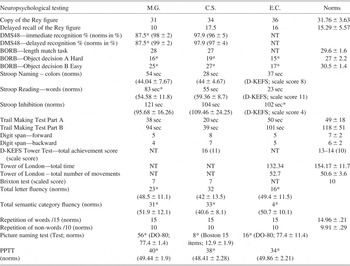
Three patients with SemD participated in this study. Their demographic characteristics are presented in Table 1, and results of neuropsychological tests are presented in Table 2.
General characteristics of the participants

Note. Mini-Mental State Examination (MMSE) (Folstein, Folstein, & McHugh, Reference Folstein, Folstein and McHugh1975); Dementia Rating Scale (DRS) (Mattis, Reference Mattis1976).
Neuropsychological assessment of the patients with SemD

Note. Delayed matching to sample 48 items (DMS48) (Barbeau et al., Reference Barbeau, Tramoni, Joubert, Mancini, Ceccaldi and Poncet2004); Birmingham Object Recognition Battery (BORB) (Riddoch & Humphreys, Reference Riddoch and Humphreys1993); Delis-Kaplan Executive Function System (D-KEFS) (Delis et al., Reference Delis, Kaplan and Kramer2001); Test de Dénomination orale d'images - DO 80 (Deloche & Hannequin, Reference Deloche and Hannequin1997); Pyramids and Palm Trees Test (PPTT) (Callahan et al., Reference Callahan, Macoir, Hudon, Bier, Chouinard, Cossette-Harvey and Potvin2010; Howard & Patterson, Reference Howard and Patterson1992).
NT = not tested; * = impaired score based on age-stratified norms.
Neuropsychological Testing
The following tests were used to document the neuropsychological profile of the participants with SemD (note: some data were not available for all patients): The Rey Figure (Rey, Reference Rey1960; Fastenau, Denburg & Hufford, Reference Fastenau, Denburg and Hufford1999); The Delayed Matching to Sample 48 (DMS48) (Barbeau et al., Reference Barbeau, Tramoni, Joubert, Mancini, Ceccaldi and Poncet2004), in which the subject must memorize incidentally 48 pictures of drawing objects and then recognize them in immediate and delayed forced-choice recognition tasks; The Birmingham Object Recognition Battery (BORB) (Riddoch & Humphreys, Reference Riddoch and Humphreys1993). In the length match test, the subject must decide if two lines presented in a pair have the same length. In the object decision tasks, the subjects must decide if line drawings correspond or not to real or unreal objects; The Stroop, the Trail Making Test A and B, and the Tower of London (Spreen & Strauss, Reference Spreen and Strauss1998). Note that E.C. had a different Stroop version, which was the one used in the Delis-Kaplan Executive Function System (D-KEFS) (Delis, Kaplan, & Kramer, Reference Delis, Kaplan and Kramer2001); The Brixton tests (Burgess & Shallice, Reference Burgess and Shallice1997), in which the subject must determine the position of a blue circle in an array of 10 cicles, according to series of rules that changes without warning; Digit span—WAIS III (Weschler, Reference Weschler1987); Letter and semantic fluency (Joanette et al., Reference Joanette, Ska, Poissant, Belleville, Lecours and Peretz1995); Repetition of words and non-words (Macoir, Gauthier, & Jean, Reference Macoir, Gauthier and Jean2005); The Test de Dénomination orale d'images - DO 80 (Deloche & Hannequin, Reference Deloche and Hannequin1997), which is a picture naming test using 80 line drawings of concepts pertaning to different categories; Pyramids and Palm Trees Test (PPTT) (Callahan et al., Reference Callahan, Macoir, Hudon, Bier, Chouinard, Cossette-Harvey and Potvin2010; Howard & Patterson, Reference Howard and Patterson1992).
Patient M.G.
M.G. is a 69-year-old right-handed woman with a grade 12 education, who had retired 3 years earlier from a job as an assistant accountant. She was presented to us in May 2010 with a 2-year history of cognitive decline mainly characterized by word-finding problems and difficulties in recognizing well-known people. With respect to memory, the patient was well oriented in time and space. The patient's performance was within the normal range for tasks exploring motor control and executive functions. Visual-perceptual abilities also appeared to be well preserved, except for object decision tasks. Visual recognition memory was slightly impaired. Speech output was fluent, well-articulated and grammatically correct but presented many signs of word-finding difficulties. M.G. was severely impaired in tasks exploring semantic memory and in confrontation naming.
An MRI carried out in November 2009 revealed substantial cortical atrophy limited to the anterior portion of the temporal lobes, slightly more marked on the left side.
M.G. lived with her husband. With respect to everyday activities, she was still carrying out household chores, gardening and shopping, and still driving her car. She did not cook much but said that it was mainly due to a loss of interest.
Patient C.S.
C.S. is a 74-year-old right-handed man with 18 years of education. He is a retired civil engineer. In 2004, he was referred to a geriatrician because of memory problems as well as word-finding and reading difficulties that began approximately 1 year before the medical consultation. He was well oriented in time and space, and his performance was normal on tests exploring executive functions, working memory, and non-verbal episodic memory. He also performed normally on perceptual tasks. C.S.'s performance was substantially affected on tests requiring semantic processing. With regard to language, speech output was fluent, well-articulated and grammatically correct but he presented many word-finding difficulties.
A brain positron emission tomography was conducted in April 2009. The reconstructed images showed hypometabolism in the anterior portion of the temporal lobes, more prevalent on the left side.
C.S. lived with his wife. Regarding everyday activities, C.S. reported in 2004 that he needed assistance to find a phone number in the directory, to prepare a meal, and to make shopping lists. In 2008, his wife reported that C.S. also needed help with paying bills. Finally, he gradually engaged in less and less conversations and avoided social situations because he was increasingly embarrassed by his cognitive difficulties. When he was seen in 2009, C.S. was still driving. He was relatively passive at home but walked about 2 hours a day and spent several hours each day playing Sudoku.
Patient E.C.
The third patient, E.C., is a 68-year-old right-handed woman with 13 years of formal education. She is a retired elementary school teacher. In 2009, she was referred to a memory clinic because of word-finding difficulties. Her complete neuropsychological profile is presented elsewhere (Bier et al., Reference Bier, Macoir, Joubert, Bottari, Chayer and Pigot2011). To summarize, E.C. showed severe deficits on tests requiring semantic processing and verbal comprehension but generally performed normally on tests exploring other cognitive domains. The anatomical MRI done in 2010 revealed bilateral atrophy of the anterior temporal lobes, predominating in the left hemisphere. At the time of testing, she was doing her household chores, managing her money and budget alone, and was still driving. However, she no longer prepared meals.
Control Participants
Forty normal control participants (25 women and 15 men) were also included in this study (see Table 1). They were matched for age and level of education with the three patients, as well as for their level of experience in preparing a hot meal. This was determined based on the frequency with which they carried out this activity (“I do not prepare meals,” “I prepare meals occasionally,” or “I prepare meals regularly”), as measured with the Instrumental Activities of Daily Living Profile – Interview (Bottari, Dassa, Rainville, & Dutil, Reference Bottari, Dassa, Rainville and Dutil2010b). Exclusion criteria for control participants included dementia, memory complaints, history of head injury and depression.
The project was accepted by the Ethical Review Boards of the patients’ institutions, or the researchers affiliated research centers, and all participants (patients and controls) gave their written informed consent to participate in the study.
Material and Procedures
The Instrumental Activities of Daily Living Profile (IADL Profile) (Bottari, Dassa, Rainville, & Dutil, Reference Bottari, Dassa, Rainville and Dutil2009a, Reference Bottari, Dassa, Rainville and Dutil2009b, Reference Bottari, Dassa, Rainville and Dutil2010a; Bottari, et al., Reference Bottari, Dassa, Rainville and Dutil2010b) was used to assess all participants. This tool was recently developed as a performance-based ecological measure of independence in everyday activities. So far, the measure has been validated with individuals with traumatic brain injury and its psychometric properties have been established (Bottari et al., Reference Bottari, Dassa, Rainville and Dutil2009a, Reference Bottari, Dassa, Rainville and Dutil2009b, Reference Bottari, Dassa, Rainville and Dutil2010a, Reference Bottari, Dassa, Rainville and Dutil2010b; Bottari, Gosselin, Guillemette, Lamoureux, & Ptito, Reference Bottari, Gosselin, Guillemette, Lamoureux and Ptito2011). This test is administered in the person's home and community environment and provides a measure of: (1) the person's level of independence in everyday activities carried out in a real-world environment, and (2) where breakdown in task performance occurs particularly in relation to problem solving (executive functions). The test, which has been described in detail elsewhere (Bottari, et al., Reference Bottari, Dassa, Rainville and Dutil2009a, Reference Bottari, Dassa, Rainville and Dutil2009b, Reference Bottari, Dassa, Rainville and Dutil2010a, Reference Bottari, Dassa, Rainville and Dutil2010b), consists of eight everyday tasks, six of which are combined to form a complex series of interrelated tasks aimed at preparing a meal for unexpected guests: dressing to go outdoors, going to the grocery store, shopping for food, preparing a hot meal, having a meal with guests, and cleaning up after the meal. The participant is first asked to prepare a hot meal for unexpected “guests” and is given $20 to cover expenses. With these instructions, it is expected that the participant will formulate an overarching goal related to preparing to receive his guests for a meal and the sub goals of the six inter-related tasks. The two other tasks are single complex tasks consisting of obtaining the bus schedule for a complete day between Montreal and Toronto, and preparing a budget. All activities are administered using a non-structured approach, that is, instructions and assistance are kept to a minimum.
Scoring takes into consideration four operations related to problem solving for each task: ability to formulate the goal, plan, execute the task, and verify attainment of the goal. For each operation, the person's level of independence is scored on an ordinal scale ranging from dependent (score of 0) to independent without difficulty (score of 4). A score of 0 indicates that the person is unable to perform the operation within a reasonable amount of time or in an acceptable manner, despite help. Scores of 1 and 2 are assigned based on the assistance required by the person: a need for both verbal and physical assistance (score of 1) or a need for either verbal or physical assistance (score of 2). The latter is the score that is used to represent the assistance required for individuals with SemD as they only have cognitive deficits and no physical deficits requiring specific physical assistance (e.g., balance deficits). Thus, a score of 1 was never used in our study. A score of 3 is assigned when the individual is capable of performing all aspects of the operation alone, but with difficulty (e.g., time taken to complete the tasks, quality of execution such as burned food). Finally, the individual is totally independent (score of 4) when all components of the operation are performed without difficulty.
For the purpose of this study, only results pertaining to the six tasks related to meal preparation are presented. The participants were videotaped and two independent evaluators rated their performance. Discrepancies were discussed to reach a consensus.
Statistical Analyses
The performances of the patients with SemD were first described on the basis of each of the four operations and for each of the tasks related to the goal of preparing a hot meal for guests. In a factorial validity study, Bottari et al. (Reference Bottari, Dassa, Rainville and Dutil2009b) reported four task-based correlated factors related to this overarching goal: (F1) going to the grocery store and shopping for food (grocery shopping), (F2) having a meal with guests and cleaning up, (F3) putting on outdoor clothing, and (F4) preparing a hot meal for guests. Each factor score represents the average score of a differing number of operation scores. They have excellent reliability (Bottari et al., Reference Bottari, Dassa, Rainville and Dutil2010b) and were thus used in this study.
The number of times assistance was required as well as safety issues were documented. The performance of the three participants with SemD was compared to the performance of the controls by means of modified t tests, which estimate whether an individual score is significantly different from the score of a small control group (Crawford & Howell, Reference Crawford and Howell1998).
Results
A description of each patient's performance is given in Appendix 1. A more complete description of E.C.'s performance can also be found in Bier et al. (Reference Bier, Macoir, Joubert, Bottari, Chayer and Pigot2011).
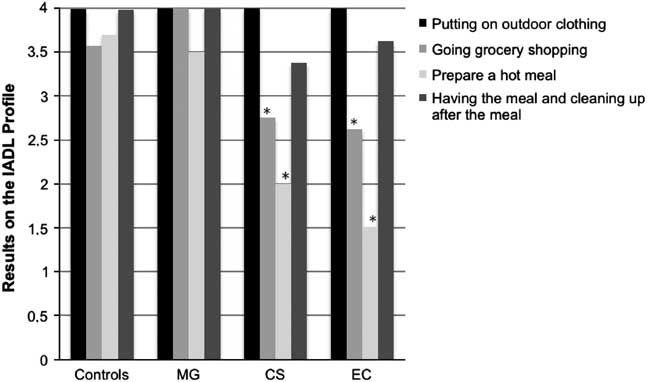
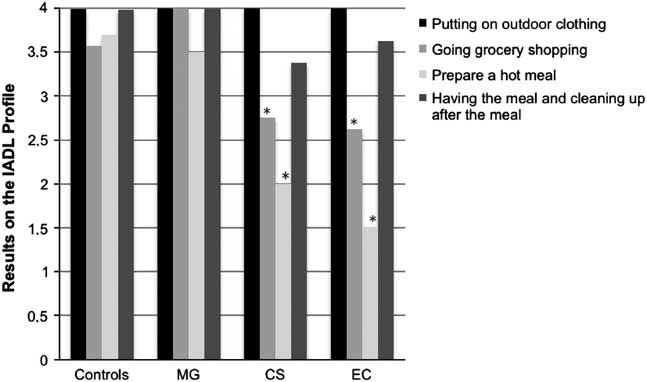
Results are presented in Figures 1 and 2. All normal controls were independent (score of 4) or independent with difficulty (score of 3) on all tasks. Since there was no difference between male and female, performance was not compared based on gender (Mann-Whitney U tests, all ps > .21; except for the operation “planning” of the tasks “having the meal/cleaning up after the meal” that was almost significant with p = .068). Compared with normal controls, M.G. had no specific difficulties in any task (all p values-ps > .29). E.C. and C.S. could put on outdoor clothing normally. However, E.C. (t = −1.25; p = .11) and C.S. (t = −1.08; p = .14) tended to have more difficulties than controls with grocery shopping but the differences were not significant. Preparing a hot meal was the most difficult activity for both of them (C.S.−t = −2.46; p = .009; E.C.−t = −3.18; p = .001). Finally, C.S. (t = −3.98; p < .001) and E.C. (t = −2.34; p = .012) showed more difficulties than the normal participants with having the meal/cleaning up after the meal.
Results of patients with semantic dementia (SemD) and normal controls on the Instrumental Activities of Daily Living Profile (IADL Profile). *Significant differences between the patients with SemD and normal controls.
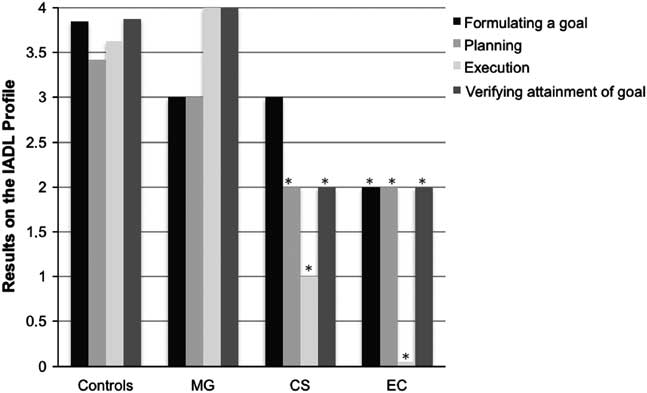
Scores of patients with semantic dementia (SemD) and normal controls on each of the four operations of the task “preparing a hot meal.” *Significant differences between the patients with SemD and normal controls.
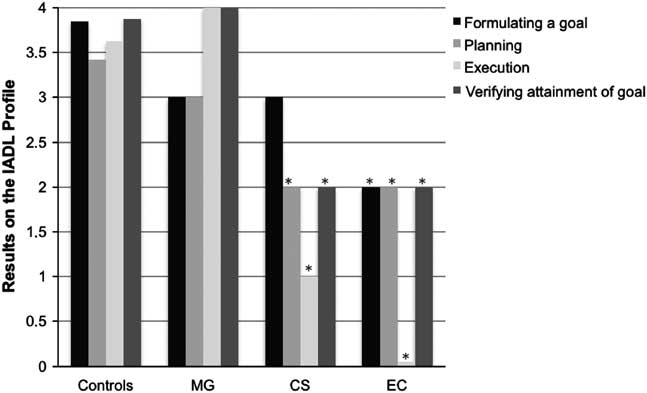
Preparing a hot meal was further analyzed since E.C. and C.S. had substantial difficulties in this task. E.C. had difficulties with all operations related to problem solving (formulating goal: t = −2.61; p = .006; planning: t = −1.88; p = .034; execution: t = −5.12; p < .001; verifying: t = −4.04; p < .001). C.S. had difficulties with planning (t = −1.88; p = .034), execution (t = −3.71; p < .001) and verifying attainment of the goal (t = −4.04; p < .001). Data were also analyzed in relation to the number of times patients asked for assistance, the number of times assistance was requested and given to participants, as well as safety issues. E.C. frequently requested assistance (17 times) while C.S. and M.G. never asked for it. Normal controls almost never asked for help (.05 times; E.C. vs control t = 75.76; p < .001). With respect to the number of cues given by the experimenter, E.C. (36 cues; t = 87.71; p < .001) and C.S. (3 cues; t = 7.03; p < .001) also differed significantly from the normal controls (.13 cues). Significant safety issues were noted in the observed behaviors of E.C. and C.S. (6 and 1 safety issues, respectively) while none were observed in the normal controls. For example, E.C. forgot to turn off the stove burners twice and C.S. was going to put the cooked ground beef in the same bowl used to mix the uncooked meat.
Discussion
The purpose of this study was to explore the impact of semantic memory deficits on everyday activities. Three patients with SemD and 40 normal controls were evaluated in their homes using an observation tool called the IADL Profile (Bottari et al., Reference Bottari, Dassa, Rainville and Dutil2010b). Among the three patients, E.C. was the most impaired. She showed marked difficulties in almost all tasks pertaining to preparing a hot meal for guests, and had difficulties in all operations related to problem solving. C.S. was less impaired but showed difficulties when shopping and preparing a hot meal and in most operations. M.G. had no marked impairment. None of the problematic behaviors reported in the patients with SemD was observed in the normal controls.
The first observation that can be drawn from these data is that SemD has an impact on everyday activities. This result is in line with what is reported by caregivers (Kashibayashi et al., Reference Kashibayashi, Ikeda, Komori, Shinagawa, Shimizu, Toyota and Tanimukai2010; Mioshi & Hodges, Reference Mioshi and Hodges2009; Mioshi et al., Reference Mioshi, Kipps, Dawson, Mitchell, Graham and Hodges2007). These patients show impairments in complex everyday activities and these deficits seem to increase with the progression of the disease. Routine activities such as personal hygiene and food selection were also reported to be impaired in some patients (Kashibayashi et al., Reference Kashibayashi, Ikeda, Komori, Shinagawa, Shimizu, Toyota and Tanimukai2010; Mioshi & Hodges, Reference Mioshi and Hodges2009; Mioshi et al., Reference Mioshi, Kipps, Dawson, Mitchell, Graham and Hodges2007; Rosen et al., Reference Rosen, Allison, Ogar, Amici, Rose, Dronkers and Gorno-Tempini2006; Shinagawa, Ikeda, Fukuhara, & Tanabe, Reference Shinagawa, Ikeda, Fukuhara and Tanabe2006; Snowden et al., Reference Snowden, Bathgate, Varma, Blackshaw, Gibbons and Neary2001).
The second observation emerging from our results is that SemD has an impact more specifically on the ability to solve problems related to complex everyday tasks. In accordance with our results, caregivers of patients with SemD also reported difficulties in everyday problem solving (Mioshi et al., Reference Mioshi, Kipps, Dawson, Mitchell, Graham and Hodges2007). All three patients had problems with selecting the meal to prepare (planning). They had only one idea of a possible menu (all three patients) and needed help to find one (C.S. and E.C.). Also, regarding execution, all patients had difficulties in recognizing food items in the grocery store (M.G. and C.S.) or during cooking (E.C.). These results are not surprising considering the difficulties of SemD patients with identifying real objects (Bozeat et al., Reference Bozeat, Lambon-Ralph, Patterson and Hodges2002; Coccia et al., Reference Coccia, Bartolini, Luzzi, Provinciali and Lambon-Ralph2004; Hodges et al., Reference Hodges, Bozeat, Lambon-Ralph, Patterson and Spatt1992, Reference Hodges, Patterson, Oxbury and Funnel2000).
Apart from these common difficulties, the three patients showed different patterns of results. C.S. and E.C. showed substantial difficulties. C.S. differed from E.C. regarding the unsanitary aspects of his food preparation and cleaning dishes. Although a loss of knowledge about germs may have contributed to his behavior, it may also reflect a loss of concern or difficulty understanding the negative aspects related to his behaviors. Orbitofrontal cortex degeneration appears during the course of SemD (Brambati et al., Reference Brambati, Rankin, Narvid, Seeley, Dean, Rosen and Gorno-Tempini2009; Desgranges et al., Reference Desgranges, Matuszewski, Piolino, Chetelat, Mezenge, Landeau and Eustache2007; Rosen et al., Reference Rosen, Gorno-Tempini, Goldman, Perry, Schuff, Weiner and Miller2002), and this region of the frontal lobe is associated with the emotions related to social behaviors and decision-making (Bechara, Damasio, & Damasio, Reference Bechara, Damasio and Damasio2000). C.S.'s performance and lack of insight may be interpreted as reflecting orbitofrontal cortex degeneration. Imaging data did not reveal any such evidence in either of our patients, but it may be that the imaging data failed to capture some amount of pathology. Neuropsychological tests measuring various aspects of social cognition related to the orbitofrontal cortex, such as the Iowa Gabling Task (Bechara, Damasio, Damasio, & Anderson, Reference Bechara, Damasio, Damasio and Anderson1994), may help address this question in more detail in future ecological studies with SemD patients. E.C. showed more insight about her performance than C.S. and was even frustrated about her difficulties. Two of her mistakes (she forgot to turn off the stove twice) may be explained by episodic memory problems. In fact, some studies have reported alterations of the hippocampal region in SemD (Desgranges et al., Reference Desgranges, Matuszewski, Piolino, Chetelat, Mezenge, Landeau and Eustache2007; Rosen et al., Reference Rosen, Gorno-Tempini, Goldman, Perry, Schuff, Weiner and Miller2002). Nevertheless, most of E.C.'s mistakes seemed to be related to lost knowledge about food and cooking, but a possible contribution of orbitofrontal cortex degeneration cannot be totally ruled out. As for M.G., she globally had no marked difficulties in the IADL Profile, although she showed semantic memory deficits similar to those of C.S. In light of this discrepancy, it may be that the difference between C.S. and M.G. rely on the presence (C.S.) or absence (M.G.) of orbitofrontal cortex degeneration.
These heterogeneous results from three SemD patients thus suggest that semantic deficits alone cannot explain the difficulties observed in the IADL Profile. However, E.C.'s performance, although probably not uniquely related to semantic memory deficits (e.g., orbitofrontal cortex degeneration, episodic memory deficits), provides interesting information about the role of semantic knowledge in everyday tasks, which is the main objective of this study. In E.C., semantic memory and complex everyday activities appear to interact via object recognition and use. They also appear to interact via problem-solving. This latter interaction may be explained by the vast mapping of connections existing between the frontal lobes and the posterior cortices. For example, such connections have been established in studies exploring the associations between language and action (Martin, Wiggs, Ungerleider, & Haxby, Reference Martin, Wiggs, Ungerleider and Haxby2000), showing that the semantic representation of an object involves information about its shape, color and size, but also about the sensory-motor features associated with its use. Consequently, the activation of this concept in a language task, such as in a word comprehension task, or in carrying out an action, recruits a large cortical network involving frontal, parietal and temporal areas (Rizzolatti, Fogassi, & Gallese, Reference Rizzolatti, Fogassi and Gallese2001). Models emerging from the study of apraxia (Buxbaum & Kalenine, Reference Buxbaum and Kalenine2010) or semantic processing (Binder & Desai, Reference Binder and Desai2011) have also pointed out the close relationship between knowledge and action and the involvement of large cerebral networks.
Of interest, Binder and Desai (Reference Binder and Desai2011) recently proposed a neuroanatomical model of semantic processing in which the ventral and lateral temporal cortex and the inferior parietal cortex form two important convergence zones for storing the abstract content of semantic knowledge. More precisely, and in line with everyday tasks, the inferior parietal cortex stores representations of “event” concepts. These concepts refer to the representations of everyday activities (e.g., a birthday party) in which entities (people, objects) interact in space and time (the beginning of the party, eating the birthday cake, opening gifts). This complex configuration helps define our representation of an event and distinguish it from others. According to Binder and Desai's model, a third important region, the prefrontal cortex, controls top-down activation and selection of the content of semantic memory stored in the posterior cortices. The content is selected regarding its relevance to the problem at hand and to allow for creative problem solving.
In accordance with Binder and Desai's view regarding the interaction between knowledge and problem solving, Barsalou (Reference Barsalou2003) specifies that these two cognitive domains are closely related via two processes: simulation and goal-derived categories. With simulation, the subject can reactivate multi-modal representations of past experiences (Barsalou, Reference Barsalou2008) and make an informed decision in accordance with it. Let us take Barsalou's example of a person who wants to change a light bulb. After simulating the action needed to change the bulb—that is, standing on something to reach the ceiling—the person concludes that he/she needs a large object to stand on. The person may have the idea of standing on an object having specific attributes, such as being tall and stable, and search in the environment to select an object that meets these criteria. When mapping is done between the selected goal and the environment, a new goal-oriented category (e.g., things one can stand on to change a light bulb) is created. Since the primary goal of such categories is to optimize a plan, reasoning is done on the ideal attributes that the exemplar of the new category should have (e.g., solid, high, and stable). Goal-oriented categories also direct the execution of the plan by taking into account the environment in which the action takes place. The role of conceptual knowledge in planning, according to Barsalou, is thus very important when the action takes place in a new context or when the action itself is new.
These models are of particular interest when considering E.C.'s performance in everyday tasks. Her profound loss of knowledge about objects and actions had a great impact on her ability to use objects purposefully. However, her general cooking abilities, which included cutting, rinsing, mixing and so on (simple gestures), were well preserved overall, as well as the general milestones of the activities (the beginning, the middle, and the end). But most importantly, we observed that her profound semantic memory deficit had a great impact on her ability to plan actions and reach a goal.
How can the above-mentioned difficulties (and models) be put in relation with models of scripts and schemas? E.C.'s difficulties were apparent during complex tasks requiring problem solving (scripts). As such, routine activities (schemas) were not really evaluated. In regard to script models, Grafman and colleagues (Grafman, Reference Grafman2002; Krueger et al., Reference Krueger, Spampinato, Barbey, Huey, Morland and Grafman2009) focused on the role of the frontal lobes in storing and activating complex structures comprising series of events (scripts). E.C.'s performance on the IADL Profile and on semantic memory testing suggests that posterior cortices responsible for semantic processing may also play an important role in scripts.
Our results do not allow us to confront the models of script and semantic processing but future research may allow a deeper understanding of these views and how they relate to each other. Future studies may shed light on the similarities and distinctions between semantic knowledge and scripts regarding their structure and content. In fact, classical taxonomic categories and scripts share very comparable properties (Barsalou & Sewell, Reference Barsalou and Sewell1985; Galambos, Reference Galambos1986; Galambos & Rips, Reference Galambos and Rips1982; Grafman et al., Reference Grafman, Thompson, Weingartner, Martinez, Lawlor and Sunderland1991). Their content differs—classical taxonomic categories contain objects while scripts contain actions—but the structure is similar. Also, future studies should try to better identify the brain regions involved in script processing. More specifically, an attempt should be made at reconciling the role of the inferior parietal lobe, a convergence zone concerned with knowledge of actions and events as posited by current theories on semantic processing (Binder & Desai, Reference Binder and Desai2011), and the role of frontal lobes in storing and retrieving complex actions and events, such as posited by current theories on scripts (Grafman, Reference Grafman2002). Studies on conceptual combination and simulation (Barsalou, Reference Barsalou2003) in semantic memory and their contribution to problem solving may also contribute to a better understanding of the role of conceptual knowledge in everyday life.
This study was a first attempt to explore the complex relationship between cognition and everyday actions by observing three SemD patients carrying out activities in their home and community. The role of semantic memory in everyday action should be further explored with studies conducted with larger groups of patients presenting isolated semantic memory deficits and with various degrees of severity. The relationship between the patients’ behavior in everyday actions and the precise localization of brain lesions should also be established. Finally, future studies should comprise a diversity of simple and complex everyday activities to allow a deeper understanding of the theoretical models on schemas and scripts.
Acknowledgments
The first two authors were supported by a postdoctoral fellowship award from the Canadian Institutes of Health Research during the time of the study. The third and fourth authors are supported by a salary award from the Fonds de recherche Québec – Santé. The authors wish to thank E.C., C.S., M.G. and the controls for their participation in this study, as well as all the evaluators who participated in data collection (Chantal Messier, Émilie Beauchemin, Maryline Pellerin, Marisol Petit, and Ariane Lacasse). The authors report no conflict of interest.
Appendix 1
The chart shows brief qualitative descriptions of the behaviors of the patients with SemD on the IADL Profile. The information in italics identifies the relevant operation.