INTRODUCTION
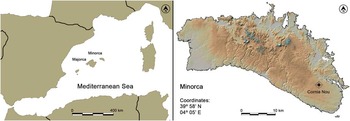
In the 3rd millennium cal BC, the early settlers of the Balearic Islands (Figure 1) introduced their domestic mammals (sheep, goat, cattle, pig, and dog), as well as two rodent species (dormouse and field mouse) (Ramis Reference Ramis2014). Later animal introductions in the archipelago were thought to occur by the end of the 1st millennium cal BC, due to contacts with Punic traders or, more than likely, to the Roman conquest of the islands in 123 BC. However, several faunal remains belonging to other introduced vertebrates (red deer, chicken, and rabbit) have recently been found in the Talayotic site of Cornia Nou (Minorca), in contexts dating to the early 1st millennium cal BC (Anglada et al. Reference Anglada, Ferrer, Plantalamor, Ramis, Van Strydonck and De Mulder2014).
The Balearic Islands in the western Mediterranean (left) and the site of Cornia Nou in Minorca (right).

The settlement of Cornia Nou, located at the eastern end of the island of Minorca, features a number of well-preserved architectural structures belonging to the Talayotic culture. The site is formed by two isolated groups of archaeological structures, which are surrounded currently by farms. During the past 10 years, a team in partnership with the Museum of Minorca has conducted an archaeological excavation project in Cornia Nou (Anglada et al. Reference Anglada, Ferrer, Plantalamor, Ramis and Van Strydonck2013).
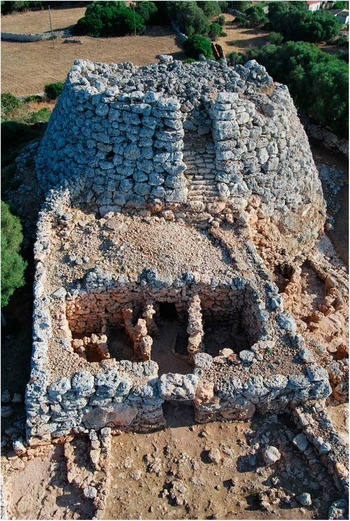
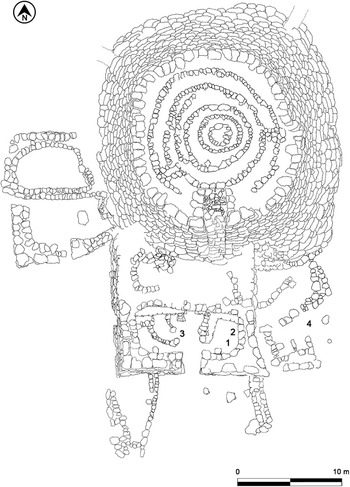
The so-called Western Sector (Figure 2) comprises, among other features, a large talayot, one of the most monumental on the island, which has a truncated cone shape and a gate with an impressive stairway on the south side, which allows access to the top of the structure. Two buildings adjoin the talayot, one of these being the South Building (SB), which was completely excavated in recent years. The other one, the West Building, is currently under excavation.
Western Sector of Cornia Nou with the South Building attached to the talayot.

A series of structures outside the SB, which adjoin its east wall, have also been excavated. The slightly concave monumental façade of the SB has a central entrance and is approximately 13 m long. This area can be divided into two main parts. Space 1 comprises an inner corridor with a hearth paved with slate slabs, and a room on each side (West and East rooms). Space 2 is almost completely blocked up with stones and contains a covered passage that allows access to the roof by means of a ramp. From the roof, one can climb the stairway up, as previously mentioned.
On the whole, the archaeological excavation of the SB allowed the recovery of many artifacts related to industrial activities: hand mills, hammer stones, mortars, pestles, bone awls, and bone spatulas. All these items were used in the processing of agricultural and animal husbandry products. An important pottery assemblage, including large storage containers, was also found in the occupation layers.
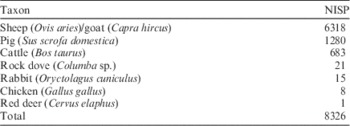
As for the faunal evidence, an assemblage of about 20,000 bone remains was recovered in the SB, of which 8326 could be identified (Table 1). The sample is heavily dominated by the domestic mammals. There is also a small representation of rock dove, rabbit, and chicken, as well as a single skull fragment of red deer.
Number of identified specimens (NISP) from the faunal assemblage found in the South Building of Cornia Nou, after Anglada et al. (Reference Anglada, Ferrer, Plantalamor and Ramis2017).

The SB was in use from ca. 1000 to 600 cal BC (Anglada et al. Reference Anglada, Ferrer, Plantalamor, Ramis, Van Strydonck and De Mulder2014). The presence of rabbit, chicken, and red deer on Minorca during this early period is of great interest to improve our knowledge of the Late Bronze-Early Iron Age maritime networks in the western Mediterranean, and to gain a better understanding of the external contacts of the Talayotic culture.
Given that the age of these bones is based on their contextual association with dated samples, the aim of this paper is to check the reliability of the chronology for these newly introduced small vertebrates (chicken and rabbit). A series of radiocarbon (14C) dates has been made directly on bones from these species to exclude the possibility of infiltration into lower layers.
MATERIAL AND METHODS
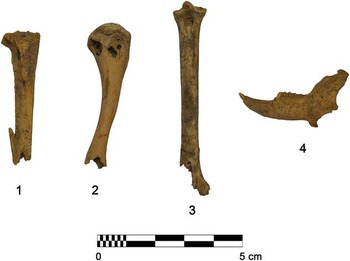
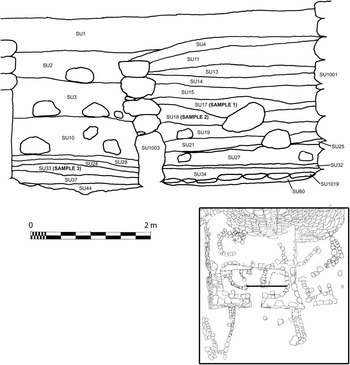
All the identified chicken and rabbit remains from the South Building were located in collapse layers (SUs 9, 11, 12, 14, 15, 16, 17, 18, 19, and 33). None of them appeared in occupation contexts. Two chicken bones and two rabbit bones were selected for radiocarbon dating (Figure 3). All of them come from stratigraphic layers containing a homogeneous cultural assemblage (Figures 4 and 5). Three of the contexts were interpreted as collapse layers (SUs 17, 18, and 33). The fourth sample comes from a structure attached to the east side of the South Building, from a context interpreted as a compacted earth floor (SU 143), which dates to the early 1st millennium cal BC. This last sample is not included in Table 1 because the study of the faunal assemblage recovered in the area outside the South Building is still in progress. None of the chicken and rabbit bones showed any clear sign of human alteration.
The four rabbit and chicken bones selected for 14C dating (see sample description in Table 2).

Plan of the Western Sector at Cornia Nou, with the approximate positions of the dated samples.

Section of the South Building of Cornia Nou indicating the locations of samples 1–3 (numbers referred to Table 2). The context of sample 4 is not represented in any section of this site.

Results of 14C dating of rabbit and chicken bones from Cornia Nou.

All bone samples were pretreated using the Longin (Reference Longin1971) method supplemented with a NaOH wash to remove humic acids. All bones contained enough good quality collagen to perform the analysis. After pretreatment, samples were combusted and transformed into graphite (Van Strydonck and van der Borg 1990–Reference Van Strydonck and van der Borg1991) and dated by accelerator mass spectrometry (AMS) (Boudin et al. Reference Boudin, Van Strydonck, van den Brande, Synal and Wacker2015).
RESULTS AND DISCUSSION
Bones of small species have proven to be easily intrusive in the archaeological contexts of Cornia Nou. Although the cultural materials from these layers are very homogeneous and fit well with a Late Bronze and Early Iron Age chronology (Anglada et al. Reference Anglada, Ferrer, Plantalamor, Ramis and Van Strydonck2013, Reference Anglada, Ferrer, Plantalamor, Ramis, Van Strydonck and De Mulder2014), three of the four dated small bones are intrusive (sensu Albarella Reference Albarella2016). This might have been due to the fact that the site has been frequented in antiquity and medieval times, as recorded in the upper layers of the South Building, which were formed after its process of collapse was completed.
Nevertheless, one of the chicken samples has been dated to 810–550 cal BC, a period when the South Building was in use. Even though this is the earliest record for chicken in the Balearic Islands, unfortunately, it was found in a collapse layer, and not in a primary position as a part of an occupation one. The scarcity of chicken bones in Cornia Nou precludes an alimentary exploitation of this species. This is a general trend in the Iron Age Mediterranean, where chicken would have been initially adopted by local peoples as an exotic good of either prestige or ritual interest (e.g. De Grossi Mazzorin Reference De Grossi Mazzorin2005; Carenti and Wilkens Reference Carenti and Wilkens2006; Sykes Reference Sykes2012; Perry-Gal et al. Reference Perry-Gal, Erlich, Gilboa and Bar-Oz2015). In the Talayotic necropolis of Son Real, Majorca, eggshell fragments, which were identified as possible hen eggshells (Nadal Reference Nadal1998), were recovered from one of the graves of the earliest phase of the site, dated before the mid-1st millennium cal BC.
A similar interpretation, as a prestige or ritual good, can be given to a single skull fragment of red deer found in the South Building of Cornia Nou (Figure 5), in a context dated to ca. 800–600 cal BC (Anglada et al. Reference Anglada, Ferrer, Plantalamor, Ramis, Van Strydonck and De Mulder2014). This bone has not been directly dated, because it is a very large fragment, and, thus, its infiltration in deeper layers seems improbable. Moreover, this is not the earliest record for red deer on the island. Evidence for red deer had been previously recorded in the Minorcan site of Cap de Forma (Depalmas and Marras Reference Depalmas and Marras2003), dated to ca. 1000 cal BC (Depalmas Reference Depalmas2014).
As for the rabbit, although the bones from Cornia Nou fall within the 2nd–1st centuries cal BC), a rabbit sample from the Minorcan paleontological site of Pas d’en Revull has been recently dated to 820–560 cal BC (Quintana et al. Reference Quintana, Ramis and Bover2016). The initial introduction of rabbit to Minorca does not seem to be related to its exploitation as an alimentary resource. In fact, it is absolutely absent in all of the archaeological contexts dated before the 2nd century cal BC. Its presence on the island is only known because of this sample from a fossiliferous breccia.
In the western Mediterranean, chicken is first recorded in the Phoenician colonies of south Iberia since the 9th–8th centuries cal BC (e.g. Hernández Carrasquilla Reference Hernández Carrasquilla1992). Rabbit, on the other hand, is indigenous to the Iberian Peninsula (e.g. Monnerot et al. Reference Monnerot, Vigne, Biju-Duval, Casane, Callou, Hardy, Mougel, Soriguer, Dennebouy and Mounolou1994). The origin of red deer in Minorca is more uncertain, because its natural distribution covers the entire Mediterranean basin.
In a wider context, it can be noted that during the late 2nd millennium cal BC a series of local maritime networks connected the central Mediterranean with Iberia (e.g. Giardino Reference Giardino1995; Ruiz Gálvez Reference Ruiz-Gálvez1997; Gómez Toscano and Fundoni 2009–2010). The Balearic Islands were probably used as stop-over places (e.g. Botto Reference Botto2013). This caused the arrival of different prestige or exotic goods to the archipelago, although in a very limited volume and variety in comparison with neighbouring regions. Bronze was the most distinctive imported product, both as raw material for Talayotic metallurgy and as final metal objects (Delibes and Fernández-Miranda Reference Delibes De Castro and Fernández-Miranda1988; Montero et al. Reference Montero, Gornés, De Nicolás and Gual2005). Faience beads and elephant ivory are other allochthonous materials recorded in the Balearic Islands in the early 1st millennium cal BC (Lull et al. Reference Lull, Micó, Rihuete and Risch1999). This navigation network, which was dominated by the Phoenicians since approximately the 9th or 8th centuries BC (e.g. Vives-Ferrándiz Reference Vives-Ferrándiz2015; Botto Reference Botto2016), brought about the Phoenician colonization of the island of Ibiza in the 7th century BC. Even though they did not settle in Majorca or Minorca, Phoenician imports, dated to the 6th century BC, have been recorded in both islands (e.g. Castrillo Reference Castrillo2005; Hernández-Gasch Reference Hernández-Gasch2009); whereas Talayotic pottery has been recorded in the 7th century BC Phoenician establishment of Sa Caleta in Ibiza (Ramon Reference Ramon2007). On the other hand, some influence of Greek trade in the northern part of the Balearic archipelago has been observed as well. It has been dated from the mid-6th to the mid-5th centuries BC and linked to the Greek colonies of the northwestern Mediterranean (e.g. Hernández-Gasch Reference Hernández-Gasch2009–Reference Hernández-Gasch2010).
Consequently, these pioneer faunal introductions recorded in Minorca can be related to the maritime activity around the Balearic Islands in the first half of the 1st millennium cal BC. This scenario fits well with the spread of the house mouse (Mus musculus) in the west Mediterranean, which has been dated to the early 1st millennium cal BC and linked to both Greek and Phoenician maritime activities (Cucchi et al. Reference Cucchi, Vigne and Auffray2005). The genus Mus has been identified on Majorca at Son Matge (Sanders Reference Sanders1979) and on Minorca at Torralba d’en Salord (Sanders Reference Sanders1984), Cova des Mussol (Alcalde Reference Alcalde1999a) and Cova des Càrritx (Alcalde Reference Alcalde1999b), in contexts which date between late 2nd and early 1st millennia cal BC.
CONCLUSION
The 14C evidence from Cornia Nou and Pas d’en Revull shows that both chicken and rabbit were already present on the Balearic Islands earlier than 560/550 cal BC. The contextual evidence from Cap de Forma and Cornia Nou indicates that red deer was introduced to Minorca, probably several times, during the first half of the 1st millennium cal BC.
Thus, the presence of these animals in the Balearic Islands before the mid-1st millennium cal BC should be placed in the context of the Late Bronze and Early Iron maritime networks which connected the central Mediterranean with Iberia and the Atlantic. Based on parallels from the western Mediterranean, Phoenicians, who had already established colonies on the Iberian coast, seem to be responsible for the introduction of chicken. Given that the original geographic distribution of rabbit is mainly the Iberian Peninsula, it is possible to suggest that its arrival to Minorca could be due to the same mechanism.
Due to their scarcity or absence in the archaeological contexts of this period, the reasons for the initial introduction of these faunal species to the Balearic Islands do not seem simply economic. Chicken could be more likely related to its value as an exotic or symbolic good, as interpreted in surrounding areas in the same period. The early arrival of rabbit and red deer remains unexplained, although a similar reason cannot be excluded.
Acknowledgments
The research and excavation project in Cornia Nou is supported by Museum of Menorca, Consell Insular de Menorca, the Royal Institute for Cultural Heritage, Bussels, Direcció General de Recerca del Govern de les Illes Balears, Associació d’Amics del Museu de Menorca, Institut Menorquí d’Estudis, as well as by the Osuna-Sard family, who own the property where the archaeological site is located.