


Introduction
Improving Access to Psychological Therapies (IAPT) is a large-scale initiative first implemented in England in 2007, which aimed to improve access to evidenced-based psychological treatments for common mental health difficulties, primarily depression and anxiety (Gyani et al., Reference Gyani, Shafran, Layard and Clark2013). The IAPT service model is informed by National Institute for Health and Care Excellence (NICE) guidelines, which recommend that mild to moderate depression and anxiety can be managed effectively using low-intensity interventions within primary care and community level settings (Department of Health, 2007).
Low-intensity interventions
‘Low intensity’ in this case refers to forms of CBT guided self-help that can be delivered in non-traditional formats (e.g. via telephone/online) and often require less practitioner support in terms of frequency and duration of sessions. The IAPT workforce delivering these interventions are referred to as psychological wellbeing practitioners (PWPs; Richards and Whyte, Reference Richards and Whyte2011). There is much evidence for the effectiveness of guided self-help which has a cognitive behavioural framework in the treatment of depression and anxiety. Please refer to the extended report online for a discussion of these reviews and meta-analyses (see Supplementary Material).
Effectiveness of the IAPT initiative
IAPT services are routinely evaluated using a session-by-session monitoring protocol, ensuring that each service user has a clinical end-point even where treatment is discontinued before expected. Evidence suggests that the IAPT model is clinically effective, and more specifically, that low-intensity interventions are an effective treatment for mild to moderate depression and anxiety. Gyani et al. (Reference Gyani, Shafran, Layard and Clark2013) examined year one data from 32 IAPT sites, representing approximately 19,000 clinical cases, and reported that 40% of individuals had reliably recovered and 64% had reliably improved by the end of treatment. In relation to low-intensity interventions specifically, Gyani et al. (Reference Gyani, Shafran, Layard and Clark2013), concluded that guided self-help was a significant predictor of reliable recovery where the diagnosis was depression, generalized anxiety or co-morbid depression and anxiety.
Moreover, the percentage of clients who were stepped up to a higher intensity service following guided self-help was 25.7%, compared with a figure of 54.5% for those who received pure self-help, which lends further support to the superior efficacy of guided self-help. These findings were in keeping with NICE recommendations whereby guided self-help but not exclusive self-help is advocated for mild/moderate depression.
Primary care level psychological therapies in Northern Ireland
Psychological therapy service provision in Northern Ireland (NI) has traditionally focused more on complex mental health difficulties. In 2013 the Northern Ireland Mental Health Services Threshold Criteria acknowledged that low-intensity therapists working at stepped care levels one and two, including those delivering low-intensity interventions, are crucial for the establishment of an effective stepped care approach to psychological therapy provision in the province (HSC, 2014); however local implementation of this has been inadequate (Betts and Thompson, Reference Betts and Thompson2017). Further details are provided within the extended report (see Supplementary Material).
Training of PWPs in Northern Ireland
In order to address this gap in service provision, a postgraduate programme has facilitated the training of PWPs (accredited by the British Psychological Society) since 2014. These trainees deliver low-intensity interventions within primary/community level services. Trainees attend university two days per week, and have one directed learning day on which a guided task is completed independently. Two days are spent seeing clients at placement sites after successful completion of assessment and intervention modules. Trainees attend individual clinical case management supervision on a weekly basis, and group clinical skills supervision sessions fortnightly as per IAPT accreditation requirements; all supervisors are either BPS or BABCP accredited practitioners and completed the IAPT PWP supervision training course (Richards and Whyte, Reference Richards and Whyte2011).
Aims and objectives
The current provision of psychological therapies at the primary/community care level in NI is in its early stages of development, with few empirical evaluations to date. The primary objective of this report is to present preliminary findings which evaluate change in clients’ symptoms following treatment delivered by PWPs. Specifically, it was predicted that following a course of LI-CBT, there would be a reduction in PHQ-9 and GAD-7 scores indicative of reliable improvement and/or recovery, and that these would be similar to existing IAPT UK outcomes; thereby providing initial evidence that this element of the IAPT service model is effective in an NI context.
Methods
Design
This report presents the preliminary findings from a larger ongoing longitudinal study, using pre–post interventional trial methods, following clients (n = 199) from baseline (before therapy) through the course of low-intensity weekly treatment (1–11) sessions, and at discharge (final session). This preliminary evaluation is limited to examining changes in psychological wellbeing before and after therapy.
Measures
As per IAPT protocol, each client completed two routine outcome measures at every session, namely the Patient Health Questionnaire (PHQ-9; Kroenke and Spitzer, Reference Kroenke and Spitzer2002) to measure depression, and the General Anxiety Disorder Questionnaire (GAD-7; Spitzer et al., Reference Spitzer, Kroenke, Williams and Löwe2006) to measure anxiety. A full overview of the measures is provided in the extended report.
Caseness and reliable change calculations
In keeping with IAPT recommendations (Gyani et al., Reference Gyani, Shafran, Layard and Clark2013), the clinical outcomes reported here are related only to clients meeting ‘caseness’ criteria. This required at least two contacts with a PWP. A ‘case’ client must also have scored above clinical thresholds on at least one of the measures at assessment, indicated by 10 or above on the PHQ-9 and/or 8 or above on the GAD-7. A reduction or increase of six or more points on the PHQ-9 and a reduction or increase of four or more points on the GAD-7 have been determined as the thresholds for reliable change in depression and anxiety symptoms, respectively.
Clients are considered ‘reliably improved’ if either measure score reliably decreased or the score for the other measure either remained the same or did not reliably deteriorate. Clients are considered ‘reliably deteriorated’ if either measure score reliably increased, or the score for the other measure either also increased or did not reliably improve. A reliable recovery index was used in line with existing IAPT studies (Gyani et al., Reference Gyani, Shafran, Layard and Clark2013). Clients are considered ‘reliably recovered’ if they scored above the clinical threshold on at least one outcome measures at baseline, achieved overall reliable improvement, and scored below clinical thresholds on both measures at treatment completion. Further details are provided within the extended report.
Interventions
In keeping with the IAPT service model, PWPs (n = 29) supported clients by delivering a range of LI-CBT interventions, which included behavioural activation, cognitive restructuring, exposure therapy, problem solving, managing panic, sleep hygiene, and medication support. Further details are provided within the extended report.
Sample
Data were collected from 199 clients referred to a trainee PWP between January 2015 and June 2016. Referrals sources included GPs, Primary Care Team, Talking Therapies Hub, and self-referrals. The current study focuses on the clinical outcomes of the referrals who met ‘caseness’ criteria of which there were 104 (64%) females and 59 (36%) males. Ages ranged from 18 to 77, with a mean age of 39 years (SD = 13.56).
The duration of treatment ranged between two and 11 sessions, with a mean of 5.7 sessions. A total of 113 clients were discharged following successful treatment completion, and 50 were discharged before treatment completion due to either non-attendance or step up. Community settings within which a variety of wellbeing services are offered, facilitated treatment for 55% of case clients, 18% were treated in a GP practice, and 27% were treated at primary care psychological therapies service within a NI NHS Trust as per a stepped care framework. In relation to initial presentations, 25% of case clients demonstrated depressive symptoms, 14% presented with general anxiety and 47% with co-morbid depression and anxiety. The primary presentations of the remaining clients included specific phobia, panic disorder (with or without agoraphobia), health anxiety, and obsessive compulsive symptoms.
Results
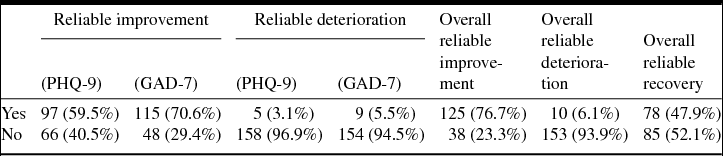
In relation to depression, 59.5% of clients achieved reliable improvement and 3% showed reliable deterioration. In relation to anxiety, 70.6% of clients achieved reliable improvement and 5.5% showed reliable deterioration. Overall, 47.9% of clients who met caseness criteria demonstrated reliable recovery; 76.7% of these clients achieved reliable improvement, and 6.1% demonstrated reliable deterioration (see Table 1). There was no proportional difference observed in overall reliable recovery rates between clients treated in NI and those treated in England at the same time period [χ²(1, n = 163) = 0.17, p > 0.5]. However, the proportion of clients treated in NI who demonstrated overall reliable improvement was significantly higher when compared with rates in England [χ²(1, n = 163) = 14.57, p < 0.001].
Frequencies and percentages of reliable recovery, improvement and deterioration rates for all clients meeting caseness criteria (n = 163)

At least two sessions attended and above clinical thresholds on one or both measures at baseline = caseness.
Discussion
Initial NI outcomes: clinical effectiveness
Findings from the current study are in keeping with outcomes from UK IAPT sites including the previously reported 2015/16 outcomes (HSC, 2016). More specifically, when NI reliable change rates are compared directly with these IAPT UK outcomes, recovery rates are 47.9 and 46.3%, respectively. Improvement rates are 76.7 and 62.2% for NI and England respectively, (HSC, 2016). These preliminary results provide initial evidence that low-intensity interventions are effective for mild to moderate level mental health difficulties in NI. The service evaluated in the current study is not an official IAPT service and trainee PWPs were not working under the usual high volume caseload, which may account partly for the higher improvement rates. Within IAPT UK, a client may have received both low- and high-intensity interventions. Given that only low-intensity interventions were delivered and evaluated in the current report, a higher proportion of suitable referrals within this sample may partly explain the higher improvement rates. Further discussion is included in the extended report.
Applying the evidence in Northern Ireland
Recent reports indicate that access to psychological services has been wholly inadequate in NI, and that significant funding is required to match provisions in England (Betts and Thompson, Reference Betts and Thompson2017). Currently, the mental health service framework in NI does not formally apply NICE evidence, as highlighted in the recent Evaluation of the Bamford Action Plans (Betts and Thompson, Reference Betts and Thompson2017). It is reasonable to assume that a PWP service in NI may reduce the prevalence of difficulties by improving access to psychological therapies at the primary care level, as the IAPT initiative has in England (Gyani et al., Reference Gyani, Shafran, Layard and Clark2013).
Limitations
The absence of a control group is an acknowledged limitation of this pilot evaluation. The outcome data reported in the current study are limited, and future work will analyse a larger sample.
Recommendations and plans for future low-intensity CBT research in NI
The collection of client data is ongoing, and reliable change will be examined based on this larger sample. Future research will also examine follow-up data and investigate predictors of treatment outcome, and changes in employment status and medication usage.
Conclusion
Our findings indicate that reliable recovery and improvement have been demonstrated for clients in NI with common mental health difficulties. This study provides evidence from NI that LI-CBT interventions (delivered by trainee PWPs) can be effective in the treatment of anxiety and depression at stepped care levels 1–3. Additionally, the Bamford evaluation highlighted a need to further promote psychological therapies, to improve access to services, and to improve involvement at the community and voluntary level (Betts and Thompson, Reference Betts and Thompson2017). Our initial findings indicate that PWPs could potentially address this need.
Acknowledgements
Ulster University would like to acknowledge the trainee PWPs and placement providers involved in delivering the intervention which has been evaluated.
Financial support: Orla McDevitt-Petrovic is funded by a studentship granted by the Department of Employment and Learning. The study was conceived and funded by Ulster University.
Ethics statement: Full ethical approval was obtained from ORECNI, with additional clinical governance obtained from three Trust sites in NI; IRAS ref. 181559; REC ref. 16/LO/0343. Data were fully anonymized prior to analysis by trainee psychological wellbeing practitioners.
Conflicts of interest: The authors report no conflicts of interest.
Supplementary material
To view supplementary material for this article, please visit https://doi.org/10.1017/S1352465818000322




Comments
No Comments have been published for this article.