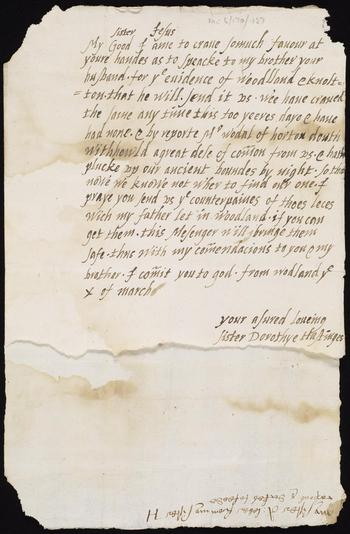
[initial, unfoliated page]: Miss Kearney Honorable
John Kearney judge[?]Footnote 1
No. 48[?] Somerset Street Portman Square
An Account of the Willughby's of Wollaton taken out of the Pedigree, Old Letters, and Old Books of Accounts in my Brother Sir Thomas Willoughby's Study December A:D: 1702 By Cass: Willoughby
[Folios 1–38 consist largely of family genealogies and national history taken out of Dugdale’s Baronage, Baker's Chronicle, Camden, and Thoroton in addition to a notebook that belonged to Cassandra's father, Francis Willoughby the naturalist. This is followed by a listing of letters mainly associated with Sir Henry Willoughby (d.1528), including a few letters from Henry VIII; one letter from Catherine of Aragon and one from Jane Seymour; and a very few household accounts. The material is largely derivative or, in the case of the letters and accounts, consists of brief notices. Cassandra copied down more substantive materials beginning with the death of Sir Henry Willoughby in 1549. This Sir Henry was the father of Sir Francis Willoughby (d.1596) who was Cassandra's great-great grandfather. The text begins here with folio 39 and the death of Sir Henry Willoughby.]
[1549–1564: The Wardship of the Willoughby Children]
[f. 39] This Sir Henry Willughby was one of those gentlemen that went to appease the rebels in Norfolk who had got together under Robert Ket a tanner upon a grievance on account of inclosures and was killed at Norwich August the 27th 1548 [sic].Footnote 2 He and his Lady both lye buried in the Church at Wollaton where there is a monument for them.
They left two Sons and one Daughter all very young. Thomas the eldest Son about eight years and a quarter old and Francis the youngest Son about two years old but the age of Margaret Willughby the Daughter is not mention'd.Footnote 3 It appears by some of the old papers that Sir Henry Willughby left these three children to the Marquis of Dorsets [Henry Grey's] care, and that the three executers of his will were George MedleyFootnote 4 and Gabriell BarwykeFootnote 5 Esquires and John Hall Gentleman.Footnote 6
There is a letter from George Medeleye dated from London in February 1549, in which he writes that the Marquis of Dorset, being now daily to attend the King, he intended to remove his family from BradgateFootnote 7 to London and therefore ordered that 12 horses should be sent for from Wollaton and a cart and horses from Middleton to come up to London with Mrs.Footnote 8 Margaret and little Mr. Francis Willughby. Attended thus, a servant to carry Master Francis before him, another servant to carry Mrs. Margaret, and another servant to carry little Whytneye,Footnote 9 a horse for Mrs. Lenton,Footnote 10 another horse for the maid, and 4 for the four men to wait upon them, a man to lead a horse to carry the male [mail = a travelling bag], and two more servants to take care of the horses.
It does not appear where these children were after thisFootnote 11 [f. 40] journey, till by a book of Medeleys accounts for the childrens cloaths etc. from the 4th of Edward the 6th to the 1st of Elizabeth, I find that his Nephew Francis Willughby and his Neece Margaret removed to TylteyFootnote 12 April the 21th 1550.Footnote 13 Mr. Medeley in his letters always calls these children Nephews and Neece which makes me conclude that he was the Son of Margaret Marchioness of Dorset by William Medeley her first Husband, and so half Brother to Lady Anne Willughby.Footnote 14
I don't find where Mr. Thomas Willughby was when his Brother and Sister removed to Tyltey, but in Mr. Medeleys account book there is set down 20sh for Mr. Thomas Willughby's board with him from May the 27th to June the 11th that year and 10s. for Mr. Thomas Willughbys mans board the same time.Footnote 15 And again the same sume is set down for his and his mans board with Mr. Medeley from November the 3d to the 18th,Footnote 16 which day I find by the book of houshold expences for the family at Tyltey Mr. Thomas Willughby went to Cambridg.
I don't find who was the housekeeper at Tyltey, but believe it might be Lady Anne Willughby's Mother who might also be Mr. Medeleys Mother.Footnote 17
There is a book in my Brother's Library at Wollaton which gives a very particular account of the expences of the family at Tyltey from the 31th of October to the last of February in this 4th year of Edward the 6th, [f. 41] which bookFootnote 18 shews that there was a very great table kept at Tyltey. This book also gives an account what company came to Tyltey viz. that upon the 31th of October there came my Ladys Grace [Frances Brandon Grey, duchess of Suffolk?] and all her train. But the next day most of her Graces retinue returned home again to Leicestershire. November the 3d there came the Lord Thomas [Grey (1526–1554)] and the Lord John [Grey (1523–1564]Footnote 19 with 21 servants from London who stayed at Tyltey three days and then returned to London again. That upon November the 16th many honest men of the Country dined there. That upon the 18th the Lord John and others came from Court, which was the same day that Mr. Thomas Willughby, Mr. Henry and Mr. Thomas Medley [two sons of George],Footnote 20 Mr. Willughbys man and three more servants went to Cambridg. The Lords and others from Court returned thither again upon the 22th of November. Upon the 23th divers of the Country dined at Tyltey. Upon the 24th ten gentlemen came from London to attend my Ladys Grace to the Lady Marys Grace [Mary Tudor].Footnote 21 They stayed at Tyltey till the 26th and then after breakfast my Ladys Grace, with Lady Jane, Lady Catherine and Lady Mary,Footnote 22 repaired to Lady Mary's Grace. ’Tis thus enter'd in this book of Tyltey accounts, by which I understand that the Dutches of Suffolk with her three Daughters went to Court to wait upon the Kings Sister, who was, after the Kings death, Queen Mary.
This book says that December the 2d [1550?] Lady Catherine and Lady Mary with their attendance and a great many gentlemen came to sup at Tyltey. And that December the 16th there came my Lord and Ladys Grace [the duke and duchess of Suffolk], Lord John [Grey], Lady Jane [Grey] and divers attending them from London to Tyltey where they stayed six or seven days [f. 42] December the 25th this book says that divers of the Country dined at Tyltey. And also upon the 26th and the 27th and that that day there came 5 players and a boy, and from that time till January the 9th [1550/1] are set down great numbers that dinned and supped at Tyltey, and that the Lord of Oxfords Players were there.Footnote 23 And that from January the 11th to the 20th there was my Lord —, Lord John, Mr. TreasurerFootnote 24 and a greatdeal of other company. And that, that day after dinner, my Lord and Lady's Grace, the Lady Jane, Lady Catherine, Lady Mary, Lady Clare,Footnote 25 Lord John and all the gentlemen went from Tyltey to the Lady Audley's at Walden.Footnote 26 This book says they all returned again to Tyltey the 22th and that they brought the Lord and Lady Audley to Tyltey with them. And that January the 25th there came Mr. George WillughbyFootnote 27 and many more strangers. Upon the 26th Lady Audley went to Walden and Lady Catherine went with her, but they both returned again to Tyltey January the 30th where Lord Audley and the rest of the company had stayed all that time. January the 31th there came a gentleman to dinner from the Lady Mary's Grace.
The noting these particulars may seem forein to my story, but they shew the manner of living in England about that time, and this family of the Grey's were the nearest relations the young Willughbys had, and for that reason, I should not pass over the melancholy relation of poor Lady Jane Grey's misfortunes if I had met with any thing in these papers concerning the steps taken for her advancement to the Crown, which cut of [off] her life before she was seventeen years of age. The English history makes her a Lady very extraordinary for piety and learning, and notwithstanding her youth perfectly resigned to dye (which she said she had diserved, not for [f. 43] seeking the Crown, but for not refusing it, when it was offer'd her).Footnote 28 When the message was brought her that she must dye the next day, she seemed to rejoyce at it, as a means to set her at liberty. And after when the docter who attended her had obtain'd of Queen Mary that she should live three days longer, she told himFootnote i he was deceived if he thought she desired life any longer, for it was now tedious to her, and she longed for nothing so much as death. Before she was brought to execution her Husband the Lord GuilfordFootnote 29 desired some conference with her, but she refused it, saying that would be rather a grief then comfort in death, and she made no doubt, but they should shortly meet in a better place, and in a better condition of society. Thus February the 12th An: D: 1553 being about seven months after she had been proclaimed Queen, her Husband first, and about an hour or two after, she was beheaded within the Tower.
After this digression I must returne to Mr. Medeleys account book and copy that part of it which shews how the young Willughbys were placed.Footnote 30
’Tis before set down that Mr. Thomas Willughby boarded twice a fortnight at a time with Mr. Medeley, and just after that, there is set down for the board of Mr. Francis Willughby from April the 24th to January the 28th [1550–1551] being 40 weeks twenty pounds, which makes me believe they then boarded with Mr. Medeley. There is also set down for Mrs. Margaret Willughby's board the same time 20li and also for Mrs. Lenton's board the same time 20li.Footnote 31 This Mrs. Lenton, who I find almost alwayes named [f. 44] after Mrs. Margaret Willughby, I suppose was Mrs. Margarets Governess or chief servant.Footnote 32 There is also set down at the same time for the board of two servants 40 weeks at 5 s. a week for each servant 20li, and twenty pound is set down for the board of one maintained to keep the Willughbys accounts. And for their fewel and washing that 40 weeks five pounds.Footnote 33 In the 5th year of Edward the 6th [1551] Mr. Medeley sets down for the board of Master Francis and Mrs. Margaret Willughby, and the same number of servants at Tyltey at the same rate as before from January the 28th to that time the year following being 12 months 121li 13sh 4d.Footnote 34
There is set down for Mr. Thomas Willughbys board at Tyltey 20 weeks the same year to October the 10th ten pounds and for his two men's board the same time ten pounds. In the 6th of Edward the 6th [1552] there is set down for the board of Master Francis Mrs. Margaret Willughby and the same number of servants at Tyltey at the same rate from January the 28th to that time 12 month 121li 13sh 4d.
And for the board of Mr. Thomas Willughby from July the 20th to October the 6th the same year 5li 10sh 0d and for the board of his two men the same time 5li 10sh 0d.Footnote 35
From January the 28th to July the 6th An: D: 1553, being the day King Edward dyed, there is set down for the board of Master Francis Mrs. Margaret Willughby and the same number of servants that are set down before, at Tyltey 48li 10sh 4d. And for all their boards at Tyltey from July the 6th to December the 10th being the 1st of Queen Mary [1553] there is set down 46li 16sh 4d.Footnote 36
Mr. Medeley setts down for the board of Mr. Thomas Willughby at Tyltey this year from July the 8th to November the 25th 10li 0sh 0d. And for the board of his two men the same time also 10li 0sh 0d.Footnote 37 [f. 45] I believe about this time Mr. Medeley and the whol familie at Tyltey were involved in great troubles upon the Duke of Suffolks account, who was beheaded upon the 23th of February following.Footnote 38
Mr. Francis and Mrs. Margaret Willughby were removed to the Minoryes,Footnote 39 with their servants, I believe a house where Mr. Medeley used to live. While they were there I believe Mrs. Lenton took care for their diet fewel etc. which reckoned by odd weeks from December the 14th to July the 5th came to 34li 0sh 2d.Footnote 40
There is a letter from Mrs. Lenton to John Hall the Baily at Middleton for money, in which letter she says she knows not where to place Master Francis and Mrs. Margaret Willughby, now that Mr. Medleys house was like to be seised etc. Mr. Medeley charges in his account for the diet etc. of Mr. Francis and Mrs. Margaret Willughby and the same number of servants that they used to have by odd weeks (they being I believe sometimes in one place and sometimes in another) from July the 5th to January the 17th being the 2d year of Queen Mary [1554–1554/5], the sume off 23li 19sh 0d. In this time tis often mentioned that Mrs. Margaret was absent with her maid a week at a time. I believe she might then be with the Lady Frances, the Duke of Suffolk's Widow,Footnote 41 because there is a letter from Mr. Medeley writ in this year being An: D: 1554 [probably written after the execution of the daughter and husband of Lady Frances in February 1554] in which letter he writes that Mrs. Margaret Willughby was then with Lady Frances.Footnote 42
Mr. Francis Willughby went to St. Antonies School [f. 46] in London.Footnote 43 There is set down in Mr. Medeleys account for his board at that School from January the 18th to June the 13th [1555] the sume of 2li 16sh 0d.Footnote 44
I believe Mrs. Margaret Willughby might stay with Lady Frances till May the 9th. From May the 9th to July the 11th [1555] there is set down in Mr. Medeleys account book for her own and her servants board the sume of 4li 3sh 3d and for the stewards board who kept the young Willughbys accounts the whole year 10li 0sh 0d.Footnote 45
From July the 11th to December the 23th [1555] there is no account where Mrs. Margaret Willughby was, but Mr. Medeley's account book shews that December the 23th An: D: 1555, Mrs. Margaret went to the Lady Elizabeth [Elizabeth Tudor, later Queen Elizabeth I] at Hatfield.Footnote 46 There is set down for her given to Lady GuilfordsFootnote 47 lackey when he came to fetch Mrs. Margaret Willughby 20 pence.Footnote 48

September the 27th 1556 there is set down in this account book for Mrs. Margaret Willughbys charges from Hatfield to Tyltey and back again to Hatfield 8s 6d. And for her charges from Hatfield to London in Hillary Term 9s 4½d and back again to Hatfield 7s 7d.Footnote 51
There is also set down in this account book, for Philip's costsFootnote 52 when he went to see Mrs. Willughby at Hatfield 2s 3d. And for Dick's charges when he went to seeFootnote ii [f. 47] Lady Elizabeth's Grace 9sh 9d. And for the charges of one sent twice to see Mrs. Willughby 3s 10d.Footnote 53 There is set down in this book of accounts for Mrs. Margaret Willughby's and her servants board at the Minories from July the 12th 1557 to August the 4th the sume of 1li 13sh 4d.Footnote 54
And the same year for hers and her servants board at Tyltey the sum of 8li 5sh 0d.
And for her own and her man Hudsons board at the Minories from October the 24th to the 30th the sum of 10s 4d, and for Kinton's board at London who stay'd to attend Mrs. Margaret Willughby to the Lady Elizabeths Grace 3s 4d.Footnote 55 A servant of the Lady Elizabeth's dying of the Small[pox] Mrs. Willughby removed to the Minories. There is set down in Medeleys account book for her's and her servants board there for 4 weeks at that time 3li 7sh 4d.Footnote 56
This account book ends here with what relates to Mrs. Margaret Willughby, and to this account of her I shall add part of severall letters that are in the Library at Wollaton, writ by Mr. Medeley concerning her, in the 1st and 2d years of Queen Mary.
There is a letter from Mr. Medeley to John Hall (who was the baily at Middleton) dated An: D: 1553. This letter is to desire John Hall to send up to the Minories by two trusty servants, all the apparell of gownes and kyrtells and all other things appartainingFootnote iii to Mrs. Margaret Willughby which remained in his keeping at Middleton, because he intended with my Lord Suffolks help to get her into some honourable place, where my Lords Grace should think most fit for her to be. [f. 48] In this letter he desires woollen blankets may be put between the gownes and kyrtells [kirtles]Footnote 57 to defend them from fretting and wet.
There is another letter from Mr. Medeley to John Hall dated An: D: 1554 in which he writes that now was the time to prefer Mrs. Margaret Willughby and to put Mr. Francis Willughby to school. [See fos 45–46 above.]
In another letter dated An: D: 1554, he writes that Mrs. Margaret Willughby was now with the Lady Frances [see f. 45 above], who was commanded to attend the Queen, and she had took Mrs. Margaret Willughby with her, who had been very much commended and was so well approved for good behavior etc., that Lady Francis [sic] did not doubt but soon to place her about the Queen so as all her friends would be pleased.Footnote 58
There is another letter from Mr. Medeley writ soon after the last to John Hall, in which he says that Mrs. Margaret Willughby had been at court with the Lady Frances's Grace (who had her place in the Privie Chamber). He writes that Mrs. Margaret Willoughby was much commended, and Lady Frances's Grace did not doubt but in a short time so to place her about the Queens Highness so as to content all her friends, and also be to her great preferment.
An: Do: 1555 Mr. Medeley requires the Lord Paget'sFootnote 59 letter for the payment of a hundred pounds to Mrs. Margaret Willughby.Footnote 60
And in Mr. Medeleys account book for the 1st year of Queen Elizabeth [f. 49] being An: D: 1558 there is set down November the 8th paid [to] Mrs. Margaret Willughby for her marriage money three hundred pounds. By which I believe it was about this time that she married Sir Mathew Arundell.Footnote 61
There is in the Library at Wollaton a large book of the accounts of George Medeley and Gabriell Barwyke Esquires and John Hall Gentleman, the three executers of Sir Henry Willughby, for the 13 years they took care of the estate. This book shews that besides the profits of the land there were large sumes of money received for cole etc., which was brought to account. And yet in conclusion the whole sume raised by them in these 13 years did not amount to more then 3125li 0sh 8d.
In this book there is an account of goods which were valued which Sir Henry Willughby had left at Middleton and Wollaton, amongst which there are set down many vestments, as copes etc. for the Chapel, and many extraordinary armes in the Armory.Footnote 62 There are set down by name in this book 42 geldings. And the plate is in this book valued at 447li 10sh 0d. There are amongst the old papers a great many acquittances for legacies and annuities left by this Sir Henry Willughby.
There is a book of Mr. Medeleys accounts for the 5th year of Edward the 6th being An: D: 1552 in which book he sets down many large sumes of money for his journeys to meet the other executers in order to pay his Brother Willughby's debts. In this book there is set down money paid [to] the Counsel for perusing his Brother Sir Henry Willughby's will.Footnote 63 [f. 50]
This book gives an account of much business with Sir Hugh Willughby concerning annuities to be paid out of his land by order of Sir Henry Willughbys will, and of other matters in dispute between Sir Hugh and Mr. Medley. But Sir Hugh promised Mr. Medeley before the Lord Suffolk that he would shew himself conformable to Sir Henry's will.
But after this Mr. Medeley sets down money paid [to] the Counsel for advice upon Sir Hugh Willughbys demands, and money paid for many journeys upon Sir Hugh's account, and for his attendance at the Lord Chancellours. An: D: 1553 Sir Hugh Willughby went into Moscovie,Footnote 64 and after that there is an account of Sir Hugh's Lady with her young Son entering upon that estate called Smallwood.Footnote 65
There is a book of Mr. Medeleys accounts for the 1st year of Queen Mary being An: D: 1553. In this book he sets down eight pounds for his costs to London to attend the Lord Suffolk for the redemption of the wardship of his Nephew Thomas Willughby.
There is set down in the book paid the Lord Suffolk 125li in part of payment of a thousand pounds for the redemption of the wardship and marriage of his Nephew Thomas Willughby, which Sir Foulk GrevillFootnote 66 would else have bought of the Lord Suffolk.Footnote 67
After this there is set down 6s 8d paid to the Clerk of the Signet for the writing, seal and lycence for his Cousin [nephew] Thomas Willughby to goe beyond sea to the University of Paris to study.Footnote 68
But I question whither Mr. Thomas Willughby did goe to Paris, because in a letter from Mrs. Lenton to [f. 51] John Hall dated from the Minories February 1554 she expresses great concern that she knows not where to place Mr. Francis and Mrs. Margaret Willughby now that Mr. Medeleys house was like to be seised and they turned out of doors,Footnote 69 but she writ that the Lord Paget would have Mr. Thomas Willughby to be with him. In this letter she desired John Hall would send her some money and writ that Mrs. Medeley [Mary Danet] was constrained to borrow money.
There is a letter from Mr. Thomas Willughby to John Hall for money, not that the Lord Paget denies him any thing (he writ) but he would have some money to spend which he would not always acquaint Lord Paget with.
In another letter from Mr. Thomas Willughby to John Hall for money, he also desired him to send him his Mothers cross=bow.
This Mr. Thomas Willughby married the Lord Pagets Daughter but there is no account when they were married.Footnote 70 From some of the old papers there is reason to believe that the Lord Paget suspected Mr. Medeleys honesty, and that therefore after Mr. Thomas Willughby had married his Daughter he was willing to take some care of the Willughbys estate. Mr. Medeley has set down in one of his account books 6s 8d for his Counsel when the Lord Paget required the executors to bring in their [f. 52] accounts.
An: D: 1555 Mr. Medeley sets down his expences in going to London to attend the Lord Padget,Footnote 71 and carrying him a letter concerning the declaration of the executors accounts made before him at Middleton and Wollaton, and also to declare the doings of Sir Nicholas Streley and Sir Hugh Willughby's Lady, who with her young Son had entered upon that estate called Smallwood. And also to attend the Lord Paget and his Counsel with the books of Peverell FeesFootnote 72 and other business relating to the affairs of the Willughbys.Footnote 73 In the 1st year of Queen Elizabeth being An:D: 1558 Mr. Medeley sets down in his account book his mans charges when he went to acquaint the Lord John [Grey of Pirgo] of the death of Mr. Thomas Willughby and about the wardship of Mr. Francis Willughby.Footnote 74 After this Mr. Medeley sets down his own charges in this book, the 2d year of Queen Elizabeth, for his going to and from London about the causes of the will and what he paid for taking out a letter of administration of Mr. Thomas Willughbys goods.Footnote 75
In all this book of accounts Mr. Medeley seems to reckon very largely for his own expences, and in conclusion he sets down for the horses bridles and sadles which he had spoyled about the business of his Brother Sir Henry Willughbys will, the sume of 83li 6sh 8d. The sum totall of this book which chiefly relates to Mr. Medeleys own charges and expences comes to 1120li 9sh 3d.Footnote 76 In this book Mr. Medley mentions a dispute about the Castle Inn, in Holbourn, which he setts down was intailed by his Brother Sir Henry Willughby.Footnote 77
I could find no farther account of Mr. Thomas Willughby, but that over heating himself with hunting he fell sick and dyed [f. 53] upon the 16th of August An: D: 1558 [sic].Footnote 78
By Mr. Medeleys account book Mr. Francis Willughby was removed from St. Antonies School in London and was sent to Walden SchoolFootnote 79 in June An: D: 1555. He stayed there till February the 17th. Paid for his board there all that time at 2s a week 3li 10s 0d. There is set down in this account book paid [to] the Master at severall times for his schooling and in rewards to him severall sumes which altogether amounts to but the sume of 14sh 2d. For his learning to sing while there 5s and for his learning to wright one shiling.Footnote 80 In the account book for cloaths for Master Francis Willughby some things are remarkably cheap, as seven pence for a hat and three half pence a pair for gloves etc.
This account book shews that Mr. Francis Willughby and his man were at Tyltey from the 17th of February to the 5th day of July in the 4th year of Queen Mary. There is set down for his and his mans board that space of time 15li and for fewel and washing in that time 15sh and for the steward that kept the accounts ten pounds.
And again for his board from the 5th of July to that time twelve=month there is set down 26li and for his man's board 13li and for fewel and washing for them forty shillings. And for the steward that kept the accounts 10li. And again there is set down for his board at Tyltey from that 5th day of July in the 5th year of Queen Mary to the 17th of April twenty pounds, and for his mans board the same time ten pounds, and for fewell 2li. And for his man's board seven weeks at London 6li 5sh 0d. And again for his and his man's board at Tyltey from June the 5th to July the 6th 3li 7sh 6d. [f. 54] And for the servant that kept his accounts the whole year 10li.
And again for Mr. Francis Willoughby's and his man's board at Tyltey in the 6th year of Queen Mary [1558] from July the 6th to October the 17th 11li 5sh 0d, and for Fewill 12sh. And for the servant that kept his accounts 10li. And for his and his man's board at Tyltey from October the 17th to August the 18th (being the first year of Queen Elizabeth and An: D: 1559) there is set down 14li 10sh 0d. And for the servant that kept the accounts 10li.Footnote 81
It may here be observed how large the reckoning for Master Francis Willughbys dyet was at Tyltey, if compared with the two shillings a week paid for him at school, and the severall sumes in reward to his Master and for his schooling all to amount to no more than 14sh 2d.
There are in the Library at Wollaton severall books of Mr. John Hall's accounts for the young Willughby's. In one for the 3d year of Queen Mary, February the 25th he sets down what his charges were to and from London when he was sent for thither by the Lord Privie-SealFootnote 82 who thought Mr. Medeley was at that time gone out of the Realm. There is also set down in Mr. Halls accounts many little sumes of money paid to Mrs. Lenton for the children's boards, very often for but a week at a time.
There is a letter from Mr. Medley to [John] TrussellFootnote 83 who was the Baily at Wollaton, dated An: D: 1552, to order him to make provision for baking and brewing etc. against the Lord [f. 55] John Grey's coming thither.
There is a letter from Mr. Medeley to John Hall at Middleton, dated from Tyltey August 1553, to desire some of the leverettsFootnote 84 bread [bred] at Middleton might be saved for the Lord John.
There is a letter from Mr. Medeley to Trussell about buying Sir Hugh Willughbys estate in MaperleyFootnote 85 and Basford. He writes that what makes him fear to goe through with it was the recognyzance wherein he stood bound to the Kings Majesty. An: D: 1553
There is an angry letter from Mr. Medeley to Trussell (on April 1562) because he neglected to keep Wollaton in good repair and let the tenants houses goe down; he orders such timber as is needfull to be cut down and the houses to be repaired, and tells him Middleton is otherwise kept, which he may be ashamed off.
There is a letter from Mr. Medeley to Mr. Francis Willughby, dated from Tyltey January 1565,Footnote 86 in which he makes heavie complaints of his own debts, but writes that he will not trouble Mr. Willughby now, because he looks upon him as his chiefest friend, and therefore he reserves him for his greater need. He expresses great concern for his Lady's mishap in her travell and wishes they may both be joyfull Parants of a jolly many Son's.Footnote 87
There is an account which shews that Mr. Medeley demanded 350li for his discharging the trust which Sir Henry Willughby had reposed in him and in this account there is mention made of money which he paid the Duke of Suffolk by Sir Henry Willughby's order.
There are severall letters from Mr. Medeleys widow, to Sir Francis Willoughby An: D: 1568, about her Husbands accounts. In one of the letters she enlarges upon the great care his Uncle Medeley took upon him for 13 years [1549–1562] together to sattisfie the trust which his Father had reposed in him.
[1564–1567: Marriage of Francis Willoughby and Elizabeth Lyttleton: Staying at the Lyttletons]
[f. 55v] There is the copy of a letter from Mr. Francis Willughby to his Uncle the Lord Grey [John Grey of Pirgo] to make him acquainted that he had been invited to many of his friends and kinsmens houses, amongst the rest (as he trusts God did appoint it) he was at Mr. Lyttleton's at Frankley in Worcestershire,Footnote 88 sundry times received with great chear and good entertainment, and in the end it was moved to him first by good Lord DudleyFootnote 89 and after by Mr. Lyttleton, a marriage between his Daughter [Elizabeth] and himself. After good deliberation it had pleased God to give him a liking to the young Gentlewoman, who had had a good education and was descended from a house of great antiquity, well friended and alyed, dwelling near his house of Middleton. And Mr. Lyttletons offers with his Daughter being reasonable, could he have his Lordships favour he was fully minded to match himself to her
Mr. Lyttleton offer'd to give with his Daughter 1500li, to apparell her decently, to bear their charges at the time of their marriage, and to give them their table with six persons to attend them, for three years, and the keeping of six geldings.Footnote 90 He writes that his Cousin MedleyFootnote 91 can at large declare to him the manner of his proceeding, and he desires his Lordships favour and good will that he may proceed herein according to his good advice.
There is the copy of a very angry letter fromFootnote iv Mr. Francis Willughby to his Brother ArundellFootnote 92 (dated An: D: 1564) for being against his marrying Mrs. Lyttleton, for which he had the advice of his Cousin Medley, the Lord Dudley, the Lord John Grey,Footnote 93 and other of his Friends.
[f. 56] From An: D: 1559 that Mr Francis Willughby was at Tyltey till near the time of his marrying I don't find where he was, but believe he might spend most of that time at the University.
His Sister the Lady Arundell I believe was elder then he, and by being much together when they were children, she had [estimed?] and gain'd to herself such aFootnote v power of governingFootnote vi him, that after when he was grown up, she could not leave of [off] the custom she had used in their childhood, but continued to expect that her Brother should advise with her in all his affairs, and therefore when she had heard it was reported that her Brother was going to marry Mr. Lyttleton of Frankeley's Daughter, she was very angry with him for begining such a treaty without first making her acquainted [with] it, and express'd her resentment of it in severall letters.
One she begins with blaming his breach of promise in not coming to London, and then goes on to tell him ’tis reported that he is insured to Mr. Littletons Daughter. She writes that she marvels much that his hastFootnote vii should be so great, and his estimation of her so little, as never to consult her in the matter, who was always willing to doe anything which might be a pleasure to him[;?] she understood George Willoughby had procured him this marriage, she believed out of some crafty designs of his own, else he would never have perswaded him to proceed so far without consulting any of his friends. She desires him not to trust to George Willoughbys painted words, nor to let his flatery abase him so much as to make him think that he was the only able person to be of his counsel, for he had divers friends that had more care for him, and were better able to advise him. She desires to see him – but writes, if this thing be already past, I pray God to send you as good speed as your hast has been great, which seldom goes [f. 57] together.
There are many more letters in the Library at Wollaton which shew that Lady Arundell was extreamly against her Brother[’?]s marrying Mrs. Lyttleton, which he took very unkindly from her and at last began to suspect that Lady Arundell coveted his estate and therefore would be [against his marrying?] any body. Lady Arundell being made acquainted with these thoughts which her Brother had of her, writ him a long letter upon this subject, to justifie her self, and in it gave her reasons why she was against this match, viz: because she thought Mr. John Lyttleton was an ill man, that he was a great dissembler, etc.
There is a story in Dugdales Antiquities of WarwickshireFootnote 94 which if true, and of the same Sir John Littleton, would give one reason to believe Lady Arundells thoughts that he was an ill man, was but too well grounded.
The story is this.
Sir Walter Smyth of Shirford that was murthered by his Lady, left Richard his Son, his heir. This Richard had but one only Daughter by his first Wife, and doubting of issue male, treated of a match for her with Sir John Littleton of Frankley in Worcestershire for his third Son, and agree'd to settle all his estate, in remainder,Footnote 95 after his own decease without other issue upon the said William Littleton and Margaret his Daughter, and their issue, and for want of such issue, to return to his own right heirs. And having the writings drawn he trusted to Sir John Littleton to get them ingrossed, which being done [f. 58] and a day appointed for sealing, Mr. Smyth came over to Frankley where he found very noble entertainment and some of Sir Johns friends to bear him company; in whose presence the writings were brought out and began to be read. But before they came to the uses, there was a plot laid to carry Mr. Smyth a coursing,Footnote 96 and Sir John protesting the writings were according to the draughts he had seen, Smyth sealed them, to goe to the park. The children (being about nine years old a piece) were married. About six years after William Littleton dyed. Smyth demanded his Daughter again, but Sir John designing to marry her to his second Son George, refused to deliver her. Upon this dispute the writings were produced, and it appeared by that settlement, so sealed in hast, that for want of issue by this William and Margaret, the estate was to goe to the right heirs of William Littleton, which was Gilbert Littleton his eldest Brother. So William the youngest Son married her, George the second Son enjoy'd her, and Gilbert the eldest Son had her estate, and kept it from Mr. Smyth the true heir, with whom he had great law sutes.Footnote 97
Lady Arundell not having power enough with her Brother to break the match, though by many letters it appears she used her outmost endeavours, at last sends him her good wishes in the mannor I shall shew by copying part of a letter from her to her Brother which she dates from the Court at St James's. She writes that it well appears [f. 59] that what he writ to her was not his own thoughts but what George Willoughby counseled. She writes that he does her wrong to say she does not like the Gentlewoman. Her saying they were more in hast then they needed, she thought was no dispraise to her. She writes that she can't take it well of him, to burden her with being unwilling that he should marry in hopes she might enjoy his estate; this she writes comes not from himself, who knew that her behaviour to him had deserved a better opinion, himself best knew if she, or any body for her had ever perswaded him not to marry. If she had been against his marrying, she would not have consented to the buying out of his wardship, and he well knew the executors would not have paid the money if she and Mr Arundell had not consented.Footnote 98 And if this were all she had to say, she thought this a sufficient proof that she was not against his marrying.
She desires him to make her commendations to her Sister that shall be, with whom she desires to be acquainted, and she wishes them happily to match, and joyfully to live together, and that God may bless them with such increase of children as may be most to both their comforts.
1564 There is the copy ofFootnote viii a letter from Mr. Francis Willughby dated from Frankley, November 1564,Footnote ix to his Sister the Lady Arundell, in which he tells her that he had then resolved to marry Mrs. Lyttleton, that he was first moved to this marriage by his near Kindsman, the very good Lord Dudley, and divers others who bore him good will; that the Lord Grey (who in duty he thought he ought to advise [f. 60] with) approved of his choice. That Mr. Lyttleton was of a very ancient family and a very good alliance, and had given his Daughter a very good education,Footnote 99 and gave her a good fortune, and required a very reasonable joynture and the settlement of but one third part of his estate upon heirs male by her etc.Footnote 100
Mr. Lyttleton gave his Daughter 1500li and three years board for themselves their horses and six servants.Footnote 101
There is a friendly letter from Sir Matthew Arundell to Mr. Francis Willughby which gives an account of some things which he had bought for him, and that he had sent him some songs, strings, and three books. And for his SisterFootnote 102 some white Flanders work, not so fine as he would have had, but such as was to be had in London, and some combs, and he writes that his Wife had sent a partletFootnote 103 and a pair of sleeves. And if he might know what other things he would have from London he would provide them. He returns thanks to Mr. Littleton and his Lady for his well usage and good cheer. And concludes, I bid you fare as my self, in hast from the Court the 20th of May. Your Brother most lovingly.
There is a letter from Lady Arundell to her Brother Willughby in which she desires to know how his executors had dealt with him and in what condition he had found his land and houses. She writes that she perceives by Mr. Lyttleton, that as yet he has dealt but little in these [f. 61] affairs, and it is her opinion that the sooner he takes them in hand the better it will be both for his experience and profit. She writes that if Sir Matthew Arundell might know when he was to goe into Dorsetshire he would accompany him. She concludes Thus with my hearty commendations to my Sister and you, I bid you fare=well wishing you as I would my self.
There is a letter from Sir John Lyttleton, (who I must now call Sir) to Mr. Willughby, who from this time I will call Sir Francis, not finding when the Queen knighted him.Footnote 104 This letter is dated August the 24th 1566. In it he writes his Son in law word, that if he had not so suddently departed from Killingworth [Kenilworth] he would have made his Daughter a Lady, for he was sought for but could not be found, within an hour after he was gone, when there were six knights made, viz: Sir William Devereux, Sir George Hastings, Sir John Throgmorton, Sir Foulke Grevile, Sir George Turpin (Sherif of Warwick, and Leicester) and himself.Footnote 105 He writes that the Queen went to Mr. Lucyes house, and that the Lord Leicester attended upon her Majesty till her Highness was pass'd Warwick,Footnote 106 and then returned to Killingworth, and so much company with him that one would have judged there was nobody wanting but the Queens Highness. And after a days stay at Killingworth he went to the Court.
There is a letter from Sir Matthew Arundell to Sir Francis Willughby to complain of his ill hap not to see his Father in law [sic]Footnote 107 at the Court, and also complaining that Sir Francis Willughby does not write to him. He hopes being at such a distance will not cause [f. 62] Sir Francis Willoughby to forget him, and writes that it is an evil dog that is not worth regarding.Footnote 108
In another letter Sir Matthew writes Sir Francis Willughby that his Sister will see him at Easter and tarry a month with him, in the mean season use her and me as you judg you may.
In another letter Sir Mathew writes Sir Francis Willoughby that he had been at WoodlandFootnote 109 to receive the Lord HerbertFootnote 110 who came and killed a buck in the Park with his hounds, of which pack tho he might have commanded, yet he would not send Sir Francis Willoughby any, because he did not like them, nor can he commend the hounds of that Country; but if he hears of any good he will try to get them, or any thing else which he shall have a mind to. He has sent a brace of young dogs apt for game. He writes that he will not fail the Queen at Oxford, where he wishes Sir Francis Willughby would also be. There is like to be great shews of learning, and a notable tragedyFootnote 111 there is in hand, and if he would come Sir Matthew promises to be his harbinger. Dated from Wilton. [1566].
There is a letter from Lady Arundell which gives an account of the Earl of Leicesters entertainment of the Court at Kellemyale [Kenilworth] his house; and she also seems to write with pleasure of an entertainment which he gave to Sir Francis Willughby and the rest of his country gentlemen. This letter tells her Brother that she has made enquiry but could not yet hear of one that could play and sing[;?] but she hopes she shall provide him one when she goes to London. She writes that she has seen his house of Woodland, which is very ancient and in great decay. She concludes with thanks for his mare, commendations to his wife, Sir John Lyttleton, and his Lady, with thanks for [f. 63] their courtious entertainment of her.
The date of the year, is not writ to any of these letters from Lady Arundell. But there are many very friendly letters from Sir John Lyttleton to Sir Francis Willughby dated An: D: 1566 and 1567, which seem to have been writ when Sir Francis had gone journeys of business from Frankley. In one Sir John thanks Sir Francis Willughby for a fat buck. In another he wishes Sir Francis Willughbys business were finished that they might soon see him again at Frankley, and sends hearty commendations from his [Francis's] Wife and Mother [Mother-in-law].
[Established at Wollaton, 1567?]Footnote 112
In a letter from Sir John Lyttleton to Sir Francis Willughby dated An: D: 1569 he expresses a kind concern for his Daughter's health, and also a concern for not paying the whol sume of money that was due, at the time he had promised it, but he writ that he had been ill used by his attorney, and therefore could only send now by the bearer 110li.
There is a letter from Lady Arundell to Sir Francis Willughby dated from the Court. In this letter she writes that tho he has no great matter to write off [of] yet it pleaseth her to hear of his good state, as she had lately done by the Lords that were with him, who had told her they had not seen him look so well of a good time, which made her think he had recover'd his cough. She writes that she here incloses the letter he desired, which was not sent to herself but to Sir Matthew, and in his absence she intersepted it, and intended to have kept it to shew him if he had not sent for it. She desires to know if Sir John Lyttleton had paid the money, or set the day when he would, and [f. 64] wishes him better fortune with the rest that is to come than he has hitherto had etc.
In another letter Lady Arundell writes Sir Francis Willughby that she should have thought Sir John Lyttletons house the best place for him to have been in, had he been such a man as he professed, but in his dealing with him he had verified her opinion of him, that he was a great dissembler, and for that reason it was that she misliked his matching into that house. For his Wife she writes, that ways might be found to deal with her, whose country friends would stand her in but little stead. She writes that she intended to stay at the Court all Sumer.
There is a letter from Lady Arundell to her Brother dated from ShaftsburyFootnote 113 in which she hopes business of his side is less troublesome than with them, where the great murtherFootnote 114 has been done and favour procured for the help of them. His cares she guesses is building and setting up of houses. She makes a doubt whither his Wife will like houskeeping, especially when she knows of the company he means to have.Footnote 115 She thinks she can't come to him till after Easter [1567?], and believes in the mean time he will not be idle. She desires to know how his last being at the Bath [spa]Footnote 116 proved with him, and concludes wishing his well doing.
In another letter, which Lady Arundell dates from the Court, she writes her Brother that she thinks the time long since she heard any thing from him, and she is very desirous to know how he likes houskeeping, now, before she can come herself to see. She is sorry she can't now fix the [f. 65] time when that shall be. She writes that the Lord AdmirallFootnote 117 desires that when he sells his woods he may have them for his money before any other, which will be a conveniency to him, being so near his house and also to himself. She concludes wishing long the well doing of himself and his Wife.
There is another letter from Lady Arundell to her Brother, in which she wishes he had not began his work upon the TreantFootnote 118 (the making it navigable) because it would be so chargable. She writes that she thinks his Wife should not be so unreasonable, and if he continues at Middleton that will make a tryal, whither she more desires to enjoy his company or follow her own will. She writes that she is uncertain whither her Highness will goe to York, or stay at Kyllingworth.Footnote 119
In a letter dated from Wilton Lady Arundell writes Sir Francis Willughby that she is come from the Court to Lord Pembrokes house in WiltshireFootnote 120 where she intends to stay 3 months, and e're it be long Mr. Arundell will begin to keep house. She writes that before she left the Court she dealt with the Lord Warwick concerning setting forth men towards Scotland,Footnote 121 and found him so willing to pleasure Sir Francis that he said he should have consider'd it himself if she had not spoke, and did assure her that he would not be unmindfull of it when occasion should serve. In this letter she writes that she thinks her Aunt TopclyfeFootnote 122 is sorry she is come down, and that she has got profers for her Husband, but wishes Sir Francis Willughby would doe something in the matter, for she believed if he perceived [f. 66] that he would take his Aunts part, he would thenFootnote x offer some reasonable provision for her. In this letter she prays to be remember'd to her Sister, and looks daily to hear of her good delivery, and desires to know what good liking he had of Asplehut,Footnote 123 and how long he tary's there.
In another letter Lady Arundell writes that she doubts Topclyfe will not be got to pay his Wives portionFootnote xi, and she pittys her case.
And in another letter she expresses great concern for her Aunt Topclyfes miserable condition, her Husband not performing what he had promised for her maintinance.
And in another letter she writes Sir Francis Willughby that she has got the Bishop of London, and others in comission with him to cause Mr. Topclyfe to appear before them, and if this helps not she knows not what will.
This Topclyf, that Lady Arundell often writes off [of], with much compassion, was Jane the Daughter of Sir Edward Willughby, and Sister to Sir Henry that was killed at Norwich An: D: 1548 [sic].
If George Willughby was a Brother of hers [viz. Jane Willoughby Topcliffe], tis more then the pedigree shews, for there is no mention of any younger Brother George, but by many letters it appears that Sir Francis Willughby called George Willughby Uncle, and that George Willughby was one that Sir Francis often employed in business.Footnote 124
There is a letter from this George Willughby dated February 1574 directed to his Son=in=law Repington,Footnote 125 who seems to have been a lawyer employed by Sir Francis Willoughby. In this letter George Willughby writes that there are other lands to pass in the same fine which are not part of the joynture,Footnote 126 as namely the manours of Wollaton and Sutton Passis, Cossall, Gunthorp and Lewdham, in the County of Nottingham, Dunsby in Lincolnshire, and Woodland in Dorsetshire, all which he writes are to pass in this manner, viz. to Sir Francis Willughby and his heirs male, and for want of [f. 67] such issue, to his heirs generall, and for want of such issue to the right heirs. There is a letter from Sir Francis Willoughby to his Uncle George Willughby, about buying land of the Earl of HuntingtonFootnote 127 and others.
There is a letter from Lady Arundell to Sir Francis Willughby to put him in mind of his promise of coming to them which both she and Mr. Arundell (she writes) look for, and desire, and if his Wife like to travell with him she might be wellcom.
Upon the back side of this letter there is writ the copy of a letter from Sir Francis Willughby to his Sister, in answer to hers. He writes that much business relating to his estate prevents his being able to come to her at this time. One thing that hinders, is land purchased lately in Cossall,Footnote 128 which he doubts he shall lose, if there be not some friend to move the Queen, and in this he should be glad to use her help, thinking she would be at the Court before he should be compelled to make his direct answer. He writes that the bargain between his Father-in-law and himself is broken off, because he can have no good assurance for the money, and he fears he shall be compelled to sue him. He writes that his Wife is great with child, and that if after her delivery she shall retain her usual trade, he shall be forced to change his mind as her frowardness shall occasion him. She had burden'd him in that by his dealing with her he had been the occasion of the loss of her children, which tho not true he was contented to bear.
There is a letter from Lady Arundell to Sir Francis Willughby in which she writes, that Lady Willughbys dislike of her coming, and writing a letter to Mr. Arundell to stay her, had made her not willing to come, to bring unquietness to any place, and much less to his house, where she prays he may be quiet without her, and then she would content herself with forbearing to come.
[f. 68] The copy of Lady Willughbys letter to Sir Matthew Arundell which still remains in the Library at Wollaton, is to this effect. That she hears his Wife is comming to see her Brother, which she desires he will prevent, for she is resolved never to stay in the house where his Wife is. She believes Sir Matthew is not ignorant what letters his Wife had writ to her Brother Sir Francis Willughby four years before this time, in which she would have represented her a person fitter for BridewellFootnote 129 than to trouble any honest gentlemans house. These letters she had ready to shew, to testifie the ill will which she bore herself and children. And she believed her comming now would tend to no other end but to break the good agreement which there was now between her Husband and self, as she had endeavoured heretofore etc. Dated from Kinsbury April the 5th.Footnote 130
There is a letter from Lady Arundell to her Brother in which she writes that if her comming to his house would stand him in any stead, she shall not refuse to come, tho she had as great dislike to come into his Wives company, as she had to come into hers.
In another letter from Lady Arundell to Sir Francis Willughby she expresses her trouble, that what should be his comfort, is his greatest grief, and writes that she often imagins how this might be help'd, and would advise that the next time she [Elizabeth] falls into those rages, that he should send for her Father to come to her, and that they should both goe with him home and board there with a convenient number of servants, till such time as she should have lost her willfullness, and would apply herself to please him. Or if he would like, since home gave him no content, to come abroad to her, and keep Christmas with them. Mr. Arundell and she should be glad of his company, but if business would not let him come now into these parts, shortly after Christmas she was to goe up to wait and stay half a year,Footnote 131 in which space she hoped he would take some good occasion [f. 69] to come up.
In another letter from Lady Arundell to Sir Francis Willughby she writes, that she has spoken to the Lord Keeper,Footnote 132 and finds the reason that he was out of the Comission of Peace in Nottinghamshire, was because he was in that for Warwickshire, and it was not allowed that one man should beFootnote xii of that Comission in two Counties, but he might chuse which County he would be of the Comission in. In this letter she writes that she is glad to hear his Wife behaves herself better.Footnote 133
There is a letter from Sir John Lyttleton to Sir Francis Willughby dated June 1572, in which he makes great complaints of two of Sir Francis Willughbys servants viz: Catesbie,Footnote 134 and Marmyon,Footnote 135 who he writes spread slanderous reports of his Daughter, the Lady Willughby.
There is in this year An: D: 1572 a long and very particular account in writing of a scene of great vilany laid by Ithel, Catesbie, Marmyon, Pardia, Barthol, and Widdison, all servants of Sir Francis Willughby,Footnote 136 who had plotted together to defame their Lady, and thereby make a breach between her and Sir Francis. Amongest these wicked servants Ithel seems by this account to have been the worst. ’Tis there noted down that he took great pains to have drawn Squire, another of Sir Francis Willughbys servants, to have been in their cabal, but they could not prevail with him, who would always assert his Ladys inocency and pitty her misfortunes.
There is a paper writ by Squire in which he says he has often heard his Lady with tears bewaile her unquiet life through Ithel and his companyons dealing against her, and belying her, to her Husband; and that she had told him that being one day with her Husband at Streley, she had heard Sir Anthony StreleyFootnote 137 say to another Gentleman leaning in a windoe with him, I am heartily sorry for that poor Gentlewomans miserable case, there being certain verlots [varlets]Footnote 138 who villanously seek her utter undoing.
[f. 70] Squire writes that Lady Willughby upon telling him this, desired he would stand her friend, and learn what he could of their meaning, but she chiefly fear'd Lady Arundell, and Ithel.Footnote 139 He writes that he promised his Lady with an oath that he would deal for her faithfully and truely in all respects.
There is an account, of Squires writing, that one time when he was going from London to Nottingham he went to wait upon the Lady Arundell to know if she would comand him any service to her Brother. She said she had great matters to talk with him about, such as she was loath to commit to writing, expecting to see him shortly in London, which she willed me to tell him, if he was not coming towards London before I came to Nottingham. She willed me to stay a while that she might talk with me, for now she had leasure the Queen being gone to Leicester House. After a little astronomicall talk, and about mathematicall books in the Italian tongue etc.Footnote 140 she made a large enquiry after her Sister the Lady Willughby, viz: what company she kept etc. Upon this subject there is a very long dialogue writ down by Squire, too much to copy, but in short it plainly shews that Lady Arundell strove to learn of Squire stories of her Sister, that she might tell her Brother in order to give him ill impressions of his Lady. Squires answers all tend to excuse and comend his Lady. He named some of the Ladys that she most viseted amongst which were the Lady Stanhop, and Mrs. Haddam,Footnote 141 to which Lady Arundell answer'd that woman with her, I heard so before, well, my Sister doth not well, and I marvell my Brother will suffer it.
There are many letters from Lady Arundell to Sir Francis Willughby which as well as this dialogue, writ by Squire, shew that she must have been very much to blame in agrivating Lady Willughbys faults to Sir Francis, and thereby increasing the uneasiness that was [f. 71] between her and her Husband. It appears that she had an inquisitive way of picking up all the little stories that she could of Lady Willughby, and then telling them with advantage to her Brother. There are severall letters from Lady Arundell to her Brother in which she excuses Ithel. And there is the copy of a letter from Sir Francis Willughby to his Sister, which shews that Sir Francis had upon examination found Ithel guilty of telling stories and making lyes of his Wife.
There is a long letter from Lady Arundell in answer to this from her Brother, in which she accuses Squire as the person that had raised ill reports of Ithel, and writes that it was Squire himself that had first told her what company his Wife kept, and that she had a great liking to Haddam's Wife, to which she had answer'd him, that she wished her Sister had chose a better companion, for she was like to get no good by keeping her company. Lady Arundell writes that many stories were bruted about by Squire, and that he would find him to be a desembling knave. She had learnt that he had been with the Countess of WarwickFootnote 142 to acquaint her that Ithel had told her stories of her Sister, and to perswade the Countess not to believe any thing which she should say of her Sister the Lady Willughby.
There is the copy of a letter dated May 1572 from Squire to Lady Willughby, in which he gives her notice of a great plot laid against her to defame her to her Husband, because she kept company with Haddams Wife who they would represent as a vile Woman, but he had ever thought her to be a good honest Gentlewoman. He prays God to defend Lady Willughby from such enemies.
[f. 72] There is the copy of a long letter writ by Sir Francis Willughby, June 1572, which seems to be an answer to one which Lady Arundell had writ to him full of stories of his Lady, who Sir Francis vindicates, and seems not to credit Lady Arundells reports of her. He writes that he guesses this comes from Catesbies WifeFootnote 143 who is scant honest and admit that his Wife should keep company with Haddams Wife, doth it follow, that she must be touch'd with the like spot of dishonesty.
There is a letter from Ithel to Sir Francis Willughby in which he endeavours to clear himself from being any means of sowing discord between himself and his good Lady dated An: D: 1572.
There are severall copies of letters writ by Sir Francis Willughby An: D: 1573 which express much pitty and compassion for his Wife, who was then in a very ill state of health, and I believe advised to goe to London for better help in her illness than she could find in the Country.
There is the copy of a letter writ by Sir Francis June 1573 to his Cousin Mr. Thomas Willoughby,Footnote xiii to let him know that earnest business would not permit him to goe to London, and his Uncle George Willughby was obliged to travell to the West, and thereby his Wife would not be so well provided for, as he wished in this time of her sickness, and therefore he prayed him that he would vouchsafe to accompainy his Wife in Town, if his own affairs would suffer him. And that during his abode with her, he would take care that [f. 73] she should want nothing which might either content her mind or be for the recovery of her health. And in his so doing Sir Francis Willughby writes, that he shall not only discharge all the charges which he shall sustain, but also requite him with such friendship as shall rest with him during life.
I don't find who this Mr. Thomas WillughbyFootnote xiv was,Footnote 144 but believe he was the Father of Sir Percivall [Willoughby].
[f. 72v] There is a letter from Lady Willughby to Sir Francis Willughby dated the 16th year of Queen Elizabeth being An: D: 1574, in which letter she thanks Sir Francis for the venison that he sent her to London, which she thought the best she ever eat [sic]. She writes that her phisitians think it is very dangerous for her to travell. She would have got their leave to have gone to her Cousin Thomas Willoughbys in Kent, and would have made two days journey of it, but they would not consent to it. She writes that she thinks tis very unlikely that she should goe forth her time, if she be with Child, as she trusts in God she is, and yet some of her phisitians think the contrary. She desires they would give her something, either to help or else to dispatch her quickly, for she thinks death would be a thousand times more welcome to her than to live as she now does continually sick.
She writes that she has sent him a hat, (which she chose for him herself) which is of the newest fashion, and she thinks a very good fashion for him, because it is not high crowned, so that when he rides a hunting he may go under the bushes and never pull it off.
[f. 73 cont.] There is in the Library at Wollaton a letter writ by Sir Francis Willughby in March 1574 to a servant of his that was then in London with his Lady to enquir of him how his Lady does and what weekly charges do arise. He writes that he gave commandment that the horses should be sent down, but he perceives her mind is now changed, and thereby he is disappointed for the conveying of the children to Middleton. He knows not the meaning of this, unless it be to increase his charges, and if that should exceed the rate he was contented to allow, it would be hardly gotten at his hands, and London standing in the eye of the world, it would not stand greatly with her credit to be still riding in the streets. He would be advertised what time she means to continue in London. He also writes to know if Mr. CremeFootnote 145 can find him any treble lutes fit for his purpose.
[1574–1578: More Troubles and a Possible Visit from the Queen]Footnote 146
There is a letter from Sir Francis Willughby dated May 1575 to Dr. SmithFootnote 147 to thank him for the care he had taken of Lady Willughby during her illness, and since he thinks Buxton WatersFootnote 148 necessary for her, Sir Francis Willughby writes that if she would [f. 74] accomplish what he would wish her to doe, then he would come himself up to London, and if his leasure would permit him he would goe with her himself to Buxton. And where=as he advised her to live in a wholsome air and eschue disorder in her diet and perturbations of her mind. ForFootnote xv the air he writes that he thinks she will not mislike the place where he is disposed to dwell, being unwilling himself to be in any air which they could find hurt by, but in this point he desires she will consider her duty rather than to suffer her self to be guided by self will. For his [her?] disorder in diet and the perturbations of her mind, she, only, must help that; for his part, he would not give her any just occasion of trouble, if reason might take place, and willfull will be laid aside.
By these and many more copy's of letters that are in the Library it appears that Sir Francis and his Lady lived very unhappily together. There is the copy of a letter from Sir Francis Willughby dated June 1575 to Sir John Lyttleton, in which letter he gives Sir John notice of his Wives intentions to goe to Buxton, where he writes she means to stay a fortnight, but to what place she will return he knows not, and to be in other mens houses, refusing his own is not convenient. Such journeys are very chargable and sometimes bring more discredit then relief to a sick person. Plain dealing he knows, has bread dislike between her and Sir John, but to let her follow her fancies would be meer phrensie.Footnote 149 Would Sir John and his Lady or any other friend of hers come to confer with him before her going, he would stay her journy some time, but if not before, he would expect to meet them at Buxton; or else at their return from thence at Middleton, where, (if she would goe thither) she should be used as became Sir John Lyttletons Daughter and his Wife, but if she [f. 75] refused, she should have but small maintenance or comfort from him. He expresses sorrow for writing so much, but says necessity forces him to shew his private pain, not that he would stain her good name, but he feared she would injure it, by her own inconsideration.
There is a letter from Sir John Lyttleton to Sir Francis Willughby dated from PrestwoodFootnote 150 June 1575 in which Sir John expresses himself very affectionately, and friendly, to Sir Francis, and beholden to him for his plain dealing touching Lady Willughby who he hoped would suffer reason to take place, for she had now faithfully promised that she would be directed by her Husband as duty required, and that she would refer her self and cause to him, to order as he should think well off [of] and that at her return from Buxton she would come to Middleton to him, and remain there, or at any other place, where he should think good, not weighing her health, or life, so much as contenting him. This done Sir John writes, that he shall then become her friend notwithstanding what before had happened.
There is a letter which Sir Francis Willughby writ to his Lady at Buxton in which he wishes, that with the recovery of her health, she may also put on a tractable mind, and let her self will give place to reason, and that she would take the wholsome advice of her best friends. He writes that the horses shall be sent, and he desires she will repair the next way to Middleton, that he may have the horses against the time he must goe to Killingworth. He desires her to be as good a Wife as she would make shew of being to the world, and let her example cause him to do the like. Thus wishing you as my self etc.
[f. 76] There is a letter from Lady Willughby to Sir Francis in which she says she finds great benefit by the Bath at Buxton, and would gladly have staid longer, but she writes, that her Sister HollysFootnote 151 must return home, and having taken her as she did, she thinks herself obliged to see her safe at home again.
This good accord, which now seemed to be begining between Sir Francis Willughby and his Lady, did not last long, as will hereafter appear, but I shall here stop to mention Queen Elizabeth's going a progres through that part of England, about this time. Upon this occasion Sir Francis Willughby sent to inform himself by George Willughby what would be fit for him to doe. In answer to which there is a letter from Georg Willughby dated June 1575, to let Sir Francis Willughby know that he had advised with severall of the Country Gentlemen, where, and in what manner they intended to meet the Queen, and by what he can learn, their servants need only to have plain livery coats, but he thinks Sir Francis's number of servants should in no wise be less then fifty, as well because heretofore he had not shewed himself to the Queen, as also that his estate was very well know[n] both to her Majesty and the whol Cownsel, to be nothing inferiour to the best. For himself, George Willughby writes, that he thinks he cannot make less than three sutes of apparell for he is well assured that his attendance will be expected a week.
I shall here copy a letter from Sir Francis KnollsFootnote 152 to Sir Francis Willughby to give him notice of the Queens coming to Wollaton.
Letter
Her Majesty is determined to tary two days at your house that is to say tomorrow night and Thursday all day, whereof I thought good to advertise you betimes. Wherefore I think it best for you not to defray her Majesty, but rather that you should give her some good present of beefs and muttons, and to keep [f. 77] a good table yourself in some place, if you have any convenient room for it, two messeFootnote 153 of meat. But do herein as you shall think best, but you had need to consider how your provision of drink etc may hold out. This Tuesday the 20th of July 1575.Footnote 154
Your loving friend
F: Knolls
There is no account book or papers that I could find, which shewed in what manner the Queen was received and entertained at Wollaton.Footnote 155
There is a book which gives a particular account of Sir Francis Willughby's expences from November 1572 to February 1574,Footnote 156 but no book (that I could find) of accounts for the next year.
In this book from November 1572 to 74, there is large sums set down for travelling charges, and often money is set down for servants board wages, which makes me believe Sir Francis Willughby and his Family removed very often, the discontent which was then between him and his Lady, I believe made every place uneasie to him, and she being sickly would often fancy the air she was in was unholsome, and therefore still be desiring to change it from one house, to another, for I find they were sometimes at Wollaton, sometimes at Middleton, sometimes at Kinsbury Hall, sometimes at Coventry, and sometimes at London, and besides these removes from one, to another, of their own houses, they were sometimes with Sir John Lyttleton and other of their friends, as appears by the Account Book for Riding Charges. By many books of accounts and papers of the orders in the family it appears that Sir Francis Willughby was very exact in keeping the account of his income, and his expencis, and that he was very reguler in his family. But many of these papers are so decayed by time, that they remain very imperfect. The only sheet I found intire of those orders to be observed by his houshold servants I shall copy on the other side.
[f. 78] A Copy of Some of the Orders Which were to be Observed by Sir Francis Willughbys Servants at Wollaton, I believe about the year 1572.Footnote 157
Item that FoxeFootnote 158 supply the place of the usher, whose office is first of all to see that the Hall be kept clean, and that his groom sees no doggs come there at all. He is diligently to have good regard of every person that comes into the Hall, to th'end that if they be of the better sort notice may be given to the Master, or some head officer that they may be entertained accordingly. If of the meaner sort then to know the cause of their coming, and to give advertisement over, to the end they may be dispatched and answer'd of their business, provided always that no stranger be suffered to pass without offering him to drink, and that no rascall or unseemly person be suffer'd to tarry there. The covering of the boards doth appertain to the under butler.
Upon intelligence given from the clerk, or the cook, that the meat is ready to be served, he is with a loud voice to command all Gentlemen and Yeomen to repair to the dresser. At the neither end of the Hall he is to meet the service, saying with a loud voice, give place my Masters, albeit no man be in the way, and so to goe before the same service untill he come to the upper end of t'hall carrying a little fine rod in his hand which at all other times he is to carry in his bosom whereby he is to be known of all strangers to be the usher. He is also to appoint some one Yeoman, at his discretion in the winter time, to carry the torch before service in the night time. The Dining Chamber being served, he is to place in the Hall in dinner and supper time, all noble=mens, men [f. 79] which be fellows together, and all Gentlemen according to every of their Masters degrees. But before their placing and sitting down, he is to give notice unto the clerk that so many mease [meals?]Footnote 159 are to be provided for, but in this matter the diligence of the clerk is no less required than the usher, to the end that they may both to their Masters worship, see the same very well served according to the degrees, and number of the strangers there. If any great press of strangers shall be, then three or four of the meanest sort of servants,Footnote xvi as namely the slaughterman, the carter, and some of the best of the grooms of the stable, or such like are to be appointed by the usher to attend in t'Hall. If no strangers be, then the grooms of the stable, and the allowed pages and boys in the house, to attend upon the first dinner, and they to have the remainder thereof with some little help out of the kitchen, as the usher shall see cause. And likewise the pages at the latter dinner to attend upon the Gentlemen and Yeomen, and the remainder of the meat at, after both the dinners and suppers, presently by the usher to be put into the almes table, which is always by him to be kept safely locked, to be distributed among the poor, such days as shall be appointed. Imediately after supper if there be any strangers th'usher is with a loud voice to command all Yeomen waiters to attend upon the buttery hatch, for the serving of [blank.]Footnote xvii
All disorders in the Hall are by the usher to be reformed, and if there shall be any stubborn persons he is to expell them out of the Hall, and to command all men at dinner and supper time (if any great noise shall be) to keep silence, saying with a loud voice Speak softly my Masters. His part is also to walk up and down the Hall, and especially in the time of the first dinner or supper, and only [f. 80] to call and to command the buttler the pantterFootnote 160 and such as be attendents to bring or fetch any thing that shall be wanting, but not in any wise to doe any service himself, otherwise then diligently to look to the tables. The benefit of the play in this as in many places doth belong to the buttler, but in most unto th'usher.
He is diligently too see that no meat filched forth of the Chamber be brought into the Hall, nor yet to suffer any waiter to abide in the Hall during the time their Master is at dinner or supper, nor is he to suffer any filchenFootnote 161 through the Hall from the buttery, kitchen, or such like places. For he is an officer of great trust and credit and next to the usher of the great Chamber (if any be) in degree above either cooke butler yeomen of the Chambers or porter.Footnote 162
Penne being appointed to the buttery, his office is ever to keep clean and sweet his buttery, and likewise his plate and cups, making sure every day to have fresh and clean water, and for the most part twice a day to wash the same withall. His jacksFootnote 163 appointed for the Hall are to be kept from furringFootnote 164 and unsweet savour. His office with th’ aid of an under buttler is to keep the great Chamber clean to make fires there, and to provide for lights in due season, and to cover the boards, and cupboards there, having very good regard to the cleanness of his linnen. And likewise to provide for cards and dyce, whereof he is to have the profit.
The under butler is to cover the boards in the Hall. He is to suffer no houshold servant to remain tipling or to be at all inFootnote xviii the butteryFootnote 165 but whosoever is disposed to drink to be served at the hatch,Footnote 166 and so to depart.
[f. 81] Neither is he to suffer any stranger to come in the buttery, other than such as shall be of worship or good reputation, and they to be brought in either by some of their officers, by th'usher of t'Hall or else by some discrete Gentleman, or Yeoman, for their better entertainment acording to their degrees and credit. He is to foresee that no breakfast, afternoon meats nor hancksFootnote 167 after supper be had or made there. Or if any houshold servant by reason of his business come after dinner and is to have some meat, he is to be served in the Hall and not in the buttery. But if any stranger of credit in like case come he is by th'usher or some other discrete servant to be had into the buttery and not to be served in the Hall.
The buttler is also to use good discretion in serving forth of the bread and beer to the houses of office, as to the kitchen the bakehouse the nursery and such like, that he understanding the allowed number there, may so serve them, as it neither be with want, nor yet with over great excess. He is to fore=see that his broken beerFootnote 168 be safe, and clean kept in sweet vessells for the poor. The buttery door ought not without speciall cause to be set open till eight of the clock in the morning, and then so to stand till it be nine, and from thence to be shut again till between ten and eleven and then to remain open till all dinnersFootnote xix be done, and so after dinner and supper be done to be shut again, till between two and three and then after half an hour or therabouts to be made fast till five and so to remain open till nine, and after by no means to be opened that night without speciall cause. The discretion of this officer is to fore=see, that no filching of bread or beer, be suffer'd, nor yet any want where reason doth require may be greatly both for his Masters profit and worshipp for it is an office both of good credit and great trust.
[f. 82] There is a book of accounts of Sir Francis Willughbys expences from November 1572 to December 1573,Footnote 169 in which the sum totall of every months disbursment stands thus.

There is also a list of servants wages paid for one quarter of a year which I shall copy upon the other side. This list begins with Mrs. Willughby, who I believe must be Sir Francis Willughbys Lady for 13li 6s 8d, must have been too large an allowance for a quarter of a year, for a servant, or companion to Lady Willughby.
[f. 83] A list of servants which did belong to Sir Francis Willughby and his Lady An: D: 1572, and their wages for a quarter of a year.


This account of servants makes no mention of any belonging toFootnote xxii the nursery, tho before this year 1572 I believe most of Sir Francis Willughbys Daughters were born.
The two John's set down amongst the women servants I believe might both belong to Lady Willughby in particular, and Henry Willoughby who is set down first in the list of the Gentlemen servants, was I believe Sir Francis's chief Gentleman, and by the spelling of his name with an O I believe he was of the Eresby family,Footnote 177 though that distinction of the names of the two families I don't find always observed, but that Sir Francis Willughby himself did sometimes write his name, ou, and that Sir PercivallFootnote 178 sometimes with the u only. Therefore ’tis very likely that both families might originally be the same, and so spell their names alike, though through this book I have made that distinction because I most often find Sir Francis Willughbys name spelt without the o, and Sir Percivall Willoughby's name spelt with it.Footnote 179
[f. 85] There are many letters which shew that towards the end of the summer An: D: 1575 Sir Francis Willughby and his Lady lived very unhappily together, and that notwithstanding her fair promises to her Father, that she would be directed by her Husband, she had not been long returned from Buxton, before she shewed the contrary. Some alteration I believe Sir Francis had a mind to make in her marriage settlement, which might displease her.
There is a letter from George Willughby to Sir Francis dated in October 1575, which shews that he did ill offices between Sir Francis and his Lady, for in this letter he desires Sir Francis Willughby would banish his Wife from him, if after her many promises she would not at least yeild to pass the finesFootnote 180
There is in the Library at Wollaton the copy of a letter writ by Sir Francis Willughby to Sir John Lyttleton, An: D: 1575 full of complaints of his Wife, amongst other things he writes that one day at Wollaton, as he was talking with Mary his foolFootnote 181 of going to Kinsbury, his Wife answer'd she would not goe thither, upon which he asked her if she would stay at Wollaton, or goe to Middleton. She answer'd that she would not stay there, and that if she had not been lately very sick; he would not have found her there, for she would have been gone before he had returned. He asked her whither, to which she answer'd, her friends would not see her destitute, and she would not bear so much as she had done, and that she would not with her good will tarry any longer with him, who she said kept her but as a fool, to jest, and flout at.
There is the copy of another letter from Sir Francis Willughby to Sir John Lyttleton in which he tells him that one night Sir Thomas CockenFootnote 182 supped with him and his Wife at Nottingham, and used many friendly speeches to perswade her to be in a better temper, calling her Sister, and telling her he did so, because he had but one Sister, [f. 86] and her name was Lyttleton, but Lady Willughby grew very angry and wished him to fall to his meat, if he had no other speeches to impart to her. Sir Thomas Cockin comended some of the servants for being men of honesty, and wished she would not be so much offended with them, to which she replyed they were the veryest villins that ever Woman was troubled with.
There are several letters from Sir John LittletonFootnote 183 to Sir Francis Willughby in behalf of his Daughter, which letters shew that he endeavoured as much as he could to reconcile Sir Francis and his Lady. In one of these letters he assures Sir Francis that he would by no means plead for his Daughter, if he did not believe her very innocent, concerning those aspersions which had been cast upon her by malicious people, and such as had ill designs upon Sir Francis.
In answer to these letters there is the copy of a very long letter wrote by Sir Francis Willughby to Sir John Lyttleton, in which he gave a large account of his Wives behaviour. He wrote that he had long born her froward humour with secret sorrow (which now long of herself was become so publick) and to keep her in temper, he had forborn having his only Sister a night in his house for eight years, and then because she came to have stayed three or four nights, his Wife went down to the Vicarage, and sent for him, but he refused to goe to her. The next day she sent to him, to know if he would suffer her [to] come into the house to speak with him. He answered, that he never forbid her the house, but he desired she would carry herself as she ought. Nevertheless, upon her coming into the house she called his Sister abominable names, and swore she would neither eat, drink, or sleep, till she was revenged of her.
[f. 87] Sir Francis Willughby did not write how this dispute ended, but by many papers it appears that from this time they lived very unhappily together, and that Lady Willughby would often fall into passions which made her say very provoking vexatious things to Sir Francis, who seems to have been a man of great piety and learning. There are in the Library at Wollaton a great many very pious discourses writ by him, and severall sermons which he made for his own chaplains to preach, and a collection of the most learned books of his time. By copys of his own letters and other papers he appears to have been of a very mild sweet disposition, and a lover of hospitality, but a little too apt to be imposed on, by stories from his servants, who I believe made some advantages to themselves by agravating those unhappy differences between himself and his Lady,Footnote 184 who seems to have been a woman of wit, and virtue, but of a turbulent spirit, and ungovernable passions as one may judg by copies of many of her letters and dialogues some of which I shall copy here.
It is before mention'd (Page 70) that the Lady Stanhop was one of those Ladys which Lady Willughby most often viseted, and from her doing so I believe some of her enemies would have raised a jealousie in Sir Francis, that Lady Willughbys friendship with the Lady Stanhop did proceed from her liking to be in Sir Thomas Stanhops company. This made an uneasyness between Sir Francis Willughby and the family of the Stanhops of Shelford.Footnote 185
There is an account that upon Christmas Even Sir Francis left his Lady and went to Coventry, and that he took with him great part of the plate, but yet left enough with his [f. 88] Lady for necessary use. At his going away from her, he did requir of her a jewel in which was Sir Thomas Stanhops picture, but she bid him content himself, for he should never have that whilst he lived, and also many other disrespectfull things she said to Sir Francis Willughby at their parting.
This jewel, in which was Sir Thomas Stanhops picture, I find by letters to Lady Willughby was bought by Sir Thomas Stanhop for his own Lady, but Lady Willughby having desired Sir Thomas upon his going to London that he would buy her some such diamonds, and he not meeting with them, writ a letter to excuse his not buying the diamonds for her, and with that letter sent the jewel which he had bought for his own Wife in which was his own picture, which picture he desired might be returned to his Wife, and if Lady Willughby liked to keep the diamonds the price of them was sixty six pounds.
There is a letter from Sir Thomas Stanhop directed to the worshipfull Mrs. Marrows (who I believe was Lady Willughbys Sister).Footnote 186 He writes, that he had received the jewell, but knew not why Lady Willughby's having the jewel or wearing it should breed any harm, for he bought it reasonably cheap, and meant his Wife should have worn it, and therefore caused his own picture to be put therein, but my Lady her Sister having desired him when he went to Town to lay out such a sum upon a jewel for her, and he finding none for her price, at his return sent this picture and a letter with it for her to shew her Husband with the jewel and the picture, and if upon consideration thereof they both liked the jewel for the money it cost, then they might keep the jewel and return him the picture. This letter was dated from London March 1578. This and other letters shew Lady Willughbys inocency concerning this picture, but such was her anger when she and Sir Francis [f. 89] parted she had no mind he should have the comfort of believing her so.
Before Sir Francis went this Christmas Eve from his Lady (who I believe might be then at Kinsbury) to Coventry, I find by a letter from Sir John Lyttleton dated November 1578, that she had gone from Sir Francis to Frankeley. In this letter from Sir John to his Daughter he blames her for coming with others with her to Frankeley, without giving them warning, when she knew that her mother was at Prestwood.Footnote 187 He wrote that he referrs it to her own rash head what wisdom was in this, and because he hears she intends to come to Prestwood, he thinks fit to let her understand that he is not well, and the sight of her will not mend, but greatly disquiet him, and therefore he trusts never to see her more. She has forgot the duty of a Daughter to him, and he will forget her as his Daughter, in every thing, but that of praying for her, that God would bless her and her children and send her grace to shew herself both in life word and deed a dutifull Wife to her Husband.
In the long account which Sir Francis Willughby gave Sir John Lyttleton of his Wives behaviour to him, he writes that three weeks after he had left her, he sent to Henry DraycottFootnote 188 to goe to her, and let her know that he was going to her Husband (on purpose to try what message she would send).Footnote xxiii Her answer was, she would send no commendations to him, for she cared not for him.
He writes that soon after he went himself to Kinsbury taking with him Sir Fowlk Grevell,Footnote 189 Mr. BoughtonFootnote 190 and Mr. Fisher.Footnote 191 Of what passed there, Sir Francis gives in this letter to Sir John Littleton a short account, and else where I find it writ down to this effect,Footnote xxiv viz: that after they had supped at Kinsbury Sir Francis Willughby sent to his Lady (who had before refused to come to supper) to requir her to speak with him. She sent word she would speak with him in the Gallery, where they all went. What Sir Francis said at first [f. 90] going into the Gallery was not heard by the company, but his Lady answer'd in great coller, I will blaze your armes and make you better known. Sir Francis pressed her to be reconciled to his Sister, which she refused [she answered, she would not be reconciled to his Sister, nor come in her company but in other matters she would doe what he required of her, if reasonable, and what she should approve off. But being moved that these unkindnesses might pass, and old love be again renewed. She answered she could never love him, and that by his forward dealing, her heart was hardend against him. Upon telling her that he heard some of the servants which he had discharged, did loyter about the house, she Answered they were no charge to him, and would be there abouts in the Country in spite of him. Being again required to submit herself to him and take some better course, she answered she should never require his good will so long as she lived, wth divers other opprobrious, undecent, and spitefull speeches.]Footnote 192 He then asked her if in all other things she would be ruled by him, to which she answer'd she would not be ruled by him. Upon which Sir Fowlk Grevell said why, Madam, will you refuse to be ruled by your husband. She answer'd she was the Queens sworn servant and knew not but Sir Francis might command her something against her Majesties proceedings, to which Sir Fowlk said that was an evil objection for a Wife to lay to her Husband.Footnote 193 Mr. Boughton would have perswaded her for her childrens sake and her own (for to discredit her Husband was to discredit herself and posterity) that there might be a good agreement and love between herself and Husband. She answer'd that her heart was hardned against Sir Francis, and she could not love him as she had done. Sir Francis answered her that since his first marrying her to this day her actions had shewed the little love which now her speech made manifest. He asked her how she could answer keeping those servants which he had discharged contrary to his liking. To which she gave him a very passionate answer and many more disrespectfull speeches are set down in this dialogue, from her to Sir Francis, who told her of somethings which he disliked, to which (says this writen account) she answer'd in mockage that she thanked him, and if she had had a cap she would have put it off to him. Many more spitefull disrespectfull speeches she made which are there copied, but this I think is sufficient to shew the nature of their uneasiness, and too much to be noted down by a Grandaughter in the fourth descent from this Lady.
This meeting which seems to have been design'd in order to have reconciled the unhappy difference between Sir Francis and his Lady, served only to increas that breach which was already made. Mrs. Mearing,Footnote 194 Lady Willughby's woman was with her Lady in the Gallery, and to Mr. Fisher expressed her sorrow for what had passed.
Sir Francis having left his Lady at Kinsbury Hall went into [f. 91] Nottinghamshire, after which Lady Willughby would have sent some of the men out of the house, but they sent her word that they would not goe, upon which she went down herself being led by Mrs. Elizabeth Mearing, and another of the maids, to have seen them turned out, but meeting CluddeFootnote 195 with his sword under his arm, Lady Willughby cry'd out in a fright, what will they murther me in my Husbands absence, and upon this sending down some of her maids to raise the Town, there came in PennFootnote 196 and Green and divers others after them, who not being able to appease or sattisfie my Lady, she desired them all to guard her to the Vicarage, which they did.
Sir Francis being advertised of this disturbance at Kinsbury left his business which he had at Colearton,Footnote 197 and returned to his Lady, taking with him Mr. Beaumont.Footnote 198 The reception he met with from his Lady was not more kind then before, and much such another discourse passed between them, which remains writ down amongst the old papers in the Library at Wollaton.
There is a letter from Mr. Beaumont to Sir Francis Willughby dated from Kinsbury, in which he writes that he came thither the night before, where he found Lady Willughby very sadd (and in the house they told him she had not been well). He asked her what was the cause of the matter that was now fallen forth. She answer'd she should be glad to know that herself. She was sure no dishonesty could be laid to her charge, and therefore her care was the less. He told her he perceived Sir Francis meant not to lay any such matter to her charge, but only to reform the disorders that had been in his house amongst his servants, and others, who resorted thither. To which she answered, she was well content, and would not dislike what you [Sir Francis] did, save only that you should not force her to see Lady Arundell, who she thought had wronged her, and she could not endure her presence with out doing [f. 92] her some mischief and therefore she would avow it. He writ that he had used all the perswasions his wit would serve him with, but Lady Willughby was so resolute, that nothing which he could say was able to stir her.
By some of the old papers it appears that Lady Willughby wasFootnote xxv after this with Sir Francis at Coventry, but those papers don't shew when she went to him. By many circumstances in them, one may judge that they lived there, most unhappily together.
[1578–1588: Separation]
There is the copy of a letter from Sir Francis Willughby to Sir John Lyttleton, in which he writ, that being to goe to London he had set down directions for his men to observe in ordering of his family during his absence from Coventry, viz: that Joahn should look to the ordering of the children. To which his Wife said, who ever should take upon them to order her children, in her presence, she would mischief,Footnote 199 [she said Joahn was his Whore]Footnote 200 and she would not be left amongst such villains, but would goe into the Town. To which he answered, that she should not, to make such an uproar as she had done before at Kingsbury. Then she desired to goe to an Inn, and send for some of her friends to her, and upon his denying her that, she fell into a most violent passion [and sitting down called for a knife] threatning to make away with herself, and being denyed a knife would have struck her scisors into her belly if she had not been prevented, [and then she said she would never eat or drink more, but with the same knife she was next to eat with would kill herself.]Footnote 201
There remains now in the Library at Wollaton those orders which Sir Francis Willughby left with his servants, Henry Dracot and J: Cludd, when he went from Coventry to London, February 1578, and left his Lady in that disturbance which his letter to Sir John Lyttleton gives the relation off.
A Copy of the Orders left by Sir Francis Willughby to his Servants at Coventry to be observed during his Absence
That prayers be said at ten a clock in the morning, and at five a clock in the evening, that the children be there present, [f. 93] and that after service is done diner, and supper be presently brought up.
That those persons which I have discharged from my house do not repair thereto, nor have any conference with my Wife, or any of her friends till my return.
That she shall have nothing to doe with the children, but that they shall be orderd by such as I shall appoint for that purpose.
That the household be ordered by the discretion of Dracot and Cludde, and such as I shall authorise, the weekly charges not exceeding 4li 13s 4d.
That my Wife shall not discharge or receive any servant, nor strike or evil entreat any servant.
That Arthur Buckly do not suffer any horses to be employed at my Wives command.
That there be no stuff bought in the Town without ready money paid for the same.
That who I shall appoint doe keep the chamber where the stuff is laid, and not suffer my Wife to buy or lay any other stuff there. That she have no authority to comand any thing in the house except necessary diet for herself.
That in my absence she shall not send any servant of any message to any place.
That Dracot and Cludde shall discharge all such as shall break these orders and place others in their rooms, if there be need to have any greater number.
That the children doe goe to bed strait after eight [f. 94] a clock at night and are made ready before eight a clock in the morning. And after it is nine a clock at night no body must be in the Great Chamber, but that the fire be raked up and the door locked.
That the servants be not gading into the Town, but give their attendance at dinner, and supper, and all other times.
Lady Willughby could not bear being thus left at Coventry with so little power in her family, and her servants so much, as appears by a letter from her directed to Sir Francis Willughby at London, and dated this February An: D: 1578.
Her letter was to this effect, that at Sir Francis's late going to London, his pleasure was that she should remain in his house at Coventry, if she could like the same, and further he did order that the MayorFootnote 202 and Aldermen of the said Citty should provide her a house, not being an Inn, if she did not like to continue in his house. She writes that after he was gone the servants did deal with her so cruelly that she was not able to bear it, fearing that both herself and the child she went with must have been both lost, such was her grief. – For which reason she went out of the house to meet her Brother and some other friends and kinsfolks to confir with them what course she had best to take, minding to have returned home imediately after, but the servants refused her enterance, which forced her to goe to a house which the Mayor and Aldermen had provided for her, in which house she now was, in want of all necessarys, having no apparell but what was upon her back, nor any money to bear her charges.
She desires he will remit and forgive her offence to him in words, and hopes at his return to be received by him, that they may live with comfort together, and till then she desires [f. 95] his answer by the messenger what she shall doe.
I could not find (by any of the old papers) what answer Sir Francis Willughby sent to this letter from his Lady, but believe he gave her no invitation to come home to his house again, and it is very likely that in this time of his being in London Lady Arundell might help to perswade him that he might live more happily from his Wife than with her, who by her ungovernable passions made her self so very vexatious to him.
There is the copy of a letter from Sir Francis Willughby to Sir John Lyttleton, which I believe might be writ about this time. In which letter Sir Francis Willughby says that if he, or her mother, will receive his Wife into their house and endeavour to reduce her to a better temper, he shall be contented to make her a fit allowance. [But in that I perceive Sr Franceis was very delaytory, for about the year 1582, I find he was obliged by the Queen to allow his Wife 200li a year for separate maintenance.]Footnote 203
There is a letter from Lady Arundell (who ’tis probable might bear her Brother company when he return'd again into the Country, and that she might write him this letter soon after her returning home). In it she says, that she hears his Wife is very joyfull for her departure out of the country, and that her gossepsFootnote 204 give out that she will use all the means she can to come to his presence and use speeches of great submission, altho, she means not to perform them. And that the Mayor and Cittyzens of Coventry have promised her so diligently to solicit the matter, that there is no heart so hard as not to be moved to pitty, much less his, whose natural disposition is to be courtious.
[By this Lady Sr Francis Willughby had six Daughters when they parted; the Son w[hi]ch was born after at Sr John Littletons dyed young. In the time that Sr Francis and his Lady lived a sunder the three Daughters were married.]Footnote 205
[f. 96] There are in the Library at Wollaton many letters which were writ by Sir John Lyttleton to Sir Francis Willughby in this year An: D: 1579 in behalf of his Daughter. There is one dated from Prestwood April 1579 in which he writes that Sir Francis only blames his Wife in the Generall without charging her with any particulars. He writes, that he hopes Sir Francis will offer her as wrong, and that natural affection forbids him to see her suffir it, and by order of law he may redress her, and if she have offended, he shall leave her reformation to the law, and in her cause he will deal and doe what he may by order of law.
There is another letter from Sir John Lyttleton to Sir Francis Willughby dated November 1579, in which he complains of his age and unfitness to travell, and for that reason he intreats Sir Francis to take the trouble of coming to Frankley, where he would be as wellcome as any friend, and when they were together he hop'd they might put an end to the difference between himself and his Lady, in which cause he thought no body was so fit to deal, as he her Husband, and himself her Father.
There is another letter ditto to ditto, dated the same month, to put Sir Francis in mind of his Lady, and little Son, who he seemed so careless, nay forgetfull, off [of].
There is the copy of Sir Francis Willughbys answer to this letter, in which he writes that he is contented to yeild more for his Wives relief than any seeking of hers, or, her demerit towards him, have deserved.
[f. 97] There is another letter from Sir John Lyttleton to Sir Francis Willughby dated December 1579. In which he writes that he has sent to his Daughter to know what she would desire Sir Francis Willughby should allow her for maintenance, to which she had answer'd, that she requested nothing but to be reconciled to his favour, and to live with him. Sir John in this letter heartily desires Sir Francis to accept the same. But if he will not; then he desires he will consider whose Wife she is, and of what family she is descended from, and accordingly proportion his allowance to her during the time of their separation. He writes, that he thinks she can't have less than a gentlewoman to attend her, a nurse for her young Son, a maid to help the nurse and to be landress to them all, a boy needfull about the nurse, and to make his Lady's fires, and a serving man to wait upon his Lady. And for their tabling he trusts Sir Francis will allow for his Wife sixteen pence a day, and for each of the servants eight pence a day, and for wages he thinks he can't give less than fifty three shillings and four pence a year a piece to the woman nurse and man, and to the landress and boy twenty six shillings and eight pence a piece.
He leaves it to Sir Francis to name what he will allow for apparel, for his Wife and little Son (who he prays God to bless with many happy years) and with money he will allow her for other needfull expences. He thinks it will be also needfull for her to have a couple of geldings to use when she shall have occasion to ride.
There are severall letters which were writ by Lady Willughby to Sir Francis in this year An: D: 1579, in which she desires to know where he would have her goe, and if he still continues to like of her going to board with Mr. Beaumont. In these letters which are dated from BarkeswellFootnote 206 she desires he will give his blessing to his Son, and subscribes herself his obedient Wife.
[f. 97 v.] There is a letter from Sir Foulk Grevill to Catesby dated An: D: 1579 to propose his taking Lady Willughby to Board with him.
[f. 98] One of those letters from Lady Willughby to Sir Francis, dated from Barkeswell An: D: 1579, is to advertise him that a Pursevant [court summoner] had been with her to appear this terme in the Starre Chamber, but seeing her in a state not able to travell he had promised to give notice thereof to the Court, but said the next terme she would be forced to answer, not at the sute of ParamourFootnote 207 but of one that was under the Lord Leycester. She desires to know Sir Francis's pleasure; what she should doe. In this letter she complains for want of money for necessary use, and writes that if he thinks there be cause why she should be so hardly dealt with, she was ready to answer it, which he would call her thereto. But she trusted that he would forget words past and accept of her as heretofore he had done, which would be to her great comfort. If not she desired he would fix the place where he would have her dwell, for she would not chuse for herself.
There is another letter from Lady Willughby to Sir Francis, in which she writes that she had kept no copy of her answer in the Starre Chamber.Footnote 208
There are many letters from Lady Willughby to Sir Francis, in which she acknowledges herself to blame for her unhansome speeches, and disrespectfull carriage to him. In one she writes that she had been his Wife 16 years, and born him 12 children – that he cannot accuse her of any breach of her marriage covenant – all the faults he charges her with are disrespectfull speeches, which she is sorry for. And once more she offers her humble submission to him, it being the fourth time, which she protests was first sealed with her heart, before it was signed with her hand. But if he thinks this not sufficient, she desires he will set her down any other reasonable form, and he shall [f. 99] find her both ready to yeild to it, and willing to perform it. She desires he will consider how many false stories he has given credit to, told by those who mortally hate her, as that in truth she was not with child when she left him, but only feigned herself to be so. Afterwards that the child was dead, and even now, that it is suborned and none of her own.
There are also some letters from Lady Willughby, to Sir Francis, full of complaints, for want of an allowance, and for having her children taken from her etc.
There are severall letters which were writ by Sir Francis, and Lady Willughby's friends, about this time in order to reconcile those unhappy differences which were between them. Amongst which there is one from Thomas DuportFootnote 209 who expresses great good will to Sir Francis Willughby and his family. He writes that he knew his Father Mr. Henry Willughby and Lady Ann, his Mother, and also his Grandfather, Sir Edward Willughby dwelling in Dorsetshire, and also his Great Uncle, Sir John Willughby dwelling at Collarton who all lived, worshipfull in their callings, and he hoped yet to see himself and his Lady live happily together for the good of them both, as well as their children who were now in a manner bereft of loving parents, and good educations. He begs pardon for his rude writing, wishing to see him live in such worship and estimation as his ancestors, in his knowledg had done, concluding – Yours to my little power.
There is a letter from Aldridge, who I believe was the Minister of Wollaton,Footnote 210 to Lady Willughby, to perswade her to submit herself [f. 100] to her Husband.
There is a letter from Bromley CancellFootnote 211 to perswade Sir Francis Willughby to be reconciled to his Lady, who, he writes he is perswaded will use all diligence in her endeavours to content him, and gladly yeild him all due submission.
There is a letter from Sir John Lyttleton to Sir Francis Willughby dated June 1580, to desire they might have a meeting in order to reconcile himself and his Lady.
There are severall letters writ by Lady Arundell about this time to her Brother Sir Francis Willughby. In one she puts him in mind of taking a house against he comes to London, and tells him there is one to be had in White Freers, which stands near the Temple of which the half years rent will be six pounds,Footnote 212 and another house is to be had in Chanon Row, which was the Controlers.Footnote 213
In another letter she writes that she has sent her geldings, for his coach, being glad to hear of his bringing his children to London. She writes that if he will go forward with his determination it will make his Wives stout stomach to yeild, and he will find many friends, to take his part. She advises that if his Wife does not come to Town, he would order her to remove out of the house and Town of Kinsbury, lest she should cause some mischief to it, which he would be forced to recompence.
There is a very long letter from Lady Willughby to Sir Francis, in which she writes that it is now near two years since she had been banished his company and forbid his house, in which time she had suffer'd great travell of body and trouble of mind, wandring from place to place and depending wholy for relief, upon borrowing of friends.[f. 101] Upon how slender causes offence was taken and a quarrell pick'd, his own conscience can tell, and God knows, who she trusts will in time redress her wrongs and revenge her cause upon their heads who first blew this fire of discord between them, which flames she had many times essayed to quench by personall submission, friends mediation, and divers humble letters. Could he charge her with incontinency or breach of her marriage covenant, she desired her accusers might appear, and she be made a publick example. Would he but look into his own actions half so precisely as he examined hers; and see the duty of a Husband to a Wife, as well as hers to a Husband, she doubts not but he would find himself blameworthy.
She complains in this letter, that her children were taken from her, her servants allowed to use her disrespectfully etc. She writes that she had three times offer'd her humble submission to him, and does so now a fourth time, beseeching him now to accept of it, and not only to receive her into his fellowship, but freely to forget and to forgive her all her former faults, as she willingly treads under her feet all the injuries that have been done her.
But if he will no longer look upon her as his Wife; then she desires he will make her such an allowance as becomes Sir John Lyttletons Daughter. She desires his speedy answer, that in case her friends should not think the offers he should make reasonable, they might then proceed to have her cause otherwise redressed.
There is a letter from Trussell (who seems to have been Lady Willughby's friend)Footnote 214 to his Uncle Marmion (one of Sir Francis's servants). In this letter he expresses to his Uncle a great value for Sir Francis Willughby's family, and hearty concern [f. 102] that some catterpillers about him do eat up the branches of his good name. He writes that Lady Willughbys cause will be heard by the Earl of Leicester, and Sir Francis Walsingham, and reported to the Queen.Footnote 215
There is the copy of a very melancholy letter writ, I believe, about this time by Sir Francis Willughby to Sir John Lyttleton, in which he laments his misfortunes, and wishes for death, rather than, to continue so vexatious a life. He writes that he is now threatned by his Wife that she will complain of him to the Queen; which would be to discredit herself.
There are many letters from Lady Arundell, which seem to have been writ about this time, to her Brother, that shew a good deal of ill nature towards Lady Willughby. And one of those letters is upon a quarrell which had been between Sir Francis and the Stanhops. She dates it from the Court, and writes that she hop'd they should have met, and had conference together of such things as had hapned, since their last being together. She had made enquiry (she writ) for the Lord Talbots coming up, who she had heard was to have ended matters between himself [Francis] and the Stanhops,Footnote 216 but being to goe out of Town now herself she could not speak with him but she wishes it were urged in this sort, that they should openly acknowledg that they had abused him, and so to desire his good will, or else she would not have him end matters with them. And for that proud fool Edward Stanhope,Footnote 217 who made comparison, to be as good as Sir Francis Willughby she would have his servants revenge it of him, till he should be weary, and glad [f. 103] to give over, and seek his favour, She writes that their braging, and his suffering it, occasions parly [partly?] to his discredit. In this letter she says, that Lady Willughby was now at Sir Edward SuttonsFootnote 218 who would give her certain knowledg of her behaviour.
There are some letters to Sir Francis Willughby, which makes Sir Thomas Stanhope appear to have been a very haughty captious Gentleman, and by the copy of a letter from Sir Francis, to Sir Thomas Stanhope, I believe tho they were neighbours, they were not very good friends. One of the paragraphs in this letter was, and wheras you desire me to be my own secretary, for that you love not embassages by servants penns, I have at this time sattisfied your request, but to be always so far tied, would be very much for me etc. It does not appear how this quarrell with the Stanhop's ended.
There is a letter from Lady Arundell in which she writes her Brother word that she heard his Wife was come to Town.
In another letter she writes to Sir Francis Willughby, that the Secretary [Sir Francis Walsingham] had told her that his Wife had caused wittnesses to be brought up to be examined of her behaviour.
In another letter dated from the Court Lady Arundell writes Sir Francis Willughby word that Sir Foulk Grevills coming would stand him in some sted, if he should need a wittness against his Wife. In this letter Lady Arundell writes, that she had provided a woman, which she thought very mete for the purpose, and that it was requisite for his Daughters, to have such a won [one], to take care of them.
There is another letter writ by Lady Arundell to Sir Francis Willughby to perswade him to draw a catalogue of his Wives faults, and send papers with it to the Secretary Walsingham, and the Earl [f. 104] of Leicester, to prevent their interceeding with the Queen in her behalf. Here Lady Arundell reckons up faults to be noted down viz: Lady Willughby's disorderly life, her watching late contrary to his liking, her keeping such company as he did mislike, her turning away RobinsonFootnote 219 out of the house at a time great matters did depend, her maintaining servants in Warwickshire which he had turned away, her riviling him to his face, her runing out of the house and raising the Town at Kinsbury.
In another letter Lady Arundell writes Sir Francis Willughby that ’tis bruted his Wife is dead, but she believes that he finds it is her own quickness, and not deadness, that troubles so many; she writes that she often resorts to the Court, and there talks her pleasure of her, thinking thereby to hide many of her own faults, which if she could, she was to be borne with, for the number of them was not a few, and to lye of others, was no deminishing of them. Her friends (she writes) wish she would come up to answer her, but she means not to bestow her time so ill. She writes that the Lord Chancellor will be earnest with him for her, to get rid of her, for she is so importunate with him, that it is very troublesome.
It does not appear how these matters in dispute between Sir Francis Willughby and his Lady ended, but there is a writing which shews that An: D 1582, he was obliged by the Queen to allow her two hundred pounds a year for separate maintenance.
[f. 105] There is a letter from Henry Trussell, dated December 1580, to Sir Francis Willughby to give him an account of the death of his little Son, which occasion'd great grief to all about him, but especially to the comfortless Lady, his Mother, who he writes had been very sick ever since. He solicits Sir Francis Willughby to be reconciled to his Lady, concluding with a prayer that they might both forget what was past, and be inspired with perfect love for the future.
There is a letter from Lady Willughby to Sir Francis writ some time after this childs death, in which there is many tender expressions in relation to the family. She writes that she had lived from him till she was above forty years old,Footnote 220 and she fear'd if a reconcilation could not soon be made, she should be past child=bearing, and that now, though she could not expect it without hazarding her life, yet she would contentedly run that hazard, with the hopes to establish the house of the Willughby's.
There remains no answer from Sir Francis Willughby to this letter from his Lady, but upon the death of this little Son, I believe he imediately resolved to marry his eldest Daughter Brigit, to Percivall Willoughby, the eldest Son of Thomas Willoughby of Boreplace in Kent, whose great Grandfather was Christopher Lord Willoughby of Eresby in Lincolnshire, which family of the Willoughbys I shall hereafter give an account of.
This Percivall Willoughby was I believe a youth of tender constitution, and therefore advised while he was very young to travell. There are letters from his governour writ from France to Mr. Thomas Willoughby which give a long account of him chieflyFootnote xxvi in relation to his health. There are a great many Letters in my Brother Willoughbys ^Study^ writ by this Tho: Willoughby, to, and off, his Son Percivall which shew, him to have been a very kind Father, & a very just Man, when Sr Percivall was a Child he sent him into ^France^ as appears by a long account of him, writ by his Governour to Tho: Willoughby. He was then too young to improve his judgement by his travels, and by a letter which Sr Percivall writ his Lady from France after he was married (with this expression, that he was with a people which he understood not) I find he did not then learn the language, and therefore I believe Tho: Willoughby sent him into France this first time, on account of his health. Footnote 221
There is a letter from Lady Arundell to Sir Francis Willoughby writFootnote xxvii about the time that the Duke of Alanson,Footnote 222 left England. In this letter she says that Monsieur is at the sea side to take his jour=Footnote xxviii [f. 106] journey to Flanders; where he is desired to take the government. The Lord Leicester and the Lord HunsdonFootnote 223 are to accompany him thither; Her Majesty with most of the Court are gone to bring him to the sea side#,Footnote 224 and if his journey thither, be no more prosperous then it hath been here, Lady Arundell judges he will make fewer hereafter. In this letter she writes that her Cousin Percivall Willoughby was going into France, which she thought would doe him good. She dates her letter from the Lord Admiralls house Purford,Footnote 225 but the date of the year is not put to any of Lady Arundells letters; that of this, may be known by the Duke of Alanson who after three months stay in England took his leave of it in February An: D: 1583.Footnote 226
[f. 105 v.] #Sir R. Baker says that in February An. D: 1581/2 the Queen brought the Duke of Anjou on his way as far as Canterbury, and then comanded the Earl of Leicester, the Lords, Charles Howard, Hunsdon, Sheffield, Willoughby, Windsor, Sir Philip Sidney, Sir Francis Russell, Sir George Bourchier, and some other prime Knights to accompany him to Antwerp, where he was made Duke of Brabent, Limburgh, and Lorrain.Footnote 227
[f. 106 cont.] There is a letter from Lady Arundell, dated from Hampton Court, to let Sir Francis Willughby know that PenFootnote 228 had reported to her great likelyhood of her Sons good success in learning etc.
There is a letter from Lady Arundell to her Neece Briget Willughby to enquire if the Traveller which she looked for, was yet come, and in this letter she desires to know when her Son ArundellFootnote 229 meant to return (by which I believe her Son went to France with Mr. Percival Willoughby). She writes, that when her Husband last saw Sir Francis Willughby, he told him that he had once thought of sending for her, and her Sisters home, for the summer, but he had alter'd his mind thinking it unfit for them to be in his house without some woman of discretion to advise them. This made her think that when her Cousin Percival did come home, they would not be sent for, and therefore she look'd that they should both come, and rest with her all the summer and at Michaelmas she would bring them up to Town and be at their wedding. She writes that she was likewise desirous to have her Sister [f. 107] Dorothy and to keep her, with her, till she was bestowed in marriage, for she thought her house a meetter place for her then where she was. And therefore she desired her neece that when she next sent to her Father she would let him know how willing she was to have them.
There are severall letters from William Arundell to his Uncle Sir Francis Willughby complaining of hard usage from his Father, which he writes must proceed from want of affection for him, because he never was undutyfull to him. His Brothers marriageFootnote 230 he writes goes on very happily, with which his Father is contented; And he alone remains rejected. He writes about trees (which I suppose Sir Francis Willughby had employ'd him to get for him) and says in his letter, that those which my Lord had were given him by merchants, and that unless he were Lord Treasurer he should not have them at that price, and that the times were now so dangerous, that no merchants durst venture over.Footnote 231 But if Sir Francis Willughby would let him know, he would do what he would have him, about getting the trees.
There is a letter from this William Arundell to Mr. JeferyFootnote 232 for a servant of Sir Francis Willughbys to offer him twenty AngellsFootnote 233 to perswade his Uncle to sell him Bloxford.Footnote 234 In this letter, he complains of his Uncles unkindness to him, and mentions services which he had done his Uncle, by procuring him money etc.
There is an account of Sir Francis Willughby's settling an annuity of twenty pounds a year upon this William Arundell.
[f. 107v] There is in the Library at Wollaton a book which gives an account of money raised by Sir Francis Willughby above the produce of his land An: D: 1579 in which the sums totall are.

[f. 108] There is in the Library at Wollaton, a book of Sir Francis Willughbys accounts for An. D. 1580, which book shews that Sir Francis with ten servants set out from Wollaton upon the 2d of November, begining a journey then towards London. This book is very particular in the account of his expences upon this journey viz: that at Packington he spent 13sh 4d. That the next day at Daintry he paid for supper, break-fast, and for horse meat 3li 7sh 0d. By this account he lay the second night at Brickkill,Footnote 236 there is set down the particulars of his expences there, which for supper, breakfast, and horse meat, in all comes to 3li 8sh 4d. There is also set down the particular account of what he spent at St. Albans, for supper, breakfast, and for horse meat, the sum of which was 3li 11sh 2d.
This book does not tell where he rested by the way upon this journey, but shews that he did not get to London till Friday November the 8th and that he with only one man supped at Mr. Thomas Willoughbys house.Footnote 237 There is set down in this book, for the supper that night, for eleven of Sir Francis Willughby's men, and three carters, and for Mr. Fisher and three men paid at the White Hart in HolbournFootnote 238 the sum of 11sh 8d.
This book shews that November the 9th being the next day; Sir Francis Willughby began to keep house in Lincolns=Inn Grange.Footnote 239 The particulars of that days dinner is set down, and that thirty four persons dined with Sir Francis. The sum of that days expences was 1li 8sh 11d. And that the next day 48 persons dined with Sir Francis Willoughby, and 42 persons supped with him. Every dish of meat is there set down [f. 109] and what it cost. The whol sum for diner and supper was 2li—16sh—11d. Thus particular each days expence in London is set down in that book from November the 8th til the 30th that day Sir Francis went into Kent to the wedding of his Daughter Brigit.
There is set down in this book of accounts paid for Mrs. Brigit Willoughby's wedding apparel as by the bills at large may appear, 156li—18sh—9d. And paid to Mr. Thomas Willoughby in part of wedding goods 500li. Paid to Mr. Repington for drawing books between Sir Francis Willughby and Mr. Thomas Willouby 2li—6sh—8d And paid his man for ingrossing them 1li. Given to Mrs. Brigit Willughby two pounds, and to her taylor for going three times into Kent, and mending the gound [gown] ten shillings. Given to the trumpeter going into Kent six shillings and eight pence. Given to the buttler at Boreplace 6sh to the yeoman of the celler six shillings, to the cook ten shillings, to the chamberlain four shillings, to the pantlorFootnote 240 three shillings, to the usher of the Hall three shillings. To the servant that help'd to dress the horses one shilling. And given to a pursevant 6sh—8d.
This book shews that Sir Francis stayed at Boreplace till the 6th of December, and that he came that night to London and stayed there till the 17th. The particulars of every dinner and supper and the number of people that dined with him every day is set down in this book, during the time which he stayed in London. This book also shews that December the 17th he lay at St. Albans, and that his supper, breakfast and horse meat came to 4li—6sh—10d.
His expences upon this journey at Northampton, Harborough, and Leicester is also set down in this book.
There is another book of accounts for An: D: 1584 which shews the particulars of Sir Francis Willughby's weekly expences that whole year, which in all amounted to the sum of – 1847li—1sh—3½d There is set down this year, for two butts of sack 22li—10sh—0d.
[f. 109 v.] There is also a book which gives an account of money raised by Sir Francis Willughby this year An: D: 1583 for his wood etc. as follows


Sum total of money raised by Sir Francis Willughby these 3 years above the produce of his land was 10825 7 7Footnote 243
[Bridget and Percival]
[f. 110] There are many letters from Mr. Percivall Willoughby to his Lady both before and after their marriage,Footnote 244 severall of which are so torn as to be hardly legible. In one he writes, that his pen is insufficient to express his joy to receive a letter writ with her own hand, the pattern whereof he tenderly harbour'd in his heart. But he is amazed to see her term him a master, to her, whom in heart he honors, in duty reverences, in love and loyalty, faithfull serves, and obeys, in all intire affection, is most carefully tender; and of whom he always desired, and to his power deserved, if not to be entertained as a faithfull friend and servant, at least to be retained as well wisher, remaining in her power and pleasure to be commanded, etc.
He writes, that we, unadvisedly sowing the seeds of our joys, are altogether ignorant when to make our harvest. Delays my only dear breeds danger, and doubtfull minds suspect the worst, yet doubt you not of this, that I love, and live to be only yours.
Some think it an ease to have a partner in their grief, but sorry should I be to have thee partaker of my sorrows.Footnote 245 I wish thee part of all my joys, but in grief I would suffer alone.
[f. 111] My letters should be longer, good heart, if business did not force me to make them short. But though my hands faint, my heart shall never fail. Though pen and paper wast, my love and liking shall increase, and albeit my ink freeze for cold, my good will in fervency shall try, so long as life shall last or you with like affection vouchsafe to blow the coles of my hot desire, I crave only that thou believe try and trust me.
I heartily thank you for the mirth in your letter, and am sorry my melancholy mood will not suffer me to be as merry with you. Wherefore till I am better disposed my dear adeu.
His own never, if not yours ever Percivall Willoughby
Another letter he begins thus
My best beloved Black
I have used all means possible for your coming to Town but can't preveil. Your Father doubts if you were here you would either see your Mother or your Mother see you, which he in no case would, while he is in Town, otherwise our marriage had been here etc. I pray send up the measure of your finger for your wedding ring etc.
Yours only Percivall Willoughby
[f. 112] There is no account of Lady Willughby's being at all consulted in the affair of her Daughter's wedding, and by this letter, which says Sir Francis would not let his Daughter be married in Town for fear she would see her Mother, I am apt to believe that Lady Willughby did not approve of the match.Footnote 246
I believe Mr. Percivall Willoughby and his Lady were both very young when they married,Footnote 247 and that it might be intended by both their Fathers that Mr. Percivall Willoughby should travell the spring after they were married.Footnote 248
There is a letter from Mrs. Willoughby, dated from Boreplace in Kent, to her Father Sir Francis, full of expressions of great duty, and respect to him, and of distrust of her own being able to indite a letter to him as she ought. Her small skill, and little use of writing, she hopes will make him excuse this her first letter.
She writes that she is very well used by her Father and Mother=in=law, and her Cousins, for which she desires when he sees her Father=in=law he will return thanks.
She writes that Mr. Percivall is now upon beginning his travells, which she prays God to prosper, and grant him well to return, and begs Sir Francis will not forget him in his absence. Her Aunt Arundell is now at the Lord Lincolns.Footnote 249
This letter bears no date, but Sir Francis Willughby's answer to it, is dated March An: D: 1581. He writes, that he is glad to hear she is so well used by Sir Percivalls relations; but of that he was always well assured, and, to continue it, must be her own care; for ’tis not beauty nor fortune [f. 113] but good qualities and a virtuous disposition which makes a Gentlewoman esteemed. Therefore ’tis her good behaviour that must gain her own credit. He desires she will learn by others in time (she may ghess who he means) to be wise and not repent too late. That now at first entrance she should frame herself a dutyfull Wife, and that she should take care to be indeed, such a woman as she desired to be esteemed, and thus she might encrease and long enjoy her friends, in order to which two things were needfull, serving God and knowing herself. He bids her know herself, what is, and what is not fit to be done, that she may follow the good and refuse the evell, he bids her therefore serve God first in the morning, and last at night, with earnest affection, even from the heart, and not for custome sake. Next he bids her be carefull to keep good company, because ill company soon infects those that are well enclyned. etc.
There is the copy of a very affectionate and respectfull answer from Mrs. Willoughby to this letter from Sir Francis her Father; in it she returns him many thanks for his fatherly counsel to her which (she writes) she will endeavour to follow; she thanks God that she is placed amongst good company, honest and well disposed people, who shew themselves very friendly to her. Her duty to her Husband she will unfeignedly be carefull to perform, having the example of others seldom out of her mind, and cause to learn to be wise by others harms. She writes that the week before, she had a letter from her Husband, who was going to Geneva, at his departure (she [f. 114] writes) that he told her he would gladly hear by letter from Sir Francis what he would have him chiefly labour to learn in his travells, and he had writ to him to that purpose.
By this and severall other letters one would believeFootnote 250 there had been a perfect good agreement between Mr. Percivall Willoughby and his Lady, and thatFootnote xxix his travelling was design'd before they married, and not the effect of any discontent between themselves after. But there are other letters from him to her which shew the contrary, though they do not shew from what cause the uneasiness which was between them did proceed; their discontents I believe they kept to themselves, and concealed from their nearest relations. His letters shew he had a very tender affection for her, and ’tis likely he thought she did not make him those returns which his kindness for her deserved. And perhaps she might value herself as being heiress to Sir Francis Willughbys great estate, and upon that account carry herself more haughtily to him than he liked.Footnote 251 They both seem to have had good spirits, and I believe both desired to govern, and from that cause ’tis likely there might at first happen some disputes between them, which when they grew older, and wiser, were all laid aside, for by all the accounts which remain of them, they seem to have been a very affectionate couple, and had their affairs been easie, as their humours appear to have been, afterwards, to each other, I should believes [sic] the whole course of their lives had been more happy than usuall; but I must hereafter shew the difficaulties they had to strugle with; and shall here copy some of his letters which make it appear that they were not in good humour with one an other when he went to travell.
[f. 115] The Copy of a letter from Mr. Percivall Willoughby to his Lady before he went to Travell.
Hard's the hap that some men have, and who is born under an unlucky planetFootnote 252 must seldom or never look for good fortune––etc. To you I have linked my liking and liberty, plighted my faith and troth, and yielded my self to your courtesy and subjection, all which how inwardly you esteem'd I know not, but outwardly it rather seems to be rejected than accepted, the greater is my grief and the more in silence do I sorrow etc. Might I be privie to your fancyes, I would frame my self to your fashions etc. Little I know I do deserve and less I desire. My sute and service I confess not to be much, and yet such, as if any of them might please you, there should be no want in me! But alass how may I please, when I must not know what breeds your displeasure; you utterly estrange your self and your discontents from me, and rather shew me your tears, than impart the cause. Words may slip unawares from me or be taken wrong, but would you friendly and freely impart your mind to me, I would as willingly mend what were a miss, as I am sorry I should offend there where I love most, for whom, and to whom I only live and care, and in whose joys I repose my greatest felicity. But if you shall secretly sorrow before me, and feed me only with lowring looks, as one not able for sorrow to endure the sight of it, I shall be constrained to forsake both my friends and country, till such time, as I shall certainly both hear and believe you to be more affectionade [sic] to him who loves you best. Thus not knowing when again to see you, and finding you unwilling to speak to me I have used this for want of conference as my last and best farewell, desiring you (what misery so ever I endure) to think of me [f. 116] as I am, that is yours, and only yours.
More faithfull then fancied Percivall Willughby
The Copy of a letter from Mr. Percivall Willoughby To his Lady when he was abroad.
My dear, the only solace of my solitary mind, if the thoughts thereof had not continuall recourse to thee, my pensive passions, would set my heart a float to all kind of sorrows, [f. 117] and so still languishing I should both see and suffer a daily pain, and in a short time my all and finall confusion. The only comfort which now I receive since parting, causes me to judg of my past happyness, when I did enjoy thee being present, and now in absence worthily to esteem the greatness of so great a pleasure by wanting it.
Pardon me I pray thee, in that so rashly I went from thee, and condemn me not of discourtisie. The penance which I suffer, may seem sufficient for such a fault, and the little ease which as yet I receive in my journey (whenever I return) will learn me so much wit as to think my self well, when I am well. The case good heart, is so much altered with me, to come from my friends and all thats dear, to those I know not, a people which I understand not, and who when they speak most friendly, mean least good. Their meat and kind of dressing I rather loath than like, their drink being wine, I can't away with. Thus lead I a life full of discontent both in body and mind. So that perswade thy self though I can't make any greater place for thee in my heart, than I have done, I shall both love and like my country far better. In the mean time however I doe, make thou thy self happy as thou mayst, and so sweet soul my love and life is only thine.
Percivall Willoughby
[Cassandra drew a heart with crossed darts which was perhaps in the original letter.]
[f. 118] There are severall other very kind letters from Mr. Percivall Willoughby to his Lady while he was travelling, and letters wherein he desires Sir Francis Willughbys commands and directions in his travells, what would be most proper for him to see or doe. In his last letter to his Lady he tells her, that he wants money to pay what he owes in France, and to bring him home, which he desires her to get of his Father for him. In this letter he laments the sadness of his case, in being absent from her, and near no friend, and without a penny of money.
Most of these letters are very much torne, and the dates of them not legible, so that it does not appear how long time Mr. Percivall Willoughby spent in his travells. But by one of those letters I find he was at Lyons in July 1583 and by a letter dated from Boreplace August 1583, which he carried from his Lady to her Father it appears that he was then returned home.Footnote 253 Her letter was to this effect. That though she could write nothing which she would not commit to this bearer by word of mouth, yet she thought it her duty by letter humbly to beg his daily blessing etc. What she could certifie him off [of] from thence, she would leave to Mr. Willoughby's report, and only let him know that her Aunt Arundell had writ to her from Shafbury [Shaftesbury] to desire her to let him know that she desired her neece Dorothy Willughby might come to her, and remain with her, till she should be bestowed in marriage.
At this time that Mr. Percivall Willoughby went to viset Sir Francis at Wollaton, I believe, Sir Francis might invite him and his Lady to come thither to live with him, because I find by the old papers that soon after Sir Percivall came home from his travells, he and his Lady went to live at Wollaton.
[f. 118v] #Footnote 254 Since the writing of this book I have found that Sir Percivall Willoughby was knighted by King James the first in Middleton Hall An: D: 1603, and that I have here given him the title of Knighthood twenty years too soon.
[f. 119] #It does not appear in what year Mr. Percivall Willoughby was knighted, and therefore from this time I shall call him Sir.Footnote 255 While he was at Lyons he took a French Gentleman to teach him Italian who was I believe a very proud haughty person. His name was Francis Conrados.Footnote 256 This servant Sir Percivall seems to have been very kind to, and there is an account that at his first comming to Wollaton he desired Sir Francis would give him leave to eat at his own table, and that he would have had Marmion's Chamber for him, but that Sir Francis would not grant but I think he had Cludds Chamber. Marmion and Cludd were two of Sir Francis Willughbys favouretFootnote xxxi servants.Footnote 257
Marmion was an ill man asFootnote xxxii appears from his endeavours to asperse his Lady, and cause the separation which was between Sir Francis and his Lady. ’Tis likely Cludd too might have been in that cabal, because when Sir Francis left his Lady at Coventry, in February 1578 Henry Dracot, and J = Cludd were the two servants which he trusted with the care of his family, and who must have been chief, which Lady Willughby writ, to complain off [of], to Sir Francis; in which letter she says, that after he was gone to London the servants dealt so cruelly with her that she was not able to bear it.
These, and I believe many more of Sir Francis's servants had very little regard to the interest of their Master or his family, but made it their chief care to enrich themselves which I believe they found more easie for them to doe when Sir Francis lived by himself, than when his Lady or any of his Children lived with him. And therefore ’tis very likely that they might resolve when Sir [f. 120] Percivall came to live at Wollaton, that they would make Sir Francis uneasie with him as soon as they could, and so make them part again. This unlucky request which Sir Percivall made in behalf of Conrados his man, gave them but too good an opportunity to put in practice what I believe they might resolve by any means to bring to pass; there are letters which shew that Marmion and Cludd were both extreamly angry at Sir Percivalls asking for their Chambers for his French man, and Conrados trusting to his Masters kindness for him, did I believe carry himself very insolently in the family, for it appears that prety soon after Sir Percivall came to Wollaton there grew very great discontent and uneasiness amongst Sir Francis's servants.
There is a letter from Mr. Thomas Willoughby to his Son Sir Percivall dated April the 14th 1584.
In this letter he advises his Son to be careful how he meddled in the differences amongst Sir Francis's servants, because if he took part with the one, that would make the other his enemy.
This advice I believe Sir Percivall followed. I also believe that he soon grew uneasie at the haughty carriage of his man Conrados,Footnote 258 and repented that he had not at his first bringing him to Wollaton kept him to a more humble and respectfull behaviour towards Sir Francis's servants, whose quarrells amongst themselves, and their dislike to Conrados gave him so much trouble, that he soon found it would be necessary for him to part with [f. 121] Conrados in order to make himself more easie. Conrados had great expectations from his Masters kindness to him, and finding that he was to be turned out of his service,Footnote 259 and that Sir Percivall would take no farther care for him, he turned so base a villain to his Master (as appears by letters and old papers in the Library) that he joyned in confederacy with Marmion and Cludd, before they parted, to render Sir Percivall as odious as was possible to Sir Francis, by reporting scandalous stories, of their own making, to Sir Francis, of Sir Percivall.
Marmion and Cludd I believe had long been striving to make Sir Francis believe that Sir Percivall only courted and respected him, till he could get his estate made secure to him, and that when ever he did settle that upon him he would find that Sir Percivall had very little regard for him, and that self interest was the only cause of his good behaviour to him now.
These wicked servants found Conrados a proper tool for them to work by, and as soon as he was gone away from his Master they had contrived a letter for Conrados to write to upbraid Sir Percivall for his breach of promise in turning him a way as he had done. In this letter Conrados enlarged upon his own faithfull services, and blamed his Master's ingratitude to him, and then accused his Master for being guilty of manyFootnote 260 ill actions, and in this letter told him of many disrespectfull words which he [f. 122] had spoke of Sir Francis, and that he had threatened that if he could but get Sir Francis Willughby's estate made secure to himself, Sir Francis should not live long after. Much more to this effect there is in this letter concerning Sir Francis, and in it he also accuses his Master of saying many reflectingFootnote 261 things of Sir Francis's Lady [(who was then parted from her husband)].Footnote 262
This letter (of which a copy now remains in the Library at Wollaton) was contrived by Sir Francis's servants to be given to Sir Francis instead of Sir Percivall. Sir Francis receiving the letter read it, and never suspecting the designs which those villains had upon him, believed all that which Conrados had writ was true of Sir Percivall. ’Tis easie to believe that Sir Francis was highly provoked by such treatment from his Son Percivall who till then he had used with a fatherly kindness. And there are many letters which shew that Sir Percivall suffer'd under excessive grief for being thus slandered, and not able to make his innocence appear. [These rogues had so well contrived their stories, that at first Sir Percivall's own father had doubtfull thoughts of him.]Footnote 263
There is a letter from Mr. Thomas Willoughby to his Son Sir Percivall dated March the 24th 1585, writ, I believe upon his first hearing of Conrado's accusation against his Master, by a letter from Sir Francis to him.
In this letter Mr. Thomas Willoughby blames his Son's behaviourFootnote 264 and want of wisdom, if he had ever had, any such discourse with his man Conrados, as his enemies make appear. He desires him to take heed; and not seek to revenge himself, which might disquiet Sir Francis, but to endeavour to purge himself from this pretended infamy by all honest means. He writes that the letter which he received from Sir Francis was opened before it came to him, and that he hears there is [f. 123] a copy of that infamous letter come to Lady Willughbys hands, who for the good=will she bears him will suffer no body to have a copy of it, but reads the letter herself to all that come to her. Mr. Willoughby writes that he heard Mr. Thomas MarkhamFootnote 265 gave Lady Willughby the copy of the letter, and that he had caused Francis Conrados to justifie the letter before the Lord Talbot.Footnote 266
Old Markham hated Sir Percivall because he [Percival] had opposed the match between his Son and Margaret Willughby, the treaty whereof I shall hereafter give an account off [of].
[insert from f. 122v] #Footnote 267 There is a letter from Mr. John AdamsFootnote 268 to his Brother Sir Percivall, dated from Boreplace August the 24. In this letter he begs Sir Percivall will not hazard himself with Markham, but rather bear the tempestious rage of so foolish a storm. (He writ) that Markhams first plot was upon his reputation, which in the end would turn to his own discredit, but now that he seeks his life, he begs he will trust to himself and other friends to revenge the quarrell. He desires Sir Percivall to consider that he is a married man and that the propigation of two honourable houses, rests on him etc.
There is another letter from Mr. John Adams to his Brother Sir Percivall dated An: D: 1587, to let him know that he had heard that his drawingFootnote 269 upon Markham by the Lord Chancellors house was taken very hainously, and therefore he thought it would be well for his Cousin Robert WilloughbyFootnote 270 and his Father to viset the Lord Chancellor, and open the whol cause thereof to him.
By some of the old letters it appears that Markham had concern'd himself very much in the affair between Sir Percivall and his servant Conrados, which Sir Francis took so ill from him that he gave that for one reason why he was against marrying his Daughter to him, saying the dislike which he had to Sir Percivall upon a light French report (the author infamous, and of no credit) might cause a division amongst his children.Footnote 271
[This shews that Sr Francis was then convinced of the falseness of F: Conrados letter and villanous reports of his Master. Footnote 272
There is a very kind letter from Sr Francis to Sr Percivall dated Dec: the 19th 1587, In which Sr Francis writes that he doth not understand what his Cousin Markham doe report of him, but he knows nothing w[hi]ch can either touch Sr Percivall or himself; concerning the match (he says) Markham broke of w[i]th him and not he with Markham, which Markham has s[ai]d many times an in many places, he has likewise said that he never claimed any promise or contract, nor would by any means seek Sr Percivalls good will w[i]thout his own better liking. In this case Sr Francis tells Sr Percivall he must depend upon the uprightness of his own conscience.]Footnote 273
[f. 123 cont.] There are severall letters from Mr. Willoughby to his Son Sir Percivall, which shew that he took great pains to discover and lay open Conrado's knavery, and also to justifie his Son and make his innocency apparant, and also letters to comfort his Son, who (by the account of this affair) appears to have suffer'd under extream affliction for being thus aspersed, and not able to clear himself.
In one of his letters he tells Sir Percivall, that he did before admonish him, that no means would be wanting to discredit him to Sir Francis, and to lessen his character in the world; but now he desired he would ease his mind by considering that this sort of dealing had been usuall in all ages, and that at length shame would be the reward of such infamy, for time would hear truth. [f. 124] He advised him and his good Wife with all reverence to serve God, and to neglect no duty to Sir Francis whose honest nature would, he doubted not, in time be cleared from false suggestions and abuses. Wherefore not respecting worldly advancement his prayer for him was, that God would give him a contented mind amidst such broiles as this world was pestered with.
There is a droling [in jest] letter from John PickerellFootnote 274 to Sir Percivall, in which he writes, that he had daily expected to hear of his death and distruction, and to have seen his finall end upon Nottingham gallows, for the fancyed murther of Sir Francis Willughby, which he believed had rather been intended by his accusers than ever thought of by himself. He desires Sir Percivall not to grieve, but remember whence he is, and despise such false hearted foes. He advised him to shake off his melancholy, and to spend his patrimony in the defence of his reputation and God would be his buckler.Footnote 275
There is a letter from Mr. Willoughby to his Son Sir Percivall to let him know that he had been three times with the villain Francis Conrados, and that he had sent to tell him, that if he would give him forty pounds he would justifie his Master to Sir Francis Willughby, and confess the whole truth; which was that Blyth, Marmion, and Clud, had set him on, so to defame his Master. Clud he said was the greatest knave, and had given him money and promised him more. In answer to [f. 125] this, Mr. Willoughby told him he should have such a reward as his villainy deserved. In this letter Mr. Willoughby tells his Son, that he has writ this account of Conrados at large to Sir Francis.
There is a letter from Mr. Willoughby to his Son Sir Percivall dated June the 9th 1585Footnote xxxiii in which he writes, that Sir Francis Willughbys Lady, and he, are grown so great friends, that she opens all her griefs to him, of Marmion, Clud etc.
There is another letter from Mr. Willoughby to his Son Sir Percivall Willoughby dated An: D: 1585. In which he advises his Son to live more thriftily. He desires him to consider the expence which he has been at for him already, and writes that he must raise fortunes for his Brothers and Sisters. But lets Sir Percivall know that he has sent him such linnin as he can spare, and a silver salt. In this letter he writes that Sir Francis is so followed by Markham, Fisher, Cludd, and Marmion, that he hardly does any thing without them.
I could find no account, how, or when, Sir Francis was reconciled to Sir Percivall, but by many letters from Thomas Markham and copys of Sir Francis Willughbys answers An: D: 1586 to 1587, it appears that Sir Francis and Sir Percivall were then good friends.
There are no papers which shew what part Sir Francis [f. 126] Willughby's Lady took in this troublesome affair, but by what Mr. Thomas Willoughby writ his Son Percivall of her, viz: that she had a copy of Conrados's letter, which she read to all that came to her, one may believe she took no pains to doe him justice.
There are letters which shew that this Lady Willughby spent part of the time she lived from her Husband, at Hogsden,Footnote 276 and that while she was there her Daughter Brigit WilloughbyFootnote 277 was in London, and never went, or sent, to see her Mother.
There is a letter from Sir Percivall to Lady Willughby to exuse his Wife on that account, to which letter there is Lady Willughby's answer dated May the 18th 1584, in which she writes, that she does not think him answerable for his Wives faults, and that if in forgeting her duty, to her, she had contented, any other (#I believe meaning Sir Francis Willughby)Footnote xxxiv it was well done, and she was content to make a virtue of necessity, trusting hereafter to have to have more comfort of her. In this letter she assures Sir Percivall that her only hopes [sic] was in him, that he would doe his best to reconcile her Husband and herself, which was the only thing she wished for in this world.
[Elizabeth and Francis, 1585–1588, and the Building of Wollaton Hall]
[BL, Lansdowne MS 46 no. 30, fos 60r–60v]Footnote 278
60v: Lady Eliz. Willoughby to Sr John Littleton her Father 1585
60r: My very good father: Many and those very grevous, have bene the discomfortes of my lyfe, synce the tyme of my seperation from Sr Frauncis, my husband. But emongste them all, there is none that hath trobled me more, or toucht me nearer, than the alienation of yor good opynion & fatherly affection towardes me. And albeit it had not pleasd yow to take yor pore daughters part so farr as to releyve her wants, and to redress her wronges, yet me thought in reason I might iustly hope for both a good opynion of me in yor self, and of yor good report of me to others. Especially synce I am caste of[f] of by Sr Fraunces wthout profe, and yll thought of by yow wthout cause. For if all reportes shalbe beleived as true and all accusations receyved as iuste, it comes all to a reckininge to be faultie or free, giltie or innocent. But synce there never hath been hitherto, nor never shalbe any matter of dishonesty proved againste me, why am I thus cruelly delt wthall of my husband. Why am I thus hardly thought of by yow. Why is yor tender love turned into hatred and yor dayly blessinges into bitter and deadly cursinges. Why spare yow not to speake yll of me to suche persons, as reioyce in my myshapps, and are ready messengers of suche newes [illeg.]Footnote 279 to my husband. Alas my good father, if yow from whom I should looke for, comfort in my greifes, assistance in my trobles, and succor in my necessities ioyne hands and take part wth my adversaryes, what hope can I conceyve ever to be reconcyled to my husband, or what ioye can I take in suche a wretched & miserable life. Therfore I beseche yow for the love of god, take pitie of me as of yor naturall childe have compassion of me as of a distressed woman. Encrease not the reioycing of my yll willers, wth the encrease of my sorrowes. And wth teares upon my knees, I moost humbly crave at yor handes, to suspend yor iugment (or at the leaste yor reporte in suspicions without profe and receyve me agayne into yor accustomed favor, and good opynion, wch I more desyre and hold dearer then any thing in this world. And so beseching almighty god to blesse yow wth good and longe health, and to dyrect yow wth his holy spirite in all yor endevors, I humbly take my leave
By yor distressed, yet moste
dutifull daughter.
Eliz Willoughby
There is a letter in the Library at Wollaton which was writ by this Lady Willughby to her Husband in December An: D: 1585.Footnote 280 The letter was to this effect. That notwithstanding the manifold wrongs and wants which she had sustained for the space of seven years past, and the just cause she had to hate those who by their leud and false reports had been the contrivers thereof, yet she [f. 127] solemnly protested that she heartily forgave them. She returned him her humble thanks for vouchsafing her his company and conference; a happy entrance she hoped to a full and perfect reconciliation betwixt them, to which as on her part she should in all good and convenient sort be directed by him, so she trusted he would hold her excusable if by the advice of her good and wise friends she should refuse to enter into hard conditions; which she does not believe could come from his own disposition, but from the malice of those who have labour'd all they can to keep them a sunder, of which she could name many, but would only mention one who fearing a likelyhood of their comming together, and finding false reports to him of her took not the effect he expected, like a cuning [cunning] woodman, changes his course, and under collour of friendship to her would insinuate that Sir Francis went about to sue a divorce between them, for which purpose certain fellows had undertaken to find out a supposed child,Footnote 281 which suspicion had been bruted, greatly to her discredit, wheras if it had pleased him at first, when this slanderous report was brought to him, to have called her to answer for herself, his mind might have been better sattisfied and her reputation not so much impaired, in defence whereof she still stands, and will to her dying day, in defyance of any villain or verlett that shall impeach it.
In this letter, she offers to come from London, if he will send for her and receive her again into his house, with his first favour, as his honest and lawfull Wife.Footnote 282 She prays for his health and long life, and desires he will give to her poor children, the fruitless blessing of their unfortunate Mother.
BL, Lansdowne MS 46 no. 32, fos 63r–64v
64v: Sr. Fra. Willowby to my Lady Willowby
Decbr 29, 1585
To my loving wife the
Lady Wyllughby give this
63r:
I have not such convenient leysure as to answere yor letter particularly as I would. This only I think, that as there is some parte wch may be reasonably excused content me, so there is muche more that may minister occasion of offence as I suppose any indifferent reader will iudge) onles I should acknowledg my self faultie in yt wherin I knowe my self moost giltles.
I do not fynd as yet by yor letter, ether that yow confesse yor fault or require pardon therof in suche humilitie as is mete and convenient for the recovering of my goodwill or as yow would seme to make showe to the world.
Yow would covenant & condition wth me, yt if I would recyve yow into myne owne howse, wth my former favor, and send for yow, that then yow would moost willingly come, otherwise yow would contynew at London till yow had satisfied yor debt. Further yow alleage that ther is no cause why yow should make any greate hast, if either [it] is or were true, or that yow did beleve the report wch yor freind in secrete & in like good will did declare to yow of my hard deling pretended & vowed against yow.
For my part I will not go about to persuad yow the contrary. Only thus farr yow may iudge of me, that yor owne doinges & desertes shalbe the ballance. that yow shalbe wayed by, wch as they be good or badd, even so make yor full account to recyve. Yow say yow will endeavor to frame all yor woords & behaviors as they may best content & please me. Yow have not knowne that against any other I have bene suche a tyrant to doe so hardly wth them wch in this sort do sett me muche lesse. Against yor self whom I sought by persuasion & in all myldnes to wynne to dutie & obedyence, if by any meanes xii or xiii yeares sufferance could have wrought yt effect wherin yor father & yor owne conscience may be sufficient iudges. Nay, I may iustly saye the contrary. In usinge some severitie I sought reformacion & not revenge. To punishe was a punishment to my self. I never did it but wth greif & endevored rather by persuasion then correction, both by my self & others to recleyme yow, wth wch kind of deling because yor stubborne & froward mynd would not be bowed, my softnes hath rather deserved reprehension then comendacion. The husbandes lenitie ought to be such as to encrease the wyves folly.
In excuse of yor faltes wch I obiected yow told me that yor younger yeares and foolish counsell were the causers. Be better advised in latter yeares. Elder yeares require riper iudgment. Take good hede what counsell you followe.
63v: This I write in yt respect: that yow say yor frend in secrete & wth like good will did thus advertise yow of my entent towardes yow. Evel counsell geven & followed hath bene many tymes the destruction of the counsellor & of them that recyved the counsell. Frame yor self to a better course, even for yor owne reputacion, & althoughe peraventure yow fynde not that yow desired, yett better than hitherto yow have deserved.
Send me the particular note of yor debtes. Wullaton the xxixth of December 1585. Yors as yow knowe, Fra. Wyllughby
BL, Lansdowne MS 46 no. 33, fos 65r–66v
65r: To Sr Fr Willoughbye
from his Lady.
About ye beginning of 1586
66r:
Sr. F: I am very hartely sory that either my hole letter, or any part therof should mynester any the least occasion of offence towardes yow. For I protest unto yow before god, it was no part of my meaninge so to do.
And to the end, that nothing should either ignorantly or negligently slype from eschape me, that might brede either quarrel or question about it truly Sr F I reade it both very often, & very considerately before I would send it, And synce the retorne of yr answere I have also more precisly perused every sentence and as I may say sillable therof. Wherin as my conscience is cleare from any yll meaninge towardes yow so the matter it self in my poore understanding doth mynester neither iuste cause nor so muche as any reasonable coulor of offence Wherin I refer my self with yow to any equall & indifferent reader.
And for yor self if it would please yow but to examyn more exactly the contentes of my letter, and compare them wth the particular of yor answere, yow shall easly fynd and confesse, that yow have mystaken both the my meaning & the matter also.
For the wch cause I will not troble yow wth any new repet[ic]ion of myne owne letter or any particular answere to yors.
Only wheras yow write that yow do not fynd as yett by my letter either that I confess my fault or require pardon for it in suche humilitie as is mete & convenient for the recovering of yor good will, & as I would faine to make show to the world, To this I must answere that I knowe not what to answer except I knowe by yor general charge, what particular fault yow meane.
For if yor meaning be that I have made yow any fault by any dysolute & incontenent kynd of life (as I have bene most lewdly & falsly both suspected & reported, then I say agayne as I sayd before and will say whilst I lyve that I defye any villeyn or varlett parson [person] that shall go about to impreache me. And towardes yow if I be found faultie in yr behalf, I require no one iote of favor at yor handes. So I pray God to dele wth me further as wth a moost faithless & periured parson both towardes him and yow.
66v: So againe if yor meaning be to have me acknowleg of my former forgettfulness of my dutie many ways towardes yow for & concernige howshold matters only, then my answere is, that that hath bene donne many tymes & long synce, both by my letters, and by my self upon my knees. And for yor further & full satisfaction herin, I do here once agayne confesse to yow under my hand & seale that I have behaved my self towardes yow both unadvisedly & undutifully both in worde & dede many wayes & many tymes, for the wch I have bene & am very hartily sory, humbly requireth yow both to forgive me & forgett it.
And as towching the tyme to come, if it shall so please god that we may come together agayne, I crave no other usage at yor handes than my good or yll behavior shall deserve, being wayed in the ballance of truthe & reason together, as yow yor self have sett downe.
So for the better increasing & continuing of a firme & unfeynidd love & lykng betwixt us I humbly beseche yow as my hope is, to waye of me as of yor lawfull wife and to say all in a word, that it will please yow truly to love her that will both faithfully & humbly love & obey yow.
I have sent yow herin enclosed according to yor commandment the particular note of my debtes here in London. I be also endebted to diverse others of my freindes in the country as namely to Mr Thomas Markham xli wch I have very necessary occasion to use he very freindly lent me I thank him for I thought not good to remember them unto yow because god willing I meane to discharge them myself of the money wch I hope to recover against the warden of ye marshallsea as sone as I can make tryall by [halve?]
And so geving yow most harty thanks that it hath pleased yow to vouchsafe to write to me (though somewhat bitterly & sharply), my humble dutie towardes yow remebred, I take my leave of yow comytting yow & my pore children to his_______ own who is best able to kepe yow.
[another hand]
Madame as I have altred this letter
Yow may wth good warrant send it to
Sr F, but in any wise, remember the condicions how they
Stand wth yow that yow be not overtaken wth them]Footnote 283
[f. 127v] There is a book of Sir Francis Willughbys houshold accounts beginning March the 4th An: D: 1586.Footnote 284 For things bought, besides what the stock produced. This book gives an account

This week Sir Francis removed from Wollaton to his house at Nottingham. This book gives an account of the names of the men servants which Sir Francis Willughby then had but makes no mention of the women servants. The number of men servants was between 30 and 40. Some weeks there was 6 or 7 men more than other weeks.Footnote 288
[f. 128] There is a letter from Lady Arundell to Sir Francis Willughby which seemes to have been writ about this time and is to this effect.
Methinks the time long now, since I either saw you or heard from you, and therefore I could not pass so good an occasion of sending as I now have, that thereby I might learn in how good state of health, both you, and yours, now are, which in my self I feel so to decay, as it maketh me more mindfull to enquir of the state of my friends etc. I pray let me know how well your purchase, and your building goe forward, which you have in hand. They both together seem to me great matters, to go forward at one time. From the Court February the 14th Your Sister
Margaret ArundellFootnote 289
The building which Lady Arundell means, was I believe Wollaton New House. The Old Hall was built near the Church. What now remains of that old building is turned into 3 or 4 farme houses, of which one is about a quarter of a mile from the rest, which was the Dairy house to the Old Hall.Footnote 290 The New House is placed upon a hill about half a mile from the Old Hall, from whence there is a very noble prospect of the country round it. One side of the house looks upon the Castle and Town of Nottingham, from another, there is a fine view of Clifton House and gardens the seat of Sir Gervas Clifton.Footnote 291 FromFootnote xxxv the other sides of the house there is the prospect of severall houses and little villages, and each corner and middle of the house pretty near point to churches that are about 2 or three miles off. The house it self is a very [f. 129] noble pile of building, but it being less easie to discribe it by writing, then by drawing, I design to place at the end of this book a draught and a plan of it,Footnote 292 and shall therefore only mention here that Sir Francis Willughby began this building [while he lived from his Lady]Footnote 293 An: D: 1580 and finished it An: D: 1588.Footnote 294 The master workmen which built the house he sent for out of Italy as also most of the stone figures which adorn the house. All the stone which it is built with, was brought from Ancaster in Lincolnshire, by the people who dwelt there, and who exchanged their stone with Sir Francis for his cole, which they carried back from Wollaton. But not withstanding the stone, and its carriage, cost nothing but the return of cole which Sir Francis made for it, and that at that time labourers wages was [sic] at that timeFootnote xxxvi very small, yet it appears by a very particular account of the building which still remains in the Library, that the building of that house cost Sir Francis Willughby four=score thousand pounds.Footnote 295
One of the account books for An: D: 1587Footnote 296 makes mention of Sir Francis Willughby's dinning at the new house November the 11th it being Lenton Fair time, and that the Earl of Rutland and his Lady,Footnote 297 Sir Thomas Mannors,Footnote 298 and his LadyFootnote 299, and Sir Gervas Clifton and his Lady,Footnote 300 Sir Anthony StrelleyFootnote 301 and his Lady, and divers other Gentlemen, with their retinue to the number of a hundred and twenty persons, all dinned with Sir Francis at Wollaton New House. The account of things bought for that diner I shall copy on the other side of this leaf. [f. 129v]
The account of things bought for a dinner at Wollaton New House November the 11th 1587. The provision of beef mutton etc being killed at home.

[f. 129 cont.] It appears by this and other account books that Sir Francis Willughby then dwelt at [f. 130] Thurland House in Nottingham, but it does not appear whither that house was then his own, or not, but of late years it has belonged to the Earl of Clare,Footnote 308 and tis probable his ancestor bought it of ours.
In this year An: D: 1587 Sir Francis Willughby married his second Daughter Dorothy to Henry Hastings,Footnote 309 the Son of George,Footnote 310 the younger Brother, of Henry Earl of Huntyngdon.Footnote 311 There are a great many letters from this Earl (who spells his name Huntyngdon) to Sir Francis concerning this match, part of which I shall copy in the account which I shall hereafter give of this Dorothy Willughby and her four younger Sisters.
There is the copy of a letter writ by Sir Francis to this Earl Huntyngdon to excuse himself for not keeping their wedding at his house, nor desiring that the young couple should stay with him till Michealmas, because by reason of his wives absence, and the furniture of his house being much decayed, he had not designed to keep house this year, and therefore had not made such provision of corn, and cattle, and other necessaries as would be needfull for him to discharge himself with credit to such an assembly, and therefore he hoped Lord Huntyngdon would hold him excused for their continuance with him after the wedding. This copy of a letter is not dated, but another which is writ upon the same sheet of paper, and I believe at the same time is dated June: 1587: which makes me believe they were married about that time.Footnote 312
Wollaton New House was not finished till the year after this, and ’tis likely Sir Francis Willughby did not care to buy any new furniture till he went into that house.
[f. 130v] The book of houshold accounts mentioned before page 127 shews Sir Francis Willughbys weekly expences, where he went, and what company came to him at Thurland House in Nottingham, after the same maner as is set down page 127 concerning his expences weekly at Wollaton. This weekly account is continued from August the 12th 1587 to the end of October. This book gives an account that upon the 21th of October the Earl of Rutland with ten servants; Mr. Spencer, and Mr. Robert Willoughby with two servants each, came to Thurland House that the two latter stayed with Sir Francis two days, and that the Earl of Rutland and his retinue stayed with him till Tuesday night and then his Countess came, and as I understand by that book they borrowed Thurland House of Sir Francis Willughby for it is there set down that then the Earls officers entered upon 32 hogsheads of beer, and what other provision remained in the house, and that Sir Francis had his diet with the Earl, except that now and then he walked to Wollaton.Footnote 313
November the 18th Sir Percivall Willoughby came to Wollaton, as that account book shews, with two men, but Sir Francis continued to stay at Nottingham with the Earl of Rutland. The expences at that time at Wollaton upon Sir Percivalls account is set down in that book, and also an account of many dinners which Sir Francis had at Wollaton to entertain company there, and that in his absence his servants were left at Wollaton at board wages.Footnote 314 There is also set down an account of many dinners which Sir Francis had to entertain company at the Chauntry,Footnote 315 that the Earl of Rutland dinned with him there in Christmas week, and the week after Sir Percivall, and severall others which are there named came and stayed with Sir Francis from Monday till Thursday, that in January the Earl dinned with him again. And the 9th of February Sir Francis went to Mr. Spencer at Allthorp, and stayed till the 18th and that then he returned and supped at the Chauntry. There is an exact account of his expences weekly, and of the dinners he had there all this time, till April the 6th 1588, and then the servants at board wages were taken into the house which he then kept at the Chauntry.Footnote 316
[f. 131] There are otherFootnote xxxvii letters in the Library at Wollaton which shew that this summer An: D: 1587 Sir Francis Willughby married his third Daughter Margaret to Robert Spencer of Wormleighton in Warwickshire, descended from the ancient Barons of that name, which Robert being a person of a great estate, was, by letters patent (bearing date July the 21 the first of King James) advanced to the dignity of a Baron of this realm, by the title of Lord Spencer of Wormleighton.Footnote 317 The ceremony of his creation was performed at Hampton Court, and soon after he was sent to the Duke of Wirtenburgh,Footnote 318 with the ensigns of the most noble Order of the Garter. From this Robert Spencer and Margaret his Lady the present Earl of Sunderland is descended.
Before Sir Francis Willughby began to build I believe he had a great estate in money [but Building Wollaton obliged him to borrow money, because many sumes w[hi]ch Sr. Francis had lent out before, he could not then get paid.]Footnote 319 There is a letter from him to George Willughby dated An: D: 1574 to treat about buying,Footnote xxxviii an estate of the Earl of Huntyngdon. But before he had near finished building his house it appears by the old letters that he wanted money, and that Mr. Thomas Willoughby the Father of Sir Percivall had supplyed him with it. There is a letter from him dated June the 5th 1584 in which he tells Sir Francis that he has offered an estate of his in Kent to sail [sell], but is profered but 5000li for it, much less (he writes) than he thinks the estate worth; and therefore he must defer to sell it which he is sorry for, and writes that he knows the land to be worth 300li per Annum.Footnote 320
There is a letter from Sir Francis, to Sir Percivall Willoughby to borrow money for him. He desires he will goe to Sir Henry GoodrickFootnote 321 to know what he had done concerning the money [f. 132] which he had promised to provide for him. And in a postscript writes, if Sir Henry be not home himself you need not make his Lady privie to it, or any else, for they can make no answer. This letter is dated July 1587 and directed to Newhall as many letters to Sir Percivall about that time were. In this letter he also desires to know if Mr. Willoughby of NuneatonFootnote 322 would help him to 300li.
There are in the Library at Wollaton severall letters and papers which were writ An: D: 1588 that shew that there was a very villainous design carried on by one Payne a servant of Sir Francis Willughbys to render him suspected by the Queen and Councel of joyningFootnote xxxix with the Spaniard at the time of their invasion, and a copy of articles exhibited in her majesties behalf, by this Robert Payne against Sir Francis Willughby to the Lords of her Privie Councel, whereby he would maliciously have made it appear that Sir Francis Willughby was in the Spanish interest, that he had plotted with severall priests to aid and assist the Spaniards in theirFootnote xl intended invasion, that he had hindred the firing of the beacons, to give the people notice of their danger. That he had made a deed of gift of his estate which Payne said he believed was done in order to defraud her Majesty, if any concealment of treason should be found against him. That for fear of Paynes discovering all this Sir Francis had endeavoured to get him murdered, and that he hadFootnote xli corrupted Payne's counsel so that he could not prosecute him in the Star Chamber, and therefore he petition'd the Privie Counsel in behalf of the Queen, against Sir Francis Willughby, laying before them these articles of accusation against him.Footnote 323
[f. 132v] There is a letter from Mr. John Adams to his Brother-in-law Sir Percivall Willoughby dated June the 15th 1588, in which he writes that he heard Sir Francis was sent for up by a Pursivant to appear before the Lord Chancellor.
[f. 133] There is no account how this matter ended, nor what became of Payne, but I am apt to believe Sir Francis would not let him go unpunished. And it appears that one of our family viz: Sir Ambrose Willoughby wasFootnote 324 one of those Gentlemen, who at their own charges hired ships to joyn the English Admiral in order to encounter the Spanish Armada. This Sir R: Bacon [sic] gives an account off.Footnote 325
It appears by many of the old papers that there was about this time a great scarcity of money in England,Footnote 326 and that Sir Francis Willughby, by his building; and in the midst of that; marrying two of his Daughters, had run himself in debt, and that he often employed Sir Percivall, and Mr. Thomas Willoughby his Father to borrow money for him and to be bound with him for it.
There is a letter from Edward Willoughby to his Brother Sir Percivall dated November 1588, in which he writes that money grows every day scantier than other, and that those that have money stick not to ask twenty in the hundred for it, and that such are mens wants that rather than they will goe without it, they daily give it. In this letter, he tells this story of Alderman Catcher and Alderman Skinner, that they were both by order of the Privie Counsel committed to the fleet, for whiping two Gentlewomen in Bridewell as common whores, and it was supposed it would cost them 2000li before they got out, the Queen taking the matter hardly against them, their fine was like to [f. 133v] be the greater.Footnote 327
One of these Gentlewomen was Wife to him that sue'd to be Lord Latimer, the other was Captain Nunames Wife.Footnote 328
There is the copy of a very angry letter from Lady Willughby to this Alderman Catcher, who I believe had writ to her in behalf of Sir Percivall, at a time when she had a quarrell with him, which I believe hapned very soon after she was reconciled to Sir Francis her Husband.
The copy of part of that letter from Lady Willughby to Alderman Catcher.
You causlessly condemn me of unkindness to Percivall Willoughby. I will forbear to repeat his unfriendly behaviours, because I will not disclose his faults to a babling fool. Expecting no better than the worst you can practice, I stay my own trouble, and stay you your tongue for al=be=it, I am Fatherless,Footnote 329 I am not Husbandless nor friendless, but
A Dispiser of vain Fools
Elizabeth Willughby
[1588–1595: End of Separation and Death of Elizabeth Willughby]
[f. 134] It was I believe about Christmas 1588, that Lady Willughby came to live with Sir Francis.Footnote 330
There is a letter from Edward Willoughby to his Brother Sir Percivall dated from Boreplace December 1588, in which letter he desires Sir Percivall will have care of old Spencer, and his Cousin Robert,Footnote 331 who he believes have some ill design against him; and writes that they now labour to bring Lady Willughby to live with Sir Francis.
There is another letter writ the same month from Edward Willoughby to his Brother Sir Percivall to let him know that Lady Willughby now speaks marvilous well of him, and that she had told him, her Son in law Spencer had been with her, and told her that Sir Francis Willughby was a most wise man for not disposing of his land in his own life time, and for his part if Sir Francis should dye, he would keep possession of one of the turrets of the new house. Spencer also told her that Sir Percivall kept his Wife from viseting her, to which she answer'd that she could not believe that, because Percivall Willoughby had told her that his Wife should come to her whenever she pleased; to which she said Spencer answer'd, that Sir Percivall could afford her little if he could not afford her fair words.
It is very probable that the reconciliation between Sir Francis and his Lady was made in London,Footnote 332 and that Sir Percivall might come up to them in Town, on purpose to wish them joy of it, and perhaps find some opportunity to press Sir Francis to make a settlement of the estate upon him, and it is also very probable that Lady Willughby might take this very ill from Sir Percivall and perhaps this might be the reason why Alderman Catcher writ to her in behalf of Sir Percivall, and occasion'd her writing that angry letter to the Alderman. [f. 135] I believe at this time while Sir Percivall might be in London with Sir Francis Willughby and his Lady my Grandfather was born.Footnote 333 For there is an affectionate letter writ by Sir Percivall to his Lady dated from London An: D: 1588, to congratulate her upon the birth of her Son. He stiles her his best beloved, and writes, that upon the news her Mother was sadly out of humour, and vented her anger upon her maids. But Sir Francis seemed to be very glad, though as yet he would doe nothing for the child, and was every day in a thousand minds what to doe with his estate. [and has been lately so ill yt he doubts ye worst.]Footnote 334 He expresses great concern for his leaving her, and promises not to be long absent from her again, writing that if Sir Francis had not promised him as he was a Christian to see him sattisfied he should not have stayed from her, with such grief and vexation of mind as he had now done. He desired she would cherish and content herself, and prayed God to send their Son happyer days than his parents. [By this and many other letters, tis plain that Lady Willughby had no true kindness for Sr Percivall, I believe she hop'd to have a Son of her own to inherit Sr Francis's estate, and therefore could not w[i]th patience look upon Sr Percivall & her daughter Brigetts ^children^ as their Heirs; and now upon the birth of my Grandfather, I believe she fear'd Sr Francis might be preveild w[i]th to settle the estate upon them and their Heris, and therefore she was so angry at the news of her Grandsons birth I believe she continued this unkind carriage.]Footnote 335
There is a very angry letter from Lady Willughby to her Son percivall, which is not dated, but I believe might be writ about this time. In this letter she tells him, that she marvels much he dares be so saucy, to medle where he had so little thanks. And that he came for no other end but to cozen Sir Francis of his money, and to tell him lyes, and tales, but it were good for him to get home in time for fear of afterclaps, and say he had fair warning.
I will not vouchsafe my name at this time, because if thou can'st not guess right, thou mayst goe shoot at roversFootnote 336 this fair weather with thy silence keeper.
[f. 135v] The before mentioned account book shews that in April 1588 Sir Francis Willughby began again to keep house, and I believe the Earl of Rutland and his family might then return to his own house, for it appears by this book that Sir Francis's family were sometimes at the Chauntry and sometimes at Thurland House in Nottingham;Footnote 337 his weekly expences, as before, is there set down, and also what company came to Sir Francis and where he went himself. That from April the 6th to the 13th Sir George Hastings stayed with him two days, and that the expences that week came to 5li—14sh—4d, from the 13th to the 20th Sir Percivall and his Brother Edward Willoughby staid 5 days with Sir Francis whose expences that week was 5li—11sh—10d. From the 20th to the 27th spent 5li—5sh—0d. That May the 4th Sir Percivall came and stayed 2 days, and other commers and goers were there that week, and that the weeks expence was 4li—11sh—4d. From May the 4th to June the 15th the same particular weekly account is set down in that book which added together in that time the sum totall was 29li—18sh—7d. June the 16th the Bishop of York,Footnote 338 Sir Thomas Mannors, Sir Thomas Stanhop, and divers other Gentlemen dined with Sir Francis at Thurland House,Footnote 339 spent that week 8li—5sh—11d. From the 22th to the 29th spent 4li—16sh—4d. in which time Mr. Sacheverell was at Wollaton 5 nights.Footnote 340 From June the 29th to July the 20th Sir Francis was most of the timeFootnote xlii in Warwickshire spent in that time at Wollaton 14li—2sh—7d. August the 3d Sir Percivall and his Brother and much company dined at Wollaton, spent that week 4li—18sh—0d. The same company stayed at Wollaton the week following spent from August the 3d to the 10th 8li—5sh—1d. Sir Percivall and his Brother continued at Wollaton part of the next week and Mr. Spencer also came, spent from the 10th to the 17th 5li—18sh—10d from the 17th to the 23th much company dined at Wollaton spent that week 6li—3sh—7d. From the 23d to the 31 spent 5li—5sh—0d. The first week in September Sir George Hastings, and the next week much other company were at Wollaton, after which Sir Francis went to Warwickshire and stayed there till the end of that month, spent at Wollaton in September 19li—6sh—4d. From October the 5th to the 12 Sir George Hastings and his Son, and Mr. PalmerFootnote 341 stayed 3 days at Wollaton with Sir Francis, spent that week 5li—13sh—2d. From the 12th to the 26th spent 11—16—10. In which time J: BartowesFootnote xliii wedingFootnote 342 dinner was kept, and much company dined with Sir Frances [sic] after at the Chauntry, from the 26th to November the 2d spent 5li—16sh—0d. Sir Percivall stayed with Sir Francis from Monday till Satturday, the week after Sir Francis lay 3 nights at Nottingham, spent from November the 2d to the 23th 16—5—0. The 23th Sir George Hastings came with 5 men, and Sir Percivall Willoughby and others who all stayed from Monday till Thursday spent that week 8li—2—3. Spent the next week 8li—2—3. Spent the 1st week of December 8—1—7, spent the 2d week in December 9—14—11.Footnote 343
[f. 136] There is a letter from Henry Trussell to Sir Francis Willughbys Lady dated February the 23th 1588/9, to congratulate her upon her coming again to live with Sir Francis. In this letter he writes, that he hopes soon to see such a reformation in Wollaton House as shall make Sir Francis sufficiently sensible of the loss he had sustained in her absence, and that he shall be heartily glad to see Wollaton reassume its former credit.
There is a letter from Lady Willughby, to her Husband, Sir Francis, dated from the GrangeFootnote 344 July 1589, full of complaints against his servants. Those who he most trusted she writes were not faithfull to him. One of them was a near kinsman to the Lord Huntyngdon and prevented his selling his western land, out of regard to his young Mistress their Daughter [Dorothy Willoughby Hastings].Footnote 345 She writes that she desires he will conceal this till he comes down (which she hopes will be quickly) and then she will let him understand such a plot of knavery amongst his own men as she believed was never used towards so good a Master as he had been to them. She desires in this letter that he will keep his Son Hastyngs out of the mess till she has spoke with him.
In this year An: D: 1589 there is an account of Lady Willughbys going to London for the recovery of her health.Footnote 346 There are in the Library severall very kind and submissive letters writ by her to Sir Francis while she stayed in Town.
In one dated November 1589 she tels him that their Daughter was deliver'd of a girle. And writes that she had been to try her Brother Willoughbys house in London which she did not think fit for them to be in, the furniture was so mean that she was fain to have all her own found, and besides the house was so cold [f. 137] that in winter she could not be able to endure it. She beseeched him to have a care of her health, for though she must bear the [word missing]Footnote 347 he would the charge of her sickness.Footnote 348 But what was his will, she would willingly obey. She writ that she marveled his charges should arise to ten pounds a week since her comming away. Before, when things were dearer, at the most their weekly expences was but eight pounds. She writs that she leaves him to judg if his charges has not been lessen'd since her comming home. She desires in this letter that her coach horses may be sent to fetch her home again.
In another letter Lady Willughby tells Sir Francis that she has found but little benefit by her medicines, though her phisitians spare neither his purse, nor their own pains, tho she writes they take but twenty shillings a day, and come twice for it.
[Despairing of a Son of her own, grew more kind to them; for there are severall very affectionate letters from her, to her Daughter Brigett, writ in the years 1592 and 93, and about that time I believe it was [by her intersession] that Sr Francis made the settlement beforementioned of Wollaton Cossall and Trowell, Middleton and Kinsbury, upon Sr Percivall and Bridgett, and their Heires. From this time until Lady Willughby's death I believe they lived very easie and happyly.]Footnote 349
There is a very kind letter from Lady Willughby to her Daughter Bridget dated An: D: 1592, in which she offers them the Chauntry to dwell in, which if she and Sir Percivall approves off [of], she will have the house repaired, and they shall have the keeping of twenty cows and Sir Percivall Willoughby's geldings, which (by her manner of writing) she thought would be better for them than to continue at Middleton.
There are also very kind letters from Lady Willughby to her Daughter Bridget An: D: 1593, who was then big with child. In one she mentions sending her wine etc, and desires Bridget Willoughby will not make strange of any thing which she can pleasure her withall, but believe the more bold she is, the more she shall think she loves her.
[f. 138] There are severall letters from Lady Willughby to her Son Percival some very kind, and others the reverse of them. In one letter to him she complains, that when she was absent from her Husband and in want, her other Sons-in-law often remembred her with many good things, but he never sent her any thing, nor lent her a groat.
In a letter An: D: 1593 Lady Willughby desires her Son Percivall will get for her a tunn [tun=a large cask or barrel] of the best claret wine and a barrell of sack.Footnote 350
There is another letter from Lady Willughby to her Son Percivall, in which she promises to use her utmost endeavour to get Sir Francis's estate made secure to him, provided he would help discharge his debts. She tells him he is too apt to take offence, and confesses she is herself to blame for sharpness of nature, but if he will trust her, she will be kind to him, and evermore friend and assist him, in which should she fail, she bids him then lay her own hand writing to her charge. She prays for his good success in his business at London, and that Kinsbury may be redeemed. And hopes that he and Henry Willughby may soon come down to Wollaton to let leases and provide sumes of money to untie the many mortgages.
[Sir Francis Willoughby had been reconciled to his son Percivall some years before his Lady dyed,]Footnote 351 There are in the Library at Wollaton many very kind letters from Sir Francis Willughby to Sir Percivall writ from An: D: 1587 to An: D: 1593. Many of those letters were writ to desire Sir Percivall would help him to money, and to desire he would be bound with him for severall sumes of money.
In one of these letters Sir Francis desires Sir Percivall will find him [f. 139] a chapman [a trader or dealer] for Steeple Hall, for his debts grow so great that without the sail [sale] of that and some other things, the interest money will eat up the profit of his revenue.
There is a letter from Sir Francis to Sir Percivall, dated An: D: 1591 to desire he would be bound with him for the sume of 1600li to Thomas Peyn,Footnote 352 for payment of 800li which he was to lend to Sir Francis Willughby.
There is a letter of Attorney dated An: D: 1593 from Sir Francis Willughby to Sir Percivall, to inable him to sue for, and levie debts due to Sir Francis.
Sir Francis seems then to have employed Sir Percivall in all his affairs, and to approve of what he did, and gave him a writing (which was drawn by Mr. George Lyttleton his Ladys Brother) to secure to him the inherritance of Wollaton, Cossall and Trowell, and of Middleton and Kinsbury.
The hopes of this settlement I believe made Sir Percivall Willoughby and his Father, so ready to assist Sir Francis with what money he wanted; and by so doing to engage themselves in those debts which he contracted, and which after Sir Francis's death fell very heavie upon Sir Percivall, as will hereafter appear in the account I shall give of Sir Percivall [in the second volume of her Account].
This settlement of Wollaton etc, and of Middleton and Kinsbury upon Sir Percivall Willoughby and Brigitt his Wife and their heirs, was I believe made by perswasion of Sir Francis Willughbys Lady about a year before her death, her state of health being then grown so bad that she could not expect to live long, and at that time I believe Sir Percivall and his Lady were much in her favour, and often with her.
There is a letter writ by Sir Percivall Willoughby to his Lady [f. 140] to give her notice that her Mother was then very sick, and to desire she would send her some of her preserved barberrys, and some cherries, and to send his dogg because they wanted a dog to kill partridges for Lady Willughby, and with this letter, there is a copy of a very affectionate letter, which he desired she would write to her Mother.
There is a letter writ I believe about the same time to Lady Willughby by Robert Spencer her Son-in-law, dated An: D: 1594, in which letter he expressed great concern for her sickness, which continued so long upon her, and which he had heard was so extream, that he doubted of her life, and that put him now upon writing plainly to her, which he hoped she would pardon, because he did it for the good of her children that were unmarried. Upon which account the world blamed her, saying that if Sir Francis and she had not come together again, they would have been as well, or better, bestowed than the rest of their Sisters, which was very unnaturall in her and she must expect God would lay the burthen of their offences on her if they should do otherwise than well. He himself (he writ) had made divers motions for their marrying such men of worth, both for living and behaviour, as had he had Sisters of his own he should have been glad they might have had them. But those offers she had received so contemptably, that had not her extream sickness now hapned, he should have used no more speeches about them, but that made him write his opinion that she should now take care for them and shew the world that she did not hate her own flesh. For should God call her, she might be sure Sir Francis would marry again, [f. 141] and then she might judg what regard would be had of her children.
There is no account of the time when, Lady Willughby dyed but I believe this was her last sickness, and that she dyed An: D: 1594.Footnote 353
[After Elizabeth Willoughby's Death: Francis Willoughby Remarries]
There is a letter without date from Abigail Willughby to her Sister Brigitt in which she writes, that she hoped they should now have happyer days, and that her Father would send for her again to Wollaton, to supply her Mothers place, which she found herself unfit for.
Lady Willughbys uneasie temper, and the severity she shewed to all her Daughters made them bear her death (I believe) with very little concern. If Sir Francis had any thoughts of having Sir Percivall and his Lady come to live with him at Wollaton, (as their Sister Abigail hoped) tis very probable that his servants, Marmion and Cludd etc. might joyn with Fisher another of Sir Francis Willughbys servants (who had married George Willughbys Daughter)Footnote 354 and prevent Sir Percivalls coming to live with Sir Francis; in order to effect this ’tis probableFootnote xliv they strove again to renew the old quarrell that has been between them.Footnote 355
There is a letter in the Library which was writ by Sir Francis Willughby to Mr. Thomas Willoughby An: D: 1595 I believe soon after his Ladys death to borrow his house in Lincolns Inn Fields. To which letter there is Mr. Willoughbys answer that he was very sorry that he could not furnish him with that house, having let a lease of some of the rooms half a year before. This house I find was often borrowed by Mr. Willoughby when he was in the Country himself. In March 1595 Robert SackvilleFootnote 356 writ a letter, which yet remains in the Library, to borrow it for his Wife and the Countess etc. [f. 141v] There is a letter from Sir Percivall Willoughby to Sir Francis dated June the 1st 1595, in which he writ, that Mr. Fisher had always sought his overthrow and disgrace, and to make himself by Sir Francis's spoyles.
[f. 142] By the old papers in the Library at Wollaton there is reason to believe that Sir Francis Willughby's servants did intend to get from their master some of their Lady's jewells, after she was dead. It was a fashion at that time in very rich embroadrys upon cloaths to mix pearl upon spangles with the gold and silver. Such a sute of cloaths I believe this Lady had when she dyed, part of which I believe still remains in the wardrobe at Wollaton. This garment was made of crimson velvet, the body of which seemed to have been richly embroadred but the embroadry was picked off. In the skert of the gowne there was ten breadths of the velvet about a yard and a half long, the bottom of which by the marks upon the velvet appear'd to have been embroadred about 4 inches deep and also an embroadry of the same breadth had been on each side of the fore part of the skert of theFootnote xlv gowne, the velvet was also marked quite round the skert about 14 inches from the top which shew'd that it had been gethered there, which made the farthingall round the hips, which old pictures shew was the dress of that time. With this gowne I found in the wardrobe a muff which was a square piece of rich embroadry upon which there was some pearl, the other side was sabl and this muff was made to tye together with ribbons. There was also a cap richly embroadred, and two long feathers, one black, and the other white which I believe was to be worn with it. Such a cap this Lady Willughby's picture is drawn with upon her head, and she isFootnote xlvi also painted inFootnote xlvii such a gowne as I believe this might have been. There was also with these cloaths a frame of wire for the hair, which was to fix jewels in, to ware upon the head. There was also some scolloped lace which I believe had been a ruff and severall holland head bands, and quoives [coifs] for the head made of fine holland embroadred with silk gold and spangles, design'd for such a dress for the head as many of Queen Anne Bullen's [Boleyn] pictures are drawn with. There was also in the wardrobe another gowne with a farthingall skert made of black farrendon and laced with black and gold lace. There was also two white wrought waistcoats to be worn with petticoats which I believe was theFootnote xlviii un=dress [under-dress] then in fashion.
After this long digression which these old cloaths have led me into I must return to the first sute upon which I believe the pearl might have been, and also that part of that pearl Lady Willughby might have borrowed of her Daughter Brigitt, because I found a letter from her [f. 143] writ to Fox (which was one of Sir Francis's servants)Footnote 357 after his Lady's death to desire she might have such jewells returned as she had lent to the Lady her Mother viz

In this letter she writ that RussellFootnote 359 had worn some of the pearl since her Mothers death, and she had seen some of the buttons worn, and for the old gold, her Mother had most of that about her when she dyed.
It is very probable that Sir Francis's servants might represent this letter in such a manner to him as might make him take it very ill from his daughter, and that also they found ways of giving him again ill impressions of Sir Percivall.
[I don't find any account of Sr Percivall or his Ladys being at Wollaton for any time after Lady Willughbys death, and do believe that Fisher (who married George Willughbys Daughter, and had insinuated himself very much in Sr Francis's favour) joined wth Cludd and Marmion two of Sr Francis's servants, who before had been chief instruments in making those unhappy differences between Sr Francis and his Lady, and after between Sr Francis and Sr Percivall, now after Lady Willughby's death thought to enrich themselves by keeping Sr Percivall at a distance from Sr Francis and by their instigation I believe it was that Sr Francis began to have hard thoughts of Sr Percivall and his Daughter Brigett.]Footnote 360
There is a letter from Sir Francis to Sir Percivall dated April the 24 1595, to let him know that he would have him meet him at London, and [bids him] that he should [fail not] bring with him the rents of Middleton Kinsbury and Wyken, and the accounts of the iron mills, and also he must bring with him that writing [the Assurance]Footnote 361 which did secure to him the inheritance of Wollaton, Cossall and Trowell; Middleton and Kinsbury.
I could find no account of Sir Percivall's going to London at that time, and believe he might excuse it; fearing to trust Sir Francis with that writing which he had order'd him to bring.
The old papers shew that Sir Francis made but a short stay in London and that at his return to Wollaton, he sent to Sir Percivall to come from Middleton to him there, and that at this meeting at Wollaton there passed so much unkindness between the Father and Son, that Sir Percivall went away from Wollaton upon the 23th of July 1595, without taking any leave of Sir Francis.
There is the coppy of a letter which Sir Percivall writ soon after his return from Wollaton to Middleton, to Green,Footnote 362 who had been his friend, by pleading in his behalf to Sir Francis. In this letter he tells Green that he had been sent for in hast to Wollaton, but his entertainment was such that he stay'd not long. And that hereafter he would frame himself to endure loss and disgrace [f. 144] with less disturbance. He desired Green because he had been an old servant, a loving friend, and a faithfull peace=maker, to meet Sir Francis at Fox's, but writ, that he believed his Father=in=law was so resolute in his own overthrow and the utter undoing of him and his, that no good would be done.
[I find no ^other^ account of what passed between Sr Francis and Sr Percivall at this meeting ^at Wollaton^ but believe by the help of Fisher, Marmion, and Cludd, there was some hot disputes between them, and to avoid more at their parting, was (I believe) ^perhaps might be^ the reason …]Footnote 363 It is very likely that the reason why Sir Percivall went a way from Wollaton without taking leave of Sir Francis, might be to avoid unkind word at their parting; but what ever the cause was, this action, together with what had before passed between them made Sir Francis so very angry with his Son Percivall that he imediately sent Russell his steward to London to seek him a Wife. This Isley Cranewell,Footnote 364 gives Sir Percivall an account off [of], in a letter dated from Wollaton July the 23th 1595, being the same day which Sir Percivall went from thence. He also writ word that the person that Russell would recommend was Mrs. Tamworth, who had been called in question for her honesty, and was separated from her Husband. Russell was very quick in performing his Masters orders, for there is a letter from Russell to Sir Francis dated August 1595 in which he writes that he had carried wedding gloves to Mr. Sutton. By which it appears that they were then married. This Ladys name was Dorothy.Footnote 365 She was the Daughter of Thomas Coleby, of Greyes Inn, and the widow of John Tamworth.
There is a letter from one LewesFootnote 366 writ (I believe soon after Sir Francis was married) to Sir Percivall, to advise him to comply as much as he could with Sir Francis, because his Lady had many great friends, and was a woman of a greatdeal of wit (as her actions shew'd). Her Mother also was a very [f. 145] wise woman, and was to live with them in London, in a house with 15 beds which Sir Francis had taken for them, and he now threatned that the Star=Chamber should decide the difference which was between them.
There is a letter writ by Sir Francis Willughby and dated from Sherfield [Shenfield, Essex?] August 29th 1595, which orders sending a buck to Dr. Smith, and if the Lord Huntyngdon can't send him a stag from Windsor (which he believes will be hard for him to doe, if the Queen comes thither) then he would have a brace of bucks sent for himself. He also ordered a pretty nagg to be found for him to give to Dr. Smith, which should have its runing at grass at Sherfield within thirty miles of London, from whence he might use him at his pleasure. Besides that at Wollaton (he writes) that his Wife needs a phisitian, and will use him, if he will be contented to come to her, which he thinks he will not refuse, to pleasure her; and Sir Michael MollynsFootnote 367 will bid him heartily wellcome.
It appears by the old papers that Sir Francis was very fond of this Lady, who I believe took great care to please and oblige him, and thereby soon gained an absolute power over him. They were in so much hast to marry, that writings could not be drawn, but Sir Francis articled to tye severall Lordships upon this Lady as a security for her joynture which was to be 2000 mark a year. But this Lady liking the land tyed for her securityFootnote xlix better than theFootnote l joynture which was to have been settled upon her, took care to prevent that settlement [f. 146] from being made. [she finding that that the difference between Sr Francis and Sr Percivall, was like to be for her advantage did her endeavor I believe to continue it.]Footnote 368
It is very likely that the servants who had made this match were intirely in this Ladys interest, and it appears by the old papers that she, together with them, had worked up Sir Francis to such a degree of anger against Sir Percivall and his Lady that he did not care what became of them. There are in the Library severall very unkind letters from Sir Francis to his Daughter Brigit writ this year; one very long one in justification of Fisher, and to express his anger for her carriage to him, and that in passing by Fisher he would have saluted her, but she bid him spare that curtisie for others that had a better opinion of him. Fisher (he writ) had deserved better usage from her, and Percivall Willoughby had ill requited him for the good he had done him, for if it had not been for Fisher an estate which he settled upon him, would not have been settled so. In this letter he also writ that her Husband was grown so froward that nothing would content him but what agreed with his own humour, and he was become so imperious, that he would not allow him to chuse his own friends, or to place his children, where he thought best. If Percivall Willoughby thought he would bear this from him he was deceived. He would therefore have her make him understand, that he should presently use Middleton House himself and therefore they must leave it, for he would no longer permit such contrary and rebellious humours to be in his house. This letter is dated September 1595.
In answer to this letter Lady Willoughby writ that her Husband was not at home, and she could wish it might please him, that somebody else might tell him of his dislike, rather than herself. That as [f. 147] to her Sisters, she had never heard her Husband speak of their being place'd, nor had she known him ever meddle with any friend of his, if they would but let him alone, and for Mr. Fisher his own friends and kindred did not spare to report how ill he had dealt with them. Even his Son DilkesFootnote 369 had reported, that if she would have been perswaded by him and his Cousin Cludd, she should have been so basely bestowed. This she had concealed, and should still, but that he was offended with her for him whom she had just cause to dislike. She desired he would not take hasty courses with her Husband by the perswasions of others, but first hear what he could say for himself. And that he would not condemn her upon Mr. Fisher's reports, without hearing her speak.
[By what I can learn of Sr Percivalls Lady, she acted wth great discretion in all these quarrels which hapned in the family, there are a great many letters of hers, writ, w[i]th a great deal of spirit, she seems to have been a woman fit for business, and very carefull of her affairs, and family, which by what I could learn ^from those old letters^ she governed w[i]th great wisdom and prudence# (f. 41v) I believe she was a lover of musick because in one of her letters to her Aunt Arundel she expreses concern that she hears nothing of her virginals, and writes that she believes if they are sent it must be by her procuring#
I believe she patiently suffered many injuries from Sr. Francis's servants, in hopes to keep peace between him and Sr Percivall, but ^in^ this last quarrel between them Fishers provocations drew from her an angry letter]Footnote 370
Lady Willoughby was so much provoked by Mr. Fishers ill treatment of her, that at the same time that she answer'd her Fathers letter, she writ a very angry letter to Fisher, which he was so enraged at, that he threatned to trouble her for it. Upon hearing that, she writ a letter to Sir Percivall who was then in London to this effect.
I have sent you, so near as I can remember a copy of what I writ to Mr. Fisher, because he threatnes to call me before the Counsel, but I hope there is nothing but what may be well answered if he were far better than he is, seeing it is all too true. He dealt so ill with me to my Father, that I could not forbear him in any thing that I knew. Come what may of it, I hope for your part (being a common enemy to us both) you will think no otherwise than well of
Yours
Brigitt Willoughby
[f. 147v] A copy of Lady Willoughby's letter to Mr. Fisher.Footnote 371
I had received at this instant letters from my Father, wherein I have his displeasure for not pleasing of your worship; I am sorry he knows you no better, but I hold your tongue for no slander, that is so busie in all matters, and spareth not Lady's and Gentlewomen of greater account than my self. Thou hast used thy pleasure in bad speeches of the Countess of Shrewsbery, of Mr. Thomas Spencers Wife, and others. Thou hast practiced dissentions betwixt my Husband and me from the begining. Thou hast set my Father and him at jares, because thou mightest the better fish and inrich thy self as thou hast done with their spoyles. Thou wouldest (being in thy house) have married me to thy Cousin Clud, a poor cozening knave of my Fathers, that came lowsy to him, and therefore in thy heart couldest never since abide me, tho hitherto I have concealed it.
I was once before for thy pleasure and perswasions, little better then hurled out of this house, being great bellied, when thou didst hope both by that means might have perished. And now again I, and mine, for not worshiping of thee, must upon small warning goe wander, as thou thinkest, a great conquest of such a worshipfull justice as thy self, that employest all thy wits and means to doe mischief. It is well known to all the Country, that my Father of himself, never offer'd such measures to the worst servant, or tenant that he had, [having no farther benefit then house room.]Footnote 372
At thy being at Middleton, thou toldest me that thou camest to cross my Fathers marriage, and to take that stumbling block [f. 148] out of my way. And yet now no man so ready to cog and desemble with them as thy self. And not withstanding all this and much worse then this thy ordinary protestation is, by the faith of an honest man. Malicious knave, thou art, that canst not spare poor Gentlewomen, and infants, with thy tongue and practices. Gentleman thou know'st thy self to be none. And tho at this instant I have no better means of revenge, than a little ink and paper, let thy soul and carkes [carcass] be assured, to hear and tast of these injuries in other sort, and tearms, then from and by the hands of a woman.
And seeing by thy practices and theirs, to whom by oath thou art confederate with, I am like to lose my Fathers favour (which was all the world to me) while I am able to speak thy treacherous knaverys shall not rest altogether concealed, and complain to my Father if thou dare again.
The answer to this letter still remains in the Library. Tis dated from Packington, and writ by Mary Fisher, to Lady Willoughby, and is to this purpose viz:
That her Husband had shewed her, her letter, so full of outrage and incivility as hardly beseem'd a Gentlewoman, and in which she had charged him with many things not true, as that he would have married her to Cludd, when she was in his house. If Cludd had, had any such dealing with her, she was sure it was unknown to Mr. Fisher. But it was well known that while she was in their house, Mr. Henry Willoughby (then living) did practice both with Cludd and Dracot to have stole her away and married her; and that she had received a letter from Henry Willoughby to that effect, herself, and divers others could witness;Footnote 373 and also that Mr. Fisher fell out with them for offering such practices in his house. Sir Francis Willughby being then in treaty with Sir Percivall Willoughby's friends, this her Husband had made Sir Francis acquainted with, but had he concealed it, she had [f. 149] not then been Sir Percivall's Wife.
In this letter she used many angry expressions not behind hand with Lady Willoughby's, and asserted her Husbands inocency of doing any ill offices between herself, Sir Percivall and Sir Francis, but the contrary which she had ill requited him for.
And whereas she threatned his carcas, and bid him complain to her Father if he durst. Should any peril fall on Mr. Fisher, her untemperate letter would be a good testimony from whose malice his evil came.
It appears that Fisher did complain to Sir Francis, by the copy of a letter from Sir Francis to Fisher dated September the 13th 1595. This letter is about other business, but in it Sir Francis tells Fisher that he is sorry Brigitt Willoughby has carried herself so ill to him, through her Husbands folly, and that for her ill expressions, as revenging herself upon his carcas etc, she shall repent it, when it will be too late. And if he had known so much before his last going to Middleton, her Sisters should rather have lodged in an ale house than there. It appears by some of the old papers that Mr. Fisher had lent to Sir Francis a thousand pounds, and that perhaps may be one reason why Sir Francis shew'd him so much friendship. [June ye 1st 1595 Sr Percivall writ Sr Francis that Fisher had always sought his overthrow and disgrace and to [enrich] ^make^ himself by Sr Francis's spoyles and doubtless that was Fishers designe, he had lent Sr Francis a thousand pounds, (which perhaps was his own before) and Fisher I believe expected that would bring him an estate. [T]o be sure his ill designs upon Sr Francis was the reason he strove to keep up the difference between him and Sr Percivall.]Footnote 374
There are severall very unkind letters from Sir Francis to Sir Percivall dated from Sherfield and from Wollaton in September and October 1595, some full of threatnings to force him from Middleton, others angry ones, that he does not vouchsafe to answer his letters, and in one of his letters to Lady Willoughby he writes thus.
Belike you learn these ill tempers of your Husband, whose base account of me is such as he disdaineth to answer any letter of mine. Tell him from me, that if a man write to his better, [f. 150] if he answer it, it is curtesie if to his equall, duty; but if to his inferiour, the not answering it is ill manners.#Footnote 375
[f. 149v]Footnote li #There is a letter from Edward Willoughby to his Brother Sir Percivall dated August 1595 to let him know that his Brother Hastings had been with Sir Francis Willughby and his Lady, and that he had taken the Woodland of Sir Francis for three lives, and that he was contented to joyn with Sir Francis in the settlement of his Ladys joynture, and the confirmation of other leases, and that he had yeilded to Sir Francis all that he had desired of him, in the doing wherof he had gain'd the good will of Sir Francis. Edward Willoughby in this letter to his Brother desires and advises him also to comply with Sir Francis in things that are reasonable, and entreats him to confirm and farther his Ladys joynture. And writes that he had heard a good report of the Lady
There is the copy of a letter from Sir Percivall writ [Jan. 8]Footnote 376 An: D: 1595Footnote 377 to W: Agard,Footnote 378 in which he writes that he is sent for to meet Sir Francis, and that there is such shews of a pretended peace as should please all parties, but he doubts, such is the minute necessity of declyning estates in these days, that nothing will stay their downfall, and that his hopes are small in so shaken a house, where the principall piller hath, and ever will ly open to all manner of pestilent blasts.
[f. 150 (cont.)] Sir Francis Willughby's Lady; and his deceitfull servants, I believe made great advantage from this quarrell which they had made between him and his Son Percivall.
There is a very flattering letter which was writ by Russell to his Master Sir Francis, dated from Wollaton October 1595, in which he heartily wishes him heirs by his new Lady, for which he writes that he had the hearty prayers of all the Country, and if he did but hear the daily good wishes that himself and Lady had from all sorts of people, it would yeild him cause of joy, and invite him to live at Wollaton. He writ that Mr. Henry WillughbyFootnote 379 had said, that he did hear, and like very well of his Lady, but said he had done her great injury in regard her joynture could never be secured by reason of all the land being so intangled, and tyed upon Sir Percivall. With many other circumstances which Henry Willughby intended to write upon to his worship himself, Russell in this letter enlarged upon his own fidelity, and concluded, with humble duty service and faith to himself and good Lady, comitting them both to the terrestrial, and celestiall paradice.
There is no letter or account book which I could find that mention this Lady's bringing any fortune to Sir Francis, but by severall one may guess that he was very fond of her person, and that she and her relations [f. 151] by their care to flatter and please him, soon gain'd great power in the management of his affairs.
Therre is a letter from Sir Francis (which bears no date) directed to his loving Wife the Lady Dorothy Willughby who ’tis very likely he might leave at Sherfeild while he went upon business to London, before she could goe. In this letter Sir Francis, writ that he had inclosed 4 letters which he desired she would send, one to Sir Micheal [Moleyns], one to Mr. Talbott, one to Sir John Conuay,Footnote 380 and the 4th to Mr. Beamont. He writ that his cause against Parramore in Chancery, had not been hear'd because of my Lords sickness.Footnote 381 He wishes her to care of herself in comming up to London, and concludes, comitting her, and the Lady her Mother, and his Sister Brigit [Sister-in-law?]Footnote 382 to the tuition of heaven.
In the postscript he writes. I did think this process would partly amaze Percivall Willoughby and his hangers on, and Mr. Robert WillughbyFootnote 383 doth utterly condemn him, touching his detaining of the houses from me, Middleton, and the Hote.Footnote 384 I would gladly hear an answer of the letters sent to Sir Foulk Grevill, and Sir Henry GodiersFootnote 385 executers. If SavageFootnote 386 advertized you how the Lord Huntington [Huntingdon] did take the matter touching his Son [nephew] Henry, I would gladly understand thereof.
Sir Francis had no Sister but Lady Arundel and therefore I conclude, that Brigit, named in the letter, was his Lady's Sister.
[f. 152] There is a letter from Sir Francis Willughby to his Daughter Brigit dated from Wolaton February 1595.Footnote 387 This letter is to tell her that he finds missing of her late Mother's apparel a velvet gown, and much other apparel containing many pearl's, and also a great quantity of bothe fine and coarser linnin, all which he charges her to send him by the bearer, for he will not suffer her to rob and spoile him.
There is the copy of Lady Willoughbys answer to her Fathers letter still remaining with his letter, tis dated February the 11th 1595 [1595/6], and is to this effect.
I did never rob, nor spoile you, nor commit any graceless action, and am sorry my better deserts, can have no better consideration with you, if at your being at Middelton, your steward Russell would have suffer'd me to have come to you, I would have sattisfied you of as many of my Mothers things as either my Sisters left here, or otherwise I did hear off [of], not meaning to desire any of them, but only such things as she had of mine, which might have been fitter for me, (as I thought) again, than for Russell and strangers, to have worn. I have deliver'd to Fox a note of such things as they left here, and he may fetch them at his pleasure, and if he had listed [listened; been attentive] he might have let you understand, being at his house, that I would have spoke with you about some causes of my Mothers. If this may not sattisfie you, I will repose my self in the inocency of my cause, and bear as I may these and other your hard course[s].
[f. 153] There is another letter from Sir Francis to his Daughter Brigit dated from Wollaton February the 13th 1595, to this effect.
I have sent you a note under Abigail's hand what things she sent to you, which I would have to be safe delivered to the bearer hereof, and likewise since the writing of the note, she has said and others do well know, and have seen a whole set of these pescoddes [a fashionable doublet], whereof I have sent you a pattern, which were deliver'd by her to you, and divers other things, with a carkenett [necklace or collar] of aggetts, and one other trymming of a gown with pearl, which I would have to be sent to me likewise.Footnote 388
There is also Abigail Willughby's letter to her Sister Brigit. In it she expressed much concern for her Fathers anger, and writ that she had sent a note of the cloaths and linnin mention'd in her Fathers letter, which he had made her set down in a note, and she fear'd if she should not send them it would be the worse for her.
It is very probable that Sir Francis Willughby might want all those things mentioned in the letter, to present to his Lady, who was then with him at Wollaton, as appears from a letter writ by John Atkinson to the Lady Dorothy Willughby at Wollaton, this letter is dated from Nottingham February 1595. In it he writes, that by the symptoms he believes her Lady to be with child.Footnote 389 He also gives in this letter an account of his care of others in the house.
[f. 153v]Footnote 390
[f. 154] (which makes me believe he might be the family phisitian) and adds his duty to Lady Mollyns, which shews that that Lady was at Wollaton with Lady Willughby.
It does not appear who that Lady Mollyns was, but finding mention of her in most of the letter's writ about that time; and that by other letter when Sir Francis married his second Lady, that her Mother was to live with them, I conjecture that this Lady Mollyns might be her Mother, and that after the death of Thomas Coleby, who was that Lady Willughby's Father, she married Sir Micheal Mollyns.Footnote 391
There are some very friendly letters writ by John Atkinson to Sir Francis Willughby. There is one dated from Nottingham in June 1596, about selling of wood, and to let Sir Francis know that the reseits for what had been sold at Wollaton would be upwards of 200li.
There is another letter writ by him the same month to tell Sir Francis that he is very ill used by his servants at Wollaton who abuse him sadly in selling his wood; at such a rate (he writes) they sell it, as if they have one half to have the other fetched away. He also writes that by the use of his money they make their own gain, and that he is betrayed by those he most trusted. This letter is directed to Sir Francis Willughby at his lodgings in Smithfield.
There is a letter from Sir Francis Willughby to Fox; about selling Lamley for 4000li and Carlton, Carrolton, and Sutton for 2500li.Footnote 392
[f. 154v] [These troubles obliged Sr Percivall to be often in London, his Lady I believe chose to stay at Middleton, that she might keep at a distance from her Father who was then so very unkind to her and her children. Sr Francis would have had Middleton from Sr Percivall, he I believe insisted upon his own right to it and so would keep possession.]Footnote 393 There is a letter from Sir Percivall to his own Father, Mr. Thomas Willoughby, which gives a long account of his troubles. How, that when he was from home, and had left his Wife big with child, Sir Francis had sent a troop to take possession of Middleton, that his servants resisting, they went off to the Town, after having broke down a wall and two doors.
He writes that the new Lady and her friends endeavour as much as they can to disgrace Sir Francis's children, and old followers, and perswade to fit him better with new feathers and plomes of their impingFootnote 394, than any which either himself hath bred, or his own experience could approve. And when they have plomed him bare, he may sit like a bird, to be a scorn to all the world. This letter is dated April the 12th 1596.
[Amidst these great afflictions, Sr Percivall's own Father, Mr. Thomas Willoughby dyed in London. Sr Percivall was then in town and June 21th 1596 writ to his Lady at Middleton an account of his Father's illness which letter was to this effect that it was not her Father's troublesome courses, not the overthrow of his house, nor any worldly concern that ever touched him so nearly as the pittyfull spectacle of his own Father, who with a few days sickness, was much weakned in mind and memory, his great care was for his Father's health, and omitting to move him on account of worldly affairs, left her (who of all other did worse deserve it) the full scope to effect, which she [Mary Weston, Thomas Willoughby's second wife] had effected; for she and her followers omitted no opportunity to contrive matters which might tend to the benefit of her, and hers, from which I fear much trouble will arise; they have procured a will from which yet I can't get a sight off. Such and so unfortunate is our case, to have such Step=Mothers, step into our houses, from whom God deliver us and ours. Footnote 395 Mr Tho Willoughby dyed that day June 21th 1596. Sir Percivall sent his brother Thomas Willoughby to take possession of Boreplace, after his Father's death.]Footnote 396
Tho: Willoughby [Percivall's younger brother] writes Sr Percivall, that his Brother-in-Law Rogers would keep him out; he desires Sr Percivall will come himself, for he fears, he will suffer wrong, the oxen he writes are driven away, and some packs of linnen are sent away.
July 1596 Tho: Willoughby writes Sr Percivall that many of the neighbouring Gentlemen have been at Boreplace to see him, and express their joy that he keeps possession of it; but are more glad to hear he intends to live there.
In August 1596 Mr Tho: Willoughby writes his Brother Sr Percivall, that their Mother-in-Law Footnote 397 sells all the goods etc and makes horred and unjust complaints of them for wronging her, and her Children […]
There is a letter from Tho: Valency to Sr Percivall dated Dec: 24th 1596. He writes to desire Sr Percivall will come to Town to look after his business, which requires his attendance, he writes whoever encounters with one Mother-in-Law, has enough to do; but he that has to deal with two, has the divell and all; from whom he prays God send him a good deliverance# Footnote 398 [insert at #] There are severall friendly letters from Tho: Valency, and also several from John Pickaral to Sr P:W: and also many from his Bror-in-law John Adams Footnote 399
See a letter from Ned Will: Book 1st Page 26[v]
So hard was Sr Percivalls case, that before he had ended his disputes, wth his own Mother-in-Law [step-mother], he found himself involved in far greater troubles by his Lady's]Footnote 400
[f. 155] [Sir Francis cut down all his timber.]Footnote 401 There are other letters and papers which shew that Sir Francis leased out the greatest part of his estate for three lives.Footnote 402 The money raised by these leases as also that, by the sail of the land and wood, ’tis very likely Sir Francis Willughby's Lady got secured for herself.
There is an account of Sir Percivall's prefering a bill in ChanceryFootnote 403 against Sir Francis, which ’tis probable might be upon this occasion that so he might secure to himself, that part of the estate which the law would allow him, in right of the settlement which Sir Francis had made of Wollaton Cossall and Trowell, and Middleton and Kinsbury, upon him, and his Lady, and their heirs.
There is a letter from Sir Percivall to his Lady dated May the 13th 1596, which said that her Father had preferred a bill against him, but that would be easie enough answer'd. In this letter he writ that her Father said none of his name must [c]ome near him, for fear of troubling his Wife, and that he would care for no bodyFootnote 404 that loved Sir Percivall.Footnote 405
There is another letter from Sir Percivall to his Lady dated June the 20th 1596 in which he writes that her Father would have all for his Wife Dorothy; but since she had made choice of him for her Husband, he would never yeild to that while he lived. At last, he writes that Sir Francis was content to chuse Mr. Micheal Murrin [Moleyns], and he his Cousin Henry Willughby,Footnote 406 to end all matters – but their demands were so unreasonable that he expected no good would be done.
I could find no account how this refference ended, but believe it produced no good to Sir Percivall, and from the [f. 156] old papers one may believe that Sir Francis neglected all his children, and made it his chief care to raise a great sum of money for his Lady. And thus having charged his estate with as much money as it could bear, he fell very sick. There is a tradition in the family that his friends suspected his Lady had given him poyson, but whither that was so, or not, is uncertain. All the account which I could find of his sickness, was from a letter writ by Sir Percivall to his Lady, which letter was to this effect.Footnote 407
That again the black messenger salutes her, and God with his many blessings hath, and doth, intermingle many troubles, that we may the better know, and acknowledg from whence both proceed. He writ that her Fathers case was lamentable, that he had been ill a fortnight, and shut up from all his friends, that the whore and her minnion had stript him both of goods and land, and left him nothing where he lay but what hung upon his back, and that he now sits haling for life, and breath, and that in this case he was solicited to see him. Dated November 1596.Footnote 408
There is no particular account either of his death or buriall, more than that he dyed in November An: D: 1596.Footnote 409
After Sir Francis Willughby's death, his Wife being with child, Sir Percivall was under great apprehensions that she might impose an heir upon him, and in order to prevent any such imposition, he obtain'd of the Queen a troop of guards [f. 157] to watch and search every body that came to the house, where she then was.Footnote 410
There is a letter from Sir Percivall to his Lady in which he says that her Mother=in=law [step-mother], had a strange woman next door to her who in the night was brought to bed of a Son. He writes that God knows whither she was not brought thither by design.
This Lady in right of the child she went with, kept possession of all the estate which Sir Francis Willughby left. This engaged Sir Percivall in very expensive law sutes.Footnote 411
Upon May the 3d 1597 she was deliver'd of a Daughter. There is the copy ofFootnote lii a letter from Sir Percivall Willoughby dated October 1597 to the Lord Burghley, then Lord high Treasurer of England, who had given the wardship of that child to his Son the Secretary. In this letter Sir Percivall desired the Lord Burghley that for the avoiding of the malice of his adversaries, and the better establishing of his perplexed estate he would vouchsafe so far to recomend his humble sute to his Son, that he might have the wardship of the child, for the land only, for such considerations as should seem good to his Honour. And that he might the better judg of the value of it, Sir Percivall writ that he had inclosed the particular of those lands, and by that particular, he would also see what lands this Lady the widow of Sir Francis Willughby, by the help of Sir Micheal Molyns, and the rest of their accomplices, had got for herself and her heirs, though her usages of Sir Francis had been such, that she had ill deserved it.Footnote 412
[f. 157v] By the journal of the House of Lords April the 4th 1621 it appears from the 2d article of the charge against the Lord Chancelor Bacon, that he took as a bribe from the Lady Wharton 310li in a cause depending between her and Sir Percivall Willoughby.Footnote 413
[f. 158] With this letter Sir Percivall sent to the Lord Burghley a present of a gelding.
Amongst the old papers in the Library at Wollaton I could not find any copy of that inclosed particular of the estate which Sir Francis Willughbys widow got from the family, but many circumstances shew that it was a very considerable estate in land, of which I believe the Dorsetshire estate was a part.Footnote 414 The money which Sir Francis raised by leases, and selling wood etc and gave to this Lady, must have been a great sum; and by tradition the goods in Sir Francis's houses (all which he gave this Lady) must have been of great value, I have been told by some of the family that there was an inventory of the plate in which there was an account of a hundred large silver dishes, and very larg quantities of all other usefull plate, all which this Lady very soon carried to the Lord Whartons family, by marrying that Lord some months after Sir Francis Willughbys death.
This Ladys Daughter dyed soon after Sir Percivall had beged the wardship of her lands.
There remains in the Library at Wollaton the following account of the estate in land and goods which Sir Percivall Willoughby and Brigit his Wife had from Sir Francis Willughby her Father. And also of the debts which the estate was charged with.Footnote 415
[f. 158v] An Account of the Land which was Settled upon Sir Percivall and his Lady by Sir Francis Willughby.
These 5 mannors were conveied to them by their heirs
male viz
Wollaton and Sutton
Cossall in Nottinghamshire
Trowell
Middleton
Kinsbury in Warwickshire
The goods which Sir Percivall had from Sir Francis Willughby, were I believe, only the locks hinges and other iron, etc, which were fixed to the houses, for which Sir Francis obliged Sir Percivall to pay 1000li as set down on the other side.
All these 5 Lordships, with some other quit rents in each County, upon a late improved rent, the tenants being leased by Sir Francis Willughby, for three lives, after his second marriage, were by the yearly value then but – 807—16—0 per Annum
Annuities charged by Sir Francis Willughby upon these 5 mannors some for years and some for lives were – 257—0—0
Which deducted out of the yearly income of those 5 Lordships, reduces the sum which Sir Percivall was to receive per Annum to be but – 550—16—0
[f. 159]
An Account of the Money which Sir Percivall Willoughby was to Pay out of the Estate which he had from Sir Francis Willughby.

There is an account of other mortgaged lands which Sir Percivall hadFootnote liii a power of redemption, upon paying 3050li, which with other things imposed upon them by Sir Francis, was as much as they were worth. It is probable that Willoughby and those other Lordships which Sir Percivall sold of his Lady's estate, might be included in these mortgaged lands.
To raise that 3050li at that time was I believe pretty hard for [f. 160] Sir Percivall to doe; and the lands themselves were so encombered that no body would buy any of them. And therefore I believe Sir Percivall was forced very soon to sell his own Kentish estate to raise this money; and also the 4000li which he paid his Ladys Sisters, and also money to enable him to carry on his law sutes with the Lady Wharton.
Thus when Sir Percivall first enjoy'd Sir Francis Willughbys estate he found himself engaged in excessive troubles, for from those 5 Lordships which were settled upon him he could receive but 550li—16sh—0d per annum, and those Lordships were charged with the debt of 35156li.Footnote 417
Having given this account of the shattered condition which Sir Francis Willughby left his estate in, to Sir Percivall, and of the neglect which he seemed to shew of all his children before his death. I think I ought to be so just to his memory as to note down, that from the papers which still remain in the Library at Wollaton it plainly appears that this Sir Francis was a man of great piety and learning. There is still remaining a collection which he made of the most valuable books of his time, and many notes and remarks upon them writ with his own hand. There is also in the Library severall other little manuscripts writ by himself upon divine subjects some of which seem to have been heads of sermons for his chaplains to preach upon.
By the papers which direct the orders which Sir Francis Willughby would have to be observed in his family, and the remaining books of his accounts, one may believe that he was a very good oeconomist.
It was the fashion of those times for families of distinction to maintain as their retinue, in their own familys, and to be always ready to attend them upon any occasion, many Gentlemen, who were really born, so, and who looked upon it to be no disgrace, to be so, retained by the great families then in England, but rather the contrary, for it was then usuall for Gentlemen to get their Son's placed in a man of qualities house, as a means to gain them a better education, [f. 161] than by continuing in their own little families they could have had. Of this sort of Gentleman Sir Francis Willughby always retained a great number, as appears by many of the old papers, as well as George Willughbys letter page 76,Footnote liv who is there mention'd to have writ, that he had advised with severall of the Country Gentlemen, where [and] in what manner they intended to meet the Queen, and by what he could learn, their servants need only to have plain livery coats, but he thought Sir Francis Willughbys number of servants should in no wise be less than fifty.
Some of these Gentlemen servants which Sir Francis retained, had I believe gain'd his friendship so much as to have thereby a power to perswade and influence him in the affairs of his family, and this power (I believe by the old papers) they used only for their own advantage, and finding those unhappy divisions between Sir Francis and his Lady, and afterwards between him and his son Percivall, and Daughter Brigitt Willoughby, might prove profitable to them, they helped to make, and continue that breach as wide as they could between these near relations; till after that Lady's death, and Sir Francis Willughbys second marriage; which second Lady defeated their projects, and soon shew'd she had subtlety enough to out wit them, so much as to make all their plotting turn to her own advantage, and thereby to gain to herself such immense wealth, as has been already shewed that she raised, by making use of the declyning age and last part of Sir Francis Willughbys life.
Before I proceed in my account of Sir Percivall Willoughby and his perplexed affairs,Footnote 418 I shall here set down what particulars I could find in those old papers relating to Sir Francis Willughby's five younger Daughters, which with their Sister Sir Percivalls LadyFootnote lv were all the Children which Sir Francis left for I think I need make no farther mention of that girl which his Widow was with child off [of], because she lived but a few months.
[Dorothy Willoughby Hastings]
[f. 162] Concerning Dorothy Willughby the Second Daughter of Sir Francis.
I shall here copy part of a letter from Henry Earl of Huntyngdon, which I believe was writ to Sir Francis Willughby upon this Daughters account – for I think it could not mean Brigett the eldest Daughter because this letter is dated August 1581, and by the account book it appears that Brigitt was married to Sir Percivall Willoughby An: D: 1580 being the year before.
The letter was to this effect.
It was my hap yesterday to pass in my journey towards York nigh your house, where you were not, or else I hope I should have spoken with you so as this letter might have been spared. There is a matter that I think fit to be moved to you without delay, which in divers respects ’tis meet you should give a favourable ear to. Henry Willoughby your kinsman, and by you commended to my service, hath been, and is a suitor to one of your daughters for marriage.Footnote 419 The liking between them is great, but without your liking to proceed to a match would be thought hard, for your favour this [Henry?]Footnote lvi is a suitor. And by me he hath chosen to make the means, because you first commended him to my service, and by his being with me, I find him such a one, as for good parts, honesty, and good nature, I may be bold to commend him, worthy of much more than I am able to doe for him, and yet what I can doe for him, he shall not want. I am bold to pray the continuance of your [f. 163] favour to him, and that in this his suit, you would vouchsafe to shew it to him.
If God send you no Son, what Willoughby is there that can be more meet to taste of your liberall favour than this gentleman. I could say more than leasure will now serve me to write. Truely I wish with all my heart it may please God to send you a Son of your own; but if that fail, till I hear more I can't change my opinion which I have uttered, and so heartily praying your favour for this my Willoughby, with my most hearty comendations I doe commit you to the tuition of the Lord, hastily from Mansfield the 17th of August 1581.
Your Loving Friend Henry Huntyngdon
Upon the Back of this letter from Lord Huntyngdon there is a Query, whether this Willoughby was a son of Sir Hugh's, writ by my Father.
Amongst the old papers I could no where find any copy of Sir Francis's answer to this letter, nor any other mention made of this Henry Willoughby, except in Mrs. Fisher's letter page 148; which person, ’tis likely, might be the same Henry Willoughby, who she there writ, had practiced with Cludd and Dracot, to have stole away, and married Brigitt Willughby while she was in Mr. Fisher's house. And at the same time that Sir Francis Willughby was in treaty with Sir Percivall's friends.Footnote 420
There are in the Library severall letters which were writ some years after that which is copy'd above, from this Henry Earl of Huntyngdon to Sir Francis Willughby, concerning the match between his Nephew, Henry Hastings, and Dorothey Willughby. Some of those letters were dated An.D. 1584, tho by what I can judg from those old papers they did not marry till 1587 as is already [f. 164] noted page 130. It is reasonable to think that the estate which the Earl of Huntyngdon offer'd to settle upon his Nephew might be less than Sir Francis thought his Daughter deserved, and that therefore this match was so long in debate.Footnote 421
There is with the letters from Lord Huntyngdon concerning this match, a paper which seems to be writ by a very good friend of Sir Francis Willughbys, in which is drawn up ten considerations, and reasons against the match between Henry Hastings and Dorothey Willughby, of which the most materiall were these, viz
That a great part of the land was design'd to descend to the heirs of Francis Hastings, in whom, and to whose issue the Earldome was to be restrained.
That the Lady Hastings hath a great part in jointure by Act of Parliament which intervein other demises.
That the Earl is above 20,000li in debt which may greatly charge his land, and that much of this money must have come by the credit and bonds of others.
That in respect of procuring such sumes of money there may be hidden mortgages upon the land, except the Earl upon his honour do confess them. The sale of Ware, and Ware Park made by the Earl to Mr. Fanshaw,Footnote 422 may teach you to beware.Footnote 423
When you have paid two thousand pounds with your Daughter, that is not their sattisfaction. They shoott at another mark, for though you pay your money, yet at the marriage there shall be a key to your land, and their desire they think to bring to pass with the countenance of their honour. God send you your hearts ease. I doubt this match will not breed it. The young gentleman is half Stanhop. A word to the wise is enough.Footnote 424
I don't understand why the author of this paper calls the young gentleman half a Stanhop. His Mother was the Daughter and co-heir of Sir John Port of Etwall in Derby Shire.
In the papers relating to this marriage I find no mention made of George Hastings who was the Father of this Henry,Footnote 425 who married Dorothy Willughby, but the whole affair seems to have been [f. 165] transacted by his elder Brother, Henry Earl of Huntyngdon, who had no children himself, and Francis, the elder Brother of our Henry, and the eldest Son of George Hastings, married, and dyed, in his Father's life time, but left a Son Henry who after became the Heir of his Grandfather George, and Georges elder Brother, Henry Earl of Huntyngdon, the person who managed the affair of this match with Sir Francis Willughby, and who ’tis likely might give Sir Francis reason to believe that he had more kindness for his Nephew Henry than the rest of his family and consequently that after his death he might give him hopes of such a part of the estate as was not entailed upon the child who was the heir to his title.
There is a letter from Francis Hastings [the older brother of Henry Hastings] (who was I believe the Father of that child) to Sir Francis Willughby, in which he earnestly desires Sir Francis Willughby to lend him a hundred pounds. This letter is dated An.D. 1577.
In this treaty of marriage there seems to have been many rubs before it could be brought to a conclusion, tho the particular reasons do not appear. There are severall letters writ by Henry Hastings to Sir Francis Willughby both before and after his marriage. In one of those letters to Sir Francis, he expresses great fears that by the perswasions of some, Sir Francis's thoughts may be drawn from him, which he is very sorry for, knowing himself to be clear from offending him, and writes that my Lord is easie to be drawn to any thing that in reason shall seem fit and convenient. He hopes Sir Francis Willughby will weigh and consider a young mans case, having settled his affection so deep that nothing but death shall alter it, he begs Sir Francis Willughby will remember his own youth, and then he will the better consider of him, who is determined as long as he lives to persecute him to death, that shall goe about to marry her, for he thinks ’tis better to dye and end his grief, than to live without her. He assures Sir Francis Willughby that it is not the heat of youth which causes him to write thus, but an honest affection, so surely settled, that he is sure never to have a quiet mind without her.
This letter is dated from London, April but not the date of the year.Footnote 426
[In Nottingham University Library is the following, undated, declaration:]
Memorandum that Dorothe Willughbie hathe declared before Robt Markham & Mary his wyfe & Mr. Martin Hill that true it is that Between Mr. Henry Hastinges & her self in pryvate hathe ben promysed faythe & troth other to other But not in precence of any other. Ro: Markham]Footnote 427
[f. 165v] There is a letter from Henry Hastings to Sir Francis Willughby dated from Loughborough October 1587.
To desire a lute with 14 strings which he once gave to Sir Francis, and seeing it is not now occupied (he writes that) he is the bolder to crave it again, that his Wife may sometimes use it.
By this letter it appears that they were married before October 1587.Footnote 428
[f. 166] In relation to this wedding I could find amongst the old papers nothingFootnote lvii to add but what is already set down page 130 in this book.
There is a letter from the Earl of Huntyngdon to Sir Francis Willughby dated from York April the 9th 1588 to let Sir Francis know that there is reason to believe that his Daughter Hastings is with child, and therefore he thinks it will be inconvenient to her, to have his Nephew continue to sojourn with her so, as they doe at present, and he has not any house in his own hands to offer his Nephew, for which reason he is a suitor to Sir Francis Willughby, to let them have the Woodland, they paying him so much rent for the house and grounds about it, as he now takes, which Lord Huntyngdon undertakes that his Nephew shall truely pay. He desires Sir Francis will answer his request by a few lines to Harry.Footnote 429
With this letter there is a copy of Sir Francis Willughby's answer, in which he writes Lord Huntyngdon word that he had sent for his Nephew to come to him that they might confer together touching his request concerning Woodland. He writes that the burthen of his debts makes him not willing to grant a lease for the yearly rent of Woodland, but by fine to set the same for 3 lives, or else by sale of some of the land there to ease himself of the debt. This he motion'd to his Lordship the last time he spoke with him, but had no direct answer, which is the cause that at this time he can't come to a resolution. Certain persons are now very desirous of the demeasnes of Woodland, which he must part with before he can pay his Lordship the hundred pounds which he is now to pay. He has offered other lands [for] sale, which these troublesome [f. 167] times considered his chapmen being of good ability would not stand too. He has been and is willing to borrow that sume upon interest, but sees no hopes of obtaining it. And therefore it rests with his Lordship what to determin herein. He hopes his Lordship will not think that he would enforce a hard bargain to his Nephew, either by settingFootnote 430 or selling this estate, for of his credit he shall know the parties and their offers, and the money that it is sold for shall come to him or his. He writ that he had offer'd to his Lordship WhmbrokFootnote lviii for 2000li which estate he had since sold for 400li more.Footnote 431 And if his Lordship would forebear the 500li which he was to pay his Lordship, for one year (for which he was willing to allow his Nephew, or where else his Lordship should other wise appoint it) or by other convenient means find a way for him without forefeiture of his bonds, to detain the demeasnes of Woodland in his hands. The farme of CaneFootnote 432 standeth five lives from Henry Hastings, viz: his own Wives and three lives granted to Myller and his children, the yearly rent is but 20 li tho the quantity of tyled (drained) ground is above 400 acors. This estate he hoped he could sell to Myller for 2000li. If his Lordship would like of it Myller should be bound with him for the payment of his Lordships money. And that Henry Hastings should be no looser himself and Percivall Willoughby would enter into bonds that the sum which it is sold for, shall come to his hands. This (Sir Francis Willughby writes) is what he can offer, and he leaves it to his Lordship and Henry Hastings to chuse what they like best, so that he may be freed from any forefeiture and pleasure them.
[f. 167v]
The Lord Huntyngdon's answer to this letter from Sir Francis Willughby still remains in the Library at Wollaton. It is dated May 1588 and is to this effect.
The bearer hereof your Son-in-law being a Father, he now the more earnestly intreats you to be good to him and his, and therefore renews his former request touching Woodland. He is sorry that Sir Francis should have cause to sell any land, but more, now, that his Daughter has a Son by his Nephew, he is sorry that he should sell any of his western lands. He believes his turns may be served as well by the sale of land in other places, without touching any of his land there or in Nottinghamshire, or Warwickshire. He had been told Sir Francis Willughby did once intend to sell some land in Essex, which he wished he would rather be contented to doe, than to sell in the west (if he must sell any land at all). But if there is no remedy and he will sell Cane, then he had advised his Nephew to make certain requests to him,Footnote 433 one of which he hoped, he would be contented to grant to him, and the more favour he shew'd him, the more bound he should be to him; and himself, and all his friends, would think themselves the more beholden to him, to whose good favour he leaves his Nephew and his cause. And whereas his Nephew had desired them both to be Godfathers to his child, Lord Huntyngdon desir'd Sir Francis Willughby would grant the name because his Daughter was the Mother.
[f. 168] There is another very pressing letter upon the same subject from the Earl of Huntyngdon to Sir Francis Willughby. It is dated from WadleyFootnote 434 August 22th 1588. And in it he desires Sir Francis, that if ever he would doe any thing for his Daughter and Henry Hastings, he would now, by letting them have the mannor of Woodland, at so reasonable a rent as might enable them to welcome both him, and their other friends. He begs Sir Francis will not alienate that love and affection which he once seemed to bear his Nephew, and which he acknowledges to have been greater than he could deserve, unless his perfect love and duty to him, might deserve it. But he doubts his Nephews continuall absence, and the ill offices from some about Sir Francis (whose vilainy he hopes time will discover) has alter'd his mind towards him.Footnote 435
There are a great many letters which shew that Henry Hastings used his Wife very ill, and ’tis likely some stories of that sort might have been brought to Sir Francis, and that Lord Huntyngdon might strive as much as he could to make his Nephew appear inocent.
There is a letter from Henry Hastings to Sir Francis Willughby dated from HintonFootnote 436 May the 23th 1593, to importune him again to let them have the Woodland. He writes that his Wife does not like to dwell so near the sea side, and that the place does not agree with her. And in this letter he says, that he has heard Sir Francis has been told that he does not use his Wife well. He desires he will send to her (which he may easily doe and he not be privie to it) and hear her answer, and if he finds him blame worthy to condemn him, otherwise to suspend his judgment and let him have his good will. He hopes for such an answer as shall sattisffie his expectation. And ends his letter with commendations to himself and Lady.
[f. 168v] There is another letter from Henry Hastings to Sir Francis Willughby dated from Duning-ParkFootnote 437 the 11th of April 1593, in which he writes that if he had known Sir Francis Willughby would have spoken with him, he would have been with him that night. But now his journey is fix'd so that he must lye at Middleton tomorrow and set forward towards the west upon Monday. He desires Sir Francis Willughby will command him, if he may stand him in any stead, and assures him that he shall always find him an honest man; and that he never served him or his Lady for the hope he had to gain by them, nor whilst he lived would he flatter them, but his regard and respect to them both was honest, and so it should be forever.
There are no letters which shew what notice Lady Willughby took of her Daughter Hastings. But by that letter of hers to Sir Francis enter'd in this book page 136 it appears that she blam'd Lord Huntyngdon on account of his preventing the sale of the western land.
After Lady Willughby's death, and Sir Francis's second marriage, Henry Hastings endeavour'd to make that second Lady and her Mother his friends in this affair of the Woodland, as appears by a letter from him dated from Middleton October the 2d 1595. This letter is directed to the Honorable Ladys, the Lady Willughby and the Lady Mollyns. In it he writes thus.
My acquaintance with you both is yet so small, that I am in doubt whither I should be so bold as toFootnote lix trouble you with my small affairs, but your kind entertaining of me imboldneth me, at this time to be an earnest suitor to you both, to obtain at Sir Francis's [f. 169] hands that I might have a lease of Woodland granted to me, my Wife and child in fee farme.Footnote 438 But if Sir Francis will not grant to you this small request for me, then let him know that if I may have of Mr. Woodall 200li more, I will except of it, and he shall have the lease. Sir Francis thinks he hath given me 200li on the bargain, but I am sure no man will give more than I have done, as you shall easily find.
I believe Sir Percivall Willoughby and Henry Hastings were very friendly to one another for some years. I shall here copy two of their letters.
The Copy of a letter from Henry Hastings to Sir Percivall Willoughby.
My good Brother
I was so bold in your absence to send to your bayliff of Middleton, for some fish against my Lord and my Fathers families came [come?], but hearing since that you are in the Country, I have sent this messenger to you, to desire you would send my Lord some. I am sure it will be very wellcome, and for my own part you shall command me in the like. And so with my hearty comendations to yourself, I end, and will ever rest
Your assur'd loving Brother for ever Henry Hastings
I left my Wife well when I came
out of the west, and am sure she
will be very glad to hear of her
Sister's and your health.
Sir Percivall Willoughby's Answer.
Sir
I shall be ever glad you would command me in any [word missing] and am very sory it was not my happ to be at Middleton; where, and here, you shall ever command both men and master, and whatever the places may afford. Though my troubles for Sir Francis's occasions, and the Lord Chancellors heavie undiserved displeasure, have made me a stranger to my own houses, and to have little pleasure in the world. [f. 169v] And were it not that I am a recommended prisoner to the Fleet, after so many heavie payments and chargable suits, for not sattisfying Sir William BreretanFootnote 439 1500li, I would both see you and tender my love and duty to my Lord. My Lord and his house I have and ever will honour. And thus being very glad to hear of your health and my Sisters, I leave you both to the tuition of the Almighty.
Yours ever to his power Percivall Willoughby
[f. 170] There are in the Library a great many letters from Dorothy Hastings to Sir Percivall Willoughby, and his Lady, some of which I shall here write an abstract off [of]. [Figures 6 and 7]
Letter from Dorothy Willoughby to her sister Bridget Willoughby (c.1600), asking for evidences and leases for two properties, in colour online. Reproduced by permission of Lord Middleton and the University of Nottingham Library Manuscripts Collection, Mi, 6/170/137.

Reverse of the same letter from Dorothy Willoughby to her sister Bridget Willoughby (c.1597), with a list of cloth, lace, lining, buttons, and other items for Bridget Willoughby and the children, in colour online. The list, written by Bridget on the back of the letter, also includes feed for the capons and ducks. Reproduced by permission of Lord Middleton and the University of Nottingham Library Manuscripts Collection.

There is a letter from Dorothey Hastings to Sir Percivall Willoughby to tell him my Lord — is minded to set his iron works, and hearing that he is desirous to deal in them, he desires he will come over to him that they may talk about them. She writes, that he is offered 1100li per annum for them, but had rather Sir Percivall should have them, than any body, and therefore offers him the refusall of them. This letter is dated from Ashby.
There is a letter from Dorothey Hastings, to her Sister the Lady Willoughby. In which she writes that she wondred her Sister Frances should continue so obstinate, that she refused to come to live with her Brother and herself, and offers to try if she can perswade her to come to them, if Lady Willoughby thought that would stand her in any stead, for she should be sory to hear she would not be ruled by her best friends.Footnote 440
There is a letter from Dorothey Hastings to her Sister the Lady Willoughby (dated from the Woodland). In behalf of her Sister Winifrid Willoughby, who she writes is under so much sorrow, that it is uncomfortable to them all to see her. She desires to hear how herself Sir Percivall, and all their little ones doe, and whither Winifrid was like to have her house or no, for she should be glad to hear that she had a home again.Footnote 441
There is another letter from Dorothey Hastings to Lady Willoughby, dated from Woodland May the 9th 1615. In which she writes that she is willing to pay her Brother Wood [Montague Wood, the husband of Frances Willoughby], as soon as she can, all his [f. 170v] charges in law, but she hoped her Brother Willoughby would not see her a looser by CranwayFootnote 442 because she had done what she did at his request.
There is another letter from her to her Sister, dated from Woodland June the 24th 1619. To desire her Sister to ask Sir Percivall if he knew of any lease for a hundred years made by her Father before she married, of all the Dorsetshire lands to four of his younger Daughters. Her Brother Wood has writ her a letter to that effect.
There is another letter from Mrs. Hastings to her Sister the Lady Willoughby dated December the 10th 1619. To desire she would give her tenants warning to pay no more rent to her Brother Wood, who she fear'd would get Lady days rent before hand, for he had play'd her a vile part in disappointing her of her own before, which she desires her Sister to get from him if she can. She writes that she has found him very false in his dealing, but it is Gods will to plague her with vile men. The letter which she sent by her Son Henry she doubts was opened, because it was not her own seal. Therefore when she writes to her she desires she will take care who she sends her letters by, for she knows some have been opened and read and sealed again before she had them, therefore she dares not write her mind to her at large, but desires that she and Lady PeckhamFootnote 443 will seal up her secrets, and pray for her. [f. 171]
She writes that Mr. Hastings gives her continually threatning words and she has her health very ill. She hears that her Son Ralph will be with Lord Huntyngdon that Christmas, and she doubts he may do her wrong, by geting her rent from the tenants, if Lady Willoughby will not prevent it by warning the tenants not to pay to any body but herself, for she knows all her children dessemble with her for their own advantage. She concludes pray God to send all her friends long life, and herself speedily to heaven.
There is another very melancholy letter from her, to her Sister, dated from Woodland July the 3d 1620.
She writes Mr. Hastings opened, and read, her last letter before he gave it her. She heartily wishes herself with some of her friends. She is daily vexed with false witnesses which say she set her hand to that which she never did. She thinks they will poyson her eare long, but hopes God will take her to his mercy, and desires her Sister to pray for her.
There are many such petious letters from Mrs. Hastings to her Sister Willoughby. In one dated April the 11th 1621, she writes that she has been most vilely used by Mr. Hasting's in words and deeds too long to write. He has threatned to lock her up and use her like a dog. She greatly fears that he means to poyson her. He wishes she could [f. 172] not write, and then he could doe well enough with her.Footnote 444 He, and Sir John RivesFootnote 445 told her, she had set her hand to writings which she never saw. She writes that they care not what they say or swear, to serve the turn they would have it.
In this letter she tells of a great escape they had of the house being burnt by a barne which was set on fire by one shooting through a hole in it. The wind blew the pouder into the thatch of the barn and so set it on fire, and had not the wind changed of a sudden so as to blow the fire from the house it must have burnt it. (She writ) that she had never been well since that fright, and desired her Sister if she could tell what was good for the trembling of the heart she would let her know it.
At the bottom of this letter it is writ by Sir Percivall Willoughby's hand. To garter your hoose below the knee, for the gartering above is not good for them which have the panting of the heart.
In a letter dated from Woodland the 30th of April 1622 she writes her Sister, that she would fain to speak to her not daring to write her mind, for fear the letter should be open'd. In this letter she tells her Sister that Mr. Hastings uses her worse than his servants, for they have wages and meat and drink, but she has nothing but meat and drink, neither cloaths nor money. She desired Lady Willoughby would write to him, to afford her some maintenance out of that estate which her Father left her, she being now in want of needfull things. And writes that he has put her out of her chamber, and threatens to lock her up, for what cause she knows not. She thinks she had best leave him. He threaten[d?] to cut down the woods at Lamly and let States [estates].Footnote 446 She desires to know if Kilborne,Footnote 447 and the rest of the tenants have sent up Lady days rent to London.
She desired Lady Willoughby would lend her 60li to help her in her extremity, for she can't long endure Mr. Hastings vile using of her. She desired the bearer might bring her the money in gold sealed up [f. 172v] in a box.
There is another letter to the same purpose from Mrs. Hastings to Lady Willoughby, dated from Woodland March 1624. In this letter she earnestly desires to see her Sister having more to say, than she can write to her. She desires she will receive the use money due to her, and send it by a sure hand, for her extremities are great. She writ that Mountiegue Wood keeps both the use and principle money from her, and that it is now near eight years since he had it, and he uses her vilely. She tells Lady Willoughby that she trusts to her more than to any of her Sisters, and has received more comfort from her.
There is another very melancholy letter from her to her Sister in which she writes, that she is alive though in great misery, being lame of one legg, and her sight fails her because of vexations which she has daily from Mr. Hastings.
In another letter from Mrs. Hastings to her Sister dated from Woodland May the 10th 1626 she writes that her Daughter RivesFootnote 448 is big with child and intends to ly inn at Woodland, and she wishes Lady Willoughby would be at her groning and help to comfort her. She writes that she is sorry to hear that Sir George PeckhamFootnote 449 and his Lady are likely to lose Streley. Her Brother Wood she fears will defraud her of her money which he has owed her (and she has forebore him) these ten years. She desires Lady Willoughby will perswade him to pay her before strangers, for she hears his land is extended for debt.
[f. 173] There is a letter from Mrs. Hastings to Lady Willoughby, dated from Abes=CourtFootnote 450 May the 5th 1628, in which she writes that she is now with her Daughter Rives, expecting her happy hour. She writes that she should be very glad to see her this summer, if the journey would not be too painfull, and too chargable.
There is another letter from Mrs. Hastings to her Sister dated from Woodland October the 31th 1628 in which she writ that she should be very glad to see her at Woodland, and desires she will bring the mare which she gave her, with her, because she wants one to take air upon, for Mr. Hastings uses the coach continually, so that she never have it except upon Sundays to goe to Church. She writes that she is grown so very sickly that she doubts she shall not live long,Footnote 451 and her Daughter Rives is also grown very sickly with breeding her children, insomuch that she doubts neither of them will ever see Wollaton again.
Upon the top of all these letters from Dorothey Hastings, and many more of the old letters, there is writ either Jesus or else Emanuell. Which I believe was an ancient custome in writing letters.Footnote 452
With these letters there is a copy of one from Sir Percivall Willoughbys Lady to Mrs. Hastings dated from Wollaton July the 9th 1620, to this effect.
The Kings coming into the west this summer will I believe prevent my seeing yourself my Brother, and my Neece Rives at Wollaton. And should I venture to come to you I doubt [f. 173v] my Brother would prevent it if he could, as he had thoughts to have done the last time. I will never come to doe either of you harme, for my heart desires to doe all the good offices that a loving well wishing friend may doe between you, and happy should I think my self if I could by any means work your likings and contents, which I pray God quickly to begin, and ever to continue; and that all jarrs and discords may be ended between you,Footnote lx and that they that are the causes may be banished from you. Thus comitting you to the protection of the Almighty, whom ever, I will intreat in my prayers to bless and keep you in all your indeavours in this world, and in the world to come, to give you everlasting happyness.
Your loving Sister
By some of the old letters one may believe that the first cause of the unhappyness of Mr. Hastings and his Lady might proceed from his desiring to have her estate in land sold, and her unwillingness to part with it.
[Margaret Willoughby Spencer]
[f. 174] Concerning Margaret Willughby the third Daughter of Sir Francis Willughby
It has been already shew'd page 131 that this Lady married Robert Spencer of Wormleighton in Warwickshire, but before this marriage there had been a long treaty of marriage for her, between Sir Francis Willughby and his kinsman Thomas Markham for Griffin MarkhamFootnote 453 his Son. This affair seems to have been first began by the young people unknown to either of their Fathers, who for some time, after they were made acquainted with it, appear to approve of the match but from the old papers it may be gather'd that neither of their Mothers were pleased with it, and also that Mr. Thomas Markham was unreasonableFootnote lxi in his demands of having more settled upon the Lady than Sir Francis Willughby was willing to part with from his estate.Footnote 454
The relation between the two families had made a great intimacy amongst them insomuch that Mrs. Margaret Willughby used to be often at Mr. Markhams house for a great while together, when she was very young; it appears by letters that she was there when her Cousin Griffin Markham went first to Cambridg. There are agreat many letters in the Library at Wollaton which he writ to her from thence, part of which letters I shall here copy.
An Abstract of Letters From Mr. Griffin Markham to his Cousin Margaret Willughby dated from Caius Colledge in Cambridg.Footnote 455
In the first letter which begins with Dear Cousin, he tells her that he has never been quiet in his mind since he parted from her so suddenly and with so few words, good will and opportunity not being wanting, but such was his shamefacedness that instead of speaking he used blushing, nor would he have spoke more to her before he went to Cambridg, but that from thence he might salute her with his rude lines which would not blush to let her perceive his stedfast unfeigned and faithfull mind towards her etc. If you will continue as I left you I don't dispare but my Father will procure the good will of yours, and then I shall hope that his perswasions, and my Mothers instruct=Footnote lxii [f. 174v] instructions your good will, will rather increase than deminish etc.
Yours to trust untill he be dust G: M:
In his second letter he tells her, that her answer gave him great content, because by it he perceived her affection to him, and good will to his friends (as yet undiserved) which shewed her great clemency, good disposition and singuler virtue. He could neither attribute to his friends sufficient thanks for providing him such a match, nor make such returns as was due her, but would rest at her command, being ready to perform any thing which might be acceptable to her. Her letter had so abandon'd fear from him that he hop'd at their next meeting he should without blushing declare to her the sume of his faithfull and unfeigned mind etc. He desires to know as soon as she can certifie him what end their parents have made, and shall daily pray that it may answer their expectations, and that God would grant to her health prosperity and virtue, and so entirely to knitt the knott of amity betwixt them, that by no means it might be dissolved. I cease any further to trouble you from Cayus Colledg December the 24th.
Yours whilst life doth rule his vital breath G: M:
In his third letter he writes that their meeting did not so much rejoyce him as their [?] departure does grieve him, for what greater grief can happen to faithfull friends than in the begining of their familiarity to be separated. But ’tis fond to strive against a stream, and best for them both to comfort themselves with hopes to meet again shortly, and although shortly, yet he should [f. 175] think it too long, but in the mean time he hoped they should often hear from one another by letters, which should carry the true meaning of his mind, who would forsake all others for hir sake, and vowed himself hers, to be true to her so long as they both should live. If [word missing] accept this I shall be sattisfied, and will labour by what means I can to deserve it hereafter, in the mean time account me yours and at your commandment, Caius Colledg 28th April.
Yours to command while life doth last. G: M:
His fourth letter is dated from Westminster, May the 15th.Footnote lxiii In it he writes that he has been almost a week in London, and that he had dined that day with her Mother who was in good health, and tho not merry, yet she was merrier than she had been, hoping all would be well again, which he heartily prayed for, both for her own, and Fathers sake. He expresses himself very affectionately to her, desiring her pardon, for his rude and hasty letter, and that she would not condemn the invention, but marke the mind from whence it proceeded.
There is another letter dated from Caius Colledg June the 7th in which he writes, that he is very glad to be assured by her letter that she was grieved at their parting as well as himself, but his sorrow was now greater than it was then, because then he hoped to have seen her again this summer but was now almost out of hope of it, for his tutor labour'd all he could to prevent his comming, but it is his continuall desire that he may not prevail, because then he might perform by word and deed, what now he can only write, tho he finds the old proverb verified in him, that where he loves most he can express least, which was the reason why he gave her the first onset by [f. 175v] writing. But he does now in heart rejoyce that it is come to this point that he need not doubt, since they have both faithfully promised and by oath vowed to be true to one another. He hop'd they should be loyal as Ulices and Penelopy, for Ulices being twenty years engaged in the siege of Troy could never be moved to be false to the chast Penelopy, though there were many traps laid for him, and he fain to escape divers of them with danger of his life, all which time the chast and wise Penelopy remain'd at Greece, being solicited by many, but obtained by none, till at length it was blazed abroad that her Husband was dead, after which they were so importunate, that at last she promised, that if they would let her weave up a web which she had in hand, she would after consent to marry one of them, which granted, she always unwove atFootnote lxiv night, what she had wove in the day till her Husband came from Troy. Such loyalty I hope will be betwixt us, if we should be so long absent, which I pray God may not be a quarter of that time, and truely for my part I would rather sustain the labour of Ciciphus, or the thirst of Tantalus, than I would swarve,Footnote 456 and I hope you think so. I would be loath to be tedious to you, but hope you are of my mind, that can never be weary of reading your letters etc.
Yours or not his own G: M:
[f. 176] In another letter from Cambridg, he complains of his not hearing from her on whom he has wholy fixed his fancy, and in whom is his whol delight, to her he yeilds himself as he is bound, for hers he is, and hers he will be so long as they live, he wishes himself with her that his words might express what now he writes. She has his heart, though he is so distant in person. He concludes praying for her health and prosperity.
Yours as his own G: M:
In another letter he complains, that he could not procure leave to come to her, which would have been the greatest joy that he could possibly have had, but necessity having no law he must be content. He hop'd the time would come that they should be oftner together. What he had said to her was so printed on his heart that he vowed nothing but death should disolve it. He pray'd for the same good fortune to her that he wish'd himself, and concluded from Cambridg August 14th.
Yours at all assayes ready prestFootnote 457 G: M:
In another letter he writes, that both present and absent he always wants either time or words. But he thinks tis now more than time to cast off that childish shamefacedness which has hitherto haunted him, and express his thanks to her for her curtisie to him. He assures her that during his whol life he will be at her comand. He desires God to grant her, her hearts desire, and to send them a merry and quick meeting, and concludes from Cambridg May the 16th.
Wholly yours both heart and mind during life G: M:
[f. 176v] In another letter he complains that all his hopes of seeing her are frustrate, and his wishes invain, and that now by writing he must explain, what by words he would have made plain, if fortune would have granted him that favour which he expected, but the vulger proverb (things most desired and wished for seldom fall out) he daily sees verified against his will, and knows no remedy, but to think of the joy their meeting will bring, when they may stay together as long as they please. These thoughts will drive away the tediousness of the time betwixt this and then, he prays for her health and concludes
Yours as he hath always said
In another letter he laments his long absence from her, which if he could have foreseen he would have used other means than now he can, but time past can't be recalled, which he is sorry for, but sorrow will not mend it, therefore he must arm himself with patience, and not look for what he so greatly desires, again, till he has enter'd the Park Pale, so many dterminations, so suddenly broke he never met with before, and thinks he never shall hereafter unless about the same matter, and from what cause he knows not, but hopes the best. He concludes his letter with most hearty commendations to her, and prayers for her health, and prosperity, from Deene the 17th December.
Yours assured as you know G: M:
[f. 177] In another letter he writes that he has been in such grief since he last parted from her that it is great pain to him to conceal it from the company he keeps, yet he blames himself for being so sorrowfull at a time that he finds his desires granted beyond what he can think himself worthy of, or shall so long as he lives be able to deserve, but he finds nothing can content him but being continually with her. He desires she will let him understand wherein he may pleasure her or any friend of hers, and to his small ability she shall find his willing mind to perform it. What he has said she knows, and from the same, he will never start whilst life doth reign in his body. He concludes from Caius Colledg 23th of February.
Yours as you know willing in all things to pleasure you G: M:
In another letter he writes with concern that through too much childish shamefacedness, he had lost the opportunity of shewing himself thankfull for her curtisie to him. And as for them which are against it, he weighs them not a rush, so long as she continues the self same mind, but hopes to be revenged of them either at London or when he comes into the Country. Some there be amongst the most, can doe least, but others he will not say can doe something (because he trusts in God their friends are wise enough) but if they leave not off quickly, they may paradventure crack their credit for their thankless office, and get what they don't look for. He commends her wisdom for not desiring to know them, which might breed inconveniencys if she could not have shewed them good countenance, as he thinks no body would, and has found by experience that he himself could not, for the greatest anger of his Fathers, because he would not vouchsafe good looks, and patiently bear with some of them. In truth he could not dissemble nor would he so long as he lived. And writ, I must here call my self back, lest I wander too far, and come to your letter for which I doe most heartily [f. 177v] thank you, as well for your good counsel, as your good affection towards me which if I live I will requite with the like if I am able. In the mean time desiring God to grant us both our hearts desire I cease any longer to trouble you from Cajus Colledg April the 12th.
Yours whilst life doth endure as you have bound him G: M:
In another letter he says he has so much to write to answer both her letters, and to give her thanks for her great curtisie, that he knows not where to begin on [sic] when to end, and to give useless thanks is but a simple requitall, yet he hopes they will be accepted, and since she says it is not meet for him to express himself at her command, he will fullfill her request and answer with silence, but think what he list, being so bound to her, that he will say no more, because she requested him. He writ that he suspected some of his letters had been intercepted by the way, or plain knavery played with them, but he does not care, being fully resolute. He hoped to see her shortly, and concluded desiring God to grant her health with all prosperous felicity from Caius Coll: 15th of May
Desirous of naught longer than he is yours G: M:
The Copy of one of Mr. Griffin Markhams Letters To his Cousin Margaret Willughby
My good Cousin.
It cannot chuse but grieve me greatly that I should be such a sottish fool, that as the proverb saith I have not a word to cast at a dog, and especially when I have strayned to speak best, for which I am greatly ashamed but I can't mend it, and therefore I must fly to my old excuse, till time will serve. But where you say that I have been thankfull sufficient, and that you are indebted to me, I will never [f. 178] grant, for if it were but only for this one letter, which is nothing in comparison of your greater curtesie, I should be never able to requite it whilst life indured, but only by shewing my self thankfull for it, as I will during life, as you shall understand at our meeting if I can doe as I wish, in the mean time vowing my self during life at all assayes to be at your command. I cease any longer to trouble you desiring God to grant you health and prosperity, and to send a soon and merry meeting, from Caius Colledge this 9th of June.
Yours whilst his own G: M:
In another of his letters he expresses great sorrow that he shall not see her, but yet he writes, that since his Mother hopes to, come, it is not reasonable that he should distrust it, but if he does not come she shall know his faithfull and unfained mind by his true messengers who will not blush. He now begins to be something rustical and bold but hopes she will pardon him. His heart she has, though in person he is absent from her, full sore against his will etc. He concludes biding her farewell, and praying God to grant her health and send them soon to meet – from Cambridg June the 27th.
Yours as his own G: M:
All these letters begin either with my Sweet Cousin, my Good Cousin, or my Dear Cousin, but the date of the year is not set to any of them. Most of them are directed to my very Good Cousin Mrs. Margaret Willughby at Kirkbie Bellers and some to my loving Cousin Mrs. Margaret Willughby at Bestwood Park.Footnote 458 All these letters I found rolled up together, and remarks writ upon them with Sir Francis Willughbys hand, which makes me believe she had given them to her Father, but with these [f. 178v] letters there are no copys of Mrs. Margaret Willughbys answers to any of letters, but there are other letters of hers which express resolutions never to engage herself farther than her Father should approve off[of].
There is the Copy of a Letter from Mrs. Margaret Willughby to a Cousin of hers whose name is not writ, nor the date. The letter is to this Effect.
Cousin I understand by your letter to my Brother Willoughby [Percival Willoughby] that Mr. Thomas Markham useth liberall speeches, that either my Father, or my self, have made some promises of marriage to him, or his Son. Why he presumes this I cannot imagin, but can assure you this is very far from truth and honest dealing. You are not ignorant how he broke with my Father, and if he thinks to withdraw me contrary to his liking he is, and shall be very much deceived. It may be thought, that being some time in his house might occasion a liking between us, but to be plain with you, both his Father and friends do know, and my self did find the contrary. But had it been otherwise, I was not so hasty, as without my Fathers further allowance, nor ever will I without his presence yeild any consent or promise to any one in that behalf, hoping that as all my endeavours shall tend to please and obey him, so he will not urge me farther than shall be with my own free will and liking.
[f.179]
There is a letter from Mrs. Mary Markham who was the Mother of Griffin Markham directed to her good Cousin Margaret Willughby.
In which she writes that she had dealt with her Father (Sir Francis Willughby) who she found not only far from the matter, but he shew'd her no curtisie, which she took unkindly. But she would still follow it as earnestly as she was able, if Margaret Willughby would assure her of her friendship. But her word she could never get, but when Mr. Markham commanded it, and good will by constraint was little worth. Her kind letter to her had been worthy thanks – if she would yet answer it, she should be sattisfied, and proceed in the cause as time will serve to win her Father, and they both must be content to stay her Fathers time, which God grant to all their comforts, she concludes Your loving friend and kinswoman
M: M:
There is a letter from Mr. Thomas Markham to Margaret Willughby, in which he writes that at his return home he found his Wife weeping, and his Son sorrowful, but himself was pleased to see that she was so well beloved, whereupon he had writ a letter to Sir Francis Willughby, which he sent open for her to see, desiring to set the matter on foot again, and to conclude with Sir Francis's own offer rather than break, if she would let the bearer his Cousin Marmione (a person she might trust for to his knowledg, she had not a truer friend in England) know she desired it should be, and that hereafter she would frame herself to please his Wife, whom she would find a loving Mother-in-law. He concludes with blessing to her his best beloved Goddaughter. From Kirby Billars October the 31th 1586.
Your loving Cousin and most assured friend Thomas Markham
[f. 179v] In a postscript to this letter he writes. These two letters I have sent unsealed, and my seal, to seal Sir Francis's letter, and pray you to further his coming both with your perswasions, and attendance hither,
So Farewell gentle Hyne.Footnote 459
In Mr. Thomas Markhams letter to Sir Francis Willughby, he writes of the sorrow which he had found his family in, and that he perceived this breach would be offencive to, and discontent, their best friends, and very well please, all their enemies, and therefore he had thought good to revive it again (if it pleased him) with the acceptance of his own offer, viz: Middleton and Wiken, he heartily prays that he would vouchsafe to come to Kirby, and bring Megge with him, where his Wife would lodg him warmly, and feed him wholsomly.
Sir Francis Willughbys Answer to this Letter was Copied to this effect.
In respect of you, which I would not have done to another, I was contented so much to leave my own determination as to yeild to that which I perceive might in the end greatly disquiet me, and therefore resolve never to grant the like again, esteeming my quietness the greatest benefit I shall enjoy upon earth. There are some speciall causes why at this time I will not enter into further talk of marriage for my third Daughter, first because it is a preposterous course, not having taken order; for the second, another cause is that paradventure it may occasion dislike from others towards [f. 180] you if all things fall not out to their content, which for old good will, I would be loath should happen to my friend, when both the cause and the suspition thereof may be avoided. A third cause is the dislike settled against some upon a light French reportFootnote 460 (the author not only being of no credit but infamous also) from which would follow such suchFootnote lxv divisions and dissentions amongst my Children as I would be loath to run into. Other causes I will not commit to writing, but this match will not content all parties, and I would not advisedly minister occasion of offence to any. I find my self not fit for travell, else I would have seen you and your Wife at Kirby, to whom I desire you to make my hearty commendations. Wollaton this 1st of November 1586.
Your Cousin and friend to use F: W:
It appears by this letter that Sir Francis Willughby was thenFootnote lxvi sattisfied of Sir Percivalls inocency, in relation to Conrado's wicked letter and report of him, for by what he writes (was the 3rd cause against the match, the dislike settled against some upon a light French report) he must mean the quarrell between Sir Percivall and Griffin Markham, which by Mr. John Adam's letters to Sir Percivall appears to have grown to such a hight that it was hard to prevent their fighting. By this letter from Sir Francis Willughby one may believe that he thought this match would not content his Lady, and that he was unwilling thereby to give her offence. That Lady Willughby was much against the match appears by a letter which she writ to her Daughter Margaret Willughby to this effect.
My Daughter, the motherly love I bear you (than which no love can be greater) constrains me to write hoping that you bear [f. 180v] a dutyfull care of my blessing and counsel. I desire the Almighty to bless you, and continue you in that faith which your Father and I carefully desired you should learn from your cradle, and as a Mother I charge and exhort you not to enter into any union which may draw you from the same. Marriage is honourable, but if religion fail on the one party, it is in my opinion a wicked joyning of the faithfull with the ungodly. I write this because I hear of a marriage motion'd to you, which for the religion suspected, or professed, is not to be received. I also hear that to procure your good will tokens have been given you which are markes and signs of popery, I mean crucifixes and such like. Either you must in time go back or God hath lost a servant, and my self a Daughter. Remember your calling, and your Fathers mind, and portion, to prefer you, and you shall find (I flatter not) that you may be sought in marriage of those who are able to treble any thing you shall receive by this match. But were it to gain the whol world and lose God, your bargain were worse than I, or any one, can write, or think. Be not bewitched with foolish love, or blind superstition etc. I am by Gods pleasure, and at his sufferance severed from my Husband and Children, and find some of them not so dutyfull as God and nature commands. She writ with some resentment, that her Daughter Willoughby had been very near her, but never came to see her, and what her Son Willoughby had reported of her, (she writ) she knew not. She blamed Margaret for shewing her letters, and delivering them to others to keep, and then telling her Father, they were burnt, but she cares not who sees what she writes. She concludes from Holbourn February the 26th 1586.
Your loving Mother if you be an obedient child Elizabeth Willughby
[f. 181] There is a long letter from Margaret Willughby to Sir Francis, her Father, dated from Eikle,Footnote 461 March the 28
She begins this letter with praying for his health, and desiring his blessing, and then repeats his last commands to her, that she should make him privie to any letter message or speech, which she should have from her Cousin Griffin Markham, and therefore she now writ to let him know that she saw her Cousin G: M: upon Wednesday, who then told her that his Father had met Sir Francis Willughby at London, and that a day was appointed for them to meet in the Country, and he hoped that end would be made which his Father and he most desired, but she remembring his last and grievious words to her, told him it was in vain for him or his Father to labour any more in it. At which he seemed greatly grieved, and asked to know her mind, and if she would goe back from what she had writ if Sir Francis Willughbys good will were obtained, to which she answered, No, If your good will were obtained, I would never goe back from what I had written. He then took his leave, and went to Northampton to bed, and the next morning writ the inclosed letter, and after came himself, desiring to be resolved what I meant to doe, to which I said I could give no other answer than what I had already given. He then took his leave, saying he hoped his Father and you would agree. Thus dear Father craving this one request that if you put an end to this match, began with both your consents, you will leave me to rest as I am, because I can never marry any other without offending my conscience. She concludes praying for his health and long life etc.
Your obedient and loving Daughter till death Margaret Willughby
[f. 181v] There is a letter from Robert Willoughby to Sir Francis dated from Eikle March the 27th 1587. In this letter he tells Sir Francis, that while he was with him, young Mr. Markham came to Eikle, and that his Wife would have prevented his having any private speeches with Margaret Willughby, but she could not, for after dinner before his Wife, and her Sisters he had some secret speeches with her, which he had desired her to give him an account of, and also to send him the letter which Mr. Markham had sent her from Northampton. This letter also mentions Mr. Markhams comming again the next day as her letter to her Father shews, with farther circumstance, that he came from Northampton with his four men up to the house, and two other men posted at the same time by the gate one having a broad buckler, the other was a double gelding with a pillion ready furnished.Footnote 462 He could not say these two men were of Mr. Markhams company, but he thought the presumption was great that they were.
It does not appear who this Robert Willoughby was. Sir Percivall's Grandfather who married the Daughter of Sir Edward Willughby of Wollaton perhaps might than be living as well as his Wife. His name was Robert, and ’tis possible he might dwell at Eikle, and that because of the double relation to them, Sir Francis Willughby might desire his Daughters should live with them some part of the time that he lived from his Lady.Footnote 463
[f. 182] There is a letter from Sir Francis Willughby to his Daughter Margaret, dated from Wollaton August the 12th 1587, to tell her he hears his Cousin Griffin Markham claimed some promise from her, which he thinks strange because she had said she would never proceed without his full consent. He comands her (in this letter) to advertize him presently what promise he could chalenge from her. And tells her there are many causes of dislike, and that fear of God is the only rule to continue liking between Man and Wife. She had been warned by Mrs. Luce BricknellFootnote 464 what exact offices must be observed of pleasing the Mother and Grandmother, with offence inexcusable against the Divine Majesty.
There still remains in the Library at Wollaton a very hansome writ letter from Margaret Willughby to her Father in answer to this from him, which letter is to this effect.
She was sorry that he had been given to understand, that her Cousin Griffin Markham should claim any promise from her, and she had hop'd he had vouchsafed a better opinion of her, then that she could be so forgetfull of her duty as to yeild consent to any without his farther liking, which was not true. By Sir Francis's appointment she was some time at their house, and then her Cousin Griffin Markham made no shew of good will or affection towards her, but what he was urged to by his Father, and the rest of his friends, and besides his indifferency in the matter, his Mothers carriage was very unkind towards her even when she had used what means she could to metigate her displeasure, that she had told her, that if her Husband would be so overseen as to match her Son, with her (which she hop'd would never be) all the rest of her Children should have their portions well assured, and after that I must not look to live in the same house with her, by my presence to disturb her devotions, but be placed in some cottage at their pleasure. And Mr. Markham had told her that, if she could not frame, and fashion, her conditions to his Wives, and her Mothers liking, [f. 182v] she would have but a weary life of it in matching with his Son. From these causes (she writ her Father that) he might believe that it was unlikely that they should presume of any promise from her, (which was untrue). By this letter she seemed to desire her Father would put an end to the affair, and she assured him that she should rest intirely at his disposition. She wished her Cousin Griffin Markham such a Wife as he need not be forced to have, and that might content his friends without so many exceptions, and so she had told him at Eikle, where she had presumed to speak to him contrary to Sir Francis's pleasure. This letter is dated from Newhall August the 15th.
There is another letter from Margaret Willughby to her Father to let him know that since her comming from Mrs. Markham's she had received but only three letters from her, the two first about Christmas last at Wollaton, which she had deliver'd to him, to which Mrs. Markham not receiving any answer to her liking had sent her that letter which she now inclosed, by one of her own men desiring a present answer, which answer she had given to this effect. She was sorry if she had any way offended her, and if she came again to her house, she would (as she had already done employ herself every way to the utmost of her power to give her content.Footnote lxvii
[f. 183] There is a very obliging letter from Sir Clement Fisher to Mistress Margaret Willughby, in which he writes; that he as much wishes her well=doing, as that of the dearest Child he has; this letter is directed to Kirby, and in it he tells her that heFootnote lxviii is very glad she is so well placed.
Amongst these old letters at Wollaton, there is one from Mr. Thomas Markham, directed to the right worshipfull Mrs. Spencer at Sandy.Footnote 465 The letter is to this effect.
Because after so desparate an attempt as this has been, and now clearly broken, I don't think fit to trouble you nor my self with often repairing to your house, I send this letter, to pray you to make my true excuse to that good Lady your Mother, for not keeping my promise with my Wife and Daughter Margaret that we would wait upon you some time this summer.
His Daughter Margaret lay ill of the small pox, and now might she be glad, and in this respect himself not sorry, that he had not concluded with Mr. Robert Spencer, as he desired for had Mr. Robert Spencer affected his Daughter Margaret, then her company might have bread his danger.
By this you may see God doth all for the best, he hath shewed his love to you by preserving your Son, and his chastisment to me by punishing my Daughter; which I doe (by his promise) also take for a note of his love, and even so in love I end from the Court at Tybballs this 25th of July 1587.
Yours wherein I may T: M:
Postscript
As for Mr. Spencer tho I have cause not to like of his hard dealing in matter of mattrimony (whereof now I heartily free him) yet his good company and mutuall friendship I will like [f. 183v] very well, as he shall perceive when he may have cause to use me.
This letter shews that there had been a treaty of marriage between Robert Spencer and Margaret, the Sister of Griffin Markham, as it is very probable that Mr. Spencer's acquaintance with Margaret Willughby might begin at Mr. Thomas Markhams house, where he came to make his addresses to Mrs. Markham, but finding reason to think MargaretFootnote lxix Willughby would be a better match for him, and coming to visit Margaret Markham, just at a time when Margaret Willughby had been ill used by that family who had claimed promises from her which she had never made, it is likely that Mr. Spencer found it no hard matter to perswade Mrs. Margaret Willughby to change those kind thoughts she once seemed to have had for her Cousin Griffin Markham to himself.
There are no papers which shew the particulars of this treaty of marriage between Robert Spencer and Margaret Willughby, but by the quick conclusion of the match one may believe, that Sir Francis Willughby was, from the first proposall, pleased with it; his last letter to his Daughter concerning Markham is dated August the 12, and by this letter from Thomas Markham dated July the 25th one may believe they were married before that time. It is already set down in this book page 131 that this Robert Spencer of Wormleighton in Warwickshire was descended from the ancient barons of that name etc.Footnote 466
[f. 184] There are in the Library at Wollaton severall very kind and friendly letters from Sir John Spencer (who was the Father of this Robert that married Margaret Willughby). These letters are to desire Sir Francis Willughby to look into his affairs, and sell land to clear his debts. One of these letters is dated April An: D: 1595. In which letter he writes that he understood by his servant Mr. Russell that his debt is now 19000li (which debt was greatly increased since their last meeting) and that he was about selling land, and raising money by fines to pay off 14000li of it. (He writes) that since he is now awake he hopes he will not again fall a sleep, and let the remaining 5000li rest a growing debt. He desires to see him in Town the next term and assures Sir Francis, that himself with his best friends will be ready to help to restore him to a perfect good estate, whereby he might live with the reputation of his Fathers. He concludes wishing him contentment, and the speedy effecting his good purpose, with hearty comendation to himself and his Sister (I believe Lady Arundell might be with Sir Francis after his Lady dyed).Footnote 467 There is another letter from Sir John Spencer to Sir Francis Willughby dated from Althropp [Althorp] October the 15th to let him know that they are to muster their horsemen on Thursday at Northampton, and upon Satturday, Monday Tuesday and Wednesday they shall deliver their foot to the captains to be taken to London the week following.
In this letter also he puts Sir Francis in mind of his debts, and writes that knowing him to be forgetfull, he has also writ to his Sister to call upon him, for that he thinks at All Saints Day, he will answer the interest of very near 20000li, and such returns are heavie.
[f. 184v] These, with other letters mention'd before from Robert Spencer the Son, are sufficient to make one believe they were both very good friends to the Willughbys, and that they had no designs upon Sir Francis to the prejudice of his family (as Mr. Hastings appears to have had) but that they acted with great honour and honesty endeavouring to doe what good offices they couldFootnote lxx in those unhappy differences that (has been already shewed) were in the family.
By the old papers one may also find reason to believe that Mr. Robert Spencer and his Lady lived very happily together. They had four Sons, and two Daughters, Mary the eldest Daughter married Sir Richard Anderson Knight, and Elizabeth the other Daughter married Sir George Vane Knight. John their eldest Son was one of the Knights of the Bath at the creation of Prince Charles An: D: 1616. He died without issue. William their second Son married Penelope the Daughter of Henry Earl of Southampton.Footnote 468 He dyed An: D: 1636, and was succeeded by Henry his Son who in the 19th of King Charles the 1st was created Earl of Sunderland. His Son Robert was the Father of Charles, the present Earl of Sunderland.
Robert Spencer who married Margaret Willughby dyed at Wormleighton the 25th of October An: D: 1627, and was buried at Brinton, in Northamptonshire, where he had caused a noble monument to be erected in his lifetime, for himself and his Lady.
[Winifrid Willoughby]
[f. 185] Concerning Winifrid Willughby the fourth Daughter of Sir Francis Willughby
There are many letters which shew that Lady Willughby used her Daughter Winifrid with very great severity; she seemed by her letters, to have had a very tender affection for her Sister Brigitt, and it is very likely that in the time that Sir Francis and his Lady were both very angry with their Son Percivall, she might strive as much as she could to pacify them, and upon the same account I believe Mr. Thomas Willoughby might often send his second Son Edward with messages in behalf of Sir Percivall to Wollaton, or Nottingham, or where else Sir Francis might be. Winifrids affection for her Sister I believe made her always desirous to hear what news he either brought from, or was to carry to, Sir Percivall, and by thus conversing together they soon engaged each others affections.Footnote 469 It appears by the old papers that Edward Willoughby made his Brother Sir Percivall acquainted with this affair, and obtain'd his friendship towards the promoting it, in order to which one may believe by the old letters that Sir Percivall was very willing his Father should settle a good younger Brothers estate upon him; and it is reasonable to believe, that Mr. Thomas Willoughby [f. 185v] would not be displeased with this affair, provided they could gain Sir Francis's consent, in order to which Mr. Thomas Willoughby gave Sir Francis an account of the whole matter. Sir Francis had a very good opinion of Edward Willoughby (as one may judg by the old papers) and his Father offering to make such a settlement upon them, as they might live comfortably upon, and not requiring any fortune fro=m Sir Francis with his Daughter, being willing his Son should marry her without any money paid down to him, and to leave it to Sir Francis to give his Daughter what he pleased, and when he pleased. The asking no ready money from Sir Francis, was a gratefull proposall; to him, who by that time Wollaton was built, had found it difficult to raise any. Weighing this affair he at last resolved to yeild to what Edward Willoughby and his Daughter Winifrid, with great earnestness desired, only bid him apply himself to his Wife to get her good will (as appears by one of Edward Willoughbys letters).
There is a letter from Edward Willoughby to his Brother Sir Percivall dated December 1588,Footnote 470 in which he writes that what his Father has offer'd him, he will perform at any time, and therefore he desires his Brother to advise him whither he shall come down to Sir Francis now in the time of his being Sheriff or not.Footnote 471 His Father, he writes, would send two men and a boy to wait upon him, but being a younger Brother, he thinks one man and a boy would be sufficient, but in this he desires Sir Percivalls ad= [f. 186] advice, as also concerning his liveries, whither they shall be green clokes or coats.
Thus Edward Willoughby seemed to have great hopes of gaining his beloved mistris when yet the greatest difficulty still remained, and that was to gain Lady Willughby's consent. In one of his letters he writes that when it was first proposed to my Lady she flew into violent passions both with Sir Francis and her Daughter Winifrid, and would by no means be prevailed upon to hear of such a match. And for fear least Winifrid should steal away and marry him privately, she kept her locked up, by such hands as he could not convey a letter to her, or get one from her.
In a letter from Edward Willoughby to Sir Percivall dated March the 18th 1589 he writes that Lady Willughby uses poor Winifrid with such severity that he fears she will be lamed.
There are severall very pittyous letters from Winifrid to Sir Percivall and his Lady. In one of her letters to Sir Percivall she writes that her Mothers illness grows worse and worse, and the doctors advise her to goe to the Bath, which she believes she intends as soon as she can. In this letter she desires Sir Percivall will find some way to get her from her Mother, who she writes leads her such a life as she is not able to endure, and now she does all she can to make her Father angry with her; she has turned away her maids now, and says Winifrid shall serve her in their room. In short Winifrid writes that she has not one quiet hour.
In another letter from Winifrid Willughby to Sir Percivall, she [f. 186v] writes; that her Mothers unkindness still continues, insomuch that at present she will not vouchsafe to call her Daughter, but Mrs.Winifrid.
Amongst Winifrid Willughbys letters, there is a love letter to her from Richard Pudsey,Footnote 472 in which he owns that he does not diserve her, and writes that words can not express the grief which he suffers for her sake. It is such, as almost drives him to dispare when he thinks of his luckless love. He beseeches her to accept of a simple token as a testimony of his good will, which undiserved curtisie will bind him to be for ever thankfull.
There is no copy of any answer from Winifrid Willughby to this letter.
There are severall letters from Edward Willoughby which express great concern for theFootnote lxxi ill usage which Winifrid suffer'd from her Mother. Which at last he found a way to free her from,Footnote 473 by geting her a way, and privately marrying her, of which there is this account in a letter which he writ to his Sister Brigit, dated from London, May An: D: 1590. That her Mothers cruelty and unnaturall usage of her Sister Winifrid, had made him take an extraordinary course for her quiet, for which he writes Lady Willughby threatens imprisonment and death shall be his portion with her; but he trusts as God has joyned them together, so he will help them and raise them up [f. 187] friends. And he hopes she will continue a Sisters love to them both.
There is also a letter from Edward Willoughby to Sir Francis dated May An: D: 1590, in which letter he expresses great concern for his heavie displeasure, assuring him that if he had not been pleased to give his consent, to his friends, as well as himself, he would never have been troublesome to him while he had lived; but having by his allowance settled his affections upon Mrs. Winifrid; pitty had moved him now to take her from such cruel hard usage as her Mother had made her indure, being he supposed rather incensed by others, than of her Ladyships own disposition, so unnaturall to her Daughter. He now heard my Lady had vowed she would have him slayn, but he hoped her Ladyship would not commit that office to any of her friends for fear he get little by the match. In this letter he writ that he had diserved better of my Lady (as others could witness) during her absence from Sir Francis. And he had now in most humble sort by all possible means which he could devise saught her good will, but this she had only returned with bitter words, and vehement protestations, that she would never give her consent. He hoped Sir Francis would not condemn him when he had considered his case. He always had, and would be ready in all dutyfull sort to doe him the best service that he may; he only craves his favour and good will towards himself, and his blessing with his Daughter, hoping that his course of life and usage of her, will hereafter gain his favour and affection.
[f. 187v] There are in the Library at Wollaton many very melancholy letters from Winifrid Willoughby to her Father acknowledging her great offence and beging he would forgive her.
In one dated January 1595 writ in very moving termes both to Sir Francis and his Lady,Footnote 474 beging if ever Child was heard of Father and Mother, they would not now stop their ears to her, who came to them with a wounded heart, for years and experience had shewed her, that the hand of God was streached out against her, which once again she begs them by their blessing to help to appease.
In another letter to Sir Francis, she begs if he will not look upon her as his Child, yet he would not let her be less than his servants.
By another letter I find Winifrid and her Husband took a journey to Wollaton, in hopes to have seen her Father (which he refused) and also to remove some goods, which I believe she had there, which had remained from the time of her going away.
Upon Sir Francis's refusing to see them, she writ to tell him that seeing their being there was offensive to him, they would seek some abiding place which should be far from him, but then she hoped he would allow her that 40li yearly which he had vouchsafed to promise her, [f. 188] towards her maintenance.
Marrying as they did, unknown to either of their Fathers, it is very likely that, that settlement which Mr. Thomas Willoughby offer'd Sir Francis to make upon his Son, if he would consent to the match, might never be made, and perhaps Mr. Thomas Willoughbys second wifeFootnote 475 to raise as much as she could for her own Children, might prevent his being very kind to his Son Edward. However this was, it is very apparent from both their letters which still remain, that they were often reduced to very low circumstances [and to beg relief from them]Footnote 476. He was engaged in a law sute, and by being bound for others was forced to pay more than he was worth, and run himself so much in debt that he was comitted to Warwick Goal.Footnote 477 Under these misfortune[s] Winifrid Willoughby writ her Sister Brigitt many very melancholy letters. In one of her letters to her Sister she desires she will send her a dish of fish against the assises, they being to have a great company of witnesses. [but under these misfortunes I believe Sr Percivall and his Lady were very kind to them, # [and by all their Letters they seem to have been happy in each other, their Tempers being perfectly agreeable]Footnote 478
In another of her letters to Lady Willoughby her Sister, she writ that she had been procuring money against the tryall, but she doubts it will fall short. She prays for patience, and complains of grievous pains in her head.
There is another letter from Winifrid to her Sister Willoughby which she dates from her Aunt Moorows. In it she writ that she had been sent for to her Sister Abigal's against her lying inn, but fell so sick by the way that she was forced to stay at her Aunts, and shall now return home as soon as she was able. In that letter she writ that her Husband had sent a petition to the King in hopes of being released from his long imprisonment.
In another very pittious letter to her Sister, she writ that the sickness was within four doors of her Husband, and therefore she begged Lady Willoughby would solicit to get him released.
[f. 188v] There is in the Library the copy of a letter writ in a very moving manner to Mr. Burrell,Footnote 479 and signed by Thomas Cartwright, Wasllia Hynton, Richard Eaton, and Ed: Pod: dated April the 9th 1602, to solicit him to release Mr. Edward Willoughby from his imprisonment, desiring him to consider his weak state of health, and that in a short time if he be kept there, he must be utterly ruined, both himself and family, and then Mr. Burrell could have nothing but his bones. Whereas now the poor and wofull Gentlewoman his Wife, to gain her Husbands liberty (as they heard) would be contented to mortgage or sell all that she had even to the bed which she lay upon. They desire he will consider that the debt was not his own, but for suretyship for another, therefore they beseech him for Christs sake to shew some compassion to his miserable case, and if not to him, to his Wife and Children who had no share in the suretyship.
There is the copy of a letter to the same effect from Edward Willoughby to Mr. Burrell dated July 1605. In this letter he desires Burrell would let him have the use of his books.
By Winifrid Willoughbys letters to her Sister Willoughby it appears that under these bitter afflictions which she suffer'd Lady Willoughby was very kind in assisting her, for the most of these melancholy letters are full of acknowledgments to her Sister for her great bounty and kindness to her.
Many of these letters give accounts of her being very sick and weak as well as in want through her Husbands misfortunes.
In a letter dated October An: D: 1606, to her Sister Willoughby she wishes her Neece Brigitt a comfortable enjoyment of her marriage, and that her other Neeces may have as good matches, and wished her Neece, would think her Bess hansome enough to wait upon her.
[f. 189] There is an account writ by Sir Percivall Willoughby's own hand from An: D: 1596 to 1599. In it I found set down
Paid to Ned Willoughby in November 1597 in part of his Wife's portion 333li—6s—8d and in November 1598 paid him 333li—6s—8d being the whole sume then due. This book mentions severall times 40li and 44li paid to Ned Willoughby, which I believe might be his half years annuity. There is also set down severall little sumes paid by Sir Percivall Willoughby for, and too [sic], Ned Willoughby. And that An: D: 1599 Sir Percivall was bound with Ned Willoughby for 60li. And again the same year for 50li, and again the same year for 40li and that the same year he paid debts for him which came to 81li—5s—0d. And that Hurley menFootnote 480 demanded of Sir Percivall the sum of 368li—15sh—0d, due from his Brother.
By this as well as severall other papers it appears that Sir Percivall and his Lady were both very kind to Ned Willoughby and his Wife.
There is a very moving letter writ by Winifrid Willoughby to her Father in behalf of her Husband and Children, beging that he would let them have one of his houses to live in, that they might have some resting place, for her present state was so deplorable that she would rather chuse her grave.
By this it appears that poor Winifrid began to want before her Father dyed. But I could by no papers find whither he, or his Lady, were reconciled to her so far as to see her before they dyed. Nor could I find any account what fortune he left her, or whither he made her any allowance during his life. Nor is there any account how long Edward Willoughby lay in Goal, nor by what means he got himself released.
[f. 189v] There is a letter from Winifrid to her Sister Willoughby to let her know that her God=daughter (who I believe was Winifrid's eldest Daughter) and her Cousin Hannam, had such an affection for each other, that her Husband and self had resolved to consent to their marrying. She had, had some scruples from their being so near of kinn, but upon discoursing with many pious good men she was sattisfied it was allowed by God, and good men, who had made her see that was no cause to break their loves, especially beholding the many graces God had endued him with, and true grace, and happyness, she thought could not be separated. Besides he had a compitent estate sufficient for them to live with content upon, and both of them being so near to her, doe now humbly beg her favour and consent to their marrying.
By this letter one may believe that Winifrid Willoughby and her Husband were then in easie circumstances, but her letters some time after show the contrary.
There is a letter from Winifrid to her Sister Willoughby dated May An: D: 1625, in which letter she writes that she isFootnote lxxii under very great affliction to part with her dear Son, who had been a great help to her, but was now going beyond sea. And writes that her griefs and wants were more than she could express. Her Son and Daughter Hanname with their Children now lying upon her for maintenance till her Husband could pay them her fortune. And her Son Swift had sued her [f. 190] Husband for that part of his Wife's portion which was not paid. With these afflictions (she writes) that her grieved heart was much cast down.
There remains no account of more Children left by this Edward and Winifrid Willoughby than this Son and two Daughters mentioned in her letter. Of the Daughters, I believe it was the eldest that married Hanname, who I think was a Major in the Kings service. They had many Children, but from them I think there now remains no descendants. The other Daughter married Swift of Worcestershire, from whom was descended that Swift who for many years was chose Member of Parliament for Worcester. He dyed without heirs, and so I think did the rest of her Children.
Thomas Willoughby, the Son of Edward and Winifrid, was bread a Hamborough [Hamburg, Germany] merchant. There is a letter still remaining in his Grand=daughters hands, which he had writ to his Wife, August the 25th, 1635, to desire her to receive 200li then due to him, and with it to pay severall small debts which he had left owing which in all amounted to the sum of 206li—2s—6d. This letter mentions his being then going to Italy, and gives an account of yarn, and of wine, in both which I believe he traded; there is an account of his being unfortunate in his business, and that after sustaining some great losses he went to the East Indies, and dyed there. He married, Elizabeth the Daughter of Robert Payne of Basingstoke in the County of Southampton, who brought to him the inheritance of the mannor of Barton Stacy in that County, being in value of 600li per annum. They had two Sons and three Daughters. The eldest Daughter married Carpenter.
Ann, the second Daughter married – Lascoe a Drugster on Cornhill. She had a Daughter who dyed young, and a Son William who married Jane Stokes, by whom he had a Son Francis, and four [f. 190v] Daughters, which five children he left at his death to the care of Mr. Edwards of Soho Square.
Elizabeth the 3d Daughter of Thomas Willoughby, married Mr. Dards an oyle man, but left no Child.
Edward Willoughby the eldest Son of Thomas dyed unmarried, by this accident. He was riding out to take the air, with another Gentleman whose hat fell off. Mr. Willoughby by endeavouring to take it up fell off his horse and broke his neck, and dyed upon the spot.
Hugh Willoughby of Barton Stacy near Winchester in Hampshire heir to his Brother Edward, was a Docter of Phisick. He married Rebecca the Daughter of Theophilus PointerFootnote 481 of Oxford, who was the Son of [blank] Pointer who was Dean of Christ Church. This Doctour Willoughby had a Son that dyed unmarried at 25 years of age and three Daughters, of which Rebecca, the eldest [blank].
Elizabeth the second Daughter of Dr. Willoughby dyed young. Elizabeth the third Daughter married Martin Wright a Counceller the eldest Son of William Wright a Welsh Judg.
[Abigail Willoughby Pargiter]
[f. 191] Concerning Abigail the fifth Daughter of Sir Francis Willughby
It appears by many of the old letters in the Library that Abigail Willughby had the care of the house during her Mothers sickness and after her death. There is a letter from her, to her Sister Willoughby, dated from Packington June the 12th but not the date of the year [probably 1595, right after Elizabeth Willoughby's death]. In this letter Abigail writ that she hoped since it had pleased God to take her Mother that she would come to Wollaton in her turn. This she hoped that herself and Brother [i.e. Bridget and Percival] would be willing to doe, because there were many things which her wits would not serve her to name, that would be spoyled for want of her help. She assured her from the bottom of her heart that it was not want of good will in her that they were not there at present. She desired her Sister would joyn with her to thank God for their happy deliverance from all their troubles, and prays God to send them a happy meeting at Wollaton.
In the postscript she writ that her Mother had given her clock to Russell had it been in her power she should have had it as willingly as she could desire it.
There is a letter from Abigail Willughby to her Father, to give him an account of keys, where they were, and also of those inventorys which she had in keeping, and to let him know that the new napkins were at the weavers when he went up to London, and that there was a great bucke [washing tub] of diaper and damaskFootnote 482 which had been ill washed, laid in a diaper chest, because they could not be washed again before he went to London. She concludes thus. I leave Packington the 15th of June. Your loving and obedient Daughter
Abigail Willughby
[f. 191v] There is a letter from Sir Francis Willughby to his Daughter Abigail in which he writes.
My pleasure is that you deliver to Nuport the buttons set in billiment,Footnote 483 and also the great pearl which your Mother did wear in a necklace about her neck, if they be not there in your custody, I would have you ride to Wollaton, with one of Mr. Fishers men and Nuport and George Draicott who shall accompany you back to Mr. Fishers house. Thus in hast I commit you and your Sister to the tuition of the Almighty, who bless and keep you according to his dyngne [digne] pleasure, Sherfield the 13th of August 1595.
Your loving Father
This letter is directed to his loving Daughter Abigail Willughby at Packington
There is Abigail Willughbys answer to this letter, in which she writes that she had sent the buttons that was upon the billiment, but the necklace which her MotherFootnote lxxiii used to wear was of two sorts of little pearl, laced with rubys, or garnetts, and a diamond hanging down through the boots, which was in a chest in his Chamber etc. Thus craving your daily blessing I humbly take my leave the 19th of August 1595.
Your humble and obeydyent Daughter Abigaill Willughby
Writ in a postscript
The necklace I cannot certifie
you off [of], but the ring that hung
at it Newport shewed me, as
I had writ the letter.
[f. 192] Amongst the old papers, I could not find any particular account of the time when Abigail Willughby married, but believe it was about two years after her Fathers death.
There is a book of Sir Percivall Willoughby's accounts of money paid and received by him in which there is set down 500li paid in part of Abigail Willughbys portion February the 7th An: D: 1598, and that in April 1599 he gave his Sister Abigail a bond for a hundred pounds, and also that June the 15th 1600, he gave her another bond for a hundred pounds.
By this account book one may believe that she was married An: D: 1598. Her Husband was William Pargiter a Northamptonshire Gentleman.
There are in the Library severall letters from her, to her Sister Willoughby after she was married. In one she writ that her Sister Wood looked to ly inn every day, after which time, she would make what hast she could, to see her, who she pray'd God to bless and requite for all her Sisterly love to her, which she could only requite in love to her again.
There is a letter from Mr. William Pargiter her Husband to Lady Willoughby to desire she would speak in his behalf to Sir Percivall to give him land security for the debt which he owed him. He writ that he had been with his Cousin Henry Willoughby, to see what directions his Father had given him for a conveyance to be made of some parcell of land in Cossall or Trowell, but found that Sir Percivall had only writ in the generall, and nothing in particular to him, whereupon he had desired his Cousin Henry to make a draught of a tenement in Cossall, which he desired her Ladyship would approve off [of], and get it ingrossed for him at Wollaton, and sealed and delivered by Sir Percivall and herself, and possession given to his Brother Wood in his behalf etc.
Another sute he made Lady Willoughby in behalf of her Son Henry who was not only in want of maintenance, but also in want of liberty in respect of his engagements for his Father, and though she had not a power to get him relieved from the latter,Footnote lxxiv [f. 193]Footnote 484 There is a letter from Mr. Pargiter to Sir Percivall WilloughbyFootnote lxxv from Greetworth September the 23th 1631 in which letter he desired that himself his Wife and two Daughters and a Gentlewoman, and servants, might come to board at Wollaton with Sir Percivall Willoughby.
Greetworth was the name of Mr. Pargiter's house in Northamptonshire. They had five Sons, and four Daughters; Dorothy the eldest Daughter married [blank] Kirby of Huntingtonshire, and after his death her second Husband was Sir John Washington of Northamptonshire. She had severall Children but they all dyed without leaving any children. Grace the second Daughter of Abigail Pargiter, married [blank] Stratford of Merywell near Aderston [Merevale near Atherstone] in Warwickshire, by him she had six Sons and three Daughters, of which, Grace the eldest married Mr. Rushton of Flower in Northamptonshire. Abigail the 2d Daughter married Mr. Trotman of Warwickshire. Dorothy the youngest Daughter married Mr. Hood a descendant from the famous Robin Hood in Leicestershire. John the eldest Son of Grace Stratford married the Sister of Sir John Coomes of Davantry in Northamptonshire by whom he had one Son and two Daughters; Grace the eldest Daughter still lives unmarried, Abigail his second Daughter married Pilkington the Consull of Aleppoe by whom she has four Daughters.
John the only Son of Sir John Stratford married Mrs. Free the Daughter of the Governour of the Company in Hamborrough by whom he has one son. Edward the second son of Grace Stratford married Mrs. Taylor of Ansty in Warwickshire, by whom he has one Son and severall Daughters. He is still living and very near 90 years of age.
Robert the third Son of Grace Stratford was settled in Ireland where he married Mrs.Welsh and by her had two Sons and seven Daughters, of which Grace the eldest Daughter married Burton, Mary the second married Mr. Pearss, Elizabeth married Mr. Hickman, Jane the 4th married Mr. Carlton, Abigail the 5th Daughter married Mr. Canning, Catherine the 6th married Mr. Spencer, and Ann the seventh Daughter married Mr. Eyre, and is since dead.
[f. 193] Edward the eldest Son of Robert, and Grandson of Grace Stratford, married Mrs. Beasly of Northamptonshire, by whom he had three Sons and one Daughter. His second Wife is the Daughter of Sir Morrice Eustace of Ireland, by this Lady he has no Child.
Francis the second Son of Robert Stratford married Mrs. Free the eldest Daughter of the Governour of the company in Hamborough.Footnote 485
William, Theodore, and Francis, the three youngest Sons of Grace Stratford who was the Daughter of Abigail Willughby, all dyed unmarried.
Elizabeth the third Daughter of Abigail Willughby (who married William Pargiter Esquire) married Francis Smith of Worcestershire, by whom she had severall children, who dyed without leaving any Children. And Ann her Daughter now living. This Elizabeth Smith who was the Daughter of Abigail Willughby lived to be 98 years of age, and not long before her death she was visited by her Sister Abigail Hickman, who was then 88 years of age, and came to let her know that her Sister Pargiter [sister-in-law?] who was then 94 years of age was very well recovered from a fit of sickness.
Ann the Daughter of this Mrs. Smith married William Friend of Northamptonshire, by whom she had three Sons and two Daughters. Ann her eldest Daughter married Mr. Delangley by whom she had one Daughter who now survives her. Elizabeth her second Daughter married Mr. Dobson, a Drugster in Ireland. She is also dead, and has left two Daughters.
Robert Friend her eldest Son, now Docter of Divinity and Master of Westminster School, married Mrs. Jane Delangley by whom he has three Sons.Footnote 486 William Friend, her second Son, a clergy=man had the good fortune to gain the 20000li prize in the lottery An: D: [blank] He married Brigit Glover a ministers Daughter by whom he has two Daughters. John Friend, her third Son who is a Doctour of Phisick married Mrs. Ann Morrice, by whom he has one [blank.]
[Frances Willoughby Wood]
[f. 193v] Concerning Frances, the Sixth Daughter of Sir Francis Willughby
There remains in the Library at Wollaton but little account of this Frances Willughby, the youngest of Sir Francis's six Daughters, but by her own letters, and some other letters which make mention of her, one may believeFootnote lxxvi that she strove to be her Mother's favoret, and as a means to make herself so, did help to aggravate those unhappy disputes which were in the family. But this course did not long keep her Mother from using her with as much severity as the rest of her Daughters, as appears by some of her letters, which are full of sad complaints of the hardships which her Mother made her suffer, [and this ill usage makes her leave her Mother]Footnote 487 her Sisters having, I believe, been before disobliged by her were not very friendly to her under these misfortunes, and this prompted her to make friendships out of her own family, and to goe away from Sir Francis and his Lady unknown to either of them, with Mr. John Drake. There remains in the Library a letter which she writ to Sir Francis upon this occasion. [f. 194] Her letter is to this effect.
That her Mother's cruelty to her had forced her to take this course, and though she was sensible she ought not to accuse her Mother, yet now such was her offence, that only her Mothers wrongs could render her excusable, and his knowing that she never used to displease him. She writ that Mr. Drake used her with great respect, and took care to preserve her reputation, and that her intention was to live for some time in his Uncle Richard Drakes house, whose Wife had an extraordinary good character, and there she hoped to carry herself so well as to merit his pleasure.
There is no copy of any answer from Sir Francis to this letter, nor does it appear how long she stayed at Mr. Drakes house, nor when she married.Footnote 488 But by a letter from her to Sir Percivall Willoughby concerning some trouble she had about her fortune, one may believe she did not marry till some time after her Fathers death, and tis probable that she might live at Mr. Drakes house till then, and that after Sir Francis Willughby's death, Sir Percivall and his Lady might invite her to come from Mr. Drakes house to live with them, and that her refusing to doe so, was the reason why Dorothy Hastings in a letter to her Sister Willoughby page 170 writ that she wondred her Sister Francis [sic] should continue so obstinate, that she refused to come live with her Brother and herself. There areFootnote lxxvii severall letters from Mrs. Hastings to her Sister, writ after her Sister Francis [sic] was married full of complaints of her Husband [Montague Wood] that he had received the rents of her estate and she fear'd she [f. 194v] should not get it out of his hands, and that he had played her a vile part. But it was Gods will to plague her with vile men. By many others letters one may believe that this Mountague WoodFootnote 489 of Lamley was a very ill man, as well as a very ill Husband to this Frances Willughby, who I believe married him while she was at Mr. Drakes house, and tis very likely this match might be made for her by Mr. Drake, or else that she made it for herself without consulting with any of her friends. I believe very soon after they married, he began to use his Wife very ill and continued to doe so as long as she lived. There are many letters from her to her Sisters which give an account of his barbarity to her viz: that he turned her out of doors, beat her, and made her suffer the want of the necessarys for life, and other of her letters complain of the unkindness of his relations to her. So that upon the whole, one may judg that she had a very miserable life.Footnote 490
Mi, C 29: Two Letters from Montague Wood to his ‘Good Sister’, c.1600, on Paper, front and back
Letter 1
Good Sister I had thought not to have written unto you, untill I had sent you sum good news, but sutche occasions have happned of late, that I am forced to send you as ill news, as ever you herde and worst to me then to all the worlde besides. Soo it is that foure my last goinge to London, your sister Fraunces, by the evill perswationes of sum dishonest people hathe acquainted herselfe, withe a coople of gentlemen bothe strangers to her before nowe and to me, bothe unmaried men and of notorious fame, and hathe yelded soo mutche to her pleasures as she hathe not refused to goe to taverns, to foll [fool] withe them, I knowe not howe often, and to staye at the taverne, whole nights withe them, she hathe ridden, to one of there howses, and hathe sent awaye her servaunte for the space of three dayes not sufferinge soo mutche as her mayde to staye withe her since siche tyme, she hathe geven [?] them entertaynement at her owne howse, and hathe lodged them with suche shamefull usage of her selfe […] them, that all my servaunts, had I not cum home as I did, woulde have lefte her, to her selfe, and of them hathe placed a mayde withe her to fitt her evill disposition, at this tyme wiche when I perceaved I turned awaye, and your sister desperatelye tooke her cloths and went awaye from me, yet I have used sutche meanes as she is cum againe, but she determinethe to goe as I thinke after those lewde felows. I tendringe [?] her creditt and the reputation of her freinds from whome she is descended, offered her that if she woulde forsake sutche companye, and live a modest and continent life, I woulde remitt those her faults passed, and suppresse the common reporte as mulche as I coulde, and defende her reputation by all possible meanes, I mighte, but she awneswared that she woulde not, but where she had binn once she woulde be tenn tymes withe them and if God Allmightye shoulde saye to her, that her soule shoulde have damnation she woulde not allter the course nor make anye reconciliation hereof, I thought good to advertise her nearest freinds, to see if they maye perswade her to more modesty omittinge to speake of manye particulars, withe care off her creditt if it maye be helpte, dothe cause me to conceale and thus leavinge the consideration howof to your discretion, I remitt you to God. Mannsffilde, the 14 of maye 1600
Your unfortunate brother in lawe Monntagu Wood
To the worshipfull my approved good sister in law Mrs. Albigall Willughby at Sutton Cofilde
Letter 2 On the same paper, folded overFootnote 491
Sister Abigall I writt you a letter from London, wherein I tolde you I was in good hope, that your sister Fraunces had forsaken her hauntinge of taverns, espetiallye with her wanted companions, but when I came home I founde the contrarye, for she was at that instant, withe and of them at an Inn, and she is growen thor[…] intisement to be altogether carelesse, of her owne honestye and my creditt, I have binn at home these three weekes, and have used bothe geutle perswations to winn her, and theateninge speaches to restrayne her, from bad places and worse companye, but neither will provayle with her, and she dowttinge that I woulde have kept her with indoores, hathe taken her apparrell and […] and hath setled her selfe to live at a poore ladyes howse whoe livethe of devotion of her freinds, and here consumethe all she hathe, sence withe departure of hers, I have binn often with her intreatinge her, to live at home, or if she will goe to anye of her freinds, I meane her sisters, I have offered her that I will send her withe men and horses but she regardethe not either of these motions, I would have sent you worde sooner of these accidents, but that I herde that Mr Percivall Wyllughby woulde have binn at Wollaton at the assises, to whome I ment to have made these matters knowen, thoughe they be allreadye too mutch knowen, for the whole countree was possessed [?] therewithe before my cumminge home, and for that he hath sumtyme seemed to wishe her good, it maye be he wanted advise her nowe […] to sutche a course, as might be of lesse scandall to her, then her present behaviour is and of late hathe biin, it is wofull to thinke of and to fowle to write the particulars thereof, and thoughe he hathe herd before chalenged [?] with harde usage her, without iust cause yet I dare refer this, to him or anye honest minde to sensure, and for that I woulde save her creditt as mulche as I maye, I am content to forget all the ill past upon her promise to shun sutche companye as now the countree cryethe shame of, I thought good to advertise you of this beinge her best freinde, to the ende if sum of her friends will worke amendement in her by good perswation, I shall be glad hereof, and if upon returne of this messenger, I perceave not a likelihood, that som of them will doe som good indevour herein, I will geive over howse and remove my selfe from thence. Herefore I earnestlye intreate you, to be a meanes, to som well disposed freinde of yours, herein, and soe I leave you. Mannffilde this 11 of July 1600.
Your most unfortunate brother in lawe Mountagu Wood
It appears by an old writing that the mannor and Lordship of Lamly did belong to Sir Francis Willughby who left it to his Lady (after Lady Wharton) for her life; at her death [in 1621] it descended to the six Daughters as co=heirs of Sir Francis Willughby. The sixth part of that estate which fell to Brigit, who was Sir Percivall Willoughbys Lady, and Sir Francis Willughby's eldest Daughter her Son Edward sold; Henry Hastings sold his sixth part of the wood and wast grown [ground?] to John Wood. The Lord Spencer sold his sixth part to Edward Willoughby his Brother=in=law, which with his own sixth part went to Edward his Grandson. William Pargiter sold his sixth part, with the wood and wast grownd to severall persons.
Montiegue Wood Esquire and Frances his Wife conveyed [f. 195] their sixth part of this mannor and Lordship of Lamly to Francis Hacker Esquire and George Lacock Gentleman to the use of Henry Wood, Mary Wood, Abigail Wood, John Wood, Frances Wood, Elizabeth Wood and Edward Wood, the Children of Mountague and Francis [sic] Wood. This writing shews that Wilsey Wright, of Lamly, married Mary Wood, and purchased the parts of Henry Wood and John Wood, her Brothers and that Abigail Wood (since the Lady Darcy) conveyed her part to Elizabeth her Sister, who sold the same together with her own 6th part to Lawrence Palmer Clerk, and the wood and wast ground she sold to John Wood Esquire.
By this conveyence of the estate it appears that Francis [sic] Wood by Mountague Wood, her Husband, had three Sons and four DaughtersFootnote 492 and that the mannor and Lordship of Lamly was not the Woods estate, but the Willughbys, and his being called Wood of Lamly must be from his living upon that part of his Wives estate, and ’tis very probable his own estate was very small.
[f. 196] Having finished what account I could find (from the old papers in the Library at Wollaton) of Sir Francis Willughbys five younger Daughters, before I return to Sir Percivall Willoughby and his Lady, and their perplexed affairs, I think it will be proper here to set down what account I have been able to find of the Willoughbys of Willoughby and Eresby in Lincolnshire, that being the family from whence Sir Percivall Willoughby was descended.
1. The pedigree of the Willoughbys of Willoughby in Lincolnshire begins with William who was Lord of the mannor of Willoughby in
2. Lincolnshire, and by it, it appears that his Son was William and also his Grandson, and that this third William Willoughby was
3. the Father of Hugh and Robert
The first which Dugdale mentioned of this family was Ralph de Wileghby of Wileghby near AlfordFootnote 493 in Lincolnshire, whose lands he says were seised for his adherence to the rebellious barons, about the end of King John's reign. But in the first of Henry the third making his peace he obtained the Kings precept to the Sherif of that County for the restitution of them. Dugdale makes this Ralph, to be the Father of Hugh and Robert and both he and the pedigree, agree that Hugh married one of the Daughters and coheirs of William de Cokerinton by Berta, his Wife, the Daughter and coheir of Lambert de Scotenai (a great man in Lincolnshire). Dugdale writes this Lady's name, Frethesend, but the pedigree spells her name Frideswold. This Lady brought to Hugh the inheritance of lands in Cumberworth, and Thorpe, and I believe something in Horn=Castle, because the pedigree calls him Willoughby of Horn=Castle.
4. This Hugh left no Children, his Brother Robert married the second Daughter and coheir of John Oreby. Oreby's eldest Daughter married John de Somervill. It is very probable that this Somervill might be the Grandson of that Sir Gualtier de Somervile [f. 197] a Norman [d. 1036], that William the Conqurour gave the mannors of Barton and Whichnor in Staffordshire to. And tis likely that Alice the Daughter of Roger Somervill who married Edmund Willughby of Nottinghamshire, as the 2d page of this book shews,Footnote 494 might be of the same family.
Hugh Willoughby dying without issue.
5. William the Son of Robert Willoughby by [blank] the Daughter of John Oreby became heir to both his Uncle and Father; and in the 44th year of Henry the 3d, upon the death of Frideswold, the widow of Hugh Willoughby his uncle, had the lands of her inheritance. Dugdale gives this account of Robert the Father of this William Willoughby, that in the 48th year of Henry the 3d he taking part with the rebellious barons, was so dominearing in Yorkshire, that the Sherif of that County could not execute his office there for the King. William the Son of this Robert was in the 54th year of Henry the 3d signed with the cross, together with many others who then accompanied Prince Edward to the Holy Land.
He married Alice the eldest Daughter and coheir of John Beck, Lord of Eresby in Lincolnshire. Her other Sister married Richard de Harecourt.
This William Willoughby by Alice his Wife had two Sons and a Daughter. Margaret his Daughter married Walter, the Son of Walter Licanby Knight. Thomas the eldest Son of William married Margaret [blank] but dyed without issue, which made Robert the second Son heir of the family.
There remains no further account of this William but that he dyed An: D: 1306.
6. Robert, Lord and Baron Willoughby of Eresby, in right of his Mother, who was the eldest Daughter and coheir of John Beck, Lord of Eresby. This Robert Willoughby in the 25th of Edward the first was in that expedition, then made into Gascoine, and in the 28th of Edward the first, he was in the Scotish wars. In the 33th of Edward the first he obtained a charter for free warren, in all his demesn=lands at Eresby and Willoughby in Lincolnshire. In the 34th of Edward the first, he was again in the wars of Scotland, and likewise in the fourth of Edward the second.
[f. 198] Upon the accession of lands which came to him by descent (upon the death of Anthony Beck, Bishop of Durham, who was the Brother of John Beck, his Mothers Father) he being before possessed of a very ample estate, and having been very servicable to the King in his wars with France and Scotland, Dugdale says he was then in the 7th year of the reign of Edward the second summoned to Parliament amongst the Barons of this Realm; he being at that time about forty years of age. Dugdale also says that he was again in armes, in the eighth of Edward the second, to restrain the incursions of [the?]Footnote lxxviii Scots. He gives an account of very many Lordship[s]Footnote lxxix that this Robert Willoughby was then possessed off [of], in th[e]Footnote lxxx Counties of Lincoln, Northampton, and Derby, one of which was the mannor of Willoughby and part of Scryvelty in Lincolnshire, and that he shared with Edmund de Somervill the mannor of Oreby etc.
He married Margaret the Daughter of Edmund, Lord Deyncourt. There is no account of his having any Child besides John, his Son and heir. He dyed An: D: 1316.
His Wife survived him, and had for her dowrie an assignation of the mannor of Willoughby, with certain lands in Ulseby and Dierthrope, as also the mannor of Wyspington, and certain land[s] in Wythalle and Serquelby [?] Langton, Thymelby, Foletby, Levethon, Boston, and Braytoft, all in Lincolnshire.