Introduction
The government’s commitment to extend healthcare access to the general population is generally known as Universal Health Coverage (UHC). The central concept of UHC is to provide a package of basic health services without causing financial hardship to users, regardless of their social status or income (Savedoff et al., Reference Savedoff, de Ferranti, Smith and Fan2012). However, a well-functioning UHC system also requires a proper institutional setting and a certain degree of income redistribution. These factors may vary widely from country to country (Moreno-Serra and Smith, Reference Moreno-Serra and Smith2012). Therefore, despite the appeal of the concept, the implementation of UHC may not be practically or politically straightforward.
Thailand is among the first non-OECD countries to have introduced a form of UHC. Before 2001 when the UHC was introduced, public health insurance was limited to certain groups of citizens. In particular, government employees and their dependents were covered by the Civil Servants Medical Benefit Scheme (CSMBS). Private employees (in the formal sector) were covered by the Social Security Scheme (SSS). The poor and the vulnerable groups were covered by the Medical Welfare Scheme (MWS), whereas workers in the informal sector could pay a small fee join the Voluntary Health Card scheme (VHC). These schemes, nonetheless, were covering less than two-thirds of the population. Most workers in the informal sector were uninsured (Evans et al., Reference Evans, Chowdhury, Evans, Fidler, Lindelow, Mills and Scheil-Adlung2012). Thailand’s UHC scheme was then aimed at filling this gap. The scheme covered everyone not already insured by either the CSMBS or the SSS. In other words, it insured all the informal workers and people not in the labour force. By 2008, 99.5% of the Thai population were covered by one of the insurance schemes and about 70% were under UHC. The range of benefits of UHC includes curative services, high-cost treatments such as coronary artery bypass, and a wide range of preventive care. Initially, there was a 30 Baht (~0.75 US$) co-payment for both inpatient and outpatient services, but it was eliminated in 2006.
In this paper, we examine the impact of Thailand’s UHC programme on preventive activities, unhealthy or risky behaviours and health care consumption using data from the Thai Health and Welfare Survey (HWS).
Although its introduction dates more than ten years ago, the assessment of UHC in Thailand goes beyond its historical and geographical context. First, the Thai system has gained political consensus within the ASEAN economic community: at the ASEAN+3 (ASEAN plus China, Japan and South Korea) Health Ministers’ meeting held in July 2012, it was reported that ‘Thailand would transfer its knowledge to help regional countries, including Japan, South Korea and China, fully implement Universal Health Coverage’ (Sarnsamak, 2012). In this light, precise impact evaluations of Thai UHC are crucial to prove the worth of such knowledge transfer. More precisely, evidence from Thailand provides an important case study of a government funded scheme in a middle-income country, where financial and medical resources may be limited.
Also, our results contribute to the debate regarding impact of public insurance schemes on moral hazard. Since the original work of Pauly (Reference Pauly1968), the idea that an insured individual does not internalise the cost of the health service, thus taking more risks ex ante and consuming more healthcare ex post (i.e. moral hazard), has influenced the policy debate in many countries. The debate has recently been supported by the so-called Oregon Health Experiment conducted in the United States (Beicker et al., Reference Beicker, Taubman, Allen, Bernstein, Gruber, Newhouse, Schneider, Wright, Zaslavsky and Finkelstein2013). In this sense, the Thai UHC provides a good and still under-researched quasi-experiment for measuring whether and how people change their behaviours following free access to health care.
Methodologically, the main contribution of this study lies in the identification of UHC impact on healthcare consumption and healthy behaviours. Our approach is to treat the UHC as a quasi-experiment. We carefully specify a treatment and a control group. Then, we employ a differences-in-differences (DD) approach to identify the changes in health behaviours and consumptions of both groups following the introduction of the UHC. The outcomes that we assess are the probability of having an annual check-up, drinking, smoking, drink-and-drive, out-of-pocket expenditure on health, and frequency of hospitalisations. Furthermore, we also extend the analysis in order to account for possible differences in the trends between a treatment and a control group. Our results suggest that Thailand’s UHC system leads to positive impacts on health consumption without inducing unhealthy behaviours. Most existing studies explore the impact of the Thai UHC on financial outcomes, for example households’ income, especially the poorest. Most studies find that the Thai UHC largely benefits the poor (Somkotra and Lagrada, Reference Somkotra and Lagrada2006; Tangcharoensathien et al., Reference Tangcharoensathien, Swasdiworn, Jongudomsuk, Srithamrongsawat, Patcharanarumol, Prakongsai and Thammatach-aree2010). Limwattanon et al. (Reference Limwattananon, Vongmongkol, Prakongsai, Patcharanarumol, Hanson, Tangcharoensathien and Mills2011) find less catastrophic health expenditure incidences after the introduction of the UHC. They argue that this is due to an increase in accessibility. Similarly, Limwattanon et al. (Reference Limwattananon, Tangcharoensathien, Tisayaticom, Boonyapaisarncharoen and Prakongsai2012) using a benefit incidence analysis, find that UHC was associated to a better financial risk protection benefitting the poor. Evidence on health outcomes and health activities, on the other hand, is surprisingly rather limited and recent. Patcharanarumol et al. (Reference Patcharanarumol, Tangcharoensathien, Limwattanon, Panichkriangkrai, Pachanee, Poungkantha, Gilson and Mills2011) show that Thailand achieved adequate maternal and child health after the introduction of the UHC. Gruber et al. (Reference Gruber, Hendren and Townsend2012) find that the Thai UHC significantly reduced infant mortality among the poorest. Wagstaff and Manachotphong (Reference Wagstaff and Manachotphong2012) find the scheme reduces the likelihood of people reporting themselves as too ill to work. Finally, using a hospital-level data set, Panpiemras et al. (Reference Panpiemras, Puttitanum, Samphantharak and Thampanishvong2011) find that UHC increased outpatient visits, while reduced the number of inpatients.
Data and methods
The dataset used in this study is the HWS conducted by the National Statistics Office of Thailand. The HWS is a household survey for which all members in the selected household are interviewed. The information asked includes basic household’s information and each member’s characteristics, health status, healthcare utilisation, and lifestyle patterns. A stratified sampling framework was employed for the surveyed households to represent their municipal area, their province and the entire country.
We use data from the 1996, 2001 and 2003 rounds of the survey: our total sample thus includes 94,800 observations. The number of observations that we analyse vary from one wave to another. This happens because the data set is a survey repeated, with the same or similar questions, at regular intervals, but on a different sample each time (a design sometimes known as ‘repeated cross-section’). In particular, the size reduces from 50,834 observations in 2001 to 15,022 in 2003.
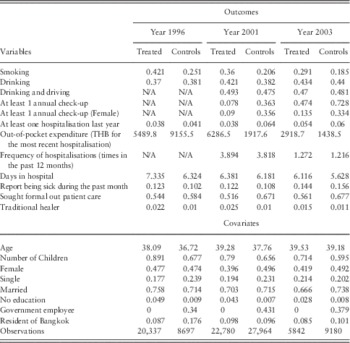
Descriptive statistics are shown in Table 1 (outcome variables are reported at the beginning of the table).
Descriptive statistics

The DD approach is adopted to measure the impact of UHC. For each outcome (Y), the impact is estimated by comparing the change in Y over time within the treatment group with the change in Y within the control group. If UHC had an impact, the change in Y would differ between the treatment and control groups. When 1996 data were available, in order to relax the well-known assumption of parallel trend (e.g. Lee, Reference Lee2005), we also correct the DD for the different pre-UHC trends in the outcomes in the two groups with a differences-in-DD (DDD) model (see, e.g., Wagstaff, Reference Wagstaff2010).
Our control group is composed of the CSMBS and the SSS beneficiaries. These individuals may be directly identified by the ‘type of health insurance’ variable in our data. For the MWS and VHC beneficiaries, we exclude them from this analysis. This is because both groups were covered by an insurance scheme before the introduction of UHC, but were transferred to UHC in 2001. Therefore, the impact on them would be from the change in insurance type. Our treatment group, then, includes only the individuals who were uninsured before 2001. These individuals are easy to identify from the 1996 and 2001 surveys. For the 2003 survey, we are able to exclude the previous MWS beneficiaries from their ‘no co-payment’ status. However, we are unable to distinguish between people who were previously covered by a voluntary insurance (i.e., VHC) and people who were previously uninsured. This is because all of these people would be entitled to the same type of UHC – the one with a 30 Baht co-payment. To exclude the former VHC beneficiaries, our treatment group for 2003 is then constructed by selecting only the individuals with a sufficiently high probability of being uninsured in 2001. Specifically, from the 2001 survey we calculate two propensity scores (conditional on a set of observable variables): one for being uninsured and one for having a voluntary insurance card. The estimated parameters are then used to predict the two probabilities for the individuals that in 2003 report themselves as being covered by the UHC. Each person is finally assigned to the category for which the estimated probability is higher. A broader definition of the treatment group, which includes all the UHC beneficiaries, is also used as a robustness check in the last part of the analysis.
Once the treated and the control individuals are identified, we first employ the double robust (DR) estimator to estimate the intra-period group differences in each outcome [see Appendix 1 and also Lunceford and Davidian (Reference Lunceford and Davidian2004) and Emsley et al. (Reference Emsley, Lunt, Pickles and Dunn2008)]. The set of covariates used for the estimation is reported in Table 1. After the DR t is calculated for each year, the DD and DDD estimators are then obtained as follows [see De Preux (Reference De Preux2011)]:
 $$DD=DR_{{2003}} \, {\minus} \, DR_{{2001}} $$
 $$DDD=(DR_{{2003}} \, {\minus} \, DR_{{2001}} ) \, {\minus} \, (DR_{{2001}} \ {\minus}\ DR_{{1996}} )$$
Standard errors are finally obtained by bootstrapping.
Results
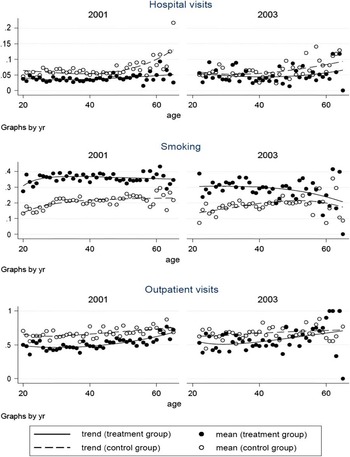
Figure 1 preliminarily shows the trends of three main outcome variables: inpatient admission, outpatient visits and smoking. Although results must still be tested formally, the effect of the UHC on inpatient and outpatient visits seems evident.
Distribution of hospitalisations, outpatient visits, and smoking across age and by treatment vs control group.

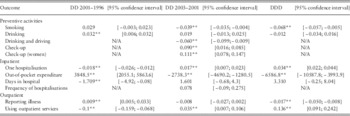
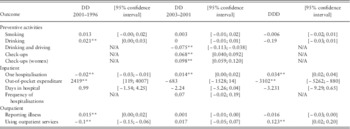
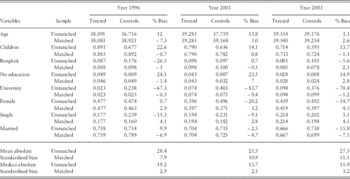
Matching works well, the balancedness test shows that the treatment and the control groups contain comparable samples (Appendix 2). Table 2 reports the final results for the DD and DDD analysis. Simple DD is performed for those outcome variables that are not available in the 1996 survey.
DD and DDD estimates

**p<0.05.
For lifestyle indicators, the gap in the prevalence of risky behaviours between the treated and the control group is either not affected or reduced by the UHC. People in the treatment group smoke and drink relatively more than others. However, this is true regardless of UHC. Smokers and drinkers actually reduced their smoking and drink-and-driving more than the control group. At the same time, no significant impact on drinking is detectable.
The most interesting result here is however related to preventive check-ups, a variable that is more directly linked to the introduction of UHC. The impact of the policy is clear: between 2001 and 2003 the difference between the treatment and the control group in the probability of going through preventive check-ups reduced by almost 70%. For women, for example, while before UHC the probability of a check-up was 16% higher for a formal worker, after the enactment of the reform this difference dropped to a 5%. The picture emerging from these figures is consistent with the idea of a substantial demand for preventive medicine which could not be satisfied due to the lack of insurance among the informal sector. In this sense, UHC might have also a significant effect in terms of reduction of future health care costs due to earlier and more precise diagnoses.
Universal coverage also had an impact on the likelihood of being hospitalised. Before UHC, there was a 2% difference between groups in the probability of receiving inpatient health care, a difference that basically disappears in 2003. Also the average length of stay for the hospitalised informal employees increased (not significantly) after the introduction of the UHC, a result that might be more related to the incentive system designed for providers than to actual patients’ demand. Similar results but with higher numbers are found for the outpatient visits. In particular, before UHC was introduced, there was a clear downward trend in the use of outpatient care for the informal sector. The parallel trend assumption is not consistent with this picture and the DDD results are more reliable: the UHC boosted an increase in the outpatient care of around 13%. Similarly, we find a marginally significant reduction of 1.7% in the probability of reporting oneself as ill, in line with Wagstaff and Manachotphong (Reference Wagstaff and Manachotphong2012). Finally, as found by most of the existing literature, the out-of-pocket expenditure is found to reduce significantly due to the UHC.
In order to explore more in depth the effects of the policy, a heterogeneity analysis was also performed, splitting the sample according to age (adults aged between 20 and 44 and between 45 and 80), gender, and municipal vs rural area.
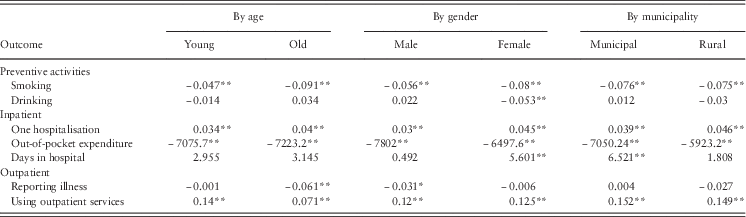
Results are reported in Table 3, which indeed replicates all the main results of Table 2. Smoking decreases in all the groups considered, although almost twice as much among the relatively elderly (people aged 45–80) and more among women. All this is consistent with what should be expected. Drinking is not affected by UHC. This is also consistent with the results obtained from using the entire sample, with the exception of a 5 percentage points decrease in women’s drinking behaviour. The likelihood of being hospitalised increases by 3–4 percentage points in all subsamples, and especially so among the elderly, females, and in rural areas. Similarly, out-of-pocket expenditures drop in every group: the most pronounced effect is observed for males (about 7800 Baht decrease), while the old and those living in municipal areas seem to benefit more from the policy than their counterparts. The average length of the last stay in hospital increases significantly only in the group of women and for people living in towns (5.6 and 6.5 more days spent in the hospital, respectively). Reporting illness, in turn, shows a significant decrease only among the elderly and males.
Heterogeneity analysis for the DDD
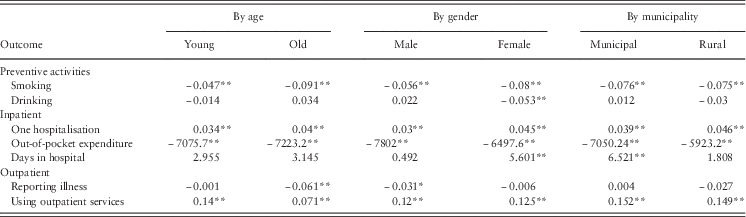
*p<0.1; **p<0.05.
Regarding our inclusion of the elderly in the treated sample, the concern may arise that, by eligibility criteria, people aged 60 or more should have been previously covered by the MWS, so that the treated group should not contain many of these people. Since our analysis excludes all the MWS beneficiaries but still identifies some individuals older than 60 reporting themselves as not covered by any scheme, we assume that these people were not aware of their eligibility to the MWS and as such never behaved as having insurance. Therefore, we believe it is reasonable to include them in our treatment sample.
Importantly, the comparison of UHC impacts across different subsamples may cast doubts on whether UHC actually benefits the poor more, something that is usually stated by the existing literature. However, the pre-treatment out-of-pocket expenditure among rural residents was lower to begin with (about 5195 THB per hospitalisation vs 6853 THB per hospitalisation for municipal residents). With respect to the pre-treatment values, the reduction in out-of-pocket expenditures is in fact proportionally greater among rural residents. Moreover, the facts that the likelihood of being hospitalised increases more and the reporting of minor illnesses is reduced (although not significantly) among rural residents actually support the idea that UHC benefits the poor more.
Another important issue is our definition of the treatment group. In this paper, the treated individuals are those who were covered by UHC in 2003 but were likely to be uninsured in 2001. The most relevant alternative is to include all UHC beneficiaries, regardless of their previous insurance status (see Table 4). Overall, however, results in Table 4 are very consistent with our main findings drawn from Table 2, and thus confirm the validity of our findings.
DD and DDD estimates with the treated group including everyone covered by UHC in 2003, regardless of their pre-UHC insurance status

**p <0.05; N/A: data not available.
A final point worth mentioning is about the usage of traditional medicine. According to the descriptive statistics (Table 1), it appears that, between 2001 and 2003, the rate of UHC beneficiaries seeking treatments from traditional healers dropped from 2.5% to 1.5%. At the same time, the usage of formal outpatient services increases from 51.6% to 56%. As for the control group, these rates remain almost unchanged. Given a very small relevant sample of observations with reports of using traditional medicine in 2003, we had to forego the formal inferential analysis of these interesting patterns. However, this evidence suggests that UHC may encourage beneficiaries to switch away from informal to formal medical treatments: an additional benefit of UHC might therefore be a reduction in the use of ineffective treatments in favour of more effective ones.
Discussion
This paper investigates the impacts of Thailand’s UHC scheme on preventive activities, health care consumption and unhealthy behaviours. Our work is among the few that assess the impact of an introduction of a comprehensive UHC scheme to a previously uninsured population. The identification of our treated group is achieved thanks to the ‘type of health insurance’ variable in the Thai HWS, which allows us to separate the uninsured from the beneficiaries of most of the pre-existing insurance schemes (CSMBS, SSS and MWS) and to use propensity score methods to distinguish between the uninsured and those enrolled in the remaining insurance schemes (mainly VHC) with a good degree of confidence.
The results suggest that UHC increases preventive activities and improves access to health care. Regarding impacts on unhealthy or risky behaviours, we find that UHC does not increase the tendency to smoke, drink or driving drunk. These results provide counter evidence to the recent findings by Baicker et al. (Reference Beicker, Taubman, Allen, Bernstein, Gruber, Newhouse, Schneider, Wright, Zaslavsky and Finkelstein2013), who find a positive (although not statistically significant) impact of the Medicaid programme on smoking prevalence using data from the Oregon Experiment. Of course, in the case of Thailand, the presence of ex ante moral hazard might have been counterbalanced by anti-smoking and anti-drinking campaigns going in the opposite direction. Thailand has indeed a long tradition for effective public health interventions. However, there is no reason why such campaigns should have a different impact on the treatment and the control groups. Moreover, while tobacco control policies might well have been at work in 2002, alcohol has become a public health priority only in more recent times. If anything, our results thus show that it was relatively straightforward for Thailand to prevent any serious perverse incentive effect of the UHC on the health behaviours of the newly insured. Overall, our findings may be considered as an instance in which the ex ante moral hazard theory might not apply.
Moreover, similarly to many existing studies on ex post moral hazard (e.g. Manning et al., Reference Manning, Newhouse, Duan, Keeler and Leibowitz1987; Sapelli and Vial, Reference Sapelli and Vial2003; Liu et al., Reference Liu, Nestic and Vukina2011; Van Dijk et al., Reference Van Dijk, Van Den Berg, Verheij, Spreeuwenberg, Groenewegen and De Bakker2013), we find that UHC increases healthcare consumption, that is the number of annual check-ups, the likelihood of hospitalisations, the duration of hospital stays, and the tendency to utilise formal outpatient care. However, it is difficult to prove whether these increases were due to ex post moral hazard or to the under-consumption observed before the implementation of UHC. In fact, health care consumption among the uninsured is consistently substantially lower than that of the CSMBS and SSS beneficiaries: the introduction of UHC only reduces the consumption gap between the already insured and the newly insured. Unless one is willing to assume significant levels of insurance-driven overconsumption in the existing CSMBS and SSS, the convergence between different schemes appears to support the pre-UHC under-consumption explanation. This is consistent with what Nyman (Reference Nyman1999) calls the ‘access motive’: given insurance, low-income people consume more health care because they can afford something that otherwise would have been too expensive to buy.
All these findings seem not to be driven by specific groups of the population, as our heterogeneity analysis shows that all the subsamples that we considered are affected in the same direction by the policy. However, there seem to be certain categories of individuals that might be benefiting more from the reform, like the group of the relatively elderly, composed of uninsured individuals aged 45–59 and of people aged 60 and more that were unaware of their eligibility for the MWS when it was in place and were therefore included in our treated sample.
Altogether, our results show that UHC did not only reduce the financial burden on health expenditures at the family level, but also effectively enabled a broader access to health care, including people that would not have used it otherwise. Some caveats, however, need to be made.
One important issue should be noted in the interpretation of the results. In April 2002, SSS was extended to all firms with more than one employee. As a consequence, the pre-2002 trend might not be maintained, mainly because the new enrolees could change their behaviour after coverage and increase their demand for health services. Although this could potentially introduce a bias in the analysis, we believe our approach is still valid. First, in terms of observables, the SSS groups are similar in 2001 and in 2003. This confirms that the group of employees affected by the new law did not change the basic structure of the control group. Second, the law took some time before picking up across the country. Given the timing of our study, it is unlikely that we could detect a significant change in the average behaviour of the SSS enrollees. Third, if anything, the bias introduced by the law, by increasing the before/after difference in health consumption within the SSS group, would reduce the estimated impact of the UHC. In this ‘worst case scenario’, our estimates would need to be seen as particularly conservative, thus representing a lower bound of the impact of the UHC on health consumption.
Other relevant issues are related to the methodological approach taken in the study, that is to explicitly prioritise internal validity, building on a coherent and rigorous identification mechanism. The extent to which the short run effects of the UHC can be projected on the medium and long term remains to be evaluated. The trade-off here is evident: the further away we move from the implementation time, the more difficult it becomes to interpret any DD model as a causal effect. Endogenous UHC innovations such as differential investments or changes in the incentive structure and external factors like the economic cycle or modifications to the pension system might influence individual behaviours even more than the UHC itself, making it difficult to isolate one effect from another. Although questionable, our identification strategy is thus deliberate and explicitly motivated. In addition, it should be pointed out that subsequent H&W surveys did not overlap particularly well with the 2001 and 2003 ones. Hence, in analysing medium run impacts we would have had to give up part of our outcome variables.
Acknowlegement
We would like to thank two referees, Peter Smith, Raya Muttarak and all the partecipants to the IUSSP International Population Conference (Busan, 2013), the Italian Health Economics Association (Trento, 2013) and the Health Systems in Asia (Singapore, 2013) meetings for the insightful comments. We would also like to thank the National Statistics Office of Thailand for the data and the support.
Appendix 1: The Double Robust estimator
According to this method, the average causal effect for the difference in the outcomes (Y) between the control and the treatment group in one year is found by a three-step process. In the first step, classical propensity scores p i [i.e. the probability of being in the treatment group (T) conditional on a set of each individual’s characteristics, X] are computed for each individual. In the second step, the outcome Y is regressed on X for each group. Predicted values of Y,  $$Y_{t} (\widehat {T,X})$$
and
 $$Y_{t} (\widehat {C,X})$$
, are computed for each individual within each group. Finally, the Lunceford and Davidian (Reference Lunceford and Davidian2004) index for the Double Robust estimator is calculated for each year (t):
 $$DR_{t} ={1 \over N}\mathop{\sum}\limits_{i\,=\,1}^N {{{T_{{i,t}} Y_{{i,t}} \,{\minus}\,(T_{{i,t}} \,{\minus}\,p_{{i,t}} )Y_{{i,t}} (\widehat {T,X})]} \over {P_{{i,t}} }}} \,{\minus}\, {1 \over N}\mathop{\sum}\limits_{i\,=\,1}^N {{{C_{{i,t}} Y_{{i,t}} {\plus}(T_{{i,t}} \,{\minus}\,P_{{i,t}} )Y_{{i,t}} (\widehat {C,X})]} \over {(1{\minus}P_{{i,t}} )}}} $$
This estimator is called double robust because it applies both propensity scores probability weighting and linear regression. As pointed out by Emsley et al. (Reference Emsley, Lunt, Pickles and Dunn2008), when both models are correctly specified, the DR estimator is a semiparametric efficient estimator. If only one of the two is valid, the DR estimator is offering protection against misspecification. Obviously, when both models are misspecified, the resulting estimate will be biased, but all alternative methods would be as well. The variance of the DR estimator is provided in Lunceford and Davidian (Reference Lunceford and Davidian2004) and is applied here.
Balancedness test – standardised percentage bias