Introduction
A number of recent reports on the Cambrian and Ordovician linguliformean brachiopods of Argentina have been published, addressing a substantial gap in our knowledge of the early Paleozoic brachiopod fauna of Gondwana. This clearly contrasts with the abundant records of rynchonelliformean brachiopods in most of the Ordovician units of western Argentinean basins (Benedetto, Reference Benedetto2003, Reference Benedetto2015, and references therein).
The upper Cambrian linguliform assemblage was described by Holmer et al. (Reference Holmer, Popov and Lehnert1999) from carbonate olistoliths of the Precordillera Basin, in the Province of Mendoza. Recent reports also come from nearby basins, such as the volcaniclastic Lower Ordovician units from the Famatina region (Lavié and Benedetto, Reference Lavié and Benedetto2020). Holmer et al. (Reference Holmer, Popov, Lehnert and Ghobadi Pour2016) reported a list of taxa from the Lower Ordovician of the San Rafael region in the southernmost extent of the Precordillera.
Lavié and Benedetto (Reference Lavié and Benedetto2016) described for the first time linguliformean brachiopods from the uppermost part of the San Juan Formation limestone of the Precordillera Basin, while some linguliformeans have been recorded in Los Azules Formation (Benedetto, Reference Benedetto2015) and in the Las Aguaditas and Las Chacritas formations (Lavié et al., Reference Lavié, Serra and Feltes2019), which are slightly younger units from the same basin.
The uppermost strata of the San Juan Formation in the Cerro La Chilca and La Brecha sections provide significant linguliformean faunas that increase our knowledge about this fossil group in the Precordillera and South America. The objective of this contribution is to describe newly discovered material from the very upper levels of the San Juan Formation in their transition to the overlying black shales and mudstones of the Los Azules Formation, and provide a brief discussion on their biogeographic affinities based on the hypothesis that Cuyania is an allochthonous terrane derived from Laurentia.
Geological setting
The Precordillera is located in western Argentina and extends for ~400 km through the provinces of La Rioja, San Juan, and Mendoza. In this region, the Cambrian–Ordovician carbonate and siliciclastic successions are developed in a shelf environment. The San Juan Formation represents the youngest carbonate unit in the Cambrian–Ordovician carbonate succession, which consists mainly of skeletal and intraclastic wackestone and packstone deposited between fair-weather and storm-wave base in a mid-ramp setting (Cañas, Reference Cañas, Cooper, Droser and Finney1995, Reference Cañas, Keppie and Ramos1999; Carrera et al., Reference Carrera, Fenoglio, Albanesi, Voldman, Albanesi and Ortega2013). This unit contains a rich fauna of brachiopods, trilobites, crinoids, gastropods, nautiloids, ostracodes, receptaculitids, sponges, conodonts, and calcareous algae (see Benedetto, Reference Benedetto2003). The age of the San Juan Formation is well constrained by conodonts, ranging from the upper Paltodus deltifer/Macerodus dianae zones (middle Tremadocian, Early Ordovician) to the Lenodus pseudoplanus Zone (middle Darriwilian, Middle Ordovician) (Lehnert, Reference Lehnert1995; Albanesi and Ortega, Reference Albanesi, Ortega and Aceñolaza2002; Heredia and Mestre, Reference Heredia, Mestre, Gutiérrez Marco, Rábano and García Bellido2011, Reference Heredia and Mestre2013; Heredia et al., Reference Heredia, Mestre, Kaufmann, Liao and Valenzuela-Ríos2017; among others). The cessation of carbonate deposition and its replacement by fine clastic sediments through the Early–Middle Ordovician was probably related to a relative increase in the sea level that led to drowning of the platform. Consequently, sedimentation took place in relatively deep or restricted environments, which resulted in a facies change toward graptolitic black shales of the Gualcamayo and Los Azules formations, or black mudstone and shales of the Las Aguaditas Formation.
Stratigraphy
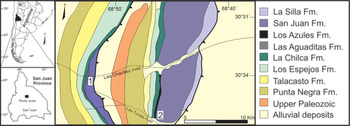
The microbrachiopods were retrieved from the uppermost levels of the San Juan Formation in the Cerro La Chilca and La Brecha creek sections (Central Precordillera) (Fig. 1). These carbonate beds are just before the transition to the black shales and mudstones of the Los Azules or Las Aguaditas formations. The uppermost beds of the San Juan Formation in each section are dissimilar in their lithological and stratigraphical settings.
Geological map showing locations of the study sections in the Central Precordillera (1) La Brecha Creek and (2) Cerro La Chilca sections.

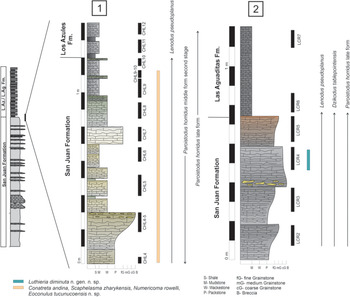
Cerro La Chilca section.—In this section, the last meter of the San Juan Formation was sampled (Fig. 2). These levels are composed of greenish bioclastic packstone in the base (CHL4), followed by the carbonate breccia (CHL4-5), which is composed of spiculitic mudstone clasts ranging from 2–10 cm in size (Mestre, Reference Mestre2011). The succession continues with greenish to reddish bioclastic wackestone to spiculitic mudstone (CHL5 and CHL6). These levels are overlaid by white carbonate calcarenite (CHL7). The San Juan Formation ends with light gray packstone–wackestone (CHL8 and CHL9) interbedded with dark gray bioclastic packstone (CHL9-10). In the top of San Juan Formation, a hardground with intense bioturbation and high concentration of trilobites and brachiopods is developed (Benedetto, Reference Benedetto2015). The lowermost levels of the Los Azules Formation are composed of dark gray mudstone (CHL11 and CHL12) interbedded with graptolitic black shale.
Stratigraphic column of the study sections showing the sampled levels (CHL4–12 and LCR2–7) and the vertical distribution of select conodonts and linguliform microbrachiopods in the study sections (1) Cerro La Chilca section and (2) La Brecha Creek section.

This facies succession would have developed from a shallow to deep subtidal environment with occasional high-energy episodes in a middle- to outer-platform setting (Mestre, Reference Mestre2010, Reference Mestre2011; Carrera et al., Reference Carrera, Fenoglio, Albanesi, Voldman, Albanesi and Ortega2013). The microbrachiopod fauna recovered from the sample levels in this section is composed of Conotreta andina Lavié, Serra, and Feltes, Reference Lavié, Serra and Feltes2019; Scaphelasma zharykensis Popov, Reference Popov2000; Numericoma rowelli Holmer et al., Reference Holmer, Popov, Lehnert and Ghobadi Pour2016; and Eoconulus tucunucoensis n. sp., representing a low-diversity fauna.
La Brecha creek section.—The last meter of the San Juan Formation in this section (Fig. 2) is composed of dark gray biointraclastic packstone–coarse grainstone in the base (LCR2 and LCR3), followed by a carbonate breccia whose clasts are composed of greenish mudstone with a size range of 2–10 cm (Mestre, Reference Mestre2011). The uppermost beds of the San Juan Formation are represented by dark gray biointralitoclatic fine- to coarse-grained grainstone (LCR4 and LCR5), which have a hardground on the top with Fe-oxide on the surface. These levels show a high concentration of phosphatic grains and biotite (Mestre, Reference Mestre2010, Reference Mestre2011). The San Juan Formation is overlain by the Las Aguaditas Formation, which is composed of dark gray mudstone (LCR6 and LCR7).
This facies succession would have developed from a shallow to deep subtidal environment in high-energy condition in a middle- to outer-platform setting (Mestre, Reference Mestre2010, Reference Mestre2011). The microbrachiopod fauna retrieved from sample LCR4 is monospecific—composed of Luthieria diminuta n. gen. n. sp., which represents a new genus and species from the Precordillera and South America.
Conodont biostratigraphy
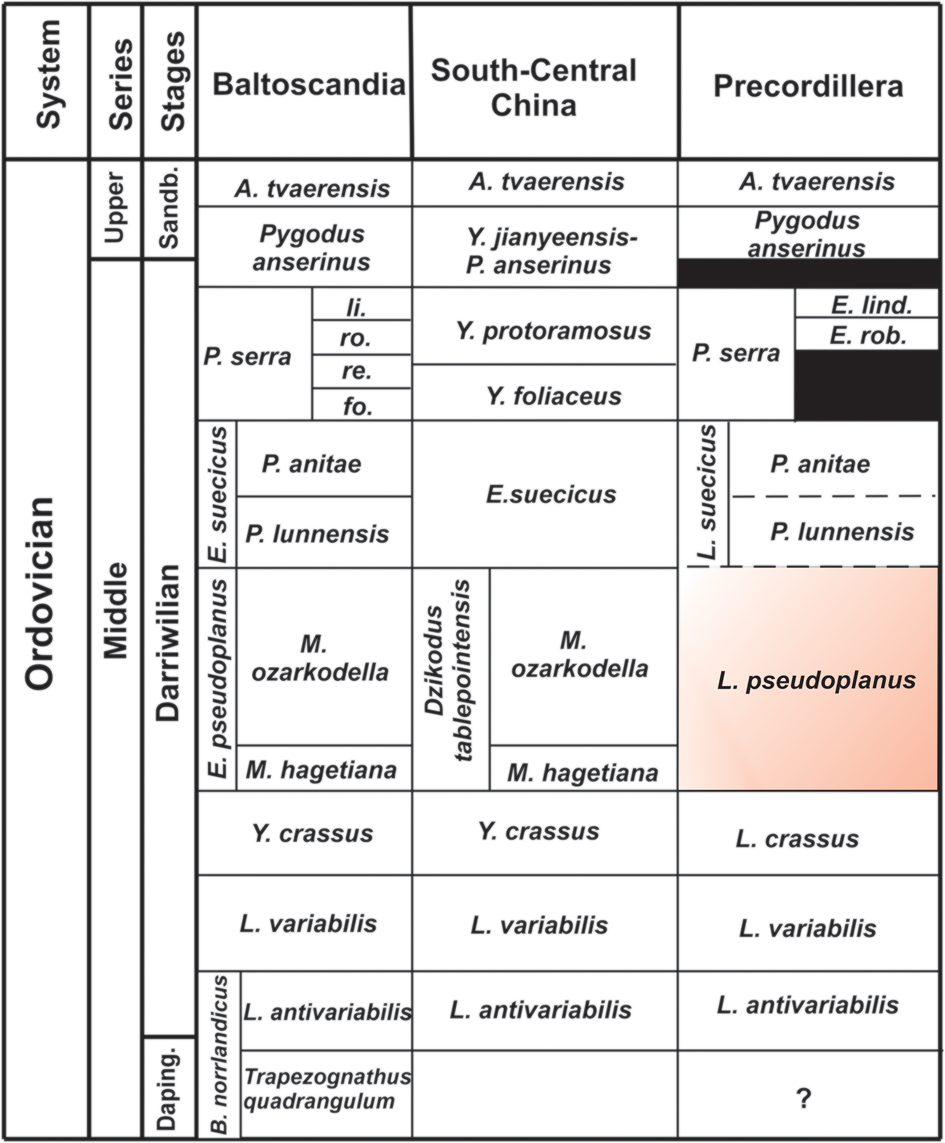
The Precordilleran Darriwilian conodont biostratigraphy has been improved significantly in recent years (Heredia and Mestre, Reference Heredia, Mestre, Gutiérrez Marco, Rábano and García Bellido2011, Reference Heredia and Mestre2013; Mestre and Heredia, Reference Mestre and Heredia2013a, Reference Mestre and Herediab, Reference Mestre and Heredia2020a, Reference Mestre and Herediab; Mestre, Reference Mestre2014; Serra et al., Reference Serra, Albanesi, Ortega and Bergström2015; Feltes et al., Reference Feltes, Albanesi and Bergström2016; Heredia et al., Reference Heredia, Mestre, Kaufmann, Liao and Valenzuela-Ríos2017; among others). Recently, Heredia et al. (Reference Heredia, Mestre, Kaufmann, Liao and Valenzuela-Ríos2017) and Mestre and Heredia (Reference Mestre and Heredia2020b) proposed an accurate Darriwilian conodont biostratigraphic chart, pointing out lower and upper limits, recording the Lenodus antivariabilis, Lenodus variabilis, Lenodus crassus, Lenodus pseudoplanus, Lenodus suecicus (Pygodus lunnensis and Pygodus anitae subzones), Pygodus serra (Eoplacognathus robustus and Eoplacognathus lindstroemi subzones), and lower Pygodus anserinus zones (Fig. 3). This Darriwilian conodont biostratigraphic scheme shows especially strong affinities with those of Baltoscandia and South China.
Darriwilian conodont biostratigraphical chart from the Precordillera. The colored area represents the conodont biozone recorded in the study section. Baltoscandia (Bergström, Reference Bergström1971; Löfgren and Zhang, Reference Löfgren and Zhang2003), south-central China (Wang et al., Reference Wang, Zhen, Bergström, Wu, Zhang and Ma2018), Precordillera (Heredia et al., Reference Heredia, Mestre, Kaufmann, Liao and Valenzuela-Ríos2017; Heredia and Mestre, Reference Mestre and Heredia2020b).

The Darriwilian conodont assemblages from the uppermost beds of the San Juan Formation and the lower beds of the Los Azules Formation in the Cerro La Chilca section were studied by Mestre (Reference Mestre2012) who proposed the Lenodus pseudoplanus Zone for these levels (Fig. 2). The equivalent beds from the La Brecha Creek section (in the Las Chacritas River region) (Fig. 2) provided a significant conodont fauna that assigned these levels to the L. pseudoplanus Zone (Heredia, Reference Heredia2012; Mestre and Heredia, Reference Mestre and Heredia2013a). The conodont Dzikodus tablepointensis (Stouge, Reference Stouge1984), which is present in this conodont assemblage, is an important biostratigraphic and biofacial marker that characterizes the outer-platform environment (Stouge, Reference Stouge1984; Zhang, Reference Zhang1998).
Recently, Mestre and Heredia (Reference Mestre and Heredia2020a), based on analysis of the morphologic evolution of the conodont Paroistodus horridus (Barnes and Poplawski, Reference Barnes and Poplawski1973) throughout the Darriwilian, proposed a biostratigraphic usage for the different morphological stages of this species. In the Cerro La Chilca section, the P. horridus middle form-second stage is present from CHL4 to CHL6, and the P. horridus late form is present from CHL8 to CHL12 (Fig. 2). On the other hand, in the La Brecha Creek section, the P. horridus late form was recovered in all samples (Fig. 2). This record would suggest that the uppermost beds of the San Juan Formation in the La Brecha Creek section are slightly younger than the equivalent beds from the Cerro La Chilca section.
Materials and methods
This study is based on 14 samples collected from the uppermost levels of the San Juan Formation in the Cerro La Chilca and La Brecha sections. The samples were treated following conventional laboratory methods, using 10% formic acid (Stone, Reference Stone and Austin1987) and 10% acetic acid (Jeppsson et al., Reference Jeppsson, Fredholm and Mattiasson1985). The insoluble residue of the samples was recovered by sieves No. 40, 80, and 120 (IRAM), and then the brachiopods were separated under a binocular microscope. Systematic descriptions follow the measurements and terminology introduced by Zhang et al. (Reference Zhang, Popov, Holmer and Zhang2018a, Reference Zhang, Zhang, Holmer and Chenb). Microphotographs were obtained with the Scanning Electron Microscope of the Instituto de Investigaciones Mineras (IIM) and the Laboratorio de Microscopía Electrónica y Análisis por Rayos X, Instituto de Física Enrique Gaviola (LAMARX-IFEG-UNC).
Repositories and institutional abbreviations
The original specimens are housed in the Centro de Investigaciones en Ciencias de la Tierra (CICTERRA), Consejo Nacional de Investigaciones Científicas y Técnicas, Universidad Nacional de Córdoba, Argentina (CEGH-UNC) and the Instituto de Geología P. E. Aparicio (INGEO), Facultad de Ciencias Exactas, Físicas y Naturales, Universidad Nacional de San Juan (INGEO-MP).
Systematic paleontology
The systematic classification follows that of the Treatise on Invertebrate Paleontology (Bassett, Reference Bassett and Kaesler2000, Reference Bassett, Williams, Brunton and Carlson2007; Holmer and Popov, Reference Holmer, Popov, Williams, Brunton and Carlson2000, Reference Holmer, Popov, Williams, Brunton and Carlson2007).
Phylum Brachiopoda Duméril, Reference Duméril1806
Subphylum Linguliformea Williams et al., Reference Williams, Carlson, Brunton, Holmer and Popov1996
Class Lingulata Gorjansky and Popov, Reference Gorjansky and Popov1985
Order Lingulida Waagen, Reference Waagen1885
Superfamily Linguloidea Menke, Reference Menke1828
Family Obolidae King, Reference King1846
Subfamily Obolinae King, Reference King1846
Genus Luthieria new genus
Type species
Luthieria diminuta n. sp.; La Brecha Creek section, Province of San Juan; San Juan Formation, middle Darriwilian, Middle Ordovician.
Diagnosis
As for type species by monotypy.
Occurrence
La Brecha Creek section, Province of San Juan. The last 50 cm of the top of the San Juan Formation, Darriwilian, Middle Ordovician.
Etymology
Dedicated to the Argentine comedy-musical group Les Luthiers.
Remarks
Luthieria n. gen. externally is a typical obolid, which resembles in its general morphology most of the genera of the subfamily Obolinae, but it is characterized by having a very small size in adult specimens, not exceeding 0.5 mm in length, and particular metamorphic ornamentation consisting of small ridges radially arranged; furthermore, the reduced pseudointerareas and the absence of a pedicle groove or pedicle track distinguishes Luthieria n. gen. from several genera of Ordovician obolids. It can be clearly distinguished from other Ordovician genera such as Lingulobolus Matthew, Reference Matthew1895; Anomaloglossa Percival, Reference Percival1978; Agalatassia Popov and Holmer, Reference Popov and Holmer1994; Pseudobolus, Cooper, Reference Cooper1956; and other medium to large obolids. Obolus von Eichwald, Reference von Eichwald1829, resembles Luthieria n. gen. in that it has a similar outline and ornamentation, but it can be differentiated from the latter by a larger size, a rather thin shell wall, well-defined pseudointerareas, and a deep, narrow pedicle groove (Popov et al., Reference Popov, Kazanovitch, Borovko, Sergeeva and Sobolevskaya1989). The genera Schmidtites Schuchert and Le Vene, Reference Schuchert, Le Vene and Pompeckj1929 and Ungula Pander, Reference Pander1830, besides their larger size, both differ from Luthieria n. gen. in having well-defined pseudointerareas with flexure lines, a deep and narrow pedicle groove, and a deeply impressed ventral visceral field. Among other Ordovician obolids with subcircular outline and concentric ornamentation, Luthieria n. gen. can be compared with the genera Apatobolus Popov in Nazarov and Popov, Reference Nazarov and Popov1980 and Divobolus Sutton in Sutton et al, Reference Sutton, Bassett and Cherns1999. However, Apatobolus has a thin shell wall, distinctive low and short pseudointerareas, with a shallow pedicle groove and postmetamorphic ornamentation composed of radial plications. Divobolus differs from Luthieria n. gen. in having more acuminate apex, an apsacline ventral pseudointerarea with shallow pedicle groove, and a dorsal low pseudointerarea with a shallow median groove. Luthieria n. gen. also can be externally compared with the Cambrian genera Dicellomus Hall, Reference Hall1871 and Eodicellomus Holmer and Ushatinskaya in Ushatinskaya and Holmer, Reference Ushatinskaya, Holmer, Alexander, Jago, Rozanov and Zhuravlev2001. Dicellomus has a similar subcircular outline and a reduced dorsal pseudointerarea, but differs from Luthieria n. gen. in having a dome-shaped dorsal valve, a dorsibiconvex lateral profile, and a ventral pseudointerarea with narrow pedicle groove. Eodicellomus resembles Luthieria n. gen. in the equibiconvex lateral profile and subcircular outline, but differs from the latter in having an apsacline ventral pseudointerarea with deep pedicle groove and elevated propareas, an anacline dorsal pseudointerarea, and radial ornamentation of thin costellae in the postmetamorphic shell surface.
The genus Pidiobolus Mergl, Reference Mergl1995, within the subfamily Obolinae, from Lower to Middle Ordovician of the central Bohemia region (Mílina and Klavaba formations), was originally described from internal and external molds, based on the general characteristics of a typical obolid, but distinguishing it from other Obolinae genera by its small size, which did not exceed 2 mm long in adults. Pidiobolus resembles Luthieria n. gen. in its subcircular outline, its postmetamorphic ornamentation that consists of fine concentric growth lines, its poorly impressed internal features, and the presence of a thick shell wall in relation to its size. However, Pidiobolus is up to four or five times larger than Luthieria n. gen., and it has a well-defined pedicle groove and medial groove in the ventral and dorsal pseudointerareas, respectively. In addition, although externally both genera are similar, Mergl (Reference Mergl2002) examined free shell specimens from the same formations where the genera were originally described, and discovered that the external surface bears fine superficial pitted micro-ornamentation, which is diagnostic for the family Zhanatellidae Koneva, Reference Koneva1986; thus, Pidiobolus was reassigned to this family. Luthieria n. gen. lacks this type of micro-ornamentation, showing a smooth external surface.
Luthieria diminuta new species
Figure 4.1–4.12
Type material
Holotype INGEO-IMP 10001, a conjoined specimen. Paratypes: Three dorsal valves INGEO-IMP 10000, 10002, 10004, and one conjoined specimen INGEO-IMP 10003. The La Brecha Creek section, Province of San Juan. The last 50 cm of the top of San Juan Formation, Darriwilian, Middle Ordovician.
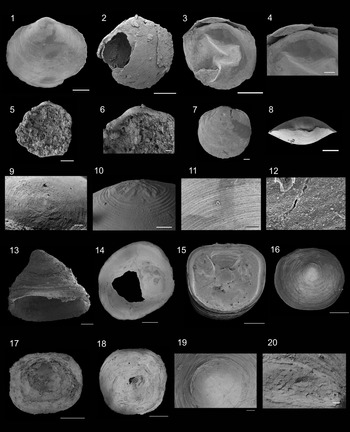
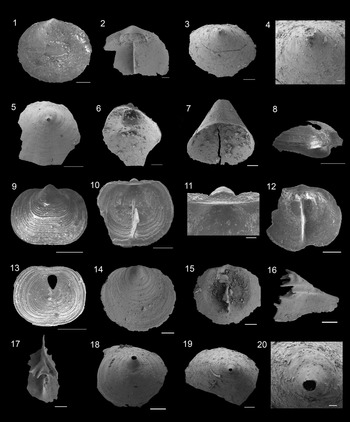
Luthieria diminuta n. gen. n. sp. (1) Paratype INGEO-IMP 10000, dorsal valve exterior; (2) holotype INGEO-IMP 10001, conjoined shell showing partially the interior surface; (3, 4) CEGH-UNC 27435, conjoined shell with external view of the dorsal valve and partial view of ventral pseudointerarea (3), with detail of the ventral pseudointerarea (4); (5, 6) paratype INGEO-IMP 10002, dorsal valve interior (5) and detail of dorsal pseudointerarea (6); (7, 11, 12) CEGH-UNC 27436, exterior shell surface (7), detail of the postlarval ornamentation consisting of fine growth lines (11), and detail of shell surface, showing the absence of postlarval microornamentation (12); (8, 9) paratype INGEO-IMP 10003, conjoined specimen in posterior view (8), and upper view of the metamorphic shell (9); (10) paratype INGEO-IMP 10004, detail of dorsal metamorphic shell showing the ornamentation composed of radial ridges. Eoconulus tucunucoensis n. sp. (13) Holotype CEGH-UNC 27432, dorsal valve in lateral view; (14) paratype CEGH-UNC 27429, internal view of a partially fragmented dorsal valve; (15) paratype CEGH-UNC 27430, ventral valve interior showing the cardinal muscle scars; (16, 19, 20) paratype CEGH-UNC 27433, dorsal valve in upper view (16) and detail of the metamorphic shell (19) and the metamorphic ornamentation composed of pits and clusters of micropits (20); (17) paratype CEGH-UNC 27434, dorsal valve interior; (18) paratype CEGH-UNC 27431, ventral valve interior. Scale bars = 100 μm (1, 3, 5, 8, 13), 200 μm (2, 14–18), 30 μm (4, 7, 19), 20 μm (6), 10 μm (9–11, 20), 1 μm (12).

Diagnosis
Almost equibiconvex obolid with subcircular outline, shell very small with relatively thick walls, and never exceeding 0.5 mm long in the adult; ventral pseudointerarea orthocline with poorly delineated propareas; dorsal pseudointerarea orthocline, with vestigial to absent propareas; pedicle groove or pedicle track absent. Muscle scars and visceral areas not preserved. Metamorphic shell with radial ridges. Postmetamorphic shell ornamentation consisting of thin concentric growth lines; postmetamorphic microornamentation absent.
Occurrence
The same levels and locality as the holotype and paratypes.
Description
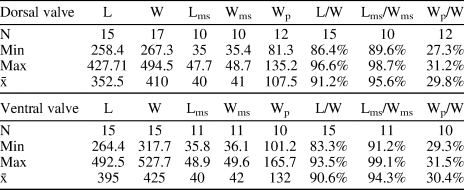
A very minute shell, with almost equibiconvex profile, the valves never exceed 0.5 mm length in adult individuals (observed range = 0.258–0.492 mm, N = 30; Table 1), and it is rather thick walled when compared with its size. Both valves possess subcircular outline (Fig. 4.1, 4.2, 4.7), averaging 88% as long as wide, with the maximum width located in mid-length, up to 0.52 mm in the largest specimen (observed range = 0.267–0.527 mm, N = 32). In lateral view, the maximum height is located in the posterior half of the shell. Anterior and lateral margins are well rounded; posterior margin with apex slightly curved backward and apical angle averaging 130°. Ventral pseudointerarea orthocline to slightly apsacline (Fig. 4.3, 4.4), with poorly defined and smooth propareas, occupying less than one-third of the total width of valve; the pedicle groove is absent. Dorsal pseudointerarea orthocline and relatively smaller than the ventral pseudointerarea (Fig. 4.5, 4.6), with propareas reduced to absent, lacking median groove. Inner valve surface has irregularly distributed, relatively coarse knobs, with no discernible visceral area or muscle scars. The metamorphic shell is poorly delineated and located within the apex (Fig. 4.8), showing a subcircular outline averaging 40 μm width; the metamorphic ornamentation consists of small ridges, radially arranged, that extend to the margins of metamorphic shell (Fig. 4.9, 4.10). The postmetamorphic ornamentation consists of fine concentric growth lines of irregular size, usually more distinctive in the posterior region (Fig. 4.11), becoming almost indistinguishable toward the margins. The external shell surface is smooth, lacking microornamentation (Fig. 4.12).
Dimensions and ratios of ventral and dorsal valves of Luthieria diminuta n. gen. n. sp. All measurements are in μm. Abbreviations: L, length; W, width; Lms, Wms, length and width of metamorphic shell; Wp, width of pseudointerarea.

Etymology
Latin derived diminutus, “extremely small.”
Material
Two conjoined specimens CEGH-UNC 27435, 27436 (illustrated), 35 ventral valves, 46 dorsal valves, and 50 conjoined specimens as additional material (not illustrated); from the same levels and locality as the holotype and paratypes.
Remarks
Luthieria diminuta n. gen. n. sp. is the only species included so far within genus Luthieria n. gen. As noted above, the very small size in adult individuals and its particular metamorphic shell ornamented with radial ridges, together with the reduced pseudointerareas, the absence of pedicle groove and pedicle track, and the postmetamorphic shell surface lacking microornamentation in L. diminuta n. gen. n. sp. justify the proposal of this new genus and species. Regarding the metamorphic shell ornamentation, it should be noted that it can be compared with that observed in some Late Devonian lingulids (Baliński, Reference Baliński1997, Reference Baliński, Brunton, Cocks and Long2001).
Order Acrotretida Kuhn, Reference Kuhn1949
Superfamily Acrotretoidea Schuchert, Reference Schuchert1893
Family Eoconulidae Rowell, Reference Rowell and Moore1965
Genus Eoconulus Cooper, Reference Cooper1956
Type species
Eoconulus rectangulatus Cooper, Reference Cooper1956, p. 282, by original designation; from Middle Ordovician (Pygodus anserinus Biozone), Pratt Ferry beds, Pratt Ferry, Alabama, USA.
Eoconulus tucunucoensis new species
Figure 4.13–4.20
Type material
Holotype CEGH-UNC 27432, a dorsal valve. Paratypes: three dorsal valves (CEGH-UNC 27429, 27433, 27434) and two ventral valves (CEGH-UNC 27430, 27431).
Diagnosis
Dome-shaped dorsal valve, subquadrate in outline; subcentral rounded apex; posterior slope concave near the apex, but convex towards the margin. Flat ventral valve subquadrate in outline, with flattened to irregular attachment scar and without pedicle foramen; low apical process located centrally. Both valves with well-developed cardinal muscle fields. Ornamentation consisting of concentric growth lines and fila.
Occurrence
The Cerro La Chilca section, Province of San Juan. The last meter of the top of the San Juan Formation, middle Darriwilian, Middle Ordovician.
Description
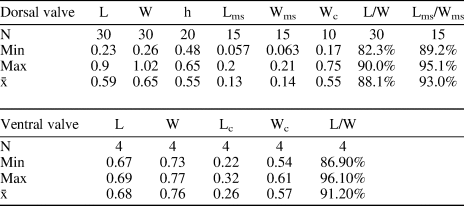
Minute shell, convex–flat in lateral profile. Dorsal valve conical to dome-shaped (Fig. 4.13), with suboval to subquadrate outline (Fig. 4.16, 4.17), up to 0.9 mm long and 1.02 mm wide, with average length/width ratio 0.86 (Table 2); the maximum height occurs near the center of the valve or slightly subcentrally, towards the posterior margin, averaging 72% as high as long (up to 0.65 mm). The apex is rounded, located in a backward subcentral position, with an apical angle ~76°. Posterior margin almost straight to gently rounded; posterior surface is concave near to the umbo, but becomes convex towards the margin; dorsal pseudointerarea is not distinguished. The dorsal interior has a pair of well-developed and slightly raised cardinal muscle scars on the posterior wall (Fig. 4.14, 4.17), occupying up to 73% of the total width. Dorsal metamorphic shell with almost circular outline, up to 0.2 mm long and 0.21 mm wide; the metamorphic shell surface is mostly decorticated, but it preserves some microornamentation composed of shallower circular pits, ~6 μm in diameter, separated by clusters of smaller micropits (Fig. 4.19, 4.20). The postmetamorphic ornamentation consists of closely spaced concentric growth lines. The ventral valve is flat, and has a subquadrate outline (Fig. 4.15), with an average length/width ratio of 0.92, up to 0.67 mm long and 0.77 mm wide in the largest specimen; it has an almost flattened or irregular-shaped attachment scar, and it lacks pedicle foramen (Fig. 4.18). The posterior and lateral margins are straight, but the anterior margin is well rounded. The ventral cardinal muscle field is well developed, occupying 79% of the total width, and it extends to half of valve length; the muscle scars are thick and oval in outline, raised posteromedially. A low but well-developed apical process (up to 0.13 mm long) is located at about the center of the valve (Fig. 4.15); ventral visceral area has widespread pits and some isolated perforations. The ventral valve surface is ornamented with well-defined and irregularly disposed fila.
Dimensions and ratios of dorsal and ventral valves of Eoconulus tucunucoensis n. sp. All measurements are in mm. Abbreviations: L, length; W, width; h, height; Lms, Wms, length and width of metamorphic shell; Lc, Wc, length and width of cardinal muscle scars.

Etymology
After Tucunuco, an abandoned village near the Cerro La Chilca section.
Material
Five ventral valves and 65 dorsal valves as additional material, not illustrated. From the same levels and locality as the holotype and paratypes.
Remarks
The type species, E. rectangulatus Cooper, Reference Cooper1956, differs from the new species here proposed in that it has a nearly posterior dorsal apex and a wider transversely oval dorsal valve outline, with the maximum width located posteriorly. Eoconulus transversus Wright, Reference Wright1963, from the Ashgillian of Ireland differs in having a large size with a length/width ratio of ~0.66, and a dorsal valve with trapezoidal outline with the maximum width located near the posterior margin. Eoconulus cryptomyus Gorjansky, Reference Gorjansky1969, from the Darriwilian of Russia and Estonia, differs in a lower conical dorsal valve lacking muscle scars, and the ventral valve without apical process. Eoconulus semiregularis Biernat, Reference Biernat1973, of which only the dorsal valve is known, derived from a Middle or Upper Ordovician erratic boulder of the Baltic coast (Poland), differs from E. tucunucoensis n. sp. in having a dorsal circular outline and the apex located near the posterior margin, and it lacks muscle scars. Eoconulus antelopensis Krause and Rowell, Reference Krause and Rowell1975, from the Dapingian of Nevada, and E. clivosus Popov, Reference Popov1975, from the Darriwilian of Kazakhstan, are both clearly distinguished from E. tucunucoensis n. sp. in that they have a biconvex lateral shell profile. Eoconulus dyminensis Bednarczyk and Biernat, Reference Bednarczyk and Biernat1978, from the Dapingian of the Holy Cross Mountains region in Poland, shows a transversely oval outline with maximum width located near the posterior margin, and a limbus-like structure along the dorsal valve margin. Eoconulus robustus Holmer, Reference Holmer1989, from the Darriwilian of Västergötland and Dalarna (Sweden), has a lower conical dorsal valve, a ventral valve with larger cardinal muscle scars, and it lacks an apical process. Eoconulus gemmatus Mergl, Reference Mergl1995, from the Floian of Bohemia, and E. primus Popov and Holmer, Reference Popov and Holmer1994, from the Floian of the South Urals region, both differ from E. tucunucoensis n. sp. in having a coarsely scalloped shell surface. Eoconulus cuboides Zhang, Reference Zhang1995, from the Darriwilian of South China, has a trapezoidal dorsal valve outline and the maximum width is located near the posterior margin. Eoconulus commutabilis Mergl, Reference Mergl2002, from the Dapingian of Bohemia region, and E. lilianae Bednarczyk in Bednarczyk and Stempień-Sałek, Reference Bednarczyk and Stempień-Sałek2011, from the Darriwilian of the Holy Cross Mountains in Poland, are both distinguished from E. tucunucoensis n. sp. in having a lower conical dorsal valve and they lack cardinal muscle scars. Eoconulus subquadratus Hansen and Holmer, Reference Hansen and Holmer2011, from the Middle Ordovician of Spitsbergen (Svalbard Archipelago, Norway), possesses a subconical ventral valve profile and the dorsal valve lacks muscle impressions in the inner shell surface. Eoconulus puteus Engelbresten in Percival et al., Reference Percival, Engelbretsen, Brock and Farrell2016, from the Katian of New South Wales (Australia), has a lower conical dorsal valve with the anterior and lateral margins forming a flattened rim, and the ventral valve possesses a deeply perforated apical process.
There are two previous records of the genus in Precordillera terrane: Eoconulus sp. (Holmer et al., Reference Holmer, Popov, Lehnert and Ghobadi Pour2016), which is from the Middle to Upper Ordovician of the San Rafael Block (Province of Mendoza), but the material is too highly fragmented and poorly preserved for a detailed comparison; and Eoconulus sp. (Lavié et al., Reference Lavié, Serra and Feltes2019), from the Darriwilian of the Las Aguaditas Formation (Province of San Juan), which has been described only from dorsal valves. This last form can be compared to the San Juan Formation material due to the similarity in the dome-shaped profile of the valve, subcircular outline, a straight posterior margin without pseudointerarea, and postlarval ornamentation consisting of closely spaced concentric growth lines. Therefore, the Las Aguaditas Formation specimens can be assigned to the new species E. tucunucoensis n. sp.
Family Acrotretidae Schuchert, Reference Schuchert1893
Genus Conotreta Walcott, Reference Walcott1889
Type species
Conotreta rustii Walcott, Reference Walcott1889; by original designation, Upper Ordovician (Katian), Denley Limestone, Trenton Falls, New York, USA.
Conotreta andina Lavié, Serra, and Feltes, Reference Lavié, Serra and Feltes2019
Figure 5.1–5.7
Reference Lavié, Serra and Feltes2019 Conotreta andina Lavié, Serra, and Feltes, p. 657, pl. 1, figs. 9–20.
Conotreta andina Lavié, Serra, and Feltes, Reference Lavié, Serra and Feltes2019. (1) INGEO-IMP 10005, dorsal valve exterior; (2) INGEO-IMP 10006, fragmented dorsal valve interior, showing the pseudointerarea, the dorsal cardinal muscle field, and the median septum anteriorly broken; (3, 4) INGEO-IMP 10007, ventral valve exterior in upper view (3) and detail of the metamorphic shell (4); (5) INGEO-IMP 10008, fragmented ventral valve in posterior view; (6) INGEO-IMP 10009, fragmented ventral valve interior, showing the apical process; (7) INGEO-IMP 10010, ventral valve in posterior view. Scaphelasma zharykensis Popov, Reference Popov2000. (8) CEGH-UNC 27437, conjoined shell in posterior and lateral view; (9) CEGH-UNC 27438, dorsal valve exterior; (10, 11) CEGH-UNC 27439, dorsal valve interior showing an incomplete median septum (10) and detail of the pseudointerarea (11); (12) CEGH-UNC 27440, dorsal valve interior with the median septum anteriorly broken; (13) CEGH-UNC 27441, ventral valve exterior. Numericoma rowelli Holmer et al., Reference Holmer, Popov, Lehnert and Ghobadi Pour2016. (14) INGEO-IMP 10011, dorsal valve exterior; (15) INGEO-IMP 10012, dorsal valve interior with the median septum anteriorly broken; (16) INGEO-IMP 10013, fragment of a dorsal median septum in lateral view; (17) INGEO-IMP 10014, fragment of a dorsal median septum in upper view; (18) INGEO-IMP 10015, ventral valve exterior in upper view; (19, 20) INGEO-IMP 10016, ventral valve in posterior view (19) and detail of metamorphic shell and pedicle foramen (20). All scale bars represents 100 μm except (5, 14) 200 μm and (4, 11, 20) 20 μm.

Holotype
Conotreta andina Lavié, Serra, and Feltes (CEGH-UNC 27362) from the lower member of the Las Aguaditas Formation, the Las Aguaditas Creek section, Province of San Juan, Precordillera of west-central Argentina (Lavié et al., Reference Lavié, Serra and Feltes2019, pl. 1, fig. 11).
Occurrence
The last meter of the top of the San Juan Formation, in the Cerro La Chilca section, Province of San Juan, middle Darriwilian, Middle Ordovician.
Material
Two dorsal valves INGEO-IMP 10005, 10006, and four ventral valves INGEO-IMP 10007–10010 (illustrated). Additional material: 15 dorsal and 32 ventral valves, not figured.
Remarks
The San Juan Formation specimens are closely similar to Conotreta andina Lavié, Serra, and Feltes, Reference Lavié, Serra and Feltes2019, from the Las Aguaditas and Las Chacritas formations, both overlaying the San Juan Formation in other nearby sections (see Lavié et al., Reference Lavié, Serra and Feltes2019, fig. 1). The specimens resemble C. andina in several external features, such as the conical ventral valve with subcircular outline (Fig. 5.1) and a procline ventral pseudointerarea with well-defined interridge (Fig. 5.5, 5.7). The specimens also have an incipient short external pedicle tube and pedicle foramen enclosed within the metamorphic shell (Fig. 5.3, 5.4), a slightly convex dorsal valve without median sulcus, and postmetamorphic ornamentation consisting of poorly developed concentric fine growth lines, which are also seen in C. andina. The interior features are poorly preserved; only one broken ventral interior shows an apical process forming a low and short ridge along anterior slope (Fig. 5.6), and the dorsal interior has a short anacline pseudointerarea with a barely distinguishable median groove and median buttress (Fig. 5.2). Despite the absence of more internal characters, the material described here can be assigned to C. andina, recording all external major features of this species, which differentiate it from other species of the genus (detailed discussion in Lavié et al., Reference Lavié, Serra and Feltes2019).
Family Scaphelasmatidae Rowell, Reference Rowell and Moore1965
Genus Scaphelasma Cooper, Reference Cooper1956
Type species
Scaphelasma septatum Cooper, Reference Cooper1956, p. 259; by original designation; from Middle Ordovician (Pygodus anserinus Biozone), Pratt Ferry beds, Pratt Ferry, Alabama, USA.
Scaphelasma zharykensis Popov, Reference Popov2000
Figure 5.8–5.13
- Reference Popov2000
Scaphelasma zharykensis Popov, p. 427, fig. 8.1–8.19.
- Reference Lavié, Serra and Feltes2019
Scaphelasma zharykensis Lavié, Serra, and Feltes, p. 658, pl. 1, figs. 21–24, pl. 2, figs. 1–9.
Holotype
NMW 98.65G.232, conjoined valves; lower Ashgill, upper Bestyube Formation, Zharyk beds, north-central Kazakhstan (Popov, Reference Popov2000, fig. 8.9, 8.10).
Occurrence
The last meter of the top of San Juan Formation, in the Cerro La Chilca section, Province of San Juan, middle Darriwilian, Middle Ordovician.
Material
One conjoined specimen CEGH-UNC 27437, three dorsal valves CEGH-UNC 27438–27440, and one ventral valve CEGH-UNC 27441 (illustrated). Additional material: 12 dorsal and 15 ventral valves, not figured.
Remarks
The specimens from the San Juan Formation are assigned to S. zharykensis Popov, Reference Popov2000, from the Katian of the Bestyube Formation in north-central Kazakhstan. Although the postmetamorphic shell ornamentation is different, consisting only of well-defined concentric fila, and lacking strong lamellae, the specimens resemble S. zharykensis in most of their general features—they have a transversely oval shell outline (Fig. 5.9, 5.13), a low conical ventral valve with procline pseudointerarea bearing deep intertrough (Fig. 5.8), and a pedicle foramen with suboval outline. Also, both forms possess a dorsal valve bearing a weak median sulcus, an orthocline dorsal pseudointerarea divided by a broad median groove (Fig. 5.11), and dorsal interior with high and triangular median septum (Fig. 5.10, 5.12). A more detailed description and discussion of this species was provided originally by Popov (Reference Popov2000), and later by Lavié et al. (Reference Lavié, Serra and Feltes2019) on material from the Las Aguaditas and Las Chacritas Formations, at levels above the San Juan Formation in localities near the Cerro La Chilca section.
Family Ephippelasmatidae Rowell, Reference Popov, Holmer, Bassett, Ghobadi Pour, Percival, Harper and Servais1965
Genus Numericoma Popov in Nazarov and Popov, Reference Nazarov and Popov1980
Type species
Numericoma ornata Popov in Nazarov and Popov, Reference Nazarov and Popov1980; by original designation; Llanvirn Kopalin Stage, Karakan (Locality 2033), Kazakhstan.
Numericoma rowelli Holmer et al., Reference Holmer, Popov, Lehnert and Ghobadi Pour2016
Figure 5.14–5.20
- Reference Krause and Rowell1975
Ephippelasma spinosum Biernat; Krause and Rowell, p. 61, pl. 8, figs. 7–22, pl. 10, figs. 1–4, 7, 8, pl. 11, fig. 2.
- Reference Holmer, Popov, Lehnert and Ghobadi Pour2016
Numericoma rowelli Holmer et al., p. 43, fig. 10A–F.
Holotype
KU 79772, dorsal valve, Middle Ordovician (Whiterockian) Antelope Valley Limestone, Meiklejohn Peak, Nevada, USA.
Occurrence
The last meter of the top of the San Juan Formation, in the Cerro La Chilca section, Province of San Juan, middle Darriwilian, Middle Ordovician.
Description
Shell ventribiconvex, with transversely oval outline (Fig. 5.14), averaging 0.86 length/width ratio (maximum length = 400 μm; maximum width = 460 μm). The ventral valve is conical, with curved apsacline pseudointerarea, which has a narrow and incipient intertrough (Fig. 5.18, 5.19); pedicle foramen with circular outline, located behind the relatively wide apex. Ventral metamorphic shell poorly delineated (Fig. 5.20); it can be distinguished only on the adult shell by the ornamentation composed of densely scattered micropits all over the metamorphic surface. Internal features not preserved. Dorsal valve flattened to slightly convex, with low, orthocline to anacline pseudointerarea divided by a wide median groove (Fig. 5.15); dorsal metamorphic shell with subcircular outline, covered by scattered micropits. Internal valve surface showing the cardinal muscle scars with oval outline larger than wide, and the median buttress is absent; strongly folded dorsal median septum, with septal spines in anterior slope; asymmetrical surmounting plate (Fig. 5.16, 5.17), folded almost 90° and bearing variable number of septal rods in the anterior edge. Both valves with postmetamorphic ornamentation composed of fine concentric growth lines.
Material
Six specimens figured; two complete dorsal valves INGEO-IMP 10011, 10012, two fragmented dorsal median septa INGEO-IMP 10013, 10014, and two ventral valves INGEO-IMP 10015, 10016. Additional material: 15 dorsal and 21 ventral valves, not figured.
Remarks
The specimens from the San Juan Formation are closely comparable in their major features to Numericoma rowelli Holmer et al., Reference Holmer, Popov, Lehnert and Ghobadi Pour2016, from the Middle–Upper Ordovician of the Ponón Trehué and Lindero formations (San Rafael Block, Province of Mendoza). They share the transversely oval outline, an apsacline ventral pseudointerarea curved posteriorly, a narrow and incipient intertrough, and a circular outline of the pedicle foramen, which is situated behind the apex. In addition, both have a flattened dorsal valve with a wide pedicle groove dividing the dorsal pseudointerarea, and the presence of a strongly folded dorsal median septum bearing numerous septal spines in the anterior slope and surmounting platform. The recovered specimens closely resemble N. simplex Holmer, Reference Holmer1989, from the Middle Ordovician of Sweden, also reported from the Las Aguaditas and Las Chacritas formations (Darriwilian–Sandbian) in the Argentine Precordillera (Lavié et al., Reference Lavié, Serra and Feltes2019), showing a transversely oval outline and ventribiconvex profile, both with pseudointerareas similar in shape and size; but they are distinguished in the pedicle foramen position, a more acuminate apex, and a more folded dorsal median septum with greater number of septal spines in the anterior slope and surmounting platform edge (Fig. 5.16, 5.17).
Biogeographic implications of the San Juan Formation linguliformeans
The knowledge of lingulid and acrotretid brachiopods from the extensive lower Cambrian to Middle Ordovician carbonate platform deposits of the Precordillera has increased significantly in recent years. However, there is still only one study on Cambrian linguliform fauna. A varied Furongian linguliform assemblage that consists mainly of acrotretids was described by Holmer et al. (Reference Holmer, Popov and Lehnert1999) from carbonate olistoliths of the Province of Mendoza. According to these authors, this lingulate fauna demonstrates a consistent similarity to contemporaneous assemblages of North America, but it also displays an important link with Siberian assemblages.
In contrast, as noted by Popov et al. (Reference Popov, Holmer, Bassett, Ghobadi Pour, Percival, Harper and Servais2013), the Middle Ordovician is the best-known interval in terms of the biogeographical distribution of lingulate brachiopods. The first Middle Ordovician assemblage described from the Precordillera Basin comes from the dysoxic black shales and marls of the Los Azules Formation of lower-middle Darriwilian age (Benedetto, Reference Benedetto2015). It consists of the lingulids Palaeoglossa and Anomaloglossa?, the acrotretid Cyrtonotreta, and the craniid Philhedra. The genus Palaeoglossa is recorded in England, Australia, the southern Urals, and south China, while Cyrtonotreta is found in North America (Pratt Ferry Formation; Cooper, Reference Cooper1956), Sweden (Holmer, Reference Holmer1989), Kazakhstan (Popov, Reference Popov2000; Nikitina et al., Reference Nikitina, Popov, Neuman, Bassett, Holmer, Bassett and Deisler2006), Bohemia (Mergl, Reference Mergl2002), and New Zealand (Percival et al., Reference Percival, Wright, Simes, Cooper and Zhen2009).
Holmer et al. (Reference Holmer, Popov, Lehnert and Ghobadi Pour2016) reported two assemblages from the San Rafael region in the southernmost area of the Cuyania terrane (Bordonaro et al., Reference Bordonaro, Keller and Lehnert1996; Astini, Reference Astini and Benedetto2003). The first assemblage was of early Darriwilian age (L. variabilis Biozone) from the Ponón Trehué Formation, which contains cosmopolitan genera, such as Paterula, Cyrtonotreta, Eoconulus, Numericoma, Nushbiella, Rowellella, and Scaphelasma, showing affinities with North American contemporaneous faunas (Antelope Valley Limestone in Nevada; Cooper, Reference Cooper1956; Krause and Rowell, Reference Krause and Rowell1975). The second and more diverse assemblage comes from the Lindero Formation, dated as late Darriwilian (P. serra Biozone), recording the same genera as the older assemblage, except for the absence of Numericoma and Nushbiella, and the appearance of the obolids Foveola and Elliptoglossa and the acrotretids Biernatia, Ephippelasma, Rhysotreta, Conotreta, and Mendozotreta. This assemblage has strong affinities with the contemporaneous fauna described by Cooper (Reference Cooper1956) from the Pratt Ferry Formation in Alabama, and it shows similarities with Kazakhstania (Popov, Reference Popov1975; Nazarov and Popov, Reference Nazarov and Popov1980), Baltica, and south China regions (Holmer et al., Reference Holmer, Popov, Lehnert and Ghobadi Pour2016, Reference Holmer, Ghobadi Pour, Popov, Zhang and Zhang2017).
The first linguliform assemblage from the San Juan Formation was described by Lavié and Benedetto (Reference Lavié and Benedetto2016), and corresponds to macrobrachiopods recovered in the last 15 m of the formation (early Darriwilian age, L. variabilis to L. pseudoplanus biozones; Ortega et al., Reference Ortega, Albanesi and Frigerio2007; Mestre and Heredia, Reference Mestre and Heredia2013a, Reference Mestre and Herediab, Reference Mestre and Heredia2020a, Reference Mestre and Herediab; Serra et al., Reference Serra, Albanesi, Ortega and Bergström2015), in almost the same levels described in this work. This fauna is characterized by the presence of the obolids Glossella and Lingulasma, which are related to Laurentian and Baltic faunas, and the siphonotretid Chilcatreta, which was originally described as endemic to the Precordillera. Nevertheless, Lavié and Benedetto (Reference Lavié and Benedetto2020) recently have described an older record of the genus Chilcatreta from the Famatina Range, Suri Formation (upper Floian), showing affinities with the West Gondwana region.
Recently, Lavié et al. (Reference Lavié, Serra and Feltes2019) reported a list of taxa from the Las Aguaditas and Las Chacritas formations (upper Darriwilian to early Sandbian), both overlying the San Juan Formation in various sections within the Precordillera Basin (see Lavié et al., Reference Lavié, Serra and Feltes2019, fig. 2). The assemblage, which includes the genera Lingulops, Paterula, Scaphelasma, Conotreta, Biernatia, Numericoma, Akmolina, Eoconulus, Ephippelasma, and Torynelasma, shows a strong affinity with the fauna of Laurentia and Baltica, but it also is closely related to the Kazakhstania and New Zealand regions (Lavié, Reference Lavié2020).
The middle Darriwilian microbrachiopod assemblage from the San Juan Formation described in the present contribution contains cosmopolitan genera, including Numericoma, Eoconulus, and Scaphelasma, sharing the presence of these taxa with some faunas cited above; it also contains the genus Conotreta, and this association of four genera shows affinity with typical Laurentian, Baltic, and Kazakhstanian faunas. Finally, the micromorphic obolid Luthieria n. gen. is presently restricted to the Precordillera Basin.
In summary, acrotretids and other lingulid microbrachiopods from the Cuyania terrane display major similarities with those inhabiting low-latitude paleocontinents, a hypothesis supported by results obtained from PCoA and the cluster analysis carried out by various authors in recent years (Popov et al., Reference Popov, Holmer, Bassett, Ghobadi Pour, Percival, Harper and Servais2013; Holmer et al., Reference Holmer, Popov, Lehnert and Ghobadi Pour2016; Lavié, Reference Lavié2020).
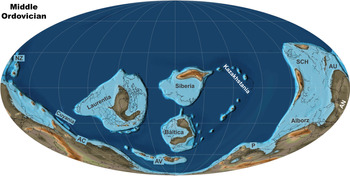
Paleogeographically, during the Furongian and Middle Ordovician, the Precordillera or Cuyania terrane would have drifted away from Laurentia and located within the southern Iapetus Ocean until its final docking with western Gondwana in the Middle–Late Ordovician (Fig. 6) (Astini et al., Reference Astini, Benedetto and Vaccari1995; Benedetto, Reference Benedetto2004; Keller, Reference Keller, Derby, Fritz, Longacre, Morgan and Sternbach2012). The overall linguliformean composition of this last interval, implying Laurentian and Baltic affinities and including the presence of minor endemic elements, is in accordance with this paleogeographic scenario, which is also confirmed by the biogeographic signature shown by the rest of the fauna.
Palaeogeographical reconstruction for the Middle Ordovician (based on Scotese, Reference Scotese2016) showing geographical distribution of the linguliform microbrachiopods association from the Precordillera. Abbreviations are: AC, Central Andean basin; AN, Antarctica; AU, Australia; AV, Avalonia; NZ, New Zealand; P, Perunica; SCH, South China (modified from Lavié, Reference Lavié2020).

Acknowledgments
This paper has benefited considerably from detailed and constructive comments by I. Percival (Geological Survey of New South Wales, W.B. Clarke Geoscience Centre, Australia) and Z.F. Zhang (Northwest University, Xi'an, China). This research was financially supported by grants PUE 2016 CONICET – CICTERRA, Agencia Nacional de Promoción Científica y Tecnológica (ANPCyT-FONCyT) PICT 2016-0588, and was partially developed with the Project PMT-PICT 0468. A. Mestre is grateful to S. Heredia for her assistance in the field and her invaluable comments. Special thanks to M.J. Salas for her contribution with the layout of the brachiopod plates. This paper is a contribution to the International Geoscience Programme (IGCP) Project 653 “The onset of the Great Ordovician Biodiversification Event.”