If we fully understood the nature of industrial entrepreneurship and the conditions under which it flourishes, and I do not claim that we have done more than scratch the surface of that subject, we would at long last be near to answering the great question with which economics began: what are the causes of the wealth of nations?
(Blaug, Reference Blaug1986: 229)
[T]he modern economy, through its ceaseless creation of new economic knowledge, changed radically the material conditions of life . . . The massive effort to innovate evidently permeated nations from the bottom up.
(Phelps, Reference Phelps2013: 53–54)
1. Introduction
Innovation and economic change are the warp and weft of 21st-century life. Innovation is the driving force of economic transformation in modern capitalist society. It is changing the conditions of almost every facet of our material and social lives: how we produce, how we work and do business, how we trade, how we distribute goods and services, how we consume them, and how we communicate and relate to each other. In general terms, innovation is the economic actualization of a new idea, such as a new good or service, a new production method, a new routine, a new rule system (i.e. institution), a new market or a new network. It is a process of emergence that generates economic novelty and variety. It propagates new ways of transforming resources into new patterns that produce qualitatively different structural and functional effects. It disseminates new ways of market making and not just new technological knowledge.
This article examines broad themes relating to the nexus of innovation and institutions. It is organized as follows. Section 2 looks at different economic notions of innovation as a “new combination.” It explores the general nature of new combinations and enquires into their constituent elements, connective structure and processes of formation. Section 3 adopts a bird's-eye view of the institutional and public policy dimensions of innovation according to different analytical approaches (namely, neoclassical, evolutionary, institutional, and Austrian perspectives). Section 4 provides a summary of the articles published in this special issue.
2. Economic conceptions of innovations as new combinations
The idea of innovation as a new combination has proven to be a highly productive concept that figures prominently in the economics of innovation, evolutionary economics, the Austrian theory of capital, and endogenous growth theory. In the language of Gregory Bateson (Reference Bateson1979: 11), the combinatorial view of innovation has itself become a successful “metapattern.” The “combinatoric feedback process,” in which knowledge builds upon itself, is a useful way to model the production of new economic knowledge and may even be the “ultimate abstraction of the innovation process” in that it captures its most fundamental mathematical properties (Weitzman, Reference Weitzman1998: 331, 336). Hence, the notion of a new combination highlights the connections between entrepreneurship and knowledge. Innovation is a process of experimentation in which a growth of economic knowledge goes hand in hand with the generation and testing of new combinations, the modification of existing ones and the replacement of outmoded arrangements. This perspective provides scope for both “conjecture and reasoned imagination” (Shackle, Reference Shackle1972: 96) – that is, entrepreneurial imagination for creating new combinations as well as rational and critical faculties for detecting errors and making sequential adjustments (Harper, Reference Harper1996).
Recombinant innovation is at the heart of the emergence of novelty and of increasing complexity in the knowledge economy. Indeed, new combinations are among the emergent economic patterns that make economies more complex (Harper and Endres, Reference Harper and Endres2012). They are emergent in that their systemic properties depend on their structural and functional organization and the way they were created. The new combination is defined in the process of its emergence and cannot exist independently of it. New combinations can perform functions that are categorically different from those of their parts. In addition, new combinations are unpredictable in principle – there is no rational procedure for predicting the kind and intensity of emergent novelty in advance.
Both evolutionary and Austrian economists use the idea of new combinations to explain endogenous economic change and self-transformation processes occurring in capitalist economies. Through the agency of innovative entrepreneurs (and their firms) who create and carry out new combinations, the economic system creates the process that transforms itself. The combinatorial perspective also throws into sharp relief the institutional framing of innovation in a capitalist system and its inherent paradox: the institutional rules that enable the generation of a spontaneous market order are the very same rules that make possible processes of variety generation and the ensuing instability posed by exposing all existing elements and connections to the possibility of challenge from new combinations (Metcalfe, Reference Metcalfe2010: 46).
Economists’ conceptions of new combinations can differ along two main dimensions: the types of things that are combined (i.e. the kinds of elements that stand in a relation of being combined together) and the nature of the combination operation involved (i.e. the ways in which the elements are connected to count as being combined or as parts of the same combination). These are not pedantic or trivial questions for they determine the kinds of entities and processes that constitute innovation and thus the scope of innovation in the economic system. For example, a combination concept that sees it as solely a connective relation among scientific-technological elements might exclude marketing-related, organizational, and institutional innovation from its purview.
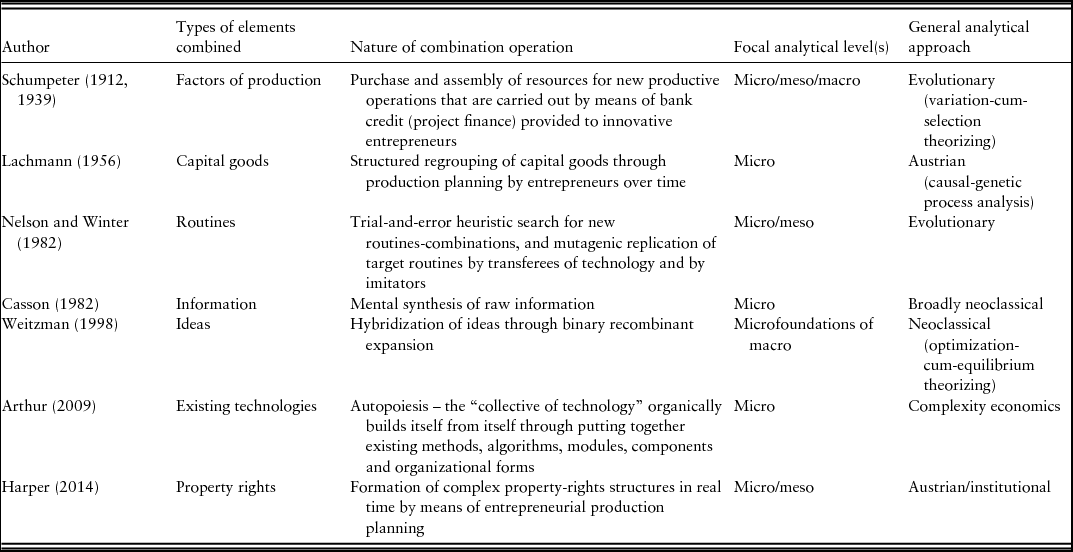
With respect to the types of elements that are combined, there is a diversity of views in economic theory. Table 1 provides a representative listing of combinatorial notions of innovation that have appeared in evolutionary, Austrian, neoclassical, and institutional economic approaches. It is not intended to be exhaustive but to reflect the variety of constituent elements that have been claimed to make up new combinations. This listing reveals at least seven kinds of elements, not mutually exclusive of one another, that can be mixed and matched to form new combinations: factors of production, capital goods, routines, information, ideas, technologies and property rights. These elements reflect different ontological commitments – they presuppose different causal powers, different degrees of generality and concreteness (e.g. ideas are more abstract than material productive factors), different degrees of representation-dependence (e.g. property rights, such as patents, are in part constituted by linguistic representation by relevant parties), different combinatorial possibilities, and different interaction rules for connecting elements together.
Different economic conceptions of new combinations

Identifying the constituents that make up new combinations makes it clear that innovation does not pop up out of nowhere without connections to anything else. Innovations are always rooted in and emerge from something; there is no innovation ex nihilo. Indeed, new combinations are rendered possible by already existing elements (or by elements that can be generated using already existing knowledge) that are available in particular contexts, as described in Schumpeter's (Reference Schumpeter1939) historical account of railroad innovation in the US in the latter half of the 19th century. “Any solution to a human need – and novel means to a purpose – can only be made manifest in the physical world using methods and components that already exist in that world” (Arthur, Reference Arthur2009: 168). Emergent novelties and new combinations spring from connection-making among elements that already exist within a system or that lie across the system boundary. “For where else could novelty come from than by suitable recombinations and selections of available cultural resources? . . . . So, again, what other source of novelty could there be?” (Nickles, Reference Nickles, Meheus and Nickles2009: 200).
Although Table 1 shows a range of perspectives regarding the nature of the combination operation, most scholars tend to regard the combination process as having production as its hallmark. There is much more to carrying out new combinations than mere exchange (e.g. purchasing requisite productive factors). This has several important consequences. First, the time dimension is a more prominent element in our analytical structure. Unlike pure arbitrage, carrying out new combinations is never instantaneous; it always involves intertemporal planning and ongoing organization of production processes that take place in stages over time. Second, as a production process, carrying out new combinations implies more than just the transfer of bundles of property rights between parties: it also entails the transformation of some higher-order resources (e.g. materials, energy, and information) into lower-order goods (e.g. consumer electronics products). Third, carrying out new combinations generally requires more complex kinds of organization than do exchange transactions in markets for factors of production. Fourth, carrying out combinations always involves changing knowledge of production possibilities in a sequential decision-making process. Entrepreneurs are constantly learning as they tweak and try out new economic combinations in the pursuit of more attractive configurations that will appeal to targeted markets. Fifth, carrying out new combinations is a highly uncertain, path-dependent, irreversible process that depends on historical context. New combinations carried out in any given period are partly conditioned by the existing combinations and existing capital structures and structural gaps in previous periods. Sixth, all innovative entrepreneurship is inseparable from market making in that it involves going beyond existing markets by trying to select and attract new groups of consumers with new bundles of goods and services. “In principle, all production is production for consumers” (Schumpeter, Reference Schumpeter2003: 243; original emphasis).
It is also clear that recombinant innovation processes are not just mechanistic operations that physically plug existing elements together. Interpretation is also required to make sense of market conditions and opportunities for new combinations. Entrepreneurs can make use of various interpretive devices, including metaphor and analogy, to select available resources and reconfigure them into new patterns. For example, discovering new uses for existing goods involves metaphorical operations that draw out structural and functional parallels between different contexts of use. Through the use of metaphor, the entrepreneur aims to change people's perceptions of an existing combination by comparing and then extending its current range of application to unexpected uses. In other words, the entrepreneur transforms the combination through an exaptation. For example, the synthetic fiber Kevlar was originally commercialized as a replacement for steel in racing tires because of its high strength, light weight and durability, but DuPont and its collaborators have pushed the boundaries of Kevlar into new economic space, so that it now includes uses as diverse as bulletproof vests and marching-snare drumheads.
In the remainder of this section, we focus upon Schumpeter (Reference Schumpeter1912, Reference Schumpeter1939), Lachmann (Reference Lachmann1956) and Nelson and Winter (Reference Nelson and Winter1982), because their approaches have been particularly influential on subsequent research on innovation.
Schumpeter: new combinations of productive factors
Schumpeter (Reference Schumpeter1912, Reference Schumpeter1934) made the notion of a new combination into a key building block in his theoretical model of endogenous economic change. His ideas on economic change and the “combinatorics” of innovation have proven to be a rich source of inspiration for examining how innovations percolate from the bottom up and propagate through the economy, while rendering less successful firms and product lines obsolete. His approach has come to shape the fields of entrepreneurial studies and evolutionary economics. More often than not, economic theories of invention (e.g. Arthur, Reference Arthur2009) and of innovation (e.g. Baumol, Reference Baumol2002) overtly or implicitly adopt Schumpeter as their starting point.
Schumpeter is widely considered to be the originator of the concept of innovation as a new combination. However, Schumpeter (Reference Schumpeter1934: 76) himself credits Jean-Baptiste Say for being the first to recognize the “combining function” of the entrepreneur. Nevertheless, even if he was not the first to construe the entrepreneurial function in this manner, Schumpeter can certainly lay claim to being the most successful champion of the idea of innovation as a new combination. He effectively drew out its insights within a comprehensive analytical scheme and was the one who made the carrying out of new combinations a central component of a theory of entrepreneurship and a key principle for explaining economic evolution.
The institutions of the monetary economy figure prominently in Schumpeter's model of the realization of new combinations. Indeed, he describes the money or credit market as the “headquarters of the capitalist system” (Reference Schumpeter1934: 126), in which banks extend credit to entrepreneurs so as to finance innovation. Schumpeter defines capital as finance – it is the money invested in the innovator's new production venture. As such, capital is the “lever” (p. 116) that enables entrepreneurs to bid existing resources away from established combinations, so that they can be transferred to new uses within new combinations. In sum, capital constitutes a “fund of purchasing power” (p. 120). Hence, for Schumpeter, real production and monetary exchange are intertwined: the essence of innovation is the building of new combinations by using money-capital to purchase and pry away the factor services required to steer production in new directions.
The carrying out of new combinations is full of causal powers: it brings about economic development; it is also the form and content of economic development (Schumpeter, Reference Schumpeter2002: 434, 412). Indeed, a new combination is defined and identified by its effects. The very notion of “carrying out” a new combination implies producing effects, bringing new ideas into effect in the outside world, and making a difference to the uses to which productive factors are put. All entrepreneurial tasks involve carrying out different uses of the means of production, uses that are outside the realm of tried and trusted routines (Schumpeter, Reference Schumpeter2003: 249–250). The consequences of the entrepreneur's conduct are the basis for any decision about whether the carrying out of a particular combination is novel or innovative. A new economic combination must bear fruit – produce novel, synergistic effects. More specifically, to qualify as innovation, a new combination must bring about one or more of the following types of effects: the introduction of a new good or service (including new qualities of goods or services); the introduction of new production methods; the creation of new forms of industrial organization; the opening up of new markets for the sale of goods or services; and the opening up of new sources of supply (including new markets for inputs) (Schumpeter, Reference Schumpeter2003: 250).
Schumpeter also focused upon the macroeconomic effects of new combinations and specifically their role in the cyclical nature of capitalist economic development. Indeed, new combinations are a recurrent idea in Schumpeter's (Reference Schumpeter1939) Business Cycles, a work that sought to integrate innovation with the study of cyclical fluctuations. Here new combinations, surrounded by a penumbra of attendant effects, become the “common cause” that are “at the root” of all the different types of business cycles, with the largest waves corresponding to the most fundamental new combinations and major technological shifts.
Innovation carries new things into effect and produces changes that become a fundamental part of capitalist reality (Schumpeter, Reference Schumpeter1947: 152). Different types of new combination have different kinds of effects. On the one hand, the changes wrought by new combinations tend to be leap-like and discontinuous rather than smooth adaptive responses to the existing expressed wants of consumers (Schumpeter, Reference Schumpeter2002: 429). On the other hand, to qualify as innovative, the effects generated by a combination do not need to be “spectacular” or of “historic importance” (Schumpeter, Reference Schumpeter1947: 151). Similarly, these effects do not have to embody anything that is “scientifically new” (p.152). Often there is no “scientific novelty” involved at all in successfully putting an untried production method into practice. And even in those cases in which scientific novelty is involved, this in itself does not make a difference to the nature of the combinatorial innovative process (Schumpeter, Reference Schumpeter1928: 378).
It should be noted that only two out of the five types of effects listed above are inherently technological. Schumpeter's recombinations do not apply only to technology. Indeed, an argument could be made that these effects have more to do with market making than technology. Every one of the five types listed above can entail creating new markets or at least reshaping existing markets. For example, introducing new production methods can require opening up new markets for new means of production to be used in the new production process.
Lachmann: new combinations of capital goods
Schumpeter's analysis of innovative entrepreneurship and of its leading role in the dynamics of capitalist economies influenced Lachmann's theory of market processes and capital change. According to Lachmann (Reference Lachmann1956), innovation is a capital formation process. Capital comprises complementary combinations of heterogeneous capital goods. Any resource (including human capabilities and all that nature provides) qualifies as capital as long as it is used in a production plan (pp. 11–12). Not all capital goods are human-built, but all of them are human-used (p. 53). A production plan is a mental construct – “a web of thought” (Lachmann, Reference Lachmann1986: 118) – which guides entrepreneurial action and innovative combinatorial activities. Innovative entrepreneurs bring new combinations into existence through experimenting with new complementarity relations (i.e. new connections) among capital goods that are either available now or are expected to become available to entrepreneurs at some future date. “Designed complementarity” exists whenever, within the unified structure of one production plan, different means are intended to be used together to attain a common set of ends (Lachmann, Reference Lachmann1956: 54–55).
Whereas early Schumpeter was concerned mainly with external capital change (the formation of new capital combinations through the creation of new firms), Lachmann focuses on internal capital change as an important source of innovation – that is, the regrouping of existing capital resources within existing firms (Lachmann, Reference Lachmann1977: 210). In addition, Schumpeter emphasizes the substitutions entrepreneurs make as they break up existing combinations and shift their redeployable parts to new combinations, while Lachmann emphasizes complementarity relationships among resources that are part of the same entrepreneurial production plan. Furthermore, Lachmann offers us a distinctively morphological approach to innovation through his emphasis upon the shape of the capital structure, its ever-changing forms and structural patterns, the heterogeneity of resources and their functional variety. This morphological approach recognizes that the entrepreneur does not merely combine means of production through contracting factor services. In the realm of production, the real function of the innovative entrepreneur is to specify and modify the concrete form of capital resources (e.g. such as the layout of a manufacturing plant), to make decisions on their mode of use, and to re-form and dissolve capital combinations (Lachmann, Reference Lachmann1956: 99).
For Lachmann (Reference Lachmann1956: 72), capital combinations are the “atoms” or “ultimate constituents” in capital formation as well as the microeconomic basis of innovation processes at meso- and macro-levels. Capital combinations are the results of individual acts of entrepreneurial choice and imagination. The focus upon capital combinations in innovation drives home the point that the realization of emergent novelties (e.g. new deliverable functionalities) requires that capital goods be fitted together and arranged in particular ways – by itself, a single capital good cannot yield any services or produce any output. It also requires innovation to take concrete forms that are complementary to various existing capital combinations and that reflect gaps left open by the prevailing capital structure (pp. 6–7). Furthermore, as a new combination fills in existing gaps, it may also open up new holes and new opportunities for yet further complementary combinations by other entrepreneurs. Innovation never leaves the prevailing structure of capital intact (Lachmann, Reference Lachmann1977: 207).
More so than other economics scholars considered here, Lachmann emphasizes the interpretive dimension of innovation and entrepreneurial action (Endres and Harper, Reference Endres and Harper2013). Whenever innovators create new capital combinations or fine-tune existing capital complementarities, they are always making their plans on the basis of their own interpretations of past economic events and their individual expectations about future events (Lachmann, Reference Lachmann1986: 4). There are no brute market “facts”; all market “data” used in planning new combinations are impregnated with interpretation and expectation. Innovation through combining capital is the result of purposive behavior: it is always referenced to the particular goal and state of knowledge (beliefs and expectations about how to achieve that goal) of the entrepreneur who creates capital.
Nelson and Winter: new combinations of routines
Schumpeter's perspective on the market as a selection process was also a primary intellectual source for Nelson and Winter's (Reference Nelson and Winter1982) evolutionary theory of economic change. They portray innovation as consisting largely of a recombination of already existing organizational routines. They define an organizational routine as a regular, coordinated and predictable pattern in a firm's behavior (pp. 14, 21). Routines are templates for governing and coordinating an organization's action sequences; they are the “skills” of the organization (p. 124). Like biological genes, organizational routines are persistent, replicable, and selectable characteristics (p. 14). As components of new combinations, organizational routines come in three types: operating routines that govern the firm's short-run behavior, investment routines for changing the firm's “capital stock,” and search routines for generating innovations. Search routines change the firm's existing operating, investment and lower-level search rules. They are the rules by which firms seek out new means (new routines-combinations) for enhancing their performance. Search routines are themselves organized hierarchically, with higher-level decision rules (e.g. for evaluating and changing the firm's current R&D program) governing lower-level rules (e.g. for deciding on changes to its current production techniques) (pp. 17–18). Search routines are the locus of innovation; they also generate “mutations” stochastically (p. 400).
Thus, the innovation process at the enterprise level is rule-guided: search routines govern the firm's choice of useful new combinations and the rejection of useless ones. Innovation proceeds via a heuristic search process in a well-defined design space of possible routine changes. Hence, although the results of a firm's innovative activity are highly uncertain, the firm's conduct in bringing new combinations into existence may display a clear-cut and predictable pattern. The firm's efforts to produce innovations and to find solutions to innovative problems are partly routinized, thereby generating “patterning of particular ways of attempting to innovate” (pp. 132–133).
Nelson and Winter stress that any innovation is always technological, organizational, and institutional. New products and process innovations often require market-making activities too:
Major changes in the nature of the goods or services being provided, and in how they are used or produced, often make prevailing methods of buying and selling obsolete . . . . When this happens, new modes of structuring markets, or new markets, may be needed. (Nelson, Reference Nelson2013: 36)
For instance, McDonald's not only standardized its hamburgers, but it also changed the layout of its production facilities, developed completely new “just-in-time” production routines for preparing hamburgers and designed new franchising arrangements. “McDonald's created not simply a new product, but a whole new market category” (Valéry, Reference Valéry1999: 5).
Similarly, new combinations of organizational routines will always encompass both production technology and decision technology. In other words, they include both the firm's set of ways of doing things and its ways of determining what to do (Nelson and Winter, Reference Nelson and Winter1982: 400). Hence, their approach blurs the line between those routines involved in carrying out a particular new combination (e.g. a new production technique) and those routines involved in choosing which new combination to carry out. In effect, new combinations are defined in the process of being implemented. Unlike neoclassical models, Nelson and Winter do not distinguish sharply between the choice set and the technology of choice.
The boundaries of new routines-combinations are fuzzy, not well defined. The novel core of new routines-combinations is often complemented by familiar routines (e.g. for shipping the new product to distributors) that have been tried out and withstood testing over many periods. Indeed, Dopfer (Reference Dopfer2004: 183) opines that Nelson and Winter's routines are actually rules that have attained institutional status. Established routines are no longer regarded as problematic in the light of the firm's background knowledge, provided they are used within their usual range of application and other specified conditions are met. Reliable routines assist learning from mistakes. When obstacles are detected in carrying out new combinations, these routines make it easier to disentangle causes from effects and to diagnose the source of problems (pp.130–131). Just as scientific progress relies upon existing background knowledge, so too business success and economic change at the “innovative frontier” depend on a stable set of established routines that provide a basis for economic calculation and entrepreneurial decision-making (p. 131).
3. The institutional and policy dimensions of innovation
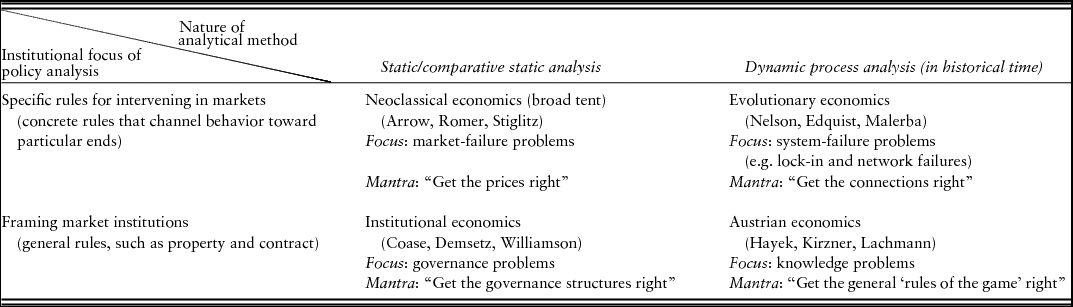
Explaining the relationship between economic institutions and innovative behavior, and illuminating the appropriate set of institutions for sustaining innovation, are topics that are hotly contested in academic and policy debates. These discussions are taking place within the context of a wider-ranging examination of the fundamental role of the state in economic affairs (e.g. Moreau, Reference Moreau2004). Our habitual ways of thinking about economic behavior, markets and other institutions frame how we see innovation and locate the factors that are most causally and teleologically connected to it. Our vision of the market economy affects how we define innovation problems and understand their various aspects and their interrelations, and how we think about alternative institutional and public-policy solutions to innovation problems. It shapes our thinking about the rationale, means and limits of innovation policies. This section (summarized in Table 2) compares neoclassical, evolutionary, institutional, and Austrian approaches according to their general outlook on the institutional and policy dimensions of innovation.
Different economic approaches to innovation and institution building

Neoclassical economic analysis
The economic vision underpinning the traditional market-failure approach sees markets for innovation (new knowledge) as riddled with inefficiency. The inherent defects of these markets cause them to malfunction and fail. Wherever such markets do not work, the state needs to intervene to ensure better outcomes. Neoclassical economists conduct policy analysis of innovation problems within an equilibrium framework that assumes maximizing behavior and stable preferences. The typical diagnosis is that the allocation of resources to innovation in a market economy is socially inefficient and Pareto-suboptimal; real-world market institutions are expected to underinvest in innovation as compared with the ideal norm of perfect competition. The usual culprits for the alleged “innovation market failure” include uncertainty about the prospects of innovative ventures, incomplete appropriability of the returns from innovation, knowledge spillovers, asymmetries of information between innovators and outside investors, indivisibilities (and increasing returns) inherent in the production of new knowledge, and the lack of complete futures markets. (The classic exposition is Arrow (Reference Arrow and Nelson1962).) It is then concluded that optimal allocation to innovation requires rational government action to substitute for or to intervene in specific markets, with the choice of policy instruments (e.g. R&D tax incentives, subsidies) depending upon the exact source of the purported market failure. The approach is regularly invoked to explain and to justify innovation policy intervention (e.g. Martin and Scott, Reference Martin and Scott2000; OECD, 2015). Indeed, all OECD governments have employed market-failure arguments to carry out specific interventions for promoting innovation (OECD, 2010: 88). The enduring prominence of neoclassical welfare economics as a “meta-rationale” for government action accounts for the widespread persistence of market-failure approaches to innovation policy (Laranja et al., Reference Laranja, Uyarra and Flanagan2008).
Market-failure logic also underpins the recent reemergence of “new” industrial policies (Rodrik, Reference Rodrik2007; Stiglitz and Lin, Reference Stiglitz and Lin2013) and the related concept of “smart specialization strategies” (Foray et al., Reference Foray, David and Hall2009). The “new” industry policies are based on so-called “generic market failures,” which include positive “learning externalities” (e.g. cross-sectoral learning spillovers). The presumption is that unfettered markets, on their own, do not generate optimal levels and patterns of innovation; “there is a role for government to ‘correct’ the market failure” (Stiglitz and Greenwald, Reference Stiglitz and Greenwald2014: 161).Footnote 1 Because markets can innovate in the “wrong” direction and thereby compromise long-run economic growth, the government needs to step in to shape the structure of a market economy and to redirect technological change. Through subsidizing entry and innovation in particular sectors while taxing others, the approach aims to promote particular technologies and particular industries (such as energy, ICT and transportation) that generate the greatest learning spillovers to other sectors. Moreover, new industrial policies may even be extended to become a permanent fixture of the institutional framework of an innovative economy (Stiglitz and Greenwald, Reference Stiglitz and Greenwald2014: 7, 321). Similarly, the smart-specialization policy approach aims at structural transformation of the regional or national economy by identifying the strongest innovation domains for future specialization (i.e. the most promising set of innovative activities for knowledge-based investments) that exploit a region's existing productive capabilities and knowledge networks (OECD, 2015).
Evolutionary economic analysis
Evolutionary economics is located in the upper-right quadrant of Table 2. Dynamics are at the heart of evolutionary economics. The approach offers a dynamic analysis of evolutionary economic systems and of processes of variety generation, selection and retention in historical time. “The tape of history is only ever played once” (Metcalfe, Reference Metcalfe2010: 66). It recognizes the dynamic nature of innovation and of technological change (both along existing technological trajectories and within new technological paradigms), and it also examines industrial dynamics and co-evolutionary processes at the meso-level.
Leading evolutionary economists have given increasing attention to the institutional aspects of innovation (e.g. Metcalfe, Reference Metcalfe2001, Reference Metcalfe, Malerba and Brusoni2007; Nelson, Reference Nelson2002a, Reference Nelson2002b; Nelson and Sampat, Reference Nelson and Sampat2001). They recognize explicitly the role that institutions play in shaping the pace and pattern of innovation. It is fair to say that evolutionary economists have done more to integrate institutional insights into their analyses than have institutional economists done to include dynamics in their theories.
Evolutionary economists typically see a more prominent and active role for the state in institution building and innovation policy than do institutional and Austrian economists. They acknowledge the importance of framing rules of the market but invariably argue for their supplementation with specific and concrete policy measures, such as targeted innovation policy instruments (specific STI policies) directed at specific sectors or regions. For example, Edquist (Reference Edquist2011) recognizes that innovation policy is “partly a matter of formulating rules of the game to facilitate innovation processes” (p. 1738), while at the same time seeing a role for public organizations to provide finance (e.g. seed capital) and subsidies “when firms and markets do not spontaneously perform this activity well enough” (p. 1739). Evolutionary authors believe that the state can be a “facilitating institution of the market process,” which can enhance coordination between different types of agents (e.g. innovative firms and workers) (Moreau, Reference Moreau2004: 853). They emphasize the potential for government intervention to mold the institutional set-up and to reshape the structure of production in order to encourage innovation. Although evolutionary policy analysis can seem on occasion to lean toward macro-institutional engineering, other evolutionary scholars at times highlight a spontaneous-order perspective, emphasizing that the goal of innovation policy is to promote the self-organization of innovation systems (e.g. Metcalfe et al., Reference Metcalfe, De Liso, Gagliardi and Ramlogan2012).
The “systems of innovation” (SI) approach takes center stage here because evolutionary economists (e.g. Nelson, Reference Nelson1993) have been heavily engaged in its development and the approach has become a dominant perspective for informing innovation policy. The SI approach concerns itself with the design and enhancement of innovation systems at the national, regional, and sectoral levels. Innovation systems are regarded as complex configurations of institutions that propel the process of economic evolution. Its adherents tend to subsume market failures under the umbrella of “system failures.” Hence, the innovation systems approach complements and integrates, rather than supplants, neoclassical market-failure arguments. System failures include infrastructural failures (e.g. inadequate ICT), technological lock-in problems, insufficient use of “dynamic complementarities” (missing connections among technologies, inputs and demand (Malerba, Reference Malerba2002)), and institutional failures, such as occurs when agents’ habits, organizational routines and social rules are out of sync and misaligned with widespread technological changes. Schmidt (Reference Schmidt2018) regards this pervasive “failure thinking” as a relic of neoclassical optimization-cum-equilibrium reasoning that must be eliminated in order to rectify serious internal contradictions in evolutionary approaches to economic policy.
The innovation systems approach emphasizes “getting the connections right.” The primary aim of policy is to promote innovation through the “principle of connectivity – the bridging together more effectively of the different actions and institutions involved in the innovation process” (Metcalfe and Georghiou, Reference Metcalfe and Georghiou1998: 94; emphasis added). The approach often casts the state in the role of a “matchmaker” or “organizer” that fosters associations between public agencies, firms and other organizations. Public intervention to increase connectivity shifts the policy focus away from individual actors and toward collaborative linkages across sectors, such as through facilitation of closer university-industry relationships. It favors policy instruments (“bridging mechanisms”) for constructing and coordinating dynamic interactions among system-elements and the development of networks and innovation clusters. The approach can also see the state taking a leading role in the formation of new product markets (Edquist, Reference Edquist2011: 1734–1735). Public support for market making includes public procurement for new products and systems, the introduction of technical standards, and the creation of intellectual property rights such as patents.
Institutional economic analysis
New institutional economists reject the neoclassical market-failure approach to innovation policy because it excludes transaction costs and fails to compare and assess alternative real-world institutional arrangements. As is well known, the logic of market failure adopts the ideal type of perfectly competitive markets as its normative yardstick for judging institutional efficiency. To practice that approach is, therefore, to engage in what Demsetz (Reference Demsetz1969) calls “nirvana analysis” because this ideal norm has no existence in reality and no likelihood of ever existing in a complex, evolving market system in which transaction costs are positive and innovation drives competition. For these reasons, new institutional economists favor a comparative institutional approach to innovation policy, which does not concern itself with optimality per se and only presents policy choices as deciding between a set of feasible modes of organization, which are all more or less imperfect. Their guiding principle is not how to correct market failure, but how to remove impediments (e.g. government-induced transaction costs) to the workings of markets and other governance mechanisms.
New institutional economics is located in the lower-left quadrant of Table 2 because it tends to apply comparative static methods for examining innovation (e.g. comparisons of ex ante and ex post contractual situations). In general, new institutional economic approaches do not map out the temporally extended causal processes by which economic changes, such as innovation, are produced. (An exception is North (Reference North2005) who addresses dynamic processes of economic development.) In addition, institutional economics tends to focus on general rules, such as property rights and generic modes of economic organization, rather than specific government interventions in markets aimed at particular results. Property rights structures affect the number of people who can innovate, their incentives to innovate and, in combination with contractual freedom, they provide a mechanism by which consumers can accept or reject the innovations generated through entrepreneurial activity (Pejovich Reference Pejovich1984: 429).
This section focuses upon transaction-cost economics (Williamson, Reference Williamson1985) and the economics of property rights (Barzel, Reference Barzel1997; Demsetz, Reference Demsetz1967) because they are both directly applicable to innovation policy and the analysis of the institutional dimension of innovation. Both approaches are also highly complementary. These approaches bring transaction costs and property rights to the forefront of the economics of innovation – one concept without the other is like “a ship with a name but no rudder” (Allen, Reference Allen2015: 712). Transaction costs are the costs of creating and maintaining property rights. All stages of the production, transfer and dissemination of new knowledge involve transaction costs. Transaction costs include the search costs in finding potential customers and suppliers, information costs in setting up a transaction to exchange new knowledge (e.g. new technology licensing), bargaining and decision costs in working out the small print of a contract, and policing and enforcement costs in making sure the transaction is carried out as planned (e.g. monitoring the quality of new products and production processes). Because in practice transaction costs are always positive and ubiquitous, therefore, property rights and contracts over innovation are never perfectly defined and their enforcement is never complete.
The transaction-cost and property-rights approaches are used to explain the way innovation is organized, how it is conducted and financed, the design of incentive and control structures for carrying out innovation, and the nature and incompleteness of intellectual property rights to new knowledge assets created by innovative activity. Transaction-cost analysis also examines how bounded rationality, opportunism and informational asymmetries can impede contracting during the innovation process. Transaction costs can hinder and block the formation of markets for new knowledge and preclude the use of various kinds of governance. Transaction-cost economics focuses mainly upon the ex post governance of transactions (i.e. ex post implementation) rather than on ex ante incentive alignment.
Transaction-cost economics entails discrete structural analysis of the institutions for governing contractual relations required to bring innovations into effect. Institutions of governance (what Williamson calls “governance structures”) are often partly the result of human design, reflecting “an effort to craft order” so as “to mitigate conflict and realize mutual gains” (Williamson, Reference Williamson2000: 599). The set of generic governance structures for organizing transactions during the innovation process includes spot markets, incomplete long-term contracts (bilateral private ordering), trilateral governance (enforcement through a third party, including the courts), hybrid ownership modes (franchising, joint ventures, strategic alliances), firms (internal hierarchical organization, i.e. vertical integration), and public bureaus. A transaction-cost framework for innovation policy uses this taxonomy of governance structures to determine whether existing policy instruments (e.g. antitrust policy) may be obstructing any of the governance mechanisms for organizing transactions to carry out different types of innovation (e.g. joint-venture arrangements).
The transaction-cost approach to innovation policy does not involve trying to induce an optimal level or pattern of innovation but rather it allows market and private-sector mechanisms to determine the kinds of innovation and new combinations to be carried out. In addition, the focus of policy analysis is the creation, policing and enforcement of property rights and other general rules of the game. This involves a range of trilateral governance mechanisms, such as patents, copyrights and trademarks, and general support for bilateral contractual arrangements via the legal system. The provision and funding of innovation through the “public bureau” is the “organization form of last resort” (Williamson, Reference Williamson2000: 603). Furthermore, the transaction-cost approach makes it clear that the breakdown of market governance of innovation transactions (alleged “market failure”) is not in itself an automatic justification for government intervention (Bollard et al., Reference Bollard, Harper and Theron1987). Markets are only one of several governance structures available, so that private-sector agents can partially overcome so-called “market failures” by replacing external market transactions with vertical integration or other institutional modes of organizing particular types of innovation (e.g. joint-venture arrangements).
Austrian economic analysis
As Table 2 makes clear, the Austrian approach to innovation employs dynamic process analysis – a causal-genetic method that studies how temporal processes result in economic change and emanate from the interaction and revision of individual plans over time. Accordingly, it treats innovation as an open-ended, dynamic, endogenous process. The focus of policy analysis is upon cultivating innovation by securing the appropriate institutional environment. (For a detailed specification of the Austrian approach to public policy in general, see Harper (Reference Harper2003: 171–210).) For example, Harper and Endres (Reference Harper and Endres2015) argue that by far the most important “innovation policy” in a modern market economy is made up of the general rules of property and contract that frame production, capital formation and market-making activities for new goods and services. The emphasis is upon maintaining the generality, stability and certainty of property rights. Indeed, the abstract legal order of a market economy includes a relatively invariant set of property forms (including patents, copyright and other kinds of intellectual property), which innovators can combine in novel and unexpected ways to create more complex structures (Harper, Reference Harper2014). General rules of conduct reflect a long-run orientation in that they are framed in terms of typical situations and are useful for as yet unknown ends of as yet unknown people. Austrian economists argue that these general institutional rules are more significant for innovation processes than the specific government interventions intended to encourage particular high-tech sectors and particular new technologies. The real locus of innovation in the market economy is the pervasive reshuffling of capital goods by entrepreneurs and co-creative users in the private sector.
The institutional order of competitive markets decentralizes and disperses the task of producing new knowledge to an open class of as yet unknown entrepreneurs. It seeks to generate the broadest possible network of potential innovators. The rationale is that, in a world of structural uncertainty, it is not possible to determine in advance who will conceive the best new ideas. We cannot predict who will innovate, nor when, where or how they will innovate. General institutional rules ensure that as yet unknown entrepreneurs, who have the imagination to experiment with new combinations and who have the local knowledge suited to carrying them out, will be attracted to these very opportunities (Hayek, Reference Hayek1949: 95). In contrast, state-led innovation policies aimed at specific concrete purposes (e.g. “mission-oriented” innovation policies (Mazzucato, Reference Mazzucato2016)) hamper spontaneous market-based innovation processes – the very processes that can make fuller use of the available local knowledge, distributed among market participants, as they each pursue various purposes whose relative significance only they appreciate (Hayek, Reference Hayek1949: 77–78). Furthermore, the degree of complexity of the innovation problems addressed by polycentric market processes is not limited to what can be handled deliberately by centralized government planning. For Austrian economists, recognition of the limits of human knowledge shapes innovation policy and argues for caution in displacing self-ordering market institutions: because they recognize that they will never have knowledge of all the relevant circumstances of time and place, Austrians refrain from recommending one-off government interventions even in those exceptional situations in which they perceive that selective adjustments to spontaneous market outcomes might be desirable (Hayek [1963] Reference Hayek and Caldwell2014: 226).
The Austrian approach to policy seeks to support the innovative capability of market systems indirectly by strengthening the institutional rules of the game that frame market processes (and that generate a spontaneous pattern of innovation), rather than directly by trying to engineer particular innovative outcomes through specific ad hoc interventions into market processes (Vanberg, Reference Vanberg2001: 40–41). For example, Austrian economists search for the source of alleged cases of “market failure” (e.g. “externalities,” such as knowledge spillovers from innovative activity) in potential gaps in the “outer” framework of laws and other institutions within which the market operates (Kirzner, Reference Kirzner2000: 77–87).
From an Austrian perspective, the knowledge requirements for selective targeted innovation policies are logically and practically impossible to fulfill. Policy makers cannot improve on the spontaneous pattern of innovation generated by markets because they can never have sufficient knowledge of the evolving structure of the economy that would be required to consciously implement a planned configuration of particular technologies, sectors, and markets. Even piecemeal government intervention into the market process generates dislocations and unintended consequences that are undesirable from the perspective of the policy maker and that in turn give rise to a spiraling series of ever-more extensive follow-up interventions. Furthermore, unlike neoclassical economists, Austrians avoid using the technical Pareto criterion as a standard of societal economic efficiency because it presumes omniscience (and omnipotence) on the part of the observing economist or social planner (Hayek, Reference Hayek1949: 104–105; Kirzner, Reference Kirzner1992: 152–162).
The Austrian economic approach recognizes the causal connections among successful innovation and profitability. Innovators must be allowed to exploit the market opportunities that they discover and keep the profits that they make. Profits arise from successful innovative activity and are not the result of monopoly power. Furthermore, according to Austrians, monopoly rents tend to be transient in competitive market processes. The focus of policy analysis is thus on discovering whether government-imposed barriers and other arrangements are inhibiting market processes from reducing or eliminating these rents.
4. The collection of articles in the special issue
The articles in this special issue of the Journal of Institutional Economics examine the institutional settings within which innovative activities occur. The articles span multiple perspectives. As befits this Journal, the center of gravity is institutional economics, but insights from a range of other intellectual traditions are to be found, including economic history, the history of economic thought, Austrian and evolutionary economics, and industrial organization. The articles focus mostly upon innovation in a market-based economy in which the private sector is the primary motor of innovation, but the impacts of government participation and the ecology of political enterprises (such as those in healthcare services) also come under scrutiny. The research questions addressed can be grouped loosely into four main themes: (1) Is innovation a bottom-up process among individuals? (2) Does the innovation process involve recombination, and if so, how? (3) How do intellectual property rights affect the innovation process, including the appropriation of returns from innovation? (4) How do institutional arrangements differ in how they screen, and make resources available to, competing innovation projects?
Forms of innovation: is innovation a bottom-up process among individuals?
The first article, by Joel Mokyr (Reference Mokyr2017), turns to economic history to investigate whether the Industrial Revolution had its roots in top-down or bottom-up processes of technological change. He argues that the technology-driven economic development of early modern Europe depended mainly upon a relatively small number of people – a technological elite of scientists, engineers, mechanics and skilled artisans, whose novel ideas, techniques and attitudes gradually worked their way into larger and larger segments of the population. Technological advance was mostly a top-down phenomenon (“the few dragging along the many”) that emanated from the upper tail of the distribution of human capital. It also involved significant human–capital complementarities throughout the economic system – among inventors, craftsmen, engineers and skilled workers. Social connections among the elite minority also mattered. The “vital few” did not work in isolation but were embedded in a particular community of practice – a social network of literate people of the time (a “Republic of Letters”) that extended beyond national boundaries. Mokyr considers how the production of new knowledge was incentivized. He pinpoints reputation mechanisms in the Republic of Letters as the most powerful incentives for motivating scholars and intellectuals to produce new ideas. With gains in social reputation and prestige came material rewards in the form of patronage jobs, endowed named chairs at universities, membership in honorary societies and pensions from affluent patrons.
In the next article, Jason Potts (Reference Potts2017) puts the spotlight on a significant, but generally unacknowledged, institutional feature of modern market economies, which he dubs “the innovation commons.” This institutional form organizes innovation in its very early stages when agents are ignorant of the nature of the entrepreneurial opportunities that a new technological idea might generate. The innovation commons is a self-organizing and largely informal network of “proto-entrepreneurs” and technology enthusiasts. It emerges from the bottom up within a broader framework of civil society institutions that gives individuals the freedom to innovate and experiment. The concept of the innovation commons has important implications for the economic theory of entrepreneurship and innovation. First, Potts puts forward the bold conjecture that innovation commons exist at the origin of all Schumpeterian innovation trajectories when knowledge is distributed and uncertainty is high. The innovation commons is not a substitute for markets and firms but is complementary to these institutions. Second, Potts challenges the individualistic bias exhibited by leading entrepreneurship theories. The higher-order discovery of entrepreneurial opportunities at the very early stage of an innovation is not confined to the mental activities internal to a single individual but is instead a socially distributed process involving multi-agent structures (see too Harper, Reference Harper2008).
Mechanisms: does innovation involve recombination?
In his article, Dick Langlois (Reference Langlois2017) critically examines the notion that innovation is essentially recombination and the role that institutions play in such processes. He distinguishes two types of recombination: non-modular recombination through “analogy” and modular recombination through “swapping components in and out.” Recombination through analogy is often associated with systemic innovation, such as occurred in extending the idea of a locomotive to road transportation in the early stages of the automobile industry. In contrast, modular recombination involves varying the composition and internal workings of modules (e.g. amplifiers, speakers and turntables in stereo systems) while keeping the basic architecture constant.
Langlois argues that the notion of innovation-as-recombination has its limits and does not capture all the kinds of innovation in market economies. In particular, the combinatorial conception needs to be supplemented by studying two other innovation processes, also identified by Adam Smith, that do not fit under the recombinant rubric: namely, subdivision and fine-tuning. Langlois explains the nature of these two processes, analyses their implications for economic organization and suggests how they might be reconciled with recombinant approaches within an augmented Smithian framework that treats all innovation as a problem-solving process. In order to illustrate the different kinds of innovation processes, Langlois provides a case study of three generations of the Sprague family who were active innovators in the electricity and electronics industries in the United States from the late 19th century onwards.
In the next article, Harper and Endres (Reference Harper and Endres2017) investigate how brand capital is created from a complex adaptive systems perspective. Brand building is an innovative process with recombinant capital formation at its core; it involves discovering and filling gaps in the existing capital structure. Entrepreneurs and co-creative users can reconfigure brand elements to create new combinations and to actualize novel ideas. Entrepreneurial brand building is a forward-looking, connection-making process that comprises four main entrepreneurial activities. (1) interpreting, extracting and communicating meaning; (2) specifying new combinations of brand capital; (3) economic appraisal; and (4) market making.
According to Harper and Endres, generative networks, and not firms, are the institutional loci of entrepreneurial brand building. Generative networks extend well beyond firms’ boundaries to encompass well-organized users and customers, so that brand building becomes highly distributed in social space. Online brand communities of consumers (e.g. for Harley Davidson, the Mini Cooper) are an example. Harper and Endres also explore the institutional characteristics of iconic brands, which serve as both routines and constraints on human action and which also act as “beacons” that guide market behavior and improve economic coordination in markets.
Intellectual property and appropriating returns from innovation
Jonathan Barnett's (Reference Barnett2018) article examines two kinds of “giveaway” strategies in digital content markets where informational goods are distributed as “free stuff” at zero prices. The first are voluntary giveaway strategies, such as Tesla's announcement that it would not enforce its patents associated with electric cars. The second are involuntary giveaway strategies, such as when a content aggregator gives away the IP rights held by content creators. Barnett identifies two main goals that motivate firms to adopt these giveaway strategies: first, to create an installed user base that is necessary for realizing network effects in technology and content markets (e.g. by supplying search engine services at no charge through Google Search); and second, to shift value capture to another production stage in which the firm, acting as a downstream intermediary between users and content creators, is able to generate revenues and appropriate returns on its investment (e.g. as Google does by offering advertising services at positive prices through Google Ads). Barnett then identifies a two-pronged evolutionary selection process in digital content markets. He concludes that weak IP regimes and giveaway strategies may distort the selection of organizational forms, reduce allocative efficiency in complementary goods markets and reduce the dynamic efficiency (innovativeness) of primary informational goods markets.
Institutions and the screening and funding of innovative ideas
In their article, Scott Shane and Nicos Nicolaou (Reference Shane and Nicolaou2017) examine the emergence of new institutions for financing early-stage high-growth technology companies since the late 1990s. They identify four major new institutional developments: angel groups, business accelerators, micro venture capital funds, and online equity crowdfunding platforms. According to the authors, technological change in the software innovation process has been the main cause of these institutional changes. First, a spectacular reduction in the cost of developing and commercializing new software products gave rise to less capital-intensive models of innovation. This has been by far the most significant cause of institutional change. Second, there was increasing automation of activities that are typically difficult to measure, such as the selection and valuation of new ventures. Third, ICTs and online platforms reduced the obstacles to market making by reducing the transaction costs involved in connecting geographically dispersed start-up entrepreneurs and early-stage investors. The four new institution arrangements have had a dramatic effect on the traditional venture capital industry, in terms of its size, pattern of investments, and geographical concentration.
In the final article of the special issue, Rebecca Eisenberg (Reference Eisenberg2018) examines the production of healthcare services and biomedical innovation in the US from the analytical perspective that treats these activities as a knowledge-generating process. Such a “learning healthcare system,” as she calls this knowledge process, leads to significant institutional change – changes in the functional specialization of different organizations (e.g. the FDA) and adjustments in the relationships of complementarity between them. It reorients the roles of institutions that currently drive innovation in healthcare. In addition, it changes the research problems that are pursued and the epistemic standards that determine what constitutes “actionable knowledge.” It also leads to differences in the content, timing, location and funding of the production of knowledge in the course of healthcare delivery. A learning healthcare system also affects the ability of different parties to appropriate the returns from their investments in healthcare research and data analysis. In effect, a learning healthcare system entails system-level changes in the architecture of biomedical innovation (“systemic innovation” in Langlois’ terminology).
Eisenberg highlights how a learning healthcare system puts existing electronic databases to new and often unanticipated uses. In particular, it repurposes electronic healthcare records and health insurance claims so that they can be used as data sources in observation studies for evaluating health technologies and alternative treatments. In so doing, the system provides larger data sets and clinically more relevant data from more diverse patient populations than what is ordinarily obtained through pre-market randomized clinical trials conducted by pharmaceutical companies.
5. Coda
Earlier versions of the articles in this special issue were presented at the New York University Symposium on “Innovation and Institutions from the Bottom Up,” organized by the Program on the Foundations of the Market Economy, Department of Economics, New York University.Footnote 2 The conference was held in the NYU School of Law on December 2, 2016. The order of the articles in the special issue more or less reproduces the order of presentations at the conference.Footnote 3