I. INTRODUCTION
Ordered B2-type (CsCl structure) iron-rhodium (FeRh) alloys have been subject of theoretical and experimental studies due to their interesting properties such as magnetocaloric effect,Reference Manekar and Roy1 elastocaloric effect,Reference Nikitin, Myalikguliev, Annaorazov, Tyurinb, Myndyevb and Akopyan2 giant magnetostrictionReference Ibarra and Algarabel3 and giant magnetoresistanceReference Sharma, Aarbogh, Thiele, Maat, Fullerton and Leighton4 occurring close to room temperature. These interesting characteristics in this alloy system are thought to arise due to a first-order magnetostructural phase transition from an antiferromagnetic (AFM) to ferromagnetic (FM) state when heating beyond a critical transition temperature (Ttr). This property has created great interest in thin films of this material to be used for temperature-dependent exchange coupling layers in heat-assisted magnetic recordingReference Maat, Thiele and Eric5 and magnetic random access memory (MRAM) applications.Reference Fullerton, Maat and Thiele6
The first-order magnetostructural phase transition is sensitive to FeRh composition and fabricating conditions, therefore there is a large variation in AFM-to-FM transition behavior reported in the literature.Reference Cher, Zhou and Chen7–Reference Cao, Nam, Inoue, Ko, Phuoc and Suzuki9 Early study on FeRh thin films was done by electron beam melting on amorphous substrates but the low amount of ordering and the compositional fluctuations of these films resulted in broad magnetic transitions.Reference Kande, Laughlin and Zhu10 Recently, sharp magnetic transitions were demonstrated in evaporated films on MgO (001) single crystal substrates and sputtered films on glass substrates in our studies.Reference Lu, Yan and Suzuki11, Reference Wei, JunWei and Biao12 In addition, the first-order magnetostructural phase transition behavior of ordered FeRh alloy depends on the microstructure, temperature, external magnetic field and pressure greatly.
During the process of deposition, diffusion is the main moving mode of surface atoms of thin films and the diffusion ability and rate of surface atoms will determine the growth morphology, microstructure and properties of thin films. The diffusion ability and rate increase with substrate temperature. Therefore substrate temperature plays an important role in determining the morphology and crystallinity of the FeRh thin films and consequently in their corresponding magnetostructural phase transition.
In this article, we aim to study the effect of substrate temperature on the crystallographic structure and the behavior of first-order magnetostructural phase transition in FeRh thin films and determine the optimal conditions to obtain the chemically ordered α′ phase in epitaxially grown FeRh thin films.
II. EXPERIMENTAL
All the samples studied in this experiment were grown on magnesium oxide plane [MgO (001)] single crystal substrates by direct current (DC) magnetron sputtering from Fe50Rh50 alloy target in a high vacuum chamber with a base pressure of around 10−8 Torr. Our previous studies show that the thickness of FeRh films has little influence on the chemical order and AFM-FM phase transition when it is larger than 20 nm. Therefore, in the present study, the thickness of FeRh films was kept at 50 nm. The substrate temperature (Ts) ranged from room temperature to 500 °C. After deposition, some of the samples were in situ annealed at 600 °C for 1 h in vacuum.
X-ray diffractometer (XRD) using Cu Kα radiation was used for structural analysis of the samples and magnetization measurements were carried out using a vibrating sample magnetometer (VSM). While doing the magnetic measurements, an in-plane magnetic field of 10 kOe was applied to saturate the film and temperature-dependent magnetization data (M-T curves) was measured.
III. RESULTS AND DISCUSSION
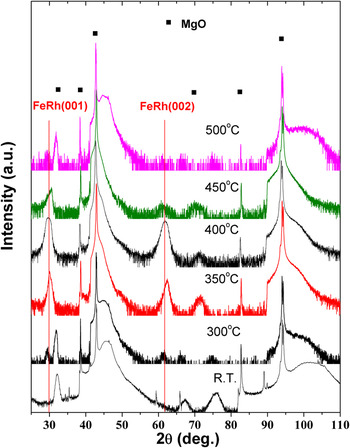
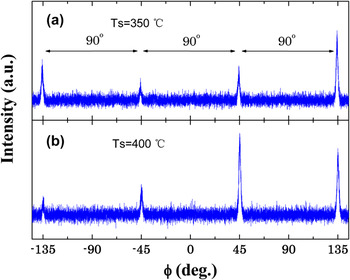
Figure 1 shows the XRD patterns (θ/2θ scan) of as-deposited FeRh thin films with different substrate temperatures during deposition. It is clear that there are no peaks that can be identified as B2 ordered α′ FeRh phase and only peaks from MgO can be found in the XRD pattern of FeRh thin film deposited at room temperature. When the substrate temperature is higher than 300 °C, bcc ordered α′ FeRh phase with (001) and (002) characteristic peaks appears in the XRD spectra. This indicates that chemically ordered bcc structure was obtained. With increasing substrate temperature, the intensity of (001) and (002) peaks of ordered B2 FeRh phase increases and it gets to be maximum when the substrate temperature reaches about 400 °C. The peak intensity decreases when the substrate temperature is increased further and the intensity of (001) and (002) peaks becomes very weak (i.e., it nearly disappears) for the sample deposited at substrate temperature of 500 °C. This result indicates that the range of 350–400 °C is the optimal substrate temperature for obtaining B2 ordered FeRh thin films. It can be seen from Fig. 1 that the films fabricated at Ts = 350 and 400 °C are grown with FeRh (001) planes parallel to the MgO (001) substrate. The result indicates that (001)-oriented FeRh thin film was fabricated on MgO (001) substrate. φ scan x-ray diffraction spectra of as-deposited FeRh thin film with Ts = 350 and 400 °C are shown in Fig. 2. As seen in the figure, the patterns confirm that the films exhibit a 4-fold symmetry in the film plane, indicating that the films are of single-crystalline state with CsCl structure.
θ-2θ XRD diffraction patterns of as-deposited FeRh thin film at different substrate temperatures.

φ scan x-ray diffraction spectra of as-deposited FeRh thin film with Ts = 350 and 400 °C.

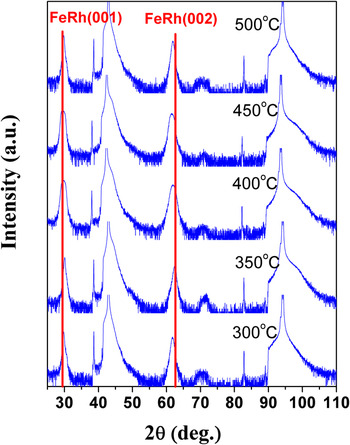
In addition, in situ heat treatment was given to the as-deposited films for improving the crystallographic structure and get B2 ordered FeRh thin films. As seen from the diffraction patterns of postannealed films in Fig. 3, the (001) superlattice peak and (002) fundamental peak of B2 ordered FeRh phase are clearly observed and this result indicates that the (001)-oriented FeRh thin film was successfully fabricated on MgO (001) substrate not only at Ts = 350 and 400 °C but also at all the substrate temperatures from 300 to 500 °C with postannealing at 600 °C for 1 h. The φ scan x-ray diffraction spectra (not shown here) confirm the single-crystalline state with CsCl structure for all the postannealed FeRh thin films.
θ-2θ XRD diffraction patterns of postannealed FeRh thin film at different substrate temperatures.

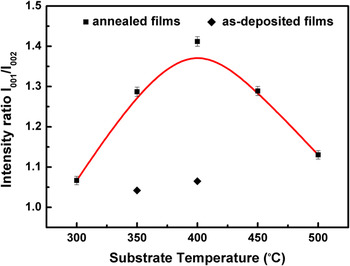
For clarifying the relationship between ordering and substrate deposition temperature in annealed FeRh thin films, we calculated the intensity ratio of the (001) superlattice peak and the (002) fundamental peak in the XRD patterns of postannealed FeRh thin films deposited at different substrate temperatures, as shown in Fig. 4. The ratio of peak intensity (I001/I002) of as-deposited films is also shown in Fig. 4 as comparison. The calculated ratio only shows the trend of ordering of B2 ordered FeRh phase as a function of substrate temperatures and it is not the actual order parameter that should take into account the geometric features of the x-ray diffractometer, the crystallographic texture of films, and the finite thickness of the films.Reference Yang, Laughlin and Zhu13 As shown in Fig. 4, the intensity ratio of the annealed thin film increases with increasing substrate temperature and it attains maximum value when the substrate temperature is about 400 °C. Further increasing the substrate temperature, the intensity ratio decreases. This is probably due to the interplay between decreasing driving force and enhanced kinetics at high temperature. Taking account of the XRD results (Fig. 1) of as-deposited FeRh thin films, it can be concluded that substrate deposition temperature has great influence on the ordering of as-deposited and postannealed FeRh thin films and a temperature of around 400 °C is the optimized substrate deposition temperature for obtaining the best ordering of postannealed α′ FeRh thin films in this study.
Relationship between order parameter of as-deposited/annealed thin films and substrate temperatures.

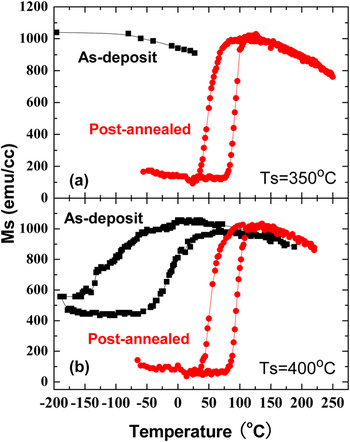
Figure 5 shows the temperature-dependent magnetization (M-T) curves of the as-deposited and postannealed FeRh thin films deposited at substrate temperatures of 350 and 400 °C respectively. From Fig. 5(a), it can be seen that for the as-deposited FeRh thin film with substrate temperature of 350 °C (S1 sample), it does not show a first-order AFM-to-FM phase transition during heating process whereas it gives a ferromagnetic behavior and its M-T curve follows a typical M-T curve of ferromagnetic materials. Although the (001) superlattice peak and (002) fundamental peak of B2 ordered α′ FeRh phase are clearly observed in the XRD pattern of S1 sample, the ordered phase shows a ferromagnetic state and does not give any antiferromagnetic behavior as expected from a B2 ordered FeRh structure. After further annealing at 600 °C for 2 h, the postannealed FeRh thin film deposited at 350 °C (S3 sample) shows a typical AFM-to-FM phase transition, as seen from the M-T curve in Fig. 5(a). It was observed that there is a residual ferromagnetic signal at room temperature in the postannealed FeRh sample and the residual magnetization moment at room temperature is about 100 emu/cc. When temperature is heated beyond 80 °C, a sharp increase of magnetization moment occurred due to the first-order AFM-to-FM phase transition of the B2 ordered α FeRh phase and the magnetization moment attains maximum value when the sample is heated to a temperature of about 120 °C. Further heating leads to the typical behavior of a FM FeRh phase. Subsequently, cooling process results in a FM-to-AFM phase transition but the magnetization moment did not go down to zero as expected from a pure AFM FeRh thin film. The residual magnetization moment at room temperature after cooling is around the same value as that of the sample before heating.
Temperature dependent magnetization curves of FeRh thin film samples at different substrate temperatures: (a) 350 °C; (b) 400 °C.

From the equilibrium phase diagram of FeRh alloy,Reference van Driel, Coehoorn, Strijkers, Brück and de Boer14 there are only two phases which show ferromagnetic behavior, one is body-centered cubic (bcc) disordered FeRh phase and another is B2 ordered α′ FeRh phase. In addition, it is also seen from the phase diagram that the AFM B2 phase exists beyond 50 at.% Rh. Below that Rh content, even complete chemical ordering would yield an FM B2 phase.Reference Ohtani and Hatakeyama15 From the XRD results shown in Fig. 1, it can be seen that the XRD pattern did not show any peak splitting at the (002) peak position corresponding to the disordered phase, nor is there any other peak that is not indexed. Hence it is quite possible that the disordered FeRh phase has a composition very near to that of the B2 ordered α′ FeRh phase. Extrapolating the M-T curve of the S1 sample to room temperature, it shows that the magnetization moment is around 900 emu/cc, which is smaller than that of purely B2 ordered α′ FM FeRh phase (∼1280 emu/cc). This indicates that the ferromagnetic state of S1 sample possibly be resulted from the B2 ordered α′ FM FeRh phase and bcc disordered FeRh phase. In addition, it can be clarified that there is no B2 ordered α″ AFM FeRh phase in such as-deposited FeRh thin film. After annealing at 600 °C for 2 h, the disordered FeRh phase transformed to ordered α″ FeRh phase with antiferromagnetic state, which leads to a typical AFM/FM phase transition in the S3 sample.
Comparing with the ferromagnetic behavior of S1 sample, the as-deposited FeRh thin film deposited at 400 °C (S2 sample) shows a broad first-order AFM/FM phase transition during heating and cooling process. And a residual ferromagnetic moment of 450 emu/cc was observed in this sample at low temperature. There are several possible reasons for the broad AFM/FM transition in this sample. As the transition is first order, the presence of B2 ordered FM FeRh phase at low temperature means that the nuclei of the product phase are already present and hence the slope of the M-T curve is not sharp as compared with the M-T curve of homogeneous nucleation of the product phase. Stress and stress distribution in the film could be another origin in the broad AFM/FM phase transition in the film, as pointed out by Ohtani et al.Reference Ohtani and Hatakeyama15 In addition, there might be a concentration gradient of Rh element in the as-deposited FeRh thin film due to the slow diffusion rate of Rh.Reference van Driel, Coehoorn, Strijkers, Brück and de Boer14 Such a concentration gradient might also be one of the causes of the broad AFM-FM transition observed. Regarding the relatively large residual magnetization moment at low temperature in this sample, it again could be mainly caused by the B2 ordered α′ FM FeRh phase and bcc disordered FeRh phase, as we discussed above.
After further annealing at 600 °C for 2 h, the postannealed FeRh thin film deposited at 400 °C (S4 sample) shows a clear AFM/FM phase transition, as seen from the M-T curve in Fig. 5(b). The AFM/FM transition behavior is similar to what we observed in S3 sample but the residual magnetization moment at room temperature is small (∼50 emu/cc). Comparing the postannealed samples (S3 and S4), both samples show a relatively sharp first-order AFM/FM phase transition with a residual FM magnetization at room temperature. The sharp AFM/FM phase transition is mainly caused by the postannealing process, which results in uniform microstructure and composition distribution in the FeRh thin films.
From the XRD results shown in Fig. 3, it is seen that the ordering degree in S4 sample is higher than that in S3 sample. This indicates that there will be less disordered FM FeRh phase in the S4 sample than that in the S3 sample. Therefore, we can attribute the reduction in the residual magnetization moment to the high ordering degree in the S4 sample. As we discussed above, the low temperature ferromagnetic magnetization in the as-deposited FeRh thin films (S1 and S3 samples) could be mainly resulted from the B2 ordered α′ FM FeRh phase and bcc disordered FM FeRh phase. This is probably not the case for the postannealed FeRh thin films (S2 and S4 samples). For the postannealed thin films there is again the same disordered bcc FM phase and B2 ordered FM phase but they do not contribute to all the room temperature ferromagnetic moment. The additional FM moment can also be attributed to a near-surface/interfacial ferromagnetism in ordered FeRh thin film.Reference Fan, Kinane, Charlton, Dorner, Ali, de Vries, Brydson, Marrows, Hickey, Arena, Tanner, Nisbet and Langridge16
IV. CONCLUSIONS
The influences of substrate temperatures and annealing temperatures on the crystallographic structure and phase transition behavior have been studied in this article. And the origin of the residual ferromagnetic state in ordered FeRh thin films are discussed in detail. Results show that 400 °C is the optimized substrate deposition temperature for obtaining the best chemical order in the postannealed α′ FeRh thin films in this study. The as-deposited FeRh thin film with substrate temperature of 350 °C does not show a first-order AFM-to-FM magnetic phase transition behavior during heating process and it gives a typical ferromagnetic behavior whereas the as-deposited FeRh thin film deposited at 400 °C shows a broad first-order AFM-to-FM phase transition during heating and cooling process. Both the postannealed FeRh thin films deposited at 350 and 400 °C give a clear first-order AFM/FM phase transition with a residual magnetization of about ∼50–100 emu/cc. The residual magnetization moment may possibly be caused by the disordered bcc FM phase, B2 ordered FM phase and a near-surface/interfacial ferromagnetism in the ordered FeRh thin films.
ACKNOWLEDGMENTS
The author (W. Lu) would like to thank Prof. Takao Suzuki (now in University of Alabama) for his kind support at Toyota Technological Institute. The present work was supported by National Natural Science Foundation of China (Grant No. 50901052) and Program for Young Excellent Talents in Tongji University (Grant No. 2009KJ003) and “Chen Guang” project (Grant No.10CG21) supported by Shanghai Municipal Education Commission and Shanghai Education Development Foundation.