INTRODUCTION
Biological invasions are increasing with the expansion of global travel and trade causing billions of dollars in economic damage annually (Meyerson and Mooney, Reference Meyerson and Mooney2007). Invasive species are also a major threat to biodiversity (Sandlund et al. Reference Sandlund, Schei and Viken2001) and introduced parasites are a serious concern in this respect (Daszak et al. Reference Daszak, Cunningham and Hyatt2000; Sandlund et al. Reference Sandlund, Schei and Viken2001). Introduced parasites can ‘spillover’ to infect native hosts which were previously naïve to the parasite (Daszak et al. Reference Daszak, Cunningham and Hyatt2000). This can be particularly severe if transmission of introduced parasites is amplified by high densities of their invasive hosts (Torchin et al. Reference Torchin, Lafferty and Kuris2002) and parasites ‘spillover’ to less common native species. Major travel and trade hubs (such as ports) serve as focal points for the establishment of invaders (Hulme, Reference Hulme2009). For example, the red imported fire ant (Solenopsis invicta) was introduced to the USA through the port of Mobile Bay and has spread focally from there (Tschinkel, Reference Tschinkel2006), and the distribution of the introduced rough-tailed gecko (Cyrtopodion scabrum) in Texas, USA hugs commercial shipping docks (Dixon, Reference Dixon2013). Similarly, ports may also provide entry points for parasites and disease vectors (Tatem et al. Reference Tatem, Hay and Rogers2006).
Recently, an introduced parasite (the pentastomid Raillietiella frenata = frenatus) was discovered infecting the lungs of invasive cane toads (Rhinella marina, previously Bufo marinus) in the tropical port city of Darwin, Australia (Kelehear et al. Reference Kelehear, Spratt, Dubey, Brown and Shine2011, Reference Kelehear, Brown and Shine2013). The prevalence of R. frenata declined with distance from the Port of Darwin, suggesting that the parasite was probably introduced to the port (Kelehear et al. Reference Kelehear, Brown and Shine2013). Importantly, this parasite originally infected only the introduced Asian House gecko (Hemidactylus frenatus) in Darwin and a few other isolated towns (Barton, Reference Barton2007; Kelehear et al. Reference Kelehear, Brown and Shine2013). The distribution of this gecko is strongly linked to the presence of buildings (Newbery and Jones, Reference Newbery, Jones, Lunney, Eby, Hutchings and Burgin2007; McKay et al. Reference McKay, Griffiths and Crase2009; Hoskin, Reference Hoskin2011; Yang et al. Reference Yang, González-Bernal, Greenlees and Shine2012); therefore, its parasites were initially restricted to urban areas (Kelehear et al. Reference Kelehear, Brown and Shine2013). However, R. frenata switched hosts to infect cane toads after toads first colonized Darwin in 2005 (Kelehear et al. Reference Kelehear, Brown and Shine2013). Since cane toads are ubiquitous through the Australian tropics and occur in both rural and urban habitats (Lever, Reference Lever2001), this host shift enabled the pentastomid to colonize Australia more widely than was originally possible in its urban gecko host (Kelehear et al. Reference Kelehear, Brown and Shine2013).
Pentastomids are haematophagous endoparasites that infect the respiratory system of reptiles, and to a lesser extent, anurans, birds and mammals (including humans; Paré, Reference Paré2008; Kelehear et al. Reference Kelehear, Spratt, Dubey, Brown and Shine2011). They can cause pulmonary haemorrhage and potentially lethal secondary bacterial infections in their hosts (Jacobson, Reference Jacobson and Jacobson2007). Raillietiella frenata primarily infects small insectivorous lizards (Ali et al. Reference Ali, Riley and Self1981) and occasionally anurans, of which the cane toad is the only known suitable definitive host (Kelehear et al. Reference Kelehear, Brown and Shine2013). Raillietiella frenata has a complex life cycle and uses coprophagic insect intermediate hosts (such as cockroaches) and insectivorous lizard or toad definitive hosts (Ali and Riley, Reference Ali and Riley1983; Kelehear et al. Reference Kelehear, Brown and Shine2013). This parasite is widely distributed throughout its native range in Asia (Ali et al. Reference Ali, Riley and Self1981), has recently become established in Australia (Kelehear et al. Reference Kelehear, Spratt, Dubey, Brown and Shine2011; Reference Kelehear, Brown and Shine2013), and also occurs in the USA (Hawaii and Texas) and Brazil (Pence and Selcer, Reference Pence and Selcer1988; Goldberg and Bursey, Reference Goldberg and Bursey2000; Anjos et al. Reference Anjos, Almeida, Vasconcellos, Freire and Rocha2008). It is likely spreading to new ranges via either a cockroach intermediate host, or a gecko definitive host, both of which are common invaders (Kraus, Reference Kraus2009; Rabitsch, Reference Rabitsch, Roques, Kenis, Lees, Lopes-Vaamonde, Rabitsch, Rasplus and Roy2010).
We discovered lung pentastomids of the genus Raillietiella in toads in the Republic of Panama near the Panama Canal, a hub for international shipping. Raillietiella is the largest pentastomid genus and contains ~43 species (Poore, Reference Poore2012), some of which may have been described as new species in error as the morphological characteristics used for species identification change ontogenetically (Kelehear et al. Reference Kelehear, Spratt, Dubey, Brown and Shine2011). Therefore, morphology alone is unreliable for distinguishing species of this genus and molecular confirmation is required. Herein we (i) document the presence of pentastomids infecting cane toads in Panama; (ii) confirm their identity using molecular techniques; (iii) begin to examine whether the distribution of this parasite follows an urban–rural gradient and consider potential pathways by which it was introduced to Panama.
MATERIALS AND METHODS
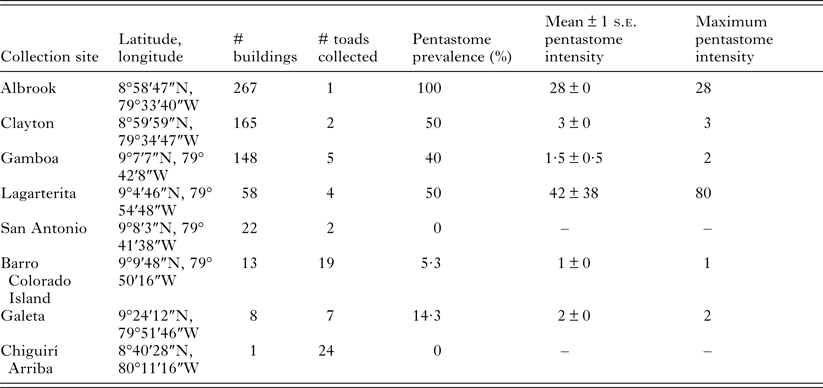
We collected 64 cane toads from eight sites across three provinces in central Panama (Fig. 1) over the period 22 August 2013 – 14 September 2013 (Table 1). We dissected toads, examined their lungs and preserved parasites in 70% ethanol.
Map of central Panama showing collection sites (triangles: closed triangles indicate presence of R. frenata; open triangles indicate absence of R. frenata), major cities with populations >35 000 (stars), and the two shipping ports (ships with arrows) at either end of the Panama Canal.

Collection site details (locations and the number of buildings within a 650 m radius) and the prevalence and intensity of pentastomids (R. frenata) infecting cane toads (R. marina) at each site surveyed in Panama

We prepared two pentastomid DNA extractions with a QIAamp DNA Micro Kit (Qiagen), using 100 μL of Buffer AE in the final elution. One extraction included a single individual and the other included three pentastomids. We initially tried to amplify the COX1 region using the primer pair LCO1490–HCO2198 (Folmer et al. Reference Folmer, Black, Hoeh, Lutz and Vrijenhoek1994) but were only able to obtain cane toad COX1 with these primers. Our subsequent attempts using the HCO2198 reverse primer paired with the forward primer crustF2 (Costa et al. Reference Costa, deWaard, Boutillier, Ratnasingham, Dooh, Hajibabaei and Hebert2007) were successful at obtaining pentastomid sequence. Each polymerase chain reaction had a total volume of 25 μL and contained 2·5 μL of 10 × PCR buffer, 2 mM of MgCl2, 50 μmol each dNTP, 0·2 μmol of each primer, 2% DMSO, 1·25 U AmpliTaq Gold polymerase and 2 μL of DNA extract. We used a PCR thermal regime of 94 °C for 12 min; 5 cycles of 94 °C for 45 s, 50 °C for 45 s and 72 °C for 60 s; 35 cycles of 94 °C for 45 s, 55 °C for 45 s and 72 °C for 1 min; followed by 72 °C for 7 min. We gel-purified PCR products using GELase enzyme (Epicentre) and sequenced them in both directions on an ABI 3100 × l automated sequencer. We edited and aligned sequences using Sequencher 5.1 (GeneCodes Corp.) and identified the species using BLAST (NCBI).
To examine whether parasite prevalence ([# of toads infected/# of toads examined] × 100) was associated with urban development, we counted the number of buildings within a 650 m radius of each site using aerial images from Google Earth (version 7.1.2.2041; images taken: 07 December 2012 – 09 July 2013; see Kelehear et al. (Reference Kelehear, Brown and Shine2013) for full methods). We performed a weighted (by sample size per site to account for uneven sampling) one-way ANOVA with number of buildings within a 650 m radius of the site as the independent variable, and pentastomid prevalence (% infected) as the dependent variable. All analyses were performed in JMP Pro 9.0.
RESULTS
All pentastomids matched the appearance of R. frenata morphologically (Ali et al. Reference Ali, Riley and Self1985; Kelehear et al. Reference Kelehear, Spratt, Dubey, Brown and Shine2011). This identification was confirmed by our molecular analysis: we obtained a single 657 bp sequence from both DNA extractions that was identical to a R. frenata specimen (GenBank Accession No. JF975594) sequenced from cane toad hosts in Australia (Kelehear et al. Reference Kelehear, Spratt, Dubey, Brown and Shine2011).
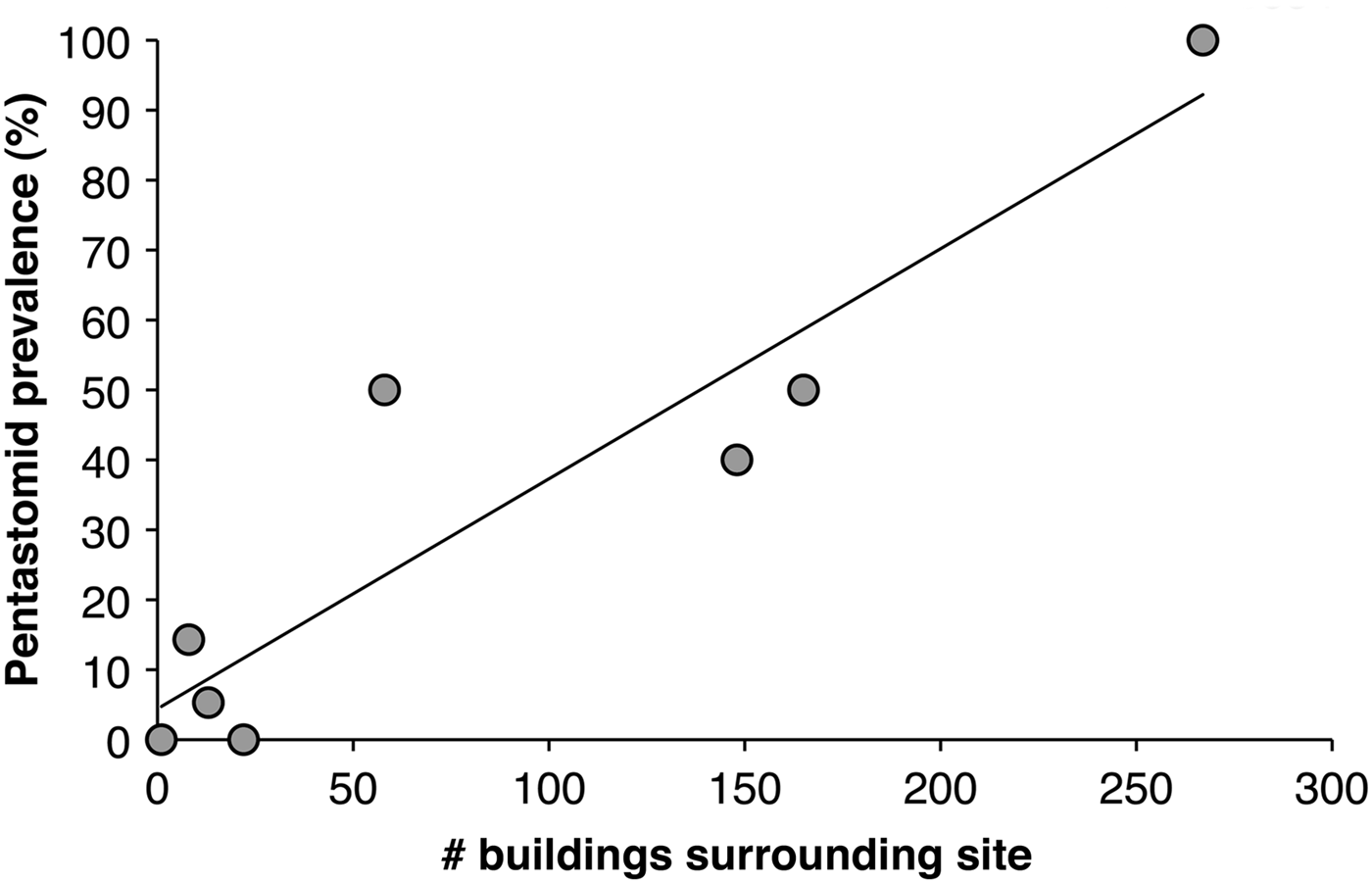
Eight (4 male, 4 female) of the 64 dissected toads (25 male, 39 female) were infected with R. frenata (Table 1). Mean infection intensity (# parasites per infected toad) was 15·13 ± 9·8 s.e. (median = 2·5, range = 1–80; Table 1). Pentastomid prevalence was positively associated with the number of buildings surrounding a site (R 2 = 0·80, F 1,6 = 23·71, P = 0·0028; Fig. 2). At one of our sites (Albrook), only one toad was sampled so we repeated the analysis excluding this site and the association remained significant (R 2 = 0·72, F 1,5 = 12·74, P = 0·016).
Relationship between the level of urban development at a collection site (# buildings within a 650 m radius of each site) and the prevalence of an introduced pentastomid parasite (R. frenata) infecting native cane toads (R. marina) in Panama.

DISCUSSION
We discovered non-native pentastomids infecting cane toads in their native range in Panama. Overall, eight of 64 toads were infected with R. frenata and infection intensities ranged from 1 to 80 pentastomids. These parasites are genetically identical to R. frenata infecting invasive cane toads and Asian House geckos in Australia (Kelehear et al. Reference Kelehear, Spratt, Dubey, Brown and Shine2011). This is the first report of R. frenata occurring in Central America and the first instance of it infecting cane toads in their native range.
The two most likely pathways by which this parasite could have been introduced to Panama are: (1) spread from adjacent infected areas, or (2) introduction to Panama via cargo (likely from Asia). Raillietiella frenata has been recorded in introduced Hemidactylus turcicus in Texas, USA (Pence and Selcer, Reference Pence and Selcer1988) and Hemidactylus mabouia in Brazil (Anjos et al. Reference Anjos, Almeida, Vasconcellos, Freire and Rocha2007, Reference Anjos, Almeida, Vasconcellos, Freire and Rocha2008; Almeida et al. Reference Almeida, Santana, Vieira and Wanderley2008), however neither of these gecko species are established in Panama (R. Ibáñez, personal communication). If the parasite spread into Panama from either Texas or Brazil, we would expect infected toads across their entire native range (southern Texas to Brazil; Lever, Reference Lever2001). Numerous surveys of the cane toad's parasite fauna throughout its native range have never reported R. frenata (Espinoza-Jiménez et al. Reference Espinoza-Jiménez, García-Prieto, Osorio-Sarabia and León-Règagnon2007; Espinola-Novelo and Guillen-Hernandez, Reference Espinola-Novelo and Guillen-Hernandez2008; C. Bursey and J. Santos, personal communication 2013), suggesting either a recent introduction to Panama and/or a recent host switch to cane toads. The Panama Canal is a hub for global shipping, receiving over 12 500 ships annually, including many from Asia (Ruiz et al. Reference Ruiz, Torchin and Grant2009; Kaluza et al. Reference Kaluza, Kölzsch, Gastner and Blasius2010). It is possible that this parasite was introduced through the ports in Panama, similar to the introduction of R. frenata to the port city of Darwin in Australia (Kelehear et al. Reference Kelehear, Brown and Shine2013). Two non-native geckos (Lepidodactylus lugubris and H. frenatus) that are established in Panama (Savage, Reference Savage2002; Kraus, Reference Kraus2009) host R. frenata in ranges outside of the Americas (see Kelehear et al. Reference Kelehear, Brown and Shine2013) and may have brought this parasite with them when they were introduced.
In our surveys, R. frenata occurred at all sites in the vicinity of the Panama Canal but was not found outside the Panama Canal Watershed, suggesting that the Panama Canal may have been the point of introduction. Further, we found that the prevalence of R. frenata was positively associated with the number of houses in the proximity of our collection sites. This result suggests that urban-associated geckos may be shedding pentastomid eggs that are being transferred to cane toads (via an unknown insect intermediate host). However, since our sampling was uneven with low sample sizes at some sites (due to scarcity of toads) further research is needed to substantiate this pattern of urban association, which has also been observed in cane toad infections in Australia (Kelehear et al. Reference Kelehear, Brown and Shine2013).
While some pentastomids can kill or debilitate their hosts (Jacobson, Reference Jacobson and Jacobson2007) and some species cause zoonotic disease in humans (Riley, Reference Riley1986; Drabick, Reference Drabick1987), little is known about the pathological effects of raillietiellids on their hosts. Kelehear et al. (Reference Kelehear, Brown and Shine2012) found no relationship between body condition of invasive cane toads and infection with R. frenata in Australia, implying negligible effects; however, the impact of this introduced parasite in Panama is yet to be determined. Considering that cane toads are competent definitive hosts of R. frenata, are infected at a modest prevalence with intensities as high as 80 parasites, and have a broad distribution over diverse habitats extending from Texas, USA to Brazil, they have the potential to spread this parasite more effectively than the presumed original gecko host (Kelehear et al. Reference Kelehear, Brown and Shine2013). Since R. frenata infects at least six families of anurans and lizards globally (Kelehear et al. Reference Kelehear, Brown and Shine2013), this parasite may spill-over from cane toads to infect additional native hosts such as other anurans and small carnivorous lizards throughout the Neotropics. Comparing the spread of this parasite within the cane toad's introduced range in Australia and its native range in Panama offers a unique natural experiment which may offer insight to disease transmission in native vs introduced host–parasite systems.
ACKNOWLEDGEMENTS
The authors thank the STRI staff of Naos Island Laboratories, Barro Colorado Island Research Station and the Galeta Marine Laboratory for logistical support. The authors also thank Roberto Ibáñez, Carmen Schlöder, Ross Robertson and Giomar Borrero for their help with collecting toads. This research was approved by STRI IACUC (2013-0815-2016).
FINANCIAL SUPPORT
The authors are extremely grateful to the Global Invasions Network (NSF RCN DEB-05411673) for providing financial support to C. Kelehear for international travel. C. Kelehear received additional financial support through the STRI A. Stanley Rand Fellowship and the Australian Society for Parasitology Network Researcher Exchange, Training, and Travel Award.