INTRODUCTION
Toxocarosis caused by the Toxocara nematode is widely prevalent in cats and dogs and is a zoonotic disease. Man – a paratenic host of the parasite – can become infected with eggs from soil contaminated with infected animal faeces. Toxocara antibodies are found in 3–7% of adults and in 15–23% of children (Gillespie et al. Reference Gillespie, Bidwell, Voller, Robertson and Maizels1993), while in the tropics seropositivity is as high as 92·8% among individuals aged >15 years (Magnaval et al. Reference Magnaval, Michault, Calon and Charlet1994b). Human exposure to toxocarosis is higher in rural than in urban areas (seropositivity of 14–37% versus 2–5% respectively) (Magnaval et al. Reference Magnaval, Glickman and Dorchies1994a). A relationship between the degree of soil contamination with Toxocara eggs and child exposure to infection has been suggested (Mizgajska, Reference Mizgajska1997; Łużna-Lyskov, Reference Łużna-Lyskov2000; Pawłowski and Mizgajska, Reference Pawłowski and Mizgajska2002). Human toxocarosis usually gives no distinctive symptoms (CT – Covert Toxocarosis), yet it can cause severe health consequences for example, Visceral Larva Migrans (VLM) and Ocular Larva Migrans (OLM) (Glickman, Reference Glickman, Lewis and Maizels1993; Pawłowski, Reference Pawłowski2001).
The impact of asymptomatic Toxocara on the paratenic host has, for ethical reasons, been tested only on laboratory animals. Studies have demonstrated that feeding Toxocara larvae to mice, depending on the dose, can cause various behavioural changes in the host and sometimes leads to cognitive disorders (Cox and Holland, Reference Cox and Holland1998; Holland and Cox, Reference Holland and Cox2001). A comparative study of intelligence and physical activity levels in humans infected and not infected with Toxocara has been conducted and the results are not conclusive. Hay et al. (Reference Hay, Kendall, Aitken and Arnott1986) observed hyperactivity in toxocarosis seropositive persons, which they suggested could be specific to individuals. Nelson et al. (Reference Nelson, Greene and Ernhart1996) have revealed that Toxocara canis-infected people tend to have lower intelligence and comprehension. Moreover, Marmor et al. (Reference Marmor, Glickman, Shofer, Faich, Rosenberg, Cornblatt and Friedman1987) suggested that toxocarosis has subtle effects on children's cognitive development. Although these studies have demonstrated that toxocarosis can manifest itself in different symptoms (not necessarily clinical ones) this subject is still not explored well enough because of its complexity and difficulties in planning and performing the studies on humans as well as interpretation of the results.
The present study aims to determine the consequences for the general biological condition of children playing in open areas contaminated with infected Toxocara eggs. A comprehensive examination of the rural environment was carried out to establish the relationship between the degree of soil contamination with Toxocara eggs and the prevalence of Toxocara seropositivity among students; and to identify a relationship between toxocarosis and student's developmental age, physical fitness and performance at school and pet ownership. This study has applied a novel broad approach to the investigation of toxocarosis and the better understanding of the reaction of the human body to a non-specific parasite and may allow us to plan and introduce more effective prevention measures to reduce Toxocara transmission to humans.
MATERIALS AND METHODS
The degree of soil contamination with Toxocara eggs in recreational areas was determined in the Polish rural village of Kołaczkowo, 60 km southeast of Poznań. A comprehensive examination of all students in the only local lower secondary school was also conducted, examining the prevalence of Toxocara antibodies, developmental age, physical fitness and end-of-year grades in individual subjects. Students were questioned about the presence of pets at home (dogs and/or cats). Prior to this, meetings with the parents were held to make them aware of the significance of zoonotic diseases, toxocarosis in particular, their sources and ways of preventing infection. The written consent of the parents had to be obtained before samples of epithelium from the mouth and blood could be taken from the children.
Soil sampling for Toxocara eggs
The sites included the areas most frequently visited by children during their leisure time, i.e. the backyards close to households, the school and kindergarten playgrounds and the village park. The material was soil samples of approximately 500 ml, collected according to rectangular distribution or at equal intervals along the diagonal, from the upper soil layer of 3 cm. After collection, the soil samples were dried in the laboratory for 24–48 h, then sifted through a 2 mm sieve to isolate stones and larger organic particles. Forty grammes of homogenous material was taken from every sample and screened for eggs by a modified Dada flotation method (Mizgajska-Wiktor, Reference Mizgajska-Wiktor2005). Wet preparations were examined by light microscopy. Eggs were measured (Gonzalez-Ruiz and Bendal, Reference Gonzalez-Ruiz and Bendal1995) and identified on the basis of their size and other morphological features such as thickness of eggshells, their transparency and visibility of semicircular cavities on the surface (Mizgajska and Rejmenciak, Reference Mizgajska and Rejmenciak1997). Genus of eggs was determined, as was their age of development and viability. Eggs with a moving larva were considered infectious, while immature eggs were stored in a humidity chamber (100% relative humidity) to investigate whether they were capable of further embryonic development. In the process of microscopic examination, photographs were taken.
Examination of students
Lower-secondary students were examined in the study. Most of the children were aged 14–16 years, with 6 individuals aged 13 and 3 aged 17. Calendar age was evaluated according to anthropological standards on the base of the decimal system (e.g. 13·50–14·49 means 14 years old). Their number varied between 183 and 277 throughout the week of the full range of the study. During serological examination 242 students were tested, 277 for developmental age, 183 for physical fitness, 236 for school performance and 204 for pet possession.
Serological tests
Venous samples of ca. 10 ml were taken at the elbow pit into polythene test tubes. Toxocara antibodies were detected with the commercial ELISA test (Bordier Affinity Products, Crissier, Switzerland). Its sensitivity is estimated to be more than 90% (Smith and Noordin, Reference Smith, Noordin, Holland and Smith2006) with a specificity of 96% (Jacquier et al. Reference Jacquier, Gottstein, Singelin and Eckert1991). According to the protocol, an optical density of 1·026 or more (OD405⩾1·026) was considered a high positive titre (>cut-off), a titre of 0·823–1·025 was considered borderline, while lower values were regarded as a negative result. Serological tests were conducted in the Department and Clinic of Tropical and Parasitic Diseases, University of Medical Sciences, Poznań, Poland. A medical interview of all students was conducted, when blood samples were taken, to determine whether any symptoms of infection had been noticed. The interview covered abdominal pain, hepatomegaly, symptoms of spastic bronchitis, rash and urticaria, allergies, visual disorders, fever, weakness and anorexia.
Developmental age determination
Oral-cavity epithelial cells were collected with a haematological knife and placed into a 1·5 ml Eppendorf tube, which was half filled with 0·9% sodium chloride solution (NaCl). The material was taken to a laboratory for EMN testing (electrophoretical mobility of nuclei) as described by Shakhbazov et al. (Reference Shakhbazov, Colupaeva and Nabokov1986, Reference Shakhbazov, Grigoreva and Colupaeva1996). This is a simple and universal method, which can be used in developmental age determination of any plant or animal. The average EMN for humans is consistent with the general model of human development, i.e. its value grows significantly during the early ontogenesis, to reach a peak around the age of 17 and decline later (Czapla and Cieślik, Reference Czapla and Cieślik1998). The method makes use of the nucleus mobility in a changing electrical field. Following a microscopical examination of 100 cells, the EMN index was determined by calculating the proportion between cells with a mobile nucleus and those where the nucleus did not pulsate. The Biotest apparatus was used, which automatically calculates EMN index when the observation data are entered.
Physical fitness determination
Physical fitness was assessed on the basis of test results for muscular strength, flexibility, agility and oxygen endurance (Wachowski et al. Reference Wachowski, Strzelczyk and Osiński1987). The tests were conducted in the gymnasium after the students were given instructions, a demonstration of tests and a 10-min warm-up (conducted by a PE teacher).
Muscular strength was tested through vertical jump. The student stood by the side of a centimetre-scaled board and marked his/her outreach with an upright hand. Then they made a vertical jump – as high as they could – from a half-squatting position with a forward bend. The height was read from the board. The test result was the distance obtained between standing reach and jumping reach, measured with a 10−1 m accuracy.
The flexibility of the lower back and hamstring muscle test involved measuring the depth of the forward bend (sit and reach test). The student stepped onto a centimetre-graduated platform his/her toes around the edge, the feet kept together, the legs straightened up. During the deepest possible bend, the lowest outreach was read with a 10−1 m accuracy.
During the agility (coordination) test, the time was measured of a run in a figure of eight delimited with poles placed at 5-metre intervals. The student had to run around the ‘eight’ 3 times and the time was measured with a 10−1 second accuracy.
The cardiovascular endurance test was a 5-min Montoye step test. During that time, the student climbed up and down a 0·3-m-high step, doing so 30 times/min. The pace was controlled by use of a metronome. The student's pulse was measured with electronic sensors and an amplifier, connected to a computer with appropriate software between 60 and 120 sec after the test was completed. The results obtained were used to calculate the endurance index expressed in points, according to the following formula:

where E=endurance index; t=strain time [s]; p=pulse value after the strain.
Student survey
The survey consisted of an interview, during which simple questions were asked about the number of dogs and cats in the household. The school reports, made available by the school, were used to calculate the average grade for every student and were entered into the survey results.
Statistical analysis
For statistical reasons, the level of Toxocara antibodies was used to identify 2 groups: seropositive (OD405⩾1·026) and seronegative (OD405<1·025). Analysis was undertaken using Statistica software (StatSoft).
Binary logistic regression was used to determine the explanatory factors (sex, age, grades, cat ownership, dog ownership, agility, flexibility, strength and endurance) that predicted the prevalence of Toxocara. Dog ownership was not included in the model because the data were overdispersed for this variable i.e. all individuals that were infected with Toxocara owned a dog. Multiple logistic regression analysis was run in SPSS 14.0. Model selection was performed using forward log ratio stepwise selection using the likelihood ratio test starting with the maximal model. All risk factors were entered as fixed-factors using reference category formulation. Comparisons of models by the likelihood ratio test requires that the exact same dataset is used throughout the selection process. Observations with missing values for any of the variables included in the maximal model were therefore excluded. See Results section for ultimate sample sizes and the number of excluded observations.
The influence of factors (sex, age and infection with Toxocara) on EMN, agility, flexibility, strength, endurance, and grades were analysed by analysis of variance (ANOVA), using 3-way ANOVAs.
RESULTS
Biological soil contamination
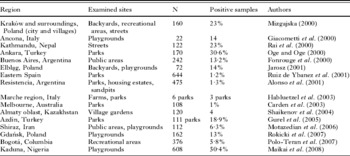
Toxocara eggs were found in 29 of the 200 soil samples studied (14·5%). The total number of eggs recovered was 152 (13·1 eggs per 100 g of soil) and 85·5% of these were embryonated. In each 40 g soil sample 1 to 22 eggs were found. Morphological features indicated that 106 of the Toxocara eggs found in soil were T. canis (69·6%), 40 were T. cati and only 6 had the properties characteristic of the genus (could not be identified to species). Contamination was the strongest in backyards close to households (21·7% of positive samples) and in the school playground (4·6% of positive samples) (Table 1).
Soil contamination with Toxocara eggs in the studied village

* Toxocara eggs identified only to genus.
Examination of students
Serological tests
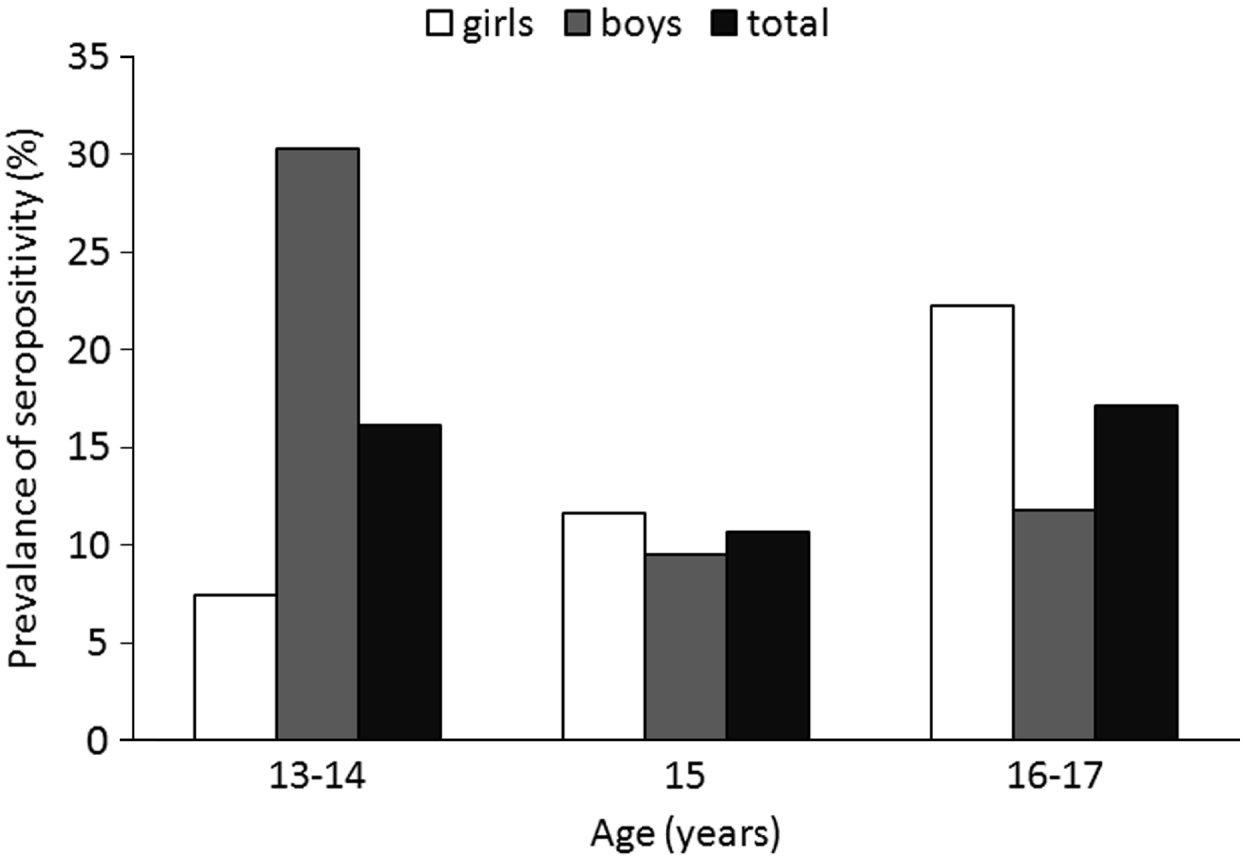
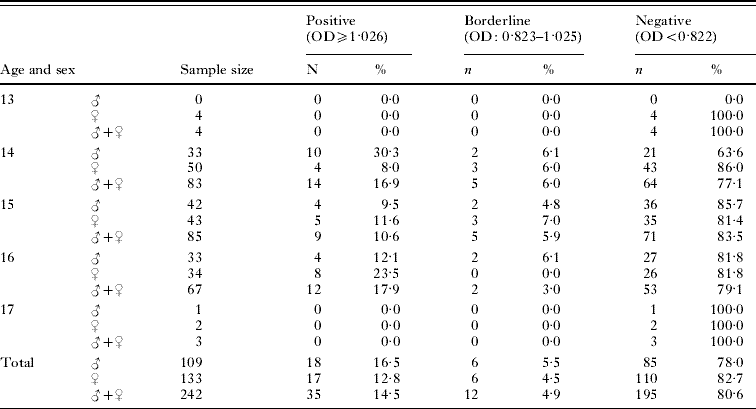
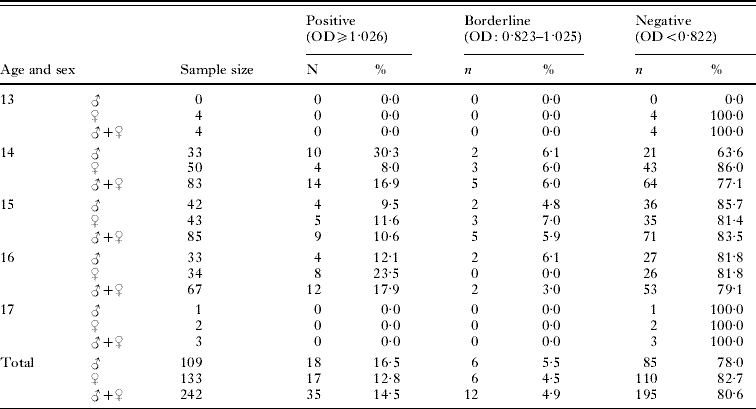
Of the 242 students, high positive titre (OD⩾1·026) was found in 35 (14·5%), while the borderline (OD: 0·823–1·025) was found in 12 (4·9%). Prevalence among boys was slightly higher than among girls being – 21·2% and 17·3% respectively. Of the 109 boys, only 18 showed high positive titre (16·5%), while 6 were in the borderline. Of the 133 girls, 17 showed high positive titre (12·8%) and, like in the case of boys, 6 were in the borderline (Fig. 1 and Table 2).
Toxocara seroprevalence (OD⩾1·026) in different age groups of rural children. Data for 13 and 14 year olds and 16 and 17 year olds have been pooled due to small sample sizes.
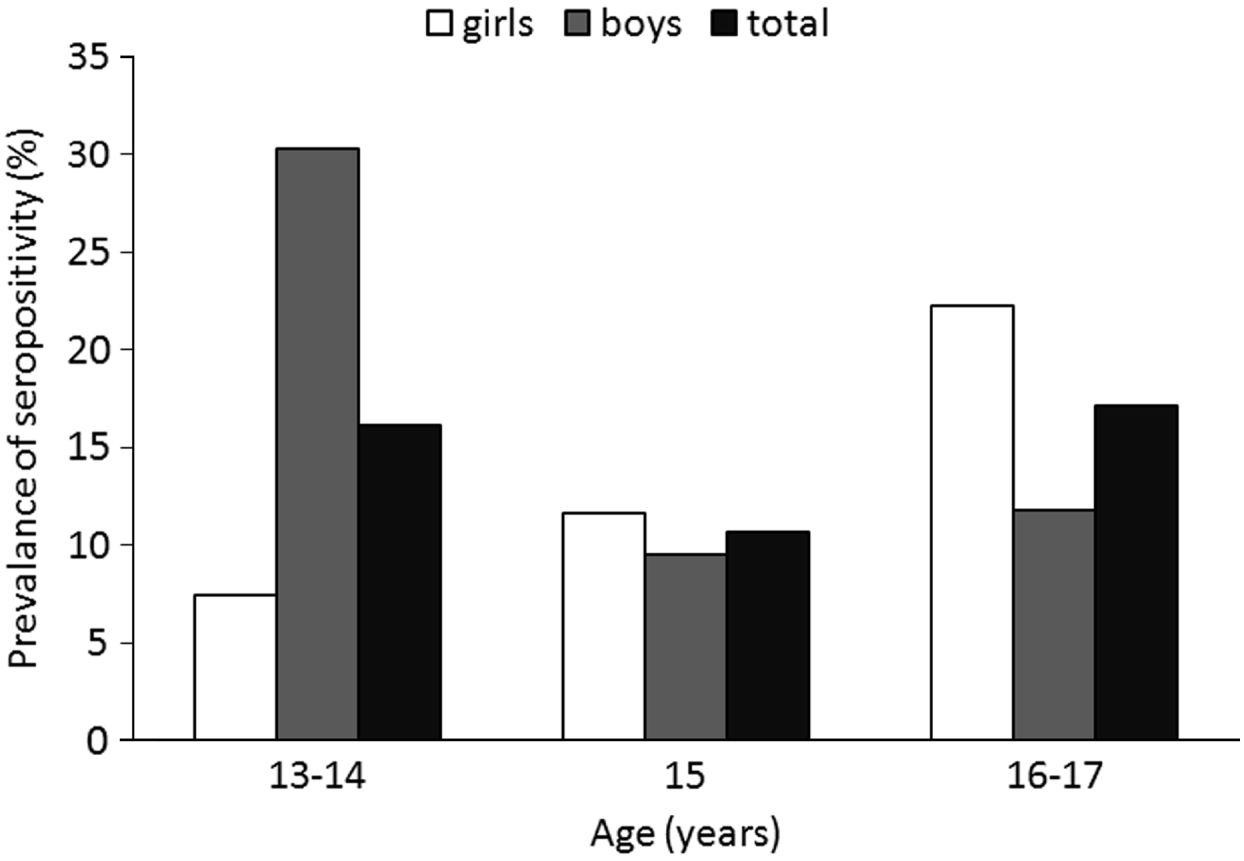
Seroprevalence of anti-Toxocara antibodies in rural school children
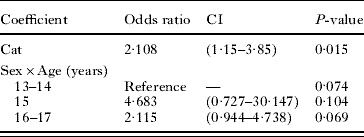
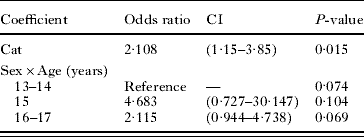
Age category, using age 13 years as the reference category, was included as a fixed factor and with an interaction between the following variables sex and cat ownership to allow for non-linear interactions with children of different ages and the sex of the child and pet ownership. An interaction between sex and cat ownership was also included in the model. The maximal model comprised of 133 observations following exclusion of missing values (144 observations were removed). Stepwise linear regression selected a minimal adequate model (Table 3) with an overall improvement of likelihood ratio from 94·46 to 87·27. The odds of being infected with Toxocara were 2 times (CI: 1·15–3·85) more likely for individuals who owned a cat than those who did not own a cat. There was an interaction between age and sex; however, this was not significant. The odds of being infected with Toxocara increased for girls as they got older. Females aged 15 years and 16–17 years were 4·6 and 2·1 times, respectively, more likely to be infected with Toxocara than those aged 13–14 years.
Minimal adequate model for the prevalence of Toxocara in individuals aged 13–17 years, with odds ratio, confidence intervals (CI) and P-value (N=133)
Incidence of infection in specific age groups was different for boys and girls. In the 14-year age group seroprevalence was considerably higher amongst boys (30·3%) than amongst girls (8·0%). Incidence of infection for girls grew with age, reaching a peak at 16 years. No Toxocara antibodies were found in the four 13-year-old students or in the three 17-year-old students (Table 2).
Cat or dog presence in the household and Toxocara seroprevalence
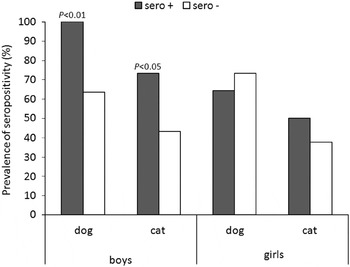
Of 115 interviewed girls, 71·2% had at least 1 dog in the household and 39·1% at least 1 cat. The respective figures for the 89 interviewed boys were 70·0% and 48·3%. The odds of being infected with Toxocara were 2 times more likely for individuals who owned a cat than those who did not own a cat, as mentioned above. All individuals that were infected with Toxocara owned a dog and therefore the data were overdispersed. The correlation between seropositivity and the presence of a cat or/and a dog at home was examined additionally with the χ2 test. With all students (boys and girls together) statistically significant association was found only between seropositivity and cat possession (χ2=4·940, d.f.=1, P=0·026). With boys, there was a statistically significant correlation between toxocarosis seropositivity and the presence of a cat in the household (χ2=4·522, d.f.=1, P=0·033) and an even stronger correlation for dogs (χ2=7·856, d.f.=1, P=0·005). No such correlations have been found with girls (Fig. 2).
A comparison of pet possession among Toxocara seropositive and seronegative boys and girls.

Developmental age and Toxocara seroprevalence
Individuals infected with Toxocara had a statistically significant higher mean EMN (64·39±1·07) than individuals not infected (60·32±0·61; 3-way ANOVA with age, sex and infection with Toxocara as factors, model R2adj=0·009, main effect of Toxocara, F1, 224=4·578, P=0·033).
The level of physical fitness and Toxocara seroprevalence
No statistically significant differences have been revealed through the comparison of seropositive and seronegative students, both boys and girls, in terms of flexibility, agility, strength and endurance.
Girls (53·25±0·87) were significantly more flexible than boys (49·04±0·75; 3-way ANOVA with age, sex and infection with Toxocara as factors, model R2adj=0·358, main effect of sex, F1, 144=6·590, P=0·011). Flexibility increased significantly as the children got older from 43·5±s.e. 1·19 in children aged 13–14 years to 55·98±s.e. 0·75 in children aged 16–17 years and (main effect of age, F2, 144=10·772, P<0·001).
Mean strength was significantly higher for boys (42·63±0·75) when compared to girls (36·07±0·59; 3-way ANOVA with age, sex and infection with Toxocara as factors, model R2adj=0·247, main effect of sex, F1, 144=19·313, P<0·001).
Mean endurance was significantly higher for boys (52·08±0·97) when compared to girls (44·44±0·63; 3-way ANOVA with age, sex and infection with Toxocara as factors, model R2adj=0·176, main effect of sex, F1, 176=10·967, P<0·001).
Mean agility was significantly lower for boys (15±0·11) when compared to girls (16·17±0·11; 3-way ANOVA with age, sex and infection with Toxocara as factors, model R2adj=0·188, main effect of sex, F1, 144=5·794, P=0·017).
The presence of Toxocara antibodies and performance at school
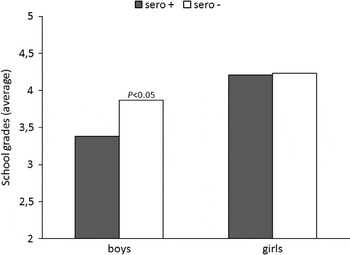
Girls, both seropositive and seronegative, had very similar grades at school (the average of 4·21 and 4·23, respectively; 2–5 scale) while seropositive boys had significantly lower grades (3·38) when compared to seronegative (3·87) (P=0·022) (Fig. 3). Girls had a significantly higher mean grade (4·22±0·05) than boys (3·68±0·07; 3-way ANOVA with age, sex and infection with Toxocara as factors, model R2adj=0·107, main effect of sex, F1, 221=13·590, P<0·001).
A comparison of end-of-year school grades of Toxocara seropositive and seronegative boys and girls.

DISCUSSION
Numerous studies conducted in various parts of the world indicate that Toxocara eggs can be found in the soil at all geographical latitudes, in rich and poor countries alike, as most young dogs and cats get infected with the nematode early in their lives (Mizgajska-Wiktor and Uga, Reference Mizgajska-Wiktor, Uga, Holland and Smith2006). Furthermore, soil contamination has been found to be greater in urban than in rural areas, which is attributed to a higher host concentration in highly urbanised areas (Mizgajska et al. Reference Mizgajska, Jarosz and Rejmenciak2001; Uga and Kataoka, Reference Uga and Kataoka1995).
In the Polish village of Kołaczkowo, 14·5% of the soil samples contained Toxocara eggs, most of which were T. canis eggs. The largest number of eggs was found in areas where children spend a lot of time, especially in backyards close to households, with 21·7% of the samples being positive. Our results are comparable with those found in other studies (Mizgajska et al. Reference Mizgajska, Jarosz and Rejmenciak2001; Mizgajska-Wiktor and Uga, Reference Mizgajska-Wiktor, Uga, Holland and Smith2006). Mizgajska and coworkers found that backyards close to the household independently of the type of environment (rural, urban or suburban) are most likely to be contaminated with the eggs. The results are consistent with those from similar areas in various parts of the world (Table 4). However, it is important to note that the results quoted by various authors are not always comparable, due to the differences in the methods and techniques of egg isolation from soil samples.
Soil contamination with Toxocara eggs in various parts of the world (2000–2008)

Soil contamination is a source of Toxocara infection for the inhabitants of Kołaczkowo. A high percentage (85·5%) of the eggs recovered were infective. Similar results were obtained in other studies performed in areas with moderate climate, e.g. 63·4% in Japan (Uga, Reference Uga1993), 51·9% (O'Lorcain, Reference O'Lorcain1994) and 94·8% (Holland et al. Reference Holland, O'Connor, Taylor, Hughes, Girdwood and Smith1991) in Ireland, 76·9% (Jarosz, Reference Jarosz2001) and 89·5% (Mizgajska, Reference Mizgajska2000) in Poland. A high positive titre (OD⩾1·026) has been found in 14·5% of the students. This prevalence is much higher than the prevalence demonstrated in studies with children from urban areas, despite the higher level of soil contamination with Toxocara eggs (Mizgajska and Uga, Reference Mizgajska-Wiktor, Uga, Holland and Smith2006). This is probably due to the fact that most of the eggs recovered from the soil in the village were T. canis, while in urban areas T. cati prevailed, considered by many authors to be less infectious to humans (Smith and Noordin, Reference Smith, Noordin, Holland and Smith2006). In addition, this higher prevalence of Toxocara in rural areas could potentially result from inadequate hygienic standards and lack of awareness of zoonotic infections transmitted by pets.
In the serological analysis, the commercial T. canis excretory-secretory antigen (TES) ELISA – the most common diagnostic test for detection of anti Toxocara antibodies – was used. It can detect both, anti-Toxocara canis and anti-T. cati antibodies, as TES profiles of these parasites show considerable homology (Kennedy et al. Reference Kennedy, Maizels, Meghji, Young, Qureshi and Smith1987). The TES-Western Blot test can overcome problems with nematode cross-reaction (Smith and Noordin, Reference Smith, Noordin, Holland and Smith2006). Infections with other helminths, for example the soil-transmitted helminths, in Poland are rare. In addition, when the children were interviewed they had no characteristic symptoms of intestinal helminthiases. Therefore it is reasonable to assume that cross-reactivity did not occur.
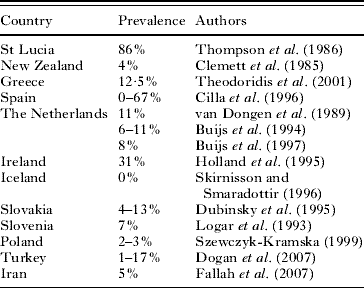
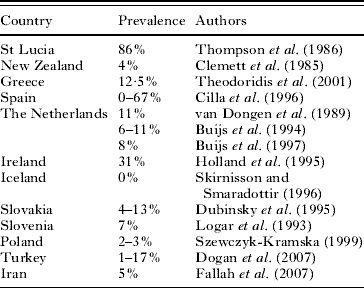
Toxocarosis prevalence did not increase with age of the all examined students and only among girls longer exposure to Toxocara infection marked in increase of toxocarosis prevalence. With boys, Toxocara seroprevalence was the greatest at the age of 14, which may be connected with their intensive physical activity outdoors (like playing football). Boys tend to spend more time outdoors than girls and are generally less particular about personal hygiene. It must be underlined that the ELISA serological test does not necessarily determine current infection but in this study it was not a key factor when the infection appeared. The prevalence of Toxocara infection among the lower-secondary students from Kołaczkowo is similar to that observed elsewhere in the world (Table 5). However, also in this case, the absence of standardized methods of serological tests and of result interpretation (cut-off) means that the comparison with results of other authors cannot be taken for granted.
Toxocara seroprevalence (ELISA-determined) of children in various parts of the world
Some authors have demonstrated pet presence as a toxocarosis risk factor (Glickman and Schantz, Reference Glickman and Schantz1981; Worley et al. Reference Worley, Green, Frothingham, Sturner, Walls, Pakalnis and Ellis1984; Holland et al. Reference Holland, O'Lorcain, Taylor and Kelly1995; Magnaval et al. Reference Magnaval, Galindo, Glickman and Clanet1997; Łużna-Lyskov, Reference Łużna-Lyskov2000; Wolfe and Wright, Reference Wolfe and Wright2003; Roddie et al. Reference Roddie, Stafford, Holland and Wolfe2008) while others claim there is no significant connection between pet presence at home and a higher probability of Toxocara infection (Nelson et al. Reference Nelson, Greene and Ernhart1996; Buijs et al. Reference Buijs, Borsboom, Renting, Hilgersom, van Wieringen, Jansen and Neijens1997; Sharghi et al. Reference Sharghi, Schantz, Caramico, Ballas, Teague and Hotez2001). In this study, the binary regression analysis showed that odds of being infected with Toxocara were higher for individuals who owned a cat than those who did not own a cat. Furthermore, girls who owned a cat, had a lowers odds of being infected with Toxocara than boys who owned cat. The presence of cat in boys' households could cause higher prevalence of the infection among them due to heavier soil contamination with eggs of T. cati in their surrounding and so their higher exposure (as was suggested above boys may spend a lot more time outdoors than girls). This observation can also indicate that the role of cats in human toxocarosis is still enigmatic.
The results from this present study and other studies (Glickman and Schantz, Reference Glickman and Schantz1981; Worley et al. Reference Worley, Green, Frothingham, Sturner, Walls, Pakalnis and Ellis1984; Holland et al. Reference Holland, O'Lorcain, Taylor and Kelly1995; Magnaval et al. Reference Magnaval, Galindo, Glickman and Clanet1997; Łużna-Lyskov, Reference Łużna-Lyskov2000; Wolfe and Wright, Reference Wolfe and Wright2003; Roddie et al. Reference Roddie, Stafford, Holland and Wolfe2008) clearly indicate that pet ownership can increase the probability of infection with Toxocara but the route of transmission is debateable. Transmisson of Toxocara through contact with contaminated soil and pet hair have been suggested (Wolfe and Wright, Reference Wolfe and Wright2003; Roddie et al. Reference Roddie, Stafford, Holland and Wolfe2008). Although this study did not examine the presence of eggs on the pets of the children, we suggest that in the area examined, soil may play a more important role in transmission of Toxocara from pets to children. It may be argued that first, it is not likely that eggs remain in pet hair for long enough to become infective (Barriga, Reference Barriga1988) and second, in a rural village, dogs and cats usually are not recognized as pets but play rather a utility role.
The influence of asymptomatic Toxocara infection on paratenic hosts previously was observed mainly among laboratory animals. Mice showed symptoms like frequent stillness, lower aggression level and a greater eagerness for risk by staying in non-enclosed areas in the presence of predators (Cox and Holland, Reference Cox and Holland1998). Their exploratory behaviour in the labyrinth was also reduced (Holland and Cox, Reference Holland and Cox2001). The magnitude of the symptoms was correlated with the dosage of larva administered to the mice. Investigations have also revealed that infected BALB/c mice took significantly longer to drink from a water source compared with control mice, indicating some degree of memory impairment (Hamilton et al. Reference Hamilton, Stafford, Pinelli and Holland2006). It has been also shown, that after heavy repeated T. canis infections, the mice were less apt to learn and remember (Cox and Holland, Reference Cox and Holland1998; Holland and Cox, Reference Holland and Cox2001). It is difficult to compare the behaviour exhibited in these murine experiments to humans as a paratenic host differs in its neuropsychological reactions, which are much more complex.
In human studies, the identification of a possible general biological impact of Toxocara infection has been scantly investigated. In our study we compared the developmental age level, physical fitness and school performance among Toxocara seropositive and seronegative students. The results show differences between EMN values of the two examined groups. Seropositive boys and girls have been found to have a higher EMN value. This suggests that among the numerous environmental factors stimulating developmental age (like the climate, the diet, the living standards) there is also parasite presence, which incites greater activity of the host organism, taking the form of faster development. However, longitudinal studies of the subject could deliver data that would allow us to draw more precise conclusions.
According to the results presented in this present study Toxocara infections seem have little impact, if any, on the students motor abilities such as muscle strength, agility and endurance. Only flexibility was observed to be significantly higher among infected children. All the infections discovered were clinically asymptomatic and therefore we did not expect that they would have an impact on students' fitness. The finding of a higher flexibility among seropositive students is difficult for to the authors to explain.
The comparison of end-of-year results of toxocarosis seropositive and seronegative students has shown that Toxocara seroprevalence and the grades at school correlate (P<0·05), but only for boys. This can be attributed to boys' greater susceptibility to environmental factors – in this case parasite presence in the body (Wolański, Reference Wolański1983). But, on the other hand, we cannot exclude that poorer school performance of seropositive boys was caused not by Toxocara infections, but by more time spent playing outdoors instead of studying (it should be noticed that exposure of boys was higher). Research into connections between Toxocara infection and children's cognitive skills were previously conducted by Worley et al. (Reference Worley, Green, Frothingham, Sturner, Walls, Pakalnis and Ellis1984), who showed that T. canis seropositive children had poorer reading skills, greater concentration problems and lower intelligence. However, this was not significant when additional variables were taken into account during multiple regression analysis. Nelson et al. (Reference Nelson, Greene and Ernhart1996) demonstrated no clear correlation between T. canis infection and the level of intelligence, even though the authors observed a clear trend towards lower cognitive abilities of the children examined. The subject of the connection between helminth infection and cognitive development of children was also studied for other parasites. For example, observations concerning widespread human-specific helminths Trichuris trichiura and Ascaris lumbricoides infections indicate that cognition impairments among infected children are connected mainly with their nutritional deficits (Nokes et al. Reference Nokes, Grantham-McGregor, Sawyer, Cooper and Bundy1992; Kvalsvig et al. Reference Kvalsvig, Cooppan and Connolly1991; Simeon et al. Reference Simeon, Grantham-McGregor and Wong1995; Levav et al. Reference Levav, Mirsky, Schantz, Castro and Cruz1995). Although it has been stated that helminth infections are associated with constraints on cognitive development and educational achievement, the nature of the causal path is unclear. The conclusion that the main causative agent of observed changes is the presence of parasites would be an excessive simplification because of the complexity of interactions in the human body. Certainly, reaction of the paratenic host on Toxocara infection is even more complex, because it cannot be explained e.g., by malnutrition and rather is connected with larvae localization in different organs and tissues. We maintain, consistently with Holland and Hamilton (Reference Holland, Hamilton, Holland and Smith2006) that explanation of the presence of neurological syndromes connected with human toxocarosis is extremely difficult and still enigmatic. On the other hand, further investigations on the impacts of covert Toxocara infections on humans would not be senseless. Although we did not find an association between the Toxocara infection among school children and some of their biological features examined, we feel that further studies investigating this phenomenon could adapt a better study design to establish the impact of toxocarosis on the biological development of children.
ACKNOWLEDGEMENTS
Grateful thanks to Professor Celia Holland for reviewing the manuscript and for her valuable comments. We also thank authorities of the Secondary School as well as parents and children from Kołaczkowo for allowing us to carry out the examinations.