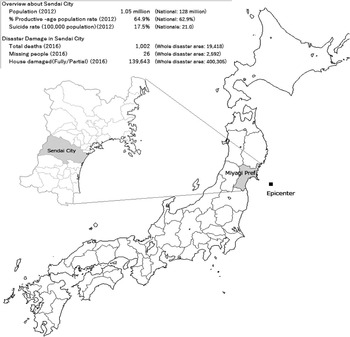
The Great East Japan Earthquake, which occurred on March 11, 2011, was the largest earthquake in Japan’s history. The earthquake generated a massive tsunami that reached a maximum height of 9.3 m and traveled up to 10 km inland in flat areas. According to a Sendai City official report, the disaster resulted in 1002 deaths and 26 missing people; 139,643 houses or buildings were fully or partially destroyed in Sendai City, the largest municipality in the disaster-stricken area and included urban regions (eg, industrial and commercial areas) (Figure 1). 1 The disaster caused many to lose family members and to experience severely damaged homes. In addition, the concomitant incident at the Fukushima Daiichi Nuclear Power Plant forced many residents of Fukushima Prefecture to evacuate, although nuclear exposure caused little damage to the city.
Detailed Information on Sendai City.

The Great East Japan Earthquake had a magnitude of 9.0 and an epicenter approximately 130 km off the shore of Sanriku and east-southeast of the Ojika Peninsula. Our disaster mental health team has been acting in Sendai City, which is characterized by a higher productive-age population and lower suicide rate than the national average. Specifically, the proportion of the productive-age population of Sendai City is higher than the national average and other disaster-stricken areas such as Iwate and Fukushima prefectures (in 2015: Sendai City, 64.9%; Iwate Prefecture, 59.0%; Fukushima Prefecture, 60.4%). The suicide rate in Sendai City (17.5/100,000 population in 2012) is comparable to the national average (21.0, 2012), even immediately after the disaster. Most of the disaster-related damage resulted from the tsunami, similar to other disaster-stricken areas.
Devastating natural disasters and their aftermath are known to cause psychological distress, including post-traumatic stress disorder and depression.Reference Murphy 2 - Reference Suzuki, Tsutsumi and Fukasawa 6 Studies on the topic suggest that prompt mental health services are required following a disaster. In the case of the Great East Japan Earthquake, disaster mental health service activities were provided at an early stage in the post-disaster period. These activities included psychological first aid, screening for individuals requiring observation or support, health screening, increasing public awareness regarding the initial psychological response to the disaster, counseling services, and support from outside volunteers.Reference Kim 7 - Reference Fukasawa, Suzuki and Nakajima 10 In the same way, our team provided disaster mental health services immediately to citizens and evacuees affected by the stress of the disaster as an administrative health service.
Mental health service activities are important for the care of evacuees, but the majority of reports regarding such services have focused on the acute phase.Reference Kim 7 - Reference Kato, Uchida and Mimura 11 Reports of long-term mental health service activities following disasters are limited.Reference Shinfuku 12 Through our long-term activities, we found that evacuees’ psychosocial issues differ from those observed in the acute phase, during which numerous victims evacuated to the shelters (eg, anxiety and fear of aftershock, depressive symptoms due to loss of family members, housing). This is likely due to the relocation of evacuees from shelters to temporary housing and subsequent changes in their lifestyles, as well as the challenges they faced in reconstruction. It was difficult to grasp the details of these changes during our ongoing activities. Therefore, the present study focused on mid- to long-term (defined as the period after all evacuees relocated to temporary housing, and later than August 1, 2011) mental health service activities in order to understand the psychosocial issues of evacuees who continuously used our support services.
We assumed that factors related to continuing our support services in the mid- to long-term period might not be limited to disaster-related experiences (eg, loss of relatives and housing or anxiety and fear of aftershock). Therefore, this practical report aimed to: (1) summarize our practical activities up to September 2015, marking 4.5 years since the disaster, during which reconstruction of permanent housing has started and (2) examine evacuees’ psychosocial functioning and social issues (eg, disaster-related stress symptoms, type of temporary housing, alcohol problems, and economic and resettlement issues), while comparing those who continued or terminated our services. Additionally, we will use the findings of the present study to develop a policy for evacuee recovery, which will continue to benefit from an analysis of related factors in ongoing support efforts.
METHODS
Disaster Mental Health Team and Disaster Mental Health Service Activities
Immediately following the disaster, a disaster mental health team was established within the Sendai City Mental Health and Welfare Center, a division of the local governmental office. Our team was composed of psychiatric doctors, public health nurses, clinical psychologists, and psychiatric social workers. We provided support to evacuees via mental health experts, while also working with regional public health center staff.
The disaster mental health team aimed to (1) help evacuees with mental distress prevent or minimize challenges in daily life by transcending the stress of the disaster, (2) help evacuees solve their psychosocial issues, and (3) help all citizens improve their mental health status. One of our team’s roles was to facilitate the transition from team-based services to conventional health or medical services in the region. Therefore, we referred some cases to conventional nondisaster welfare services (eg, community mental health and welfare services or elderly welfare services) and also referred cases to psychiatric hospitals or clinics. Support services were provided by outreach efforts targeting “hard-to-reach” evacuees who relocated to temporary housing.Reference Buck and Pleasence 13 Previous studies have reported that subclinical distress and emotional upset were observed after the 2004 earthquake in Niigata Prefecture. However, the majority of affected evacuees did not show overt symptoms because the expression of negative feelings in front of other people was strongly avoided.Reference Kim 7 Therefore, mental health outreach efforts at temporary housing areas could also aid in reducing the stigma of accessing mental health care services.Reference Tanisho, Smith and Sodeoka 14
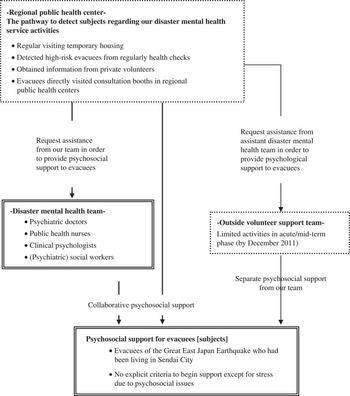
The process by which we initiated our disaster mental health services is shown in Figure 2. First, regional public health center staff identified subjects and conducted clinical interviews regarding living conditions, health status, and daily activities. Second, regional public health center staff referred cases identified as potentially having mental distress to us. Finally, our team received requests from the regional public health center to support evacuees in temporary housing who were thought to be suffering from psychosocial issues. The individuals we supported were evacuees of the Great East Japan Earthquake who had been living in Sendai City. However, no explicit criteria were established to initiate support, except for the presence of stress or psychosocial issues. This is because our activities were provided as a part of administrative services, and it was necessary to provide a broad range of care to all citizens.
Disaster Mental Health Team and Disaster Mental Health Service Activities.

The flow of our disaster mental health service activities is shown. The regional public health center referred evacuees to our team for support. Participants in our services were evacuees of the Great East Japan Earthquake currently living in Sendai City. There were no explicit criteria for initiation of support, except for stress or psychosocial issues experienced by evacuees.
Based on the 2003 Japanese Guidelines on Post-Disaster Mental Health Care, our team initiated activities during the acute phase, mainly providing the following services for the sake of prevention, early detection, and treatment of particular mental disorders: (1) psychological first aid, (2) screening for people in need of observation or support, (3) counseling, and (4) providing psychoeducation or increasing the awareness of the public towards initial psychological responses to disasters. 15 To address the strong demand for support, we were helped by several teams of outside volunteers formed by well-trained psychiatrists, psychologists, public health nurses, and psychiatric social workers, particularly during the acute phase, which is defined herein as the end of July 2011 because all evacuee shelters were closed by July 31, 2011, and all evacuees relocated to temporary housing. Conversely, in the mid- to long-term post-disaster phase (defined as later than August 1, 2011), our team’s activities transitioned to providing psychosocial support, which was characterized by (1) identifying high-risk evacuees by visiting temporary housing regularly, (2) listening carefully to evacuees’ troubles or providing advice or information for reconstruction, and (3) improving the awareness of the entire community towards mental health. These activities were focused on psychosocial issues for the purpose of helping evacuees prevent or minimize challenges in daily life that arise from disaster-related stress, rather than identifying evacuees who seemed to have serious symptoms or severe distress and needed medical care in the acute phase.Reference Shinfuku 12
Records of Activities and Data Variables
All authors and members of our disaster mental health team collected data from participants based on activities relating to our disaster mental health service. Every activity undertaken by our team was recorded in a database, including information on support date, disaster-related experiences (loss of family, relatives, or homes), stress symptoms, improved stress symptoms, economic and resettlement issues, alcohol-related problems, community-related problems, and past history of physical or mental disorders, as well as basic information on sex, age, employment status, housing status, and living situation, which was obtained based on self-report from evacuees through clinical interviews and careful listening.
Stress symptoms were as follows: depression, loss of sleep, loss of appetite, fatigue, irritability, oversensitivity, regression, memories of the disaster, lack of memories of the disaster, repression, and discomposure. Economic and resettlement issues were as follows: unemployment, decreased income, work instability, increased debt, and undetermined resettlement location. Alcohol-related problems were defined as consumption of large amounts of alcohol (approximately 120 mL of whiskey or brandy, 480 mL of wine, 1000 mL of beer, or 360 mL of Japanese sake per day) or causing trouble related to drinking in the community. Information on alcohol consumption was determined on the basis of interviews. Community-related problems included complaints from neighbors and isolation from family or community.
Decisions regarding stress symptoms and psychological issues were made after face-to-face clinical interviews or careful listening between our consultant staff and evacuees or their family members. Through this process, our consultant staff evaluated psychological status and symptoms on the basis of answers and feelings expressed by evacuees. Subsequently, we recorded the presence or absence (2 dichotomous items) of evacuees’ symptoms. In particular, improved stress symptoms were assessed as follows: (1) confirmation of the presence or absence of stress symptoms at the first intervention (eg, during clinical interviews and by careful listening) and (2) reconfirmation of the presence or absence of symptoms in subsequent interventions. If improvements in stress symptoms could be determined through clinical interviews or careful listening, we recorded the information in the database.
Records of activities of outside volunteer support teams were kept separately; thus, their activities were not recorded in our database. However, some activity records of the Japan Association of Neuro-Psychiatric Clinics, an outside volunteer support team that provided support with our team, were included in this information set.
The database of our activity records contains personal information such as name, date of birth, and address, and thus measures were taken to ensure strict security and protection from outside access. Only our team members and regional public health center staff had access to the database.
Definitions of Terminated, Continuing, Discontinued, and Single Support
Support status was divided into 4 categories: terminated support, continuing support, discontinuing support, and single support. Detailed definitions are as follows. Terminated support was defined as (1) resolved or improved psychosocial issues related to the disaster and (2) transitioned to conventional nondisaster welfare services, such as community mental health and welfare services or elderly welfare services. Continuing support was defined as (1) support that was ongoing on September 30, 2015, or (2) passage of less than 1 year from the last date of support. Discontinued support was defined as (1) loss of contact with evacuees (continuous contact failure) due to lack of response to communication efforts or relocation to a new address without providing detailed information, (2) referred to psychiatric hospitals or clinics due to severe mental distress during the provision of support, or (3) death. Single support was defined as (1) provision of information to evacuees who already meet the criteria for psychosocial well-being or (2) referral to psychiatric hospitals or clinics due to the need for medication during the first intervention. Most terminated cases who transitioned to conventional nondisaster welfare services (eg, those who were diagnosed with dementia or schizophrenia) had improved disaster-related stress symptoms. However, as they were required to receive social services, we aided their transition to conventional nondisaster welfare services based on our team’s role.
Evaluation of Cases of Continuing or Terminated Support and Psychosocial Issues
At meetings and case reviews with regional public health center staff, we discussed whether our support should be terminated or continued on the basis of the evacuees’ narratives or the impressions of our team consultants and regional public health center staff. Therefore, there may have been differences in the methods used to determine whether to terminate or continue support. In order to standardize disaster mental health service activities, we held regular workshops with our staff and regional public health center staff during which we discussed how to support cases.
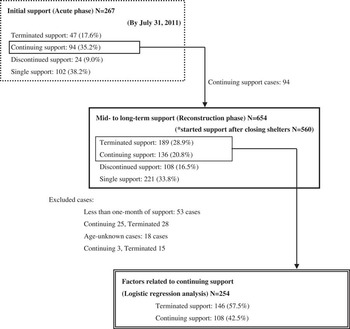
Prior to data analysis, cases were excluded if they (1) had support terminated by July 31, 2011 (corresponding to the acute phase); (2) received support only once; (3) received support for less than 1 month; or (4) did not have their age documented. The reasons for these exclusion criteria were that evacuee shelters were closed and numerous outside volunteer support teams were acting independently during the acute phase (a few outside volunteer groups were active before the mid-term phase), which made it difficult to provide a detailed description of their activities. In addition, we assumed that the psychosocial issues faced by evacuees may have changedReference Shinfuku 12 compared with those observed during the acute phase. A total of 254 evacuees were included in this analysis (Figure 3). Data for acute phase cases that completed support by July 31, 2011, are shown in Table S1 in the online data supplement.
Analysis of Disaster Mental Health Service Activities (Mid- to Long-term Phase).

Before logistic regression analysis was performed, 654 cases were assessed for factors related to continuation or termination of support. After exclusion of cases that received less than 1 month of support and age-unknown cases, the remaining 254 cases were analyzed. Also shown are the basic characteristics of excluded cases who (1) discontinued or were single support cases, (2) received less than 1 month of support, and (3) were age-unknown cases.
To assess factors related to the continuation of disaster mental health support, we used the following variables: (1) living with family members, (2) type of temporary housing (privately rented temporary housing or prefabricated temporary housing), (3) past history of physical or mental illness, (4) disaster-related traumatic experience (loss of family, relatives, or homes), (5) current employment status (employed, self-employed, or unemployed), (6) economic (eg, unemployment, income reduction, increasing debt) and resettlement problems, (7) alcohol-related problems, (8) isolation from family or community, (9) number of stress symptoms, (10) number of improved stress symptoms, (11) frequency of support, and (12) rate of contact failures. These variables, except (11) and (12), were evaluated by clinical interviews with evacuees or their family and by careful listening during our activities. Moreover, with respect to the type of temporary housing (ie, (2) above), residents in prefabricated temporary housing were allocated into 17 temporary housing areas by use of 2 approaches: random allocation and allocation to an area with members of the same community in order to preserve local social ties. Therefore, some residents in prefabricated temporary housing were able to sustain local social ties. Conversely, residents in privately rented housing were allocated randomly and relocated to nondamaged areas where nonevacuees lived. For these evacuees, former local community ties were completely severed. The number of stress symptoms (ie, (9) above) was determined by summing the defined stress symptoms (mentioned in the section “Records of Activities and Data Variables”). These were marked as present or absent during clinical interviews and careful listening. The rate of contact failures (ie, (12) above) was determined on the basis of instances in which our team visited temporary housing to support evacuees (with or without an appointment) but were unable to contact absent evacuees.
Statistical Analysis
Prior to logistic regression analysis, simple cross-tabulation was used to calculate basic statistics by sex, age group, living with family, job status, number of stress symptoms, and disaster-related damage. Logistic regression analysis was performed by using continued support (scored as 1) versus terminated support (referent, scored as 0) as the dependent variable, and the above-mentioned 12 variables (used to assess psychosocial issues) as independent variables.
All variables were documented at the time of initial support. Model 1 used support status (referent category: terminated support) as the dependent variable and one of the 12 independent variables, sex, and age as independent variables. Each independent variable was entered separately in a series of regression analyses. In order to assess whether improved stress symptoms could lead to terminated support, we performed further logistic regression analysis with Model 2, which was adjusted for sex, age, and the number of stress symptoms. Each odds ratio (OR) reflected the likelihood of continuing or terminating support. If the OR was greater than 1, the cases had experiences, events, or psychosocial issues that led to continuing support. The number of stress symptoms was used for analysis instead of a psychological scale (eg, K6/K10, Impact of Event Scale-Revised) owing to the difficulty of using validated scales during outreach efforts. Particularly in the acute phase, it was difficult for our team to contact evacuees in crowded shelters and to use the psychological scale because evacuees were defensive about providing details regarding psychological troubles, likely due to the stigma associated with mental health issues. Statistical significance was evaluated by using two-sided, design-based tests with a 5% level of significance.
Ethical Considerations
This study was conducted to evaluate the administrative health services provided by our public sector. According to the epidemiological research guideline set forth by the Ministry of Education, Culture, Sports, Science, and Technology and the Ministry of Health, Labor, and Welfare in Japan, evaluation of health services, such as in the present study, is exempt from ethical review. Thus, review by an ethics committee was not necessary. Based on this guideline, implementation of the study was made public and informed consent was considered not to be required as it was an observational study that used only existing documents. Notwithstanding, our team members, as local governmental office workers, were responsible for maintaining confidentiality. This included safety measures to prevent the leakage of personal information, in accordance with the Sendai City personal information protection ordinance.
RESULTS
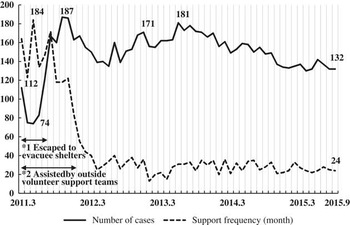
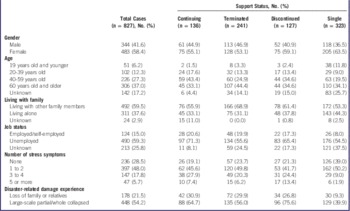
Changes in the number of cases and support frequency are shown in Figure 4. During the acute phase surrounding July 2011 (during which many people were evacuated to shelters), there was a high frequency of support for evacuees owing to immediate psychological reactions to the disaster. The number of cases included in this analysis had 2 peaks: (1) the period in which outside volunteer support teams were acting and (2) the period around July 2013 (during which a health check was performed to detect high-risk evacuees from among those residing in prefabricated temporary housing). Of the 827 total cases included in our activities, most were older than 40 years (Table 1). Of cases who received continuous support, a high proportion were aged 40 to 59 years, whereas younger cases tended to use single support.
Number of Cases and Support Frequency in Disaster Mental Health Service Activities. *1: The period during which shelters were provided to evacuees (through July 31, 2011).*2: The period during which support was provided by outside volunteers (around the end of December 2011).

Basic Statistics of the Population Receiving Services Through Our Intervention (Whole Cases)

Changes in the number of cases participating in our activities are shown in Figure 4. The solid line represents the number of cases, and the dotted line represents support frequency. Evacuees relocated to temporary housing when all shelters were closed by end of July 2011. Our disaster mental health team was assisted by outside volunteer support teams in December 2011, although many teams were also active during the acute phase.
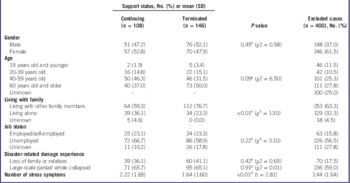
A total of 254 cases were analyzed in order to assess the psychosocial backgrounds of evacuees who continued or terminated services. Basic statistics regarding evacuees who used support services during the mid- to long-term phase are shown in Table 2. All 254 cases were divided into 2 groups: those who terminated support and those who continued support. These groups did not differ significantly by the χ2 test for sex, age group, employment status, number of stress symptoms, or disaster-related damage experience. However, the 2 groups differed with respect to living with other family members (χ2=13.0, effect size: 0.23) and number of stress symptoms (t=2.81, effect size: 0.36).
Basic Statistics of Analysis Subjects (Mid- to Long-term Phase)

a Chi-square test.
b t-test.
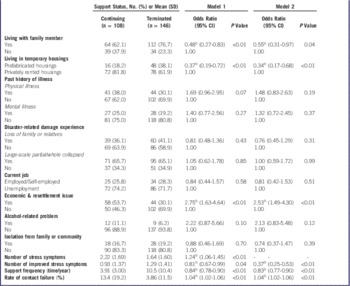
Logistic regression analysis revealed significant associations between termination of support and living with family (OR: 0.48; 95% confidence interval [CI]: 0.27-0.83), living in prefabricated temporary housing (OR: 0.37; 95% CI: 0.19-0.72), number of improved stress symptoms (OR: 0.81; 95% CI: 0.67-0.99), and higher support frequency (OR: 0.84; 95% CI: 0.78-0.90) (Table 3). Conversely, based on Model 1 (adjusted for sex and age), economic and resettlement issues (OR: 2.75; 95% CI: 1.63-4.64), a larger number of stress symptoms (OR: 1.24; 95% CI: 1.06-1.45), and a greater rate of contact failures (OR: 1.04; 95% CI: 1.02-1.06) were significantly associated with continuation of support.
Association Between Support Status and Psychological and Social Variables (Mid- to Long-term Phase)

a Abbreviations: CI, confidence interval. Model 1: independent variables were adjusted by sex and age. Model 2: independent variables were adjusted by sex, age and number of stress symptoms.
b Significant variables (p<0.05).
An additional analysis was conducted by adjusting for the number of stress symptoms in Model 2 (adjusted for sex, age, and number of stress symptoms), which revealed variables related to support status similar to those identified in Model 1 (with the variable of living with family excluded). In Model 2, the number of improved stress symptoms was significantly related to support termination. Furthermore, living in prefabricated temporary housing was strongly associated with termination of support (ORs: number of improved stress symptoms=0.37; relocated to prefabricated housing=0.34). A detailed analysis between prefabricated temporary and privately rented temporary housing showed that prefabricated housing residents received support at a higher frequency (prefabricated vs. privately rented: 13.4 vs. 5.2 times per year, t=7.08, P<0.01), were less difficult to contact (number of contact failures with evacuees living in prefabricated vs. privately rented: 0.10 vs. 0.69 times per year, t=17.8, P<0.01), and had a lower proportion of economic and resettlement issues (prefabricated vs. privately rented: 20.8% vs. 51.0%, χ2=17.1, P<0.01). These factors associated with living in prefabricated temporary housing may have influenced the termination of support.
Our findings collectively suggest that termination of psychosocial support was affected not only by improved stress symptoms, but also by living arrangements, which was affected by the high-frequency supports. Moreover, economic and resettlement issues were detrimental to continuing support.
There were no significant associations between support status and past history of illness, disaster-related experiences, employment status, alcohol-related problems, or isolation from family or community. Although alcohol use disorders were observed after devastating natural disasters in a previous study,Reference North, Ringwalt and Downs 16 - Reference Ueda, Yabe and Maeda 18 no association was found between alcohol use and support status in the present study.
DISCUSSION
The present study focused on factors associated with continued disaster mental health services. Our judgments of terminated or continuing support were based on whether evacuees were able to improve their stress symptoms related to the disaster or resolve social issues such as isolation from their family or community, alcohol problems, and resettlement through disaster mental health activities. Therefore, terminated support could indicate improvements in mental distress or a resolution of social issues. We found that a higher frequency of contacts with evacuees, living in prefabricated temporary housing, and improved stress symptoms were significantly associated with terminated support. Moreover, economic and resettlement issues were some of the most difficult issues to resolve in the mid- to long-term phase of our disaster mental health activities.
Support during the acute phase focuses on victims who experienced severe traumatic episodes such as loss of family, relatives, or homes. In this study, however, we assessed economic and resettlement issues in the long-term post-disaster period. A previous study conducted in the town of Yamada in Iwate Prefecture, which experienced severe damage during this disaster, reported that economic status was related to serious mental health problems.Reference Yokoyama, Otsuka and Kawakami 19 Resettlement issues among evacuees in Sendai City were difficult to handle because they involved deciding between moving to reconstructed permanent housing or new permanent housing based on the 5-year deadline of providing temporary housing set by Sendai City officials. Since the number of reconstructed permanent dwellings was limited, and not all evacuees who relocated to temporary housing could move there, some evacuees needed to find new permanent dwellings. A previous study of Hurricane Katrina evacuees reported that 62% of evacuees required housing assistance. 20 These findings underscore the prevalence of economic and resettlement issues, as well as the mental states and stress-related symptoms of evacuees, in disaster situations. Unfortunately, our ability to address economic and resettlement issues was limited because the current team of psychologists and social workers was not adequately trained to address these issues. Thus, further collaborations with experts in fields such as legal or employment support and reconstruction will be necessary.
Social ties were shown to improve mental distress and resolve social issues of evacuees during the mid- to long-term phase. Recent studies have highlighted the importance of social ties in disaster recoveryReference Nakagawa and Shaw 21 - Reference Aldrich 24 and have shown that “communities rich in social capital recovered more quickly after disasters.”Reference Koyama, Aida and Kawachi 25 In the present study, relocation to prefabricated temporary housing and high support frequency were associated with improved mental distress and resolved social issues among evacuees. Relocation to prefabricated temporary housing may result in better outcomes than relocation to privately rented housing, as it could help sustain social ties. Since social ties could affect mental status,Reference Tomiyasu, Imoto and Otsuki 22 establishment of social networks and community-based care are essential after devastating disasters. Our analysis highlights the importance of sustaining a high frequency of support for evacuees, or decreasing contact failures, in order to build mutual trust between support staff and evacuees.
According to previous studies, alcohol-related problems are an important psychological issue for which evacuees require support. However, alcohol-related problems were not associated with continued support in the present study. One potential reason for this is that those with alcohol problems had difficulty with receiving continuous support and dropped out during follow-up, with a majority of such individuals characterized as discontinuous cases (approximately 30%). Such evacuees should be monitored carefully.
The present study had several noteworthy limitations. First, the validity and accuracy of the study may be somewhat compromised by the lack of clear criteria for terminating psychosocial support, except for improved mental distress or resolved social issues. The fact that we did not use a psychological scale to evaluate evacuees’ mental status is an important limitation. Using a psychological scale in the acute phase is difficult, although it is feasible during the mid- to long-term phase because evacuee privacy can be ensured by visiting each evacuee’s temporary residence. Although this limitation was discussed during meetings and case reviews with regional public health center staff and it was determined to be appropriate to terminate support due to improved psychosocial status, use of a psychological scale in the mid- to long-term phase should be considered in future disaster mental health activities. Second, there was potential selection bias. The cases included in this analysis were referred to us by regional public health center staff members, who had identified cases with various disaster-related problems and mental distress. We provided support to all cases referred to us by the center, rather than focusing only on particular cases. Third, the methods used by our staff to determine termination or continuation of support may have differed. In order to standardize disaster mental health service activities, we held regular workshops to train both our staff and regional public health center staff who worked with our team. Finally, information communicated between evacuees and team members was not always confidential in the acute phase because most victims evacuated to shelters with inadequate privacy protection. Thus, the majority of affected people did not provide answers in response to questions about their stress symptoms because they tended to avoid expressing negative feelings in front of other people. Conversely, our study focused on the mid- to long-term period after evacuees had relocated to temporary housing, which provided some measure of privacy. Therefore, confidentiality was secured to a certain degree in this study.
Despite these limitations, this study had several strengths. The majority of previous studies and reports regarding disaster mental health services after the Great East Japan Earthquake have focused on the acute phase.Reference Kim 7 - Reference Kato, Uchida and Mimura 11 Our study focused on mid- to long-term disaster mental health services for evacuees, as well as on the acute phase with long-term follow-up. Long-term follow-up activities are important because they provide perspective on changes in evacuees’ psychosocial needs, as compared to those observed in the acute phase. Factors related to the continuation of psychosocial support changed between the acute phase and mid- to long-term phase. During the mid- to long-term phase, economic and resettlement issues and decreased support frequency were significantly associated with continuation of support, whereas continuation of support in the acute phase was associated with loss of family, relatives, or homes, infrequent support, and a high number of stress symptoms (Tables S1 and S2 in the online data supplement). Our team tended to identify those with several disaster-related stress symptoms or traumatic experiences (eg, loss of family, relatives, or homes) in the acute phase for the purpose of prevention, early detection, and treatment of particular mental disorders, which may have affected the continuation of support in the acute phase. These findings indicate that individuals providing disaster mental health services should be aware of changesReference Shinfuku 12 in problems faced by evacuees as time passes and highlight the importance of long-term psychosocial support for evacuees.
Collectively, our findings demonstrate the importance of providing intensive, long-term disaster mental health care services. Fortunately, the suicide rate in Sendai City has not increased since the disaster. However, at 4.5 years after the Great East Japan Earthquake, many evacuees still live in temporary housing and face various challenges in rebuilding their lives. Many evacuees are still burdened with the decision of whether to relocate to reconstructed permanent housing or to pursue new living arrangements. New cases may still arise and require careful monitoring. Therefore, disaster mental health service activities should be provided on an ongoing basis.
Acknowledgments
Our disaster mental health service activities in Sendai City were supported by numerous nationwide volunteer groups. Regional public health center staff and other volunteer groups cooperated in our activities. We thank these groups and staff for their enthusiasm in supporting evacuees in Sendai City. Members of our Disaster Mental Health Team of the Sendai City Mental Health and Welfare Center who were not listed as authors include: Kanako Tazaki, Akiko Sato, Yuri Takahashi, Kouko Sato, Ryosuke Shiomi, Aki Hasegawa, Mikiko Watanabe, Junko Takeishi, Miyuki Watanabe, and Masanobu Ohashi.
SUPPLEMENTARY MATERIAL
To view supplementary material for this article, please visit https://doi.org/10.1017/dmp.2016.157