Introduction
Sudden hearing loss is a symptom of cochlear injury that usually results from idiopathic causes. It is defined as a sensorineural hearing loss of 30 dB or more over at least three contiguous audiometric frequencies, which develops over a period of a few hours to three days.Reference Wilson, Byl and Laird1, Reference Byl2 Sudden hearing loss is a frequent disorder (occurring in one in 3000–5000) with an increasing incidence in western countries.Reference Ullrich, Kleinjung, Steffens, Jacob, Schmitz and Strutz3 The rate of spontaneous recovery is 45 to 65 per cent of patients.Reference Wilson, Byl and Laird1, Reference Mattox and Simmons4, Reference Byl5 It is difficult to estimate the efficiency of the various treatment modalities used in sudden hearing loss.Reference Zadeh, Storper and Spitzer6, Reference Kanzaki, Inoue, Ogawa, Fukuda, Fukushima and Gyo7 The factors considered to be important in the prognosis of this condition are: severity of hearing loss, duration of symptoms before treatment, presence of vertigo, type of audiogram, age of patient, hearing level in the opposite ear, erythrocyte sedimentation rate, coexistence of metabolic diseases such as hypertension and diabetes mellitus, and audiological parameters.Reference Byl2, Reference Fetterman, Saunders and Luxford8–Reference Ikeda, Kusukari, Kobayashi, Inamura, Shibuya and Takeyama12
In this study, we aimed to assess the impact of patient-related and audiovestibular parameters on the prognosis of sudden hearing loss.
Materials and methods
We evaluated retrospectively the medical records of patients treated for sudden hearing loss between 1995 and 2001. The 83 patients who had adequate follow-up data were included in the study. These included 44 men and 39 women, with a mean age of 43 years (range, 18–79 years). No patients had otitis media or a history of ear surgery or vertiginous disease. All patients were hospitalised and treated using the following protocol: 10 days of bed rest, plus medical treatment with pentoxifylline 120 mg/day, heparin 5000 U/day, methylprednisolone 1 mg/kg/day (tapered down over two weeks), ginkgoglycosides 28.8 mg/day and papavarine HCl 120 mg/day (all administered intravenously).
The following parameters were noted for each patient: demographics (age and gender); systemic diseases (cardiovascular disorders, cerebrovascular problems and endocrine diseases); time elapsed between onset of sudden hearing loss and initiation of treatment; tinnitus; vestibular symptoms; type of initial audiogram; pure tone averages (PTAs) in the frequencies 250, 500, 1000, 2000 and 4000 Hz; and speech discrimination score. In all patients, audiological measurements were performed on initial admission and at the completion of treatment on the 10th day.
The type of initial audiogram was determined as described previouslyReference Saeki and Kitahara13 and classified as: flat (i.e. no more than a 15 dB deviation from the PTA at any frequency between 250 and 8000 Hz); down-sloping (i.e. hearing loss increasing from low to high frequencies); up-sloping (i.e. hearing loss more severe at lower frequencies, with an increment of at least 20 dB towards normal at high frequencies); and midfrequency type (i.e. hearing loss more severe at middle frequencies).
Hearing gain, relative hearing gain and recovery rate were calculated as parameters for determination of hearing recovery on the fifth and 10th days of treatment. Hearing gain (in dB) was an absolute value of hearing recovery which was defined as the change in the average of hearing levels at five frequencies (250 Hz to 4 kHz). Relative hearing gain represented the ratio of the hearing gain to the initial hearing level.Reference Probst, Tschopp, Ludin, Kellerhals, Podvinec and Pfaltz14 Recovery rate was calculated by dividing the hearing gain by the difference in initial hearing level between the affected and unaffected sides.Reference Yamamoto, Kanzaki, Ogawa, Inoue and Ikeda15
Statistics
Correlation between parameters was assessed using curvilinear regression analysis. Independent samples t-test was also used when necessary in order to compare the parameters of independent groups.
Results
Gender and age
There was no correlation between the hearing gain and recovery rate scores and gender or age (p>0.05). However, a correlation was found between gender and relative hearing gain. The mean relative hearing gains of the male and female patients were 0.43±0.3 and 0.28±0.4, respectively; this represented a significant difference (f=0.695, 81 degrees of freedom, p=0.46) (Table I).
Audiological parameters by gender

ipPTA=pure tone average before treatment in diseased ear; ipSDS=speech discrimination score before treatment in diseased ear; clPTA=PTA before treatment in contralateral ear; clSDS=SDS before treatment in contralateral ear; HG=hearing gain; RHG=relative hearing gain; RR=recovery rate; M=male; F=female
Systemic disease
Of the 83 patients, 25 (30.1 per cent) had a systemic disease such as hypertension, diabetes mellitus or hyperlipidaemia. However, there was no correlation between the presence of a systemic disease and patients' hearing gain, relative hearing gain or recovery rate scores (p>0.05).
Vertigo and tinnitus
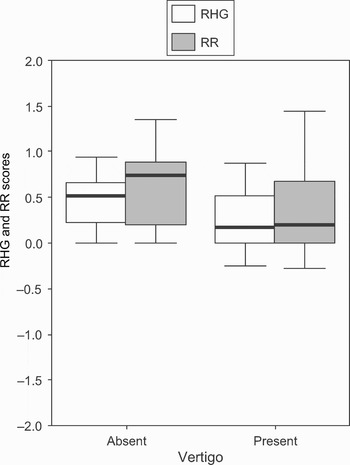
Vertigo was present in 34 of the 83 patients (40.9 per cent) but was not correlated with hearing gain and recovery rate scores (p<0.05). However, the relative hearing gain correlated negatively with the presence of vertigo (−r=0.05, 81 degrees of freedom, p=0.043) (Figure 1). Tinnitus was present in 76 (91.57 per cent) patients, but there was no correlation between this symptom and scores for hearing gain, relative hearing gain and recovery rate (p>0.05).
Recovery rate (RR) and relative hearing gain (RHG) scores for patients with and without vertigo.

Time elapsed between onset and treatment
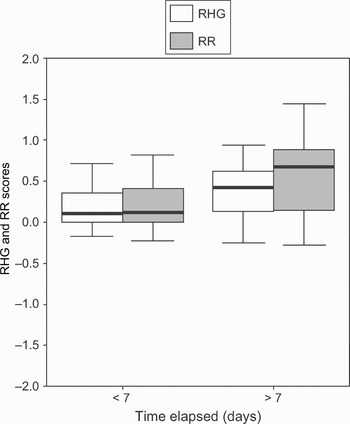
The mean time elapsed between onset of sudden hearing loss and initiation of treatment was 5.4 days. There was no correlation between this time duration and the scores for hearing gain, relative hearing gain or recovery rate (p>0.05). However, when seven days was considered as a cut off level, a significant difference was found between the relative hearing gain and recovery rate scores of patients whose treatment had been initiated within and following seven days of the onset of hearing loss. The scores of patients admitted within seven days of hearing loss onset were significantly better than those of patients admitted after seven days (t=662, 81 degrees of freedom, p=0.03; and t=3.221, 81 degrees of freedom, p=0.023, respectively) (Figure 2).
Recovery rate (RR) and relative hearing gain (RHG) scores for patients admitted within and following seven days of onset of their symptoms.

Type of audiogram
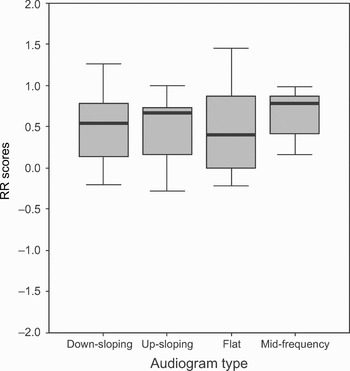
The audiogram type was down-sloping, up-sloping, flat and midfrequency in 19, 10, 45 and nine patients, respectively. On initial admission, there was no correlation between patients' scores for hearing gain, relative hearing gain and recovery rate and their type of audiogram (p>0.05), except for the midfrequency type of audiogram. Patients with midfrequency type audiograms showed significantly better hearing gain scores (r=0.56, 81 degrees of freedom, p=0.031) (Figure 3) (Table II).
Recovery rates (RRs) for patients with different audiogram types on intial admission.

Audiological parameters by type of initial audiogram in affected ear

ipPTA=pure tone average before treatment in diseased ear; ipSDS=speech discrimination score before treatment in diseased ear; clPTA=PTA before treatment in contralateral ear; clSDS=SDS before treatment in contralateral ear; HG=hearing gain; RHG=relative hearing gain; RR=recovery rate
Audiologic parameters
There was correlation between some audiological parameters and the scores for relative hearing gain and recovery rate. Patients with <40 dB hearing loss on admission showed better relative hearing gain (r=0.55, 81 degrees of freedom, p=0.03). The relative hearing gain scores correlated positively with better pre-treatment speech discrimination scores (r=0.82, 81 degrees of freedom, p=0.009) and negatively with the presence of vertigo (−r=0.05, 81 degrees of freedom, p=0.043) as well as with poor pre-treatment PTA (−r=0.082, 81 degrees of freedom, p=0.009).
Patients with <40 dB hearing loss on admission showed better recovery rates (r=0.127, 81 degrees of freedom, p=0.001). However, patients with >60 dB hearing loss on admission showed poor recovery rates (−r=0.087, 81 degrees of freedom, p=0.007). Recovery rate scores correlated positively with pre-treatment speech discrimination scores (r=0.149, 81 degrees of freedom, p<0.001) and negatively with pre-treatment PTAs (−r=0.172, 81 degrees of freedom, p<0.001) (Table III).
Audiological parameters by pure tone averages on initial admission

PTA=pure tone average; ipPTA=PTA before treatment in diseased ear; ipSDS=speech discrimination score before treatment in diseased ear; clPTA=PTA before treatment in contralateral ear; clSDS=SDS before treatment in contralateral ear; HG=hearing gain; RHG=relative hearing gain; RR=recovery rate
Discussion
Sudden hearing loss is an enigma. However, its relatively high incidence makes clarification of both aetiological and prognostic factors a priority. Unfortunately, early estimation of prognosis represents a dilemma.
Sudden hearing loss is most common amongst patients aged 30 to 60 years, and advanced age is considered a prognostic factor.Reference Mattox and Simmons4, Reference Megighian, Bolzan, Barion and Nicolai16–Reference Hirano, Ikeda, Kawase, Oshima, Kekehata and Takahashi23 The physiological and structural degeneration that occurs with ageing may increase the possibility of vascular compromise.Reference Chang, Ho and Kuo22 Although childhood is considered a poor prognostic factor,Reference Byl2, Reference Kiris, Cankaya, Icli and Kutluhan24–Reference Roman, Aladio, Paris, Nicollas and Triglia26 a better recovery rate was reported in young patients.Reference Linssen and Schultz-Coulon9, Reference Kanzaki, Taiji and Ogawa27 By contrast, several other studies did not find a correlation between age and prognosis of sudden hearing loss,Reference Moskowitz, Lee and Smith28–Reference Mamak, Yilmaz, Cansiz, Inci, Guclu and Derekoylu31 in agreement with our findings. Female gender was considered to be a poor prognostic factor in sudden hearing loss. Correspondingly, in our study, the relative hearing gain scores of female patients were worse than those of males.
Systemic diseases such as hypertension, diabetes mellitus and hyperlipidaemia may be poor prognostic factors in sudden hearing loss.Reference Ohinata, Makimoto, Kawakami, Haginomori, Araki and Takahashi32, Reference Pruszewicz, Kruk-Zagajewska, Szyfter and Smolinska33 The outcome of hearing may be worse in these patients because of the presence of microvascular disorders.Reference Hirano, Ikeda, Kawase, Oshima, Kekehata and Takahashi23, Reference Weng, Chen, Hsu and Tseng34 However, it was also suggested that diseases such as atherosclerosis, hyperlipidaemia, diabetes mellitus and hypertension do not influence the prognosis of sudden hearing loss,Reference Ulrich, Aurbach and Drobik35 in agreement with our results.
The time from onset of sudden hearing loss to treatment is considered to be one of the most important prognostic factors.Reference Murai, Tsuiki, Kusano and Shishido36 Most authors agree on the positive effect of immediate treatment of sudden hearing loss.Reference Byl2, Reference Mattox and Simmons4, Reference Linssen and Schultz-Coulon9, Reference Chang, Ho and Kuo22, Reference Kiris, Cankaya, Icli and Kutluhan24, Reference Mamak, Yilmaz, Cansiz, Inci, Guclu and Derekoylu31, Reference Murai, Tsuiki, Kusano and Shishido36–Reference Schweinfurth, Parnes and Very38 Treatment should be started as soon as possible, and it probably is not helpful after 30 days as active disease may have resolved and damage may be permanent.Reference Hughes, Freedman, Haberkamp and Guay39 It was suggested that audiometric parameters measured on the seventh day after onset might be useful for predicting the prognosis in sudden deafness.Reference Yamamoto, Kanzaki, Ogawa, Inoue and Ikeda15 Shaia and Sheehy achieved a complete, moderate or slight recovery in 75 per cent of their patients treated with a vasodilator within seven days of onset of sudden hearing loss; however, the recovery rate decreased to 53 per cent in patients who presented one week to one month after the onset of their hearing loss.Reference Shaia and Sheehy25 A 56 per cent recovery rate was reported following steroid treatment in patients admitted within seven days of onset of sudden hearing loss, whereas this rate fell to 28 per cent for patients who presented after seven days.Reference Moskowitz, Lee and Smith28 In the same study, a 68 per cent recovery rate was achieved in patients who presented within three days. However, other authors reported that a delay in initiating treatment did not appear to influence the final degree of hearing loss.Reference Huy and Sauvaget40 In our study, the patients who were treated within the first seven days of onset of sudden hearing loss showed better recovery rates.
Vertigo may accompany sudden hearing loss in 40–60 per cent of patients.Reference Shaia and Sheehy25, Reference Moskowitz, Lee and Smith28, Reference Hallberg41 However, this symptom has been considered a poor prognostic factor.Reference Byl2, Reference Byl17–Reference Nishida, Kumagami and Dohi19, Reference Chang, Ho and Kuo22, Reference Kiris, Cankaya, Icli and Kutluhan24, Reference Kanzaki, Taiji and Ogawa27, Reference Moskowitz, Lee and Smith28, Reference Mamak, Yilmaz, Cansiz, Inci, Guclu and Derekoylu31, Reference Sano, Okamoto, Shitara and Hirayama37, Reference Wilkins, Mattox and Lyles42, Reference Mattox and Lyles43 Recovery rates range from 14 to 40 per cent in the presence of vestibular symptoms.Reference Moskowitz, Lee and Smith28, Reference Mamak, Yilmaz, Cansiz, Inci, Guclu and Derekoylu31, Reference Shiraishi, Kubo, Okumura, Naramura, Nishimura and Okusa44 By contrast, other studies found no significant correlation between vestibular symptoms and the prognosis of sudden hearing loss.Reference Linssen and Schultz-Coulon9, Reference Friedrich and Wolf21, Reference Grandis, Hirsch and Wagener29, Reference Noury and Katsarkas45 In our study, a correlation was found between poor outcome and the presence of vertigo.
Tinnitus has been reported to accompany sudden hearing loss in 75 per cent of patients.Reference Byl2 There is consensus on the favourable prognostic effect of tinnitus in cases of sudden hearing loss.Reference Saeki and Kitahara13, Reference Roman, Aladio, Paris, Nicollas and Triglia26, Reference Moskowitz, Lee and Smith28, Reference Danino, Joachims, Eliachar, Podoshin, Ben-David and Fradis46 Evidence for an association between tinnitus and the outcome of sudden hearing loss is conflicting.Reference Byl2, Reference Saeki and Kitahara13, Reference Roman, Aladio, Paris, Nicollas and Triglia26, Reference Grandis, Hirsch and Wagener29 In our study, there was no correlation between tinnitus and the outcome of sudden hearing loss.
• Sudden hearing loss is a symptom of cochlear injury that is usually idiopathic. It is defined as a sensorineural hearing loss of 30 dB or more over at least three contiguous audiometric frequencies, which develops over a period of a few hours to three days
• This retrospective study of 83 patients with sudden hearing loss, treated medically, investigated prognostic factors in the recovery of hearing function
• Female gender, presence of vertigo, initiation of treatment after seven days of onset of deafness, and hearing loss greater than 40 dB on admission were poor prognostic factors for recovery
Increased severity of initial hearing loss may be associated with poorer prognosis in sudden hearing loss.Reference Mattox and Lyles43, Reference Schuknecht and Donovan47 It is generally agreed that nearly all patients with >90 dB hearing loss will not recover, regardless of therapy. Other studies showed 70 or 80 dB hearing loss as cut off levels affecting the outcome of sudden hearing loss.Reference Saeki and Kitahara13, Reference Roman, Aladio, Paris, Nicollas and Triglia26, Reference Cole and Jahrsdoerfer48, Reference Russolo and Poli49 In our study, patients with <40 dB hearing loss on admission had better relative hearing gain and recovery rate scores, whereas recovery rate scores were poorer for patients admitted with >60 dB hearing loss.
For patients with sudden hearing loss, the most commonly reported audiogram types are flat (32 per cent) and down-sloping (31 per cent); patients with up-sloping audiograms are reported to be more likely to recover.Reference Mattox and Lyles43, Reference Sheehy50, Reference Kallinen, Laippala, Laurikainen and Grenman51 By contrast, another study could not find any association between audiogram type and patient outcome.Reference Grandis, Hirsch and Wagener29 In our study, the highest hearing gain scores were found in patients with midfrequency-type audiograms.
Conclusion
Systemic disease, tinnitus and audiogram type (except for the midfrequency type) do not affect the outcome of sudden hearing loss. However, the following were found to be poor prognostic factors: female gender; the presence of vertigo; initiation of treatment more than seven days after onset of sudden deafness; and >40 dB hearing loss on admission.