


Introduction
Food neophobia, which means the reluctance or refusal to try diverse or unfamiliar foods,(Reference Meiselman1) is a behavioural trait observed across the lifespan, although it is particularly prominent during early childhood.(Reference Pasqualone2) It typically appears between the ages of two and six, when children begin to develop preferential tastes and likings. While this behaviour often stabilises or improves with age, in some cases it continues and limits the variety of foods a child eats. Over time, a less diverse diet can increase the risk of nutrient deficiencies and may contribute to health issues such as obesity or chronic diseases later in life.(Reference Pliner3–Reference Dovey, Staples, Gibson and Halford6)
Globally, the prevalence of food neophobia among preschool-aged children shows considerable variation, ranging from 14% to 60%, depending on cultural context, assessment methods and parental perceptions.(Reference Damsbo-Svendsen, Frøst and Olsen7–Reference Wang, Luo and Sun10) In India, although research is still limited, emerging evidence indicates that food neophobia may be common among 30–40% of young children.(Reference Sukumaran and Joy11) Cultural feeding practices, household food availability and maternal attitudes toward feeding such as perceived permissiveness, use of pressure during meals or beliefs about picky eating, play a major role in shaping this behaviour. Parents sometimes interpret a child’s refusal to eat as being fussy, disobedient or already full, instead of recognising it as a normal part of growing up. When this happens, they may respond by forcing the child to eat, showing frustration or tightly controlling what and how much the child consumes.(Reference Coulthard and Blissett12) These reactions, though often well-intentioned, can actually make children more resistant to trying diverse foods and may gradually reduce the variety and quality of their overall diet.(Reference Kaar, Shapiro, Fell and Johnson13)
Many different factors shape how food neophobia develops in children. These include inherited traits, a child’s sensitivity to the taste, smell and texture of foods, the frequency of introducing diverse foods, and the types of eating behaviours observed within the family.(Reference Kaar, Shapiro, Fell and Johnson13–Reference Anzman, Rollins and Birch15) Mothers who are well informed about child feeding practices and food neophobia and who hold positive attitudes toward feeding tend to create a relaxed and encouraging mealtime environment, introduce diverse foods more often and model varied eating habits, all of which can help children become more open to trying diverse foods. On the other hand, limited awareness or negative beliefs about diverse foods can reinforce picky eating and reduce a child’s exposure to diverse foods. Studies from high-income countries have consistently shown that parental feeding approaches and repeated exposure to diverse foods can help lower food neophobia.(Reference Cooke16–Reference Torres, Gomes and Mattos18) Yet, there is a noticeable gap in similar research from low and middle-income countries, where cultural practices and household conditions such as food availability, cooking practices and family meal structure may shape feeding behaviour differently. In India, where maternal education and family income strongly affect both food choices and child feeding patterns, exploring how maternal factors relate to food neophobia is particularly important. Despite increasing attention to behavioural aspects of nutrition, very few studies have examined how maternal knowledge, attitudes and practices are linked to children’s reluctance to try diverse foods and their nutritional well-being in urban Indian settings.
It is essential to understand how a mother’s knowledge and feeding practices impact food neophobia, as this can inform the development of simple and effective strategies to encourage children to try diverse foods, prevent undernutrition and establish healthy eating habits early in childhood. Existing national programmes such as the Integrated Child Development Services (ICDS) and POSHAN Abhiyaan include maternal nutrition counselling components, but behaviour change communication on feeding practices is inconsistently delivered, and neither programme specifically addresses food neophobia.(Reference Praveen Kumar, Selvamani and Singh19) Programmes that aim to strengthen both the knowledge and everyday feeding practices of caregivers may help lessen the negative effects of food neophobia on children’s nutrition and growth.
In this context, the present study set out to determine how common and severe food neophobia is among children aged 2 to 7 years, to assess mothers’ knowledge, attitudes and practices related to feeding and to explore how these factors are connected to children’s nutritional status. The study was based on the idea that mothers with lower knowledge and less positive feeding attitudes and practices would have children with higher levels of food neophobia, which might be linked to poorer nutrition outcomes such as being underweight or wasted.
Materials and methods
Study design and setting
A community-based cross-sectional study was conducted between Aug 2025 and Oct 2025 among mothers and their children aged 2–7 years residing in Addagutta, an urban neighbourhood of Hyderabad, Telangana, India. The area is part of the Health and Nutrition Demographic Surveillance System (HNDSS) maintained by the ICMR–National Institute of Nutrition (NIN). Addagutta represents a typical low- to middle-income urban slum with diverse socio-economic characteristics, making it a suitable setting to explore behavioural determinants of child feeding and nutrition.
Study participants and sampling
All eligible households within the surveillance catchment area were visited using a door-to-door approach. Mother–child pairs were recruited consecutively until the desired sample size was achieved. When more than one child aged 2–7 years was present in a household, one child was selected using simple random selection to ensure balanced age distribution.
Eligible participants were mothers of children aged 24–83 months who provided written informed consent. Mothers were excluded if they were trained health or nutrition professionals or if their children had chronic illnesses, developmental delays, congenital abnormalities or feeding conditions requiring specialised diets (e.g., coeliac disease, diabetes, phenylketonuria or enteral feeding).
Ethical standards disclosure
This study was conducted according to the guidelines laid down in the Declaration of Helsinki, and all procedures involving research study participants were approved by the Institutional Ethics Committee of ICMR approved the study (National Institute of Nutrition, Hyderabad; Ref No: NIN/IEC/2025/8/ER/AN/14). Written informed consent was obtained from all participating mothers before data collection. Privacy and confidentiality were maintained throughout, and participation was voluntary. The research was conducted in accordance with the ethical principles of the Declaration of Helsinki (1964).
Sample size determination
The sample size was determined based on an estimated 37% prevalence of food neophobia reported in an earlier study conducted in India,(Reference Damsbo-Svendsen, Frøst and Olsen7) a 10% absolute precision and a 95% confidence level. The minimum sample required was 128. Accounting for a 30% non-response rate, the final target sample was 150 mother–child pairs, ensuring adequate statistical power for multivariable analysis.
Data collection procedures
Data were obtained digitally through the Kobo Toolbox Android application (KoboToolbox, version 2025.2.3). The questionnaire was first prepared in English and then translated into Telugu to facilitate easier communication with participants. Trained field investigators, experienced in taking anthropometric measurements and conducting interviews, carried out the survey. The questionnaire included four sections: (1) demographic information; (2) Child Food Neophobia Scale (CFNS); (3) Maternal knowledge, attitudes and practices (KAP) questionnaire; and (4) child anthropometric measurements.
Measurement tools and variables
Assessment of food neophobia
Food neophobia was assessed using the CFNS developed by Pliner and Hobden.(Reference Meiselman1,Reference Pasqualone2) The nine-item scale was adapted for local use, and responses were rated on a five-point Likert scale ranging from ‘strongly disagree’(Reference Meiselman1) to ‘strongly agree’.(Reference Russell and Worsley5) Five items worded in the neophilic direction (indicating openness to diverse foods) were reverse-scored so that higher values consistently reflected greater neophobia, while the remaining four items, worded in the neophobic direction, were scored directly(Reference Meiselman1–Reference Russell and Worsley5); total scores ranged from 9 to 45, with higher scores indicating greater food neophobia. The complete CFNS item list is provided in Supplementary Appendix A. Based on the mean and standard deviation (SD) of scores, children were categorised as follows: Low food neophobia: CFNS < (mean – 1 SD); Moderate food neophobia: CFNS between (mean ± 1 SD); High food neophobia: CFNS > (mean + 1 SD).(Reference Antoniou, Roefs and Kremers8,Reference Szakály, Kovács, Soós, Kiss and Balsa-Budai20,Reference Zou, Liu and Yang21) The adapted CFNS demonstrated acceptable internal consistency in the present study (Cronbach’s α = 0.781).
Maternal knowledge, attitudes and practices (KAP)
Maternal KAP regarding child feeding and food neophobia was assessed using a structured questionnaire developed based on previous studies.(Reference Antoniou, Roefs and Kremers8–Reference Wang, Luo and Sun10) Knowledge included items on causes and consequences of food neophobia and appropriate feeding responses (yes/no/don’t know format). The attitude section assessed mothers’ beliefs about introducing diverse foods, coercive feeding practices and how they perceived their child’s reluctance to eat. Responses were recorded on a five-point Likert scale ranging from ‘strongly disagree’ to ‘strongly agree.’ The practices section focused on actual feeding behaviours, such as how often mothers offered diverse foods, the strategies they used during meals and how they responded when their child refused food, with response options from ‘never’ to ‘always’. Composite KAP scores were calculated and categorised as: Low: ≤25th percentile, Moderate: 25th–75th percentile and High: ≥75th percentile.
Higher scores designated greater knowledge, positive feeding attitudes and healthier feeding practices. Cronbach’s α was used to test the internal consistency of the overall KAP tool during the pilot testing (α = 0.76).
Anthropometric measurements
Anthropometric data were collected following WHO standard procedures.(Reference de Onis, Onyango, Van den Broeck, Chumlea and Martorell22) Height was measured to the nearest 0.1 cm using a SECA 213 portable stadiometer. Weight was measured to the nearest 0.1 kg using a SECA 876 digital scale. Children were measured without shoes and in light clothing. Z-scores were calculated using WHO Anthro software (version 3.2.2). For children aged 2 to 5 years, nutritional status was assessed using standard growth indicators. Stunting was defined as a Height-for-Age Z-score (HAZ) below -2 standard deviations (SD), wasting as a Weight-for-Height Z-score (WHZ) below −2 SD and underweight as a Weight-for-Age Z-score (WAZ) below −2 SD. For children aged 5 to 7 years, Body Mass Index-for-Age Z-scores (BAZ) were used to assess nutritional status, with thinness classified as a BAZ value below −2 SD.
Study variables
The dependent variable was the CFNS score (continuous). The independent variables included maternal KAP level, sociodemographic characteristics (mother’s age, education, occupation, family income) and child characteristics (age, sex, birth order, nutritional indicators).
Statistical analysis
Data were analysed using Stata version 18.0 (StataCorp, TX, USA). Descriptive statistics were examined as means and standard deviations for continuous variables and as frequencies and percentages for categorical variables. Associations between categorical variables were examined using the chi-square test, while differences in CFNS scores between groups were compared using the independent t-test. Bivariate correlations between maternal KAP and CFNS scores were evaluated using the Pearson correlation coefficient.
A multivariable linear regression model was used to examine predictors of food neophobia, adjusting for potential confounders (child age, gender, birth order, maternal education, occupation and family income). Results were expressed as β coefficients with 95% confidence intervals (CIs). Statistically significant was considered when the two-sided p-value < 0.05.
Results
Participant characteristics
A total of 150 mother–child pairs participated in the study. The mean age of mothers was 26.0 ± 3.6 years, with half (50.6%) aged between 26 and 30 years. The majority were homemakers (81.3%), and one-third (33.3%) had completed secondary education. Most families reported an annual household income between INR 100,000 and INR 200,000 (66%). Fathers were primarily employed in the private sector (36.6%), with 49.2% having completed secondary or below schooling (Table 1).
Characteristics of the study group of mothers and their children at risk of food neophobia

Table 1. Long description
A table with 11 rows and 3 columns detailing characteristics of mothers and children in a study group. The columns are labeled ‘Characteristic’, ‘Category’, and ‘n (%)’. The table includes data on mother’s age, education, occupation, father’s education, father’s occupation, family annual income, child’s age, child’s sex, and birth order. Each row lists specific categories and their corresponding percentages. For example, mother’s age ranges from 20-25 years to over 36 years, with the highest percentage (50.6%) being in the 26-30 years category. Mother’s education levels range from no formal schooling to postgraduate, with the highest percentage (33.3%) having completed secondary education. Most mothers are homemakers (81.3%), and most fathers are in self/other employment (63.3%). Family annual income is predominantly between 1-2 lakhs INR (66.0%). Child’s age ranges from 2-7 years, with a fairly even distribution across ages. The child’s sex is nearly evenly split between male (49.3%) and female (50.7%). Birth order shows the majority of children are firstborn (52.0%).
The mean age of children was 4.6 ± 1.45 years, and the sex distribution was nearly equal (49.3% boys, 50.7% girls). Approximately half (52%) were first-born children. Table 1 presents the key demographic and socio-economic characteristics.
Children food neophobia levels
The mean CFNS score among all participants was 27.4 ± 5.65 (range 12–42). Based on the mean ± 1 SD classification, 12.0% of children had low food neophobia, 76.7% had moderate and 11.3% had high levels. Male children had significantly higher mean CFNS scores compared to females (28.4 ± 0.59 vs. 26.3 ± 0.68; p = 0.018). However, categorical analysis (low, moderate, high) showed no statistically significant difference in prevalence by gender (χ 2 = 3.52, p = 0.17) or age group.
Maternal KAP associated with CFN
The analysis revealed a significant association between maternal KAP and food neophobia category (χ 2 = 13.15, p = 0.011). Mean CFNS scores decreased steadily with rising KAP level (low: 30.2 ± 5.8; moderate: 26.5 ± 5.4; high: 25.9 ± 5.2), but the categorical pattern was not fully linear: low-KAP mothers’ children had the fewest low-neophobia cases (2.9%) and the most high-neophobia cases (17.1%), while moderate-KAP mothers’ children showed the most favourable profile overall (16.5% low, 3.8% high), slightly better than high-KAP mothers’ children (11.1% low, 11.3% high), possibly reflecting social desirability bias among mothers who rated their own KAP as high.
As shown in Figure 1, maternal KAP and children’s CFN scores demonstrated a weak but negative correlation (r = –0.15; p = 0.057), indicating that higher maternal KAP tended to be associated with lower food neophobia. In the univariable regression analysis, KAP score was included as a predictor of CFN score, revealing a negative linear relationship with a slope of –0.09, meaning that for every one-unit increase in KAP score, the CFN score decreased by 0.09 units. This association was statistically significant (p = 0.049). Furthermore, categories of KAP scores were significantly associated with different levels of CFN (χ 2 = 13.15, p = 0.011) as shown in Table 2. However, other sociodemographic factors, including mother’s occupation and education, father’s occupation and education and birth order, showed no significant association with CFN categories.
Scatter plot with regression line and 95% confidence band showing the relationship between maternal KAP scores and children’s CFN scores.

Association of child and maternal characteristics with food neophobia scores and categories

Table 2. Long description
The table presents data on the association of child and maternal characteristics with food neophobia scores and categories. It includes variables such as child’s sex, birth order, nutritional status, and maternal KAP level. The table has 12 rows and 5 columns. Column headers are Variable, Mean CFNS ± SD, p-Value, Food neophobia categories (% within group), and Chi-square p-Value. Row labels include categories like Child’s sex (Male, Female), Birth order (First, Second, Third), Nutritional status (Wasted, Not wasted, Stunted, Not stunted, Underweight, Not underweight, Thinness, Not thinness), and Maternal KAP level (Low, Moderate, High). Each row provides specific values for Mean CFNS ± SD, p-Value, Food neophobia categories (% within group), and Chi-square p-Value. Notable trends include significant p-values for variables like Child’s sex, Nutritional status (Wasted), and Maternal KAP level, indicating a notable association with food neophobia categories.
*Statistical Significance (p value <0.05).
Association of children’s nutritional status and CFN
The prevalence of malnutrition among children in the study population indicates a considerable burden of undernutrition. Among children aged 2 to 5 years, the prevalence of stunting was 24.8%, reflecting chronic undernutrition, while wasting, an indicator of acute undernutrition, was observed in 8.6% of children. Additionally, 22% of children in this age group were found to be underweight, indicating a combined effect of both acute and chronic nutritional deficits. Among children aged 6 to 7 years, 13.3% were categorised as thin, based on BMI-for-age Z-scores, suggesting the persistence of undernutrition beyond the early childhood years.
Table 2 shows a significant association between nutritional status and food neophobia. Children who were wasted had a significantly higher mean CFN score (32.7 ± 5.8) compared to those who were not wasted (26.7 ± 5.5) (p = 0.003), and the distribution across food neophobia categories was also significant (χ 2 = 0.044). Among wasted children, 33.3% exhibited high food neophobia and none had low food neophobia (0%), while the majority (78.1%) of non-wasted children had moderate levels. This significant chi-square result was therefore driven largely by the complete absence of low food neophobia among wasted children alongside a markedly higher proportion of high food neophobia, compared with non-wasted children (13.5% low, 8.4% high).
In contrast, no statistically significant associations were found between food neophobia and other nutritional indicators such as stunting (p = 0.990; χ 2 = 0.776), underweight (p = 0.307; χ 2 = 0.455) or thinness (p = 0.950; χ 2 = 0.326). These findings suggest that wasting is the nutritional condition most closely linked to higher food neophobia among the children studied.
Reliability and correlation analysis
The internal consistency of the adapted Food Neophobia Scale was assessed using Cronbach’s alpha (Supplementary Appendix 1). The overall Cronbach’s alpha coefficient was 0.781, indicating acceptable reliability for research use. Item-level reliability statistics showed that the item-rest correlations ranged from 0.190 to 0.650, suggesting that most items were moderately correlated with the total scale. The alpha values, if an item was deleted, varied between 0.732 and 0.802, indicating that removal of any single item would not substantially improve the overall reliability. Therefore, all nine items were retained, confirming that the adapted scale demonstrates satisfactory internal consistency and can be reliably used to measure food neophobia among children in the present study.
Association between maternal and child factors and food neophobia
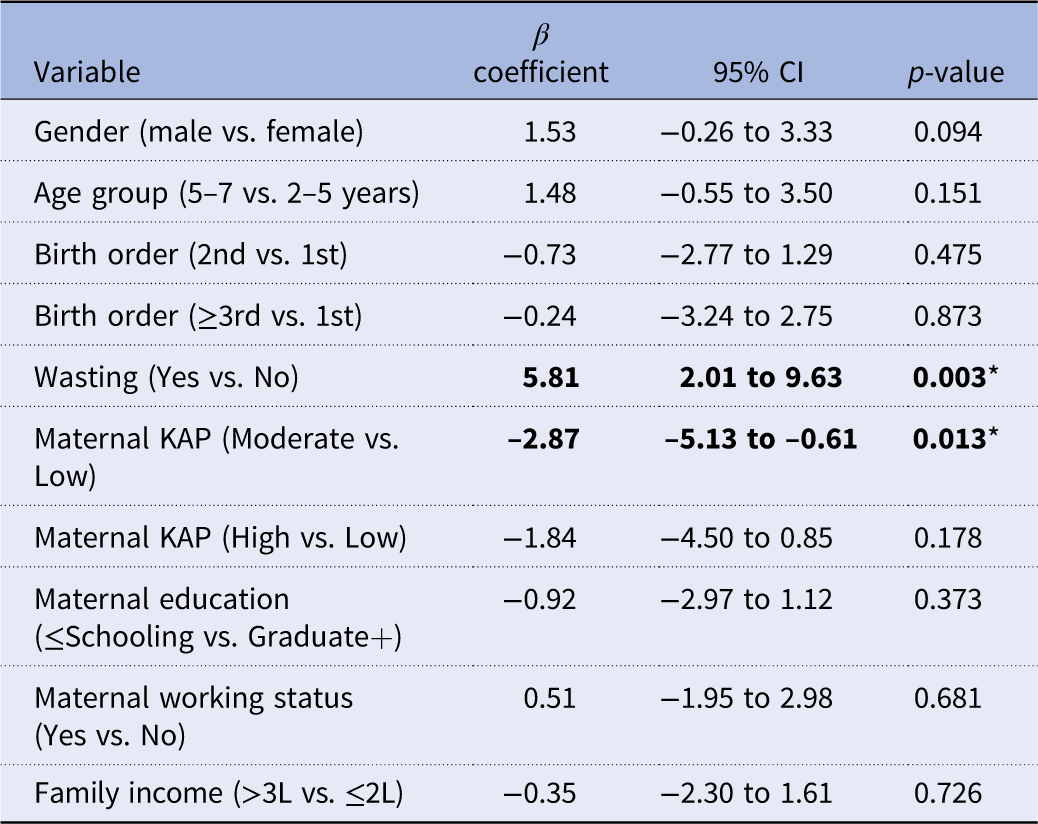
In multivariable linear regression analysis (Table 3), wasting emerged as a significant positive predictor of higher CFNS scores (β = 5.81; 95% CI: 2.01–9.63; p = 0.003). Maternal KAP levels were inversely associated with CFNS, with children of mothers having moderate KAP showing significantly lower CFNS scores (β = –2.87; 95% CI: –5.13 to –0.61; p = 0.013) compared to those with low KAP. Other factors, including maternal education, occupation, family income and child’s birth order, were not significant predictors. The final regression model explained 22.8% of the variance in CFNS scores (adjusted R 2 = 0.228).
Multivariable linear regression of factors associated with food neophobia (Dependent variable: CFNS score)

Table 3. Long description
A table with 11 rows and 4 columns showing multivariable linear regression of factors associated with food neophobia. The columns are labeled Variable, Beta Coefficient, 95% CI, and P-value. The table lists variables such as Gender, Age group, Birth order, Wasting, Maternal KAP, Maternal education, Maternal working status, and Family income. Each row provides the beta coefficient, 95% confidence interval, and p-value for each variable. Notable significant predictors include Wasting with a beta coefficient of 5.81 and a p-value of 0.003, and Maternal KAP (Moderate vs. Low) with a beta coefficient of -2.87 and a p-value of 0.013.
*Statistical Significance (p value <0.05).
Discussion
This study explored how common food neophobia is and how it relates to mothers’ knowledge, attitudes and feeding practices among children aged 2 to 7 years living in urban low- to middle-income areas of Hyderabad, India. The results showed that food neophobia was widespread, with nearly nine out of ten children showing moderate to high hesitation toward trying diverse foods. Particularly, male children had higher mean CFNS scores than females, and food neophobia was significantly more prevalent among wasted children. Maternal KAP showed a significant, though not strictly linear, association with food neophobia: children of mothers with low KAP showed the highest levels of food neophobia, while children of mothers with moderate KAP showed the lowest, suggesting that mothers with higher knowledge, more positive attitudes and better feeding practices were less likely to have children with high food neophobia. These results suggest that maternal knowledge, attitudes and feeding practices, as captured by the KAP questionnaire, may influence how children eat and grow. The final regression model explained 22.8% of the variance in CFNS scores, indicating a modest but meaningful association between the measured maternal and child factors and food neophobia. These findings emphasise the importance of introducing nutrition programmes in early childhood that focus on everyday feeding behaviours and positive mealtime experiences.
The prevalence of moderate to high food neophobia observed in this study aligns with global estimates (40–60%) reported in earlier research.(Reference Antoniou, Roefs and Kremers8,Reference Torres, Gomes and Mattos18) An Indian study conducted in Kerala found that 37% of children exhibited food neophobia using the CFNS.(Reference Sukumaran and Joy11) These differences could be due to variations in cultural eating habits, parental influence and the range of foods children are exposed to in different communities.(Reference Brown, Vander Schaaf, Cohen, Irby and Skelton23) The finding that male children had higher mean CFNS scores than females is consistent with reports from Western and Asian studies, suggesting that boys may display greater resistance to unfamiliar foods or novel textures.(Reference Galloway, Lee and Birch24,Reference Okumus, Dedeoğlu and Shi25) Biological differences in sensory processing and social modelling may partially explain this pattern. When food neophobia was analysed categorically, however, low food neophobia was more common among females than males (15.8% vs. 8.2%), while high food neophobia showed the reverse pattern (9.9% vs. 12.7%); neither difference reached statistical significance (p = 0.17). This categorical result should be distinguished from the significant difference observed for mean CFNS scores and suggests that the overall effect of sex is likely modest in magnitude.
The observed link between wasting and higher food neophobia scores is consistent with earlier research showing that selective eating habits are often associated with low dietary diversity and undernutrition.(Reference Perry, Mallan, Koo, Mauch, Daniels and Magarey26,Reference Knaapila, Sandell and Vaarno27) Children who are hesitant to try diverse foods tend to eat only a narrow range of familiar items, which can limit their nutrient intake and increase the risk of acute malnutrition. Conversely, chronic undernutrition could also heighten food avoidance due to altered appetite or reduced taste sensitivity.(Reference Nicklaus, Monnery-Patris and Reilly28,Reference del Campo, Bouzas and Tur29)
The negative association between maternal KAP and children’s food neophobia is in line with previous research showing that what parents know and believe about feeding has a strong impact on how open their children are to trying diverse foods.(Reference Kutbi30,Reference Zainab, Khan and Shah31) Studies found that when parents apply excessive pressure or strict control during mealtimes, children are more likely to reject unfamiliar foods.(Reference Antoniou, Roefs and Kremers8,Reference Brown, Vander Schaaf, Cohen, Irby and Skelton23) On the other hand, mothers who approach feeding with patience, provide positive encouragement and regularly introduce diverse foods often have children who are more open to trying them.(Reference Holden, Buryn-Weitzel and Atim32–Reference Vidhya, Sree and Sudha Rani35) These findings suggest that helping caregivers build confidence and skills in positive feeding practices could play an important role in improving children’s dietary variety and overall nutrition.
The link between a mother’s knowledge, attitudes and practices and food neophobia in children probably works through a mix of behavioural and environmental factors. To begin with, what a mother knows and believes about feeding influences how she responds when her child refuses food. Mothers with a better understanding of neophobia as a developmental phase may respond calmly and persist with gradual exposure rather than resorting to forceful feeding or substitution with preferred foods. Second, feeding practices such as offering small repeated tastings, involving children in food preparation and maintaining positive mealtime environments can increase acceptance of diverse foods.(Reference Costa and Oliveira36) Third, maternal modelling where children observe parents consuming diverse foods plays a critical role in familiarisation and desensitisation to novel tastes.(Reference Shahdan and Sidek37,Reference Mura Paroche, Caton, Vereijken, Weenen and Houston-Price38) Finally, socio-economic constraints may restrict access to a variety of foods, indirectly reinforcing neophobia through reduced exposure opportunities.(Reference Schuler, Shipe and O’Reilly39–Reference Ziso, Chun and Puglisi41)
The high prevalence of food neophobia found in this study underscores the need to integrate behavioural feeding education into existing maternal and child health programmes in India.
Counselling modules within platforms such as the ICDS and POSHAN Abhiyaan could include short sessions on recognising normal developmental feeding behaviours, encouraging repeated, pressure-free food exposure, modelling diverse eating patterns at home and avoiding punitive or coercive feeding techniques.
Community-based health workers, including Anganwadi and ASHA workers can play an important role in offering this kind of guidance during regular health and nutrition counselling sessions. Alongside this, programmes that aim to improve access to a wider variety of foods, especially for low-income urban households, can strengthen behaviour-focused efforts. Community campaigns that share how early feeding experiences affect a child’s eating habits later in life can encourage parents and caregivers to adopt more mindful and supportive feeding practices.
A key strength of this study lies in its use of a validated CFNS instrument and the inclusion of both behavioural (maternal KAP) and anthropometric (nutritional) measures. The focus on an urban Indian population adds novel evidence from a context where behavioural determinants of child feeding remain underexplored. Both the CFNS and KAP questionnaires demonstrated acceptable consistency, which strengthens confidence in the study’s findings. However, certain limitations need to be considered.
Because the research used a cross-sectional design, it cannot determine cause and effect; follow-up studies over time would be needed to better understand how maternal KAP and food neophobia influence one another. Because the information came directly from mothers, some responses may have been affected by memory lapses or by social desirability bias, the tendency to give socially favourable answers which may be particularly relevant for the KAP practices sub-scale, where mothers may have over-reported positive feeding behaviours. In addition, the study did not collect detailed information on what children actually ate, which might have helped explain more clearly how food neophobia influences their nutrition and eating habits. Lastly, as the study was carried out in one urban location, the findings may not reflect conditions in rural or more affluent settings.
Although this study was conducted in an urban setting in Telangana, India, the observed associations between parental knowledge, attitudes and practices and child food neophobia may be relevant to populations with similar socio-demographic and cultural characteristics. However, dietary behaviours and food neophobia are influenced by cultural practices, food availability, parental feeding styles and socio-economic conditions. Therefore, caution should be exercised when generalising these findings to rural populations or other regions with different cultural and socio-economic contexts.
To build on these results, future research should use long-term studies to observe how children’s reluctance to try diverse foods changes as they grow and how it responds to focused interventions. Conducting experimental or quasi-experimental studies that assess the effects of mother-centred feeding education programmes could provide useful, real-world evidence for reducing food neophobia and improving children’s nutrition. Additionally, integrating qualitative studies, such as focus group discussions and home observations, might provide more understanding of the cultural and emotional dynamics that change the feeding practices in Indian households. Paternal and wider family involvement in feeding also warrants greater attention in the Indian context: a recent community-based study among fathers in Ethiopia found that fathers’ knowledge and involvement significantly shaped child feeding practices,(Reference Eshetu, Molla and Ambaw42) highlighting the need for similar family-inclusive approaches, rather than a sole focus on maternal KAP within Indian maternal and child health programmes.
The study was conducted in a single urban setting, which may limit the external validity of the findings. Consequently, the results may not be fully generalisable to children living in rural areas or in populations with different socio-economic, cultural or dietary environments.
In summary, the study finds that a mother’s knowledge, attitude and feeding behaviour have a strong influence on how willing young children are to try diverse foods. The link between greater food neophobia and wasting points to the behavioural aspects of undernutrition among children. Enhancing caregiver understanding and offering practical, behaviour-based support through maternal and child health initiatives could help children develop healthier, more diverse eating habits and lower the risk of nutrition-related problems, particularly in families from low- and middle-income backgrounds.
Conclusion
This study highlights the high prevalence of food neophobia among preschool-aged children in an urban Indian setting and identifies maternal KAP as a key modifiable determinant. Children whose mothers had higher levels of knowledge, positive attitudes and appropriate feeding practices were found to have lower levels of food neophobia. This indicates that greater caregiver awareness and supportive feeding behaviours may encourage children to be more open to trying diverse foods. The observed association between food neophobia and wasting highlights the behavioural component of undernutrition in children. These findings point to the need for incorporating behavioural nutrition counselling into routine maternal and child health services. Programmes that emphasise repeated and gentle exposure to a variety of foods, positive parental role modelling and non-pressuring feeding approaches should be strengthened within national initiatives such as ICDS and POSHAN Abhiyaan. Strengthening maternal education and feeding competence can play a pivotal role in improving dietary diversity and preventing early nutritional deficits. Future multicentre studies involving diverse geographical regions, including both urban and rural populations with varying socio-economic and cultural backgrounds, are warranted to validate the present findings and improve their generalisability. Such studies would also help to identify context-specific determinants of child food neophobia and inform tailored intervention strategies.
Acknowledgements
The authors express their sincere gratitude to all participating mothers and children for their valuable time and cooperation. We also thank the field investigators and staff of the Health and Nutrition Demographic Surveillance System (HNDSS), ICMR–National Institute of Nutrition, Hyderabad, for their support in data collection and logistics.
Supplementary material
The supplementary material for this article can be found at https://doi.org/10.1017/jns.2026.10148.
Data availability statement
Data will be made available from the corresponding author upon reasonable request.
Author contributions
KR. initiated the study, writing and editing, project administration, methodology, investigation, funding acquisition and conceptualisation; T.Y. Data collection and formal analysis. M.M., JB.G., SR.N. Writing – review, editing and supervision. All authors contributed to the refinement of the manuscript and approved the final manuscript.
Financial support
The ICMR supported this work (National Institute of Nutrition Intramural ignition grant INTR-IG/NIN/02/2023).
Competing interests
We confirm that there are no known conflicts of interest related to this publication. All listed authors have read and approved the final version of the manuscript, and no other individuals who meet the criteria for authorship have been omitted. We also confirm that the order of authors presented in the manuscript has been reviewed and approved by all authors.




 Open access

