1 Introduction
This article is an attempt to add to the individual qualitative studies of historical grammar books of English that already exist (in the style of Tieken-Boon van Ostade Reference Tieken-Boon van Ostade2011; Straaijer Reference Straaijer2011; Navest Reference Navest2011; Fens-de Zeeuw Reference Fens-de Zeeuw2011; see also individual contributions in Leitner Reference Leitner1986, Reference Leitner1991; Tieken-Boon van Ostade Reference Tieken-Boon van Ostade2008) by adding a quantitative dimension. This quantitative approach to historical grammaticography will in turn be linked to historical corpus-linguistic studies. In this way, the study of historical grammaticography and historical corpus linguistics can each profit from insights deriving from the neighbouring field. Ultimately, this combination should enable us to say with some confidence which features of language were subject to successful prescriptive influence, and where prescriptivists’ attempt at changing (or preserving) the language had little or no effect. This is a particularly pertinent question for the nineteenth century, which is still known widely in English historical linguistics as the prescriptive century par excellence. In this article I will look at one phenomenon rising to prominence during that century, the progressive passive (the bridge is being built), because it undergoes striking changes, and because it seems to have been hated the most by prescriptivists. In section 2, I will look at the changes in actual language first. In order to gauge prescriptive opinion, I will then resort to my Collection of Nineteenth-Century Grammars (CNG), presented in section 3, and introduce my method of quantitative grammaticography. Section 3.3 applies the findings to language change as documented in the Corpus of Historical American English, and section 4 asks whether the documented development can indeed be traced back to prescriptive influence.
2 Changes in grammar in the nineteenth century
It has by now been documented for almost every area of grammar that the nineteenth century was by no means a century of stasis in the English language. Changes in the verb phrase have been particularly well investigated. Thus we know that the nineteenth century was the crucial phase in the grammaticalization and integration of the progressive (Arnaud Reference Arnaud and Jacobson1983, Reference Arnaud1998; Smitterberg Reference Smitterberg2005), it saw the rise of the progressive passive (Pratt & Denison Reference Pratt and Denison2000; Hundt Reference Hundt, Lindquist and Mair2004), a substantial rise in the number (and kind) of get-constructions and the establishment of the get-passive (Hundt Reference Hundt2001), it witnessed the final decline of the be-perfect (Rydén Reference Rydén and Kastovsky1991; Rydén & Brorström Reference Rydén and Brorström1987; Kytö Reference Kytö, Rissanen, Kytö and Heikkonen1997) and the fixation of do-support (Denison Reference Denison and Romaine1998). For phenomena beyond the verb phrase, there are indications that the nineteenth century was instrumental in the reversal of the fate of the s-genitive (Szmrecsanyi Reference Szmrecsanyi, Börjars, Denison and Scott2011), and in the fixation of patterns of adjective comparison (Mondorf Reference Mondorf2009; Kytö & Romaine Reference Kytö, Romaine and Wright2000, Reference Kytö, Romaine, Kytö, Rydén and Smitterberg2006). More generally, in changes in complementation patterns the nineteenth century also seems to have been instrumental (Vosberg Reference Vosberg, Rohdenburg and Mondorf2003; Rohdenburg Reference Rohdenburg, Dalton-Puffer, Kastovsky, Ritt and Schendl2006; Rudanko Reference Rudanko2011). For a general overview of changes in Late Modern English syntax, see Denison (Reference Denison and Romaine1998). In this article, I will restrict myself to what seems to be the most prominent member of these changes, often cited as the first example of grammatical change in the nineteenth century (e.g. Fennell Reference Fennell2001: 173; Mugglestone Reference Mugglestone and Mugglestone2006: 285; Brinton & Arnovick Reference Brinton and Arnovick2011: 405): the rise of the progressive passive, as in (1) to (3).
(1) The bridge is being built.
(2) Dinner is being served.
(3) The king is being dressed.
The progressive passive is first documented in individual examples from the last quarter of the eighteenth century (Denison Reference Denison and Romaine1998: 150–2 argues for a first example from the year 1772), but the construction only started to be used with more regularity and frequency over the course of the nineteenth century, and can thus with justification be called a nineteenth-century phenomenon. An earlier form with a similar meaning was the use of the progressive form with passive meaning, the so-called passival form (Visser Reference Visser1973: 2004 ff.) as in (4) to (6).
(4) The bridge is building.
(5) Tea was carrying round.
(6) The king was dressing.
As example (6) already illustrates, with animate subjects the ing-form was ambiguous between an active and a passive reading. It is therefore perhaps not surprising that the progressive passive, shortly after its inception, overtook this earlier construction in frequency, and quickly became much more frequent than the passival ever was. The progressive passive clearly filled a gap in the system of the English verb phrase that had opened up as soon as the progressive itself became grammaticalized (and – which goes hand in hand – much more frequent; see Smitterberg Reference Smitterberg2005).
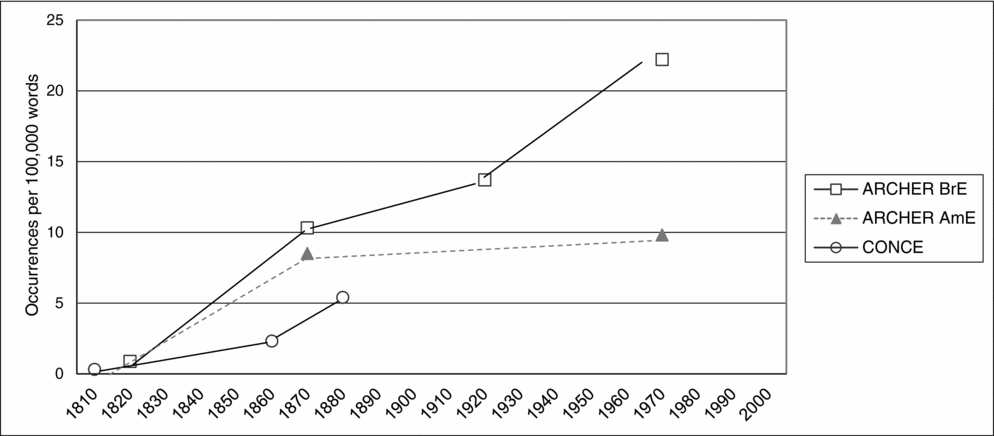
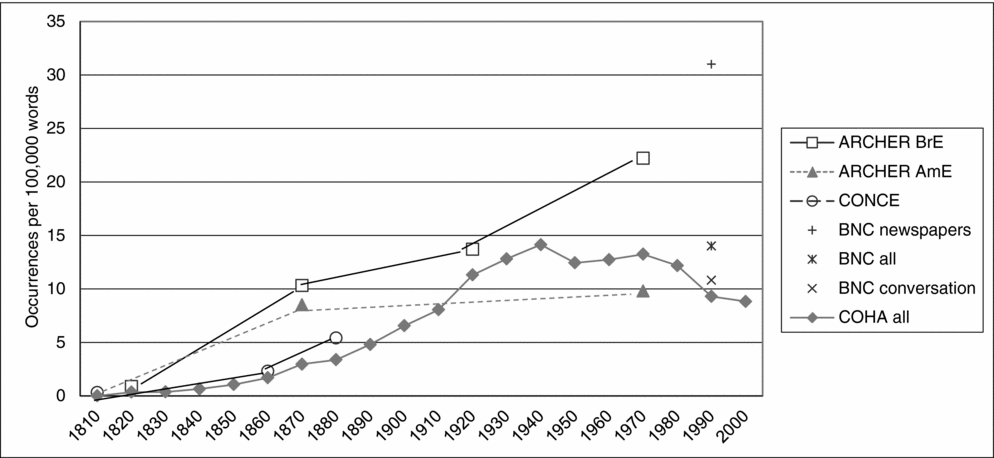
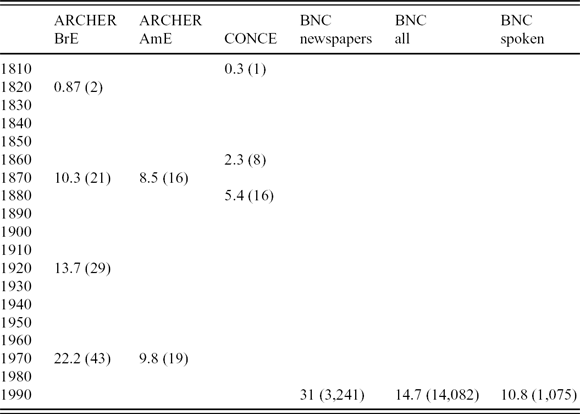
Figures from Hundt (Reference Hundt, Lindquist and Mair2004) based on ARCHER (A Representative Corpus of Historical English Registers; see Biber, Finegan & Atkinson Reference Biber, Finegan, Atkinson, Fries, Tottie and Schneider1994) indeed show that the progressive passive rose in frequency considerably over the nineteenth century, and continues to rise until today, at least in British English. There are some indications that American and British English behave differently with regard to this phenomenon; thus Hundt claims that ‘the progressive passive spread much more slowly in the transatlantic variety than in BrE’ (Hundt Reference Hundt, Lindquist and Mair2004: 110), and her figures seem to support this interpretation, as figure 1 illustrates (absolute figures in table A1 in the appendix). However, as we will see below (section 3.3), the gaps in the data in ARCHER mask some important internal developments in American English.
The rise of the progressive passive (based on Hundt Reference Hundt, Lindquist and Mair2004 for figures from ARCHER; and Smitterberg Reference Smitterberg2005: 131 for figures from CONCE). For the sake of comparison, periods of the corpora have been converted to points in time, using the middle of the period. In this way, comparison is made easier

The addition of Smitterberg's figures from CONCE (Smitterberg Reference Smitterberg2005: 131) in figure 1 shows striking differences between the two corpora (for CONCE, the Corpus of Nineteenth-Century English; see Kytö, Rydén & Smitterberg Reference Kytö, Rydén, Smitterberg, Kytö, Rydén and Smitterberg2006). As we know from both historical and present-day studies (see data in Smith & Rayson Reference Smith and Rayson2007 based on the British National Corpus (BNC); see also figure 7 below), the progressive passive is highly text-type sensitive, and very much a feature of written rather than spoken data. It is perhaps not surprising, then, to see that this construction occurs much more rarely in CONCE, which has a very high proportion of personal letters (Kytö, Rydén & Smitterberg Reference Kytö, Romaine, Kytö, Rydén and Smitterberg2006), as opposed to ARCHER, which contains many more formal genres of writing (e.g. medical writing, legal writing; see Biber et al. Reference Biber, Finegan, Atkinson, Fries, Tottie and Schneider1994).
An interesting question to be answered by this article is therefore whether British–American differences can be substantiated, in particular whether there is additional evidence that American English lags behind Britain in the use of the progressive passive. We know from earlier studies that the progressive passive was criticized rather vehemently in normative grammars of the time (Visser Reference Visser1973: 2004ff.; Bailey Reference Bailey1996: 221–4; Denison Reference Denison and Romaine1998: 150–1; Hundt Reference Hundt, Lindquist and Mair2004: 108). This article will substantiate and quantify this criticism, ask whether national differences did in fact exist between British and American grammar writing with respect to this phenomenon, and investigate the temporal development of this criticism. In this way we can perhaps begin to answer the interesting question whether the vicious criticism of the progressive passive may have caused the differences in use between the national varieties that earlier scholars have observed.
3 Investigating the progressive passive in the CNG
3.1 The Collection of Nineteenth-Century Grammars
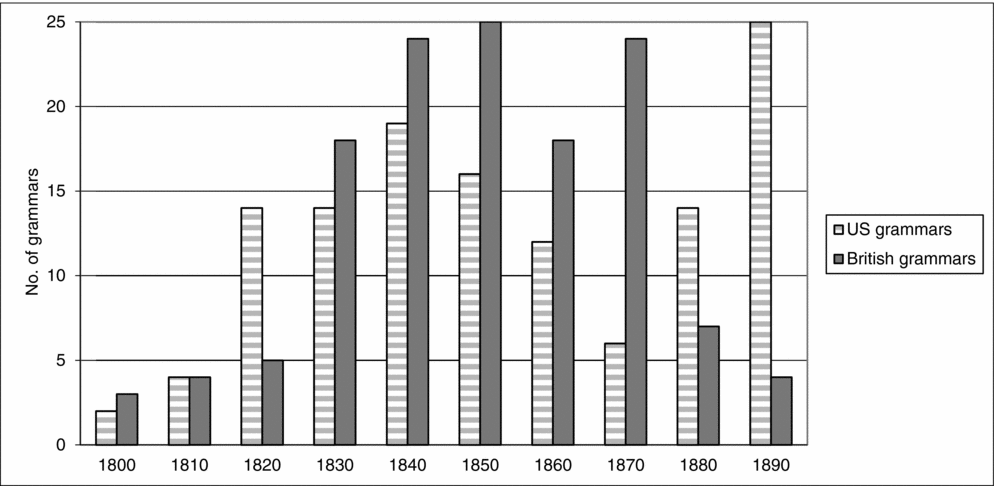
In order to ask, and eventually answer, questions like the preceding ones in a principled way, I have been collecting nineteenth-century school grammars since 2007 from the Google books project as it grew. The Collection of Nineteenth-Century Grammars (CNG) now includes just under 260 grammars from Britain and North America, in roughly equal numbers.Footnote 1 Included were all works available as full texts for download that included a treatment of English grammar, were written by native speakers of English for native speakers of English, and that were published between 1800 and 1900. In all cases, the earliest edition available was included. All publications were checked against the bibliographic details in Görlach (Reference Görlach1998). The published volumes (ordered by date of first publication, where known) now cover all ten decades of the nineteenth century, although not evenly, as figure 2 illustrates.
Number of grammar books per decade included in the CNG
The uneven distribution across decades is, on the one hand, caused by differences in publication processes that have been documented in particular for England – according to Michael (Reference Michael1997), many more grammars were published between the 1840s and the 1870s; on the other hand, we can assume some skewing due to Google's digitalization process. Although shrouded in much secrecy, this digitalization concentrates on works held by American libraries, and these in turn can be expected to have preserved later books from the end of the nineteenth century to a greater extent than earlier ones. In order to be able to compare findings across decades (and national boundaries), I will resort to displaying my data in terms of percentages per decade (from figure 5 onwards). Here, we have to bear in mind the rather small number of grammar books in the first two or three decades, where a display in terms of percentages is not really useful in itself. However, investigating minority and majority positions across decades clearly makes more sense than looking at absolute numbers overall, and will produce interesting new results that earlier, more qualitative and anecdotal work, has had no access to. In this way, my study provides a first consistently quantitative approach to historical grammaticography.
3.2 Comments on the progressive passive
Although I will not go into more detail on the nature of the comments on the progressive passive (see Anderwald forthcoming for an analysis of the evaluations, and their basis in reality), some representative comments are collected in (7) to (10).
(7) cumbersome, awkward, ugly, inelegant, objectionable, disagreeable
(8) a tautology, a contradiction, unnecessary, ambiguous; a solecism, an absurdity, ungrammatical, uses incompatible terms
(9) upstart, not sanctioned by authority, an affected form, inappropriate, in bad taste, barbarous
(10) shamefully bad, despicable; careless, loose, shameful, of doubtful propriety, not respectable, an illegitimate form, not pure
As the examples illustrate, criticism comes from the domains of aesthetics (7) and logic (8), it includes social criticism (9) and criticism in moral terms (10), and often in combination.Footnote 2 One of the most vociferous critics is David Booth, who writes
For some time past, ‘The bridge is being built’, ‘The tunnel is being excavated’, and other expressions of a like kind, have pained the eye and stunned the ear. Instead of ‘The stone is falling’, and ‘The man is dying’, we shall next be taught to say, ‘The stone is being fallen’, and ‘The man is being dead.’ This incongruous conjunction of a present with a perfect participle, as if for the purpose of producing a confusion of tenses, is an absurdity of very modern origin, and has scarcely yet appeared in any respectable composition. (Booth Reference Booth1837: 96f.)
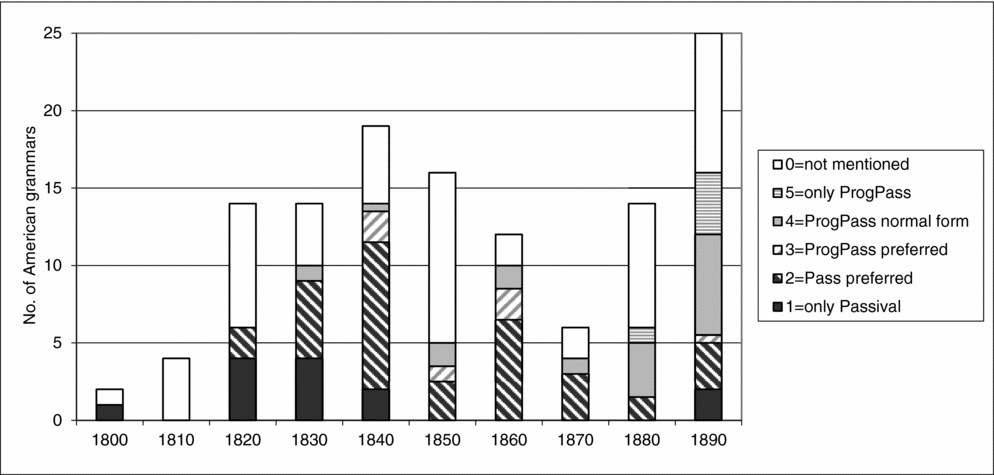
This passage itself was frequently quoted in later grammars, and thus the sentiments were repeatedly endorsed over the century. Individual terms clearly derive from a longer tradition of normative grammar writing, which they continue (see Sundby et al. Reference Sundby, Bjørge and Haugland1991 for the eighteenth century), but the density of negative terms, the length of the quoted passage, and the number of different semantic fields that are utilized in the criticism clearly set comments on the progressive passive apart from other phenomena that are also criticized throughout the nineteenth century (for an overview, see Anderwald Reference Anderwald2012). Although Booth himself was British (DNB: s.v. Booth, David, 1766–1846), American grammars seem to have taken up the tone of his criticism with a vengeance, and comments on the progressive passive as a rule are more unforgiving, more dramatic and much more intolerant in American than in British grammars, as I have shown elsewhere (Anderwald forthcoming). Also numerically, we can see that American grammars as a whole were much more critical of the progressive passive than their British counterparts, as figure 3 illustrates.
Evaluating the progressive passive (American grammars in the CNG, absolute numbers)
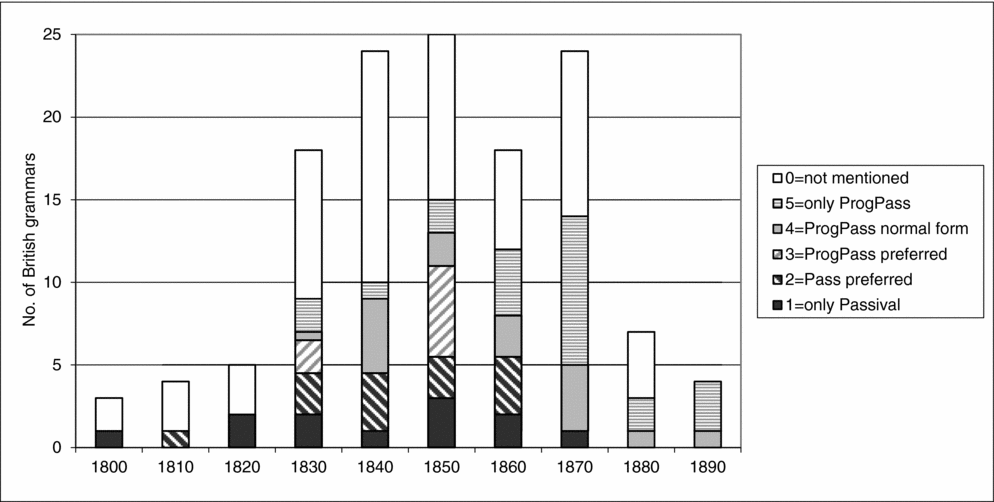
As a comparison of figure 3 and figure 4 shows, the older passival (the bridge was building) was preferred by some American grammars until the 1890s. Grammars until the 1840s even maintained that only the passival existed – a correct description for the time before 1800, but amounting to massive criticism of the innovative form of the progressive passive after the 1820s, when the progressive passive overtook the passival in frequency, and rose to become much more frequent than the passival ever was. In British grammar writing, a critical stance can also be identified, but this ends in the 1860s, and the number of grammars which mention only the progressive passive (i.e. which are basically descriptively adequate) is particularly prominent from the 1860s onwards. However, we can only say something about shifts in majority and minority positions when we look at their relative frequencies.
Evaluating the progressive passive (British grammars in the CNG, absolute numbers)
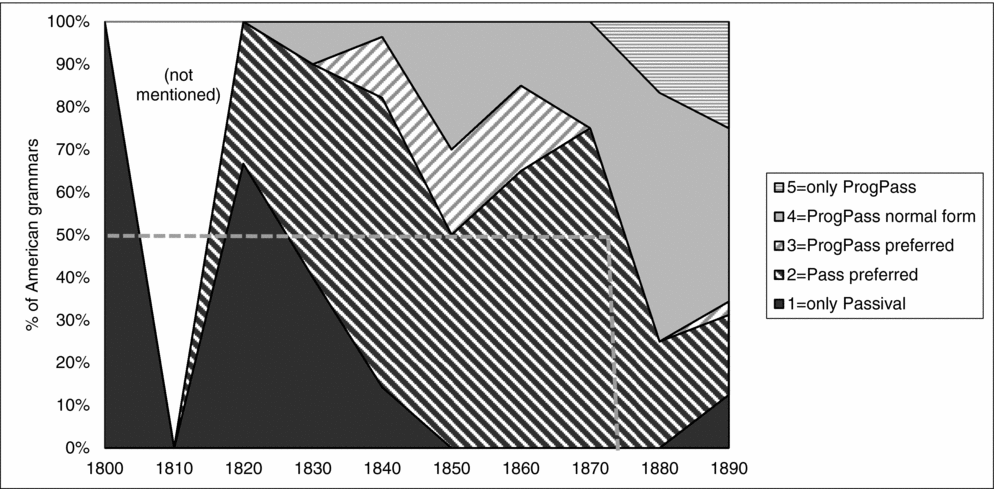
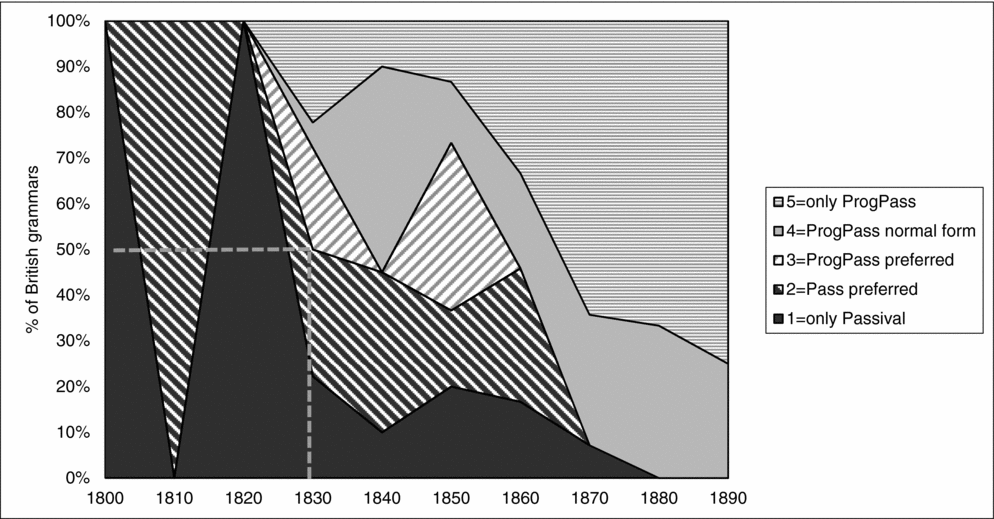
A comparison of figure 5 and figure 6 shows the striking differences between American and British prescriptive comments on the progressive passive. In American grammars on aggregate, a critical position is dominant until after the 1870s (indicated by the dotted line). Even though after this point in time, American grammars become descriptively more adequate in that they at least acknowledge the existence of the progressive passive, a critical strand persists as a strong minority opinion: around 30 per cent of grammars are still critical from 1880 to 1900. In British grammars, on the other hand, criticism of the progressive passive becomes a minority position after 1830, and acknowledgement of the progressive passive as a normal paradigmatic form becomes the rule, rather than an exception. In contrast to American grammar writing, the last grammar to mention only the passival in the CNG can be found in the 1870s, and even this one author is not particularly critical.Footnote 3 After the 1870s British grammar writers only mention the progressive passive descriptively, but never criticize it.
Evaluating the progressive passive (American grammars in the CNG, percentages)
Evaluating the progressive passive (British grammars in the CNG, percentages)
3.3 Measuring prescriptive success
The overview of comments on the progressive passive in section 3.2 has shown that the progressive passive was indeed criticized vehemently. Criticism was harsher, more protracted and more frequent in American grammar writing, and could be shown to continue throughout the century, as figure 5 has illustrated. In fact, we have seen that a critical attitude to the progressive passive was the majority opinion until after the 1870s in North America. By contrast, fewer British grammars criticized the progressive passive overall, criticism was milder, and it stopped several decades earlier: after the 1830s, a more descriptively adequate position became the rule in British grammars, matching quite well what actually happened in the (written) language, as figure 6 has illustrated. Seeing these divergent traditions in grammar writing, it is therefore not implausible to ask whether the strong criticism in American grammars can be linked to the differences in actual use that have been observed in earlier studies. Once we are able to establish a temporal correlation with the corpus data, we can then ask whether the strong prescriptive stance in American grammars may have caused the less frequent usage.
In order to obtain a more detailed overview of developments in American English, I have added data from the Corpus of Historical American English (Davies Reference Davies2010–) to the earlier studies mentioned above. COHA contains 400 million words spanning the nineteenth and twentieth centuries (albeit with less material from the earlier decades; see table A2 in the appendix for details), from the four text types Fiction, Newspapers, Magazines and Non-Fiction Books. The proportion of texts from these text types is largely held constant between 1810 and 2000, but newspapers are only represented from the 1860s onwards. All material in COHA is POS-tagged and lemmatized, and quite intricate searches for specific constructions thus become feasible. Although some tagging is faulty, and some scanning errors are still apparent in the earlier texts, COHA is thus a resource of unprecedented size for the study of historical developments in written American English, and for the first time makes possible detailed historical investigations of medium- and low-frequency phenomena, such as the incoming progressive passive.
For my investigation of the progressive passive, I restricted my searches to directly adjacent occurrences of a form of be, the word form being, and a past participle (i.e. [be] being *.[v?n*]). This is more restrictive than semi-manual searches employed by earlier studies, but more general searches and manual post-editing are clearly not possible in a corpus the size of COHA. It was found that the retrieved occurrences were indeed instances of the progressive passive. Although my search could not retrieve instances of negation (the bridge is not being built), inserted adverbials (the bridge is slowly being built), or inversion (is the bridge being built?), this loss is counterbalanced by avoiding a rather laborious post-editing of all retrieved forms in less specific searches, and my more narrow search string was therefore deemed an acceptable compromise. Sample searches indicate that including all instances mentioned above raises the text frequency of the progressive passive by 1 to 2 instances per 100,000 words in the nineteenth-century material, but does not change the overall shape of the curve. This makes my figures a rather conservative estimate of the actual frequencies of the progressive passive – a fact which should be taken into account in comparing my figures from COHA to earlier studies.
As figure 7 shows, the progressive passive rises comparatively slowly throughout the nineteenth century in COHA, and there is a marked difference to Hundt's figures from ARCHER. In COHA, use of the progressive passive peaks in the 1940s, and then declines again perceptibly. According to these figures, the text frequency of the progressive passive in written American English today is roughly equivalent to text frequencies at the beginning of the twentieth century, and the text frequency of the progressive passive in COHA overall today is only about equivalent to the least progressive-passive friendly environment in British English, viz. spoken texts, as the comparable figures from the BNC show (my own analysis, based on the same search string; see also the more extreme figures for more specific text types in Smith & Rayson Reference Smith and Rayson2007).
The rise of the progressive passive in earlier studies and in COHA
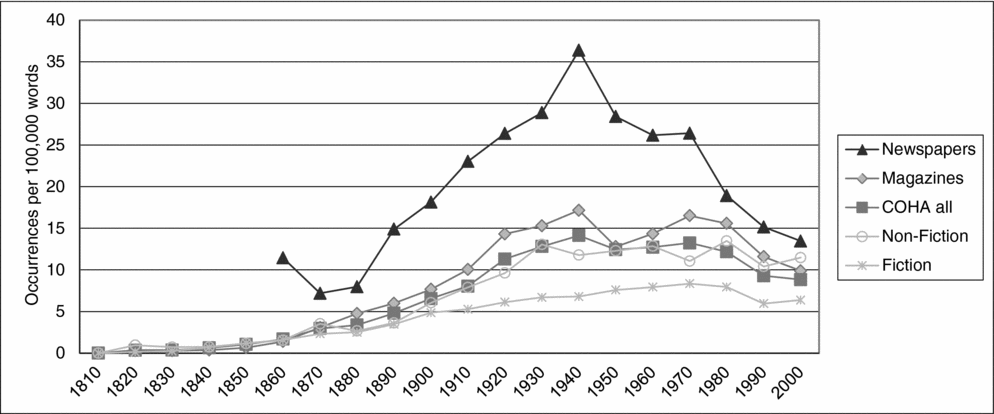
If we look at data from COHA in more detail, we can see that most text types pattern very closely together for the nineteenth century. Over the course of the twentieth century, the spread becomes slightly wider, as figure 8 illustrates.
The most strikingly different text type is newspapers, and from the time newspapers are included in COHA (i.e. the 1860s), figure 8 documents that the progressive passive is more than twice as frequent there than in other texts. On the other hand, this striking difference inside COHA also shows that the earlier impression that American English lags behind developments in Britain probably has to be qualified, even taking into account that my method of defining the progressive passive was rather restrictive. As figure 7 has already shown, average figures from COHA are surprisingly similar to the frequency of the progressive passive in British English of the time (as represented by figures from CONCE). Quite clearly, what we see in the proposed differences between American and British English is the overriding effect of the text-type sensitivity of the progressive passive, rather than national differences. CONCE has a predominance of informal text types, since it consists to a large degree of private letters and of fiction. COHA also has a predominance of fiction texts, which make up 50 per cent of the material in all decades (see the COHA website > composition of corpus; see also Davies Reference Davies, Hegedűs and Fodor2012). As figure 8 shows very clearly, fiction is the text type where the progressive passive is consistently used the least, and the large part that fiction texts play in the make-up of COHA also influences the shape of the average distribution (indicated by solid squares in figure 8). Compared with this, the development of the progressive passive in newspaper language is very different.
The text-type specific rise in the progressive passive in COHA
It seems, then, that differences between text types are much larger than purported national differences in the nineteenth century. Of course, we do not have directly comparable data for nineteenth-century British English, but figures from COHA are too similar to figures from CONCE to support any hypotheses of differential success in the establishment of this innovative construction in the system of grammar of English(es). Since we cannot even substantiate a fundamentally different national development, then, the hypothesis that normative grammar writing may have been responsible for making written American English different from British English in the nineteenth century with respect to this phenomenon also evaporates. In other words, a direct influence of prescriptive criticism on this specific process of language change in the nineteenth century – the formative period in the history of the progressive passive – must be considered extremely unlikely.
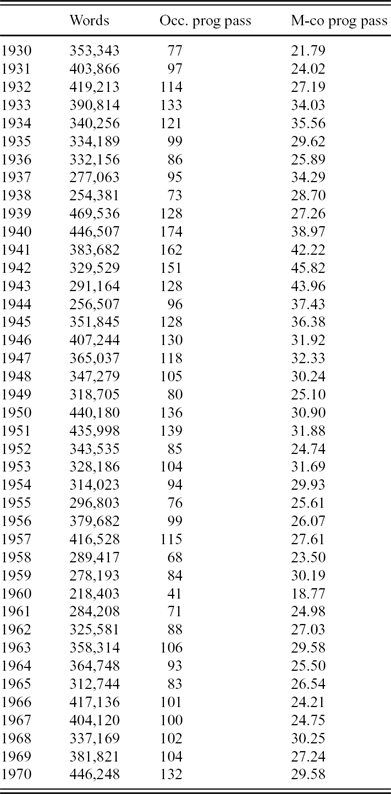
However, as we can see particularly clearly from figure 8, there is a striking decline of the progressive passive in written American English after the 1940s. We do not possess parallel data from British English for the same period, but from all studies that exist we can say that proposing a parallel rise and rapid decline for British English for the middle of the twentieth century seems highly improbable. On the contrary, if we compare data from ARCHER with data from the BNC for the 1990s, they indicate a continuing rise of the progressive passive, testifying to the continuing success of this construction especially in written genres of (British) English. The sharp decline in use of the progressive passive seems to be specific to American English, then, and if we look at figure 8 again, this decline seems to be even more specific to newspaper language. A text type like fiction, by contrast, has remained quite stable: it did not take part in the sharp rise of the progressive passive in the first half of the twentieth century, and there is hardly any subsequent decline either.
We know that newspaper language today is highly edited, with strict guidelines in the form of in-house style guides that are enforced and policed by copy-editors (see anecdotally the account of one copy-editor, Downes Reference Downes2008). For newspapers this is important, since a consistent, instantly recognizable style is part of their marketing strategy, and forms part of the appeal for readers. It serves to distinguish broadsheet papers from tabloids, left-wing from right-wing publications, or intellectual from mass-appeal productions, and in this way also defines and identifies the readers (see studies by Conboy Reference Conboy2006, Reference Conboy2007; Jucker Reference Jucker1992; or the overview in O'Donnell & Todd Reference O'Donnell and Todd1991: 87–104). It seems to be these highly circumscribed characteristics that make effective prescription at least possible.
As has been noted by others, American English shows a striking decline in the passive more generally, most notably in newspapers and in academic writing (as documented by e.g. Leech & Smith Reference Leech, Smith, Renouf and Kehoe2006; Seoane Reference Seoane, Breivik, Halverson and Haugland2006; see also Leech et al. Reference Leech, Hundt, Mair and Smith2009: 148–54), a decline that has already been linked to modern normative proscription against the passive (e.g. Leech & Smith Reference Leech, Smith, Renouf and Kehoe2006: 194; Leech et al. Reference Leech, Hundt, Mair and Smith2009: 148f., 151f.). Data from COHA in figure 8 show the rapidity of the decline of this one subclass of passive constructions, the progressive passive, which falls from a text frequency of about 36 (instances per 100,000 words) in the 1940s to about 13 – in other words, it is used roughly once in the 2000s where it would have been used three times as frequently only fifty years earlier. The ominous Elements of Style by Strunk & White was first published in 1959; the style guide sold over 2 million copies in the first edition alone and has become the one usage guide that Americans ‘revere . . . swear by . . ., [and] carry . . . around with them’ (Pullum Reference Pullum2010). Pullum has called this a ‘twentieth century prescriptive copy-editing mill’ through which all texts are now forced (Pullum Reference Pullum2009), even though this little pamphlet has seen linguists up in arms against its inconsistent, unilluminated and ‘stupid grammar advice’, as Pullum calls it (Reference Pullum2009; see also Pullum Reference Pullum2010). One of the best-known warnings of Strunk & White is to ‘avoid the passive’ (Strunk & White Reference Strunk and White1959: 13)Footnote 4 – a warning so successful that it has spawned its own websites recently, and comes up as a regular topic in all grammar help pages.Footnote 5
From its subsequent success it is not implausible to assume an initial influence of the publication of Strunk & White also on those newspapers collected in COHA, mediated through their style guides and enforced through their copy-editors.Footnote 6 As Chapman has pointed out, prescription acts like a bulldozer, erasing fine linguistic distinctions, as users become over-cautious and avoid stigmatized constructions in general, even those that are only superficially similar (Chapman Reference Chapman2012). It is therefore all the more likely that the tirade against the passive more generally would also have affected the highly salient progressive passive in the wake of Strunk & White. In contrast to the rather diffuse criticism of nineteenth-century grammarians that was spread over scores of publications, and over decades, in the case of The Elements of Style we have a single publication with a single publication date,Footnote 7 marketed at a very focused group (young college students), which has resulted in a very high dissemination (Pullum speaks of more than 10 million copies that have been sold). The fact that Strunk & White served as a model for many subsequent style guides, and is presumably even the influence behind present-day electronic grammar ‘checkers’ that are built into our word processing software, stresses the influence that one publication can have in the twentieth century. As my corpus study has shown, the success of banishing the passive more generally had dramatic repercussions on the progressive passive in American English more specifically. The high text-type sensitivity of this proscription has become visible in its effect on formal texts, and newspaper language in particular. I have argued that this is no coincidence, but shows how dependent on a high degree of institutionalization normative intervention is for its success. Without the work of copy-editors who reformulate passages and rewrite passive sentences as active ones, the striking decline of the progressive passive in newspaper language in the second half of the twentieth century is hard to explain.
4 Outlook
Over much of the twentieth century, in English historical linguistics the nineteenth century was seen as the century of stasis, and as the century of prescriptivism (see the overview in Beal Reference Beal1999: 13–19 – even though she refers to the eighteenth century more specifically, her arguments are valid for the nineteenth century too). The link between the two was more than implied: it was taken for granted that once prescriptive grammar writing flourished, as it clearly did in the nineteenth century, all natural language change had to slow down to stasis, since all incipient changes would immediately be nipped in the bud, so to speak, by the critical comments of hawk-eyed grammarians. Our test case of the progressive passive promised ample illustration of this process: it is demonstrably an innovation that rose to prominence during the nineteenth century; it was noticed by grammarians and vehemently criticized; and, in addition, initial corpus-linguistic studies seemed to have demonstrated American lag for this phenomenon. The application of my new method of quantitative historical grammaticography could show that the phenomenon of the progressive passive was indeed treated very differently in American and in British grammar books, and these national differences at first sight seemed to correlate quite well with the purported lag in use of the progressive passive in (written) American English. A more careful analysis of new historical corpus materials has shown, however, that what looked like long-term lag in ARCHER can in fact be related to the considerable differences in text frequencies of the progressive passive between text types. The text-type sensitivity of the progressive passive was shown to be extremely pronounced in both national varieties. In both British and American English, differences between spoken and written texts, or between fiction and newspapers, was and still is much larger than purported differences between national varieties.
In addition, we have seen that the seemingly level development of American English in ARCHER between the second half of the nineteenth century and the second half of the twentieth – which contributed to the impression of American lag – masked a very pronounced development in American English of a rapid rise, followed by a decline almost as rapid, in the use of the progressive passive. This development was the most striking in newspaper language, and the 1950s turned out to be the decisive turning point here. I have tentatively suggested that the sharp decline that is observable in particular between materials printed in 1959 and materials printed in 1960 was due to the publication, and implementation, of Strunk & White's guide on style (Strunk & White Reference Strunk and White1959), with its nonsensical general advice to ‘avoid the passive’, which in its wake also affected the progressive passive.
Surprisingly, then, while for the purportedly over-prescriptivist nineteenth century a prescriptive influence on actual language change could not be convincingly demonstrated, the middle of the twentieth century, the descriptive century per se, showed the most convincing correlation of the publication of a notorious style guide (Strunk & White) and the actual striking reversal in the fortunes of the progressive passive in written American English.
However, at the same time we have seen that our results do not mean that prescriptivism is necessarily always without influence (for a collection of some comments illustrating this position see Millar Reference Millar, Hogg and van Bergen1998) – the influence just came in a rather unexpected place and at an unexpected time. We clearly need detailed explorations of prescriptive comments, both qualitative and quantitative, in order to be able to draw up generalizations about which prescriptive comments turn out to be instrumental in influencing language, and which do not. For the historical situation, a careful analysis of metalinguistic comments can provide us with valuable insights into the cultural discourses of the time. However, we desperately need correlative corpus-linguistic studies to separate fact from fiction. In the wealth of prescriptive material especially for the nineteenth century, it is all too easy to find individual prescriptive pronouncements to suit individual researchers’ own agendas, and ‘prescriptive influence’ is too often invoked these days as a catch-all explanation for unexpected phenomena, without any further substantiation. (See Auer & González-Díaz Reference Auer and González-Díaz2005 for a similar argument.) Only a careful analysis of the grammaticographic environment allows us to place individual comments in context, and to say with confidence anything about their representative, or unrepresentative, status with respect to the intellectual climate of the times. In case this climate should change, it still remains the task of the corpus linguist to correlate the change in prescriptive pronouncements with actual language change. It is an open question that to my knowledge has not been addressed yet which kind of time lag we should accept between prescriptive comments and their successful implementation in language change. (But see Szmrecsanyi Reference Szmrecsanyi2012 for a first attempt at statistically delineating the influence of prescriptivism, incidentally also on the influence of Strunk & White.) As the example of the progressive passive has shown, successful prescriptivism probably always needs institutional support (in the sense of Gloy Reference Gloy, Ammon, Dittmar, Mattheier and Trudgill2004). Present-day newspaper language, with its adherence to in-house style norms, seems to be an environment conducive to spreading new norms, be they linguistically sensible or not. Nineteenth-century grammar writing, in contrast, quite clearly was not, as my case study of the development of the progressive passive in British and American English has shown.
Corpora
ARCHER – A Representative Corpus of Historical English Registers, see Biber et al. (Reference Biber, Finegan, Atkinson, Fries, Tottie and Schneider1994)
BNC – British National Corpus, see Aston & Burnard (Reference Aston and Burnard1998)
COHA – Corpus of Historical American English, see Davies (Reference Davies2010–, Reference Davies, Hegedűs and Fodor2012)
CONCE – Corpus of Nineteenth-Century English, see Kytö et al. (Reference Kytö, Rydén, Smitterberg, Kytö, Rydén and Smitterberg2006)
Appendix
Rise of the progressive passive (data from Hundt 2004 for ARCHER; Smitterberg 2005 for CONCE; own investigation for the BNC), occurrences per 100,000 words. Figures in brackets are the absolute figures. Note that Smith & Rayson (2007) have even more extreme frequencies for more specific subgenres in the BNC, but do not provide absolute figures.
The progressive passive in COHA per decade and text type
Text frequency of the progressive passive in newspapers in COHA by year, 1930–1970 (M-co = occurrences per 100,000 words)