Worldwide, politicians devote increasing attention to the sociodemographic representativeness of political institutions. The underrepresentation of specific groups (and of women in particular) in political institutions is a democratic problem (Phillips Reference Phillips1995). To counter the lack of representativeness of political institutions, measures have been adopted to increase the influx of female politicians in parliaments and governments. Among others, quota regulations have been implemented in several countries in recent years (Dahlerup Reference Dahlerup2007; Krook Reference Krook2007).
The presence of women in parliaments has also been high on the research agenda for several decades. Political scientists have been mainly concerned with the entry of female politicians into parliament and their functioning as MPs. This research has focused primarily on the factors that stimulate or hinder women's entry into political institutions, including the effect of electoral systems on the number of women in parliaments. There seems to be a consensus among scholars that a system of proportional representation (PR) is more favorable for the election of women than is a majority system (Caul Reference Caul1999; Leijenaar Reference Leijenaar, Meier and Celis2004; Matland Reference Matland, Ballington and Karam2005; Matland and Montgomery Reference Matland and Montgomery2003; Norris Reference Norris, LeDuc, Niemi and Norris1996; Reference Norris2004). This difference is mostly attributed to the higher turnover rate and the possibility of presenting “diverse” candidates in PR systems. Recent discussions in the literature, however, criticize the overemphasis on institutional factors (such as electoral systems). That is, how voters, candidates, and parties cope with these institutional variables is considered as important as these variables themselves. Parties, in particular, play a crucial role in the election of women: How they select, present, and support female candidates affects their chances of electoral success (Tremblay Reference Tremblay2008).
A second strand of research has focused on measures introduced to enhance the presence of female MPs, most notably, quota regulations. Studies have analyzed the different types of quota regulations, their adoption process, and their effects on the presence of female MPs (Dahlerup Reference Dahlerup2007; Franceschet, Krook, and Piscopo Reference Franceschet, Krook and Piscopo2012; Jacobson Reference Jacobson2004; Krook Reference Krook2007; Norris Reference Norris2004). As for the effects of quota regulations, we should note that the relationship between quota legislation and the number of women in parliament is not straightforward: Intervening variables, such as district and party magnitude, “contagion effects,” the degree to which the list order is decisive, and the particular features of the regulations (such as the possibility of sanctions) also play an important role (Meier Reference Meier2004).
A third area of research focuses on the activities of women in parliament. Once they are elected, how do female MPs fulfill their mandate? This research is primarily concerned with the substantive representation in parliament: To what extent are women's interests defended in parliament? More particularly, what is the relationship between descriptive representation (being member of a social group) and substantive representation (defending the interests of that group)? Owing to shared life experiences and structural exclusion, women are supposed to be more sensitive to women's issues and prioritize them (Phillips Reference Phillips1995).
Researchers have also examined how many female MPs are needed to represent women's interests. It is now generally assumed, for example, that women do not necessarily need to be represented by a large number of MPs (“critical mass”). Rather, a handful of very committed MPs (“critical actors”) can be sufficient for the furthering women's interests (Childs and Krook Reference Childs and Krook2008). And scholars have also examined whether parliaments adapt their regulations, culture, and habits to newcomers (Peters Reference Peters1999).
Despite the abundance of research about various aspects of the relationship between women and politics, one blind spot remains: the exit of women from parliament. In other words, we know how women gain seats in parliament, the factors that facilitate their entry, and the circumstances that stimulate or hinder their representational activities. But we know little about the factors that lead them to vacate their seats. The only research dealing with this issue concerns the United States Congress. This research shows that the average tenure of retiring members is much longer for men than women. Lawless and Theriault (Reference Lawless and Theriault2005) relate this difference to the fact that women need policy influence as a motivation to pursue their congressional career; for men, status is a more important drive. As result, women are less inclined than men to remain in Congress when they reach a career ceiling—that is, when their ability to contribute to the policymaking process stalls.
But the decision to retire from the US Congress is voluntarily—even when a congressional career loses momentum. In most parliamentary systems, on the other hand, particularly those with PR elections, it is the party that plays a crucial role in selecting and deselecting MPs. The question, therefore, is whether the decision to leave parliament is voluntarily, or whether the MP was pushed toward the exit by the party.
One might argue that the “outflow” of female MPs from parliament is irrelevant for the study of women's representation. As long as a constant or increasing “inflow” of female MPs is guaranteed—for instance, through a quota—then the “outflowing” women are replaced, and women's overall representation is unaffected. We argue, however, that we should be concerned not only with the mere entry and presence of women in parliament, but also with their ability to build expertise and a power base. Obtaining a seat in parliament is one thing. Consolidating this mandate and constructing expertise and a political and electoral network is just as important, if not more, both for the functioning of women in parliament (Beckwith Reference Beckwith2007; Jeydel and Taylor Reference Jeydel and Taylor2003) and for securing their reelection (Schwindt-Bayer Reference Schwindt-Bayer2005). The chances of being listened to when defending a position, the chances of having a real impact in parliamentary committees, and the chances of having proposals adopted increase when an MP can rely on a network of both intra- and extraparliamentary allies and when he or she is experienced both in political decision-making mechanisms and in the policy field at stake. This obviously takes time. But this time might not be available to women if they are easy victims of a predominantly male party selectorate or if they are more inclined to put a voluntary end to their parliamentary career.
One of the reasons why we are left groping in the dark with these issues is that the analysis of turnover in western European parliaments has mostly focused on explaining variation in turnover at a macrolevel. This research has attempted to relate turnover figures to political and institutional system variables. But these macrolevel studies do not tell us why and how a parliamentary career ends. Such questions can only be answered through microlevel studies: We need to put the former MPs under the microscope and try to find out why and how the curtain fell over their parliamentary careers. However promising this line of research may seem, microlevel studies of turnover are comparatively scarce (de Vos Reference de Vos1990; Edinger and Schwarz Reference Edinger and Schwarz2009; Francis and Baker Reference Francis and Baker1986; Hamm and Olson Reference Hamm, Olson, Moncrief and Thompson1992; Hibbing Reference Hibbing1982; Samuels Reference Samuels2000; Theakston, Gouge, and Honeyman Reference Theakston, Gouge and Honeyman2007). This may be due to the fact that collecting data from former MPs is notoriously difficult and time consuming, but it may also result from the fact that few microlevel studies of turnover engage the possibility that gender plays a role.
Based on the results of a large-scale mail survey of former MPs, we offer an assessment of the gender dynamics of the termination of parliamentary careers. More specifically, we focus on regional parliaments—often considered more open to women—to investigate how the careers of female MPs ended in the regional parliaments of Catalonia, Saxony, Scotland, Flanders, and Wallonia while taking into account two consecutive legislative terms between 1999 and 2009.
THEORETICAL LOGICS AND HYPOTHESES
Based on the extant literature, we develop a framework that includes four factors that might account for women's exit from parliament: the psychological/sociological logic, the party logic, the electoral logic, and the parliamentary logic.
We begin with the psychological/sociological logic. In this approach, the exit from parliament is influenced by the self-image of women and by views held in society about the roles and functioning of men and women in general. Research has shown that female politicians in general tend to be less ambitious than men and that they tend to evaluate themselves as less capable. Although having comparable competences, they are more inclined than men to doubt that they are capable to run for and serve in office and to fulfill a political mandate (Frederick Reference Frederick2007; Lawless and Fox Reference Lawless and Fox2005; Wauters, Maddens, and Put Reference Wauters, Maddens and Put2010). Also, as already mentioned, female politicians with the ambition to run for office appear more often motivated by a desire to influence policy, while men are more attracted to status and prestige (Bledsoe and Herring Reference Bledsoe and Herring1990; Costantini Reference Costantini1990). Regardless of its origins, the lack of political ambition, in combination with doubts about political capabilities and the absence of interest in status and prestige, might make women more inclined than men to abandon their seat voluntarily. Thus,
H1
More voluntary leaves are expected among women than men.
Next, there is the party logic. Whether an incumbent can prolong his/her mandate is to a large extent determined by the party selectorate, which decides which politicians will run and which will obtain a favorable position on the list (in PR systems). We know that the power brokers in the party, who can make or break political careers, are predominantly male and are often suspected to be less favorably disposed toward women's candidacies (Bochel and Denver Reference Bochel and Denver1983; Norris Reference Norris1997). Niven (Reference Niven1998) calls this the “outgroup effect.” To male party elites, women are an outgroup assessed by using stereotypes of women as a group, resulting in a judgment of these candidates as less politically capable. Male candidates, on the contrary, are identified as belonging to the “ingroup” (because of the similarity to the party elite) and are more easily judged as capable. If this is true, then women will not only have fewer chances to obtain a (good) position on the list, but female MPs will also be more vulnerable to party deselection. The former problem can be remedied by quota legislation. But even so, the party selectorate will always have some leeway to decide whether the favorable positions on the list will go to men or women. For the deselection problem, there is no straightforward solution.
Moreover, how MPs enter parliament influences their survival rate and the reasons for leaving. All parties are nowadays more eager than before to give women some (prominent) positions on their list, either because it is compulsory or because they are convinced that diverse candidate lists are attractive to voters (Meier Reference Meier2004). This implies that (some) parties are putting (at least some) women on their lists just because of their identity, not because of their points of view or their capabilities. A drawback to this practice is that descriptive representatives are easily replaceable by other members of their social group. If the only goal is to have women on the candidate list, then a female MP can easily be replaced by another in the next elections. Together, the party logic leads to our next hypothesis:
H2A
Women are more likely to leave parliament involuntarily because they are more likely than men to be deselected by the party.
Third, the electoral logic states that women tend to be less successful in electoral contests than men. Some studies provide evidence that female candidates obtain fewer votes than men, even though some other studies point to the contrary (Fox and Smith Reference Fox and Smith1998; Leijenaar Reference Leijenaar, Meier and Celis2004; Matland Reference Matland1994; Reference Matland, Ballington and Karam2005; Sanbonmatsu Reference Sanbonmatsu2002). When holding crucial factors constant, however, the difference in votes between men and women disappears. This implies that if women are less successful than men in PR systems, then it is not primarily due to the voters' preference for male candidates (voter bias), but rather to party-related factors (party bias) influencing the vote. Parties are, to a large extent, accountable for the fact that women obtain less attention in the media, occupy less visible positions on the list, or spend less in the campaign (Murray, Krook, and Opello Reference Murray, Krook and Opello2009; Wauters, Weekers and Maddens Reference Wauters, Weekers and Maddens2010). Studies show that these factors have a negative effect on the number of votes female candidates obtain. If women are more vulnerable to electoral defeat, then they might preempt that defeat by leaving parliament. Hence,
H2B
More involuntary leavers are expected among women than men, as more women will fall victim to potential electoral defeat.
A final explanation referring to the functioning of parliament combines elements of the three hypotheses. The parliamentary logic suggests that parliaments are institutions that, according to the neoinstitutionalist literature (Thelen Reference Thelen, Mahoney and Rueschemeyer2003), tend to resist changes, especially when the parliamentary features at stake are supported by long-standing power positions. Formal and informal rules in parliament are still firmly rooted in historic traditions—in a time when only men were present in parliament. Research has shown that the influx of women in parliament has not led to drastic changes in parliamentary regulations, habits, or culture (Celis and Wauters Reference Celis and Wauters2010). Conversely, women have to adapt themselves in order to function in parliament: pregnancy leave, “family friendly” working hours, absence for children who are ill, etc., are not commonplace. Female politicians unable or unwilling to function in this male-oriented culture experience small or large hindrances in their daily functioning in parliament. The results would be consistent with Hypotheses 1, 2A, and 2B.
CASE SELECTION AND DATA
We collected data about the postparliamentarians in five regional parliaments for two consecutive legislative periods: Scotland (1999–2003; 2003–2007), Catalonia (1999–2003; 2003–2006), Saxony, Flanders, and Wallonia (1999–2004; 2004–2009). We opted for regional parliaments because they offer, in general, more favorable conditions for the entrance and daily functioning of female politicians, as compared to national parliaments (Celis Reference Celis2000). They are, first of all, located at an intermediate level in between the daily lives of the citizens and the hard policy making in the (often distant) capital. Further, the competences assigned to the regions often involve “soft” issues, such as education, culture, and child care, which seem to attract female politicians more than their male counterparts. Finally, some regional parliaments, most notably in Belgium and Scotland, are quite recent parliaments in which no long-standing traditions and power relations favor men.
The five specific regional parliaments were selected on the basis of the following criteria. First, we took into account the size of the parliaments. We picked five assemblies with a size large enough to yield sufficient units of analysis (i.e., MPs who have finished their parliamentary career during the investigated period). At the same time, we attempted to minimize differences in size, so as to keep the availability of mandates more or less constant. But a certain difference in size could not be avoided: In Scotland, the parliament has 129 seats, in Catalonia 135, in Saxony 120, in Flanders 124, and in Wallonia 75. We also wanted to limit the analysis to parliaments with a predominantly proportional electoral system (PR system) and the concomitant multiparty system. Here again, a certain variation was unavoidable: Catalonia has a PR system with closed lists while the Belgian cases have open lists, and Saxony and Scotland are examples of a mixed member proportional system.
We limit the analysis to MPs who left the parliament during the investigated period, and neither returned nor moved to a parliament at another level.Footnote 1 Of the 663 MPs who left, 15.1% returned later, and 10.8% obtained a legislative mandate at the federal or European level. The “real” former MPs, those who completely abandoned their parliamentary career, thus constitute 67.7% of all the departing MPs. These politicians found other employment, retired, or became unemployed. This group of 449 former MPs is the focus of our analysis.Footnote 2
On the basis of biographical sources, we could gather information about the precise circumstances of the departure of these 449 former MPs. We determined whether they departed prematurely (i.e., during the legislative term) or at the end of the term and, in the latter case, whether they were still a candidate at the election. Apart from sex, we gauged the age of the MP at the time of departure, as well as length of service (in either the regional, federal, or European parliament).
In addition, we conducted a large-scale mail survey to obtain information about whether the departure from the parliament was voluntary and the specific reasons for leaving. The overall response rate was 37.4% (or 168 persons). Important for our purposes, whether a former MP responded to our survey is not significantly related to the region, gender, age, or length of service.Footnote 3
ANALYSIS
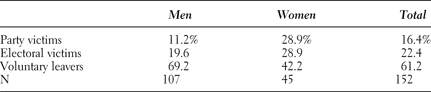
We begin by constructing a simple typology of former MPs. A first type consists of MPs who left parliament of their free will. Our survey results indicate that 61.2% of all former MPs left voluntarily, either prematurely at the end of the period without being a candidate, or they stood for election but intended to leave parliament. The MPs who left involuntarily form a second category: electoral victims who wanted to return but were defeated by the voters and those who left involuntarily—either early or at the end of the term—and did not stand for reelection (42.4% of the involuntary leavers belong to this type). These candidates were likely forced to abandon their seat by the party, or were refused a good place on the list.
Women and men leave parliament in a different way (see Table 1). That is, we see a significant relationship between gender and the type of departure. The percentage of voluntary leavers is significantly lower among women than men, contrary to H1. Female MPs, however, are more often deselected by the party than are men, and are also more often sent away by the electorate than are their male counterparts. That women are more likely to be party victims supports H2A.
Distribution of type of MP departure, by sex
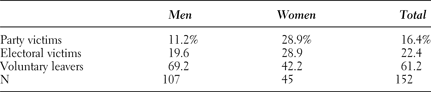
Notes: X 2=10,9879; df = 2, p = 0.0041.
Whether these differences are due to MP sex rather than other factors, however, remains to be seen. After all, female MPs who leave parliament are generally younger than men (53.8 years for women, compared to 57.9 years for men), and women are particularly underrepresented among the older cohorts. Thus, to the extent that these older and mostly male MPs leave voluntarily (because they want to retire), the bivariate gender effect may not be driven by sex, per se. It is also possible that the gender effect can be attributed to a difference in seniority. Arguably, MPs with a longer tenure will have a stronger power base, both in the party and in the electorate (Schwindt-Bayer Reference Schwindt-Bayer2005). The more experienced MPs can be expected to have developed a broader network in the party and among voters. This support base should make the experienced MP more immune to both party deselection and electoral defeat. On average, female MPs who leave look back on a parliamentary career of 8 years, compared to men, who average an 11 year career (see also Lawless and Theriault Reference Lawless and Theriault2005). This difference partly reflects the age difference between men and women. Older former MPs tend to have more parliamentary experience, although the correlation is far from perfect.
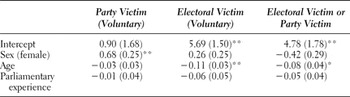
In order to assess the net effect of these explanatory variables, we employ a multinomial logistic regression with a categorical dependent variable (type of departure).Footnote 4Table 2 reports the parameter estimates for each pair of categories in the dependent variable, controlling for sex, age, and parliamentary experience. Given the relatively small sample size, we consider 0.10 statistically significant.
Multinomial logistic regression coefficients (and standard errors) predicting type of departure

Notes: Levels of significance: **p < 0.01; *p < 0.05.
The multivariate analysis confirms that gender has a significant effect on the type of departure; those data corroborate H2A. Still, age has a stronger effect. The older the candidate, the more likely he/she is to leave of free will (42.9% of former MPs aged 50 or younger left voluntarily, compared to 85.7% among those older than 60). The forced departures among younger politicians are, in large part, due to the fact that they are much more likely to be defeated. Among politicians younger than 50, for example, nearly 43% are electoral victims; among those older than 60, fewer than 4% fall in this category. This appears to be an effect of age and not the duration of the parliamentary career. Controlling for age, parliamentary experience does not have a significant effect on the type of departure.
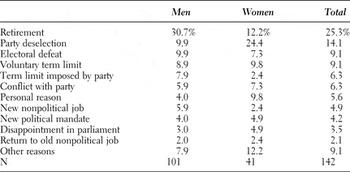
Although the data indicate that female MPs are less likely than men to leave of their free will, we have not yet provided sufficient evidence to draw conclusions about the underlying mechanism. We proposed two explanations for the expected (negative) effect of gender: the party logic (women are more vulnerable than men to party deselection) and the electoral logic (women are more vulnerable than men to electoral defeat). The fact that women are overrepresented among the party victims suggests that the first explanation is the more valid. But the survey included a far more elaborate question to tap into reasons for departure. Respondents were presented with a list of 52 possible reasons, subdivided in twelve categories, and were asked to check all that applied to them. We also asked them to rank order the three most important reasons for their departure. The last column in Table 3 presents the distribution of MPs' responses. About one-quarter left because they wanted to take up their pensions. Party deselection is the second most important reason, followed by voter deselection. As Table 3 makes clear, voluntary departures, conflict with the party, disappointment in the functioning of parliament, and personal reasons are far less common.
Reason for MP departures, by sex

For our purposes, it is important to note that women and men do not leave for the same reasons. More specifically, women are less than half as likely as men to report departing because they want to retire. This finding reflects the fact that the male MPs are generally older than the women. The expectation that women are vulnerable to electoral defeat (H2B) is not corroborated by the data. Also, we do uncover support for the expectation (H2A) that party deselection is a more decisive indicator of departures for women than men. If we recalculate these percentages without taking the predominantly male group of retiring MPs into account (i.e., those who mentioned their pension as the most important reason), then the difference remains substantial. Whereas 27.8% of women consider themselves as having been dismissed by the party, only 14.3% of men do.Footnote 5
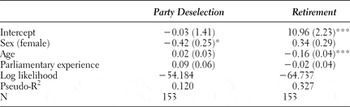
As a final test, we performed two separate multivariate logistic regression analyses to assess the power sex exerts on identifying party deselection and retirement as the most important reasons for departure. The data presented in Table 4 reveal that, as expected, the gender effect on mentioning retirement as one of the most important reasons for leaving parliament disappears completely once we control for age. Gender's effect on mentioning party deselection, however, remains significant regardless of age and parliamentary experience. More women than men consider themselves victims of party deselection.
Logistic regression coefficients (and standard errors) predicting whether party deselection and retirement are the most important reasons for leaving

Notes: Levels of significance: *** p < 0.01; ** p < 0.05; * p < 0.10.
CONCLUSION AND DISCUSSION
Women's presence in parliaments has been high on the research and policy agenda for several decades, but attention has focused mainly on women's entry and legislative role, not on their exit from the parliamentary arena. Yet departing from parliament is important; the longer women can stay in parliament, the more they can build expertise and a power base. These two assets empower MPs when undertaking their parliamentary activities (scrutinizing government decisions more effectively, initiating legislative bills more successfully, etc.) and in securing reelection. Based on survey data collected from former MPs of the regional parliaments of Catalonia, Saxony, Scotland, Flanders, and Wallonia, we find that female MPs who retire from parliament are more likely than their male counterparts to do so involuntarily. This effect remains significant when we control for age and parliamentary experience. In general, retiring women are pushed toward the exit by their own party.
Our central findings lead us to generate two broader conclusions. First, studies about the presence and influx of women tell us only a part of the story. If women enter parliament to stay there for a relatively short tenure, then their impact will be limited. The abundant literature on the effects of quotas, therefore, should be complemented by studies focusing on parliamentary exits and the reasons underlying those departures. Activists striving for gains in women's representation should also take departures into account when devising strategies.
Second, parties clearly play a pivotal role in women's representation. Not only do they facilitate women's entrance into parliament, but our findings suggest that they also shape women's departures. Moreover, the other reason for an involuntary exit—electoral defeat—is influenced by the party. It is the party that determines the position of female candidates on the list and thus, indirectly, their electoral score. Both political scientists and activists, then, must continue to pay attention to the party selectorate, since its composition and functioning bear directly on women's presence in and absence from political institutions.