


%20--%3e%3c!DOCTYPE%20svg%20PUBLIC%20'-//W3C//DTD%20SVG%201.0//EN'%20'http://www.w3.org/TR/2001/REC-SVG-20010904/DTD/svg10.dtd'%3e%3csvg%20version='1.0'%20id='Layer_1'%20xmlns='http://www.w3.org/2000/svg'%20xmlns:xlink='http://www.w3.org/1999/xlink'%20x='0px'%20y='0px'%20width='64px'%20height='64px'%20viewBox='5.5%20-3.5%2064%2064'%20enable-background='new%205.5%20-3.5%2064%2064'%20xml:space='preserve'%3e%3cg%3e%3ccircle%20fill='%23FFFFFF'%20fill-opacity='0'%20cx='37.785'%20cy='28.501'%20r='28.836'/%3e%3cpath%20fill='%23595959'%20d='M37.441-3.5c8.951,0,16.572,3.125,22.857,9.372c3.008,3.009,5.295,6.448,6.857,10.314%20c1.561,3.867,2.344,7.971,2.344,12.314c0,4.381-0.773,8.486-2.314,12.313c-1.543,3.828-3.82,7.21-6.828,10.143%20c-3.123,3.085-6.666,5.448-10.629,7.086c-3.961,1.638-8.057,2.457-12.285,2.457s-8.276-0.808-12.143-2.429%20c-3.866-1.618-7.333-3.961-10.4-7.027c-3.067-3.066-5.4-6.524-7-10.372S5.5,32.767,5.5,28.5c0-4.229,0.809-8.295,2.428-12.2%20c1.619-3.905,3.972-7.4,7.057-10.486C21.08-0.394,28.565-3.5,37.441-3.5z%20M37.557,2.272c-7.314,0-13.467,2.553-18.458,7.657%20c-2.515,2.553-4.448,5.419-5.8,8.6c-1.354,3.181-2.029,6.505-2.029,9.972c0,3.429,0.675,6.734,2.029,9.913%20c1.353,3.183,3.285,6.021,5.8,8.516c2.514,2.496,5.351,4.399,8.515,5.715c3.161,1.314,6.476,1.971,9.943,1.971%20c3.428,0,6.75-0.665,9.973-1.999c3.219-1.335,6.121-3.257,8.713-5.771c4.99-4.876,7.484-10.99,7.484-18.344%20c0-3.543-0.648-6.895-1.943-10.057c-1.293-3.162-3.18-5.98-5.654-8.458C50.984,4.844,44.795,2.272,37.557,2.272z%20M37.156,23.187%20l-4.287,2.229c-0.458-0.951-1.019-1.619-1.685-2c-0.667-0.38-1.286-0.571-1.858-0.571c-2.856,0-4.286,1.885-4.286,5.657%20c0,1.714,0.362,3.084,1.085,4.113c0.724,1.029,1.791,1.544,3.201,1.544c1.867,0,3.181-0.915,3.944-2.743l3.942,2%20c-0.838,1.563-2,2.791-3.486,3.686c-1.484,0.896-3.123,1.343-4.914,1.343c-2.857,0-5.163-0.875-6.915-2.629%20c-1.752-1.752-2.628-4.19-2.628-7.313c0-3.048,0.886-5.466,2.657-7.257c1.771-1.79,4.009-2.686,6.715-2.686%20C32.604,18.558,35.441,20.101,37.156,23.187z%20M55.613,23.187l-4.229,2.229c-0.457-0.951-1.02-1.619-1.686-2%20c-0.668-0.38-1.307-0.571-1.914-0.571c-2.857,0-4.287,1.885-4.287,5.657c0,1.714,0.363,3.084,1.086,4.113%20c0.723,1.029,1.789,1.544,3.201,1.544c1.865,0,3.18-0.915,3.941-2.743l4,2c-0.875,1.563-2.057,2.791-3.541,3.686%20c-1.486,0.896-3.105,1.343-4.857,1.343c-2.896,0-5.209-0.875-6.941-2.629c-1.736-1.752-2.602-4.19-2.602-7.313%20c0-3.048,0.885-5.466,2.658-7.257c1.77-1.79,4.008-2.686,6.713-2.686C51.117,18.558,53.938,20.101,55.613,23.187z'/%3e%3c/g%3e%3c/svg%3e)
%20--%3e%3c!DOCTYPE%20svg%20PUBLIC%20'-//W3C//DTD%20SVG%201.0//EN'%20'http://www.w3.org/TR/2001/REC-SVG-20010904/DTD/svg10.dtd'%3e%3csvg%20version='1.0'%20id='Layer_1'%20xmlns='http://www.w3.org/2000/svg'%20xmlns:xlink='http://www.w3.org/1999/xlink'%20x='0px'%20y='0px'%20width='64px'%20height='64px'%20viewBox='5.5%20-3.5%2064%2064'%20enable-background='new%205.5%20-3.5%2064%2064'%20xml:space='preserve'%3e%3cg%3e%3ccircle%20fill='%23FFFFFF'%20fill-opacity='0'%20cx='37.637'%20cy='28.806'%20r='28.276'/%3e%3cg%3e%3cpath%20fill='%23595959'%20d='M37.443-3.5c8.988,0,16.57,3.085,22.742,9.257C66.393,11.967,69.5,19.548,69.5,28.5c0,8.991-3.049,16.476-9.145,22.456%20C53.879,57.319,46.242,60.5,37.443,60.5c-8.649,0-16.153-3.144-22.514-9.43C8.644,44.784,5.5,37.262,5.5,28.5%20c0-8.761,3.144-16.342,9.429-22.742C21.101-0.415,28.604-3.5,37.443-3.5z%20M37.557,2.272c-7.276,0-13.428,2.553-18.457,7.657%20c-5.22,5.334-7.829,11.525-7.829,18.572c0,7.086,2.59,13.22,7.77,18.398c5.181,5.182,11.352,7.771,18.514,7.771%20c7.123,0,13.334-2.607,18.629-7.828c5.029-4.838,7.543-10.952,7.543-18.343c0-7.276-2.553-13.465-7.656-18.571%20C50.967,4.824,44.795,2.272,37.557,2.272z%20M46.129,20.557v13.085h-3.656v15.542h-9.944V33.643h-3.656V20.557%20c0-0.572,0.2-1.057,0.599-1.457c0.401-0.399,0.887-0.6,1.457-0.6h13.144c0.533,0,1.01,0.2,1.428,0.6%20C45.918,19.5,46.129,19.986,46.129,20.557z%20M33.042,12.329c0-3.008,1.485-4.514,4.458-4.514s4.457,1.504,4.457,4.514%20c0,2.971-1.486,4.457-4.457,4.457S33.042,15.3,33.042,12.329z'/%3e%3c/g%3e%3c/g%3e%3c/svg%3e)
Antimicrobial overuse is common Reference Fleming-Dutra, Hersh and Shapiro1,Reference Hersh, Shapiro, Pavia and Shah2 despite adverse consequences including antimicrobial resistance, Reference Shallcross and Davies3 excess cost, Reference Demirjian, Sanchez and Finkelstein4 adverse reactions, Reference Shehab, Patel, Srinivasan and Budnitz5 and microbiome disruption. Reference Jernberg, Löfmark, Edlund and Jansson6 In 2013, 67 million outpatient antibiotic prescriptions were dispensed to children in the United States, or 813 antibiotic prescriptions per 1,000 children. Reference Fleming-Dutra, Demirjian, Bartoces, Roberts, Taylor and Hicks7 Approximately 40% of antibiotic prescriptions to patients of all ages are written from urgent care and retail clinics. Reference Palms, Hicks and Bartoces8 Although it is estimated that 30% of these prescriptions are inappropriate, Reference Fleming-Dutra, Hersh and Shapiro1 antibiotic prescribing appropriateness has been shown to vary by clinical setting. Reference Palms, Hicks and Bartoces8
In the past decade, there has been increasing recognition of prescribing as a social and behavioral phenomenon in addition to a clinical act. Reference Barlam, Neuhauser, Tamma and Trivedi9 Many nonclinical factors have been described as drivers of inappropriate antimicrobial prescribing, including time pressures, belief that antibiotics are overprescribed, actual or perceived patient desire for antibiotics, age of the patient, age or experience of the clinician, perception of social responsibility, risk tolerance, and perception of applicability of treatment guidelines. Reference Barlam, Neuhauser, Tamma and Trivedi9–Reference Mangione-Smith, McGlynn, Elliott, McDonald, Franz and Kravitz12
Few studies have evaluated clinician perception of nonclinical drivers of antibiotic prescribing, only 2 studies were from the United States, Reference Dempsey, Businger, Whaley, Gagne and Linder13,Reference Patel, Pfoh and Misra Hebert14 and few included clinicians in urgent and retail care clinics or advanced practice providers (APP). Incorporating perceptions of clinicians in urgent and retail care clinics is important given their large proportion of antibiotic prescribing. Reference Palms, Hicks and Bartoces8
In this study, we sought to describe and compare clinicians’ perceptions of nonclinical drivers of outpatient antibiotic prescribing for pediatric patients across diverse ambulatory settings. We evaluated the data using an existing framework for domains of continuity including relational, informational, and management continuity as described by Haggerty et al (Table 1). Reference Haggerty, Reid, Freeman, Starfield, Adair and McKendry15
Three Types of Continuity (as described by Haggerty et al) Reference Haggerty, Reid, Freeman, Starfield, Adair and McKendry15

Methods
Setting
Participants were attending physicians or advanced practice providers (nurse practitioners or physician assistants) who care for children and were working in practices affiliated with Vanderbilt University Medical Center. Practice settings included pediatric primary care (pediatricians and APPs), retail health (APPs only), and urgent-care clinics including walk-in clinics that care for adult and pediatric patients (ie, APPs and family medicine, internal medicine, and medicine–pediatrics physicians) and pediatric-only clinics (ie, pediatricians only).
Sampling strategy and ethical issues
All clinicians from included settings were invited to participate through e-mail. Recruitment continued until representative sampling from each setting and clinician type (physician and advanced practice provider), and thematic saturation were achieved. Interviews were conducted in person or by telephone. This project was approved by the Vanderbilt University Institutional Review Board with a waiver of informed consent
Interviews
Interviews included open-ended questions to elicit participant experiences with prescribing antibiotics for children in ambulatory settings and factors that influenced those experiences. An interview guide was developed through a process of literature review, consultation with content and methodological experts, and pilot testing for length and comprehensibility. Questions addressed prescribing priorities and general considerations, modifying social and behavioral features, discussion of sample cases (selected to be ambiguous relative to guidelines), and questions about unique factors related to care settings (see the interview guide in the Supplementary Material). All interviews were conducted and analyzed by a single researcher (H.S.).
Data analysis and techniques to enhance trustworthiness
Interviews were recorded and transcribed verbatim. Demographic data were stored in the REDCap database (Vanderbilt University, Nashville, TN). Transcripts were uploaded into MAXQDA qualitative data software (VERBI Software, 2020, Berlin, Germany) for management and analysis.
Data analysis was based on the grounded theory constant comparative method Reference Kolb16 and a thematic analysis approach. Using ResearchTalk’s Sort and Sift, Think and Shift methodology, Reference Maietta, Mihas, Swartout, Petruzzelli and Hamilton17 an interim analysis of 10 representative interviews identified preliminary categories of data to inform a code system, was applied to the entire data set. After all transcripts were coded, the code system was refined to organize analysis around domains of continuity Reference Haggerty, Reid, Freeman, Starfield, Adair and McKendry15 based on the emergence of concepts suggested by the data. The full data set was verified with the final code set. Results were organized into a conceptual model to visualize relationships between the domains of continuity and factors influencing each domain.
Trustworthiness was enhanced through iterative questioning and data saturation. Additionally, results were presented to a subset of participants in a member-checking activity conducted by teleconference (n = 10) or e-mail (n = 2).
Results
In total, 55 clinicians were interviewed: 17 (31%) from primary care, 13 (24%) from retail health, and 25 (45%) from urgent-care clinics (Table 2). Furthermore, 28 (51%) were APPs and 27 (49%) were physicians. Overall, 45 interviews (82%) were conducted by telephone and 10 (18%) were conducted in person. We found no difference in identified themes by setting or clinician type; however, clinicians in primary care described having more reliable relational and informational continuity.
Characteristics of Participants

Conceptual model of nonclinical factors
At the model’s center is the theme “providing guideline concordant care” (Fig. 1). Participants described the desire to prescribe in accordance with guidelines as their primary priority. The ability to do so was supported by the presence of relational, informational, and management continuity and made more difficult by their absence. Participants also identified a variety of nonclinical influences across care settings, such as social determinants of health (finances, transportation, parental employment, stability of homelife), health literacy, setting workflow, hours of operation, tolerance for risk of treatment failure, diagnostic uncertainty, and clinician readiness to engage. These features were categorized into domains of clinician, patient, and environmental factors.
Conceptual model of relationships between primary nonclinical drivers of outpatient antimicrobial prescribing for pediatric patients.

Central priority: Guideline-concordant care
Most clinicians identified “guideline recommended” as the primary factor informing their prescribing decisions for pediatric patients. Guideline-concordant care was important for several reasons. Guidelines incorporate evidence and expert opinion, which some clinicians cited as improving confidence in their treatment recommendation. Guidelines also incorporate new knowledge, antibiotic susceptibilities, and antibiotic resistance patterns:
“I believe in the importance of using research and empiric evidence to support clinical practice. I also don’t have a lot of confidence in my own memory of my education or of the longevity of the lessons I received 10, 15, 20 years ago in medical school. Knowledge changes. Available medications change. Antibiograms change. People change. And even for things I treat regularly, the knowledge around them does change. And so, I think it serves our patients better to provide treatments that are more aligned with the best available evidence.”—Physician, urgent care
Theme of management continuity
Clinicians across settings relayed the importance of having consistent management practices (management continuity). Consistency in management was described as being important within an individual’s practice, within a clinical setting (ie, among all clinicians in an specific clinic), and across settings (ie, across a healthcare system).
“I feel like we all need to be on the same team, too. I think [the institution] does a great job of that, but it’s frustrating when I hear of patients who go somewhere else and get a Rocephin shot and an antibiotic for their cold. … I just want all the providers across the U.S. and the world, even, let’s just all practice within these guidelines. Because it’s such a big deal.”—APP, retail clinic
In all clinical settings, participants shared the perception that previous antibiotic experiences were the primary influence on parental expectations for antibiotics, reflecting the presence or absence of management continuity. Previous experiences with antibiotics may promote expectations for antibiotics, but they may also shape expectations in a way that enables guideline concordant care if previous care did not involve an unnecessary antibiotic. Previous parental experiences were perceived by participants as not limited to the child for whom they were currently seeking care, but also included experiences for other children and for themselves, either historically or for a concurrent illness in the adult.
“I definitely feel like it’s confusing for families because the adults often have… very similar symptoms as the child. They’ll go to some sort of walk-in urgent care or their regular place that they see a provider and they’ll get an antibiotic, and they’ll say, ‘I’m being treated for bronchitis or whatever, and I have this antibiotic and I have this steroid. And I think my kid [has] got the same thing.’”—Physician, urgent care
Theme of relational continuity
Relational dynamics and relational continuity were described by clinicians in all settings and were influenced by patient and clinician factors. For pediatricians in urgent care specifically, the importance of guidelines in fostering consistency of care across the healthcare system was one way to balance the absence of relational continuity. However, clinicians who commonly had a longstanding relationship with their patients, like those in primary care, were more likely to describe parent expectations that were already aligned with the clinicians’ practice.
“It’s easier, of course, if I’m the PCP [primary care physician] because you already have that relationship with the family, the trust and confidence and so it’s easier to work through that conversation.”—Physician, primary care
Parental expectations were also thought to be shaped by a “slow burn” of messaging over time. This theme was shared by a portion of participants who described the process of bringing parental expectations into alignment with guidelines as happening over time rather than being a one-time event. This highlighted the relationship between relational continuity and management consistency. Consistent practice can shape parental expectations for antibiotics and thus facilitate guideline-concordant prescribing. Consistency was perceived to facilitate trust in a clinician when the clinician does not have an existing relationship with the patient.
“As things change slowly and more and more people do or don’t [do] things, it just becomes more normalized…. it just takes [a] slow burn.”—Physician, urgent care
In addition to having better aligned expectations with a known patient via management continuity, a pre-existing relationship between the clinician and patient was described as facilitating guideline concordant care through mutual trust. When relational continuity was absent, clinicians described having to foster a parent’s trust de novo. They did this through spending time (to explain their reasoning, to allay fears, etc), through shared decision making, by exuding confidence, and by providing access to information about their decision making. Trust in the clinician was also perceived to be improved when management continuity exists. Relational continuity was also described as facilitating knowledge of the patient’s history and family dynamics (informational continuity). Such a relationship was described only as routinely existing in the primary-care setting and even there did not always exist.
A patient–clinician relationship is bidirectional, and clinicians must trust a patient as well as gain their trust. When relational continuity does not exist, clinicians must de novo develop trust in the patient or parent. One way clinicians may do this is by drawing on documentation of previous encounters if they have access to a patient’s medical record (informational continuity).
“I look at a patient’s chart before I go in there and then I kind of see this patient has gone to the emergency six times in the last 2 months for fever for 12 hours. So you can kind of … not that I prejudge but I kind of do look at how often they bring their child in… [and] I make sure to document in my chart if a parent voices their dissatisfaction with my service of not giving them an antibiotic. It’s helpful for me because I would want to know.”—APP, primary care
Theme of informational continuity
In addition to informing a clinician of a patient’s trustworthiness with regard to historical care seeking and compliance with recommendations, informational continuity was described as informative to a clinician’s medical decision making. The decision to prescribe antibiotics was perceived to be informed by a patient’s past medical history including frequency of previous infections, length of time since last antibiotic prescription, and most recent class of antibiotic exposure. Although parents may provide a history, clinicians described that a verbal history may lack sufficient details or accuracy.
“‘Oh, but my kiddo is prone to getting strep. They get strep all the time,’ but when I take the time to really look that over with them, sometimes they’re surprised…. The timeline blurs and when I take that extra time to go over that data with them about their specific child, because sometimes it crosses, the sibling had strep and it wasn’t this child.”—Pediatrician, primary care
The availability of information feedback after the visit (post visit informational continuity) varied across settings. Clinicians in non–primary-care settings described the difficulty making contingency plans because of poor informational continuity post visit and limited or no feedback about the ultimate outcomes for their patient. Clinicians in primary care, on the other hand, described the benefit of often having longitudinal information on their patients.
“I honestly don’t know how often [antibiotic failure] happens because a lot of our patients follow up with a lot with other providers because our clinic has such weird hours and so many providers. So maybe that’s occurring more than individual providers know because they follow up with somebody else a couple days later. So we don’t know that the antibiotic didn’t work.”—APP, primary care
Informational continuity was described as only reliably (but not uniformly) existing in the primary care setting. Informational continuity variably existed in other urgent- and retail-care settings when patients have previously been seen at in-network clinics that share medical records.
Discussion
By interviewing clinicians in diverse ambulatory settings, we identified practitioner values and perceptions of nonclinical influences on antibiotic prescribing for pediatric patients. We identified 3 domains of continuity that clinicians felt were essential for the provision of guideline concordant care: relational continuity, informational continuity, and management continuity. Reference Haggerty, Reid, Freeman, Starfield, Adair and McKendry15 Additionally, we developed a conceptual model to visualize how these themes are related and how patient, clinician, and environmental factors affect these themes.
In our study, both physicians and APPs across settings placed a high value on guidelines and prioritized guideline concordant care. Prior studies have reported mixed acceptance of guidelines, Reference Szymczak, Feemster, Zaoutis and Gerber18 highlighting greater acceptance among trainees compared to their supervisors, who considered guidelines as “a threat to their professional autonomy.” Reference Mol, Rutten, Gans, Degener and Haaijer-Ruskamp19 The regard for guidelines in our study may reflect an increased acceptance over time or previous work done in our institution to gain clinician confidence. As we discussed guideline-concordant care with clinicians, the themes of consistency of management, access to information, and the importance of relationship and trust emerged.
We found that primary care was unique in its ability to provide relational and informational continuity, domains of continuity that do not reliably exist in urgent- and retail-care settings. The absence of informational and relational continuity was perceived as affecting the ability to provide guideline concordant care. The third domain of continuity (management continuity, or consistency of practice) was valued across primary and non–primary-care settings.
Management continuity was perceived as an outcome of providing guideline concordant care. Management continuity may also indirectly affect the ability to provide future guideline concordant care by shaping parental expectations. Both physicians and APPs across settings identified the value of management continuity, although it was less commonly described by clinicians in the walk-in clinic. The emphasis on management continuity may have been due to the strong representation from non–primary-care settings which do not have informational and relational continuity on which to rely.
The strong regard for guidelines may reflect the interdependent nature of practice in non–primary-care settings. Further, non–primary-care settings often lack relational and informational continuity, elevating the importance of management continuity. These findings indicate that establishing consistent guideline implementation and utilization throughout our healthcare system may be an important next step for an outpatient antibiotic stewardship program.
In evaluating prescribing influences, we hypothesized that clinicians would cite social determinants of health as a major factor. Although clinicians described various social determinants of health as impacting prescribing behavior, none of these factors were described as influencing prescribing and they were not described as primary drivers for the decision to prescribe. However, the behavioral feature of parental expectations for antibiotics emerged as a dominant patient-level factor.
The effect of parental expectations for antibiotics on guideline-concordant prescribing was a dominant theme in our study. The literature is mixed on whether and to what extent parents expect antibiotics at a sick visit. Reference Mangione-Smith, McGlynn, Elliott, McDonald, Franz and Kravitz12,Reference Szymczak, Klieger, Miller, Fiks and Gerber20–Reference Van Hecke, Butler, Wang and Tonkin-Crine24 Regardless of actual expectations, which are often inaccurately perceived, mere perception of expectations for antibiotics has been shown to affect prescribing. Reference Mangione-Smith, McGlynn, Elliott, McDonald, Franz and Kravitz12,Reference Mangione-Smith, McGlynn, Elliott, Krogstad and Brook25 Clinicians in our study felt that parental expectations can be positively shaped over time through consistent practice and positive, reinforced messages.
Although our findings need to be validated in additional populations, they point to broader system-level interventions that may provide local impact. We have outlined potential actions (Table 4) at each system level, from clinician and clinic to outpatient antimicrobial stewardship program, medical center and at the level of governmental public health, based on the themes (Fig. 1 and Table 3). Individuals and entities at all levels may find actions they can institute based on these findings. Instituting a combination of interventions is likely more effective than any one intervention alone. Reference Hamdy and Katz26
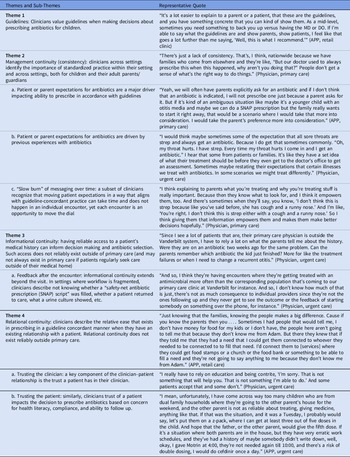
Description of Major Themes, Subthemes, and Representative Quotes

Recommended Actions Based on Identified Themes by Healthcare System Level of Intervention

This study is unique in the breadth of clinicians included with strong representation of APPs; however, this study had several limitations. All participants included in this study were affiliated with a single academic medical center, and the results may not be generalizable to community settings. However, clinicians who work in the walk-in and retail clinics function similarly to private practice. Additionally, antibiotic prescribing varies widely from region to region within the United States. Reference Fleming-Dutra, Demirjian, Bartoces, Roberts, Taylor and Hicks7 The nonclinical factors that make up the difference between high- and low-prescribing regions likely also vary in type and degree of importance among different regions. Nevertheless, many of the overriding themes identified here are likely applicable to other regions. However, with any quality improvement or implementation project, intervention design and implementation should be grounded in local culture. Reference Kaplan, Brady and Dritz27 Additionally, interviews were coded by a single researcher.
In conclusion, both physicians and APPs placed a high value on providing guideline-concordant care across primary and urgent- or retail-care settings; however, many patient-, clinician-, and environmental-level factors facilitated or impeded their ability to do so, including parental expectations for antibiotics. Providing guideline-concordant care was perceived to be largely driven by the presence or absence of continuity across all domains including relational, informational, and management continuity. Clinicians perceived expectations for antibiotics to be modifiable, primarily through consistent management practices. As healthcare systems become more complex and fragmented, and access to relational and informational continuity decreases, greater emphasis should be placed on management continuity.
Supplementary material
To view supplementary material for this article, please visit https://doi.org/10.1017/ash.2022.224
Acknowledgments
We thank Drs Clay Smith, Edward Shackleford, Kris Rehm, and Kathryn Carlson for their contributions to this project.
Conflicts of interest
Ritu Banerjee has received research support from Biomerieux, Roche, and BioFire, outside the submitted work. The other authors have no conflicts of interest relevant to this article to disclose.
Financial support
This work was supported in part by the Childhood Infections Research Program (NIAID grant no. 5T32-AI095202-08 to Mark Denison) and the David T. Karzon Fellowship in Pediatric Infectious Diseases. Milner Staub received support from the Office of Academic Affiliations, Department of Veterans’ Affairs, VA National Quality Scholars Program, with use of the facilities at the VA Tennessee Valley Healthcare System, Nashville, Tennessee.




 Open access

