European warfare in the eighteenth century was a gentleman's art. Comparable to a large chess game with human pieces, but far more deadly, the art of war had its rules of behavior, etiquette, and intricate maneuvers. Uniforms were elaborate and ornate, and conformed to a detailed color code. Campaigns were fought from the spring until the late fall, when armies went into winter quarters to rest, consolidate, train, and recover losses, preparing for the next year's campaign. Opposing forces of professional infantry soldiers commanded by experienced officers and veteran noncommissioned officers waged fixed battles. The soldier was required to function as part of a team, almost as an automaton, strictly obeying whatever commands his superiors gave him and never acting independently without orders. Since the sixteenth century, infantry tactics required the men to march in step, advancing and retreating in block formations. The snare drum served to regulate the cadence of the men while marching and gave signals and orders, since oral commands were difficult to hear in the din and confusion of battle. The military drummer, therefore, was an important and indispensable member of the infantry unit. In the North American colonies, a fifer would normally accompany the drummer, providing melodies that identified and further defined the drummer's beats, especially in the formal ceremonies and parades that were so important to developing and maintaining the esprit de corps and morale of the troops. The drummers and fifers when assembled were referred to as the field music. The drummers regulated the military day through their beats and signals, while fifers were to regulate the steps of the men with tunes “which have some grandeur and solemnity in them.”Footnote 1
The colonies did not have an army, instead relying on militia units for their safety and protection. George Washington's primary task, on being appointed commander in chief of all Continental forces, was to form an army patterned on European models out of the conglomeration of miscellaneous militia units that he found besieging Boston in April 1775. Militia training was rudimentary at best; there were few experienced officers, and even fewer noncommissioned officers available. There were no uniforms, and provisions and equipment were in short supply. Congress approved the establishment of a Continental army of twenty-six infantry regiments and one artillery regiment, all authorized for the year 1776. Each regiment consisted of a headquarters, staff, and eight companies of ninety officers and men, including one fifer and one drummer. The staff included a drum major and a fife major.Footnote 2 The enlistments were for only one year, as most colonists assumed that Great Britain would settle colonial grievances quickly and amicably, and did not expect that the strife would last more than one campaign. But British policy hardened against the colonies, and the conflict was to become one of the longest wars in United States history.
1776 was a year of continuing military disappointments, for Washington's small and poorly trained army could not stand up to the highly trained and well-disciplined British forces. The victories at Trenton and Princeton were the only rays of hope, and they came just as the army's enlistment period was expiring. Washington set out to form a new army, this time enlisted for the duration of the war. Recruiting was slow, however, and when Washington left his first winter encampment at Morristown he had but 8,000 of the Congressionally-legislated 76,000 men. The supply picture had brightened somewhat, for France, always anxious to discomfort its traditional enemy, had agreed to send muskets, powder, and other badly needed military stores. In addition, a number of foreign volunteers arrived to help build and mold the army. Most important among these were the Marquis de Lafayette and Baron von Steuben.
The campaign of 1777 offered little hope of success. Having been forced out of New York, Washington was unable to prevent the British from capturing Philadelphia as well. With the British commander, Major General William Howe, and his troops comfortably settled in Philadelphia, Washington moved his diminished army into Valley Forge for the second winter encampment of the war. He was buoyed somewhat by the success of General Gates and his forces in capturing Burgoyne at Saratoga, but he knew that he would have to resolve many serious problems before attempting another campaign. The difficult times and the shortages of food, clothing, and shelter at Valley Forge have often been recounted. The devotion of this small group of men may perhaps be summarized by von Steuben's comment that no European army would ever have remained in existence under such desperate conditions.
Friedrich Wilhelm, Baron von Steuben, arrived at Valley Forge in February 1778 and offered his services as a volunteer. Washington instituted a new staff position and asked von Steuben to serve as acting inspector general of the army, in charge of training the troops. The conditions that von Steuben saw and described—the lack of clothing, the confusing jumble of understrength and irregular units, the lack of standardized drill techniques, the poor equipment and ignorance of its proper use, and the general lack of any systematized organization—have frequently been cited.Footnote 3 Von Steuben immediately set to work developing a drill manual that adapted Prussian techniques to the existing Colonial culture of individualism. He then organized a model company and began to drill it himself in these new techniques. Using the model company as cadre, he then extended the new drill to the remainder of the army in the encampment. Greatly pleased with the results, Washington had von Steuben confirmed as inspector general with the rank of major general and recommended to Congress that the drill regulations he had developed be adopted for the entire army. The Regulations for the Order and Discipline of the Troops of the United Sates were officially adopted, and they remained basically in force until superseded by new regulations in 1821.Footnote 4
Chapter 21 of the Regulations, entitled “Of the Different Beats of the Drum,” listed the various beats and signals ordered into use for the Continental army and described their functions. Unfortunately, von Steuben did not include any musical notation, and there were no colonial fife or drum tutors available. Washington realized that the lack of standardization would frustrate his attempts to form a unified army, and he appointed a subordinate inspector general in charge of standardizing and supervising the army's music. The general orders of 19 August 1778 announced, “Lieutenant Hiwell of Colonel Crane's Regiment of Artillery is appointed Inspector and Superintendent of Music in the Army and is to be respected accordingly.”Footnote 5 John Hiwell was the fife major of Crane's artillery regiment, and was in charge of its excellent band of music.Footnote 6 He was at Valley Forge, and would certainly have been familiar with von Steuben's work.
Hiwell immediately set to work to remedy the shortages of equipment. New fifes and drums were issued to the various units, and damaged instruments were returned to the Quartermaster. Fifes within each unit were sorted according to pitch, and the pitch was standardized. Since the drummers and fifers of the various regiments were trained by their own drum and fife majors, it was important for Hiwell to begin his work with these noncommissioned officers. Less than a month after his appointment, the general orders directed that “The Drum and Fife Majors of the Regiments on the Ground are to attend at the Inspector of Music's tent in the rear of the [Artillery] Park tomorrow morning ten o’clock to receive his Instructions.”Footnote 7 The improvement of the army's music had begun.
As mentioned above, von Steuben did not include any musical notation in his Regulations. The beats consisted mainly of references to normal camp duties performed by the field music, the company fifers and drummers. The Assembly, for example, “is the signal to repair to the colours.” Similarly, “The March [is] for the whole to move”; “The Reveille is beat at day-break, and is the signal for the soldiers to rise, and the centries to leave off challenging.” The signals were mainly drum rudiments, such as “First Serjeant's call—one roll and three flams” or known melodies, as in “To go for provisions—roast beef,” referring to Richard Leveridge's popular song “Roast Beef of Old England.”Footnote 8 Because of this lack of musical notation in the Regulations, the fifers and drummers had to rely on knowledge gained from experienced musicians or from one of the five different fife tutors published in England between 1756 and 1770, all of which contained the basic English and Scots camp duties and a number of marches (see Appendix).
It is clear that Hiwell put high demands on his musicians. A number of colonial army manuscripts contain primo and secondo fife parts, and there must have been players proficient enough to play those parts to warrant their inclusion. The assumption, therefore, that most fifers, especially those in the emerging colonial forces, played single line melodies in unison and had only a rudimentary level of musical proficiency is clearly refuted by these manuscripts. Thanks to the abundance of singing schools in the colonies, by the 1760s “note reading was no longer a rare skill.”Footnote 9
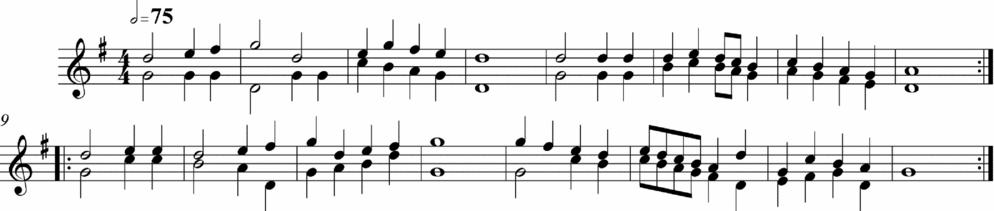
Some of the tunes are quite demanding, but even the simpler ones can be rather effective in context. For example, Von Steuben's Regulations state, “The Tattoo is for the soldiers to repair to their tents, where they must remain till reveille beating next morning.” The earlier form of this word gives additional meaning to the function of the beat: tap-too. It was the signal for the innkeepers or sutlers to shut the taps of their casks and close business for the day. Tattoo was usually beat at eight or nine p.m. in the winter, and ten p.m. in the summer. Although Hiwell did not compose the music, “Hiwell's Taptoe for the Lord's Day Evening” does show his influence on the fifers under his command and their ability to perform two-part music. The harmonization may be considered crude by musical standards, but one may imagine its effect on the soldiers when performed by twenty or more massed fifers and drummers. William Billings's “Chester” is effective even today; how much more so at that time! (See Example 1).
“Hiwell's Taptoe for the Lord's Day Evening.”Footnote 10

The armies of Britain and France had two basic march cadences in the eighteenth century: the common march and the quickstep or quick march. As its name implies, the common step was the normal marching cadence. The quickstep was used only for turning movements or changing formations; when the movement was completed, the men would revert to the common step. The regulations are very clear in explaining that “march” by itself always meant the common step, and if the quick march were meant, it would be so commanded. British drill manuals had not specified the length of the step or the tempo of the cadence, but in 1759 the Windham plan for the militia was published in London. It specified a twenty-four-inch step at the rate of sixty per minute for the common, and 120 for the quickstep, directives repeated by Pickering in his 1775 American adaptation of Windham's plan. While maintaining 120 for the quickstep, Von Steuben's Regulations raised the common step to seventy-five per minute.Footnote 11
Louis XVI of France and his ministers were encouraged by the victory at Saratoga and recognized the independence of the American colonies. This action led to war with Great Britain, and France decided to send troops and equipment to Washington's aid. Lieutenant General Jean Baptiste Donatien de Vimeur, Comte de Rochambeau, arrived at Newport, Rhode Island, in July 1780 with four regiments of French infantry, supporting artillery and engineers, and a legion of infantry and cavalry. The regiments were the Bourbonnais, Soissonnais, Saintonge, and the Royal Deux-Ponts, with the legion known by the name of its commander, the Duc de Lauzun. The colonists had seen French troops previously when the Comte d’Estaing brought a force to aid General Sullivan in the attempt on Newport in 1778. These troops had disembarked from the ships for the brief campaign and then as quickly returned to sail off for the West Indies. Rochambeau's force was sent to North America for the duration of the war, and the men quickly settled in at Newport. Colonial soldiers, like the British, wore cocked hats with black rosettes or cockades on the left side. The French soldiers wore cocked hats with white cockades. As a tribute to his French allies, Washington directed his officers “to have black and white cockades; a black ground with a white relief emblematic of the expected union of the two armies.”Footnote 12
Almost a year would pass before the two armies finally met. It has been conjectured that one reason they did not meet sooner was that Washington was afraid to have his allies see his army until it was somewhat better equipped and trained, or it would appear in too sharp a contrast to the well-disciplined, well-trained, and well-equipped French soldiers. Washington directed his efforts once again to recruiting, equipping, and training his army. Rochambeau tried to combat his soldiers’ boredom while they waited at Newport by encouraging sports and social activities.Footnote 13 One of the most important of the latter was dancing, and Rochambeau had a large hall built that could serve for festival dinners and dances. Berthier, a captain attached to the Soissonnais Regiment, noted in his journal that “our general gave charming balls for us there, and it is my opinion that this hall served a very useful and beneficial purpose to the whole army and did honor to M. de Rochambeau, who presided there like the head of a family.”Footnote 14 Dances were held at other locations as well.
An oft-repeated story has it that on Washington's visit to Newport in March 1781 to confer with Rochambeau, the French officers arranged a ball in his honor. They decorated Mrs. Cowley's assembly room with flags, swords, drums, streamers, and all the fanciful decorations that the army possessed. Nineteenth century family lore claims that George Washington, the guest of honor, opened the ball with Miss Margaret Champlin, a young lady from Newport renowned for her beauty. The story was later amplified to state that “A Successful Campaign,” a popular English country-dance, opened the festivities and that the French officers happily responded by taking the instruments from the musicians and providing the music. It is a charming legend, but not one supported in period reports. It would have been very unusual for a ball to have opened with a country dance rather than a minuet, and the guest of honor would normally have as his first partner the senior lady present or the host's wife, not her sixteen-year-old daughter.Footnote 15
The colonists, meanwhile, were busy gathering supplies, uniforming and equipping the men, training, and preparing for the meeting of the two armies. On Washington's recommendations, Congress voted to reorganize the Continental army. Effective 1 January 1781, each infantry regiment was to consist of nine companies of sixty-eight noncommissioned officers and men. The total complement consisted of three field grade officers, nine captains, twenty-two subalterns, a surgeon, a surgeon's mate, a sergeant major, a quartermaster sergeant, forty-five sergeants, a drum major, a fife major, ten drummers, ten fifers, and 612 rank and file. A lieutenant, a drummer, and a fifer remained in the regiment's home colony for recruiting duty.Footnote 16 At full strength, the regiment would have a field music contingent of twenty men, counting the drum and fife majors. With three regiments to a brigade, one can well imagine the spirited effect of sixty drummers and fifers playing for a review or grand parade.
The two armies finally met on 6 July 1781 at King's Bridge, New York. Washington welcomed his allies in the general orders for the day; to be sure that every soldier was familiar with the names of the allies, the parole (sentry's challenge) for the day was “Lewis the sixteenth,” with the countersigns “Luzerne” (the French ambassador), and “Rochambeau.”Footnote 17 Washington also ordered a grand review to be held the following day. It is most likely, as Allan Forbes has stated, that Washington “ordered the [Continental] drums to beat a French march,” for that would have been a common musical courtesy extended by the host.Footnote 18 Three days later there was another review in the presence of the French ambassador, who came from Philadelphia to inspect the troops, after which the French army passed in review before the general officers of both armies. Dr. Thacher, a surgeon in the army, commented regarding the French troops:
The French army exhibit their martial array to the greatest advantage. In the officers we recognize the accomplished gentlemen, free and affable in their manners. Their military dress and side-arms are elegant; the troops are under the strictest discipline, and are amply provided with arms and accoutrements, which are kept in the neatest order; they are in complete uniform, coats of white broadcloth trimmed with green, and white under-dress, and on their heads they wear a singular kind of hat or chapeau. It is unlike our cocked hats in having but two corners instead of three, which gives them a very novel appearance. It has been remarked, to their honor, that during their march from Newport to join our army, their course has been marked with the most exemplary order and regularity, committing no depredations, but conducting towards the inhabitants on their route with great civility and propriety. We now greet them as friends and allies, and they manifest a zealous determination to act in unison with us against the common enemy. This conduct must have a happy tendency to eradicate from the minds of the Americans their ancient prejudices against the French people. They punctually paid their expenses in hard money, which made them acceptable guests wherever they passed; and, in fact, the large quantity of solid coin which they brought into the United States, is to be considered as of infinite importance at the present period of our affairs.Footnote 19
It should be remembered that the French and Indian War, when the colonists fought on the British side against the French, was only two decades past when this historic meeting took place, and there was great mistrust and prejudice against the French among the general population. The Chevalier de Pontgibaud, a French volunteer, mentions a humorous incident at a house where he had been billeted. The farmer expressed his delight at having a Frenchman in the house, for now he could get a good shave, since he had been told that “all Frenchmen were barbers and fiddlers.”Footnote 20 The Comte de Clermont-Crèvecoeur blamed the English for much of this bad reputation:
The English had made the French seem odious to the Americans by their remarks about us. According to them, we were the meanest and most abominable people on earth. They had carried their insolence to the point of saying that we were dwarfs, pale, ugly specimens who lived exclusively on frogs and snails—and a hundred other such stupidities.Footnote 21
The diaries of other French visitors have similar anecdotes. Washington, always aware of the psychological nature of warfare, was most anxious to remedy this situation, and welcomed the French support in every way possible.
The French were getting quite an impression of the colonials as well. Baron von Closen, Rochambeau's aide-de-camp, was sent ahead of the army to White Plains to meet with Washington. His journal entry for 4 July 1781 recounted:
I had a chance to see the American army, man for man. It was really painful to see these brave men, almost naked, with only some trousers and little linen jackets, most of them without stockings, but, would you believe it? Very cheerful and healthy in appearance. A quarter of them were Negroes, merry, confident, and sturdy.Footnote 22
Clermont-Crèvecoeur, a participant in the grand review, commented:
In beholding this army I was struck, not by its smart appearance, but by its destitution: the men were without uniforms and covered with rags; most of them were barefoot. They were of all sizes, down to children who could not have been over fourteen. There were many Negroes, mulattoes, etc. Only their artillerymen were wearing uniforms. These are the élite of the country and are actually very good troops, well schooled in their profession.Footnote 23
The training and preparations continued, and Washington was ever mindful of the music of his army. On 20 July he ordered that all the drum and fife majors in camp were to assemble every day at 10 a.m. until further notice. “in the wood in the rear of the second line to practice under the direction of the Inspector of Music[,] who will attend for that purpose.”Footnote 24 General Edward Hand, the Adjutant General, sent Hiwell specific instructions on his duties at this important time:
Until they are perfectly organized with their Duty, the Drum and Fife majors of the line should be assembled at a particular time and place to practice together. Their first attention should be to acquire a perfect knowledge of the different beats and signals printed out in the regulations and to establish a uniformity in the time, both which are absolutely necessary to regulate the march of an army, and as the drum and fife majors are answerable for the conduct of the musick of their regiment it is their business to make them acquainted with every particular of their duty whether in Camp on Guard, when the Troops are under arms for exercise, or on a march. They are therefore when collected to regulate the whole so that the same principal may prevail through the line.Footnote 25
The drum and fife majors must have been avid students, or possibly Hiwell had been properly supervising their work previous to the order, for only one week later the general orders announced:
The Attendance of the Drum and Fife Majors on the superintendent [Inspector] of Music will for the present be dispensed with that they may attend to the instruction of the Drummers and fifers of their respective regiments who are to practice from five to six o’clock every morning and from four to five o’clock every afternoon. Colonel Crane's Band of Music will attend the Grand Parade every Morning.Footnote 26
One of the fife majors who must have attended the sessions with the Inspector of Music was Nathaniel Brown, fife major of the 4th Connecticut Regiment, commanded by Colonel Zebulon Butler. Brown had enlisted into the 6th Connecticut Regiment as a musician from Durham, Connecticut, on 13 December 1777. He was appointed fife major on 10 October 1780.Footnote 27 With the reorganization of the Continental Army in 1781, the 6th Connecticut was re-designated the 4th Connecticut. The New Haven Museum owns a small music book which has, on its inside front cover, the inscription “Nathl Brown Fife Major of the fourth Connt Regt His Book Drawn Septr 24h 1781.”Footnote 28 The tunes that he entered into the book are similar to those in other fife manuscripts from this period and give a realistic account of the army's music at this momentous time. This manuscript is significant for several other important reasons, as will be seen upon closer examination.
We have little information about Brown's life prior to his enlistment, but by the time he dated his manuscript, he had been a fifer for almost four years, the last one serving as fife major. He must have been skilled at his trade, for this is not a tutor in the traditional sense: there is no fingering chart and no “Instructions for the Fife.” With two exceptions, there are no camp duty calls. The two exceptions are “The General” and “The Grenadier's March.” Since there were no grenadiers in the Continental Army, this British march was probably adopted by the colonials as the signal to advance “briskly” for a bayonet charge.Footnote 29 “The General” was substituted for “The Reveille” when the unit had orders to march, and may have been included either because it had not been customary in the Connecticut regiments, or because the fifers were playing it incorrectly. Were it not for the references to the fife and the many regimental marches and quicksteps, one could easily mistake this manuscript for a gentleman's leisure time flute book, due to its abundance of country-dances, hornpipes, and cotillions. Brown apparently knew the camp duties so well that he did not need to copy them down, and only included those pieces that were new, difficult, or not used frequently enough to remain in memory. There are other manuscripts from the same period that seem to have a similar repertoire, supporting the belief that Brown's inclusions are typical for his time and represent the basis for a core repertory of Revolutionary fife music.Footnote 30
Regiments have traditionally adopted a specific march to identify them in ceremonies or social occasions, especially in passing in review during the evening parade. Brown's unit, the 4th Connecticut, was in the second brigade of the Connecticut line, along with the 2nd Connecticut and Rhode Island Regiments. The 1st, 3rd, and 5th Connecticut Regiments constituted the first brigade. To the left of the Connecticut line in the order of battle in July 1781 was the Massachusetts line, also of two brigades. The 1st Massachusetts Regiment, being on the right flank, was therefore adjacent to the Rhode Island Regiment on the left flank of the Connecticut line. It is not surprising, therefore, to find that Brown included the marches of the 1st, 2nd and 4th Connecticut Regiments, the Rhode Island, the 1st Massachusetts, and the 1st New Jersey Regiments. The 4th Connecticut March is actually an old tune found in British fife tutors going back to 1756 and known as “Prince Ferdinand's March.” Another melody, simply titled “March,” is the “March of the 15th Regiment,” found in many of the British fife tutors and colonial manuscripts, some with the name “General Green's March.” It, or one of the other marches Brown included, may have served for the 3rd and 5th Connecticut Regiments, but no further association has as yet been located. All of these marches are common step, or half note equal to seventy-five steps per minute. Other common step marches included in this manuscript and found in many others are “Guilderoy,” “Garden [Guardian] Angels,” and the “King of Prussia's March.” There are also a number of quicksteps in 6/8 or 2/4 meter, to be performed, according to regulations, at 120 steps per minute. Many of them are without further identification, but some of them, such as “Stoney Point,” “Basket of Oysters,” “Hessian Dragoons March,” and “The Turk's March,” appear in many contemporary manuscripts. There are also some retreats, such as “Lebirty” [Liberty], the funeral march “Roslin Castle,” and troops such as “My Dog and Gun” and “Lord Kingsleys Minuet.”Footnote 31
The colonials were no less fond of dancing than the French and took advantage of every opportunity to enjoy it. Washington and the other senior officers often organized dancing assemblies when in winter quarters, even in the most trying years of the conflict. The winter encampment of 1778 was even more difficult than that at Valley Forge, yet Dr. Thacher noted many social occasions in his journal, such as the brief entry for 25 November: “dined with General Muhlenburg, in company with several Virginia officers, and, as usual, closed the day with music and dancing.”Footnote 32 The fondness for dancing is reflected in Brown's manuscript, which includes a number of dances. Ten are identified as country dances, including “The Successful Campaign,” the dance that purportedly figured prominently at the Newport ball. Other dances included are “Soldier's Joy,” “Flowers of Edinburgh,” “Sweet Richard,” “The Frog and Mouse,” “Wilks Fancy,” “Widow Dickson” (later know as “Widow Dixon” or “Washington's Reel”), “Country Frolic,” and the patriotic “Brave Protect the Fair.”
There are also two cotillions, “La Chasmante” and “New French Cotillion.” It has been generally assumed that the cotillion—a four-couple ancestor of today's square dance that originated in France—became popular in North America in the 1790s, as a result of the large emigration that took place following the French Revolution. In view of their inclusion in Brown's manuscript, this assumption should be reevaluated. The emphasis on dance in a military fife book confirms that the military musicians provided music for social occasions as well as military ceremonies, much as they do in the present day. Obviously the French officers had brought this latest dance with them from France, and the colonists were quick to emulate.
The emphasis on French music was not restricted solely to dances. “The White Cockade,” a popular march of Scottish origin, pays tribute to the French hat ornament. The inclusion of “The French King,” “French Quick March,” “French Marines March,” and “French Reviely” all suggest that the musicians swapped tunes and that Hiwell was anxious for his musicians to become familiar with the music of their allies. All five of these marches left an indelible impression on the American culture.
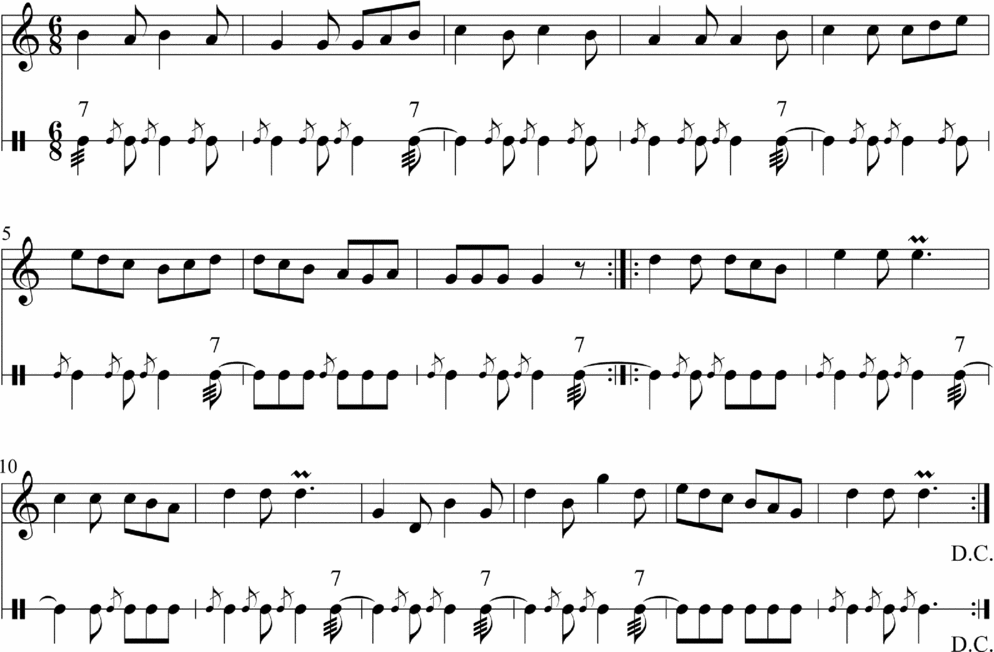
Unfortunately, no eighteenth-century French fife book has as yet been located, and so it is impossible to determine paternity for many of these tunes, including the many untitled quicksteps included in the manuscript. Brown's “French Quick March” can be used as an example of how melodies traveled from country to country, titles garbled and genres adapted to other uses. “L’Anglaise Française, Contre-Danse Française” was published in a Collection des Contre-Danses in France in 1775. It appears in Galoubet's 1790 manuscript as “L’Anglaise de la Reine.” Brown and others included it as the “French March,” “French Quick March,” or “Quick March,” and others included the melody under a number of titles, including “Cacina,” “The Cassano,” “The Cassino,” “Cotillion,” “Leighton Buzzard,” “Girls Take Care of Your Tow Row Row,” and “Big Bow Wough.” By the beginning of the nineteenth century it had taken on the name “Baltimore,” which is how it survives in the fifers’ repertoire today.Footnote 33 (See Example 2.)
“French Quick March.”Footnote 34
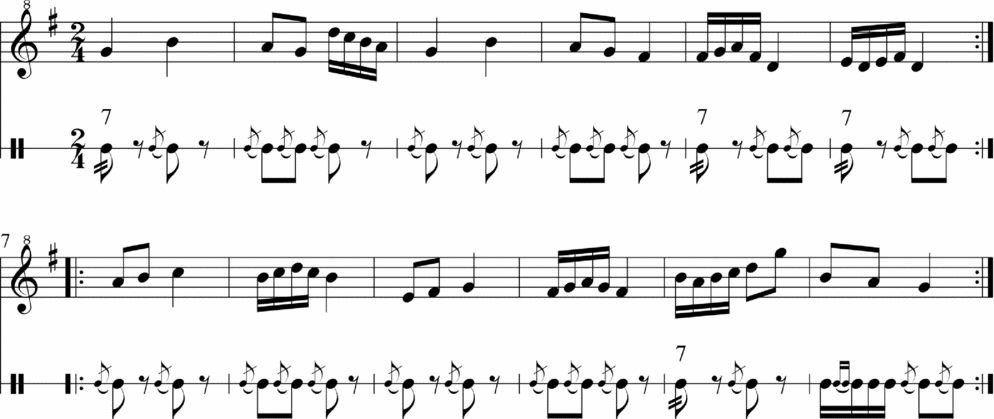
“The French King” first appears in the Brown manuscript, then four later eighteenth-century manuscripts. The same melody appears in other manuscripts under the title “The French Grenadiers,” and by the end of that century it had become the “General's Salute.” It is tempting to suppose that the colonials adopted this march, originally intended to honor the French king, as an honor to their general officers when reviewing the troops, but this is hard to prove without an original French source.Footnote 36 (See Example 3.)
“The French King.”Footnote 35
As mentioned, the fife manuscripts often contain many dances; it is not surprising therefore to find that manuscripts for flute, violin, and other non-military instruments often contain military marches. Whittier Perkin's collection of melodies for the violin, for example, contains that same “French Grenadier” among an assortment of primarily British tunes.Footnote 37 Another example is Brown's “The French Reviely.” It seems to have been the origin of the reveille sequence known as “The Hessian” in nineteenth-century U.S. fife books even into the Civil War. Did Brown misidentify his melody, or did the colonists make a misattribution?Footnote 38
An example of Hiwell's influence is a melody entitled “Lieut Hivel's Delight,” included in an anonymous manuscript that turns out to be a tune from Pierre-Alexandre Monsigny's very popular comic opera of 1769, Le Déserteur.Footnote 39 Charles Dibdin also used the tune in his 1773 adaptation The Deserter, but under the circumstances one may assume that Hiwell became familiar with the original through his contacts with the French musicians.
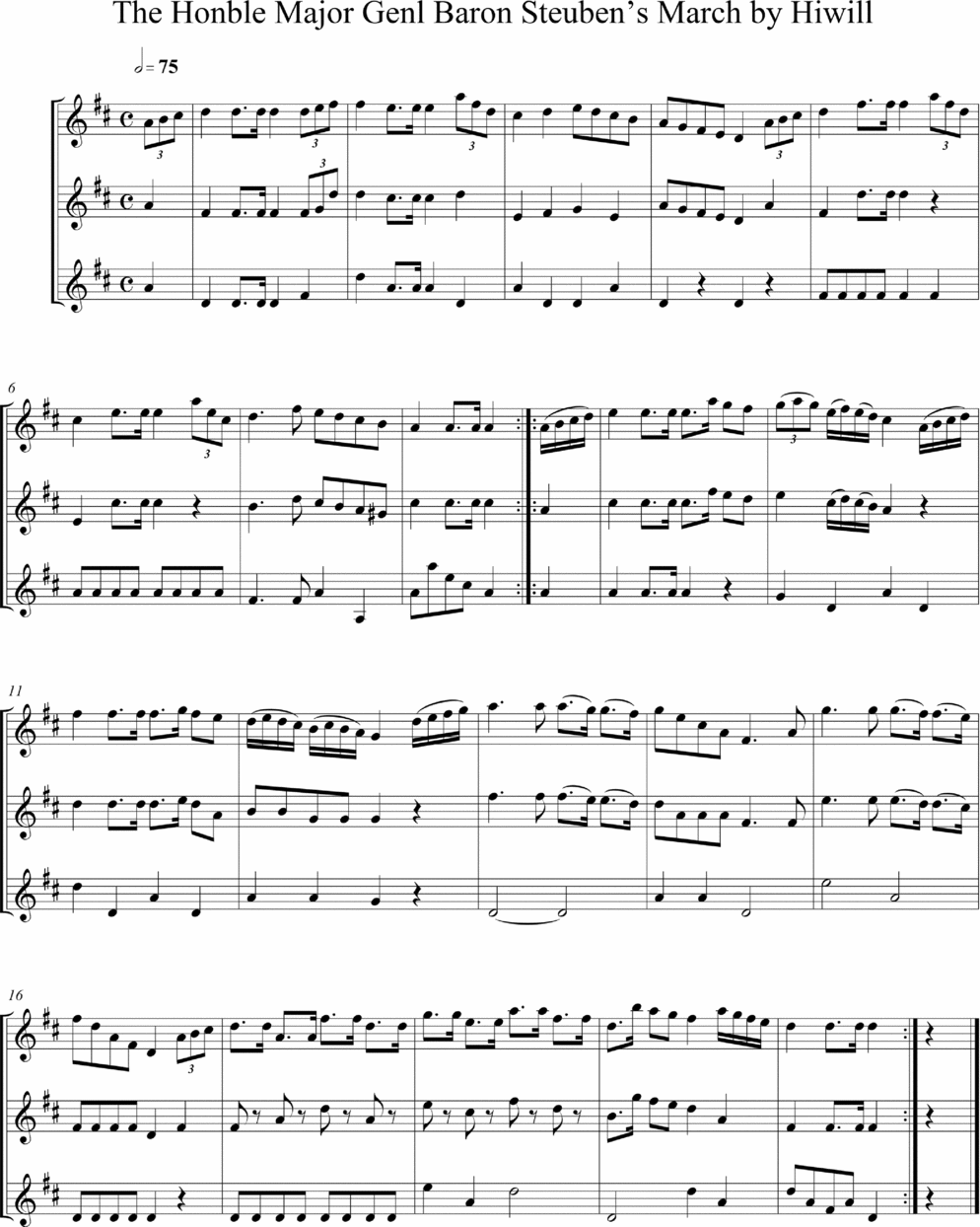
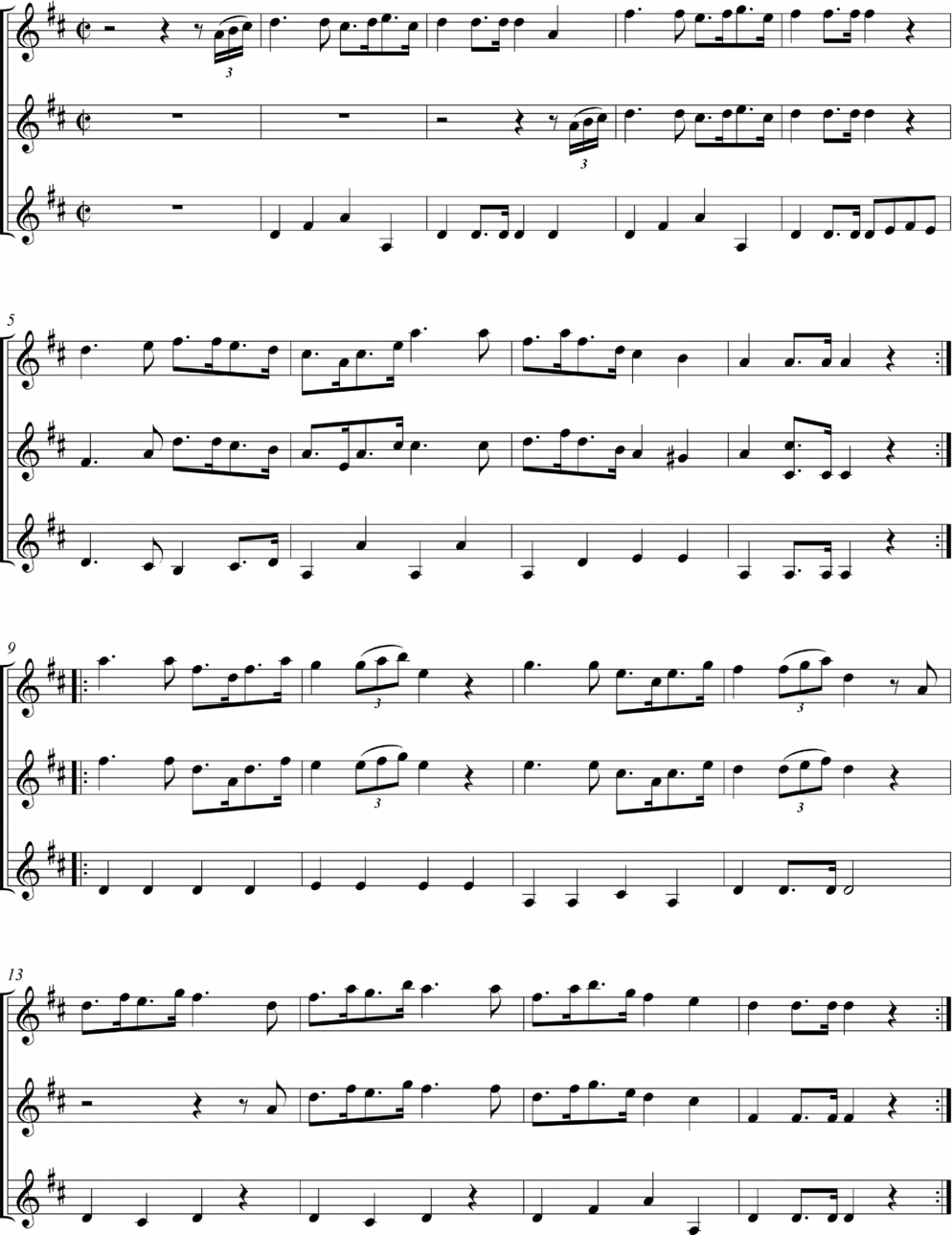
Hiwell is credited with “Trip to Pluckemin,” remembering the Continental Army's artillery cantonment during the winter of 1778–79,Footnote 40 and one of the marches in the Brown manuscript, but whether they were actually composed by Hiwell is open to question. Brown's march appears twice: once under the title “American March,” the second time as “The Honble Major Genl Baron Steuben's March.” In both instances the scoring is for three fifes, and it is most fitting that this exceptional march was named for Hiwell's superior, the Inspector General Baron von Steuben. (See Example 4.)
“The Honble Major Genl Baron Steubens March By Hiwill.”Footnote 41
Baron von Closen was present at the grand review of the Continental Army at King's Bridge mentioned above, and made the following comments in his journal:
The whole effect was rather good. Their arms were in good condition; some regiments had white cotton uniforms. Their clothing consisted of a coat, jacket, vest, and trousers of white cloth, buttoned from the bottom to the calves, like gaiters. Several battalions wore little black caps, with white plumes. Only General Washington's mounted guard and Sheldon's legion wore large caps with bearskin fastenings as crests. Three-quarters of the Rhode Island regiment consists of Negroes, and that regiment is the most neatly dressed, the best under arms, and the most precise in its maneuvers.Footnote 42
This description is quite different from his first impression quoted previously. Verger, a sous-lieutenant in the Royal Deux-Ponts Regiment, was also fascinated by the Rhode Island Regiment and included a drawing of a black light-infantryman in white uniform in his journal.Footnote 43 Could part of the favorable impression on both men have been caused by the music of this regiment? The tune was also known as “The Staffordshire March,” and appears in many manuscripts and printed editions even into the nineteenth century. Note the thirteen low A pitches in the third fife part, another indication of the skill of these fifers in being able to produce such a difficult low note on the small-bore simple-system fifes then in military use. Despite the physical hardships endured by the army musicians, it is not only possible but also indeed likely that the fifers played the melodies and harmonies that Fife Major Brown included in his manuscript. (See Example 5.)
“The Rhode Island Regiment's March.”Footnote 44
The Brown manuscript contains a number of intriguing puzzles that no doubt could fruitfully be further researched. One is the fascinating number of compositions that do not appear in the other contemporary manuscripts. Might some of these be French melodies? Another puzzle is the inclusion of “The Wourld Turnd Upside Down.” The EASMES Index includes more than 75,000 secular melodies, and yet this title appears only in this one source. Nor is it the melody that has usually been associated with that title so famous for the many legends that have sprung from the Yorktown surrender. Where did Brown find this melody, and why did he include it in his manuscript? A third enigma is the inclusion of “Gavet for Four Fifes.” Unfortunately, Brown has only three parts, all in treble clef: a “Hornpart,” which is not actually a horn part and does not have sufficient interest to be a melody; a second; and a bass part. Is it possible that Hiwell's musicians were able to play four-part harmony on the fifes?
In August 1781 Washington received word that Admiral Comte de Grasse, commanding thirty-six ships of the line and three regiments of infantry with their supporting auxiliaries, would be available to the combined forces until 15 October, when they would be required to return to the West Indies. As the defensive position around New York was very strongly entrenched and General Clinton's forces outnumbered them, Washington and Rochambeau determined to trap Lord Cornwallis and his army at Yorktown, Virginia. The combined French and Continental armies were immediately ordered to march southward to Baltimore and the Head of Elk where an improvised flotilla carried them down the Chesapeake to Williamsburg. Washington was afraid to leave Clinton and the New York area unguarded, and ordered Major General William Heath with the Connecticut and Massachusetts lines to secure West Point and the highlands. As a result, John Hiwell, Nathaniel Brown and their musicians were not present at the great victory. In the words of Milton, however, “they also serve who only stand and wait.” Brown's little manuscript proves conclusively that the Continental fifers and drummers were far more musically sophisticated than has heretofore been acknowledged.
AppendixFootnote 45
Published British Fife and Drum Tutors
1756 Rutherford Fife, 1756. The Compleat Tutor for the Fife. London: Davd [sic] Rutherford [ca. 1756]. British Library, e.318. Warner 91.
1760 Thompson Fife, 1760. The Compleat Tutor for the Fife. London: Thompson & Son [ca. 1760]. Research Library for the Performing Arts, New York Public Library. Warner 94.
1767 Bennett Fife, 1767. The Compleat Tutor for the Fife. London: Thos. Bennett [1767?]. British Library, e.318.a. Warner 112a.
1770 Longman Fife, 1770. Compleat Instructions for the Fife. London: Longman Lukey & Co. [ca. 1770]. Manchester Public Library, Manchester, England. Warner 116.
1770 Thompson Fife, 1770. The Compleat Tutor for the Fife. London: C. & S. Thompson [ca. 1770]. National Library of Scotland, Edinburgh, Scotland. Warner 117.
1780 Skillern Fife, 1780. Compleat Instructions for the Fife. London: T. Skillern [ca. 1780]. Library of Congress, MT356 C6 1780. Warner 136.
1780 Longman Fife, 1780. Entire New and Compleat Instructions for the Fife. London: Longman and Broderip [ca. 1780]. Library of Congress, MT356.C62 Case. Warner 140.
1780 Drum MS, 1780. “Drum Beating.” [England, ca. 1780] 43 lvs. Shaw-Hellier Collection 287, University of Birmingham. See entry for The Young Drummer's Assistant, below.
1780? Longman Drum, 1780. The Young Drummer's Assistant. London: Longman & Broderip [ca. 1780]. Pp.13. Birmingham University, Birmingham B15 2TT. Similarities in content, sequence and notation style suggest that this publication was available to the compiler of the Drum MS, 1780 above. However, there is no specific indication of when The Young Drummer's Assistant was published, save for the known activity of the publisher's partnership (1776–98). During this time Longman & Broderip were located at 26 Cheapside in London; however, in December 1782, they occupied a second location as well at No. 13 Haymarket. The omission of a Haymarket reference on the title page of The Young Drummer's Assistant indicates a publication of 1782 or earlier, a date that corresponds to the ca. 1780 date suggested by watermarked paper of Drum MS, 1780.
American Fife Manuscripts
1770 Campbell MS, 1770. Campbell, Jacob Archibald, compiler. Only outer leaf available; the cataloguer's title, “Slow marches and quick steps for the fife 1770–80” suggests that the copybook was once intact and contained more music entries. Rhode Island Historical Society, Providence, RI. Keller, p. 103.
1772 Hudson MS, 1772. Hudson, Samuel and Nicholas Cook. “Gamut for the Violin.” [Commonplace book containing fingering chart and tunes for the violin; also, about 18 tunes in second hand for fife. Johnston, RI, 1772.] M1.A1 T8 [2] Harris Collection, Brown University, Providence, RI. Keller, p. 99.
1775 White, O. MS, 1775. Oliver White, owner. “Behind the Bush.” [Commonplace book containing 27 airs and marches for fife. Connecticut: 1775?.] Was White MS, Massachusetts, 1785?; redated and relocated by Susan Cifaldi based on watermark and genealogical research. Collection of Gilbert Vincent.
1775 Williams MS, 1775. Williams, William, Compiler. “Ladys Brest Knot.” [Commonplace book of tunes for the fife plus unfinished fingering chart and instructions. Pawtuxet, RI, 1775.] WA863p [2]. Brown University, Providence, RI. Keller, p. 102. See comment under Remington 1778.
1776 Blake MS, 1776. Blake, Henry, compiler. “The Gamet Henry Blake his book.” [Commonplace book containing diary entries, tanner's notes, fingering chart, and fife tunes. New Hampshire, 1776.] American Antiquarian Society, Worcester, MA. Keller, p. 60.
1776 Morris MS, 1776. Morris, William. “William Morris First Regament Hunterdon 1777.” [Commonplace book of tunes for one and two fifes. Hunterdon County, NJ, 1776.] New York Historical Society, New York, NY.
1776 Nixon MS, 1776. Nixon, Thomas, Jun, owner [and Joseph Long?]. “Danbury September ye 25th 1778 Thomas Nixon Junior his Fife Book. 1778 Bought in New york in ye year 1776.” [Commonplace book containing fingering charts and tunes for the fife. Danbury, CT and New York, 1776–78.] Framingham Historical Society, Framingham, MA.
1777 Gibbs MS, 1777. Gibbs, Giles, Compiler. “Giles Gibbs Jr. His Book for the Fife.” [Commonplace book containing fingering chart and tunes for the fife.] East Windsor [Ellington Parish], CT, 1777. MS Stack, Connecticut Historical Society, Hartford, CT. Keller, p. 6.
1777 Joslen MS, 1777. Joslen, Abel, compiler. “Abel Joslen Book Made.” [Commonplace book containing two fingering charts for eight-holed instrument, one for seven-holed instrument and one for six-holed instrument, all incomplete, and a sketch of a two-masted ship.] 13 entries [for the fife?]. Recent research indicates the compiler may be Abel Joslen, b. 15 May 1772 in Tyringham, MA. The “Abel Joslen / of Thompson, CT” on the first leaf is a later inscription. Music Book, Old Sturbridge Village, Sturbridge, MA. Keller, p. 59.
1777 Thompson MS, 1777. Thompson, Aaron, Compiler [Fifer, 3rd New Jersey Regiment]. “A Table of Time.” [Commonplace book containing instructions and tunes for the fife plus journal entries, song-texts, mathematical accounts, and penmanship exercises. New Jersey, 1777–82.] Manuscripts and Archives Misc. Mss. 72, Sterling Memorial Library, Yale University, New Haven, CT. Keller, p. 21.
1778 Remington MS, 1778. Remington, Thomas, compiler? “Hiwell Taptoe for Lords Day Evening.” [Unbound signature containing tunes for the fife. Warwick, RI, ca. 1778.] Harris Collection, John Hay Library, Brown University, Providence, RI. p76 Wa863p 3. May be a continuation of the 1775 Williams MS, as the stitching, orientation and trimming of the signature matches those bound in the Williams MS, and it is likely that one hand penned entries in both manuscripts. Keller, p. 101.
1779 Bush, George, compiler. “A New Collection of Songs. . . From. . . The Songster's Compan[ion]” 1779–89. 92 leaves. [Bush appears to have copied fife tunes from the now unlocated 1776 Philadelphia fife tutor, later reprinted by George Willig.] The Historical Society of Delaware, Sunbury and Lancaster, PA; Wilmington, DE.
1779 Treat MS, 1779. [Treat, John?] “Gamut for the Fifes.” [Commonplace book containing gamut for the fifes followed by 70 tunes; second section entitled “Music for the German Flute” including 11 pages of instructions followed by 51 tunes. Binding papers from The Compleat Pocket Songbook, Eliphet Mason (Northampton, MA: 1802). 1779–1802?.] Wolfe #5633. Center for Popular Music/Middle Tennessee State University, Murfreesboro, TN.
1780 Swetland MS, 1780. Swetland, Benjamin, compiler. West Point, NY, 1781. [Orderly book containing military orders with at least two tunes for two fifes, one song-text, and diary entries, 1780.] Unlocated; supposedly given to the Chicago Historical Society. Facsimile pages in Mary P. Root, Patriot's Daughters (New Haven: CT Chapters, Daughters of the American Revolution, 1904). See Keller, p. 120.
1781 Brown, N. MS, 1781. Brown, Nathaniel, compiler. “Nathl Brown Fife Major of the fourth Connt Regt His Book Drawn Septr 24h 1781.” [Commonplace book containing tunes for one, two, and three fifes. New York, 1781.] Box 5, Folder G. New Haven Museum, New Haven, CT. Keller, p. 15.
1785 Greenwood MS, 1785. Greenwood, John, owner. “John Greenwood, Fife Major in the Army of the United States.” [Massachusetts?, 1785?]. New York Historical Society, Manuscripts, Mus. Isaac J. Greenwood, grandson of the John Greenwood who once owned this manuscript, surmised in The Revolutionary Services of John Greenwood (New York, 1926, republished as A Young Patriot in the American Revolution, Westvaco, 1981) that this document might represent a book of fife tunes given his ancestor “by an English fifer,” possibly “a memento of the battle of Trenton” (26 December 1776). This is unlikely, as there were no English (or British) troops present at Trenton, only Hessian mercenaries. Furthermore, there is no internal evidence to suggest a military provenance—there are no camp duties, no martial titles, and no military-oriented marginalia. Rather, the seven marches entered in the manuscript are amidst a preponderance of dance and song airs, including fourteen titled minuets. This would suggest that this collection represents the genteel social interests of the mid-1780s rather than the functional duties of a military fifer during the Revolution.
1788 Gardner MS, 1788. Gardner, Benj’n, compiler. “Benj’n Gardner's Book, 1788.” Marblehead, MA, 1788. Early Music Collection, Box 1, Item 8-A, Essex Institute, Salem, MA. Keller p. 54.
1790 Mass. MS, 1790. “Stony Point.” [Commonplace book containing 72 airs, marches and dance melodies. Massachusetts, 179?.] M63.F5 No. 1 Case, Music Division, Library of Congress, Washington, D.C. Keller, p. 32.
179? Belknap MS, 1784. Belknap, Elisha, compiler. [Commonplace book containing 82 airs, marches and dance melodies for violin and fife. Framingham, MA; redated to 179?.] MS MUS 124, Houghton Library, Harvard University, Cambridge, MA. Keller, p. 48.
1797 Commonplace MS, 1797. “The American Volunteer.” [Commonplace book containing 79 airs and dance and camp-duty melodies for the fife, including 7 in 2 parts, and 12 songs.] Music MA 638.2 Harris Collection, John Hay Library, Brown University, Providence, RI. Keller p. 96.
1798 Dance Tunes MS, 1798. “Dance Tunes and Marches.” [Commonplace book, Rhode Island?, ca. 1798.] M1450 D3 Vault, John Hay Library, Brown University, Providence, RI. Keller, p. 97.
1799 Boynton MS, 1799. “Eli Boynton's Property” [Commonplace book with music for one or two fifes.] Private collection.
1800 Clarke MS, 1800. Clarke, Penuel, compiler. [Commonplace book containing 19 marches for the fife.] Windsor, Connecticut [18?], Windsor Historical Society, Windsor, CT. Keller, p. 22.
1801 Clark, I. MS, 1801. Clark, Ira Jr, compiler. “Ira Clark Jr. his Book.” [Connecticut, ca. 1801 by Susan Cifaldi based on watermark.] Spec. Coll. JOD 72–14 Research Library for the Performing Arts, New York Public Library, New York. Keller, p. 77.
1801 Shattuck MS 1801. Shattuck, Abel, compiler. [Commonplace book containing 288 airs, marches and camp duty and dance melodies. 180?.] M63.S5 Case, Music Division, Library of Congress, Washington, D.C. Keller, p. 32.
1801 Trumbull MS, 1801. Trumbull, Gurdon, compiler. [Copybook containing 26 marches and dance melodies. Leaves laid into book contain 52 additional melodies, chiefly marches.] Stonington, Connecticut [180?]. Watkinson Library, Trinity College, Hartford, CT. Keller, p. 11.
1807 Johnson MS, 1807. Johnson, Seth, owner. “Woburn, Fife Book.” [Massachusetts, 1807–40]. Commonplace book of 145 tunes for the fife. Pp. 77. Middle Tennessee State University, Murfreesboro, TN.
1807 Stiles MS, 1807. Stiles, John W., owner. [Commonplace book containing 64 marches in 1, 2 and 3 treble parts.] 1807. Old Gaol Museum, York, ME. Keller, p. 36.
1816 Gaylord MS, 1816. Gaylord, Major John, Jr. [Copybook containing 155 dance, march and camp duty melodies. Connecticut, ca. 1816.] Allen MSS Music Books, Watkinson Library, Trinity College, Hartford, CT. Keller, p. 10.
1817 Hooves MS, 1817. Hooves, Joseph, owner. “David Melvenz Fife Book.” New Ipswich, MA, 1817. 27 lvs. Dedham Historical Society, Dedham, MA.
1820 Van Schaack MS, 1820. Van Schaack, P, Jr, compiler. “Music Book.” Kinderhook, NY, 1820. 66 pp. Old Sturbridge Village Library, Sturbridge, MA, 1965.35BV.
Published American Fife Tutors
1776 Hillegas Fife, 1776. A Compleate Tutor for the Fife. Philadelphia: Hall & Sellers. Unlocated. Advertised for sale in the Philadelphia Gazette, July 3, 1776 “just published and for sale by Michael Hillegas.” Warner 131.
1803 Hulbert, James Jun. A Variety of Marches. Northampton, 1803. MWA.SS 4410. SS 8226, Warner 269, Wolfe 4390.
1805 Willig Fife, 1805. The Compleat Tutor for the Fife. Philadelphia: George Willig [ca. 1805]. Warner 273, Wolfe 9425.
1805 Fifer's Comp, 1805. The Fifer's Companion. No 1. Salem, MA: Joshua Cushing [1805]. SS 50536, Warner 275, Wolfe 2790.
1807 Hulbert Fife, 1807. Hulbert, James Jun. The Complete Fifer's Museum. Northampton, MA: Simeon Butler [1807]. SS 12793, Warner 290, Wolfe 4387.
1808 Village Fifer, 1808. The Village Fifer. Exeter, NH: Norris & Sawyer, 1808. SS 16635, Warner 295, Wolfe 9491.
1810 Hazeltine D&F, 1810. Hazeltine, David. Instructor in Martial Music. Exeter, NH: C. Norris [1810?]. SS 51012, Wolfe 3575.
1811 Hulbert Fife, 1811. Hulbert, James. The Complete Fifer's Museum. Greenfield, MA: Ansel Phelps [1811?]. Wolfe 4389.
1812 Narramore Fife, 1812. Narramore, William W. and A. Jewett. The Fifer's Assistant. MA, 1812. Warner 328, Wolfe 6456. Unlocated.
1812 Robbins D&F, 1812. Robbins, Charles. The Drum and Fife Instructor. Exeter, NH: C. Norris and Co, 1812. Wolfe 7506.
1815 Porter D&F, 1815. Porter, Rufus. The Martial Musician's Companion. ME, 1815. Wolfe 7201. Unlocated.
1815 Steele Fife, 1815. The New and Complete Preceptor for the Fife. Albany, NY: Daniel Steele [ca. 1815]. SS 2398–99, Warner 338, Wolfe 7211.
1817 Rumrille D&F, 1817. Rumrille, J. L. and H. Holton. The Drummer's Instructor. Albany, NY: Packard & Van Benthuysen, 1817. Wolfe 7694.
1818 Robinson Coll, 1818. Robinson, Alvan, Jun. Massachusetts Collection of Martial Musick. Hallowell, ME: E. Goodale, 1818. SS 51829, Warner 360, Wolfe 7520.
1819 Williams Fife, 1819. A New and Complete Preceptor for the Fiff. Rev. ed. Utica, NY: William Williams, 1819. Warner 363, Wolfe 7212.
1820 Blake Fife, 1820. Fife Instructor [Philadelphia: G. E. Blake, ca. 1820]. Warner 368, Wolfe 852. Unlocated.
1820 Robinson Coll, 1820. Robinson, Alvan, Jun. Massachusetts Collection of Martial Musick. 2nd ed. Exeter, NH: J. J. Williams, 1820. Warner 360, Wolfe 7521.
1826 Robinson Coll, 1826. Robinson, Alvan, Jun. Massachusetts Collection of Martial Musick. 3rd ed. Hallowell, ME: Glazier, 1826. Warner 360.
1826 Williams Fife, 1826. A New and Complete Preceptor for the Fife. Rev. ed. Utica, NY: William Williams, 1826. Warner 363.
1826 Willig Fife, 1826. A New and Complete Preceptor for the Fife with a choice Collection of Marches, Airs &c. Baltimore: Geo. Willig [182-].
1830 Glazier Fife, 1830. Fife Instructer. Hallowell, ME: Glazier, Masters & Smith [ca. 1830]. Warner 435.
American Drum Tutors & Manuscripts
1776 Drummer's Book of Music, 1776. See: Lovering MS, 1792.
1792 Lovering Ms, 1792. Lovering, Levi, compiler. “The Rule of the First Roll or Gamut for the Drum” [Commonplace book containing instructions, rudiments, camp duties, and 21 beatings for the drum in musical notation. Athol, MA: ca. 1792–1805.] Massachusetts Historical Society, MS Collection: “Drummer's Book of Music, 1776.” [Attribution and dating by Susan Cifaldi; old short title: “Gardner Drum MS, 1787.”]
1797 Clark Drum MS, 1797. Clark, Benjamin, compiler. “Benjamin Clark's Drum Book, 1797.” Massachusetts, 1797. MS Collection, Massachusetts Historical Society, Boston, MA.
1797 Day Drum MS, 1797. Day, Isaac, compiler. “Isaac Day 1st Book.” Chesterfield, NH, ca. 1797–1808. Privately owned [Bob Wood, Middle Tennessee State University].
1819 Lovering Drum, 1819. Lovering, Levi. The Drummer's Assistant. Philadelphia: Bacon & co [1819?]. Wolfe 5466. J. G. Klemm (1823–24) edition identical in content. Wolfe 5466A.