Introduction
Delirium is a neuropsychiatric syndrome that has been widely studied over time. Its clinical features are grouped into three domains (cognitive, circadian, and higher thinking), in addition to its acute and fluctuating course (Barnes et al., Reference Barnes, Kite and Kumar2010). Although the etiology is multicausal in most cases, the main risk factors for developing delirium are age, immobility (either due to motor deficit secondary to underlying disease or due to medical indication), uncorrected sensory deficit, and the presence of infection (Bush et al., Reference Bush, Lawlor and Ryan2018).
It has been reported in the literature that delirium occurs in 18–90% of patients at the end of life (Inouye, Reference Inouye2006). In fact, it constitutes one of the main symptoms for which palliative sedation is decided in terminally ill cancer patients (Webber et al., Reference Webber, Watt and Bush2021). The methods used for the classification of the subtypes also influence the variability of the reported data; the hypoactive subtype is the most common in this population group; however, it is commonly underdiagnosed by health-care personnel (Inouye, Reference Inouye2006; de la Cruz et al., Reference de la Cruz, Fan and Yennu2015; Uchida et al., Reference Uchida, Okuyama and Ito2015).
Risk factors associated with delirium have been classified as precipitating and predisposing. However, most oncological studies have focused on psychiatric comorbidities, rather than identifying specific sociodemographic or disease-associated predictors of delirium (Inouye et al., Reference Inouye, Westendorp and Saczynski2014).
With regard to the cardiovascular population, there is limited literature available, and existing studies have limitations such as small sample sizes, mixed medical–surgical populations, and retrospective designs. For example, there is still no consensus on the prevalence and incidence of delirium and its course, and importance in patients attended to cardiac care units (Grotti and Falsini, Reference Grotti and Falsini2017; Falsini et al., Reference Falsini, Grotti and Porto2018).
In a recent retrospective analysis, Pauley et al. (Reference Pauley, Lishmanov and Schumann2015) found a correlation between the prevalence of delirium (in the cardiovascular population) and the low survival rate and higher resource consumption, identifying delirium as an independent predictor of short- and long-term mortality (Lahariya et al., Reference Lahariya, Grover and Bagga2014; Pauley et al., Reference Pauley, Lishmanov and Schumann2015). As for the clinical subtype, it is known that the hypoactive pattern is associated with a worse hospital outcome (Hshieh et al., Reference Hshieh, Inouye and Oh2020).
Delirium is a multifactorial entity, and two of the most frequently associated comorbidities are cardiovascular and oncological diseases (Nydahl et al., Reference Nydahl, Baumgarte and Berg2022). It is possible to compare them to determine differences in the presentation and type of delirium as this a valid research question to develop. In addition, etiologies are sometimes mixed with risk factors and predisposing factors, which may hinder its management; if we could evaluate and find differences in the presentation of delirium according to the cause or underlying disease that brings the patient to the hospital, it would make the treatment of delirium more targeted and probably improve the response to it (Falsini et al., Reference Falsini, Grotti and Porto2018).
To date, there are no known studies that compare both populations, establishing differences in associated factors, clinical presentation, and the severity of the syndrome. Therefore, the aim of the present study is to determine and compare the clinical characteristics and factors associated with the diagnosis of delirium in patients with the cardiovascular disease and those with an oncologic disease.
Methodology
Study design and participants
A quantitative, cross-sectional, analytical study was performed. A total of 1,986 consecutive patients were evaluated, and of them, 205 were eligible and only 110 met the inclusion criteria, seen at an oncological palliative care unit (OPCU) and a cardiology care unit (CCU) of a high-level institution in Colombia entered the study, between September 2017 and December 2018 (CCU: 61, OPCU: 49).
Inclusion criteria were patients over 18 years of age with a diagnosis of cardiovascular or oncologic disease, with a hospital stay of more than 24 h, and who presented delirium during the first 72 h of hospitalization, according to the criteria of the Diagnostic and Statistical Manual of Mental Disorders, fifth edition (DSM-V). Patients with difficulties in oral communication (mutism, aphasia, and language other than Spanish) and those who had received general anesthesia 72 h prior to the study admission evaluation were excluded.
The project was approved by the health research ethics committees of the Universidad Pontificia Bolivariana, the Clínica Las Américas AUNA, and the Instituto de Cancerología Clínica las Américas AUNA. Eligible patients had a diagnosis of delirium, so their informal family and nonfamily caregivers were asked to sign the informed consent to participate.
Instruments
For the clinical assessment, all available sources of information were considered (patient, companion, current and previous medical history, and care staff) and the following instruments were filled:
• Assessment for obtaining sociodemographic information (sex, age, educational level, institutionalization, and permanent companion) and clinical information of the patient (admission diagnosis, active secondary diagnosis, severity of delirium, motor presentation of delirium, presence of comorbidity, patient's functionality, clinical prognosis, associated dementia, use of anticholinergics, antipsychotics, opioids, benzodiazepines, steroids, antibiotics, and bladder catheter, clinical diagnosis of malnutrition, pain, dyspnea, and immobility in the last 72 h, constipation, history of delirium, auditory or visual sensory deficit, among others).
• The delirium severity scale (DRS-R98): It is an instrument that allows diagnosis and follow-up and quantifies the severity of patients with delirium. It evaluates the symptoms of the disorder. It is composed of 16 items that make up two subscales; the first one contains 13 severity items that can be grouped to represent the characteristics of delirium, and the second one, three diagnostic items. The maximum score is 46. The scale was validated in Colombia by Franco et al. (Reference Franco, Mejía and Ochoa2007).
• Delirium Etiology Checklist (DEC): It is a checklist that accounts for the various etiologic factors precipitating delirium, and it allows for a weighted assessment of etiologies grouped in 13 categories (substance intoxication, substance withdrawal, metabolic–endocrine disturbance, craniocerebral trauma, seizures, intracranial infection, systemic infection, intracranial neoplasm, systemic neoplasm, cerebrovascular disease, organ failure or insufficiency, other CNS disorders, and other disorders) and also allows to estimate the causal relationship of each category with delirium (definite, probable, or possible causal association) (Franco et al., Reference Franco, Mejía and Ochoa2007).
• The Karnofsky index: It is an index of patient functionality widely used in the general evaluation of the cancer patient. Its score ranges from 100 to 0, where 100 is “perfect” and 0 is “deceased”. A score of 50 or lower indicates a high risk of death during the next 6 months (Schag et al., Reference Schag, Heinrich and Ganz1984).
• Charlson comorbidity index, abbreviated version: This is the most studied index for assessing comorbidity (cerebral vascular disease, diabetes, chronic obstructive pulmonary disease, heart failure/ischemic heart disease, dementia, peripheral arterial disease, severe chronic renal failure or dialysis, and cancer). The abbreviated version was used, which correlates significantly with mortality, disability, readmissions, and hospitalization. No comorbidity is considered to be between zero and one point, low comorbidity is when the index is two, and there is high comorbidity when it is equal to or more than three points (Marchena-Gomez et al., Reference Marchena-Gomez, Acosta-Merida and Hemmersbach-Miller2009).
Procedure
All patients hospitalized and labeled for pain and palliative care and clinical cardiology at Clínica las Américas AUNA (Medellin, Colombia) were evaluated during the first 72 h of admission. Patients were included if, after the evaluation, they were diagnosed with delirium according to DSM-5 criteria, met the inclusion criteria, and had no exclusion criteria, and whose nonfamily caregivers had given informed consent. The delirium severity was assesed with de delirium severity scale (DRS-R98) administered only performed on patients who met the inclusion criteria, and that they had delirium.
The patients included were assessed by two physicians from the research group, previously trained in the completion and application of the evaluation forms. The investigators had access to all available sources to collect sociodemographic and clinical data, such as the review of medical records and the interrogation of family members and/or health-care personnel (this same method was used to collect data). The investigators had access to all available sources to collect sociodemographic and clinical data, such as the review of medical records and the interrogation of family members and/or health-care personnel (this same method was used to collect data). In addition to the questionnaire created for data collection, the assessment instruments described above were completed once the patients had a diagnosis of delirium.
The relatives of the patients were the ones who gave consent for participation in the study because the patient was in delirium.
Prior to the start of data collection, a pilot test was conducted in 10 patients to standardize the process of applying the instruments and identify possible problems in the execution of the study, which allowed the necessary corrective measures to be implemented.
Statistical analysis
Statistical analysis was performed using the Statistical Package for the Social Sciences (SPSS version 22). Descriptive and comparative statistical analyses were performed after verifying the normality of the continuous variables using the Kolmogorov–Smirnov test. Since there was no statistical normality in the variables, medians and interquartile ranges (IQRs) were reported. Discrete variables were presented as frequencies and percentages. Bivariate comparisons between patients admitted to the CCU and those admitted to the OPCU were performed using the χ 2 or Fisher's exact test (discrete and dichotomous variables) and the Mann–Whitney U test.
A descriptive analysis was conducted to determine the sociodemographic characteristics of the population, and subsequently, a bivariate analysis was carried out to determine the variables associated with the onset of delirium.
Results
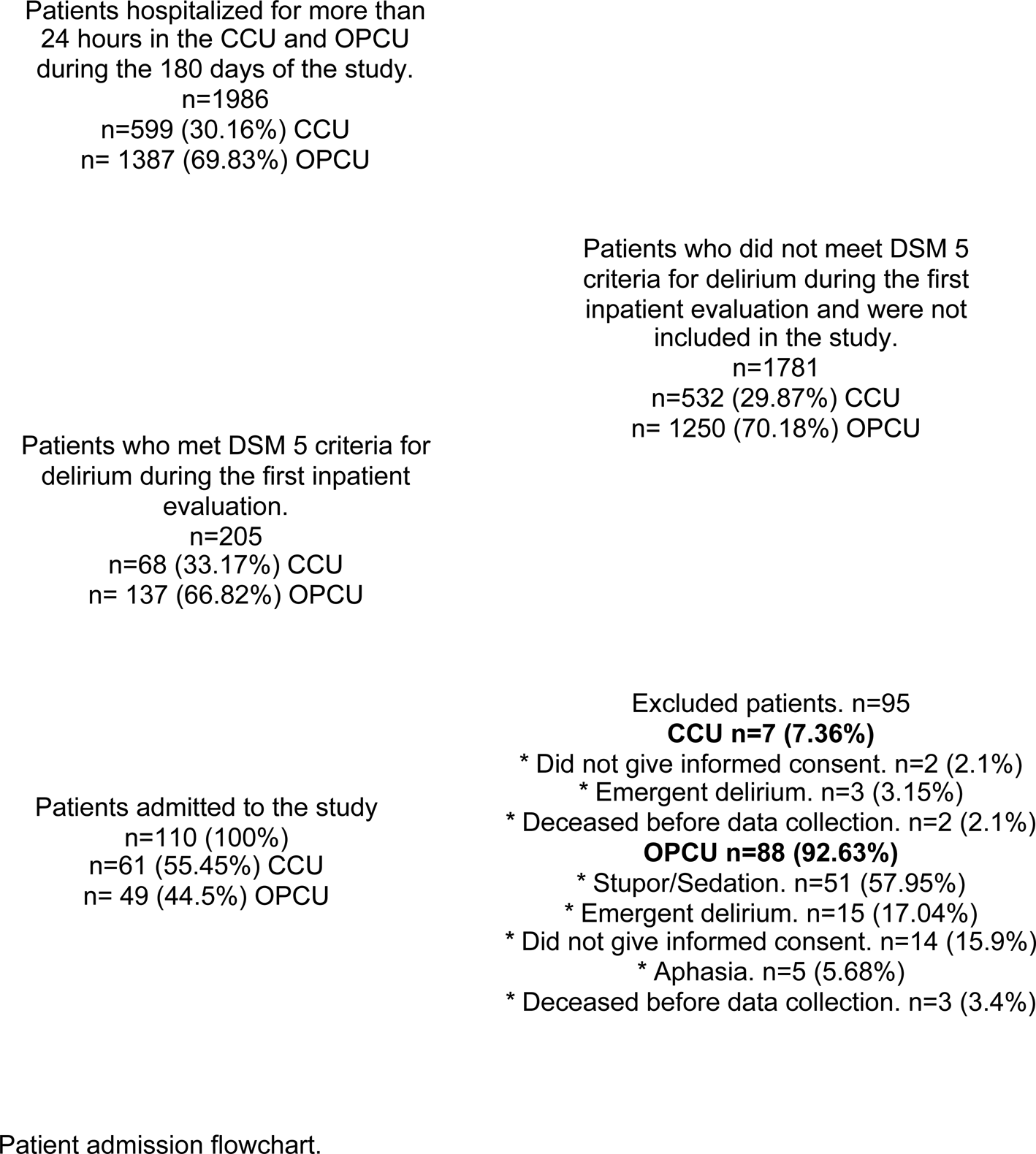
A total of 1,986 patients were evaluated, of whom 599 belonged to the CCU and 1,387 belonged to the OPCU; 205 met the criteria for delirium and 110 were included in the study. The prevalence of delirium was 11.35% in the CCU and 9.87% in the OPCU. The main cause of exclusion in the CCU was emergent delirium, and in the OPCU, it was sedation or an altered state of consciousness such as stupor. The reasons for exclusion and the number of patients in each phase are detailed in Figure 1.
Patient admission flowchart.

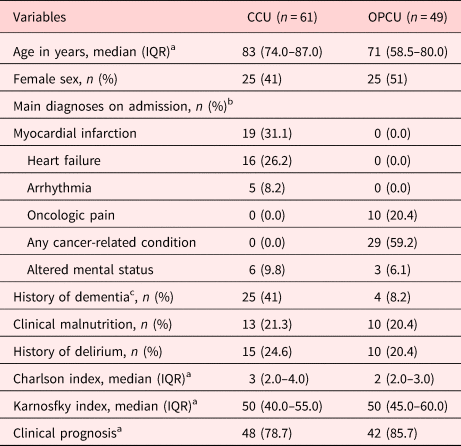
Forty-one percent of CCU patients were female compared to 51% of OPCU patients, and the former was significantly older in age (83 vs. 71, p = 0.03). The main admitting diagnosis for CCU patients was heart failure, while for the OPCU group, it was cancer-related conditions. It was also found that CCU patients had a higher comorbidity index and more personal history of major neurocognitive disorder of dementia type than their OPCU counterparts, while OPCU patients had a life prognosis of less than 6 months, with these differences being statistically significant. With regard to main diagnoses, no comparisons were made because different comorbidities were found between patients belonging to the CCU and the OPCU. No differences were found between the groups with respect to the degree of malnutrition and history of delirium (Table 1).
Sociodemographic and clinical characteristics of patients with delirium admitted to a CCU or a OPCU

CCU, clinical cardiology unit; OPCU, oncology palliative care unit; IQR, interquartile ranges; NA, not applicable.
a p = 0.03 for all Mann–Whitney U tests.
b No comparisons are made for these variables, except for altered mental status, which showed no difference between groups.
c p < 0.001 for χ 2.
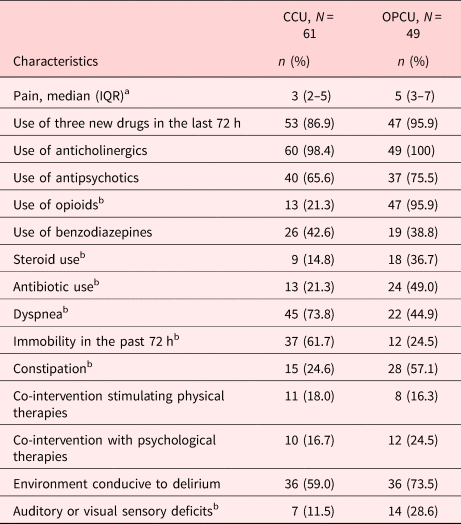
With regard to hospitalization-related characteristics, statistically significant differences were found in the use of steroids, antibiotics, and opioids, with the use of these drugs being higher in the OPCU group. Patients admitted to the OPCU unit had significantly more pain, constipation in the last 72 h of hospitalization, and auditory or visual sensory deficits, while CCU patients had more dyspnea and immobility. There were no differences in terms of physical and psychological interventions or in terms of an environment conducive to delirium (Table 2).
Hospitalization-related characteristics of patients with delirium admitted to a CCU or a OPCU

CCU, clinical cardiology unit; OPCU, oncologic palliative care unit; IQR, interquartile ranges.
a p = 0.001 for the Mann–Whitney U test.
b p < 0.05 for the χ 2 test.
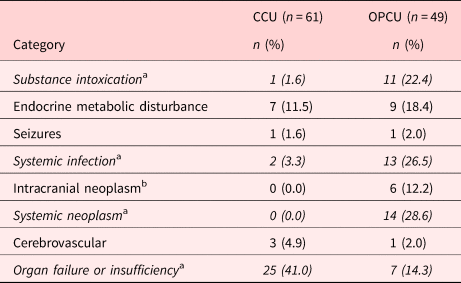
When comparing definite and probable etiologies as measured by the DEC, the results indicate that substance intoxication, infection, and systemic and intracranial neoplasms occurred in a higher proportion of the OPCU patients, while organ failure or failure was more frequently found in CCU patients, with the differences being statistically significant (Table 3).
Definite/probable etiologies of delirium in patients admitted to a CCU or OPCU

CCU, clinical cardiology unit; OPCU, oncologic palliative care unit.
a p < 0.005 for the χ 2 test.
b p = 0.007 for Fisher's exact test.
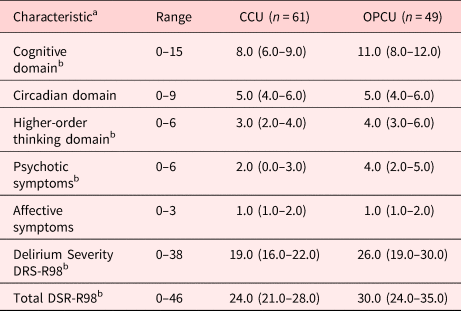
With regard to the clinical characteristics of delirium in both groups of patients, it was found that all three domains had high medians, with the cognitive and higher-order thinking domains scoring significantly higher in the OPCU group. Affective accessory symptoms had low and similar medians in both groups, while affective symptoms were significantly higher in the OPCU group. Delirium severity was also significantly higher in this group (Table 4).
Comparison of clinical characteristics of delirium measured with the DRS-R98 in patients with delirium admitted to a CCU or a OPCU

CCU, clinical cardiology unit; OPCU, oncology palliative care unit; DSR-R98, Delirium Rating Scale-Revised-98.
a Medians are reported with interquartile ranges in parentheses.
b p ≤ 0.001 for the Mann–Whitney U test.
Discussion
The present study aims to compare the clinical characteristics of delirium in patients with cardiovascular and oncologic diseases (Naghavi et al., Reference Naghavi, Abajobir and Abbafati2016).
Although there are studies related to the diagnosis of delirium in patients with cardiovascular comorbidities, most of them have focused on the behavior of this syndrome in patients in Critical Care Units, Coronary Intensive Care Units, and postoperative cardiovascular surgery, respectively (Pendlebury et al., Reference Pendlebury, Lovett and Smith2015; Restrepo et al., Reference Restrepo, Duque and Montoya2018). Studies on delirium in patients with oncologic disease have focused on its recognition and treatment, rather than on its sociodemographic and clinical characterization (Douglas and Smeeth, Reference Douglas and Smeeth2008; Bush et al., Reference Bush, Leonard and Agar2014; Bush et al., Reference Bush, Tierney and Lawlor2017).
The overall prevalence of delirium found in this study was 10.32%, which is in line with what is reported in the literature in general hospitalization services (Bush et al., Reference Bush, Lawlor and Ryan2018); likewise, the prevalence found in each unit was 11.35% in the CCU and 9.87% in the OPCU, respectively, findings similar to those reported so far in the literature. For example, the prevalence of delirium in the CCU ranges from 6.3% 9 to 18.7% (Lahariya et al., Reference Lahariya, Grover and Bagga2014) although there is no consensus on the prevalence and incidence of delirium in this population (Pauley et al., Reference Pauley, Lishmanov and Schumann2015; Grotti and Falsini, Reference Grotti and Falsini2017), while the prevalence in the OPCU is between 8.5% and 42.3% (Inouye, Reference Inouye2006; Bush et al., Reference Bush, Lawlor and Ryan2018). It is important to note that, despite using the same diagnostic criteria, the prevalence of delirium in the CCU was higher than in the OPCU, which is associated with the presence of predisposing factors to the onset of delirium, such as age and immobility, aspects that are probably associated with a decrease of physiological and metabolic brain defense mechanisms, favoring cholinergic imbalance at the central nervous system (CNS) level and inflammation (Bush et al., Reference Bush, Tierney and Lawlor2017).
In the present study, advanced age was found to be a common variable in both populations, highlighting a significantly higher median age (12 years older) in patients belonging to the CCU group. On the contrary, in terms of life prognosis, this was lower in the OPCU group. This trend could be due to advances in the management of chronic diseases, specifically cardiovascular pathologies, percutaneous cardiac intervention, and aortic-coronary bypass surgery, which have had a positive impact on the life expectancy of this population group (Morita et al., Reference Morita, Tei and Tsunoda2001; Mishra, Reference Mishra2016), compared with a palliative oncology population that, possibly due to the underlying disease by itself and its palliative condition, showed a lower life prognosis.
Other risk factors associated with delirium have been extensively studied, including the presence of brain metastases, which have been clearly identified as a predisposing and triggering factor (Lawlor and Bush, Reference Lawlor and Bush2015; Şenel et al., Reference Şenel, Uysal and Oguz2017); however, the sociodemographic characteristics associated with specific comorbidities are less well known. With regard to the relevant sociodemographic and clinical characteristics found, we note the high percentage (41%) of a history of major neurocognitive disorder of the dementia type in patients with delirium in the CCU, compared with 8.2% in the OPCU; data similar to those reported by Sato et al. (Reference Sato, Kubota and Oda2017), who developed delirium in general Intensive Care Units and Coronary Intensive Care Units, indicating that delirium is strongly associated with a dementia-like major neurocognitive disorder, a history of cardiovascular pathology, and elevated organ dysfunction scores, in addition to reports of increased mortality and hospital stay (Sato et al., Reference Sato, Kubota and Oda2017).
In addition, an association was identified between delirium in OPCU patients and pharmacological treatments with steroids, antibiotics, and opioids. The use of steroids (Lawlor et al., Reference Lawlor, Gagnon and Mancini2000; Gaudreau et al., Reference Gaudreau, Gagnon and Harel2005), antibiotics (Tomé and Filipe, Reference Tomé and Filipe2011; Caraceni, Reference Caraceni2013; Lawlor and Bush, Reference Lawlor and Bush2015), and opioids (Lawlor et al., Reference Lawlor, Gagnon and Mancini2000; Lawlor, Reference Lawlor2002) is widely known as a risk factor for the development of delirium (Matsuoka et al., Reference Matsuoka, Yoshiuchi and Koyama2015), and the findings of our study support this association, more specifically with opioids. Opioids are essential drugs in the analgesic management of cancer patients, given that pain (Morrison et al., Reference Morrison, Magaziner and Gilbert2003; Lawlor and Bush, Reference Lawlor and Bush2015) is one of the most common symptoms in patients in oncological palliative care. The literature reports that in up to 64% of patients with terminal disease, 59% of those receiving antineoplastic treatment and 33% of patients in remission of their oncologic disease (Van Den Beuken-Van et al., Reference Van Den Beuken-Van, Hochstenbach and Joosten2016) report pain. Delgado-Guay et al. (Reference Delgado-Guay, Ferrer and Ochoa2018) compared the outcomes of oncology patients with advanced disease receiving palliative care in public hospitals vs. comprehensive centers for cancer management and research, finding that pain was one of the main symptoms, followed by fatigue, nausea, and vomiting . The results of this study are consistent with those mentioned above, since when characterizing the variables related to hospitalization, it was found that the group of patients in the OPCU presented a higher subjective assessment of pain compared to patients in the CCU.
Among the results obtained, the characterization of symptoms and severity of delirium is highlighted. The classification of delirium is classically done in three motor subtypes: hyperactive, hypoactive, and mixed. However, the application of DRS-R98 allows a better clinical characterization through an evaluation of symptoms in three core domains: cognitive (attention, orientation, and visuospatial ability and memory), circadian (sleep-wake cycle and motor behavior), and higher-order thinking (course of thought and language) (Gaviria, Reference Gaviria2016). Both the OPCU and CCU groups obtained high medians in the three domains, which indicates that for a correct evaluation of delirium, the three aforementioned domains should be explored. However, a greater severity of delirium and significantly higher scores in psychotic symptoms were observed in the OPCU group, which may be related not only to the existence of advanced systemic neoplasia, but also to the use of the aforementioned drugs, including opioids, necessary in the management of oncological pain, as previously mentioned (Cole, Reference Cole2020).
Noh et al. (Reference Noh, Kwon and Lee2018) conducted a study to identify the core symptoms of delirium in elderly people with risk factors and associated comorbidity; they performed a clinical characterization of the patients and the main diagnoses were: neoplasms (25%), infections (16.5%), and organ failure (10.5%); diagnoses shared with those of this study, where drug side effects, systemic infection, and systemic neoplasia were evidenced as definitive/probable etiologies in a higher proportion in OPCU patients, while in CCU patients insufficiency or organ failure was in a higher proportion and was the definitive/probable cause in this group. This might suggest that an early identification of these conditions could reduce the risk of delirium arising from a preventive approach.
One of the main strengths of the study was the implementation of widely known instruments, indices, and rating and classification scales. An outstanding case was the implementation of Delirium Rating Scale-Revised-98 for the characterization and classification of the severity of delirium in patients previously diagnosed by DSM-V criteria. It is important to emphasize that this scale has been validated for Colombia since 2007 (Franco et al., Reference Franco, Mejía and Ochoa2007) and in Spanish since 2005 (Fonseca et al., Reference Fonseca, Bulbena and Navarrete2005), and thus, it is expected to achieve greater sensitivity and specificity in the results of its application. Another significant and novel contribution of this study is the comparison of the presentation of delirium in two different populations with high palliative care needs.
Limitations of the study
Perhaps the main limitation is that inherent to the cross-sectional nature of the study, which does not allow examining the evolution over the time of delirium and its causal relationship with potential risk factors. Another limitation is related to the differences in the presentation of some variables and characteristics of both groups, which makes their comparison difficult and limits providing a more precise observation and characterization data. Finally, it is important to consider that the data obtained correspond to patients consulting a single institution, which affects the possibility of generalizing the results to other populations. Therefore, it would be advisable to replicate studies of this type with patients from other institutional contexts.
Conclusions
In conclusion, delirium is a common condition in patients with chronic oncologic and cardiovascular diseases. Exposure to precipitating factors specific to cancer care (steroids, antibiotics, and opioids) and major comorbidities in cardiological patients (major neurocognitive disorder of the dementia type and older age) are variables associated with delirium in both populations. Although it was confirmed that delirium consists of alterations in the three nuclear domains, affective accessory symptoms were more frequent in patients in the OPCU; this suggests that the difference in the management approach could lie in the correction of the triggering factors to which each patient is exposed according to his or her underlying pathology.
Acknowledgments
The authors thank the patients and their families for motivating the development of this research. They also thank the health-care institutions that made this study possible: Clínica Las Américas AUNA, Instituto de Cancerología and Universidad Pontificia Bolivariana.
Conflict of interest
The authors declare that they have no conflicts of interest.