Introduction
This paper reports on a study made at Malmö Academy of Music in connection with the national project Students' Ownership of Learning (SOL), based at the Royal College of Music in Stockholm, Sweden. The project was designed as parallel case studies at three Swedish academies of music, with the aim of involving teachers, students and researchers in research projects, dialogues and discussions about core issues in one-to-one teaching.
Tradition and innovation in Higher Music Education (HME)
The training of tomorrow's musicians needs to prepare students for situations of re-orientation, re-thinking and perhaps re-learning, where they will be challenged to use subject-specific knowledge in new ways and new constellations. Bennett (Reference BENNETT2008) argues for a rephrasing of the term ‘musician’ and points out that ‘success as a musician is the achievement of sustainable practice, and it is to be expected that the parameters of success will change for musicians throughout their careers’ (p. 149). Against the background of the Bologna process (EHEA, 2012), curricula for bachelor and master level programmes in music today especially emphasise aspects of independence and students' ability to identify their own need for further knowledge and competence development (cf. Smilde, Reference SMILDE2008). Their musical learning should therefore include learning about learning and the development of generic skills and of their metacognition (Hallam, Reference HALLAM2001). Students in higher music education also need to develop their own strategies for artistic and technical development (Hultberg, Reference HULTBERG2010) and an independent relationship to what ‘old basic skills’ and ‘new basic skills’ mean in their field of practice (Johansson, Reference JOHANSSON2012). The challenge for teachers, students and institutions alike concerns the combination of educating musicians who are both respectful carriers of craftsmanship and tradition and innovative creative agents in a complex cultural context. However, this is not always a goal that is easily attained in practice. Gaunt (Reference GAUNT2008) points to how instrumental teachers expect their students to be independent while the one-to-one teaching situation in itself presents a hindrance for the development of this independence. Several studies show that students in HME do not learn independently, they may even demonstrate resistance or indifference towards what is offered in the teaching situation (e.g. Holgersson, Reference HOLGERSSON2011). It is common that both students and teachers experience problems with, for example, communication about content, asymmetrical power relations, poor musical development and lack of energy or motivation (Gaunt, Reference GAUNT2008; Jørgensen, Reference JØRGENSEN2009). Such problems are often described as personal difficulties with adaptation or flexibility that have to be solved on an individual level and removed before musical learning can take place. An alternative perspective on problems that arise in the one-to-one teaching situation will be described in this paper, in which these are seen as assets that provide energy and initiative for future development of the practice as a whole.
Investigating one-to-one teaching from the perspective of cultural-historical activity theory (CHAT)
In this study, higher education of professional musicians was investigated in the framework of cultural-historical activity theory (CHAT), in line with some previous studies of musical practice (Welch, Reference WELCH2007; Burnard & Younker, Reference BURNARD and YOUNKER2008; Johansson, Reference JOHANSSON2008; Heikinheimo, Reference HEIKINHEIMO2009). This approach offers the possibility of theorising the one-to-one situation as being part of ‘a collective, artefact-mediated and object-oriented activity system, seen in its network relations to other activity systems’ (Engeström, Reference ENGESTRÖM2005, p. 63), where individual actions spring from the collective activity system with its history, rules and division of labour.Footnote 1 As an activity, instrumental teaching has a long history in Western Europe (Bennett, Reference BENNETT2008) where most classical musicians enter into and take part in the master-apprentice tradition. Simultaneously, they are agents in the enactment of one-to-one teaching as a local activity in a certain place and time with a certain background and history, with their specific instruments, talents and aims.
Every learning situation can be expected to contain a variety of approaches that depend on personal backgrounds, gender, class and ethnic identity, musical inclination and educational experiences. For instance, previous studies have shown how the epistemological space (Krüger, Reference KRÜGER1998) offered to instrumental students during lessons is related to, for example, the teacher's position as a professional (Presland, Reference PRESLAND2005; Nerland, Reference NERLAND2007). The one-to-one lesson is thus not only a meeting between individuals (Triantafyllaki, Reference TRIANTAFYLLAKI2005), but between novices and representatives of academies, conservatoires and living musical cultures. Consequently, musical learning and artistic knowledge development in this study are seen as happening in a relationship between individual goal-oriented action and collective object-oriented activity (Leont'ev, Reference LEONT'EV1981). As a collective activity, higher music education has the aim of producing competent musicians for society's musical life, while individual teacher or student actions may have goals that only partly coincide with this. For example, Heikinheimo (Reference HEIKINHEIMO2009) points to how the tension between the professed goal of student autonomy and teacher-dominated strategies is mirrored in the interaction between individual teachers and students, but seldom articulated or reflected upon (cf. Gaunt, Reference GAUNT2011). The relationship between artistic independence and the preservation of traditions can be a difficult topic to handle on a personal level. Here, studies of the dynamics of this system as a whole may provide tools for developing not only the skills of music students but also the context of one-to-one teaching as a whole.
This article especially draws on the concepts of double stimulation and contradictions (see Appendix A and B). With the ‘functional method of double stimulation’ (Vygotsky, Reference VYGOTSKY1978, p. 74), the research participants are provided with an auxiliary tool that gives the researcher the possibility to study how they make sense of their activity, that is to say, ‘how the subjects perceive and are motivated by the object’ (Ellis, Reference ELLIS, Ellis, Edwards and Smagorinsky2010, p. 96). I used this method in the project simply by introducing the model of the activity system as a thinking tool, in order to focus on how the personally experienced disturbances in the dynamic context of the activity related to historically generated contradictions (Ilyenkov, Reference ILYENKOV1977). Individually voiced conflicts and problems are not the same thing as contradictions (Engeström & Sannino, Reference ENGESTRÖM and SANNINO2011) but they enable analysis of the simultaneous existence of opposing elements within or between activity systems. A focus on contradictions has previously been used in one extensive study of the intensity of interaction in one-to-one tuition (Heikinheimo, Reference HEIKINHEIMO2009), in a teaching-developmental project (Johannsdottir, Reference JOHANNSDOTTIR, Ellis, Edwards and Smagorinsky2010) and as a versatile research tool in a number of studies on educational technology (Murphy & Rodriguez-Manzanares, Reference MURPHY and RODRIGUEZ-MANZANARES2008). One of the reasons for applying the principle of contradictions in this study is that it provides a perspective where conflict is seen as rooted not only in individual personalities but in the systems of which individuals are part (Peruski, Reference PERUSKI2003).
The project Students' Ownership of Learning (SOL)
The SOL-project as a whole addressed one of the central questions concerning quality development in higher music education, namely, how to access and formulate the personal and embodied knowledge of both teachers and students, and how to make it transferable (Jørgensen, Reference JØRGENSEN2009). It is sometimes stated that musicians do not readily speak about their practice (Presland, Reference PRESLAND2005), and the sums of personal experiences are seldom verbalised outside one-to-one teaching situations (Corkhill, Reference CORKHILL2005; Gaunt, Reference GAUNT2008). Knowledge thus remains on an individual level and is not made available for the collective of musicians/music teachers. However, recent studies (Hultberg, Reference HULTBERG2005; Gaunt, Reference GAUNT2008; Bennett, Reference BENNETT2008; Heikinheimo, Reference HEIKINHEIMO2009; Rowe, Reference ROWE2009) point to how researchers who are insiders themselves may establish collaborative relationships with practitioners and develop fruitful methods for investigating the practice. During the longitudinal case studies in the SOL-project, the teachers' and students' explicit verbal and written reflections on musical teaching and learning have, in dialogue with the researchers, represented starting-points for the questioning and development of established practices. In this project, insiders’ knowledge and experience are seen as central for developing the dialogue between practitioners, educational contexts and music-making institutions. Apart from opening up hitherto unformulated dimensions of knowing, this mode of working has a feedback effect: practitioners may catch sight of their own expertise, which in turn presents them with tools and inspiration for further investigation and development of their practice.
The overarching aims of the SOL-project (Hultberg, Reference HULTBERG2010) were to (i) contribute with evidence-based insights concerning musical learning and knowledge development and to (ii) share the results with musicians and teachers in order to develop and inspire the practice of one-to-one tuition methodologically as well as artistically. Initial findings showed that students' ownership of learning is dependent on, for example, (i) instrumental skills as a prerequisite for realising the teacher's instructions; (ii) personal motivation, which sets the limit for development; (iii) an understanding of the goals of the tuition, the course and the teacher's general strategies; and (iv) an ability to implement and use the knowledge gained during the lesson to other situations. Consequently, the students' independent learning is dependent on the teacher's capacity to (i) perceive and understand the students' expectations and wishes; (ii) match the students' intentions and motivation; and (iii) make their own intentions clear and understandable.
A preliminary observation in the SOL-project concerns how strategies with an emphasis on imitation and on the final musical product in the students' performances may obscure what is effectively learnt. Both students and teachers may believe that learning has taken place, but the students are not able to benefit from the teacher's advice and/or to transfer their knowledge independently to new situations; they do not own their learning (Hultberg, Reference HULTBERG2010). This means that even if the criteria mentioned above are fulfilled and the parties involved experience a socially well functioning dialogue there may be discourses not immediately accessible to the participants operating in the practice (Nerland, Reference NERLAND2003), that limit the students' epistemological space – as long as they are not spelled out. The present study will demonstrate how continuous collaborative reflection and the use of the double stimulation strategy may uncover obstacles for learning that can be turned into advantages when verbalised and interpreted as structural disturbances.
Methods
This study was organised as a continuation of a project that was initiated during the first year of the SOL-project. The participants were two female undergraduate vocal students and their female teacher, who had all expressed a wish to continue. A special feature of this particular case study as compared with the others in the SOL-project was that the participants studied at the Church Music Programme. In Sweden higher education for church musicians is organised with organ, piano, vocal studies, choir and composition as main instruments, and the students receive individual tuition in all these subjects. Many students also develop high-level skills and become proficient performers in several areas. However, when they enter the programme, they often have a preference for and extensive professional experience of certain subjects while others are less developed. The two undergraduate students who agreed to take part in this study were both highly skilled pianists, which offered the possibility to study their musical learning and development as singers against the background of an already established musicianship in another instrument. They also carried with them experiences of one-to-one teaching from another instrument into the situation of vocal tuition. Furthermore, the study should be seen against the background of a parallel interview study with 12 teachers (Johansson, Reference JOHANSSON2012) at Malmö Academy of Music and in the context of long-term work at the institution, with the aim of shedding light on and verbalising musicians’ knowledge as practitioners and teachers.
Participants
At the time of the project, Anne was studying for a University Diploma in Church Music and did her final exam at the end of the study. She had previously studied for four years in England for a piano degree and had worked as a pianist.
Betty was a student at the Church Music Bachelor Programme and after her exam she continued at the Master programme. She had studied jazz piano for several years before entering the Bachelor programme.
Tessa has trained as an opera singer with many years of experience as a professional performer. She has been teaching vocal studies at the academy for 20 years. She combines performing with teaching, which is common in the conservatoire tradition (Triantafyllaki, Reference TRIANTAFYLLAKI2010), and wrote a bachelor thesis in music education based on this study from an action research perspective (Härstedt, Reference HÄRSTEDT2010) during the course of the SOL-project. She can be expected to function as a role model for the students in individual, one-to-one situations. Her previous experience includes studies in and professional experience of church music, which is what the students are trained for.
R, the researcher (and the author of this paper), with a PhD in Music Education, is also a conservatoire-trained organist, a professional musician and has taught HME for 25 years. Over the years, I have been a student, an instrumental teacher, a PhD student and a research fellow at the academy of music. During the study, I acted as a participating observer.
A longitudinal, collaborative case study questioning the practice
The present study was planned as a collaborative case study by the researcher and the participants in cooperation. An adaptation of the collaborative method for longitudinal qualitative studies in natural settings developed by Hultberg (Reference HULTBERG2008) was used. Against the background of the profession, with its traditions and motivational power (which was not focused on per se), the study aimed at exploring and developing relationships between the following agents:
• the students with their wishes, talents and limitations
• the teacher with her intentions, values and ambitions for the students
• the course at the institution with its curriculum.
In line with Bologna recommendations, curricula at the institution emphasise the students' development of artistic independence and entrepreneurship (Malmö Academy of Music, 2010). As seen in the simultaneous study of 12 teachers' views on teaching and music making (Johansson, Reference JOHANSSON2012), this goal is not always easy to combine with the necessary focus on transmitting musical craftsmanship and tradition. The present study gave the opportunity to study these relationships in depth and on an individual level.
An important aspect of the collaborative method is the involvement and engagement of the participants in all parts of the study. Apart from our common interest in the teaching situation, which was in line with the aims of the SOL-project, each of us had our own reasons for our involvement, which were clarified at the outset:
Anne and Betty were interested in verbalising their thoughts and in learning more about their own vocal development and learning processes.
Tessa wanted to investigate the complexity of church musicians’ identities as singers and to explore her own pedagogical goals and ambitions. Her role during the first part of the project had been that of a reflecting teacher, while she in this part combined her role as a teacher with her role as a researcher writing her bachelor thesis.
As a researcher, my main interest concerned the relationship between individual and collective knowledge development and the analysis of the interaction between goal formulation and musical learning.
This study might therefore be seen as the inception of what Engeström (Reference ENGESTRÖM2005) calls an expansive cycle, which may result in learning about learning on a meta-cognitive level:
Expansive learning is initiated when some individuals involved in a collective activity take the action of questioning the existing practice. This can lead to an escalating process of debate and collaborative analysis of contradictions in the current state of affairs, which may lead to a projective modelling of a developmentally new form of the activity in which the contradictions are resolved. The model and its implications are examined, and it is implemented step by step in practice. This leads to consolidation and proliferation of the new practice, and to reflective evaluation of the process. (Tuomi-Gröhn, Reference TUOMI-GRÖHN, Engeström, Lompscher and Rückreim2005, s. 32)
As pointed out by Heikinheimo (Reference HEIKINHEIMO2009), instrumental lessons seldom enter an expansive cycle because of the strength of the ‘script’ (p. 117) in the conservatoire tradition. The term ‘script’ in cultural-historical activity theory (Engeström, Reference ENGESTRÖM2008) refers to historically evolving, collective and often tacit regulations for procedures of learning. In this context, the script for action and interaction in one-to-one tuition usually means that the teacher has the initiative, asks questions, gives advice and criticism while only one position is available for the student; that of a learner without knowledge (cf Jahreie & Ottesen, Reference JAHREIE, OTTESEN, Ellis, Edwards and Smagorinsky2010). Students and teachers are often not aware of and do not reflect upon structural tensions as for example between artistic experimentation, professional traditions and institutional requirements; this results in a restricted degree of agency. However, in this paper I will demonstrate how participants in a collaborative study such as this one may experience expansive learning according to their own pre-conditions and starting points.
The empirical study
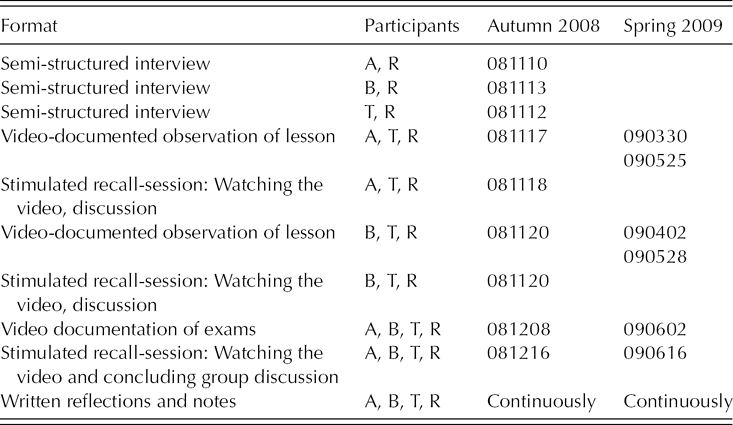
The study was conducted during autumn 2008 and spring 2009. As a whole, it resulted in two similar sets of data material, one from the autumn term and one from the spring term. The participants gave their consent to use all the data collected in the study for research and teaching purposes. A combination of ethnographic methods made it possible to triangulate sources of information from the same event. The following formats were used:
• Initial interviews with students and the teacher, conducted by the researcher.
• Video recordings of lessons.
• Continuous written reflections and notes made by all participants.
• Video recordings of exams and concerts.
• Stimulated recall-sessions with focus group discussions.
• Concluding interviews and focus group discussions.
The data collection was planned and carried out according to Table 1.Footnote 2
Time-plan of the study

Stimulated recall-sessions, where participants watch or listen to recorded data together with the researcher and make comments, are increasingly used in qualitative studies of music education and learning (e.g. Heikinheimo, Reference HEIKINHEIMO2009; Rowe, Reference ROWE2009). It gives the opportunity to return to the actual event and to go deeper into processes of interaction. In this study, the lessons and exams were video-recorded as described in Table 1 and thereafter watched and discussed in their entirety. Stimulated recall-sessions of the lessons were carried out with each student at separate occasions, and the exams were watched and discussed with the two students together. Inspired by Developmental Work Research (Engeström et al., Reference ENGESTRÖM, LOMPSCHER and RÜCKREIM2005), conceptual tools from activity theory were introduced as a double stimulation strategy (Vygotsky, Reference VYGOTSKY1978) in order to explore how the participants ‘construct and reconstruct the object of activity and [. . .] how the subjects perceive and are motivated by the object’ (Ellis, Reference ELLIS, Ellis, Edwards and Smagorinsky2010, p. 96). According to Daniels (Reference DANIELS2008), asking fundamental and seemingly simple questions about the object of a certain activity constitutes ‘a very powerful first step in the identification of systemic contradictions’ (p. 137) since it commonly reveals to the participants themselves as well as to researchers that they have not clarified what they are trying to achieve. As we shall see, this was confirmed in the present study.
One year after the completion of the study all the participants gathered again and discussed the outcome, in the light of Anne's and Betty's continued vocal development and Tessa's work with her thesis. The project was presented at the SOL-conference in Stockholm in September 2010 and at staff days at Malmö Academy of Music, as part of the ongoing work with encouraging the teachers' reflection and dialogue. Consequently, the study had the dual function of being (i) a research study that provided inside perspectives of one-to-one teaching situations and accessed tacit dimensions of the learning experience and teaching expertise, and (ii) a developmental project that gave individual students and teachers the opportunity to explore and develop musical learning, on intra-personal as well as inter-personal levels.
Multi-levelled analysis
The study contained analyses on three levels: (i) a collaborative, on-going analysis during the reflective process that involved all the participants, (ii) an action-research-based analysis made by the teacher in connection with her bachelor thesis, where the researcher also acted as supervisor, and (iii) the analysis made by the researcher of the data material in the completed study. The collaborative analysis focused on clarifying and formulating the teacher's and the students' individual experiences. The teacher's analysis focused on the development of the students' identities as singers as well as their growing awareness of their own learning, their meta-cognition (cf Hultberg, Reference HULTBERG2008). The researcher's analysis was made against the background of these two levels and in line with the described CHAT-perspective, with the aim of uncovering and analysing the participants’ perceptions of obstacles to the students' musical learning. During this process, I used the procedure described by Murphy and Rodriguez-Manzanares (Reference MURPHY and RODRIGUEZ-MANZANARES2008) as ‘zooming in’ (p. 449), that is to say gradually narrowing down the perspective after an initial analysis of the complete set of data.
Findings: a process of articulating, confronting and transforming obstacles
An important overarching result in this study is that self-reflection, verbalisation and a focus on obstacles for vocal development do not negatively interfere with the development of musical proficiency and skills. All participants stated that the study encouraged them in their work; the teacher gained new insights and the students made good progress, completed their courses and performed well in their exams. However, as demonstrated by this study a debate went on underneath the daily routine of practising vocal technique, songs and musical expression. It can be described as follows: What is the aim of one-to-one vocal tuition? What does it mean to be a singer? This argument was gradually brought to the surface through the continuous reflective work carried out within the framework of the study. It was initiated by the researcher's introduction of Engeström's theoretical model of the activity system (1987) with its focus on goals and objectives during the first interviews. Talking about the objective of the singing tuition initially seemed to be uncomfortable and difficult for the students, as seen in the following excerpts:
R (introduces the CHAT model and exemplifies how this can be applied in Anne's vocal development) . . . you can use this as a thinking tool and for achieving what you want with your voice.
Anne I see what you mean, but it's difficult to formulate or to think about . . .
R Yes . . . but you can use it like this (further explanations)
Anne Mm . . .
R It may help you to think about your goals and objectives . . .
Anne Well . . .
Apparently, the students did not consider this – viewing their musical practice as a collective activity in a historical context – as a helpful conceptual tool:
R (describes to Betty how she can use the model for thinking about her work) . . . and how do you see your own role in the teaching situation?
Betty Well . . .
R What are your thoughts about it?
MM I don't know, I haven't thought much about it. I don't think much about goals – I mostly play and practice right now, and that's that.
However, in the course of the study, it became evident that the notion of individual goals functioned as an important tool in the common exploration of obstacles to learning.
The initial interviews revealed tensions and disagreements in each of the areas that were mentioned above as important for the development of students' ownership of learning: (i) instrumental skills, as a prerequisite for realising the teacher's instructions; (ii) personal motivation, which sets the limit for development; (iii) an understanding of the tuition goals, the course and the teacher's general strategies; and (iv) an ability to implement and use the knowledge gained during the lesson in other situations and contexts. For example:
(i) instrumental skills: The teacher's and the student's opinions about the student's vocal proficiency and instrumental skills, that is to say, their tools, differed: Anne and Betty judged their own voices as being of inferior quality and as lacking musical value. On the other hand, Tessa described their progress as remarkably positive, she constantly pointed out the specific qualities of their respective voices and reminded them of their great vocal potentials.
(ii) personal motivation: The teacher and the students had ongoing discussions about personal motivation and the importance of practice, that is to say, the rules: Anne and Betty lacked strong ambition and – in their own words – did not practise as much as they should. Even so, both students ‘loved singing’. Tessa insisted that dedication to practising and working with the voice leads to great vocal progress, and that this is available to everyone.
(iii) The teacher and the students understood the object and meaning of the activity in different ways: Anne and Betty had no clearly stated goals and rather vaguely described their aim as ‘attaining a functional voice’, and adding that it had to be fun. Tessa wanted the students to identify with being a singer.
(iv) The students had difficulties in transferring the technical skills they had gained to their performance of repertoire.
In the following, I will give examples from the study as a process of articulation, confrontation and transformation of obstacles for learning.
Articulation: uncovering obstacles
The major issue in this study turned out to be the contradictory object of the activity: Anne and Betty both recurrently and spontaneously emphasised that they definitely did not want to become soloists even though they liked singing.
Anne I love singing and I think it's fun. But sometimes it sounds disastrous.
R That seems to be your personal judgement.
Anne But I can hear it [. . .] and I have no ambitions whatsoever to become a singer in any way or to perform as a soloist.
Betty I'm not the solo type who performs in front of people, I think it's unpleasant – unless I'm at the piano . . . Being charismatic is not my style, I find it embarrassing. But I like to work with the voice as an instrument, that's fun.
Interestingly, the curriculum for vocal studies in church music (Malmö Academy of Music, 2010) does not mention solo singing. Still, speaking of personal goals, Anne and Betty spent a lot of time resisting this imaginary objective and describing what their goals were not rather than what they wanted to do. They did not share Tessa's positive evaluation of their vocal possibilities. Betty, who describes her voice as ‘not educated’ in spite of several years of vocal training, says:
Betty I will never be able to do it [sing] really, really well, and then it seems ridiculous.
Anne states that she will never be capable to express what she wants in vocal music due to technical insufficiencies.
Anne I have always liked to sing, but I have never thought that I can do it very well. Early on, I decided that my place is behind the piano.
Tessa, on the other hand, wants Anne and Betty to see themselves as singers. She firmly believes that every voice has great potential for qualitative development, and her goal is to communicate this more clearly to her students. She describes both the students' vocal development during the year preceding the present study as remarkably good, and reflects on their differing views in connection with one of Betty's lessons:
Tessa I think it was a fantastic lesson. Betty sang her songs so well, accompanied by a fellow student. We worked with a lot of things, and I gave her advice on interpretation. I was very happy since I could hear a great difference in Betty's treatment of her voice compared to the beginning of the year. And still, in connection with this lesson she was very keen to point out that ‘either you have it or you don't’ and stated that she definitively cannot see herself as a singer. It's strange – she worked hard during two terms and did a wonderful exam, but obviously didn't believe so herself since she still maintains that ‘either you have it or you don't’. It would be interesting to go deeper into how she defines ‘development’ and compare it to the way I see it.
Against the background of her opinion that vocal progress is accessible for everyone, Tessa repeatedly emphasises the need to work systematically with the voice. She reflects on whether her positive attitude and encouraging comments towards the students may be counterproductive:
Tessa I'm convinced that the teaching situation has to be pleasant and stimulating, but maybe I should be more firm and demanding. [. . .] Singing is a lot about muscles and physical memory, and about the ability to work. It's very much a craft.
Anne and Betty downplay the importance of practice and in essence define singing skills as a talent rather than as a craft:
Betty I don't have the voice, and I'm not good at it [. . .] and I don't spend much time on it.
R Practising?
Betty No. I sing, of course, but it's not my first priority.
R You choose to do other things?
Betty Exactly.
Anne Right now, I dread the midterm exam – I will probably sing some German lieder, and I don't do it well.
R How do you mean, you ‘don't do it well’? What's the difference between that and ‘doing it well’?
Anne Well, if I would get going and work a little bit more. . .
R What do you mean by that?
Anne Simply some more practising, I guess. [. . .] But I've got off track, and I don't sing much right now.
The reflective work in this first part of the study showed that the teacher and the students had completely opposite views on goals, methods and knowledge development in their common activity, which can be illustrated as below:

The verbalisation of these contradictory opinions formed the starting point for a constant returning to and engaging with the areas of tension, rather than direct problem solving. Due to the longitudinal design of the study, unfinished discussions and hesitant statements could be returned to and further explored in future meetings. One important context within this process was the sessions in which the students, the teacher and the researcher together watched and discussed video recordings of lessons and examinations.
Confrontation: exploring obstacles
The stimulated-recall occasions proved to be crucial for the development of what Tessa at the end of the project called ‘a creative dialogue’, which ‘made it possible for the students to verbalise their experiences and to share inside perspectives on the learning process in singing’ (Härstedt, Reference HÄRSTEDT2010, p. 42, my translation). She reflects on this in a follow-up interview:
Tessa Watching the video together gave me as a teacher the opportunity to take part in the students' self-confrontation. In fact, their reflections during these occasions were the most important triggers for development of our mutual process during the project.
R Can you give a concrete example?
Tessa The students had negative conceptions of their singing abilities, maybe due to the difference between their competence and experience as pianists/organists and as singers. While watching the video they discovered qualities in their singing that they had not been aware of, even though I, as their teacher had pointed them out. They were very surprised, and during their first confrontation with themselves they asked several times ‘can I trust the sound?’. They suddenly started to act as their own teachers and came up with suggestions for new exercises and practice routines. For example, Betty said that ‘I have to work more with my vowels!’ and Anne pointed out that ‘maybe if I memorise the music I will be able to maintain the rich sound quality that I find in the exercises also when I sing repertoire’. To me, this was a turning point in their work.
During a discussion with Anne concerning her voice quality, she finally accepted that her inner experience could be challenged:
Anne At the end of phrases, especially in a high register, I always think that I sound like an old lady.
Tessa But isn't that an experience that is inside your head?
Anne Yes . . . and now [watching and listening to the recording; my remark] I don't hear that, it doesn't sound as bad as I think it does. But that might be a beautifying effect of the recording.
R + Tessa No, it's not a beautifying effect. We hear it also, and this is how it sounds. If there's a difference, it sounds even better in reality.
Anne OK, I'll buy that . . . What I experience when I sing is not acceptable to me, but what I hear now is acceptable. I can see the difference.
Also, for Tessa the process of questioning habitual practices and beliefs meant that she re-evaluated her own role as a teacher:
Tessa During one of the recorded lessons Anne and I were preparing for her examination performance with songs by Aaron Copland and J S Bach. Afterwards, I was very pleased. She had done a great job in preparing the music, and I found that her voice as well as her interpretation and performance of the music developed during the course of the lesson. She also showed aspects of her musical personality that I hadn't seen before. This impression remained when I watched the recording. However, I wasn't pleased with my own role as a teacher: I said nothing and came across as a passive accompanist while Anne was singing for a good 45 minutes. There were very few pedagogical explanations and inspiring musical instructions. I thought that if I were to choose a promotional lesson for myself, I would never pick this one! But I later discovered that Anne had written her longest and most interesting reflection in connection with this lesson.
In conclusion: My first impression was that this was a good lesson, but I changed my mind when I watched the recording, because I didn't see myself as the inspiring pedagogue that I want to be. Later on I re-evaluated this second impression too, and considered the question: Was it precisely because I didn't do very much that this was a good lesson? Did I allow a flow by not ‘teaching’ so much? By listening and waiting for Anne's actions rather than giving instructions, I perhaps gave her the opportunity to develop musically.
Transformation: turning obstacles into options
The method of common analysis opened up the space for new insights and for knowledge transfer. For example, in one stimulated-recall session we watched a lesson where Anne practised one of the songs from Robert Schumann's cycle ‘Frauenliebe und leben’, which she had chosen to work with since she had performed the entire opus as a pianist. She now wanted to explore what this knowledge could give her as a singer. Watching the video, Anne found that she was ‘fidgeting’, that is to say, made compensatory hand movements while singing, and she related this to her sense of frustration when things do not work – while performing the song she noted that she lost some of the sound qualities and the vocal strength that we had commented upon during technical exercises and that had pleasantly surprised her. Then she realised:
This is similar to my own piano students' frustration. I used to think they were annoyed with me, but then I realised they were actually annoyed with themselves! It's exactly the same with me.
By verbalising her realisation and connecting it to her own teaching, Anne was able to use and transform this experience to other areas of work.
During another session we watched the recording of Betty's final exams, and she reflected on the way her relationship to performance in school situations compared with what she called ‘real life’:
Betty I can only engage myself one hundred per cent in making music in real life situations, as in concerts. I don't take examinations seriously.
R I see, can you develop that?
Betty At school, I position myself as ‘the bad student’, and then I'm unable to communicate anything musically. I can't inspire myself. A real-life concert is very different.
During the year, both students gained professional experience as church musicians, and Betty later referred to this experience as helping her to relate to her choristers’ vocal problems – she even mentioned that she had started to offer them individual voice coaching. When we met again one year after the study neither Anne nor Betty had any problem in seeing themselves as singers (cf. Härstedt, Reference HÄRSTEDT2010) or acting as role models for their choirs. They made use of Tessa's vocal technique exercises in their work with choirs and were frequently active as solo singers.
Discussion and conclusions: an expanded object
The examples above illustrate a process of development and change in which the teacher, the students and the teaching situation were all involved. Through extensive reflective work the study accessed issues that otherwise would have remained unarticulated and undeveloped. The results might be summarised as follows:
• In vocal lessons, performances and exams throughout the study, the students and the teacher verbalised and examined positive insights as well as experiences of tension, difficulties and problems.
• The participants reflected upon their own actions in stimulated-recall sessions together with the researcher. Problems were unearthed and discussed but were not solved during the year.
• The study resulted in documented meta-learning that enabled the students to transfer their experiences to professional situations, which in turn made it possible for them to utilise the knowledge offered to them by their teacher.
• Suggestions for changes in the practice of one-to-one vocal teaching were produced such as the introduction of video recording of all exams. These were implemented and will be continuously evaluated.
The results thus illustrate a cycle of expansive learning (Engeström, Reference ENGESTRÖM1987), in which the strategy of double stimulation (Vygotsky, Reference VYGOTSKY1978) functioned as a trigger for exploring underlying tensions in the object of the teacher's and students' common activity, and as a method for meta-learning that ‘enables participants to do more than simply work on improving their own performance’ (Ellis, Reference ELLIS, Ellis, Edwards and Smagorinsky2010, p. 103). A fundamental thought in activity theory is that contradictions provide the energy for innovations and development. When they, as here, are made explicit in discursive manifestations (Engeström & Sannino, Reference ENGESTRÖM and SANNINO2011) they are productive in a process that may lead to the creation of an expanded and shared object of the activity. This was made possible in the present case by (i) the initiation of a creative dialogue; (ii) a process of self-confrontation; and (iii) using professional work as a developmental transfer. The conflicting views on singing and the following development in this project demonstrate personal ways of handling problematic issues. However, the process also illustrates the systemic and primary contradiction between use value and exchange value (Engeström, Reference ENGESTRÖM2005): singing for fun in private situations vs. professional singing as a wage earner. Anne and Betty initially defend the former position while Tessa is strongly committed to the latter, and the development in the study may also be described as an ongoing debate about the role of music, and of musicians, in a professional musical context. The students' initial objective was not to be singers, since their idea of professional singing in general and as presented by their teacher in particular did not seem to be compatible with their identity as instrumentalists. However, through a combination of reflective work, self-confrontation and growing professional experience the object of the activity was gradually expanded, and Tessa, Anne and Betty could discuss and share the experience of seeing themselves as singers. The students' resistance towards imitation of and identification with their teacher was in this process transformed into a tool for meta-learning.
An important experience from this and the previously mentioned study (Johansson, Reference JOHANSSON2012) is that the knowledge gained in collaborative projects is not only productive in specific teaching situations. It may also result in inspiration and knowledge development for the collective of teachers, if and when cooperative projects between teachers and researchers are supported and encouraged on an institutional level.
In conclusion, this study shows how problems and learning obstacles experienced in one-to-one teaching may be redefined and used as learning options by students as well as teachers, thus providing space for a development of the situation as a whole. Furthermore, it suggests that the use of theoretical tools by researchers and practitioners in interaction may give the courage and endurance to approach and investigate problematic teaching situations. It also proves that new methods for documentation, evaluation and dissemination of knowledge in HME may be developed and tested in the framework of collaborative projects and shared with other teachers and staff. Finally, the study points to the need for further long-term collaborative projects that engage teachers, students and informed researchers in a creative dialogue and that are supported by institutional leaders, in order to explore and develop the formats for HME.
APPENDIX A/Note
The strategy of double stimulation and its use in this study
The method of double stimulation described by Vygotsky (Reference VYGOTSKY1978) was in this study used as a tool for investigating and exploring how the participants constructed and reconstructed the object of their activity. As a methodological principle, the double stimulation strategy means introducing tools for problem solving in the educational situation, although these are not tools for direct solutions:
By using this approach, we do not limit ourselves to the usual method of offering the subject simple stimuli to which we expect a direct response. Rather, we simultaneously offer a second series of stimuli that have a special function. In this way, we are able to study the process of accomplishing a task by the aid of specific auxiliary means; thus we are also able to discover the inner structure and development of higher psychological processes. The method of double stimulation elicits manifestations of the crucial processes in the behaviour of people of all ages. Tying a knot as a reminder, in both children and adults, is but one example of a pervasive regulatory principle of human behaviour, that of signification, wherein people create temporary links and give significance to previously neutral stimuli in the context of their problem-solving efforts. (Vygotsky, Reference VYGOTSKY1978, pp. 74–75)
In the field of teacher learning, Ellis (Reference ELLIS, Ellis, Edwards and Smagorinsky2010) points out that this strategy provides the opportunity to study the process of engaging with a task rather than just the outcome. As an example, he describes the researcher's introduction of an unfamiliar lesson-planning template into the planning process of a teacher group, ‘in order to reveal how they understand the concept of curriculum and the materiality of the students they are teaching’ (p. 96). In this study, the model of the human activity system (Engeström, Reference ENGESTRÖM1987, Reference ENGESTRÖM2005) was introduced to the participants as a thinking tool in the process of verbalising their views on their own goals and objectives. In the individual interviews, I suggested to them that the situation of one-to-one vocal tuition might be seen as an activity system rooted in historical and cultural structures of motives, rules and division of labour. It consists of individual goals as well as collective motives, as described by Engeström (Reference ENGESTRÖM2005):
1. The unit of analysis is ‘a collective, artefact-mediated and object-oriented activity system, seen in its network relations to other activity systems’ (p. 63).
2. The activity system is characterized by a multitude of voices and incorporates a number of different views, backgrounds and traditions among the participants. This causes conflicts and problems as well as motives for innovation and development.
3. An important part of every activity system is its history, partly its local history and partly the general historical background concerning dominating theories and ideas.
4. Contradictions – not the same thing as problems – constitute the driving force for change of activity systems, and are described as ‘historically accumulating structural tensions within and between activity systems’ (p. 64).
5. Activity systems may go through qualitative change and expansion, through cycles of expansive transformation. These may lead to the formation of an extended scope of possibilities in new versions of the activity system, and are understood as ‘a collective journey through the zone of proximal development of the activity’ (p. 65).
I asked the participants to think about their positions as subjects in this particular activity system, about what tools they used and about what their goals were. As described in the article, this operation quickly made it clear both to the researcher and the participants that their goals did not coincide, which proved to be an important step in the development of a shared, collective object.
APPENDIX B/Note
Contradictions
In cultural-historical activity theory contradictions are commonly described as historically generated structural tensions that also provide the energy for change and development. Every activity in capitalist societies is seen as characterized by an inner unrest, which is conceptualised by the idea of dialectical contradictions on four levels (see Engeström, Reference ENGESTRÖM1987). The primary contradiction between use value and exchange value might in the case of music making be represented by, for example, the opposition between playing music for its own sake and for a living. In music education, manifestations of contradictions may be experienced and expressed by teachers and students as tensions concerning the content, form or direction of the lesson. Heikinheimo (Reference HEIKINHEIMO2009) describes the tension between the goal of student autonomy and teacher-dominated teaching strategies as an example of a contradiction between tools and the object and also points to a common tension between context and learning:
Another tension may appear between developing musical expression and developing the teacher–student work. Typically, teachers and students are oriented towards change, as they search for and develop musical expression, instrumental skills and musical knowledge. The process of evaluation or development does not, however, usually concern the development of collaborative work. The activity of teaching and learning itself often remains the same despite the fact that the obstacle of development in producing, rehearsing, or attaining musical knowledge may be actually within the lesson activity. Hence, the development of musical expression does not include the development of the context. (pp. 76–77)
As described in this article, the contradiction in focus in the present study is the one concerning the object of the activity, and it is not until the opposing views of the teacher and the students are uncovered that the learning situation may be developed and changed.
Karin Johansson completed her thesis on organ improvisation in Music Education in 2008 and is now a postdoctoral research fellow and director for artistic research at Malmö Academy of Music, Lund University, Sweden. She is currently completing post-doctorate studies on higher music education, choir leadership and improvisation.