


Introduction
Vegetable production has been reported to cause nitrate contamination of groundwater due to the high inputs of nitrogen (N) fertilizer and low N use efficiency (Babiker et al., Reference Babiker, Mohamed, Terao, Kato and Ohta2004; Song et al., Reference Song, Zhao, Wang and Li2009; Benoit et al., Reference Benoit, Garnier, Anglade and Billen2014). Efficient N management, for example, decreased synthetic N fertilizer rate without yield losses (de Paz and Ramos, Reference De Paz and Ramos2004), crop rotations with improved N use efficiency (Vos and Van der Putten, Reference Vos and Van Der Putten2004; Thorup-Kristensen, Reference Thorup-Kristensen2006) and autumn catch crops taking up soil N after the harvest (Thorup-Kristensen, Reference Thorup-Kristensen1994; Wyland et al., Reference Wyland, Jackson, Chaney, Klonsky, Koike and Kimple1996), has been applied and has shown positive effects in conventional and organic vegetable production on reducing nitrate leaching. However, these strategies are difficult in the case of vegetables such as leek (Allium porrum L.) and cauliflower (Brassica oleracea L. var. botrytis), which demand high N availability during the growing season when they are: late-harvested before a cold period without plant covers (continental and temperate regions) or followed immediately by another crop (Mediterranean regions). Therefore, a high amount of inorganic N (Ninorg) may be left in the soil and can be leached and lost from the agro-ecosystem before it is taken up by a succeeding crop that is established right after harvest or the following spring. For example, cauliflower left 50–80 kg Ninorg ha−1 in the soil (0–0.6 m) (Everaarts et al., Reference Everaarts, De Moel and Van Noordwijk1996) and leached as much as 293 kg nitrate N ha−1 below a 0.9 m depth in a conventional field (De Neve et al., Reference De Neve, Dieltjens, Moreels and Hofman2003), whereas soil Ninorg after leek harvest was 133 kg N ha−1 in the 1–2.5 m soil layer (Thorup-Kristensen, Reference Thorup-Kristensen2006). Therefore, growing a cash crop intercropped with a living mulch (LM) could be effective to retain N during the cropping cycle and/or the leaching period (i.e. winter), N that would otherwise be lost by leaching. LMs were found to decrease the risk of nitrate leaching in both conventional (Manevski et al., Reference Manevski, Børgesen, Andersen and Kristensen2015; Mariotti et al., Reference Mariotti, Masoni, Ercoli and Arduini2015) and organic cereal and vegetable systems (Whitmore and Schröder, Reference Whitmore and Schröder2007; Thorup-Kristensen et al., Reference Thorup-Kristensen, Dresboll and Kristensen2012). Higher or comparable yield and quality of cash crop in LM systems were achieved when the interspecific competition was negligible (Båth et al., Reference Båth, Kristensen and Thorup-Kristensen2008) and LM suppressed pests and weeds (Brainard and Bellinder, Reference Brainard and Bellinder2004). In other cases, interspecific competition resulted in high yield losses of crops (Lotz et al., Reference Lotz, Groeneveld, Theunissen and Van Den Broek1997).
The choice of LM species is important for the outcome in LM systems. The species should be selected on the basis of its features, the competitiveness of the cash and LM crops, and the ecological benefits that the LM is able to provide. The N uptake of the LM varies from species to species (Campiglia et al., Reference Campiglia, Mancinelli, Radicetti and Caporali2010). Legumes are commonly used as LMs in cereal production to improve cereal yield in low N-input systems, especially in organic systems, due to their biological nitrogen fixation and less competition with cereals (Bedoussac and Justes, Reference Bedoussac and Justes2010; Bedoussac et al., Reference Bedoussac, Journet, Hauggaard-Nielsen, Naudin, Corre-Hellou, Jensen, Prieur and Justes2015). In such systems, less N fertilizer is needed since the N fixation increases the soil Ninorg (Abad et al., Reference Abad, Lloveras and Michelena2004). Compared with legume sole crop, the combination of legume and non-legume depleted more soil Ninorg due to the complementary use of fixed N and soil Ninorg. In other cases, plant species from the Brassica family have been used as LM due to their potential for weed suppression without yield reduction (Fernandez et al., Reference Fernandez, Sheaffer and Wyse2015) and have been used as autumn catch crops because of their high N uptake capacity and deep root systems (Thorup-Kristensen, Reference Thorup-Kristensen2006; Herrera et al., Reference Herrera, Feil, Stamp and Liedgens2010). Furthermore, cultivars of cash crops have shown different competiveness against LMs (Picard et al., Reference Picard, Ghiloufi, Saulas and De Tourdonnet2010). Although interspecific competition existed in several cases, it was possible to control or alleviate it by management strategies. For example, root pruning increased the aboveground biomass of white cabbage in LM systems (Båth et al., Reference Båth, Kristensen and Thorup-Kristensen2008); sowing LM after maize planting decreased the competition for nutrients and then increased the dry weight of the cash crop (Uchino et al., Reference Uchino, Iwama, Jitsuyama, Yudate and Nakamura2009); sowing LM 7 weeks or more after leek transplanting improved leek yield compared with 3 or 5 weeks (Kolota and Adamczewska-Sowinska, Reference Kolota and Adamczewska-Sowinska2004); and the use of the substitution design has given acceptable yields (Thorup-Kristensen et al., Reference Thorup-Kristensen, Dresboll and Kristensen2012).
The ability of LMs to reduce nitrate leaching has only been subject to few studies in row crop production compared with studies of weed and insect control and cash crop yield (Brainard and Bellinder, Reference Brainard and Bellinder2004). Moreover, studies have only been conducted in one site at a time, hindering general conclusions across climatic, edaphic and management conditions. To investigate the feasibility of LMs to reduce the potential nitrate leaching in organic vegetables, 2 yr of field trials with intercropping of LM and vegetables of cauliflower and leek were conducted in Italy, Slovenia, Germany and Denmark, representing different cropping conditions across Europe. Introduction strategies of LM (sowing date and crop density) for competition control were investigated. Open-pollinated (OP) and hybrid cultivars of vegetables were used to reveal the competiveness for N. We hypothesized that: (1) Hybrid cultivars show higher ability to compete for N in the LM systems compared with OP cultivars. (2) Due to higher competition for N, the addition design (ADD) is more effective in reducing soil nitrate N than the substitution design (SUB). (3) The delay of LM sowing late after cash crop planting is less efficient in reducing the potential nitrate leaching due to weaker competition for N in comparison with the sole crop and early-sown LM.
Materials and Methods
Experimental sites
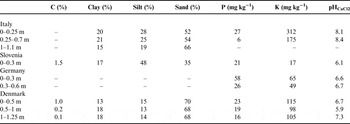
This study was conducted in four European countries, Italy (2011 and 2012), Germany, Slovenia and Denmark (2012 and 2013). The geographical locations of the four experimental sites were the research farm Hessian State Estate Frankenhausen, Germany (51°9′N, 9°4′E), Agricultural Centre of the University of Maribor, Slovenia (46°28′N, 15°38′E), CREA—ORA research farm, in the Marche Region, Italy (42°53′N, 13°48′E) and the Research Centre Aarslev, Aarhus University, Denmark (55°18′N, 10°27′E). The soil properties of the four experimental sites are listed in Table 1. The annual precipitation and average air temperature during the vegetable growing season in each experimental year was 272 mm and 13.4°C and 634 mm and 13.5°C and in Italy, 430 mm and 18.1°C and 230 mm and 18.4°C in Slovenia, 293 mm and 11.9°C and 257 mm and 13.5°C in Germany, and 441 mm and 14°C and 167 mm and 16°C in Denmark. The field experiments were conducted according to the local organic management practices and regulations, in which inorganic fertilizers and synthetic pesticides were excluded.
The soil properties of the experimental fields in four countries.

The symbol – means the data are not available.
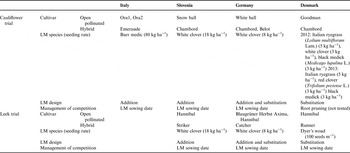
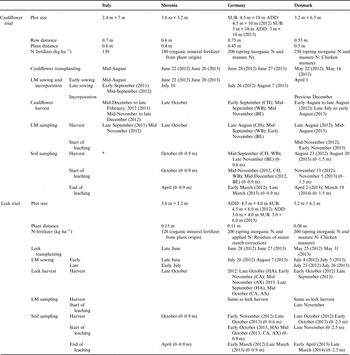
The trials were conducted using randomized block design with three replicates, where cauliflower (all countries) and leek (all except Italy) were grown as cash crops. Different plant species (legumes or non-legumes) were chosen as LM. OP cultivars and hybrids of the vegetables, the choice of LM and the means of controlling interspecific competition varied from country to country depending on local practice (Table 2). The management practices are listed in Table 3. The ADD and SUB designs were compared in Germany. The crop density in the ADD design was the same as in the sole crop system (sole crop), and LM was broad sown, which allowed weeding until LM sowing. In the SUB design, every third row of vegetables was replaced by a row of LM, resulting in a reduction of crop density by 1/3 per area unit, which allowed weeding between rows after LM sowing. To alleviate the competition between vegetables and LM, the displacement of sowing dates of LM was tested in Slovenia, Italy and Denmark. The LM in those trials was either early-sown or late-sown after vegetable planting. The LM used in the Danish cauliflower trial was an overwintering, grass–clover mixture, which was sown the previous April and was either fully incorporated or incorporated in strips the previous December according to Båth et al. (Reference Båth, Kristensen and Thorup-Kristensen2008). Before cauliflower planting, the row of LM was cut aboveground and root pruned at 0.2 m soil depth on May 22, 2012 and May 14, 2013. After the vegetables were harvested, the LM was left in the field to grow until early spring in Italy, Slovenia, Germany and Denmark.
The cultivars of vegetables, the LM species and introduction strategies, and management of interspecific competition in four countries.

Agricultural management of crops and LMs in four countries. If years are not indicated, the time point was the same in both years.

Note: *Soil Ninorg was studied by use of lysimeters in Italy, but inadequate amounts of soil solution disabled statistical analysis. SUB: Substitution design, ADD: Addition design. The abbreviations in parentheses indicate the cultivar of cauliflower or leek (CH: cauliflower cv. Chambord; WB: cauliflower cv. White Ball; BE: cauliflower cv. Belot; HB: leek cv. Hannibal; AX: leek cv. Axima; CA: leek cv. Catcher).
Plant and soil sampling and analysis
Cauliflower and leek were harvested by hand and were sorted into yield and crop residues. The LM was sampled by cutting at the soil surface just before (Germany) or after (all others) the harvest of vegetables. All plant samples were oven-dried to a constant weight (Germany: 80°C for 48 h; Slovenia: 105°C; Italy: 70°C for 48 h; Denmark: 80°C for 20 h) and were analyzed by the combustion method. Soil in the Slovenian, German and Danish trials was sampled three times per cropping cycle to determine the soil Ninorg representing the planting time, harvest and the end of the main leaching period the following spring. Soil samples were also taken at the start of the main leaching period in autumn in the Danish trials and the German cauliflower trial in 2012 and leek trial in 2013. The start and end of the main leaching periods were defined according to local climate and soil conditions (Table 3). The soil samples were taken to a depth of 0.9 m (Slovenia and Germany), 1.5 m (Denmark, cauliflower) or 2.5 m (Denmark, leek) by manual or machine driven augers. Soil sampling and analysis for soil Ninorg (Germany NO3 −) content was performed after standard agronomic procedures. Soil NO3 − and NH4 + were determined by extracting soil samples with 1M KCl solution and analyzing soil extract with standard colorimetric methods.
Data analysis
Soil nitrate N was calculated per area based on the measured soil nitrate N concentrations and the local soil bulk densities for each soil layer. The results of the plant N content and the soil nitrate N distribution were analyzed by the Kenward–Roger-based method (R software, version 3.0.2). The LM, cultivar (Cultivar) and year (Year) were treated as fixed factors and block as the random effect. If the variances were not homogeneous, data were transformed by the function y = X 1/2 or y = log(x). Tukey's test was applied to compare the significance of the differences among treatments with P < 0.05.
Results and Discussions
Cauliflower trials
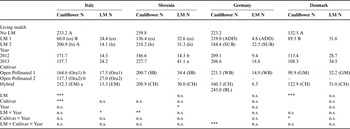
The influence of LM, cultivar and year on the total crop and LM uptake of N in four countries is presented in Table 4. Interactions between LM, cultivar and/or year were found in the N uptake of cauliflower in Germany, Slovenia and Denmark. In Denmark, LM decreased cauliflower N considerably by 43 kg N ha−1 (P < 0.01). In Italy, the hybrid Emeraude had higher crop N uptake and higher total N uptake (crop + LM) compared with two OP cultivars (P < 0.01). The differences for cauliflower N amounted to 48 and 95 kg N ha−1 between the hybrid and OP cultivars. The early-sown LM system had 173 and 141 kg N ha−1 lower cauliflower N uptake compared with the sole crop and late-sown LM, respectively (P < 0.01).
The effect of living mulch (LM), year and cultivar on cauliflower and LM N uptake in the four countries.

Note: The * indicates the significant differences at P < 0.05, ***indicates the significant differences at P < 0.001. Different lower case letters indicate the significant differences at P < 0.05 and upper case letters indicate significant differences at P < 0.01.The abbreviations given in parentheses indicate the design (ADD: Addition design; SUB: Substitution design); sowing date of living mulch (es: Early sown; ls: Late sown) or cauliflower cultivar (WB: White Ball; CH: Chambord; BE: Belot; EM: Emeraude; SB: Snow Ball; GM: Goodman). – indicates not relevant.
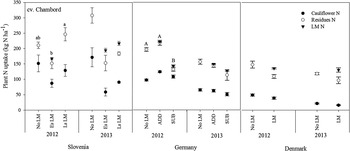
Figure 1 presents the results of the plant N uptake from the trials with cultivar (cv.) Chambord, which was tested in Germany, Slovenia and Denmark. The difference of total plant N uptake in each country was not consistent. Significant differences between treatments were only found in 2012 in Germany and Slovenia. The decrease of cauliflower N was observed in countries using the SUB design due to the reduced crop density, compared with the sole crop, but not in those using the ADD design. In the German and Danish trials, the SUB design had the lowest total cauliflower N uptake (cauliflower head + residues) compared with the other treatments (Fig. 1), and this effect of reduced crop density was also observed in the reduced fresh biomass yields (results not shown). This result was in accordance with our hypothesis. No statistically significant differences were found in the cauliflower and residue N uptake between the ADD design and sole crop systems in Germany, Slovenia and Italy, when LM was sown late.
The plant N uptake in cauliflower trials with hybrid cv. Chambord in Germany, Slovenia and Denmark. Different lower case letters indicate significant differences at P < 0.05. Different upper case letters indicate significant differences at P < 0.01. No LM: Sole crop; ADD: Addition design; SUB: Substitution design; Es LM: Early sown LM; Ls LM: Late sown LM.

The SUB design was able to alleviate the interspecific competition compared with the ADD design. In 2013 in Germany, the LM N uptake in the SUB design was higher than in the ADD design (cv. Chambord: 14 > 5 kg N ha−1, P < 0.05; Fig. 1). This was consistent with the other two cultivar treatments (cv. White Ball: 34 > 2 kg N ha−1; cv. Belot: 39 > 0 kg N ha−1, both P < 0.05) (results not shown). The LM N uptake in the ADD design was < 5 kg N ha−1 in both years, indicating strong competition between the LM and cauliflower in this system due to the higher plant density. The SUB design was able to mitigate the interspecific competition and suppression on LM from cauliflower. The increase of LM N uptake compensated for the reduction of N uptake caused by the reduced cauliflower density. Similarly, the LM system of overwintering and root-pruned grass–clover mixture in Denmark had equivalent total N uptake to the sole crop due to weak competition (Xie and Kristensen, Reference Xie and Kristensen2016).
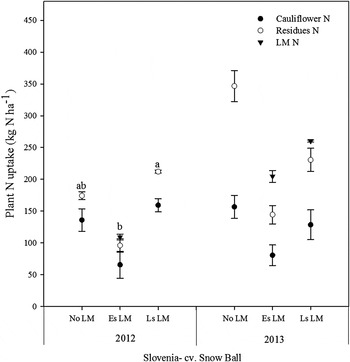
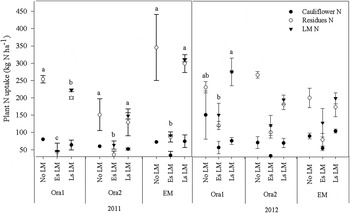
The delay of LM sowing alleviated the suppression of cauliflower from the interspecific competition, compared with sowing LM at the same time as cauliflower planting. In Slovenia, where the addition design was used, the total cauliflower N of cv. Chambord in early-sown LM was 95 kg ha−1 lower than late-sown LM in 2012 and 113 kg ha−1 lower than the sole crop in 2013 (Fig. 1). Likewise, in cv. Snow Ball, early-sown LM had lower total cauliflower N than late-sown LM in 2012 and sole crop in 2013 (P < 0.05, Fig. 2). In Italy, early sowing also decreased the total cauliflower N uptake in both years by 118–258 kg N ha−1 compared with the sole crop (Fig. 3). This considerable suppression of N uptake in cauliflower grown with early-sown LM could be explained by the dependency of legumes on soil Ninorg at the early stage (Mahon and Child, Reference Mahon and Child1979). Therefore, sowing white clover (Trifolium repens L.) or burr medic (Medicago polimorpha L. var. anglona) at the same time as cauliflower transplanting led to strong competition between the crop and LM species, which was also confirmed by the lower fresh biomass yields (results not shown). In this case, the SUB design should be used to alleviate the competition to maintain the cauliflower yields. Another possibility is to use the ADD design combined with available management methods to control the interspecific competition during the crop season to maintain vegetable yield while reducing potential nitrate leaching (see below). Such methods include root pruning (Båth et al., Reference Båth, Kristensen and Thorup-Kristensen2008) or mowing (Theriault et al., Reference Theriault, Stewart and Seguin2009), although the biomass partitioning of N indicated that mowing would not be efficient to control belowground competition. However, a system with LM root pruning in the ADD design poses technical challenges for the development of machinery due to the limited space. No difference was found in the cauliflower N between the sole crop and late-sown LM, which demonstrated that the delay of LM sowing, for instance, 4 weeks (Italy) or 2.5 weeks (Slovenia) after cauliflower transplanting strongly reduced interspecific competition compared with early-sown LM. Another study also reported that the delay of LM or intercrop sowing can alleviate interspecific competition (Kolota and Adamczewska-Sowinska, Reference Kolota and Adamczewska-Sowinska2004).
The plant N uptake in cauliflower trials with cv. Snow Ball in Slovenia in 2 yr. Different lower case letters indicate the significant differences at P < 0.05. No LM: Sole crop; Es LM: Early sown LM; Ls LM: Late sown LM.

The plant N uptake in cauliflower trials with cv. Ora1, Ora2 and Emeraude in Italy in both years. Different lower case letters indicate significant differences at P < 0.05. No LM: Sole crop; Es LM: Early sown LM; Ls LM: Late sown LM; EM: cv. Emeraude.

In general, the LM did not accumulate as much N as expected based on a previous study, where white clover took up more than 63 kg N ha−1 when grown as LM (Carof et al., Reference Carof, De Tourdonnet, Saulas, Le Floch and Roger-Estrade2007). The early- and late-sown LM responded in a similar way in LM N uptake (Table 4). No or only minor differences were found between early- and late-sown LM in Slovenia and Italy in all cultivars during both years (Figs 1–3) due to the stronger competition in the early-sown LM system. In the Italian trials, in the early-sown LM system, cauliflower N was 3.4–4.6 times lower than in the late-sown LM system, which led to lower total N uptake in the system with early-sown LM compared with late-sown LM in 2012. Different from our hypothesis on total N uptake, the delay of LM sowing in the cauliflower trials had higher total N uptake than early-sown LM system but was similar to the sole crop system. Thus, late-sown white clover or burr medic increased the competitiveness of cauliflower, but resulted in no benefits for the total N uptake in the systems.
Cauliflower N uptake was higher in hybrid cultivars in Italy and Denmark (Table 4), but the performance of the cultivars could not be related consistently to the sole crop and LM systems in any of the countries.
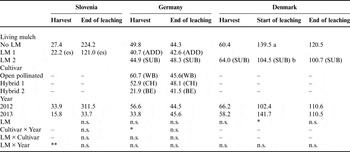
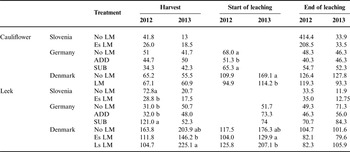
Soil nitrate N content was measured in selected cultivars, systems and times in Germany, Slovenia and Denmark showing interactions of cultivar and year on soil nitrate N at harvest in Germany and interactions of LM and year in Slovenia (Tables 5 and 6). In the Danish trials, the LM system had a lower soil nitrate content of 35 kg N ha−1 at the start of leaching compared with the sole crop, indicating the potential of LM to reduce the risk of leaching during winter. The increase of soil nitrate N from the harvest to the start of leaching could be ascribed to the mineralization of soil organic N and cauliflower residues, which has been reported to increase soil Ninorg by 88 kg N ha−1 after harvest (de Neve and Hofman, Reference De Neve and Hofman1998). The lower soil nitrate N content in the LM system compared with the sole crop could be attributed to two factors. First, the lower cauliflower density in the LM system resulted in lower cauliflower residual N. Secondly, LM left growing in the field after cauliflower harvest took up N and acted this way as an autumn catch crop.
The effect of living mulch, cultivar and year on the total soil nitrate N (kg ha−1) in cauliflower trials at harvest, start of leaching and end of leaching.

Note: The * and ** indicates significant differences at P < 0.05 and P < 0.01, respectively. Different lower case letters indicate significant differences at P < 0.05. The abbreviations given in parentheses indicate the design (ADD: Addition design; SUB: Substitution design); sowing date of living mulch (es: Early sown; ls: Late sown) or cauliflower cultivar (WB: White Ball; CH: Chambord; BE: Belot). The soil inorganic N was measured in the soil layer of 0–0.9 m in Germany (except 2012 at harvest 0–0.6 m), 0–0.9 m in Slovenia and 0–1.5 m in Denmark. In Slovenia and Denmark, the soil nitrate N results were measured for Chambord. – indicates not relevant.
The effect of living mulch on soil nitrate N (kg ha−1) in trials with cauliflower cultivar Chambord and leek cultivar Hannibal at harvest, at the start of leaching and at the end of leaching in separate years.

Note: Different lower case letters indicate the significant differences at P < 0.05.The abbreviations given in the table indicate design (No LM: sole crop; ADD: Addition design; SUB: Substitution design) or sowing date of living mulch (es: Early sown; ls: Late sown).
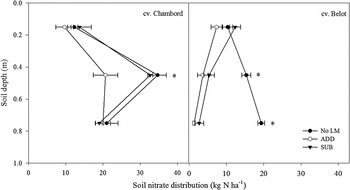
Both the ADD and SUB designs in the German cauliflower trials reduced soil nitrate N at the start of leaching, and hypothesis (2) was rejected in most of cases in Germany when the two designs were compared. At the start of leaching, cv. Chambord had lower soil nitrate N left in the ADD design (51 kg N ha−1) compared with the sole crop and SUB design (68 and 65 kg N ha−1) (P < 0.05) (Table 6). The two LM strategies with cv. Belot left less soil nitrate N (12 and 20 kg N ha−1in ADD and SUB) compared with the sole crop (45 kg N ha−1) (P < 0.01) (Fig. 4), which indicated that both LM systems had the potential to reduce soil nitrate N at the start of leaching by LM taking up N after harvest, considering no difference between treatments at the harvest. The difference was mainly present at the depth of 0.3–0.6 m for both cultivars and 0.6–0.9 m for cv. Belot (Fig. 4), which is within the expected root zone of white clover of 1.4 m (Evans, Reference Evans1978). Thus, white clover took up N in the root zone after harvest.
The soil nitrate distribution in the soil layer of 0–0.9 m in cauliflower trials with cv. Chambord and cv. Belot in Germany 2012 at the start of leaching. The * indicates significant differences at P < 0.05. No LM: Sole crop; ADD: Addition design; SUB: Substitution design.

In Slovenia, the soil nitrate N content in the sole crop system was not significantly different from that in the early-sown LM in each year (Table 6). Although not supported by the Slovenian results, the soil nitrate N in Denmark and Germany indicated the potential for a reduction of leaching risk by the introduction of LM in cauliflower systems.
Leek trials
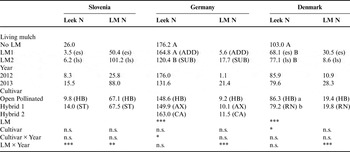
Table 7 shows the effects of LM, cultivar and year on plant N accumulation. There were LM and year interactions for the total leek N uptake in Slovenia (P < 0.01) and the LM N uptake in all three countries. The total leek N uptake in Germany was affected by LM (P < 0.01) and the interaction between cultivar and year (P < 0.05). In the Danish trial, the leek N uptake was lower in both LM treatments compared with the sole crop treatment (P < 0.01). The total plant N uptake was influenced by the interaction between the LM and year in all three countries, which suggested that the effect of LM on total N uptake was influenced by the cropping conditions, which affected the growth of both leek and LM. An influence of leek cultivars on the total N uptake was only found in Denmark, and was higher in cv. Hannibal compared with the hybrid cv. Runner in Denmark (P < 0.05).
The leek (including residues) and living mulch N uptake (kg N ha−1) in three countries in two years.

Note: The *, ** and *** indicate the significant difference at P < 0.05, P < 0.01 and P < 0.001, respectively. Different lower case letters indicate significant differences at P < 0.05 and upper case letters indicate significant differences at P < 0.01. The abbreviations given in parentheses indicate the design (ADD: Addition design; SUB: Substitution design); sowing date of living mulch (es: Early sown; ls: Late sown) or leek cultivar (HB: Hannibal; ST: Striker; AX: Axima; CA: Catcher; RN: Runner).
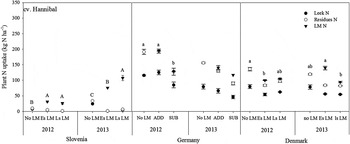
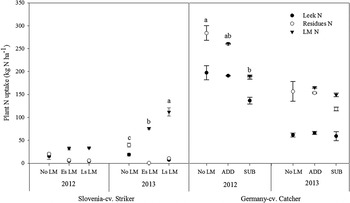
Figure 5 shows the results of plant N uptake in OP cv. Hannibal, which was tested in Slovenia, Germany and Denmark. Differences in total plant N uptake between treatments were found in Germany in 2012 and in Slovenia and Denmark in both years.
The plant N uptake in leek trials with open pollinated cv. Hannibal in Germany, Slovenia and Denmark. Different lower case letters indicate significant differences at P < 0.05. Different upper case letters indicate significant differences at P < 0.01. No LM: Sole crop; ADD: Addition design; SUB: Substitution design; Es LM: Early sown LM; Ls LM: Late sown LM.

White clover as LM in Germany and Slovenia did not show consistent effects on total N uptake and the results varied from year to year, with positive effects of the SUB design in Germany 2013, which showed the potential of accumulating N by LM. The ADD design did not suppress leek N uptake compared with the sole crop system in Germany, but it did strongly outcompete both cv. Hannibal and cv. Striker in Slovenia in both years compared with the sole crop (Table 7, Figs. 5 and 6). The results from Slovenia contradicted previous studies that reported that white clover was less competitive against leek compared with other LMs and that similar yield to the sole crop was achieved when white clover was sown after leek transplanting (Kolota and Adamczewska-Sowinska, Reference Kolota and Adamczewska-Sowinska2004; den Hollander et al., Reference Den Hollander, Bastiaans and Kropff2007). For cv. Hannibal in the SUB design in Germany, the leek N uptake was consistently lower than the sole crop in both years (2012: P < 0.01; 2013: P < 0.05) because of the reduced crop density (Fig. 5). This was consistent with the leek N uptake in LM systems in the Danish trial with both cultivars.
The plant N uptake in leek trials with cv. Striker in Slovenia and cv. Catcher in Germany. Different lower case letters indicate significant differences at P < 0.05. No LM: Sole crop; ADD: Addition design; SUB: Substitution design; Es LM: Early sown LM; Ls LM: Late sown LM.

The total N uptake of the LM system was comparable with the sole crop, except in Slovenia where the LM out competed the leek. In Germany in 2013, with an LM N content of 27 kg ha−1, the SUB design decreased the difference caused by leek N, and subsequently resulted in equivalent total N uptake (Fig. 5). Similar results were observed with Axima in 2013 (results not shown). Overall, the ADD design achieved lower LM N uptake compared with the SUB design in 2013, with the three cultivars (results shown for cv. Hannibal and cv. Catcher, Figs 5 and 6) resulting in similar total N uptake compared with the sole crop. When early-sown LM was established in Denmark 2013, it took up 48 and 44 kg N ha−1 with cv. Hannibal and cv. Runner, respectively, and had comparable total N uptake to the sole crop (results shown for cv. Hannibal in Fig. 5).
The delay of white clover sowing might mitigate the suppression on leek compared with sowing LM at the same time as leek transplanting, where competition was strong, which was the case for the trials with the ADD design. In Slovenia, the leek N uptake of cv. Hannibal and cv. Striker in both years was extremely low and was even lower when LM was present compared with the sole crop in 2013, which suggested the suppression of LM on leek N uptake (Figs. 5 and 6). The N uptake of LM in Slovenia was 5–13-fold that of the leek uptake, showing that the LM overgrew and suppressed the N uptake of leek to an extent that indicated failure of this experiment in Slovenia, which was confirmed by the results of the fresh biomass of leek (results not shown). This result was in contrast to the German trial in 2012, where leek suppressed the LM. The possible reason could be the different sowing dates of LM, which was one month after leek transplanting in Germany 2012 but only 2.5 weeks after leek transplanting in Slovenia, again stressing the importance of the displacement of sowing dates of white clover to the planting date of leek when grown as an in-season LM during leek production. For example, Müller-Schärer (Reference Müller-Schärer1996) demonstrated equivalent yields of leek when grown with ryegrass sown as LM at 6 weeks, but not 4 weeks, after leek transplanting. Kolota (Reference Kolota and Adamczewska-Sowinska2004) reported that the sowing of white clover should be delayed 7–11 weeks after leek transplanting for autumn harvested leek and 3–5 weeks for spring harvested leek. Due to the substitution design in Denmark, the N uptake of cv. Hannibal was lower in both systems with dyer's woad (Isatis tinctoria L.) as LM (Fig. 5). For cv. Runner in Denmark, 8 weeks, but not 5 weeks, delay of LM sowing allowed similar leek N uptake compared with the sole crop (results not shown). Thus, the sowing date of white clover and dyer's woad had a large influence on the outcome of in-season intercropping with leek.
The delay of sowing dyer's woad decreased the LM N uptake compared with early-sown dyer's woad and consequently resulted in lower total N uptake in the Danish trials. This result supports hypothesis (3) of total N uptake. When LM grew well in 2013, the early-sown LM took up 48 kg N ha−1 with cv. Hannibal (Fig. 5) and 44 kg N ha−1 with cv. Runner (results not shown), which resulted in equivalent total N uptake in the early-sown LM compared with the sole crop and higher N uptake than late-sown LM (P < 0.05). The delay of dyer's woad sowing decreased the LM N uptake in both years and cultivars due to the short growing period, and resulted in lower total N uptake compared with the sole crop in 2013. This result verified the conclusion of the importance of sowing dates for N accumulation found by others (Vos and Van Der Putten, Reference Vos and Van Der Putten1997). Overall, well-developed LM in the SUB design can compensate the N uptake reduction caused by lower leek density and achieve comparable total N uptake to the sole crop system.
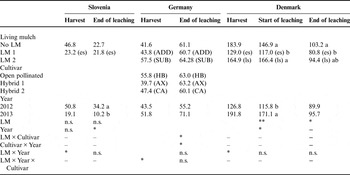
Soil nitrate N was measured in cv. Hannibal at harvest and the end of leaching in the three countries and at the start of leaching in Denmark and Germany in 2013 (Tables 6 and 8), showing interactions of cultivar, LM and/or year on soil nitrate N at harvest in Germany and interaction of LM and year in Slovenia and Denmark (Table 8). The results from separate years showed that differences between systems were observed in the soil nitrate N in Slovenia 2012, Denmark 2013 and Germany 2012 (Table 6).
The effect of living mulch, cultivar and year on the total soil nitrate N (kg ha−1) in leek trials at the harvest, the start of leaching and the end of leaching in three countries.

Note: The * and ** indicate the significant difference at P < 0.05 and P < 0.01, respectively. Different lower case letters indicate significant differences at P < 0.05. The abbreviations given in parentheses indicate design (ADD: Addition design; SUB: Substitution design); sowing date of living mulch (es: Early sown; ls: Late sown) or leek cultivar (HB: Hannibal; AX: Axima; CA: Catcher). The soil nitrate N was measured in the soil layer of 0–0.9 m in Germany (except 2012 at harvest 0–0.6 m), 0–0.9 m in Slovenia and 0–2.5 m in Denmark. The soil nitrate N results from Slovenia and Denmark was only for Hannibal. – indicates not relevant.
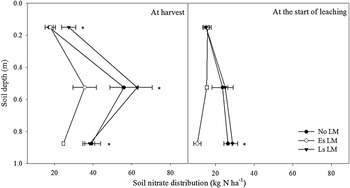
In the Danish trials in 2013, lower soil nitrate N was found at harvest in the early-sown LM compared with the two other systems in the soil layer of 0.3–1 m (early-sown LM: 60 kg N ha−1; late-sown LM and sole crop: 101 and 95 kg N ha−1; P < 0.05) (Fig. 7). At the start of leaching, early-sown LM left 117 kg nitrate-N ha−1 in the 0–2.5 m soil layer, which was lower than the 166 kg ha−1 in the late-sown LM calculated for both years (Table 8). These results are in agreement with hypothesis (3) on reducing the potential nitrate leaching. The soil nitrate N distribution with depth showed a significant difference at the 0.7–1 m soil layer at the start of leaching (Fig. 7). This soil depth was out of the reach of the leek roots, which extend to a maximum of 0.5 m (Kristensen and Thorup-Kristensen, Reference Kristensen and Thorup-Kristensen2007). Therefore, dyer's woad, with root distribution to 2 m (Thorup-Kristensen and Rasmussen, Reference Thorup-Kristensen and Rasmussen2015), took up and decreased soil nitrate N in this soil layer. These differences had almost disappeared by the following spring at the end of the leaching period, when early-sown LM had lower soil nitrate N than the other systems in the soil layer of 1–1.5 m (results not shown).
The soil nitrate distribution in the soil layer of 0–1 m at harvest and at the start of leaching in leek trials with cv. Hannibal in Denmark 2013. The * indicates significant differences at P < 0.05. No LM: Sole crop; Es LM: Early sown LM; Ls LM: Late sown LM.

In Germany, neither the SUB nor the ADD design showed reduction of soil nitrate N at harvest each year, which was not in accordance with hypothesis (2). In Denmark, the delay of sowing dyer's woad decreased the ability of cropping systems to deplete soil N. These results could be ascribed to the lower total N uptake, for example with the lowest total N uptake and the highest soil nitrate N in the SUB design in Germany 2012; and the lowest total N uptake in the late-sown LM system in Denmark in 2013 with the highest soil nitrate N content. Similar results were also found in some cases of the cauliflower trials.
Conclusions
Different introduction strategies of LM could be used to control plant competition and to reduce the potential nitrate leaching, but the performance depended on the intensity of the interspecific competition and the local conditions. In most cases, legumes (white clover, burr medic) sown at the same time as cauliflower or leek transplanting had limited effects on reducing soil nitrate N and negative effects on cash crop N uptake. Late sowing of LM increased the competitiveness of cash crops when competition between cash crops and early-sown LM was strong, and N accumulation of LM (legumes, dyer's woad) was equal to or decreased compared with the early-sown LM. The ADD and SUB designs in cauliflower trials decreased soil nitrate at the start of leaching by 17–33 and 25–33 kg N ha−1, respectively. The SUB design worked better than the ADD design when the interspecific competition was strong. In leek grown in a SUB design with dyer's woad sown 5 weeks after leek transplanting, soil nitrate N was decreased by 55 and 30 kg N ha−1 at harvest and at the start of leaching. Overall, leaving LM in the field until the following spring was a feasible option to reduce soil nitrate N before winter and to reduce the potential leaching in continental and temperate areas. Sowing LM at the same time as crop transplanting in the SUB and ADD designs with root pruning to control the competition should be tested.
Acknowledgements
This study has been performed within the framework of the InterVeg Research Project: Enhancing Multifunctional Benefits of Cover Crops—Vegetables intercropping (Core Organic II ERA-NET).