1. Introduction
Regional Economic Communities (RECs), also called Regional Trade Agreements, have been at the heart of industrializations strategies in Sub-Saharan Africa and have grown in number and membership in recent decades. In an attempt to expand their markets and address regional inefficiencies (economic, political, and geographic), African nations have increasingly leaned on RECs as documented by the rising number of agreements these countries conclude among themselves rather than with countries in the North (de Melo and Tsikata, 2015).Footnote 1 In reality, however, many RECs have endured on paper but waned in practice. Whether due to limited implementation capacity or low political will, most African RECs are not fully implemented and significant obstacles to higher intra-regional trade like tariffs and non-tariff barriers remain.
The East African Community (EAC), the ‘only fully operational customs union in Africa’ (AfDB, 2019: 80), has long been considered a rare example for an African REC that has completely liberalized trade among its member states.Footnote 2 In this paper, we show that EAC members risk undermining this achievement by gradually dismantling the key feature of the customs union: the EAC Common External Tariff (CET), a unified tariff regime eliminating price differentials for imported goods across different EAC markets thereby facilitating and promoting free intra-EAC trade. Crucially, and similar to most other customs unions, EAC members (as well as individual firms) can deviate from the EAC-CET through exemption schemes. However, little is known about the prevalence and nature of these deviations even though they undermine the CET as the key principle of a customs union.Footnote 3
In this paper, we provide the first comprehensive review of such deviations from the EAC-CET. To the best of our knowledge, this is the first systematic exploration of deviations from the CET of a developing-country customs union, and certainly in Africa.Footnote 4 We construct a new dataset of country- and firm-level deviations from the CET at the product level by digitizing information published in the gazettes of the Secretariat of the East African Community covering fiscal years 2009/2010 to 2019/2020. The constructed data set includes 2,580 deviations from the EAC-CET at the country-level and 23,275 deviations of individual firms. Using these data, we document five findings on the state of the EAC-CET and tariff policy in the EAC customs union.
First, increased usage of country-level deviations renders the EAC-CET less and less ‘common’. For the 2017/2018 fiscal year, the last year for which trade data are available, our estimates suggest that more than 4% of imported tariff lines, accounting for about 2% of total EAC import value, entered the EAC under more than one tariff rate (compared to only about 0.5% of imports in 2009/2010). When we apply data on deviations from the most recent fiscal year (2019/2020) to the last year for which trade data are available, this extrapolation suggests that a sizeable 11% of imported tariff lines, accounting for about 7% of total EAC import value, entered the customs union under more than one tariff rate in that year.
Second, Kenya, Tanzania, and Uganda use unilateral deviations to increase external protection while Rwanda makes use of the same mechanism mostly to decrease tariffs. These changes tend to persist due to countries renewing their deviations in subsequent fiscal years.
Third, Kenya, Tanzania, and Uganda increase tariffs for the same broad classes of products (intermediate and final goods) but target different industries.
Fourth, tariff decreases through unilateral deviations at the country level are mostly used to facilitate access to inputs and correct for misclassifications in the EAC-CET, which wrongly assigns tariffs of 25% to a number of goods that should be taxed at 0% or 10% in line with the intended design of the tariff schedule.
Fifth, data on firm-level exemptions suggest that private sector development in the EAC would benefit from lower tariffs on intermediate inputs.
The remainder of this paper is organized as follows. In section 2, we briefly describe our data and the context of our study. In section 3, we present five patterns on tariff policy in the EAC. Section 4 concludes.
2. Context and Data
The EAC-CET is a component of the customs union protocol signed by five members of the EAC: Uganda, Tanzania, Kenya, Rwanda, and Burundi. The regime consists of a three-band system assigning 0% on imports of capital goods, 10% on imports of intermediate inputs, and 25% on imports of final goods.Footnote 5 The rationale of this three-band structure is to allow for affordable access to imported factors of production while offering substantive rates of protection to local industry. Crucially, the CET is the defining tariff regime for all members of the EAC: trade among EAC members is tariff free with bilateral tariffs between member states at zero, while imports originating from countries that export to EAC members under a different tariff regime are negligible.Footnote 6
The CET has two major exemption schemes that allow countries and individual firms to deviate from the common tariff schedule for individual products and specified periods.Footnote 7 The first are country-wide deviations through the Stay of Application (SoA) mechanism, which EAC members can employ to unilaterally decrease or increase tariffs relative to agreed EAC-CET rates. These new tariffs apply to all importers of the good subject to the deviation. The second are firm-level exemptions through the Duty Remission Scheme (DRS). These allow individual, approved firms to import inputs at tariffs lower than those set by the EAC-CET and are often accompanied by quantity restrictions (see example below). Both types of exemptions are subject to approval mechanisms at the EAC level and are announced to the public through gazettes published by the Secretariat of the East African Community. The following are examples for both types of deviations.
Stay of Application: HS-Code 5608.11.00 (‘Made up fishing nets’): Rwanda to stay application of the EAC-CET and apply a duty rate of 10% instead of 25% for one year (cf. EAC, 2016, 3).
Duty Remission Scheme: HS-Code 1701.99.10 (‘White Refined Sugar’): Approved Kenya manufacturers and quantities of sugar for industrial use to be imported at a duty rate of 10% under the duty remission scheme for twelve months. Company ‘ROK Industries Ltd’ allocated 700 metric tonnes for the productions of assorted sweets (cf. EAC, 2019, 4).Footnote 8
In this paper, we create a dataset capturing both types of tariff deviations at the level of the implementing country, fiscal year, and product (as well as the individual firm in the case of the DRS), by digitizing information from all gazettes published by the EAC secretariat between 2009 and 2019. We then combine data on these two types of deviations with the official EAC-CET schedules, detailing product-specific statutory tariffs for about 5,600 goods. The result is a panel dataset of statutory tariff rates for each member of the EAC customs union from fiscal year 2009/2010 to 2019/2020, complete with data on 2,580 country-level deviations from the EAC-CET through the SoAs and 23,275 firm-level deviations through the DRS. Finally, we merge these data with import data from the Trade Map database maintained by the International Trade Centre (Trade Map 2020).Footnote 9 Wherever suitable, we complement our findings at the EAC level with insights from Ugandan customs data.
To the best of our knowledge, this is the first and only dataset on tariff deviations for all five EAC member states. Although applied and statutory tariff rates could be obtained from the customs data of individual countries, creating a panel dataset would require access to these data for each EAC member state and over multiple years. Additionally, although the EAC Secretariat coordinates both the SoAs as well as the DRS, the only public record of these deviations from the CET are the EAC gazettes, which provide this information only as PDFs or in printed form.Footnote 10 Beyond allowing us to document the implementation of the EAC-CET, our project also contributes a valuable research dataset for future work on the EAC customs union.
3. Five Patterns on Tariff Policy in the East African Community
(1) Increased usage of country-level deviations through the SoAs have rendered the CET less and less ‘common’.
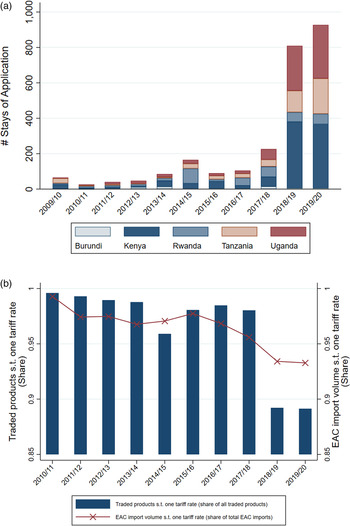
Figure 1(a) shows the evolution of a simple count of granted SoAs per EAC member and fiscal year. The figure demonstrates that the number of approved, country-wide deviations from the EAC-CET has increased significantly over the course of the past decade, from below 100 in 2009/2010 to more than 900 in 2019/2020. Notably, some countries use the scheme more frequently than others; Kenya, Tanzania, and Uganda unilaterally deviate from the EAC-CET for many products, especially in more recent years.Footnote 11 Rwanda is a notable user of SoAs as well but for fewer products. In contrast, Burundi has utilized SoAs from the EAC-CET only for a handful of products in any given year.
(a) Unilateral deviations from the CET have increased substantially and (b) render the CET less ‘common’
Notes: (a) A SoA allows an EAC member to unilaterally deviate from the CET and implement a tariff (higher or lower) for the period of one fiscal year. (b) The left Y-axis expresses the number of imported varieties that entered the EAC customs union under a communal tariff rate. The right Y-axis expresses the import volume that entered the EAC under a communal tariff rate as share of total EAC imports (i.e., it subtracts imports entering under SoAs). Import values for 2018/2019 and 2019/2020 are the ones from 2017 to 2018, the latest year for which these data are available. For Rwanda, import data are only available up to 2013/2014 and aggregate figures for later years exclude Rwanda.

Figure 1(b) explores the impact of this sizeable number of country-specific deviations on two measures of uniformity of the EAC-CET: the number of tariffs lines traded under a uniform rate and the share of imports entering the EAC under a uniform rate. Factoring in country-specific deviations through the SoAs, on the left y-axis of Figure 1(b) we show the number of products that entered the EAC customs union under one tariff rate, expressed as a share of all varieties EAC members imported from outside the region. On the right y-axis, we express the EAC's import volume that enters the union under a single tariff rate as a share of total EAC imports from outside the region. While we do not have import data for 2018/2019 and 2019/2020, we can extrapolate the share of affected import volumes by applying SoAs implemented in those two years to the import volumes of EAC members in 2017/2018. Following this procedure, we estimate that about 7% of all EAC imports entered the customs union under different rates in those two fiscal years (assuming imports in 2017/2018 are a suitable proxy for imports in 2018/2019 and 2019/2020).
These findings demonstrate an incipient but clear trend towards a less communal tariff regime in the EAC customs union. EAC member states have increasingly moved towards national trade policies by implementing tariffs different from those stipulated in the EAC-CET through the SoAs. The result is that a significant share of the union's import volume enters the EAC under different tariff rates. While this estimate relies on an extrapolation, when examining Ugandan customs data for the 2018/2019 fiscal year, we find that those products subject to a SoA contributed about 8.1% to the country's import volume in that year, adding considerable credibility to these estimates.
Besides being contrary to the EAC's mission of trade integration, deviations through the SoA scheme create price differentials of imported goods across different EAC markets that matter for the ability of the EAC to leverage the institution of a CET to boost intra-regional trade. Specifically, sustained differences in the price of imported inputs are likely to encourage ‘trade deflection’, where goods are imported through the EAC member with the lowest tariff and subsequently exported tariff free to other EAC members under the customs union protocol.Footnote 12 To prevent such practices, EAC members would have to implement measures that could significantly impede on intra-regional trade such as temporary or permanent import bans, more restrictive Rules of Origin, burdensome checks and controls for intra-regional shipments, or, probably most concerning, the possibility of re-introducing intra-EAC tariffs.
(2) Kenya, Tanzania, and Uganda predominantly use SoAs to increase external protection while Rwanda makes use of the mechanism mostly to decrease tariffs.
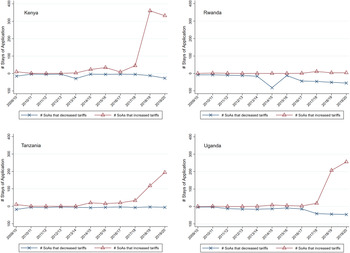
Figure 2 tracks the number of individual SoAs that increased tariffs (in red) and decreased tariffs (in blue), relative to standard EAC-CET rates per fiscal year for Kenya, Tanzania, Uganda, and Rwanda.Footnote 13 As evident from this illustration, Uganda, Kenya, and Tanzania have increasingly made use of the mechanism to increase tariffs. Rwanda has done the opposite and mostly used SoAs to decrease tariffs.Footnote 14
Countries deviate from the CET into different directions
Notes: Omitted are those SoAs that do not unambiguously result in a higher or lower tariff rate on a product. For a small number of cases, the formulation of an SoA in the EAC gazettes is as follows: ‘Sunflower Oil – Kenya to stay application of EAC CET of 25% and apply a duty rate of 25% or USD 500/MT whichever is higher for one year.’ We count these cases as increases as the country moves from a fixed ad valorem tariff to a choice between the same ad valorem tariff or an amount that is higher.

To provide a sense for the magnitude of these tariff reforms, we can again rely on customs data for Uganda. In line with the substantial number of SoAs the country implemented between fiscal year 2014/2015 and fiscal year 2019/2020, the average collected tariff rate on individual shipments increased from 13.96% to 17.40%, an increase of almost 25%. Over the same period, the aggregate applied rate increased by 63% (from 3.29% to 5.36%).Footnote 15
The finding that Tanzania, Kenya, and Uganda strive towards higher tariffs for imports into their domestic markets while Rwanda uses SoAs mostly to lower tariffs bears interesting implications from the vantage point of efficiency and economic development. Tariffs can affect consumer welfare through higher prices of goods (cf. Artuc, Porto, and Rijkers, Reference Artuc, Porto and Rijkers2020) and can affect the development of industry by affecting competition in final goods markets and by regulating the price of imported inputs that are required for competitive production.Footnote 16
(3) Kenya, Tanzania, and Uganda increase tariffs for the same broad classes of products but target different industries.
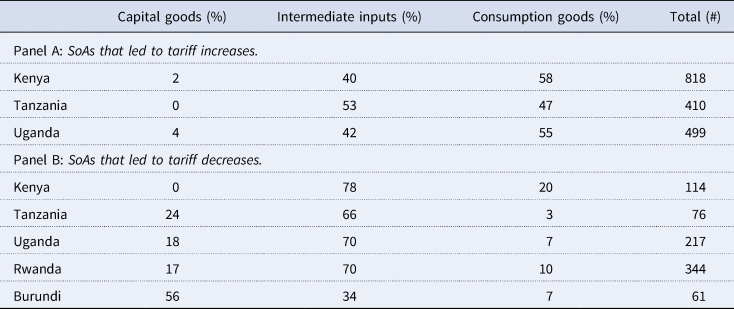
What classes of products and industries do EAC members increase tariffs on using SoAs? To answer this question, we first restrict our data to those SoAs that led to tariff increases and merge the data with the Broad Economic Categories (BEC) taxonomy of goods, allowing us to categorize traded goods in line with their primary end use (capital goods, intermediate inputs, and consumption goods).Footnote 17 We present the result in Table 1, Panel A. We omit Rwanda and Burundi due to the very small number of SoAs these countries implement to increase tariffs.Footnote 18
SoAs by direction of tariff change and end-use of goods

Notes: The table shows per each country the percent of SoAs over the period 2009/2010–2019/2020 that increased tariffs on imports of capital goods, intermediate inputs, and consumption goods (Panel A) or decreased tariffs (Panel B). The total number of SoAs that led to tariff increases is 1,762 and the number of SoAs that led to tariff decreases is 812. Classification in line with the Broad Economic Categories taxonomy of goods. For a small number of cases where the BEC assigns a good into more than one category (e.g., sugar is both an intermediate input as well as a consumption good), we assign the product to the first category. For tariff increases, there are three distinct products that do not have a corresponding BEC categorization. For tariff decreases, the same number is six. We drop unclassified products from the table. All percentages are rounded.
We find that Kenya, Tanzania, and Uganda employ tariff increases almost exclusively to issue higher protection on intermediate inputs and consumption goods (in similar shares), mirroring a desire to shield their domestic industries from global competition. It is important to note that tariff increases on products labelled as ‘intermediate’ are most likely used to protect domestic producers in the same way as higher tariffs on consumption (or final) goods. For example, in 2018/2019, Kenya increased tariffs on a large number of processed steel products such as flat-rolled iron, iron bars, rods, nails and others – goods that the country produces in sizeable volumes and exports to the region. In the BEC taxonomy, these products are labelled as ‘intermediate’ goods, also suggesting that tariffs on such products are likely to hurt downstream industry in EAC members (e.g., the construction sector in the case of steel) while higher tariffs on final/consumption goods may predominantly affect consumers.
Using our data, we are also able to delve into deviations across industry and product categories. We find a few similarities but also striking differences. First, Kenya, Tanzania, and Uganda, all increase tariffs on the imports of base metals (mostly steel products at various stages of processing). However, unlike Kenya, Tanzania and Uganda also issue higher tariffs for the agricultural sector and its downstream industries (e.g., fats and waxes, prepared foodstuffs, and beverages). We also find that all three countries offer higher CET rates of protection for textiles, but Kenya is more consistent and applies higher rates on a much larger number of individual products.Footnote 19
(4) Tariff decreases through the SoAs are mostly used to facilitate access to inputs and correct for misclassifications in the EAC-CET.
Next, we restrict our data to those SoAs used by EAC members to decrease tariffs on imported products. Once again, we split the data into three categories: capital goods, intermediate inputs, and consumption goods (Table 1, Panel B). In terms of absolute numbers, it is noteworthy that Rwanda and Uganda have used SoAs to decrease tariffs on a sizeable number of products over the years while Kenya and Tanzania have made little use of the scheme for this purpose, relative to their excessive use of the scheme to increase tariffs.
In terms of the broad classes of products targeted for tariff reductions, capital goods and intermediate inputs make up the largest share (almost 87% of all cases). This suggests that EAC members use the mechanism to facilitate access to imported factors of production rather than, for example, to improve consumer welfare by lowering prices on consumption goods.Footnote 20 Specifically, our data suggest that countries employ the SoA mechanism to manually correct for ‘misclassifications’ in the CET. To recap, the goal of the three-band system of the CET (0% for raw material/capital goods, 10% for intermediate inputs, and 25% for final/consumption goods) is to make access to imported inputs affordable while at the same time offering substantive protection to local industries. Previous research on the EAC-CET suggests that the regime suffers from issues of misclassification. Many goods that are intermediate inputs and should therefore be subject to the 10% rate are erroneously misclassified as final/consumption goods and subject to the 25% rate. Similarly, a small number of raw materials and capital goods are subject to tariffs greater than zero (cf. Frazer, Reference Felbermayr, Teti and Yalcin2017, 6–7). To assess the extent to which countries use SoAs to correct for such misclassifications, we compare the original CET rates for the products that are subject to tariff reductions with the rates they should have according to the BEC classification: 0% for raw material/capital goods, 10% for intermediate inputs, and 25% for final/consumption goods. We find that 619 out of 812 products (76%) that were subject to tariff decreases through the SoAs over the study period were misclassified in the CET according to the BEC.Footnote 21
Crucially, and related to the first three findings presented in this paper, our data also suggest that deviations from the EAC-CET through SoAs tend to be permanent: Across all EAC members around 76% of SoAs granted in 2017/2018 were still in place two years later, while around 89% of those issued in 2018/2019 were still in place in 2019/2020.Footnote 22
(5) Data on firm-level exemptions through the DRS suggest that private sector development in the EAC would benefit from lower tariffs on intermediate inputs.
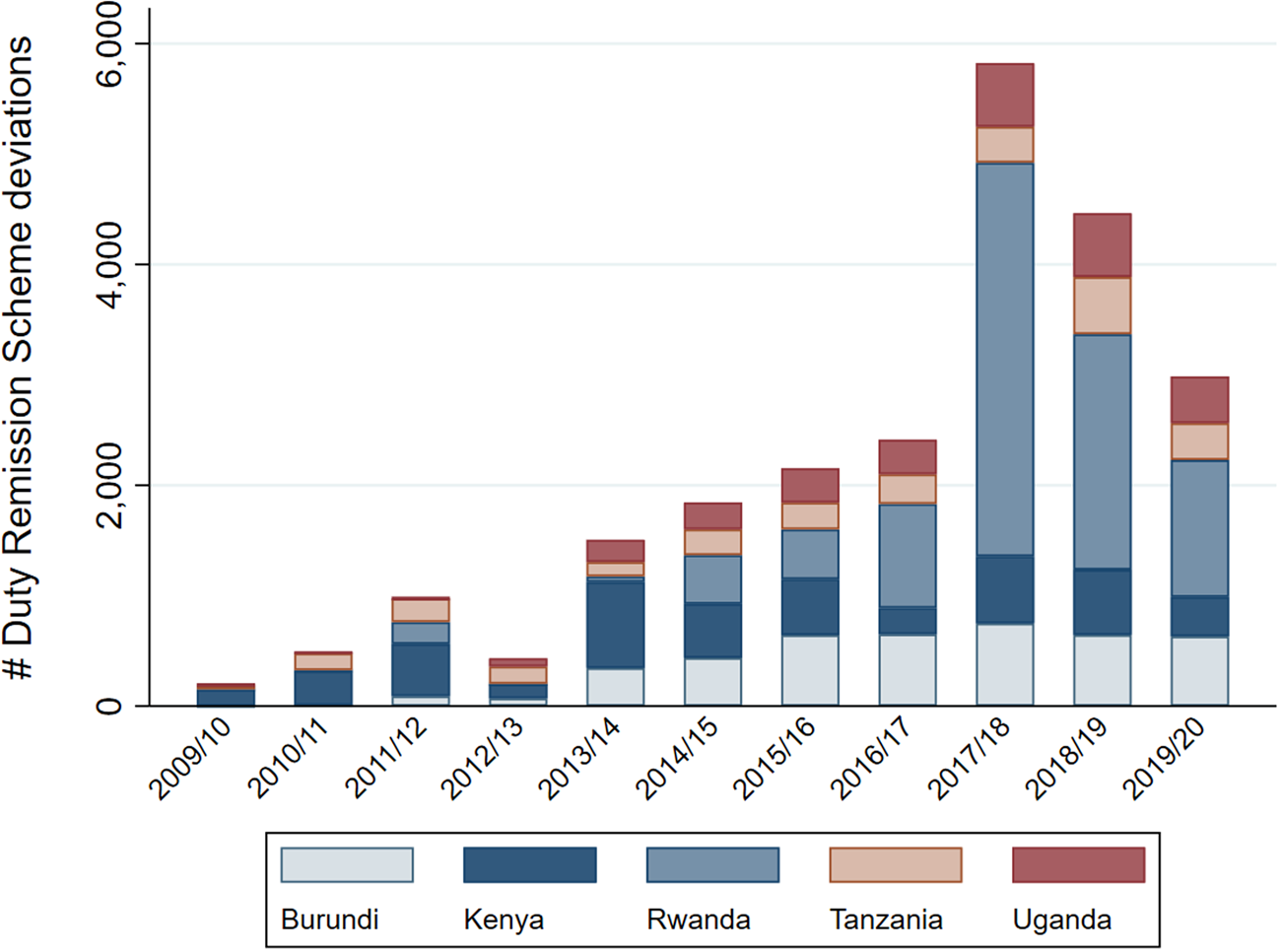
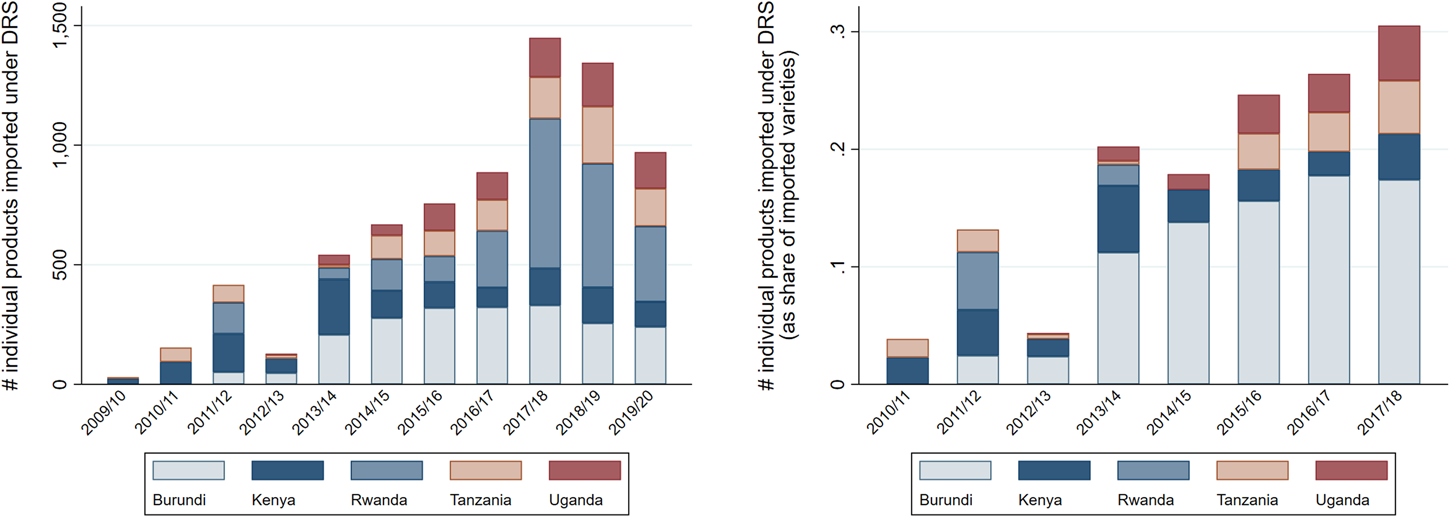
Finally, we explore data on firm-level exemptions from the CET through the EAC's DRS. First, in Figure 3, we offer a simple count of the number of approved firm-level exemptions through the DRS per EAC member and fiscal year.Footnote 23 The number of deviations from the EAC-CET through the DRS has increased substantially over the years. Figure 4 takes a product perspective. The left figure provides a count of the individual products imported under the DRS, while the right figure expresses this number as share of all of a country's imported varieties. For example, Burundi's 331 DRS approved products correspond to a sizeable 7% of all individual goods the country imported from outside of the EAC in the same fiscal year.
DRS exemptions from the CET have increased substantially

An increasing number of individual prodcuts are imported under the DRS
Notes: The left graph shows the number of individual products imported under the DRS. The right graph expresses these as share of individual products imported by an EAC member. For Rwanda, data are only available up to 2013/2014.

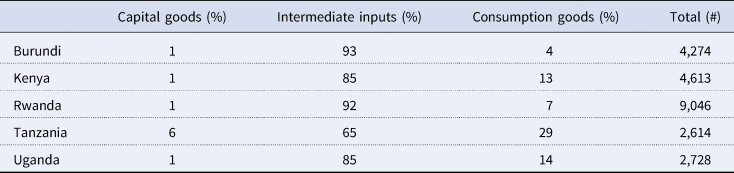
What types of products do firms import under the DRS? Again making use of the BEC classification, Table 2 presents the share of approved DRS exemptions from the EAC-CET per the three broad categories capital goods, intermediate goods, and consumption goods. In line with the purpose of the scheme to facilitate access to inputs for production, the vast majority of deviations are for imports of intermediate inputs. An outlier is Tanzania: only 65% of the country's DRS deviations concern intermediate inputs with a large share of exemptions targeted at consumption goods.Footnote 24
Deviations from the DRS per product category and country

Notes: The table shows per each EAC member the percent of its total DRS deviations over the period 2009/2010–2019/2020 in different product categories. The total number of these exemptions across all EAC members was 23,275. To classify goods into the three categories, we employ the Broad Economic Categories taxonomy of goods. For a small number of cases, the BEC assigns a good into more than one category (e.g., sugar is both an intermediate input as well as a consumption good). For these cases, we assign the product to the first product category. We omit a small number of products that are not classified by the BEC. All percentages are rounded.
An important (if unsurprising) insight from these data is that the private sector of the East African Community seem to reveal a preference for lower tariffs on imported intermediate inputs from outside of the region. However, the number of individual firms with gazetted access to the DRS is very small compared to the size of the private sector in these countries.Footnote 25 This means that a limited number of companies have more affordable access to imported factors of production than existing and potential domestic and regional competitors, potentially undermining competition and entry.
Furthermore, we find inconsistencies in EAC members’ national trade policies that seem to suggest favouritism of individual firms. Specifically, we document a small number of cases where EAC members increased tariffs country-wide through the SoAs while at the same time granting one or more firms access to the very same product at a lower rate through the DRS.Footnote 26 While not numerous, these instances suggest that some firms are able to leverage their political influence to obtain crucial factors of production at competitive prices from abroad, while their (existing and potential) competitors suffer higher tariffs.
4. Concluding Remarks
In this paper, we construct a novel data set of country- and firm-level deviations from the EAC-CET by digitizing information published in the gazettes of the Secretariat of the East African Community between 2009 and 2020. We employ these data to assess the integrity of the EAC-CET, a cornerstone of what is arguably Africa's most successful REC.
We establish the following findings. First, increased usage of country-level deviations renders the Common External Tariff less ‘common’ and large shares of traded products are affected. This departure poses a threat to the customs union's potential to promote regional trade and could impede future efforts to deepen regional integration in the EAC. Second, differences in the use of unilateral deviations show that Kenya, Tanzania, and Uganda strive towards higher protection, while Rwanda employs the mechanism mostly to decrease tariffs. Third, the three countries that increase tariffs through unilateral deviations target the same broad class of products but target different industries. Fourth, in those instances where countries decrease tariffs through these reductions, they predominantly target inputs for production (rather than consumer goods) and are used to manually correct for misclassifications in the CET regime. Fifth, and closely related, data on the DRS suggest that private sector development in the EAC would benefit from lower tariffs on intermediate inputs.
We conclude with three questions for further research:
i) How effective is national and regional tariff policy in the EAC at fostering the development of firms? For example, what is the effect of higher external protection on firm (and sectoral) productivity, exports and employment?
ii) What is the role of access to intermediate inputs for firm performance and does (possibly discriminatory) access to the DRS undermine competition and entry of new firms?
iii) What economic and political forces drive the observed patterns of protection in different EAC members?
Acknowledgements
We thank Paul Brenton, Jaime de Melo, and Richard Newfarmer for great comments, and Philomena Panagoulias for excellent research assistance.