




No CrossRef data available.
Article contents
Caregiver unmet needs, burden, and satisfaction in symptomatic advanced cancer patients at a Veterans Affairs (VA) medical center
Published online by Cambridge University Press: 01 December 2003
Abstract
Objectives: Caregiver outcomes among those caring for symptomatic advanced cancer patients at VA Medical Centers have not been well reported. The purposes of this study were (1) to identify the caregiver characteristics and their unmet needs; (2) to examine the association between caregiver unmet needs, caregiver burden, and caregiver satisfaction; and (3) to identify the independent predictors of different caregiver outcomes.
Methods: One hundred caregivers completed three caregiver outcomes instruments: Family Inventory of Needs (FIN), Care Strain Index (CSI), and Family Satisfaction with Advanced Cancer Care (FAMCARE). The caregivers' demographics and their function, depression, health status, and social support status as well as the caregivers' perception of the patients' unmet needs (PPUN) were obtained. Principal component analysis was performed to examine the underlying dimensions of caregiver outcome measures. Pearson correlation and stepwise multivariate regression analyses were performed.
Results: The median number of unmet needs was 2 and the median CSI score was 4. Most of unmet needs were related to information needs (needing more information related to home care, finding help with the problems at home, and disease prognosis) and symptom management. The majority of caregivers were satisfied or very satisfied by the care patients received. Spouse caregivers (N = 60, 60%) were significantly older (p = 0.006) with higher unemployment rates (p = 0.001), higher depression scores (p = 0.04), and lower social support scores (p < 0.0001) than nonspouse caregivers (N = 40, 40%). The PPUN predicted caregiver burden and the presence of caregiver unmet needs independently. The presence of caregiver unmet needs was the only independent predictor of caregiver satisfaction. Caregivers with a high PPUN and higher depression score experienced a higher burden.
Significance of the research: The caregiver outcome model is proposed and needs to be further validated in a new cohort of caregivers.
Keywords
Information
- Type
- Research Article
- Information
- Copyright
- © 2003 Cambridge University Press
INTRODUCTION
Advanced cancer patients usually experience a significant symptom burden due to disease progression, which can lead to multiple needs for both patients and their caregivers (Chang et al., 2000; Hwang et al., 2003). Needs can be defined as “a wish to receive support with regard to an experienced problem. Problems related to health status and problems related to the quality of health care provided both can evoke needs for further professional care” (Osse et al., 2000, p. 901). The Institute of Medicine National Research Council (2001) and the World Health Organization (Johnston & Abraham, 1995) have recommended approaching both patients and their caregivers as a “unit of care.” Identifying the patients' and their caregivers' unmet needs will assist health care providers in providing the appropriate interventions, and ultimately lead to better palliative care outcomes (Ramirez et al., 1998; Teno et al., 2000). To accomplish this, it is necessary to first understand the needs of patients and their caregivers and how they interact.
We initiated the “Unmet Needs Project” in 1999 at VA New Jersey Health Care System (VANJHCS), section of Hematology/Oncology, (1) to identify symptomatic advanced cancer patients' and their caregivers' unmet needs and their predictors; (2) to assess the association between patient unmet needs and caregiver unmet needs; and (3) to assess the association between caregiver unmet needs, caregiver burden, and caregiver satisfaction. The preliminary patient results showed that the patients were very symptomatic with a median of 14 symptoms and a median of 3 unmet needs. The major unmet needs areas were physical (80%), activities of daily living (49%), nutritional (42%), and emotional (32%). Quality of life (QOL), depression scores, number of symptoms, and symptom distress scores independently predicted the patients' total unmet needs. Patient and caregiver pairwise comparison showed that there was a significant correlation between the patients' total unmet needs and the caregivers' perception of patients' total unmet needs (PPUN; r = 0.40, p < 0.0005; Hwang et al., 2001).
In this article we report the results on the caregiver outcomes. The main objectives of this article were (1) to identify the caregivers' characteristics and their unmet needs, (2) to assess the association between different caregiver outcomes, and (3) to identify the independent predictors of different caregiver outcomes.
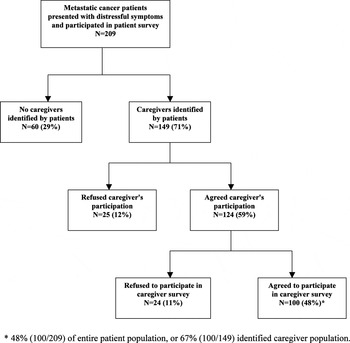
The assessment of caregivers' unmet needs and caregiver burden is based on the stressor theory proposed by Pearlin et al. (Pearlin & Schooler, 1978; Pearlin et al., 1990). According to the stressor theory, caregiver burden is linked to a negative reaction to caregiving and can refer to the physical, psychological, emotional, social, and financial problems that accompany caregiving (Zarit et al., 1985). These problems have the potential to threaten the caregivers' daily routines, and can be therefore considered as stressors (Pearlin & Schooler, 1978; Pearlin et al., 1990). We hypothesized that the caregivers' perception of patients' unmet needs (PPUN) and other variables associated with caregiver characteristics—poorer social support, lower emotional states, poorer health and functional level—would act as stressors, which may have significant impact on caregiver unmet needs. We also hypothesized that the above stressors along with caregiver unmet needs may have significant impact on caregiver burden.
The assessment of caregiver satisfaction is based on the fulfillment theory that the caregiver satisfaction “is a function of the extent to which care needs have been met” (Kristjanson et al., 1995, p. 120). We hypothesized that if caregiver unmet needs are fulfilled, then the caregiver will have better satisfaction.
METHODS
Caregiver Selection
Consecutive advanced cancer patients with distressing symptom(s) seen in the outpatient Hematology/Oncology clinic or from the inpatient Hematology/Oncology service were invited by research associates to participate in the patient survey of the “Unmet Needs Project.” The participating patients then identified their caregiver, defined as “a spouse, adult child, sibling, a parent of patient or non blood-related person identified by the patient as the individual who is most involved in or affected by the patient's illness” (Laizner et al., 1993, p. 114). With the patients' permission their caregivers were invited to participate in the caregiver survey.
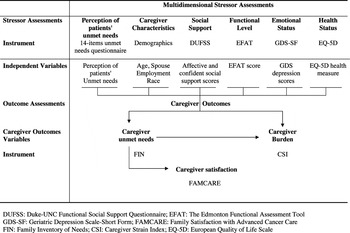
A total of 209 male patients with advanced cancer participated in the patient survey (Hwang et al., 2001). Of 209 patients, 60 patients (29%) identified no caregivers. Of the remaining 149 patients (71%) with caregivers, 25 patients (12%) refused caregiver's participation, and 24 caregivers (11%) refused to participate, which left a total of 100 caregivers (48% of 209 patients, or 67% of 149 caregivers) to participate in the caregiver survey. The caregiver recruitment process is illustrated in Figure 1. Outpatients completed the survey during their clinic visit and the inpatients completed the survey within 2 days of admission. All caregivers completed the demographic information sheet and a set of questionnaires within 48 h after patients participation by personal interview. The caregiver questionnaires required about 20 to 30 min to complete. The VANJHCS is the sole tertiary care teaching hospital providing hematology/oncology services for veterans residing in the state of New Jersey. The Institutional Review Board at the VANJHCS approved all the studies, and all participants signed informed consent prior to study entry.
Instruments
Because the caregiver survey required the administration of a number of instruments, we selected each instrument based on its validity and reliabil-ity and on the ease of administration. The instruments and variables used in this study are also illustrated in Figure 2.

Theoretical frameworks: stressor and fulfillment theories.

Caregiver recruitment process.
The Family Inventory of Needs (FIN; Kristjanson et al., 1995) is a validated 20-item tool that assesses the needs of a patient's family. It was designed to quantify two concepts: importance of family care needs and fulfillment of care needs. The importance of family care needs is defined as the family member's perception of the significance of requirements for care from health professionals. The results lie along a continuum ranging from extremely unimportant (0) to important (10). The fulfillment of care needs is defined as the judgment made by a family member about whether or not his/her perceived needs have been satisfied by health professionals. It is conceptualized as a dichotomous variable with score 0 corresponding to not met and score 1 to met. We asked each caregiver to rate the importance of each need as it relates to their present situation. Then we checked whether each need was currently being met or not.
The Caregiver Strain Index (CSI; Robinson, 1983) is a validated instrument that assesses the caregiver burden as it relates to the following domains: employment, financial, physical, social, and time. There is one overall score obtained by summing the “yes” responses. The index measures objective burden, but does not measure subjective burden.
The 14-item needs questionnaire (Houts et al., 1988), which assesses caregivers' perception of patients' unmet needs (PPUN), was adapted from a survey identifying cancer patient needs. It assesses 14 areas of need: physical, activities of daily living, nutrition, reactions to treatments, emotional, life purpose, social, family, financial, insurance, getting health care, medical staff, home health care, and transportation. The formats of the questions were the same for all need areas. First we asked the caregiver if he/she thought the patient had any problems within each domain. If respondents answered “yes,” then they were asked if this was “very much, some, or a little problem” and “was additional assistance with this problem very helpful, somewhat helpful, or not at all helpful.” Responses were scored as indicating an unmet need when the respondent replied that the patient experienced either very much or some problem and if the additional assistance would have been either very helpful or somewhat helpful. The number of unmet needs is the total number of areas scored as an unmet need.
The Family Satisfaction with Advanced Cancer Care (FAMCARE; Kristjanson, 1993) conceptualizes caregivers' attitudes ranging from very satisfied to very dissatisfied. FAMCARE is a 20-item Likert-type scale (ranging from 1 to 5; very dissatisfied to very satisfied) and measures the degree to which family members are content with health care provider behaviors directed toward the patient and themselves. The possible range of scores is 20–100. There are four subscales: information giving (5 items), availability of care (4 items), psychosocial care (4 items) and physical patient care (7 items).
The Edmonton Functional Assessment Tool (EFAT; Kaasa et al., 1997) is designed to evaluate functional performance of patients. It assesses the status of 10 functions: communication, pain, mental status, dyspnea, sitting or standing balance, mobility, walk or wheelchair locomotion, activities of daily living, fatigue, and motivation. Each item in the EFAT is evaluated by a 4-point rating scale from 0 to 3 (0 = functional independent performance; 3 = total loss of functional performance). A total possible score on the EFAT is 30.
The Geriatric Depression Scale–Short Form (GDS-SF; Lesher & Berryhill, 1994) is a 15-item scale developed as a basic screening measure for depression in older adults. Each item is scored either 0 or 1. Although differing sensitivities and specificities have been obtained across studies, for clinical purposes a total score greater than 5 is suggestive of depression and warrants a follow-up interview. Scores equal to or greater than 10 almost always signify depression. We chose this instrument because it is easy to administer. The Cronbach's alpha coefficient was 0.77 for the study population.
The European Quality of Life Scale (EQ-5D; Brazierm et al., 1993) covers five dimensions of health: mobility, self-care, usual activities, pain/discomfort, and anxiety/depression. There is a visual analogue 0–100 scale to assess the overall evaluation of the current state of health. In this study, we used only the 0–100 health scale to assess the perception of the health state.
The Duke-UNC Functional Social Support Questionnaire (DUFSS; Broadhead et al., 1988) is an 8-item, self-administered, multidimensional, functional social support questionnaire. Each item is scored from 1 to 5 with two subscales: affective support (3 items) and confident support (5 items).
Statistical Analysis
The caregiver characteristics, employment status, and relationship with patients were summarized in descriptive statistics.
Principal component analysis was performed to examine the underlying dimensions of the PPUN, CSI, FIN unmet needs subscale, and FAMCARE. All four scales were analyzed together to determine the extent to which these measures were mutually orthogonal. The Cronbach's alpha coefficient was assessed for each measure to determine its internal consistency.
The caregivers were further split into spousal (n = 60) and nonspousal (n = 40) caregiver groups to form stratified comparisons on the outcome measures by using chi square or t tests.
To measure the caregiver's unmet needs, the mean importance score and the prevalence of each FIN item were tabulated; the FIN unmet needs subscale was obtained. To measure caregiver burden, the prevalence of each CSI item was obtained and tabulated.
Pearson correlation was calculated between the FIN unmet needs subscale, PPUN, FAMCARE, and CSI scores for the entire sample and for the spousal and nonspousal caregiver groups.
We performed an exploratory univariate analysis to identify the important variables of each caregiver outcome variable. We then performed a multiple stepwise regression analysis to identify the independent predictors of caregiver unmet needs (FIN unmet needs subscale), caregiver burden (CSI), and caregiver satisfaction (FAMCARE).
For the FIN unmet needs subscale, the model included race, PPUN, and EFAT function score. For CSI, the model included employment status, PPUN, FIN unmet needs subscale, GDS-SF depression score, and confident social support score. For FAMCARE, the model included FIN unmet needs subscale, race, EQ-5D health measure, age, and FIN unmet needs subscale.
RESULTS
Caregiver Demographics
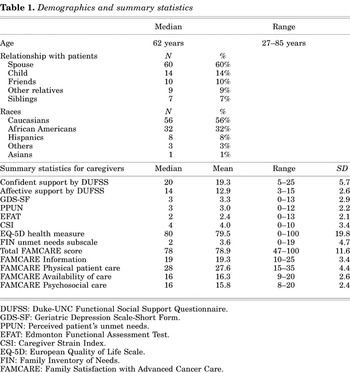
Of the 100 caregivers who participated in the study, 97 were women and 3 were men. There were 56 Caucasians and 44 were African Americans. Relationships with patients were spouse in 60, child in 14, sibling in 7, friend in 10, and other relative caregiver in 9. The median age was 62 years (range 27 to 85). Sixty-six caregivers were unemployed, 23 had a full-time job, and 11 had a part-time job.
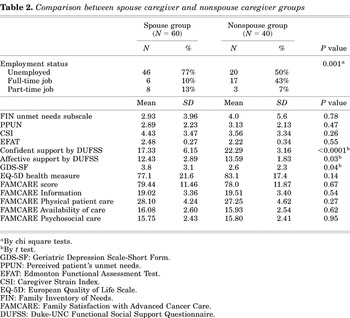
The spouse caregivers were significantly older (64.4 vs. 56.7 years, p = 0.006), with a significantly higher unemployment rate (77% vs. 50%, p = 0.001) than the nonspouse caregivers.
Caregivers' Depression, Functional Status, Health, and Social Support Scores
The mean score of caregiver GDS-SF was 3.3 (SD 2.86), EFAT 2.4 (SD 2.1), EQ-5D health 79.5 (SD 19.9), confident social support 19.3 (SD 5.69), and affective social support 12.9 (SD 2.58). Based on the GDS-SF cutoff point, 20 caregivers were at risk for depression (GDS-SF > 5; see Table 1). The spouse caregivers showed significantly higher risk of developing depression (28% vs. 8%, χ2 = 6.18, p = 0.01), a higher GDS-SF score (mean 3.78 vs. 2.57, p = 0.04), and lower confident (mean 17.33 vs. 22.29, p < 0.0001) and affective (mean 12.43 vs. 13.59, p = 0.03) social support scores relative to the nonspouse caregivers (Table 2).
Demographics and summary statistics

Comparison between spouse caregiver and nonspouse caregiver groups

Construct Validity, Internal Consistency, and Summary Statistics of Different Caregiver Measures
The rotated factor patterns showed that the items from PPUN, FIN unmet need subscale, CSI, and FAMCARE clearly loaded on different factors and suggested that these scales were measuring separate conceptual constructs.
The Cronbach's alpha coefficients were 0.74 for PPUN, 0.92 for FIN unmet needs subscale, 0.84 for CSI, and 0.95 for FAMCARE.
Perception of Patients' Unmet Needs (PPUN)
The medium PPUN was 3 (range 0–12) and the most frequently perceived patient unmet needs areas were physical (80%), nutritional (51%), activity of daily living (44%), and emotional (33%). There was no difference in the prevalence of each unmet need area between spouse and nonspouse caregivers.
Caregiver Unmet Needs Results (FIN Unmet Needs Subscale)
All the need items in the FIN were considered “important” with the mean importance score ranging from 8.34 (have someone be concerned with my health) to 9.91 (have explanations given in terms that are understandable).
The median number of unmet needs FIN unmet needs subscale was 2 (range 0 to 19) and 10% of caregivers had more than 10 unmet needs. The most frequently reported caregiver unmet needs were “having information about what to do for the patient at home” (37%), “knowing when to expect symptoms to occur” (31%), “being told about people who could help with problems” (26%), and “knowing the probable outcome of the patient's illness” (26%; Table 3).
Results of Family Inventory of Needs

Caregiver Satisfaction Results (FAMCARE)
FAMCARE scores showed that most caregivers were satisfied or very satisfied about the care patients received with a mean total FAMCARE score of 78.9. The subscales scores are summarized in Table 1. There were no differences in FAMCARE scores between the spouse and nonspouse caregivers (Table 2).
Caregiver Burden Results (CSI)
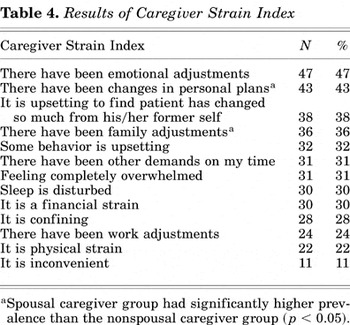
The CSI scores ranged between 0 and 12 with a median of 4 with 25% of caregivers scoring higher than 6. The most frequently reported burdens were “emotional adjustments” (46%), “changes in personal plans” (43%), and “upsetting to find the patient has changed so much from his/her former self” (38%; Table 4).
Results of Caregiver Strain Index

Spouse caregivers were nearly twice as likely as the nonspouse caregivers to endorse the two items: “There have been family adjustments” (45% vs. 24%, p = 0.04) and “There have been changes in personal plans” (52% vs. 29%, p = 0.03).
Associations between PPUN, FIN Unmet Needs Subscale, CSI, and FAMCARE
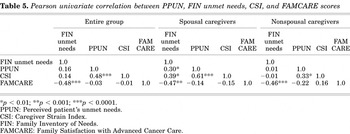
For the entire group and for the spouse and nonspouse caregivers, significant associations were found between FIN unmet needs subscale and FAMCARE (r = −0.48 and −0.46, p < 0.0001 and = 0.003, respectively), and between caregiver burden (CSI) and caregiver's perception of patient's unmet needs (PPUN; r = 0.48 and 0.33, p < 0.0001 and = 0.04, respectively; Table 5).
Pearson univariate correlation between PPUN, FIN unmet needs, CSI, and FAMCARE scores

However, for the spouse caregiver group, FIN unmet needs subscale not only correlated significantly with FAMCARE (r = −0.47, p = 0.0003), but also with PPUN (r = 0.30, p = 0.02) and CSI (r = 0.39, p = 0.003), and the CSI also correlated significantly with PPUN (r = 0.61, p < 0.0001).
Independent Predictors of CSI, FAMCARE, and FIN Unmet Needs
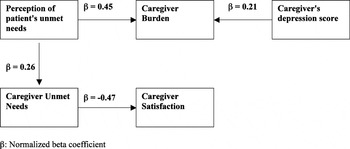
Stepwise regression analysis showed that the PPUN (β = 0.45, p < 0.0001) and the GDS-SF depression score (β = 0.21, p = 0.03) independently predicted CSI (R2 = 0.29, p < 0.00001). The PPUN also predicted the FIN unmet needs subscale independently (β = −0.26, p < 0.0001; R2 = 0.25, p < 0.00001). For FAMCARE, the independent predictor was the FIN unmet needs subscale (β = 0.47, p < 0.01; R2 = 0.12, p < 0.008). The results are illustrated in Figure 3.

Proposed caregiver outcome model.
DISCUSSION
Many cancer caregiver studies have reported the caregivers needs/unmet needs and caregiver burden in advanced cancer patients receiving hospice care (Steele & Fitch, 1996; Payne et al., 1999; Andrews, 2001), in end-of-life care settings (Rose, 1999; Harding & Higginson, 2001), and in general oncology patients (Siegel et al., 1991; Soothill et al., 2001). We studied the caregivers of symptomatic metastatic cancer patients in a VA medical oncology setting. To the best of our knowledge, this is the first article that describes the caregivers' characteristics and examines the suitability of these instruments to assess outcomes of caregivers of advanced cancer patients seen at a VA Medical Center.
Approximately one third of our patients identified no caregivers and only 67% of caregivers participated in the caregiver survey. Compared with other reports, the caregivers in our study were older, with a lower employment rate (Siegel et al., 1991; Harrington et al., 1996; Payne et al., 1999). These differences may reflect the unique characteristics of our veteran patient population. The veteran patients are not only older with a higher mortality rate (Fisher & Welch, 1995), but are also in the lower 10% of the socioeconomic strata (Harris et al., 1989). They also have poorer health status scores compared with non-VA populations (Kazis et al., 1998).
The results of our study suggest that spouse status may be a modifier for associations among some caregiver variables and outcomes. In our study, the spouse caregivers are not only older with higher unemployment rates, but also have higher depression scores, greater caregiver burden, and lower social support scores. These findings suggest that spouse status should be included in analyzing caregiver outcomes as a stratifying or interaction variable in future studies.
The study results provide data that support the construct validity and internal reliability of the FIN unmet needs subscale, CSI, and FAMCARE. The correlation coefficients may help with assessing the degree of similarity between the instruments. Choice of an appropriate instrument will depend on the clinical or research question at hand.
Caregivers in our study had a relatively low number of unmet needs (median number of 2) and a low level of caregiver burden (median CSI of 4). Only about 10% of our caregivers had more than 10 unmet needs and about 25% of caregivers had a CSI score higher than 6. Most of the unmet needs were related to information needs (needing more information related to home care and to disease prognosis and finding help with the problems at home) and symptom management. These results are supported Hileman et al. (1992), who reported most unmet needs were related to psychological aspects, information, and patient care. Other studies have shown that caregivers often encounter difficulties while trying to obtain information from health care professionals (Dyck & Wright, 1985; Wilson & Morse, 1991; Bascom & Tolle, 1995), despite the fact that accessibility of disease-related information is a critical element in helping a caregiver to cope with the patient's illness (Gotay, 1984). Carefully designed studies to examine the impact of an informational intervention on caregivers' unmet needs is needed.
The PPUN was the strongest independent predictor of caregiver burden, followed by the caregiver's depression score. These findings are partially supported by other studies. Siegel et al. (1991) reported that greater caregiver burden was associated with a greater risk for encountering unmet needs among advanced cancer patients. Although caregiver characteristics such as younger age (Houts et al., 1988; Payne et al., 1999), female gender (Payne et al., 1999), and being employed (Houts et al., 1988) have been associated with higher caregiver burden, our results did not support these findings. Our VA sample tends to be more homogeneous than those study samples in age, gender, and employment as the patient population largely consists of retired older male veterans. These unique population characteristics are likely to be a factor limiting our ability to replicate some of these previous findings.
Caregiver satisfaction is another frequently used outcome variable. The FIN unmet needs subscale was the only independent predictor of the outcomes of the FAMCARE scale. This is supported by the proposed fulfillment theory that satisfaction is a function of the extent to which care needs have been met. The lack of association between FAMCARE and CSI and between FAMCARE and PPUN was not expected. Although the FAMCARE is a validated tool, the usefulness of FAMCARE in different study populations has not been well reported. The construct underlying the FAMCARE emphasizes satisfaction with aspects of medical care given to the patient, such as diagnosis, availability of health professionals, and information. It omits domains related to caregiver burdens and nonmedical needs. In retrospect, it is not surprising that there was little correlation, reemphasizing the importance of careful instrument evaluation.
In this study, we explored the association between PPUN and different caregiver outcomes. Based on these analyses, the caregiver outcome model for caregivers of symptomatic advanced cancer patients is proposed and outlined in Figure 3. Further validation with larger sample size is needed.
There are some limitations in our study. First, the study was conducted at a VA Medical Center and the results may not be generalizable to other populations. Second, the conclusions were drawn from a small sample size and need to be interpreted with caution. Third, 97% of caregivers were females. Further studies including both genders in community settings with large sample sizes can effectively address these limitations.
In summary, the caregivers in our study, who were older with higher unemployment rate, need more information or education about patients' disease conditions and clinical prognoses. We confirmed the validity and reliability of caregiver outcome measurements. The caregivers' perception of the number of patients' unmet needs is an independent predictor for caregiver burden and caregiver unmet needs. Caregivers who perceive a greater number of patients' unmet needs and who have a greater depression score experience a higher caregiver burden. The caregiver's own unmet needs was the only factor associated with caregiver satisfaction.
ACKNOWLEDGMENTS
The authors thank Ms. Helen Yan for data entry and verification.
This study was partially supported by the New Jersey Commission on Cancer Research, Grant Award No. CCR-01-56-EO and by VA HSR&D, Grant Award No. PCC 98-068-02. Preliminary results were presented at the Annual Scientific Meeting of the American Society of Clinical Oncology at Orlando, Florida in 2002.
The views expressed herein do not necessarily reflect the views of the Department of Veterans Affairs or of the U.S. Government.
References
REFERENCES
Andrews, S.C.
(2001).
Caregiver burden and symptom distress in people with cancer
receiving hospice care.
Oncology Nursing Forum,
28,
1469–1474.Google Scholar
Bascom, P.B. &
Tolle, S.W.
(1995).
Care of the family when the patient is dying.
The Western Journal of Medicine,
163,
292–296.Google Scholar
Brazierm, J.,
Jones, N., &
Kind, P.
(1993).
Testing the validity of the Euroqol and comparing it with the SF-36
Health Survey questionnaire.
Quality of Life Research,
2,
169–180.Google Scholar
Broadhead, W.E.,
Gehlbach, S.H.,
De Gruy, & F.,
et al.
(1988).
The Duke-UNC Functional Social Support Questionnaire: Measurement
of social support in family medicine patients.
Medical Care,
26,
709–723.Google Scholar
Chang, V.T.,
Hwang, S.S.,
Feuerman, & M.,
et al.
(2000).
Symptom and quality of life survey of medical oncology patients at
a Veterans Affairs Medical Center. A role for symptom assessment.
Cancer,
88,
1175–1183.Google Scholar
Dyck, S. &
Wright, K.
(1985).
Family perceptions: The role of the nurse throughout an
adult's cancer experience.
Oncology Nursing Forum,
12,
53–56.Google Scholar
Fisher, E.S. &
Welch, H.G.
(1995).
The future of the Department of Veterans Affairs health care system.
Journal of the American Medical Association,
273,
651–655.Google Scholar
Gotay, C.C.
(1984).
The experience of cancer during early and advanced stages: The
views of patients and their mates.
Social Science & Medicine,
18,
605–613.Google Scholar
Harding, R. &
Higginson, I.
(2001).
Working with ambivalence: Informal caregivers of patients at the
end of life.
Supportive Care in Cancer,
9,
642–645.Google Scholar
Harrington, V.,
Lackey, N.R., &
Gates, M.F.
(1996).
Needs of caregivers of clinic and hospice cancer patients.
Cancer Nursing,
19,
118–125.Google Scholar
Harris, R.E.,
Hebert, J.R., &
Wynder, E.L.
(1989).
Cancer risk in male veterans utilizing the Veterans Administration
medical system.
Cancer,
64,
1160–1168.Google Scholar
Hileman, J.W.,
Lackey, N.R., &
Hassanein, R.S.
(1992).
Identifying the needs of home caregivers of patients with cancer.
Oncology Nursing Forum,
19,
771–777.Google Scholar
Houts, P.S.,
Yasko, J.M.,
Harvey, & H.A.,
et al.
(1988).
Unmet needs of persons with cancer in Pennsylvania during the
period of terminal care.
Cancer,
62,
627–634.Google Scholar
Hwang, S.S.,
Chang, V.T.,
Alejandro, & Y.,
et al.
(2001).
Unmet needs, depression, and symptom distress in advanced cancer patients
and their impact on caregiver burden at a VA medical center.
Proceedings American Society of Clinical Oncology,
20,
395a
(Abstract 1576).Google Scholar
Hwang, S.S.,
Chang, V.T.,
Fairclough, & D.L.,
et al.
(2003).
Longitudinal quality of life in advanced cancer patients: Pilot
study results from a VA medical cancer center.
Journal of Pain and Symptom Management,
25,
225–235.Google Scholar
Institute of Medicine National Research Council.
(2001).
Improving palliative care for cancer: summary and recommendations.
National Academy Press,
Washington, DC.
Johnston, G. &
Abraham, C.
(1995).
The WHO objectives for palliative care: To what extent are we
achieving them?
Palliative Medicine,
9,
123–127.Google Scholar
Kaasa, T.,
Loomis, J.,
Gillis, & K.,
et al.
(1997).
The Edmonton functional assessment tool: Preliminary development
and evaluation for use in palliative care.
Journal of Pain and Symptom Management,
13,
10–19.Google Scholar
Kazis, L.E.,
Miller, D.R.,
Clark, & J.,
et al.
(1998).
Health-related quality of life in patients served by the Department
of Veterans Affairs.
Archives of Internal Medicine,
158,
626–632.Google Scholar
Kristjanson, L.J.
(1993).
Validity and reliability testing of the FAMCARE Scale: Measuring
family satisfaction with advanced cancer care.
Social Science & Medicine,
5,
693–701.Google Scholar
Kristjanson, L.J.,
Atwood, J., &
Degner, L.F.
(1995).
Validity and reliability of the Family Inventory of Needs (FIN):
Measuring the care needs of families of advanced cancer patients.
Journal of Nursing Measurement,
3,
109–126.Google Scholar
Laizner, A.M.,
Yost, L.M.,
Barg, & F.K.,
et al.
(1993).
Needs of family caregivers of persons with cancer: A review.
Seminars in Oncology Nursing,
9,
114–120.Google Scholar
Lesher, E.L. &
Berryhill, J.S.
(1994).
Validation of the Geriatric Depression Scale–Short Form among
inpatients.
Journal of Clinical Psychology,
50,
256–260.Google Scholar
Osse, B.H.,
Vernooij-Dassen, M.J.,
de Vree, & B.P.,
et al.
(2000).
Assessment of the need of palliative care as perceived by
individual cancer patients and their families.
Cancer,
88,
900–911.Google Scholar
Payne, S.,
Smith, P., &
Dean, S.
(1999).
Identifying the concerns of informal carers in palliative care.
Palliative Medicine,
13,
37–44.Google Scholar
Pearlin, L.I. &
Schooler, C.
(1978).
The structure of coping.
Journal of Health and Social Behavior,
19,
2–21.Google Scholar
Pearlin, L.I.,
Mullan, J.T.,
Semple, & S.J.,
et al.
(1990).
Caregiving and the stress process: An overview of concepts and
their measures.
The Gerontologist,
30,
583–594.Google Scholar
Ramirez, A.,
Addington-Hall, J., &
Richards, M.
(1998).
ABC of palliative care. The carers.
British Medical Journal,
316,
208–211.Google Scholar
Robinson, B.C.
(1983).
Validation of a caregiver strain index.
Journal of Gerontology,
38,
344–348.Google Scholar
Rose, K.
(1999).
A qualitative analysis of the information needs of informal carers
of terminally ill cancer patients.
Journal of Clinical Nursing,
8,
81–88.Google Scholar
Siegel, K.,
Raveis, V.H.,
Houts, & P.,
et al.
(1991).
Caregiver burden and unmet patients needs.
Cancer,
68,
1131–1140.Google Scholar
Soothill, K.,
Morris, S.M.,
Harman, & J.C.,
et al.
(2001).
Informal carers of cancer patients: What are their unmet
psychosocial needs?
Health & Social Care in the Community,
9,
464–475.Google Scholar
Steele, R.G. &
Fitch, M.I.
(1996).
Needs of family caregivers of patients receiving hospice care for
cancer.
Oncology Nursing Forum,
23,
823–828.Google Scholar
Teno, J.M.,
Okum, S.N.,
Casey, & V.,
et al.
(2000).
Toolkit of instruments to measure end of life care (TIME), Resource
Guide: Achieving quality of care at life's end. Brown University.
Available at
http://www.chcr.brown.edu/pcoc/toolkit.htm.
Wilson, S. &
Morse, J.M.
(1991).
Living with a wife undergoing chemotherapy.
Image—Journal of Nursing Scholarship,
23,
78–84.Google Scholar
Zarit, S.H.,
Orr, N.K., &
Zarit, J.M.
(1985).
The burden victims of Alzheimer's disease: Families under
stress.
New York:
University Press.
Theoretical frameworks: stressor and fulfillment theories.
Caregiver recruitment process.
Demographics and summary statistics
Comparison between spouse caregiver and nonspouse caregiver groups

Results of Family Inventory of Needs
Results of Caregiver Strain Index
Pearson univariate correlation between PPUN, FIN unmet needs, CSI, and FAMCARE scores
Proposed caregiver outcome model.
 You have
Access
- 100
- Cited by