The idea that the protection of property rights is of utmost importance for economic growth and financial development has become extremely influential in economics in recent years. In a famous article, Douglass North and Barry Weingast argue that institutions and property rights are the reason why Britain was the first country to undergo an industrial revolution and to embark on modern economic growth.1
North and Weingast, “Constitutions.”
The discussion of institutions and property rights has spread far beyond Britain of the seventeenth and eighteenth centuries. In a series of studies that have dramatically changed the academic discourse in financial economics, Rafael La Porta, Florencio Lopez de Silanes, Andrei Shleifer, and Robert Vishny argue that countries whose legal system is of the British common law tradition offer better protection to outside investors.2
La Porta, Lopez de Silanes, Shleifer, and Vishny, “Legal Determinants” and “Law.”
Levine and Zervos, “Stock Markets.”
Acemoglu, Johnson, and Robinson, “Rise.”
Before proceeding, we emphasize that the present study does not attempt to challenge the importance of “good” institutions and of well-established property rights for economic growth and financial development. The evidence presented in this article suggests, however, that the notion that financial markets swiftly reward countries for the establishment of investor-friendly institutions is not grounded in historical facts, both for the case of Britain after the Glorious Revolution, and for other historical examples (for example, nineteenth-century Japan).5
North and Weingast, “Constitutions,” p. 805, seem to suggest that institutional changes in seventeenth-century Britain did bring about an immediate change—“In just nine years … government borrowing increased by more than an order of magnitude … reflect(ing) a substantial increase in the perceived commitment of the government … .”
More specifically, we use several newly constructed series on British interest rates throughout the eighteenth century to contrast two conjectures. The first, in the spirit of North and Weingast's work, suggests that the institutional reforms of the late seventeenth century should have led to a low cost of British government debt, both relative to earlier periods and relative to other European governments.6
North and Weingast, “Constitutions.”
Especially Sussman and Yafeh, “Institutions”; and Mauro, Sussman, and Yafeh, “Emerging Market Spreads.”
Our empirical analysis of Britain's cost of debt is based on several newly constructed (and reconstructed) measures of British interest rates starting in the late seventeenth century and continuing throughout the eighteenth century. The analysis takes into account explicitly the fact that Britain's cost of debt was affected not only by the perception of property rights by local investors, but also by the perception of Britain's creditworthiness by foreign investors, most notably in Amsterdam. We therefore study changes in interest rates in Britain and the Province of Holland between the late seventeenth and the late eighteenth centuries, taking into account the existence of international capital movements from Holland to Britain.8
On the interaction between financial markets in Amsterdam and in London see Wilson, Anglo-Dutch Commerce; Dickson, Financial Revolution; Neal, Rise of Financial Capitalism; and Oppers, “Interest Rate Effect.”
Our main empirical results are the following. First, we show that the level of interest rates in Britain continued to be fairly high for several decades following the Glorious Revolution, and increased substantially in response to the outbreak of military conflicts. Moreover, we find that during the period 1690–1720, much of Britain's government debt was illiquid, casting doubt on the conjecture that the development of financial markets was due to the development of a secondary market for government debt soon after the institutional changes of the late seventeenth century.9
On the liquidity of British government debt, see also Carlos, Neal, and Wandschneider, “Origins.”

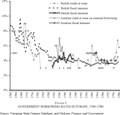
FIGURE 1a ESTIMATES OF THE COST OF DEBT, BRITAIN 1690–1790

FIGURE 1b THE INTEREST RATE DIFFERENTIAL, BRITAIN VS. THE PROVINCE OF HOLLAND, 1690–1790
Second, as can be expected in global open financial markets, we find that interest rate dynamics in Britain were often shared by Holland as well. Moreover, some of our statistical tests suggest that interest rates in Britain were determined, to a large extent, by the volume of borrowing in Holland and by interest rates there.10
Oppers, “Interest Rate Effect,” shows, using a different methodology, that Dutch lending was important in keeping British borrowing rates low until the 1770s. A comparison with interest rates in France would have been interesting, but, to the best of our knowledge, data are not available for the early eighteenth century. Existing evidence on French interest rates in the second half of the eighteenth century is discussed below.
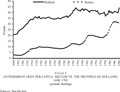
Third, moving from prices (interest rates) to quantities (volume of debt), we find that, on a per-capita basis, Holland continued to be a larger borrower than Britain for the entire eighteenth century.
Finally, although the British government could certainly borrow from foreign investors, a comparison of Britain's cost of debt with that of several other European countries suggests that Britain did not borrow at very different rates from other countries.
These findings notwithstanding, there is no doubt that British capital markets became important in the second half of the eighteenth century. The long time lag between the institutional reforms of the late seventeenth century and the emergence of London as the world's main financial center suggests that the link between the two is, at best, a long-run phenomenon; even if institutions do affect interest rates and financial development, the effect tends to be slow. Moreover, it is not impossible that the development of financial markets in Britain was in response to developments other than institutional reforms, such as political changes, improved debt management techniques, or newly developed asset-trading networks.11
On political changes, see Stasavage, Public Debt; on debt management, see Riley, Seven Years War; and on asset trading networks, see Carlos, Neal, and Wandschneider, “Origins.”
Going beyond Britain, the conclusion that financial markets do not reward positive institutional changes in the short run seems to hold also for a number of other historical examples that are discussed below, such as nineteenth-century Japan and other “emerging markets” of the 1870–1914 era of globalization. Indeed, there is little evidence that financial markets ever rewarded the establishment of the “right” institutions with a swift reduction in the cost of capital, or that countries with good institutions could borrow at lower costs than countries without institutional investor protection. We conclude that the link between institutions and ability to borrow appears to be more complex than what some of the literature on institutions might imply.
A LITERATURE SURVEY
The present article is related to several previous studies on the changes in Britain's financial markets starting in the late seventeenth century and on the institutional changes of that period. Writing long before North and Weingast, John Ramsey McCulloch describes the determinants of interest rates in Britain as follows: “In the beginning of the funding system, the term fund meant that the taxes or funds (were) appropriated to the discharge of the principal and interest of loans …. Owing perhaps, to the scarcity of disposable capital, but far more owing to the supposed insecurity of the Revolutionary establishment (our own emphasis), the rate of interest paid by the government in the early part of the funding system was comparatively high. But, as the country became richer, and the confidence of the public in the stability of the government was increased, ministers were enabled to take measures for reducing the interest, first in 1716 and then in 1749.”12
McCulloch, Dictionary, p. 585.
Moving to more recent studies, one related line of research has focused on the evolution of private (nongovernment) interest rates in Britain. Gregory Clark, for example, examines private (real) rents on agricultural land.13
Clark, “Political Foundations.”
Quinn, “Glorious Revolution's Effect”; and Temin and Voth, “Private Borrowing.”
Wells and Wills, “Revolution.”
Carlos, Neal, and Wandschneider, “Origins.”
In addition to these attempts to provide evidence based on British interest rates, several studies cast some doubt on the relative importance of institutional changes in the protection of property rights, in comparison with other institutional changes in seventeenth- and eighteenth-century Britain. John Brewer, for example, attributes Britain's economic and military success to the emergence of a strong government, which he views as the most important transformation that took place at the time.17
Brewer, Sinews.
O'Brien, “Fiscal Exceptionalism.”
Riley, Seven Years War.
Ferguson, Cash Nexus.
Stasavage, “Credible Commitment,” Public Debt, and “Partisan Politics.”
Allen, “Progress.”
Roseveare, Financial Revolution.
Beyond Britain, the present study is also closely related to studies of the relation between the cost of capital, institutional changes, and political events more generally. Robert Barro and J. F. Wright document the relationship between long-term interest rates and wars for the eighteenth and nineteenth centuries.24
Barro, “Government Spending”; and Wright, “British Government Borrowing.”
Epstein, Freedom, chapter 2.
Velde and Weir, “Financial Market.”
Summerhill, “Political Economics” and “Inglorious Revolution.”
Sylla, “Financial Systems.”
Sussman and Yafeh, “Institutions.”
METHODOLOGY AND DATA
Methodology
Our investigation of the evolution of Britain's cost of government debt during the century that followed the Glorious Revolution begins around 1690, and makes use of several newly constructed and reconstructed interest rate and government debt series, which are described in the next subsection. Methodologically, as noted in the introduction, a central feature of the present article is the treatment of Britain as an international borrower, whose cost of capital is calculated relative to that of the Province of Holland. This approach does not necessarily require that Holland be viewed as a completely risk free borrower; it is sufficient to acknowledge that Holland was an established borrower by the end of the seventeenth century, whereas Britain a relatively new one. This view is certainly consistent with descriptions of the Dutch Republic (sixteenth through eighteenth centuries) by Jan de Vries and Ad van der Woude as the “first modern economy,” whose society, economic efficiency, urbanization, and educated workforce were admired by contemporary and later observers.30
de Vries and van der Woude, First Modern Economy.
To study the dynamics of the determination of interest rate on government debt we use a VAR (vector auto-regression) analysis describing the relation between interest rates in Britain and the Province of Holland in more detail:


In this specification, interest rates in London are determined by a weighted average of lagged interest rates in London and Amsterdam (denoted by i) and by a vector of additional explanatory variables (denoted by X).
Modern uncovered interest rate parity specifications relate the interest rate differentials to expected depreciation and to country risk. In practice, for nearly 90 years, between 1698 and 1785, the British pound-Dutch schilling (Banco) exchange rate was virtually constant, fluctuating slightly within a very narrow band of 34 to 37 schilling per pound (European State Finance Database). It is therefore reasonable to assume that the expected depreciation was zero, so that changes in relative interest rates should reflect primarily changes in the risk premium.
The control variables we use in the estimation of the determinants of the risk premium on British government debt are in line with the modern literature on emerging market risk premia.31
See Mauro, Sussman, and Yafeh, Emerging Markets.
Exports in absolute figures or exports per capita can be used instead of the trade surplus without changing the empirical results.
Another macroeconomic variable that we examine is inflation, which turns out to be insignificant, perhaps because this variable did not vary much during the period.
Data Issues
In support of their argument that there exists a relation between interest rates and institutional reforms, North and Weingast provide evidence on a decline in interest rates on British government debt following the Glorious Revolution.34
North and Weingast, “Constitutions.”
Part of the rise in the volume of trade on the London Stock Exchange during the period was related to the South Sea Bubble. There is no doubt that the bubble had ramifications that did not lead to financial development that could contribute to economic growth, and, in fact, it led to popular resentment that hindered the growth of British equity markets for over a century. In particular, the Bubble Act of 1720 limited the use of joint stock companies (Neal, Rise of Financial Capitalism, p. 62). For further details on the South Sea “Scheme,” see, for example, Roseveare, Financial Revolution, chapter 6. Recently, Carlos, Neal, and Wandschneider, “Origins,” suggest that a possibly positive effect of this episode was an improved microstructure of trading on the London Stock Exchange and greater liquidity of securities markets.
Data constraints have made the design of a more precise test of the determinants of the cost of government debt in the seventeenth and eighteenth centuries virtually impossible. High frequency time series of government borrowing rates or government bonds yields are available only starting in 1753, when British Consol prices become available for the first time (although annuity prices are available earlier). Attempts to bridge this gap have generally followed three different routes. The first is based on examinations of interest rates on private loans, and attempts to infer from them whether or not interest rates declined starting in the late seventeenth century.36
See, for example, Clark, “Political Foundations”; Quinn, “Glorious Revolution's Effect”; and other studies mentioned in the literature review.
Buchinsky and Polak, “Emergence.”
The second route is based on substitute financial assets from which inference is made about government borrowing rates. Thus, Wells and Wills use the Bank of England shares as a proxy for government bonds, an approach which requires that the Bank of England stock be correlated with British government bonds.38
Wells and Wills, “Revolution.”
The third approach is based on using the fragmentary available data on the cost of government debt at issue. This series (first compiled by P. G. M. Dickson using British Parliamentary Papers, 1890–1891 and 1898) has been used more recently by Clark and Stasavage.39
P. G. M. Dickson, Financial Revolution; Clark, “Debt”; and Stasavage, Public Debt.
According to McCulloch, Dictionary, this form of borrowing became a feature of British debt management during the reign of George II (starting 1727). It continued into the twentieth century.
See North and Weingast “Constitutions and Commitment,” pp. 823-824. The discussion on p. 823 suggests that with the issue of 3 percent bonds, Britain achieved a permanent decline in government borrowing rates.
Rather than follow one of the existing routes in the literature, we construct a novel fiscal measure of Britain's cost of capital, the ratio of debt service payments to total government debt. This variable is constructed by dividing total government debt service expenditures (from Brian Mitchell) by a newly constructed total debt series, which includes both long-term and short-term debt obligations.42
Mitchell, British Historical Statistics.
British Parliamentary Papers, History. Because Mitchell, British Historical Statistics, provides data for fiscal years whereas the information in the British Parliamentary Papers is listed per calendar year, there may be minor dating discrepancies. See a comment on this issue in Dickson, Financial Revolution, p. 525.
The calculation of short-term debt is more involved; short-term notes were issued by the Exchequer (“Tallies” or IOUs) and by the Army and Navy, and were not fully accounted for in the British Parliamentary Papers.
44British Parliamentary Papers, History.
Mitchell, British Historical Statistics; and Dickson, Financial Revolution, p. 525.

. Starting in 1704, we use the short-term debt series provided by Dickson which includes the Exchequer “Tallies” and IOUs (called “Fictitious Loans”).
46Dickson, Financial Revolution.
Dickson, Financial Revolution.

We complement this fiscal measure of Britain's cost of debt by constructing, using the British Parliamentary Papers, a yield at issue series of actual interest rates on newly issued debt, which is conceptually similar to that of Dickson but takes into account the discount at which bonds may have been sold.48
British Parliamentary Papers, History; and Dickson, Financial Revolution.
Finally, to verify the robustness of the results we report, we calculate yet another proxy for the government's cost of debt—the coupon interest rate on long-term bonds, which includes both “funded” and “unfunded” long-term debt. (The term “unfunded” means that no specific tax revenues were earmarked for repaying this debt).
All of the measures we use have shortcomings: The fiscal proxy for the cost of debt, the ratio of debt service to total debt, measures the average (not marginal) cost of debt. In the first years following the Glorious Revolution this average is highly influenced by the short duration of the debt, and therefore the series may exhibit more volatility than in subsequent years when marginal debt issues affect the average much less. On the other hand, this volatility conveys important information to the extent that it reflects the inability of the government to borrow at reasonable long-term rates in those years. Another possible shortcoming is that the debt service series for the initial years may also include debt redemptions, causing an upward bias in the series. In practice, there were no substantial redemptions before the second decade of the eighteenth century, so this is unlikely to constitute a significant problem.
The yield at issue series captures the marginal cost of long-term borrowing faced by the government, but because the government did not borrow in every year, this series has missing observations for 21 years. In addition, the series does not take into account the cost of short-term debt.
The interest rate on long-term debt also ignores the substantial short-term debt in the beginning of the sample period; after 1712, when much of the short-term debt was refinanced, the series becomes very similar to the fiscal series.
The three series, together with annuity prices between 1731 and 1753, followed by daily market Consol yields are presented in Figure 1a.49
Annuity prices are from Sinclair, History, appendix 2, pp. 28–33. Consol yields are from European State Finance Database. In addition to the shortcomings listed above, none of the measures takes into account the fact that lenders to the British government in the early years were often the Bank of England or the East India Company, which were granted monopolies, partly in exchange for providing loans. Ignoring this form of repayment may lead to an under-estimate of the cost of British government debt; see Broz and Grossman, “Paying for Privilege.”
From Castaing, Course.
We now turn to variables other than measures of the British government's cost of debt which are used in this study. Data on Britain's population, total government expenditure, and exports are all drawn from Mitchell.51
Mitchell, British Historical Statistics.
Although precise data are not available, in the eighteenth century the Province of Holland accounted for about 60–70 percent of total Dutch debt, and its population, around 800,000, constituted about 40 percent of the total population in the Netherlands (based on private communication with Wantje Fritschy).
In comparing British to Dutch interest rates, differences in monetary standards between the two countries may be an issue. The use of a fiscal proxy for interest rates (nominal interest payments divided by nominal debt) mitigates this concern, because interest rates are not expressed in terms of a currency unit. Nevertheless, the Dutch Gulden, which was based on a silver standard, was stable from 1681—each Gulden contained 9.61 grams of silver. Following the Glorious Revolution, the British currency, which at the time, was also based on a silver standard, was clipped and large quantities of silver were exported. In 1696 the British currency was stabilized, and in 1717 the value of the gold guinea in terms of silver was reduced by Newton from 21.5 to 20 shillings, thus putting Britain on a de-facto gold standard.
de Vries and van der Woude, First Modern Economy.
EMPIRICAL ANALYSIS AND RESULTS
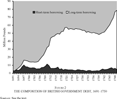
Before turning to a detailed discussion of Britain's cost of capital, we briefly discuss the liquidity of government debt using The Course of the Exchange. Surprisingly, although this source provides continuous quotes on equity prices and exchange rates, it rarely quotes prices or yields of long-term government bonds. Table 1 shows the fraction of long-term government bonds quoted relative to the total number of outstanding bonds in public hands: the market for these bonds was extremely illiquid, almost nonexistent.55
See Carols, Neal, and Wandshneider, “Origins,” for a description of the development of a liquid market for British government debt in the second and third decades of the eighteenth century.
North and Weingast, “Constitutuions.”
WARS, REFORMS, AND BRITAIN'S COST OF CAPITAL IN THE EIGHTEENTH CENTURY
Figure 1b displays the interest rate differential (“spread” in modern parlance) between British government debt and debt issued by the Province of Holland using the fiscal cost of capital series. Early in the eighteenth century, when Britain was involved in the War of the Spanish Succession, the spread was very high and volatile. It began to decline in 1709, and especially in 1711–1712 when short-term debt was converted into capital of the South Sea Company, but the spread remained positive until around 1730.57
See also Dickson, Financial Revolution, pp. 474–75.
We now turn to a more detailed discussion of the decline in British interest rates (and spreads) between 1711 and 1730. As noted, part of the decline during this period coincided with the use of the South Sea Company as a mechanism to refinance the expensive government debt issued following the Glorious Revolution (conversion to cheaper government bonds was apparently impossible). The first debt refinancing in 1711—when creditors were to be incorporated as the South Sea Company—involved 9.2 million pounds of short-term debt in arrears.58
Somewhat in contrast with the importance that Stasavage, “Partisan Politics,” attributes to Whig governments, it was the Tory government of Harley which initiated this conversion scheme.

FIGURE 2 THE COMPOSITION OF BRITISH GOVERNMENT DEBT, 1691–1750
The second refinancing scheme of 1719 involved about 22 million pounds of debt; as a result, annual interest payments were reduced by 415,000 pounds.59
The converted debt carried an interest rate of about 7 percent, which was reduced to 5 percent on government debt obligations held by the South Sea Company. For more detailed data on the South Sea conversion scheme, see Dickson, Financial Revolution, appendix B.
In sum, the institutional changes of the seventeenth century clearly did not suffice to guarantee a permanently low cost of capital for the British government. A comparison with the pre–Glorious Revolution borrowing rates would have been interesting, but it is made difficult by the fragmentary nature of the available data. Nevertheless, Roseveare cites interest rates of about 7 or 8 percent for the 1670s, and in some cases interest rates of 6 percent were observed as well, figures which are lower than those for the early decades of the eighteenth century (Figure 1a).60
Roseveare, Financial Revolution.
In order to shed further light on Britain's financial development, Figure 3 portrays government debt per capita in pounds for Britain and the Province of Holland during the eighteenth century (see the European State Finance Database for the exchange rate). It is evident that the government of Holland could borrow relatively more than her British counterpart without paying higher interest rates: despite the large increase in British government borrowing, as late as 1749, on the eve of issuing the first Consols, debt per capita in Holland was almost three times as large as in Britain.61
See also Riley, International Government Finance.
See also Dickson, Financial Revolution, p. 483, on the common trends of British (government and private) bonds and bonds of the Province of Holland. Neal, Rise of Financial Capitalism, discusses the financial integration of the two countries in the eighteenth century.

FIGURE 3 GOVERNMENT DEBT PER CAPITA: BRITAIN VS. THE PROVINCE OF HOLLAND, 1698–1790 (pounds Sterling)

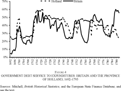
FIGURE 4 GOVERNMENT DEBT SERVICE TO EXPENDITURES: BRITAIN AND THE PROVINCE OF HOLLAND, 1692–1795
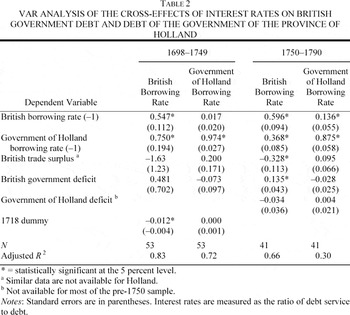
Moving to a more formal treatment of the relation between interest rates in Britain and Holland, Table 2 displays the results of the VAR analysis, which suggest that the cost of debt of the government of Holland affected the cost of debt of the British government. During the first half of the eighteenth century the effect of interest rates in Holland on the cost of British debt was particularly pronounced. By contrast, Dutch interest rates prior to 1750 were not very sensitive to British rates.63
During this period, other potential determinants of British interest rates such as the export surplus or the government deficit are insignificant.
The regression specification includes a dummy variable for the beginning of the second refinancing of government debt through the South Sea Company after 1718. The regression does not include the trade surplus for the Province of Holland which is not available; the government deficit for Holland is available only after 1727 and is therefore included in the later sample regressions only.

Taken together, the empirical evidence we present suggests that the fruits of the institutional reforms of the seventeenth century did not affect the London financial market immediately; over half a century was needed for these changes to be reflected in the market. This conclusion is consistent with that of Nicholas Crafts who describes the early decades of the eighteenth century as a period in which “there were institutional weaknesses related to banking, finance and company legislation which must have had some inhibiting effects both on savers and on business investment.”65
Crafts, “Industrial Revolution,” p. 52. See also Allen, “Great Divergence,” on the standards of living in London and on the Continent in that period, and Clark “Debt,” and “Conditions” who does not identify any “break” in British growth rates and standards of living in the seventeenth century. In fact, Clark, “Conditions,” p. 1313, shows explicitly that growth slowed down at the end of the seventeenth century, a fact which he describes as an “uncomfortable revelation” for economists who see institutions as the explanation for growth.
For an early treatment of this issue, see Wilson, Anglo-Dutch commerce.
ADDITIONAL EVIDENCE FROM AROUND THE WORLD
Moving from eighteenth-century Britain to Continental Europe, we briefly discuss the fragmentary available evidence on the cost of borrowing of several other European countries, see Figure 5. Data on Austrian external borrowing rates (in Amsterdam and elsewhere), drawn from Dickson and the European State Finance Database, suggest that this absolute monarchy borrowed at rates that were similar to those of Holland and far lower than the British cost of debt early in the eighteenth century.67
Dickson, Finance and Government, volume 2.
According to Dickson, Finance and Government, volume 2, pp. 402–15, Austrian borrowing in the first half of the eighteenth century and during the Seven Years War was secured by taxes and proceeds from silver mines, a feature which may have lowered the Austrian cost of capital. However, in Britain, too, specific taxes were earmarked for debt repayment as late as 1748 (Dickson, Financial Revolution, p. 242), so that there was no fundamental difference between the two countries in this respect in the first half of the eighteenth century. Like British bonds, Austrian bonds starting in 1764 were typically of long maturity (10–20 years), albeit not perpetuities.
Riley, International Government Finance.
Kroner, “Public Debt,” shows that interest rates for Switzerland in the second half of the eighteenth century were comparable to, or even lower than, those of Austria and Holland. Both Denmark and Switzerland managed to borrow at long maturities.
Velde and Weir, “Financial Market.”
Stasavage, Public Debt.
Velde and Weir, “Financial Market.”
Riley, International Government Finance.

FIGURE 5 GOVERNMENT BORROWING RATES IN EUROPE, 1700–1780
We now turn to the nineteenth-century experience of two belligerent regimes, Tsarist Russia and the Ottoman Empire. For these regimes, that did not advocate the rule of law, the absence of secure property rights was not much of a constraint when it came to foreign borrowing—both countries were among the largest borrowers in the 1870–1914 period.75
Stone, Global Export; and Mauro, Sussman, and Yafeh, Emerging Markets.
Moving away from Europe, the conclusion that institutional changes in Britain were not immediately translated into a lower cost of government debt is in line with our earlier findings.76
Sussman and Yafeh, “Institutions.”
Mauro, Sussman, and Yafeh, “Emerging Market Spreads,” table 5.
CONCLUDING REMARKS
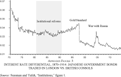
The main conclusion that emerges from the present study is that financial markets do not reward countries for institutional reforms in the short run. “Good” institutions may well be important for long-run growth, but the mechanism relating institutions and growth is apparently something other than an immediate reaction of financial markets and a reduction in the cost of capital. By contrast, financial markets do respond immediately to domestic instability and to major wars. This was the case in eighteenth-century Britain, and this was the case a century and a half later in Meiji Japan; in both cases, it was not a constitution that made a big impact on the cost of government debt. We believe that Britain's ascendancy to a position of supremacy in Europe and in the world was the outcome of very long processes, perhaps related to the development of the legal system, science, and government tax collection. The evidence on the importance of the Glorious Revolution and the institutional changes of the seventeenth century as a turning point remains elusive.
Appendix


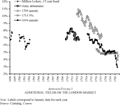
Appendix Figure 1 ADDITIONAL YIELDS ON THE LONDON MARKET

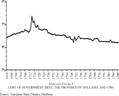
Appendix Figure 2 COST OF GOVERNMENT DEBT, THE PROVINCE OF HOLLAND, 1692–1789

Appendix Figure 3 INTEREST RATE DIFFERENTIAL, 1870–1914: JAPANESE GOVERNMENT BONDS TRADED IN LONDON VS. BRITISH CONSOLS

An earlier version of this article was circulated under the title “Constitutions and Commitment: Evidence on the Relation between Institutions and the Cost of Capital,” CEPR Discussion Paper No. 4404. We wish to thank Wantje Fritschy for her comments and advice regarding the Dutch data. We are also grateful to Greg Clark, Stefano Fenoltea, Niall Ferguson, Knick Harley, Simon Johnson, Gary Libecap, Jacob Metzer, Joel Mokyr, Petra Moser, Yona Rubinstein, Andrei Shleifer, Richard Sylla, Peter Temin and to seminar participants at Bar Ilan University, Harvard Business School, Harvard Economic History Workshop, Queen's University, Stanford University, Tel Aviv University, UC Berkeley, University of Toronto, University of Western Ontario, the IMF Research Department, the 2003 Economic History Association meeting, the conference “From Stagnation to Growth” (St. Gallen) and the CEPR conference “The Building Blocks of Effective Financial Systems” (Rome) for helpful comments and suggestions. Earlier work on this article was carried out during Yishay Yafeh's stays at the Berglas School of Economics, Tel Aviv University, the Institute of Economic Research, Hitotsubashi University, and the Department of Economics of the University of Montreal, whose hospitality is gratefully acknowledged.