INTRODUCTION
There is a paucity of published information on the occurrence of dolphins and whales off the Atlantic coast of Guinea in West Africa, and no dedicated literature exists. In an extensive review of fisheries–cetacean interactions from the West African coast by Maigret (Reference Maigret1994), no evidence was reported from its 300 km coastline stretching from Guinea-Bissau in the north (coastal border at 10°55′N 15°03′W) to Sierra Leone in the south (coastal border at 09°02′N 15°18′W) (Figure 1). The Soviet vessel RV ‘Evrika’ surveyed the Guinean coast in May–July 1984 and mapped five sightings of unidentified coastal dolphins within the 200 m isobath (two within the 20 m isobath) plus an unidentified whale between the 200 and 500 m isobaths (Anonymus, 1984). A few cetacean sightings in Tormosov et al. (Reference Tormosov, Budylenko and Sazhinov1980), although possibly relevant for Guinean waters, lack coordinates and, plotted as large symbols on a small-scale map of Africa, do not allow reliable interpretation. Jefferson et al. (Reference Jefferson, Curry, Leatherwood and Powell1997) cited and considered Guinea as a possible range state for five small cetaceans based on the literature, as reviewed below.
The coastal area of Guinea with locations for ten fully documented cetacean records (landings, strandings, one sighting) and one unidentified baleen whale (see text). Abbreviations used: Megaptera novaeangliae (M.nov), Balaenoptera brydei (B.bry), Balaenoptera acutorostrata (B.acu), Tursiops truncatus (T.tru), Sousa teuszii (S.teu), Kogia breviceps (K.bre) (satellite images ©2009 Google, ©2010 TerraMetrics, ©2010 Europa Technologies).

In May 2000, the Guinean Ministry of Agriculture, jointly with the Convention on the Conservation of Migratory Species of Wild Animals (CMS), organized a regional workshop in Conakry on the conservation and management of small cetaceans from West Africa, in which several of the authors participated. The meeting called for, inter alia, the inventory of cetacean species, the collection, treatment and compilation of data for each range state, and improved surveillance and regulation of fisheries with respect to by-catches (Archer & Van Waerebeek, Reference Archer and Van Waerebeek2000; CMS, 2000). Circa 2001, Guinea's Centre National des Sciences Halieutiques de Boussoura (CNSHB) embarked on a pioneering effort to collect basic field data, evaluate evidence from various sources and produce a first inventory of cetacean biodiversity, the results of which we present below.
MATERIALS AND METHODS
Cetacean records documented here result mainly from observations achieved during irregular, often opportunistic, surveys of fishers' communities by CNSHB personnel in 2001–2003, typically in follow-up on verbal accounts received from local agents stationed in key fish landing sites. Most study material originated from stranding and by-catch events as documented by voucher specimens, photographs, video and descriptions of diagnostic features. An exhaustive literature search yielded a minimal amount of additional substantiated information. References were traced back to their original sources and any claims based on distributional inference rather than observational data were not further considered. A cetacean morphologist (K.V.W.) critically examined all available evidence. Distances between locations were computed with GPS Mapsource 6.4 software (©2004 Garmin Corporation). ‘West Africa’ is used sensu the UN definition, i.e. the westernmost region of Africa, from Mauritania south and east to Nigeria. Records are plotted (Figure 1) on a satellite hybrid map of the study region (©2009 Google).
Study area
Guinea has a tropical climate with alternating dry and rainy seasons. Thanks to physical factors including shallow waters, a strong tidal regime and pronounced seasonal pluviosity, large parts of the coastal zone are covered in extensive mangrove forests. The continental shelf of almost 43,000 km2 represents the greatest submerged surface off the West African coast. Its width varies from 87 nautical miles (161 km) in the south to 104 nautical miles (193 km) in the north (Rougeron, Reference Rougeron1996). Guinea's seabed consists of muds and sandy muds, containing terrigenous particles deposited by several rivers (Postel, Reference Postel1955; Domain & Bah, Reference Domain and Bah1993). Beyond the 20 m isobath, sandy bottoms predominate. On the edge of the old submarine valleys, especially in the north, the sea bottom is characterized by the presence of exposed rock formations (ridins) up to 5 m high, hazardous to bottom trawling. In the rainy season (April–November) south-westerly winds predominate. Always north of the equator, the warm, south-eastward-flowing Guinea Current changes position with the seasons so that its northern limit lies at approximately 7°N during the winter and 15°N during the summer. Sea surface temperatures, averaging 28–29°C, show little seasonal variation. Surface salinity exceeds 32.0‰ on the coast and steeply increases to 35.5‰ further offshore.
RESULTS
Family Delphinidae Gray, 1821
ATLANTIC HUMPBACK DOLPHIN SOUSA TEUSZII (KÜKENTHAL, 1892)
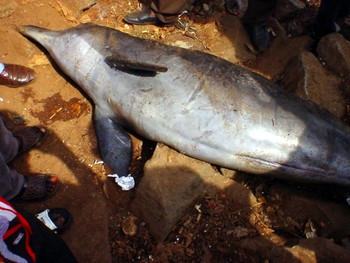
Although thought to be widely distributed in Guinea (Cadenat, Reference Cadenat1956a, Reference Cadenat1959) the only documented S. teuszii specimen is a 222-cm male (Figure 2) landed by artisanal fishers at Dixinn (09°33′N 13°40′W; ‘S.teu’ in Figure 1), baie de Sangaréah, on 13 March 2002 (Van Waerebeek et al., Reference Van Waerebeek, Barnett, Camara, Cham, Diallo, Djiba, Jallow, Ndiaye, Samba Ould Bilal and Bamy2004). The animal's sexual organs, stored in formalin, are deposited at CNSHB. No other recent sightings have been reported but marine biologist Jean Cadenat (Reference Cadenat1956a, p. 558) stated [literal translation from French] ‘the characteristic shape of the dorsal fin of this species and its colour pattern […] make me think today that the delphinids which showed exactly these characteristics and which I could observe in January 1953 in the silt-laden inshore waters of French Guinea, south of Conakry, must also belong to the species Sotalia teuszii’. This account, although not authenticated, is credible considering Cadenat had ample first-hand expertise with the species. Van Waerebeek et al. (Reference Van Waerebeek, Barnett, Camara, Cham, Diallo, Djiba, Jallow, Ndiaye, Samba Ould Bilal and Bamy2004) provisionally defined a ‘South Guinea’ management stock. Two of us (I.L.B. and K.V.W.) interviewed fishermen in the Baie de Sangaréah area in April 2006 who described dolphins matching the diagnostic features of humpback dolphins as occasionally entangled in their nets. It is unclear whether the Cadenat (Reference Cadenat1959) claim of the species being ‘very common’ off Guinea is still valid today.
A male Atlantic humpback dolphin, Sousa teuszii, for sale at the fish landing site of Dixinn, Baie de Sangaréah, on 13 March 2002.

COMMON BOTTLENOSE DOLPHIN TURSIOPS TRUNCATUS (MONTAGU, 1821)
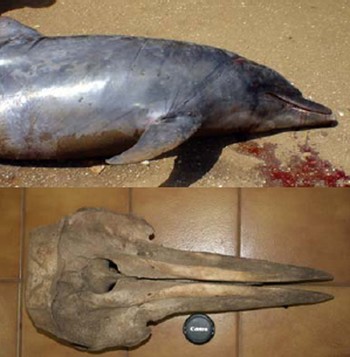
A 340 cm adult female was landed in fresh condition at Bonfi, Salatougou, 200 km north-west of Conakry (13°18′N 09°03′30″W; ‘T.tru1’ in Figure 1) on 10 March 2002. The dolphin, a by-catch victim, showed net marks on the dorsum and anterior flanks. This specimen is the first documented T. truncatus record for Guinea and represents a new country record (Figure 3). The skull and a full set of standard cranial measurements are deposited at CNSHB. Considering slightly eroded occipital condyli in the Bonfi specimen, its minimum condylobasal length (CBL) of 556 mm is consistent with adult CBL ranges of 540–610 mm (Robineau & Vely, Reference Robineau and Vely1997) and 504–578 mm (Ross, Reference Ross1984) for Senegal and southern Africa respectively. The high values found for CBL and rostrum length (335 mm) are in accordance with the elongate rostra noticeable even in some free-ranging T. truncatus from West Africa (e.g. Van Waerebeek et al., Reference Van Waerebeek, Bamy, Jiddou, Sequeira, Diop, Ofori-Danson, Tchibozo and Campredon2008).
A common bottlenose dolphin, Tursiops truncatus, landed at Bonfi on 10 March 2002 and its skull, deposited at the CNSHB reference collection. Diameter of scale (lens cap) is 60 mm.

A second T. truncatus by-catch was landed in fresh state at the port of Boulbinet (09°30′11″N 13°42′53″W; ‘T.tru2’ in Figure 1), Conakry, on 11 December 2005, and was examined by a CNSHB team led by S.T. Diallo on 12 December 2005. It was briefly reported but without diagnostic evidence (Diallo et al., Reference Diallo, Bah and Sow2007). On 9 March 2010, from a photograph archived at CNSHB, K.V.W. could confirm the species as T. truncatus.
ATLANTIC SPOTTED DOLPHIN STENELLA FRONTALIS (G. CUVIER, 1829)
M.E. Postel harpooned a ~2-m dolphin at an unspecified distance and position from Conakry (port at 09°30′N 13°43′W; ‘S.fro’ in Figure 1) on 3 January 1953 and collected the head. It was assigned to the genus Prodelphinus Gervais 1880 (Cadenat, Reference Cadenat1956b, Reference Cadenat1959; Cadenat & Lassarat, Reference Cadenat and Lassarat1959) which is a junior synonym for Stenella Gray, 1866. Low tooth counts (32LL, 34LR, 32UL and 33UR), numerous large black spots on the lower jaw and below the eye, white spots on the otherwise dark dorsal side of the head and an upturned tip of the mandibles (see figure 27 in Cadenat Reference Cadenat1956b; and figures 39 & 40 in Cadenat, Reference Cadenat1959) confirm the dolphin belongs to Stenella frontalis (G. Cuvier, 1829). Apparently the head was taken to Senegal and deposited at the Musée de la Mer, Institut Fondamental d'Afrique Noir (IFAN), Ile de Gorée (Cadenat, Reference Cadenat1959). When studying and re-organizing the cetacean collection at that museum in 1999, one of us (K.V.W.) assigned a new catalogue number ‘SN80’ to a slightly damaged mummified dolphin head without associated reference (Van Waerebeek et al., Reference Van Waerebeek, Ndiaye, Djiba, Diallo, Murphy, Jallow, Camara, Ndiaye and Tous2000, p. 61). Visible cranial features revealed it belonged to Stenella, and probably S. frontalis, but X-ray examination would have been necessary for species confirmation. Van Waerebeek et al. (Reference Van Waerebeek, Ndiaye, Djiba, Diallo, Murphy, Jallow, Camara, Ndiaye and Tous2000) assumed the dolphin head had been collected in Senegal. However, careful re-reading of Cadenat (Reference Cadenat1959) suggests that SN80 probably is the historical S. frontalis specimen from Conakry.
Family Kogiidae Gill, 1871
PYGMY SPERM WHALE KOGIA BREVICEPS (DE BLAINVILLE, 1838)
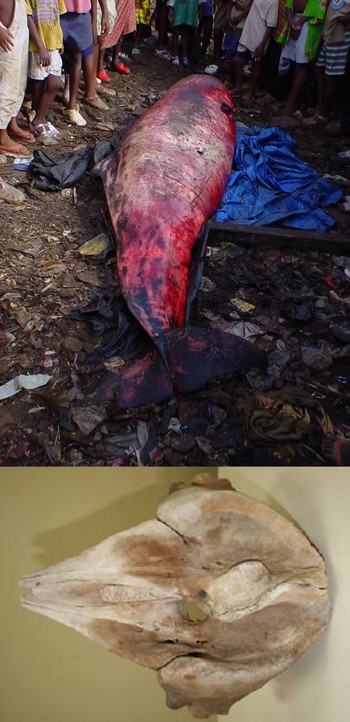
An adult female of 340 kg landed by artisanal fishermen at the Dabondi landing site, just south of Conakry (commune Matoto), on 3 May 2002 and reportedly captured off Tanène (09°56′29″N 13°51′46″W; ‘K.bre’ in Figure 1) represents the first record of K. breviceps in Guinea. The fresh carcass was butchered and locally consumed. The low dorsal fin set well behind body midpoint and its larger body size (Figure 4) positively distinguishes K. breviceps from the dwarf sperm whale Kogia sima (Owen, 1866). Body length of 345 cm as measured by one of us (I.B.) if not strictly axial may slightly overestimate standard length. The skull (CBL, 401 mm) and partial skeleton is deposited in the CNSHB collection. Most epiphyses are fused to the vertebral centres indicating physical maturity, in agreement with its adult body length, however some epiphyseal fusion lines persist.
Adult pygmy sperm whale, Kogia breviceps, landed as by-catch at Dabondy (photograph by Moussa Sylla) and (below) the skull curated at CNSHB. Note the low dorsal fin posteriad to the middle of the animal's dorsum.

Family Balaenopteridae Gray, 1864
BRYDE'S WHALE BALAENOPTERA BRYDEI OLSEN, 1913
Olsen's (Reference Olsen1913) original description of B. brydei was based on whales taken off South Africa's Cape Province, however he did not assign a holotype. A meticulous morphological account by Lönnberg (Reference Lönnberg1931) is generally considered as the primary reference for B. brydei description (see also Yamada et al., Reference Yamada, Kakuda and Tajima2008). Soot-Ryen (Reference Soot-Ryen1961) provided further morphological evidence to distinguish B. brydei from Eden's whale Balaenoptera edeni Anderson, 1879, a dwarf form endemic in the Indo-Pacific region. While for half a century most authors followed Junge (Reference Junge1950) who synonymized B. brydei with B. edeni, recently species-level differences are again recognized (e.g. Wada et al., Reference Wada, Oishi and Yamada2003; Best, Reference Best2007; Kanda et al., Reference Kanda, Goto, Kato, McPhee and Pastene2007; Yamada et al., Reference Yamada, Kakuda and Tajima2008).
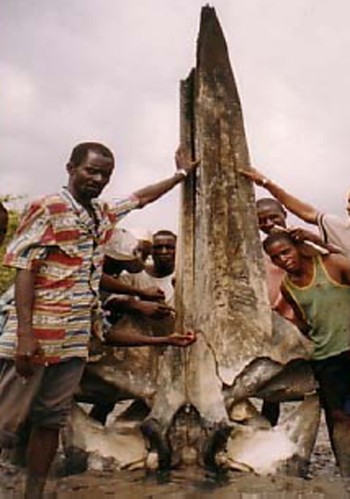
A 13 m B. brydei stranded in northern Guinea near Koukoubaya, Kanfarandé (10°46.183′N 14°42.60′W; ‘B.bry1’ in Figure 1), Boké Préfecture, on 21 May 2001. The skull was examined by the senior author in July 2001. A photograph of the skull is the only remaining voucher available (Figure 5). Locals reported to have consumed the flesh of the whale, suggesting it stranded in fresh condition, if not alive.
Ventral view of the skull of a Bryde's whale, Balaenoptera brydei, stranded at Kanfarandé in May 2001.

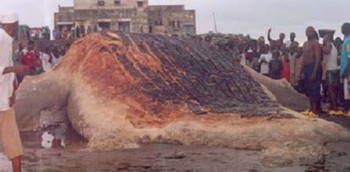
A 9.8 m B. brydei beached alive in daytime at Kassa (reportedly during a storm), Ile de Loos (09°28′N 13°48′W; ‘B.bry2’ in Figure 1) on 29 July 2002 (Figure 6). The stomachs contained unspecified teleost fish and squids. Two photographs of the stranded animal were examined, one showing the straight maxillar tipFootnote 1 and a prominent falcate dorsal fin. The complete skeleton is mounted at the CNSHB headquarters in Conakry. Several osteological features combined characteristic for B. brydei are evident, i.e. maxillae with proximally nearly parallel borders, concave anterior margin of nasal bones and bent forward on the outer side, strongly curved and very robust mandibles and vertebrae with relatively short spinous processes which are heavily inclined backwards (Lönnberg, Reference Lönnberg1931; Omura et al., Reference Omura, Kasuya, Kato and Wada1981; Cummings, Reference Cummings, Ridgway and Harrison1985).
Bryde's whale, Balaenoptera brydei, stranded alive at Kassa, Ile de Loos, in July 2002.

COMMON MINKE WHALE BALAENOPTERA ACUTOROSTRATA LACÉPÈDE, 1804
A B. acutorostrata of unknown sex became entangled in a fishing net in the Bay of Tabounsou (09°33′N 13°36′W; ‘B.acu’ in Figure 1) at the south end of Conakry and was landed at Gbessia-Port in March 1986 where it was inspected by one of us (B. Kaba). Two grainy photographs in a local newsletter article (Kaba & Boltachev, Reference Kaba and Boltachev1986) support the event. However the colour pattern of the whale and its flippers was not recorded. The single baleen plate available, curated in the CERESCOR collection, measures 21 cm long for 6.5 cm wide, in agreement with the 23.5 cm maximum baleen plate length for North Atlantic B. acutorostrata (Jonsgård, Reference Jonsgård1951, his figures 2 and 3). The baleen plate (Figure 7) is cream-white with, labially, a grey-brown edge, has an almost straight outer edge and fine, short, cream-coloured bristles, all characteristic for minke whales (Jonsgård, Reference Jonsgård1951; Sergeant, Reference Sergeant1963; Mitchell & Kozicki, Reference Mitchell and Kozicki1975). It is unclear whether the reported body length of 877 cm (Kaba & Boltachev, Reference Kaba and Boltachev1986) was taken partly over the body curvature which is known to overestimate standard length. Horwood (Reference Horwood1990, cited in Perrin & Brownell, Reference Perrin, Brownell, Perrin, Würsig and Thewissen2002) reports an average length for B. acutorostrata at physical maturity of 850–880 cm in females and 780–820 cm in males.
Baleen plate of a common minke whale, Balaenoptera acutorostrata, from the Bay of Tabounsou, deposited at the CERESCOR Institute.

The Tabounsou specimen is the first B. acutorostrata record for Guinea, and one of very few authenticated records in West Africa (reviewed by Van Waerebeek et al., Reference Van Waerebeek, André, Sequeira, Martin, Robineau, Collet, Papastavrou and Ndiaye1999). The former southernmost documented case in the north-east Atlantic was a juvenile, also a by-catch, landed at Hann (14°41′N 17°27′W) on Senegal's central coast, more than 5° latitude to the north (Van Waerebeek et al., Reference Van Waerebeek, André, Sequeira, Martin, Robineau, Collet, Papastavrou and Ndiaye1999).
HUMPBACK WHALE MEGAPTERA NOVAEANGLIAE (BOROWSKI, 1781)
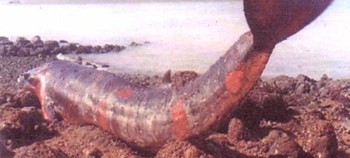
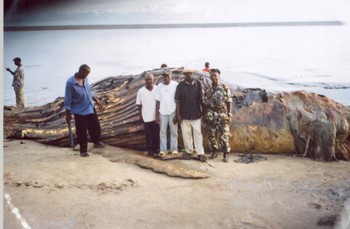
The anterior half body of an adult-sized M. novaeangliae washed ashore at Téminitaye, Conakry (09°30′N 13°42.9′W; ‘M.nov1’ in Figure 1) on 26 September 2005. The elongated flippers with prominent bumps on the leading edge and the low number of ventral pleats (14–17 estimated from photographs) confirmed the species (Figure 8). To judge from the advanced decomposition (code 4) death may have occurred sometime during the 2nd or 3rd week of September. The missing posterior body strongly suggests a collision with a large vessel, either ante-mortem or post-mortem. A second adult M. novaeangliae stranded at Taboriya, Boffa (09°57′50″N 13°57′04″W; ‘M.nov2’ in Figure 1) on 22 July 2008 (Figure 9). No samples were taken from either whale. A third record, a live animal, was sighted on the shelf some 24.5 km from shore, at 09°19′N 13°41′W (‘M.nov3’ in Figure 1) on 1 October 2002 during a dedicated oceanographic survey (NOAL WAN, Guinea, 29 September–21 October 2002). This observation, made from the RV ‘Ala Awam’, is supported by an identifiable photograph deposited at CNSHB and CEPEC.
The anterior body of a humpback whale, Megaptera novaeangliae, stranded in advanced decomposition at Téminitaye, near Conakry, on 26 September 2005.

Remains of an adult-sized humpback whale washed ashore at Taboriya, Boffa, on 22 July 2008.

INCOMPLETELY DOCUMENTED AND REJECTED RECORDS
Sightings for an additional three cetacean species have been mentioned in unpublished reports, unfortunately with insufficient temporal and spatial details, thus impeding confirmation for Guinean waters. Nonetheless, we consider these records as likely valid, thanks to recognizable photographs (S.T. Diallo et al., Reference Diallo, Yoshida, Samoura, Sow, Camara, Bah, Monteiro, Fall, Da Fonseca, Almeida and Rerambyath2002, Reference Diallo, Bah, Sow, Camara, Cissé, Monteiro, Sylla, Da Fonseca, Almeida, Rerambyath, Yoshima and Yoshida2004; Bamy et al., Reference Bamy, Van Waerebeek, Bah, Dia, Kaba, Keita, Konate and Tall2006). They include: short-finned pilot whale Globicephala macrorhynchus Gray, 1846, rough-toothed dolphin Steno bredanensis (G. Cuvier in Lesson, 1828) and short-snouted common dolphin Delphinus delphis Linnaeus, 1758. Common dolphins Delphinus spp. have been reported from most coastal countries in Western Africa (e.g. Cadenat, Reference Cadenat1959; Jefferson et al., Reference Jefferson, Curry, Leatherwood and Powell1997; Van Waerebeek, Reference Van Waerebeek1997; Van Waerebeek et al., Reference Van Waerebeek, Ndiaye, Djiba, Diallo, Murphy, Jallow, Camara, Ndiaye and Tous2000; Perrin & Van Waerebeek, Reference Perrin and Van Waerebeek2007; Weir, Reference Weir2010). Cadenat (Reference Cadenat1959, table 1) lists a D. delphis record under ‘confirmed’ (‘déterminations contrôlées’) but did not provide supporting data.
Dutch ornithologist Jan Veen (in litteris, to K.V.W., 3 February 2010) sighted two S. teuszii in the ‘area near Iles Tristao’ during a seabird survey on 23 May 2009. No photographs are available, but J. Veen is familiar with the species from observations in Senegal's Saloum delta.
Hammond & Lockyer (Reference Hammond, Lockyer, Sigurjónsson and Leatherwood1988) reported an offshore O. orca sighting (their record 81) off Guinea at ~10°N 19°W. Upon re-examination, Phil Hammond (in e-mail to K.V.W., 3 January 2007) indicated the record was erroneous. Hammond & Lockyer (Reference Hammond, Lockyer, Sigurjónsson and Leatherwood1988, p. 27) further state ‘Cadenat (Reference Cadenat1959) reports observations in March off the coast of Guinea’, however a careful reading of the O. orca paragraph (Cadenat, Reference Cadenat1959, p. 1399) reveals records solely for Mauritania, Senegal and Côte d'Ivoire, but this inaccuracy has seeped into the literature (e.g. Jefferson et al., Reference Jefferson, Curry, Leatherwood and Powell1997, p. 90). In fact, no O. orca records are documented for the stretch of coast from southern Senegal (Casamance) to Liberia. In the broader eastern North Atlantic, O. orca is widespread, while nowhere common, in coastal and offshore areas (Hammond & Lockyer, Reference Hammond, Lockyer, Sigurjónsson and Leatherwood1988). The question remains whether the species ventures into the shallow waters of Guinea-Bissau, Guinea and Sierra Leone.
Cadenat (Reference Cadenat1957, table p. 1366) listed Guinea as range state for the harbour porpoise ‘Phocaena phocaena ?’ [sic] referring to an unsubstantiated sighting by the crew of a tuna boat operating at latitude ~08°30′N, in fact, off northern Sierra Leone. The species identification is considered equivocal as there are no other harbour porpoise Phocoena phocoena (Linnaeus, 1758) accounts from south of Senegal. Specifically the southernmost substantiated record is a by-catch recovered from fishermen at Ile de Fadiouth (14°09′N 16°49′W) on Senegal's Petite Côte (Van Waerebeek et al., Reference Van Waerebeek, Ndiaye, Djiba, Diallo, Murphy, Jallow, Camara, Ndiaye and Tous2000). Waters further south and east, bathed by the Guinea Current, are almost certainly too warm for this temperate water species. The contextFootnote 2 strongly suggests that Cadenat (Reference Cadenat1957) himself did not lend much credibility to the Guinea report. Jefferson et al. (Reference Jefferson, Curry, Leatherwood and Powell1997) also called it a questionable record.
On 13 November 2001, with logistical support from Guinean navy personnel, one of us (I.B.) collected cranial and some postcranial bones of a large unidentified balaenopterid stranded in October 2001 in the area of Kamsar (10°39.1′N 14°37.0°W; ‘whale’ in Figure 1), northern Guinea. Initially deposited at CNSHB, the skeleton was exported to France to an unknown destination. A single photograph of the partial skull suggests M. novaeangliae, but low resolution does not permit a definitive identification.
DISCUSSION
Five of the seven cetacean species (T. truncatus, K. breviceps, M. novaeangliae, B. acutorostrata and B. brydei) documented here represent first records for Guinea. This initial inventory is obviously incomplete in view of the modest survey effort and that known cetacean biodiversity in the western African region amounts to some 25–30 species (Perrin & Van Waerebeek, Reference Perrin and Van Waerebeek2007).
Population structure in S. teuszii is unclear including to what degree distributional continuity and gene flow exists between the provisionally defined ‘South Guinea stock’ and other defined stocks (Van Waerebeek et al., Reference Van Waerebeek, Barnett, Camara, Cham, Diallo, Djiba, Jallow, Ndiaye, Samba Ould Bilal and Bamy2003, Reference Van Waerebeek, Barnett, Camara, Cham, Diallo, Djiba, Jallow, Ndiaye, Samba Ould Bilal and Bamy2004). The species is listed on CITES Appendix I, is classified as ‘Vulnerable’ by IUCN and in 2008 was upgraded to the CMS Appendix 1 after WAFCETFootnote 3 research raised concern about fisheries interactions, and wide distribution hiatuses were found between communities of low numbers (Van Waerebeek, Reference Van Waerebeek2003a; Van Waerebeek et al., Reference Van Waerebeek, Barnett, Camara, Cham, Diallo, Djiba, Jallow, Ndiaye, Samba Ould Bilal and Bamy2003, Reference Van Waerebeek, Barnett, Camara, Cham, Diallo, Djiba, Jallow, Ndiaye, Samba Ould Bilal and Bamy2004; Collins et al., Reference Collins, Ngouessono and Rosenbaum2004; Van Waerebeek & Perrin, Reference Van Waerebeek and Perrin2007; Weir, Reference Weir2009, Reference Weir2010). Like in Guinea-Bissau, Guinea's coast features prime S. teuszii habitat: warm and shallow waters (0–40 m deep) on a shelf extending up to 200 km from shore (Chavance et al., Reference Chavance, Diallo, Diallo, Domain, Drapeau, Fautrel, Guilavogui, Morize, Solie and Traore1998), extensive creeks with mangrove forest around four main river mouths, i.e. Río Komponi, Río Nuñez, Fatala, and Konkouré. The lack of sighting records of S. teuszii in Guinea may partly be blamed on the low level of near-shore survey effort. Nonetheless, because of both direct and circumstantial evidence of by-catches and since estimated numbers of the stocks for which some estimate was available have invariably been low, i.e. tens or hundreds of individuals (Collins et al., Reference Collins, Ngouessono and Rosenbaum2004; Van Waerebeek et al., Reference Van Waerebeek, Barnett, Camara, Cham, Diallo, Djiba, Jallow, Ndiaye, Samba Ould Bilal and Bamy2004; Weir, Reference Weir2009, Reference Weir2010), concern is expressed about removals of any level. The Konkouré Estuary is protected since 1992 as a Ramsar wetlands site (No. 575) and is proposed as an ideal target area to initiate dedicated small-boat and shore-based surveys.
Tursiops truncatus in western Africa attains great body length, up to 368 cm in Senegal (Robineau & Vely, Reference Robineau and Vely1997) and 330 cm in South Africa (Ross, Reference Ross1984). Osteological characteristics have been discussed for dolphins from Mauritania, Senegal and Côte d'Ivoire (Cadenat & Lassarat, Reference Cadenat and Lassarat1959; Cadenat et al., Reference Cadenat, Doutre and Paraiso1959). The hypothesis of a Mauritania/Senegal population linked to the north-west African upwelling zone and characterized by a long rostrum and a relatively smaller neurocranium (Robineau & Vely, Reference Robineau and Vely1997) deserves further study. The Bonfi specimen suggests that such a form may have a considerably wider distribution off western Africa. So far no T. truncatus sightings are documented in Guinea, but as in neighbouring Guinea-Bissau where an inshore population inhabits much of the waters surrounding the Bijagos Archipelago (Spaans, Reference Spaans1990; Van Waerebeek et al., Reference Van Waerebeek, Ndiaye, Djiba, Diallo, Murphy, Jallow, Camara, Ndiaye and Tous2000, Reference Van Waerebeek, Bamy, Jiddou, Sequeira, Diop, Ofori-Danson, Tchibozo and Campredon2008), with very similar habitat it seems plausible that inshore T. truncatus also range over an appreciable part of Guinea's shallow coast. As inshore T. truncatus are a target of a live-capture fishery in Guinea-Bissau (Van Waerebeek et al., Reference Van Waerebeek, Bamy, Jiddou, Sequeira, Diop, Ofori-Danson, Tchibozo and Campredon2008) managers are reminded that offshore form T. truncatus may also occur, and in much larger groups, which could result in abundance over-estimates if populations are not clearly distinguished during surveys.
Little is known on the status of S. frontalis off western Africa, except that it is widely distributed in the region and validated records exist for the Canary Islands, Mauritania, Cape Verde, Senegal, Côte d'Ivoire, Ghana, Benin and Equatorial Guinea (Jefferson et al., Reference Jefferson, Curry, Leatherwood and Powell1997; Van Waerebeek et al., Reference Van Waerebeek, Ndiaye, Djiba, Diallo, Murphy, Jallow, Camara, Ndiaye and Tous2000; Perrin & Van Waerebeek, Reference Perrin and Van Waerebeek2007).
A few authors have studied the biology of K. breviceps in Atlantic Africa (Maigret & Robineau, Reference Maigret and Robineau1981; Robineau & Vely, Reference Robineau and Vely1998) and it is documented only from temperate areas, i.e. north-west Africa and Namibia (Perrin & Van Waerebeek, Reference Perrin and Van Waerebeek2007). The large number of records suggests the species is fairly common off the Canary Islands (Casinos, Reference Casinos1977; Vonk & Martin-Martel, Reference Vonk and Martin-Martel1988; De Stephanis & Urquiola, Reference De Stephanis and Urquiola2006). Six dead animals recovered in 1999–2005 showed collision lesions, likely from strikes by fast ferries (De Stephanis & Urquiola, Reference De Stephanis and Urquiola2006). There are fewer records elsewhere, one in Madeira (Maul & Sergeant, Reference Maul and Sergeant1977), two in Mauritania (Robineau & Vely, Reference Robineau and Vely1998) and two strandings, four individuals in total, from Senegal (Cadenat, Reference Cadenat1959; Maigret & Robineau, Reference Maigret and Robineau1981). No K. breviceps has been encountered in the Gulf of Guinea despite expanding field research (see e.g. Debrah, Reference Debrah2000; Ofori-Danson et al., Reference Ofori-Danson, Van Waerebeek and Debrah2003; Picanço et al., Reference Picanço, Carvalho and Brito2009; Van Waerebeek et al., Reference Van Waerebeek, Ofori-Danson and Debrah2009). The Dabondi specimen (see above) represents a 525 km southward extension of the species' known range in the north-eastern Atlantic, but it is unclear if this marks its approximate southern distribution boundary.
Balaenoptera brydei in the north-east Atlantic has not been the subject of dedicated research (see IWC, 1977; Kato, Reference Kato, Perrin, Würsig and Thewissen2002). Two allopatric forms, an inshore and an offshore form, occur on the west coast of South Africa. The offshore form is thought to migrate north to the equator in winter (Best, Reference Best1977; Kato, Reference Kato, Perrin, Würsig and Thewissen2002). However its relation to north-east Atlantic B. brydei is undocumented and in the meantime it is advisable to treat them as different stocks. Kanda et al. (Reference Kanda, Goto, Kato, McPhee and Pastene2007), for instance, showed that gene flow between populations in the Pacific and Indian Oceans is low and that effective management actions should treat them as separate entities.
Similar uncertainties exist with respect to the population identity of B. acutorostrata off West Africa (Van Waerebeek et al., Reference Van Waerebeek, André, Sequeira, Martin, Robineau, Collet, Papastavrou and Ndiaye1999; Perrin & Brownell, Reference Perrin, Brownell, Perrin, Würsig and Thewissen2002). The affinity of the Tabounsou specimen, which extended the documented range south from Senegal to Guinea, may lie with either the north-east Atlantic or central North Atlantic stocks (for definitions see Donovan, Reference Donovan1991) or it may be a member of a distinct, undescribed population. The boreal distribution range of the Antarctic minke whale Balaenoptera bonaerensis Burmeister, 1867 in the eastern Atlantic reaches at least into cool southern Angolan waters at 15°45′S (Best, Reference Best2007) but there is no indication that it inhabits tropical waters farther north, much less transgresses the equator into the northern hemisphere.
Increasing evidence shows that M. novaeangliae is not uncommon in tropical waters of the north-east Atlantic south-east of the Cape Verde Archipelago (CV). Slijper et al. (Reference Slijper, Van Utrecht and Naaktgeboren1964; chart 4) reported ten M. novaeangliae groups within a large area with perimeter 0°–10°N and 10°–20°W, including Guinean waters, during February (1), March (1), April (2), September (5) and October (1), i.e. six or twice as many sightings during the southern hemisphere breeding season versus the three with northern hemisphere seasonality. The three records from Guinea documented here also show a southern hemisphere seasonality (July, September and October) in contrast with the spatially nearest stock, a northern hemisphere one, which breeds and overwinters in the CV from September until April (Lagendijk, Reference Lagendijk1984; Reiner et al., Reference Reiner, Dos Santos and Wenzel1996; Wenzel et al., Reference Wenzel, Allen, Berrow, Hazevoet, Jann, Seton, Steiner, Stevick, López and Whooley2009). As CV whales annually arrive from the northern Atlantic at the earliest in September, it is highly implausible that some would by-pass the archipelago to arrive in Guinea, almost 1000 km to the south-east, in July. We hypothesize that the Guinean humpback whales documented here and the six southern hemisphere-consistent sightings from Slijper et al. (Reference Slijper, Van Utrecht and Naaktgeboren1964) indeed originate from the southern hemisphere. We suggest they comprise the north-western range of the population known to breed/overwinter on the shelf of the Bight of Benin, northern Gulf of Guinea, from Nigeria to eastern Côte d'Ivoire, from August until early December (Van Waerebeek et al., Reference Van Waerebeek, Tchibozo, Montcho, Nobime, Sohou, Sohouhoue and Dossou2001, Reference Van Waerebeek, Baker, Félix, Gedamke, Iñiguez, Sanino, Secchi, Sutaria, van Helden and Wang2007, Reference Van Waerebeek, Ofori-Danson and Debrah2009; Van Waerebeek, Reference Van Waerebeek2003b). We predict M. novaeangliae to seasonally occur also off Sierra Leone and Liberia. The northern Gulf of Guinea or Bight of Benin breeding population as discovered and named by Van Waerebeek et al. (Reference Van Waerebeek, Tchibozo, Montcho, Nobime, Sohou, Sohouhoue and Dossou2001, Reference Van Waerebeek, Baker, Félix, Gedamke, Iñiguez, Sanino, Secchi, Sutaria, van Helden and Wang2007, Reference Van Waerebeek, Ofori-Danson and Debrah2009) is, jointly with Gabon, Congo and Cabinda (Angola) referred to by the IWC as the B1 substock of Breeding Stock B in the south-east Atlantic Ocean (IWC, 2006). The three sightings with a northern hemisphere seasonality reported by Slijper et al. (Reference Slijper, Van Utrecht and Naaktgeboren1964) could belong to the CV population. The wide area offshore Guinea could harbour, out-of-phase, both northern hemisphere and southern hemisphere stocks, reminiscent of the hemispheric overlap off Pacific Costa Rica (Acevedo & Smultea, Reference Acevedo and Smultea1995).
The mutilated M. novaeangliae carcass that washed ashore near Conakry was thought to have been struck by a ship, ante- or post-mortem. Theoretically it could have been transported some distance on the bow bulb of a vessel, however, unlike other Balaenopteridae, only 4% of M. novaeangliae (N = 143) killed by vessels world-wide became, or remained, draped over ships' bows (Van Waerebeek & Leaper, Reference Van Waerebeek and Leaper2008), due perhaps to its anteriad more rotund shape and long flippers generating greater turbulence, causing the carcass to dislodge. Although rarely recognized, ship collisions with cetaceans occur far more frequently in African coastal waters than acknowledged and in some areas may constitute a major conservation problem (Félix & Van Waerebeek, Reference Félix and Van Waerebeek2005; Van Waerebeek et al., Reference Van Waerebeek, Baker, Félix, Gedamke, Iñiguez, Sanino, Secchi, Sutaria, van Helden and Wang2007).
Over the past decades Guinean fisheries developed rapidly and in 1995 some 75,300 MT of fish products were landed, 69% artisanally with some 2300 canoes (Chavance et al., Reference Chavance, Diallo, Diallo, Domain, Drapeau, Fautrel, Guilavogui, Morize, Solie and Traore1998; I. Diallo et al., Reference Diallo, Cissé, Bah, Palomares and Pauly2004). In view of intense fishing effort and only a handful of documented by-catch cases, it is doubtful that these are representative for cetacean mortality levels. Lack of trained observers, limited port surveillance and few incentives to report illegal landings may be blamed. While there is no evidence for substantial dolphin landings, of the kind seen in Ghana for instance (Debrah, Reference Debrah2000; Ofori-Danson et al., Reference Ofori-Danson, Van Waerebeek and Debrah2003; Van Waerebeek et al., Reference Van Waerebeek, Ofori-Danson and Debrah2009), monitoring should intensify. Fin-fish, mollusc and other marine products may still largely satisfy local demand. Article 34 of Guinea's Fisheries Code (Code de la Pêche) clearly states that any capture of a marine mammal is prohibitedFootnote 4. However, as seen in other regions of the world (e.g. Mangel et al., Reference Mangel, Alfaro-Shigueto, Van Waerebeek, Cáceres, Bearhop, Witt and Godley2009), if a strong demand for cetacean products persists or develops, mere regulations do not offer sufficient deterrence. Guinea has ratified and is an active party to most international conventions relevant to cetacean conservation and management, primarily CMS, IWC and CITES, but also Ramsar, the United Nations Convention on the Law of the Sea (UNCLOS) and the CMS Memorandum of Understanding concerning the conservation of the manatee and small cetaceans of western Africa and Macaronesia.
In order to pool scarce resources, a national reference collection of aquatic mammal specimens and a national database is proposed in Conakry's Centre de Recherches Océanographiques de Rogbané (CERESCOR). It can provide ample office and laboratory space and it already curates a collection of marine biological specimens. Cetacean strandings offer good opportunities to collect valuable biological information and voucher specimens in an economic way. Unlike in Senegal, Mauritania and Cape Verde, no mass strandings are known for Guinea but events may have been overlooked.
ACKNOWLEDGEMENTS
We thank local fisheries agents for their valuable help with reporting and two anonymous referees for providing thoughtful comments on an earlier draft. The King Leopold III Fund for Nature Exploration and Conservation (Brussels) and the International Fund for Animal Welfare (IFAW) kindly granted support to K. Van Waerebeek for two missions to Guinea. Dr J. Van Goethem and Mr V. Papastavrou are thanked for recommending the applications. K. Van Waerebeek is very grateful also for the warm hospitality extended to him by the CNSHB Director and staff, as well as by the Bamy family in Conakry.