Nosocomial pneumonia (NP) can occur in a diverse spectrum of patients and can be attributed to varied etiologic pathogens. 1 NP is typically classified according to the location and conditions of infection onset (community-onset usually with healthcare-associated risk factors [COP], hospital-acquired pneumonia [HAP], or pneumonia acquired during mechanical ventilation).Reference Kollef, Shorr, Tabak, Gupta, Liu and Johannes 2 Few studies have attempted to evaluate NP according to the location and conditions of infection or to compare outcomes among these categories of NP.Reference Sopena and Sabria 3 – Reference Esperatti, Ferrer and Theessen 5 Notably, recent trends show an increase in the prevalence of NP caused by multidrug-resistant (MDR) gram-negative bacteria, most commonly Pseudomonas aeruginosa.Reference Wang, Jerng and Chen 6 – Reference Zilberberg and Shorr 10 Mortality associated with P. aeruginosa NP (Pa-NP) is among the highest of any bacteria owing to both the virulence of P. aeruginosa as well as the administration of inappropriate initial antibiotic therapy (IIAT) in MDR isolates.Reference Driscoll, Brody and Kollef 11 – Reference Micek, Reichley and Kollef 15
The escalating prevalence of antibiotic resistance in P. aeruginosa, along with the development and availability of novel antimicrobial therapies, requires a precise understanding of how the various categories of Pa-NP influence outcome. A comparison of mortality of Pa-NP, as well as risk factors for mortality, according to pneumonia classification has not previously been performed. Pneumonia classification of P. aeruginosa may have important clinical implications, especially from treatment and infection control perspectives where typically ventilator-associated pneumonia (VAP) is primarily evaluated. Therefore, we set out to perform an analysis of a multinational study of Pa-NP with the following objectives: first, to describe and compare the mortality associated with Pa-NP according to pneumonia classification; second, to identify and compare risk factors for hospital mortality and IIAT according to pneumonia classification.
METHODS
Study Design and Ethical Standards
We conducted a retrospective cohort study in 12 hospitals in 5 countries (United States, 3; France, 2; Germany, 2; Italy, 2; and Spain, 3). Eligible consecutive patients were aged 18 years or older and admitted for their index hospitalization within 36 months prior to study initiation in 2013. All eligible patients met a clinical diagnosis of NP defined as new or progressive infiltrates consistent with pneumonia on chest radiograph or computed tomography and either a temperature higher than 38.3°C or leukocytosis greater than 10,000 cells/mm3 or both. To be eligible patients had to have P. aeruginosa cultured from blood or a respiratory specimen collected from the following: sputum, pleural fluid, flexible bronchoscopy with protected specimen brush, bronchoalveolar, or transbronchial biopsy, “mini-bronchoalveolar” sample, and tracheobronchial aspirate in intubated patients. Microbiologic cultures had to be obtained within the 24-hour period surrounding initiation of antibiotics. Pa-NP was classified as COP, HAP, and VAP according to the location and conditions of the onset of infection (COP: prior to hospital admission; HAP: developing during the hospital stay; VAP: developing while receiving mechanical ventilation). Patients with COP had to have 1 or more of the following characteristics to be included: hospitalized in an acute care hospital for 2 or more days within 90 days of infection; resided in a nursing home or long-term care facility; received recent intravenous antibiotic therapy, chemotherapy, or wound care in the past 30 days; or attended a hospital or hemodialysis clinic. Each investigator obtained approval from an independent ethics committee or institutional review board at his or her institution.
End Points and Covariates
The primary end point examined was hospital mortality. We also examined other important covariates to include demographic characteristics, MDR status of the P. aeruginosa isolate, and comorbidities (acute coronary syndrome, valvular heart disease, hypertension, venous thromboembolism, chronic obstructive pulmonary disease, asthma, other chronic respiratory diseases, and diabetes mellitus). Patients were also classified according to whether they received IIAT.
Definitions
To be classified as MDR, the P. aeruginosa isolate had to be nonsusceptible to at least 1 agent in at least 3 of the following antimicrobial categories: aminoglycosides, antipseudomonal carbapenems, antipseudomonal cephalosporins, antipseudomonal fluoroquinolones, antipseudomonal penicillins plus β-lactamase inhibitors, monobactams, phosphonic acids, and polymixins.Reference Magiorakos, Srinivasan and Carey 16 Antimicrobial treatment was deemed to represent IIAT if the initially prescribed antibiotic regimen was not active against the identified isolate on the basis of in vitro susceptibility testing or was administered more than 24 hours following respiratory specimen collection.Reference Kollef 17 Microbiology laboratories determined antimicrobial susceptibility of the isolates using disk diffusion or automated testing methods according to established guidelines and breakpoints. 18 , 19
Statistical Analyses
Continuous variables were reported as means with standard deviations. Differences between mean values were tested via the t test. Categorical data were summarized as proportions, and the χ2 test or Fisher exact test for small samples was used to examine differences between groups. We developed several multiple logistic regression models to identify clinical risk factors associated with hospital mortality and IIAT. Risk factors that were significant at P≤.20 in the univariate analyses, as well as all biologically plausible factors even if they did not reach this level of significance, were included in the corresponding multivariable analyses. All variables entered into the models were examined to assess for collinearity, and interaction terms were tested. The most parsimonious models for the predictors of hospital mortality and IIAT respectively were computed and their fit was tested with the area under the receiver operating curve and the Hosmer-Lemeshow goodness-of-fit test. All tests were 2-tailed, and a P value<.05 was deemed a priori to represent statistical significance. On the basis of our prior experience and available publications, we estimated that the hospital mortality for COP would be approximately 20% and the hospital mortality for HAP and VAP would be between 35% and 40%. Using a 2-sided estimate with a P value of .05 and 80% power required at least 138 patients per pneumonia type to yield statistically meaningful estimates. Thus our goal prior to performing the study was to have at least 150 patients per pneumonia type during study recruitment and data collection to ensure that our mortality analysis would be valid. All analyses were performed with SPSS software, version 19.0 (IBM).
RESULTS
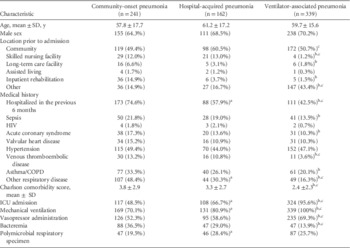
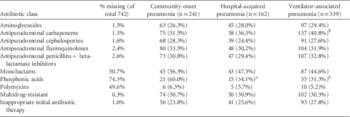
Seven hundred forty-two patients with Pa-NP met the inclusion criteria and were enrolled in the study. There were 258 patients (34.8%) from the United States, 141 (19.0%) from France, 120 (16.2%) from Germany, 115 (15.5%) from Spain, and 108 (14.6%) from Italy. A diagnosis of pneumonia was made most commonly via bronchoalveolar lavage (35%), tracheobronchial aspirate (28%), mini-bronchoalveolar (18%), and sputum samples (15%). VAP was most common (339 [45.7%]) followed by COP (241 [32.5%]) and HAP (162 [21.8%]). Significant differences in subject location prior to hospital admission, underlying comorbidities, and vital signs were observed by pneumonia classification (Table 1). Patients with VAP had the lowest Charlson comorbidity scores and prevalence of secondary bacteremia, but VAP was associated with the greatest use of vasopressors following pneumonia onset. The antibiotic susceptibility of the P. aeruginosa isolates was comparable for COP, HAP, and VAP (Table 2). Similarly, the prevalence of MDR isolates and the rate of IIAT were equivalent for all 3 pneumonia categories.
Baseline Characteristics

NOTE. Data are no. (%) unless otherwise specified. COPD, chronic obstructive pulmonary disease; HIV, human immunodeficiency virus; ICU, intensive care unit.
a P<.05 comparing hospital-acquired pneumonia and community-onset pneumonia.
b P<.05 comparing ventilator-associated pneumonia and community-onset pneumonia.
c P<.05 comparing ventilator-associated pneumonia and hospital-acquired pneumonia.
Antibiotic Resistance

NOTE. Data are no. (%) unless otherwise indicated.
a P<.005 comparing hospital-acquired pneumonia and community-onset pneumonia.
b P<.005 comparing ventilator-associated pneumonia and community-onset pneumonia.
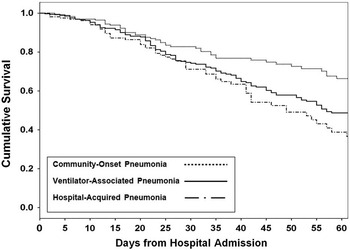
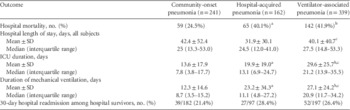
Overall hospital mortality was 35.8% (n=266) and ranged across centers from 12% to 60%. Hospital mortality was greater for VAP (41.9%) and HAP (40.1%) compared with COP (24.5%) (P<.001). This was confirmed in a Kaplan-Meier analysis (Figure 1). Hospital length of stay, uncensored for survival, was significantly longer for VAP compared with HAP (Table 3). However, total durations of mechanical ventilation and intensive care progressively increased going from COP to HAP and VAP. Hospital readmission was similar across pneumonia types. Among the HAP patients, 97 (59.9%) developed HAP while in the intensive care unit (ICU) setting. Hospital mortality was higher for HAP within the ICU compared with HAP occurring outside of the ICU (45.4% vs 32.3%; P=.097). However, median (interquartile range) hospital length of stay was similar for HAP within the ICU and HAP occurring outside of the ICU (28 days [11.5–45.0 days] vs 23.0 days [12.0-37.0 days]; P=.414).
Kaplan-Meier curves of cumulative survival from hospital admission. Community-onset pneumonia compared with hospital-acquired pneumonia (P<.001; log-rank test); community-onset pneumonia compared with ventilator-associated pneumonia (P<.001; log-rank test); hospital-acquired pneumonia compared with ventilator-associated pneumonia (P=.139, log-rank test).

Outcomes

NOTE. ICU, intensive care unit.
a P<.005 comparing hospital-acquired pneumonia and community-onset pneumonia.
b P<.005 comparing ventilator-associated pneumonia and community-onset pneumonia.
c P<.05 comparing ventilator-associated pneumonia and hospital-acquired pneumonia.
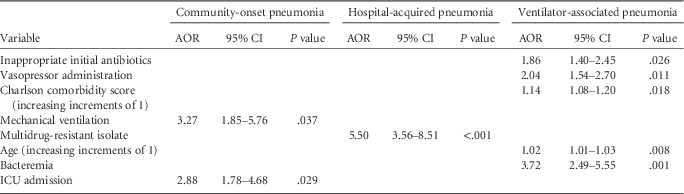
Table 4 shows the results of the logistic regression model derivations examining the variables associated with hospital mortality for each pneumonia category. Among subjects with COP the need for mechanical ventilation and the ICU were independent predictors of hospital death. For subjects with HAP only the presence of an MDR isolate was independently associated with hospital death. Administration of IIAT, vasopressor use, increasing Charlson comorbidity scores and age, and secondary bacteremia were identified as independent predictors of hospital mortality for VAP. MDR and bacteremia were independent predictors of IIAT for COP (Table 5). MDR was also an independent predictor of IIAT for HAP, whereas increasing Charlson comorbidity scores predicted IIAT in VAP and recent antibiotic administration was found to be protective against IIAT.
Independent Predictors of Mortality

NOTE. Factors excluded from the model for collinearity: aminoglycoside resistance, carbapenem resistance, cephalosporin resistance, fluoroquinolone resistance, penicillin-beta-lactamase inhibitor resistance (collinear with multidrug-resistant isolate). Variables included but not retained in the model at the P<.05 in addition to those shown: corticosteroids for the ventilator-associated pneumonia analysis. Hosmer-Lemeshow/ area under the receiver operating curve: community-onset pneumonia, 0.452/0.642; hospital-acquired pneumonia, 0.866/0.679; ventilator-associated pneumonia, 0.698/0.620. AOR, adjusted odds ratio; ICU, intensive care unit.
Independent Risk Factors of Inappropriate Initial Antibiotic Therapy

NOTE. Hosmer-Lemeshow/ area under the receiver operating curve: community-onset pneumonia, 0.453/0.691; hospital-acquired pneumonia, 0.721/0.641; ventilator-associated pneumonia, 0.731/0.609. AOR, adjusted odds ratio.
DISCUSSION
We found that hospital mortality varied among patients with Pa-NP according to their pneumonia classification. Those with VAP and HAP had significantly greater risk of hospital death compared with patients with COP. Moreover, the risk factors for hospital death also varied by pneumonia classification. Among patients with COP, severity of illness markers including the need for mechanical ventilation and intensive care predicted death. For the HAP cohort, infection with an MDR isolate was found to be the most important predictor of outcome. Patients with VAP had both severity of illness markers (need for vasopressors, bacteremia, 1-point increments in the Charlson comorbidity score) and IIAT identified as risk factors for death. Interestingly, the rates of antibiotic resistance, multidrug resistance, and inappropriate therapy were similar for COP, HAP, and VAP, suggesting that a similar pathogen phenotype was responsible for infection regardless of pneumonia classification. We also found that MDR status was an important risk factor for IIAT among patients with COP and HAP.
Kollef et alReference Kollef, Shorr, Tabak, Gupta, Liu and Johannes 2 previously examined a large US pneumonia database and showed that mortality rates associated with healthcare-associated pneumonia (HCAP) and HAP were both significantly higher than that for community-acquired pneumonia and lower than that for VAP. Similarly, hospital length of stay and hospitalization charges varied significantly with pneumonia category in order of ascending values for community-acquired pneumonia, HCAP, HAP, and VAP. These findings were confirmed in a subsequent single-center study from the United States.Reference Micek, Kollef, Reichley, Roubinian and Kollef 20 However, several authors have criticized the use of the term HCAP, suggesting that it could result in the needless administration of broad-spectrum antibiotics to individuals with COP not infected with antibiotic-resistant pathogens.Reference Ewig, Welte, Chastre and Torres 21 , Reference Vallés, Martin-Loeches and Torres 22 An alternative approach for classifying patients with COP is to identify the number of risk factors for MDR infection they have in order to better direct the use of broad-spectrum antibiotics.Reference Maruyama, Fujisawa and Okuno 23 Our study found that almost one-third of Pa-NP had onset in the community setting and that the rates of MDR and IIAT were similar for COP compared with HAP and VAP, being approximately one-third and one-quarter respectively. Moreover, patients with COP had the highest rates of previous hospitalization, placing them at greater risk for infection with healthcare-associated pathogens. This highlights the importance of correctly identifying patients at risk for Pa-NP, regardless of the location and conditions of their pneumonia, in order to provide optimal medical treatment for potentially antibiotic-resistant isolates.
Our study is unique in providing the largest cohort to date of Pa-NP in order to assess the impact of pneumonia classification on outcomes. By focusing on a single pathogen we have a more homogeneous population in order to minimize pathogen-related confounders. Nevertheless, our findings are consistent with those from studies examining NP attributed to heterogeneous pathogens. Quartin et alReference Quartin, Scerpella, Puttagunta and Kett 24 performed a post hoc analysis of a randomized antibiotic treatment trial in 1,184 patients. Compared with patients with HAP or VAP, patients with COP were older, had slightly higher severity scores, and were more likely to have comorbidities. P. aeruginosa was the most common gram-negative organism isolated in all pneumonia classes (COP,11.1%; HAP, 7.4%; VAP, 9.4%). Piskin et alReference Piskin, Aydemir and Oztoprak 25 examined 348 patients with HAP or VAP and found that risk factors for IIAT varied by their pneumonia type. Multiple logistic regression analysis revealed that the risk factors for inappropriate initial therapy in HAP were late-onset infection and greater APACHE II scores whereas in VAP antibiotic usage in the previous 3 months and admission to a surgical unit were found to be independent risk factors for IIAT. Taken together with our data, these studies highlight the difficulty in identifying consistent clinical markers for outcome in NP across pneumonia categories.
A large volume of research has emphasized the importance of early appropriate antimicrobial therapy for serious infections in order to minimize the risk of death.Reference Iregui, Ward, Sherman, Fraser and Kollef 26 – Reference Ferrer, Artigas and Suarez 30 It has also been shown that escalation of treatment from IIAT to an appropriate antibiotic regimen in response to culture results fails to mitigate this increase in the risk of death.Reference Zilberberg, Shorr, Micek, Mody and Kollef 31 , Reference Kollef, Morrow and Niederman 32 Our findings generally confirm these relationships. IIAT was found to be a predictor of hospital death in VAP where patients with VAP had the greatest severity of illness and prevalence of septic shock. The potential practical implications of these findings are illustrated by a recent large epidemiologic study from the United States that identified 205,526 patients with P. aeruginosa infections (187,343 pneumonia; 18,183 bloodstream infection) and 95,566 patients with Enterobacteriaceae infections (58,810 pneumonia; 36,756 bloodstream infection).Reference Zilberberg and Shorr 33 The prevalence of MDR P. aeruginosa was approximately 15-fold higher than carbapenem-resistant Enterobacteriaceae and there was a net rise in MDR P. aeruginosa as a proportion of all P. aeruginosa infections from 2000 to 2009. A recent meta-analysis also demonstrated that MDR status was an important determinant of mortality due to nosocomial infections attributed to gram-negative bacteria, where P. aeruginosa and Acinetobacter species were the most common isolates.Reference Vardakas, Rafailidis, Konstantelias and Falagas 34 It is also interesting that the observed mortality for COP was lower than that observed more than 10 years ago despite the high rate of bacteremia, suggesting that these may have been less virulent strains of gram-negative bacteria.Reference Arancibia, Bauer and Ewig 35
The high rates of MDR and IIAT in Pa-NP for all pneumonia types mandate that clinicians have therapeutic strategies in place to optimize therapy. Scoring systems to identify patients with MDR infections, including MDR P. aeruginosa, are available but limited in their overall ability to predict MDR infection.Reference Maruyama, Fujisawa and Okuno 23 , Reference Shindo, Ito and Kobayashi 36 , Reference Shorr, Zilberberg and Reichley 37 A number of novel methods aimed at improving the early identification of pathogens and related antibiotic susceptibilities are also entering the diagnostic arena. Such technological advances offer a strategy that could potentially maximize the administration of appropriate antibiotic therapy while minimizing unnecessary antibiotic exposure. One such approach employs advanced automated microscopy techniques that allow the identification of bacterial species, the determination of the presence of antibiotic resistance genes, and bacterial killing by specific antibiotics within 4 to 6 hours using direct specimen inoculation.Reference Burnham, Frobel, Herrera and Wickes 38
Our study has a number of limitations. First, it was limited to an evaluation of Pa-NP and the findings may not be applicable to NP attributed to other pathogens. Second, the criteria for establishing a diagnosis of Pa-NP varied across centers. Therefore, our study cohort could have included patients without true pneumonia. Third, by analyzing each category of pneumonia separately we have limited our ability to identify all important risk factors for hospital mortality and IIAT. Larger cohorts might show more-similar risk factors for these outcomes. Fourth, our definition of COP included patients who previously would have been classified as HCAP. However, given the controversies surrounding the HCAP definition we chose to simply define patients acquiring Pa-NP outside of the hospital as community-onset. In addition, we did not assess the type of prior antibiotics administered nor did we assess how clinicians made decisions regarding the selection of empirical antibiotic therapy in this cohort. This may have been important, especially if the administration of prior antibiotics gave rise to broader subsequent empirical therapy resulting in less IIAT as suggested by the VAP analysis. Finally, we did not require the study sites to provide information on the overall number of patients screened or the number of patients with possible Pseudomonas pneumonia that were excluded for not meeting the entry criteria. We recognize that this is a potential bias of our study, potentially selecting out a cohort of patients with Pseudomonas pneumonia that may not be representative of all patients with this infection.
In summary, our study found that for Pa-NP, pneumonia classification identified patients with different risks for hospital mortality. Risk factors for hospital mortality also differed by pneumonia classification and multidrug resistance appeared to be a common risk factor for IIAT. These findings suggest that pneumonia classification for P. aeruginosa identifies patients with different mortality risks and specific risk factors for outcome and IIAT.
ACKNOWLEDGMENTS
Financial support. Cubist Pharmaceuticals.
Potential conflicts of interest. S.T.M. reports that he has received research funding from Cubist, Astellas, Forest, Theravance, Tetraphase, and Pfizer. M.H.K. reports that he has served as a consultant to and/or received research funding from Cubist, Astellas, Pfizer, Forest, Cardeas, the Academy of Infection Management, and Theravance. J.C. reports that he has received consulting or lecture fees from Bayer, Pfizer, Basilea, Astellas, Cubist-Trius, and Kenta-Aridis. H.O. reports that he has served as a consultant and/or speaker and/or received research grants from Astellas, AstraZeneca, Cubist, Gilead, MSD, and Pfizer. All other authors report no conflicts of interest relevant to this article.
Appendix 1. Number of Subjects Enrolled at each Center and Corresponding Hospital Mortality Rate (%)
Groupe Hospitalier Pitie-Saltpetriere, France, n=100 (38%)
Hopital Raymond Poincare, France, n=41 (37%)
University Hospital of Munich, Germany, n=41 (12%)
Medizinische Hochschule Hannover, Germany, n=79 (57%)
Polclinica Universitario A Gemelli, Italy, n=83 (46%)
Azienda Ospedaliera Universitaria Pisana, Italy, n=25 (48%)
Hospital Universitari Mutua De Terrassa, Spain, n=27 (26%)
Hospital Vall D’Hebron, Spain, n=62 (60%)
Hospital Clinic De Barcelona, Spain, n=26 (42%)
Barnes-Jewish Hospital, United States, n=100 (15%)
Northwestern Memorial Hospital, United States, n=78 (19%)
Mayo Clinic, United States, n=80 (36%)