When the quilt is donated to the Yakima Valley Museum in 1978, it arrives with a short note that claims a sinister provenance for the object.Footnote 1 Catherine Parmeter cut the white cotton blocks from Ku Klux Klan uniforms in order to make the quilt fifty years earlier, or so the note says.
Like many of the early twentieth-century Klan artifacts now in museum collections across the country, the quilt was an anonymous donation. “You may not want to use this information but I shall write it down anyway, just in case you may want it,” the note begins.Footnote 2 The mystery of its provenance leaves an open question: who are the “you” and “I” supposed to be? What the author thought of the decision to make a quilt out of such controversial material is also unclear. “Just in case you may want it.” The note is ambivalent about what is to be done with both the quilt and the story that accompanies it. It suggests the author's desire to transmit information without knowing precisely what subsequent readers will do with that information. At the moment, that “you” might be me, a historian examining the quilt as it is laid out across a block of tables in a conference room at the museum. As I measure blocks, tracing the quarter circle that traverses each one, I ask myself one question over and over again until it becomes a macabre mantra: what does it mean to preserve a piece of the Klan?
This question has come up almost every day for the past seven years, as I've researched and written a dissertation about the regalia worn by members of the early twentieth-century Ku Klux Klan. Between 1915 and 1937, the Ku Klux Klan Incorporated used factory-made ceremonial regalia to encourage men across the country to buy in to the organization.Footnote 3 Of the several hundred thousand garments reportedly produced by the three factories that produced Klan regalia during this period, only a small fraction can be found in museums, archives, and historical societies nationwide.Footnote 4 Now scattered from Astoria, Oregon to Charleston, South Carolina, these objects make up a convoluted scavenger hunt.
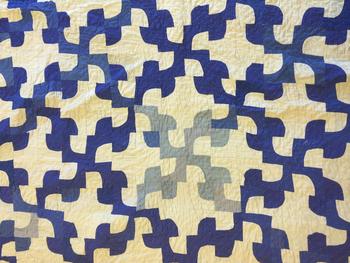
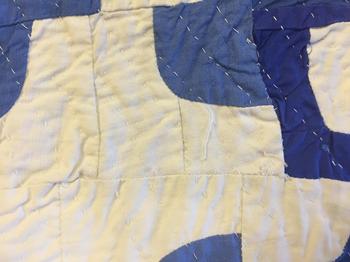
Catherine makes a quilt in 1928. She stitches carefully to ease the excess fabric into the curving seams that characterize the patterned blocks of the quilt. If she works too fast the seam will pucker and refuse to lie flat. She has invested time in this process. She is working with her hands to make cotton fabrics in white and blue into a disorienting pattern. Detail photograph of Catherine Parmeter quilt, courtesy of Yakima Valley Museum. Photo by the author.

My project has involved locating and examining as many Klan garments and related artifacts as possible. The method of this work is straightforward. I virtually deconstruct garments designed to demonstrate their wearers’ commitments to white supremacy into a catalog of component parts: fibers, stitching, belts, tassels, trim, tags, handwritten notation, inconsequential stains, consequential stains. I look for patterns that can help me to periodize artifacts with spotty provenance, better understand the process of production, or contextualize reoccurring signs of use wear. Looking across a larger archive of garments lets me tie individual biographies of Klan regalia and their wearers with larger systems of production and consumption. Through this work, I can better understand how Klan leaders and members used factory-made regalia to disseminate the Klan's particular brand of white supremacy.
To state the obvious, Catherine Parmeter's quilt is not an industrially produced Klan robe. It is a homemade, domestic object that ostensibly incorporated fabric from Klan regalia into its surface. This slight shift makes the object harder to read than the explicitly ideological garments that I usually study. Klan robes can be challenging to classify; are they costumes, uniforms, ceremonial regalia, tools, or garments? In my other work I argue that these objects continue to hold cultural power precisely because they have traversed these identifiable categories, thus transforming a large-scale political project into an intimate experience for Klansmen and their supporters across the country. The quilt takes this categorical confusion even further, since the fragments of Klan masks incorporated into the patchwork surface would be incognito without the identifying note. Where most Klan regalia operated as an identifiable representation of a symbolic type, the idealized “white-robed Klansman,” Parmeter's quilt uses scraps of these representational garments to fashion an otherwise mundane domestic object. Working with any Klan object is a weird, affective experience, but the Parmeter quilt raises a set of questions about provenance, commemoration, and the display of violent objects that lurk around the margins of my larger project but rarely come into focus this clearly.
Klan artifacts are simultaneously ubiquitous and elusive – at once hard to find, and then suddenly everywhere once you start looking. A surprising number of museums, libraries, and archives have a robe or hood stashed in a cabinet, though only a few ever put these objects on display. Tracking down these objects has required me to scour archival databases, perform creative keyword searches, and also make cold calls based on the popularity of the Klan in any given region in the early twentieth century and the scope of an institution's collections. State museums and archives are likely candidates, as are larger historical institutions and research libraries.
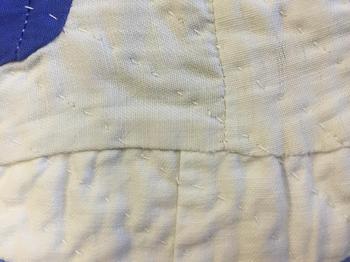
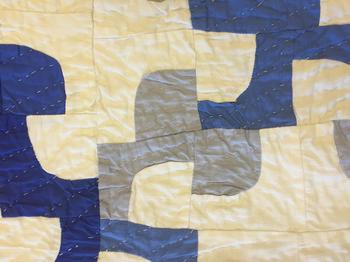
Piecing the top of a quilt is to get stuck in the repetitive motion of tiny actions that build into something larger. Some of the pieces inside the quilt blocks were themselves pieced. Perhaps Catherine keeps track of how many blocks she has already made, or maybe she loses track and is surprised to find she already has enough. Detail photograph of Catherine Parmeter quilt, courtesy of Yakima Valley Museum. Photo by the author.

Klan regalia can also be found through a kind of archival snowball method. During long research trips, some of the most fruitful leads emerged as I chatted with folks at the historical society, gas station, or coffee shop. In these conversations, travel companions and I mined for information about Klan regalia that I'd not yet uncovered.Footnote 5 Thoughtful archivists at the Avery Research Center in Charleston sent me to the Mississippi Department of Archives and History in Jackson. A detour to visit a family friend in Shreveport resulted in an unexpected visit to the special collections of a regional branch of a major university that happened to have a hood in its collection. A rainy day in Butte became a productive tour of former Klan meeting sites in town, thanks to another distant connection. These encounters have been important reminders that the solutions to my most stubborn research problems often require collaborative thinking.
The ad hoc process of finding Klan robes demonstrates the unstable position that these objects occupy in contemporary historical collections. The fraternal organizer who revived the Klan in 1915 wanted white robes and hoods to be a visual representation of the order's racial project. Subsequent displays of historic Klan regalia in a museum setting can easily reproduce the goals of the Klan itself, which sought to reinforce the relationship between its most iconic symbol and the political message it represented. If the representational capacity of these garments conveyed information in the early twentieth century, it also helps to explain the complicated routes these objects traveled to reach museums and archival collections worldwide.Footnote 6
The preservation of each object has been dependent upon the power of the Klan robe as a historical symbol, and the contradictory ways that multiple historical actors have related to that symbol over time. My ability to study Klan objects thus results from the preservation efforts of these actors: not only Catherine Parmeter, whose quilt holds pieces of Klan regalia, but also archivists, curators, private collectors, auctioneers, family members, antiques dealers, junk pickers, conservators, and Klansmen themselves – both historical and contemporary. This is a heterogeneous group of individuals who have become unintended collaborators on a shared project despite widely divergent motivations as well as temporal and spatial distance. Despite having confidence in the historical merits of this work, my entry to this unintended cohort has been uneasy at best.
Even once I've located an artifact, tracing its route to the archive is often difficult, if not impossible. Barriers to determining the origin of a particular garment, or even the name and location of its donor, are often intentional. The historical circumstances governing the provenance of these garments is twofold. First, Klan leaders attempted to strictly control the storage of the organization's regalia in the early twentieth century. Individuals were not supposed to keep their own regalia because these garments were technically the rented property of the KKK Inc. The relatively small number of extant robes in museum collections suggests that many local chapters may have destroyed caches of stored robes during the rapid decline of the organization in the late 1920s and early 1930s. Second, the Klan was a secret, and at times legally dubious, organization whose popularity among the American public was uneven at best. Since these garments were factory-made goods that materially linked men and women across the country with one of the most infamous social organizations in American history, these items could be incriminating evidence of their wearers’ relationship with the Klan. Even under less dramatic circumstances, the early twentieth-century Klan drew many members who would never again express public support for the order. Given the longer career of the Klan and its repeated revival in the twentieth and twenty-first centuries, the visibility and relevance of this order continue to unfold over time. Klan garments thus defy their own historicization, appearing at once to be relics of a distant past, and yet also images of our own contemporary moment.
These dynamics have shaped the ways in which these garments reached historical institutions, a process wrapped up with the still-uncomfortable problem that many white Americans have Klan members in their family trees. Individuals still supportive of the Klan's project would likely not donate these objects to historical collections critical of the order, while others may not want to celebrate their own or their family's ties to organized white supremacy. Anonymously donated Klan robes are intimate objects that carry evidence of complicated family histories, regardless of how legible that evidence may be. In these cases, the name of the donor or wearer of the regalia can be obscured in museum records as a condition of the donation. Whether that discretion is to protect the identity of the long-dead Klansman who wore it, or to avoid embarrassing connections between that person and individuals in the present, varies on a case-by-case basis. Even when the provenance is more explicit, it is not necessarily any more direct. One robe in the collection of the Indiana State Museum reportedly belonged to the donor's “wife's grandmother's cousin's husband … who ran off with the milkmaid.”Footnote 7 This particular artifact is credited to a specific, named donor, but the text of the accession file makes it clear that the donor has narratively distanced himself from the object and the organization it represents.
Though I am always delighted to find another artifact to catalog, I am also unsettled by my own pleasure in locating these macabre objects. My unease with the satisfaction of doing a good job at a terrible task has not gone away. While doing this research on the material remains of the early twentieth-century Klan, I've accumulated my own collection of artifacts: thousands of digital files mixed with some photocopies, piles of notes, clutches of crumpled receipts, and a North Carolina cotton boll shoved unceremoniously in the glove compartment of my car. This detritus is evidence of the routes I have traveled in pursuit of historical actors whose politics I find indefensible. Travels along these lines have enabled my historical findings, and yet are largely invisible in the resulting work, despite the fact that the experience of locating and collecting these materials has significantly shaped the story I am telling about the past and the way that I can tell it. Though I am narrating this story, I keep trying to write myself out of it.
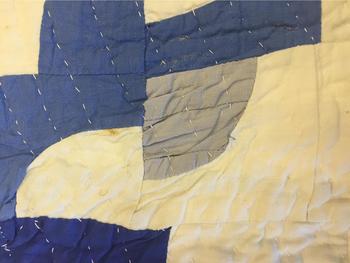
Straight pins are crucial for aligning pieces of fabric as she prepares to stitch, but the pins should be removed as she goes so that the fabric is not torqued unnecessarily. When stitching by hand this is less necessary than it is with a machine whose feed dogs will tug material, or even a finger, under the plunging needle if she stops paying attention for even a moment. Detail photograph of Catherine Parmeter quilt, courtesy of Yakima Valley Museum. Photo by the author.

Staying away from first-person narration is a matter of both personal and professional self-preservation. Training as a historian has led me to reflexively remove myself from my research, while my socialization as an American has prompted a desire to stay as far away from the Klan as possible. But despite my reflexive attempts to shy away from narrating my own relation to my objects of study, I can never seem to remove myself from the work entirely; perhaps I shouldn't, even if I could. The more time I spend with this work, the more I must acknowledge the degree to which my own body has shaped the research spaces that I can access, and the way that I read and understand archival sources I find when I get there. These realizations stem from my engagement with works in the interdisciplinary fields of American studies, African American studies, feminist theory, ethnic studies, and performance studies, among others. In these interdisciplinary fields, scholars have argued that attempts to evacuate the researchers’ corporeal experience from the scholarship we produce privileges scholars whose bodies are not too visible, not too distracting or disruptive, bodies that don't take up too much space.
I am frequently aware of the presence of my body in an archive, of laughing too loudly, of sitting too heavily in a creaking chair. These heightened moments of physicality are magnified by the fact that the documents and artifacts I am examining were produced for and by the Ku Klux Klan. Since I frequently examine artifacts housed in collections comprising mostly documents, my research is a kind of spectacle in its own right. I have measured the round embroidered patch on the front of a Klan robe as other researchers peer at me over the rotting spines of rare books. I have unfurled white robes on a table to the audible surprise of unsuspecting library patrons. In these cases, the iconic garment itself often takes focus for a moment, but the subsequent questions are always directed at me. “Honey,” a southern colleague asked me once in the hallway “what's a white girl from Ohio doing studying the Ku Klux Klan?” I can answer a question like this with scholarly detachment, but that answer is never satisfying, since nobody should spend a decade pursuing violent artifacts just to fill a gap in the literature. For the record, I'm not. But learning how to say what I'm doing and why I'm doing it without falling into apology or overexplanation has taken time. Even as my performance of objective distance follows codes of scholarly propriety, the fact of my body always lingers alongside my interventions into historiographic debates.
As I study Klan materials, questions of what I am doing and why I am doing it always enter the conversation, no matter how I narrate it. The concern motivating these questions lies in the ongoing relevance of the Ku Klux Klan in contemporary American culture, and the potential that my research could be used to bolster the fame and popularity of groups aligning themselves with historical Klans. “We don't have that sort of thing here,” one collections manager wrote in an email sent from a southern coastal swamp. Luckily, for the sake of my research, this response was an uncommon one. In fact, most collections managers and curators were delighted to learn that a few of the most ignominious objects in their collections could be used for knowledge production. To what ends this knowledge could be applied is nonetheless never far from any of our minds.
I often wonder whether vendors in the active secondary market for Klan artifacts may turn to my scholarship in order to increase the monetary value of the arifacts they sell under the label of “collectibles.” Alongside Nazi ephemera and other sensationally “bad” objects, Klan items are frequent features of public auctions – both live and virtual.Footnote 8
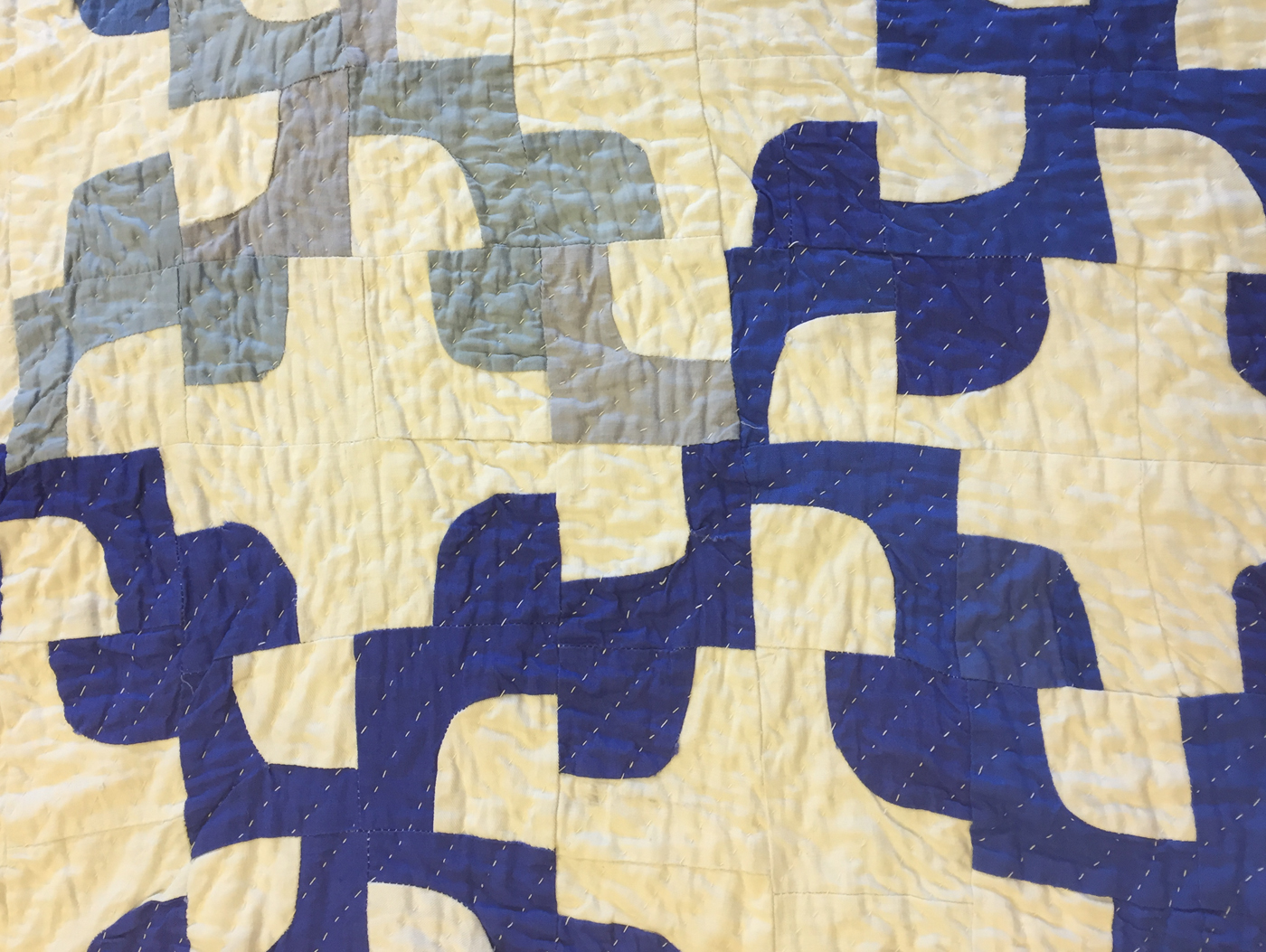
Depending on which way she turns the pieces, the arching segments of blue and white transform from convex to concave forms. Her stitching is sometimes imprecise, which means that the curves do not always lie flat. Puckers in the surface of curving seams make irregular shadows on the surface of the quilt when viewed from certain angles. Detail photograph of Catherine Parmeter quilt, courtesy of Yakima Valley Museum. Photo by the author.

The accession of artifacts by these means puts historical institutions in an unfortunate double bind; institutions can contribute to increasing the exchange value of these goods and enable individuals to profit from their sale, or they can allow these goods to potentially vanish forever into the shadowy realm of private collections. Some private collectors deploy these objects in public display. Baltimore collector Phillip Merrill deploys Klan objects to memorialize black victims of racial violence with his nonprofit Nanny Jack and Co. Other collectors leave no public trace of their plans for these artifacts, leaving space for speculation about their motives. After a 2005 auction in Howell, Michigan, the Associated Press reported that two of the bidders attended the event wearing a swastika armband and a Klan pin.Footnote 9 Ultimately, secondary markets both rely upon and frustrate historical documentation, sometimes at the same time. Important information about the biography of an object may be lost as these garments change hands over time, and yet also, stories about the dramatic lives of Klan artifacts may be used as a way to authenticate these objects and, more troublingly, increase their market values.Footnote 10
Once these objects enter a collection, their preservation requires the active labor of museum staff. For this reason, the anchors of collections management – safe storage and conservation of artifacts – become moments in the social lives of these objects where institutions have to materially commit to the preservation of a Klan object.Footnote 11 Tight budgets and limited personnel resources of many institutions often make this commitment a frustrating decision to make. During the course of my research, several collections managers and museum staff members confided that their institution would never direct resources towards the preservation of these items. Other institutions include Klan regalia on permanent display, despite the known instability of cotton fibers exposed to light over long periods of time. Such departures from best museum practices can happen for divergent reasons – either an institution may possess, but cannot envision displaying, these objects, or the single Klan robe in a collection is central to an exhibition but the staff cannot justify the purchase of another robe. Institutions that do choose to conserve and display Klan regalia do so because the historical value of these objects, and their status as physical evidence of violent American histories, by far outweigh the more personal discomfort of dealing with these garments or directing resources towards their protection.
This decision can come at the expense of significant public controversy, a fact that some institutions have used to generate publicity for their institution and popular interest in a particular exhibition. The Ohio Historical Society did just this in 2011, using the power of sensational objects to open a conversation about the “pieces you don't normally see” with their Controversy exhibition.Footnote 12 It comes as no surprise that curators prominently featured a robe and hood that once belonged to an Ohio Klan recruiter among the objects on display. This use of the sensational properties of Klan regalia is common among institutions that use these objects in service of antiracist projects. Museums can use Klan regalia to provide visitors with a visceral understanding of the dangers faced by black Americans, immigrants, and Catholics in the twentieth century, and these artifacts become material signs of forms of violence and discrimination that leave less lasting physical traces.
But what happens when this use of Klan objects to display the violent power of the Klan aligns with the Klan's own ideological project? Despite the best intentions of institutions that deploy these objects to antiracist ends, the problem remains that the Klan itself championed a kind of preservation project of its own.
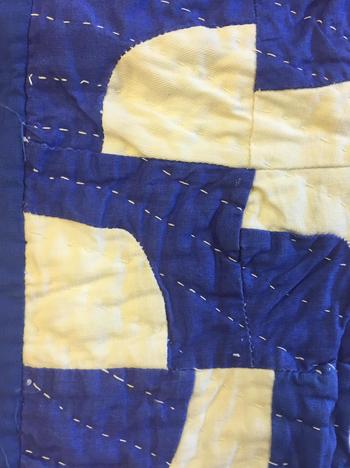
If she doesn't do a small backstitch every time she starts to sew, the entire seam can easily come undone. This is a particular danger for the long running stitches that sandwich fluffy batting between the plain bottom and pieced top, since the stitches are large and exposed. If these quilting stitches are pulled away, the layers of the blanket will start to torque and become lumpy, an action that places undue stress on each of the pieced seams of the quilt top. Detail photograph of Catherine Parmeter quilt, courtesy of Yakima Valley Museum. Photo by the author.

When William J. Simmons described his new fraternal order in 1915, he made it clear that he wanted to revive the Klan of Reconstruction days.Footnote 13 In his extensive writings on the subject, Simmons often referenced the lineage of his organization, generally drawing on romantic depictions of Reconstruction violence found in turn-of-the-century history and cultural production. Simmons went farther than simply talking about links between the old and new Klans, however; he wanted to find ways to make his act of historical appropriation apparent to even the most casual observers of the organization. His version of “reviving” the Klan hinged on his use of symbols that Americans already recognized as signs of the Klan.Footnote 14
For many Americans, particularly those without access to Simmons's writings and speeches, the most convincing link between old and new Klans was a visual one. The secrecy of the self-proclaimed “Invisible Empire” usually gets top billing in discussions of the Ku Klux Klan, but as its critics frequently announced, the big ideas that members wanted to promote were apparent to anyone who paid much attention. Klansmen wore their politics on their sleeves. The men who populated Simmons's order dressed in white uniform robes and pointed hoods for ceremonial events. The strange shape of these garments referenced the macabre costumes worn by nineteenth-century Klansmen, while also revising that aesthetic.Footnote 15 Simmons's new uniforms disrupted the sartorial codes of everyday life at the time, and yet also presented members as part of a regimented and hierarchical order. These garments offered up the bodies of members as a visual display of the Klan's power. When large groups of uniformed Klansmen gathered, their garments illustrated the kind of collective power that Klan leaders envisioned – hierarchical, disciplined, and politically coherent – even if the reality was much more complicated.
In addition to demonstrating the ideal internal structure of the organization, Klan regalia also modeled the kind of social reform that its members sought for the nation. The society that Klan leaders promoted was organized according to what they argued were innate hierarchies, with race, religion, ethnicity, nationality, and gender portrayed as immutable characteristics that determined an individual's capabilities for citizenship, leadership, and cultural participation. Klan leaders taught that widespread adherence to this model would lead to the end of social conflict, and the perfection of American society.Footnote 16 The job of this unified body was to restore and preserve the health of the nation.
The Klan's project of social and racial preservation was predicated on practices of public display, which both advertised the contemporary Klan and commemorated the Reconstruction-era groups that the new Klansmen claimed to revive. Imperial Wizard Simmons not only borrowed strategies from the newly constituted marketing industry, but also incorporated the staff of a small advertising firm into the Klan's leadership structure in 1921. Their strategy relied on easily recognizable symbols to allow individuals to identify with collective social projects.Footnote 17 Thus the Klan's project of national expansion was effective precisely because its complicated ideological project could be conveyed in immediately visual form. Reproducing the symbols of the Klan became a way of reproducing the Klan itself.
Though it incorporates material from Klan robes, the most famous of the Klan's symbolic images, the Parmeter quilt exhibits a stubborn ambivalence in its nonrepresentational preservation of the Klan. This object requires careful untangling. The Parmeter quilt is one of only three known quilts related to the Klan.Footnote 18 The other two, held in collections at Michigan State University Museum and the Desoto Museum in Kansas, were used for fund-raising raffles in the mid-1920s. These objects feature the name of the local Klavern (lodge) and the embroidered signatures of raffle participants on the patchwork surface. Parmeter's quilt is far less explicit. This object bears neither signatures nor the embroidered image of a Klansman on horseback found on the Michigan quilt. Unlike either of these raffle quilts, it does not visibly represent a shared affiliation to the Klan, instead, it may preserve parts of the garments that Klansmen used to perform and experience that affiliation in a way that is not apparent without access to the object's provenance.
Making a quilt from secondhand fabric requires careful economy when laying out the pattern. To make the three-inch squares that cover the surface of the quilt, Catherine needs at least one quarter-inch of seam allowance around each edge, more if she's less confident in her ability to stitch along the lines of her pattern. On the eleven-inch-wide facemask of a Ku Klux Klan hood she can fit three squares across. Even with tiny seam allowances, only six pieces for the quilt could be cut from each mask since the eyeholes get in the way. Sometimes she doesn't have enough to cut a whole piece from the fabric she has, and she constructs a piece from even smaller fragments of fabric. She pieces the pieces. Detail photograph of Catherine Parmeter quilt, courtesy of Yakima Valley Museum. Photo by the author.

The question whether or not Catherine Parmeter used the white squares of fabric in order to commemorate the Klan is an open one, though some research into Parmeter and her family can help make this leap more plausible. Catherine Parmeter was a fifty-two-year-old mother of two living in Puyallup, Washington when she reportedly made the quilt.Footnote 19 After migrating west from their home state of Minnesota, Parmeter and her husband Charlie traversed the state of Washington, farming berries in Puyallup in the 1920s, living just north of Seattle in the 1930s, and landing in Yakima some time before their deaths in 1967 and 1968.Footnote 20 Having a good guess of how the quilt got to Yakima prior to its donation to the museum, however, does not explain the object's relation to the Klan.
In order to make this connection, Parmeter's biographical data must be laid alongside the facts we know about the Klan in Washington State, and in Puyallup more specifically. The 1915 Klan revival set into motion a bureaucratic structure that envisioned Klan expansion on a franchise model. Recruiters reached the Pacific Northwest in 1922, with a particularly active Klan centered in Portland, Oregon.Footnote 21 Local Klan organizations were to report to county, state (realm), and regional officials, each of whom helped to administrate dictates distributed from the Klan's “Imperial Palace” in Atlanta. In January of 1928, Imperial Wizard Hiram W. Evans issued an edict directing Klansmen across the country to “unmask,” in order to help the order shed its ties to illegality and violence.Footnote 22 According to the author of the note found with the quilt, the masks used for the white portions of the textile were removed from the Klansmen's distinctive pointed helmets at a 1928 “torch-lighting parade” in Olympia.Footnote 23 Given the networks of regional and statewide collaboration between Klans, the operations of Puyallup's Pierce County Klan is part of the bigger story of the Klan's popularity in Washington State, and the Pacific Northwest more broadly. The Pierce County Klan was likely dwarfed by larger Klans in nearby Tacoma, Seattle, and Issaquah, where rallies to initiate new members drew crowds reported to be in the tens of thousands.Footnote 24 Seen in this light, the Parmeter quilt could be a fascinating document of Klan leaders’ attempts to make their organization respectable, as Washington State Klans tried to put the directives of Atlanta leaders into practice.
The only information linking the Parmeters to the Klan is found in that short note, now housed in the object's accession file. Following a 2006 feature about the quilt on a national NPR program, the Parmeters’ daughter, Ruby Kitchen, called the museum to say that her parents were active in the organization when she was a young girl, and dressed her up to be a Klan mascot.Footnote 25 Like many Klans across the country, there is no documentation of the meetings held in the Puyallup Klavern, save a single program from an installation ceremony annotated with the names of Pierce County Klansmen, though Charlie Parmeter is not listed among the Klansmen whose names are written on that document.Footnote 26
Another likely tie between the quilt and the Klan may be read from Catherine Parmeter's choice of pattern for her piecework. Since the 1870s the “drunkards path” pattern signified a potential association with the Women's Christian Temperence Union, particularly when worked in blue and white fabrics.Footnote 27 The WCTU had an active chapter in Puyallup, as well as the northern Minnesota county where the Parmeters lived until they moved to Washington.Footnote 28 While distinct organizations, the WCTU was sometimes used as a feeder organization for the Women of the Ku Klux Klan, the KKK's women's auxiliary. It's possible that Catherine Parmeter's relation to the Klan was not simply in supporting her husband's likely membership, but in her own right as a member of the WKKK.Footnote 29
Popular interest in the Klan's role in US history has guided recent public interest in the quilt, even though the significance of this artifact was not made public until more than two decades after the quilt's donation to the museum in 1978.Footnote 30 There is no record that the quilt was displayed until 2003, when it appeared as part of a show of two hundred quilts from the Yakima Valley Museum collection.Footnote 31 Three years later, the quilt generated broader public attention when it was displayed in a singular display case on the merit of its sensational backstory.
The Parmeter quilt is part of an impressive set of textile holdings at the Yakima Valley Museum, which comprise roughly one-fifth of the 70,000 objects that make up the total collection. Among these artifacts are “two-hide” dresses, intricately beaded by members of the Yakama tribe, and the calico bonnets of nineteenth-century settlers who took their land. Given this context, the dramatic story of a quilt made from recycled Klan regalia doesn't seem terribly out of place. Parmeter's handiwork isn't even the only Klan object in the museum's collection. Their holdings also include a ceremonial sword and a white cotton hood with a faded red wool tassel stitched to its pointed tip. This Klan helmet has a suggestive link to the Parmeter quilt – at some point the facemask was cut off with a slice that leaves two arcs of zig-zag stitching indicating where the eyeholes used to be. The helmet was purchased at auction and subsequently donated to the museum, so there is no way to confirm the claim that it was worn in the Olympia Washington region. Nonetheless, it is possible that this mask was removed at the same event as the masks cut up to form the white parts of the Parmeter quilt. It could even be one of the helmets that Parmeter used to piece her quilt, though such a speculation doesn't get us anywhere.
In fact, supporting any claims I can make about Parmeter's quilt is a tricky operation. Even knowing that it was made by Catherine Parmeter in the first place requires a certain kind of faith in the stories that are attached to objects. In this case, that attachment is literal, since the artifact's provenance was pinned to the quilt when it arrived at the museum. Despite this suggestive evidence, neither careful study of the Parmeter quilt nor the historical context of its production can answer the most compelling questions surrounding this object.
While this information can help me to map some aspects of how Parmeter produced this object, her motivation for making this object remains opaque. We don't know whether she was trying to honor the organization to which her husband and perhaps she belonged, or whether she simply saw an opportunity to acquire some free fabric. We don't know if she was enlisted to do this work by one of the leaders of Puyallup's Klan, or if the project was on her own initiative. While the quilt shows some marks that suggest some sort of use, we don't know what position the quilt held in the Parmeter home, or whether the individuals using it realized its relation to the Klan. In short, we don't know what saving a piece of the Klan meant for Parmeter, or whether she even saw it that way in the first place. She left behind no narrative accounts of her involvement with the Klan, of her motivations for making the object, or of how she used it once it was made. We don't know if she made it alone, or if her children knew what it was made from, or if unsuspecting guests to the home slept under a blanket of the Klan. The small bit of narrative that we have about the object, from the text of the note in the accession file, invites imaginative renderings of the production and use of this object, even as the artifact itself resists clear definition.
No matter what Parmeter intended, her project saved something of the Klan – traces of its most iconic symbol, in fact – but her handiwork transformed Klansmen's masks into something nonrepresentational. Such a move could be interpreted in one of two ways. One possibility is that this quilt pushes against the very basis of the Klan's project of preservation through display, in that these scraps of white fabric are no longer recognizable as components of the Klan's uniform regalia. By transforming the masks into a domestic item, Parmeter could be evacuating the organization of its violent power.
Another possibility is that Parmeter repurposed Klan masks in the familiar nineteenth-century practice of collecting souvenirs that could function either as historical relics or as personal mementos. These material tokens could be used to bring “deep and tender feeling,” on either a personal or a national scale, into everyday life.Footnote 32 By hoarding shards of the curtains that lined the stage of Ford's theater the night that Lincoln was shot, Americans could translate larger public emotions into portable talismans.Footnote 33 Likewise, cutting up pieces of the discarded masks from a large Klan rally could function as a memento of that event, and a way to commemorate the Klan or Parmeter's relation to it. The transformation of the discarded masks could also protect these material signs of the Klan's political project and keep them safe, even incorporating them into her daily life in ways she could not with an intact robe and hood.
Since we don't know who wrote the anonymous note included with the donation of the quilt, there is no way to assess whether Parmeter would have approved of the quilt's donation, or the note that identifies the source of its fabric. Instead, what I have is an object, a historical rumor, and a set of contextual convergences that stack up into something more complicated than a yes or a no. Catherine Parmeter’s quilt is probably made from the discarded masks of early twentieth-century Klan robes, but such a definitive identification only gets us so far. Displaying the quilt means that viewers can better grasp the way that the Klan's ideology operated on an intimate level, and was incorporated into the daily lives of believers – whether or not Parmeter made it for that reason.
She chooses a pattern that is too ambitious for her sewing skills, or she works too quickly, or she stitches so many of these short curving seams that she gets bored and doesn't worry about precision. We don't really know. No matter what the reason, the curving seams at the center of each block rarely take the shape of a graceful arc. The overall impact is one of dizzying repetition, all imperfections smoothed with the help of a heavy iron. Seen up close, however, the fragmentary nature of the medium is immediately apparent. This is a thing pieced from fragments. Detail photograph of Catherine Parmeter quilt, courtesy of Yakima Valley Museum. Photo by the author.

In August of 2014, I drove a Ford Focus with a broken air conditioner around Washington State. While Yakima is lodged in a valley known for its fruit production, the landscape is dry hills and scrub brush. The city sprawls into the desert but looks much smaller because it is surrounded by such an expanse of land. I arrived in the midst of a record heat wave and an oppressive dust storm, the combination of which necessitated that I drive through the state with the windows down and a scarf wrapped around my face to keep brown powder from my nose and mouth. This would be beside the point except that my experience of seeing the quilt for the first time was so bound up with the relief of acute physical discomfort. The Yakima Valley Museum was climate-controlled, and the opportunity to study an object within that space offered an unexpected moment of relaxation, even as I studied an object with such an unsettling pedigree.
This tension underlies each of my archival visits, and all the conversations that make those visits possible. How can I find pleasure in the pursuit of something so awful? How can I continue to do this work if I do not? The first time I walked into a museum storeroom to examine a Klan robe, I could hear my breath a little too loudly in the back of my ears. By the third time, the sensation of unease that comes with being too close to a bad object had already become a routine practice. Working with these materials over time has made them mundane, and I know I am not alone in this since the routine practices of archival work can be numbing. This kind of familiarization with violence in the archive is central to the ability of many scholars to do this work in the first place. I too need to be accustomed to seeing these objects in order to continue my study without being undone by every archival visit.
But this basic condition of doing my work may be too much of a price to pay. It leads to writing that stalls out in revisions, or never even reaches the page. Without the rage and urgency there is nothing to do but continue to comb the census, to refill the humidifier, and top off a cup of coffee that is always cold. Instead, I settle for a stitch in my side or a catch at the back of my throat that won't quit as I keep chasing records and objects that appall me. Doing this has meant that I am preserving the Klan, even if the impulse that has propelled me is one of demystification. Writing myself out of this story works for my historical scholarship, but it also does a disservice to the ambiguous relationship between preservation and commemoration, between delight in discovery and alarm at the contents of the material that historians may find. I find myself working to keep these qualities in tension, or else the work becomes lifeless, the conclusions inevitable.
I've come to realize that becoming undone, again and again, is part of the deal. Tracking down Klan objects means thinking about their producers and the complicated relations to an ideology that they may have held. Through this work I find myself tracing the daily life of a Washington State berry farmer who ate dinner and sowed crops while his wife sewed a quilt. But the sowing and the sewing and the eating and all the other everyday activities of the Parmeter family were underpinned with the fact that Charlie and Catherine Parmeter were somehow also involved with the Klan. The cut-up Klan masks stitched into the quilt can't be extricated from the blue patches, and to try takes us away from the very thing that made the early twentieth-century Klan so powerful and dangerous in the first place. “You may not want to use this information but I shall write it down anyway, just in case you may want it,” the note begins, and so do I.