INTRODUCTION
The wahoo (Acanthocybium solandri) is a highly migratory species distributed in tropical and subtropical waters (Collette & Nauen, Reference Collette and Nauen1983; Collette, Reference Collette and Carpenter2002) that spends most of its time above the thermocline (Sepulveda et al., Reference Sepulveda, Aalbers, Ortega-Garcia, Wegner and Bernal2011). Like other scombrids, the species is a fast swimmer with high aerobic performance (Korsmeyer et al., Reference Korsmeyer, Dewar, Lai and Graham1996; Katz et al., Reference Katz, Syme and Shadwick2001; Wegner et al., Reference Wegner, Sepulveda and Graham2006), permitting individuals of the species to travel hundreds of kilometres (Theisen & Baldwin, Reference Theisen and Baldwin2012). This scombrid is captured worldwide mainly as incidental catch in the purse seine, pelagic longline and trolling fisheries, as well as private recreational fishing in the Pacific Ocean (Zischke, Reference Zischke2012). The annual haul in the Pacific Ocean has increased recently, with an estimate of 8279 t in 2013 (FAO, 2016).
Acanthocybium solandri is a high trophic level predator that feeds mainly on fishes and cephalopods (Allain, Reference Allain2003; Vaske et al., Reference Vaske, Vooren and Lessa2003; Baque-Menoscal et al., Reference Baque-Menoscal, Páez-Rosas and Wolff2012), consuming a wide variety of prey items (Manooch & Hogarth, Reference Manooch and Hogarth1983; Allain, Reference Allain2003; Vaske et al., Reference Vaske, Vooren and Lessa2003; Franks et al., Reference Franks, Hoffmayer, Ballard, Garber and Garber2008; Rudershausen et al., Reference Rudershausen, Buckel and Edwards2010; Baque-Menoscal et al., Reference Baque-Menoscal, Páez-Rosas and Wolff2012). The species inhabits epipelagic, pelagic, mesopelagic and bathypelagic areas (Allain, Reference Allain2003). In the Pacific Ocean, fishes are the most important prey (Allain, Reference Allain2003; Iversen & Yoshida, Reference Iversen and Yoshida1957); however, cephalopods also represent an important part of the wahoo diet (Allain, Reference Allain2003; Baque-Menoscal et al., Reference Baque-Menoscal, Páez-Rosas and Wolff2012).
Studies on A. solandri feeding ecology in the Pacific Ocean are scarce. Further studies, including diet description and an assessment of possible regional and interspecific differences in feeding habits, are necessary to enhance our knowledge of this predator's role in the area. Moreover, considering its economic importance, we also need further research on this species’ life history in order to develop effective management programmes. Our goal was to describe the feeding habits of A. solandri by identifying the main prey and assessing possible regional, sexual and ontogenetic differences in diet, in addition to evaluating their feeding strategy.
MATERIALS AND METHODS
Sampling and stomach content analysis
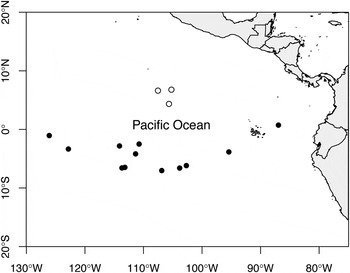
Acanthocybium solandri samples were collected by Inter-American Tropical Tuna Commission (IATTC) observers during morning hours on purse seine fishing trips off the Pacific coast of Central and South America (Figure 1) in January, February, March, June and July 2005. Each individual was sexed and the fork length (FL) was measured to the nearest cm; stomach contents were frozen for posterior analysis. Stomach contents were classified and prey were weighed to the nearest 0.01 g and identified to the lowest taxonomic level. Wet weight was used for analysis as wet reconstruction cannot be applied to all prey species. Complete fishes and cephalopods were identified according to Fischer et al. (Reference Fischer, Krupp, Schneider, Sommer, Carpenter and Niem1995a, Reference Fischer, Krupp, Schneider, Sommer, Carpenter and Niemb), and Jereb & Roper (Reference Jereb and Roper2010). Fishes were also identified based on the skeleton or otoliths (Clothier, Reference Clothier1950; García-Godos, Reference García-Godos2001) and cephalopod species identification was also based on beaks (Clarke, Reference Clarke1962, Reference Clarke1986; Wolff, Reference Wolff1984).
Map showing the study area. Circles indicate sample sites. Empty circles correspond to the North Pacific Equatorial Countercurrent Province; black circles indicate sites in the Pacific Equatorial Divergence Province (Longhurst, Reference Longhurst2007).

Data analysis
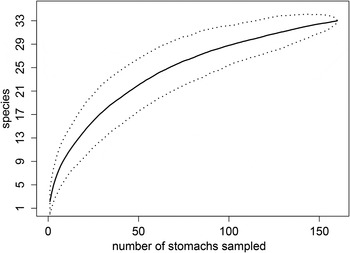
To evaluate whether the sample size was adequate to describe the full diet a randomized cumulative prey curve was generated using the vegan package (Oksanen et al., Reference Oksanen, Blanchet, Kindt, Legendre, O'Hara, Simpson, Solymos, Stevens and Wagner2010) in R (R Development Core Team, 2014) including the lowest taxonomic level of each prey (Preti et al., Reference Preti, Soykan, Dewar, Wells, Spear and Kohin2012). The mean species accumulation curve (±2 standard deviations) was plotted from 500 random permutations of the data. When the curve approaches the asymptote, the number of samples is assumed to be sufficient to describe the diet (Hurtubia, Reference Hurtubia1973). When the asymptote was not evident a straight line to the last 4 points was compared to the slope of the line with a line of slope zero, reaching the asymptote when the lines did not differ significantly (Bizzarro et al., Reference Bizzarro, Robinson, Rinewalt and Ebert2007).
To determine the relative importance of each prey to the diet, we calculated the Prey Specific Index of Relative Importance (%PSIRI) (Brown et al., Reference Brown, Bizzarro, Cailliet and Ebert2012) using the equation: %PSIRI = 0.5%FO
i
(%PN
i
+ %PW
i
), where %FO
i
is the number of stomachs containing prey category i divided by the total number of stomachs, n. Prey-specific abundance was calculated with the equation
 $\% {\rm PA}_i = \Sigma _{\,j = 1}^n \% A_{ij} n_i ^{ - 1} $
where %A
ij
is the abundance (by counts, %PN
i
or weight, %PW
i
) of prey category i in stomach sample j and n
i
is the number of stomachs containing prey i. The %PSIRI is a modification of the Index of Relative Importance (IRI) (Pinkas et al., Reference Pinkas, Oliphant and Inverson1971). The measure accounts for %FO redundancies in the %IRI, and is additive with respect to taxonomic levels; thus, the %PSIRI of a family will be equal to the sum of the %PSIRI of the species in that taxon (Brown et al., Reference Brown, Bizzarro, Cailliet and Ebert2012).
Individuals were grouped in two size classes based on sexual maturity (Brown-Peterson et al., Reference Brown-Peterson, Franks and Burke2000; Jenkins & McBride, Reference Jenkins and McBride2009) (juveniles = 66–92 cm, N = 86; adults = 93–127 cm, N = 74) to identify possible ontogenetic changes in diet. Samples were also classified by geographic area based on Longhurst's (Reference Longhurst2007) biogeographic provinces (Figure 1) (North Pacific Equatorial Countercurrent Province, N = 31; Pacific Equatorial Divergence Province, N = 129) in order to assess regional differences.
Sexual, ontogenetic and regional differences in diet were evaluated with multivariate techniques including analysis of similarity (ANOSIM) and non-metric multidimensional scaling (MDS) plots (PRIMER v6.2; www.primer-e.com) using the per cent number (%N) of each prey grouped by family. Prey items were grouped by family to reduce the number of prey categories in the samples with zero values, increasing the effectiveness of the multivariate analysis (White et al., Reference White, Platell and Potter2004; Espinoza et al., Reference Espinoza, Clarke, Villalobos-Rojas and Wehrtmann2013; Szczepanski & Bengtson, Reference Szczepanski and Bengtson2014). Data were square-root transformed and a similarity matrix was constructed using the Bray–Curtis similarity coefficient. Data were permutated 999 times for a distribution to determine the P-value of ANOSIM's R statistic (R = 0 is identical, R = −1 or 1 is most divergent) (Clarke & Gorley, Reference Clarke and Gorley2001).
To determine niche breadth, we calculated the Levin's standardized index (B
a) using the %PSIRI converted to proportions for the different prey species identified (Krebs, Reference Krebs1999). This measure varies between 0 and 1, where values close to 0 express a specialized diet and values close to 1 indicate a generalized diet (Krebs, Reference Krebs1999). To assess feeding patterns, we used the graphical analysis proposed by Amundsen et al. (Reference Amundsen, Gabler and Staldvik1996), a modification of Costello's (Reference Costello1990) method that provides information regarding prey importance and the predator's feeding strategy in the form of a two-dimensional graph plotting the prey specific abundance
 $(\% P_i )$
vs the %FO
i
, with
 $\% P_i $
= (Σ prey i weight/Σ weight of all prey in stomachs containing prey i) × 100.
RESULTS
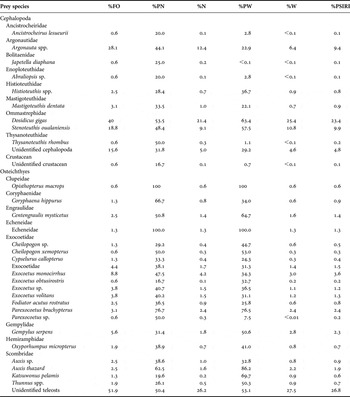
A total of 226 samples were obtained; 160 stomachs contained food representing a total of 33 taxa (Table 1). Sample size was not sufficient to describe the diet (P < 0.05) (Figure 2). Of the wahoo with food in their stomachs, 88 were females (69.3–127.0 cm), 70 were males (68.2–126.0 cm), and one was of undetermined sex. Cephalopods and fishes were the main prey groups (50.4 and 49.5% PSIRI, respectively), followed by crustaceans (0.1% PSIRI). Dosidicus gigas (23.4% PSIRI), Stenoteuthis oualaniensis (9.9% PSIRI) and Argonauta spp. (9.4% PSIRI) were the most important prey species (Table 1).
Cumulative prey curve for A. solandri.

Diet composition of Acanthocybium solandri by per cent frequency of occurrence (%FO), per cent prey-specific number (%PN), per cent number (%N), per cent prey-specific weight (%PW), per cent weight (%W) and prey-specific index of relative importance (%PSIRI).

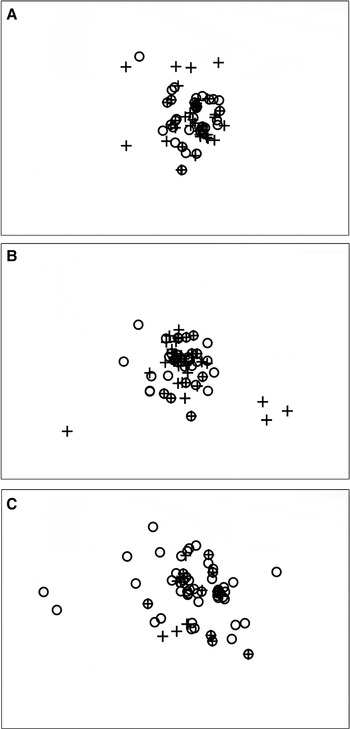
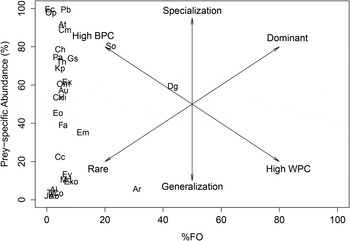
ANOSIM did not reveal any significant differences in diet based on sex (R = 0, P = 0.44), size class (R = 0, P = 0.40) or regions (R = 0.039, P = 0.22) and these results are illustrated by MDS plots (Figure 3). Based on the 33 dietary items, the niche breadth was 1.0. Amundsen graphical analysis suggests that A. solandri exhibits a generalist feeding pattern, with no clearly dominant prey. Considering their low species abundance and frequency of occurrence, several prey items were of little importance (lower left): the squids Ancistrocheirus lesueurii, Abraliopsis sp., Japetella diaphana and Thysanoteuthis rhombus; and the dolphinfish Coryphaena hippurus (Figure 4).
(A) MDS plots comparing wahoo males (+) vs females (o); (B) juveniles (+) vs adults (o); and North Pacific Equatorial Countercurrent Province (+) vs Pacific Equatorial Divergence Province (o). The stress level for the 2-D ordination was 0.01.

Prey-specific abundance
 $(\% P_i )$
plotted against the frequency of occurrence for A. solandri prey species. The explanatory axes for foraging patterns are those used by Costello (Reference Costello1990) as modified by Amundsen et al. (Reference Amundsen, Gabler and Staldvik1996). The two diagonal axes represent the importance of prey (dominant vs rare) and the contribution to niche width (high between-phenotype vs high within-phenotype contribution); the vertical axis defines the predator feeding strategy (specialist vs generalist). Ab, Abraliopsis sp.; Al, Ancistrocheirus lesueurii; Ar, Argonauta spp.; At, Auxis thazard; Au, Auxis sp.; Cc, Cypselurus callopterus; Ch, Cheilopogon sp.; Cm, Centengraulis mysticetus; Co, Coryphaena hippurus; Cx, Cheilopogon xemopterus; Dg, Dosidicus gigas; Ec, Echeneidae; Em, Exocoetus monocirrhus; Eo, Exocoetus obtusirostris; Ex, Exocoetus sp.; Ev, Exocoetus volitans; Exo, Exocoetidae; Fa, Fodiator acutus rostratus; Gs, Gempylus serpens; Hi, Histioteuthis spp.; Jd, Japetella diaphana; Kp, Katsuwonus pelamis; Md, Mastigoteuthis dentata; Om, Oxyporhumpus micropterus; Op, Opisthopterus macrops; Pa, Paraexocoetus sp.; Pb, Paraexocoetus brachypterus; So, Stenoteuthis oualaniensis; Th, Thunnus spp.; Tr, Thysanoteuthis rhombus.

DISCUSSION
The number of wahoo prey items registered in this study is higher than that reported elsewhere in the Pacific (Iversen & Yoshida, Reference Iversen and Yoshida1957; Allain, Reference Allain2003; Baque-Menoscal et al., Reference Baque-Menoscal, Páez-Rosas and Wolff2012) and Atlantic Oceans (Franks et al., Reference Franks, Hoffmayer, Ballard, Garber and Garber2008) probably due to the extensive area and larger sample size considered here. In a long-term study, Manooch & Hogarth (Reference Manooch and Hogarth1983) observed more prey items off the Atlantic coast of the USA, in the Gulf of Mexico and around Bimini (Manooch & Hogarth, Reference Manooch and Hogarth1983).
The cephalopods D. gigas, S. oualaniensis and Argonauta spp. were the main prey species in this study. Around the Galapagos Islands, D. gigas was also one of the most representative prey items based on the per cent number (%N) (Baque-Menoscal et al., Reference Baque-Menoscal, Páez-Rosas and Wolff2012). Fishes were the most important prey group registered in the Western and Central Pacific in terms of number, frequency of occurrence and weight (Allain, Reference Allain2003) and were also the most frequent prey in the Line Islands (Iversen & Yoshida, Reference Iversen and Yoshida1957). For the Western and Central Pacific not considering unidentified fish, the most frequent prey items were squids, Alepisaurus sp. (lancetfish) and Chiasmodontidae fishes; based on number, the most common prey items were squids, and Siganidae and Chiasmodontidae fishes (Allain, Reference Allain2003).
Squids make up an important component of the wahoo diet. Based on a decadal study of the Thunnus albacares diet, Olson et al. (Reference Olson, Duffy, Kuhnert, Galván-Magaña, Bocanegra-Castillo and Alatorre-Ramírez2014) argued for broad-scale changes in the pelagic food web in the Eastern Tropical Pacific, with squids and crustaceans predominating. The abundance of squids as D. gigas in this area (Nigmatullin et al., Reference Nigmatullin, Nesis and Arkhipkin2001) may contribute to the high rate of consumption as they are also an important prey item for other oceanic predators in the eastern Pacific, including sharks (Galván-Magaña et al., Reference Galván-Magaña, Polo-Silva, Hernández-Aguilar, Sandoval-Lodoño, Ochoa-Díaz, Aguilar-Castro, Castañeda-Suárez, Chavez-Costa, Baigorrí-Santacruz, Torres-Rojas and Abitia-Cárdenas2013) and tunas (Olson et al., Reference Olson, Duffy, Kuhnert, Galván-Magaña, Bocanegra-Castillo and Alatorre-Ramírez2014). The high site fidelity displayed by this predator may be related to the abundance of prey in particular areas, as previously suggested for this species off Baja California Sur, Mexico (Sepulveda et al., Reference Sepulveda, Aalbers, Ortega-Garcia, Wegner and Bernal2011).
Crustaceans do not make a significant contribution to the A. solandri diet in the eastern Pacific Ocean. In this study, only one hard part in one stomach was observed; a low frequency of occurrence also had been reported for this prey group around the Galapagos Islands (Baque-Menoscal et al., Reference Baque-Menoscal, Páez-Rosas and Wolff2012). However, in the western and central Pacific, wahoo feed on a wide variety of crustaceans, including shrimp, Amphipoda and Hyperiidea (Allain, Reference Allain2003). The importance of crustaceans in the wahoo diet varies by geographic area rather than availability in the marine environment; in the Pacific Ocean, Olson et al. (Reference Olson, Duffy, Kuhnert, Galván-Magaña, Bocanegra-Castillo and Alatorre-Ramírez2014) observed that cephalopods and crustaceans were more prevalent in the Thunnus albacares diet in the 2000s than in the 1990s. To date, no studies have been conducted on temporal changes in the wahoo diet in the Pacific Ocean; however, Rudershausen et al. (Reference Rudershausen, Buckel and Edwards2010) mentioned that the wahoo diet exhibited low interannual variability in the North Atlantic Ocean.
We observed high trophic overlap and no regional differences in diet between males and females. Ontogenetic shifts in diet have been observed in scombrids (Graham et al., Reference Graham, Grubbs, Holland and Popp2007; Shimose et al., Reference Shimose, Watanabe, Tanabe and Kubodera2013). However, our study also reports high trophic overlap between size classes, likely related to the narrow size range of the wahoo sampled.
Acanthocybium solandri is a generalist consumer in the study area with a wide niche breadth. An opportunistic feeding strategy had been suggested for A. solandri (Zischke, Reference Zischke2012) and observed for other scombrids, like Thunnus albacares, Thunnus obesus (Ménard et al., Reference Ménard, Labrune, Shin, Asine and Bard2006) and Thunnus orientalis during the early stages of life (Shimose et al., Reference Shimose, Watanabe, Tanabe and Kubodera2013). Epipelagic and mesopelagic cephalopods and epipelagic fishes are the most representative prey in the wahoo diet in this area; this is in contrast to the western and central Pacific, where deeper fish species like Alepisaurus sp. and Chiasmodontidae have been registered (Allain, Reference Allain2003). Few data are available on A. solandri and this study presents new information on the importance of cephalopods to the wahoo diet. Due to their economic importance and role as generalist predators, studies involving longer study periods and larger sample sizes are needed to evaluate possible temporal and interspecific differences in wahoo feeding habits.
ACKNOWLEDGEMENTS
We thank the Tropical Tuna Commission (IATTC) and Robert J. Olson for their support.
FINANCIAL SUPPORT
F.G.M. thanks the Instituto Politécnico Nacional (COFAA; EDI) for fellowships.