1. Introduction
The relationship between population dynamics and economic performance remains one of the oldest and most debated questions in macroeconomics. From Malthus’s (Reference Malthus1798) original claim that population pressure on the fixed factor of land inevitably depresses living standards, to contemporary discussions on demographic dividends, rural–urban migration, and the role of land-saving technological progress, the question of whether population growth stimulates or hinders economic development continues to occupy a central place in growth theory and policy analysis. Modern growth models usually abstract from land as a binding constraint and focus on capital dilution as the primary channel through which population affects output. In such settings, the long-run consequences of demographic expansion are moderate, and cross-country differences in growth are driven primarily by technology, institutions, and capital accumulation. Yet for many economies—especially those with extensive agricultural sectors, limited arable land, or slow structural transformation—land remains central to production, and demographic pressure continues to shape the path of development.
This paper revisits this classical question by taking seriously the idea that the binding nature of land constraints varies across countries and over time. In economies where agriculture is dominant and land per worker is low, increases in population may still reduce per-capita income growth through a modern Malthusian mechanism. Conversely, in more diversified economies where agriculture accounts for a small share of output, the fixed factor of land plays a far smaller role in shaping macroeconomic dynamics, and population growth may be neutral or even growth-enhancing. Understanding when and why population growth becomes harmful therefore requires a framework in which effective land intensity is endogenous to structural transformation and demographic adjustment.
Building on Karras (Reference Karras2010), who shows that population growth lowers per-capita income growth in proportion to an economy’s effective land intensity—defined as the product of the land share in production and the agricultural share of GDP—this paper extends the analysis in three important ways. First, the theoretical framework is generalized to a two-sector economy in which only the agricultural sector uses land, while the non-agricultural sector—manufacturing and services—relies solely on reproducible factors. Structural transformation, through the reallocation of labor and output away from agriculture and toward non-agriculture, endogenously determines the economy’s effective land intensity rather than treating it as fixed. As countries develop, this mechanism relaxes the land constraint, attenuates the negative effect of population growth, and generates cross-country variation in demographic impacts consistent with long-run development patterns documented by Herrendorf et al. (Reference Herrendorf, Rogerson, Valentinyi, Herrendorf, Rogerson and Valentinyi2014).
Second, the model introduces migration as an explicit demographic adjustment margin that operates alongside structural transformation. Whereas Karras (Reference Karras2010) treats population growth as fully absorbed domestically, this framework allows population pressure to trigger labor reallocation away from land-intensive production through rural–urban migration and international emigration. When demographic expansion lowers the land–labor ratio in agriculture, productivity and wage gaps widen between agricultural and non-agricultural activities or between domestic and foreign labor markets, inducing net outflows. This migration response reduces effective population pressure on land and partially offsets the congestion mechanism. Accordingly, the growth effect of population expansion becomes a joint function of land intensity, structural transformation, and migration responsiveness. This generates new testable predictions involving interactions between population growth, agricultural dependence, and migration that cannot arise in Karras’s original model.
The interaction of these mechanisms offers a unified way to interpret the heterogeneous empirical effects of population growth found in the literature. While some studies find negative effects of demographic expansion on growth (e.g., in agriculture-dependent economies), others find neutral or even positive effects, particularly in settings experiencing rapid structural transformation, urbanization, or significant migration flows. A framework incorporating land constraints and demographic adjustment is therefore well suited to explaining these diverging results.
This paper provides new empirical evidence on these issues using a panel of 152 countries over 1960–2023. By combining data on population dynamics, net migration, agricultural shares, land availability, and land-saving technological progress, the empirical analysis estimates how population growth interacts with land scarcity and structural characteristics to shape per-capita GDP growth. Consistent with the extended framework developed here, the results show that the effect of natural population growth on income growth is highly conditional. In fixed-effects specifications, population growth is not uniformly growth-reducing but becomes negative in land-scarce and agriculture-dependent economies. When endogeneity is addressed using dynamic system-Generalized Method of Moments (GMM) estimation, the direct effect of population growth turns negative, but this effect is substantially weakened in economies with lower agricultural dependence and higher land-saving technological capacity.
Migration plays an important mitigating role in this relationship. Countries experiencing higher net emigration rates exhibit a less pronounced adverse impact of demographic pressure, consistent with migration acting as an adjustment margin that reallocates labor away from land-intensive production. Land-saving technological progress, proxied by cereal yields and land-augmenting innovation, further attenuates the demographic burden by raising effective land productivity. Together, these channels—structural transformation, migration, and technological progress—help explain why population growth has heterogeneous growth effects across countries and over time.
These results have important implications for understanding long-run development. They indicate that demographic expansion does not exert a uniform influence on economic performance; instead, its consequences depend critically on a country’s position along the structural transformation path, the degree of land scarcity, and the responsiveness of migration to resource pressures. Countries in Sub-Saharan Africa and parts of South Asia, where population growth remains high, agriculture still occupies a large share of employment, and arable land is limited, face a stronger demographic–growth trade-off than economies that have already transitioned toward manufacturing and services. By contrast, economies experiencing rapid urbanization, substantial migration flows, or sustained agricultural modernization are better able to absorb population growth without sacrificing per-capita income dynamics.
Overall, this paper demonstrates that land scarcity and structural characteristics fundamentally shape the macroeconomic consequences of demographic change. By endogenizing effective land intensity and incorporating migration as an adjustment margin, the analysis sheds new light on how population growth affects economic performance across different development contexts. The findings underscore the importance of policies that facilitate labor mobility, promote structural transformation, and support agricultural innovation in order to mitigate the potential growth costs of rapid demographic expansion.
The rest of the paper proceeds as follows. Section 2 reviews the related literature. Section 3 presents the theoretical framework. Section 4 describes the data and empirical strategy. Section 5 reports the main results, and Section 6 concludes.
2. Related literature
The relationship between population dynamics, land scarcity, and economic performance has a long intellectual lineage that traces back to the classical political economists. Malthus (Reference Malthus1798) famously argued that population growth tends to outpace food production because land is fixed, generating diminishing returns that depress per-capita income. In this classical Malthusian world, living standards stagnate because demographic pressures repeatedly collide with resource constraints. Although technological change and demographic transitions eventually relaxed these constraints in many countries, recent work suggests that land scarcity continues to shape development outcomes, particularly in economies where agriculture remains dominant or structural transformation is slow.
Modern growth theory has revisited these classical ideas through several channels. A first strand highlights the macroeconomic consequences of land as a fixed factor of production. Hansen and Prescott (Reference Hansen and Prescott2002) incorporate land into a two-sector model to explain the transition from Malthusian stagnation to modern growth, showing that technological progress and structural transformation jointly determine when economies escape resource-driven stagnation. Restuccia et al. (Reference Restuccia, Yang and Zhu2008) emphasize the role of agricultural productivity and land constraints in explaining cross-country income differences. Similarly, Vollrath (Reference Vollrath2011) shows that land scarcity affects the size of the agricultural sector and thereby shapes economy-wide productivity. These models underline that land plays a quantitatively important role as long as a significant share of labor remains in agriculture; only once labor reallocates toward land-free industries does land scarcity cease to bind.
A second strand of literature focuses more directly on the interaction between population growth and land intensity. Karras (Reference Karras2010) provides a particularly relevant benchmark for the present paper. Using a Solow model with land, he shows that the effect of population growth on output depends critically on the economy’s effective land intensity—defined by the land share in production and the share of agriculture in aggregate output. Empirically, he finds stronger negative effects of population growth on growth in countries with larger agricultural sectors. This paper builds on his insight but departs from it in two key dimensions: (i) effective land intensity is endogenized through a two-sector structure rather than treated as fixed, and (ii) migration is introduced as an explicit demographic adjustment margin.
A related set of studies examines the role of technological progress in relaxing Malthusian constraints. Kremer (Reference Kremer1993) links population size to technological change, arguing that larger populations generate more ideas and thus faster innovation. Ashraf and Galor (Reference Ashraf and Galor2011) similarly emphasize feedback between population density, technological progress, and long-run development. Yet while larger populations may foster innovation, they also increase pressure on fixed land resources. Land-saving technological change—through improved crop varieties, fertilizers, irrigation, and mechanization—plays a crucial role in determining whether population growth is ultimately beneficial or harmful. Empirical studies show that Green Revolution technologies significantly raised agricultural yields, effectively reducing land scarcity in many developing economies. The present paper incorporates this channel by examining how cereal yield growth and related proxies for land-augmenting innovation modify the population–growth relationship.
A third literature examines the macroeconomic impact of migration. Migration has long been viewed as a mechanism that reallocates labor from low-productivity to high-productivity regions, mitigates local resource constraints, and smooths demographic shocks. Clemens (Reference Clemens2011) outlines the potential gains from labor mobility, emphasizing that migration can sharply increase productivity by moving workers away from constrained environments. Ortega and Peri (Reference Ortega and Peri2013) show that migration responds strongly to economic differentials across countries, including differences driven by demographic pressure and resource scarcity. In the context of global demographic imbalances, migration acts as a vent that reduces congestion in densely populated or land-scarce economies. Despite this, relatively few studies integrate migration into growth models that incorporate land as a fixed factor. The present paper contributes to this gap by modeling migration as an endogenous response to local land scarcity and showing how this channel mediates the impact of population growth on income dynamics. In doing so, it links demographic adjustment directly to the effective land intensity mechanism emphasized in the theoretical framework.
A fourth and increasingly influential strand concerns structural transformation—the reallocation of labor and output from agriculture to manufacturing and services. Herrendorf et al. (Reference Herrendorf, Rogerson, Valentinyi, Herrendorf, Rogerson and Valentinyi2014) document the universal nature of this process and emphasize its implications for aggregate productivity. Duarte and Restuccia (Reference Duarte and Restuccia2010) show that structural transformation explains a substantial portion of cross-country income differences. McMillan and Rodrik (Reference McMillan, Rodrik, McMillan and Rodrik2011) highlight how sectoral labor shifts contribute to growth in developing countries. Since agriculture is the only sector that uses land as a factor of production, the pace of structural transformation directly affects an economy’s effective land intensity. As countries industrialize, the land constraint weakens endogenously. This paper formalizes this link by allowing effective land intensity to evolve with structural transformation rather than treating it as a fixed parameter. The paper explicitly incorporates this mechanism: the agricultural share determines how strongly population growth affects output, and empirical results show that the demographic penalty is far larger in agriculture-intensive economies.
Finally, empirical work on population and growth has produced mixed results, reflecting underlying heterogeneity across countries. Some studies find that population growth hampers growth by diluting capital or straining resources, particularly in low-income or land-scarce settings. Others find neutral or positive effects when economies are structurally diversified or when labor markets are flexible. Kelley and Schmidt (Reference Kelley and Schmidt2005), Bloom and Canning (Reference Bloom and Canning2003), and others highlight that demographic effects depend on age structure, human capital, and economic context. The ambiguous findings point to the need for frameworks that incorporate structural and resource-based heterogeneity—precisely the gap addressed by this paper.
In sum, this paper contributes to four strands of research: (i) growth models with land and resource constraints; (ii) empirical studies on population growth and economic performance; (iii) migration as a demographic adjustment mechanism; and (iv) structural transformation and the decline of land dependence. By jointly endogenizing effective land intensity and incorporating migration as a response to land scarcity, the paper provides new evidence that population growth is growth-reducing mainly in economies where land constraints bind and structural transformation is incomplete, while migration and land-saving innovation help mitigate these pressures. This approach generates a richer and more nuanced understanding of demographic dynamics in the global economy.
3. Theoretical framework
This section develops a two-sector growth model in which land is a fixed factor used exclusively in agriculture, while the non-agricultural sector relies solely on reproducible inputs. This structure embeds a modern Malthusian mechanism directly into the Solow framework: population growth increases pressure on land only insofar as labor remains allocated to agriculture. As economies undergo structural transformation and the agricultural share declines, the relevance of the land constraint diminishes, and the adverse demographic effect weakens.
Building on Karras (Reference Karras2010), who shows that population growth lowers per-capita income growth in proportion to an economy’s effective land intensity—defined as the product of the land share in production and the agricultural share of GDP—this paper extends that insight by demonstrating that demographic expansion is not universally harmful; instead, its effect varies systematically with the importance of land in aggregate production. The present framework builds directly on this insight but introduces two refinements that sharpen its theoretical and empirical implications. First, rather than treating effective land intensity as a fixed structural parameter, we explicitly derive it from a two-sector economy in which only agriculture uses land. This makes land intensity endogenous to the pace of structural transformation, so that the strength of demographic effects evolves with development. Second, the model introduces migration as an endogenous response to demographic pressure, allowing population growth to trigger labor reallocation both across sectors and across locations. This additional adjustment margin is absent in Karras (Reference Karras2010) and implies that demographic pressure can be partially offset through labor mobility. It is also empirically relevant in many developing economies where net migration responds strongly to land scarcity, wage gaps, and rural–urban congestion.
Agricultural and non-agricultural output are produced according to
 \begin{align} Y_{A} &=A_{A}{K}_{A}^{\alpha }{L}_{A}^{1-\alpha -\theta }T^{\theta } \\[-10pt] \nonumber \end{align}
 \begin{align} Y_{N} &=A_{N}{K}_{N}^{\beta }{L}_{N}^{1-\beta } \\[10pt] \nonumber \end{align}
where
 $Y_{A}$
and
 $Y_{N}$
denote agricultural and non-agricultural output,
 $A_{A}$
and
 $A_{N}$
are sector-specific productivity levels,
 $K_{i}$
and
 $L_{i}$
denote capital and labor in sector
 $i\in \{A,N\}$
, and
 $T$
is a fixed land endowment. Parameters satisfy
 $\alpha ,\beta \in (0,1)$
,
 $\theta \in (0,1)$
, and
 $\alpha +\theta \lt 1$
, ensuring diminishing returns to reproducible factors. Land enters only agricultural production, capturing the idea that congestion arises through the land–labor ratio in that sector.
Labor satisfies
 $L=L_{A}+L_{N}$
, and the stock of land
 $T$
is fixed. Aggregate output is a CES composite of the two sectors:
 \begin{equation} \begin{array}{l} \begin{array}{llll} & Y=\left[\mu {Y}_{A}^{\rho }+(1-\mu ){Y}_{N}^{\rho }\right]^{1/\rho } \end{array} \end{array} \end{equation}
where
 $\mu \in (0,1)$
denotes the agricultural share in output and
 $\rho \leq 1$
governs the elasticity of substitution across sectors. The parameter
 $\mu$
captures the economy’s structural composition and declines with development as labor and production shift toward non-agriculture. This formulation implies that the macroeconomic relevance of land depends not only on its technological role in agriculture but also on the size of the agricultural sector itself.
The degree to which land matters for aggregate production is therefore summarized by
 \begin{equation} \begin{array}{l} \begin{array}{llll} & \phi \equiv \mu \theta\end{array} \end{array} \end{equation}
where
 $\phi$
denotes effective land intensity. Unlike in George Karras (Reference Karras2010), where this parameter is treated as fixed, here it varies endogenously with structural transformation through
 $\mu$
. As economies develop and agriculture shrinks,
 $\phi$
declines, weakening the land constraint over time.
Capital accumulates according to
 \begin{equation} \begin{array}{l} \begin{array}{llll} & \dot{K}=sY-\delta K \end{array} \end{array} \end{equation}
and population evolves according to
 \begin{equation} \begin{array}{l} \begin{array}{llll} & \frac{\dot{L}}{L}=n+m \end{array} \end{array} \end{equation}
where
 $s$
is the savings rate,
 $\delta$
the depreciation rate,
 $n$
the natural population growth rate, and
 $m$
the net migration rate. The inclusion of
 $m$
allows population dynamics to respond endogenously to economic conditions, in contrast to standard Solow frameworks.
To characterize the effect of demographic expansion, consider a first-order log-linear approximation of aggregate output around a balanced growth path. Using the fact that only agriculture depends on land, and aggregating across sectors, per-capita output growth can be expressed as
 \begin{equation} \begin{array}{l} \begin{array}{llll} & g_{y}=g_{A}+(1-\phi )g_{k}-\phi (n+m) \end{array} \end{array} \end{equation}
where
 $g_{y}\equiv \dot{y}/y$
is per-capita output growth,
 $g_{A}$
is aggregate productivity growth, and
 $g_{k}$
captures capital deepening. The term
 $-\phi (n+m)$
represents the land congestion effect: an increase in labor reduces output per worker in proportion to the economy’s effective land intensity. This provides a direct macroeconomic channel through which population growth affects income dynamics.
This expression implies the reduced-form relationship
 \begin{equation} \begin{array}{l} \begin{array}{llll} & g_{y}=\gamma -\beta \phi (n+m) \end{array} \end{array} \end{equation}
where
 $\gamma \equiv g_{A}+(1-\phi )g_{k}$
collects growth components unrelated to demographics, and
 $\beta \gt 0$
is a constant parameter scaling the effect of effective land intensity. The demographic drag is therefore proportional to
 $\phi$
, so that its magnitude increases with effective land intensity, reflecting the role of land in amplifying congestion effects. This reproduces the central insight of Karras (Reference Karras2010), but here
 $\phi$
evolves endogenously rather than being fixed.
An important departure from Karras (Reference Karras2010) is the explicit modeling of migration as a demographic adjustment mechanism. Population growth reduces the land–labor ratio in agriculture, lowering marginal productivity and wages in that sector relative to non-agriculture or foreign labor markets. These differentials generate incentives for labor reallocation across sectors and locations.
The resulting migration response is captured in reduced form as
 \begin{equation} \begin{array}{l} \begin{array}{llll} & m=-\eta \phi n \end{array} \end{array} \end{equation}
where
 $\eta \gt 0$
measures the responsiveness of migration to land-induced demographic pressure. The negative sign reflects that higher population growth in land-constrained economies leads to net outflows. This specification should be interpreted as a reduced-form representation of standard arbitrage mechanisms rather than a fully microfounded migration model.
Substituting (9) into (8) yields
 \begin{equation} \begin{array}{l} \begin{array}{llll} & g_{y}=\gamma -\beta \phi \,n(1-\eta \phi )\end{array} \end{array} \end{equation}
This expression makes clear that the effective demographic burden depends not only on population growth
 $n$
, but also on the interaction between land intensity
 $\phi$
and migration responsiveness
 $\eta$
. When
 $\eta$
is large, migration absorbs part of the population increase, reducing the impact of land congestion on per-capita output. Migration therefore acts as a “safety valve,” reallocating labor away from land-intensive production and dampening the adverse growth effects of demographic expansion.
The framework also allows for land-saving technological change. Let effective land evolve as
 \begin{equation}T_{e}=Te^{\psi t}\end{equation}
where
 $\psi \gt 0$
is the rate of land-augmenting technological progress. This raises the productivity of the fixed land stock and reduces effective scarcity over time.
This implies a time-varying effective land intensity
 \begin{equation} \begin{array}{l} \begin{array}{llll} & \phi _{t}=\mu \theta e^{-\psi t}\end{array} \end{array} \end{equation}
and the growth equation becomes
 \begin{equation} \begin{array}{l} \begin{array}{llll} & g_{y}=\gamma -\beta \phi _{t}(n+m) \end{array} \end{array} \end{equation}
Thus, technological progress provides an additional mechanism mitigating the impact of population growth by lowering the effective importance of land in production.
Where Karras (Reference Karras2010) emphasizes cross-country differences in
 $\phi$
, this formulation highlights that
 $\phi$
evolves endogenously over time and across countries through structural transformation and technological progress, while migration provides an additional mechanism dampening demographic pressure. Equations (10)–(13) jointly imply that the growth effect of population dynamics depends jointly on effective land intensity, migration responsiveness, and land-augmenting technological change. Overall, the model delivers four testable predictions that generalize and extend the insight of Karras (Reference Karras2010):
-
(H1) Land intensity. Population growth is more harmful for per-capita income growth where effective land intensity
 $\phi$
is high. Empirically, this implies a negative interaction between population growth and agricultural dependence.
-
(H2) Land abundance. Greater land availability per worker mitigates the adverse impact of population growth by reducing effective congestion. This implies a positive interaction between population growth and arable land per capita.
-
(H3) Land-saving technology. Land-augmenting technological progress (higher
$\psi$
) weakens the congestion effect generated by demographic expansion. This implies a positive interaction between population growth and the land-technology index. -
(H4) Migration adjustment. Migration operates as an adjustment margin to land scarcity. A higher responsiveness of migration (
$\eta$
) reduces the effective demographic burden, although net emigration may lower short-run output by shrinking the labor force, particularly in agriculture-dependent economies. This implies that the interaction between migration and agricultural dependence is negative.


These predictions follow directly from the reduced-form growth equation (13) and map into the interaction terms of the empirical specification, providing clear sign restrictions that guide the interpretation of the regression results in Section 5.
4. Data and empirical specification
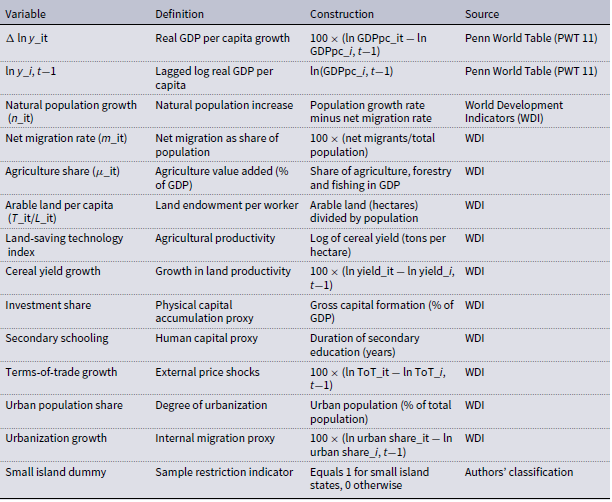
To examine the mechanisms outlined in the theoretical framework, we combine a broad set of macroeconomic and structural indicators in an unbalanced panel of 152 countries covering 1960–2023. The long time span and large cross-sectional variation allow the analysis to capture differential demographic and structural conditions across countries and stages of development. The dependent variable is real GDP per capita growth, computed as the annual log-difference of real GDP per capita from the Penn World Table (PWT 11). The PWT provides purchasing-power–adjusted income measures that ensure comparability across space and time, and its long horizon is well suited to studying slow-moving demographic and structural processes.
Natural population growth is constructed from World Development Indicators (WDI) data as the difference between the total population growth rate and the net migration rate. This measure captures the demographic component that increases the labor force independently of cross-border population movements. Net migration is taken from the WDI and reflects cross-border population movements driven by economic incentives, wages, labor demand, and demographic pressure. Although migration data are often measured with error, the WDI series is widely used in cross-country macroeconomic studies and provides consistent annual estimates for a large set of economies. In the context of this paper, natural population growth and net migration play distinct conceptual roles consistent with the theoretical model: the former increases the domestic labor force mechanically, while the latter represents a behavioral adjustment that can alleviate or amplify demographic pressures.
To operationalize the “effective land intensity” mechanism, we employ several WDI variables. Agriculture’s share in GDP proxies the structural composition parameter
 $\mu$
in the model and measures the extent to which aggregate production depends on land-intensive activities. Arable land per capita captures the physical scarcity of land relative to population size, which influences the degree to which demographic expansion increases congestion. Cereal yields, measured as kilograms per hectare, serve as a proxy for land-saving technological progress—the
 $\psi$
term in the theoretical framework—and help assess whether improvements in productivity mitigate the negative effects of population growth. Together, these variables permit a rich empirical characterization of how land availability, land use, and technological progress shape the demographic–growth relationship.
A set of standard macroeconomic controls is included to isolate the channels of interest. The investment share of GDP accounts for capital accumulation, secondary-school attainment captures human capital, and terms-of-trade growth controls for external shocks that affect income independently of demographics. The urbanization rate is also included because it reflects structural transformation and internal migration patterns; although it is not a perfect substitute for net migration, it helps capture broader spatial reallocation of labor. All of these controls are obtained from the WDI, ensuring consistency of definitions and coverage.
The empirical specification follows directly from the reduced-form growth equation derived in Section 3. Equation (13) implies that the effect of demographic expansion on per-capita income growth depends on (i) natural population growth and migration, which determine labor force dynamics; (ii) effective land intensity, captured by the interaction between agricultural dependence and the role of land in production; and (iii) land-saving technological progress, which attenuates the congestion effect of population pressure. To take this implication to the data, we model per-capita GDP growth as a function of lagged population growth and net migration, interacted with observable proxies for effective land intensity and land-augmenting innovation. Agriculture’s share in GDP serves as an empirical counterpart to the structural parameter
 $\mu$
, arable land per capita captures physical land scarcity, and cereal yields proxy land-saving technological progress. The resulting regression provides a direct empirical analog of equation (13), allowing the marginal effect of population growth to vary systematically with structural composition, land endowments, and technological conditions, as implied by the theoretical framework. To assess the predictions of the model, we estimate the following specification:
 \begin{align} \begin{array}{l} \begin{array}{llll} & \begin{array}{ll} {\unicode[Arial]{x0394}} \ln y_{it}= & \rho \ln y_{i,t-1}+\beta _{1}n_{i,t-1}+\beta _{2}m_{i,t-1}\\[3pt] & +\beta _{3}(n_{i,t-1}\times \text{AgrShare}_{i,t-1})+\beta _{4}(m_{i,t-1}\times \text{AgrShare}_{i,t-1})\\[3pt] & +\beta _{5}(n_{i,t-1}\times \text{LandPC}_{i,t-1})+\beta _{6}(n_{i,t-1}\times \text{LandTech}_{i,t-1})\\[3pt] & +{X}_{i,t-1}^{\mathrm{'}}\Gamma +\mu _{i}+\tau _{t}+\varepsilon _{it} \end{array} \end{array} \end{array} \\[-20pt] \nonumber \end{align}
where
 $y_{it}$
denotes real GDP per capita,
 $b_{it}\equiv n_{it}$
is natural population growth from the theoretical model,
 $m_{it}$
is the net migration rate,
 $\text{AgrShare}_{it}$
the share of agriculture in GDP,
 $\text{LandPC}_{it}$
arable land per capita,
 $\text{LandTech}_{it}$
land-saving technological progress,
 $X_{it}$
a vector of controls,
 $\mu _{i}$
country fixed effects, and
 $\tau _{t}$
year fixed effects. Standard errors are clustered at the country level to account for serial correlation and heteroskedasticity.
Equation (14) is specified in conditional convergence form through the inclusion of lagged income. A negative coefficient on lagged log GDP per capita indicates convergence toward a country-specific steady state. The estimated coefficients therefore capture transitional growth dynamics rather than steady-state growth effects, and measure how population dynamics interact with land scarcity and structural characteristics along the convergence path.
Each set of coefficients corresponds to a component of the theoretical framework. The coefficient
 $\beta _{1}$
measures the average effect of natural population growth on transitional per-capita income growth. The coefficient
 $\beta _{2}$
captures the independent role of migration, reflecting how net inflows or outflows affect growth conditional on natural population dynamics. The interaction terms reflect the central prediction of the model that demographic effects depend on the economy’s structural and resource environment. The term
 $\beta _{3}$
tests whether the effect of population growth is more adverse in economies with larger agricultural sectors, consistent with higher effective land intensity
 $(\phi )$
. The coefficient
 $\beta _{4}$
captures whether the growth effect of migration itself varies with agricultural dependence, in line with the view that migration constitutes a more important adjustment margin in land-intensive economies. The interaction with arable land per capita,
 $\beta _{5}$
, allows the effect of population growth to depend on land availability per worker, while
 $\beta _{6}$
examines whether land-saving technological progress mitigates demographic pressure by raising the effective productivity of the fixed land stock.
The vector
 $X_{i,t-1}$
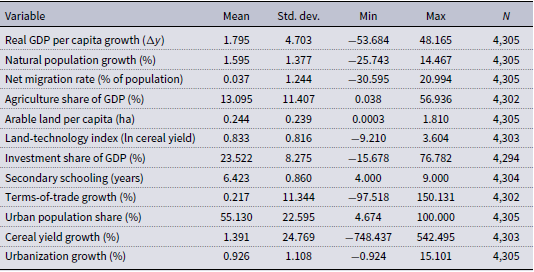
contains the baseline controls discussed above. Country fixed effects ensure that identification comes from within-country variation over time, thereby controlling for time-invariant characteristics such as geography and long-run institutional differences. Year fixed effects capture global shocks common to all countries, including commodity price movements and worldwide business-cycle fluctuations. Descriptive statistics and nomenclature for all variables appear in Tables A1 and A2 in the Appendix.
The panel is unbalanced due to historical data limitations, especially for migration and agricultural variables in the earlier decades, but the coverage is sufficiently broad to allow precise estimation of interaction terms. Together, this empirical design enables a direct test of the model’s predictions: whether natural population growth slows income growth more sharply in land-scarce and agriculture-dependent economies, and whether migration and land-saving innovations alleviate these effects.
The theoretical model yields clear priors for the interaction coefficients. In particular, the interaction between natural population growth and agricultural dependence is predicted to be negative, reflecting the stronger land constraint in more agrarian economies. By contrast, the interaction between population growth and land-saving technological progress is expected to be positive, since higher land productivity mitigates the adverse effect of demographic expansion. The interaction between population growth and arable land per capita captures the role of land abundance and is therefore also expected to attenuate the negative demographic effect. Finally, the interaction between migration and agricultural dependence reflects the adjustment mechanism embedded in the model and is predicted to attenuate the growth penalty associated with demographic pressure in land-intensive economies.
5. Results
This section presents the baseline findings and examines how population growth, migration, and land-related characteristics jointly shape per-capita income growth. The analysis directly tests the predictions derived in Section 3, in particular the conditional effect of population growth implied by equation (13) and operationalized in equation (14). The empirical estimates are based on the fixed-effects specification in equation (14), with all regressors lagged one year to reduce simultaneity concerns. Country fixed effects control for time-invariant heterogeneity, while year fixed effects absorb global shocks.
5.1 Baseline estimates
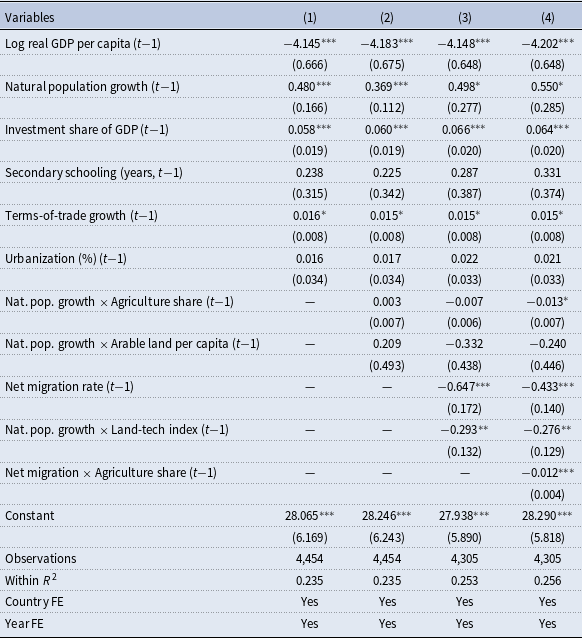
The results in Table 1 confirm the presence of conditional convergence across countries, as reflected in the negative and highly significant coefficient on lagged per-capita income. Conditional on this convergence term, natural population growth is positively associated with transitional per-capita income growth in the baseline specification. Quantitatively, a one-percentage-point increase in natural population growth is associated with an increase in per-capita GDP growth of about 0.4–0.6 percentage points.
Fixed-effects regressions: population growth, land, and migration

Notes: The dependent variable is real GDP per capita growth (Δy %). All regressions include country fixed effects and year fixed effects. Standard errors clustered at the country level are reported in parentheses. Lagged regressors refer to t−1 values. * p < 0.10, ** p < 0.05, *** p < 0.01.
However, consistent with the theoretical framework, this average effect masks substantial heterogeneity. The model predicts that the marginal effect of population growth depends on effective land intensity (
 $\phi$
) and related structural characteristics. Once interactions with agricultural dependence, land availability, and technological conditions are introduced, the marginal effect of population growth declines sharply and becomes negative in sufficiently land-intensive and agriculture-dependent economies.
More formally, the estimated specification implies that the marginal effect of population growth is given by
 $\beta _{1}+\beta _{3}\text{AgrShare}+\beta _{5}\text{LandPC}+\beta _{6}\text{LandTech}$
, which varies systematically across countries. This pattern provides empirical support for the central prediction of the model that demographic expansion is not uniformly growth-enhancing or growth-reducing, but depends on structural composition and land-related constraints.
Once migration is included, its coefficient is negative and statistically significant, indicating that higher net emigration (i.e., negative net immigration) is associated with lower short-run income growth. This pattern is consistent with the mechanical reduction in the domestic labor force induced by emigration in the short run.
At the same time, the interaction terms indicate that migration also operates as an adjustment margin, in line with the theoretical mechanism captured by the parameter
 $\eta$
. The negative interaction between migration and agricultural dependence suggests that the short-run growth cost of emigration is larger in economies where production is more land-intensive, consistent with limited absorptive capacity outside agriculture.
Importantly, the coefficient on natural population growth remains positive after controlling for migration, highlighting that natural increase and cross-border migration operate as distinct demographic channels. While migration captures spatial reallocation of labor across countries, natural population growth reflects domestic demographic pressure and therefore interacts more strongly with land availability and sectoral structure, as examined in the interaction terms below.
Overall, the baseline results provide broad support for the key theoretical predictions: the adverse growth effects of population pressure are stronger in economies with higher effective land intensity, while migration and land-saving technological progress mitigate these effects.
5.2 Conditioning role of land scarcity and structural dependence
The interaction terms in Table 1 provide evidence on the core mechanism of the model, namely that the effect of demographic pressure depends on effective land intensity (
 $\phi$
) and related structural characteristics. While the interactions between natural population growth and agricultural dependence are small and imprecisely estimated in the intermediate specifications, they become economically and statistically meaningful once migration and land-saving technology are jointly accounted for. In the full specification, the negative coefficient on the interaction between population growth and agricultural share implies that the marginal effect of population growth declines with agricultural dependence, consistent with higher effective land intensity. This indicates that demographic expansion is more likely to translate into land congestion when production remains heavily land-intensive, in line with Hypothesis H1.
The interaction with arable land per capita is negative but not precisely estimated, suggesting that cross-country variation in land endowments alone is insufficient to generate sharp differential effects once fixed effects and controls are included. This result provides only weak support for Hypothesis H2 and indicates that land abundance per se is not the primary margin through which demographic pressure operates once unobserved heterogeneity is accounted for.
By contrast, the interaction with the land-technology index is consistently negative and statistically significant. This implies that higher land-saving technological progress reduces the marginal growth effect of population expansion, consistent with the role of
 $\psi$
in attenuating effective land scarcity in the theoretical framework. This pattern is consistent with the idea that technological improvements in land use alter the transmission of demographic pressure by weakening the link between population growth and effective land scarcity, providing support for Hypothesis H3.
Finally, migration interacts negatively with agricultural dependence, indicating that the short-run growth cost of net emigration is larger in economies where agriculture remains dominant. This finding is consistent with the model’s prediction that the effectiveness of migration as an adjustment mechanism (captured by
 $\eta$
) depends on the structural composition of the economy. In such settings, labor reallocation through migration appears to exacerbate output losses because labor is more closely tied to the fixed factor of land and sectoral mobility is more limited, although this effect reflects short-run adjustments rather than long-run gains from reallocation.
Taken together, these results suggest that population growth is not uniformly beneficial or harmful for income growth, but instead operates through channels that depend on structural composition and land-related constraints. In particular, the marginal effect of population growth becomes increasingly negative as effective land intensity rises, while migration and land-saving technological progress mitigate these effects. Economies that have largely transitioned away from agriculture or that benefit from more productive land use technologies face weaker demographic frictions, whereas more agrarian economies remain more exposed to the adverse consequences of population pressure and labor outflows.
5.3 Robustness checks
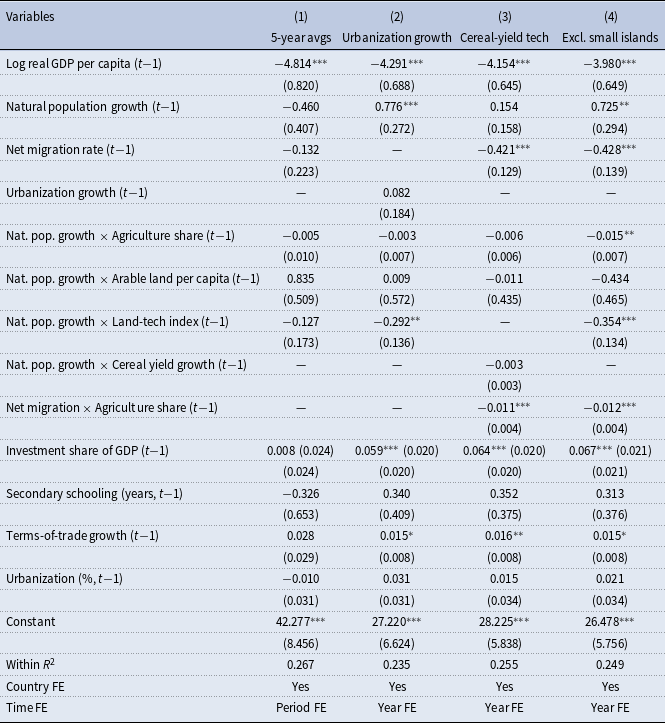
The robustness exercises reported in Table 2 indicate that the baseline patterns are broadly preserved, though their strength varies across alternative specifications. Across all specifications, the key implication of the model—that the effect of population growth depends on structural characteristics and land-related constraints—remains qualitatively intact.
Using five-year non-overlapping averages (Column 1) yields a much smaller sample and correspondingly wider standard errors; in this setting, most demographic and interaction effects lose statistical significance, even though conditional convergence remains strong. This is consistent with the substantial loss of time-series variation induced by aggregation and the reduced number of observations per country-period. Accordingly, the weaker results in this specification are best interpreted as a loss of statistical power rather than evidence against the underlying mechanisms.
Replacing net migration with urbanization growth (Column 2) leaves the main demographic channel intact. Natural population growth remains positive and statistically significant, while the coefficient on urbanization growth is small and statistically insignificant, suggesting that internal population movements—proxied by changes in urbanization—do not explain the baseline relationship. Importantly, the interaction between population growth and the land-technology index remains negative and significant, reinforcing the role of land-saving technological progress (
 $\psi$
) in mitigating the effects of demographic pressure.
Robustness: alternative proxies and specifications

Notes: Column (1) uses 5-year non-overlapping averages with period fixed effects. Column (2) replaces net migration with urbanization growth. Column (3) uses cereal yield growth as the land-saving technology proxy. Column (4) excludes small island states. All regressions include the indicated fixed effects. Standard errors clustered at the country level are reported in parentheses. * p < 0.10, ** p < 0.05, *** p < 0.01.
Using cereal yield growth as an alternative proxy for land-saving innovation (Column 3) preserves the negative interaction between migration and agricultural dependence, while the population-growth interaction with cereal yield growth is negative but not precisely estimated. This result is directionally consistent with the theoretical prediction but indicates that short-run fluctuations in productivity may be a noisier proxy for land-augmenting technological change than levels of land productivity.
Finally, excluding small island economies (Column 4) does not overturn the main conclusions: conditional convergence remains strong, net emigration continues to be associated with lower short-run growth, and the interaction terms—particularly those involving agricultural dependence and land-technology—become more negative and statistically clearer in the restricted sample. This suggests that the baseline findings are not driven by small or structurally atypical economies.
While the fixed-effects estimates mitigate bias from time-invariant country characteristics and global shocks, they do not fully address the potential endogeneity of demographic variables implied by the model. In the theoretical framework, both migration (
 $m$
) and population growth (
 $n$
) are potentially endogenous to economic conditions, reflecting feedback effects between income, labor allocation, and demographic dynamics. This raises concerns of reverse causality and omitted-variable bias in the baseline specifications. To address these issues, we complement the fixed-effects results with a dynamic panel estimator based on system GMM, which treats lagged income, natural population growth, and migration as potentially endogenous and instruments them using their own deeper lags.
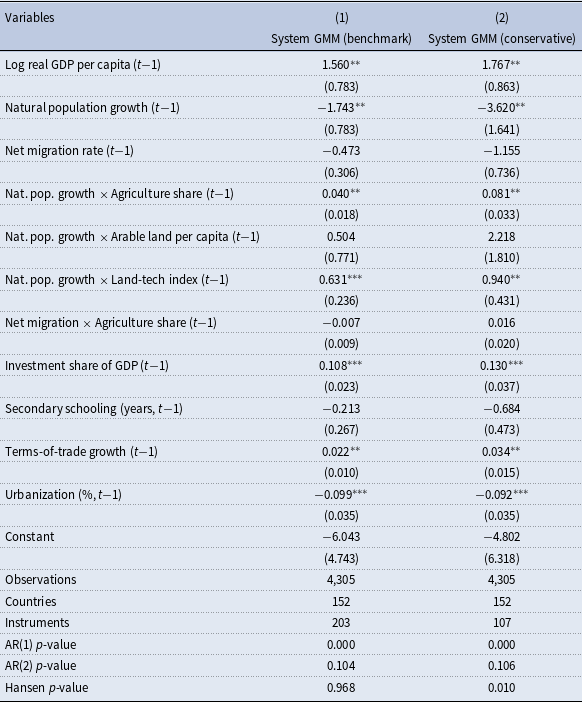
Building on these robustness checks, Table 3 reports dynamic panel estimates using system GMM to address the potential endogeneity of income dynamics, population growth, and migration implied by the model. Because migration responds endogenously to land scarcity in the theoretical framework, and population growth may be correlated with unobserved country-specific shocks, both variables are treated as endogenous and instrumented with their own deeper lags.
Robustness: system GMM estimates (dynamic panel with convergence)

Notes: Two-step system GMM, robust (Windmeijer-corrected) standard errors in parentheses. Both specifications include year dummies (some dropped due to collinearity). AR(1) and AR(2) are Arellano–Bond tests in first differences. Hansen is the test of overidentifying restrictions. * p < 0.10, ** p < 0.05, *** p < 0.01.
The GMM results reinforce the conditional nature of demographic effects highlighted in Tables 1 and 2. The Arellano–Bond tests indicate no evidence of second-order serial correlation, while the Hansen test supports the benchmark specification but suggests that the more conservative specification approaches the limits of instrument validity; accordingly, the GMM results should be interpreted primarily in terms of qualitative patterns rather than precise magnitudes. The coefficient on lagged income in the system-GMM specifications is positive, in contrast to the negative coefficient obtained in the fixed-effects estimates. This difference reflects the distinct interpretation of the dynamic parameter across estimators. In the fixed-effects model, the lagged level captures conditional convergence toward a country-specific steady state. In the system-GMM framework, by contrast, the lagged dependent variable primarily captures short-run persistence in growth dynamics once endogeneity and measurement error are addressed through instrumentation. A positive coefficient therefore indicates inertia in income growth rather than divergence, and should not be interpreted as contradicting the conditional convergence pattern. Natural population growth is no longer uniformly growth-enhancing once endogeneity is accounted for: its direct effect turns negative, but this is offset in economies with lower agricultural dependence and higher land-saving technological capacity. In particular, the positive and significant interaction between population growth and agricultural share reflects that, once endogeneity is controlled for, the adverse average effect of population growth is attenuated in less land-intensive economies, consistent with the role of effective land intensity (
 $\phi$
). Similarly, the interaction with the land-technology index is positive and significant, indicating that improvements in land productivity substantially weaken the adverse impact of demographic expansion, in line with the role of
 $\psi$
in the theoretical framework. By contrast, the interaction with arable land per capita remains imprecisely estimated, suggesting that technology rather than land abundance per se is the dominant margin of adjustment.
Migration effects are weaker in the GMM framework but remain economically meaningful. Net emigration continues to be associated with lower short-run growth, and its interaction with agricultural dependence retains the expected sign, although it is estimated with less precision than in the fixed-effects models. This pattern is consistent with migration acting primarily as a short-run adjustment mechanism, with its effectiveness depending on structural conditions, as captured by the parameter
 $\eta$
.
Taken together, the system GMM results provide an important robustness check on the baseline findings. They confirm that the relationship between population growth and income growth is highly conditional on production structure and land-saving technological progress, and that ignoring endogeneity may overstate the average growth-enhancing role of demographic expansion. Across specifications, the evidence consistently supports the central mechanism of the model: demographic pressure is most harmful in economies with high effective land intensity, while migration and land-augmenting technological progress mitigate these effects.
5.4 Marginal effects and visualization
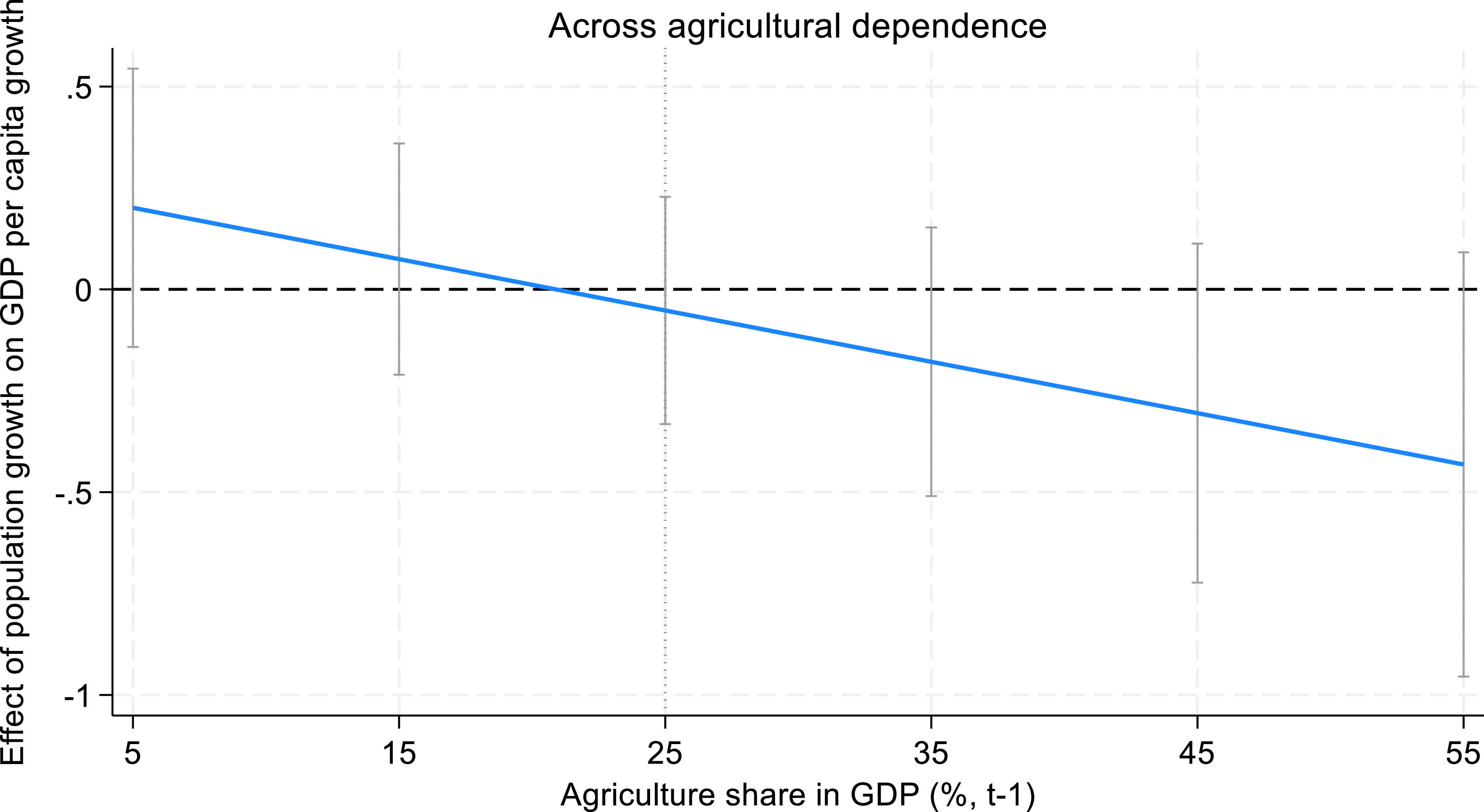
Figure 1 provides a compact visual summary of the model’s central nonlinearity by plotting the marginal effect of natural population growth on per-capita GDP growth across different levels of agricultural dependence, holding net migration at zero and the remaining interacted covariates at their sample means. The estimated marginal effect is positive at low levels of agricultural share but declines monotonically as agricultural dependence increases. The marginal effect crosses zero at intermediate levels of agricultural share within the observed support of the data and becomes increasingly negative at higher levels, indicating that the growth impact of population expansion weakens—and eventually turns negative—in more agrarian economies.
The confidence intervals widen at some points along the distribution, reflecting lower precision in parts of the sample, but the overall downward slope is clear and closely mirrors the interaction patterns in the regression results. This pattern is consistent with the theoretical mechanism: as economies become more land-intensive (captured by a higher agricultural share), effective land intensity increases and the associated congestion effect strengthens, offsetting any scale benefits from population growth. In this sense, Figure 1 provides a direct graphical counterpart to the estimated interaction terms, illustrating how structural transformation away from agriculture reduces the importance of land constraints, while economies that remain agriculture-intensive are more exposed to the growth-limiting effects of demographic pressure.
Marginal effect of natural population growth.
Notes: This figure plots the marginal effect of lagged natural population growth on per-capita GDP growth as a function of the lagged agricultural share in GDP, holding net migration fixed at zero and the remaining interacted covariates at their sample means. The estimates are based on the fully specified fixed-effects model reported in Table 1, column (4), which includes conditional convergence and the full set of interaction terms. The solid line shows point estimates and the vertical bars denote 95% confidence intervals. The marginal effect declines monotonically with agricultural dependence and becomes negative at moderate-to-high levels of the agricultural share. This pattern indicates that the growth impact of population expansion weakens—and eventually turns negative—as economies become more land-intensive, consistent with the model’s prediction that higher effective land intensity amplifies the demographic burden.

6. Conclusion
This note contributes to the literature on population and growth in two main ways. First, it extends the land-augmented Solow model of Karras (Reference Karras2010) by embedding land in a two-sector framework in which only agriculture uses the fixed land input. This structure makes effective land intensity endogenous to structural transformation, rather than a fixed technological parameter. Second, the model incorporates migration as an endogenous response to demographic pressure, allowing population growth to affect per-capita income through both local congestion effects and labor reallocation across sectors and locations.
Using a panel of 152 countries over 1960–2023, the empirical results show that the growth impact of population dynamics is highly conditional on structural characteristics. In fixed-effects specifications, population growth is not uniformly growth-reducing but becomes negative in economies with high agricultural dependence. The marginal-effects analysis highlights a clear threshold: the effect of population growth declines with agricultural share and turns negative beyond moderate levels of land intensity. When endogeneity is addressed using system-GMM estimation, the direct effect of population growth becomes negative on average, but is substantially attenuated in economies with lower agricultural dependence and higher land-saving technological capacity. These findings are consistent with the model’s central mechanism: demographic expansion is most harmful when effective land intensity is high and is mitigated by structural transformation and technological progress.
Migration plays an important moderating role. Net emigration is associated with lower short-run growth, reflecting the mechanical reduction in the domestic labor force, but also operates as an adjustment mechanism that alleviates population pressure in land-intensive economies. Together, migration, structural change, and land-saving innovation help explain the heterogeneous growth effects of population dynamics across countries and over time.
These results carry several policy implications. Facilitating labor mobility—both internal and international—can help ease congestion in land-intensive sectors. Accelerating structural transformation toward manufacturing and services reduces dependence on fixed land inputs. At the same time, promoting agricultural innovation increases effective land productivity and mitigates the adverse effects of demographic pressure. More broadly, the findings suggest that the growth consequences of population dynamics depend critically on how economies adjust through structural change, technological progress, and labor reallocation. In addition, the results reconcile conflicting findings in the empirical literature by showing that the growth effects of population dynamics are inherently conditional on structural and resource constraints.
While the analysis relies on cross-country macroeconomic data and is therefore subject to measurement limitations—particularly for migration flows and land-related indicators—the consistency of the results across specifications provides support for the underlying mechanisms. Future research could further explore nonlinear thresholds in land intensity, incorporate spatial and micro-level evidence on migration and labor allocation, or extend the framework to account for climate-induced changes in land productivity and long-run environmental constraints.
Funding statement
This work was supported by the FCT (Fundação para a Ciência e a Tecnologia) [grant number UID/06522/2025]. The opinions expressed herein are those of the authors and do not necessarily reflect those of the authors’ employers. Any remaining errors are the authors’ sole responsibility.
Appendix
Descriptive statistics

Notes: This table reports descriptive statistics for the estimation sample used in Tables 1–3. Real GDP per capita growth is measured as the log difference of GDP per capita in constant 2015 US dollars. Natural population growth equals total population growth minus net migration. Land-technology is proxied by the log of cereal yield.
Variable definitions and sources