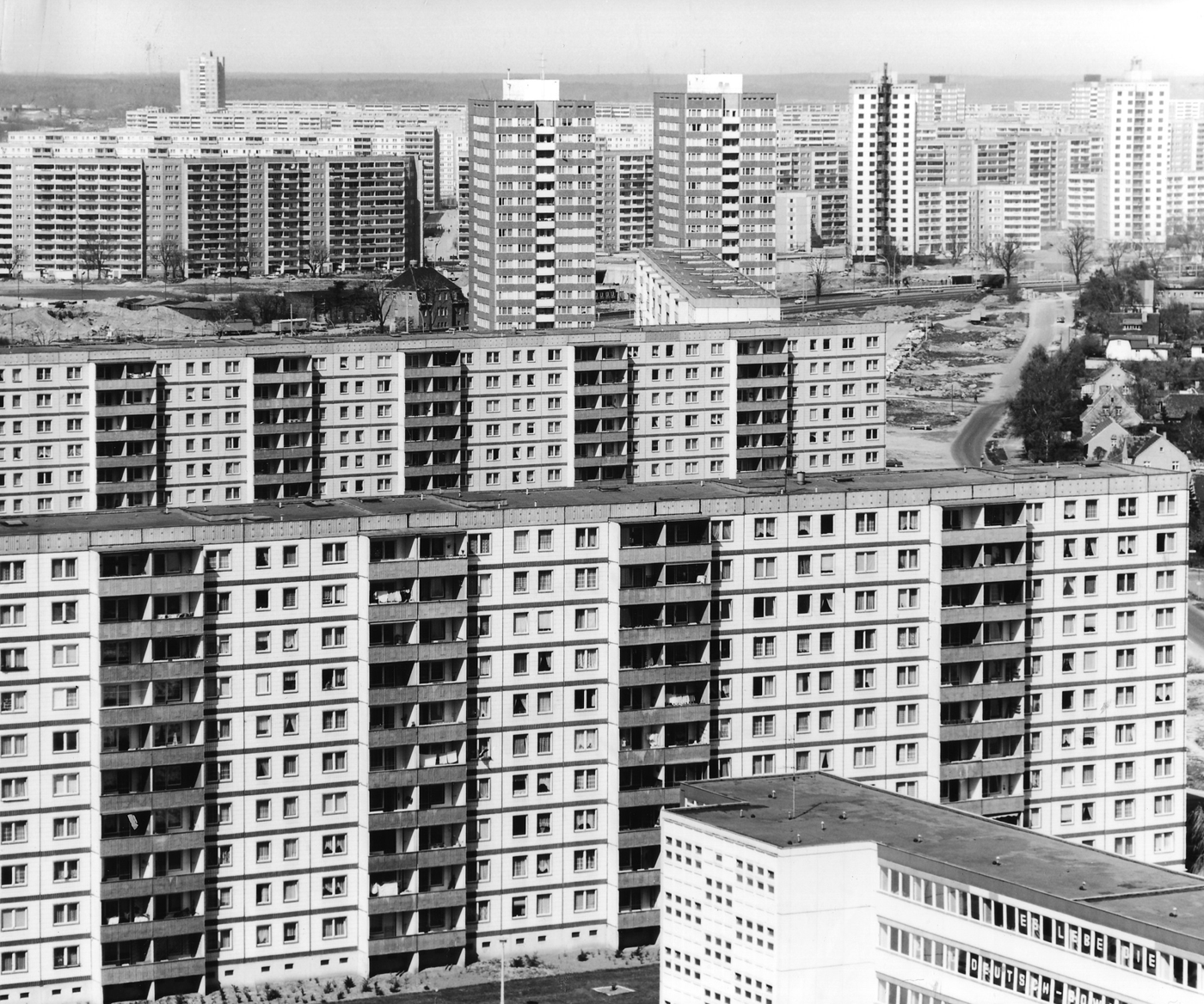
On April 11, 1977, near a small village northeast of Berlin called Marzahn, construction teams from the Volkseigener Betrieb (VEB) Tiefbau Berlin began digging the first foundation for what became the largest construction site and the largest prefabricated housing settlement (Plattenbausiedlung) not just in the German Democratic Republic (GDR), but in all of Europe (see Figure 1). An army of more than 6,000 workers arrived, and over the course of the next decade, built more than 200,000 apartments in Marzahn and the surrounding areas of the northeast edge of Berlin. These came to house more than 400,000 residents, who moved there from the older neighborhoods of East Berlin and from all over the GDR.Footnote 1
Berlin-Marzahn, 1984. Courtesy of Bezirksmuseum Marzahn-Hellersdorf.

All the buildings erected were mass-produced, prefabricated apartment blocks usually of the type Wohnungsbauserie (WBS) 70. More importantly, Marzahn was not just apartment blocks—it was conceived of and built as a complete new city, with schools, stores, clinics, recreation centers, and much more; and it was built according to modernist, Fordist, and functionalist principles. Several other such settlements were planned and built throughout the GDR as part of the so-called Housing Program (Wohnungsbauprogramm), one of the most important initiatives of the Erich Honecker regime—by 1989, almost half of all East Germans lived in such places, and had the regime continued, eventually many more would have. The housing program was itself part of a broader strategy known as “The Unity of Economic and Social Policy,” sometimes also referred to as “Real Existing Socialism,” which intended to raise the standard of living for all East Germans in a number of ways, from better consumer goods to credit for furnishings for new apartments. It formed the central pillar of the last two decades of the GDR's life. Marzahn was the largest and most visible manifestation of the housing program and thus an important pillar of the policy of Real Existing Socialism. Because it lay just outside the capital, it was a particularly important showpiece for the entire country, as well as for visitors and dignitaries from the rest of the socialist—and even western—worlds. It was intended to be the testament to state socialism's ability to lift the working class out of its misery and into a modern, comfortable lifestyle.
This essay, however, argues that there is more to be understood from this massive socialist project than simply the mass construction of nearly identical apartment blocks. Marzahn is easily overlooked because it seems to be identical to so many other apartment block settlements throughout the eastern bloc, and beyond. Because they were built in a starkly functionalist style and as holistic, self-contained cities on the outskirts of cities, Marzahn and similar settlements functioned as radical breaks with the urban past, a past that contained within it the traces of capitalism, fascism, and war. Places such as Marzahn were socialist utopias, in the twofold sense of representing the Marxian culmination of history in “Real Existing Socialism” as well as being literally “no places”—or rather, places with no memory.
The GDR's Politbüro and the planners who built Marzahn did not explicitly set out to “erase” or forget the past. Both the policies of the GDR and the methods through which it operated tended toward that end, however; the GDR allowed old city centers and small towns to crumble into disrepair while diverting most funding to the construction of vast new Plattenbausiedlungen, usually on the margins of cities such as Berlin. The very nature of the GDR's planned economy lent itself to large-scale, holistic projects in which tens and hundreds of industries and other economic or political forces could be mustered under one overarching project, and the GDR's economic structure lent itself to Fordist techniques of mass production. Furthermore, the production of such Plattenbausiedlungen represented what James Scott would call “high modernism” in terms of the degree to which the regime, in building them, wholeheartedly bought into the ability of technology, wielded by the state, to reengineer the natural environment.Footnote 2 The GDR state saw Marzahn and its surrounding areas as a marginal space, a blank slate, upon which to build something completely new. Finally, for the East Germans who moved to Marzahn, the experience was also one of profound material rupture, of arriving in a terra nova or terra incognita, and represented for them a radically new phase in their lives.
This essay argues finally that there is a dialectic of remembering at work with the radical new beginnings that Marzahn represented; the construction of Marzahn unearthed (literally) reminders that the northeast margin of Berlin was no blank slate and that the GDR was only the latest in a long history of colonization and settlement in Berlin and Brandenburg.
Berlin's Mietskaserne and the Dream of Colonizing the Margins of the City
The industrial revolution began in Berlin in the 1830s, causing its population to swell and leading to a boom in real estate speculation and the hasty building of cramped living quarters for the new working class. These cramped quarters were sometimes known as “misery quarters” (Elendsviertel) or “rental barracks” (Mietskaserne). These buildings contained very small apartments, often without running water or a toilet, crammed together and stacked on top of each other to maximize the number of tenants that could fit on a parcel and thus maximize the profit of the building owners.Footnote 3 By 1871, seventy-five percent of Berlin apartments were considered rental barrack apartments—small and containing only one heatable room.Footnote 4 Ten percent were basement apartments, which were the dampest and most unsanitary of them all. As Kristin Poling describes in her essay in this issue of Central European History, the housing shortage and related high rents meant that many Berlin families could not even find an apartment and slept in city parks or shantytowns outside the city gates. Needless to say, once Berlin became the capital of the newly unified German Reich, the massive in-migration accelerated even faster, with the housing shortages becoming even more acute.
Bourgeois liberals fretted greatly about the slums and were concerned that the rental barracks were breeding grounds for both radical left-wing politics and moral degeneration.Footnote 5 As Marion Gray describes in his essay in this issue of Central European History, reformers such as James Hobrecht and Rudolf Virchow all sought to improve the conditions of the working-class ghettos through widening streets, providing parks, and improving hygiene. Reformers and municipal authorities were especially concerned about the fact that the cramped apartments seemed to lead to the deterioration of family life, as men avoided their families, spending their time in pubs and beer gardens, and children spent their time on the streets, forming street gangs.Footnote 6 The lack of sunlight and the narrow passageways were thought by reformers to be especially conducive to criminal and subversive activity.Footnote 7
In the view of many on the left, the vast neighborhoods of rental barracks were, in their very physical form and construction, simultaneously a material manifestation of capitalism and a major factor in perpetrating the dominance of the capitalist system. Indeed, Friedrich Engels had made clear that the only solution to the problem of the rental barracks was the complete overthrow of the capitalist system—attempts to “reform” urban poverty and blight on behalf of reformist liberals and social democrats merely papered over or even worsened the misery of the working class under capitalism.Footnote 8
And yet, as miserable as these neighborhoods were, they contained within them the seeds of resistance. Beer gardens, in particular, such as the Prater and the Bötzow Brewery, were often used as forums by revolutionaries such as August Bebel, Rosa Luxembourg, and Clara Zetkin to mobilize the working class to protests, strikes, or even armed insurrection.Footnote 9 The memory of revolution and insurrection had roots in Prenzlauer Berg, both figuratively and literally, in the form of the “lone poplar” tree (einsame Pappe) that stood for more than a century near the corner of Topsstrasse and Cantianstrasse, the site of the first demonstration of the 1848 uprising in Berlin, on March 26 of that year, and that had grown and remained as a constant lieu de mémoire of revolution and working-class spirit across the generations.Footnote 10 When necessary, the rental barracks seemed almost to serve as real barracks for the left-wing street fighters who clashed with police during the Spartacus uprising in 1919 or during the “Bloody May” riot in 1929, or with Nazi storm troopers.Footnote 11
It was the lands outside the city—including the northeast—that presented themselves to city planners and reformers as a tantalizing solution to the problem of overcrowding and the social problems it seemed to lead to, especially in light of the expectations that Berlin would continue to grow in the future, to compete with London, Paris, and New York as one of the great cities of the world. In 1911, a competition was held by the Association for Greater Berlin (Zweckverband Groß-Berlin), discussed in detail by Barry Jackisch in his essay in this issue of Central European History, for a plan of infrastructure for the future of greater Berlin, and the winning designs both involved the creation of settlements in the northeast, among other places.Footnote 12 Further plans for infrastructure and settlement of upwards of 450,000 residents along the Wuhle River, the Spree River tributary that runs through the northeast of Berlin, were discussed throughout the Weimar Republic. Although these plans never materialized, other workers' colonies had been built under the leadership of Martin Wagner on a smaller scale in the 1920s. These included the famous Horseshoe Settlement (Hufeisen Siedlung), designed by Bruno Taut, as well as others in the north and the southwest fringes of the city.Footnote 13 These were, as Pamela Swett pointed out, designed to get workers out of the slums and onto the periphery of the city, where they would be exposed to sunlight and greenery, not to mention modern kitchens and indoor plumbing.Footnote 14
The Nazis, once in power, were hostile to the existence of inner-city slums—many Nazis who were “old fighters” or had been in the Freikorps had engaged in combat with communists in those very streets.Footnote 15 National Socialist officials, such as the mayor of Stuttgart, Karl Strölin, openly called for the rental barracks to be razed in order to drain the swamps of “Marxist” and “asocial” elements.Footnote 16 It was partially the Nazi fear of “red” districts close to the nerve center of the Reich that led them to rename Friedrichshain, one of Berlin's reddest, “Horst Wessel,” after the famous martyred SA member.Footnote 17
These desires to empty the inner cities and rebuild anew on the margins culminated in Albert Speer's 1938 General Plan for Berlin, which sought to remake the city dramatically as Germania, the capital of the entire world. Speer's plan called for the construction of 450,000 apartments in the Berlin northeast, around the village of Biesdorf, which would be the eastern terminus of the “east-west axis” of Germania.Footnote 18 (Another 200,000 would be built in “South City” at the southern end of the north-south axis). Simultaneously, his plan depopulated the inner city to the tune of almost 200,000 people through the demolition of apartments to make room for the grandiose plazas and halls of the future world capital.Footnote 19 Speer hoped to resettle the large numbers of Berliners who would be displaced from the Germania construction.Footnote 20
As with almost all his plans for “Germania,” Speer's plans for a workers' colony in the northeast had to be put on hold once the war began. The urban planners in the Imperial Office for Spatial Planning (Reichsstelle für Raumordnung), a division of the Reich government staffed by Speer's fellow planners and architects, however, welcomed the Allied bombing of German cities; the British goal of “de-housing” the German working class meant for Nazi planners, such as those in Speer's office, a chance to resettle the working class outside the cities in a new, decentered urban space that would be racially healthy.Footnote 21 Goebbels himself welcomed the devastation in Berlin's slums because it sped up the demolition of the slums that he had envisioned since at least 1938.Footnote 22
During the Third Reich, the National Socialist government of the city designated Marzahn to be a “Gypsy rest place” (Ziguenerrastplatz)—a euphemism for a kind of temporary concentration camp. The “rest place” was built directly on a field that had been until recently one of the Marzahn sewer farms, and it was built in 1936 in conjunction with the upcoming Olympic games in Berlin, an event for which the NSDAP wanted Berlin itself to be “Gypsy-free.”Footnote 23 The camp at one point held 852 Sinti and Roma, all of whom were eventually deported to Auschwitz, the vast majority of whom died.Footnote 24 Marzahn was also the site of a major forced labor camp connected with the firm Carl Hasse & Wrede, which built a large machine-tool factory in Marzahn in 1940.Footnote 25 The Hasse & Wrede factory was part of Albert Speer's plan for workers' settlements in Marzahn, and it would eventually become part of the plan for Marzahn, as the VEB Berliner Werkzeugmaschinenfabrik.Footnote 26 The presence of industry in Marzahn made it a target for heavy bombing during 1943 and 1944. Directly after the war, Marzahn held a mass grave for bodies of civilian victims of the war in Berlin, and it was one of several sites where rubble from the bombed-out buildings in the city was dumped, forming an artificial hill that would later be enlarged in the construction of the socialist prefabricated settlement.Footnote 27
The northeast was not just a place for Berliners to dump their waste—human or otherwise. It was also a popular destination for day trips to the rural idyll outside Berlin.Footnote 28 It was also seen as “wild,” and the train line that connected Berlin to Marzahn, the Royal Eastern Line, was known in Berlin as the Wilderness Line (Wüstenbahn).Footnote 29 Berliners knew about the northeast as a place to escape the inner city; for them it was almost a mythical place in the Wüste (“wastelands” or “wilderness”), or as it came to be known in Berliner slang, “j.w.d” or “jotwedee” (short for “janz weit draußen,” or “way far out there”).Footnote 30 The meaning of the northeast as both a pleasant day-trip location, a projected location for utopian workers' settlements, and as a dumping ground for the sewage and undesirable of the city subjects highlights the importance of the city's margins in its history. It was a place where the city could dream its dreams and its nightmares, and begin to think seriously about its future—a kind of accelerated space-time.
Socialism, Modernity, and the Housing Program in the Postwar Era
World War II devastated German cities, and although some cities sustained a higher percentage of their housing, no German city had more bombs, artillery shells, and other forms of destruction rained down upon it than Berlin. Immediately after the war, there was a widespread housing shortage across Germany. The Soviet Occupation Zone (which would become the GDR) had lost 7.3 million usable rooms, or forty-one percent of the prewar total.Footnote 31 In all of Berlin, only 380,000 out of 1,562,000 apartments survived without some significant damage.Footnote 32 In East Berlin, 870,000 apartments were destroyed, about one-third of all domiciles prior to 1939, and in some places where the fighting was the heaviest, such as Friedrichshain and Mitte, sixty percent of all buildings were destroyed.Footnote 33 In addition, the Soviet Occupation Zone absorbed more than a million refugees, mostly Germans from eastern territories that Germany lost as the war came to an end, including the Sudetenland, Silesia, West Pomerania, and Königsberg.Footnote 34
Yet, under the influence of Stalinism, most of the reconstruction that took place in cities such as Berlin did not involve housing stock for the large numbers of East Germans who could not find an apartment of their own. Instead, it focused on prestige projects such as Stalinstadt and Stalinallee, which involved the use of traditional building materials such as cut stone and wood, and ornamentation, and thus were too costly to be provided to the majority of the population. The GDR spent only one-third of one percent of its total budget on housing in 1950, and this actually fell to one-tenth of one percent by 1955.Footnote 35
The Soviet world changed dramatically, of course, once Stalin died and Khrushchev took over. And one of Khrushchev's earliest and most immediate initiatives was his realization, emanating in part from his famous “kitchen debate” with Richard Nixon, that the Cold War was being fought on the battlefield of domestic consumption and socialism was losing: the capitalist world could provide a better standard of living for more people than the socialist could.Footnote 36 To catch up, Khrushchev targeted housing, in the U.S.S.R. and the eastern bloc, demanding in 1954 that socialist governments begin a new push toward housing construction. Housing construction would have to become “better, cheaper, and faster,” according to Khruschev.Footnote 37 There was only one way to do this—mass, block housing made from prefabricated concrete panels, the whole process shaped by the Fordist technologies of standardization, serialization, and assembly lines.Footnote 38 No more ornamentation, no more cornices, pillars, or friezes—all of these were replaced by cement, granulate, and rebar.Footnote 39
There would be no more traces of the past built into the material contours of the present. The GDR, as most of the rest of the Soviet world, was turning away from everything that was old, traditional, or of bourgeois or petty bourgeois heritage. This rejection of the past and the embrace of the radically new was part of a broader trend in the eastern bloc in the 1950s and 1960s, for example, in the widespread fascination with the Soviet space program, evident in publications such as Weltall, Erde, Mensch (Space, Earth, Man) and Unsere Welt von Morgen (Our World of Tomorrow), two books commonly given at the official socialist coming-of-age ceremony, Jugendweihe.Footnote 40Unsere Welt promised a Soviet world of the near future that consisted of entire cities built from scratch on completely blank substrates—tabula rasae, such as in the arctic, at the bottom of the ocean, or even on the moon, encased in plastic domes.Footnote 41 The popular East German magazine Jugend und Technik (Youth and Technology) went so far as to say explicitly that by completely rebuilding new socialist cities far away from any previous trace of civilization, including possibly Mars, the Soviet world would “avoid the mistakes of capitalist city construction.”Footnote 42
Such formulations echoed a belief that had been present in socialist and left-wing circles for many years. From Owenite colonies in North America, to bündisch communes, to the Ansiedlung Ost project of early Weimar social democrats, the concept of building a new society from scratch away from the slums of industrial capitalism was not new.Footnote 43 What was new, however, was that socialists in the GDR had the power of the state and its centrally planned economy at their disposal to realize such utopias fully, and though it proved impractical to build such completely socialist cities on the moon or at the poles, it was within the realm of practicality to build them on the margins of older cities.
Khrushchev's ascendance and embrace of technology and functionalism opened up leadership positions for a group of modernist architects and urban planners who had once been connected with the constructivists in the U.S.S.R., the Bauhaus in Germany, and the International Congress of Modern Architects (CIAM) in Switzerland. These architects, including Mart Stam, Mies van der Rohe, and Gerd Kosel, had been frozen out of the socialist world because Stalinism was openly hostile to modernism and functionalism. Early in the GDR, the Bauhaus and the CIAM, along with their plans to rebuild East Germany using functionalism and mass-produced housing, were condemned by East German leaders as “cosmopolitan” and “alien to the people.”Footnote 44 Some, such as Stam and van der Rohe, left for the west and never returned, even once Stalinism was overthrown. Others, such as Richard Paulick and Kosel, who rose from relative obscurity to become the head of the German Architectural Federation (or DBA, the main architectural and planning organ in East Germany), however, bided their time until “better, cheaper, faster” became the new philosophy.Footnote 45
In envisioning the solution to East Germany's housing crisis, the ideas of planners and architects, like Kosel's, closely resembled those of Le Corbusier, the founder and central figure of the CIAM. In particular, they were influenced by Le Corbusier's radical “City of Tomorrow” (or “Radiant City”), expressed most clearly in his “Plan Voisin” for Paris, which sought to erase completely the chaotic, congested old city—a living testament not just to history, but the history of irrationality and shortsighted planning, which the CIAM called “evil” and “chaotic”—to remake the modern city along purely rational, functionalist terms.Footnote 46 In his plan, citizens of the City of Tomorrow would dwell in high-rise towers, surrounded by open, verdant spaces, to maximize citizens' exposure to sunlight and nature. Traffic would be kept far away from dwellings, and every other part of life, from school to shopping to clinics, would be built within walkable distance from the towers. To work at all, it had to be an entirely new city built from scratch. This was more than just a practical solution to urban planning problems. It was nothing less than geomancy—the belief that the spatial and built environment, from the angle of the sunlight to the distance between buildings to the quality of the air, could fundamentally influence those who dwelt within that space.
Indeed, Le Corbusier's ideas found a welcome audience in the early U.S.S.R. constructivists, who had developed a number of plans for prefabricated, functionalist living settlements similar to the City of Tomorrow, including Moshei Ginzburg's F-Type apartment model, which presaged the WBS 70.Footnote 47 In fact, Le Corbusier himself, along with other modern architects and planners such as Mart Stam, Ernst May, and Bruno Taut, was invited to help to build Soviet Russia in its early, utopian, revolutionary days.Footnote 48 Walter Gropius himself advocated the mass production of high-rise apartment blocks to house the working class, and no less than Lenin himself believed famously that Fordist and Taylorist techniques of mass production could be used to complete the socialist revolution in the U.S.S.R.Footnote 49 State socialism and the ideas of the Bauhaus and the CIAM were natural allies, at least seen from this perspective.
Gerd Kosel, a student of the Bauhaus/CIAM and also a Soviet planner, was a bridge between the Bauhaus, constructivists, U.S.S.R., and GDR.Footnote 50 He had taken part in some of the first pioneering projects in the U.S.S.R. to mass-produce housing, working with the People's Commissariat for Construction in 1937 on the Gostroi project, as well as the building of entirely new socialist cities in Siberia, such as in Novokusnezk, which was led by Ernst May.Footnote 51 So when he returned to the GDR, he was well placed to take advantage of Khruschev's call for mass-produced housing settlements by reintroducing the ideas of modernist and functionalist architecture and planning to East Germany.
Although it was not politically correct to acknowledge the influence of Le Corbusier openly, modernist urban planning and architectural ideas that owed their genesis to the CIAM found their home in the DBA in the 1960s and 1970s, especially at the DBA's Institute for Urban Planning and Architecture (Institut für Städtebau und Architektur, ISA).Footnote 52 And Marzahn's planners left little doubt as to the source of their inspiration, placing a tribute to Le Corbusier in the center of the new settlement. Indeed, Marzahn would become one of the most fully realized manifestations of Le Corbusier's vision of a “City of Tomorrow.”
So, for example, planners at the ISA, especially its Division of Architectural Theory and History, such as Harald Knopf, argued in the late 1960s and early 1970s for the importance of thinking in terms of architectonics as key to being able to transmit meaning through the built environment to influence the ordinary citizens who lived in it. In another study in 1970, engineers from the ISA argued that the guiding principle of urban design should be the creation of a living milieu (Wohnmilieu) that incorporated commerce, education, health care, social functions, facilities for the “development of spiritual and cultural life,” sports, and recreation.Footnote 53 In addition, the report incorporated the notion that this new, socialist living milieu should be, as much as possible, contained within a pedestrian-only zone, away from automobile traffic—a notion that could easily have come almost directly from Le Corbusier's Radiant City itself.Footnote 54 Yet another report from the DBA-ISA sought to integrate traffic flow into urban planning as part of building this unifying socialist living system. Rather than simply tackle the problem of cars and pedestrians, the report argued that planners should instead think in terms of “movement systems” (Bewegungssysteme) in which cars, streetcars, buses, elevated and underground commuter trains, bikes, and footpaths all served the most functional task possible in an integrated system.Footnote 55
The DBA-ISA and other urban planning and architectural organs had become focused on “systems” by the late 1960s and early 1970s—all-encompassing, holistic systems that would seamlessly integrate the economy, daily life, space and materiality, technology, and the needs of the people themselves. In 1970, the Sozialistische Einheitspartei Deutschlands (SED) Central Committee's Department of Construction (Abteilung Bauwesen), led by Günter Mittag, who had taken a commanding position within the party and the state in terms of both economic and urban planning, held the Central Committee's 5th Construction Conference.Footnote 56 There, it passed a resolution calling for all future building projects to be done as “unitary system of construction” (Einheitssystem Bau, or ESB), a directive made law by the Ministers' Council that same year. ESB meant that the planning and construction of all new living areas would focus on the sociologically determined needs of the citizen, rather than simply proceeding as the construction of individual dwelling units. Living quarters had to be built along with kindergartens, day cares, stores, and gastronomical facilities. Planners had to consider traffic patterns, green space, recreation, and health clinics, as well as utility connections, the layouts of streets and sewers, and more.Footnote 57 Thinking, planning, and building holistically were now mandated by the party and state. And to have to think in terms of complete systems in practice virtually mandated thinking in terms of entirely new settlements built from whole cloth. The notion of building holistic settlements culminated in the production of the “Apartment Construction System 70” (Wohnungsbausystem 70, later changed to Wohnungsbauserie 70, or WBS 70), the basis of most buildings in Marzahn and throughout the GDR in the 1970s and 1980s, as discussed in more detail below.
And yet, although the GDR made some initial attempts at prefabricated apartment blocks, such as the P2 (described in an exhibition in 1963 as the “Apartment of the Future”), and even entire planned settlements, such as Halle-Neustadt, Magdeburg Neu-Reform, and Hoyerswerda, the regime of Walter Ulbricht did not really place a priority on solving the growing housing crisis in East Germany.Footnote 58 Despite proclamations of plans to mass-produce as many as 750,000 apartments, by the end of the 1960s, the living situation of the working class in the “Workers' and Peasants' State” still largely resembled life in the bad old days of the nineteenth and early twentieth centuries.Footnote 59 One-third of all apartments had no running water at all. In smaller cities and towns, such as Neubrandenburg, only one-third of dwellings had running water at all. In many cases, “running water” meant a spigot in the kitchen that poured cold water, unfiltered, at a torrent. Neither the volume nor the temperature could be controlled. Taking a bath in such a situation was, to say the least, unpleasant, but those with spigots were among the fortunate, as thirty-five percent of dwellings were not connected to any plumbing whatsoever.Footnote 60
Only a third of East German apartments had a toilet.Footnote 61 Sixty-five percent of dwellings were not connected to the sewage system at all.Footnote 62 Only one in forty residences had central heating, necessitating the use of heating ovens in the residences and the lugging of sacks of coal briquettes from the coal cellar upstairs, as many as five or six stories, because equally as few buildings had an elevator, on a daily basis.Footnote 63 While the coal cellar was also common for a time in West Germany, central heating was a standard feature of the postwar building programs, and numerous private residences were steadily being retrofitted with modern boilers or forced air systems. By the 1960s, the most common subject of citizens' complaint letters—Eingaben—was inadequate housing.Footnote 64 In Berlin, the situation was even worse—exacerbated by the large influx of new “cadres” swelling the ranks of the mushrooming central state apparatus, combined with the sudden closing of the border and the building of the Wall, which, by stopping the exodus of East Germans to the west, forced more people to find roots in East Berlin.Footnote 65 By the end of the 1960s, an estimated 90,000 people were unsuccessfully looking for an apartment.Footnote 66
East Germans who later moved to a modern apartment in Marzahn recalled very clearly the awful conditions that they endured in such dwellings in the inner city. For example, Jürgen Hinze, a construction safety inspector, lived with his wife and two children in a tiny apartment in a rental barrack on Zionskirchstraße in the Mitte district of East Berlin. The building, built in 1862, was, as Hinze put it, “practically a ruin, dark and drafty; water ran down the walls and we had to share a toilet a half floor up in the stairwell with the neighbors . . . The living conditions had become catastrophic. The ceiling was busted [kaputt], the toilets no longer functioned. You couldn't touch most of the windows because otherwise they would break.”Footnote 67
Regina Trappe, a doctor, lived on the fifth (top) floor of a two-room apartment on Arkonaplatz in Prenzlauerberg with her husband and son. Water poured into the living room whenever it rained, she recalled.Footnote 68 Jutta and Rudi Bartsch shared a three-and-half-room apartment in Griefswald, near Berlin, with three other families—they lived in the living room with their three children.Footnote 69 Lothar and Helena Hepner recalled their old apartment building in Berlin where the “walls were always damp.”Footnote 70 Werner Zühlke, a construction worker and aspiring welder, lived in a “through-way apartment”—a room that connected another apartment to the exiting corridor, meaning he had no privacy at all.Footnote 71 Gerlinde Paulus recalled even worse conditions—in her tenement on Arnimplatz in Pankow, she had to cross the courtyard to go to the toilet, which was unpleasant in the winter and at night—and when it was cold enough, the toilet would freeze, and the residents would have to use a bucket in the courtyard. To bathe, Paulus remembered, most people used public bathhouses once a week, purchasing soap there for one mark.Footnote 72 All these people would, as they saw it, be rescued by the Housing Program, getting an apartment in Marzahn.
For the state, it was a problem that East Germans were still living in the slums that dated back to the worst excesses of capitalist speculation. These neighborhoods were openly referred to by the state as a “capitalist legacy” (kapitalistische Erbe).Footnote 73 For ordinary East Germans, however, the old neighborhoods were more than just embarrassing—they were lieux de mémoire of the most painful kind. This was the case for Anna Elisabeth Heinze, who was born in 1891 and who had lived in Prenzlauerberg on Fehrbelliner Strasse since the 1920s, profiled in an article in the magazine Neuer Berliner Illustrierte. The article described the demolition of two buildings on her street to make room for a prefabricated apartment. Heinze, pictured in the magazine clasping her daughter and granddaughter and gazing grimly out the window, claimed that the demolitions had terrified her, “letting loose memories of experiences and people that she had buried,” including “her husband, a mason and a communist.” These then reawakened even darker ghosts in yet more intimate spaces, including the kitchen table, a few feet away by the window, where her husband had argued with their young adult son about his decision to join the Nazi party, to no avail. “He fell in the war” she remembered, looking at the table and back out the window.Footnote 74 Nor was her son's ghost the only one disturbed by the demolitions—her daughter, too, died in the war, in this very neighborhood, buried under the rubble of a building that collapsed on top of her when it was struck by an Allied bomb.Footnote 75
The failure to meet the needs of the citizenry in terms of consumption and especially housing was one of several factors that went into the removal of Walter Ulbricht from power at the Eighth Party Congress of the SED in 1971 and his replacement with Erich Honecker.Footnote 76 It was at that same congress, as Honecker emerged as the new leader of the GDR to the surprise of many in the party, that the new direction for the country, and the Honecker era, was set in motion. The SED resolved that the “main task” of the country was now to achieve the “unity of economic and social policy” (Einheit von Wirtschafts- und Sozialpolitik) that was also expressed with the term “Real Existing Socialism.” The “unity of economic and social policy” reflected a common trend in the eastern bloc where communist governments offered their citizens real, tangible material improvements in the standard of living in exchange for no more social unrest.
It also meant that the GDR would embark on a program to make certain that everyone in the GDR had a newly built or renovated dwelling of his own by the year 1990—the Housing Program.Footnote 77 “The housing issue as a social problem will be solved,” stated the party proclamation, and in so doing, it was addressing, finally, one of the core issues that had troubled the working-class movement since its inception. The Politbüro of the Central Committee of the SED made the Housing Program official with a resolution on October 2, 1973, that called for the building of 800,000 apartments by 1980 and a whopping three million new or modernized apartments by 1990—by which point every family in the GDR would have a modern and comfortable place to live, “solving once and for all the apartment problem as a social problem.”Footnote 78 The Housing Program focused especially on Berlin, where it planned the construction or renovation of 200,000 to 230,000 apartments between 1976 and 1990.Footnote 79 The total cost of the Housing Program was estimated at 200 billion marks, much of which was borrowed from West Germany.
It is significant here that the Housing Program was announced as part of the broader “unity of economic and social policy” because it went beyond simply dictating the number of apartments, or “living units” (Wohneinheiten), to be built. Instead, the Housing Program also called for the building of ancillary structures, such as schools, kindergartens, clinics, shopping centers, and transportation networks—all things that would improve the everyday lives of East Germans. This was a sign that East German planners were beginning to see things holistically, a holism that would come to define the thinking of the architects in the BDA and the Marzahn project.Footnote 80 Moreover, it was clear in internal discussions in the East German leadership that the Housing Program, like the other benefits of Real Existing Socialism, was to accrue specifically to those East Germans who were held in the favor of the party: young, married couples (especially families who were kinderreich, or who had a lot of children); workers; party members; career military personnel; and construction workers. Eventually, everyone would see the benefits of the program, but those who made up the “mainstream” of East German society would be the first to get apartments.Footnote 81
Marzahn, the WBS 70, and the Tabula Rasa
By March 1973, the Politbüro and the Berliner Magistrat were clearly focused on the question of how to fulfill the mandate of making Berlin the center of the now all-important Housing Program. The Politbüro—in particular, the powerful Central Committee member Günter Mittag, who was essentially in charge of the GDR's planned economy—had tasked political and planning leaders with developing a plan for realizing the program in Berlin, beginning with 30,000 living units by 1975 and another 55,000 between 1976 and 1980.Footnote 82 Through this work, it became clear that simply renovating old apartments would not work, as Chief Municipal Architect and Deputy Mayor Günter Peters found out through an attempted renovation of Arnimplatz in Prenzlauerberg.Footnote 83 Because so many of the old apartments were just one room, to make them into modern apartments meant actually reducing the overall number of apartments—from 8,000 to 6,000.Footnote 84 And in a state where Tonnenideologie—the rule of brute quantities of production—reigned, and during the era of the Housing Program, taking steps to reduce the number of total apartments in Berlin was simply not acceptable to the Politbüro.
Furthermore, the GDR government had already made it clear that it did not place a high priority on renovating apartments that were relics of the past capitalist age—as the Ministry for Construction announced in 1967, its overriding goal would to “prove the superiority of the socialist social order” through urban planning, and that “in the period of time up to 1980, to complete or fully replace those buildings that still exist from the capitalist era—residential as well as urban infrastructure—and that are inadequate or in poor condition.”Footnote 85
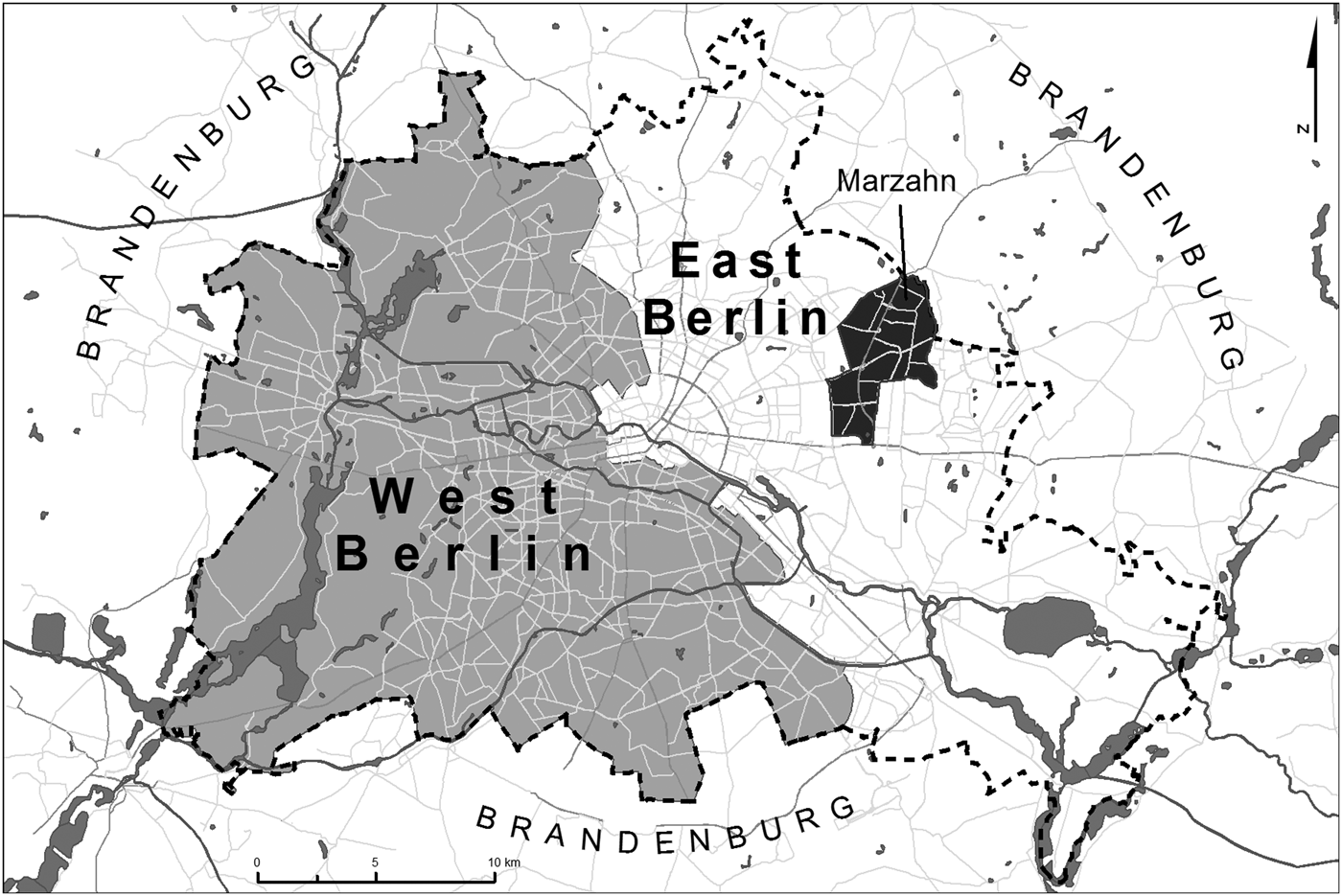
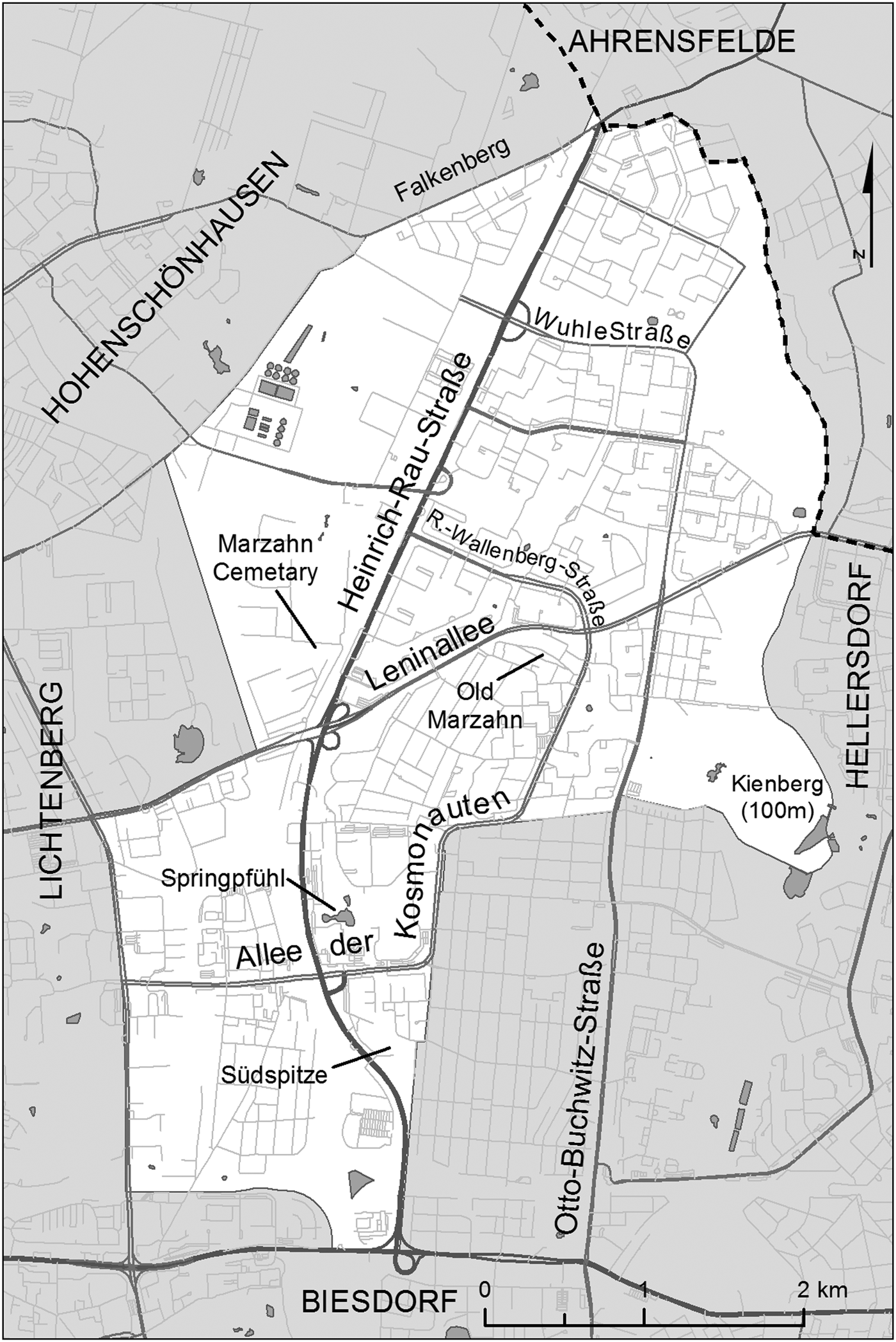
On March 27, 1973, the Politbüro decided to build a settlement of 20,000 apartments just to the north of Biesdorf, a small village south of Marzahn (see Figures 2 and 3). The name was changed at the last minute to Marzahn by the Politbüro, which objected to the name “Biesdorf” (the word Dorf means “village”), explaining that “the working class will not move to a village” (der Arbeiterklasse zieht sich nicht ins Dorf ).Footnote 86
Location of Marzahn (shaded in black). Courtesy of Jason Glatz, Western Michigan University Libraries Mapping Service.
Map of Marzahn. Courtesy of Jason Glatz, Western Michigan University Libraries Mapping Service.
The plan for Marzahn, created by planner Roland Korn, was expanded to include 35,000 apartments, although it would continue to be expanded throughout Marzahn's various phases of construction in the 1970s and 1980s, crossing into adjoining areas such as Hellersdorf, Ahrensfelde, Neu-Hohenschönhausen, and Lichtenberg, eventually housing 450,000 people. The Korn plan was not simply the building of apartments; it was the creation of an entirely planned city, along Le Corbusian lines. Everything was included: schools, shops, parks, workplaces, public transit, restaurants, youth centers (Jugendklubs), playgrounds, and preschool/kindergartens (so-called Kinderkombinationen, or KiKos). Each section of the settlement was to have its own “center” containing eating, drinking, and entertainment facilities, including a restaurant, a café, a milk bar, a food and dance hall, and a pub; a shopping center, including a grocery store (which had to be at least 1,000 to 1,500 square meters) and several specialized shops; a collection point for recycling; a branch library and bookstore (which had to be at least 700 square meters); a service complex, housing repair shops; a health-care center, including a facility for sports medicine; and a public swimming pool.Footnote 87 Everything was included to make it a welcoming community—especially to families with young children.Footnote 88 In each center, there needed to be at least one high school and one school for special education.Footnote 89 Finally, there was to be a police station and an office for the local (Kreis) branch of the ruling SED party.Footnote 90
There was also to be an artificial 100-meter-high “mountain,” called the “Kienberg,” built from the dirt and debris removed in the construction of the settlement—5,000 cubic meters worth—and piled on top of a preexisting elevation, built from war debris removed from the city after 1945.Footnote 91 There was to be a kind of dry bobsled run called Rodelbahn down the hill here that could become a real bobsled run in the winter; a miniature ski slope with a rope tow; hiking, biking, and cross-country ski trails; an “adventure playground” (Abenteuer Spielplatz), and a beer garden.Footnote 92 There were also plans to dam the Wuhle River, the small river that runs through Marzahn, to make an artificial lake roughly 60,000 square meters large, on which paddleboats would be available for residents.Footnote 93
The new city was defined by two main traffic arteries along its peripheries—Leninallee and the Allee der Kosmonauten (Avenue of the Cosmonauts).Footnote 94 All other streets in Marzahn were to be named after prominent communists or antifascists.Footnote 95 Everything else was pedestrian pathways that would cut through wide green spaces between buildings; no residence could be closer than fifty meters to a roadway.Footnote 96 No residence could be more than 600 meters' walking distance from public transportation, a school, or a KiKo.Footnote 97 In short, Marzahn's planners had thought of everything. Or at least everything that they could reasonably have been expected to; the comprehensive nature of their planning bespoke their modernist ideology, and their extensive emphasis on social facilities revealed the influence of Real Existing Socialism's focus on consumption, health care, education, recreation, and other aspects that constituted the “good life” as it was promised to East Germans.
At the center of the plan was the main type of prefabricated apartment model used by the GDR in the 1970s and 1980s, the WBS 70. WBS, which stood for Wohnungsbauserie (or “apartment construction series”), was the most advanced Plattenbausystem developed by the DBA, essentially the fourth generation of Plattenbauten, after the P1, P2, and QP71.Footnote 98 The WBS 70 came in five- and eleven-story variants, though in Marzahn it was mainly the eleven-story that was used. The WBS 70 was what was termed a “complete comfort apartment” (Vollkomfortwohnung), meaning it had central air, a fully equipped bathroom with endless warm water, and often a balcony and an elevator.Footnote 99 It was also larger than previous models, such as the P2.Footnote 100
The technology used to build the WBS 70 and most of Marzahn had to be imported from abroad, something not uncommon in East German industry, which added greatly to the cost of the project. In particular, the cement panel factory, built nearby in Hohenschönhausen, was imported wholesale from the Partek Corporation in Finland.Footnote 101 The construction method was also an import, from the U.S.S.R. Known as the Slobin technique, it operated the construction site literally like an assembly line (Taktstrasse).Footnote 102 Cranes mounted on tracks hauled the prefabricated wall panels, as well as the bathrooms—the entire bathroom was assembled in the factory—into place where three shifts of workers mounted them, and then the assembly slid down the line, building in seemingly endless rows.
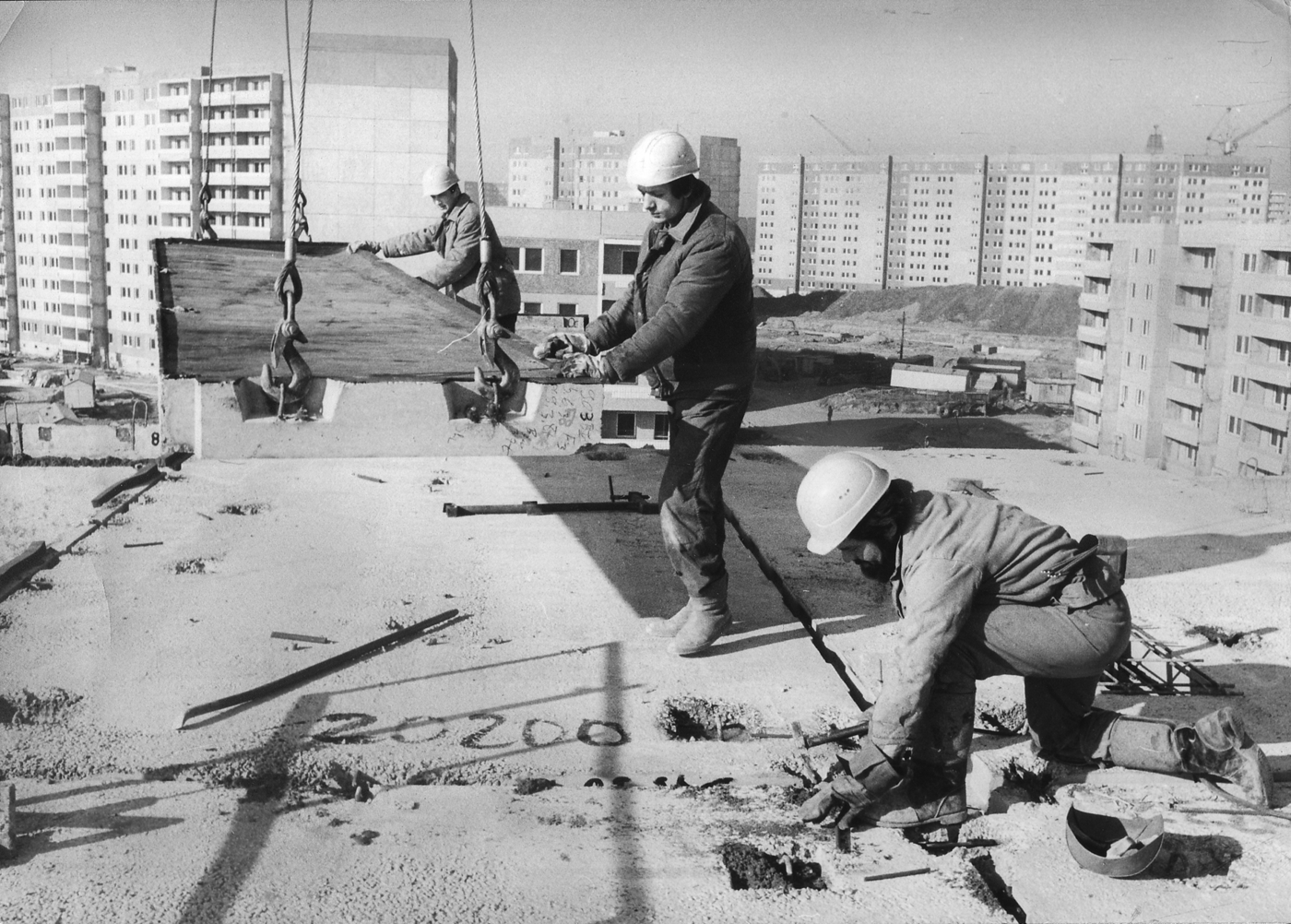
The Slobin technique was a masterpiece of socialist Fordism—the basic structure of a five-story WBS 70 building was generally finished within two weeks. It took longer for the electricity, plumbing, elevators, hall flooring, etc., to be installed; however, the plumbers, electricians, floor layers, and so on went to work on one floor as soon as it was finished, even as cranes and montage brigades were welding panels in place on the floors above. As soon as one floor was completely finished, people could begin moving in, even if construction was continuing on the floors above. In total, then, the average construction time from foundation laying to the top floor being ready to move in was sixty-one days for a WBS 70/5, between eighty-seven and 109 days for a WBS 70/11, and between 194 and 235 days for a QP 71 twenty-two-story tower. In total, each apartment ended up costing about 44,000 East German marks.Footnote 103 Ultimately, the WBS 70 and its variants would be used for a majority of the buildings built during the Wohnungsbauprogramm between 1975 and 1990 (see Figures 4, 5, and 6.)
Workers constructing a WBS 70 building in Marzahn, 1980. Courtesy of Bezirksmuseum Marzahn-Hellersdorf.
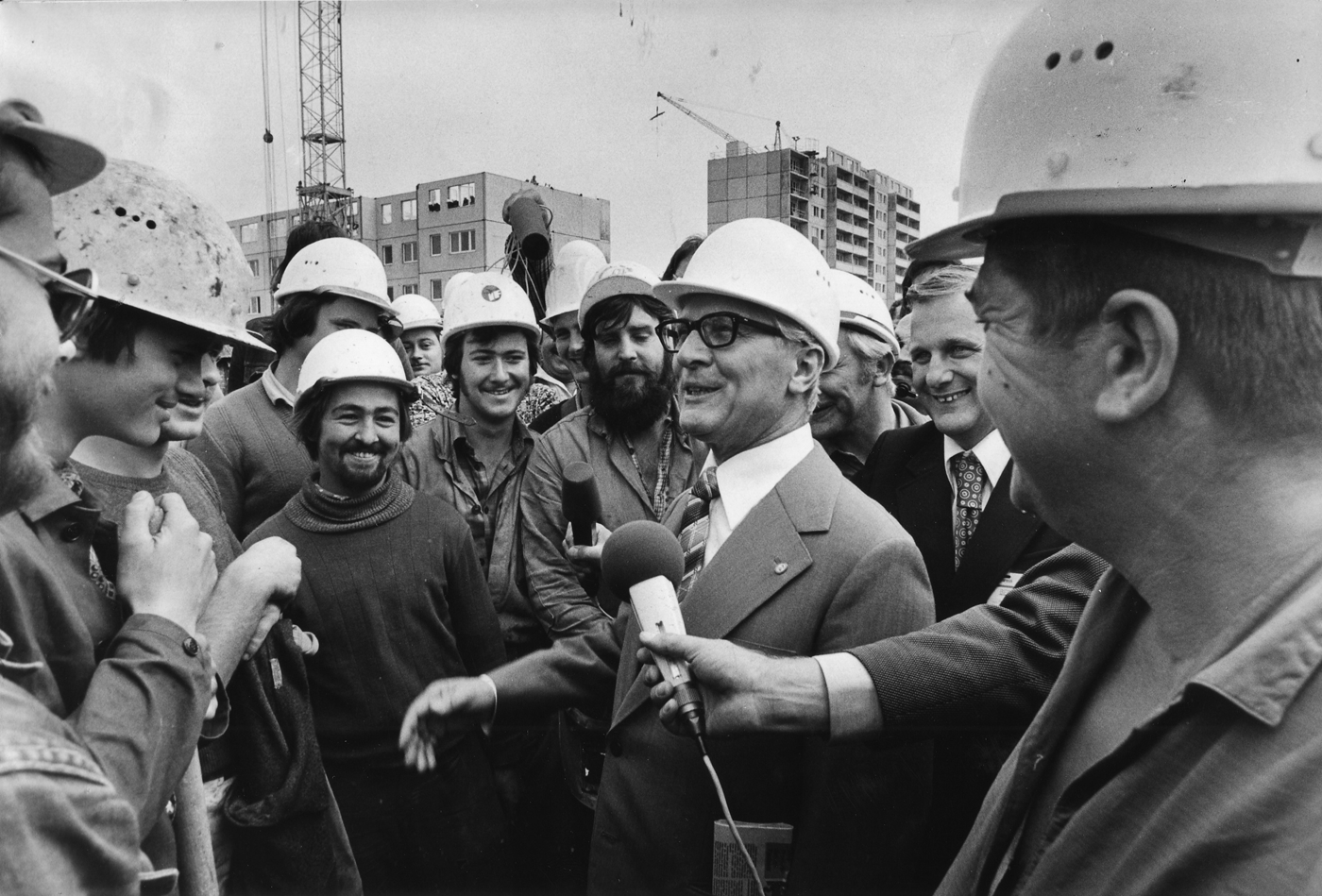
Erich Honecker with workers in Marzahn. Courtesy of Bezirksmuseum Marzahn-Hellersdorf.
WBS 70 eleven-story building, Allee des Kosmonauten, Marzahn, in 2012. Photo by author.
To mark where the first building was created, the work brigades erected a Richtkrone, a “crown” traditionally made of wood and local materials to celebrate the completion of a house or other building, a tradition that dates back to the Middle Ages, only this was made of cement panels. Under it, they placed a cement panel from the factory with the silhouette of a man with one arm raised cut into it. It was an homage to Le Corbusier's “Modulor,” a design similar to Da Vinci's “Vitruvian man” intended to make man “the measure of all things” in architecture, a testament to the importance of Le Corbusier's vision to the entirety of the Marzahn project (see Figure 7).Footnote 104
The concrete “Richtkrone” and homage to Le Corbusier's “Modulor” made from a concrete Platte, Marzahn. Photo by author.
The work brigades that came to build Marzahn were described and saw themselves often as colonists. Heinz Graffunder, the director of the project, described them as “pioneers of the first hour,” “brave,” and sometimes “homesick” out there on the frontier.Footnote 105 In general, life on the construction site had the feel of a frontier town, with the thousands of workers housed in barracks on site, and a freewheeling culture of heavy work, heavier drinking, and sometimes brawling prevalent amid the din of construction vehicles and seas of mud.Footnote 106 It was, in a way, a version of the Wild West—the “Wild East,” so to speak.
Of course, as much as the workers and the project's planners saw themselves as socialist “pioneers,” they were only the latest in a long history of colonization that had defined the mark. The irony was that as the construction project began to tear up the soil and raze the vegetation, they began to unearth the traces of that very history. Teams quickly found that there were archeological remains of the area's previous settlers. More than 100 archeological sites were investigated by a team under archeologist Heinz Seyer of the Märkisches Museum, where they were kept and put on display.Footnote 107 Among the discoveries were ur-German vases and flint stones from the Late Stone Age; the foundations of ur-German and Slavic homes; jewelry, urns, and knives of both German and Slavic provenance; and, most importantly, a near intact Slavic fountain with an irrigation system discovered when an excavator struck it in October 1977.Footnote 108 Nor were ur-German and Slavic remains the only ones found—the foundation of the original Romanesque church that was built for the very first German settlers after the Askanian reconquest in the twelfth century was found not far from the nineteenth-century church in the middle of the village green.Footnote 109 The soil itself was inscribed with the longue dureé history of the mark as a contested zone between Germans and Slavs.Footnote 110 It was, as Marzahn architect R.-Wolfgang Eisentraut put it, “a reminder that this was not the first time that people had settled here.”Footnote 111
And the record of that contest did not end with the Cistercian settlement. The most recent episode of conflict in the area between Slavs and Germans was World War II, specifically, the Battle of Berlin in April 1945. Almost as soon as they began digging, workers began to encounter the massive amounts of unexploded ordinance that had been buried in the sandy märkische soil around Marzahn. Workers grew accustomed to hearing the dreaded “dull clank” in the soil while digging.Footnote 112 A team of ordinance removal specialists (Munitionsbergungsdienst) from the Volkspolizei (VP), the main police force in the GDR, stationed under Captain Heinrich Luthe in Potsdam, was called in to remove a four-ton air mine; twenty-two two-ton bombs; 1,863 incendiary bombs; eighty-eight mines; and nine rockets, as well as more than one million smaller pieces of ordinance, such as bullets, grenades, and artillery rounds, all potentially still live. The bombs uncovered underneath Marzahn were, according to an article in the Neue Berliner Illustrierte, the final traces of the “fascist war of conquest,” and after “thirty years have passed over this sandy soil and these fields,” the magazine claimed, the building of Marzahn, by uncovering and removing the ordinance, finally brought closure to World War II, so that “the traces of that war claim no more victims.”Footnote 113
In some cases, however, the painful, buried past would not pass away, for example, on the Kienberg, where, as residents began to wear footpaths along the sides of the hill, the war rubble began to emerge. Even today, in some places, these can be seen: a window frame here, a patch of rebar there, the physical traces of the built spaces of a previous era of German history.Footnote 114
Marzahn's planners sought to recreate the natural environment of Marzahn, including the reshaping and repurposing of the local river, the Wuhle, by straightening it, laying its bed with prefabricated concrete panels, and making it the source for all the storm-water runoff to be collected in the new settlement, as well as the carrier for the “purified water” discharged from the new sewage treatment plant built on the site of the old sewage farms in bordering Falkenberg.Footnote 115 The Wuhle River had been in many ways the heart of settlement in the area since the very beginnings—crews constructing bridge stations over it found Early Stone Age relics dating back to the very first record of human settlement, from 9,000 BCE, not long after the last glacier had receded, creating the entire hydrological and geological landscape of the Greater Berlin and märkisch area in the first place.Footnote 116 Remaking the Wuhle River, using the same mass-produced cement panels that the Falkenberg plant made for the WBS 70, was another form of negating the history of the area and subjugating it to a top-down, utopian vision.
Throughout the settlement, tens of thousands of new trees were planted, including 38,000 trees in the long strip that bordered the newly constructed Wuhle River. In keeping with the entire GDR economic system, the planting was done in Fordist fashion—just like the rows of WBS 70 buildings, the trees were planted in assembly-line fashion, derived from a central source, the VEB Forestry Berlin, and with little regard to the natural habitat or soil. The ground was torn up, and a boring machine drilled holes in rows into which the trees were inserted by the VEB forestry workers. Broad-leafed trees, mainly linden, ash, chestnut, maple, oak, and rowanberry trees made up the bulk of the 38,000 saplings brought in from the VEB's enormous tree nursery, with poplars and larches brought in later, often planted along with trees-of-heaven and ashes near building entranceways.Footnote 117 Other machines leveled all surrounding vegetation, to eliminate any harmful “weeds” in the area. Then, more than 20,000 holes were bored for shrubs, with planting following in quick succession. A 1,600-meter-long fence surrounded the area to keep out any herbivores that would be tempted to eat the saplings and young bushes.Footnote 118
And yet here, too, as with the construction workers, the forestry workers found that they were not working with a true tabula rasa and that the margin of a city had as much history as the city itself. The use of Marzahn and Ahrensfelde as a dumping ground for the city's sewage, through the use of sewage farms into which the city's sewage would pour, had contaminated the soil and the runoff into the Wuhle River, making it very difficult at first to plant many of the trees. This was exacerbated by the disturbed soil; after rainstorms, residents often complained about the smell of sewage wafting from the mountains of excavated soil. This pointed again to the irony that the more the construction of a new socialist settlement proceeded, the more the buried traces of the earlier era's use of the margins of the city as a dumping ground was unearthed.Footnote 119
The goal of Marzahn's planners was clear—Marzahn's residents should be surrounded by as much green as possible, but it should be according to a very clear plan. As Deutsche Architektur, the central journal of East German architects and urban planners, claimed in 1973, the tree was an “essential part” of urban space.Footnote 120 In this, they were reflecting the CIAM's embrace of open, green spaces outside the city, as well as the long-standing history of planners in Berlin to seek solutions in the “green fields” outside the margins of the city to all the ills of the inner city.
Tree planting was such an iconic activity in Marzahn's early days, that it was common for visiting politicians or other guests to help plant a tree. The most famous example of this was the tree planted along one of the main roads, Allee der Kosmonauten, by the East German cosmonaut and popular hero, Sigmund Jähn, the only East German to go into space. Jähn visited Marzahn with his Soviet copilot, Valery Bykofsky, on September 22, 1978, three weeks after returning from a trip to the Soviet space station Soyuz as part of his triumphal return to the GDR, which included receiving the Order of Marx at the Palace of the Republic.
The choice of Marzahn as place for the cosmonauts' visit was a result of the high propaganda value of the settlement. It also spoke to the popularity of the Soviet space program, and the radical break, the new beginning for socialism that it signified, was deeply tied into the Marzahn project and the Housing Program overall. This was a new, space-aged working class, as the Marzahn local newspaper, the Marzahn Aktuell made clear on the cover of its special issue published for the cosmonauts' visit, which displayed a cartoon that linked the growing skyline of Marzahn to the Soviet space program and outer space itself. It depicted Bykofsky and Jähn in the Soyuz, orbiting Earth, and looking down at Berlin (depicted by a bear with a crown, the symbol of Berlin for centuries) and saying “and what keeps growing each time we orbit the earth, way down there below, is our Berlin-Marzahn.”Footnote 121 The tree itself became the namesake of the street it stood alongside; the name “Allee der Kosmonauten”—still used today—was picked by the mayor of East Berlin, Eberhard Krack, to honor the visit and the tree.Footnote 122 In the end, socialism might not have been able to construct entirely new cities on the moon, but it could construct them on the green fields outside cities such as Berlin, and they could get cosmonauts to help.
Nor was Jähn's visit the only high-profile one; Marzahn was so vast, and such a showcase of socialism's economic might as well as utopian future, that Honecker himself often made appearances there. It was one of the top sights to be shown to international visitors of all kinds, from Willy Brandt to Indira Gandhi to Kim Il Sung, and most importantly, Mikhail and Raisa Gorbachev, all of whom were given a personal tour of the construction site.Footnote 123
Year One on the Green Fields
In the end, Marzahn and the rest of the Berlin northeast was built, finally realizing a long history of attempts to move the working class out of the “misery quarters” of the city. Nearly half a million people moved there. What was the experience like for these people? What did it mean actually to live out the principles of the CIAM and the constructivists, and to fulfill, in a way, the destiny of colonization? If what was really happening with the building of endless units of WBS 70s in satellite cities was a kind of geomancy, then, what was the effect of this geomancy on the subjects who came to dwell in such charmed spaces? Did the construction of a socialist urban space in turn create a kind of socialist consciousness?
To a degree, yes. By moving out of the bad old neighborhoods, East Germans experienced not only a relief of their atrocious living conditions, but they also encountered a new sensory world, with new smells, sounds, senses of light and dark, and even a different sense of orientation in vertical and horizontal space. One big spatial change that Marzahners experienced was a sense of vertical spatiality. Most Marzahners lived on a story higher than they ever had before, and higher than anyone they knew or anyone in their previous generations had before. Living in a high-rise now meant the opening of a new world of the senses—exactly, it must be noted, as Le Corbusier had intended. Sunshine itself became a new and major facet of life (even if northeastern Germany was and is notorious for long stretches of overcast weather, especially in the winter). Living vertically opened up new phenomena of the natural world that either were not visible or at best highly obscured for those living in cramped rental barracks.
Johann and Sofia Schöring experienced this when they moved to Marzahn from Pankow in 1983, where they lived in a passageway apartment with no windows that they described as “miserable.” Living on the seventh floor of a QP 71 building, with windows and a balcony facing toward the east, they saw sunrises and rainbows—if not necessarily for the first time, then regularly, and from a majestic and unfettered vantage point, which they documented with their camera and saved in a photo album, a record of new sense memories, weaving their state-built verticality with the geography and meteorology of the place they were in.Footnote 124
Thus, being in a position where they could see rainbows regularly not only introduced a new sensory artifact to their everyday worlds, but their new sense of verticality also introduced a new sense of orientation, in Germany, in Europe, in a strict east-west axis defined by the weather and the sun as much as by political geography. All of this orientation was made possible by the elevation of Marzahners out of the cramped inner cities, defined by a very different form of orientation.
For those with western views, the sunsets were often the first things they thought of when asked what was the best part of their new apartments. “The best are the sunsets,” commented Renate Bautz, reflecting on her twenty-five years in Marzahn. “You don't have to go to Capri. Every night we enjoy the view right from our window.”Footnote 125 For others, such as Helena Hepner, the view was what helped to mitigate the ambivalence they felt about leaving their familiar surroundings in the city. According to Hepner, “We weren't terribly excited [to move to Marzahn] because we lived in the city. It was like a little town here [Dörfli] for us—everything was just farmland. But we moved into a building with a beautiful easterly view, and when the weather was clear, we could see all the way to the Müggelturm [a modern recreation of a historical tower on the Müggelsee, a popular vacation outing destination twenty kilometers southeast of Marzahn].”Footnote 126 Renate and Reinhard Ludwig also pointed to their view of the distant Müggelberge (hills near the Müggelsee) and the Schönefeld airport even farther to the south, and a sweeping vista “from Hoppegarten to Neukölln.”Footnote 127
As much as high-rise settlements such as Marzahn were reorientations on a vertical axis, they were also a reordering of horizontal space. Indeed, the spacing of buildings within a matrix of community buildings and spaces (shops, schools, athletic facilities, etc.) and roads was just as important to Le Corbusier as the vertical stacking of people on top of each other. In the radiant city, the verticality of the living arrangements was part of the overall ordering of horizontal space: people who lived in towers maximized horizontal space, and this allowed for wide open areas between structures, which would be traversed mainly by footpaths.
Other Marzahners, such as Christian Domnitz, also saw the broad meaning of modernity and socialism inscribed in the very reordering of space produced in Marzahn. For the young Domnitz, the physical reality of the relationships between the living towers, the pathways, and the schools produced and shaped his own inner self into a “socialist personality”:
When I went to school, I could choose between two paths. Both were about equal in length and both paved with asphalt, so I could keep my feet dry. One led straight along the edge of the new housing settlement. That was the way that almost all the kids used. Every morning there was a kind of procession. To the left stood tall and proud the new housing settlement, and in front of us lay the school. When I took this path, I felt as if I were developing a socialist personality that would fit into a huge socialist project.Footnote 128
But there was another side for Domnitz, who had always been conflicted about the transformation of his home village. The environment, both built and “natural,” was the medium through which the socialist state was creating this “socialist personality” inside him. But the “environment” was essentially a neutral substrate—it could just as well be manipulated in ways that ran counter to the state's intentional or implicit designs. Simply by finding a second path to school, regardless of whether it was a short cut, he could reclaim or preserve a part of him that was not turning into the “socialist personality”:
The other way snaked through the small garden colony. There, I could linger [nachhängen] in peace and alone with my thoughts. In the summer, plum trees grew over the fences, dogs ran barking through the gardens, and on one corner there was a crazy old man who carved wooden figurines. The figurines were colorfully painted and funny to look at, and then there was a small water mill that still turned round and round. That was really the path of self-discovery [author's emphasis].Footnote 129
Domnitz straddled both worlds—the world of the straight path with a clear destination, and the world of whimsy, nature, and chance—by walking both paths. “Sometimes,” he recalled, “I took one, and sometimes the other. I liked both of them.”Footnote 130
For many Marzahners, the first defining experience of Marzahn was that of entering a profoundly alien landscape, a vast construction site, in which their new lives were set to begin. Gabriele Franik, for example, was stunned the first time she and her husband drove to their new apartment in 1978 from an older neighborhood in Berlin:
I had no idea of the scale of the construction site. . . . We emerged in a giant construction site: our way was lined with cranes. Plattenbauten that had just begun stood everywhere. There were no streets for far and wide. Mountains of sand towered, a gigantic wasteland of mud [Schlammwüste], nowhere a tree, or even a shrub.Footnote 131
The Franiks found their building, a WBS 70–11 on Ludwig-Renn-Strasse 43 still under construction, and Gabriele recalled entering their new place for the first time:
My heart was in my throat with excitement and my knees shook as I left the car and we walked up to the second floor together, the building still smelling of cement and paint. My husband opened the door to our new apartment and . . . a giant empire appeared, with enough room for five family members. Central heating, warm water from the wall, and a six-meter-long balcony! This is what happiness looks like. We fell into each other's arms, euphorically.Footnote 132
Others experienced the same kind of disorientation as landing on a completely new planet. One was Klaus Hölgermann, who moved his family from the small town of Ilmenau, south of Erfurt, where they had shared a house with his wife's grandparents, to Marzahn in the snowy winter of 1979. In the deep snow and ice, under the moonlight and the lights of the third shift, Klaus, his family, and the movers arrived—and promptly got lost. There were still no street signs, and the snow made it even more of an alien and foreign landscape. It took the movers “four or five” trips around the settlement before they found their building.Footnote 133 This took place under auspices of a national program known as Join In! (Mach Mit!), which, although not exclusive to the Plattenbau settlements, did have a particularly unique meaning there.Footnote 134 Not only was Mach Mit! used as a venue to socialize new residents into a new community, but it was also a means to landscape and decorate the newly built areas around the buildings in new settlements such as Marzahn. In fact, much of the landscaping, from planting grass and trees to building playgrounds, was accomplished through Mach Mit! initiatives—initiatives that took place every two weeks in the planting season and were coordinated between the communal associations, the Berlin Magistrat, and the VEB Office of Green Space (VEB Grünflächenamt, part of the WBK that oversaw the whole project), accounting for “many thousands of square meters of green space,” according to one official with the Green Space Office.Footnote 135
Thus, one of Torsten Preußing's first memories of moving into Marzahn was of a placard posted by his building's communal association in the lobby that read “Tomorrow topsoil is coming. All men outside, with shovels in hand!” “It worked,” Preußing recalled. “We stood there [the next day], and we spread out the topsoil. And we designed the garden in front of our building ourselves. It was a time that can be described with a phrase that was often thrown around back then: ‘From ‘I’ to ‘we.’”Footnote 136
For many, the act of planting something was a way that they began marking time in this new space. This was the case for Elisabeth Albrecht, who planted a poplar tree after moving to Marzahn in 1982 directly below her ninth-story apartment. This tree came to symbolize for her the rebirth of her own life and especially that of her very young son, because the Albrechts had lived in a tiny rental barrack apartment that was contaminated with carbon monoxide in Friedrichshain for ten years and they experienced “frequent headaches. We often felt faint and sick.”Footnote 137 For her, the fresh air and the greenery of Marzahn symbolized the return to health, and the planting of the sapling was her way to mark the beginning of the new era in her life, although here again it should be noted that there never was a true blank slate, because Albrecht was among those who were unable at first to plant a tree successfully due to the contaminated soil left over from nineteenth-century sewage. She had been poisoned by the air in Friedrichshain, and now her attempt at a new life outside the city was still “haunted” by the poisons of the capitalist, industrializing city of the 1800s.
After three attempts, however, she was successful in planting her poplar, which grew from two meters to be “a proper tree” within four years—around the time her son began school. The tree grew as her son grew; as it put down its roots, so did she and he. Eventually, her son grew up and moved away, “but in the meantime, the poplar that I planted during those days [when he was a child] has reached all the way to me, almost growing into my window. It is now twenty-one years old.”Footnote 138
It was not just trees that were “growing” in the overturned soil. WBS 70 towers went up so fast that it seemed they were “growing,” too. Christian Domnitz recalled the experience of watching the construction project: “All over, concrete pieces shot up out of the ground . . . when I was at home with my family, and I gazed out the window, I did not see trees growing, as elsewhere; I saw dwellings growing. There were more and more, they grew all around, and they grew higher and higher.”Footnote 139
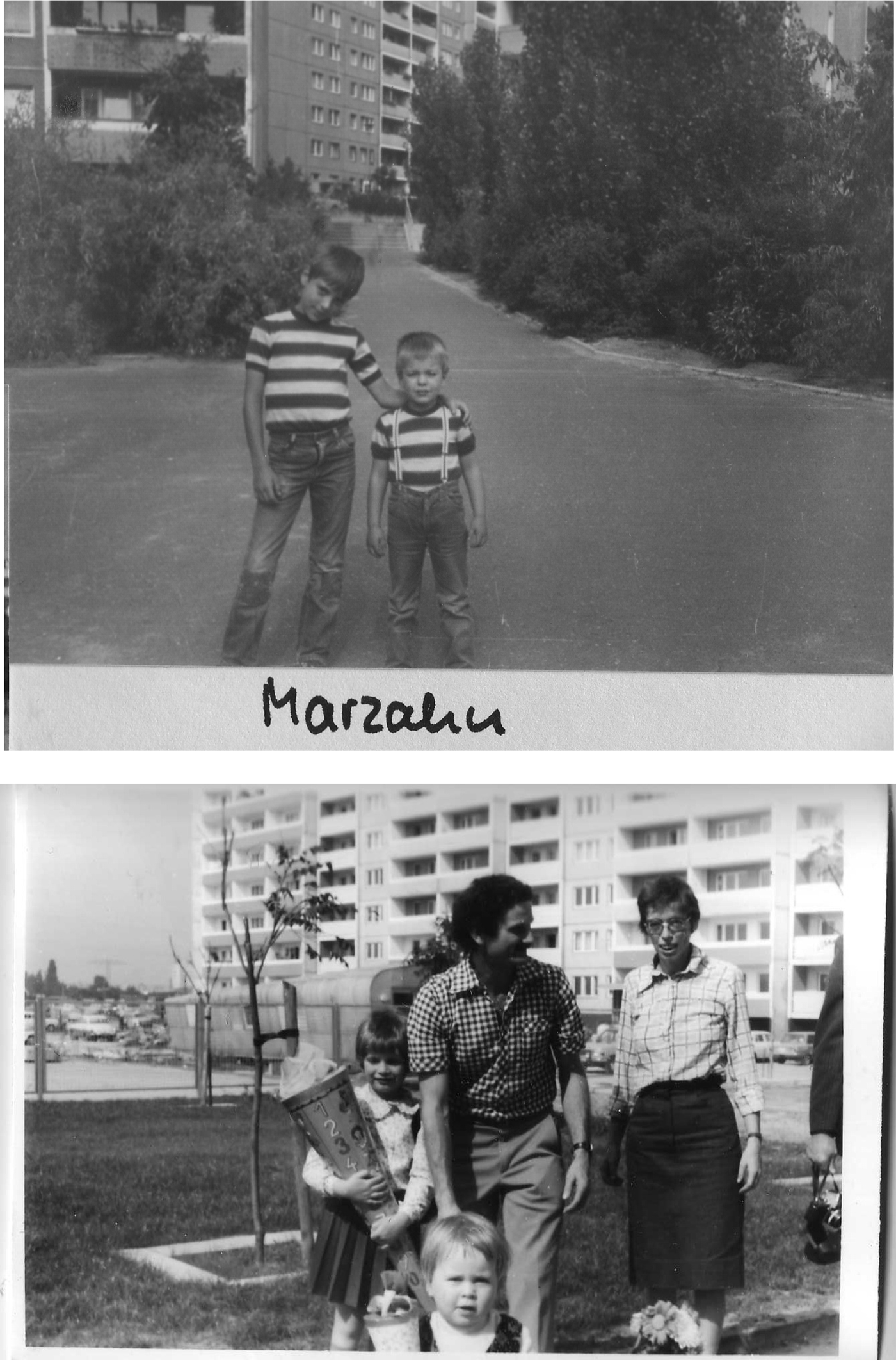
For many Marzahners, the growth of the buildings and the trees occurred parallel to the growth of their children. Marzahn had the highest concentration of children per capita of any district in the GDR, with more than thirty percent of its residents under the age of eighteen and seventeen percent under the age of seven, a third higher than the population of East Berlin as a whole.Footnote 140 The simple reason was that among the easiest ways to get an apartment in Marzahn was to have a small child, which was a direct result of Honecker's policy of supporting young families, a policy that extended to marriage credits and interest-free loans for furniture and other support to encourage young people to get married and start families. This was felt especially in Marzahn. As Anke S., who had been recruited to Marzahn in 1977 to teach ninth grade, recalled, “with the apartments being completed, the moving vans came. And with the moving vans, came ever more children.”Footnote 141 Eleanor Gast recalled that in the Marchwitzastrasse area (Viertel), “all the KiKos were overburdened. We had so many kids that the buildings were on the verge of falling apart.”Footnote 142 The near omnipresence of children was one of the defining features of life in the new settlement. There were, by 1988, 33,000 schoolchildren and a further 18,000 in kindergartens or KiKos (see Figures 8 and 9).
Childhood in Marzahn, 1982. Courtesy of Barbara Diehl (Figure 8) and Evelyn Marquardt (Figure 9).
Renate Bautz, who moved to the Allee der Kosmonauten with her husband and four-year-old daughter in 1979, recalled, “we were only let into the AWG [Arbeiterwohnungsbaugenossenschaft, or workers' housing collective, the main vehicle through which East Germans got apartments—each factory or place of work would generally allow its employees to belong to one, and these then doled out the apartments to applicants] because we could say that there would soon be three of us. That was the reason that so many young people in the GDR married and quickly had kids, so they could get [a modern] apartment.”Footnote 143 Gabriele Franik also recalled that it was the fact that she was eight months pregnant with twins that allowed her and her husband to get a Marzahn apartment—she punctuated her reminiscence of entering their high-rise for the first time with the statement “my stomach measured 108 centimeters!”Footnote 144
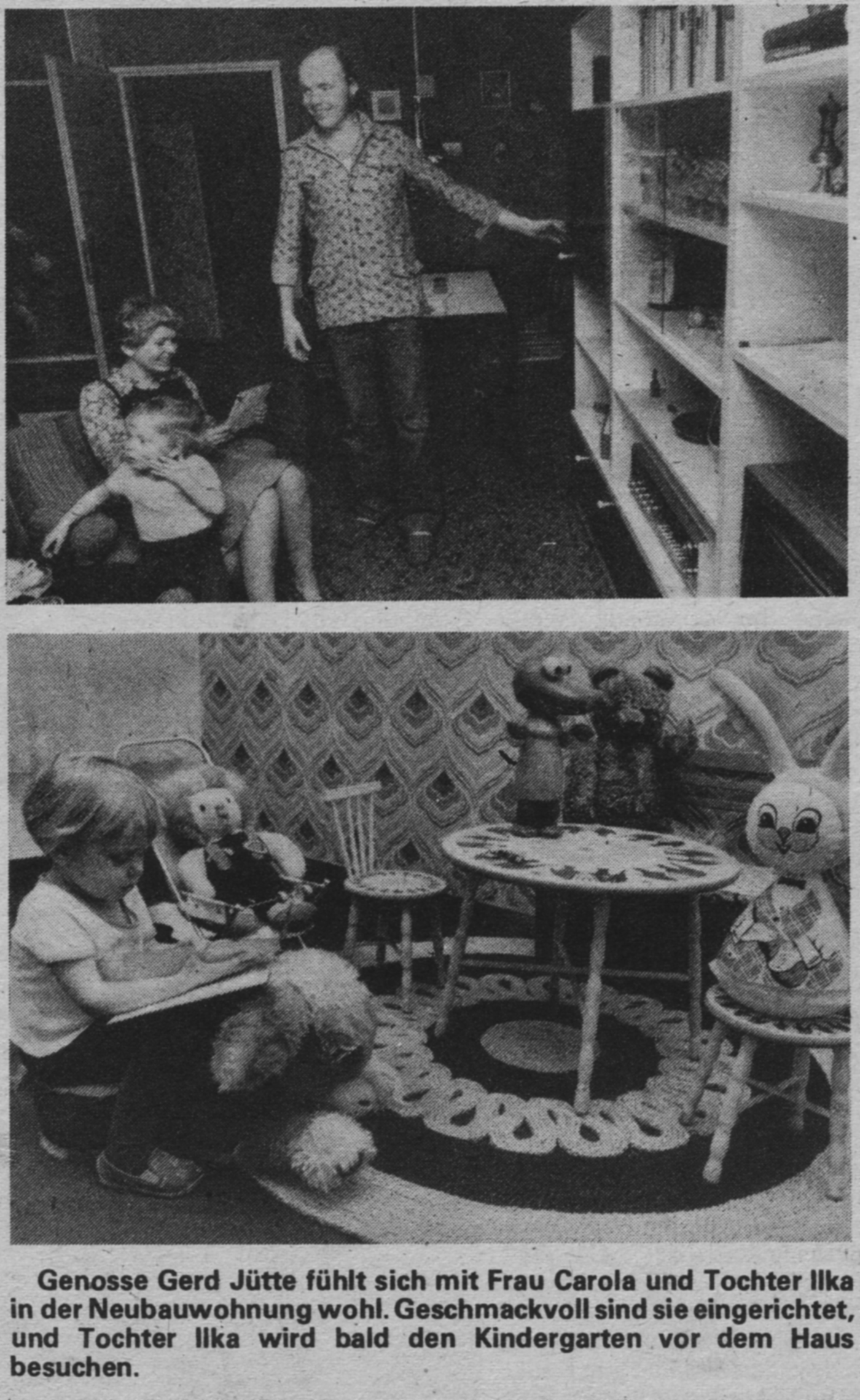
Children were celebrated in the local press as the first generation of Marzahners, who were growing together with the settlement. One of the first families to move into Marzahn in 1977, Gerd and Carola Jütte and their two-year-old daughter Ilka, were profiled in the local paper Marzahn Aktuell (see Figure 10). The paper focused on Ilka, the fact that she had her own room (in contrast to the cramped Mietskaserne one-room apartment they had left behind in Weissensee), and that the kindergarten was within easy walking distance, practically across the walkway from the front door of their high-rise. The article, entitled “Ilka Wächst Mit” (“Ilka Grows Along With”), especially highlighted the fact that she was growing up as Marzahn grew up:
Ilka has grown sleepy from playing and from the many new impressions. From children grow great people. In time, perhaps, she will tell her own children about the district Berlin-Marzahn and its origins. Ultimately, the two of them are growing up together!Footnote 145
The Jütte family, profiled in the local newspaper Der Neunte, vol. 2, no. 3, 4.
The paper came the next year, in 1978, to do a follow up on the now three-year-old Ilka, and depicted her as a budding artist on her easel in her own room, stating again, “Little Ilka of the Jütte family is growing with Berlin-Marzahn.”Footnote 146
Twins were especially celebrated in Marzahn. According to the former mayor of Marzahn, Gerd Cyske, if a family had (or was pregnant with) twins or triplets, they were often moved to the very front of the waiting list at their AWG for an apartment.Footnote 147 In fact, there were so many twins and triplets in Marzahn that a special parade of them was organized at the “Marzahn Spring” annual festival.Footnote 148 Franik was one example of this; so, too, were Christian and Constance Hämmerling, born to mother Karin and father Detlev in March 1978 and celebrated in the local press as the first babies born in Marzahn. The local paper explicitly compared the start of their new lives with the start of a new life in Marzahn, one defined by children, buildings, and trees. Visiting the twins just before their first birthday in March 1979, reporter Volkhard Kühl wrote:
The first twins in Berlin-Marzahn are already standing on their own two feet. Constance and Christian Hämmerling will be one year old on March 13. But in the intervening time, more twins have arrived [in Marzahn.]
The residential district, in which the little ones will now grow up, is also already able to stand on its own two feet. On March 8 and 15, 1978, the first Residential District Committee of the National Front was constituted; and on March 18, the residents of Marchwitzastrasse began planting the first garden in front of their building.
Soon, Constance and the already very adventurous Christian will discover the neighborhood they call home [Heimat].Footnote 149
Marzahn was defined as a place of rebirth, of new beginnings. Children, saplings, and freshly constructed buildings filled the scenery, a connection many Marzahners themselves made. It seemed as though the future of socialism was just beginning.
Conclusion
The construction of apartments and prefabricated community buildings in the Berlin northeast continued right up until early 1990, when the East German state effectively ceased to function as a state. Workers shut off the cranes, put down their tools, and walked away, with buildings half finished. What they left behind was truly a vast and bizarre monument to socialism, modernity, and the legacy of colonization in and around Berlin, one that we have yet really to decipher or unravel. Marzahn, the flagship settlement of the Housing Program, was intended to be the blueprint for the future. It was part of a trajectory of history that was heading to a very clear destination—a society built on rationality, functionalism, and most importantly, a complete break with the mnemonic traces of the past. It was a place with no memory—an amnesiopolis, a place with no past, only a future. After 1990, it became a place with no future and no past—a truly stranded space.
Like many revolutions, the Wende of 1989–90 in East Germany turned a society on its head. Marzahn had been one of the most desired destinations for East Germans, and Marzahners were happy in their Plattenbausiedlung. According to a longitudinal sociological study conducted through the 1980s by Loni Niederländer at the Humboldt University's Institute for Marxist-Leninist Sociology, seventy-three percent of Marzahners studied either strongly agreed or agreed with the statement “I have a sense of well-being in Marzahn”; similarly, sixty-five percent of Marzahners were happy with the overall atmosphere in their new building, while another thirty percent felt it was “okay.” Only five percent were unhappy with where they lived. Similarly, seventy-six percent had a sense of well-being in their individual apartment; thirty-six percent would “strongly urge” those they knew to move there, and another forty-eight percent would “recommend” moving there to others.Footnote 150
There was some dissent in Marzahn, as there was everywhere in the GDR, especially by the late 1980s. A group calling itself “Group 89” surfaced around the time of the infamous national elections of May 1989, distributing flyers and spraying graffiti that called attention to the mismanagement of the economy (Mißwirtschaft) and invoked Gorbachev as a symbol of resistance, lamenting the fact that there was “no East German Gorbachev.”Footnote 151 And yet, Marzahn was in many ways an easy place for the Stasi (the East German secret police) to work. A secret Stasi training manual, which prepared agents to conduct surveillance in a Plattenbausiedlung based on WBS 70 buildings, especially in Marzahn, testified to this—the wide-open spaces, ringed by high-rise towers, most of which had apartments with windows on both sides of the building, made observation of suspects incredibly easy.Footnote 152 Also important for the Stasi was the fact that the WBS 70 and QP 71 models used a central antenna that fed into each apartment, making it impossible to watch western TV; the tall concrete towers blocked the airborne signal for anyone else in the area.Footnote 153 Indeed, the “Group 89” leader was quickly found out and arrested within a couple weeks—it was just too easy to observe their movements and recruit informers with excellent vantage points, namely, their balconies.Footnote 154 By the next year, there was a roundtable in Marzahn, and there were, for the first time, as everywhere else in East Germany, free elections. Unlike many other places, however, the communist party stayed strong—now in the form of the PDS (Party of Democratic Socialism), it garnered 36 percent of the vote, with the SPD (the Social Democratic Party) gaining 31.7 percent. In 1992 the PDS garnered 35 percent and in 1995 45 percent.Footnote 155 Marzahn-Hellersdorf became and has remained one of the reddest electoral districts in all of the Federal Republic of Germany.
The goal of the Honecker regime was once and for all to solve the housing problem as a means to make the socialist utopia “real,” as Engels had called for a century before. The Housing Program was the main vehicle for achieving this “Real Existing Socialism,” and Marzahn was the largest and most well-known aspect of that Housing Program. Looked at in this way, it can be argued that Marzahn represented a culmination of socialist utopia, achieved through urban planning—in particular, the creation of a completely new city, thoroughly and holistically planned, in close approximation to the ideas of CIAM and modernist planners from the 1920s and 1930s, especially including Le Corbusier. And judging by the experiences of the people who settled there, it really was in most respects a brand new world and one that reinforced everything that was best about socialism.
And yet there is a painful, bittersweet irony in what happened with Marzahn and other “edge cities” like it from Leipzig to Moscow. Once East Germany was absorbed into the free-market economy of Unified Germany, the old crumbling neighborhoods in places such as Prenzlauer Berg began to gentrify. The oldness of the facades, as well as the variation of different historical eras, helped to make the old Mietskaserne attractive to property flippers and other investors.Footnote 156 At the same time, the identically mass-produced apartments in Marzahn were of little to no interest on the private real estate market. So, too, was the fact that the old districts were close to the city center, where there was and is more of a “scene.” Marzahn's population dropped; despite tons of money invested, vacancy rates remained high, and in an effort to avoid the chronic problems that can occur with too many vacant apartments, the City of Berlin began a program of deconstruction (Rückbau—removing sections or stories of the high-rises) or outright demolition. Now, it is fashionable and desirable to live in Prenzlauer Berg and unfashionable to live in Marzahn; today, the streets of Prenzlauer Berg are full of young children, strollers, used toy and children's clothing stores, and maternity stores, and these are largely absent from Marzahn. Instead, Marzahn is a strange oddity; a vision of a future that was interrupted as it was in a state of becoming, it now stands like an island stranded in a longer dureé of time.