Introduction
Mentally disordered patients with a history of serious violent offences present a unique prescribing challenge to forensic psychiatrists.Reference Brown, Larkin, Sengupta, Romero-Ureclay, Ross, Gupta and Das 1 These patients classically have a history of a serious violent (violent assault, murder, and similar offenses)Reference Larkin, Murtagh and Jones 2 or sexualReference Gordon and Grubin 3 offending associated with a psychotic illness (commonly schizophrenia spectrum disorder) or a severe personality disorder.Reference Rutherford and Duggan 4 Patients in these groups who are deemed to pose the highest level of risk receive treatment in the highest level of security, such as a high security hospital (HSH) in the UK, so that the risks to the public are managed. Such patients commonly have complex comorbidities of substance misuse, personality disorders, and a psychotic illness,Reference Blackburn, Logan, Donnelly and Renwick 5 and they often lack insight, which makes them difficult to treat.Reference Thomas, Leese and Dolan 6
There are 3 HSHs in England with 797 beds for such mentally disordered offenders; they care for the population of both England and Wales (56 million).Reference Stone, Roberts, O’Grady, Taylor and O’ Shea 7 Patients are detained under the Mental Health Act 1983, England and Wales (MHA 1983), 8 and include patients transferred from lesser security hospital units or prisons, or those who receive a hospital treatment order at sentencing from court. The hospital has wards that are distinguished by the level of dependency or risk that the patient poses. Patients who are particularly violent toward staff or present a high absconsion risk may be placed in Intensive Care or High Dependency, whereas patients who no longer pose challenging behaviors may be resident on rehabilitation wards from where patients are discharged. Patients are discharged to lesser security hospitals or repatriated to prison once their treatment is complete.
While there are studies of psychotropic prescribing patterns from a range of psychiatric settings,Reference Hayhurst 9 , Reference Harrington, Lelliott, Paton, Okocha, Duffett and Sensky 10 such studies are few from forensic settings. Given the assumption that patients treated in a HSH tend to be the most seriously violent, treatment-resistant, and difficult to treat, one would assume that prescribing in the high security setting has higher rates of antipsychotic polypharmacy, and high-dose antipsychotic and clozapine prescribing. However there is limited existing literature to ground this assumption. It is likely that physical comorbidities would be more prevalent in this patient groupReference Stahl 11 – Reference Ojala, Niskanen, Tiihonen, Paavola, Putkonen and Repo-Tiihonen 13 because of the chronic nature of their illnesses and associated prescribing patterns. It is hoped that the present study will inform our knowledge about these assumptions.
We report a cross-sectional survey that examines prescribing patterns of all 189 patients at a UK high security hospital.
Methods
All patients reported in this article were inpatients at Broadmoor Hospital, 1 of 3 HSHs in England and Wales with 210 beds. HSHs treat patients who have committed serious offenses and also have severe psychiatric conditions; these patients therefore pose a grave and immediate risk to others and cannot be safely managed in conditions of lesser security. The most common diagnosis is schizophrenia spectrum disorder (SSD), followed by personality disorder.Reference Taylor, Leese, Williams, Butwell, Daly and Larkin 14 According to their predominant clinical need, patients in a HSH are placed in 1 of 2 service provisions: mental illness (MI) or personality disorder (PD). Wards in the 2 service provisions differ in the way psychosocial treatments are delivered. PD wards have services better tailored to patients with personality disorder, with a more structured behavioral management and psychological therapies program. MI wards are better suited to deal with patients whose primary clinical need is treatment of a psychotic or other mental illness, with a focus on psychopharmacological strategies. The hospital has wards that are distinguished by the level of dependency or risk that the patient poses. This ranges from Intensive Care or High Dependency to Rehabilitation wards from where patients are discharged. Patients are discharged to lesser security hospitals or repatriated to prison once their treatment is complete.
All patients in the hospital are legally detained under provisions in the MHA 1983. This includes patients who were convicted of a crime but were deemed (on the advice of 2 doctors) more suitable for hospital treatment of their mental disorder (section 37) and may have restrictions on leave and discharge decisions (section 37/41); patients who were serving a custodial sentence in prison but a decision is made (on the advice of 2 doctors) that they would benefit from treatment of their mental disorder in hospital (section 47/49); those on a section 47/49 who have served the full length of their custodial sentence but who will nevertheless need to remain in hospital for treatment of their mental disorder (notional 37) due to the severity or nature of their condition.
For all 189 patients in the hospital, information pertaining to their age; length of stay; service provision to which they were allocated (MI or PD); primary and other diagnoses; section of detention under the MHA 1983; consent to treatment order; list of medications and doses, including long acting injectable (LAI), oral, and “as required” (PRN); and some physical comorbidities were collected on January 19, 2015 from the computerized clinical and pharmacy database of the hospital. Primary and other diagnoses are made by the responsible psychiatrist for each patient at 6-monthly case review meetings and the diagnoses from each patient’s last case review meeting were recorded.
Patients were split into three diagnostic groups: (1) SSD-only, including schizophrenia, schizoaffective disorder, and schizotypal PD, with no comorbid PD; (2) PD-only, including antisocial PD, borderline PD, and comorbid personality disorders, with no comorbid SSD; and (3) comorbid SSD and PD. Schizotypal PD was included in the SSD category, as its presentation and treatment is more closely aligned to SSD than PD. Other comorbid mental disorders, such as autistic spectrum disorder, mood disorders, and substance abuse, were sorted into 1 of the 3 categories based on the presence or absence of one or both SSD and PD.
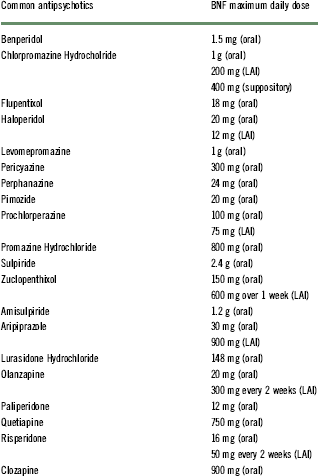
Legal grounds of consent to treatment under the MHA 1983 were recorded. This includes patients being on a T2 (meaning that patients were consenting and had the mental capacity to do so) or a T3 (meaning patients were under enforced treatment, as they were either refusing treatment or lacked mental capacity to consent). In each diagnostic group, the mean age of patients, mean length of stay in months, prevalence of T2/T3 consent to treatment orders, as-required medication prescription (nature of medication prescribed was recorded a posteriori), and section type were recorded. Antipsychotic use, high-dose antipsychotic use (defined by the British National Formulary [BNF] 15 with common examples in Table 1), antipsychotic polypharmacy (more than 1 regular antipsychotic, including oral and LAI), LAI antipsychotic use, 1st generation and 2nd generation antipsychotic use, and mood stabilizers (defined as regular treatment with at least 1 of sodium valproate, lithium carbonate, valproate semisodium, carbamazepine), as well as benzodiazepine, antidepressant, and antilibidinals were recorded. We also recorded use of medication for physical health such as antidiabetic (defined as any glycemic control medication including insulin), statin, antihypertensive (defined as regular prescription of at least 1 of calcium channel blocker, angiotensin-converting enzyme inhibitor (ACEi), or diuretic), and proton pump inhibitor (PPI) treatment. Each variable compared patients from each diagnostic group as well splitting the patients by service provisions.
Antipsychotics and their maximum daily doses as defined by the British National Formulary (BNF) 15

The antipsychotic users were split into those on clozapine and those on non-clozapine antipsychotics. For each of the 2 groups, the prevalence of antihypertensive, antidiabetic, and statin use was noted. Clozapine augmentation was defined as the co-prescribing of an antipsychotic or mood stabilizer with clozapine, and the prevalence of each was noted.
All recorded patient data were entered into the IBM Statistical Package for Social Science (SPSS) Statistics Data Editor Version 22.0.0, and statistical significance tests (chi-square or Fisher’s exact significance test) were used as determined by sample size.
Results
Overall
Data were collected on the 189 patients in Broadmoor. The average age of all patients was 37.3, and the mean length of ongoing stay was 64.1 months.
We categorized the patients on the basis of their legal grounds of detention under the MHA 1983. The most common section was the hospital order with restrictions (section 37/41) followed by the prison transfer order with restrictions (section 47/49).
The most prevalent primary diagnoses in order were SSD, PD, mood disorders, and autism spectrum disorders.
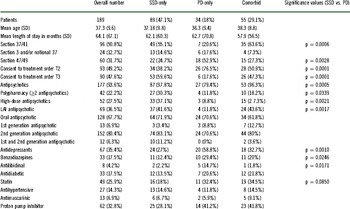
Overall 93.6% of patients were prescribed at least 1 antipsychotic, 22.2% were prescribed 2 or more, and 27.5% were prescribed high-dose antipsychotics either in combination or as a single dose. Of those 52 patients prescribed high dose antipsychotics, 73.1% were due to polypharmacy while the remaining 26.9% were due to a single high dose. In this group of patients, 36.5% had LAI antipsychotics and 67.7% were on oral antipsychotics. There were 152 patients taking a 2nd generation antipsychotic compared to only 13 taking a 1st generation antipsychotic and 12 patients prescribed a combination of the 2. The most commonly prescribed 2nd generation antipsychotics were olanzapine (53), clozapine (52), and quetiapine (16).
In terms of other psychotropic medications, 35.4% were prescribed an antidepressant, 17.5% were prescribed a benzodiazepine, and 4.2% were prescribed an antilibidinal. With regard to physical health medications, 17.5% were prescribed an antidiabetic medication, which was defined as an antiglycemic medication including insulin, 25.9% were prescribed a statin, and 14.3% were taking an antihypertensive.
As-required medication prescribing was relatively common, with 4.8% on haloperidol, 12.2% on lorazepam, 13.2% on diazepam, 3.7% on zopiclone, and 17.5% on procyclidine.
Diagnostic groups
There were 89 patients in the SSD-only group, 34 patients in the PD-only group, and 55 in the comorbid group. There were 11 patients who did not feature in any of the 3 categories. The average ages and lengths of stay were broadly similar across all 3 groups (Table 2).
Demographic and medication data split by diagnostic group

SSD-only and comorbid patients were more likely to be on a hospital order (section 37/41) than a prison transfer order (section 47/49), whereas PD-only patients were more likely to be on a prison transfer order (section 47/49) than a hospital order (section 37/41).
There were statistically significant differences between the ways medications were prescribed across diagnostic groups. Patients from the SSD-only group were more likely to be prescribed medications using an enforced treatment order (T3) than those with PD-only. In contrast, the PD-only group was more likely to be prescribed medications using a consensual treatment order (T2) than the SSD-only group.
Antipsychotics were more likely to be prescribed to those in the SSD-only group compared with the PD-only group, and this was found to be statistically significant. Those with SSD-only were again statistically more likely to be taking 2 or more antipsychotics than those with PD-only. A greater proportion of SSD-only patients were prescribed high-dose antipsychotics than PD-only patients, and this was also found to be statistically significant. There was a statistically significant result between rates of LAI prescribing with SSD-only and comorbid groups higher than the PD-only. The majority of patients in all 3 groups were taking 2nd generation antipsychotics; however, there were no patients on a combination of 1st and 2nd generation antipsychotics in the PD-only group compared to 12 patients in the SSD-only group.
The prescription rates of other psychotropic medications (benzodiazepines, antidepressants, and antilibidinals) were all statistically significantly higher in the PD-only group compared to the SSD-only group. The rates of both antidiabetic medications and statins were similar in both the PD-only and SSD-only group.
Patients in the SSD-only group were more likely to be prescribed as-required medications: haloperidol (6.7%), lorazepam (15.7%), zopiclone (7.8%), and procyclidine (25.8%) compared to the PD-only group, with haloperidol (2.9%), lorazepam (2.9%), zopiclone (0%), and procyclidine (5.8%). Prescribing rates of as-required medications of diazepam were approximately similar across all groups (SSD-only 14.6%, PD-only 14.7%, comorbid 12.2%).
Service provisions
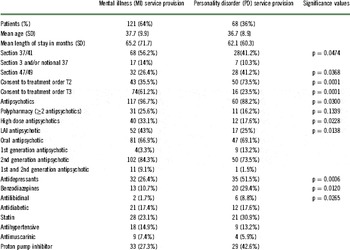
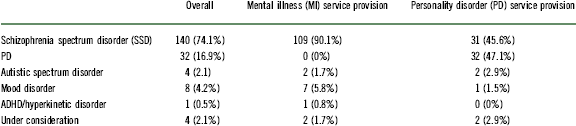
There were 121 patients in the MI service provision and 68 patients in the PD service provision (Tables 3 and 4). The mean ages and mean duration of stay were broadly similar. In the MI service provision, SSD was found to be the most common primary diagnosis, and, as expected in the PD service provision, PD was found to be the most common primary diagnosis. There was, however, a significant group of patients with a SSD primary diagnosis (45.6%) within the PD provision. The majority (83.9%) of this group of patients had secondary or tertiary diagnosis of PD. Intriguingly, this left 5 patients with a primary diagnosis of SSD with no comorbid PD that were treated in the PD service provision.
Demographic and medication data split by service provision group

Primary diagnosis split by service provision

When patients are split on the basis of their service provision, those in the MI service provision were significantly more likely to be on a hospital order (section 37/41) compared with the PD service provision. Patients in the PD service provision were comparably more likely to be on a prison transfer order (section 47/49).
There are significant differences between the uses of consent to treatment orders across service provisions. Patients from the MI service provision were more likely to be enforced treatment orders than those on the PD service provision, while those on the PD service provision were more likely to be on consensual treatment orders than the MI service provision.
Antipsychotics, and in -particular highdose antipsychotics, were significantly more likely to be prescribed to those in the MI service provision compared with those in the PD service provision. The differing prevalence rates of antipsychotic polypharmacy were not found to be statistically significant. LAI administration rates were highest within the MI service provision, with significantly less being prescribed in the PD service provision. The vast majority of patients were taking 2nd generation antipsychotics compared to a relatively small number taking only 1st generation or a combination of the 2.
Benzodiazepine and antidepressant prescribing were statistically more prevalent in the PD service provision than in the MI service provision.
The prevalence of physical health medications did not markedly differ between service provisions, with rates of antidiabetic, antihypertensive, and statin use being similar in both groups.
Those patients who were in the MI service provision were more likely to be prescribed as-required medications [haloperidol (4.9%), lorazepam (18.2%), zopiclone (5%), and procyclidine (23.1%)] than patients in the PD service provision, while rates of prescribing diazepam were even across both groups (MI service provision 13.2%; PD service provision 13.2%).
Clozapine
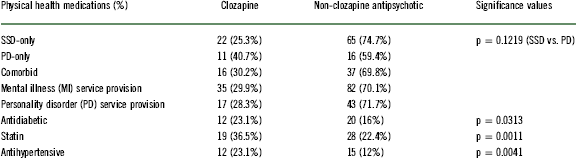
Of the 189 patients, 177 were on at least 1 antipsychotic. Of these antipsychotic users, 52 were being treated at least with clozapine (Table 5).
Clozapine vs. non-clozapine antipsychotic

Splitting the antipsychotic users on the basis of their diagnostic group revealed higher clozapine prescribing rates in the PD-only group compared with the SSD-only group, though this was not statistically significant. There were 3 patients who received clozapine but who did not fit in the SSD, PD, or comorbid categories. There was similarly no significant difference between clozapine uses between service provisions. In the clozapine group, treatment rates with an antidiabetic, antihypertensive, or statin were all significantly higher than the non-clozapine antipsychotic group.
In all, 30 patients out of 52 clozapine users were augmented, 9 with at least another antipsychotic, 28 with at least a mood stabilizer, and 7 with both. Of those augmented with another antipsychotic, 4 were augmented with amisulpride, 2 with olanzapine, and 1 each on haloperidol, chlorpromazine, or quetiapine.
Discussion
We report a cross-sectional study of prescribing patterns of the entire population of a UK HSH (N=189) that treats high-risk, mentally disordered offenders with a primary diagnosis of schizophrenia and/or personality disorder.
Our key findings were that the majority of patients had a primary diagnosis of SSD with the next most prevalent group being those with a primary diagnosis of PD. In our HSH, 93.6% of the patients were prescribed antipsychotics, 22.2% were on more than 1 antipsychotic (polypharmacy), and 27.5% were on high-dose antipsychotics. More SSD patients were found to lack the capacity to consent to treatment and were on enforced medication than PD patients. SSD patients were typically on hospital orders (section 37/41) compared to PD patients, who were mainly sentenced prisoners transferred to hospital for treatment (section 47/49). The SSD patients were also more likely to be receiving antipsychotics and especially LAI antipsychotics than PD patients, whereas PD patients were more likely to be on other psychotropic medications (antidepressants, benzodiazepines, and antilibidinal medication, ie, triptorelin). Clozapine was prescribed to 27.5% of patients in this UK HSH. PD patients were more likely to be prescribed clozapine than SSD patients. Over half (57.7%) of patients on clozapine were augmented with either an antipsychotic or mood stabilizer. Patients on clozapine were more likely to be co-prescribed medication for hypertension, diabetes, and hyperlipidemia.
Antipsychotic polypharmacy and high-dose prescribing
In our patient population of 189 patients, the vast majority of patients were prescribed at least 1 antipsychotic, with one-fifth of patients on more than 1, more than one-quarter on high dose, and over one-third on LAI antipsychotics. There is scant literature on prescribing patterns in high-risk, mentally disordered offenders. Our study is however comparable to data from a previous large multicenter study by Harrington et al,Reference Harrington, Lelliott, Paton, Okocha, Duffett and Sensky 10 across all inpatient settings in the UK. Our rate of polypharmacy was lower than that reported in Harrington et al (48%). There could be a number of reasons for our findings of polypharmacy rates. HSHs are specialized centers that have a range of therapeutic options for managing psychosis associated with aggression through the use of nonpharmacological means, such as seclusion/de-escalation facilities, greater use of specialized psychological therapies, violence reduction training for staff, and the emphasis on physical and procedural security. The comparative study also dates from before robust literature was published showing limited clinical value to antipsychotic polypharmacy.Reference Stahl 16 – Reference Stahl 18 High-dose antipsychotic prescribing in our HSH was 27.5% compared to 20% across all antipsychotic users in one region of the UK.Reference Hayhurst 9 Less of our high-dose antipsychotic prescribing (73%) was due to antipsychotic polypharmacy compared to other studies (94%).Reference Harrington, Lelliott, Paton, Okocha, Duffett and Sensky 10 As-required antipsychotic prescribing also accounted for half of the reported high-dose figures for other psychiatric settings, whereas this was very low in our sample. Therefore, high-dose prescribing due to both monotherapy alone and polypharmacy at our HSH is higher than the average across all in-patient settings.Reference Harrington, Lelliott, Paton, Okocha, Duffett and Sensky 10 Cross-sectional data can be difficult to interpret, and this is true when looking at the polypharmacy figures across all settings, where 12% of patients recorded as polypharmacy were in transition from one antipsychotic to another.Reference Harrington, Lelliott, Paton, Okocha, Duffett and Sensky 10
Comparisons between HSH and other settings are difficult to make due to fundamental differences in study design, recruitment, and distinct clinical and operational conventions in different hospitals. Our HSH population comprises entirely males, so sex-specific differences in clinical variables may confound any comparisons made between different psychiatric settings.
Splitting our patient population into diagnostic groups revealed that SSD-only patients were significantly more likely to be prescribed an antipsychotic than PD-only patients, with the comorbid group rates similar to SSD-only patients. This may suggest that the presence or absence of SSD may inform the decision to prescribe antipsychotic medication. Polypharmacy and high-dose prescribing were more prevalent in SSD-only patients than PD-only patients, which would be expected given that antipsychotics are primarily indicated for the treatment of psychotic illnesses.
Prescribing of LAI antipsychotics in our population was higher than in other psychiatric settings as reported in the literature, with 36.5% being on a LAI antipsychotic compared with approximately 30% across other settings.Reference Adams, Fenton, Quraishi and David 19 , Reference Barnes, Shingleton-Smith and Paton 20 There are previous studies from HSHs reporting the benefit of the use of LAI antipsychotic medication.Reference Gibbon, Silva and Kaler 21 , Reference Baruch, Das and Sharda 22 Although it has not been explored in the literature, it can be hypothesized that LAI antipsychotics may be beneficial to violent schizophrenia patients such as ours because of the reduction in noncompliance it offers.
Clozapine prescribing in HSH
Of the 177 patients in the study on an antipsychotic, 29.4% were prescribed clozapine compared with approximately 15.4% when compared to other psychiatric settings.Reference Hayhurst 9 The patient population in HSH includes a subgroup of patients who were transferred to a high security setting because they were difficult to manage in a lesser security setting. One could reasonably hypothesize therefore that the HSH population will include a greater number of patients who are particularly violent and treatment-resistant, and are therefore best treated with clozapine due to its strong antipsychotic and anti-aggression properties.Reference Brown, Larkin, Sengupta, Romero-Ureclay, Ross, Gupta and Das 1 , Reference Walsh, Leese and Taylor 23
Breaking down our patient population on the basis of their diagnostic groups reveals that PD-only patients on an antipsychotic have a higher prevalence (40.7%) of clozapine use than SSD-only patients (25.3%). This prescribing pattern may reflect the emerging evidence of the effectiveness of the use of clozapine as a therapeutic option in personality disorders.Reference Frogley, Taylor, Dickens and Picchioni 24
A recent study reported the effectiveness of clozapine in men with antisocial personality disorder.Reference Brown, Larkin, Sengupta, Romero-Ureclay, Ross, Gupta and Das 1 Since the vast majority (70.7%) of the PD patients in this study have a diagnosis of antisocial personality disorder, this would likely account for the high clozapine prescribing in the PD-only group. There is evidence to demonstrate that patients with psychopathy and antisocial personality disorders have a range of biological abnormalities demonstrated by neuroimagingReference Das, Barkataki, Kumari and Sharma 25 and psychophysiological studies.Reference Kumari, Das and Hodgins 26 It has been also shown that clozapine treatment can normalize information processing abnormalities,Reference Kumari, Soni and Sharma 27 and recent literature suggests that clozapine prescribing should be considered more often in such populations.Reference Stahl 28
A great deal has been reported on the cardiovascular risk profiles of antipsychotic medication,Reference Stahl 11 – Reference Ojala, Niskanen, Tiihonen, Paavola, Putkonen and Repo-Tiihonen 13 with clozapine in particular as being highlighted as one of the worst offenders.Reference Raedler 29 – Reference Young, Taylor and Lawrie 31 There was a significant difference between rates of physical health medications (statins, antihypertensives, and antidiabetic) in patients receiving clozapine versus those receiving a non-clozapine antipsychotic in our population. In the literature, clozapine has a higher cardiovascular risk profile than non-clozapine antipsychotics,Reference Raedler 29 – Reference Young, Taylor and Lawrie 31 so it may be expected to have higher prescribing rates of cardiovascular risk reduction medications. Whether primary preventative medication is prescribed as a response to an increase in markers of cardiovascular risk in clozapine users or as pre-emptive prescribing for clozapine users would need further investigation.
Co-prescribing of other psychotropic drugs to augment the antipsychotic effect of clozapine is an exciting area of research, with data suggesting several drugs as effective augmenters of clozapine.Reference Hotham, Simpson and Brooman-White 32 – Reference Suzuki, Uchida and Takeuchi 35 In all, 30 patients out of 189 were augmented, 9 with at least another antipsychotic, 28 with at least a mood stabilizer, 7 with both. The figures for augmentation do not account for the possibility that some co-prescribing of a mood stabilizer with clozapine could be for different indications. Amisulpiride proved the most popular augmenting antipsychotic, making up 4 out of the 9 augmenting antipsychotics. These numbers are low, and data for a comparison with other settings do not exist. However, it is worth noting that the proportion of patients at HSH on clozapine augmentation therapy is not condiserable.
Other noteworthy results
The data suggest that PD patients are more likely to consent to treatment than SSD patients. One could reasonably surmise that a schizophrenic spectrum disorder leads to lower insight than PD.
Of the 189 patients, 8 were on antilibidinal medication. Of these, 5 were PD-only patients and 2 were SSD-only. With such small numbers it is difficult to draw any conclusions, even with a statistically significant result. However, these results would be consistent with an association between personality disorder and deviant sexual behavior.Reference Ho, Kottalgi, Ross, Romero-Ulceray and Das 36
As-required lorazepam prescribing was significantly more likely in the SSD-only group than the PD-only group, which may be due to patients with schizophrenia presenting with agitation, or aggressive or violent behavior that requires calming with benzodiazepines.
With a large schizophrenia population and high antipsychotic prescribing rates in our HSH, one would anticipate high concomitant procyclidine prescribing. Procyclidine is an anticholinergic medication used for the treatment of extra-pyramidal symptoms, which are a relatively common side effect of antipsychotic use. Indeed, 31 patients in the population were on procyclidine, 23 of those belonging to the SSD-only group, 2 from the PD-only group, and 6 from the comorbid group. Significantly higher procyclidine use in the SSD-only population compared with the PD-only population may reflect higher antipsychotic use in the former and can present a confounding factor in any comparison of SSD populations with other mental illness, given its possible effect on cognition.Reference Zachariah, Kumari and Galea 37
We also found that patients with PD were more likely to be co-prescribed other psychotropic medication on a regular basis, such as antidepressants and benzodiazepines, which may be due to the need to treat a wider range of symptomatology in personality disorders as evident from previous literature.Reference Ingenhoven, Lafay and Rinne 38
Diagnostic groups versus service provision
The patient population was split on the basis of their service provision, and diagnoses with prescribing patterns in each service provision were compared with those in each diagnostic group. Given that service provision is a more practical split based on patient need for different services (and in fact 45.6% of patients in the PD service provision had SSD as their primary diagnosis), we would not expect a perfect correlation between service provision and diagnostic group data. We present these data as an interesting comparison between the types of considerations that go into the decisions made about a patient’s diagnosis and the more practical split about the service that would best meet their needs. From the data there, is not a patient variable that is significantly different when split by service provision or by diagnostic group, which suggests that the practical considerations that go into deciding the patient’s needs on the wards correlate somewhat with both theoretical and practical considerations that underpin the designating of a patient under a certain diagnostic label.
Limitations
There are many interesting questions borne out of the data that cannot be answered by a cross-sectional study. This includes information on change of prescribing patterns over time, progression of antipsychotic (from less to more aggressive regimens and vice versa), and chronology of primary preventative medication and antipsychotic medication in each patient. It is worth adding that a snapshot of patients in any forensic setting will skew the data toward those with a longer length of stay.
Thresholds for prescribing and diagnosis are impossible to standardize across all prescribing doctors on all wards, so inter-clinician variation can confound the picture. We hope that anomalous practice is mitigated by the inclusion of all patients in the hospital.
Though data collection on each patient was as comprehensive as can practically be executed in a HSH, confounders for certain associations can never be ruled out. Many of these possibly confounding variables were not recorded, such as poor dietary intake and personal hygiene, which could have proved to be the key causative factor where some other factor is suggested by our data. For example, the incidence of metabolic syndrome in our patient group is likely to affect what physical health medications these patients are prescribed. Moreover, physical health medication was a useful but imperfect surrogate for physical health sequelae. The means for using diagnostic markers of poor physical health were not available but would be an interesting area of future enquiry.
Lacking in our patient data is information on history of treatment resistance, length of illness, and past history of antipsychotic prescribing and side effects in each patient. This information would help make clearer the prescribing behavior of clinicians for each patient, as well as allow us to stratify patients in terms of severity of illness and constraints of treatment. Our definition of “high dose” was dosage exceeding the maximum stipulated in the BNF, which is followed for prescribing purposes in the United Kingdom; thus this may differ from other countries.Reference Stahl, Morrissette and Cummings 39
The high security setting confers certain advantages to academic research perhaps not present in other psychiatric settings. Strict prohibition of any substance misuse and robust logistics (including patients’ room and body searches, random urine illicit substance testing, thorough visitor searches, security scanners, metal detectors, and closely observed visitor–patient interactions) mean we can almost rule out substance misuse as a confounder. This includes smoking, since none of the patients at Broadmoor are permitted to smoke tobacco. Noncompliance is less likely to confound the analysis than in other psychiatric settings due to more thorough monitoring, which can include serum antipsychotic levels, at a HSH.
We would submit that, despite its limitations, the present data and discussion present a snapshot of the patient population and clinical practice at a HSH both as a unique reference and as a comparison with other psychiatric settings.
Conclusion
HSHs are unique and under-researched psychiatric settings, with seriously violent and treatment-resistant populations. Our study presents a comprehensive analysis of prescribing patterns and patient variables in a HSH. Overall, there was some evidence of different treatment of mental illness at HSH compared with other psychiatric settings, but with surprising results regarding antipsychotic polypharmacy prescribing. Future avenues of research can build upon some of the general trends and associations highlighted in this study, with a focus on novel areas of research, including clozapine augmentation across other psychiatric settings and antipsychotic treatment of some PDs already being implemented in our HSH.
This, to our knowledge, is the first comprehensive report of prescribing patterns of psychotropic medications at a HSH. It represents a reference to which other psychiatric settings can compare their own data and analyze variations in practice.
Disclosures
The authors do not have anything to disclose.