Introduction
At birth, littermates greatly differ in terms of weight and maturity. Within herds, a great within-litter heterogeneity of piglet birth weight (BW0) is associated with an increased mortality before weaning and a high variation in weight at weaning (English and Smith, Reference English and Smith1975; Pettigrew et al., Reference Pettigrew, Cornelius, Moser, Heeg, Hanke, Miller and Hagen1986; Tuchscherer et al., Reference Tuchscherer, Puppe, Tuchscherer and Tiemann2000; Milligan et al., Reference Milligan, Fraser and Kramer2002). It may also have repercussions on slaughter management within batches with regard, on the one hand, to time taken to reach the most valuable carcass weight range and, on the other hand, to heterogeneity among pigs (Le Cozler et al., Reference Le Cozler, Pichodo, Roy, Guyomarc’h, Pellois, Quiniou, Louveau, Lebret, Lefaucheur and Gondret2004). Detrimental effects of low BW0 were also reported on meat quality (Gondret et al., Reference Gondret, Lefaucheur, Juin, Louveau and Lebret2006). If consequences of BW0 heterogeneity on piglet survival and growth performance have been extensively described, factors susceptible to influence this criterion have been less investigated. Within breed, heterogeneity of BW0 has been shown to increase with litter size (Milligan et al., Reference Milligan, Fraser and Kramer2002; Quiniou et al., Reference Quiniou, Dagorn and Gaudré2002). Because of the possible benefits of more homogeneous litter, the possibility of genetic improvement of within-litter variation in BW0 by selective breeding was also studied (Damgaard et al., Reference Damgaard, Rydhmer, Løvendahl and Grandison2003). The aim of the present study was to describe the within-litter variation in piglet BW0 and to assess the influence of additional factors mainly related to the sow, such as parity, birth date and body reserves.
Material and methods
Data sets
All data have been collected on LW and LR × LW crossbred sows. The first two data sets described piglet BW0 measured within the 24 h after birth. Piglets were recorded as alive or stillborn. No floatation test was performed to discriminate pigs that died during the birth progress and those who were born alive but died shortly thereafter. In the third data set, piglets were weighed immediately at birth, i.e. before the first suckling. The fourth data set described foetus weights.
In the first data set, data were collected in the INRA experimental herd (35590 Saint-Gilles, France), from January 1994 to June 2005. From the mid-1990s, highly prolific sows (also called ‘hyperprolific’ sows) have been introduced in French herds, as well as in other European countries. In the INRA herd, genetic improvement of prolificacy was obtained through artificial insemination. From 1996 to 2004, semen came from selected lines of ‘hyperprolific’ LW and LR boars characterised by a high breeding value for litter size. This data set was used to study changes in litter characteristics before and after this genetic improvement. Initially, data included 4479 litters born from LW and LR × LW crossbred sows. Litter ranks averaged 2.5 and 60% of litters were first and second litters. Piglets were individually weighed within the first 24 h of life, except for stillborn piglets that were weighed together. Because individual BW0 of all piglets, born alive and stillborn, are necessary to describe accurately the within-litter variation of BW0, this data set was restricted to litters with no or only one stillborn piglet (3338 litters representing 75% of all litters). Analyses compared litters from sows born between 1994 and 1996 (n = 990) and between 2001 and 2004 (n = 782).
In the second data set, data were collected in the experimental station of IFIP-Institut du Porc (35850 Romillé, France). Calculations were performed on 1596 litters from LR × LW sows born between 2000 and 2004. Half litters were first or second parities. All piglets, born alive and stillborn, were weighed individually within the first 24 h after birth. During gestation, feed allowance was adapted individually for all sows to body condition at mating. Sows were weighed 7 days after conception and within 24 h after farrowing. Backfat thickness was ultrasonically measured at the P2 site 7 days after conception and at the end of gestation (105th day on average).
In the third data set, data were collected from LR × LW sows in the IFIP and INRA experimental herds (111 and 120 litters, respectively). Piglets were weighed within the first 5 min after birth and identified. The actual BW0 was designated as ‘BW0 at time 0’ (BWt0). Piglets were also weighed at 24 h of age (BWt24).
In the fourth data set, data originated from an experiment performed on 43 LW pregnant gilts born in 1991 and 1992 (Père et al., Reference Père, Dourmad and Etienne1997). Gilts were slaughtered at 112 days of pregnancy. Number of alive and dead foetuses and ovulation rate were recorded and live foetuses were individually weighed.
Variables and calculations
For each litter in data sets 1 and 2, numbers of total piglets born, born alive and stillborn were recorded. Within-litter mean (mBW0), standard deviation (SDBW0) and coefficient of variation (CVBW0) of piglet birth weight were calculated. Within-litter minimal and maximal BW0 were also determined. In addition, for data set 2, piglets were categorised in four classes according to their absolute BW0 (<1 kg; 1 to 1.4 kg; 1.4 to 1.8 kg; or >1.8 kg) or to the difference between their BW0 and the mBW0 of their litter. Classifications were based on the literature. Probability of pre-weaning survival is significantly reduced (below 75%) for piglets weighing less than 1 kg and is beyond 95% for piglets weighing more than 1.8 kg (Pettigrew et al., Reference Pettigrew, Cornelius, Moser, Heeg, Hanke, Miller and Hagen1986; Roehe and Kalm, Reference Roehe and Kalm2000; Quiniou et al., Reference Quiniou, Dagorn and Gaudré2002). Other authors reported a greater risk of dying for piglets weighing less than 75% to 80% of the mean BW0 of the litter as reviewed by Le Dividich (Reference Le Dividich1999). Accordingly, classes in the second classification corresponded to piglets weighing less than 75% of mBW0, between 75% and 100%, between 100% and 125%, or 125% and more of mBW0. For data set 3, within-litter CV of piglet weight was calculated for weight at birth (CV BWt0) and 24 h after birth (CV BWt24). For data set 4, within-litter mean and CV of living foetuses weight were calculated.
Statistical analyses
Analysis of variance was performed using the MIXED procedure (Statistical Analysis Systems Institute (SAS), 1999). All models included at least litter size, parity and sow’s birth year as main factors. The random effect of sow within birth year was also included in order to take into account the permanent environment effect of the sow. Sow’s birth year was chosen rather than year of farrowing because it better represented genetic selection for improved prolificacy. Litter size was categorised in five classes: less than 10 total born piglets, 10 to 11, 12 to 13, 14 to 15, 16 and more. Parity was also categorised in five classes: first, second, third and fourth, fifth and sixth, seventh and more. Effect of birth year was tested within parity. Effect of categorised litter size was tested within parity because of the correlation between these two factors (r = 0.13, P < 0.001). For the first data set, the main effects were litter size, parity, sow’s birth year pooled in two periods (1994 to 1996 v. 2001 to 2004) and breed (LW v. LR × LW). For the second data set, the main effects were litter size, parity, sow’s birth year, season at conception and the interaction season × sow’s birth year. Season represented the first, second, third and fourth trimesters of the year. When an effect was significant, means were compared using the Student–Newman–Keuls test after GLM. Repeatability was calculated from variance component estimates (proc MIXED; SAS, 1999) with the parity (categorised), birth year and batch as fixed effects and sow as random one. Relationships between CVBW0 and criteria of sow body condition were tested using proc REG (SAS, 1999), taking also into account the litter size. Results are expressed as raw data.
Results and discussion
Influence of genetic selection for prolificacy on piglet BW0 variation
Retrospective analysis of the first data set was conducted to assess the evolution of litter characteristics over a decade. Because the occurrence of stillbirth increases with litter size (Fraser et al., Reference Fraser, Phillips and Thompson1997), the exclusion of litters with at least two stillborn piglets from the analysis was likely to eliminate more large litters than small ones. Thus, average litter size in this data set (11.7 total born piglets) was lower than in the whole population of sows in the herd (12.4) and in French herds over the same period (12.6 piglets; IFIP, 1995 to 2005). Litter size was higher in LR × LW crossbred than in LW sows (12.2 v. 11.1 piglets; P < 0.05), which is consistent with data from the national survey (IFIP, 1995 to 2005) and can be related to a heterosis effect.
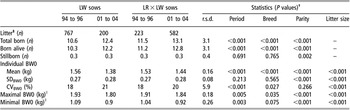
For LW sows, genetic improvement over 10 years resulted in 1.8 extra piglet per litter and a reduction by 180 g in mBW0 (Table 1). Concomitantly, SDBW0 did not increase significantly, whereas CVBW0 increased by 3%. Although less marked, a similar evolution of litter characteristics was observed for LR × LW crossbred sows (Table 1). In an experiment using frozen semen of boars born in 1977 or 1998, Tribout et al. (Reference Tribout, Caritez, Gogué, Gruand, Billon, Bouffaud, Lagant, Le Dividich, Thomas, Quesnel, Guéblez and Bidanel2003) previously reported such an increase in CVBW0 related to genetic improvement over 20 years for LW sows (20% v. 18%). In their study, however, the impact of selection on the other characteristics of piglets and litter at birth differed from our present findings. Despite the increase in prolificacy, they did not observe a reduction in piglet BW0 but a lower piglet maturity at birth (Canario et al., Reference Canario, Père, Tribout, Thomas, David, Gogué, Herpin, Bidanel and Le Dividich2007). Moreover, according to Tribout et al. (Reference Tribout, Caritez, Gogué, Gruand, Billon, Bouffaud, Lagant, Le Dividich, Thomas, Quesnel, Guéblez and Bidanel2003), the increase in CVBW0 over time was caused by an increase in the maximum piglet BW0 and not by a higher frequency of small piglets. In the present data set, both average maximal and minimal BW0 decreased as prolificacy increased. Discrepancies may originate in the experimental design or the period considered.
Descriptive statistics and analysis of variance of data collected before and after genetic improvement of sow prolificacy (from 1994 to 1996 and from 2001 to 2004) at the INRA experimental herd (data set 1)

r.s.d. = residual standard deviation; BW0 = birth weight; CVBW0 = coefficient of variation of BW0.
†The model (proc MIXED) included period (birth year range), parity (categorised) and litter size within parity as main effects. The interactions were not significant thus they were removed from the model.
‡Litters with zero or only one stillborn piglet.
∥Average maximal and minimal BW0.
Within-litter variation of BW0 from highly prolific sows (2000 to 2004)
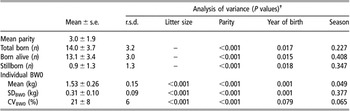
Prolificacy in the second data set (14 piglets; Table 2) was higher than the average prolificacy in French herds calculated from the database of Technical Management of Sows Herds (13.1 piglets from 2000 to 2004; IFIP, 2001 to 2005), but representative of the most performing herds in terms of prolificacy. Within-litter variation in individual BW0 averaged 21%, ranged from 0% to 51% (with total born piglets ranging from 2 to 21) and was significantly influenced by litter size and sow parity.
Descriptive statistics and analysis of variance of data collected at the IFIP experimental herd (data set 2, n = 1596 litters)

r.s.d. = residual standard deviation; BW0 = birth weight; CVBW0 = coefficient of variation of BW0.
†The model (proc MIXED) included litter size within parity (categorised) parity, birth year within (categorised) parity, season at conception and year×season interaction as main effects. The interaction was not statistically significant.
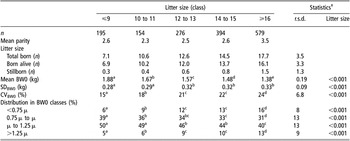
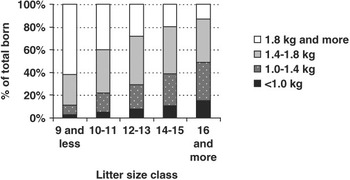
Mean BW0 decreased and variation in BW0 (SDBW0 and CVBW0) increased as litter size increased (Table 3), as previously reported (Le Dividich, Reference Le Dividich1999; Milligan et al., Reference Milligan, Fraser and Kramer2002; Quiniou et al., Reference Quiniou, Dagorn and Gaudré2002). In the present herd, when litter size varied from less than 10 piglets to more than 15, mean BW0 decreased by 510 g while CVBW0 increased from 15% to 24%. This rise in CVBW0 was accompanied by an increased proportion of small piglets. According to Le Dividich (Reference Le Dividich1999), piglets weighing less than 75% or 80% of the mBW0 in the litter can be considered as small. As most piglets weighing less than 1 kg are included in this category, they can also be considered as small. When litter size increased from 9 to 16, the proportion of small piglets weighing less than 1 kg increased from 3% to 15% (Figure 1). It remains debatable whether these small piglets have a higher risk to be stillborn but they clearly have a lower survival rate than their heavier littermates (Roehe and Kalm, Reference Roehe and Kalm2000; Milligan et al., Reference Milligan, Fraser and Kramer2002; Quiniou et al., Reference Quiniou, Dagorn and Gaudré2002). On the contrary, a high survival rate, beyond 90%, was reported when piglets weighed more than 1.4 kg at birth (Quiniou et al., Reference Quiniou, Dagorn and Gaudré2002). When piglets were categorised relatively to mBW0, the proportion of heavier piglets increased with litter size (Table 3). However, when absolute BW0 was considered, the proportion of heavy piglets decreased, simultaneously with the increased proportion of small piglets (Figure 1). While most piglets weighed more than 1.4 kg at birth in small litters, they were only 50% in litters of 16 piglets and more. Such large litters represented 30% of the litters born in French herds in 2006 (IFIP, 2007). It is therefore not surprising that piglet mortality increased from 12% to more than 14% over the past 10 years since the diffusion of hyperprolific sows (IFIP, 1997 to 2007).
Effect of litter size on piglet BW0 variation (data set 2, n = 1596 litters)
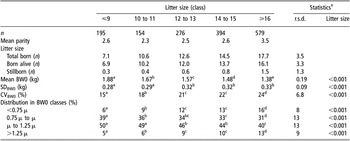
BW0 = birth weight; CVBW0 = coefficient of variation of BW0.
†Litter size effect (see statistical model in Table 2). Student–Newman–Keuls test was used to determine differences between groups after GLM. Values with different superscripts, within rows, differ significantly (P < 0.05).
Effect of litter size on piglet distribution into BW0 classes (raw data from data set 2, n = 1596 litters).

Stillbirth was related to CVBW0 (r = 0.23, P < 0.001). This relationship is likely to reflect the influence of litter size, given the concomitant increase in stillbirth occurrence and CVBW0 with litter size (Table 3). Nevertheless, such a positive correlation, although weak (r comprised between 0.14 and 0.21), was also observed within class of litter size (data not shown), suggesting that stillbirth might be influenced by litter heterogeneity per se. The role of within-litter BW0 variation has been pointed out in between-breed variability of stillbirth (Canario et al., Reference Canario, Cantoni, Le Bihan, Caritez, Billon, Bidanel and Foulley2006). Within breed also, litter heterogeneity could enhance stillbirth probability. Potential underlying mechanisms are unclear since the present study did not discriminate piglets that died during the birth process from those dying shortly thereafter. More heterogeneous litters contain more light piglets, which are more susceptible to premature death and also, according to several authors, more susceptible to death during the birth process (Leenhouwers et al., Reference Leenhouwers, van der Lende and Knol1999; Knol et al., Reference Knol, Leenhouwers and van der Lende2002; Canario et al., Reference Canario, Cantoni, Le Bihan, Caritez, Billon, Bidanel and Foulley2006). Heterogeneous litters also contain more heavy piglets, which tend to have also a greater risk of death during farrowing (Canario et al., Reference Canario, Cantoni, Le Bihan, Caritez, Billon, Bidanel and Foulley2006). Whether a relationship exists between litter uniformity and farrowing duration should be investigated.
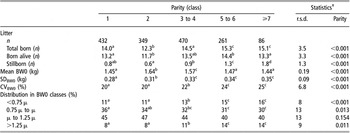
Sows in first and second parities had less heterogeneous litters than older ones (Table 4), in agreement with Bolet and Etienne (Reference Bolet and Etienne1982). Piglets from primiparous sows have been reported to be more uniform than piglets from older sows, this effect being related to parity effect on litter size (Milligan et al., Reference Milligan, Fraser and Kramer2002) or not (Pettigrew et al., Reference Pettigrew, Cornelius, Moser, Heeg, Hanke, Miller and Hagen1986). In the present study, CVBW0 was similar in first and second parity sows despite a difference in nearly two total born piglets on average. This would suggest that litter heterogeneity is partly influenced by parity effect per se. Indeed, considering the relationship between litter size and CVBW0 presented in Table 3, heterogeneity of second litters seems to be in accordance with their reduced size. On the contrary, for first litters, CVBW0 seems rather low, since litter size averaged nearly 14 piglets (Table 4). This finding needs to be further investigated. In contrast, parity effect on CVBW0 was not significant in the first data set (Table 1). Such a discrepancy is likely related to the exclusion of litters with more than one stillborn piglet in data set 1. This eliminated mainly older sows, from parities five and more, since stillbirth frequency increased with sow parity (Table 4).
Effect of sow parity on piglet BW0 variation (data set 2, n = 1596 litters)

r.s.d. = residual standard deviation; BW0 = birth weight; CVBW0 = coefficient of variation of BW0.
†See statistical model in Table 2. Student–Newman–Keuls test was used to determine differences between groups after GLM. Values with different superscripts, within rows, differ significantly (P < 0.05).
No significant effect of the season at conception was found on CVBW0 or litter size (Table 2). In contrast, in a retrospective study including 20 000 litters, Xue et al. (Reference Xue, Dial, Marsh and Davies1994) reported a reduction in litter size and litter weight when conception occurred in summer. Discrepancies can be partly attributed to different climates and different sample sizes. It cannot be ruled out also that herd management (sow nutrition and housing, hormonal treatments, etc.) modulates summer effects on reproductive performance in the different herds considered (Quesnel et al., Reference Quesnel, Boulot and Le Cozler2005). Season at conception influenced mBW0 (Table 2), with piglets conceived in spring being heavier (P < 0.1) than piglets born in the other seasons. Consistently, piglets born in summer have been shown to be heavier (n = 1833 litters, Bolet and Etienne, Reference Bolet and Etienne1982).
Influence of sow’s body condition on piglet BW0 variation
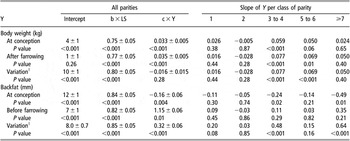
Significant relationships were found between sow’s body condition and CVBW0 (Table 5). Litter heterogeneity increased with body weight (BW) at the beginning and the end of gestation. Parity partly contributed to this relationship as sow BW significantly increased with age (data not shown). Heterogeneity increased also with backfat thickness at the end of gestation. However, relationships were very weak and no longer significant when parities were considered separately. A weak negative relationship was observed between within-litter variation in piglet birth weight and sow’s backfat thickness at conception. This correlation was mainly due to three to four, and seven and more parities sows (Table 5).
Relationships between coefficient of variation of birth weight (CVBW0) and body condition of the sows during gestation (equation of regression with correction for litter size, data set 2)Footnote †, Footnote ‡

† Number of observations: 1519 for body weight; 1585 for backfat thickness.
‡ Equation used for regression: CVBW0 = intercept + b × LS + c × Y with Y as by condition parameter and LS = litter size. Values are mean ± s.e.
∥Variation: weight after farrowing minus weight at conception or backfat thickness before farrowing minus backfat thickness at conception.
The CVBW0 was not linked with BW gain during gestation but with backfat thickness gain. In this herd, backfat gain is likely to reflect adaptation of feed allowance during gestation to body reserve mobilisation during previous lactation. Indeed, higher backfat thickness gains were obtained with lowest initial BW (r = −0.52, P < 0.001). We may wonder whether body reserve loss during lactation may influence BW0 heterogeneity in the subsequent litter. Besides sows’ body condition, it has been well established that sows’ metabolic status influences follicle and oocyte quality with consequences on embryo survival and development (Zak et al., Reference Zak, Cosgrove, Aherne and Foxcroft1997; Quesnel et al., Reference Quesnel, Pasquier, Mounier and Prunier1998; Ferguson et al., Reference Ferguson, Slevin, Edwards, Hunter and Ashworth2006), and also on within-litter variation in piglet birth weight (van den Brand et al., Reference Van den Brand, Soede and Kemp2006). These effects were generally attributed to specific hormones, essentially insulin and IGF-I. Large-scale studies should be conducted to relate sows’ metabolic status before ovulation and subsequent CVBW0.
Repeatability of mean BW0 and within-litter BW0 variation
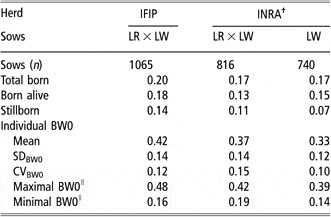
Estimates of repeatability for litter size were similar to those previously reported (Le Cozler et al., Reference Le Cozler, Dagorn, Dourmad, Johansen and Aumaître1997; Damgaard et al., Reference Damgaard, Rydhmer, Løvendahl and Grandison2003; Nguyen et al., Reference Nguyen, McPhee and Wade2006). Values of repeatability for CVBW0 were similar in both herds. They were relatively low, indicating that CVBW0 was not a repeatable criterion in successive litters (Table 6). Similarly low values were found for SDBW0. This is consistent with findings from Damgaard et al. (Reference Damgaard, Rydhmer, Løvendahl and Grandison2003) reporting low repeatability (0.17) for within-litter s.d. in birth weight. Repeatability for mean BW0 was much stronger, as previously described (Damgaard et al., Reference Damgaard, Rydhmer, Løvendahl and Grandison2003; Nguyen et al., Reference Nguyen, McPhee and Wade2006). Repeatability for maximal BW0 was also found to be strong, whereas repeatability for minimal BW0 was low. The maximal weight is likely limited by morphological and physiological constraints related to the sow. Consistent with these observations, CVBW0 was, in both herds, highly correlated with minimal BW0 (r = −0.82, P < 0.001, n = 1596 litters) but not with maximal BW0 (r = −0.02, P > 0.1).
Values of repeatability of litter performance (data sets 1 and 2)

BW0 = birth weight; CVBW0 = coefficient of variation of BW0.
†Repeatability was calculated on all litters for piglet numbers and on litters with no or only one stillborn for other criteria.
∥Average maximal and minimal BW0.
Other causes for the high variability of BW0 variation
Findings presented above pointed out the high variability of within-litter BW0 variation, with CVBW0 varying from a few per cent up to 50%. Taking into account the effects of litter size, sow parity, sow’s birth year and season at conception explained less than one-fourth of the variation in CVBW0 (Table 2).
Piglet weighing procedure. As usually in experimental herds, piglets in the present studies were weighed within 24 h after birth, with some litters being weighed shortly after birth and others lately. Then, in some litters, competition for teats may have exacerbated differences in weight and vitality among piglets. However, from data collected immediately at birth and 24 h later precisely on same piglets, it appears that increase in BW0 variation between birth and 24 h of age is limited (+0.5% in the first herd and +2% in the second one; Table 7). Therefore, variability in weighing time after birth seems to participate only marginally in CVBW0 variability.
Variation in piglet weight recorded at various times after birth in litters born from crossbred LR × LW sows (data set 3)

BW0 = birth weight; CVBW0 = coefficient of variation of BW0; CV: coefficient of variation (%).
†Piglet weights were recorded within 5 min after birth (BWt0) and 24 h later, precisely (BWt24), or once within 24 h after birth (BW0).
‡Calculated from litters with zero or one stillborn piglet.
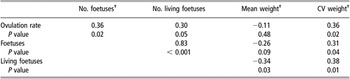
In utero litter size. The existing literature (Milligan et al., Reference Milligan, Fraser and Kramer2002; Quiniou et al., Reference Quiniou, Dagorn and Gaudré2002) and our findings indicated that CVBW0 clearly depends on litter size at birth but that litter size explained only a small part of this variation. Litter size effect partly reflects in utero competition for nutrients between foetuses during foetal growth and development. In moderately prolific sows, i.e. having ovulation rate that did not exceed 20 or 22, litter size has been shown to be related to ovulation rate and to the number of developing conceptuses (King and Williams, Reference King and Williams1984; Blasco et al., Reference Blasco, Gogué and Bidanel1996). In this context of moderate prolificacy, variation in foetus weight in late gestation was correlated to the number of living foetuses and to ovulation rate (Table 8). In hyperprolific sows, however, ovulation rate and number of developing embryos largely exceed the number of piglets at birth (Vonnahme et al., Reference Vonnahme, Wilson, Foxcroft and Ford2002). Besides, heterogeneity is already evident between embryos at the end of the first month of gestation. In hyperprolific LW gilts, CV of embryo weight averaged 9% around 33 days of gestation (Martinat-Botté and Quesnel, unpublished data). In addition, within-litter distribution of weight has been shown to be established as soon as 30 or 35 days of gestation (van der Lende et al., Reference van der Lende, Hazeleger and de Jager1990; Wise et al., Reference Wise, Roberts and Christenson1997; Finch et al., Reference Finch, Antipatis, Pickard and Ashworth2002). It can therefore be hypothesised that events occurring during the first month of gestation play a key role in CVBW0 variation. As mentioned above, ‘events’ such as nutrition and metabolic status even before ovulation are also susceptible to influence embryo development, and consequently CVBW0. However, no difference in CVBW0 was reported by Quiniou and Quesnel (Reference Quiniou and Quesnel2008) between sows fed 1.7 or 2.6 times their maintenance requirement during the first month of gestation but fed the same amount of feed over the whole gestation.
Relationship between ovulation rate and litter characteristics during late gestation, in LW gilts (Pearson’s coefficients, n = 43, data set 4)

†Number of foetuses, alive and dead, present in the uterus at 112 days of gestation; mean weight of living foetuses; coefficient of variation of foetus weight.
Conclusion
Selection for prolificacy over the past decades has been associated with a deterioration of within-litter variation in piglet BW0. It increases significantly with litter size and parity. Nevertheless, taking into account litter size, parity, sow birth date and season at conception explains less than one-fourth of BW0 variation. Variation in BW0 was significantly but weakly correlated to backfat thickness gain during gestation. In addition, this criterion is not repeatable from one parity to the next. Thus, a major part of heterogeneity is due to other factors not identified in the present investigations. It can be assumed that these factors include embryo genotype on the one hand, and factors that influence embryo and foetus development, such as epigenetic factors, on the other hand.
Recently, a canalising selection experiment on within-litter variability of BW0 in rabbits had a favourable selection response on birth weight variability and positive consequences for the young survival (Garreau et al., 2004). In pigs, considering the lack of identified environmental factors allowing the breeders to reduce BW0 variability, and that genetic improvement of BW0 variability by selective breeding seems possible (Damgaard et al., Reference Damgaard, Rydhmer, Løvendahl and Grandison2003), selection on BW0 uniformity would be a relevant approach to improve piglet survival.
Acknowledgement
The authors wish to acknowledge the technical staff of the experimental stations of INRA and IFIP for their meticulous and patient work while weighing and identifying all those piglets. They also acknowledge S Boulot, I Dubroca, F Guyomard, D Loiseau (IFIP, France) for farrowing supervision and measurements (third data set), J Le Dividich and MC Père (INRA, Saint-Gilles, France) for providing part of the third data set and the fourth data set, respectively.