Introduction
Pain and depression are prevalent among older adults (McDougall et al., Reference McDougall2007). The prevalence of chronic pain, for example, has been estimated to be 45%–80% among older individuals (Maxwell et al., Reference Maxwell2008), and the prevalence of depression has been estimated to be 5%–15% (McDougall et al., Reference McDougall2007; Snowden et al., Reference Snowden, Steinman and Frederick2008). Previous research has shown that the coexistence of pain and depression greatly impacts functioning and QOL (Arnow et al., Reference Arnow2006).
There is consistent evidence that the pain – depression relationship is bi-directional, that is, that pain is associated with the development of depression among those not previously depressed, and that depression is associated with the appearance of, or an increase in, pain (Arola et al., Reference Arola, Nicholls, Mallen and Thomas2010; Gayman et al., Reference Gayman, Brown and Cui2011). These associations may relate to shared common genetic factors and biological pathways (Bair et al., Reference Bair, Robinson, Katon and Kroenke2003; Gambassi, Reference Gambassi2009), indicating that physiological or genetic factors may predispose individuals to pain and depression. Both conditions exhibit a common neurochemical pathway that is influenced by serotonin and norepinephrine.
Patients with chronic medical conditions associated with pain often develop depression during the course of these disorders. The many studies conducted to elucidate risk factors for the development of depressed mood in the setting of chronic pain indicate that age, sex, psychosocial factors (e.g. social support, self-efficacy, coping, poor sleep quality, and fatigue), and physical disability (e.g. loss of ability to perform valued activities) play an important role (Hawker et al., Reference Hawker2011). The impact of co-morbid depression on disease outcomes has also been reported for a wide range of medical conditions, including chronic obstructive lung disease, hypertension, diabetes, coronary artery disease, stroke, and end-stage renal disease (Egede, Reference Egede2007; Kil et al., Reference Kil, Oh, Koo and Suk2010).
Although the impact of PPS has been consistently reported in adults with depression, the impact of those symptoms in older adults with depression is much less studied. In a retrospective study, Meeks et al. found that depressed elderly psychiatric inpatients with chronic pain were more likely to report suicidal ideation, have sleep disturbance, have a higher medical burden and were more likely to be diagnosed with a personality disorder than depressed elderly patients without chronic pain (Meeks et al., Reference Meeks2008). The reciprocal relationship between pain and depression was also reported in elderly Asian patients (Chou and Chi, Reference Chou and Chi2005). In this study conducted in 318 elderly Hong Kong Chinese, the presence of pain at baseline significantly predicted depression at 12 months. While depression at baseline was not associated with pain at 12 months, depression did predict the onset of pain. However, depression severity was rated with only a few questions rather than by standardized instruments, which weakens the strength of these conclusions.
In an investigation of the association between depression and pain in a community population in Beijing, China, 64% of patients with MDD reported at least one chronic pain condition (Chen et al., Reference Chen, Cheng, Huang, Liu and Luo2012). Some studies have even indicated that Asian patients are more likely to report somatic symptoms than emotional/mood symptoms (Ji and Zhang, Reference Ji and Zhang2002; Chou and Chi, Reference Chou and Chi2005; Arnow et al., Reference Arnow2006). For example, a small study of 62 Chinese patients with depression reported that the majority presented with somatic complaints, including poor appetite (68%), insomnia (66%), chest discomfort (58%), palpitations (55%), and fatigue (45%) (Ji and Zhang, Reference Ji and Zhang2002).
The aim of the present analysis was to explore the relationship between PPS and depression severity, and the impact of PPS on depression outcomes and QOL among elderly East Asian patients participating in an observational study.
Methods
Study design and population
This analysis used data from a prospective, observational study (the Asian international multi-country trial, IMCT) that was designed to assess the frequency of somatic symptoms in East Asian patients treated for an acute episode of a MDD in the psychiatric care setting. The study enrolled patients from 40 study sites across six East Asian countries and regions: China (mainland), Hong Kong, South Korea, Malaysia, Singapore, and Taiwan. Patients were recruited from 14 June 2006 to 15 February 2007, and each patient was followed for a period of three months. Details of the study have been published previously (Ang et al., Reference Ang2009; Lee et al., Reference Lee2009). The post hoc analysis reported here focused on individuals aged 60 years and older.
The study included inpatients and outpatients who presented with a new or first episode of MDD, as defined by the diagnostic criteria of the Diagnostic and Statistical Manual of Mental Disorders, fourth edition text revision (DSM-IV-TR) or International Classification of Diseases, 10th revision (ICD-10). Additional inclusion criteria were: a CGI-S score ≥4 (moderately ill) at study entry, at least two months free of any depression symptoms before onset of the current episode, and consent to participate in the study.
Patients were excluded if their current depressive episode had persisted for more than six continuous months; if they had a previous or current diagnosis of schizophrenia, schizophreniform disorder, schizoaffective disorder, bipolar disorder or dementia; were experiencing chronic, treatment-resistant pain or pain of an inflammatory origin related to an identified medical condition; or if they were simultaneously participating in another study that included a treatment intervention or an investigational drug.
All treatment decisions were based solely on the healthcare provider's usual practice in the provision of care to patients with MDD, independently of participation in the study. Adverse events were reported to the appropriate health authorities according to each country's local rules, regulations, and legislation. The study was conducted in accordance with the ethical principles that have their origin in the Declaration of Helsinki and that are consistent with the International Conference on Harmonization and good clinical practice guidelines. The study was approved and reviewed by the institutional or ethical review board of at least one site in each participating country or region. Written informed consent was obtained from all patients or their legal representative prior to enrolment.
Measures
Severity of depression was assessed at baseline and three months using the physician-rated CGI-S score and the 17-item, HAMD-17. Response was defined as a >50% reduction in HAMD-17 total score from baseline to endpoint. Remission was defined as a HAMD-17 total score of ≤7 at endpoint.
Somatic symptoms were assessed using the 28-item modified SSI, which is a patient self-report scale that assesses the extent to which each of 28 somatic symptoms bothered the patient over the previous week, using a scale ranging from 1 “(not at all)” to 5 “(a great deal).”. PPS status was assessed as PPS− or PPS+; PPS+ was defined as a mean score of ≥2 for the seven pain-related items of the SSI, which included abdominal pain, lower back pain, joint pain, neck pain, pain in the heart or chest, headaches, and muscular soreness (Novick et al., Reference Novick2013).
Patient perception of QOL was assessed using the EuroQoL questionnaire-5 dimensions (EQ-5D). This instrument has five items (mobility, self-care, usual activities, pain/discomfort, and anxiety/depression) each of which is scored on a scale from 1 (no problems) to 3 (extreme problems). The responses are converted to a “utility” score that ranges from 0–1, where 0 represents dead and 1 represents perfect health. The UK tariff was applied to the EQ-5D data from the Asian patients to calculate the utility score (Brooks et al., Reference Brooks, Rabin and de Charro2003). The EQ-5D questionnaire also includes a visual analog scale (EQ-VAS) on which patients were asked to rate their current overall health that day on a scale from 0 (worst imaginable health state) to 100 (best imaginable health state), thus providing an overall “health state” score.
Several co-morbid conditions were also recorded: diabetes mellitus, renal disease, cardiovascular disease, gastrointestinal disorder, chronic movement disabilities, cervical/lumbar disease, alcohol abuse or dependence substance abuse or dependence.
Statistical analysis
Data were summarized descriptively, with means and standard deviations (SD) for numerical variables and percentages for categorical variables. The association between baseline variables and PPS status was examined using bivariate analysis. The association between severity of depression at baseline (CGI-S, HAMD-17) and QOL at baseline and endpoint (EQ-5D, EQ-VAS) was described using Pearson correlation coefficients.
Linear and logistic regression modeling were used to identify baseline variables (including PPS status) associated with depression severity (HAMD-17 total score), overall severity (CGI), and QOL outcomes (EQ-5D score and EQ-5D VAS) at three months. The independent variables included in the model were patient demographics (age, sex, number of co-morbidities), baseline scores of the outcome scales, and the baseline patient and clinical characteristics which were found to be associated with each dependent variable in a previous descriptive analyses (p < 0.20). Data were presented as parameter estimates and 95% confidence intervals (95% CI), with p values.
All statistical analyses were performed using SAS version 9.1 for Windows (SAS Institute, Cary, NC, USA).
Results
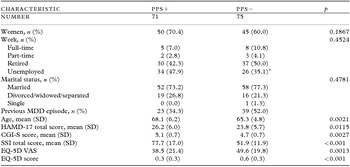
A total of 146 patients aged 60 years and older were included in the study. Of these, 95 (65%) were women. A total of 75% of the patients were married. Forty-nine percent of the patients were PPS+ at baseline. Baseline characteristics by PPS status are summarized in Table 1.
Baseline characteristics by PPS status

CGI-S, clinical global impressions of severity scale; EQ-5D, EuroQoL questionnaire-5 dimensions; HAMD-17, 17-item Hamilton depression rating scale; MMD, major depressive disorder; PPS−, painful physical symptom negative; PPS+, painful physical symptom positive; SSI, somatic symptom inventory; VAS, visual analog scale.
*Information was missing in one case.
For the whole sample, the baseline mean HAMD-17 total score was 25.0 (SD 5.9) and the baseline mean CGI-S score was 4.9 (SD 0.7), indicating that depression was moderate to severe at baseline. QOL as measured with the EQ-5D was low, with a mean VAS rating of 44.2 (SD 21.3) and an EQ-5D score of 0.4 (SD 0.4) at baseline.
Bivariate analysis showed significant correlations between depression severity (HAMD-17, CGI-S) and QOL (EQ-5D and EQ-VAS) at baseline. The Pearson correlation coefficient between baseline depression severity measured using the HAMD-17 and the baseline EQ-5D score was −0.48 (p < 0.0001), and −0.39 (p < 0.0001) for EQ-VAS. The correlation coefficient between baseline CGI-S score and the baseline EQ-5D score was −0.42 (p < 0.0001), and −0.35 (p < 0.0001) for the EQ-VAS.
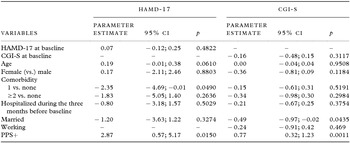
Table 2 summarizes the results of the linear regression models used to analyze the baseline factors associated with depression severity (HAMD-17) and overall clinical severity (CGI-S score) at three months. PPS status was the baseline characteristic most significantly associated with depression severity and overall clinical severity at three months; PPS+ patients had an estimated HAMD-17 score of 2.87 points greater at three months compared to PPS− patients and 0.77 points greater in their CGI-S score.
Baseline variables associated with HAMD-17 and CGI-S at 3 months (linear regression analysis)

CGI-S, clinical global impressions of severity scale; CI, confidence interval; HAMD-17, 17-item Hamilton depression rating scale; MMD, major depressive disorder; PPS+, painful physical symptom positive.
Results adjusted by country.
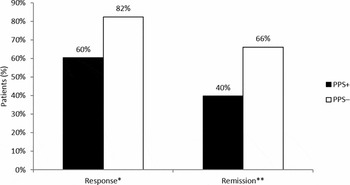
PPS status was also highly associated with rates of response and remission (Figure 1). PPS+ patients had a frequency of response of 60%, compared with 82% for PPS− patients (p = 0.0078). The difference in remission rates between the two groups was higher, with PPS+ patients having a remission rate of 40%, while PPS− patients had a remission rate of 66% (p = 0.0037). In both cases the difference was statistically significant when adjusting by baseline characteristics in a logistic regression model. The OR for response when comparing PPS− to PPS+ patients was 3.26 (95% CI 1.23; 8.64, p value = 0.017) and the OR for remission when comparing PPS− to PPS+ patients was 2.47 (95% CI 1.09; 5.58, p value = 0.031).
Response and remission by baseline PPS status (PPS−, painful physical symptom negative; PPS+, painful physical symptom positive). *p < 0.05 logistic regression model, difference between PPS+ and PPS−; **p < 0.05 logistic regression model, difference between PPS+ and PPS−.

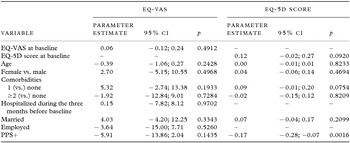
QOL at endpoint was also associated with PPS status at baseline. Patients who were PPS+ had a lower three month rating in QOL when measured with the EQ-5D score (Table 3).
Factors associated with quality of life at 3 months (linear regression model)

CI, confidence interval; EQ-5D, EuroQoL questionnaire-5 dimensions; PPS+, painful physical symptom positive; VAS, visual analog scale.
Results adjusted by country.
Discussion
This study of elderly Asian patients treated for an episode of MDD shows that PPS are common in these patients and that such symptoms negatively influence depression outcomes and patient QOL. Specifically we found that, compared with PPS− patients, PPS+ patients had lower response and remission rates, a higher severity of depression at endpoint, a lower QOL at baseline and less improvement in their QOL after three months of treatment (measured with the EQ-5D score).
The prevalence of PPS at baseline in this population of elderly Asians with MDD was 49%. This is within the range reported globally (Ohayon and Schatzberg, Reference Ohayon and Schatzberg2003; Bair et al., Reference Bair, Robinson, Eckert, Stang, Croghan and Kroenke2004; Muñoz et al., Reference Muñoz2005).
Our findings are consistent with previous studies in adult patients that have found that the presence of pain is associated with worse depression outcomes (Bair et al., Reference Bair, Robinson, Eckert, Stang, Croghan and Kroenke2004; Chou and Chi, Reference Chou and Chi2005; Karp et al., Reference Karp, Scott, Houck, Reynolds, Kupfer and Frank2005; Muñoz et al., Reference Muñoz2005) and in elderly patients (Meeks et al., Reference Meeks2008; Kil et al., Reference Kil, Oh, Koo and Suk2010). The reverse has also been proven; that is, that pain outcomes among patients with painful medical conditions are worse in the presence of depression (Bair et al., Reference Bair, Robinson, Katon and Kroenke2003; Meeks et al., Reference Meeks2008). In the analysis of data from 240 MDD patients aged ≥60 years from an observational study of depression in primary care and a randomized trial of antidepressants conducted by Drayer et al., it was found that symptoms of depression were significant predictors of somatization after controlling for age, gender, and medical comorbidities (Drayer et al., Reference Drayer2005). This study signals the relevance of assessing depression symptoms in elderly patients with somatic or pain complaints.
One of the strengths of our study compared with previous research is that we used standard diagnostic criteria and validated instruments to assess depression severity, QOL and the presence of PPS (Ang et al., Reference Ang2009; Lee et al., Reference Lee2009). Widely used and well validated instruments, HAMD-17 and CGI-S (Leucht et al., Reference Leucht, Fennema, Engel, Kaspers-Janssen, Lepping and Szegedi2013) were used to assess depression and overall clinical severity in our study. Another well-established and widely used generic instrument, the EQ-5D (Herdman et al., Reference Herdman2011) was used to assess QOL.
In the current study, the mean baseline EQ-5D score was 0.3 (SD 0.3) in the PPS+ patients. This is a very low figure compared with mean EQ-5D scores for patients with other severe medical conditions. For example, QOL estimates presented as EQ-5D scores in cancer patients (metastatic soft tissue and bone sarcoma; all disease states) were reported to be 0.6 or 0.7 (Reichardt et al., Reference Reichardt2012). The figures for arthritis (0.5) (Jansson and Granath, Reference Jansson and Granath2011), chronic heart failure (0.6) (Iqbal et al., Reference Iqbal, Francis, Reid, Murray and Denvir2010), and renal failure (0.7) (Ahlström et al., Reference Ahlström, Tallgren, Peltonen, Räsänen and Pettilä2005) were also substantially higher. Thus the QOL of elderly PPS+ patients with MDD is poor even compared with other disease states traditionally considered to be associated with poor QOL.
Consistent with our results, a recent study of 414 Korean outpatients with MDD found that 30% had painful physical symptoms, and that this PPS+ group had significantly greater depression severity and a lower QOL (according to EQ-VAS scores) compared with the PPS− group (Bahk et al., Reference Bahk, Park, Jon, Yoon, Min and Hong2011). Our findings are also in line with findings from the Asian IMCT; among the Taiwanese cohort, PPS+ MDD patients were, on average, more severely depressed and had a worse QOL at baseline compared with PPS− patients (Chen et al., Reference Chen, Cheng, Huang, Liu and Luo2012). Thus, there is growing evidence that emphasizes the importance of assessing PPS in patients with depression so that treatments can be targeted to improve outcomes, including patient QOL.
Pain and depression have complex pathophysiological mechanisms that are similar but not yet fully understood (Kapfhammer, Reference Kapfhammer2006; Williams et al., Reference Williams, Jacka, Pascoe, Dodd and Berk2006). The neurochemicals serotonin and norepinephrine are involved in both phenomena, providing more evidence that pain and depression are interrelated (Trivedi, Reference Trivedi2004). Despite the overlap in their underlying neurobiological processes, pain and depression have been shown to contribute independently to patient QOL. Sheehan et al., for example, found that somatic symptoms independently affected QOL among elderly primary care patients, independent of depression, physical health status and other potential confounders (Sheehan et al., Reference Sheehan, Lall and Bass2005). Thus, when selecting treatment for patients with depression, physicians must determine whether somatic symptoms (especially pain) are present and use treatments that target both the emotional and physical symptoms of depression; this approach should lead to a better depression outcome and QOL for depressed patients who present with PPS (Trivedi, Reference Trivedi2004).
A number of limitations should be considered when interpreting these results. This was an observational study, so the findings should be interpreted conservatively. Information on somatic symptoms was collected using direct, closed-ended questions regarding each symptom within the SSI; it is unclear how many of these symptoms would have been reported if the patients had not been prompted. The study included only patients from the psychiatric care setting and patients from primary care were not included; our sample is therefore not representative of the total MDD population in these Asian countries and this limits the generalizability of our findings. Only a limited number of medical co-morbidities were assessed. This was a post hoc analysis and the sample of elderly patients was relatively small. Besides, several outcome measures were analyzed, but no correction for multiple comparisons was implemented. The analysis did not take into account the antidepressant prescribed, which might have influenced patient QOL ratings at three months. The relationship between EQ-5D tariff and depression and pain could be influenced by the fact that two of the five items of the EQ-5D scale do assess anxiety/depressive symptoms and pain. Finally, because there is no Asian EQ-5D tariff, we applied the commonly used UK tariff to the EQ-5D data of the Asian patients to calculate utility scores (Brooks et al., Reference Brooks, Rabin and de Charro2003). While there is evidence that different populations value health states differently (including racial/ethnic differences) (Fu and Kattan, Reference Fu and Kattan2006), the EQ-5D has been shown to be useful for assessing QOL in patients with MDD (Sapin et al., Reference Sapin, Fantino, Nowicki and Kind2004), and to have acceptable validity and reliability in Asian populations (Gerhards et al., Reference Gerhards, Huibers, Theunissen, de Graaf, Widdershoven and Evers2011).
Conclusion
The findings of this post hoc analysis from an observational study indicate that the presence of PPS in elderly East Asian patients is a strong predictor of the outcomes of depression. Treatment of depression needs to take into account the presence of PPS to maximize clinical response and patient QOL.
Conflict of interest
Diego Novick, William Montgomery, and Xiaomei Peng are employees of Eli Lilly and Company. Jordan Bertsch conducted the statistical analysis under a contract between Fundació Sant Joan de Déu and Eli Lilly and Company. Josep Maria Haro has acted as consultant or speaker for AstraZeneca, Eli Lilly and Company, Lundbeck, and Roche.
Description of authors’ roles
Diego Novick was involved in the organization and execution of the project, data analysis and writing the paper. William Montgomery and Roberto Brugnoli were involved in the design of the analysis, and writing the paper. Jordan Bertsch conducted the statistical analysis. Xiaomei Peng was in the statistical analysis. Josep Maria Haro was involved in the design of the project and statistical analysis, data analysis and writing the paper. All authors were involved in critical review of the manuscript for intellectual content, and all authors approved the final version of the manuscript.
Acknowledgments
This study (FIJ-AA-B015) was supported by a research grant from Eli Lilly and Company, Indianapolis, USA. The authors thank all of the investigators and patients in the study, and Sarah Smith PhD, for editorial assistance.