Introduction
Since the mid-2000s, an increasing trend of interstate and societal conflict has been observed worldwide along with conflict-induced forced migration (Centre for Systemic Peace, 2015; IDMC, 2015). According to the Internal Displacement Monitoring Centre (IDMC) figures, internally displaced and refugee population numbered around 57.5 million in 2014, compared to 39 million in 2004 and 33.7 million in 1989 (IDMC, 2015). Conflict-associated trauma significantly contributes to the subsequent development of mental disorders during post-displacement periods (Porter and Haslam, Reference Porter and Haslam2005). The development of mental illness among forced migrant populations depends on a number of factors including the nature of trauma, number of traumatic events experienced, objective/perceived severity of trauma, age and gender (Porter and Haslam, Reference Porter and Haslam2005; Roberts and Browne, Reference Roberts and Browne2011). Of these, older age (defined as those over the age of 60 by the United Nations) has been reported to be associated with significant mental health issues (World Health Organization, 2015). Impact of forced migration on elderly mental health is important in the context of increasing global older population faction. In 2006, 11% of the world's population consisted of people over the age of 60 years (Inter-Agency Standing Committee, 2008; United Nations, 2015). By 2050, this is expected to increase to 22% with a simultaneous rise in the proportion of older people living in developing countries (60% to 80%), and the fastest growing subset is the over-80 age group (Inter-Agency Standing Committee, 2008; Karunakara and Stevenson, Reference Karunakara and Stevenson2012). The proportion of older people affected by forced migration only stands to increase due to the rising number of violent conflict situations, especially in the Middle East, Africa, and Asia (Inter-Agency Standing Committee, 2008; Karunakara and Stevenson, Reference Karunakara and Stevenson2012).
A wide range of additional age-specific factors may compound the mental health impact of forced migration among older people (Burton and Breen, Reference Burton and Breen2002; Karunakara and Stevenson, Reference Karunakara and Stevenson2012; Loi and Sundram, Reference Loi and Sundram2014). Psychological distress induced by forced migration may occur on a background of existing age-related neurological and mental disorders such as dementia, depression, un-recognized alcohol abuse, and general reduction in mental capacity (Inter-Agency Standing Committee, 2008; HelpAge International, 2012; World Health Organization, 2015). Chronic physical illnesses, disability, reduced mobility, and nutritional deficiencies can also compound psychological stress (Inter-Agency Standing Committee, 2008; Karunakara and Stevenson, Reference Karunakara and Stevenson2012; Loi and Sundram, Reference Loi and Sundram2014). Such chronic geriatric conditions usually require regular monitoring, medication, and resources (e.g. power supply for respiratory or dialysis machines), and these resources may not be available during enforced migratory episodes, especially in resource-poor settings (HelpAge International, 2012; Loi and Sundram, Reference Loi and Sundram2014). The cumulative effects of existing health impairments may have a significant impact on the mental health of the displaced older adults (Hinton et al., Reference Hinton, Franz, Yeo and Levkoff2005). In addition, having lived through a greater number of adverse events during their lifetime, the displaced older adults are at an increased risk of developing mental illnesses (Chee and Levkoff, Reference Chee and Levkoff2001).
Although positive contributions to society from the older adults are highly valued in many cultures, in situations of forced displacement, they may become a burden on surviving families and communities, as their contribution to survival efforts can be limited (Burton and Breen, Reference Burton and Breen2002; Loi and Sundram, Reference Loi and Sundram2014). Inability to play a meaningful role during a time of crisis can result in loss of social/family support/respect, precipitate loss of self-esteem and further contribute to increased psychological distress (Burton and Breen, Reference Burton and Breen2002). Death of close family, such as children, or abandonment by families during displacement may precipitate adverse mental health outcomes (Kirmayer et al., Reference Kirmayer2010).
Furthermore, older forced migrants may have significant issues with acculturation in post-displacement living areas (for example African/Asian/Middle Eastern refugees in Western countries), compounded by cultural, linguistic, and religious barriers impeding their ability to integrate with new social structures (Burton and Breen, Reference Burton and Breen2002; Bhugra et al., Reference Bhugra2011). They may also be prevented from making full use of available resources due to a lack of relevant cultural or linguistic knowledge (Inter-Agency Standing Committee, 2008; Loi and Sundram, Reference Loi and Sundram2014). Elderly people may also be reluctant to move from familiar places resulting in increased risk of social isolation (Levkoff et al., Reference Levkoff, Macarthur and Bucknall1995).
Due to increased pressure to address acute physical health issues in many conflict situations, elderly populations and their psychosocial needs are often overlooked by humanitarian programs (Inter-Agency Standing Committee, 2008). This oversight must be addressed to understand specific risk factors linked to mental disorders among older forced migrants. While there are some existing recommendations and policy guidance on older people in emergencies (World Health Organization, 2006; Inter-Agency Standing Committee, 2008), they lack specific provisions on mental health. Understanding and establishing the current level of knowledge about the impact of forced migration on mental health of older people is essential in the context of the worlds’ aging population and interlinked challenges in providing effective healthcare, especially in resource-poor countries (Mirsky, Reference Mirsky2009). However, current and comprehensive evidence-base on issues around forced migration and mental health of older people is not available. In order to address this gap, a scoping review of quantitative and qualitative research on mental health issues of older forced migrants, including refugees, asylum seekers, and internally displaced people (IDP), was conducted.
Methods
Databases and search terms
Seven databases (Pubmed, PsycArticles, PsycINFO, Google Scholar, Embase, Medline, and Global Health), expert recommendations, and a manual search were used to explore published and grey literature. The final search terms included a combinations of the following terms as well as related terms: “war” AND “mental health” AND “elderly” AND “older adult” (See the supplementary material).
Screening, selection, and assessment
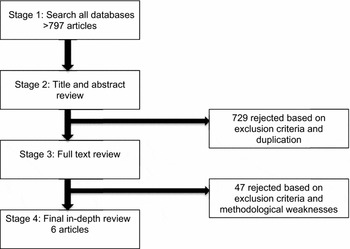
The initial search of all databases as well as a manual search and a search of recommended articles produced over 797 results. Of these, 729 articles were rejected following a title and abstract review and as a result of inaccessibility to the full article. Following duplicate review, 15 articles were removed leaving a total of 53 results. Following a full text review, a further 47 articles were rejected. A total of six articles were chosen for a final in-depth review (Figure 1). The STROBE checklist was used to assess the quality of quantitative studies included (STROBE, 2015). The STROBE checklist lists items that should be included in research articles such as details of the sample population and discussions of potential bias and limitations of the study. There are 22 items, given 1 point each and the total score gives an indication of the strengths and weaknesses found in research studies (STROBE, 2015).
Study selection process.

Selection criteria included population of conflict-affected migrants over the age of 50 of either gender. Studies on both internal migrants (those displaced within the national borders) and external migrants (those displaced beyond their national borders) were included. Studies with statistically significant mental health outcomes resulting from forced migration were included. The review considered worldwide studies written in the English language. Voluntary migrant populations (for example, those migrating for economic reasons) were excluded. Both qualitative and quantitative research was considered. Demographic variables taken into account in this review include different combinations of age, gender, marital status, living arrangements, education, income, length of residency in host country, age of immigration, and time since traumatic event.
Results
Demographic characteristics
All included articles except one (Marshall et al., Reference Marshall, Schell, Elliott, Berthold and Chun2005) sampled populations 50 years and older. Marshall et al., (Reference Marshall, Schell, Elliott, Berthold and Chun2005) included adults of 35–70 years and was included as it provided valuable information on mental health of older age groups. Of the six studies included in the final review, three were conducted in the United States of America (USA) (Marshall et al., Reference Marshall, Schell, Elliott, Berthold and Chun2005; Howells Wrobel et al., Reference Howells Wrobel, Farrag and Hymes2009; Cummings et al., Reference Cummings, Sull, Davis and Worley2011), two studies in Finland (Kuittinen et al., Reference Kuittinen2014; Mӧlsӓ et al., Reference Mölsä2014), and one study in Lebanon (Chaaya et al., Reference Chaaya, Sibai, Fayad and El-Roueiheb2007).
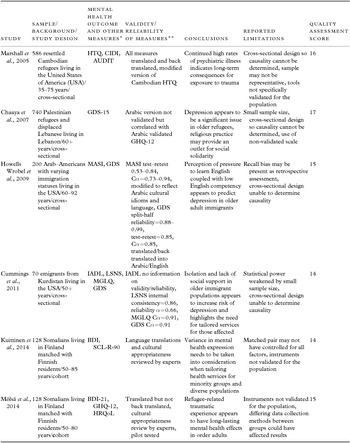
The majority of studies included in the review focused on conflict-affected refugee populations (Marshall et al., Reference Marshall, Schell, Elliott, Berthold and Chun2005; Chaaya et al., Reference Chaaya, Sibai, Fayad and El-Roueiheb2007; Cummings et al., Reference Cummings, Sull, Davis and Worley2011; Kuittinen et al., Reference Kuittinen2014; Mӧlsӓ et al., Reference Mölsä2014), with one study focusing on a population with varying immigration status (Howells Wrobel et al., Reference Howells Wrobel, Farrag and Hymes2009). All articles reported mental health findings for both men and women. Five of the included studies sampled populations 50 years and older who had been displaced as adults or older adults (Chaaya et al., Reference Chaaya, Sibai, Fayad and El-Roueiheb2007; Howells Wrobel et al., Reference Howells Wrobel, Farrag and Hymes2009; Cummings et al., Reference Cummings, Sull, Davis and Worley2011; Kuittinen et al., Reference Kuittinen2014; Mӧlsӓ et al., Reference Mölsä2014) and one study sampled a population aged 35–75 years (Marshall et al., Reference Marshall, Schell, Elliott, Berthold and Chun2005), who had been displaced as adults. Table 1 summarizes key information of included studies.
Summary of selected studies

*HTQ – Harvard Trauma Questionnaire; CIDI – Composite International Diagnostic Interview World Mental Health version; AUDIT – Alcohol Use Disorder Identification Test; GDS-15 – Geriatric Depression Score 15-item; MASI – Multi-dimensional Acculturative Stress Inventory; GDS – Geriatric Depression Scale; IADL – Instrumental Activities of Daily Living and Social Functioning; LSNS – The Lubben Social Network Scale; MGLQ – Migratory Grief and Loss Questionnaire; BDI – Beck Depression Inventory; SCL-R-90 – Symptom Checklist-Revised; BDI-21 – Beck Depression Inventory 21 item version; GHQ-21 – General Health Questionnaire 21 item version; HRQol – Health-Related Quality of Life.
Mental disorder and psychosocial outcomes
Mental disorder and psychosocial outcomes reviewed include post-traumatic stress disorder (PTSD), depression, alcohol use, predictors of depression, expression of mental illnesses, and mental health effects of trauma. A study of resettled Cambodian refugees in the USA found that continued high rates of various psychiatric illnesses indicates long-term consequences of exposure to trauma (Marshall et al., Reference Marshall, Schell, Elliott, Berthold and Chun2005). They reported higher rates of PTSD and major depression but lower risk of possible alcohol use disorder for older participants with women in the sample less likely to have either PTSD or alcohol use disorders (Marshall et al., Reference Marshall, Schell, Elliott, Berthold and Chun2005). One study on older Palestinian refugees living in Lebanon found high rates of depression (Chaaya et al., Reference Chaaya, Sibai, Fayad and El-Roueiheb2007). They also reported that depression appears to be a significant challenge for all older refugees in their sample and that religious practice may mitigate some of the effects as an outlet for social solidarity (Chaaya et al., Reference Chaaya, Sibai, Fayad and El-Roueiheb2007).
Two other studies conducted in the USA looked at predictors of depression, one among older immigrants with varying immigration status (Howells Wrobel et al., Reference Howells Wrobel, Farrag and Hymes2009), and another among refugees who had fled conflict (Cummings et al., Reference Cummings, Sull, Davis and Worley2011). The first study with varying immigration status participants found that the risk of depression is predicted by people's perception of pressure to learn English and low English competency (Howells Wrobel et al., Reference Howells Wrobel, Farrag and Hymes2009). This study also reported increased levels of depression and acculturative stress amongst those self-identifying as refugees as compared to those identifying as citizens, permanent residents or visa holders of the country providing refuge (Howells Wrobel et al., Reference Howells Wrobel, Farrag and Hymes2009). The second study in the USA, which sampled refugees from Kurdistan found high rates of depression (Cummings et al., Reference Cummings, Sull, Davis and Worley2011). This study concluded that the risk of developing depression was associated with social isolation and lack of social support (Cummings et al., Reference Cummings, Sull, Davis and Worley2011).
A study conducted in Finland compared Somali refugees to Finnish citizens and found that the Somali refugees displayed more somatic-affective symptoms of mental distress (Kuittinen et al., Reference Kuittinen2014). They concluded that variance in how mental illness is expressed must be taken into account when tailoring health services for minority groups to ensure full spectrum of mental illness is understood (Kuittinen et al., Reference Kuittinen2014). A second study on the same sample of Somalian refugees living in Finland reported that traumatic experiences can create long-lasting mental health effects into older adulthood (Mӧlsӓ et al., Reference Mölsä2014). It found clinically significant differences in reported self-related health status, depression symptoms, and general psychological distress (Mӧlsӓ et al., Reference Mölsä2014).
Methodological issues
Table 1 presents summary information on sample and background, study design, mental health outcomes, validity and reliability of measures, study conclusions, and reported limitations. A wide range of mental health measurements were used, including the Harvard Trauma Questionnaire (HTQ), the Composite International Diagnostic Interview World Mental Health version (CIDI), the Alcohol Use Disorder Identification Test (AUDIT), Geriatric Depression Score (GDS-15), Multi-dimensional Acculturative Stress Inventory (MASI), Instrumental Activities of Daily Living and Social Functioning (IADL), the Lubben Social Network Scale (LSNS), Migratory Grief and Loss Questionnaire (MGLQ), Beck Depression Inventory (BDI), Symptom Checklist-Revised (SCL-R-90), General Health Questionnaire (GHQ-21) and Health Related Quality of Life (HRQoL).
The majority of studies were of cross-sectional design. Sample sizes of the studies varied widely (range; 70 to 740). Sample population total from all included studies was 1,724. Reliability and validity of information was provided by some studies, mostly limited to Cronbach's α figures. In addition, it was not clear in most studies whether the measurements were administered in English, in the native language of the host country (for refugees) or in the native language of participants. The quality assessment scores ranged from 14 to 17 (from a total of 22). Most studies lost points for not stating potential sources of bias, funding sources, and limitations. There was no identifiable pattern of links between quality score and other study attributes such as sample size. Main reported limitations were recall bias, lack of power due to small sample size, and lack of reliability, as instruments were not validated for the population.
Discussion
This review explored mental health issues of older forced migrants including refugees, asylum seekers, and IDP. In summary, the findings show an increased level of mental disorders and psychosocial issues among older adults affected by conflict. Most commonly studied and prevalent mental disorders were depression, anxiety, and PTSD. In general, psychosocial well-being of those affected by forced migration was reported as poor, and factors such as experiences during displacement, post-migration acculturation, age at displacement, and gender played a role in poor mental health. Forced migration emerged as a highly significant predictor of negative mental health outcomes among older conflict-affected adults, especially for current anxiety. Overall findings show increased depression, anxiety, and an increased risk of developing PTSD. However, caution must be exercised when interpreting these findings, as the majority of studies had examined populations long after the event of forced migration. Furthermore, factors related to the process of natural aging of participants needs to be considered.
A key finding to emerge from the review is the lack of epidemiological studies looking at mental health of older adults affected by conflict-related forced migration in low-and middle-income countries (LAMIC). The studies included in this review were focused on refugee populations living in developed countries such as European Union member states and the United States. Previous research on conflict-affected populations in LAMIC have shown older age to be a specific risk factor for mental disorders (Roberts and Browne, Reference Roberts and Browne2011). Despite this, our findings indicate that research with a specific focus on older age groups is scarce in most LAMIC.
Studies in the review had focused on refugee populations, neglecting IDP. This is a notable gap in research focus, as the numbers of IDPs from global conflicts have increased exponentially during recent years (IDMC, 2015). As mentioned before, the majority of these IDPs are located in LAMIC, with increasing older population factions. Given the contextual and factual importance, mental health of older adult IDPs should be considered as a research priority.
In addition, this review points towards a significant lack of evidence on mental health issues of older adults displaced by recent conflict. The nature, context, and severity of conflicts are fast changing, and it is important to study the mental health impact of forced migration from recent conflicts. Since the World Wars, most conflicts have taken place in developing countries. In this context, understanding mental disorder trajectories of older people affected by conflict and forced migration within the immediate aftermath will be highly useful for the development and delivery of critical psychosocial support to this vulnerable population group. While a number of guidelines have highlighted the importance of providing psychosocial support to older people in emergencies (World Health Organization, 2006; Inter-Agency Standing Committee, 2008; HelpAge International, 2012), lack of research focus on older populations in resource-poor regions hampers such support provision.
Most epidemiological studies on mental health of forced migrants focus on a limited number of disorders such as depression, anxiety, and PTSD (De Jong et al., Reference De Jong, Komproe and Van Ommeren2003; Siriwardhana et al., Reference Siriwardhana2013). Studies from the current review have similarly focused on these disorders, and only a few examined a wider array of mental disorder outcomes. Prevalence of mental disorders, as evidenced through the reviewed studies, shows a wide variation. This may be explained due to methodological differences such as sample size, measurements, and study quality.
There is a notable lack of focus on older age-specific physical or mental health outcomes in reviewed studies. The impact of trauma caused by forced migration on an older individual can be compounded by age-specific, pre-existing conditions such as chronic physical illnesses, Parkinson's disease, dementia, geriatric depression, and unrecognized alcohol abuse. Prevalence of these conditions are generally increased among the elderly and present difficulties to differentiate psychological distress induced by forced migration from distress due to prevailing age-related health issues. Pre-existing conditions can act as strong predictors or mediators between traumatic experience of forced migration and subsequent mental ill health among older adults. The review findings identify the need for research that explores associations between age-related health issues and consequences of forced migration trauma. In addition, routine inclusion of specific measurements for age-related mental/neurological disorders in health surveys among conflict-affected older adults is recommended.
Among older refugees or IDPs, being forced to abandon their homes, villages, and countries where they have lived for most of their life may instill strong feelings of loss (Burton and Breen, Reference Burton and Breen2002). Sense of attachment to their ancestral land is likely to be increased among older forced migrants than their younger counterparts. Acculturation process in new and unfamiliar cultural or linguistic settings may be slower among older forced migrants. They may find it more difficult to re-establish fragmented social support systems and networks, compounded by losing close family or friends during the forced migration process. Some studies included in our review show that older refugees with low social support and low English proficiency (or the language of the recipient country) can increase the risk of depression (Howells Wrobel et al., Reference Howells Wrobel, Farrag and Hymes2009; Cummings et al., Reference Cummings, Sull, Davis and Worley2011). Forced migration of older adults needs to be conceptualized in a framework that emphasizes the importance of social support as well as comprehensive care, which includes both medical and psychosocial components.
Our review has identified several methodological issues among mental health research of older forced migrants. Most research studies are of cross-sectional design, limiting the understanding of temporality and clear causal pathways between forced migration and development of mental disorders. Given the complex nature of health issues faced by older forced migrants, longitudinal studies are encouraged. We identified a paucity of qualitative studies exploring mental health issues around forced migration of older people. Older forced migrants may have diverse, rich, and in-depth lived experiences that could allow researchers to gain a deeper understanding of trauma and mental health trajectories, and the lack of qualitative exploration prevents use of such valuable insight for specific intervention development.
The current review also highlights the lack of clear information or agreement about the instruments used to measure mental health outcomes. Most studies have not provided adequate information about translation/adaptation process of measurements (if required by the setting/population) or information on reliability and validity of instruments. Importance of validity and reliability of psychiatric measurements is firmly established, and given the contextual complexities in mental health research among older forced migrant populations, more attention should be given to measurement issues. As mentioned before, a number of studies in the review have issues regarding recall and information bias, and care must be taken to avoid such biases where possible.
Our review has several limitations. The scarcity of studies we discovered in this review should be considered a limitation itself, as the low number of studies limits a wider discussion. Although a large volume of current work on conflict-affected displacement and mental health include older population fractions, this review only included studies with a primary focus on older adults. We also acknowledge that there are other potential approaches to this topic (for example, after careful consideration, studies looking at long-term mental health of those displaced as children due to conflict were excluded). The heterogeneity of studies prevented a systematic review (meta-analytic) being conducted. The heterogeneity of methodology, samples, measurements, and statistical analysis prevented us from providing a pooled data analysis. We may not have captured other important studies published in languages other than English and some grey literature. Studies that did not have a primary focus on mental health, conflict or displacement were not included; therefore, a substantial subset of literature on older people in emergencies such as disasters has not been included. In addition, the keywords used may have caused the omission of some relevant literature (for example, using broader “mental health” term might exclude specific disorder-focused studies).
In conclusion, as the older adult population fraction increases worldwide along with severe conflict, it is crucial to establish the extent of current evidence-base on the effect of forced migration on mental health of these populations. The design and implementation of effective mental health interventions should be informed by research that reflects the changing global realities such as population and conflict dynamics, especially in resource-poor LMIC (Mirsky, Reference Mirsky2009). According to our review findings, the current body of mental health research on older forced migrants does not seem to reflect the changing realities in the world, and highlights the need for a strategic re-think from academics, health professionals, and other stakeholders on a global scale.
Supplementary Materials
To view supplementary material for this article, please visit http://dx.doi.org/10.1017/S1041610216000193.
Conflict of interest
None.
Description of authors’ roles
CS conceptualized the paper. AV conducted the literature search. AV and SD reviewed articles and wrote the first draft. CS reviewed and edited the manuscript. All authors agreed on the final version.