Introduction
Interest in porous materials, defined as solids comprising empty space in the form of channels or cavities, is related to a number of properties that are not available for bulk solids. For instance, high specific surface areas that can reach several thousands of square meters per gram are characteristic of porous solids. Another distinguishing property is the pore size, which can vary from a few Angstroms to hundreds of nanometers, and thus the pores can be used for selective separation and storage of different species. According to the classification of the International Union of Pure and Applied Chemistry (IUPAC), porous solids are divided into three categories: (1) microporous, with pores less than 2 nm in size; (2) mesoporous, with pores from 2 to 50 nm; and (3) macroporous, with pores between 50 and 1000 nm. 1 Porous materials can be organic, inorganic, or hybrid with different structural organizations (crystalline or amorphous). All of these characteristics are important for the potential uses of a porous solid.
Zeolites are crystalline microporous materials with a framework built of corner sharing SiO4– and AlO4– tetrahedral units that form channels and cages. There are naturally occurring and synthetic zeolites. At present, there are 231 zeolite framework types. The Structure Commission of the International Zeolite Association assigns a three-letter code to each distinct framework type according to the rules set up by an IUPAC Commission on Zeolite Nomenclature. 2 The structure code is generally obtained from the name of the zeolite, for instance, the synthetic zeolite structure MFI stands for “Mobil 5,” while FAU is an abbreviation of the name of the mineral faujasite. Depending on the framework composition, zeolites with a similar structure type can have different names. The MFI-type family includes an all-silica (Silicalite-1), an Al-containing (ZSM-5), and a Ti-containing (TS-1) member. The structure of a zeolite can also be built from two or more polymorphs. A typical example is zeolite beta, which always includes two polymorphs (BEA and BEB) that can be present in different proportions. 2
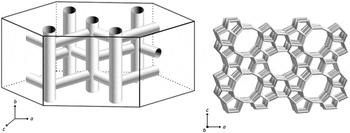
Well-defined pore systems ( Figure 1 ) and flexible chemical compositions are the origin of the unique characteristics of zeolites such as shape selectivity, high specific surface area, high thermal and chemical stability, and controllable hydrophilic/hydrophobic properties. These properties make zeolites indispensable materials for catalytic and separation processes. Reference Martinez and Corma3 The small and regular pore dimensions of zeolites allow separation of molecules with size differences below 1 Å. Their shape selectivity, however, comes at the cost of diffusion limitations (due to the similar dimensions of the diffusing species and zeolite channels), which brings some undesirable effects. For instance, pore blocking and active site deactivation are the main drawbacks in the use of zeolites as catalysts.
Schematic presentation of the morphology of a MFI-type crystal with the system of interconnected channels running along the a- and b-axes (left). Element of MFI-type structure with the channel openings along the b-axis (right).

A decrease in zeolite crystal size is a possible solution to this problem owing to the shorter diffusion path length. Reference Landau, Vradman, Valtchev, Lezervant, Liubich and Talianker4 However, the number of zeolites that can be obtained in nano-sized form is still limited. Reference Valtchev and Tosheva5–Reference Mintova, Jaber and Valtchev7 An alternative solution is the introduction of a system of larger (meso-/macro-) pores in zeolite crystals. Reference Perez-Ramirez, Christensen, Egeblad, Christensen and Groen8 Zeolite crystals that combine the intrinsic microporosity with mesoporosity (or macroporosity) are referred to as hierarchical zeolites.
The term “hierarchical zeolites” has not been clearly defined and might cause some confusion, especially for researchers from the nonporous materials community. In general, hierarchy means arrangement of items where each entity has a structured position with only one “neighbor” above and below each level. The first association with the term hierarchy is that each item is superior or subordinate to its neighbors, which is different from the meaning implied by the porous materials community. It is clear that the previous definition cannot be applied to solids that are considered as hierarchical porous materials. The hierarchical porous material then is defined as a solid material that comprises at least two types of pores with sizes in distinctly different scale ranges. These also operate interdependently, enhancing desired properties. Therefore, the hierarchical zeolite can be described as a crystalline microporous material containing a system of larger (meso-/macro-) pores.
During the last decade, the preparation and investigation of hierarchical zeolites has been among the hottest topics in the field of porous solids. Reference Wei, Parmentier, de Jong and Zacevic9 This interest is related to great expectations for mass-transport improvements and thus higher reaction rates in zeolite catalysts. The objective of this article is to provide a condensed analysis of the methods for preparation of hierarchical zeolites, which are categorized into destructive and constructive methods.
Destructive methods
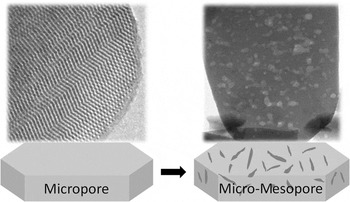
Destructive methods are based on post-synthesis chemical etching of zeolite crystals that lead to the formation of meso-/macropores. Reference Valtchev, Majano, Mintova and Perez-Ramirez10 Depending on the etchant used, one of the framework cations, Al or Si, is preferentially extracted. Upon more severe treatment, a substantial part of the zeolite structure is removed, and thus secondary pores are formed ( Figure 2 ). The framework composition (Si/Al ratio) and the type of pore system are the two factors that determine which etching approach is appropriate for a particular zeolite. The choice of the etchant and the conditions of treatment strongly depend on the ability of the zeolite to support chemical etching.
Scanning electron micrographs and schematics showing the transformation by chemical etching of a MFI-type zeolite (left) into a hierarchical micro-mesoporous material (right).

Steaming
Steaming is a high-temperature treatment (>500°C) of zeolites in a water vapor atmosphere. Under such conditions, the aluminum is extracted from the zeolite framework, leaving behind vacancies. The process also includes healing of the vacancies by less stable and mobile silicon species. Reference McDaniel, Maher and Barrer11 The aluminum extracted from the framework remains in the channels and on the external surface of the zeolite crystals, necessitating a mild acid treatment to remove the aluminum debris. The aluminum extraction and the migration of silicon lead to an increase in the Si/Al ratio and the formation of mesopores. The size and distribution of the mesopores is fairly random, but the process can be controlled to some extent. Reference Van Donk, Janssen, Bitter and de Jong12 Repeated steaming and acid leaching provide zeolites with a larger mesopore volume and a higher Si/Al ratio. This steaming treatment is used for the production of ultrastable zeolite Y (USY), which is the main component of the fluid cracking catalysts used in crude oil transformation. Although this method has been used on an industrial scale since the mid-1960s, some aspects of the process remain not well understood. Reference Agostini, Lamberti, Palin, Milanesio, Danilina, Xu, Janousch and van Bokhoven13
Acid leaching
Various mineral or organic acids are used to extract Al from zeolites. Besides the removal of non-framework aluminum species in the production of USY, acid leaching is used to increase the Si/Al ratio in zeolite frameworks. Usually zeolites with Si/Al ≥ 2.5 are subjected to this treatment since the de-alumination of low-silica zeolites leads to structure collapse. Reference Roberge14,Reference Chung15 Similar to steaming, acid leaching results in the formation of secondary pores. However, the process is not very efficient and is rarely used for the preparation of hierarchical zeolites.
Alkaline leaching
Treatment of a zeolite in alkaline solution results in preferential extraction of silicon from the framework. Young patented the treatment of the zeolite mineral mordenite with sodium hydroxide solution in 1967 as a method for improving the sorption capacity. Reference Young16 Sodium hydroxide is the most widely used etchant, but for particular purposes, hydroxides of other alkaline and organic cations can be employed. Reference Wei, Parmentier, de Jong and Zacevic9,Reference Valtchev, Majano, Mintova and Perez-Ramirez10 Ogura et al. first pointed out that the alkaline treatment results in the formation of mesopores in zeolite crystals. Reference Ogura, Shinomiya, Tateno, Nara, Kikuchi and Matsukata17 During the last decade, the method was largely explored to produce zeolites with hierarchical porosity. An important contribution to the development of the last approach came from the group of Perez-Ramirez. Reference Perez-Ramirez, Christensen, Egeblad, Christensen and Groen8,Reference Milina, Mitchell, Crivelli, Cooke and Perez-Ramirez18 Nowadays, desilication is a routine method largely used on a laboratory scale. The treatment can be applied to different zeolite materials, with the Si/Al ratio ranging from four to infinity (all silica structures). Desilication is very efficient in the treatment of high-silica zeolites.
Fluoride medium treatment
Hydrofluoric acid (HF) is commonly used to etch or completely dissolve silicon-containing materials. A study of the dissolution of ZSM-5 in HF of different concentrations showed that a diluted (0.5 M) solution is Al-selective. Reference Qin, Lakiss, Gilson, Thomas, Goupil, Fernandez and Valtchev19 This selectivity is much less pronounced in more concentrated HF solution, which is due to a larger presence of bifluoride ions (HF2 –). The latter is much more active than F–, and extracts Si and Al indiscriminately from the zeolite framework. In order to shift the equilibrium to HF2 –, buffered HF solutions were used. The treatment of the ZSM-5 zeolite with such a solution resulted in hierarchical materials with similar compositions to the parent ZSM-5. Lately, similar results were obtained with concentrated NH4F solution, where the release of NH3 leads to the formation of bifluoride anions. Reference Valtchev, Qin and Gilson20
The nonselective (in terms of equally removing Al and Si) nature of this treatment has important advantages in the preparation of hierarchical materials. This treatment can be applied to any type of zeolite, including those with Si/Al ratios close to 1. Reference Valtchev, Qin and Gilson20 Another important advantage is the preferential dissolution of defect zones in zeolite particles. The stress in these zones and the presence of surface hydroxyls make the defects more vulnerable to chemical etching. Thus the dissolution process strongly depends on the growth mechanism. These effects make the fluoride treatment much more controllable compared to other etching approaches. Reference Qin, Gilson and Valtchev21
Fluoride treatment has been used for the preparation of hierarchical ZSM-5, with parallel macropores crossing the entire crystal. In this case, high-energy 238U ion bombardment was employed prior to the fluoride treatment to create amorphous zones in the crystals. Reference Valtchev, Balanzat, Mavrodinova, Diaz, El Fallah and Goupil22 Higher etching rates of the amorphous versus crystalline part resulted in the formation of a system of parallel macropores without changing the intrinsic characteristics of the zeolite. This model material showed substantially higher activity with retained selectivity in the conversion of m-xylene to para- and ortho-isomers. More recently, materials with similar properties have been prepared by controlled etching in a fluoride medium. Reference Valtchev, Qin and Gilson20
Several nanometers thick layers of zeolite crystals are of great interest for practical applications and preparation of hierarchical zeolites. Corma and co-workers reported the first example Reference Corma, Fornes, Pergher, Maesen and Buglass23 of these materials, also known as two-dimensional (2D) zeolites. They used a destructive approach to delaminate zeolite structures that form weakly bound zeolite layers, separated by the template molecules, during the crystallization step. Reference Corma, Fornés and Díaz24 More recently, selective extraction of germanium from zeolite frameworks was used to obtain 2D zeolite and their further framework conversion. Reference Cejka, Morris, Nachtigall and Roth25 One-unit-cell-thick zeolite sheets have also been obtained by melt blending. Reference Varoon, Zhang, Elyassi, Brewer, Gettel, Kumar, Lee, Maheshwari, Mittal, Sung, Cococcioni, Francis, McCormick, Mkhoyan and Tsapatsis26 First, a zeolite polystyrene mixture was prepared and treated with a twin screw extruder. Next, the zeolite nanosheet-polystyrene composite was placed in toluene and sonicated in order to dissolve the polystyrene. Finally, the zeolite sheets were purified by density gradient centrifugation.
Constructive methods
The most widely used constructive method is the incorporation of a mesoporogen during the growth of micron-sized zeolite crystals. Specifically, species in the mesopore size range (2–50 nm) that can be easily removed by simple combustion or dissolution are used as templates during zeolite crystallization. Egeblad et al. carefully reviewed this approach, in particular, the use of hard templates, namely carbon nanoparticles. Reference Egeblad, Christensen, Kustova and Christensen27 Here, we address the preparation of hierarchical zeolites through the assembly of well-defined nano-sized building blocks or zeolite nanocrystals.
Dual templating
In dual templating, two distinct templates or two distinct components in a single template, one directing the formation of microporosity and one directing mesoporosity (mesoporogens), are used in hydrothermal synthesis. The hierarchical material is then obtained by combustion of the templates. This approach has attracted considerable attention due to its potential in the control of mesopore size, and it is still under development via utilization of: (1) organosilanes, (2) cationic polymers, (3) dual-function poly(quaternary ammonium) surfactants, and (4) dual-function polymers. Reference Wei, Parmentier, de Jong and Zacevic9 Zhu et al. discussed the mechanism of formation of hierarchical zeolites in the presence of two templates. Reference Zhu, Hua, Zhou, Wang, Zhao, Gong, Wu, Ruan and Shi28
Ryoo and co-workers first presented the use of positively charged amphiphilic organosilanes for preparation of hierarchical zeolites. Reference Choi, Cho, Srivastava, Venkatesan, Choi and Ryoo29 These surfactants contain a hydrolysable methoxysilyl moiety, a zeolite structure-directing group such as quaternary ammonium, and a hydrophobic alkyl chain moiety. After hydrolysis, the methoxysilyl group interacts with growing crystal domains through the formation of covalent bonds, enabling the hydrophobic alkyl chain to act as a mesoporogen. The surfactant can be tailored by changing the number of ammonium centers, the length and structure of the linkage, and the hydrophobic tails, leading to different hierarchical structures. For instance, the use of C18–N3–C18 surfactant as a template resulted in a zeolite with hexagonally ordered mesopores. Reference Na, Jo, Kim, Cho, Jung, Seo, Messinger, Chmelka and Ryoo30 Hierarchical LTA- and FAU-type zeolites were synthesized using amphiphilic organosilane surfactants. Reference Inayat, Knoke, Spiecker and Schwieger31
Moeller et al. reported a polymer-based synthetic approach for the preparation of hierarchical zeolite beta with tunable mesoporosity. Reference Moeller, Yilmaz, Meuller and Bein32 The authors pointed out the relationship between the size of the primary zeolite beta nanoparticles and the size of the mesopores.
Intergrown structures
Hierarchical materials also have been prepared by the intergrowth of zeolite crystals with particular morphologies. For instance, the intergrowth of MFI- and MEL-type zeolites was tailored by the use of two templates, leading to the formation of hierarchical structures called the “house-of-cards” structure. Reference Zhang, Liu, Xu, Asahina, Cychosz, Agrawal, Al Wahedi, Bhan, Al Hashimi, Terasaki, Thommes and Tsapatsis33 Self-pillared single-unit-cell Sn-MFI nanosheets have also been reported. Reference Ren, Guo, Kumar, Orazov, Xu, Alhassan, Mkhoyan, Davis and Tsapatsis34 These structures are formed by repetitive branching caused by orthogonal rotational intergrowth of zeolite lamellae. An example of intergrowth without using organic templates occurs between zeolite structures with similar basic units such as the FAU-type and its hexagonal counterpart (EMT-type). Reference Khaleel, Wagner, Mkhoyan and Tsapatsis35
Steam-assisted crystallization
Steam-assisted conversion of dense precursor gel yielded a hierarchical zeolite beta material without using a mesoporogen. Reference Moeller, Yilmaz, Jacubinas, Mueller and Bein36 The steam-assisted conversion of the highly concentrated precursor resulted in abundant nucleation and formation of nanocrystals. The additional steam treatment condensed the nanoparticles, thereby retaining the mesopores. The obtained zeolite beta aggregates were comprised of mesopores (∼13 nm) and large surface areas (630–750 m2/g). This hierarchical zeolite showed tunable chemical compositions and high crystalline yields. Hierarchical MFI-type materials (ZSM-5, Silicalite-1, TS-1) were produced by a similar approach. Reference Valtchev, Majano, Mintova and Perez-Ramirez10,Reference Zhou, Hua, Shi, He, Guo and Ruan37
Agglomeration of discrete nanocrystals
A simple agglomeration of nano-sized particles with narrow particle size distribution results in mesopore formation. This textural porosity can be tuned by the size of the nanoparticles. Advances in the synthesis of nano-zeolites have made these materials much more available. Reference Valtchev and Tosheva5–Reference Mintova, Jaber and Valtchev7 Discrete nanocrystals can now be obtained without using an organic structure directing agent. Reference Awala, Gilson, Retoux, Boullay, Goupil, Valtchev and Mintova38,Reference Ng, Chateigner, Bein, Valtchev and Mintova39 The high yield of these syntheses is an important advantage that opens the road to large-scale applications.
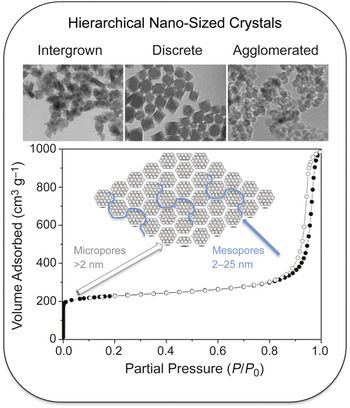
Close-packing of nano-sized zeolite crystals has also resulted in hierarchical materials with substantial mesopore volumes ( Figure 3 ). Zeolite nanocrystals (5–40 nm) made from suspensions with low water content led to hierarchical materials with tunable mesopores (5–30 nm). High-temperature treatment (550°C) of such materials leads to the fusion of zeolite crystals and the formation of sponge-like structures with defined porosity. Reference Mintova, Talapaneni, Grand and Gilson40
Example of an assembly of zeolite nanocrystals in hierarchical micro-mesoporous material. Electron micrographs in the top part of the figure represent different types of nano-sized particles that generate hierarchical porosity. A representative N2 adsorption isotherm of micro-mesoporous material is shown (bottom), where the uptake at high relative pressure indicates the presence of mesopores. A schematic presentation of the mesopores formed between the individual crystals and agglomerates is shown as an inset in the isotherm.

Nano-sized zeolites in colloidal form offer considerable flexibility in the preparation of hierarchical materials in different forms by simple and rapid methods. For instance, Serrano et al. reported that the textural porosity in self-supported zeolite bodies depends on the type of the solvent and the concentration of the zeolite suspension. Reference Serrano, Aguado, Escola, Peral, Morales and Abella41 Colloidal suspensions of nano-sized zeolites can also be used for the preparation of zeolite films or fibers. Reference Tosheva and Valtchev42
Zeolite bodies
All of the previous discussions concern zeolites in powder form. For practical uses, zeolite catalysts and sorbents are shaped in different morphologies and sizes by means of a binder. The zeolite is embedded in inorganic matrices such as silica, alumina, amorphous silica-alumina, or natural clays to meet the requirements for large-scale industrial applications. Reference Hargreaves and Munnoch43,Reference Michels, Mitchell and Pérez-Ramírez44 The role of the binder is to provide mechanical and thermal strength, dilute the active phase (zeolite), and offer conditions for rapid mass and heat transfer. Physicochemical interactions occurring between a zeolite and a binder during the shaping process may lead to composites with properties different from their simple mechanical mixture. However, there is little information on the exchange of species between zeolite and binder and its impact on the active sites in the composite. 1,2 The zeolite–binder interaction is expected to be more pronounced in the case of nano/hierarchical zeolites because of the high external surface area of the zeolitic material. More research will have to be devoted to this topic in order to advance zeolite shaping to a highly controllable art.
Summary
New families of crystalline microporous materials have appeared during the last two decades, but aluminosilicate zeolites remain indispensable for the chemical process industry. Interest toward micro-mesoporous crystals has been high, since these materials represent a promising alternative in many large-scale processes based on zeolites. This promise could become a reality if hierarchical zeolites can be produced in a way to meet industrial requirements. Improved performance of zeolite materials is highly desired, but the impacts of economic, environmental, and production issues are equally important in making the final selection of the material. Thus multistep procedures, methods based on specialized equipment, and expensive or dangerous chemicals are not appropriate for scale-up. Analysis of critical factors shows that chemical etching and the agglomeration of preformed nano-sized crystals might be the most plausible routes for large-scale production of hierarchical zeolites.
Acknowledgments
The authors acknowledge the MicroGreen Project (ANR-12-IS08–0001–01) and the Lower Normandy Region (France). S.M. acknowledges the Lower Normandy Region (France) for financial support of the ANR TARGET Project.