Introduction
Melanophloea was described as a monotypic genus by James & Vězda (Reference James and Vězda1971), based on two collections from the Solomon Islands. Melanophloea pacifica James & Vězda was the first, and for a long time the only, species to be described from among a sizeable collection of lichens from that region collected by D. J. Hill in 1965. It was clearly an unusual lichen, and the new genus was considered unique. It was attributed to the Thelocarpaceae because of the globose ascomata and the multispored asci. However, some quite fundamental differences with Thelocarpon, the type (and at that time only) genus of that family, were already pointed out in the original description. These include a fully carbonized (instead of hyaline to yellow) ascoma wall and anastomosing (as opposed to simple or branched) hamathecium filaments.
Here we will use the general descriptive terms ascoma and hamathecium rather than developmentally defined terms such as perithecia, apothecia, clypeus, pseudothecia, paraphyses, pseudoparaphyses or paraphysoids, as use of these terms would bias the setting of the research unnecessarily. In the results section we hope to be able to interpret the structures in special terms.
For several decades, no additional specimens were reported of the genus Melanophloea. It was, however, collected by B. J. Coppins in Sarawak (Malaysia) during the Mulu expedition in 1978 (cited in Aptroot et al. Reference Aptroot, Diederich, Sérusiaux and Sipman1997), and subsequently in 1992 in Papua New Guinea (Aptroot et al. Reference Aptroot, Diederich, Sérusiaux and Sipman1997). In Papua New Guinea, it is rather abundant in a lichenologically unique undisturbed rainforest that is still the only known locality of, for example, the genus Wegea (Aptroot & Tibell Reference Aptroot and Tibell1997) and of Crustospathula cartilaginea Aptroot (Aptroot Reference Aptroot1998). More recently, Melanophloea pacifica has been reported from Cape Tribulation in Australia (McCarthy & Kantvilas Reference McCarthy and Kantvilas2009). A fleeting examination of the boxes with the still largely unidentified lichens from D. J. Hill's 1965 collection showed that the species is quite abundantly present in the Solomon Islands material, with at least a dozen specimens.
The specimens now known show some variation between them, chiefly in ascoma size and thallus colour, and in the degree of immersion of the ascomata in the thallus, but there is not enough differentiation to necessitate the distinction of different species. In fact, the type species is a well-characterized and, in the field, recognizable species which seems to indicate undisturbed lowland rainforests in the Malesian-Australasian region.
In 2008 the genus was expanded with a second species, M. montana P. M. McCarthy (McCarthy Reference McCarthy2008; McCarthy & Kantvilas Reference McCarthy and Kantvilas2009), described from rainforest in Queensland, but from rock. It resembles the type of Melanophloea in several characters, chiefly the multispored ascus and the globose algae, but differs in so many characters that its inclusion made the genus quite heterogenous. The author was aware of the differences with the type species of the genus, but was unable to find a better disposition. Differences include the hyaline and less pigmented ascoma wall, the algiferous thallus covering most of the ascomata, the ellipsoid rather than globose ascospores, and the sparse, sparingly branched hamathecium filaments.
In 2011, Knudsen and Lendemer added a third species to the genus, viz. M. americana K. Knudsen & Lendemer (Knudsen et al. Reference Knudsen, Lendemer and Harris2011). The type is a duplicate specimen of Aptroot 21389 which was left by the collector in NY. This species has virtually nothing in common with the type of Melanophloea, and it is unclear why it has been published in such a remote genus. This species has, for example, a dark brown outer ascoma wall that is curved inward below, apically (slightly) thickened asci, branched but not anastomosing hamathecium filaments and short-cylindrical ascospores.
As an afterthought, Knudsen and Lendemer suggest that Thelocarpon nigrum Aptroot & K. H. Moon from Korea (Moon & Aptroot Reference Moon and Aptroot2009) might be a further species of Melanophloea, and mention that it differs from M. americana by the thicker hamathecium filaments and larger ascospores. To this, one might add several other characters, notably the ascoma wall that is greenish outside and yellow to hyaline inside, the presence of paraphyses, as well as its occurrence on bark in East Asia.
So, what was for decades a very characteristic monotypic genus with a well-defined ecology and distribution, and one of the few easily recognizable lichens that are restricted to primary rainforest, has within a few years become a fairly heterogenous assemblage of species, each with a limited known ecology and distribution without any overlap, and occurring in discrete climatic zones.
As we have easy access to good material of most species, we endeavoured to make a detailed study of the morphology in order to present an alternative hypothesis for the classification of the various species now thrown together in Melanophloea.
Material and Methods
Identification and descriptive work was carried out in Soest using an Olympus SZX7 stereomicroscope and an Olympus BX50 compound microscope with interference contrast, connected to a Nikon Coolpix digital camera, and in Wangen using a Wild M3 stereomicroskope, an Olympus BX51 compound microscope with interference contrast, a Canon EOS 40D camera with MP-E 65 mm and a Mic HM 560 cryotome. Specimens were measured and illustrated using material mounted in tap water, unless marked with IKI (mounted in iodine) or LCB (mounted in lactophenol Cotton Blue). The materials are preserved in ABL, B, BM, BR, E, F and hb. Diederich.
Results
Melanophloea pacifica P. James & Vězda
Lichenologist 5: 89 (1971); type: Solomon Islands, Kolombangara, on bark, 29 August 1965, D. J. Hill 10376 (BM—holotype).
(Fig. 1)
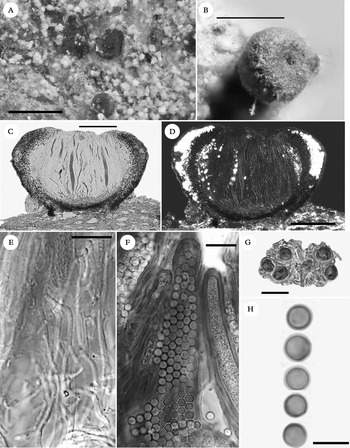
Melanophloea pacifica (Aptroot 36520). A, habit; B, ascoma in surface view; C, ascoma in transverse section; D, ascoma in transverse section with polarized light; E, hamathecium filaments; F, ascus tips; G, photobiont cells; H, ascospores. C, G & H in LCB, E & F in IKI. Scales: A=500 μm; B=200 μm; C & D=100 μm; E–G=10 μm; H=5 μm.

Thallus expanding, of smooth, whitish to green granules 0·05–0·1 mm diam. Algae chlorococcoid, globose, 4·8–6·5 µm diam.
Ascomata pyrenocarpous, wall carbonized throughout, closed below, mostly globose but flattened at the top, 0·15–0·2 mm diam., with preformed ostiole, carbonized wall equally thick in most places, 33–44 µm wide, but thinned towards the ostiole and sometimes thickened in a ring-like zone around the depression towards the ostiole; inside the carbonized wall a thin layer of hyaline cells and, especially towards the top, many polarizing crystals.
Hamathecium K/I+ blue, copious, filaments paraphysoid, anastomosing, c. 1 μm wide, without discernable septa, tips unchanged, not forming an epithecium but ending in the ostiole; periphysis absent.
Asci uniformly thick-walled, up to 160×12 µm, with wall c. 2 μm wide, tip when young with flat and wide ocular chamber, bitunicate. Ascospores >500 per ascus, hyaline, globose, 2·7–3·0 µm diam.
Notes. A detailed investigation of the morphology shows that this is clearly a pyrenocarpous lichen with an ostiole (Fig. 1B) and thick-walled, bitunicate asci (Fig. 1E) that resemble those of members of the Trypetheliaceae when young. The hamathecium consists of strongly anastomosing paraphysoids without septa and is indistinguishable from the hamathecium in many Trypetheliaceae. This species may in fact be quite close to the genus Aptrootia, a genus of three known species (Aptroot Reference Aptroot2009), all known from Australasia, with one extending to the neotropics. The main differences are the polyspory, the simple globose ascospores that remain hyaline, and the chlorococcoid (not trentepohlioid) algae. However, the thallus in the genus Aptrootia is quite variable, and associated algae are even nearly absent in A. terricola (Aptroot) Lücking et al. (Aptroot Reference Aptroot1999; Lücking et al. Reference Lücking, Sipman, Umaña, Chaves and Lumbsch2007). Aptrootia is currently classified in the Trypetheliaceae (Trypetheliales, Dothideomycetes). The genus Melanophloea (of which M. pacifica is the type) is herewith suggested to belong to this family, but the genus Aptrootia is not synonymized with it, as the differences between them seem firm. Moreover, Aptrootia is, in its current circumscription, an ecologically informative taxon, restricted to tropical mountains or wet subtropical lowlands.
Selected additional specimens examined. Papua New Guinea: Madang: foothills of Finisterre Range along road Madang–Lae, 1997, A. Aptroot 36520 (ABL, BR); ibid., 1992, P. Diederich 12149 (ABL, hb. Diederich).—Borneo: Sarawak: Gunong Mulu National Park, 1978, B. J. Coppins 5123 (ABL, E).—Solomon Islands: Kolombangara, 1965, D. J. Hill (BM).
Thelenella americana (K. Knudsen & Lendemer) Aptroot comb. nov.
MycoBank No.: MB563999
Melanophloea americana K. Knudsen & Lendemer in Knudsen, Lendemer & Harris, Opuscula Philolichenum 9: 61 (2011); type: USA, Pennsylvania, Montgomery Co., Pennypack Watershed, on siliceous rock, November 1987, A. Aptroot 21376 (ABL, BR—isotypes) & A. Aptroot 21389 (ABL, BR—isotypes).
Notes on typification. The plate of the new species in the paper by Knudsen et al. depicts the collection Aptroot 21389, which is however not mentioned in the text at all. This collection is an isotype, but only the authors and the collector could know as it is not cited as such. It is illustrated in the original description and the illustration is part of the protologue. It would have been easier to just cite the specimen in the text, and it remains strange that only a duplicate in NY is mentioned as original material; more and larger material is present in ABL and BR. All type specimens examined are enumerated above.
(Fig. 2)
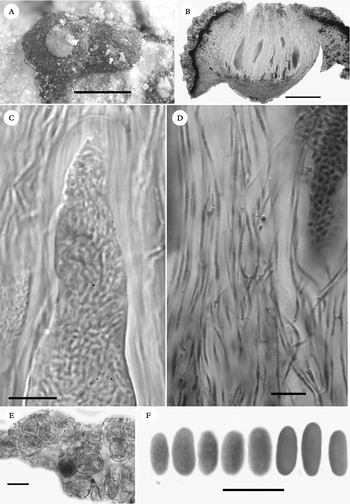
Thelenella americana (Aptroot 21376). A, habit; B, ascoma in transverse section; C, ascus tip; D, hamathecium filaments; E, photobiont cells; F, ascospores. B & D in LCB, C & E in IKI. Scales: A=500 μm; B=100 μm; C–E=10 μm; F=5 μm.

Thallus absent. Algae chlorococcoid, 12 µm diam., angular to ellipsoid, present chiefly inside the inner ascoma wall at the basis of the hymenium.
Ascomata consisting of a hyaline inner wall, surrounded by a black (in section dark brown) pseudostromatic clypeus wall, 15–20 µm wide, that curves inward below, enclosing the alga.
Hamathecium K/I–, copious, filaments paraphysoid, branched, up to 1·2 μm wide, with clearly discernable septa, tips unchanged, not forming an epithecium but ending as a wide ostiole; periphyses absent.
Asci with thickened IKI+ blue tip with round ocular chamber, bitunicate. Ascospores >500 per ascus, hyaline, short cylindrical, 3·3–4·4×1·3–1·5 µm.
Notes. A detailed morphological analysis shows that the overall ascoma shape, ascomal wall, ostiole, ascus, hamathecium and algae are all in perfect accordance with the genus Thelenella (Mayrhofer Reference Mayrhofer1987; Smith et al. Reference Smith, Aptroot, Coppins, Fletcher, Gilbert, James and Wolseley2009), which is currently classified in the Thelenellaceae and belongs to the Ostropomycetidae. It is the first polysporous species in this genus.
Thelenella montana (P. M. McCarthy) Aptroot comb. nov.
MycoBank No.: MB564000
Melanophloea montana P. M. McCarthy, Australasian Lichenology 62: 26 (2008); type: Australia, Queensland, Atherton Tableland, Tully Falls, on siliceous rock, 7 August 2006, P. M. McCarthy 2520 (CANB—holotype n.v.).
Notes. This species was not studied by us, but the beautiful illustrations and detailed decriptions and discussion of the type and only specimen (McCarthy Reference McCarthy2008; McCarthy & Kantvilas Reference McCarthy and Kantvilas2009) leave little doubt that it is close to the previous species. The main difference seems to be that the ascospores are wider and oblong to ellipsoid, and that the algae are also present somewhat higher up in between the inner ascoma wall and the outer wall. It is the second species in the genus Thelenella with polysporous asci.
Thelocarpon nigrum Aptroot & K. H. Moon
in Moon & Aptroot, Bibliotheca Lichenologica 99: 309 (Reference Moon and Aptroot2009); type: Korea, Chungchongbuk-do, Danyang-gun, Youngchun-myun, Backja-ri, around entrance parking area of Guin-sa temple, on tree, 19 May 2007, A. Aptroot 67727 (B—isotype).
Notes. This is without doubt a species of Thelocarpon; it shows all key characters, although it should be noted that the genus Thelocarpon in its present sense is quite variable as to hamathecium characters. It is specifically characterized by the dark green ascoma pigment, which is formed by a mixture of the greenish yellow pigment present in many Thelocarpon species, together with some sparse carbonization. We have not re-examined this species, which is still known only from the type. Just like all other species of Thelocarpon, it has thin-walled, closed perithecia with paraphyses, which in T. nigrum are unbranched and rather wide. It has no close relationships with any of the other species which have been placed in Melanophloea. Thelocarpon is currently classified in the Thelocarpaceae, the position of which within the Pezizomycotina is uncertain.
Discussion
The only characters the abovementioned species have in common are their polyspory, hyaline ascospores and chlorococcoid algae (though all of different sizes and shapes). They do not share, for example, ascoma type, wall colour and texture, branching type of hamathecium filaments or ascus tip morphology. In fact, they could serve as an introduction to the main characters which are useful for distinguishing fungal subclasses with lichenized members, with the four species serving as probable examples of three different groups.
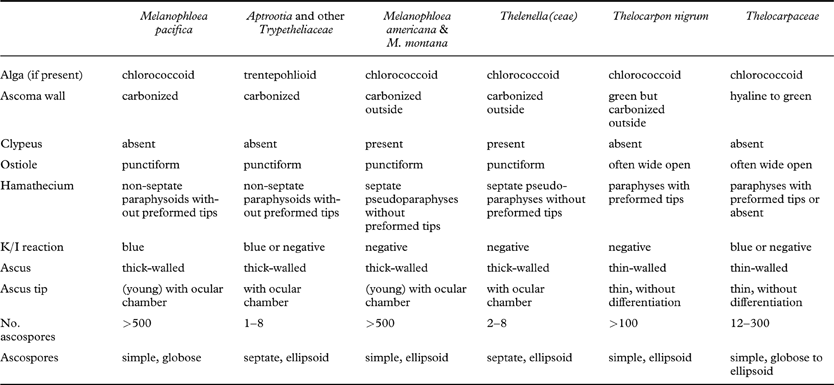
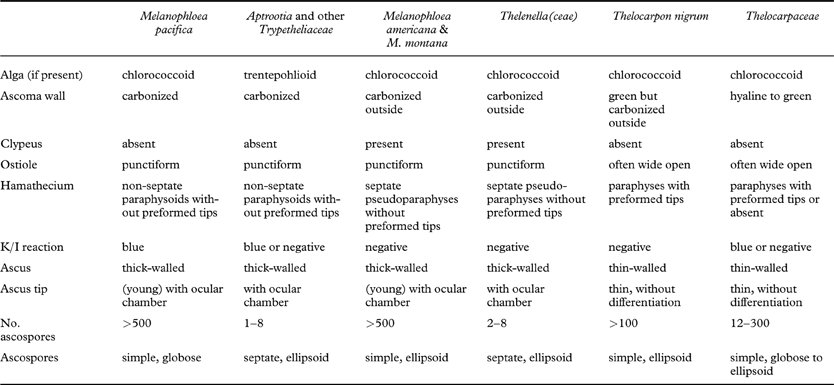
Even so, the classification proposed here is just an alternative hypothesis, based only on morphological comparison. Although it is possible that future work will show that the affinities of the taxa lie elsewhere, it can be safely ruled out that the different species described in Melanophloea are related. There are too many fundamental characters differentiating them. The main taxa under discussion here are listed in Table 1. Listed are the differentiating key characters that are generally rather stable in larger groups. In pyrenocarpous lichens, as in non-lichenized pyrenocarpous ascomycetes, this includes the general ascoma structure (including the presence of ostiole and clypeus), the hamathecium structure (filaments with differentiated apices meaning that they grew only from below or not and their septation) and the ascus structure (uni- or bitunicate, apical structure). The table shows that the main character in which the Melanophloea species differ from the families to which they are suggested to belong in this paper is the polysporous ascus, with the tiny, simple and sometimes globose ascospores as a more or less logical consequence of that single trait. It is impossible to accommodate >500 ascospores in an ascus if they are not at the same time tiny and simple.
Diagnostic characters of Melanophloea species and other lichen taxa discussed in this paper
Polyspory is also probably what has led the respective authors to suppose a taxonomic relatedness of the species described in or referred to Melanophloea. However, only rarely are all members of a higher lichen taxon (up to family level) polysporous. Groups of lichenized ascomycetes with usually polysporous asci are the three families Acarosporaceae, Biatorellaceae and Thelocarpaceae and the genera Arthrosporum, Biatoridium, Lithoglypha, Maronea, Melanophloea s. str., Neoheppia, Piccolia, Placothelium (whatever it may be), Sarcosagium, Sporastatia, Steinia, Strangospora, Thelopsis, Timdalia, Tylophorella, and Wadeana (Martens Reference Martens1937; Aptroot & Tibell Reference Aptroot and Tibell1997; Hafellner & Türk Reference Hafellner and Türk2001; Reeb et al. Reference Reeb, Lutzoni and Roux2004; Ahti et al. Reference Ahti, Jørgensen, Kristinsson, Moberg, Søchting and Thor2007; Lücking Reference Lücking2008; Smith et al. Reference Smith, Aptroot, Coppins, Fletcher, Gilbert, James and Wolseley2009). Often only one or a few members of a certain genus are polysporous. Many accepted lichen genera that largely have 8 ascospores (which is the most common number throughout) in the ascus include one or a few species with more ascospores in the ascus. Such genera are the totally unrelated Anema, Anzia, Buellia, Bulbothrix, Caloplaca, Candelaria, Candelariella, Catillaria, Catinaria, Cryptolechia, Cryptothele, Epigloea, Fellhanera (F. duplex Coppins & Aptroot), Fellhaneropsis, Gyalidea, Lecania, Lecanora, Lecidea s. lat. (e.g. Lecidea dodecamara Müll. Arg., of unknown affinity), Lichinella, Pachyphiale, Peccania, Peltula, Phylliscum, Placidium, Protoparmelia (the species formerly placed in Maronina), Psorotichia, Pterygiopsis, Pyrenopsis, Ramonia, Rinodina, Scoliciosporum, Strigula, Synalissa (genus probably monotypic, but the type species is variably polysporous), Thallinocarpon, Thelenella (with the inclusion of the two species excluded above from Melanophloea), Thelignya, Verrucaria (the species formerly placed in Trimmatothele) and Zahlbrucknerella (Martens Reference Martens1937; Reeb et al. Reference Reeb, Lutzoni and Roux2004; Ahti et al. Reference Ahti, Jørgensen, Kristinsson, Moberg, Søchting and Thor2007; Lücking Reference Lücking2008; Smith et al. Reference Smith, Aptroot, Coppins, Fletcher, Gilbert, James and Wolseley2009; Papong et al. Reference Papong, Kantvilas and Lumbsch2011). Obviously, the occurrence of multispored asci is multi-polyphyletic (Reeb et al. Reference Reeb, Lutzoni and Roux2004), having already originated within the lichenized fungi at least 57 times independently, as each of the above represents at least one separate evolutionary pathway towards multispory. In fact, there must be more than 57 separate origins, as polyspory sometimes occurs in several different, unrelated species within a genus.
The tendency to polyspory can be regarded as convergent evolution. There is obviously an ecological advantage in producing many tiny ascospores, especially when compared to large, muriform ascospores that do not disperse well. Two of the three species of Aptrootia are among the lichens with the largest ascospores known, and are recorded 3rd and 15th on a list of species with the largest ascospores (Sweetwood et al. Reference Sweetwood, Lücking, Nelsen and Aptroot2012). There is no doubt it would be a huge evolutionary advantage if these ascospores (which are nearly 0·5 mm long) dissolved into tiny spores, which seems to have happened and led to the origin of Melanophloea pacifica.
It should also be realized that there is a huge variation in the numbers of ascospores in polysporous asci, which reflects, at least in part, their different origins. Asci with 16, 32 or 64 ascospores are obviously the result of one extra mitotic division, or a premature cleavage of, for example, mature 1-septate ascospores within the ascus. Asci with >1000 tiny ascospores may at least in part result from a totally different phenomenon, the formation of ascoconidia, which can occasionally be observed, especially in tropical taxa with large hyaline muriform ascospores, such as Brigantiaea and Gyalidea (Martens Reference Martens1937; Hafellner & Bellemère Reference Hafellner and Bellemère1981; Aptroot & Lücking Reference Aptroot and Lücking2003). At some stage, often while still in the ascus, these ascospores disintegrate into numerous conidia with shapes and sizes indistinguishable from the elements that are described as the ascospores in Thelenella americana and T. montana.