I. Introduction
The rule of law (RoL) is an age-old political ideal that celebrates the limitation of arbitrary power (Tamanaha Reference Tamanaha2004), but it is also increasingly a transnational industry worth multiple billions of dollars. Bilateral aid donors, international financial institutions, and privately funded nongovernmental organizations all dedicate substantial resources to building the RoL. As part of this enterprise, a transnational network of RoL practitioners and promoters is crystallizing (Rajah Reference Rajah, Halliday and Shaffer2015, 340–73).
Both scholars and policy makers have linked the RoL to various important goals and values, such as promoting justice, improving economic development, building democracy, and increasing international cooperation (Hadfield and Weingast Reference Hadfield and Weingast2014, 22). As the World Justice Project (WJP) notes, “[w]here the rule of law is weak, medicines fail to reach health facilities, criminal violence goes unchecked, laws are applied unequally across societies, and foreign investments are held back” (WJP 2014, 1). Moreover, most scholars and policy makers do not merely regard the RoL as an instrument used to achieve these goals, but also as an end in and of itself (Ginsburg Reference Ginsburg2011, 269–80).
The global effort to build the RoL has been accompanied by the development of numerous indicators that purport to measure the phenomenon. This is hardly surprising, since we live in an age of measurement and quantification, which has produced cross-national indicators on gender equality, war and peace, countries' perceived masculinity and individualism, and gross national happiness, to name just a few (Merry Reference Merry2011). As part of this trend, recent decades have witnessed a proliferation of indicators that purport to capture legal, governance, and institutional quality (Davis Reference Davis2014; Merry forthcoming). By one estimate, there are currently no fewer than 150 different governance indicators (Malik Reference Malik2002, 19; Haggard, MacIntyre, and Tiede Reference Haggard, MacIntyre and Tiede2008, 205, 223). A number of these indicators directly quantify the degree to which the RoL is present in each country.
RoL indicators have been criticized, both individually and collectively, on various grounds (Davis Reference Davis2004, Reference Davis2014, 9; Møller and Skaaning Reference M⊘ller and Skaaning2014; Merry forthcoming). Indicators inherently reduce complex social phenomena to simple measures and thus may mislead. Some indicators measure formal institutions, others measure behavior, while yet others measure beliefs. These differences are not always transparent. Indicators are also subject to various technical problems of aggregation and endogeneity that may not always be clear (Ginsburg Reference Ginsburg2011). While the general problems with RoL indicators are well documented, there has been limited systematic inquiry into what these indicators actually capture and how they map onto underlying normative concepts (exceptions include Haggard, MacIntyre, and Tiede Reference Haggard, MacIntyre and Tiede2008; Skaaning Reference Skaaning2010; Haggard and Tiede Reference Haggard and Tiede2011; Møller and Skaaning Reference M⊘ller and Skaaning2014).
In this contribution, we take up this task and empirically compare and contrast four of the most influential RoL indicators. Specifically, we scrutinize the attempts by the World Bank's World Governance Indicators project (WGI), the Heritage Foundation, Freedom House, and the WJP to quantify the RoL. These are not the only RoL indicators, but they are arguably the most prominent ones.Footnote 1 We show that these four indicators build significantly different substantive values into their definitions of the RoL. The WGI's RoL indicator focuses on the absence of crime and the security of persons and their property, the Heritage Foundation's index emphasizes the protection of private property and the absence of corruption, and Freedom House's indicator focuses primarily on civil liberties and equality. The WJP's index uses the most comprehensive definition, and combines rights, crime and security, the absence of corruption, civil justice, and numerous other features into a single (multidimensional) indicator.
In addition to conceptualizing the RoL differently, the indicators use different coding methodologies. The Heritage Foundation and Freedom House both base their indicators on coding by country experts, whereas the WGI aggregates a range of existing variables into an overall RoL index. The WJP is unique in that it combines assessments from country experts with perceptions of ordinary citizens, based on nationally representative surveys.
Given their disparate conceptual approaches and measurement strategies, one might expect these different RoL indicators to be weakly correlated. Strikingly, however, we find that all four indicators are remarkably similar to each other. The indicators created by the WGI, the Heritage Foundation, and the WJP are almost identical, with their pair-wise correlations all exceeding 0.95. Freedom House's RoL indicator is the only one that produces slightly different values—its correlation with the other measures ranges from 0.79 (with the Heritage Foundation) to 0.83 (with the WJP). Moreover, using factor analysis, we show that a single underlying latent dimension explains 92 percent of the variation in the four RoL indicators.
One could draw the inference from these findings that the four indices indeed capture the essence of the RoL and that the observed similarities suggest that they are all valid proxies of the underlying concept. If so, it would follow that, despite substantial theoretical disagreement over how to define the concept, the RoL is something that “you know when you see it” (to borrow Justice Potter Stewart's famous description of obscene images—Jacobellis v. Ohio 1964: Stewart, J, concurring). Yet, the stark differences in conceptualization and measurement raise considerable doubts about whether this is the case.
We therefore explore two alternative explanations for the convergence between the indicators. First, we explore whether the indicators capture something discrete by contrasting them with a number of neighboring concepts, such as democracy, human rights, judicial independence, constitutionalism, and corruption. Remarkably, we find that the three RoL indicators that are nearly identical to each other are also nearly identical to Transparency International's (TI's) Corruption Perceptions Index (with the correlation between each of these three and TI's index all exceeding 0.95). By contrast, the indices are less similar to indicators of human rights, democracy, constitutionalism, judicial independence, and GDP per capita. We speculate that the main theoretical link between perceptions of corruption and the RoL indicators is that they both capture the impartiality of government. At the same time, the conceptual link between these two concepts does not explain why the substantive differences in RoL conceptualization fade out in RoL measurement.
Consequently, we explore a second set of more technical explanations that emphasize the role of experts and information constraints. All the RoL indicators are perception-based measures created by experts who rely on a limited set of information sources, including each other's assessments and past scores. The only exception is the WJP indicator, which also brings in popular perceptions of the RoL. We find that when we disaggregate the expert and population components of the WJP data, the country scores differ substantially from each other, especially regarding openness of government and civil justice. These discrepancies suggest that the similarities between the different RoL indicators and their similarity with the corruption indicator might result from the reliance on experts and the procedures they use to quantify the RoL.
We suggest that these two explanations might work together. Experts who rate the RoL utilize a limited set of resources and lack deep experience of the various environments in which the RoL operates. They may rely on an overall impression of the country's administration, which reduces the importance of definitional disagreements. The larger lesson, we conclude, is that measurement strategy, rather than conceptualization, seems to be the dominant factor shaping current RoL indicators.
Our study builds on and extends earlier studies that also explored similarities among RoL indicators (Haggard, MacIntyre, and Tiede Reference Haggard, MacIntyre and Tiede2008; Skaaning Reference Skaaning2010; Haggard and Tiede Reference Haggard and Tiede2011; Møller and Skaaning Reference M⊘ller and Skaaning2011, Reference M⊘ller and Skaaning2014). Notably, the findings from these studies are different from ours. Møller and Skaaning (Reference M⊘ller and Skaaning2014, 66), for example, observe that “the empirical convergence of the rule of law indices is relatively low.” Haggard, MacIntyre, and Tiede (Reference Haggard, MacIntyre and Tiede2008, 222) and Haggard and Tiede (2011, 673) reach similar conclusions and emphasize the differences between different RoL components. These different findings likely result from a different selection of indicators. Specifically, none of these studies include the aggregate WJPFootnote 2 indicator or the Heritage Foundation's RoL indicators. In addition, these studies include a number of measures that do not explicitly purport to capture RoL. Møller and Skaaning (Reference M⊘ller and Skaaning2014), for example, use the Fraser Institute's Legal System and Property Rights Index, Polity IV's Executive Constraints Index, and the Political Risk Services Group's Law and Order Index. Haggard, MacIntyre, and Tiede (Reference Haggard, MacIntyre and Tiede2008) and Haggard and Tiede (2011) likewise use a range of institutional indicators that are often seen as components of the RoL, but do not purport to capture RoL directly. Our study, by contrast, focuses only on what we believe to be the four most prominent RoL indicators. Unlike previous studies, we not only find that the indicators are remarkably similar, but also find a discrepancy between expert assessments and popular assessments of the RoL.
The remainder of this contribution proceeds as follows. Section II describes the challenges in measuring the RoL at the level of conceptualization. Section III compares the four different RoL indicators to each other. Section IV explores how these RoL indicators relate to neighboring concepts. Section V offers some potential explanations for the observed similarities and contrasts expert assessments of the RoL with the RoL perceptions of the general public. Section VI concludes.
II. Conceptualizing the Role
One of the underappreciated challenges in measuring the rule of law is in conceptualization (Ginsburg Reference Ginsburg2011). Conceptualization requires formulating the object of inquiry at a high level of abstraction (Gerring Reference Gerring2001, 54; Goertz Reference Goertz2006, 28). As one of us (Ginsburg Reference Ginsburg2011) has summarized the work of Gerring (Reference Gerring2001, 40): “A good social science concept has several features, including coherence, parsimony, and utility. It should be relatively clear and bounded from neighboring concepts; it should be relatively parsimonious; susceptible in principle to measurement; and capable of being deployed within research designs.”
Conceptualization is especially challenging for measuring the RoL because there is no single, well-accepted definition in the theoretical literature. In this section, we briefly survey the different ways in which RoL is conceptualized in the theoretical literature and how these conceptualizations are operationalized in the RoL indicators.
A. RoL Theories
The theoretical literature does not offer a single definition of the RoL and is characterized by substantial conceptual confusion (Rodriguez, McCubbins, and Weingast Reference Rodriguez, McCubbins and Weingast2010, 1455–94). A recent review of the literature concludes that the RoL is undertheorized and that most practitioners and many scholars take the concept for granted, “equating it with the institutions and practices in those (relatively few) parts of the world where the rule of law has been largely achieved” (Hadfield and Weingast Reference Hadfield and Weingast2014, 22). Another group of scholars has criticized the idea that the RoL entails a set of institutional prescriptions. They argue that the RoL is necessarily culturally contingent, dependent on time and place, and that transplanting Western institutions in the name of RoL is bound to fail (Berkowitz, Pistor, and Richard Reference Berkowitz, Pistor and Richard2003; Brooks Reference Brooks2003; Tamanaha Reference Tamanaha2011, 209–47; Hadfield and Weingast Reference Hadfield and Weingast2014, 27). According to these scholars, a single definition of the RoL may not exist.
Another important source of contention is whether the RoL is a “thin,” formal, and procedural concept or a “thick” concept that builds in certain substantive values. The thin version of the RoL is commonly associated with Lon Fuller's classic definition, which stipulates eight procedural requirements for the RoL (Fuller Reference Fuller1969, 33–39; Rodriguez, McCubbins, and Weingast 2010, 1466–67):
-
1. Generality, that is, conduct is stated in rules that are impartially applied;
-
2. Publicity, that is, rules are publicly announced;
-
3. Prospectivity, that is, rules will not be changed retroactively;
-
4. Clarity, that is, rules are understandable for all;
-
5. Consistency, that is, rules are not inconsistent or contradictory;
-
6. Possibility of compliance, that is, no rules can demand conduct that is beyond the ability of those to whom they apply;
-
7. Stability, that is, rules are stable and not subject to frequent change;
-
8. Congruence between the rules as announced and their actual administration.
Fuller's version is thin because it makes no demand that the laws that are produced are good laws in any substantive sense. Numerous legal theorists have since built on this definition, adding further procedural and/or functional elements to his list. For example, scholars have singled out judicial independence and judicial review as further functional components of the RoL. Joseph Raz notes that “[s]ince just about any matter arising under any law can be subject to a conclusive court judgment, it is obvious that it is futile to guide one's action on the basis of the law if when the matter comes to adjudication the courts will not apply the law and will act for some other reasons” (Raz Reference Raz and Raz1979, 227). Despite these relatively minor disagreements, however, Fuller's definition remains the canonical definition of the thin or formal version of the RoL.
While the thin definition of the RoL is relatively uncontroversial, substantial disagreement exists over whether the RoL should include one or more substantive values and, if so, which ones (Rodriguez, McCubbins, and Weingast 2010, 1469). Some theorists have argued that the formal definition allows for what is sometimes called rule by law, in which the government is not genuinely constrained so long as it follows the formal requirements of the law. According to this view, true RoL requires some thicker content. Friedrich Hayek, for example, has suggested that the RoL “includes the recognition of the inalienable, individual right of man” (Hayek Reference Hayek1944, 63). As another example, Ronald Dworkin has argued that the RoL is not merely a rulebook, but that the concept is necessarily substantive and includes equality and rights (Rodriguez, McCubbins, and Weingast Reference Rodriguez, McCubbins and Weingast2010, 1470). Many other theorists have similarly added various substantive values to the definition of the RoL. Indeed, it may be exactly this indeterminacy that makes RoL an appealing concept. Rodriguez and coauthors write that the “[r]ule of law is an attractive ideal, but its attractiveness may stem mainly from its imprecision, which allows each of us to project our own sense of the ideal government onto the phrase rule of law” (Rodriguez, McCubbins, and Weingast Reference Rodriguez, McCubbins and Weingast2010, 1458; Ginsburg Reference Ginsburg2011).
Once substantive values are built into the rule of law, it necessarily becomes more contested. Let us take the example of human rights. Among the various substantive values that theorists have sought to incorporate into the RoL, respect for basic human rights is probably the most common.Footnote 3 It is perhaps also the least controversial, since the international community has articulated a set of human rights norms that are generally perceived as universal and may even have the status of jus cogens norms in international law (i.e., they are peremptory norms from which no deviation is permitted). Yet even these seemingly universal rights norms are surrounded by controversy: the universalist premise in human rights law has been criticized as an imposition of Western values on countries that purportedly prefer communal values and/or economic progress over individual liberties (Emmerson Reference Emmerson1995; Bauer and Bell Reference Bauer and Bell1999). Indeed, the somewhat tired debate over cultural relativism in international human rights law demonstrates how including substantive values in the definition of RoL opens it up to contestation.
What is more, incorporating substantive values makes the concept of the RoL harder to separate from neighboring concepts. Take again the example of human rights. A version of the RoL that includes human rights is hard to separate from the concept of human rights itself, especially since principles such as fair trial, access to justice, and a prohibition of retroactive laws are core human rights under international law. Indeed, as Joseph Raz has argued, once the notion of RoL is taken to mean the “rule of good law, then to explain its nature is to propound a complete social philosophy” with the result that “the term lacks any useful function” (Raz Reference Raz and Raz1979, 211). In other words, once substantive values are incorporated into the RoL, the concept becomes synonymous with those values and might lose analytical value on its own.
B. The Concepts Behind RoL Indicators
The same conceptual confusion that permeates the RoL literature also affects the various indicators that purport to measure the RoL (Møller and Skaaning Reference M⊘ller and Skaaning2011). Although all indicators appear to start from the core formalist ideal that contrasts the rule of law with the “rule of man” (to paraphrase John Adams's famous description of the RoL from the Massachusetts Constitution), they each add different substantive values, such as the absence of crime, human rights, substantive equality, the security of private contracts, and property rights. Indeed, not a single pair of the four indicators reviewed in this contribution defines the RoL in the same way. Of course, this diversity is unsurprising given the disagreements in the theoretical literature.
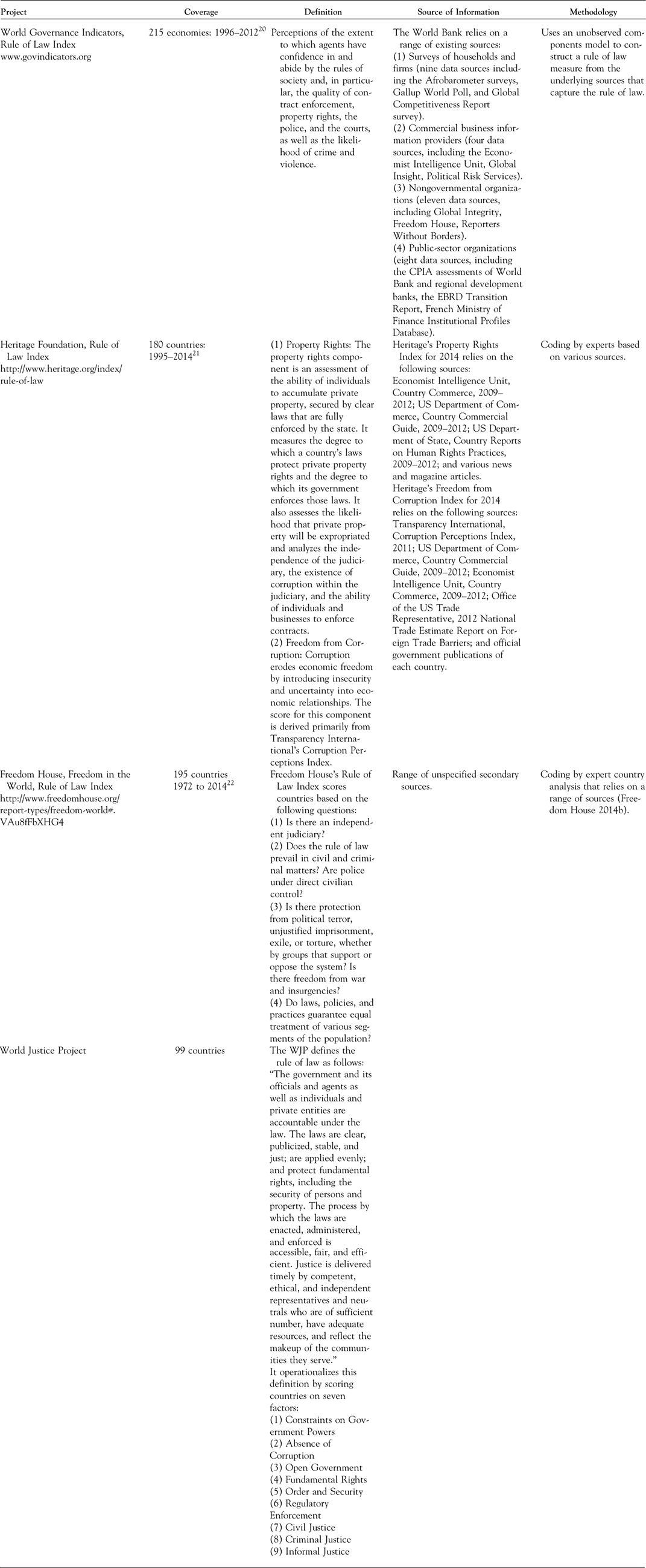
The World Bank RoL Index is probably the most well-known and most commonly used in social science research (Kaufmann, Kraay, and Mastruzzi Reference Kaufmann, Kraay and Mastruzzi2010). There is a growing consensus within the World Bank that the viability of investment and long-run economic growth depends on good governance and the quality of legal and political institutions, which caused the World Bank to start measuring RoL in the 1990s. The World Bank's RoL Index is part of a larger project, the WGI (World Bank 2014), which produces a number of indicators that capture different dimensions of good governance and are widely used by social scientists.Footnote 4 According to the World Bank, its RoL indicator captures “perceptions of the extent to which agents have confidence in and abide by the rules of society, and in particular the quality of contract enforcement, property rights, the police, and the courts, as well as the likelihood of crime and violence” (Kaufmann, Kraay, and Mastruzzi Reference Kaufmann, Kraay and Mastruzzi2010).Footnote 5 This definition demonstrates that the WGI's indicator not only includes procedural elements (e.g., whether “agents have confidence in and abide by the rules of society”) but also adds substantive concepts (e.g., security of property and private contracts). As Ginsburg previously argued, the WGI's indicator “conflates many different notions into a single concept, including both crime and contract enforcement in the same framework” (Ginsburg Reference Ginsburg2011, 271; see also Kurtz and Schrank Reference Kurtz and Schrank2007). Likewise, Thomas notes that the WGI's indicator lacks “content validity—it does not map onto a definition of the rule of law” (Thomas Reference Thomas2010, 40). Indeed, the World Bank's indicator is not only the most widely used, it is also the most heavily criticized. Appendix 1 provides more detailed information on the WGI's RoL Index.
The Heritage Foundation, a conservative US think tank, has constructed another prominent RoL index. The mission of the Heritage Foundation is to “formulate and promote conservative public policies based on the principles of free enterprise, limited government, individual freedom, traditional American values, and a strong national defense” (Heritage Foundation 2014a). The Heritage Foundation views the RoL as one of the four core economic freedoms, together with limited government, regulatory efficiency, and open markets. Compared to the WGI's indicator, the Heritage Foundation's RoL index is less focused on crime and personal security; instead, it focuses on property rights and the absence of corruption. The index assesses some formal components, such as “the independence of the judiciary, the existence of corruption within the judiciary, and the ability of individuals and businesses to enforce contracts” (Heritage Foundation 2014c). In addition, the index combines information on the security of private property rights, “the ability of individuals to accumulate private property, secured by clear laws that are fully enforced by the state,” with information on the absence of corruption. Thus, like the WGI's indicator, the Heritage Foundation's index builds substantive values into its RoL definition, albeit different ones. Appendix 1 provides more information on the Heritage Foundation's index.
Freedom House, a US-based nongovernmental organization “dedicated to the expansion of freedom around the world,” produces a third RoL measure. As part of its mission, Freedom House “speaks out against the main threats to democracy and empowers citizens to exercise their fundamental rights” and analyzes “the challenges to freedom; advocate[s] for greater political and civil liberties; and support[s] frontline activists to defend human rights and promote democratic change” (Freedom House 2014a). Unlike the World Bank and the Heritage Foundation, the Freedom House conceptualization of the RoL is heavily focused on human rights. Freedom House assigns numerical RoL scores to countries based on the following questions:
-
1. Is there an independent judiciary?
-
2. Does the rule of law prevail in civil and criminal matters? Are police under direct civilian control?
-
3. Is there protection from political terror, unjustified imprisonment, exile, or torture, whether by groups that support or oppose the system? Is there freedom from war and insurgencies?
-
4. Do laws, policies, and practices guarantee equal treatment of various segments of the population?
Like the definitions provided by the WGI and the Heritage Foundation, Freedom House's definition combines procedural elements (such as an independent judiciary and absence of abuse by state agents) with substantive elements (such as civil liberties, bodily integrity, and substantive equality). These substantive values appear to constitute at least half the information on which Freedom House bases its country scores. Unlike the WGI and the Heritage Foundation, however, the Freedom House Index does not capture the protection of private property rights or the security of private contracts. Appendix 1 provides further information on the Freedom House RoL index.
A more recent initiative in measuring the RoL comes from the WJP. The WJP is a nongovernmental organization founded with the mission “to advance the rule of law around the world,” based on the idea that “the rule of law provides the foundation for communities of opportunity and equity—communities that offer sustainable economic development, accountable government, and respect for fundamental rights” (WJP 2014, 1). Since the WJP's main goal is to promote the RoL, it is perhaps not surprising that its RoL indicator is by far the most ambitious effort to measure the rule of law globally. According to the WJP, its indicator “builds on years of development, intensive consultation, and vetting with academics, practitioners, and community leaders from over 100 countries and 17 professional disciplines” (WJP 2014, 1). The rule of law concept captured by the indicator is also the most comprehensive. The WJP (2014, 1) defines the RoL as follows:
The government and its officials and agents as well as individuals and private entities are accountable under the law. The laws are clear, publicized, stable, and just; are applied evenly; and protect fundamental rights, including the security of persons and property. The process by which the laws are enacted, administered, and enforced is accessible, fair, and efficient. Justice is delivered timely by competent, ethical, and independent representatives and neutrals who are of sufficient number, have adequate resources, and reflect the makeup of the communities they serve.
To provide further clarity to this definition, it scores countries on nine separate factors: (1) constraints on government powers, (2) absence of corruption, (3) open government, (4) fundamental rights, (5) order and security, (6) regulatory enforcement, (7) civil justice, (8) criminal justice, and (9) informal justice (note, however, that the last component is not part of the published index).
Each of these nine factors has subdimensions, producing a total of forty-seven subdimensions (see Appendix 2 for a complete listing). As this long list demonstrates, the WJP's index combines almost all the substantive values that also feature in the other RoL indicators (WJP 2014, 8). In addition, it adds a range of features not found in any of the other indicators. The WJP notes that its conceptualization of the RoL represents “an effort to strike a balance between what scholars call a ‘thin’ or minimalist conception of the rule of law that focuses on formal, procedural rules and a ‘thick’ conception that includes substantive characteristics, such as self-government and various fundamental rights and freedoms” (WJP 2014, 5). Despite an effort to strike a balance, the WJP's RoL index arguably adopts the thickest conception of the RoL among the four RoL indicators. But it also has the distinct advantage of being modular: because there are forty-seven different dimensions, scholars can aggregate the data in different ways in accordance with their own definitions of the rule of law.Footnote 6
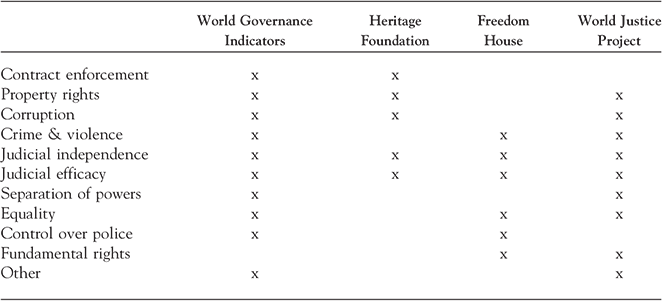
Table 1 offers a more systematic comparison of how the four RoL indicators overlap and differ. Specifically, it offers an overview of all components that are found in at least two of the four RoL indicators. Ten such components were identified. (Appendix 3 provides more detailed information on how these components are operationalized in the indicators in which they appear.) Table 1 reveals that even when we concentrate on the components for which the indicators overlap, their emphases differ substantially.
Overview of Similarities and Differences Between Four RoL Indicators

| World Governance Indicators | Heritage Foundation | Freedom House | World Justice Project | |
|---|---|---|---|---|
| Contract enforcement | x | x | ||
| Property rights | x | x | x | |
| Corruption | x | x | x | |
| Crime & violence | x | x | x | |
| Judicial independence | x | x | x | x |
| Judicial efficacy | x | x | x | x |
| Separation of powers | x | x | ||
| Equality | x | x | x | |
| Control over police | x | x | ||
| Fundamental rights | x | x | ||
| Other | x | x |
At first glance, the WGI and WJP indicators appear to have considerable substantive overlap with the other RoL indicators. The WGI RoL indicator overlaps with at least one other indicator on all but one of the ten components (fundamental rights), and the WJP's RoL index overlaps with one or more indicators on all but two components (contract enforcement and control over the police). Importantly, however, both the WGI and WJP RoL indicators add a range of features not found in any of the other indicators. These more idiosyncratic features (listed in more detail under the category “other” in Appendix 3) include the right to petition government, the prevalence of tax evasion, administrative efficiency, the prevalence of human trafficking, the size of the parallel economy, popular observance of the law, and the degree to which official information is available on request. Table 1 also reveals that the Heritage Foundation and Freedom House indicators have a more distinctive focus. The Heritage Foundation's index overlaps with one or more indicators on only five of the ten components, and Freedom House's index overlaps with at least one indicator on six of the ten components. Notably, they are almost exact opposites of each other—Freedom House and the Heritage Foundation only overlap on judicial independence and judicial efficacy. Overall, there are substantial differences in the way the different indicators conceptualize the RoL.
C. Approaches to Measurement
In addition to defining the RoL differently, the four RoL indices use different methodologies to create their country scores. Two of the indicators—the Heritage Foundation and Freedom House—rely almost exclusively on country experts. Freedom House relies on “in-house and external analysts and expert advisers from the academic, think tank, and human rights communities” (Freedom House 2014b). According to Freedom House, “60 analysts and nearly 30 advisors” compiled its 2014 scores (Freedom House 2014b). These analysts and advisors draft country reports based on a wide range of sources, such as “news articles, academic analyses, reports from nongovernmental organizations, and individual professional contacts” (Freedom House 2014b).
The Heritage Foundation also significantly relies on expert assessments to assign country scores. Specifically, the property rights component of the RoL score is based on expert coding done by the Heritage Foundation itself. In constructing its property rights index, the Heritage Foundation relies on a standardized set of sources. For example, it based the 2014 index on (1) the Economist Intelligence Unit, Country Commerce, 2009–2012; (2) the US Department of Commerce, Country Commercial Guide, 2009–2012; (3) the US Department of State, Country Reports on Human Rights Practices, 2009–2012; and (4) various news and magazine articles (Heritage Foundation 2014c). These sources are consulted in the order they are listed, which means that the Economist Intelligence Unit's country commerce reports are the primary source. The corruption component of the Heritage Foundation's RoL index also appears to be primarily drawn from secondary expert-based sources, most notably TI's Corruption Perceptions Index.Footnote 7
The WGI indicator is different from the Freedom House and Heritage Foundation measures in that it does not directly rely on experts to assign RoL country scores; rather, it aggregates information from thirty-two existing variables into a single rule of law indicator. To do so, the WGI indicator uses an unobserved components model to create a measure that presumably captures the unobserved level of the rule of law that explains the joint variation in the thirty-two variables included in the model.Footnote 8 The variables included in the model vary considerably in their focus, but, according to the WGI's creators, all bear some connection to the RoL. They include measures of personal security and crime, the enforcement of contract and property rights, the prevalence of human trafficking, and the frequency of tax invasion, among many others (for a critique see, Arndt and Oman Reference Arndt and Oman2006, 51; Møller and Skaaning Reference M⊘ller and Skaaning2011, 49). The WGI indicator gives more weight to those variables that fit better within the underlying RoL component, thus reducing the importance of those variables less related to the RoL.
The Heritage Foundation, Freedom House, and WGI all ultimately rely on expert assessments of the RoL (the WGI indirectly relies on expert opinion by using existing variables that are based on expert coding). The WJP is more empirically ambitious than the other three initiatives. In contrast to the other indicators, the WJP supplements expert opinion with original and nationally representative household surveys for each country. Specifically, the WJP explains that its index is “constructed from over five hundred variables drawn from two novel data sources collected by the World Justice Project in each country: (1) a general population poll (GPP) conducted by leading local polling companies using a representative sample of 1000 respondents in the three largest cities; and (2) qualified respondents' questionnaires (QRQ) consisting of close-ended questions completed by in-country practitioners and academics with expertise in civil and commercial law, criminal justice, labor law and public health.” One might expect that this comprehensive approach would make the WJP's index significantly different from the other RoL indicators that rely only on expert judgment. However, it appears that the population-based questions ultimately play a small part in the overall indicator. We return to this issue in Section V.
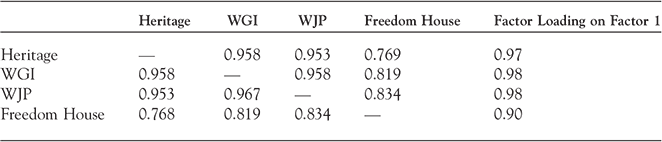
Pair-Wise Correlations of Four RoL Indicators
| Heritage | WGI | WJP | Freedom House | Factor Loading on Factor 1 | |
|---|---|---|---|---|---|
| Heritage | — | 0.958 | 0.953 | 0.769 | 0.97 |
| WGI | 0.958 | — | 0.958 | 0.819 | 0.98 |
| WJP | 0.953 | 0.967 | — | 0.834 | 0.98 |
| Freedom House | 0.768 | 0.819 | 0.834 | — | 0.90 |
III. An Empirical Comparison of RoL Indicators
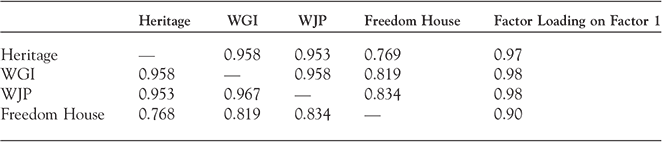
Since the RoL indicators by the Heritage Foundation, WGI, WJP, and Freedom House conceptualize the RoL differently and rely on different methods to score individual countries, one would expect to find that these indicators are only weakly correlated (Møller and Skaaning Reference M⊘ller and Skaaning2011). To our surprise, however, the four indicators turn out to be remarkably similar. Table 2 presents the pair-wise correlations between the four RoL indicators. The numbers are based on the last available year for each indicator (2012 for the WGI and 2014 for the other indicators).Footnote 9 The table reveals that the indicators compiled by the Heritage Foundation, WGI, and WJP are almost identical to each other, with their pair-wise correlations ranging between 0.953 and 0.967. The only distinct indicator is Freedom House's index—its correlation with the others ranges from 0.789 (with Heritage RoL) to 0.834 (with WJP RoL). While these correlations are still quite high, they show that Freedom House's RoL index is different from the other three.
To gauge the extent of the similarity of the three most similar RoL indicators, it is illuminating to compare our findings to a similar study on democracy indicators. Casper and Tufis systematically compare three democracy indicators, which they selected because they are widely used in the literature and, more importantly, they all start from Dahl's canonical definition of democracy (Casper and Tufis Reference Casper and Tufis2003, 197). These democracy indicators thus exhibit far greater conceptual agreement than the RoL indicators. Nevertheless, the pair-wise correlations among the democracy indicators, which range from 0.85 to 0.92, are actually lower than those of the RoL indicators (Casper and Tufis Reference Casper and Tufis2003, 197). None of these democracy indicators have the extreme correlations exceeding 0.95 that we observe for the Heritage Foundation, WJP, and WGI (whose definitions, as we have seen, vary wildly).
To explore the similarity among the four RoL indices further, we performed a principal component factor analysis, a data-reduction technique that allows researchers to reduce a larger number of variables to a lower number and to reveal the simplified structure that underlies these variables (see also Skaaning Reference Skaaning2010). When performing principal component analysis with a varimax rotation, we find that a single underlying factor with an eigenvalue of 3.7 explains 92 percent of the variation in the four indices. The factor loadings, which indicate how each variable is weighted on this factor, are 0.98 for WGI, 0.98 for WJP, 0.97 for the Heritage Foundation, and 0.90 for Freedom House. If we perform principal factor analysis instead of principal component analysis, the first factor explains up to 95 percent of all variation in the four variables. This further confirms that the different RoL indices are very similar, if not almost identical, to one another.
The finding that the Heritage Foundation, WGI, and WJP RoL indices are largely identical to each other poses a puzzle: Why do these three indicators, with such different conceptualizations of the RoL and dissimilar measurement strategies, come up with similar country assessments? In theory, this could occur because all four indicators capture the essence of the RoL, notwithstanding definitional distinctions. In other words, a clear definition is not needed to identify whether or not a country possesses the RoL. As a result, when different organizations with divergent conceptualizations of the RoL set out to quantify the RoL, their judgments are largely identical. Yet, considering the stark differences in both conceptualization and measurement, we believe that further exploration is required before we can draw such a conclusion. The next sections engage in such an exploration.
IV. The Rule of Law and Neighboring Concepts
A number of alternative explanations exist for the remarkable convergence between the four RoL indicators. First, it is possible that the RoL indicators do not capture something discrete and are indistinguishable from related concepts such as democracy or human rights. Second, the convergence between the indicators might be driven by information constraints and practical obstacles faced by experts measuring the RoL. The idea here is that the stark differences in conceptualization fade out when measuring the RoL because the experts tasked with quantifying the RoL rely on a limited set of sources, possibly including each other's assessments and past impressions. These two explanations are, of course, related: information constraints might produce indicators that fail to capture something distinct. We nonetheless believe that it is useful to explore these explanations separately in order to gradually rule out different possibilities. The remainder of this section explores the first explanation, while the next section explores the second explanation.
To explore whether the RoL indicators capture something distinct, we compare them with measures of a number of related concepts. As noted, one of main challenges in measuring the RoL is to define it in such a way that it is distinguishable from such neighboring concepts (Ginsburg Reference Ginsburg2011). If the RoL is discrete and can be captured by the RoL indicators, then they should be distinct from indicators that capture neighboring concepts. However, if the RoL is defined so broadly that it incorporates a whole range of other values, such as democracy and human rights, it might become indistinguishable from those values. A related possible cause for convergence is measurement error caused by coders' impressions of the neighboring concepts. Indeed, the WGI's governance indicators have been criticized for suffering from a “halo effect,” meaning that general perceptions of economic and social development lead to higher governance scores (Kurtz and Schrank Reference Kurtz and Schrank2007; Kaufmann, Kraay, and Mastruzzi Reference Kaufmann, Kraay and Mastruzzi2010, 15). Similar halo effects could also make the RoL indicators harder to separate from related measures of countries' social and economic performance.
To explore the empirical validity of these explanations, we compare and contrast the four RoL measures with several related concepts: (1) democracy, (2) human rights, (3) constitutionalism, (4) judicial independence, (5) GDP per capita, and (6) corruption. We find that, in general, the RoL indicators appear to capture something distinct. They are only loosely correlated with democracy, human rights, constitutionalism, judicial independence, and GDP per capita. This means that the convergence between the indicators does not simply result from poor conceptualization or a halo effect. The notable exception, however, is corruption. Specifically, we find that the indicators by the Heritage Foundation, WGI, and WJP are largely identical to TI's Corruption Perceptions Index. This raises the question of whether the RoL indicators capture corruption rather than the RoL or perhaps a more general concept of government impartiality that encompasses both corruption and RoL.
A. The RoL and Democracy
A first related but distinct concept to which we compare the RoL indicators is democracy. RoL theorists do not generally suggest that democracy is part of the RoL, and none of the four RoL indices explicitly incorporate democracy into their definitions of the RoL. Indeed, it has been suggested that the RoL is frequently in tension with democracy (Tamanaha Reference Tamanaha2008). At the same time, some of the indicators include institutional features, such as checks and balances and judicial independence, which are closely related to democracy (and sometimes even considered to be part of it). To explore the relationship between the RoL and democracy, we used the polity2 variable from the Polity IV data project (Marshall, Gurr, and Jaggers Reference Marshall, Gurr and Jaggers2014). This variable combines information on the competitiveness and openness of executive recruitment, constraints on the executive, regulation of political participation, and the competitiveness of political participation into a single numerical indicator that ranges from −10 (most autocratic) to 10 (most democratic) (Marshall, Gurr, and Jaggers Reference Marshall, Gurr and Jaggers2014, 15–17). The polity2 indicator is widely used in the quantitative political science literature.
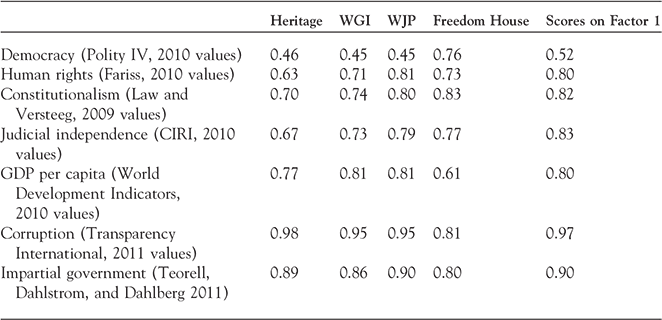
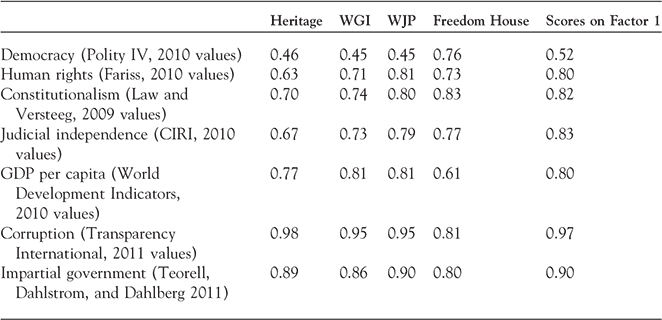
Table 3 lists the pair-wise correlations of each of the four RoL indicators with democracy. It also lists the correlation between democracy and countries' factor scores on the first factor as obtained through our principal component analysis. The results in Table 3 reveal that the correlation between democracy and the RoL is consistently positive (ranging between 0.45 and 0.76), but not nearly high enough to conclude that the democracy and RoL indices capture the same thing. The indicator that is most strongly correlated with democracy is that of Freedom House (correlation 0.76). This is unsurprising considering that Freedom House's primary mission is to promote democracy around the world, which plausibly affects its conceptualization and assessment of the RoL.Footnote 10
Relationship of RoL with Neighboring Concepts
| Heritage | WGI | WJP | Freedom House | Scores on Factor 1 | |
|---|---|---|---|---|---|
| Democracy (Polity IV, 2010 values) | 0.46 | 0.45 | 0.45 | 0.76 | 0.52 |
| Human rights (Fariss, 2010 values) | 0.63 | 0.71 | 0.81 | 0.73 | 0.80 |
| Constitutionalism (Law and Versteeg, 2009 values) | 0.70 | 0.74 | 0.80 | 0.83 | 0.82 |
| Judicial independence (CIRI, 2010 values) | 0.67 | 0.73 | 0.79 | 0.77 | 0.83 |
| GDP per capita (World Development Indicators, 2010 values) | 0.77 | 0.81 | 0.81 | 0.61 | 0.80 |
| Corruption (Transparency International, 2011 values) | 0.98 | 0.95 | 0.95 | 0.81 | 0.97 |
| Impartial government (Teorell, Dahlstrom, and Dahlberg Reference Teorell, Dahlström and Dahlberg2011) | 0.89 | 0.86 | 0.90 | 0.80 | 0.90 |
B. The RoL and Human Rights
A second concept that is related to, but distinct from, the RoL is human rights. Although human rights are not part of Lon Fuller's procedural definition of the RoL, subsequent theorists have often suggested that respect for basic rights is a crucial component of the RoL. Indeed, both the WJP and Freedom House indicators explicitly include human rights in their definitions of the RoL. To compare the four RoL indicators with human rights, we rely on a new indicator created by Christopher Fariss, which is currently considered the gold standard in the quantitative human rights literature (Chilton and Versteeg forthcoming). Fariss's measure combines information from multiple existing human rights indicators, which are primarily based on the quantitative coding of the US State Department's and Amnesty International's annual country reports on human rights. In contrast to these other human rights indicators, Fariss's data are corrected to account for changes in the way the US State Department and Amnesty International report information on human rights abuses. His resulting indicator captures respect for basic physical integrity rights, such as the absence of torture, arbitrary arrests and detention, and extrajudicial killings (Fariss Reference Fariss2014, 297–318).Footnote 11
Table 3 lists the pair-wise correlations between Fariss's human rights indicator, the RoL indicators, and countries' factor scores on the first factor. It reveals that the RoL is more closely related to human rights than democracy, but that the RoL and human rights indicators are not identical. The WJP's RoL index (0.81) is the most closely related to human rights, followed by Freedom House (0.73), the World Bank (0.71) and the Heritage Foundation (0.63). The fact that the WJP and Freedom House indices are most strongly correlated with RoL is not surprising considering that they explicitly build respect for human rights into their definitions of the RoL.
C. The RoL and Constitutionalism
A third concept related to the RoL is constitutionalism. Constitutionalism is perhaps as complicated a concept as the RoL. Many theorists have imported various substantive values into the idea of constitutionalism. In a thin version of the concept, though, constitutionalism is arguably just the degree to which a country upholds its constitutional promises, regardless of what these promises are and whether other promises should have been included (Hardin Reference Hardin, Galligan and Versteeg2013). Such a thin version of constitutionalism shares some similarities with Lon Fuller's conception of the RoL, especially his notion of congruence. One measure that arguably captures the thin version of constitutionalism is Law and Versteeg's Constitutional Performance Index. Their index captures how many out of fifteen possible rights that are promised in the constitution are actually upheld in practice (Law and Versteeg Reference Law and Versteeg2013, 863–951). It does so by contrasting the presence of fifteen de jure rights provisions with the actual realization of these same fifteen rights de facto. The result is a measure of constitutional congruence, which captures the proportion of rights promised in the constitution that is upheld in practice (Law and Versteeg Reference Law and Versteeg2013).
Table 3 presents the correlations between the Constitutional Performance Index, the four RoL indicators, and the factor scores on the first factor. It reveals that constitutionalism is fairly closely correlated with RoL (with the correlations roughly in the same range as the human rights indicator, ranging between 0.70 and 0.83), though not close enough for the two to be characterized as capturing the same thing. The closest correlation between constitutionalism and the RoL is with the Freedom House index (0.83), which is perhaps not surprising given that Freedom House's definition emphasizes judicial independence and respect for rights more than the other indicators.
D. The RoL and Judicial Independence
A fourth concept that is related to the RoL is judicial independence. As noted, judicial independence was not part of Lon Fuller's definition of the RoL, but other theorists in the procedural tradition of the RoL have subsequently added it to the list of procedural/functional conditions for the RoL. To compare the RoL indices with judicial independence, we rely on a measure by Cingranelli and Richards, which is based on the coding of US State Department's annual country reports on human rights and rates judicial independence on a three-point scale.
Table 3 presents the correlations between the judicial independence index, the four RoL indicators, and the factor scores on the first factor. The results reveal that the RoL indices are related to judicial independence, but that they do not capture the same thing. The WJP and Freedom House indicators have the highest correlation with judicial independence (0.79 and 0.77, respectively), which is unsurprising because both include judicial independence in their definitions of the RoL.
E. The RoL and GDP per Capita
We also explored the relationship between the RoL and (logged) GDP per capita. GDP per capita is not a neighboring concept to the RoL—it bears no relationship to Lon Fuller's criteria. Instead, it might be more accurate to think of GDP per capita as a possible predictor of the RoL (and the determinants of RoL are a whole separate research question, beyond the scope of this article [Gutmann and Voigt Reference Gutmann and Voigt2014]). We nonetheless include GDP per capita because Kurtz and Schrank (Reference Kurtz and Schrank2007) have shown that the WGI's governance indicators are influenced by coders' perceptions of economic growth. They claim that countries that have experienced recent economic growth are coded as possessing high-quality government institutions, a phenomenon that has been described as the halo effect (Kaufmann, Kraay, and Mastruzzi Reference Kaufmann, Kraay and Mastruzzi2010). Including GDP per capita in our analysis, therefore, has the advantage that it allows us to explore the possibility of halo effects directly.
Table 3 presents the correlations between a logged GDP per capita indicator, the four RoL indicators, and the factor scores on the first factor. The results reveal that richer countries have higher RoL scores, but that GDP and RoL are not identical. The correlation is highest for WJP and WGI (0.81). The emphasis on economic development is perhaps unsurprising for the World Bank, whose primary goal is to promote economic development, but is more surprising for the WJP, which was established for the sole purpose of measuring RoL.Footnote 12
F. The RoL and the Absence of Corruption
A final concept that is related to the RoL is corruption, commonly defined as the use of public power for private gain. Notably, three of our indicators explicitly add the absence of corruption to their definitions of the RoL, but even without explicitly adding corruption to the definition of RoL, the widespread prevalence of corruption in a country arguably violates Fuller's criteria of generality, publicity, consistency, and congruence. A government that is corrupt is by definition not limited by law. This is true even if the source of abuse is the private gain of rulers rather than an oppressive political program. Corruption and the RoL, therefore, are closely related concepts (Haggard, MacIntyre, and Tiede Reference Haggard, MacIntyre and Tiede2008, 210–11).
To capture corruption we rely on TI's Corruption Perceptions Index. According to TI, corruption “generally comprises illegal activities, which are deliberately hidden and only come to light through scandals, investigations or prosecutions” (Transparency International 2013b). Because corruption is hidden from the public eye, the Corruption Perceptions Index captures perceptions of corruption and does not try to measure corruption directly. To that end, it relies on thirteen secondary expert-based sources, including the Economist Intelligence Unit, Freedom House, the Political Risk Services International Country Risk Guide, the World Bank, the International Monetary Fund, and the corruption component from the WJP (Transparency International 2013a).
The TI corruption index and the four RoL indicators turn out to be nearly identical to each other. Table 3 presents the correlations between the Corruption Perceptions Index, each of the four RoL indicators, and the factor scores on the first factor. It shows that the RoL indicators by the Heritage Foundation, the World Bank, and the WJP are nearly identical to the Corruption Perceptions Index. The correlation between the Corruption Perception Index and the Heritage Foundation's RoL index is a whopping 0.98, and the correlation with the World Bank and WJP RoL indices is 0.95. The correlation with the factor scores on the first factor is 0.97. Indeed, when we add all the neighboring concepts as explanatory variables in a simple cross-sectional OLS regression model where the dependent variable is the factor scores on the first dimension, corruption is the only statistically significant predictor of the RoL at the 1 percent level. In other words, after controlling for democracy, human rights, constitutionalism, judicial independence, and GDP per capita, corruption uniquely explains the remaining variation in the RoL indices. Together, these findings suggest that whatever is discrete about the RoL indices is also captured by TI's Corruption Perception Index.
Overall, these findings suggest that the RoL indicators do capture something discrete, which means that their convergence is not driven by conceptualizations that conflate the RoL with neighboring concepts or halo effects. The notable exception for corruption, however, leaves us with another puzzle. Do the RoL indicators simply capture government corruption? Is absence of corruption the same thing as respect for the RoL?
In tackling this puzzle, it deserves mentioning that the three RoL indicators that are highly correlated with the TI index all build corruption into their definitions of the RoL. In the case of the Heritage Foundation, no less than half the indicator consists of corruption data drawn from TI, which means that the correlation is driven by identical data. The same is not true, however, of the WJP and WGI indicators.
This raises the question of whether corruption and the RoL are theoretically distinct. Importantly, conceptual connections appear to exist between the two. Although the classic discussions of the RoL focus on the risk of government arbitrariness and oppression, they do not specify the motives that might prompt such pathologies. Corruption, the misuse of public power for private gain, is surely one such motive. Thus, corruption might be an important explanation, if not the primary explanation, for the absence of the RoL. The result might be that, once operationalized in indicators, corruption and the RoL are indistinguishable from each other. Indeed, previous studies have also noted the close empirical link between RoL indicators and corruption indicators (Haggard, MacIntyre, and Tiede Reference Haggard, MacIntyre and Tiede2008, 222; Haggard and Tiede Reference Haggard and Tiede2011, 677).
Another possibility is that the indicators capture a more abstract concept that transcends the specifics of both corruption and the RoL. One such candidate is impartial government (as developed most prominently by Bo Rothstein Reference Rothstein2011, Reference Rothstein2014). According to Rothstein, both corruption and the RoL fit into a broader umbrella concept of impartiality (Rothstein Reference Rothstein2011). First, the idea of impartial government rules out all forms of corruption and several forms of particularism, including clientelism, patronage, and nepotism (Rothstein Reference Rothstein2011, 14). Second, government impartiality implies the presence of the RoL. Since laws are the most general rules of society, an impartial application of the rules requires impartial application of law, a core feature of the thin definition of the RoL (Weingast Reference Weingast1997, 245; Rothstein Reference Rothstein2011, 28). Thus, government impartiality might be a higher-order concept that connects corruption and the RoL and, accordingly, might constitute the essence of both indicators.
Teorell, Dahlstrom, and Dahlberg (Reference Teorell, Dahlström and Dahlberg2011) have attempted to measure Rothstein's notion of impartiality through a “low-cost web survey with public administration scholars” (Rothstein Reference Rothstein2011, 32). If the RoL and corruption ultimately capture impartiality, we would expect the impartiality survey questions to correlate highly with both corruption and the RoL. The last row of Table 3 presents the correlation of the various RoL measures with Rothstein's impartiality data. It shows that the correlations are indeed quite high: ranging from 0.80 for Freedom House to 0.90 for the WJP. The correlation between Rothstein's impartiality measure and TI's Corruption Perceptions Index is 0.87. These results suggest that impartiality might be the core concept captured by these indicators, especially since the impartiality data are merely a shoestring effort to capture the concept (Rothstein Reference Rothstein2014).
But we are left with another puzzle. Rothstein's concept is procedural, not substantive. That is, it captures whether government officials treat all people the same. It does not judge the substance of the treatment—whether the rules that are impartially applied are also normatively appealing. Impartiality is a thin concept, not a thick one. Thus, if the RoL indicators ultimately capture impartiality, it means that their stark differences in conceptualization (including the substantive values that they build into the RoL) fade away. Thicker conceptualizations do not matter.
V. Experts and Information Constraints
In this section, we explore a different explanation for the convergence in RoL indicators, which is their reliance on expert coding and the presence of information constraints. The indices are mostly based on the coding of experts, who appear to rely on a set of standardized sources, such as the Economist Intelligence Unit or US State Department Country Reports. In fact, there is some internal replication among the different indicators. For example, the Heritage Foundation draws on TI's Corruption Perceptions Index as one of its components, and the WGI relies on Freedom House and the Heritage Foundation as two of its thirty-two components.Footnote 13 We should note, however, that the WJP and Freedom House do not explicitly rely on the other indicators in producing their scores. But even the WJP's and Freedom House's country experts might take account of the information produced by the other RoL initiatives. Thus, experts who measure the RoL with access to a limited set of resources might cause convergence between the indicators.
Relatedly, experts might also rely on previous years' scores, which can create path dependency. Such path dependency could occur because experts take account of earlier reports when writing their own. Alternatively, these earlier ratings could affect the sources on which they rely. For example, the Economist Intelligence Unit, the US Chamber of Commerce, or the US State Department might take previous RoL assessments into account when drafting their reports (which are subsequently coded by RoL experts). Indeed, RoL scores tend to vary only a little on a yearly basis.Footnote 14
While it is difficult to explore how experts quantify the RoL directly, we can explore the importance of expert coding by contrasting expert assessments with RoL perceptions of the general public. Unlike experts, the general population's perception of the RoL should not be affected by the same constraints. Generally speaking, ordinary people who are asked a series of questions relating to the RoL will not have consulted the same information sources as expert coders. Moreover, randomly selected survey respondents are less likely to be aware of their country's previous RoL scores. At the same time, one obvious downside of relying on popular perceptions is that ordinary people simply have less information about some aspects of the RoL.
The WJP is the only RoL indicator that includes popular perceptions. The publicly available WJP data do not break down expert and population scores; instead, they only provide aggregate numbers based on both. The WJP granted us access to the disaggregated data, which we used to explore differences between expert opinion and popular perceptions.
Contrasting expert opinion with popular opinion data is not straightforward. A first complication is that, in many instances, the general population and the experts are asked somewhat different questions, which complicates direct comparisons. However, the WJP does design the questions so that they are related; for each of the nine topics and almost all of the forty-seven subtopics, the expert questions and general population questions are closely related to each other. For example, within the subtopic of “Government powers are effectively limited by the legislature,” experts are asked the following questions:
-
• “In practice, the chief executive (President, Prime Minister, etc.) of [contact (“country”)] rules without regard to legislative checks.
-
• In practice, the government's power is not concentrated in one person, but is distributed among different independent branches, for instance the President or Prime Minister, the Congress or Legislative body, and the judges.
In this case, the matching question for the general population is: “Please assume that one day the President decides to adopt a policy that is clearly against the [COUNTRY] Constitution: How likely is the National Congress/Parliament to be able to stop the President's illegal actions?” Thus, while the questions are phrased differently, they do try to capture the same thing.
Our first cut at comparing the expert and population data simply calculates the expert-based average and the population-based average for each of the nine overall categories in the WJP indicator. We do so by simply taking the average score for all population-based questions within each category and comparing it with the average across all expert-based questions in the same category (even though these are slightly different questions and the number of questions is different). Each question is assigned the same weight. Since all the questions are on the same scale and scaled in the same direction, we do not have to rescale them.
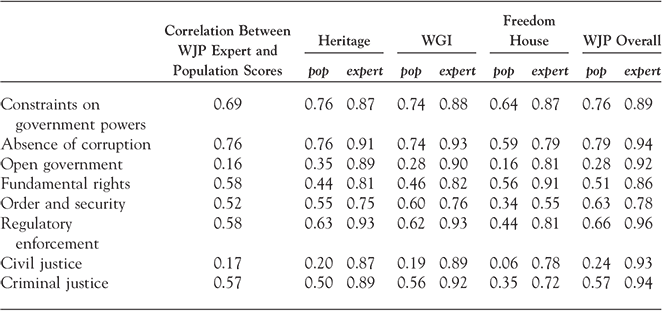
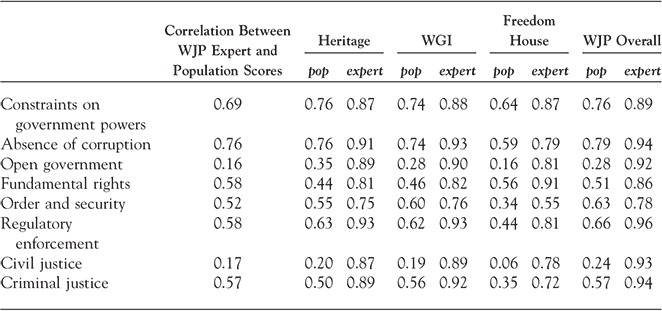
The first column of Table 4 shows the correlation between the expert-based scores and the population-based scores in each of the nine categories. It reveals substantial differences between the expert-based scores and the population-based scores. Open government and civil justice exhibit the largest differences, with correlations between the expert and population scores of 0.16 and 0.17, respectively. Agreement between the experts and general population is largest for corruption (with a correlation of 0.76).
The subsequent columns of Table 4 show the correlations between the WJP's population-based and expert-based RoL scores and the RoL indicators by the Heritage Foundation, the WGI, and Freedom House. For comparison, the last two columns of Table 4 list the correlations with the overall WJP indicator. Even though we cannot disaggregate the other indicators along the same nine dimensions, Table 4 reveals a clear pattern. It shows that the WJP's expert-based scores tend to have substantially higher correlations with the other RoL indicators than do the WJP's population-based scores. The exercise thus suggests that it is the expert-based scores that are driving the convergence between the RoL indicators. It also suggests that the population-based assessments ultimately play a small part in the construction of the overall WJP RoL indicator.Footnote 15
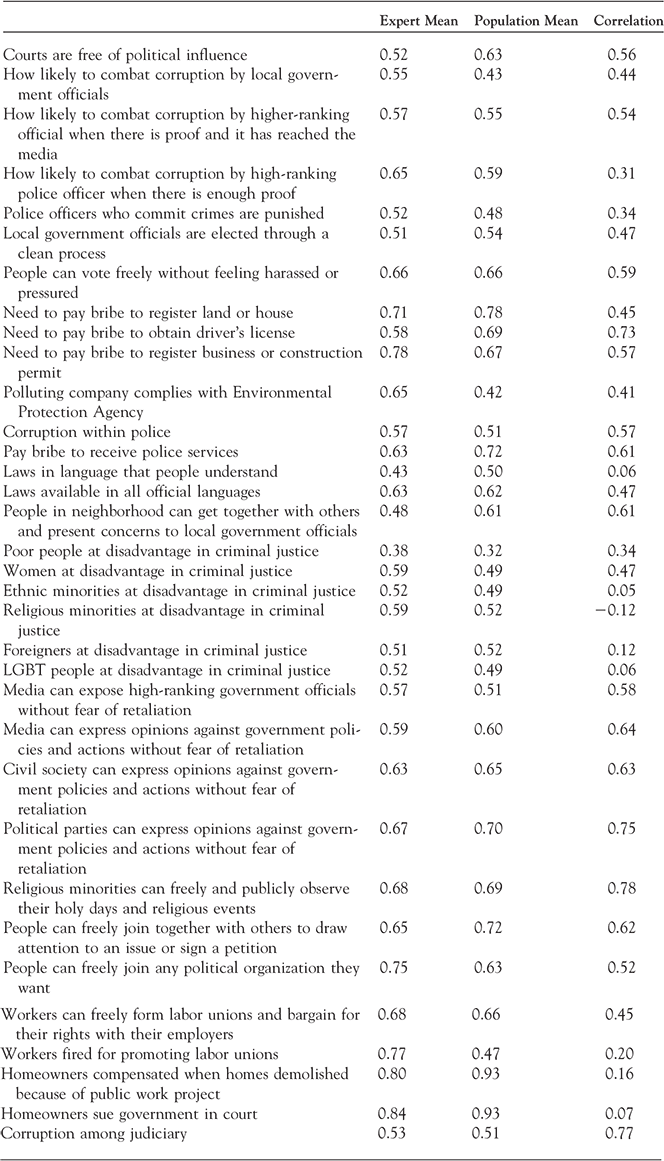
On some topics, the WJP asked its country experts and the general population identical questions. We can use the identical questions to perform a more direct comparison between expert and popular perceptions of the RoL. Table 5 shows the correlations between the expert answers and the population answers for these questions. It also lists the average score across all countries for each question. Table 5 reveals substantial disagreements between the experts and the general population. On topics such as the role of ethnic minorities, religious minorities, and LGBT citizens in the criminal process, the availability of laws in a language that people understand, the ability to obtain compensation or sue government in case of expropriation, and workers' rights, the correlation is close to zero or even negative. There is more agreement for questions relating to corruption, though not nearly the same level of agreement between the overall corruption and RoL expert-based indicators.
Disaggregated WJP Data by Population and Experts
| Correlation Between WJP Expert and Population Scores | Heritage | WGI | Freedom House | WJP Overall | |||||
|---|---|---|---|---|---|---|---|---|---|
| pop | expert | pop | expert | pop | expert | pop | expert | ||
| Constraints on government powers | 0.69 | 0.76 | 0.87 | 0.74 | 0.88 | 0.64 | 0.87 | 0.76 | 0.89 |
| Absence of corruption | 0.76 | 0.76 | 0.91 | 0.74 | 0.93 | 0.59 | 0.79 | 0.79 | 0.94 |
| Open government | 0.16 | 0.35 | 0.89 | 0.28 | 0.90 | 0.16 | 0.81 | 0.28 | 0.92 |
| Fundamental rights | 0.58 | 0.44 | 0.81 | 0.46 | 0.82 | 0.56 | 0.91 | 0.51 | 0.86 |
| Order and security | 0.52 | 0.55 | 0.75 | 0.60 | 0.76 | 0.34 | 0.55 | 0.63 | 0.78 |
| Regulatory enforcement | 0.58 | 0.63 | 0.93 | 0.62 | 0.93 | 0.44 | 0.81 | 0.66 | 0.96 |
| Civil justice | 0.17 | 0.20 | 0.87 | 0.19 | 0.89 | 0.06 | 0.78 | 0.24 | 0.93 |
| Criminal justice | 0.57 | 0.50 | 0.89 | 0.56 | 0.92 | 0.35 | 0.72 | 0.57 | 0.94 |
Both disaggregation exercises suggest that the expert-based nature of the RoL indicators likely causes their convergence. Although these exercises do not tell us whether the reliance on a limited set of sources, last year's scores, or other RoL indicators ultimately causes the stark similarities among the indicators, they show that we cannot rule out the possibility that these similarities have something to do with experts and their coding protocols.
It is worth emphasizing that expert assessments are ultimately based on perceptions. Since the RoL cannot be counted directly (like GDP per capita, for example), RoL indicators are necessarily based on perceptions of the stability of rules, the impartiality of government officials, and so on. The WJP explicitly recognizes that its index is perception based, since it is partly based on opinion poll data, but expert assessments are also perception based, as the experts who measure the RoL possess few truly objective measures on which to rely. The same is true for corruption. TI recognizes this and classifies its indicator as a subjective one: it does not purport to measure corruption directly, but rather relies on sources that capture perceptions of corruption.Footnote 16
Direct Comparison of Expert and Population Answers to Same Questions

| Expert Mean | Population Mean | Correlation | |
|---|---|---|---|
| Courts are free of political influence | 0.52 | 0.63 | 0.56 |
| How likely to combat corruption by local government officials | 0.55 | 0.43 | 0.44 |
| How likely to combat corruption by higher-ranking official when there is proof and it has reached the media | 0.57 | 0.55 | 0.54 |
| How likely to combat corruption by high-ranking police officer when there is enough proof | 0.65 | 0.59 | 0.31 |
| Police officers who commit crimes are punished | 0.52 | 0.48 | 0.34 |
| Local government officials are elected through a clean process | 0.51 | 0.54 | 0.47 |
| People can vote freely without feeling harassed or pressured | 0.66 | 0.66 | 0.59 |
| Need to pay bribe to register land or house | 0.71 | 0.78 | 0.45 |
| Need to pay bribe to obtain driver's license | 0.58 | 0.69 | 0.73 |
| Need to pay bribe to register business or construction permit | 0.78 | 0.67 | 0.57 |
| Polluting company complies with Environmental Protection Agency | 0.65 | 0.42 | 0.41 |
| Corruption within police | 0.57 | 0.51 | 0.57 |
| Pay bribe to receive police services | 0.63 | 0.72 | 0.61 |
| Laws in language that people understand | 0.43 | 0.50 | 0.06 |
| Laws available in all official languages | 0.63 | 0.62 | 0.47 |
| People in neighborhood can get together with others and present concerns to local government officials | 0.48 | 0.61 | 0.61 |
| Poor people at disadvantage in criminal justice | 0.38 | 0.32 | 0.34 |
| Women at disadvantage in criminal justice | 0.59 | 0.49 | 0.47 |
| Ethnic minorities at disadvantage in criminal justice | 0.52 | 0.49 | 0.05 |
| Religious minorities at disadvantage in criminal justice | 0.59 | 0.52 | −0.12 |
| Foreigners at disadvantage in criminal justice | 0.51 | 0.52 | 0.12 |
| LGBT people at disadvantage in criminal justice | 0.52 | 0.49 | 0.06 |
| Media can expose high-ranking government officials without fear of retaliation | 0.57 | 0.51 | 0.58 |
| Media can express opinions against government policies and actions without fear of retaliation | 0.59 | 0.60 | 0.64 |
| Civil society can express opinions against government policies and actions without fear of retaliation | 0.63 | 0.65 | 0.63 |
| Political parties can express opinions against government policies and actions without fear of retaliation | 0.67 | 0.70 | 0.75 |
| Religious minorities can freely and publicly observe their holy days and religious events | 0.68 | 0.69 | 0.78 |
| People can freely join together with others to draw attention to an issue or sign a petition | 0.65 | 0.72 | 0.62 |
| People can freely join any political organization they want | 0.75 | 0.63 | 0.52 |
| Workers can freely form labor unions and bargain for their rights with their employers | 0.68 | 0.66 | 0.45 |
| Workers fired for promoting labor unions | 0.77 | 0.47 | 0.20 |
| Homeowners compensated when homes demolished because of public work project | 0.80 | 0.93 | 0.16 |
| Homeowners sue government in court | 0.84 | 0.93 | 0.07 |
| Corruption among judiciary | 0.53 | 0.51 | 0.77 |
To explore the extent to which perceptions cause convergence between indicators, it is useful to contrast the RoL indicators with a proxy for the RoL that is not based on subjective assessment. A good candidate for this purpose is the data collected by Fisman and Miguel on the number of parking tickets incurred by diplomats who parked illegally in front of the UN building in New York City and used their diplomatic immunity to avoid the fines (Fisman and Miguel Reference Fisman and Miguel2007, 1020). The idea is that diplomats from countries that respect the RoL will be more inclined to pay their tickets than those from countries without the RoL. Interestingly, various studies have used the parking ticket data as a proxy for both the RoL and corruption.Footnote 17 Of course, this measure does not capture the RoL perfectly, but, unlike the other measures, it is not based on perceptions.
Correlating the RoL measures with the logged number of parking ticket violations per diplomat,Footnote 18 we find that more parking tickets are generally associated with lower RoL scores. The correlation is −0.49 for the WJP, −0.44 for the Heritage Foundation, −0.42 for the World Bank, and −0.34 for Freedom House. The pair-wise correlation with TI's Corruption Perceptions Index is −0.46. The finding that this objective RoL indicator differs substantially from the subjective, expert-based RoL data further suggests that the convergence between the RoL indicators results from their measurement strategy.Footnote 19 More precisely, it suggests that the perceptions of experts cause the convergence.
We end by noting that our suggestion that expert perceptions cause convergence among the RoL indicators is consistent with our earlier finding that the RoL indicators might capture a concept at a higher level of abstraction (which, following Rothstein, we suggested might be government impartiality). Indeed, it seems plausible that the experts who rate the RoL based on a limited set of resources ultimately rate countries based on their perceptions of government impartiality. Definitional disagreements thus fade out in the larger measurement enterprise, where limited resources prevent experts from capturing the nuances of their RoL definition. The result is that expert perceptions of government impartiality are highly correlated, even when measures purport to capture different aspects of government.
VI. Conclusion
Our inquiry has been necessarily speculative. In canvassing the various RoL indicators, we were struck by the high degrees of correlation among them, notwithstanding different conceptualizations. This led us to believe that the measures were correlated (1) because they were actually capturing a higher-order concept that subsumes all the differing conceptions of the RoL and/or (2) because the measures were derived from the same sources, cross-referenced, or path dependent.
We ultimately conclude that both explanations might operate together. The similarity of RoL indicators despite different RoL definitions, together with their close connection to corruption, suggests that they might capture a concept at a higher level of abstraction, such as Rothstein's concept of government impartiality. Moreover, the differences between expert and general population assessments of the RoL suggest that expert perceptions are a crucial determinant of the convergence between the indices. The lesson is that measurement strategy, rather than conceptualization, seems to be the dominant factor determining RoL indicators.
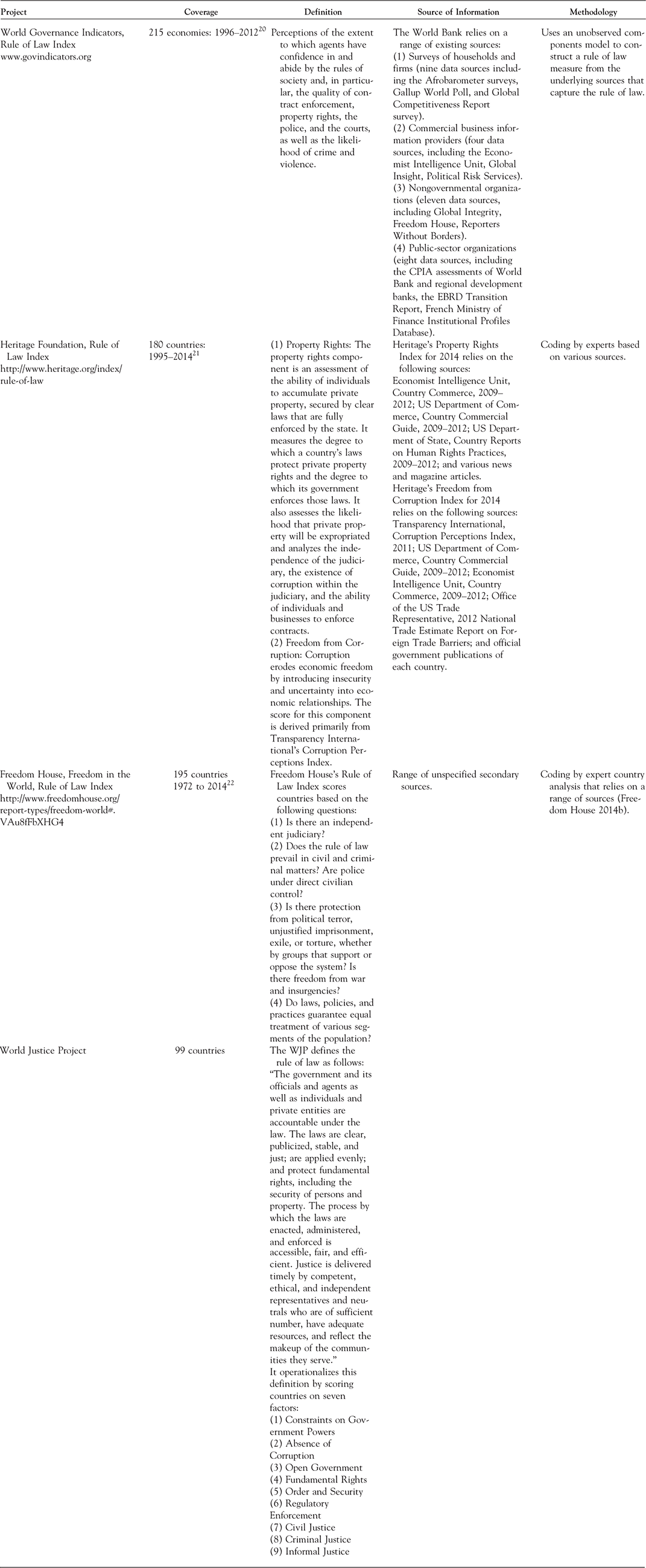
APPENDIX 1: Basic Information on Rol Indicators
| Project | Coverage | Definition | Source of Information | Methodology |
|---|---|---|---|---|
| World Governance Indicators, Rule of Law Index www.govindicators.org | 215 economies: 1996–2012Footnote 20 | Perceptions of the extent to which agents have confidence in and abide by the rules of society and, in particular, the quality of contract enforcement, property rights, the police, and the courts, as well as the likelihood of crime and violence. | The World Bank relies on a range of existing sources: (1) Surveys of households and firms (nine data sources including the Afrobarometer surveys, Gallup World Poll, and Global Competitiveness Report survey). (2) Commercial business information providers (four data sources, including the Economist Intelligence Unit, Global Insight, Political Risk Services). (3) Nongovernmental organizations (eleven data sources, including Global Integrity, Freedom House, Reporters Without Borders). (4) Public-sector organizations (eight data sources, including the CPIA assessments of World Bank and regional development banks, the EBRD Transition Report, French Ministry of Finance Institutional Profiles Database). |
Uses an unobserved components model to construct a rule of law measure from the underlying sources that capture the rule of law. |
| Heritage Foundation, Rule of Law Index http://www.heritage.org/index/rule-of-law | 180 countries: 1995–2014 Footnote 21 | (1) Property Rights: The property rights component is an assessment of the ability of individuals to accumulate private property, secured by clear laws that are fully enforced by the state. It measures the degree to which a country's laws protect private property rights and the degree to which its government enforces those laws. It also assesses the likelihood that private property will be expropriated and analyzes the independence of the judiciary, the existence of corruption within the judiciary, and the ability of individuals and businesses to enforce contracts. (2) Freedom from Corruption: Corruption erodes economic freedom by introducing insecurity and uncertainty into economic relationships. The score for this component is derived primarily from Transparency International's Corruption Perceptions Index. |
Heritage's Property Rights Index for 2014 relies on the following sources: Economist Intelligence Unit, Country Commerce, 2009–2012; US Department of Commerce, Country Commercial Guide, 2009–2012; US Department of State, Country Reports on Human Rights Practices, 2009–2012; and various news and magazine articles. Heritage's Freedom from Corruption Index for 2014 relies on the following sources: Transparency International, Corruption Perceptions Index, 2011; US Department of Commerce, Country Commercial Guide, 2009–2012; Economist Intelligence Unit, Country Commerce, 2009–2012; Office of the US Trade Representative, 2012 National Trade Estimate Report on Foreign Trade Barriers; and official government publications of each country. |
Coding by experts based on various sources. |
| Freedom House, Freedom in the World, Rule of Law Index http://www.freedomhouse.org/report-types/freedom-world#.VAu8fFbXHG4 |
195 countries 1972 to 2014Footnote 22 | Freedom House's Rule of Law Index scores countries based on the following questions: (1) Is there an independent judiciary? (2) Does the rule of law prevail in civil and criminal matters? Are police under direct civilian control? (3) Is there protection from political terror, unjustified imprisonment, exile, or torture, whether by groups that support or oppose the system? Is there freedom from war and insurgencies? (4) Do laws, policies, and practices guarantee equal treatment of various segments of the population? |
Range of unspecified secondary sources. | Coding by expert country analysis that relies on a range of sources (Freedom House 2014b). |
| World Justice Project | 99 countries | The WJP defines the rule of law as follows: “The government and its officials and agents as well as individuals and private entities are accountable under the law. The laws are clear, publicized, stable, and just; are applied evenly; and protect fundamental rights, including the security of persons and property. The process by which the laws are enacted, administered, and enforced is accessible, fair, and efficient. Justice is delivered timely by competent, ethical, and independent representatives and neutrals who are of sufficient number, have adequate resources, and reflect the makeup of the communities they serve.” It operationalizes this definition by scoring countries on seven factors: (1) Constraints on Government Powers (2) Absence of Corruption (3) Open Government (4) Fundamental Rights (5) Order and Security (6) Regulatory Enforcement (7) Civil Justice (8) Criminal Justice (9) Informal Justice |
APPENDIX 2: Dimensions of the WJP Rol Indicator
Constraints on Government Powers
1.1 Government powers are defined in the fundamental law.
1.2 Government powers are effectively limited by the legislature.
1.3 Government powers are effectively limited by the judiciary.
1.4 Government powers are effectively limited by independent auditing and review.
1.5 Government officials are sanctioned for misconduct.
1.6 Government powers are subject to nongovernmental checks.
1.7 Transition of power is subject to the law.
2. Absence of Corruption
2.1 Government officials in the executive branch do not use public office for private gain.
2.2 Government officials in the judicial branch do not use public office for private gain.
2.3 Government officials in the police and the military do not use public office for private gain.
2.4 Government officials in the legislative branch do not use public office for private gain.
3. Open Government
3.1 The laws are publicized and accessible.
3.2 The laws are stable.
3.3 Right to petition the government and public participation.
3.4 Official information is available on request.
4. Fundamental Rights
4.1 Equal treatment and absence of discrimination.
4.2 The right to life and security of the person is effectively guaranteed.
4.3 Due process of law and rights of the accused.
4.4 Freedom of opinion and expression is effectively guaranteed.
4.5 Freedom of belief and religion is effectively guaranteed.
4.6 Freedom from arbitrary interference with privacy is effectively guaranteed.
4.7 Freedom of assembly and association is effectively guaranteed.
4.8 Fundamental labor rights are effectively guaranteed.
5. Order and Security
5.1 Crime is effectively controlled.
5.2 Civil conflict is effectively limited.
5.3 People do not resort to violence to redress personal grievances.
6. Regulatory Enforcement
6.1 Government regulations are effectively enforced.
6.2 Government regulations are applied and enforced without improper influence.
6.3 Administrative proceedings are conducted without unreasonable delay.
6.4 Due process is respected in administrative proceedings.
6.5 The government does not expropriate without adequate compensation.
7. Civil Justice
7.1 People can access and afford civil justice.
7.2 Civil justice is free of discrimination.
7.3 Civil justice is free of corruption.
7.4 Civil justice is free of improper government influence.
7.5 Civil justice is not subject to unreasonable delays.
7.6 Civil justice is effectively enforced.
7.7 ADRs are accessible, impartial, and effective.
8. Criminal Justice
8.1 The criminal investigation system is effective.
8.2 The criminal adjudication system is timely and effective.
8.3 The correctional system is effective in reducing criminal behavior.
8.4 The criminal justice system is impartial.
8.5 The criminal justice system is free of corruption.
8.6 The criminal justice system is free of improper government influence.
8.7 Due process of law and rights of the accused are protected.
9. Informal Justice
9.1 Informal justice is timely and effective.
9.2 Informal justice is impartial and free of improper influence.
9.3 Informal justice respects and protects fundamental rights.
Appendix 3:
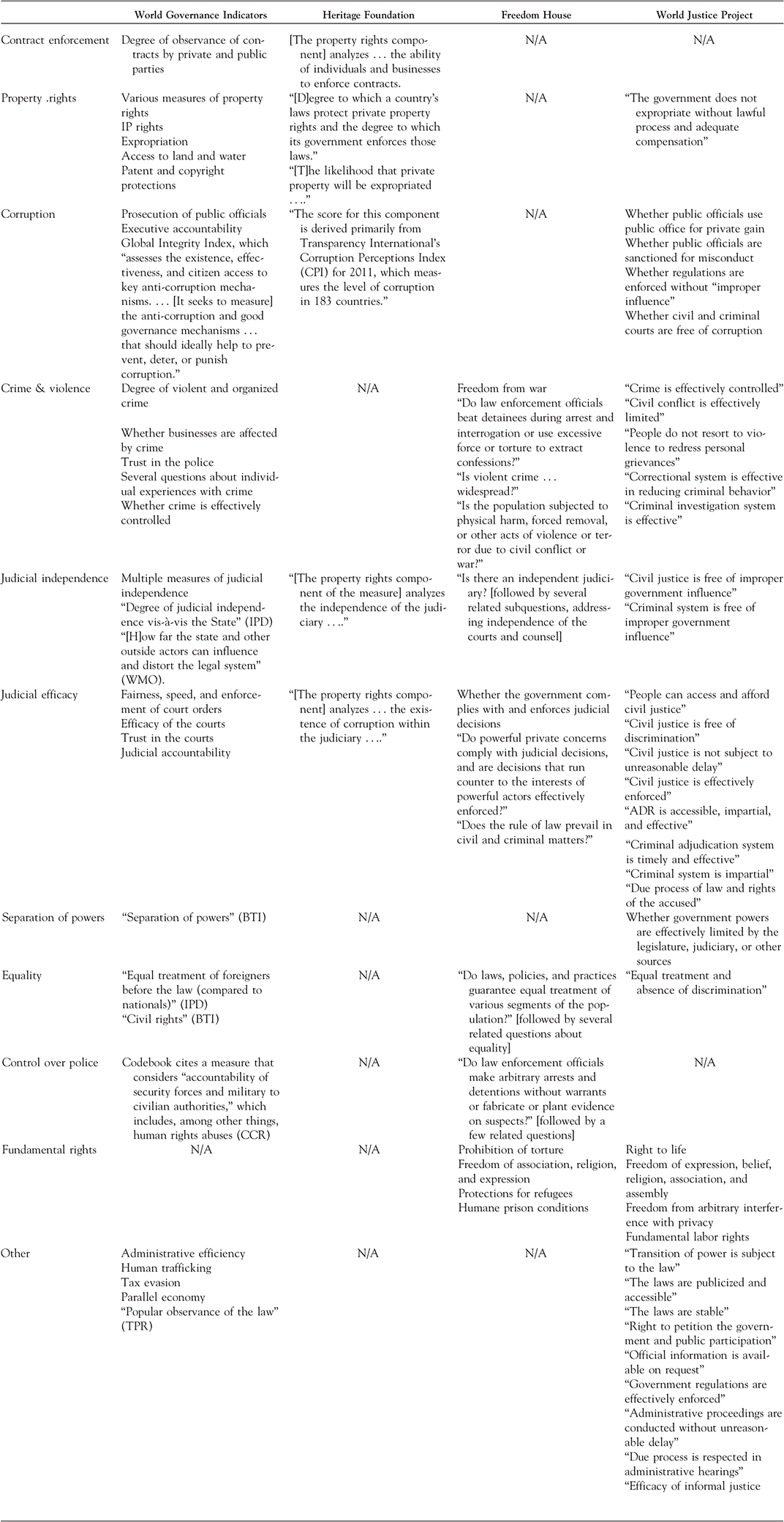
| World Governance Indicators | Heritage Foundation | Freedom House | World Justice Project | |
|---|---|---|---|---|
| Contract enforcement | Degree of observance of contracts by private and public parties | [The property rights component] analyzes … the ability of individuals and businesses to enforce contracts. | N/A | N/A |
| Property .rights | Various measures of property rights IP rights Expropriation Access to land and water Patent and copyright protections |
“[D]egree to which a country's laws protect private property rights and the degree to which its government enforces those laws.” “[T]he likelihood that private property will be expropriated ….” |
N/A | “The government does not expropriate without lawful process and adequate compensation” |
| Corruption | Prosecution of public officials Executive accountability Global Integrity Index, which “assesses the existence, effectiveness, and citizen access to key anti-corruption mechanisms. … [It seeks to measure] the anti-corruption and good governance mechanisms … that should ideally help to prevent, deter, or punish corruption.” |
“The score for this component is derived primarily from Transparency International's Corruption Perceptions Index (CPI) for 2011, which measures the level of corruption in 183 countries.” | N/A | Whether public officials use public office for private gain Whether public officials are sanctioned for misconduct Whether regulations are enforced without “improper influence” Whether civil and criminal courts are free of corruption |
| Crime & violence | Degree of violent and organized crime Whether businesses are affected by crime Trust in the police Several questions about individual experiences with crime Whether crime is effectively controlled |
N/A | Freedom from war “Do law enforcement officials beat detainees during arrest and interrogation or use excessive force or torture to extract confessions?” “Is violent crime … widespread?” “Is the population subjected to physical harm, forced removal, or other acts of violence or terror due to civil conflict or war?” |
“Crime is effectively controlled” “Civil conflict is effectively limited” “People do not resort to violence to redress personal grievances” “Correctional system is effective in reducing criminal behavior” “Criminal investigation system is effective” |
| Judicial independence | Multiple measures of judicial independence “Degree of judicial independence vis-à-vis the State” (IPD) “[H]ow far the state and other outside actors can influence and distort the legal system” (WMO). |
“[The property rights component of the measure] analyzes the independence of the judiciary ….” | “Is there an independent judiciary? [followed by several related subquestions, addressing independence of the courts and counsel] | “Civil justice is free of improper government influence” “Criminal system is free of improper government influence” |
| Judicial efficacy | Fairness, speed, and enforcement of court orders Efficacy of the courts Trust in the courts Judicial accountability |
“[The property rights component] analyzes … the existence of corruption within the judiciary ….” | Whether the government complies with and enforces judicial decisions “Do powerful private concerns comply with judicial decisions, and are decisions that run counter to the interests of powerful actors effectively enforced?” “Does the rule of law prevail in civil and criminal matters?” |
“People can access and afford civil justice” “Civil justice is free of discrimination” “Civil justice is not subject to unreasonable delay” “Civil justice is effectively enforced” “ADR is accessible, impartial, and effective” “Criminal adjudication system is timely and effective” “Criminal system is impartial” “Due process of law and rights of the accused” |
| Separation of powers | “Separation of powers” (BTI) | N/A | N/A | Whether government powers are effectively limited by the legislature, judiciary, or other sources |
| Equality | “Equal treatment of foreigners before the law (compared to nationals)” (IPD) “Civil rights” (BTI) |
N/A | “Do laws, policies, and practices guarantee equal treatment of various segments of the population?” [followed by several related questions about equality] | “Equal treatment and absence of discrimination” |
| Control over police | Codebook cites a measure that considers “accountability of security forces and military to civilian authorities,” which includes, among other things, human rights abuses (CCR) | N/A | “Do law enforcement officials make arbitrary arrests and detentions without warrants or fabricate or plant evidence on suspects?” [followed by a few related questions] | N/A |
| Fundamental rights | N/A | N/A | Prohibition of torture Freedom of association, religion, and expression Protections for refugees Humane prison conditions |
Right to life Freedom of expression, belief, religion, association, and assembly Freedom from arbitrary interference with privacy Fundamental labor rights |
| Other | Administrative efficiency Human trafficking Tax evasion Parallel economy “Popular observance of the law” (TPR) |
N/A | N/A | “Transition of power is subject to the law” “The laws are publicized and accessible” “The laws are stable” “Right to petition the government and public participation” “Official information is available on request” “Government regulations are effectively enforced” “Administrative proceedings are conducted without unreasonable delay” “Due process is respected in administrative hearings” “Efficacy of informal justice |