1. Introduction
In comparative linguistic studies—across language families, on languages of the same language family, or even on dialects of one language—traditional research questions address word order, case morphology, and other linguistic characteristics in the light of typological universals and genealogical and areal proximity of the languages. As a relatively young discipline, crosslinguistic research on the neurocognition of language, or neurotypology, adds a new dimension to this discussion (see Bornkessel-Schlesewsky & Schlesewsky Reference Bornkessel-Schlesewsky, Schlesewsky, Sanz, Laka and Michael2013, Reference Bornkessel-Schlesewsky, Schlesewsky, Michael, George and Poeppel2020). Neurocognitive aspects of sentence comprehension in different languages may cut across traditional typological categories. On the one hand, some typologically diverse and genealogically unrelated languages may share certain processing mechanisms, and on the other hand, some structurally similar and closely related languages may differ in their processing strategies. The present study seeks to contribute to a better understanding of Continental West Germanic languages, and in particular shed further light on the interplay of case morphology, animacy, and word order, by presenting new evidence from the processing domain.
Case distinctions are important for successful communication (otherwise languages would not have them), but not essential (otherwise all languages would have them). In the present study, we are not asking whether a language does or does not have rich case morphology, but rather whether processing strategies in the brains of native speakers differ when a language does or does not have rich case morphology. German and North Frisian with their various dialects provide an ideal laboratory situation to study microvariation between closely related linguistic systems, and in particular the variation in morphological case markings. German, or more precisely Standard German, is one of the best studied Continental West Germanic languages. The present study focuses on the High Alemannic dialect Zurich German and the North Frisian dialect Fering, both rather unexplored in experimental psycholinguistics so far. These two varieties are ideal candidates for a comparison to Standard German because both are genealogically related with and sociolinguistically influenced by Standard German to a greater or lesser extent and both are spoken within the German-speaking area, yet Zurich German and Fering differ markedly in their case systems from each other and from Standard German.
Research in the field of comparative Germanic linguistics strives to explore the relationship among Germanic languages and dialects on a theoretically and empirically sound foundation. We do not intend to offer a comprehensive theoretical description of Zurich German or Fering here, but our goal is to present an innovative comparative approach using psycholinguistic methodology. Whereas many other empirical approaches have already found their place in linguistics, findings from neurocognitive research have not been incorporated into linguistic theories to the same extent. We wish to bridge the gap between psycho-/neurolinguistics and other strands of linguistic research by providing an answer to the following question: Do speakers of closely related Continental West Germanic varieties rely on the same processing strategies during language comprehension or do speakers of varieties with case syncretism compensate for the lack of case distinctions by focusing their attention on semantic information—in particular the animacy of nouns—instead?
1.1. Processing Strategies for Argument Role Identification
When people communicate, one major task of the hearer is to assign the correct thematic roles to the arguments in a sentence in order to retrieve the meaning that the speaker intended to convey. It is of particular importance to understand who the “doer” of the action is (Bornkessel-Schlesewsky & Schlesewsky Reference Bornkessel-Schlesewsky and Schlesewsky2009b, Reference Bornkessel-Schlesewsky, Schlesewsky, Sanz, Laka and Michael2013). The “doer” is typically animate, sentient, and volitionally causing or controlling the action, as John in John ate a sandwich. However, since sentences may not only express typical actions but also processes or states, as in John enjoyed the movie, or may contain only inanimate nouns, as in the wind ruffled the water, the “doer” should be understood as a special case of a generalized thematic role referred to as proto-agent or actor (see, among others, Dowty Reference Dowty1991, Primus Reference Primus1999, Van Valin Reference Van Valin2005). The proto-agent/actor can be defined as the highest-ranking role in a hierarchy of thematic roles, and there is also a correlation to formal syntactic features, as the proto-agent/actor is typically represented by the grammatical subject in a transitive relation with an active verb (see Primus Reference Primus1999, Reference Primus, Bornkessel, Schlesewsky, Friederici and Comrie2006 for discussion of the relationship between thematic roles, structural positions, and case).
In a language like English, the determiner phrase (DP) immediately preceding the finite verb may be reliably analyzed as the subject of the sentence. Thus, in English, argument serialization is an effective and (usually) reliable strategy for actor identification (MacWhinney et al. Reference MacWhinney, Bates and Kliegl1984). Indeed, there is evidence to suggest that native speakers of English overapply an order-based strategy during real-time sentence comprehension, thus leading to a higher proportion of incorrect interpretations when sentences deviate from the expected actor-first order (Ferreira Reference Ferreira2003). However, in a language with a flexible word order like German, the actor/subject may not always appear as the first argument.Footnote 1 Compare the differences between the German examples in 1 and their word-by-word English translations in 2. In all three sentences in 1, a German speaker can easily understand who the actor is, and all sentences make perfect sense, with argument focus depending on the context in 1b,c. By contrast, an English speaker could only accept 2a as a meaningful sentence, whereas 2b would sound nonsensical and ungrammatical (indicated as ‘*’) due to an agreement error, and 2c would appear grammatically well-formed while conveying a strange proposition typically encountered in a fantasy or horror story where fruit would actually devour human beings (indicated as ‘#’). German and English speakers do not process language the same way because they pursue different processing strategies.
(1)


(2)

In German, the sequence of subject > indirect object > direct object is considered the unmarked (that is, information-structurally neutral) word order of (nonpronominal) DPs. Other serializations are grammatical but usually require some sort of licensing context to be perceived as appropriate, involving a complex interaction of semantic, pragmatic, and prosodic factors (see, for example, Lenerz Reference Lenerz1977, Uszkoreit Reference Uszkoreit1987, Müller Reference Müller1999, Struckmeier Reference Struckmeier2014). Therefore, in German, argument positions are not as reliable for thematic role assignment. We explicate the processing strategy of German speakers with respect to the interplay of syntactic and semantic cues in the sentences in 3, where scrambling of DPs is possible. Scrambling is a term coined by John Ross (Reference Ross1967), which we understand as the syntactically optional reordering of arguments in the domain of the verb, following Haider & Rosengren Reference Haider and Rosengren1998, Reference Haider and Rosengren2003 (see also Haider Reference Haider2010, 2017 for more recent overviews).
(3)

Sentence 3a contains two DPs that both represent human beings capable of performing an action. Since German allows scrambling of arguments, either DP could, in principle, be the subject. However, there is a strong crosslinguistic preference that the first DP in a sentence is interpreted as the subject, often referred to as the “subject-first preference” (for German, see Bader & Meng Reference Bader and Meng1999, Meng et al. Reference Bader and Meng1999, Schlesewsky et al. Reference Schlesewsky, Gisbert, Reinhold, Josef, Hemforth and Konieczny2000; see also Haupt et al. Reference Haupt, Schlesewsky, Roehm, Friederici and Bornkessel-Schlesewsky2008 for discussion). In the absence of evidence to the contrary, the first DP die Bogenschützin ʻthe archerʼ is, therefore, the best candidate to represent the subject and should be assigned the actor role, accordingly.
Animacy as a prominence cue affects processing because of a general correlation between animacy and thematic roles. Research in language typology showed that in a typical transitive relation there is a strong tendency of “an information flow from more to less animate” (Comrie Reference Comrie1989:128), that is, the A argument (realized as the nominative subject in a nominative-accusative language) is likely to be more animate, whereas the P argument (realized as the accusative object in a nominative-accusative language) is likely to be less animate.Footnote 2 This correlation has ramifications for processing strategies as it sets an expectation for the parser, and thus animacy influences the processing of syntactic constructions. For example, psycholinguistic experiments have shown that the processing difficulty of object relative clauses is considerably reduced when the head noun is inanimate and the relative clause subject is animate (see, among others, Mak et al. Reference Mak, Wietske and Schriefers2002, Traxler et al. Reference Traxler, Morris and Seely2002). These findings reflect the typological tendency of a more animate subject and a less animate object because this pattern is only respected if the relative pronoun of an object relative clause refers to an inanimate head noun.
Across languages, animate arguments tend to be subjects and to appear early in word order (see also Branigan et al. Reference Branigan, Pickering and Tanaka2008 for a discussion in the light of language production). However, what happens if the preference for the first argument in a sentence to be the subject conflicts with the expectation that the subject is animate? In 3b, there is a competition between word order and animacy as cues for the actor role because the first argument refers to an inanimate entity, but the second argument to a human being. The language processor needs to evaluate which of these cues, word order or animacy, should be considered the most prominent in order to correctly interpret the roles of the arguments. Psycholinguistic experiments have demonstrated this competition of syntactic and semantic cues and have shown that their prominence rankings are language-specific (MacWhinney et al. 1984, Kempe & MacWhinney Reference Kempe and MacWhinney1999, Alday et al. Reference Alday, Matthias and Bornkessel-Schlesewsky2015). In German, animacy is ranked higher than word order, so that a sentence such as 3b is understood with the second DP die Bogenschützin ʻthe archerʼ as its subject. In English, by contrast, word order is ranked higher than animacy as could be seen in the strange yet inevitable interpretation of example 2c above that follows from an order-based strategy.
In 3a,b, the DPs are formally ambiguous because nominative and accusative forms of the definite article are identical when the head noun of the DP is feminine or neuter. However, whenever case marking is distinctive, as in 3c, containing DPs with masculine head nouns, case will become the highest-ranking cue in German, leading to an interpretation of der Pfeil ʻthe arrowʼ as the subject even though it is the second argument and refers to an inanimate entity.Footnote 3
For the current discussion it is important to be aware of the difference between prominence cues for actor identification on the one hand, and constraints that determine the markedness of a word order on the othe. In the sentences in 3, we were concerned with prominence cues that compete for the actor role, that is, whether in German the first argument (as in 3a), or the animate argument (as in 3b), or the nominative-marked argument (as in 3c) is considered the best candidate for the actor role (see MacWhinney et al. Reference MacWhinney, Bates and Kliegl1984, Bornkessel-Schlesewsky & Schlesewsky Reference Bornkessel-Schlesewsky and Schlesewsky2009b). By contrast, the markedness or degree of grammaticality of an argument serialization can be described in terms of violable constraints or precedence rules—for example, animate arguments precede inanimate arguments or nominative-marked arguments precede accusative-marked arguments (see, among others, Uszkoreit Reference Uszkoreit1987, Müller Reference Müller1999)—and predictions of these constraints have been empirically tested in psycholinguistic experiments (for instance, Pechmann et al. 1996, Keller Reference Keller2000) and corpus studies (for instance, Kempen & Harbusch 2004, Reference Kempen, Harbusch and Steube2008). Both prominence cues and precedence rules/constraints can be ranked or weighted, but whereas precedence rules/constraints determine how acceptable or frequent a word order is, prominence cues determine whether a given argument is a prototypical actor or which argument in a sentence wins the competition for the actor role.
1.2. Processing Effects of Scrambling in Standard German
Syntactically free permutation of constituents has important implications for any model of sentence comprehension. In everyday conversations, our brains perform extremely fast and dynamic cognitive processes to retrieve meaning from the acoustic signals caught by our ears. The language processor does not wait until the end of a sentence, but real-time comprehension is incremental, and each incoming word is rapidly incorporated into the sentence representation based upon previous information (Marslen-Wilson Reference Marslen-Wilson1975, Altmann & Steedman Reference Altmann and Steedman1988, Crocker Reference Crocker, Clifton, Frazier and Rayner1994). In addition, predictions for upcoming words are evaluated and updated in the course of incremental sentence interpretation (Pickering & Garrod 2007, 2013; Kamide Reference Kamide2008; Bornkessel-Schlesewsky et al. Reference Bornkessel-Schlesewsky and Schlesewsky2016). In the discussion of the examples in 3 above, the choice for subject was made by considering the sentence as a whole, but during on-line interpretation, words are evaluated as soon as they are perceived, which gives rise to local ambiguities and uncertainties. Insights from the processing domain open new windows into the understanding of word order variation because, rather than taking a global perspective, one can also examine processing effects that arise at specific words or phrases.
Many psycholinguistic studies use behavioral methods such as lexical decision tasks, self-paced reading, or speeded acceptability judgments that produce interesting data for investigating the cognition of language but remain inconclusive with respect to the underlying neurophysiological processes. Brain responses during sentence compre-hension can be uncovered by means of neuroscientific methods such as electroencephalography (EEG) or functional magnetic resonance imaging (fMRI). Neurons produce electrical activity when processing information, and changes in these electrical potentials—when synchro-nized across large neural populations—can be measured noninvasively in the human EEG. The event-related potential (ERP) technique allows us to investigate even very small potential changes and to study neurocognitive responses to specific events within the range of milliseconds during real-time processing (for a general introduction, see Luck Reference Luck2014; for overviews on ERP research in language comprehension, see, among others, Kutas et al. Reference Kutas, Van Petten, Kluender, Matthew and Morton2006, Bornkessel-Schlesewsky & Schlesewsky Reference Bornkessel-Schlesewsky and Schlesewsky2009a, Leckey & Federmeier Reference Leckey, Federmeier, de Zubicaray and Schiller2019a). Whereas the EEG provides very precise data at a temporal level, the locations of the underlying neural generators cannot be straightforwardly deduced from effects recorded on the scalp surface. Conversely, the fMRI technique cannot provide the high temporal resolution of the EEG, but allows one to investigate effects in specific brain regions with a high local precision by recording changes in blood oxygenation correlated with neural activity (for an introduction, see Huettel et al. Reference Huettel, Song and McCarthy2014, among others).
Psycholinguistic studies have made use of scrambled word orders in pursuit of various research goals. Behavioral experiments by Pechmann et al. (1996) and Keller (Reference Keller2000) tried to shed further light on the gradient grammaticality of word order variations depending on the sequence of arguments and on pronominalization. Scrambling also lends itself to testing cognitive responses to movement operations as assumed in many generative theories. For example, Clahsen & Featherston (Reference Clahsen and Featherston1999) used a crossmodal lexical priming procedure to investigate the psychological reality of syntactic traces. Of particular interest for the present study are psycholinguistic experiments on garden-path effects and syntactic function ambiguity resolution (for overviews, see Bader Reference Bader1994, Bader et al. Reference Bader, Michael, Josef and Jens-Max2000, and Haupt et al. Reference Haupt, Schlesewsky, Roehm, Friederici and Bornkessel-Schlesewsky2008, among others). Scrambling in German may serve as a testing ground for subject-object ambiguity resolution because it is possible to construct sentences with formally ambiguous arguments and a sentence-final verb or auxiliary that carries disambiguating relational information such as number agreement. As discussed above, the processing system follows a subject-first preference, that is, an ambiguous first argument is usually interpreted as the subject, and it could be shown that this expectation of a subject-initial order can even be found with restrictive contexts where an object-initial order would be pragmatically appropriate (Meng et al. Reference Bader and Meng1999).
Many ERP studies on scrambling in German focused on subject-object ambiguity resolution and investigated neural responses at positions later in the sentence when scrambled word order was detected, for example, at the second argument or the final verb (Friederici & Mecklinger 1996, Friederici et al. Reference Friederici, Axel, Spencer, Karsten and Donchin2001, Bornkessel et al. Reference Bornkessel, McElree, Schlesewsky and Friederici2004, Schlesewsky & Bornkessel Reference Schlesewsky and Bornkessel2006, Haupt et al. Reference Haupt, Schlesewsky, Roehm, Friederici and Bornkessel-Schlesewsky2008). The present study, however, is concerned with processing effects when the parser recognizes a scrambled word order immediately at the first argument. In such cases, scrambling in German gives rise to a specific negative-going ERP effect at the scrambled DP. In most studies, this effect (dubbed the “scrambling negativity”) was observed approximately between ~300 and ~500 ms poststimulus onset with a central or left-lateralized scalp distribution (Rösler et al. Reference Haider and Rosengren1998; Bornkessel et al. Reference Bornkessel, Schlesewsky and Friederici2002, 2003; Schlesewsky et al. Reference Bornkessel, Schlesewsky and Friederici2003; Bornkessel & Schlesewsky Reference Bornkessel and Schlesewsky2006; Dröge et al. Reference Dröge, Fleischer, Schlesewsky and Bornkessel-Schlesewsky2016).Footnote 4 The scrambling negativity has been found at the first DP in object-subject orders, as in 4b–c, compared to the unmarked subject-object order, as in 4a (examples from Schlesewsky et al. Reference Bornkessel, Schlesewsky and Friederici2003:120; the critical position in their study was the definite article of the first DP, underlined here).
(4)

The negative-going ERP effect at the scrambled DP was initially interpreted as reflecting preparatory processes for storing the noun in working memory (Rösler et al. Reference Haider and Rosengren1998). However, later studies presented convincing evidence that the scrambling negativity is not directly related to working memory and should rather be viewed as reflecting a violation of grammatical linearization principles (Schlesewsky et al. Reference Bornkessel, Schlesewsky and Friederici2003).Footnote 5 For example, Schlesewsky et al. (Reference Bornkessel, Schlesewsky and Friederici2003) showed that the scrambling negativity was absent in initial object pronouns, and Bornkessel et al. (Reference Bornkessel, Schlesewsky and Friederici2002) reported an absence of the scrambling negativity in initial dative objects in subordinate clauses. Even though the object preceded the subject in both of these studies, which should have led to increased working memory demands, the tested structures were not in violation of linearization principles at the position of the critical word and did not engender a scrambling negativity. Recently, Dröge et al. (Reference Dröge, Fleischer, Schlesewsky and Bornkessel-Schlesewsky2016) suggested that the scrambling negativity should not be interpreted as a syntax-related effect, but it rather reflects more general cognitive mechanisms. According to this view, the scrambling negativity may reflect a prediction mismatch between the expected subject-initial and the observed object-initial word order. It could therefore be interpreted as an instance of the N400, a negative-going ERP response traditionally associated with semantic prediction effects (see, for example, Federmeier Reference Federmeier2007, Kutas et al. Reference Kutas, DeLong, Smith and Bar2011, Kutas et al. Reference Kutas, Federmeier, Urbach, Michael and George2014 for reviews).
1.3. The Scrambling Negativity in Case Ambiguous DPs
In most previous ERP studies on scrambling, the scrambling negativity has been reported only for clearly case-marked DPs (Rösler et al. Reference Haider and Rosengren1998; Bornkessel et al. Reference Bornkessel, Schlesewsky and Friederici2002, 2003; Schlesewsky et al. Reference Bornkessel, Schlesewsky and Friederici2003; Bornkessel & Schlesewsky Reference Bornkessel and Schlesewsky2006). As outlined above, morphological case marking is the highest-ranked cue for argument interpretation in German. Distinctive case marking thus allows the processing system to evaluate a scrambled word order at the position of the first DP and, more specifically, at the position of the definite article, as was the case in 4. However, in an ERP study on scrambling in connected speech, Dröge et al. (2016) investigated the scrambling negativity in formally ambiguous DPs such as die Dame ʻthe ladyʼ, which could be either nominative or accusative. Furthermore, they included animate as well as inanimate nouns to shed further light on the interaction of syntactic and semantic cues.
Dröge et al. (Reference Dröge, Fleischer, Schlesewsky and Bornkessel-Schlesewsky2016) used a novel experimental design with question-answer pairs introducing both arguments and the verb in the question. The thematic roles in the answer, which was the critical sentence, could be inferred from the preceding question, and a violation of linearization principles could immediately be recognized at the first DP even when morphological case marking and animacy information were ambiguous. The experimental conditions in Dröge et al. 2016:152 are illustrated in 5–8. A question in 5a, 6a, 7a, and 8a was either followed by a critical sentence with the unmarked order of subject > object (SO), as in 5b, 6b, 7b, and 8b, or by a sentence with the scrambled order of object > subject (OS), as in 5c, 6c, 7c, 8c. The information structure was neutral and the language processor therefore always expected the SO order in the critical sentence. By contrast, while grammatically possible, OS is a dispreferred alternative order.Footnote 6 The critical position for the ERP analysis was the first DP, underlined in the examples below. The examples in 5 contain unambiguous case marking and unambiguous animacy.
(5)

The examples in 6 contain unambiguous case marking and ambiguous animacy.
(6)

The examples in 7 contain ambiguous case marking and unambiguous animacy.
(7)

The examples in 8 contain ambiguous case marking and ambiguous animacy.
(8)

In 5 and 6, morphological case marking of the DPs was unambiguous (DPs with masculine head nouns), whereas 7 and 8 did not provide syntactic cues for argument identification because both DPs in the critical sentences were formally ambiguous between nominative and accusative case (DPs with feminine head nouns).
In 5 and 7, the subject was animate and the direct object inanimate so that animacy information was an unambiguous cue for argument identification. In other words, the decision concerning which of the two arguments is more likely to be the subject can be based on animacy.Footnote 7 For instance, the first DP in 7b die Dame ʻthe ladyʼ refers to a human being and is therefore a typical subject, in contrast to the first DP in 7c die Pelzjacke ʻthe fur jacketʼ, which refers to a piece of clothing and is more likely to be the object in a transitive relation (see also example 3b and the discussion above). However, in 6 and 8, both arguments were animate, thereby rendering animacy as a cue ambiguous. For example, in 6 it cannot readily be determined which of the two animate nouns Nachtwächter ʻnightwatchmanʼ or Dieb ʻthiefʼ is the subject without considering other cues such as case marking. The combination of ambiguous case marking and ambiguous animacy in 8 created critical sentences, where the parser needed to rely on the information provided by the preceding question to ensure a correct assignment of thematic roles to the arguments.
Dröge et al. (Reference Dröge, Fleischer, Schlesewsky and Bornkessel-Schlesewsky2016) found that sentences with SO order such as 5b, 6b, 7b, 8b were rated as most acceptable in an acceptability judgment task, which was expected. Interestingly, however, OS sentences with distinctive case marking, such as 5c and 6c, also received very good acceptability ratings, whereas the case ambiguous OS conditions, such as 7c and 8c, were rated as rather unacceptable. Thus, the availability of morphological case distinctions had an influence on sentence acceptability. This finding is reminiscent of an observation that is well-known in the psycholinguistic literature: Locally ambiguous sentences requiring a reanalysis toward the nonpreferred reading show lower acceptabilities than their unambiguous counterparts (for discussion, see Bornkessel et al. Reference Bornkessel, McElree, Schlesewsky and Friederici2004). Interestingly, the recent results by Dröge et al. (Reference Dröge, Fleischer, Schlesewsky and Bornkessel-Schlesewsky2016) suggest that a similar effect holds for morphologically ambiguous sentences with word order variations even in the presence of a disambiguating context (see Muralikrishnan et al. Reference Muralikrishnan, Schlesewsky and Bornkessel-Schlesewsky2015 for converging evidence suggesting that contextual information attenuates local preferences during on-line sentence comprehension but does not override them).
Figure 1 is adapted from Dröge et al. Reference Dröge, Fleischer, Schlesewsky and Bornkessel-Schlesewsky2016:157 (figure 6) and shows the results for Standard German. Panel A shows the contrast between SO order (solid line) and OS order (dashed line) in sentences with unambiguous case marking. Panel B shows the contrast between SO order (solid line) and OS order (dashed line) in sentences with ambiguous case marking. Conditions with unambiguous and ambiguous animacy have been combined here. Negativity is plotted upwards.
Grand average (n=27) ERPs of the first DP in the critical sentences at electrode sites FZ and PZ.

The ERP analysis at the first DP of the critical sentences revealed a scrambling negativity followed by a positive-going effect with a parietal topography, a P600, in all conditions with OS order. The ERP effects are illustrated in figure 1. Dröge et al. (Reference Dröge, Fleischer, Schlesewsky and Bornkessel-Schlesewsky2016) showed that the question presented before the critical sentence provided enough information for an OS order to give rise to a scrambling negativity even in the absence of distinctive case marking. However, the scrambling negativity had an earlier onset in unambiguously case-marked OS sentences. The correlation between the onset of the scrambling negativity and the availability of disambiguating information at different time points is a further indicator of its role in predictive processes (Dröge et al. Reference Dröge, Fleischer, Schlesewsky and Bornkessel-Schlesewsky2016:158): This observation suggests that incoming sensory information is matched against the current prediction at every time point during the comprehension process. The P600 effect is interesting for two reasons. First, Dröge et al. (Reference Dröge, Fleischer, Schlesewsky and Bornkessel-Schlesewsky2016) found a clear P600 effect in OS sentences, but a P600 following the scrambling negativity was not reported in other ERP studies on scrambling in German (Rösler et al. Reference Haider and Rosengren1998; Bornkessel et al. Reference Bornkessel, Schlesewsky and Friederici2002, 2003; Schlesewsky et al. Reference Bornkessel, Schlesewsky and Friederici2003; Bornkessel & Schlesewsky Reference Bornkessel and Schlesewsky2006). Second, the amplitude of the P600 effect was affected by the factor case marking: The P600 was larger in OS sentences with clearly case-marked DPs, as in 5c and 6c, compared to the case ambiguous OS sentences, as in 7c and 8c. By contrast, the statistical analysis of the ERP data in Dröge et al. 2016 could not confirm a significant effect of animacy information on the P600 effect in the OS conditions.Footnote 8 Thus, while case marking was reflected in the P600 response, this was not the case for animacy. The observation that the P600 was affected by the presence or absence of distinctive case marking could be connected to the behavioral task. Participants were asked to judge the acceptability, and they expected to hear SO sentences, so a major component of the behavioral task was the successful categorization of the order of arguments. Dröge et al. (Reference Dröge, Fleischer, Schlesewsky and Bornkessel-Schlesewsky2016:160) argued that unambiguous case marking provided a strong prominence cue for argument identification, which increased the participantsʼ certainty to categorize a sentence as having a marked word order reflected in a larger P600 effect. We return to the functional interpretation of this effect with reference to the present experiments in the general discussion in section 6.2.
When distinctive case marking is available, it is a highly reliable cue for argument interpretation in the standard variety of German (for instance, Kempe & MacWhinney Reference Kempe and MacWhinney1999), which may be the reason why Dröge et al. (Reference Dröge, Fleischer, Schlesewsky and Bornkessel-Schlesewsky2016) found a P600 effect for case marking but not for animacy in sentences with OS order. Interestingly, distinctive case marking is not available in every German variety. Whereas Standard German is relatively conservative as far as its case system is concerned, most German dialects have lost some of the case distinctions in comparison to Standard German or older stages of High or Low German, as discussed extensively by Shrier (Reference Shrier1965). For the morphological expression of case in the German diasystem, it is important to note that personal pronouns retain most distinctive forms. In nominal phrases, case does not so much find formal expression on the noun itself, but rather in determiners of the noun, most importantly in the article. This is a well-known typological feature of many (modern) Germanic languages in a typology of case in general (Blake Reference Blake2001:101–102). As the definite article is crucial for our experiments, the following discussion of syncretism patterns is restricted to the definite article.Footnote 9 In many dialects, the distinction between nominative and accusative case is lost in all article forms, even in the definite masculine singular article.
The important question arises whether animacy as a prominence cue becomes more salient for the processing system in those German varieties where morphological case marking for nominative and accusative case has become indistinguishable in all genders. A systematic case syncretism may possibly lead to a stronger influence of animacy in those varieties, which could be reflected in the ERP. Assuming that the P600 is affected by the most salient cue for argument interpretation, its amplitude should be modulated as a function of the availability of unambiguous animacy information in varieties with systematic case syncretism. To test this hypothesis, we investigated processing effects in a Swiss German variety with nominative/accusative case syncretism and in a North Frisian variety with complete syncretism in the definite article. As our intent was to directly compare the results from these closely related Continental West Germanic varieties to those obtained from Standard German, we designed the experiments analogously to the study by Dröge et al. (Reference Dröge, Fleischer, Schlesewsky and Bornkessel-Schlesewsky2016), adopting their experimental design and their stimuli.
Experiment 1 investigated scrambling in Zurich German, the High Alemannic German variety spoken in and around Zurich. Zurich German has a systematic nominative/accusative syncretism in the definite article in all genders (see Weber Reference Weber1964:102–103, among others). As speakers of Zurich German thus cannot rely on case marking for argument interpretation, animacy should be the most salient cue for identifying the actor role. Other German varieties exist that also show a systematic nominative/accusative syncretism, but we chose a Swiss German variety for the EEG experiment for practical reasons because we needed to recruit a reasonable number of competent dialect speakers within a certain age range. Age is known to influence ERP effects, for example, because different neural pathways may be recruited in older participants (see Wlotko et al. Reference Wlotko, Chia-Lin and Federmeier2010 for a review). Furthermore, age-related atrophy influences the power of oscillations. In elderly individuals, loss of gray matter leads to weaker responsiveness of neural ensembles, hence weaker EEG signals (Giroud et al. 2018). Therefore, we decided to test only participants between 18 and 35 years to ensure comparability of our results to previous studies, in particular Dröge et al. Reference Dröge, Fleischer, Schlesewsky and Bornkessel-Schlesewsky2016. While in most areas of Germany the dialects are not passed on to the young generation, the situation in German-speaking Switzerland—which already served as one of Ferguson’s (Reference Ferguson1959) four “classic” examples to illustrate a diglossic situation with a complementary distribution between the two varieties—markedly differs in that respect (see, for example, Rash Reference Rash1998, especially pp. 52–70). The dialect is still acquired as L1 by the children born to dialect-speaking parents, and pressure for immigrants to understand and speak the dialect is relatively high.
In experiment 2, we tested our hypothesis in Fering, the North Frisian variety spoken on the island of Föhr. Speakers of Fering as well as other North Frisian dialects are at least bilingual. They also speak the Standard German variety, which is the language of formal education (Århammar Reference Århammar2001). Although Fering—as all other North Frisian dialects—is severely endangered (see, among others, Århammar Reference Århammar and Wirrer2000, Walker Reference Walker2001), it continues to be passed on to the next generation, especially in the Western parts of the island of Föhr (Århammar Reference Århammar and Wirrer2000, especially pp. 149–151). North Frisian is a language that is closely related to German, but its morphosyntax differs from that of German. Fering has lost all case distinctions in the definite article, resulting in a one-case system (see, among others, Wilts Reference Wilts1995:16). Even though we did not include indirect objects in our stimuli, the systematic lack of this category in Fering may well influence processing strategies. Therefore, it is interesting to investigate whether speakers of Fering rely more on argument serialization or on animacy as a prominence cue for argument interpretation.
In sections 2 and 3, we report the ERP studies on Zurich German and Fering, respectively, followed by an interim summary in section 4. Inspired by these results, we present a new analysis of the ERP data from Dröge et al. Reference Dröge, Fleischer, Schlesewsky and Bornkessel-Schlesewsky2016 in section 5. In a general discussion in section 6, we compare the results from Standard German, Zurich German, and Fering to shed further light on the question of which cognitive mechanisms are involved in processing locally ambiguous phrases, and in what way animacy information compensates for the lack of rich morphology in these Continental West Germanic languages.
2. Experiment 1: Scrambling in Zurich German
2.1. Syntactic Features of Zurich German and Experimental Design
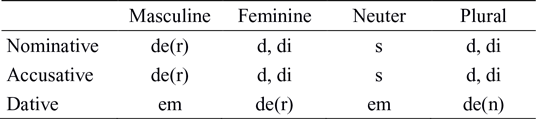
Zurich German—in principle—has a three-case system: Nominative, accusative, and dative are differentiated for at least some pronouns. As in Standard German, case is hardly ever expressed on the noun itself, but rather on the article. In some (originally strong) nouns not displaying a plural form in -e, there is a distinct dative plural ending (for example, nominative/accusative d haar ‘the hairs’, but dative a de haare ‘on the hairs’), but this morpheme was already reported as having been lost in the 1960s (see Wolfensberger Reference Wolfensberger1967:111–112). For the definite article, the morphological distinction between nominative and accusative case has been neutralized in all genders, as is illustrated in table 1 (forms according to Weber Reference Weber1964:102–103, 107; also Weber Reference Weber1923:172–173). Werlen (Reference Werlen and Philipp1990:170) states that this has had the consequence that word order is less flexible in Alemannic, with the subject being defined by its position. Note, however, that Werlen (Reference Werlen and Philipp1990:186, note 15) acknowledges that the object might precede the subject, but, according to him, only if the object is focused.
Paradigm of the definite article in Zurich German.

Experiment 1 sought to investigate the role of animacy in the interpretation of sentences with OS order in Zurich German, where morphological case marking is unavailable as a cue for argument identification in a transitive relation with two nonpronominal DPs. The present study used a 2 x 2 design. All critical sentences had the structure Adverb-Verb-DP-DP and contained only DPs that were ambiguous between nominative and accusative case. The subject was always animate, but the direct object was either animate or inanimate. If the object was also animate, animacy information was an ambiguous cue for argument identification (Anim +amb). If the object was inanimate, animacy was unambiguous (Anim -amb). Every critical sentence appeared in two word orders: the unmarked SO order or the scrambled OS order. Since our results were intended to be directly comparable to the results from Standard German obtained by Dröge et al. (Reference Dröge, Fleischer, Schlesewsky and Bornkessel-Schlesewsky2016), we adopted their design for our experiment, with the exception that case morphology was not a factor in our study because of the systematic case syncretism in Zurich German.
In Dröge et al. Reference Dröge, Fleischer, Schlesewsky and Bornkessel-Schlesewsky2016, as well as in the present study, it was crucial that an OS order was detectable at the first DP of the critical sentence, even in the absence of formal cues such as distinctive case marking. As in our previous study, we used question-answer pairs to this end, thereby enabling participants to predict the subject of the critical sentence. A question introduced both arguments and the verb, and was followed by an answer, which was the critical sentence. The question was an information-structurally neutral yes-no question that was set in passive voice. Accordingly, the agent was realized as a prepositional phrase in the question and was, therefore, easily identifiable. The answer was always affirmative beginning with the particle-adverb combination ja, natüürlich ʻyes, of courseʼ so that the participant would expect the answer to express a reassurance containing the identical lexical material as the preceding question, rather than a contrast that might introduce new, unknown lexemes. The verb in the answer was always in active voice so that the participant was cued to expect a regular transitive structure with the agent realized as the subject and the theme realized as the direct object. Each question was recorded with sentence focus and neither of the two arguments received focal stress, so that there was no reason to expect a deviation from the information-structurally neutral SO order in the answer. A sample of the stimuli for each condition is given in 9 and 10.
(9)

(10)

This experimental design enabled the participant to build up a specific expectation during incremental processing, which was crucial so that the participant would be able to recognize a scrambled word order already at the position of the first DP in the answer even if that DP was formally ambiguous. Conforming with the experimental criteria in Dröge et al. Reference Dröge, Fleischer, Schlesewsky and Bornkessel-Schlesewsky2016, the subject and object nouns in each critical sentence had phonologically different onset sounds. Since the phonetic form of the DPs was primed in the question, the onset sound of the nouns can be understood as the identification point for the DPs in the answer sentence.
2.2. Method: Participants, Materials, Behavioral Tasks
Twenty-four participants (mostly students from the University of Zurich) were recruited for the EEG experiment in Zurich. All took part voluntarily, gave informed consent, and were paid for participation. Twenty-two participants were monolingual native speakers of German, two were multilingual, but raised in Switzerland with German as their first language. Twenty-three participants reported a high competence in speaking the Zurich German dialect; one participant reported a lower confidence in speaking Zurich German, but this individual was excluded from data analysis due to EEG problems (see below). The participants were right-handed (handedness assessed with a modified version of the Edinburgh Inventory; Oldfield Reference Oldfield1971), had normal or corrected-to-normal vision, and did not report any hearing damage or neurological impairments. Twenty-three participants (15 females; mean age: 25.22 years; SD: 4.18; age range: 18–34 years) entered the final data analysis; one participant had to be excluded because of excessive artifacts in the EEG and self-rated low Zurich German competence.
The sentences in Dröge et al. Reference Dröge, Fleischer, Schlesewsky and Bornkessel-Schlesewsky2016 served as the basis for the present study, so that the results could be directly compared. The sentences were translated into Zurich German by a native speaker and checked with several other native speakers, both linguistically trained and untrained. Translations were intended to be as close to the Standard German source as possible. Most Standard German sentences could be transferred to the dialect by adapting the pronunciation of the words (for example, Schneider ʻtailorʼ as Schniider or Pfosten ʻpostʼ as Pfoschte), or Standard German words were replaced by their dialect counterparts (for example, Schaffner ʻticket inspectorʼ replaced by Kondiktöör or Frisörin ʻfemale hairdresserʼ replaced by Gwafföös). Some lexical items (nouns and verbs) had to be substituted by words with different meanings because they sounded unnatural or were extremely infrequent in the dialect (for example, Schatzkanzler ʻchancellorʼ substituted by Kantonsraat ʻmember of the (cantonal) parliamentʼ), which in some cases led to the substitution of other words in the respective sentence to retain a meaningful relationship between words.
Aside from these lexical differences, some substitutions were necessary because of specific phonological rules. In Zurich German, the masculine definite article de is ambiguous between nominative and accusative case, which is a crucial component of the study design. Only if the articles were formally identical would the participants not be able to identify the first DP until the noun was processed. However, there is a sandhi rule in Zurich German that the masculine definite article is pronounced as der if the following noun begins with a vowel (Fleischer & Schmid Reference Fleischer and Schmid2006:249).Footnote 10 Therefore, it was necessary to replace all masculine nouns with an initial vowel with semantically similar nouns with a consonantal onset. For example, the Standard German DP den Eintopf ʻthe stewʼ was replaced by the Zurich German DP de Braate ʻthe roasted meatʼ.
Another issue concerned DPs containing feminine nouns derived from an adjective (as in die Kranke ʻthe sick femaleʼ derived from adjective krank ʻsickʼ). The Zurich German definite article of such DPs changes from the usual clitic d to the full form di (see Weber Reference Weber1964:107). Therefore, the few problematic Standard German feminine nouns had to be replaced by Zurich German feminine nouns that take the clitic article. For example, die Kranke ʻthe sick femaleʼ was replaced by d Paziäntin ʻthe female patientʼ.
Sixty critical sentences were used for each of the two animacy conditions (Anim -amb and Anim +amb). These 120 stimuli appeared in both word order conditions (SO and OS), yielding 240 critical stimuli. Sentences in each experimental condition contained either two masculine nouns or two feminine nouns in equal proportions. This distribution of masculine and feminine nouns was adopted from Dröge et al. Reference Dröge, Fleischer, Schlesewsky and Bornkessel-Schlesewsky2016, where gender correlated with a difference in case morphology. In the present experiment, the gender contrast is not an experimental condition but serves to provide a greater lexical variety. In total, the stimulus material consisted of 360 question-answer pairs. Each of 120 questions appeared three times, followed by either a critical sentence in SO order, a critical sentence in OS order, or a filler sentence with a different structure or containing a different lexeme. An additional 10 question-answer pairs, which were similar in structure, served as training stimuli.
The Zurich German stimuli were recorded in phonetics labs at the University of Marburg and the University of Zurich. All 120 questions and 360 answers plus the 10 training questions and answers were spoken by two male native speakers. The speakers were instructed that all stimuli should be produced with the same intonational contour irrespective of word order, and that neither of the two DPs should be accented. Markers for the onset of the first DP in each critical sentence were manually set in the audio files, and all audio files were postprocessed by applying Appleʼs AUDynamics Processor Audio Unit with the “hard” factory preset, and normalizing the RMS power to 25% using the Amadeus Pro software (HairerSoft, Kenilworth, UK).
For the experiment, we created a stimulus list where one speaker asked all the questions and the other speaker gave all the answers totaling 360 question-answer pairs, and another list also containing the 360 question-answer pairs, but with the two speakers interchanged. Each of these two lists was pseudo-randomized twice, yielding four versions of stimulus lists. Each participant in the experiment was presented with one of these lists. Thus, each participant heard all question-answer pairs, but the stimulus order and the roles of the two speakers differed between participants.
After hearing each question-answer pair in the experiment, participants performed two behavioral tasks. The first task was an acceptability judgment task to assess how appropriately the critical sentence was perceived as an answer to the question. Directing the participantsʼ attention to the relationship between question and answer helped to ensure a correct assignment of thematic roles in the critical sentences. Since the OS conditions only contained a marked word order but were complete answers to the questions, we included fillers that contained different lexemes or represented incomplete answers in order to provide lexically inappropriate answers, as well. Acceptability ratings were given on a 4-point scale (3=“perfect”, 2=“quite good”, 1=“not that good”, 0=“really odd”).
The second task was a word recognition task to monitor if the participants were attentively following the stimuli. A probe word was presented and participants decided whether this word had occurred in the answer. Fifty percent of the probe words appeared in the preceding critical sentences. While questions and answers were played as audio files, probe words in the word recognition task were presented in written form on screen. Before the experiment, participants were informed that the dialect spelling of these words could deviate from their own way of spelling (as there is no official Zurich German orthography), but they should not judge the spelling but only the content of the word. Both tasks were to be answered as quickly as possible, and reaction times were analyzed for the acceptability judgments.
2.3. Procedure and EEG Recording and Preprocessing
Participants were seated in front of a laptop with a 15-inch screen in a quiet environment and gave responses to behavioral tasks by pressing keys on the laptop keyboard. Sound was played back on external loud speakers set to medium volume. After the participants had read the instructions, the EEG electrodes were set up, and participants were asked to minimize body movements and eye blinks during the presentation of the sentences. Participants began with a training session of 10 trials that were similar to the experimental trials, so that they were familiarized with the procedure and behavioral tasks. Having completed the training session, participants began the experimental session divided into 8 blocks with 45 trials per block and short breaks between blocks for recreation. Average experiment duration per participant was about 3 hours, of which the EEG recordings comprised approximately 1.5 hours.
Trials were presented using the software Presentation (Neuro-behavioral Systems, Inc., Berkeley, CA, USA). As a fixation point, an asterisk was displayed in the center of the screen that appeared 500 ms before and lasted until 1,000 ms after the playback of the audio. Between the playback of the question and the critical stimulus, there was a 1,000 ms silence. After playback, a question mark was displayed in the center of the screen to signal the acceptability judgment task with a maximal reaction time of 2,000 ms. After 500 ms of blank screen, the probe word for the word recognition task was displayed with a maximal reaction time of 3,000 ms. The next trial began after 1,000 ms of blank screen.
Responses to the acceptability judgment task were provided by pressing one of the four keys D, F, J, K on the keyboard. Answers to the word recognition task were either yes or no, so that only the keys D and K were used for this task. To avoid a lateral bias, we also used a mirrored setting of key responses, and both configurations were counter-balanced across participants.
The EEG was recorded with 31 channels as well as reference and ground: 24 electrodes were placed on the scalp by means of an elastic cap, 6 electrodes were placed around the eyes to record the electro-oculogram (EOG), 1 electrode was placed at each mastoid as on-line reference and for re-referencing, AFZ was the ground electrode. EEG recordings were conducted using a BrainAmp amplifier and the BrainVision Recorder software (BrainProducts GmbH, Gilching, Germany). The EEG was recorded with a sampling rate of 500 Hz. Impedances were kept below 5 kOhm. EEG signals were filtered off-line with a 0.3–20.0 Hz band pass filter to exclude slow signal drifts and re-referenced to linked mastoids.
Trials containing EEG artifacts such as eye blinks within the critical region, and trials with incorrect answers or button press time-outs in the word recognition task were excluded from the ERP analysis. For the ERP analysis, we first calculated single-participant averages for each condition in a time window of 200 ms before onset of the first DP in the critical sentence to 1,200 ms postonset. No baseline correction was performed (see Wolff et al. 2008 for discussion of why baseline corrections are problematic in ERP studies using naturally recorded auditory stimuli; see also Alday Reference Alday2019 for a critical discussion of traditional baseline correction and a new statistical approach as an alternative). The time window of -200 ms to +1,200 ms was also used for EEG artifact rejection. The EOG rejection criterion was 40 μV. Subsequently, grand averages for each condition were computed over all participants.
2.4. Statistical Analysis
All statistical analyses were calculated in R (R Core Team 2018). ANOVA analyses employed the ez package (Lawrence Reference Lawrence2016), while mixed effects analyses used the packages lme4 (Bates et al. 2015), lmerTest (Kuznetsova et al. 2017), ordinal (Christensen Reference Christensen2018), and emmeans (Lenth Reference Lenth2018).
For the behavioral data, trials with incorrect answers or button press time-outs in the word recognition task as well as trials with time-outs in the acceptability judgment task were excluded from the analyses of the acceptability ratings and the analyses of the reaction times. All behavioral data were analyzed using linear mixed effects models, including Order and Animacy as fixed factors and crossed random factors for participants and items. Following Barr et al. Reference Barr, Roger, Christoph and Tily2013, we fitted the model with the maximal random effects structure, which included random slopes by item for Order and random slopes by participant for Order x Animacy. Note that, whereas all items can vary with respect to Order, that is, take the values SO or OS, the value of Animacy is invariable for each item, that is, an item is either always unambiguous or always ambiguous in Animacy. Hence, random slopes for the Order x Animacy interaction could only be included by participant but not by item.
As acceptability judgments were given on a 4-point scale and are thus Likert-type ordinal data, we analyzed these using a cumulative link mixed model with logit link (proportional odds mixed model; for a general introduction to regression models, see, among others, Fahrmeir et al. Reference Fahrmeir, Thomas, Stefan and Brian2013; for the cumulative model in particular, see chapter 6 therein). The model was based on maximum likelihood estimation and fitted with the Laplace approximation; p-values were obtained using Type II Wald chi-squared tests. The same factors were used when analyzing the reaction time (RT) results for the acceptability judgments. Here, however, we fitted a linear mixed effects model instead of a cumulative link mixed model. The linear model was based on restricted maximum likelihood estimation. The p-values were estimated via Satterthwaite’s estimation of degrees of freedom.
For the statistical analysis of ERP effects, ANOVAs for mean amplitude values were computed for the time window of 200 ms to 500 ms and the time window of 600 ms to 900 ms postonset of the first DP in the critical sentence. These time windows were chosen based on previous studies and visual inspection of the ERP effects. ANOVAs were calculated per time window with the within-participants factors Order (SO or OS), Animacy (unambiguous or ambiguous), and topographical region of interest (ROI). We used the same electrode setting as in Dröge et al. Reference Dröge, Fleischer, Schlesewsky and Bornkessel-Schlesewsky2016 and also adopted their specification of six midline ROIs (one electrode per ROI: FZ; FCZ; CZ; CPZ; PZ; POZ) and four lateral ROIs (left-anterior: F7, F3, FC5, FC1; right-anterior: F8, F4, FC6, FC2; left-posterior: CP1, CP5, P3, P7; right-posterior: CP2, CP6, P4, P8). Separate statistical analyses were performed for the midline ROIs and for the lateral ROIs. The significance level was set at .05. All analyses followed a hierarchical procedure where only significant interactions were resolved. Main effects of ROI are not reported because they are not informative for the present study. Interactions of an experimental condition with ROI are informative as they provide information about the topographical distribution of the effect. However, whenever there is a significant interaction of a condition with ROI and, resolving by ROI, the effect of this condition reaches significance in all ROIs, we only report minimal (F MIN) and maximal (F MAX) F-values for reasons of clarity and comprehensibility. To protect against increased Type I errors resulting from violations of sphericity, p-values were adjusted by applying the Huynh-Feldt correction (Huynh & Feldt Reference Huynh and Feldt1970) whenever there was more than one degree of freedom in the numerator and Mauchlyʼs sphericity test (Mauchly Reference Mauchly1940) was significant. After computing the statistical analysis, we applied an 8.5 Hz low pass filter to the ERP waves to reduce visible noise when displaying the ERP plots in the figures. This filter was used for visualization only.
2.5. Results
The word recognition task served to assess if participants were following the sentences attentively. The accuracy for the critical stimuli was very high (98.1%). Trials with incorrect answers (1.56%) and button press time-outs (0.34%) were excluded from further analyses.
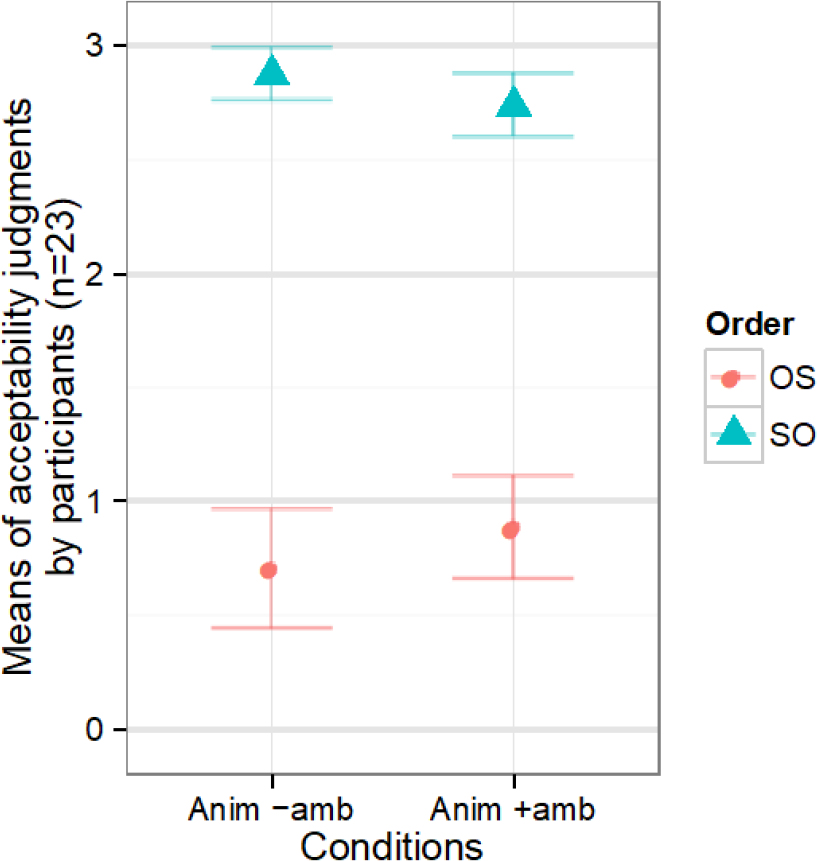
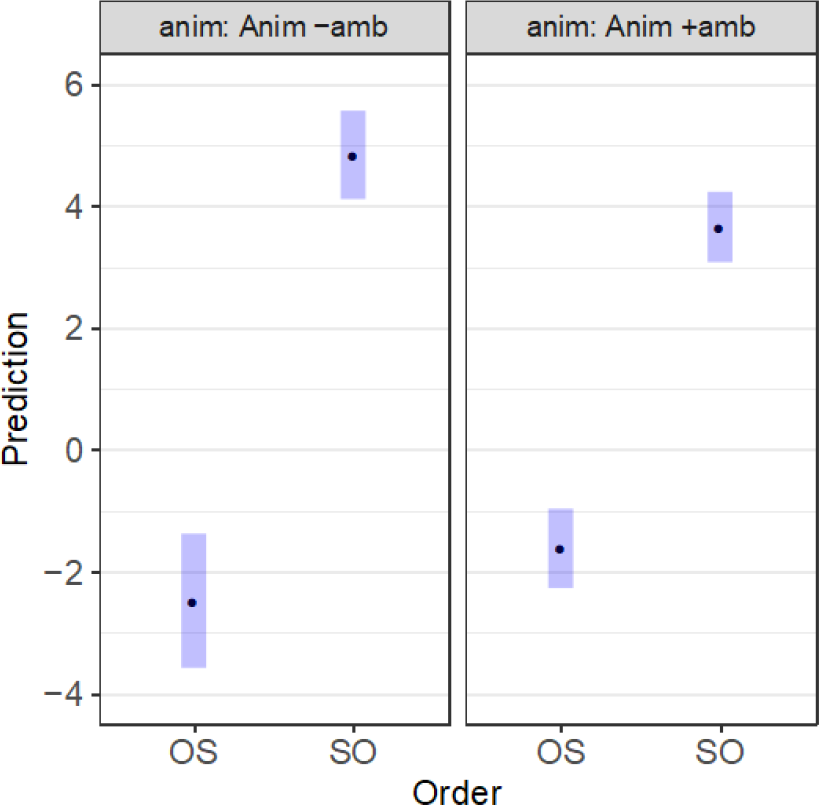
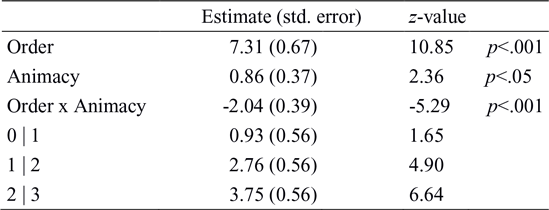
As far as acceptability judgments are concerned, figure 2 shows that the SO conditions were rated as highly acceptable, whereas the OS conditions were rated as rather unacceptable. Animacy seems to play only a marginal role, but the gap in acceptability between SO and OS appears smaller for the sentences with ambiguous animacy. The cumulative link mixed model with Order x Animacy interaction and maximal random effects structure confirmed these impressions (see table 2). The main effect of Order, the main effect of Animacy, and the interaction of Order x Animacy were significant. The AIC of the model was 6842. Estimated marginal means (Searle et al. Reference Searle, Speed and Milliken1980) are visualized in figure 3.
Means of acceptability judgments by participants (n=23).

Estimated marginal means of acceptability judgments.

Acceptability judgments as predicted by Order and Animacy.

Table 2 outlines the results from the cumulative link mixed model predicting acceptability judgments from Order and Animacy with maximal random effects structure in Zurich German. Estimates are given for location coefficients for Order, Animacy, and Order x Animacy with p-values, and for threshold coefficients. Standard errors are given in parentheses.
Figure 2 visualizes results from Zurich German. Ratings were given on a 4-point scale with 3 indicating the highest acceptability (“perfect”) and 0 the lowest acceptability (“really odd”). Triangles represent mean values of SO sentences and circles represent mean values of OS sentences. Conditions with unambiguous animacy (Anim -amb) are given on the left and conditions with ambiguous animacy (Anim +amb) are given on the right. Error bars give 95% confidence intervals.
Figure 3 shows estimated marginal means of acceptability judgments obtained from the cumulative link mixed model. Conditions with unambiguous animacy (Anim -amb) are given on the left and conditions with ambiguous animacy (Anim +amb) are given on the right. Error bars give 95% confidence intervals.
The reaction times for the acceptability judgment task were very similar for SO and OS orders when animacy was unambiguous, but somewhat shorter for SO compared to OS when animacy was ambiguous, as figure 4 shows. Furthermore, sentences with unambiguous animacy were rated faster than sentences with ambiguous animacy. The linear mixed effects model with maximum random effects structure confirmed a significant main effect of Animacy (b=87.01, SE=18.39, t(37)=4.73, p<.001), but no significant main effect of Order (b=-8.90, SE=21.46, t(28)=-0.42, p=.7) and no significant interaction of Order x Animacy (b=-38.43, SE=21.30, t(65)=-1.80, p=.08). The AIC of the model was 76074. In figure 4, means of reaction times of acceptability judgments by participants (n=23) are given in milliseconds. Triangles represent mean values of SO sentences and circles represent mean values of OS sentences. Conditions with unambiguous animacy (Anim -amb) are given on the left and conditions with ambiguous animacy (Anim +amb) are given on the right. Error bars give 95% confidence intervals.
Means of reaction times by participants (n=23).

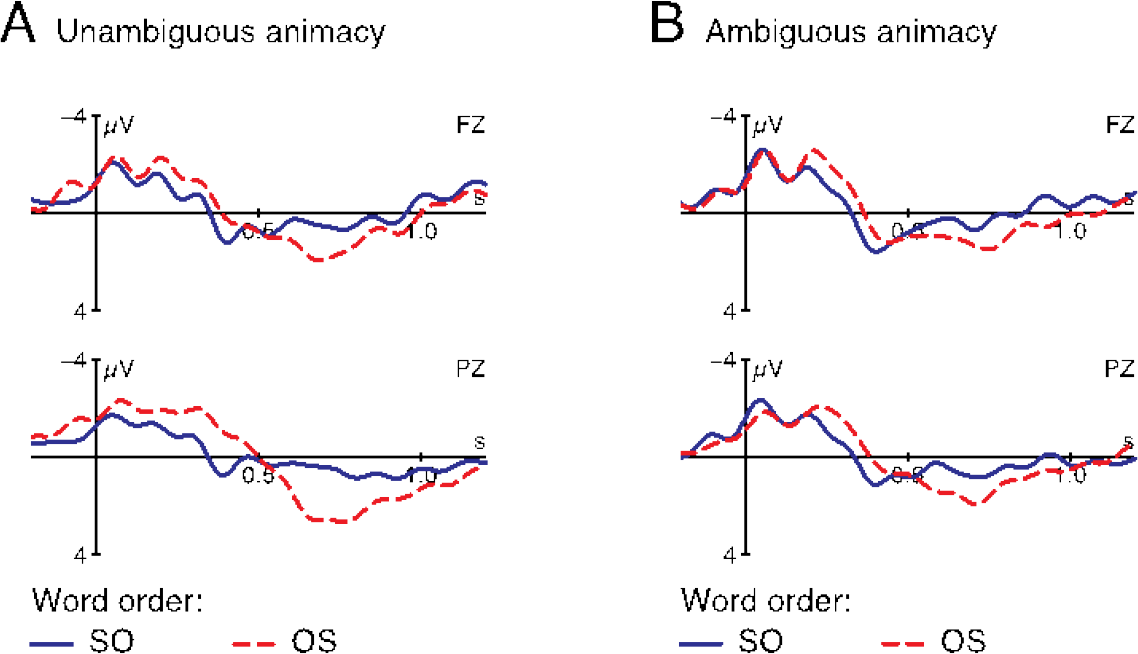
As far as ERP results are concerned, in Zurich German, OS sentences compared to SO sentences showed a negativity between ~200 ms and ~500 ms post-DP onset, followed by a late positivity between ~600 ms and ~900 ms (and even after 900 ms). In figure 5, panel A and panel B show the ERP response to SO versus OS order for sentences with unambiguous animacy and ambiguous animacy, respectively.Footnote 11 Grand average (n=23) ERPs of the first DP in the critical sentences is shown at electrode sites FZ and PZ. Panel A shows the contrast between SO order (solid line) and OS order (dashed line) in sentences with unambiguous animacy information. Panel B shows the contrast between SO order (solid line) and OS order (dashed line) in sentences with ambiguous animacy information. Negativity is plotted upwards.
Grand average (n=23) ERPs of the first DP in the critical sentences is shown at electrode sites FZ and PZ.

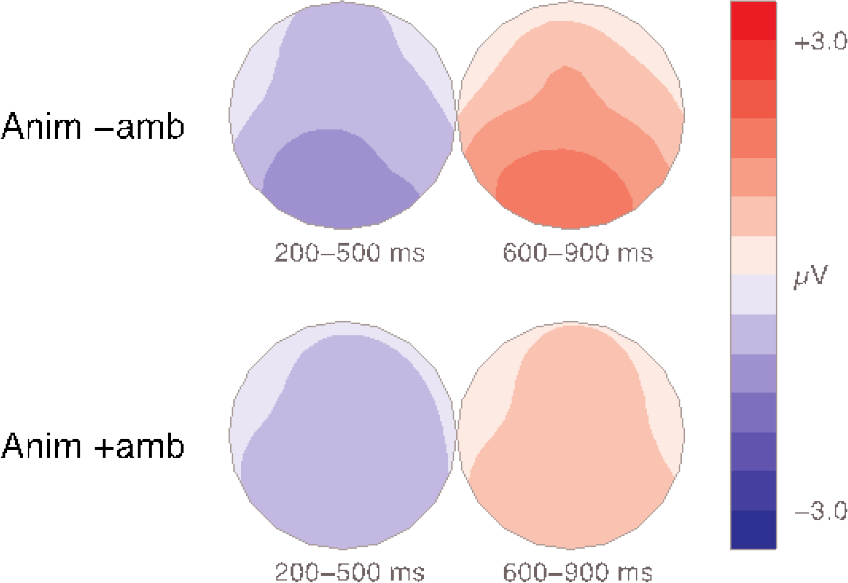
The topographical maps in figure 6 display the distribution of the differences on the scalp. The biphasic pattern is observed in both animacy conditions, but the effects seem more pronounced in conditions with unambiguous animacy. Following Dröge et al. (2016), we refer to the negative-going effect as a scrambling negativity, and to the late positivity as a P600.
Difference plots of grand average (n=23) ERPs of the first DP in the critical sentences.

Figure 6 shows difference plots of grand average (n=23) ERPs of the first DP in the critical sentences. The topographical maps show the difference waves on the scalp (anterior regions are plotted upwards). SO conditions were subtracted from the respective OS conditions to calculate the difference waves. The plots at the top show conditions with unambiguous animacy information (Anim -amb) for the time windows 200–500 ms and 600–900 ms; the plots at the bottom show conditions with ambiguous animacy information (Anim +amb) for the time windows 200–500 ms and 600–900 ms. Darker shades indicate greater differences and lighter shades indicate smaller differences.
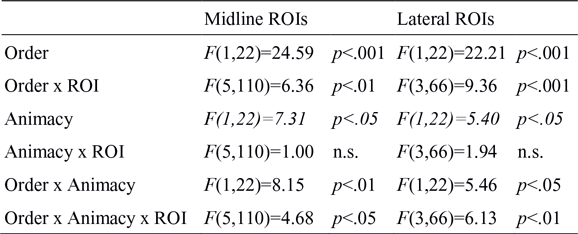
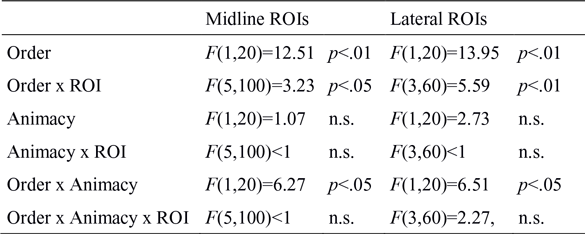
The scrambling negativity was most prominent in the time window between 200 ms and 500 ms post-DP onset. The ANOVA for this time window confirmed the effect of Order and also revealed an interaction of Order x ROI in lateral ROIs (see table 3). Resolving the interaction by ROI showed that the effect of Order was significant in all four lateral ROIs, but it was greater in the two posterior ROIs (left-anterior: F=6.94, p<0.05; right-anterior: F=12.45, p<0.01; left-posterior: F=20.95, p<0.001; right-posterior: F=21.79, p<0.001). The ANOVA also showed an effect of Animacy and an interaction of Animacy x ROI (see table 3). The animacy effect was significant in all midline ROIs except for FZ (FCZ: F=4.21, p=0.05; CZ: F=8.27, p<0.01; CPZ: F=13.44, p<0.01; PZ: F=14.98, p<0.001; POZ: F=14.66, p<0.001) and in the two posterior lateral ROIs (left-posterior: F=18.60, p<0.001; right-posterior: F=13.06, p<0.01). However, as there was no significant interaction of Animacy x Order, there is no evidence that animacy affected the strength of the scrambling negativity.
ERP results from Zurich German in the time window 200–500 ms.

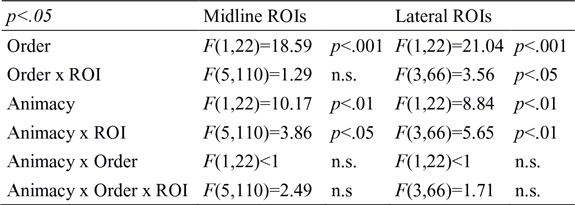
In table 3, the results are shown for the statistical analyses with six midline ROIs and four lateral ROIs, with n.s. meaning “not significant”.
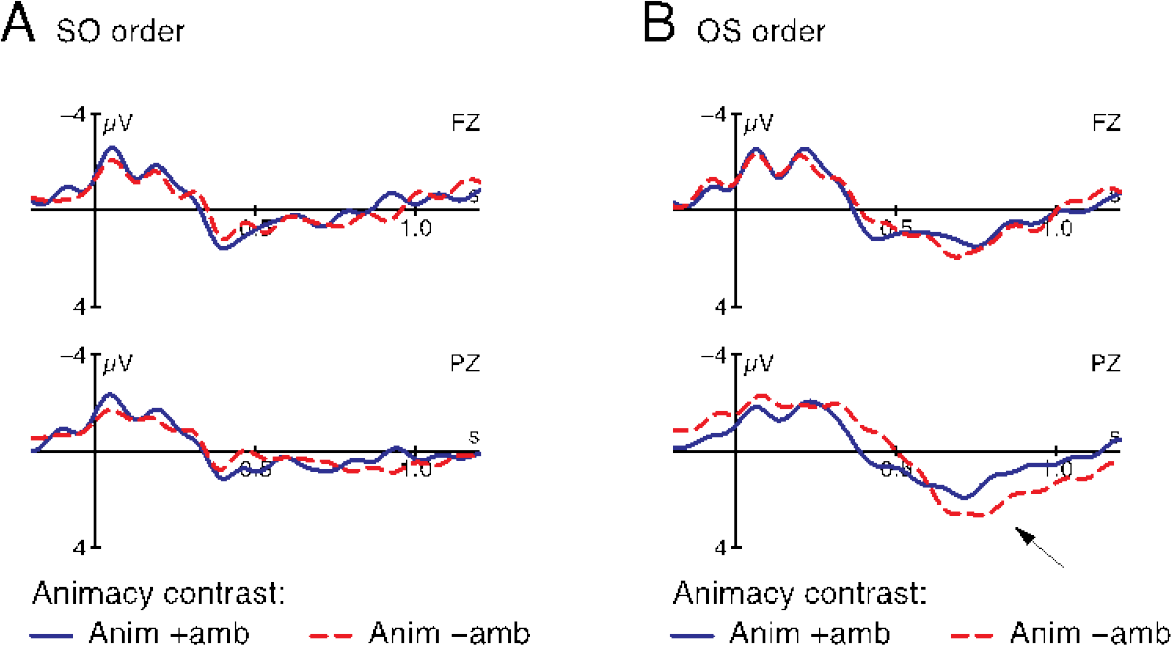
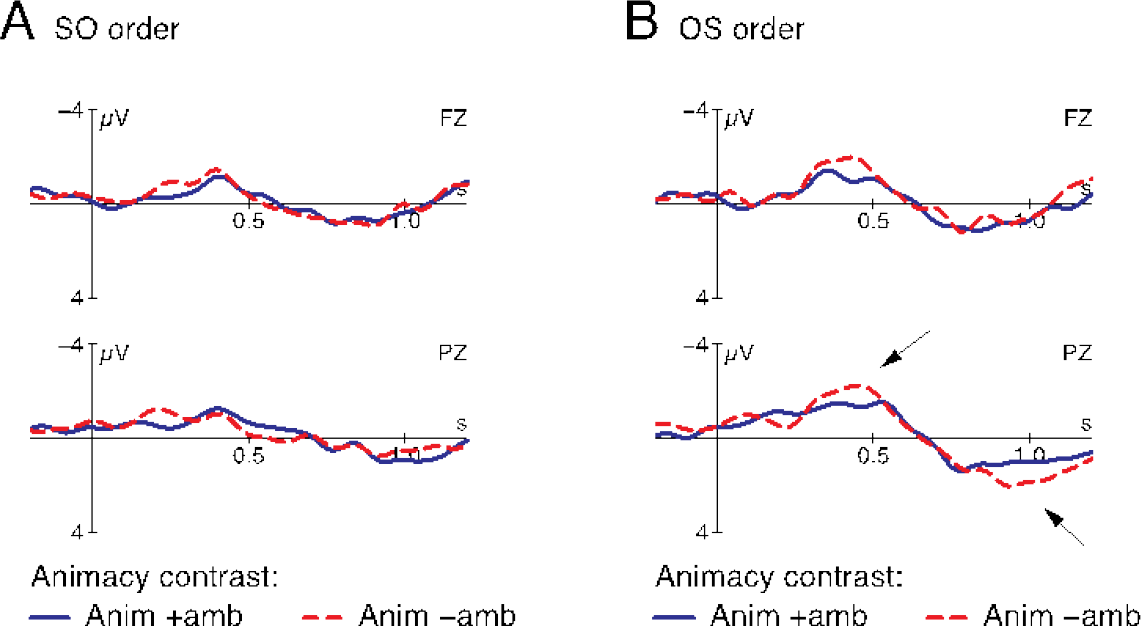
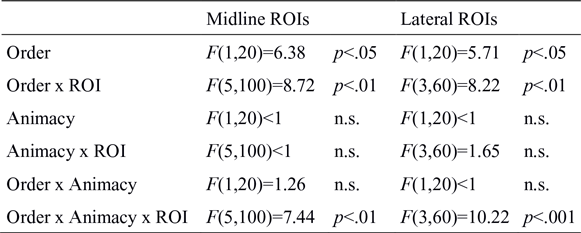
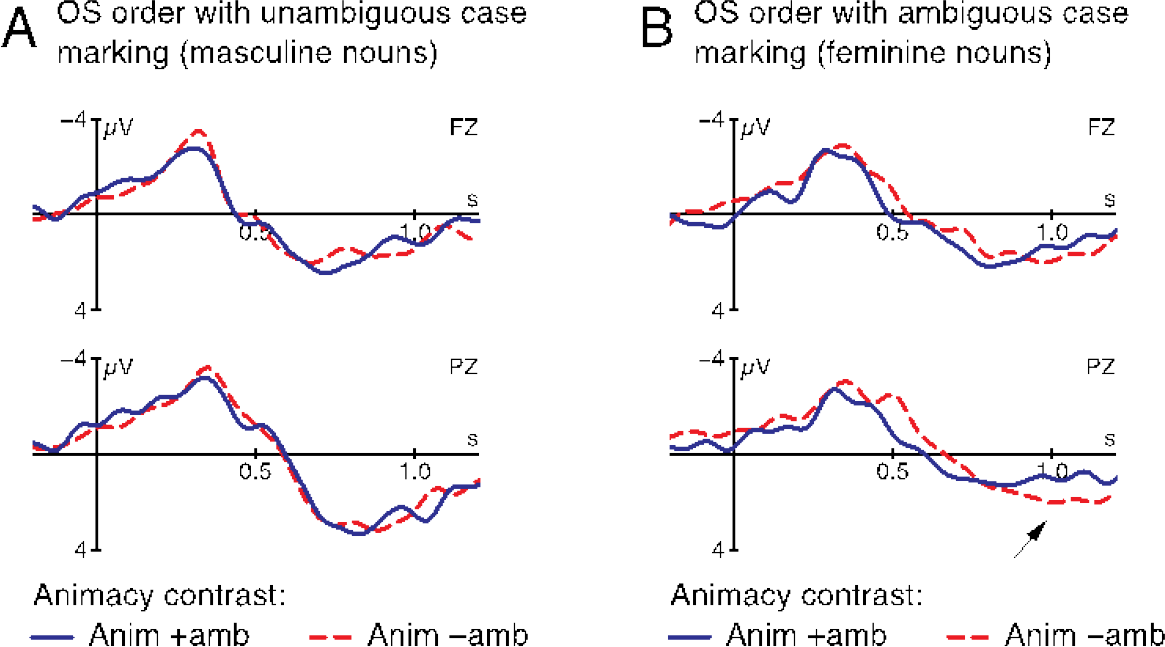
The P600 was analyzed in the time window between 600 and 900 ms post-DP onset. Statistical analyses confirmed a main effect of Order and an interaction of Order x ROI (see table 4). Resolving by ROI showed that the effect of Order was significant in all midline ROIs and all lateral ROIs, but the effect was most pronounced in posterior regions both in midline ROIs (F MAX=35.07, p<0.001 at POZ; F MIN=15.00, p<.001 at CZ) and lateral ROIs (F MAX=27.08, p<.001 in left-posterior ROI; F MIN=8.64, p<.01 in right-anterior ROI). In this time window, the ANOVA also showed a main effect of Animacy as well as an interaction of Order x Animacy and an interaction of Order x Animacy x ROI (see table 4). Resolving the interaction of Order x Animacy by word order revealed that the effect of Animacy was significant in the OS order (midline ROIs: F=11.08, p<.01; lateral ROIs: F=8.16, p<.01), but there was no animacy difference in the SO order (F<1 in midline and lateral ROIs). To better understand the topography of this effect, we resolved the interaction of Order x Animacy x ROI by ROI, revealing interactions of Order x Animacy in centro-posterior and posterior regions (midline ROIs: CZ: F=5.09, p<.05, CPZ: F=10.84, p<.01; PZ: F=15.44, p<.001; POZ: F=17.97, p<.001; lateral ROIs: left-posterior: F=14.70, p<.001; right-posterior: F=9.38, p<.01). When further resolving the significant interactions of Order x Animacy in each ROI, we obtained a picture similar to the overall interaction of Order x Animacy: The effect of Animacy was clearly significant in OS order in the four midline ROIs (CZ: F=8.32, p<.01, CPZ: F=9.38, p<.01; PZ: F=12.92, p<.01; POZ: F=16.70, p<.001) and the two lateral ROIs (left-posterior: F=14.52, p<.001; right-posterior: F=8.68, p<.01), but not so in SO order (all Fs<1 in respective ROIs). Thus, the P600 in OS sentences was significantly more pronounced when animacy was unambiguous. Figure 7 illustrates this difference in animacy by plotting the animacy contrasts for each word order. The ERP waves of the SO conditions are almost perfectly aligned, whereas there is a clear animacy difference between the ERPs of the OS conditions. The results are shown for the statistical analyses with six midline ROIs and four lateral ROIs.
Grand average (n=23) ERPs of the first DP in the critical sentences at electrode sites FZ and PZ.

ERP results from Zurich German in the time window 600–900ms.

Figure 7 shows grand average (n=23) ERPs of the first DP in the critical sentences at electrode sites FZ and PZ. Panel A shows the contrast between sentences with ambiguous animacy information (Anim +amb, solid line) and unambiguous animacy information (Anim -amb, dashed line) when word order is SO. Panel B shows the contrast between sentences with ambiguous animacy information (Anim +amb, solid line) and unambiguous animacy information (Anim -amb, dashed line) when word order is OS. Negativity is plotted upwards.
To summarize the results of experiment 1, we found that scrambled sentences were rated as rather unacceptable irrespective of whether the sentence contained an animate or inanimate object. Reaction times for the acceptability ratings were shorter when animacy information was unambiguous, that is, when the object was inanimate. The ERPs showed a scrambling negativity followed by a P600 effect for the OS versus SO sentences. This biphasic pattern is reminiscent of the ERP effects reported in Dröge et al. 2016 for Standard German. However, while the P600 was larger for OS sentences with unambiguous case marking in Standard German, the present experiment on Zurich German showed a more pronounced P600 in OS sentences with unambiguous animacy information.
3. Experiment 2: Scrambling in Fering
3.1. Syntactic Features of Fering and Experimental Design
The morphological system of Fering is even more dramatically reduced than that of Zurich German. In principle, Fering displays a two-case system (with only some personal pronouns for which a nominative form is distinct from an oblique form), with the additional interesting feature that the feminine and neuter are conflated in a single gender (see Wahrig-Burfeind Reference Wahrig-Burfeind1989:193). Interestingly, North Frisian displays two series of definite articles (see Ebert Reference Ebert1971), usually called d- and a-articles. Both articles display the same total case syncretism. Table 5 illustrates the a-article only (see Ebert Reference Ebert1971:9, Wilts Reference Wilts1995:16).
Paradigm of a-article in Fering.

The experimental design for experiment 2 on Fering was the same as that for experiment 1 on Zurich German (see section 2.1). We used translated and adapted versions of the stimuli from Dröge et al. Reference Dröge, Fleischer, Schlesewsky and Bornkessel-Schlesewsky2016, as well as a 2 x 2 design with word order (SO or OS) and animacy information (Anim -amb or Anim +amb) as factors. Examples of stimuli containing an inanimate object and an animate object are given in 11 and 12, respectively.
(11)

(12)

The first DP in the answer occupied the critical position (underlined in the examples).
3.2. Method, Procedure, and Statistical Analysis
Twenty-two participants were recruited for the EEG experiment on the Island of Föhr. Participants took part voluntarily, gave informed consent, and were paid for participation. All participants reported a high competence in speaking Fering. Twenty-one participants were bilingual in Fering and German (with eleven participants having acquired German at the age of 4 or older); one participant reported German as their first and Fering as their second language (individual moved to Föhr at the age of 12 months; one parent from Föhr). The participants were right-handed (handedness assessed with a modified version of the Edinburgh Inventory; Oldfield Reference Oldfield1971), had normal or corrected-to-normal vision, and did not report any hearing damage or neurological impairments that would negatively impact the experiment. Twenty-one participants (14 females; mean age: 22.05 years; SD: 4.05; age range: 18–35 years) entered the final data analysis; one participant had to be excluded because of excessive artifacts in the EEG.
The construction of the materials was undertaken analogously to the experiment on Zurich German (see section 2.2). The sentences were taken from the study on Standard German (Dröge et al. Reference Dröge, Fleischer, Schlesewsky and Bornkessel-Schlesewsky2016) as before and were translated by native speakers of Fering and a trained linguist. Two native speakers recorded the auditory stimuli with professional audio equipment at the Ferring Stiftung in Alkersum/Föhr.
Note that the conflation of feminine and neuter briefly mentioned in section 3.1 is not yet complete according to Ebert (Reference Ebert, Boeder, Schroeder, Wagner and Wildgen1998:270). Wilts (Reference Wilts1995:16) still distinguishes a neuter (for which he provides the a-article at) from a feminine (for which he provides the forms a/at) in his paradigm. After consulting with native speakers, we decided to only use the originally neuter form at in our stimuli. This is the only option for original neuters as well as most feminines and the more progressive option for a few feminines specifically designating persons.
As in the Zurich German experiment, we created stimuli lists that consisted of 360 question-answer pairs with 120 questions each appearing three times and being followed by an SO answer, an OS answer, or a filler sentence. Four lists were created, each containing all 360 question-answer pairs: two lists with one speaker asking the questions and the other speaker giving the answers, and two other lists with reversed assignment of speakers. These four lists were then pseudo-randomized. Each participant was presented with one of these four lists.
Tasks, procedure, EEG recording and preprocessing were analogous to the experiment on Zurich German (see the respective paragraphs in section 2.2). The data analysis was conducted analogously to the analysis of the Zurich German data (see section 2.2). However, visual inspection of the mean ERP effects revealed that the biphasic pattern had a different latency as compared to the effects in Zurich German. Hence, different time windows were chosen for the statistical analysis of the ERP effects. The negativity was analyzed in the time window of 300 to 600 ms, and the positivity was analyzed in the time window of 700 to 1,100 ms postonset of the first DP in the critical sentence.
3.3. Results
With 96.98% correct answers for the critical stimuli, accuracy in the word recognition task was very high, which indicates that participants were following the stimuli attentively. Incorrect answers amounted to 2.57% and button press time-outs to 0.46%, which were excluded from further analyses.
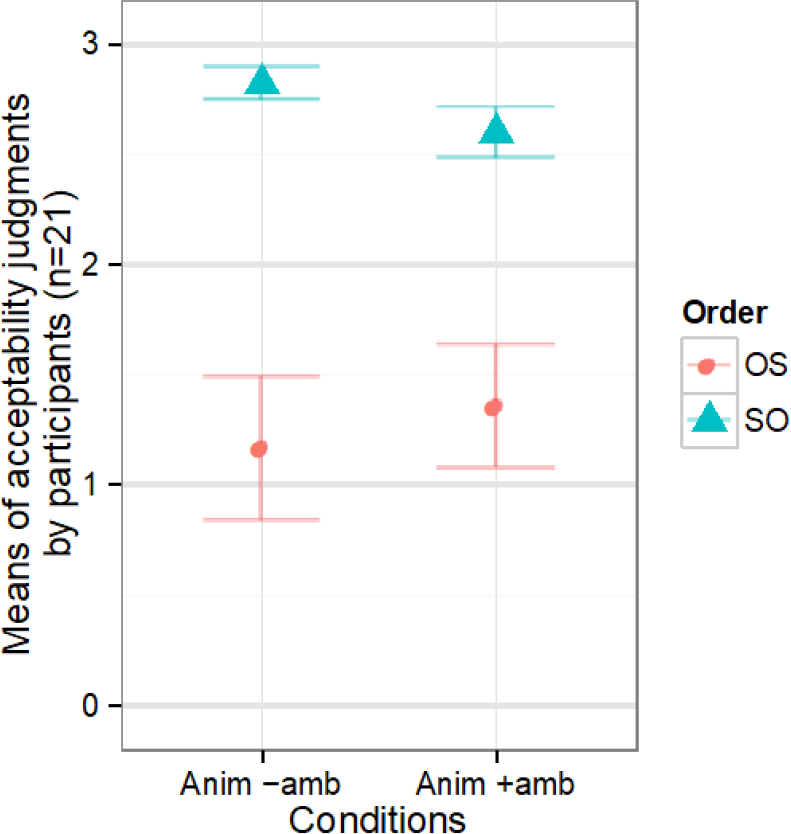
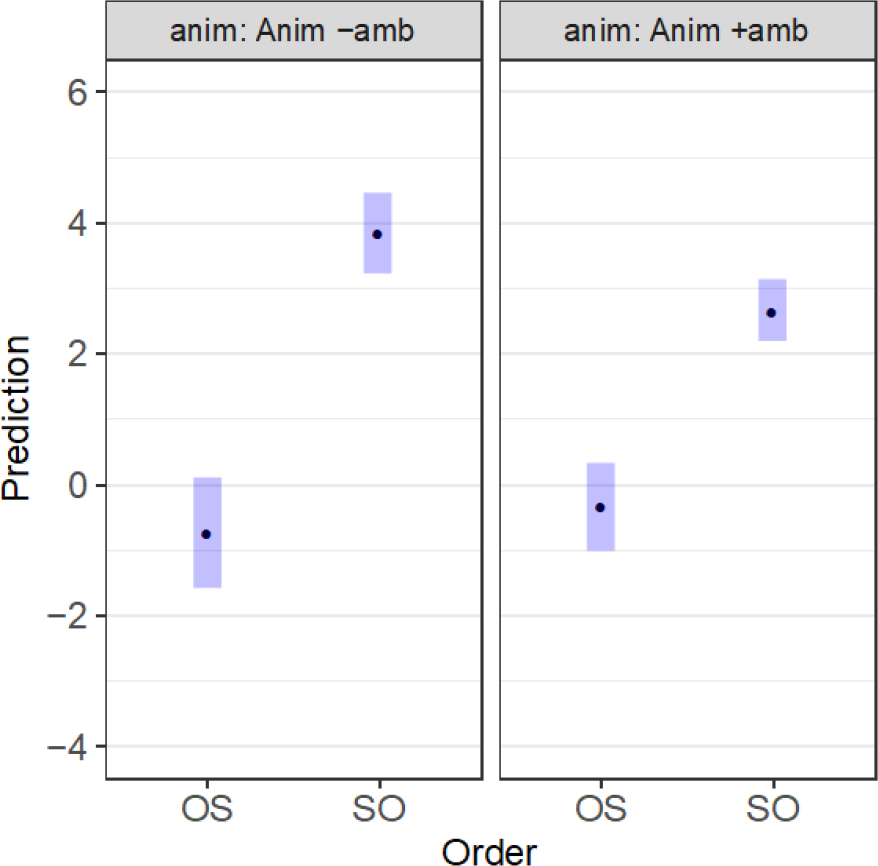
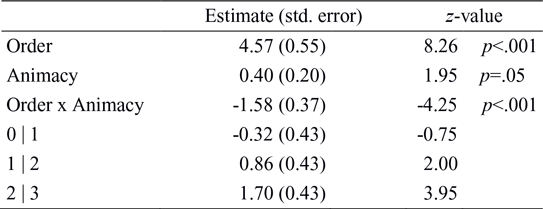
With respect to acceptability judgments, as figure 8 shows, OS conditions were rated as less acceptable than SO conditions. In sentences with ambiguous animacy, the acceptability gap between the OS and the SO conditions appears smaller than that for the respective unambiguous animacy conditions, due to a slightly lower acceptability of SO and a slightly higher acceptability of OS sentences in the ambiguous cases. The cumulative link mixed model with Order x Animacy interaction and maximal random effects structure confirmed these impressions (see table 6). The main effect of Order and the interaction of Order x Animacy were clearly significant. The main effect of Animacy was at the significance level of p=.05. The AIC of the model was 7872. Estimated marginal means were computed (Searle et al. Reference Searle, Speed and Milliken1980) and are visualized in figure 9.
Means of acceptability judgments by participants (n=21).

Estimated marginal means of acceptability judgments.

Acceptability judgments from Order and Animacy.

Table 6 shows the results from the cumulative link mixed model predicting acceptability judgments from Order and Animacy with maximal random effects structure in Fering. Estimates are given for location coefficients for Order, Animacy, and Order x Animacy with p-values, and for threshold coefficients. Standard errors are given in parentheses.
Figrue 8 shows the results from Fehring. Ratings were given on a 4-point scale with 3 indicating the highest acceptability (“perfect”) and 0 the lowest acceptability (“really odd”). Triangles represent mean values of SO sentences and circles represent mean values of OS sentences. Conditions with unambiguous animacy (Anim -amb) are given on the left and conditions with ambiguous animacy (Anim +amb) are given on the right. Error bars give 95% confidence intervals.
Figure 9 show estimated marginal means of acceptability judgments obtained from the cumulative link mixed model. Conditions with unambiguous animacy (Anim -amb) are given on the left and conditions with ambiguous animacy (Anim +amb) are given on the right. Error bars give 95% confidence intervals.
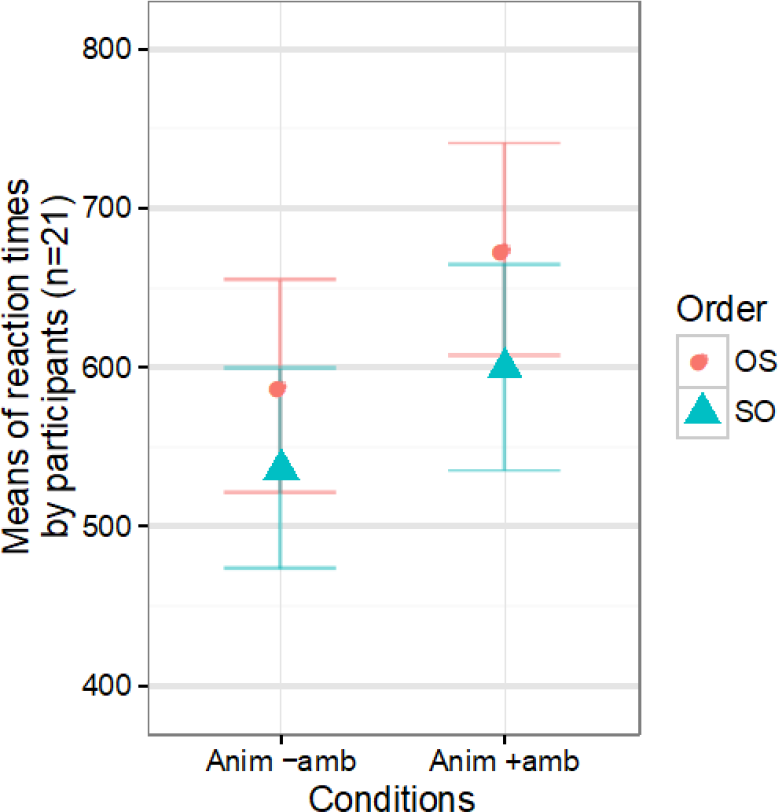
The analysis of the reaction times for the acceptability judgment task showed faster reactions in SO conditions compared to the respective OS conditions. Furthermore, for each word order, sentences with unambiguous animacy were rated faster than their counterparts with ambiguous animacy. Reaction times are given in figure 10. The linear mixed effects model with maximum random effects structure revealed significant main effects of Order (b=-52.62, SE=20.37, t(26)=-2.58, p<.05) and Animacy (b=85.17, SE=20.64, t(27)=4.13, p<.001), but the interaction of Order x Animacy was not significant (b=-19.90, SE=23.84, t(52)=-0.84, p=.4). The AIC of the model was 70017. In figure 10, means of reaction times of acceptability judgments by participants (n=21) are given in milliseconds. Triangles represent mean values of SO sentences and circles represent mean values of OS sentences. Conditions with unambiguous animacy (Anim -amb) are given on the left and conditions with ambiguous animacy (Anim +amb) are given on the right. Error bars give 95% confidence intervals.
Means of reaction times of acceptability judgments by participants (n=21).

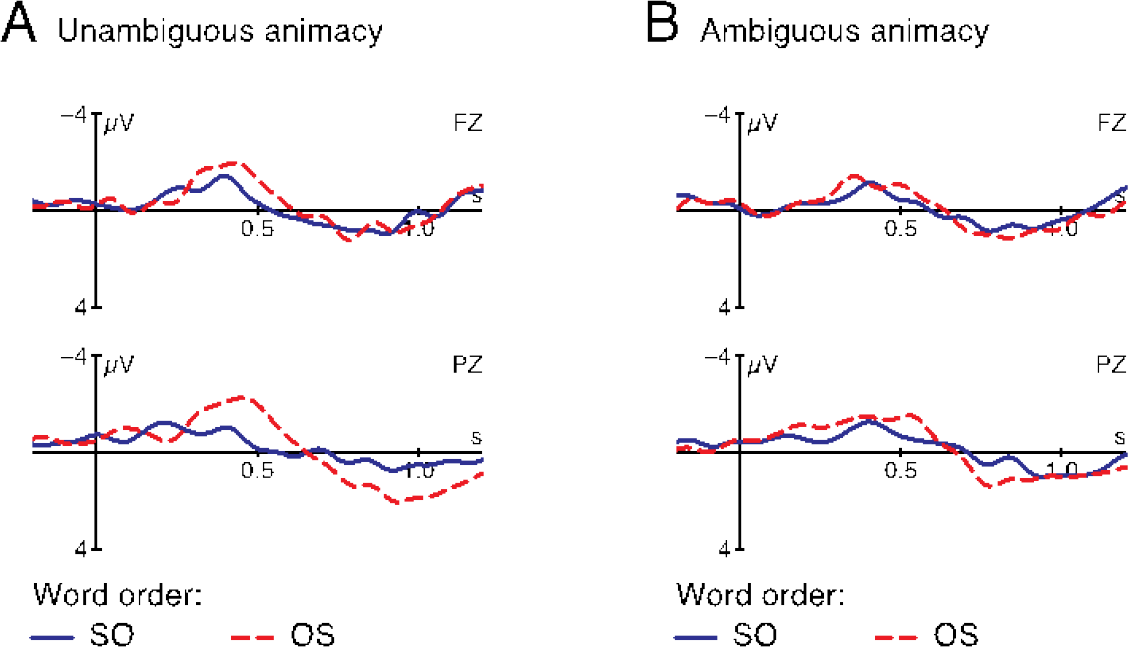
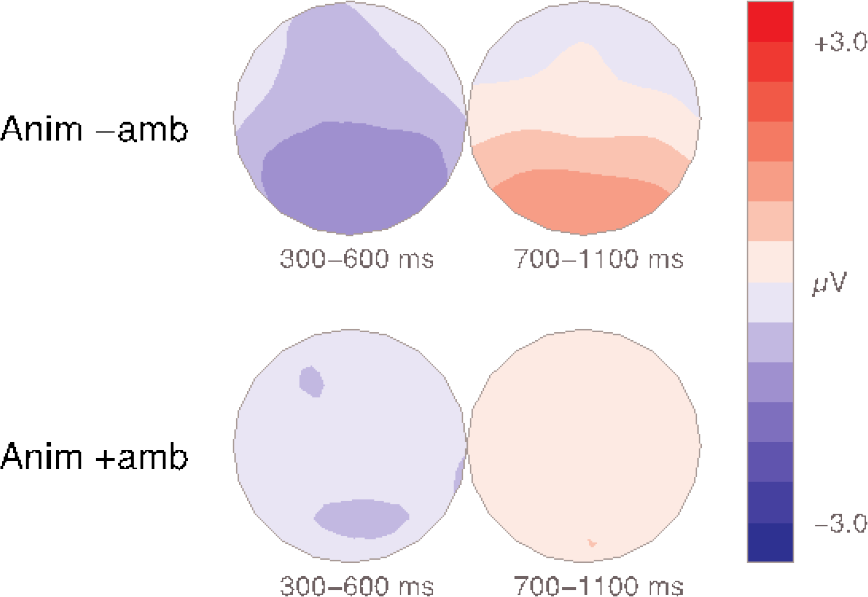
As far as the ERP results are concerned, OS conditions against SO conditions engendered a biphasic pattern in the ERP with a negativity between ~300 and ~600 ms followed by a positivity between ~700 and ~1,100 ms post-DP onset. As in experiment 1, we refer to the former effect as a scrambling negativity and to the latter effect as a P600. Figure 11 illustrates the ERP effects for selected electrodes. It shows grand average (n=21) ERPs of the first DP in the critical sentences at electrode sites FZ and PZ. Panel A shows the contrast between SO order (solid line) and OS order (dashed line) in sentences with unambiguous animacy information. Panel B shows the contrast between SO order (solid line) and OS order (dashed line) in sentences with ambiguous animacy information. Negativity is plotted upwards. Figure 12 shows the topographical scalp distribution of the differences. The biphasic effect appears to be strong in sentences with unambiguous animacy, but attenuated in sentences with ambiguous animacy.
Grand average (n=21) ERPs of the first DP in the critical sentences at electrode sites FZ and PZ.

Figure 12 shows difference plots of grand average (n=21) ERPs of the first DP in the critical sentences. The topographical maps show the difference waves on the scalp (anterior regions are plotted upwards). SO conditions were subtracted from the respective OS conditions to calculate the difference waves. The plots at the top show conditions with unambiguous animacy information (Anim -amb) for the time windows 300–600 ms and 700–1,100 ms. The plots at the bottom show conditions with ambiguous animacy information (Anim +amb) for the time windows 300–600 ms and 700–1,100 ms. Darker shades indicate greater differences and lighter shades indicate smaller differences.
Difference plots of grand average (n=21) ERPs of the first DP in the critical sentences.

We analyzed the scrambling negativity in the time window of 300 to 600 ms. The ANOVA confirmed the main effect of Order for both midline and lateral ROIs and also showed an interaction of Order x ROI (see table 7). To gain further insights into the topographical distribution of the effect of Order, we resolved the interaction by ROI. The effect of Order was significant in all six midline ROIs (F MAX=18.39, p<.001 at POZ; F MIN=7.49, p<.05 at FCZ) and all four lateral ROIs (F MAX=17.69, p<.001 in right-posterior ROI; F MIN=5.94, p<.05 in right-anterior ROI); the F-values indicate that the effect was greater in posterior regions. In addition, we found a significant interaction of Order x Animacy for the scrambling negativity (see table 7). Resolving this interaction by word order revealed a significant effect of Animacy in the OS conditions (midline ROIs: F=8.29, p<.01; lateral ROIs: F=11.26, p<.01) but no significant effect in the SO conditions (midline ROIs: F=1, p=.3; lateral ROIs: F<1, p=.4). This difference in animacy effects is illustrated in figure 13, which shows separate comparisons of the two SO conditions and the two OS conditions. Table 7 shows the results of the statistical analyses with six midline ROIs and four lateral ROIs.
Grand average (n=21) ERPs of the first DP in the critical sentences at electrode sites FZ and PZ.

ERP results from Fering in the time window 300–600 ms.

Figure 13 shows grand average (n=21) ERPs of the first DP in the critical sentences at electrode sites FZ and PZ. Panel A shows the contrast between sentences with ambiguous animacy information (Anim +amb, solid line) and unambiguous animacy information (Anim -amb, dashed line) when word order is SO. Panel B shows the contrast between sentences with ambiguous animacy information (Anim +amb, solid line) and unambiguous animacy information (Anim -amb, dashed line) when word order is OS. Negativity is plotted upwards.
The P600 was analyzed in the time window of 700 to 1,100 ms post-DP onset. The statistical analysis showed a significant main effect of Order as well as an interaction of Order x ROI and an interaction of Order x Animacy x ROI (see table 8). Resolving the interaction by ROI, we found that the effect of Order only reached significance in posterior regions in midline ROIs (CPZ: F=4.97, p<.05; PZ: F=11.94, p<.01; POZ: F=15.56, p<.001) and lateral ROIs (left-posterior ROI: F=14.50, p<.01; right-posterior ROI: F=10.37, p<.01). Furthermore, there was a significant interaction of Order x Animacy in two posterior midline ROIs (PZ: F=4.72, p<.05; POZ: F=5.98, p<.05) and the left-posterior lateral ROI (F=5.80, p<.05). Further resolving these significant interactions by word order revealed a significant effect of Animacy in OS conditions (F=4.50, p<.05 at PZ; F=4.88, p<.05 at POZ; F=4.31, p=.05 in left-posterior lateral ROI) but not so in SO conditions (F=1.82, p=.2 at PZ; F=3.66, p=.07 at POZ; F=2.98, p=.09 in left-posterior lateral ROI).
Table 8 shows the results of the statistical analyses with six midline ROIs and four lateral ROIs.
ERP results from Fering in the time window 700–1100 ms.

To summarize experiment 2 on Fering, the acceptability judgment task showed that OS sentences were rated as less acceptable than SO sentences and reaction times were shorter for SO sentences. Ambiguous animacy reduced the acceptability gap between SO and OS sentences, but led to longer reaction times. ERPs revealed a biphasic pattern of a scrambling negativity followed by a P600 for OS sentences compared to SO sentences. The amplitudes of both effects were more pronounced when animacy was unambiguous.
4. Interim Summary
Experiments 1 and 2 examined the processing of SO and OS orders in Zurich German and Fering, the North Frisian variety spoken on the island of Föhr, respectively. The two experiments had parallel designs: Subject and object DPs were formally ambiguous, with sentences containing either an animate or an inanimate object (subjects were always animate). At first glance, the results of the two experiments appear very similar. There are, however, some interesting differences in both the acceptability judgments as well as the ERP data.
In both Zurich German and Fering, SO sentences received very high acceptability ratings (mean values with animacy combined: 2.81 in Zurich German; 2.71 in Fering). OS sentences were rated less acceptable than their SO counterparts, but the mean ratings of the OS conditions in Fering showed a greater acceptability compared to the OS conditions in Zurich German (0.79 in Zurich German; 1.26 in Fering). For comparison, filler conditions with incoherent question-answer pairs received low acceptability ratings in both languages (0.54 in Zurich German; 0.69 in Fering). Even though an interpretation of these mean values must be treated with caution, the OS order seems more likely to be accepted as a possible structure by Fering speakers despite the high degree of case syncretism in this language. The reaction time results in the acceptability judgment tasks were also slightly different in the two experiments. Sentences with unambiguous animacy were always rated faster than their counterparts with ambiguous animacy both in Fering and Zurich German. However, only in Fering did we find a main effect of word order, that is, SO sentences were rated faster than their OS counterparts. In Zurich German, there was no word order difference in conditions with unambiguous animacy.
The ERP results also revealed interesting parallels as well as differences between Fering and Zurich German. For the word order contrast, OS versus SO conditions engendered a similar biphasic pattern of a scrambling negativity followed by a P600 in both Fering and Zurich German, and the P600 effects in both experiments were more pronounced when animacy was unambiguous. This animacy difference reflected in the P600 showed a posterior scalp distribution in both Zurich German and Fering, but the effect was less pronounced in Fering and only became statistically significant in some posterior regions. Only the Fering data also showed a significant animacy effect in the OS conditions within the time window of the scrambling negativity. We return to the discussion of this animacy effect in Fering in section 6.1.
5. New Analysis of Animacy Effects in Standard German
Dröge et al. (Reference Dröge, Fleischer, Schlesewsky and Bornkessel-Schlesewsky2016) reported no significant effects of animacy in OS sentences. Thus, in contrast to the findings from Zurich German (experiment 1) and Fering (experiment 2) in the present study, unambiguous animacy did not lead to an increase in the amplitude of the P600 effect in Standard German. This “missing” animacy effect in Standard German is evident in the ERP plots of OS sentences with ambiguous and unambiguous animacy in figure 14 (adapted from figure 5 in Dröge et al. Reference Dröge, Fleischer, Schlesewsky and Bornkessel-Schlesewsky2016:156), where both waveforms align almost perfectly. In light of the results obtained from Zurich German and Fering, it would be interesting to investigate if animacy information may have also had an influence in Standard German when distinctive case marking was unavailable. Recall that, in Standard German, only DPs containing a masculine definite article are clearly case-marked for nominative and accusative case. DPs with a feminine definite article, which were also included in the stimuli in Dröge et al. Reference Dröge, Fleischer, Schlesewsky and Bornkessel-Schlesewsky2016, resemble the case pattern of Zurich German with nominative/accusative case syncretism. In the following, we present a posthoc analysis of the Standard German ERP data with new time windows that were not analyzed in Dröge et al. Reference Dröge, Fleischer, Schlesewsky and Bornkessel-Schlesewsky2016.
Results from Standard German (grand average n=27 ERPs of the first DP in the critical sentences).

Figure 14 shows grand average (n=27) ERPs of the first DP in the critical sentences at electrode sites FZ and PZ. The plot shows the contrast between OS sentences with ambiguous animacy information (Anim +amb, solid line) and unambiguous animacy information (Anim -amb, dashed line). Conditions with unambiguous and ambiguous case marking have been combined here. Negativity is plotted upwards (the figure is adapted from figure 5, Panel D, Dröge et al. Reference Dröge, Fleischer, Schlesewsky and Bornkessel-Schlesewsky2016:156).
Visual inspection of new, separate plots for OS sentences with and without distinctive case marking (see figure 15, not presented in Dröge et al. Reference Dröge, Fleischer, Schlesewsky and Bornkessel-Schlesewsky2016) reveals that only the conditions with distinctive case marking appear unaffected by animacy, whereas sentences with ambiguous case marking seem to be susceptible to animacy differences. It appears as if OS sentences with ambiguous case marking and unambiguous animacy show a prolonged negativity in a time window after 500 ms post-DP onset, as well as a more pronounced positivity after approximately 900 ms. However, the time windows 500–700 ms and 900–1,100 ms were not analyzed in Dröge et al. Reference Dröge, Fleischer, Schlesewsky and Bornkessel-Schlesewsky2016. The 500–700 ms time window was not of interest because the main effect of word order transitions from a negativity into a positivity within this time window, obscuring other possible effects. The late time window (900–1,100 ms) appeared to only contain sustained main effects already captured in the analyses of other time windows, and the possible animacy effect was overlooked.
Figure 15 shows grand average (n=27) ERPs of the first DP in the critical sentences at electrode sites FZ and PZ. Panel A shows the contrast between OS sentences with ambiguous animacy information (Anim +amb, solid line) and unambiguous animacy information (Anim -amb, dashed line) when case marking is unambiguous (masculine nouns). Panel B shows the contrast between OS sentences with ambiguous animacy information (Anim +amb, solid line) and unambiguous animacy information (Anim -amb, dashed line) when case marking is ambiguous (feminine nouns). Negativity is plotted upwards.
Results from Standard German (grand average n=27 ERPs of the first DP in the critical sentences).

If animacy has an influence on the ERPs of OS sentences when case marking is ambiguous, this should be reflected in a three-way interaction of Case x Order x Animacy. Thus, we calculated repeated-measures analyses of variance (ANOVA) for the new time windows 500–700 ms and 900–1,100 ms using the factors identical to the ones employed in Dröge et al. Reference Dröge, Fleischer, Schlesewsky and Bornkessel-Schlesewsky2016.Footnote 12 The presentation of the results is limited to the relevant three-way interactions; other significant effects such as main effects for word order etc. are not reported or discussed here. The ANOVA for the time window 500–700 ms did not confirm a significant three-way interaction of Case x Order x Animacy (midline ROIs: F(1,26)=1.66, p=.2; lateral ROIs: F(1,26)=1.12, p=.3). The statistical analysis of the time window 900–1,100 ms also did not reveal a significant three-way interaction in lateral ROIs (F(1,26)=3.05, p=.09), but showed a significant interaction of Case x Order x Animacy in midline ROIs (F(1,26)=4.61, p<.05). Resolving this interaction by case marking showed a significant interaction of Order x Animacy in sentences with ambiguous case marking (F=8.00, p<.01), but no such interaction in sentences with distinctive case marking (F<1, p=.9). The interaction of Order x Animacy in sentences with ambiguous case marking was further resolved by word order, revealing significant effects of Animacy in OS conditions (F=5.22, p<.05) and in SO conditions (F=4.26, p<.05). The animacy effect in OS conditions with ambiguous case marking confirms the impression of a more pronounced positivity shown in figure 15.Footnote 13 This late positivity perfectly parallels the pattern found in Zurich German and Fering. It seems that case marking overrides animacy in Standard German, but only in those conditions where case distinctions are available, that is, when the DPs contain a masculine definite article. As soon as case marking in the DPs is ambiguous, Standard German seems to exhibit an ERP pattern that is very similar to the one observed in Zurich German and Fering. This influence of animacy in Standard German was not detected in Dröge et al. 2016 because the effect is very small, only found in case of ambiguous OS conditions, and only measurable in a very late time window.
6. General Discussion
We investigated electrophysiological brain responses to the processing of word order variations in spoken sentences in Zurich German, a variety of German, and Fering, a variety of North Frisian, and we compared our findings to the results in Dröge et al. 2016 from Standard German, using a parallel experimental design in all experiments. Stimuli were presented as question-answer pairs in connected speech. Critical sentences appeared in SO order or OS order with ambiguous animacy information (both subject and object animate) or unambiguous animacy information (animate subject and inanimate object). While our previous study on Standard German included both ambiguous and unambiguous case marking (Dröge et al. Reference Dröge, Fleischer, Schlesewsky and Bornkessel-Schlesewsky2016), case ambiguity was not a factor in the present study because both Zurich German and Fering have systematic nominative/accusative case syncretism in the definite article in all genders. The current findings thus provide new insights into sentence comprehension mechanisms in varieties that are closely related to Standard German, but exhibit reduced case distinctions.
The major findings in Dröge et al. Reference Dröge, Fleischer, Schlesewsky and Bornkessel-Schlesewsky2016 on Standard German were replicated both in experiment 1 on Zurich German and in experiment 2 on Fering. In an acceptability judgment task, the case ambiguous OS sentences in Standard German, as well as the OS sentences in Zurich German and Fering were rated as less acceptable than their SO counterparts. Reaction time results were similar in that conditions with unambiguous animacy information were rated faster than their counter-parts with ambiguous animacy information in all three experiments, and in Standard German and Fering reaction times were shorter for SO conditions compared to the respective OS conditions. The ERP results for the Standard German, Zurich German, and Fering data also showed a similar pattern. Dröge et al. (Reference Dröge, Fleischer, Schlesewsky and Bornkessel-Schlesewsky2016) reported a scrambling negativity followed by a P600 at the first DP in OS sentences compared to SO sentences in Standard German. This biphasic ERP pattern was also found for OS sentences in experiment 1 on Zurich German as well as in experiment 2 on Fering.
However, the findings from Zurich German and Fering are not a mere replication of the effects in Standard German. Rather, they reveal how processing strategies in closely related varieties vary depending on the availability of syntactic and semantic cues. The similarities and differences with regard to the scrambling negativity and P600 effects in Standard German, Zurich German, and Fering are discussed below. The paper concludes with a discussion on how other strands of linguistic research, in particular comparative linguistics, dialectology, and language typology can benefit from neurocognitive findings.
6.1. The Scrambling Negativity
Schlesewsky et al. (Reference Bornkessel, Schlesewsky and Friederici2003) suggested that the scrambling negativity reflects a violation of grammatical linearization principles. The replication of the scrambling negativity in the present study corroborates this hypothesis. Furthermore, the scrambling negativity seems to be tied to a prediction mismatch because the language processing system expects an unmarked subject-object order, but in a scrambled sentence, this expectation is violated because the unexpected object rather than the expected subject is recognized as the first DP (see discussion in Dröge et al. Reference Dröge, Fleischer, Schlesewsky and Bornkessel-Schlesewsky2016).
In Dröge et al. Reference Dröge, Fleischer, Schlesewsky and Bornkessel-Schlesewsky2016, animacy information and case marking did not have a significant influence on the amplitude of the scrambling negativity, but the scrambling negativity had an earlier effect onset in OS sentences with unambiguous case marking because the prediction mismatch was already triggered by the unexpected case marking of the definite article before the noun. The findings from the present experiments on Zurich German and Fering provide further evidence that the scrambling negativity may reflect a possible prediction mismatch between an expected item and the actual input. Importantly, a prediction mismatch in the case of a violation of linearization principles in scrambled sentences is only one example of prediction effects in language comprehension (see Kamide Reference Kamide2008 for a review). An incoming element may conflict with an internal prediction model in several ways, and a number of negative-going ERP effects with approximately the same latency have been associated with prediction. A semantic conflict often engenders an N400 effect (see Federmeier Reference Federmeier2007, Kutas et al. Reference Kutas, DeLong, Smith and Bar2011, Kutas et al. Reference Kutas, Federmeier, Urbach, Michael and George2014 for reviews), and a left-anterior negativity (LAN) may be the response to a grammatical agreement conflict (Molinaro et al. 2011; but see Bornkessel-Schlesewsky et al. Reference Bornkessel-Schlesewsky and Schlesewsky2016 for a recent discussion of findings that challenge this dissociation based on linguistic subdomains). The scrambling negativity seems to belong to this group of negative-going ERP effects and reflects the mismatch between the current input and an expected subject-first word order. Following a unified approach to negativities as reflecting predictive processing, as suggested in Bornkessel-Schlesewsky & Schlesewsky Reference Bornkessel-Schlesewsky and Schlesewsky2016, Reference Bornkessel-Schlesewsky and Schlesewsky2019, Dröge et al. (Reference Dröge, Fleischer, Schlesewsky and Bornkessel-Schlesewsky2016:158) classified the scrambling negativity as an N400 because of the polarity and topography of the effect and the functional interpretation in terms of a prediction indicator, irrespective of whether semantic or syntactic stimuli trigger the response.
Even though we argue in favor of a prediction-based account of the N400, the data presented here are also compatible with an integration-based account, where the reduced N400 amplitude for expected subjects may be interpreted as facilitated integration (see also Van Petten & Luka Reference Van Petten and Luka2012 for a review of such accounts). The predictability of a word may also be described in terms of its surprisal. Surprisal is an information-theoretic estimate for the processing difficulty of a word (Hale Reference Hale2001, Levy Reference Levy2008), and it could be shown that N400 amplitude can be estimated by surprisal (Frank et al. Reference Frank, Otten, Giulia and Vigliocco2015). However, Zarcone et al. (2016) argue that current surprisal accounts are not sufficient to adequately model processing effects related to salience in language comprehension, such as the influence of attention and task-related effects. Similarly, Bornkessel-Schlesewsky & Schlesewsky (Reference Bornkessel-Schlesewsky and Schlesewsky2019) suggest that, rather than reflecting surprisal per se, N400 amplitude is modulated by precision-related prediction error signals, that is, it takes into account the relevance of the respective information source for updating a predictive model in a given language. The hierarchical predictive coding model (Rao & Ballard 1999; Friston Reference Friston2005, Reference Friston2010; Huang & Rao Reference Huang and Rao2011; Clark Reference Clark2013) is a neurobiological approach originally developed to model prediction in visual cognition, which is highly compatible with the temporal dynamics of predictive processes in language comprehension (Bornkessel-Schlesewsky et al. Reference Bornkessel-Schlesewsky and Schlesewsky2016) as well as a promising model to expand surprisal-based accounts (Zarcone et al. 2016; see also Kuperberg & Jaeger Reference Kuperberg and Jaeger2016).
Only in experiment 2 on Fering did we observe a significant influence of animacy information on the amplitude of the scrambling negativity. OS sentences with unambiguous animacy produced a more pronounced negativity compared to OS sentences with ambiguous animacy (section 3.3, figure 13). This raises the question of why the scrambling negativity was affected by animacy in Fering, but not in Zurich German or Standard German. Visual inspection of the animacy differences in Zurich German (section 2.5, figure 7) and Standard German (section 5, figure 15) show that the negative deflections in OS sentences with and without ambiguous animacy are not perfectly aligned, and there appears to be a more pronounced or prolonged negativity in Zurich German and Standard German, as well. However, statistical analyses for Zurich German and Standard German did not reveal significant interactions of animacy with word order; hence, OS sentences with an inanimate object were not statistically different from those with an animate object.
We argued above that the scrambling negativity should be viewed as an instance of the N400 component. Inanimate nouns compared to animate nouns in subject position have been found to elicit an N400 effect because an inanimate noun is less expected to be the subject of a sentence (see, for example, Weckerly & Kutas Reference Weckerly and Kutas1999). In all three tested varieties, the negativity tended to be more pronounced for an inanimate object as compared to an animate object as the first DP, but this difference only reached significance in Fering. Observing a more pronounced negativity for inanimate nouns in subject position is not unexpected, but such an effect should be noticeably mitigated in the present study because of the experimental design. Recall that the arguments were primed in the preceding question and integrated into a prediction model. Thus, participants not only expected the subject of the critical sentence to be an animate noun, but they were even able to predict a specific lexical item. Thus, a sentence beginning with any other lexical item, be it animate or inanimate, would be unexpected. Therefore, the amplitude of the scrambling negativity in OS sentences should be only mildly affected by animacy differences.
To better understand the impact of these differences, we calculated a comparison across experiments. Z-scores of mean amplitude differences (OS–SO) were computed so that word order differences between experiments were comparable. ANOVAs of the standardized differences with language variety as between-factor, directly comparing the differences of the animacy effects, revealed no significant main effect of animacy (midline ROIs: F(1,68)=1.72, p=.2; lateral ROIs: F(1,68)=1.88, p=.2), no significant main effect of language variety (midline ROIs: F(2,68)=1.24, p=.3; lateral ROIs: F(2,68)=0.91, p=.4), and no significant interaction of language variety with animacy (midline ROIs: F(2,68)=2.25, p=.1; lateral ROIs: F(2,68)=2.27, p=.1).Footnote 14 Thus, even though the animacy effect is significant in Fering, it does not seem justified to conclude that Fering behaves differently from Zurich German or Standard German with respect to animacy differences.
Based on the current data, it seems difficult to determine why the overall tendency of the larger negativities in OS sentences with inanimate objects in all three varieties only became statistically significant in Fering. There could be a language-specific explanation such as a slightly stronger expectation of Fering speakers for SO sentences. The stronger impact of animacy in Fering could be connected to the systematic case syncretism in the inflectional paradigm in Fering as compared to Zurich German, where at least some case distinctions, such as the dative, still exist (see sections 2.1 and 3.1). However, other reasons are possible, as well, such as higher variance of the peak latencies in Standard German and Zurich German resulting in reduced amplitudes in the averaged ERPs. Therefore, further research is required for a sound judgment on this issue.
The N400 may not be the only ERP component sensitive to a prediction mismatch (Van Petten & Luka Reference Van Petten and Luka2012, Kutas et al. Reference Kutas, Federmeier, Urbach, Michael and George2014). A number of studies have shown that a failed prediction (=a prediction mismatch) is accompanied by differential ERP effects. The prediction effect was elicited at an article or adjective before the actual predicted element because of a mismatch in the predicted inflectional form For example, in a study on English, an N400 effect was found at an indefinite article when its form (for instance, an) did not match with the onset sound of the predicted noun (for instance, kite; DeLong et al. Reference DeLong, Urbach and Kutas2005:1118).Footnote 15 Similar negativities were reported for Spanish (Wicha et al. Reference Wicha, Bates, Moreno and Kutas2003, Martin et al. Reference Martin, Branzi and Bar2018) and Polish (Szewczyk & Schriefers 2013). Interestingly, however, other studies with comparable designs found widely distributed or frontal positivities instead of an N400 (Wicha et al. Reference Wicha, Moreno and Kutas2004, Van Berkum et al. Reference Jos J. A. van, Brown, Zwitserlood, Kooijman and Hagoort2005).Footnote 16 In many studies with failed predictions, late positivities with posterior topographies were found, and these posterior positivities seem to share many characteristics with the P300 component (Kutas et al. Reference Kutas, Federmeier, Urbach, Michael and George2014). We discuss the posterior positivity found in our study in the light of an interpretation as a P300 in the next section.
6.2. The P600
OS sentences in our previous study on Standard German as well as in the present study on Zurich German and Fering gave rise to a P600 effect. Traditionally, the P600 was thought to be associated with syntactic processes of repair, reanalysis, or integration (see, among others, Osterhout & Holcomb Reference Osterhout and Holcomb1992, Hagoort et al. 1993, Osterhout et al. 1994, Kaan et al. 2000, Kaan & Swaab Reference Kaan and Swaab2003). At first glance, the P600 in studies on scrambling such as ours could be interpreted as a response to the syntactic processing difficulty of the scrambled word order. However, in OS sentences in Standard German, Zurich German, and Fering, P600 amplitude was modulated as a function of the availability of distinctive cues for argument interpretation in the respective variety, regardless of whether those were syntactic (case marking) or semantic (animacy), which renders an explanation in terms of syntax-specific processing questionable. It could be argued that the P600 reflects not a syntactic but a thematic reanalysis or repair, which is triggered by syntactic cues in Standard German and by semantic cues in Zurich German and Fering. However, if the P600 were an indicator of a linguistic reanalysis or of a repair process of any sort, larger P600 amplitudes should be associated with lower acceptability ratings of the sentences, which was not the case in the Standard German study. Dröge et al. (Reference Dröge, Fleischer, Schlesewsky and Bornkessel-Schlesewsky2016) found that the clearly case-marked OS conditions showing the larger P600 effect were rated almost as acceptable as the SO conditions, whereas the case ambiguous OS sentences with the smaller P600 effect were rated as rather unacceptable. Under the hypothesis that the P600 reflects the processing of dispreferred structures, it would be difficult to explain why the more acceptable types of OS sentences engendered a larger P600 effect.
As an alternative to the traditional syntax-specific interpretation of the P600, we suggest that the P600 reflects task-related stimulus categorization. In all three experiments, the task for participants was to judge if the critical sentence was an appropriate answer to the question. Since the SO order was pragmatically preferred and expected, the detection of an object as the first DP would suffice to categorize the sentence as a marked structure, and the difficulty of this categorization affected P600 amplitude. Importantly, categorization difficulty hinges on the availability of distinctive cues in a given variety. In the study on Standard German, the P600 was more pronounced in OS sentences with distinctive case marking as compared to OS sentences without case distinctions, which Dröge et al. (Reference Dröge, Fleischer, Schlesewsky and Bornkessel-Schlesewsky2016:160) interpreted as an increase in task-related decision certainty. Unambiguous case marking increased the certainty with which a sentence could be categorized as OS, whereas ambiguous case marking led to increased categorization difficulty and decreased decision certainty as stimulus categorization could not rely on formal features alone. Importantly, Dröge et al. (Reference Dröge, Fleischer, Schlesewsky and Bornkessel-Schlesewsky2016) did not find any influence of animacy on the P600 in OS sentences in Standard German. In the present study, by contrast, animacy affected the P600, and OS sentences with unambiguous animacy information led to a more pronounced P600 effect in both Zurich German and Fering, where case distinctions were not available even though this animacy effect became only significant in some posterior regions in Fering. Furthermore, our new analysis of the Standard German data showed that, while animacy did not affect the P600 when case marking was distinctive, the P600 was indeed affected by animacy when case marking was ambiguous (though in a later time window). This also indicates that animacy and case marking do not seem to have an additive effect in the ERP; in other words, animacy seems to exert its influence only if case marking as the higher-ranking cue is not available (see section 5). We thus argue that the P600 effects in Zurich German and Fering can be accounted for by the interpretation suggested in Dröge et al. Reference Dröge, Fleischer, Schlesewsky and Bornkessel-Schlesewsky2016, with the difference that animacy rather than case marking facilitated stimulus categorization and increased decision certainty in the present study.
Since the P600 is sensitive to the difficulty of stimulus categorization and subjective decision certainty, Dröge et al. (Reference Dröge, Fleischer, Schlesewsky and Bornkessel-Schlesewsky2016:159–160) suggested to interpret the effect as an instance of the P300 (or P3) component. The P300 is not specific to language processing but found for many types of auditory and visual stimuli (see, among others, Donchin Reference Donchin1981; Johnson 1988; Verleger Reference Verleger1988; Kok Reference Kok2001; Polich Reference Polich2007, 2012 for reviews):
P3 amplitude reflects attentional capacity invested in categorization of task relevant (or significant) events. Event categorization (in the above sense) is conceived of as a process that leads to the decision that the external stimulus matches (or does not match) with an internal representation of a specific event or category of stimuli.
Kok (Reference Kok2001:571)
The P300 may be affected by various aspects such as “attentiveness, orienting, processing demand, salience, task relevance, uncertainty reduction, the utilization of a general purpose cortical processor, and value” (Johnson 1988:69–70). Of particular importance for the current discussion is the participantʼs decision certainty when categorizing a stimulus. “Certainty” in decision making may be associated with small or large P300 deflections depending on a priori and a posteriori processes: Whereas high stimulus probability increases a priori certainty resulting in small P300 amplitudes, ease of stimulus discriminability increases a posteriori certainty, which leads to large P300 amplitudes (see Ruchkin & Sutton 1978; see also discussion in Johnson 1988). In our experiments, distinctive linguistic cues transmitted more information, which facilitated stimulus categorization and increased a posteriori certainty. Note that the label P300 may be misleading with respect to peak latency because the amplitude maximum does not always occur at 300 ms poststimulus onset, but P300 latency is sensitive to the difficulty of stimulus categorization (Kutas et al. Reference Kutas, McCarthy and Donchin1977, McCarthy & Donchin Reference McCarthy and Donchin1981, Magliero et al. 1984).Footnote 17
There is an ongoing debate as to whether the P600 reported for syntactic anomalies and the P300 belong to the same ERP component. According to one view, the P300 is not a language-specific component, but linguistic features may trigger this ERP response, and many studies have presented evidence that the P600 in language studies could indeed be interpreted as a P300 (for example, Coulson et al. 1998, Bornkessel-Schlesewsky et al. Reference Bornkessel-Schlesewsky, Kretzschmar, Tune, Wang, Genç, Philipp, Roehm and Schlesewsky2011, Sassenhagen et al. 2014, Dröge et al. Reference Dröge, Fleischer, Schlesewsky and Bornkessel-Schlesewsky2016; for a recent overview, see Leckey & Federmeier Reference Leckey and Federmeier2019b). We argued above that the difficulty of categorizing a word order as OS was dependent on the availability of syntactic or semantic cues. Distinctive formal case features of the definite article in Standard German or unambiguous animacy information of the noun in Zurich German and Fering provided for a rapid and easy stimulus evaluation with a low degree of equivocation, and thus led to the larger P600 effects. Conversely, in conditions with ambiguous case marking in Standard German or ambiguous animacy in Zurich German and Fering, cognitive load was increased as successful stimulus categorization could not rely on distinctive features of the DP itself but additional information needed to be processed, which was reflected in the smaller P600 effects. Due to language-specific availability of cues, speakers of Zurich German and Fering directed their attention to animacy as compared to speakers of Standard German, resulting in the differences of the P600 observed in the three varieties. The current findings, therefore, support the interpretation of the P600 as a member of the P300 family and present convincing evidence that the P600 is not specific to syntactic processing.
6.3. The Benefits of Neuroscientific Methods in Comparative Research
The general importance of empirical data has long been recognized within the linguistic community (see, among others, Kepser & Reis Reference Kepser and Reis2005, Featherston & Winkler Reference Featherston and Winkler2009, Stolterfoht & Featherston Reference Stolterfoht and Featherston2012). Corpus research and behavioral methods such as acceptability judgments have become the empirical basis of many current developments in linguistic theories, which has not yet been achieved for the relatively young branch of research on the neurocognition of language. We want to bridge this gap between cognitive neuroscience and traditional linguistics and highlight the value of neuroscientific methods such as EEG or fMRI because new aspects of language can be uncovered that would remain obscure in behavioral or corpus studies. In this final section, we discuss the present findings as well as some previous studies to motivate the particular relevance of neurocognitive research for theoretical linguistics, language typology, dialectology, and historical linguistics.
Neuroscientific methods enable one to uncover differences in language-specific processing strategies when processing structurally comparable sentences. So-called semantic reversal anomalies are an interesting case in this respect. ERP studies on English and Dutch found that sentences such as The hearty meal was devouring the kids, where the argument meal is semantically connected to the verb devour but would be an implausible actor, engendered a P600 effect but no N400 effect at the verb (example from Kim & Osterhout Reference Kim and Osterhout2005:208). Sentences of this type sparked the debate involving why such a semantic violation failed to elicit an N400 effect (for example, Kolk et al. Reference Kolk, Chwilla, Marieke Van and Oor2003, Kuperberg et al. Reference Kuperberg, Tatiana, David and Holcomb2003, Kim & Osterhout Reference Kim and Osterhout2005; see Bornkessel-Schlesewsky & Schlesewsky Reference Bornkessel-Schlesewsky and Schlesewsky2008, van de Meerendonk et al. 2009, Brouwer et al. 2012 for reviews). Comparing neural responses to such constructions in various languages, Bornkessel-Schlesewsky et al. (Reference Bornkessel-Schlesewsky, Kretzschmar, Tune, Wang, Genç, Philipp, Roehm and Schlesewsky2011) found that some languages such as German, Turkish, or Chinese indeed produced an N400 effect, whereas other languages such as English or Dutch did not, which they interpreted as an indicator of different underlying processing strategies: Langauges in which argument identification strategies rely on an interplay of various prominence cues, such as animacy, case marking, and word order, give rise to an N400 effect, while languages that identify argument roles predominantly based on position lack the N400 effect.Footnote 18 Importantly, these similarities and differences cannot be explained on the basis of language families because, for example, German and Dutch are both closely related Continental West Germanic languages, but speakers of these languages seem to use different processing strategies.
The comparison of ERP effects across languages highlights the importance of neurocognitive research for language typology (Bornkessel-Schlesewsky et al. 2011; see also Bornkessel-Schlesewsky & Schlesewsky Reference Bornkessel-Schlesewsky, Schlesewsky, Sanz, Laka and Michael2013, 2020). However, instead of addressing questions on neurotypological differences across language families, the present study attempted to harness neuroscientific methods in an investigation specifically into Continental West Germanic varieties. We compared the standard variety (Standard German) to a dialect of the same language (Zurich German) as well as to a closely related language spoken within the borders of the German speaking area (North Frisian). Schmidt (Reference Schmidt2016) places such an approach in the very recent field of neurodialectology discussing its difficulties, but also its benefits and potential significance. Due to the experimental requirements of the ERP technique, in particular the age range of participants, and the linguistic requirements of dialectological studies, we were limited to a few regions where it would be feasible to recruit sufficient numbers of suitable participants to conduct our research. Nonetheless, we believe that the benefits outweigh the difficulties by far.
The benefits of the present comparison of processing effects in closely related Continental West Germanic varieties are twofold. First, the comparison of argument identification strategies in Standard German, Zurich German, and Fering exemplified the language-specific interplay of morphological case marking, animacy, and word order as linguistic prominence cues for thematic role assignment. To identify whether an argument represents the actor in a sentence, the processing system computes word order, case marking, animacy, and other linguistic prominence information (such as subject-verb agreement, definiteness, and stress). Prominence cues compete in the identification of the actor role (see, for instance, MacWhinney et al. Reference MacWhinney, Bates and Kliegl1984), which leads to measurable ERP responses during sentence comprehension (see Bornkessel-Schlesewsky & Schlesewsky Reference Bornkessel-Schlesewsky and Schlesewsky2009b, 2014 for reviews). For argument interpretation in Standard German, an animacy contrast is more reliable than word order, which also seems to hold for Zurich German and Fering. However, whenever unambiguous case morphology is available in Standard German, this cue is most reliable, whereas in Zurich German and Fering, case marking in the definite article is always ambiguous between nominative and accusative case, thus rendering animacy the most reliable cue for argument identification in these variaties. The present data are therefore in accordance with previous studies on Standard German (MacWhinney et al. Reference MacWhinney, Bates and Kliegl1984, Kempe & MacWhinney Reference Kempe and MacWhinney1999, Alday et al. Reference Alday, Matthias and Bornkessel-Schlesewsky2015), but in addition, our study shows the increased sensitivity for animacy differences reflected in ERP responses in the closely related varieties Zurich German and North Frisian when distinctive case morphology as a structural property is systematically different.
Second, and perhaps even more importantly, comparing the ERP data on Standard German from Dröge et al. Reference Dröge, Fleischer, Schlesewsky and Bornkessel-Schlesewsky2016 to the present ERP data on Zurich German and Fering provides crucial insights into the foundations of general cognitive mechanisms. Syntactic cues in Standard German and semantic cues in Zurich German and Fering elicited a similar ERP pattern at the point of argument interpretation in the sentence, with the same component, the P600, similarly affected by case marking in Standard German and by animacy in Zurich German and Fering. Such parallels would be difficult if not impossible to uncover without methods that allow for the analysis of neurophysiological processing effects in real-time. EEG studies are well suited for a fine-grained analysis of the temporal dynamics of sentence comprehension, and effects in different ERP components like the N400 or P300 can be associated with different cognitive functions such as predictive processes or stimulus categorization, so that this research is not only relevant for language processing but contributes to a better understanding of brain function in general.
Findings from neurocognitive research on present-day languages may even shed further light on issues in historical linguistics. One long-standing debate is concerned with the relationship between case morphology and word order freedom. Even long before neuroscientific methods such as the ERP technique were available, linguists understood that the human parser is in need of cues to identify argument roles, and that the loss of one cue over time needed to be compensated for by another cue to ensure successful sentence comprehension. The focus of traditional grammarians was directed toward the interplay of word order and case morphology, assuming that a free word order would require distinctive morphological case marking, whereas a loss of case distinctions would entail the fixation of word order (see, among others, Kellner Reference Kellner1892, Jespersen Reference Jespersen1894, Meillet Reference Meillet1917; see also Scaglione Reference Scaglione1981 for discussion). Within the debate on this diachronic change, the question of cause and effect arose, that is, whether inflectional morphology affected word order or vice versa. Concerning the development in English, Kellner (Reference Kellner1892:313–314) said: “The strictly observed order of words (subject + predicate + object) is partly due to the desire of making up for the want of visible marks of subject and object.” Thus, he suggested that a fixed word order follows from a loss of morphological case distinctions. Jespersen (Reference Jespersen1894:96–97) provided an opposing view stating “that a fixed word-order is the prius, or cause, and grammatical simplification, the posterius, or effect.” Jespersen explicitly argued against a process going in the other direction because this would have led to an intermediate state where neither word order nor case morphology would represent a reliable cue for sentence interpretation (see also discussion in Allen Reference Allen, van Kemenade and Los2006).
We do not attempt to solve the mystery of the relationship between word order freedom and case morphology, but considering psycholinguistic findings such as ours, we would like to propose a solution for Jespersenʼs dilemma. The state when word order is free but case distinctions have been lost may not be as problematic as assumed by Jespersen because animacy information (and other cues such as subject-verb agreement) may provide for successful argument interpretation. Recall that our experiments were not concerned with the question whether a language has free word order, but we used scrambled word orders as a means to explore the processing strategies of speakers when morphological case marking is ambiguous. When acting as distinctive cues for argument interpretation, animacy and case marking, as the present study showed, affect the same functional ERP component, which indicates that semantic and syntactic information may be utilized in a similar fashion by the processing system.
Appendix Stimulus lists for Zurich German (experiment 1) and Fering (experiment 2)
Stimuli of the SO answers are provided below. To yield the respective OS answers, the order of the two arguments must be reversed. Conditions 1–30 and 61–90 provide unambiguous animacy information (Anim -amb); conditions 31–60 and 91–120 provide ambiguous animacy information (Anim +amb). Spelling of words was based on native speaker informants’ suggestions and does not follow a specific standard. Note that participants in the experiments did not see the written form of the stimuli but were only presented the audio recordings. All stimuli follow the pattern Adverb-Verb-DP-DP, and the word-by-word English translation is given underneath each stimulus. Note that a preposition of phrasal verbs (as in to look for somebody) in the English translation refers to the object of the sentence, that is, the second DP.
I. Zurich German stimuli (experiment 1)
1 Anim -amb Ja, natüürlich wüürzt de Scheffchoch de Braate
yes, of course, seasons the chef the roast meat
2 Anim -amb Ja, natüürlich sèrviert de Chälner de Rootwii
yes, of course, serves the waiter the red wine
3 Anim -amb Ja, natüürlich suecht de Schriftschteler de Chugi
yes, of course, looks for the author the ballpoint pen.
4 Anim -amb Ja, natüürlich sägnet de Pfarer de Schpilplatz
yes, of course, blesses the priest the playground
5 Anim -amb Ja, natüürlich schniidet de Metzger de Schinke
yes, of course, cuts the butcher the ham
6 Anim -amb Ja, natüürlich montiert de Sanitäär de Haane
yes, of course, installs the plumber the faucet
7 Anim -amb Ja, natüürlich schtüürt de Faarer de Bagger
yes, of course, operates the driver the excavator
8 Anim -amb Ja, natüürlich misst de Tokter de Bluetdruck
yes, of course, checks the doctor the blood pressure
9 Anim -amb Ja, natüürlich raucht de Grosvatter de Tábak
yes, of course, smokes the grandfather the tobacco
10 Anim -amb Ja, natüürlich felt de Föörschter de Baum
yes, of course, logs the forester the tree
11 Anim -amb Ja, natüürlich macht de Schriiner de Chläiderchaschte
yes, of course, makes the cabinetmaker the wardrobe
12 Anim -amb Ja, natüürlich maalt de Müller de Rogge
yes, of course, grinds the miller the rye
13 Anim -amb Ja, natüürlich butzt de Chnächt de Traktóór
Yes, of course, cleans the farmhand the tractor.
14 Anim -amb Ja, natüürlich versänkt de Kapitään de Dampfer
yes, of course, scuttles the captain the steamboat
15 Anim -amb Ja, natüürlich bringt de Briefträäger de Liferschii
yes, of course, brings the postman the delivery note
16 Anim -amb Ja, natüürlich repariert de Techniker de Fèrnsee
yes, of course, fixes the technician the TV set
17 Anim -amb Ja, natüürlich behebt de Handwèrker de Schade
yes, of course, remedies the craftsman the defect
18 Anim -amb Ja, natüürlich verläit de Fachmaa de Bode
yes, of course, lays the specialist the floor
19 Anim -amb Ja, natüürlich verriisst de Scheff de Vertraag
yes, of course, tears up the boss the contract
20 Anim -amb Ja, natüürlich verchauft de Bsitzer de Lade
yes, of course, sells the owner the shop
21 Anim -amb Ja, natüürlich beaarbäitet de Bildhauer de Grabschtäi
yes, of course, carves the sculptor the tombstone
22 Anim -amb Ja, natüürlich faart de Lütnand de Panzer
yes, of course, drives the lieutenant the tank
23 Anim -amb Ja, natüürlich nèèjet de Schniider de Mantel
yes, of course, sews the tailor the coat
24 Anim -amb Ja, natüürlich schtüürt de Bouläiter de Laschtwage
yes, of course, steers the site manager the truck
25 Anim -amb Ja, natüürlich trifft de Fuessballer de Pfoschte
yes, of course, hits the soccer player the post
26 Anim -amb Ja, natüürlich bättet de Mönch de Psalm
yes, of course, says the monk the psalm
27 Anim -amb Ja, natüürlich verbutzt de Muurer de Chileturm
yes, of course, renders the mason the church tower
28 Anim -amb Ja, natüürlich laggiert de Maaler de Gaartehaag
yes, of course, varnishes the painter the garden fence
29 Anim -amb Ja, natüürlich sèèjet de Puur de Wäize
yes, of course, sows the framer the wheat
30 Anim -amb Ja, natüürlich üebt de Schauschpiler de Monoloog
yes, of course, rehearses the actor the monologue
31 Anim +amb Ja, natüürlich verfolgt de Nachtwächter de Dieb
yes, of course, chases the nightwatchman the thief
32 Anim +amb Ja, natüürlich kontroliert de Kondiktöör de Phändler
yes, of course, checks the conductor the commuter
33 Anim +amb Ja, natüürlich begläitet de Musiker de Sänger
yes, of course, backs the musician the singer
34 Anim +amb Ja, natüürlich beschimpft de Busfaarer de Schüeler
yes, of course, scolds the bus driver the student
35 Anim +amb Ja, natüürlich begrüesst de Huushèr de Gascht
yes, of course, welcomes the house owner the guest
36 Anim +amb Ja, natüürlich verwirt de Richter de Chleger
yes, of course, confuses the judge the prosecutor
37 Anim +amb Ja, natüürlich beobachtet de Fuessgänger de Dröögeler
yes, of course, watches the pedestrian the drug abuser
38 Anim +amb Ja, natüürlich bschiist de Händler de Chäufer
yes, of course, cheats the merchant the customer
39 Anim +amb Ja, natüürlich kontroliert de Mäischter de Leerling
yes, of course, supervises the boss the apprentice
40 Anim +amb Ja, natüürlich holt de Bischof de Minischtrant
yes, of course, calls the bishop the altar boy
41 Anim +amb Ja, natüürlich beschützt de Bodigard de Kantonsraat
yes, of course, protects the bodyguard member of the ca. par.
42 Anim +amb Ja, natüürlich belieferet de Winzer de Bäizer
yes, of course, supplies the vintner the innkeeper
43 Anim +amb Ja, natüürlich bsuecht de Näffe de Pããsionèèr
yes, of course, visits the nephew the pensioner
44 Anim +amb Ja, natüürlich gseet de Jeger de Wilderer
yes, of course, sees the hunter the poacher
45 Anim +amb Ja, natüürlich findet de Wanderer de Bäärgschtiiger
yes, of course, finds the hiker the mountain climber
46 Anim +amb Ja, natüürlich überfalt de Räuber de Kassierer
yes, of course, mugs the robber the teller
47 Anim +amb Ja, natüürlich underschtützt de Tachdecker de Zimermaa
yes, of course, supports the roofer the carpenter
48 Anim +amb Ja, natüürlich bewirtet de Gaschtgäber de Bsuecher
yes, of course, entertains the host the visitor
49 Anim +amb Ja, natüürlich verhätschelet de Götti de Bueb
yes, of course, coddles the godfather the boy
50 Anim +amb Ja, natüürlich überholt de Schwümer de Ruederer
yes, of course, outpaces the swimmer the rower
51 Anim +amb Ja, natüürlich behinderet de Zueschauer de Läufer
yes, of course, blocks the spectator the runner
52 Anim +amb Ja, natüürlich verwütscht de Wèèrter de Schtrö̀ö̀fling
yes, of course, catches the guard the prisoner
53 Anim +amb Ja, natüürlich weckt de Pfläger de Kurgascht
yes, of course, wakes up the male nurse the health resort patient
54 Anim +amb Ja, natüürlich warnet de Häizer de Lokifüerer
yes, of course, warns the fireman the locomotive engineer
55 Anim +amb Ja, natüürlich vertrööschtet de Schuldner de Gläubiger
yes, of course, puts off the debtor the creditor
56 Anim +amb Ja, natüürlich beläidiget de Huetmacher de Sattler
yes, of course, insults the hatter the saddler
57 Anim +amb Ja, natüürlich beraatet de Goldschmiid de Juwelier
yes, of course, advises the goldsmith the jeweler
58 Anim +amb Ja, natüürlich schtöört de Bättler de Naachber
yes, of course, annoys the beggar the neighbor
59 Anim +amb Ja, natüürlich zitiert de Redner de Politiker
yes, of course, quotes the speaker the politician
60 Anim +amb Ja, natüürlich beuufträit de Mieter de Rächtsaawalt
yes, of course, mandates the renter the lawyer
61 Anim -amb Ja, natüürlich verschänkt d Daame d Pelzjagge
yes, of course, gives away the lady the fur jacket
62 Anim -amb Ja, natüürlich wüscht d Butzfrau d Chuchi
yes, of course, wipes the cleaning lady the kitchen
63 Anim -amb Ja, natüürlich schwingt d Riiterin d Päitsche
yes, of course, cracks the female rider the whip
64 Anim -amb Ja, natüürlich èèrntet d Aarbäiterin d Gèèrschte
yes, of course, crops the female worker the barley
65 Anim -amb Ja, natüürlich liferet d Pöschtlerin d Sändig
yes, of course, delivers the postwoman the package
66 Anim -amb Ja, natüürlich verziert d Beckerin d Tuurte
yes, of course, decorates the female baker the cake
67 Anim -amb Ja, natüürlich mèèjet d Gèèrtnerin d Wise
yes, of course, mows the female gardener the lawn
68 Anim -amb Ja, natüürlich miidet d Busfaarerin d Autobaan
yes, of course, avoids the female bus driver the highway
69 Anim -amb Ja, natüürlich bschlüüsst d Chöchin d Türe
yes, of course, closes the female chef the door
70 Anim -amb Ja, natüürlich eroberet d Tänzerin d Büüne
yes, of course, enters the female dancer the stage
71 Anim -amb Ja, natüürlich wächslet d Tante d Windle
yes, of course, changes the aunt the diaper
72 Anim -amb Ja, natüürlich löscht d Pfarerin d Cheerze
yes, of course, douses the female priest the candle
73 Anim -amb Ja, natüürlich flickt d Nèèjerin d Jagge
yes, of course, patches the female needleworker the jacket
74 Anim -amb Ja, natüürlich glettet d Wöscherin d Bluse
yes, of course, irons the laundry woman the blouse
75 Anim -amb Ja, natüürlich entdeckt d Forscherin d Löösig
yes, of course, discovers the female researcher the solution
76 Anim -amb Ja, natüürlich verfasst d Dichterin d Schtroofe
yes, of course, writes the female poet the verse.
77 Anim -amb Ja, natüürlich hebet d Ggusiine d Tasse
yes, of course, lifts the female cousin the cup.
78 Anim -amb Ja, natüürlich bringt d Assischtäntin d Kafichane
yes, of course, brings the female assistant the coffee pot
79 Anim -amb Ja, natüürlich zalt d Läiterin d Wienachtsfiir
yes, of course, pays for the female boss the Christmas party
80 Anim -amb Ja, natüürlich dünget d Huusfrau d Zimerpflanze
yes, of course, fertilizes the housewife the indoor plant
81 Anim -amb Ja, natüürlich mäisslet d Künschtlerin d Schtäischtaatue
yes, of course, chisels the female artist the stone statue
82 Anim -amb Ja, natüürlich fäget d Huushelterin d Garaasch
Yes, of course, sweeps the female house keeper the garage.
83 Anim -amb Ja, natüürlich isst d Chälnerin d Bradwuurscht
yes, of course, eats the female waiter the sausage
84 Anim -amb Ja, natüürlich repariert d Optikerin d Sunebrüle
yes, of course, repairs the female optometrist the sun glasses
85 Anim -amb Ja, natüürlich kontroliert d Leererin d Täsche
yes, of course, checks the female teacher the bag
86 Anim -amb Ja, natüürlich verbesseret d Graafikerin
yes, of course, improves the female graphic designer
d Bleischtiftzäichnig.
the pencil drawing
87 Anim -amb Ja, natüürlich bezwingt d Bèèrgschtiigerin
yes, of course, conquers the female mountain climber
d Schtäilwand.
the steep face
88 Anim -amb Ja, natüürlich setzt d Aarzthälferin d Schprütze
yes, of course, gives the doctor‘s fem. assistant the injection
89 Anim -amb Ja, natüürlich günt d Atleetin d Goldmedálie
yes, of course, wins the female athlete the gold medal
90 Anim -amb Ja, natüürlich verchauft d Gwafföös d Pèrügge
yes, of course, sells the female hair dresser the wig
91 Anim +amb Ja, natüürlich betröit d Schwöschter d Paziäntin
yes, of course, tends the nurse the female patient
92 Anim +amb Ja, natüürlich schtöört d Uushilf d Beamtin
yes, of course, disturbs the assistant the female clerk
93 Anim +amb Ja, natüürlich beruiget d Hebame d Muetter
yes, of course, soothes the midwife the mother
94 Anim +amb Ja, natüürlich suecht d Wiirtin d Sèrwiererin
yes, of course, looks for the female innkeeper the waitress
95 Anim +amb Ja, natüürlich beschimpft d Läserin d Autoorin
yes, of course, affronts the fem. reader the female author
96 Anim +amb Ja, natüürlich schminkt d Trouzüügin d Bruut
yes, of course, makes up the fem. marriage witness the bride
97 Anim +amb Ja, natüürlich schigganiert d Püürin d Magd
yes, of course, picks on the female farmer the maid
98 Anim +amb Ja, natüürlich belaschtet d Züügin d Mörderin
yes, of course, incriminates the fem. witness the fem. Murderer
99 Anim +amb Ja, natüürlich trööschtet d Schwö̀ö̀gerin d Ehefrau
yes, of course, consoles the sister-in-law the wife
100 Anim +amb Ja, natüürlich kritisiert d Trèènerin d Schportlerin
yes, of course, criticizes the fem. coach the fem. athlete
101 Anim +amb Ja, natüürlich besiigt d Gegnerin d Schpilerin
yes, of course, defeats the fem. opponent the fem. player
102 Anim +amb Ja, natüürlich beraatet d Mèèrtfrau d Chundin
yes, of course, advises the market woman the fem. customer
103 Anim +amb Ja, natüürlich überzüügt d Schtadtrö̀ö̀tin
yes, of course, convinces the city councilwoman
d Bürgerin.
the female citizen
104 Anim +amb Ja, natüürlich loobt d Käiserin d Dienerin
yes, of course, praises the empress the female servant
105 Anim +amb Ja, natüürlich umarmt d Grosstante d Fründin
yes, of course, hugs the great aunt the female friend
106 Anim +amb Ja, natüürlich büesst d Polizischtin d Fuessgängerin
yes, of course, fines the policewoman the fem. pedestrian
107 Anim +amb Ja, natüürlich informiert d Aawältin d Mandantin
yes, of course, informs the fem. lawyer the fem. client
108 Anim +amb Ja, natüürlich underichtet d Èrztin
yes, of course, instructs the female doctor
d Chrankeschwöschter.
the nurse
109 Anim +amb Ja, natüürlich bedient d Buechhändlerin d Schtamchundin
yes, of course, attends the fem. book seller the fem. patron
110 Anim +amb Ja, natüürlich befrö̀ö̀get d Schurnalischtin d Diplomaatin
yes, of course, interviews the fem. journalist the diplomat
111 Anim +amb Ja, natüürlich holt d Rossbsitzerin
yes, of course, calls the female horse owner
d Tierèèrztin.
the female veterinarian
112 Anim +amb Ja, natüürlich verwirt d Fluglootsin
yes, of course, confuses the female flight controller
d Pilootin.
the female pilot
113 Anim +amb Ja, natüürlich beförderet d Scheffin
yes, of course, promotes the female boss
d Sekretèèrin.
the female office assistant
114 Anim +amb Ja, natüürlich bewunderet d Baleriina d Rocksängerin
yes, of course, admires the ballerina the fem. rock singer
115 Anim +amb Ja, natüürlich küsst d Profässoorin d Schtudäntin
yes, of course, kisses the fem. professor the fem. student
116 Anim +amb Ja, natüürlich vereert d Pianischtin
yes, of course, adores the female piano player
d Tirigäntin
the female conductor
117 Anim +amb Ja, natüürlich fangt d Komissaarin
yes, of course, catches the female inspector
d Mäischterdiebin.
the female master thief
118 Anim +amb Ja, natüürlich betröit d Erzierin d Tochter
yes, of course, looks after the governess the daughter
119 Anim +amb Ja, natüürlich befreit d Soldaatin d Gäisle
yes, of course, frees the female soldier the hostage
120 Anim +amb Ja, natüürlich verunglimpft d Schnuritante
yes, of course, discredits the female gossiper
d Naachberin.
the female neighbor
II. Fering stimuli (experiment 2)
1 Anim -amb Jä, uk al dreit a slaachter a fleeskklömpk.
yes, of course, rolls the butcher the meatball
2 Anim -amb Jä, uk al brangt a betiiner a ruadwin.
yes, of course, brings the waiter the red wine
3 Anim -amb Jä, uk al schükt a dachter a pokluad.
yes, of course, looks for the poet the pencil
4 Anim -amb Jä, uk al seegnet a prääster a bruadliaf.
yes, of course, blesses the priest the loaf of bread
5 Anim -amb Jä, uk al saaltet a kook a swinbraas.
yes, of course, salts the chef the pork roast
6 Anim -amb Jä, uk al späält a klempner a weederhönk.
yes, of course, rinses the plumber the faucet
7 Anim -amb Jä, uk al keert a werker a bager.
yes, of course, drives the worker the excavator
8 Anim -amb Jä, uk al meedt a dochter a bluddruk.
yes, of course, checks the doctor the blood pressure
9 Anim -amb Jä, uk al paaset a kemerer a prufitj.
yes, of course, takes care of the treasurer the profit
10 Anim -amb Jä, uk al kapet a förster a buum.
yes, of course, logs the forester the tree
11 Anim -amb Jä, uk al temert a liarling a reewel.
yes, of course, makes the apprentice the shelf
12 Anim -amb Jä, uk al grant a maler a wiaten.
yes, of course, grinds the miller the wheat
13 Anim -amb Jä, uk al keeft a büür a treker.
yes, of course, buys the farmer the tractor
14 Anim -amb Jä, uk al fäärt a stjüürmaan a damper.
yes, of course, pilots the helmsman the steamboat
15 Anim -amb Jä, uk al beskaasigt a postluuper a amslach.
yes, of course, damages the postman the envelope
16 Anim -amb Jä, uk al repariaret a tekniker a fernseher.
yes, of course, fixes the technician the TV set
17 Anim -amb Jä, uk al beredet a aatj a skaas.
yes, of course, remedies the father the defect
18 Anim -amb Jä, uk al leit a snetjer a grünj.
yes, of course, lays the carpenter the floor
19 Anim -amb Jä, uk al skraft a politsei a stroofseedel.
yes, of course, writes the policeman the traffic ticket
20 Anim -amb Jä, uk al feert a kuupmaan a laaden.
yes, of course, runs the merchant the shop
21 Anim -amb Jä, uk al saat a diker a likstian.
yes, of course, sets up the stonemason the tombstone
22 Anim -amb Jä, uk al keert a soldoot a panser.
yes, of course, drives the soldier the tank
23 Anim -amb Jä, uk al seit a skruader a mantel.
yes, of course, sews the tailor the coat
24 Anim -amb Jä, uk al stjüürt a skaper a koder.
yes, of course, navigates the skipper the cutter
25 Anim -amb Jä, uk al draapt a futbaaler a pual.
yes, of course, hits the soccer player the post
26 Anim -amb Jä, uk al beedget a leeser a salem.
yes, of course, says the reader the psalm
27 Anim -amb Jä, uk al baut a müürmaan a sarktörn.
yes, of course, builds the mason the church tower
28 Anim -amb Jä, uk al strikt a mooler a dör.
yes, of course, paints the painter the door
29 Anim -amb Jä, uk al rensket a hanbüür a fersaater.
yes, of course, cleans the chicken farmer the chicken cage
30 Anim -amb Jä, uk al ööwet a spelster a aptreed.
yes, of course, rehearses the actor the scene
31 Anim +amb Jä, uk al ferfuligt a puts a tiif.
yes, of course, chases the policeman the thief
32 Anim +amb Jä, uk al kontroliaret a keerer a mäkeerer.
yes, of course, checks the driver the fellow passenger
33 Anim +amb Jä, uk al halept a musiker a schonger.
yes, of course, supports the musician the singer
34 Anim +amb Jä, uk al ferjat a buskeerer a skuldring.
yes, of course, forgets the bus driver the student
35 Anim +amb Jä, uk al begröötet a kruuger a siamaan.
yes, of course, greets the innkeeper the sailor
36 Anim +amb Jä, uk al erigt a rachter a klaager.
yes, of course, upsets the judge the prosecutor
37 Anim +amb Jä, uk al schocht a futluuper a iinbreeger.
yes, of course, sees the pedestrian the burglar
38 Anim +amb Jä, uk al beskat a hanelsmaan a kuuper.
yes, of course, cheats the merchant the customer
39 Anim +amb Jä, uk al paaset a määster a liargast.
yes, of course, supervises the boss the apprentice
40 Anim +amb Jä, uk al haalet a bischof a tiiner.
yes, of course, calls the bishop the altar server
41 Anim +amb Jä, uk al berauigt a ualaatj a dring.
yes, of course, soothes the grandfather the boy
42 Anim +amb Jä, uk al belöwert a henler a winbüür.
yes, of course, supplies the salesperson the vintner
43 Anim +amb Jä, uk al beschükt a enkel a rentner.
yes, of course, visits the grandson the pensioner
44 Anim +amb Jä, uk al schocht a jeeger a waanersmaan.
yes, of course, sees the hunter the hiker
45 Anim +amb Jä, uk al fant a reder a kliiwrer.
yes, of course, finds the rescuer the mountain climber
46 Anim +amb Jä, uk al auerfäält a ruuwer a kasiarer.
yes, of course, mugs the robber the teller
47 Anim +amb Jä, uk al brükt a driiwer a temermaan.
yes, of course, needs the roofer the carpenter
48 Anim +amb Jä, uk al betiinet a fermiiter a baasemaan.
yes, of course, entertains the landlord the vacationer
49 Anim +amb Jä, uk al slait a komandöör a matruus.
yes, of course, hits the commander the sailor
50 Anim +amb Jä, uk al auerhaalet a sweemer a ruimaan.
yes, of course, outpaces the swimmer the rower
51 Anim +amb Jä, uk al bewonert a tuluker a luuper.
yes, of course, admires the spectator the runner
52 Anim +amb Jä, uk al fangt a wechter a skitjkiarel.
yes, of course, catches the guard the bastard
53 Anim +amb Jä, uk al wreekent a pleeger a uij.
yes, of course, wakes up the male nurse the grandfather
54 Anim +amb Jä, uk al wäärent a heitser a tsuchkeerer.
yes, of course, warns the fireman the locomotive engineer
55 Anim +amb Jä, uk al fertreest a koptein a maat.
yes, of course, puts off the captain the mate
56 Anim +amb Jä, uk al beleest a hudmaager a sütjer.
yes, of course, stresses the hatter the shoemaker
57 Anim +amb Jä, uk al bereet a gulsmas a klookmaager.
yes, of course, advises the goldsmith the watchmaker
58 Anim +amb Jä, uk al stjiart a mülmaan a beedelmaan.
yes, of course, annoys the garbageman the beggar
59 Anim +amb Jä, uk al iaret a reedner a ferfaader.
yes, of course, honors the speaker the politician
60 Anim +amb Jä, uk al betaalet a wiart a hoonwerker.
yes, of course, pays the innkeeper the craftsman
61 Anim -amb Jä, uk al drait at wüfhood at peltsjak.
yes, of course, wears the woman the fur jacket
62 Anim -amb Jä, uk al faaget at putswüf at baaserüm.
yes, of course, sweeps the cleaning lady the bathroom
63 Anim -amb Jä, uk al swangt at ridjerswüf at swöb.
yes, of course, cracks the female rider the whip
64 Anim -amb Jä, uk al tepket at ualmam at fleesk.
yes, of course, chops the grandmother the meat
65 Anim -amb Jä, uk al leest at postluuper at koord.
yes, of course, reads the postwoman the card
66 Anim -amb Jä, uk al falt at bekerwüf at toort.
yes, of course, fills the female baker the cake
67 Anim -amb Jä, uk al haut at foomen at gääs.
yes, of course, mows the maid the grass
68 Anim -amb Jä, uk al ferleet at keerer at struat.
yes, of course, leaves the driver the main street
69 Anim -amb Jä, uk al slat at kook at wiartshüs.
yes, of course, closes the chef the restaurant
70 Anim -amb Jä, uk al brükt at schongster at büüne.
yes, of course, needs the singer the stage
71 Anim -amb Jä, uk al wakselt at tante at bleech.
yes, of course, changes the aunt the diaper
72 Anim -amb Jä, uk al keeft at präästerwüf at tualiglaacht.
yes, of course, buys the female priest the candle
73 Anim -amb Jä, uk al klütjet at skruader at brek.
yes, of course, patches the needleworker the pants
74 Anim -amb Jä, uk al strikt at hüshualer at bluus.
yes, of course, irons the laundry woman the blouse
75 Anim -amb Jä, uk al fant at wedenskapswüf at liasing.
yes, of course, finds the female researcher the solution
76 Anim -amb Jä, uk al skraft at dachter at stroofe.
yes, of course, writes the poet the verse
77 Anim -amb Jä, uk al nadigt at büürenwüf at njoksfurk.
yes, of course, uses the female farmer the pitchfork
78 Anim -amb Jä, uk al brangt at tiinstfoomen at kofekoon.
yes, of course, brings the maid the coffee pot
79 Anim -amb Jä, uk al betaalet at koleeg at julfeier.
yes, of course, pays the colleague the Christmas party
80 Anim -amb Jä, uk al jat at hüswüf at potruus.
yes, of course, waters the housewife the indoor plant
81 Anim -amb Jä, uk al moolet at konstler at bilj.
yes, of course, paints the artist the painting
82 Anim -amb Jä, uk al rensket at wedwüf at iidjrüm.
yes, of course, cleans the widow woman the dining room
83 Anim -amb Jä, uk al häält at faskerswüf at angel.
yes, of course, holds the fisherwoman the rod
84 Anim -amb Jä, uk al repariaret at optikerin at sanbral.
yes, of course, repairs the fem. optometrist the sun glasses
85 Anim -amb Jä, uk al ferjat at skuulmääster at penaal.
yes, of course, forgets the teacher the pencil case
86 Anim -amb Jä, uk al maaget at mooler at teekning.
yes, of course, makes the painter the drawing
87 Anim -amb Jä, uk al slankt at sweemer at weeder.
yes, of course, swallows the swimmer the water
88 Anim -amb Jä, uk al saat at tusdochter at sprütj.
yes, of course, gives the dentist the injection
89 Anim -amb Jä, uk al drait at köningin at parelkeed.
yes, of course, wears the queen the pearl necklace
90 Anim -amb Jä, uk al ferkeeft at frisöörin at perük.
yes, of course, sells the hair dresser the wig
91 Anim +amb Jä, uk al fersurigt at saster at kraank.
yes, of course, tends the nurse the sick woman
92 Anim +amb Jä, uk al onerracht at ooberin at none.
yes, of course, instructs the Mother Superior the nun
93 Anim +amb Jä, uk al halept at föörstuner at mam.
yes, of course, helps the midwife the mother
94 Anim +amb Jä, uk al schükt at wiartswüf at betiinster.
yes, of course, looks for the female innkeeper the waiter
95 Anim +amb Jä, uk al berauigt at memke at puutje.
yes, of course, soothes the mommy the little girl
96 Anim +amb Jä, uk al gratuliaret at freundin at bridj.
yes, of course, congratulates the female friend the bride
97 Anim +amb Jä, uk al erigt at aangler at dükster.
yes, of course, annoys the angler the diver
98 Anim +amb Jä, uk al beleest at tjüüg at sigeunerin.
yes, of course, incriminates the witness the gypsy
99 Anim +amb Jä, uk al treest at sweegerin at wüf.
yes, of course, consoles the sister-in-law the wife
100 Anim +amb Jä, uk al priiset at treenerin at daanser.
yes, of course, praises the female coach the dancer
101 Anim +amb Jä, uk al fulert at swiigermam at dootje.
yes, of course, feeds the mother-in-law the baby
102 Anim +amb Jä, uk al bedrait at markelswüf at kuuper.
yes, of course, lies the market woman the customer
103 Anim +amb Jä, uk al auertjücht at halper at iinwaanerer.
yes, of course, convinces the assistant the immigrant
104 Anim +amb Jä, uk al stroofet at prenses at waskwüf.
yes, of course, punishes the princess the laundry woman
105 Anim +amb Jä, uk al süüsent at oome at nichte.
yes, of course, kisses the grandmother the niece
106 Anim +amb Jä, uk al rumpt at puts at welluuper.
yes, of course, pushes the police officer the bicyclist
107 Anim +amb Jä, uk al fertrat at afkoot at mandantin.
yes, of course, represents the lawyer the client
108 Anim +amb Jä, uk al onerracht at dochter at kraankensaster.
yes, of course, instructs the doctor the nurse
109 Anim +amb Jä, uk al betiinet at bukhenler at kun.
yes, of course, attends the book seller the customer
110 Anim +amb Jä, uk al ferbütjet at oterbaanke at faantje.
yes, of course, replaces the dwarf the baby
111 Anim +amb Jä, uk al rept at hingsterwüf
yes, of course, calls the female horse trainer
at tierärztin.
the female veterinarian
112 Anim +amb Jä, uk al feert at fluglooste at piloot.
yes, of course, guides the flight controller the pilot
113 Anim +amb Jä, uk al verbeedert at schefin
yes, of course, corrects the female boss
at sekreteerin.
the female office assistant
114 Anim +amb Jä, uk al plaaget at stjipmam at letj.
yes, of course, annoys the stepmother the child
115 Anim +amb Jä, uk al miket at profesor at student.
yes, of course, kisses the professor the student
116 Anim +amb Jä, uk al ferünseekert at spuaister at wüfke.
yes, of course, upsets the fortune teller the woman
117 Anim +amb Jä, uk al bewonert at stjipsaster at kint.
yes, of course, admires the stepsister the child
118 Anim +amb Jä, uk al bewachet at ualfoomen at jongfoomen.
yes, of course, watches the maiden the girl
119 Anim +amb Jä, uk al schat at soldoot at geisel.
yes, of course, shoots the soldier the hostage
120 Anim +amb Jä, uk al begröötet at katuulsk at geliibte.
yes, of course, greets the Catholic the lover