The reproductive biology of Adelomyrmex is mysterious…….. I have never seen a male or a winged queen in all of Central America (Longino Reference Longino2012).
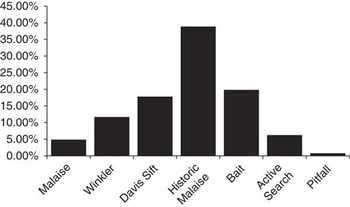
Our ongoing programme to inventory the ants of Área de Conservación Guanacaste (ACG), Costa Rica consists of multiple collection methods including Malaise traps (Smith et al. Reference Smith, Hallwachs and Janzen2014: Appendix 1). Malaise traps (Townes Reference Townes1972) regularly capture both male and winged female ants. However, male ants of many species are character-poor (Yoshimura and Fisher Reference Yoshimura and Fisher2007) and sufficiently morphologically different from workers and queens that it is difficult to connect them with con-specific workers and queens. In our inventory of ACG ants, we extract DNA and barcode as many species and specimens as possible. DNA barcoding, the use of a standardised gene locus for species identification and discovery, has been successfully used in the past to associate morphologically divergent ant sexes (Yoshimura and Fisher Reference Yoshimura and Fisher2007; Fisher and Smith Reference Fisher and Smith2008). One genus of ant, Adelomyrmex Emery, 1897 (Hymenoptera: Formicidae), is particularly abundant in the collections from high elevation ACG localities. Workers of these small and dark-coloured ants in this cold and wet environment are routinely captured with Winkler sifting, active searching, bait, and pitfall traps (Longino Reference Longino2012: Fig. 1). However, despite the relative omnipresence of Adelomyrmex workers in collections across the Neotropics, alates of either sex are less well known. Occasionally, dealate queens are recovered from leaf litter samples, however alate queens are not known for many species of Adelomyrmex. For example, 11 of the 19 new species descriptions presented in Longino (Reference Longino2012) and Fernández (Reference Fernández2003) did not include information about queens.
The 147 collection lots that included Adelomyrmex according to methodology. “Historic Malaise”=1998–2001, “Malaise”=2008–2011.

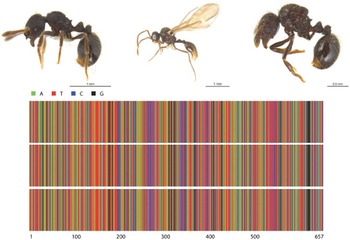
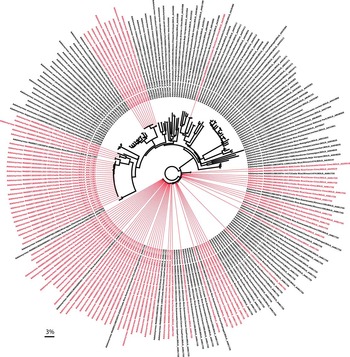
In a recent and thorough revision of the genus for Central America, Longino (Reference Longino2012) reported that, “…a male or a winged queen in all of Central America” had not been observed. To date, the only published record of a male Adelomyrmex was a specimen of A. vaderi Fernández, Reference Fernández2003 recovered by Fernández from a nest (Fernández Reference Fernández2003). Subsequently, B. Boudinot, Department of Entomology, University of California Davis, California, United States of America (personal communication) has discovered distinctive morphological characters for presumed Adelomyrmex males and many specimens are now available from throughout Central America, all from Malaise samples. In the ACG inventory samples, DNA barcoding the workers from litter samples and males from Malaise trap samples allowed the unambiguous association of conspecific workers and males of Adelomyrmex (Fig. 2) and the independent confirmation of Boudinot’s morphological characterisation. Supplemental barcoding of material from the Leaf Litter Arthropods of MesoAmerica project (LLAMA) allow placement of ACG results in a broader geographic context (results as yet unpublished, but accessible on the Barcode of Life Data System (BOLD) via the doi:http://dx.doi.org/10.5883/DS-LLAMA). In the ACG inventory, nine species of Adelomyrmex have been found at a single location on the peak of Volcan Cacao at 1500 m (Fig. 3, Supplementary Figure 1). We have used DNA barcodes to associate workers and males for six of the 11 species recovered to date over the entire ACG. For the remaining five species, four are known only from males and one is known only from workers.
Adelomyrmex MAS002 worker, male and queen ants collected from Volcan Cacao, ACG, and their corresponding DNA barcodes that demonstrate, as for all ants, divergent morphology and DNA barcodes that link them to the same BIN with maximum two base pairs divergent (BOLD: AAB1735) (top to bottom: worker, male, queen). Pictorial representation of DNA barcodes for each specimen were prepared using Fingerprint (Lou and Golding Reference Lou and Golding2007).

Neighbour-joining (Saitou and Nei Reference Saitou and Nei1987) tree based on Kimura two parameter (K2P) distance (Kimura Reference Kimura1980) for 221 Adelomyrmex specimens from Área de Conservación Guanacaste and across Central America (J.T.L., LLAMA specimens) presented as an aid in viewing the inter-specific and intra-specific genetic distances in the barcode region. Fifty-eight DNA barcode BINS (or provisional species) are represented here. Those labels coloured in red are the nine BINs or species found sympatrically at the highest elevation locality on Volcan Cacao. Two holotypes from Longino (Reference Longino2012) (A. anxiocalor, A. bispeculum) and paratypes of both A. metzabok and A. paratristani have been barcoded and are included in this tree. Note that A. tristani and A. paratristani members are deeply divergent in the tree (and within the paratype series). Please see Supplementary Figure 1 for a larger presentation of the same tree.

Adelomyrmex MAS002 has been found at the tops of the three ACG volcanos (Orosi, Cacao and Rincón de la Vieja). Adelomyrmex tristani (Menozzi, 1931) occurs in the same samples and the workers, so far, are indistinguishable (dorsal promesonotum with longitudinal rugae, antennal fossa with sculpture, head width between 0.6 and 0.65 mm). However, the DNA barcode of MAS002 is nearly 15% divergent from that of A. tristani. In general, the ACG Adelomyrmex species are deeply divergent with respect to their barcodes (barcode index number system, Ratnasingham and Hebert Reference Ratnasingham and Hebert2013) – and often sympatric (Smith et al. Reference Smith, Hallwachs and Janzen2014).
Despite more than a decade of Malaise trapping in tropical montane cloud forest on ACG’s Volcan Cacao and the recovery of many males – we have not yet recovered an alate queen – this fits Longino’s (Reference Longino2012) observation that after hundreds of collection events across Central America, “….the lack (or extreme rarity) of males and winged queens suggest a lineage with extremely low dispersability, perhaps contributing to the high levels of endemism and geographic variation [of the worker ants]”. However using DNA barcoding we have documented that Adelomyrmex males are relatively common among the Malaise-trapped myrmicine ants. Furthermore, the patterns of genetic divergence evident at the top of Volcan Cacao (i.e., nine species occurring sympatrically (Fig. 3)) suggest that the high-endemism (particularly as measured by the mtDNA barcode) is not singularly due to intraspecific isolation-by-distance. To date, the only male known from South American was collected in lowland forest (Fernández Reference Fernández2003), suggesting the potential of altitudinal movement. Additionally, the mesosomal configuration is as typical myrmicine males, with no impediment for active flight. The winged males, especially common in the Malaise samples, further suggest that Adelomyrmex are quite capable of movement by flight. Furthermore, since upper elevation litter ant samples are lacking from nearly all Costa Rican mountains, we have little idea of the degree of endemism of these mountain-top taxa.
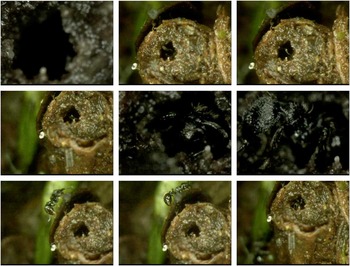
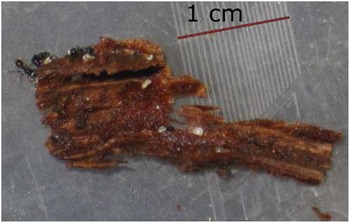
In the tropical montane cloud forest at about 1500 m near the peak of Volcan Cacao within the Area Conservacion Guanacaste, an Adelomyrmex colony was found in a rotting and hollow twig on the forest floor (27 March 2013). Activity at the colony entrance was recorded using a DinoLite© AMK4012-C200 digital field microscope (London, Ontario, Canada) (Fig. 4). To confirm that the observed activity was associated with a colony and reproduction, the twig (Fig. 5) was opened and the ants collected into 95% ethanol. A worker from this colony was DNA barcoded (specimen accession: BIOUG02672-H12, DNA barcode Process ID: ACGAH924-13). Morphologically and genetically the colony was that of the provisional species MAS002 – the most frequently collected of the nine species of Adelomyrmex found at this site to date. No queen was recovered from the wood, perhaps suggesting that the colony was dispersed among various pieces of rotting wood
Frames from video documenting an Adelomyrmex MAS002 colony living in a small twig at 1500 m (130327-Cacao 1500 m – Adelomyrmex: http://youtu.be/-A2_LctXwtA).

The twig from Fig. 4 broken open to reveal the colony of Adelomyrmex MAS002 within.

This is the first video imaging of an Adelomyrmex colony in the wild. Longino (Reference Longino2012) reports on nests of two species of Adelomyrmex. His findings of Adelomyrmex paratristani (Longino, Reference Longino2012) (nest chambers in rotting wood on ground with only workers and brood recovered) are similar to our observations. The provisional species MAS002 has a DNA barcode very different from those of A. paratristani and A. tristani – while morphologically it resembles A. tristani.
All collection information, photographs, DNA sequences, and trace files discussed here have been deposited on BOLD (http://dx.doi.org/10.5883/DS-ASADE), in GenBank and as Supplementary Appendix 1. The video of the collection event is on YouTube (http://youtu.be/-A2_LctXwtA). An image of the habitat at the collection site was captured with high-resolution panorama on GigaPan http://gigapan.com/gigapans/126894 and a blog entry of the specific collection day is here: https://sites.google.com/site/acgantcollectionsmar2013/journal-blog/130327---cacao-1500m.
Ongoing field collections, using multiple collection methodologies, facilitated by technologies only recently widely and affordably available (digital field microscopy and DNA barcoding) enabled us to eliminate some of the mysteries surrounding the reproductive biology of one species of Costa Rican mountain-top Adelomyrmex. We expect that each of these technologies will become increasingly more affordable and thus expect that other inventories of tropical arthropods will standardise the incorporation of such technologies when appropriate or useful. For example, we note that external magnification lenses for cell phone cameras can already be purchased for $50–70 CAD. Democratising access to such tools will help to resolve many other mysteries of reproductive biology and natural history.
Acknowledgements
This study was supported by grants to M.A.S. from the Natural Sciences and Engineering Research Council of Canada (NSERC) and the Canada Foundation for Innovation (CFI). The ongoing work in ACG is supported by the Wege Foundation of Grand Rapids, Michigan, the International Conservation Fund of Canada (Nova Scotia), the private donors to the Guanacaste Dry Forest Conservation Fund, and the 34 ACG parataxonomists who collect, rear, and database ACG insects. Laboratory analyses of ant sequences generated between 2009 and 2011 were funded by the Government of Canada through Genome Canada and the Ontario Genomics Institute (2008-0GI-ICI-03). J.T.L. was supported by United States National Science Foundation grant DEB-1354739 (Project ADMAC). Finally, we thank members of the Smith Lab for their help and encouragement, and in particular Hayley Cahill who has photographed many Adelomyrmex.
Supplementary material
To view supplementary material for this article, please visit http://dx.doi.org/10.4039/tce.2014.82