Introduction
Livestock sit at conflicting crossroads in the USA; one road is defined by ultra-efficient confined production and the other road reaches into an older history, pre-1920s, when animals were raised outdoors as a matter of courseReference Hendrickson, Sassenrath, Archer, Hanson and Halloran1. The second path re-emerges today in pasture-based livestock agriculture. At this uneasy crossroads, former vegetarians are doing the slaughtering and most sales transactions happen under the radar of agricultural statistics, involving no more than producer and consumer. Pastured livestock are a rapidly growing sector of alternative agricultureReference Karsten, Patterson, Stout and Crews2. Portrayed as a form of meat and animal product production that allows natural animal behavior and positive environmental outcomes, pastured livestock enterprises contain ‘embedded qualities’Reference Murdoch, Marsden and Banks3 of naturalness and environmental soundness at the core of their identities. In pastured animal production, the ‘moral economy’Reference Follett4 is emphasized over ultra-efficient production successes that define US industrial meat and animal production. This paper reports on one particular pastured livestock, poultry and growers' experiences with profitability, whole-farm management and ethical dilemmas in this emerging ‘alternative agro-food network’Reference Goodman5.
Alternative poultry production
Alternative meat production is one of the fastest-growing sectors of the US food system with organic poultry comprising 60% of this growthReference Oberholzer, Greene and Lopez6. Twelve percent of consumers in the USA regularly purchase organic poultry and 15% buy organic eggsReference Nielsen7. Poultry is considered a gateway food in the organic sector with consumers' first purchasing organic poultry and then other organic productsReference Oberholzer, Greene and Lopez6, Reference Crandall, Seideman, Ricke, O'Bryan, Fanatico and Rainey8. Similar to organic poultry, pastured poultry are promoted as humanely raised, environmentally friendly and beneficial to food nutritional qualityReference Karsten, Patterson, Stout and Crews2. Pastured production differs from organic management, however, in that poultry live on and consume pasture, whereas organic regulations stipulate only that birds have access to the outdoors. Pastured poultry are raised outdoors and fed a grain-based diet that is naturally supplemented when birds graze their pastureReference Ponte, Prates, Crespo, Crespo, Mourao, Alves, Bessa, Chaveiro-Soares, Gama, Ferreira and Fontes9. Studies regarding pastured poultry are few and primarily address meat and egg quality. For example, Ponte et al. Reference Ponte, Prates, Crespo, Crespo, Mourao, Alves, Bessa, Chaveiro-Soares, Gama, Ferreira and Fontes9 found that pasturing poultry significantly increased the n-3 (omega-3) fatty acid content of meat, whereas Karsten et al. Reference Karsten, Patterson, Stout and Crews2 found higher vitamin A, vitamin E and n-3 fatty acid content in eggs from pastured poultry in comparison to caged birds with no access to pasture. These studies shed light on product outcomes in this new industry but do not assess grower outcomes of participation with a new alternative agricultural practice. Analysis of farmers' experiences with pastured poultry is critical to assessing areas for future research and to informing alternative agro-food network theory.
The farmer experience of alternative animal production
Growers that raise pastured poultry are participants in a new management practice. Although poultry have been reared outdoors for centuries, the practice of raising poultry for commercial sale at scale without confinement is a new oneReference Hinrichs and Welsh10. The conventional poultry industry in the USA is characterized by high efficiency, confinement and extreme vertical integrationReference Hinrichs and Welsh10. Pastured poultry growers face steep price competition with the conventional industry and must rely on niche marketingReference Hinrichs and Welsh10. In order to analyze growers' experiences with this new practice, the objectives of this research were: (i) to explain what drives farmers to participate in pastured poultry production, (ii) to describe the benefits and challenges farmers experience and (iii) to analyze the most contentious debates between grower participants in the emerging pastured poultry alternative agro-food network.
Methods
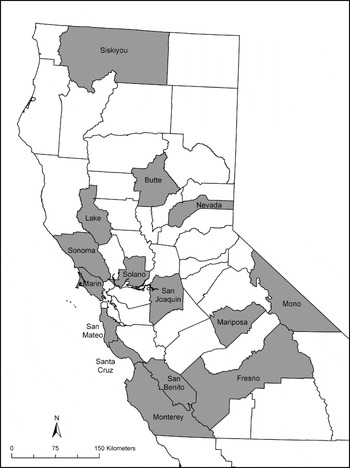
This paper reports on the results of a survey that queried farmers on firsthand experiences with pastured poultry agriculture in California. Survey administration occurred between April and August 2010. All pastured poultry growers in California were sought for inclusion in the study, a small group given the newness of the practice (Fig. 1). Requests for participation were sent out to all poultry farmers in the California Eat Wild network (http://www.eatwild.com). Additional requests for participation were sent to all pastured poultry farmers found via the California Certified Organic Farmers (CCOF) database and by word of mouth. The response rate for the survey was 62% of 29 requests for participation. The survey was delivered via two channels, in-person administration or online completion. Thirty-nine percent of growers opted for in-person survey completion, whereas 61% completed the survey online.
Map of California counties where the survey was administered.

The survey instrument addressed background information regarding location of farm, organic certification, quantity of farm animals and acreage of crops. Producers were asked to comment on the benefits and challenges of raising poultry as well as on specific management practices (e.g., managing predators and maintaining pasture). Farmers were then asked to comment on the profitability of pastured poultry and what stimulated them to raise pastured poultry. All questions were open ended allowing farmers to provide as much information as they preferred. A copy of the survey will be available at: http://www.surveymonkey.com/s/VDNWKMQ.
Survey responses were coded by topic (Reference Bernard11: p. 400). For example, responses to the question on what inspired farmers to work with poultry were coded as ‘exposure to Joel Salatin’, ‘profitability’ and ‘pest control’. Themes and relationships between coded variables were assessed quantitatively. For example, profitability was analyzed for a relationship to farm product (e.g., meat versus eggs). Data could not be analyzed by geographic region because using word of mouth to find survey participants necessarily skewed the geographic range of respondents to the Santa Cruz, California area, the location of the author's university. The following equations were used to calculate breed richness. Breed diversity was calculated as

where R is breed richness and C represents a count of 1 for each distinct poultry breed. The average breed richness across all farms was calculated as:

where the sum of breed diversity at each farm was divided by F for the total number of farms. Finally, each breed's relative abundance was determined as:

where A is abundance, N is the number of farms with a particular breed, C, and the denominator accounts for the total breed richness of all farms.
Results
Farm information
Eighteen pastured poultry farms participated in this study, all located in the state of California. Thirty-three percent of farms were certified organic, but 58% of non-certified farms specified that they used organic practices. All farms had layers; the average number of birds/year/farm was 591 (range=50–3000; median=300). Sixty-seven percent of farms also raised meat chickens; the average number of birds/year/farm was 5066 (range=200–20,000; median=1150).
Drivers of pastured poultry
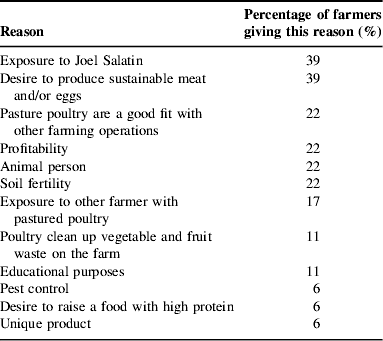
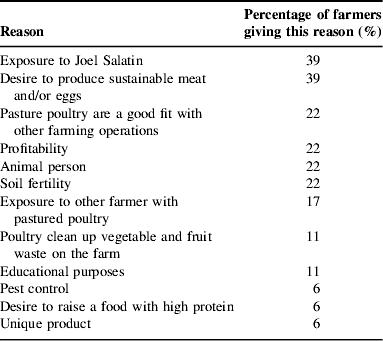
The influence of well-known farmer, Joel Salatin, tied with the desire of farmers to sustainably produce meat and/or eggs as the primary drivers California survey respondents gave for raising pastured poultry (Table 1). Following those two reasons were a suite of responses related to the role of poultry at the farm-scale, such as improving soil fertility with manure, birds cleaning up fruit and vegetable waste on farm, and chickens aiding in pest management through predation. Other farmers were motivated to raise pastured poultry because of perceived profitability.
Reasons given by farmers for deciding to raise pastured poultry.
Benefits of pastured poultry
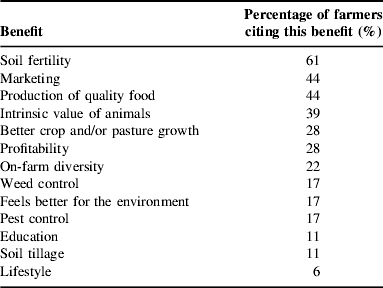
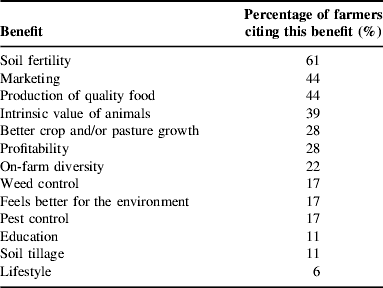
Farmers were asked what benefits they experienced from having poultry (Table 2). The top response was soil fertility, and approximately one-third of respondents went on to say that enhanced soil fertility contributed to better crop and/or pasture growth. Other common responses were with regard to marketing benefits and the production of quality food as a benefit. Many growers also commented on the intrinsic value of animals as a benefit.
Benefits described by farmers of raising pastured poultry.
Pastured poultry profits
Growers responded with lengthy qualitative responses to the question, ‘Has raising poultry been a profitable endeavor for you? Why or why not?’ Fifty percent of farmers reported direct profitability from pastured poultry. There was no interaction between profitability and whether a farm had meat chickens versus layers or whether a farm was certified organic. In response to the same question, 78% of growers reported that pastured poultry were indirectly profitable because they attracted new customers to the farm, enhanced customer loyalty and contributed to savings on fertilizer, fuel and pest control. Specifically, 44% of respondents reported marketing advantages in response to this question.
Challenges to pastured poultry growers
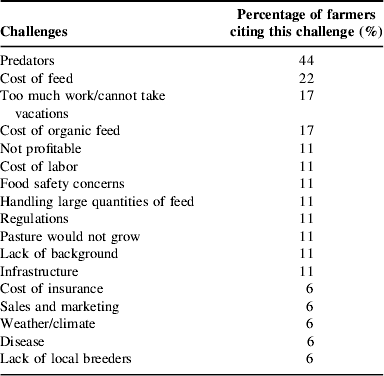
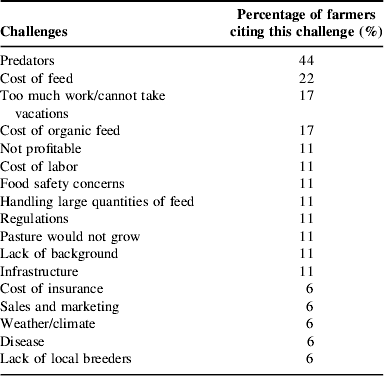
The top issue for pastured poultry growers was carnivore predation of birds, with 44% of growers commenting on this in a question regarding challenges (Table 3). Besides predators, pastured poultry growers were challenged by costs and labor, food safety concerns, the ability to handle large quantities of feed, regulations, pasture growth, a lack of background and constructing appropriate infrastructure.
Challenges described by farmers to raising pastured poultry.
Chicken breed diversity
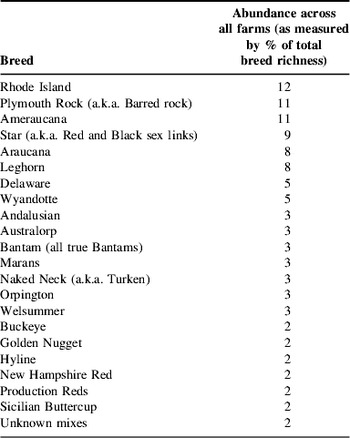
Breed diversity was higher for hens than for meat chickens, both across all farms and within farm. Among all farms, 21 breeds of layers were represented; the average breed richness per farm was 4.3. Table 4 shows the breakdown of richness by breed.
Hen diversity and abundance of breed type among all farms.

Far fewer breeds made up the diversity of meat chickens; six breeds were represented across all 12 farms surveyed with meat chickens. Of these, the industrial Cornish Cross represented 47% of all breed richness and was reared on 58% of the farms. Freedom Rangers (a.k.a. Colored Rangers or Poulet Rouge), a bird known for its livability on pasture, represented 27% of breed richness. K-22's, Plymouth Rock/Brit hybrid, Slow White Broilers and Slow Red Broilers were all reported by one farm each.
Discussion
Farmer identity: the productivist meets the activist
Just as the consumer faced with a refrigerated case of eggs bearing labels such as cage-free, organic and local must grapple with values and definitions of sustainability, so too must pastured poultry producers struggle when implementing their values on the ground. Production imperatives sometimes conflicted with activist strategies in the survey responses, forcing farmers to place their values in a hierarchy of importanceReference Burton and Wilson12. Growers critiqued each other regarding the relative morality and cost of breed type, pen type, organic versus conventional feed and other aspects of management. For example, some farmers argued that conventional grain was the key to profitability while others refused to use feed grown with synthetic products and genetically modified organisms. Other growers stood squarely behind raising heritage breeds, whereas some argued that the industrial breeds should only be used because they are more efficient at converting feed to meat or eggs. The juxtaposition of values with the economic reality of pastured poultry challenged producers as they tried to implement sustainability on the ground, yet growers were driven to raising pastured poultry by the desire to produce food with ethical attributes. Growers were also driven by the influence of one particularly outspoken advocate of pastured poultry, Joel Salatin.
Why pastured poultry?
Joel Salatin, a rancher from Virginia, leader in pastured meat chicken production and author of Pastured Poultry Profits Reference Salatin13, was a main driver for farmers to raise pastured poultry. He captured the public's imagination when he was featured in the bestseller, Omnivore's Dilemma, by food journalist Michael PollanReference Pollan14, and his impact on the swiftly growing pastured poultry movement cannot be underestimated. He emerged as an opinion leader in this survey, inspiring many of the survey respondents to enter into the new pastured poultry industry.
One of Salatin's most pivotal contributions to pastured poultry production has been a floorless moveable field pen, also called a chicken tractor. Moveable pens were developed as a solution to the problem of meat chicken susceptibility to predators in pasture-based systems. Salatin's 3×3.7×0.6 m floorless pens house 75–90 meat chickens and are moved daily, affording birds access to pasture, insects and dust, the three main components in natural bird behavior. Salatin's style of pastured poultry is controversial, however. Although the pens do protect birds on pasture, they also represent a form of semi-confinement, which is an animal welfare issue for some growers and consumers.
The other controversial aspect of Salatin-style pastured poultry production is that he promotes the use of the Cornish Cross, the principal industrial breed for meat chickens. Cornish Cross birds have an excellent capacity to convert feed to body mass, reaching harvest weight in 6–8 weeksReference Fanatico and Polson15. However, they are bred for confinement and not pasture-based systems. Although they can survive and sometimes thrive in pasture-based systems, they may have higher mortality, greater incidence of heart disease and more leg problems than slower-growing varietiesReference Fanatico, Pillai, Hester, Falcone, Mench, Owens and Emmert16. Despite the health issues of Cornish Cross birds, they can be a profitable choice for pasture and for confinement alike because of their grain-to-meat efficiencyReference Fanatico, Pillai, Hester, Falcone, Mench, Owens and Emmert16.
Chicken breed diversity
The great efficiency of the Cornish Cross was reflected in the breed diversity results, which showed higher diversity for hens than for meat chickens, both across all farms and within farm. Among all farms, 21 breeds of layers were represented. Rhode Islands and Plymouth Rocks topped the list and are known to be prolific layers of brown eggs. Ameraucanas were third on the list; they are reliable layers of blue eggs, a trait that helps growers market a colorful dozen. Stars were the fourth most abundantly represented breed; they are also prolific layers of brown eggs and are valued by hen growers because they can be sexed by their color as chicks. Far fewer breeds made up the diversity of meat chickens. Of these, the industrial Cornish Cross represented 47% of all breed richness and was reared on 58% of the farms.
These disparate diversity results are explained by efficiency imperatives. There are many varieties of layers that can efficiently convert feed and forage to eggs, whereas Cornish Crosses are currently the most efficient meat chickens. As fast growers, they are less expensive to rear to market weight than slower-growing breedsReference Fanatico, Pillai, Hester, Falcone, Mench, Owens and Emmert16, Reference Fanatico, Pillai, Cavitt, Owens and Emmert17. This creates a paradox for pastured meat chicken producers. They may be endeavoring to satisfy animal welfare criteria, but economic imperatives push them toward selecting industrial genetic varieties with lower livability on pasture than slower-growing varieties. This paradox is inextricably tied to the chicken digestive track and the cost of feed. Chickens, unlike ruminants such as cows, do not fit comfortably into the grassfed world. Poultry do not have the digestive system of ruminants that allows them to digest fiber and convert grass into energyReference Burbaugh, Toro and Gernat18, Reference Beyer and Wilson19. So although pasturing poultry does increase the nutritional content of meat and eggsReference Karsten, Patterson, Stout and Crews2, Reference Ponte, Prates, Crespo, Crespo, Mourao, Alves, Bessa, Chaveiro-Soares, Gama, Ferreira and Fontes9 and affords access to protein from legume foraging and invertebrate predation, it does not reduce the amount of carbohydrates required by poultry, meaning that poultry growers must supplement pasture with grain-based feeds, which can be expensive. In California, organic feed can cost nearly twice as much as conventional feed; typical conventional feed sells for $0.53 kg−1 ($0.24 lb−1), while organic feed costs $0.97 kg−1 ($0.44 lb−1). Growers in this alternative agro-food network, then, are caught in the space of justifying every choice as they solve for myriad unknowns, prioritized on values at times productivist and at times activist.
The grass is greener: indirect profits
Although the top reason that growers cited for choosing to raise pastured poultry was the influence of Joel Salatin and his Pastured Poultry Profits Reference Salatin13 book, in this survey, only 50% of farmers reported direct profitability from pastured poultry. However, pastured poultry were indirectly profitable to 78% of surveyed growers because they attracted new customers to the farm, enhanced customer loyalty, and contributed to savings on fertilizer, fuel and pest control. One farmer said of indirect profits, ‘With the price of the organic feed we usually come just over break even price. However if we factor in the value of what we'd have to pay for a fertility or bug control program then it still makes sense’, and another responded, ‘We make $6 per bird, but the fertilizer makes it worth it’. Growers reported both that chickens directly fertilize soil and that droppings are used as an ingredient in compost. ‘[We see an] improved topsoil ecosystem. [The] grass is darker green, grows taller, and soil retains moisture longer because of chickens, pasture, not spraying and not tilling’.
On a farm-finances scale, poultry were described as indirectly profitable because of their contribution to the overall marketability of a farm. Farmers said things like, ‘ “[Having pastured poultry] builds customer loyalty because we have a product year-round”, “Customers love ethical products”, and “We stand out more [than crop-only farmers] at farmers' markets” ’. To stand out in a direct marketing environment such as a farmers' market or CSA (Community Supported Agriculture), growers have to ‘embed values’ into the food they grow and sellReference Feagan and Morris20, a process abetted by the advertisement of an ethical product. Consumers, especially in a direct-marketing environment, may be likely to align themselves with producers whom they perceive as having similar values. Animal products are also a unique item at farmers' markets, where fruits and vegetables are more common. One such grower said, ‘You might even think of it as partly an advertising expense’.
Growers also cited the production of safe, high-quality food among the benefits of raising pastured poultry, saying things such as, ‘We eat safe healthy and wholesome food, as do our customers’. Developing a niche in this setting can be critical to successful marketingReference Griffin and Frongillo21. In terms of overall profitability, then, the results of this study suggest that pastured poultry combine well with other farming activities and are best suited to diverse farms where the benefits of soil fertility and customer loyalty add value to other products.
Acknowledgements
Foremost, I would like to thank the farmers and specialists who participated in the interviews and surveys that make up the substance of this study. In particular, I would like to thank Nancy Vail, Jered Lawson and Paul Hain for sitting through extremely long pilot versions of the survey. Thank you to professors Steve Gliessman and Margaret FitzSimmons for their comments on earlier drafts. Thank you to Scott Roberts for his cartographic assistance. I would like to thank the two anonymous reviewers who made insightful comments on an earlier version of this manuscript. This project was partially funded by the following institutions: Western Sustainable Agriculture Research and Education Program; Center for Agroecology and Sustainable Food Systems; Annie's Sustainable Agriculture Scholarship; Organic Crop Improvement Association; the Ruth and Alfred Heller Chair in Agroecology; and the Department of Environmental Studies at the University of California, Santa Cruz. Finally, I would like to thank Modesto Milling and Peaceful Valley Organics for the gift certificates they donated as raffle prizes for participants in this research.