Surgical site infections (SSIs) are associated with increased morbidity, mortality, and healthcare costs.Reference Zimlichman, Henderson and Tamir 1 , Reference Cassini, Plachouras and Eckmanns 2 Previous studies have reported associations between patient insurance status and various postsurgical complications.Reference Manoso, Cizik, Bransford, Bellabarba, Chapman and Lee 3 – Reference Olsen, Higham-Kessler and Yokoe 6 However, these analyses were restricted to specific surgeries and patient populations and did not a priori focus their analysis on the insurance status–SSI relationship. Therefore, we aimed to estimate differences in SSI risk across health insurance categories (basic, semiprivate, and private) in a universal health insurance coverage setting.
Methods
This prospective cohort study was performed at the University Hospital Basel—a tertiary care hospital with >38,000 inpatient cases per year. As part of a national SSI surveillance, we included consecutive patients undergoing cholecystectomy, heart surgery, orthopedic surgery, or colon surgery between January 2014 and December 2018.Reference Troillet, Aghayev, Eisenring and Widmer 7 We excluded repeated surgical interventions during the same hospital stay. The local ethics committee approved this study as part of a continuing quality improvement program.
Infection control practitioners prospectively collected SSI surveillance data in the framework of a national SSI surveillance program.Reference Troillet, Aghayev, Eisenring and Widmer 7 In brief, they screened patients for evidence of SSI, and a board-certified infectious diseases specialist trained in surveillance double-checked all cases. SSIs were classified according to Centers for Disease Control and Prevention definitions.Reference Horan, Gaynes, Martone, Jarvis and Emori 8 Standardized postdischarge surveillance was conducted by telephone interview and review of electronic medical records. The surveillance program has been validated, and it undergoes routine on-site checks of data quality.Reference Troillet, Aghayev, Eisenring and Widmer 7
We predefined SSI within 30 days after surgery as our primary outcome and insurance status of the patient at surgery as our main exposure. Basic insurance covers all medical treatments but is limited in the choice of the hospital, surgeon, and comfort (often 4-bed room), whereas the semiprivately or privately insured are hospitalized in double or single rooms, respectively, and are usually treated by senior physicians or chief physicians, respectively. Private insurance allows choice of desired hospital and surgeon. Observation times were analyzed from day of surgery until death, SSI, loss to follow-up, or day 30 after surgery, whichever came first. A priori sample sizes were calculated: α, 0.05; power, 0.80; minimally detectable effect size, hazard ratio (HR), 2; SSI proportion, 0.05; and private insurance proportion, 0.05. We estimated 3,631 patients and 182 SSIs.
We compared patient and operation characteristics across insurance categories using the χ2 test or the Kruskal-Wallis test, as appropriate. We investigated the insurance status–SSI relationship using univariable and multivariable Cox regression models with basic health insurance as the baseline category. In multivariable analysis, we defined age at surgery, sex, and surgery type as a priori confounders. Furthermore, we considered the following variables as potential confounders, based on a causal diagram, expert opinion and previous reportsReference Manoso, Cizik, Bransford, Bellabarba, Chapman and Lee 3 – Reference Olsen, Higham-Kessler and Yokoe 6 : duration of surgery (incision until skin closure, in minutes), emergency surgery, adequate antimicrobial prophylaxis, preoperative American Society of Anesthesiologists score, surgical wound classification, body mass index (BMI), diabetes mellitus type 2, year of surgery and the number of comorbidities according to the International Classification of Diseases, 10th Revision. Potential confounders were included in the final multivariable model if they confounded the main association. The proportional hazard assumption was upheld in all models. We chose not to model potential intracluster correlation because there was no indication of within-patient clustering. We performed all analyses in Stata version 15 software (StataCorp, College Station, TX); all P values are 2-sided.
Results
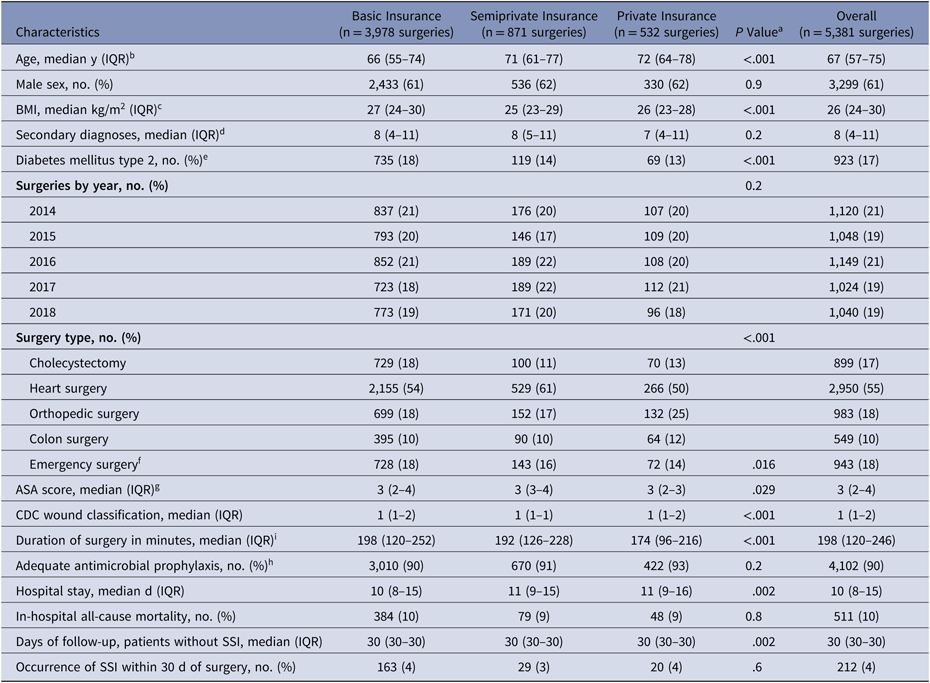
A total of 5,381 surgeries on 4,910 patients were included; 20 repeated surgeries were excluded. 3,978 of 5,381 surgeries (74%) were covered by basic health insurance, 871 (16%) were covered by semiprivate health insurance, and 532 (10%) were covered by basic and private health insurance, respectively (Table 1). Overall, 212 of 5,381 surgeries (4%) resulted in an SSI: 59 superficial SSIs and 153 deep/organ-space SSIs. Estimated SSI incidence rates per 30 patient days were 0.029 (95% confidence interval [CI], 0.019−0.045) for cholecystectomy, 0.038 (95% CI, 0.031−0.046) for heart surgery, 0.011 (95% CI, 0.006−0.02) for orthopedic surgery, and 0.175 (95% CI, 0.141−0.219) for colon surgery.
Individual and Surgery Characteristics

Note. ASA, American Society of Anesthesiologists classification; BMI, body mass index; CDC, Centers for Disease Control and Prevention; IQR, interquartile range; SSI, surgical site infection.
a For difference across insurance categories.
b Data missing for 12 patients.
c Data missing for 2,749 patients.
d No. of secondary International Classification of Diseases, Tenth Revision diagnoses at discharge.
e Patients with a discharge diagnosis of diabetes mellitus type 2.
f All nonelective surgeries.
g Data missing for 20 patients.
h Valid percentages; data missing for 848 patients. Antimicrobial prophylaxis was registered as adequate prophylaxis if given ≤60 minutes prior to incision.
i Data missing for 1,164 patients.
Overall, SSI proportions did not differ across health insurance categories, and the median follow-up in patients without consecutive SSI was 30 days. Compared to patients with basic insurance, semiprivately and privately insured individuals were older, had lower BMIs, were less commonly diagnosed with diabetes mellitus type 2, and had shorter surgery durations.
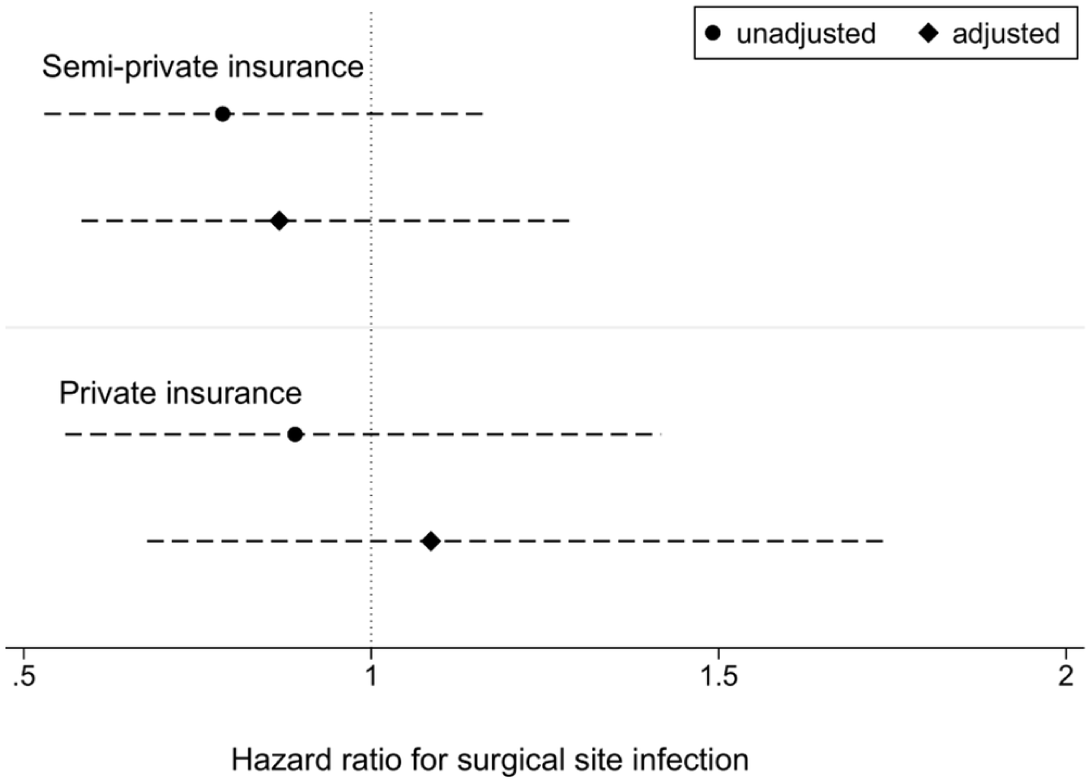
In the final analysis, there was no evidence for an association between insurance status and SSI risk in univariable and multivariable analysis. In Fig. 1, the crude HR for semiprivate insurance was 0.79 (95% CI, 0.53−1.17; P = 0.2); the crude HR for private insurance was 0.89 (95% CI, 0.56−1.42; P = 0.6); the adjusted HR for semiprivate insurance was 0.87 (95% CI, 0.58−1.29; P = 0.5); and the adjusted HR for private insurance was 1.09 (95% CI, 0.68−1.74; P = 0.7). We observed no interaction between insurance status and surgery type or emergency admission status (P = 0.5 and P = 0.1, by likelihood ratio test).
Crude and adjusted effect estimates of private and semiprivate health insurance status on surgical site infection incidence.

Discussion
In the current cohort, we found no evidence for an association between insurance status and SSI incidence in a setting with universal health insurance coverage. Our findings contrast with those of previous research that identified patient insurance status as a risk factor for SSI or increased complications following some surgical interventions.Reference Manoso, Cizik, Bransford, Bellabarba, Chapman and Lee 3 – Reference Olsen, Higham-Kessler and Yokoe 6 However, to our best knowledge, this is the first study specifically investigating the health insurance–SSI relationship across multiple surgical interventions.
The shorter duration of surgery in privately insured patients may reflect their care by more experienced staff surgeons.
In a previous study performed in the United States, Manoso et alReference Manoso, Cizik, Bransford, Bellabarba, Chapman and Lee 3 observed a 2-fold higher risk of SSI in patients with Medicaid payer status compared with other publicly or privately insured patients following spinal surgery. Furthermore, Smucny et alReference Smucny, Menendez, Ring, Feeley and Zhang 4 reported that among patients undergoing shoulder arthroplasty, patients with Medicaid insurance had a 4-fold increased SSI risk compared to privately insured patients. Differences in the populations covered by basic, semiprivate, and private insurance in the respective healthcare systems could explain the diverging results of our study.
It has been well established that individuals who lack private health insurance and rely on government-funded insurance schemes such as Medicaid in the United States have outcomes following surgery inferior to those of populations with private insurance.Reference Manoso, Cizik, Bransford, Bellabarba, Chapman and Lee 3 – Reference Olsen, Higham-Kessler and Yokoe 6 This might be a natural consequence of the eligibility criteria for public insurance. To qualify for Medicaid in states with expanded coverage due to the Affordable Care Act, a household can earn at most 138% of the federal poverty levelReference Sommers and Grabowski 9 (ie, they must have a low socioeconomic status). In contrast, health insurance status in Switzerland (and possibly other European countries with universal health insurance such as Sweden) is less indicative of socioeconomic status because basic health insurance covers most of the Swiss population (~63%). 10
Our study has several limitations. First, our results are from a single institution and may not be generalizable to healthcare settings with different health insurance programs. Second, we cannot exclude the possibility of residual or unmeasured confounders in the insurance status-SSI relationship; however, in the final multivariable analysis, we observed only marginal confounding when we included well-established SSI risk factors (Fig. 1). Third, in our models, we could not adjust for socioeconomic factors (eg, household income) and ethnicity, which may have confounded our main association. Nevertheless, we included risk factors for SSI in our multivariable model that may be proximal to socioeconomic status (eg, diabetes and the number of comorbidities).
In conclusion, patient health insurance status was not associated with SSI incidence in Switzerland. Given the current lack of data on the impact of different health insurance and reimbursement schemes on SSI incidence, population-based studies are warranted and hospitals with SSI surveillance should consider performing their own respective analyses as part of quality improvement programs.
Author ORCIDs
Jan A. Roth 0000-0003-4502-1123
Acknowledgments
None.
Financial support
This work was funded by the Division of Infectious Diseases and Hospital Epidemiology, University Hospital Basel, Basel, Switzerland.
Conflicts of interest
All authors report no conflicts of interest relevant to this article.