Introduction
The majority of people with dementia living in the community receive assistance directly from family caregivers (Schulz and Martire, Reference Schulz and Martire2004), which are family members, primarily older spouses, followed by middle-age or older adult children (Brodaty and Donkin, Reference Brodaty and Donkin2009). Providing daily care for a relative having dementia is stressful and particularly burdensome to many family caregivers. Thus, caregiving is considered as a chronically stressful process with potentially negative mental and physical health consequences (Pearlin et al., Reference Pearlin, Mullan, Semple and Skaff1990; Vitaliano et al., Reference Vitaliano, Zhang and Scanlan2003), including high levels of burden, depression and anxiety (e.g. Schulz et al., Reference Schulz, O’Brien, Bookwala and Fleissner1995), and also poor nutritional status (Vitaliano et al., Reference Vitaliano, Russo, Scanlan and Greeno1996; 2003).
Poor nutrition is a frequent condition among older adults. A recent retrospective pooled analysis estimates that 5.8% of elderly people living at home are malnourished and 31.9% are at risk of malnutrition (Kaiser et al., Reference Kaiser2010), based on the Mini Nutritional Assessment (MNA®) (Vellas et al., 1999). This tool has been initially validated to identify elderly people at risk of malnutrition and permits a comprehensive global nutritional assessment (Vellas et al., 1999). However, caregivers are not only older spouses but also middle-aged individuals for whom few data are available. In the single relevant study to our knowledge concerning caregivers’ nutritional status, 21% of family caregivers were at risk of malnutrition (Torres et al., Reference Torres, McCabe and Nowson2010).
Indeed, while a broad range of psychological and physical health outcomes has been examined (e.g. Schulz et al., Reference Schulz, O’Brien, Bookwala and Fleissner1995; Pinquart and Sörensen, Reference Pinquart and Sörensen2007; Schulz and Sherwood, Reference Schulz and Sherwood2008), only one study has reported risk of malnutrition in primary family caregivers aged 50 years or over (Torres et al., Reference Torres, McCabe and Nowson2010), based on the MNA®. This study revealed that the caregivers who had depressive symptoms were more likely to present a poor nutritional status; their unique findings underlined the interplay between depression and malnutrition in family caregivers. However, this study did not consider the caregiving dyad, and in particular characteristics of the care recipient.
In a recent paper (Rullier et al., Reference Rullier, Lagarde, Bouisson, Bergua and Barberger-Gateau2013), we suggested that more explanatory research is needed to identify factors associated with the nutritional status of caregivers of persons with dementia through an integrative and psychosocial approach including characteristics related to caregiver and care recipient. Indeed, based on the theoretical framework of caregiving as a stressful process, compromised nutritional status in dementia family caregiver could be investigated as a detrimental health effect of caregiving (Fredman, 1998; Vitaliano et al., Reference Vitaliano, Zhang and Scanlan2003). Thus, the determinants of caregiver's health, related to the burden of care, would encompass individual characteristics of the person with dementia including cognitive, neuropsychiatric, and functional status considered as stressors (e.g. Vitaliano et al., Reference Vitaliano, Russo, Young, Teri and Maiuro1991; Schulz et al., Reference Schulz, O’Brien, Bookwala and Fleissner1995; Black and Almeida, Reference Black and Almeida2004), and individual characteristics of the caregivers including age, sex, co-residence, relationship with their relative with dementia, their functional status, and also psychological distress (e.g. Pinquart and Sörensen, Reference Pinquart and Sörensen2007; Schulz and Sherwood, Reference Schulz and Sherwood2008).
This exploratory study aimed to investigate the associations of individual characteristics of both family caregiver (i.e. burden, anxiety, depression, emotional impact of behavior disorders, and functional status) and elderly people with dementia (i.e. cognitive, functional, neuropsychiatric and nutritional status) with the nutritional status of caregivers.
Methods
Participants and data collection
This cross-sectional study is part of a pilot study based on psychosocial interventions, with older people with dementia and family caregivers within the frame of a community gerontological center in rural areas of south west France. The data collected included sociodemographic information and measures of physical and mental health of caregiving dyad. This pilot study was approved by the Ethics Committee of the CHU (Centre Hospitalo-Universitaire) of Bordeaux according to the principles embodied in the Declaration of Helsinki.
Our sample consisted of 56 persons with dementia and 56 family caregivers who participated in the pilot study (for more details on the design, see Rullier et al., 2013). Persons with dementia were included when they:(i) met the criteria for dementia according to the DSM-IV criteria (DSM-IV-TR) (American Psychiatric Association, 2000); (ii) lived at home; and (iii) had a responsible caregiver who lived with them or visited them several times a week. In addition, the family caregivers did not have to receive previously a dementia or psychiatric diagnosis. These information were verified with their general practitioner. Informed consent was obtained from older people with dementia and from their caregiver.
Measures
Characteristics of older people with dementia
Sociodemographic variables included age, sex, and education level. Global cognitive functioning was examined using the Mini-Mental State Examination (MMSE; Folstein et al., 1975). Functional status was measured with Lawton's scale of Instrumental Activities of Daily Living (IADL; Lawton and Brodie, Reference Lawton and Brodie1969) considering only the four IADL strongly associated with the presence of dementia: phone use, transportation use, taking medication, and handling finances (Barberger-Gateau et al., Reference Barberger-Gateau, Fabrigoulle, Helmer, Rouch and Dartigues1999). A participant was considered as “dependent” for each of these activities if he or she could not perform the activity at the highest level of performance. We then computed four IADL scores adding the number of IADLs for which the participant is considered to be “dependent” (ranging from 0 to 4). As we were interested in activities related to food, we considered independently the “shopping” activity as measured in the Lawton's scale i.e. with a score ranging from 1 (independent) to 4 (totally dependent). Functional status was also assessed using Katz's scale for Activities of Daily Living (ADL; Katz et al., 1970). Continence was not considered in this paper because difficulties in bladder or bowel control reflect an abnormality in a particular physical system, and should therefore be considered as an impairment rather than a disability (Spector, Reference Spector and Spilker1990). We computed a five ADL scores adding the number of ADLs for which the participant is considered to be “dependent” (ranging from 0 to 5) based on threshold defined by Katz et al. (Reference Katz, Downs, Cash and Grotz1970). The NeuroPsychiatric Inventory (NPI; Cummings et al., 1994) was used to identify what types of behavioral and psychological symptoms of dementia (BPSD) were associated with nutritional status of caregivers. The severity score (frequency × Severity) for each symptom, ranging from 0 to 12, was considered rather than the total score. Because BPSD are considered as the most distressing factors (e.g. Schulz et al., Reference Schulz, O’Brien, Bookwala and Fleissner1995; Black and Almeida, Reference Black and Almeida2004; Schulz and Sherwood, Reference Schulz and Sherwood2008), we wanted to examine the impact of each BPSD on caregiver's nutritional status in order to identify the most detrimental for caregivers’ nutritional status. Therefore, we did not exclude a priori any NPI subscale. Nutritional status was measured with the MNA® (Vellas et al., 1999). With a range score from 0 to 30, this quick and non-invasive scale consists of 18 items including anthropometric measurements (body mass index, mid-arm and calf circumference, and weight loss), dietary information (number of meals consumed, frequency of food and fluid intake, and feeding autonomy), a general assessment (life-style, medication, mobility, presence of acute stress, and presence of dementia or depression), and a self-perception measure (self-rated health and nutrition). An MNA score <17 indicates malnutrition, a score between 17 and 23.5 indicates a risk of malnutrition and a score ≥24 reflects a good nutritional status (Vellas et al., 1999). Functional, neuropsychiatric, and nutritional assessments were based on structured questionnaires administered to the family caregiver.
Characteristics of family caregivers
Sociodemographic data included age, sex, education level, caregiver relationship with person with dementia, and living arrangements (living with or without the patient). Trait anxiety was assessed by the State-Trait Anxiety Inventory form Y/Trait Scale (STAI Y-B; Spielberger et al., 1983). Depressive symptoms were evaluated using the Center for Epidemiologic Studies Depression Scale (CES-D; Radloff, Reference Radloff1977). The Zarit Burden Interview evaluates caregiver burden (Zarit et al., Reference Zarit, Orr and Zarit1983). Emotional impact related to each BPSD on caregivers was measured with the NPI. Functional status was evaluated using the Autonomy, Gerontology and Group Resources (AGGIR) scale (Vetel et al., Reference Vetel, Leroux and Ducoudray1998), a French standardized instrument, assessing eight measures of ADL limitations and two additional measures of intellectual coherence and orientation and resulting in a classification in six degrees of dependency (Group resources: GIR 1 to GIR 6). Because GIR 1, 2, 3, and 4 correspond to very severe at moderate dependency and GIR 5 and 6 to mild and absence of dependency, the functional status was divided into two levels as follows: dependent (GIR ≤4) or not dependent level (GIR > 4). As in another study in caregivers aged 50 years and over (Torres et al., Reference Torres, McCabe and Nowson2010), caregivers’ nutritional status was also assessed with the MNA® (Vellas et al., 1999), as most of them were aged and in order to use similar tools in the patient with dementia and his/her caregiver.
Statistical analyses
The MNA can be used as a categorical (normal, at risk of malnutrition and malnourished) or continuous variable (range score from 0 to 30) (Romero-Ortuno et al., Reference Romero-Ortuno2011). We used the MNA score both as a categorical variable to describe the nutritional status and as a continuous variable in regression analyses. The MNA score of caregivers as a continuous variable was considered as the dependent variable.
Our analyses comprised several steps to select the significant variables included in the final stepwise model as the main explanatory variables of variation of caregivers’ MNA score. So we conducted the following analyses: (i) a set of univariate linear regressions with all variables of persons with dementia and those of caregivers as separate independent variables; (ii) two separate multiple linear regressions to test the relationship between the MNA score and significant variables of the older people with dementia on the one hand, and significant variables of caregivers on the other hand, based on the previous set of univariate analyses, with a forward stepwise procedure; (iii) a single multiple linear regression to test the relationship between the caregivers’ MNA score and the significant variables of both persons with dementia and caregivers selected from the two previous multiple regression models. These variables were introduced in this final model with a forward stepwise procedure.
Thus, each of the multiple linear regressions was conducted with a forward stepwise procedure which was based on the sequential introduction of variables. Each explanatory variable was tested for entry into the model one by one, based on the significance level of the likelihood-ratio statistic (p < 0.05). The variable with the strongest Beta and with the smallest significance level is the first to enter into the model, improving the model the most, and repeating this process until none improves the model. The normality of the distribution of continuous variables was established with the Kolmogorov–Smirnov test and homoscedasticity and normality of the distribution of residuals were verified. The significance level of p < 0.05 was considered for all statistical analyses. All statistical analyses were performed with IBM® SPSS® 18.0 (SPSS®, 2009).
Results
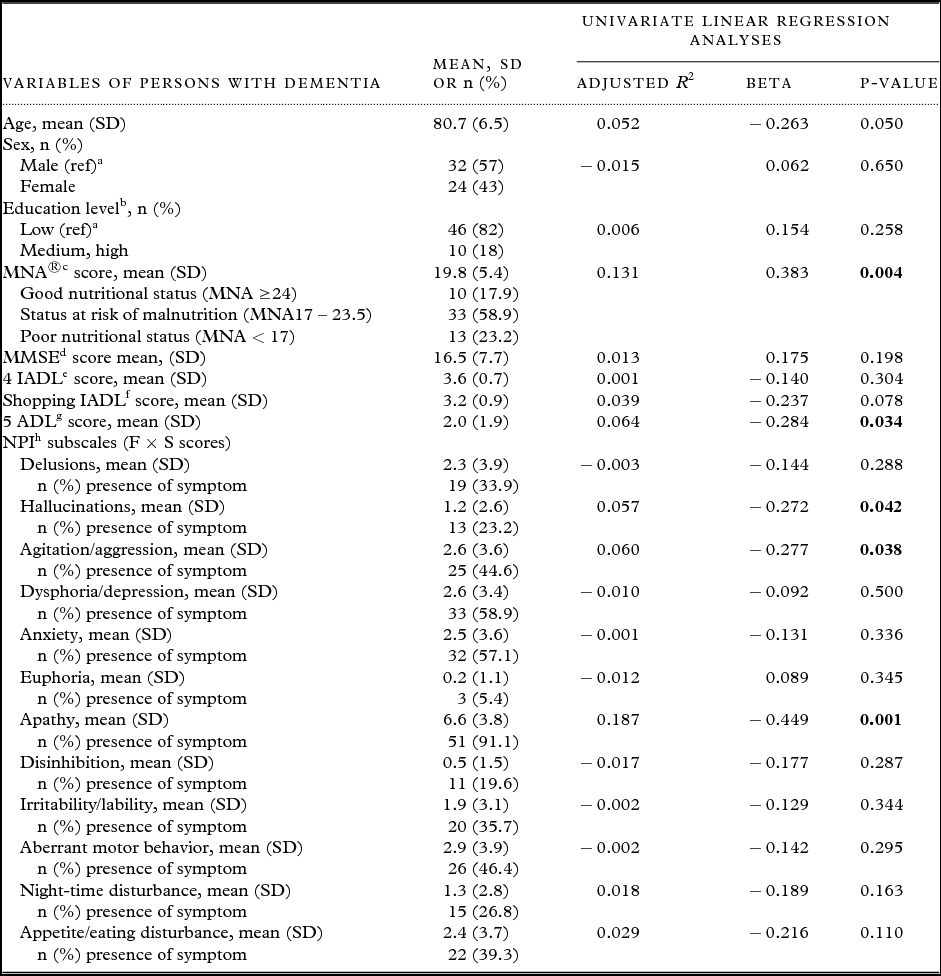
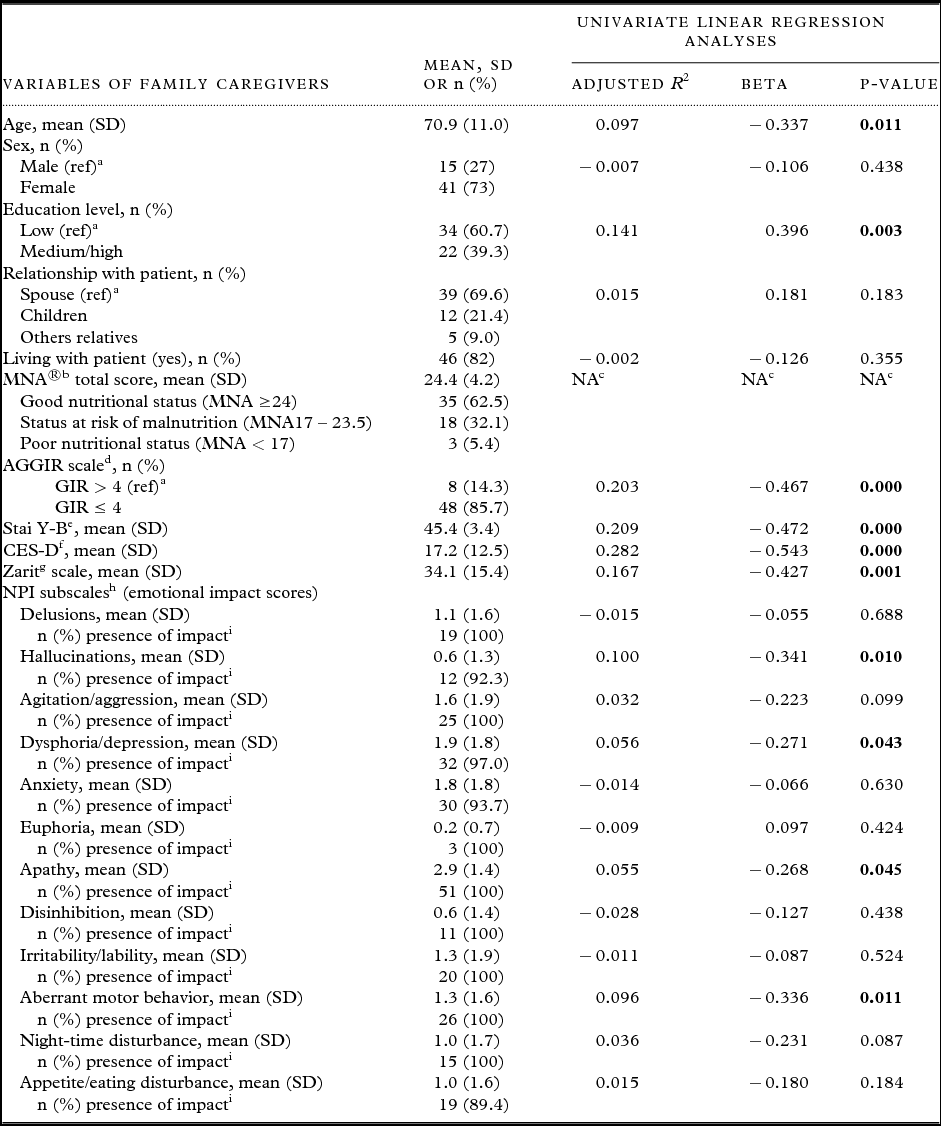
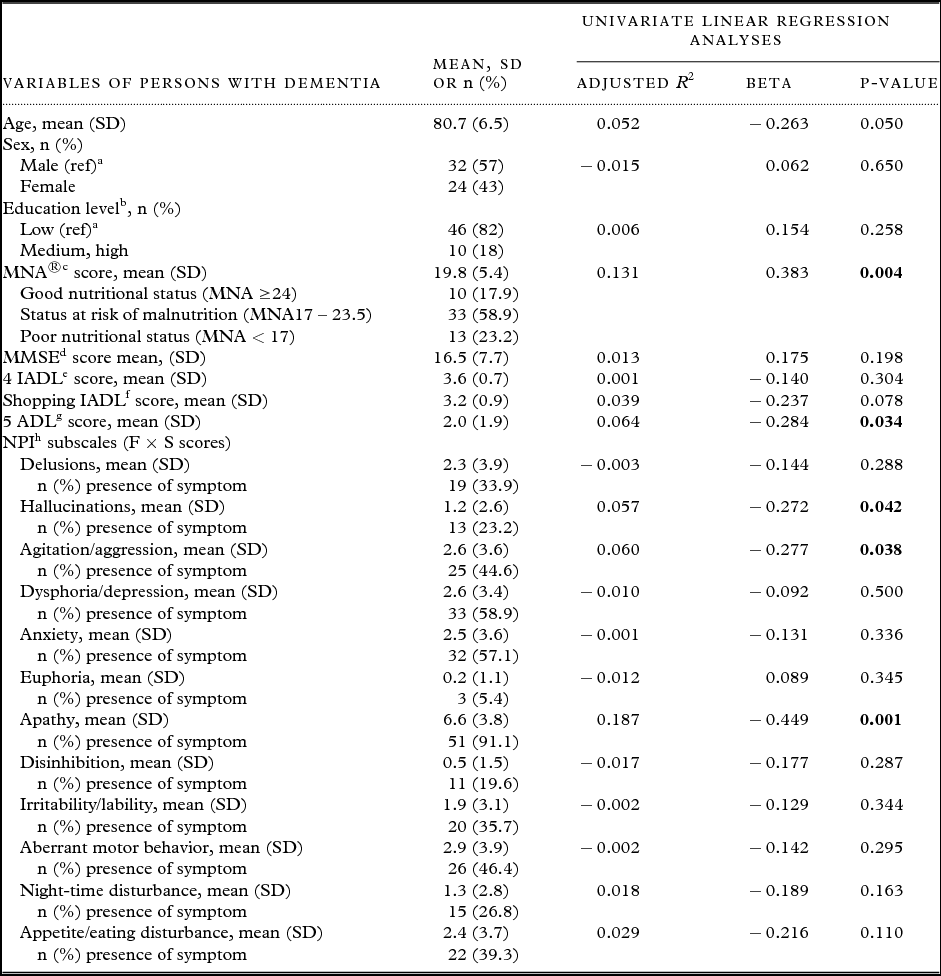
The demographic and clinical characteristics of persons with dementia are presented in Table 1 and those of family caregivers in Table 2. The mean score of MNA was 24.4 ± 4.2 for the family caregivers and 19.8 ± 5.4 for the persons with dementia. Among caregivers, 32.1% were at risk of malnutrition and 5.4% were malnourished. Our results showed that 58.9% of elderly people with dementia were at risk of malnutrition and 23.2% were malnourished.
Associations between characteristics of persons with dementia (independent variables) and nutritional status of family caregivers (MNA® score as dependent variable). Univariate linear regression analyses, n = 56
Note: Statistically significant data p-values were highlighted in bold.
aReference group for the analysis.
bEducation level was divided into two levels as follows: low level which corresponds to participants without schooling or having only obtained the French “Certificat d’Etudes Primaires,” equivalent to seven years of schooling; and medium/high level which corresponds to participants with a higher education level.
cMNA® = Mini Nutritional Assessment.
dMMSE = Mini-Mental State Examination.
eIADL score = number of Instrumental Activities of Daily Living for which the participant is considered to be “dependent” (ranging from 0 to 4), for each domain = percentage of dependence.
fShopping IADL score = as used in Lawton scale i.e. ranging from 1 to 4.
gADL score = number of Activities of Daily Living for which the participant is considered to be “dependent” (ranging from 0 to 5), for each domain = percentage of dependence.
hNPI = NeuroPsychiatric Inventory.
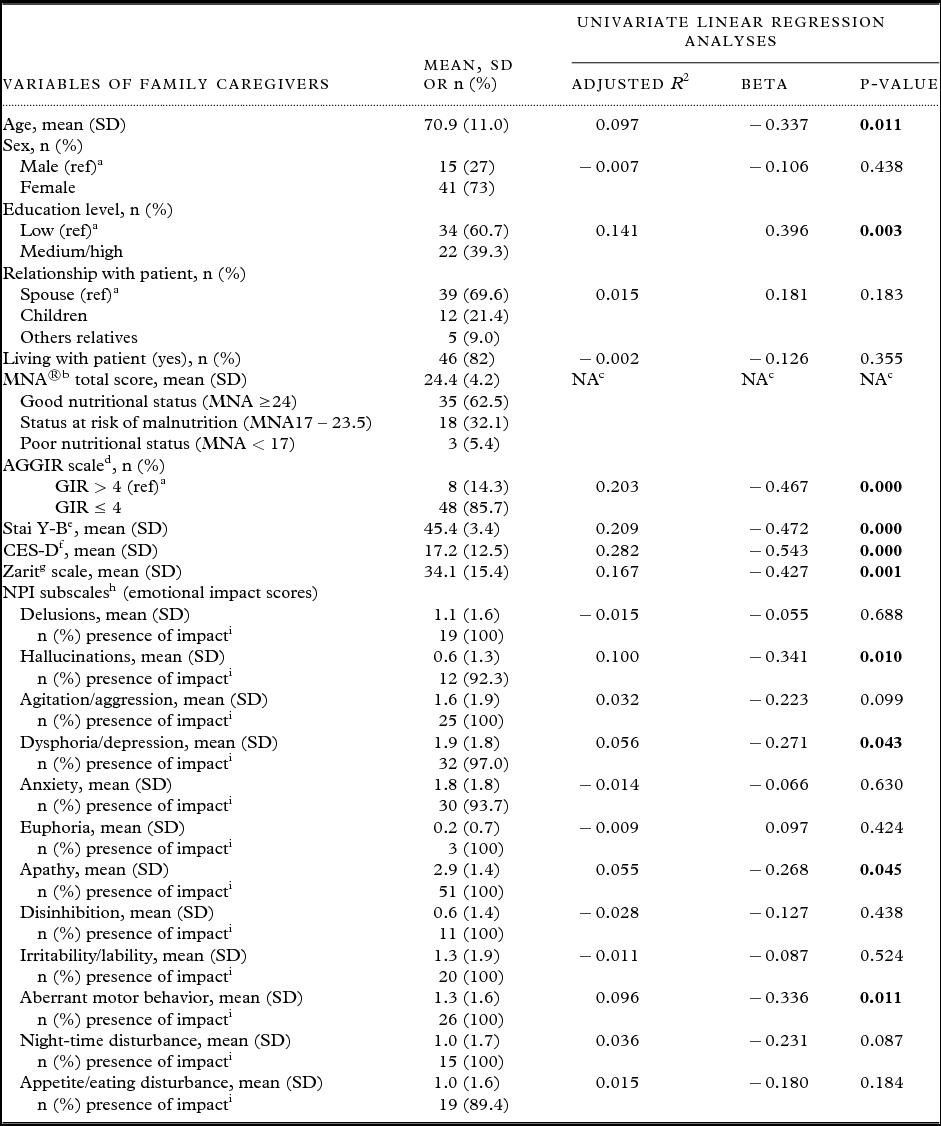
Associations between characteristics of family caregivers (independent variables) and their nutritional status (MNA® score as dependent variable). Univariate linear regression analyses, n = 56
Note: Statistically significant data p values were highlighted in bold.
aReference group for analysis.
bMNA® = Mini Nutritional Assessment.
cNot Appropriate.
dLevel of dependency on AGGIR scale: GIR > 4 = 0 (independency); GIR ≤ 4 = 1 (dependency).
eSTAI Y-B = State-Trait Anxiety Inventory form Y/Trait Scale.
fCES-D = Center for Epidemiologic Studies Depression Scale with scores ranging.
gZarit scale = Zarit Burden Interview.
hNPI = NeuroPsychiatric Inventory.
iIf presence of symptom, the presence of an emotional impact was considered as a categorical variable: (0) absence of emotional impact corresponding to score = 0; (1) presence of emotional impact corresponding to score > 0.
In univariate analyses, the characteristics of persons with dementia significantly associated with the MNA score of family caregivers were MNA score, 5 ADL score, and NPI severity score of hallucinations, agitation/aggression, and apathy (Table 1). The variables of caregivers significantly associated with their MNA® score were age, education level, dependency level on AGGIR scale, CES-D, STAI Y-B and Zarit scale scores, and NPI emotional impact scores of hallucinations, dysphoria/depression, apathy, and aberrant motor behavior (Table 2).
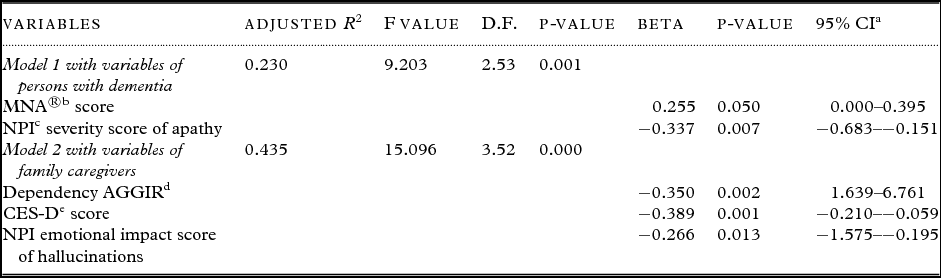
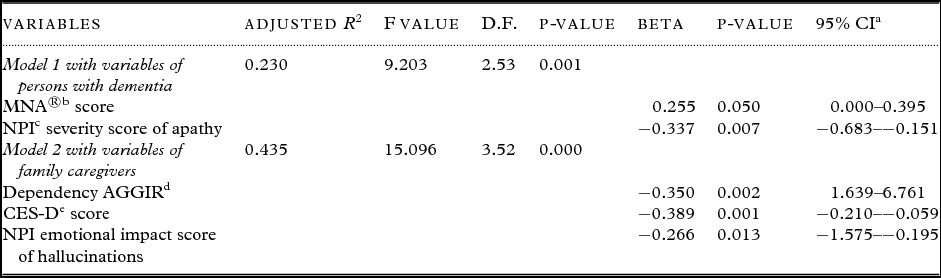
The first multiple linear regression analysis, including only significant variables of persons with dementia selected previously from univariate analysis (Table 1), showed that MNA score and NPI severity score of apathy significantly explained 23% of variation of MNA score of caregivers (Table 3). For the second multiple linear regression analysis including only significant variables of caregivers selected previously from univariate analysis (Table 2), dependency on AGGIR scale, CES-D score, and NPI emotional impact of hallucinations significantly explained 43% of variation of MNA score of caregivers (Table 3).
Two separate multiple regression models of nutritional status of family caregivers with variables of persons with dementia and of caregivers, n = 56
Note: Dependent variable = MNA® (Mini Nutritional Assessment) score of family caregivers.
a95% CI = 95% Confidence Interval.
bMNA = Mini Nutritional Assessment.
c NPI = NeuroPsychiatric Inventory.
dLevel of dependency on AGGIR scale: GIR > 4 = 0 (independency); GIR ≤4 = 1 (dependency).
eCES-D = Center for Epidemiologic Studies Depression.
In the final multiple linear regression analysis, significant variables selected from the previous multiple linear regression analyses of both people with dementia (MNA score and NPI severity score of apathy) and caregivers (functional status level on AGGIR scale, CES-D score, and NPI emotional impact of hallucinations) were introduced as explanatory variables. Considering the inclusion of five predictors in this model, a power analysis ensured that the current sample provided a statistical power above 0.96. Using a forward stepwise procedure, the first variable introduced in the model was CES-D, because it was the strongest variable associated with caregiver's MNA score. The following variables introduced were the severity of apathy and the level of dependency, both of which also contributed to the final model such as CES-D. Thus, in this final model, NPI severity score of apathy of persons with dementia, dependency level on AGGIR scale, and CES-D score of caregivers significantly explained 48% of variation of caregivers’ MNA score (Table 4).
Final multiple regression model of nutritional status of family caregivers, N = 56

Note: a95% CI = 95% Confidence Interval.
bThis model tests the relationship between the MNA® score of caregivers (dependent variable) and the characteristics of both persons with dementia and caregivers selected from the two previous multiple linear regressions.
cNPI = NeuroPsychiatric Inventory.
dLevel of dependency on AGGIR scale: GIR > 4 = 0 (independency); GIR ≤ 4 = 1 (dependency).
eCES-D: Center for Epidemiologic Studies Depression.
Discussion
In our sample of community-dwellers, the prevalence of poor nutritional status was very high in both the older people with dementia and their family caregiver. This finding revealed that 37.5% of caregivers presented a compromised nutritional status. Our results confirmed the presence of nutritional risk in community-dwelling caregivers shown also by Torres et al. (Reference Torres, McCabe and Nowson2010). However, in their study, 21.1% of caregivers were at risk of malnutrition but the medical condition of the person receiving the care was not considered. Our sample was composed of caregivers of elderly people with dementia, who are identified as a particularly vulnerable population (Vitaliano et al., Reference Vitaliano, Zhang and Scanlan2003).
Regarding factors related to persons with dementia, our results showed a strong association between the severity of apathy and caregivers’ nutritional status. These findings confirmed the link between the physical health of caregivers and BPSD (Schulz et al., Reference Schulz, O’Brien, Bookwala and Fleissner1995), especially with the negative symptoms such as apathy that is particularly burdensome (Thomas et al., Reference Thomas, Clement, Hazif-Thomas and Léger2001). Indeed, apathy leads to less participation in ADL and may require intensive stimulation by the caregiver. Moreover, caregivers often have limited knowledge about the symptoms of dementia. As a consequence, they may have difficulty in interpreting their relative's behavior, especially during mealtime (Mamhidir et al., Reference Mamhidir, Karlsson, Norberg and Kihlgren2007). Finally, we can hypothesize that these caregiving dyad's difficulties could affect their mealtime interactions: for example, apathy could weaken emotional and social exchanges within the caregiving dyad during mealtime, thus compromising psychosocial function of eating with others (Keller et al., Reference Keller, Martin, Dupuis, Genoe, Edward and Cassolato2010).
Regarding factors related to caregivers, our result showed that a poor nutritional status is strongly associated with depressive symptoms and higher level of dependency. This study confirmed the association between depressive symptoms and risk of malnutrition among family caregivers (Torres et al., Reference Torres, McCabe and Nowson2010). Poor appetite is an item of both the CES-D and the MNA, thus explaining in part their association. However, the link between depression and appetite is controversial. Indeed, depression could be positively or negatively associated with appetite and weight (Torres et al., Reference Torres, McCabe and Nowson2010). Although depression and functional limitations have been shown to be associated among family caregivers (Covinsky et al., Reference Covinsky2003), our study shows that both are independently associated with their nutritional status. Otherwise, caregivers with poor physical health have probably more difficulties to withstand the physical demands of caregiving (Covinsky et al., Reference Covinsky2003). These difficulties may increase the burden of care and psychological distress, thus inducing a vicious circle. Finally, future studies could investigate what kind of functional limitations are more associated with risk of malnutrition, especially if they lead to social deprivation which is well known as caregivers’ distress factor (Vitaliano et al., Reference Vitaliano, Russo, Young, Teri and Maiuro1991).
Taking simultaneously into account factors that are related to both persons with dementia and their caregivers better explained the risk of malnutrition in the family caregivers than each group of factors considered separately, as shown by the adjusted R 2. We found that the most highly depressive and dependent caregivers and those whose person with dementia presents severe apathy are the most at risk of malnutrition. These novel findings are in agreement with Thomas et al. (Reference Thomas2006), who proposed that the vulnerability of the caregiver is related both to individual factors and pathological conditions he/she must cope with. Studies that examine nutritional issues in dementia should consider caregiving dyad's relationship and in particular during mealtime, because their quality is recognized as an essential factor to improve nutritional status of persons with dementia (Aselage and Amella, Reference Aselage and Amella2010). We can hypothesize that it is also important for the caregivers’ nutritional status. This suggests that interventions should concern the community-dwelling caregiving dyad in order to improve their quality of life.
This study has some limitations. The specificity of our recruitment explains the limited size and the clinical characteristics of our sample. We cannot exclude that some associations could not be evidenced because of lack of power in this small sample. Thus, these findings cannot be generalized and require replication and confirmation in larger samples in various settings. Indeed, the caregiving dyads were not recruited in care center but through a community gerontological center and, they already presented some vulnerability due to the course of the disease. Moreover, living in rural areas could increase the nutritional deficiencies because of limited accessibility to food shops and lack of public transportation. In order to better understand risk factors for malnutrition in the context of dementia, it seems important to consider the dwelling environment, other contextual factors such as formal or informal support and also dietary habits and other nutritional measures, such as eating behaviors and sharing mealtime with the care recipient, which were not available in our study. Finally, the cross-sectional design of this study prevents the detection of causal relationship between psychosocial factors and caregivers’ risk of malnutrition.
Conclusion
The factors associated with nutritional status of caregivers involve both their individual characteristics, i.e. their functional status and depressive symptoms, and those of their relatives having dementia, i.e. the severity of apathy. These preliminary results confirmed the relationship between risk of malnutrition of the family caregiver and factors related to burden of care. These findings demonstrate the importance of paying more attention to these risk factors of malnutrition in dementia family caregivers. In particular, they emphasize the need for routine assessment of their depressive symptoms, functional and nutritional status, in order to prevent their potential detrimental impact on the caregiving dyad's quality of life. Future prospective researches are needed to better understand caregivers’ risk of malnutrition in the context of dementia and should investigate this issue through an integrative view including psychosocial approach.
Conflict of interest
Marion Torres received PhD financial support from Nutricia France.
Description of authors’ roles
Laetitia Rullier contributed to study design, to data collection and data analysis, and wrote the paper. Alexia Lagarde supervised the community gerontological center staff, participated in the design of the study and in data collection. Valérie Bergua contributed to draft and to revise the paper. Jean Bouisson supervised the study. Marion Torres contributed to revise the paper. Pascale Barberger-Gateau participated in the study design, the statistical analyses, and in drafting and revising the paper.
Acknowledgments
We are grateful to the Mederic Alzheimer Foundation and also to the Federative Research Structure in Public Health (Univ. Bordeaux) for their support during our doctoral work. We are grateful to the older people with dementia and their family caregivers. We would like to thank the community gerontological center staff and Thierry Atzeni for assistance with the analysis.