Introduction
In the current context of environmental protection, the use of the fungus Metarhizium acridum ( = Metarhizium anisopliae var. acridum; Bischoff et al., Reference Bischoff, Stephen and Richard2009) in the control of the desert locust could reduce the risks associated with the use of synthetic insecticides such as environmental pollution, development of insecticide resistance and adverse effects on non-target organisms. Over the years, M. acridum has been particularly promising and has received much attention for the control of the desert locust. It is regarded as being of low risk to humans and livestock (Peveling and Demba, Reference Peveling and Demba1997; Thomas et al., Reference Thomas, Blandford, Gbongboui and Lomer1998; Peveling et al., Reference Peveling, Rafanomezantsoa, Razafnirina, Tovonkery and Zafimaniry1999; FAO (Food and Agriculture Organization of the United Nations), 2001). The FAO listed M. acridum as a biopesticide recommended against the desert locust at a dose of 50 g/ha, equivalent to 2.5 × 10¹² conidia/ha (FAO, 2004). In field conditions, this dose is expected to provide adequate control under favourable and moderate environmental conditions (Van der Valk, Reference Van der Valk2007).
Despite its slow action in comparison with chemical insecticides, M. acridum shows real potential for the control of the desert locust (Kooyman and Godonou, Reference Lomer, Bateman, Dent, De Groote, Douro-Kpindou, Kooyman, Langewald, Ouambama, Peveling and Thomas1997; Lomer et al., Reference Lomer, Bateman, Dent, De Groote, Douro-Kpindou, Kooyman, Langewald, Ouambama, Peveling and Thomas1999). The efficacy of the fungus has been shown under laboratory and field conditions (Moore et al., Reference Moore, Reed, Le Patourel, Abraham and Prior1992; Bateman et al., Reference Bateman, Carey, Moore and Priore1993; Douro-Kpindou et al., Reference Douro-Kpindou, Godonou, Houssou, Lomer and Shah1995; Kooyman et al., Reference Kooyman, Batman, Langewald, Lomer, Ouambama and Thomas1997; Lomer et al., Reference Lomer, Thomas, Godonou, Shah, Douro-Kpindou and Langewald1997; Langewald et al., Reference Langewald, Thomas, Douro-Kpindou and Lomer1997, Reference Langewald, Ouambama, Mamadou, Peveling, Stolz, Bateman, Attignon, Blanford, Arthurs and Lomer1999). Three abiotic factors determine the success of M. acridum: temperature, amount of free moisture for initial germination of conidia and the rate of solar radiation reaching the conidia after spraying (Blanford and Klass, Reference Blanford and Klass2004). Indeed, direct exposure of conidia to solar radiation for 1 day can affect their viability (Scherer et al., Reference Scherer, Bateman, Moore and McClatchie1992; Moore et al., Reference Moore, Bridge, Higgins, Bateman and Prior1993). However, dry conidia can withstand high temperatures up to 55 °C (Moore and Morley-Davies, Reference Moore and Morley-Davies1994). Blanford and Klass (Reference Blanford and Klass2004) concluded that temperature is the most decisive environmental factor determining the efficacy of M. acridum. According to these authors, the impact of solar radiation on the survival of conidia in the field does not seem to be an important constraint for the successful use of M. acridum as a biopesticide for two reasons: (i) the recommended dose provides a sufficient amount of conidia to kill in spite of losses due to solar radiation; (ii) conidia deposited in shaded conditions (in shaded parts of leaves) will be protected. Blanford and Klass (Reference Blanford and Klass2004) noted that, in addition to ambient temperature, thermoregulation by the insect is also an important factor influencing the field efficacy of M. acridum.
In field conditions, locusts can be exposed to M. acridum conidia in three ways: direct exposure, secondary pick-up of conidia from treated vegetation and horizontal transmission from infected cadavers. In arid and semi-arid areas, rainfall may be a critical factor for the success of horizontal transmission (Arthurs et al., Reference Arthurs, Thomas and Lawton2001). Currently, the targets for spray droplets are both individual locust and the vegetation. Contaminated vegetation can, therefore, increase the probability of the treated insect to collect more conidia and result in the infection of untreated insects moving into the treated area.
Secondary pick-up from treated vegetation is an important mode of exposure of the insect to conidia (Lomer et al., Reference Lomer, Bateman, Godonou, Kpindou, Shah, Paraiso and Prior1993, Reference Lomer, Thomas, Godonou, Shah, Douro-Kpindou and Langewald1997; Thomas et al., Reference Thomas, Simon, Langewald and Lomer1996, Reference Thomas, Wood, Langewald and Lomer1997, Reference Thomas, Blandford, Gbongboui and Lomer1998; Bateman et al., Reference Bateman, Douro-Kpindo, Kooyman, Lomer and Ouambama1998; Kassa et al., Reference Kassa, Stephan, Vidam and Zimmermann2004). In field conditions, Van der Valk (Reference Van der Valk2007) concluded, in his review of the efficacy of M. acridum against the desert locust, that this mode presents the most important mode of exposure of locusts and grasshoppers to M. acridum conidia.
The importance of secondary infection of M. acridum conidia from contaminated vegetation is closely related to the length of time that the conidia persist (time that the conidia remain viable after application). For effective secondary infection, it appears that the pathogen must contact mobile insects within 24–48 h in order to be effective (Scherer et al., Reference Scherer, Bateman, Moore and McClatchie1992; Van der Valk, Reference Van der Valk2007). In natural conditions, the time that the locusts stay in vegetation is determined by predation, moulting and food availability (Culmsee, Reference Culmsee2002). The activity and behaviour of the desert locust have been found to be influenced by the distribution of vegetation cover (Despland et al., Reference Despland, Collett and Simpson2000; Despland and Simpson, Reference Despland and Simpson2000).
The influence of M. acridum on the desert locust has been extensively studied. There are several reports in the literature demonstrating the efficacy of this fungus on locusts. However, no previous studies on the influence of vegetation cover on the efficacy of M. acridum have been published. The aim of the present study was to assess, under semi-field conditions, the efficacy of M. acridum in relation to vegetation cover.
Materials and methods
Experimentation site
This study was organized at the beginning of the summer season in the coastal area of the Red Sea. Various treatments were conducted in Sudan, at a farm in the Sallom area (19°38′55″N × 37°15′37″E), 28 km south-west of Port Sudan, which is part of the research station of the International Centre of Insect Physiology and Ecology (ICIPE).
Insect rearing
Insects used for testing came from a gregarious desert locust stock, which was maintained at the ICIPE field station. The colony was developed initially from egg pods collected from the field, and the laboratory culture was regularly refreshed with new field collections. Locusts were crowd-reared in wooden-frame cages of 1 × 0.5 × 0.5 m with wire mesh (2 mm2) on the ceiling and on the three sides of the cage. The cage door was made of white cloth with a sleeve to enable inspection, easy cleaning and food supply. The bottom false floor was made of wood with 10 holes to fit plastic cups (10 cm in diameter) for egg-laying. The cages were placed in a room with open windows to allow temperature and humidity conditions to equilibrate with outside conditions. Insects were fed on natural desert plants collected from the field, mainly millet and Heliotropium spp. (Boraginaceae), with some Dipterygium glaucum (Capparaceae) and Crotalaria microphylla (Fabaceae). During the shortage of field plants, fresh alfalfa, millet and wheat bran were provided. For heating, three light bulbs of 60 W were placed at the top of each cage and switched on for 6 to 8 h.
After laying eggs, the plastic cups (with egg pods) were covered with mosquito wire mesh and placed under a 60 W light bulb for 6 to 8 h to accelerate embryonic development. After hatching, the first-instar larvae were transferred to new cages made in the same way as above, but with different dimensions (length × width × height: 1 × 1 × 0.5 m). In these cages, insects were kept until they reached the third- or fourth-instar stage. At this stage, the insects were used for the experiments or transferred into large field cages placed outside for mass rearing under natural conditions. Locusts remained in these outdoor cages until maturation and then transferred to laboratory cages for egg-laying.
Experimental cages
The study was conducted under semi-field conditions in wooden-frame experimental cages of 2 × 2 × 1 m with 2 mm2 wire mesh. These cages, with the bottoms open, were placed on 2 × 2 m plots cultivated with millet. The cage ceiling was provided with a door to facilitate the application of the product. Control plots were placed upwind from the treated ones to prevent contamination. Plots were cultivated with two types of vegetation cover: high and low. In the high vegetation cover, all the plots were sown to give approximately 90% coverage. In the low vegetation cover, only about 10% of each plot surface was sown (in the middle). Vegetation height (73.7 ± 6.76 to 90.7 ± 7.52 cm) was assessed in three randomly defined plots.
In each treatment, 120 third- and fourth-instar locust larvae were tested. These insects were introduced into the cages 24 h before the treatment. Wooden-frame cages measuring 25 cm3 were used for monitoring and sampling. To evaluate the persistence of conidia, 50 cm3 cages, with the bottoms open, were also used. In all cases, each plot was replicated three times.
Treatments and sampling
Metarhizium acridum powder (Biological Control Products, South Africa) was used. Overall 50 g of this formulation (containing approximately 2.5 × 10¹² conidia, as recommended for the control of desert locusts) were used per hectare.
The germination test carried out gave 91% of viable conidia. The test was conducted by inoculating two or three Petri dishes containing malt extract agar with an appropriate conidial suspension (for easy counting), and incubating for 24 h at 30 °C. To prepare conidial suspension, 1 g of the product was mixed with 9 ml of diesel oil. A series of dilutions were made until the appropriate suspension of conidia was obtained, in general 103 to 104 conidia/ml. The percentage of germination was assessed under a light microscope using a 400 × magnification. A minimum of 300 germinated and non-germinated conidia (presence or absence of germ tubes) were counted. The rate of germination was calculated by applying the following formula (LUBILOSA, 1999): (a/a+b) × 100, where a and b represent the germinated and non-germinated conidia, respectively.
The effects of M. acridum on Schistocerca gregaria were investigated by exposing 120 larvae (40 of the third instars/80 of the fourth instars). At 24 h after application, a sample of 20 larvae (randomly picked) was taken from each cage and transferred to small cages for monitoring.
Treatments were performed using a calibrated hand-held battery-driven ULVA+ sprayer. Two nozzles were used: orange for a volume of 1 l/ha and black for 2 l/ha. Because of the difficulty in applying the exact volume on 4 m2 plots, and of simulating field application conditions, all cages were treated in the same procedure adopted under field conditions, i.e. a one-pass coverage with the sprayer of about 2 s.
Conidial persistence on vegetation was investigated by putting 20 untreated larvae in contact with the treated vegetation inside the 50 cm3 cages at 1 h, 3 days and 6 days after treatment. The larvae were left for 24 h before being transferred to monitoring cages (25 cm3) placed on the experimentation site, near the large cages. These cages were positioned under shaded trees at mid-day (the hottest period of the day). During the monitoring period (7–8 days), caged larvae were fed with uncontaminated vegetation.
To assess the efficacy of the treatments, all cages (large and small) were daily controlled and mortality recorded. This allowed monitoring of the behaviour and activity of both treated and untreated (control) larvae. Because of the high mortality rate recorded in small cages, the mortality rate was corrected for control mortality according to Abbott's formula (Reference Abbott1925):
 $$\begin{eqnarray} \end{eqnarray}$$
where CM is the corrected mortality, and M 1 and M 2 are mortality in the control and treated groups, respectively.
Daily monitoring also allowed us to observe the behaviour of the control and treated larvae. As meteorological conditions can greatly influence the efficacy of the treatments, speed and direction of wind were registered during the treatments. Temperature and relative humidity were recorded every 2 h in the open field, from 07.00 to 21.00 h by a digital thermometer.
Data analysis
Results are expressed as means ± standard deviation. To identify significant effects of the treatments on the variables measured, data were subjected to the analysis of variance using SPSS (version 15.0). Differences between the control and treated series were compared using the Student–Newman–Keuls test at the 5% level.
Results
Meteorological data
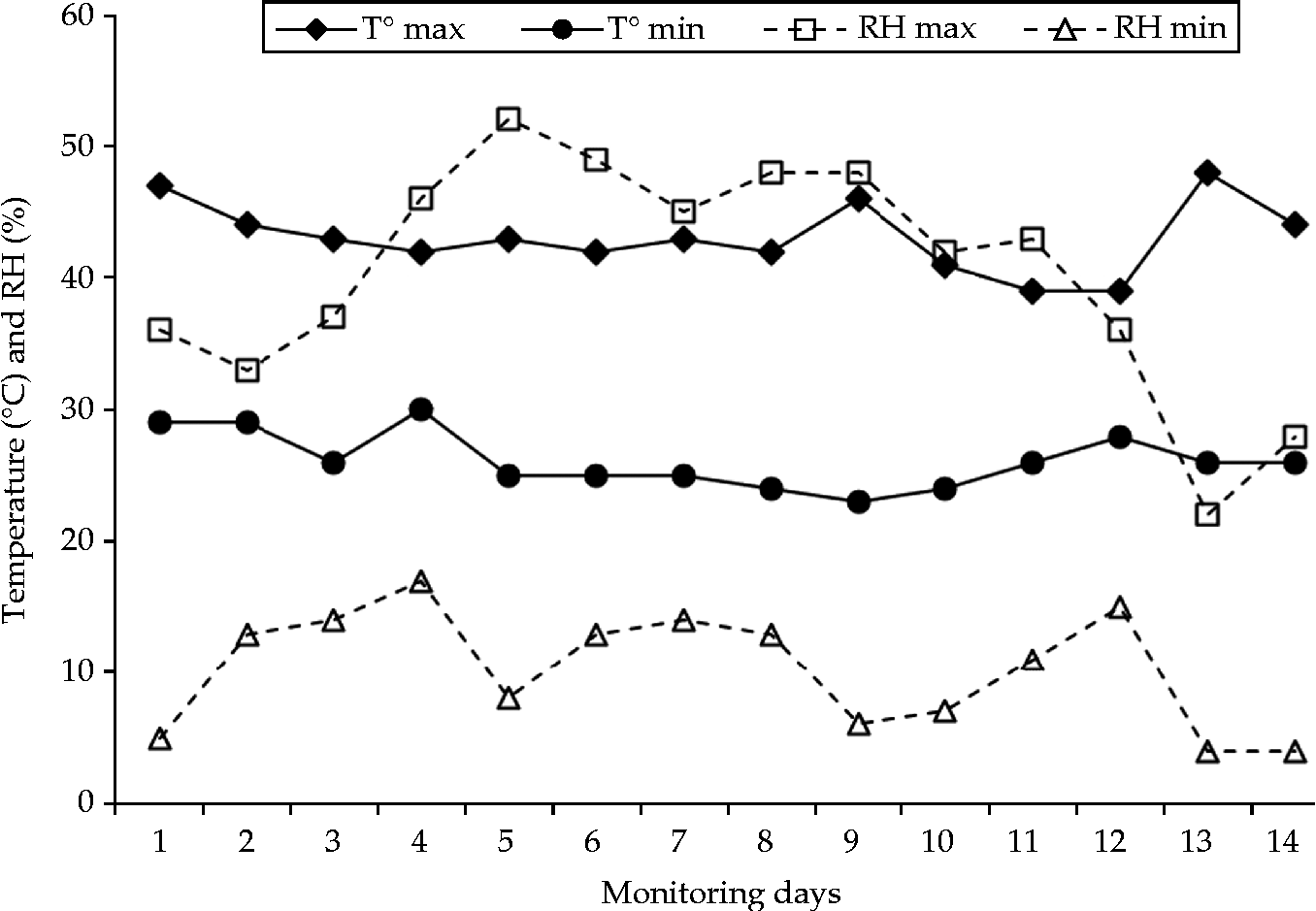
Meteorological data (maximum and minimum temperatures and relative humidities) throughout the trial period are shown in Fig. 1. During the treatments, wind speed ranged between 2.5 and 4.1 m/s. The study was conducted at the beginning of the summer season and temperatures increased dramatically. Generally, the conditions were not suitable for the development of M. acridum with temperatures ranging from 23 to 48 °C. The relative humidity recorded ranged from 4 to 52%.
Maximum and minimum temperatures recorded during the trial period in 1 m below the soil surface level. RH, relative humidity.

Treatment efficacy
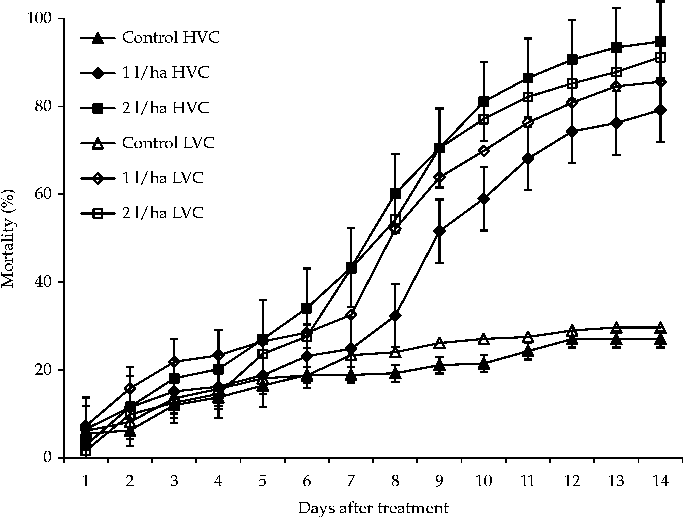
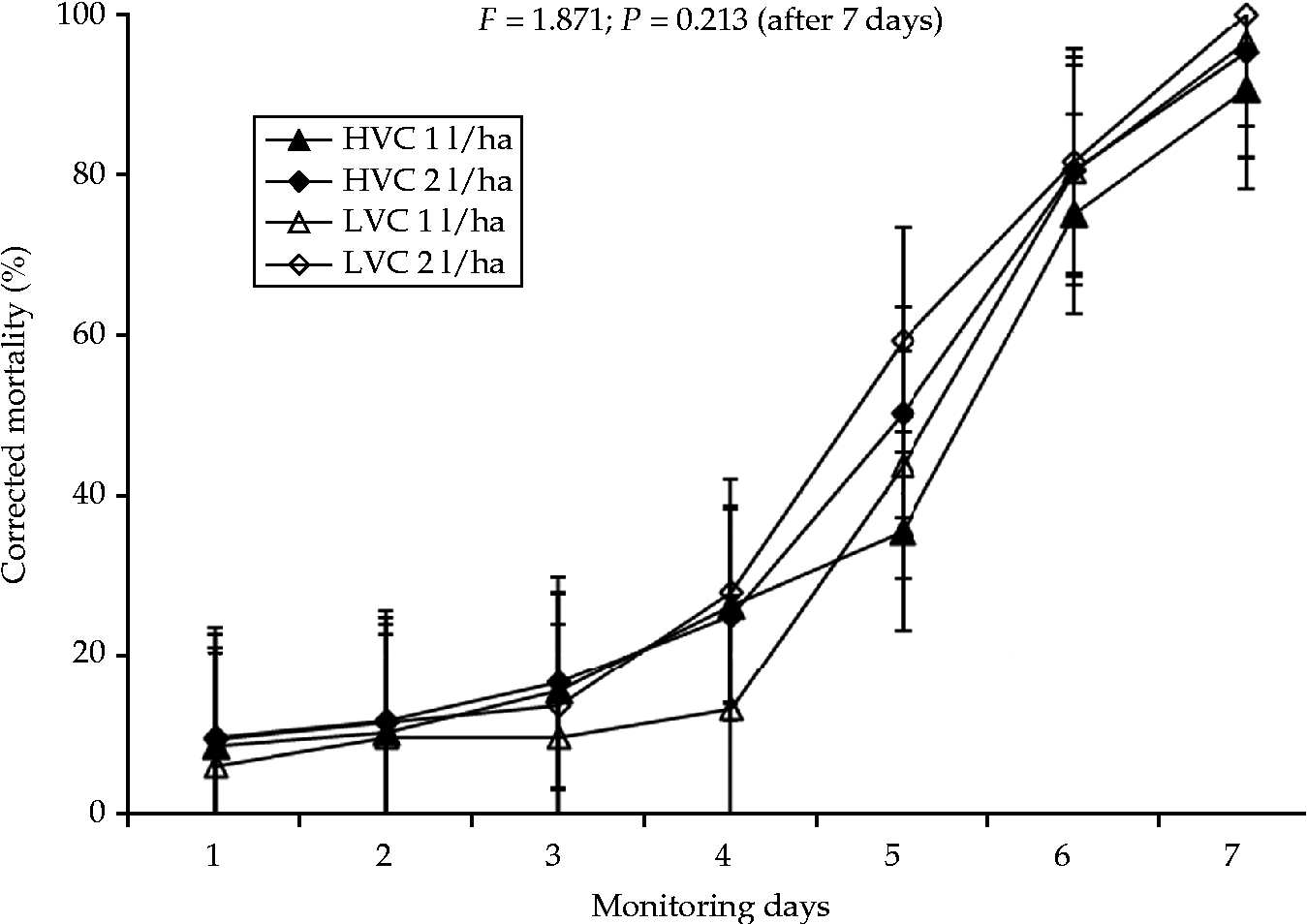
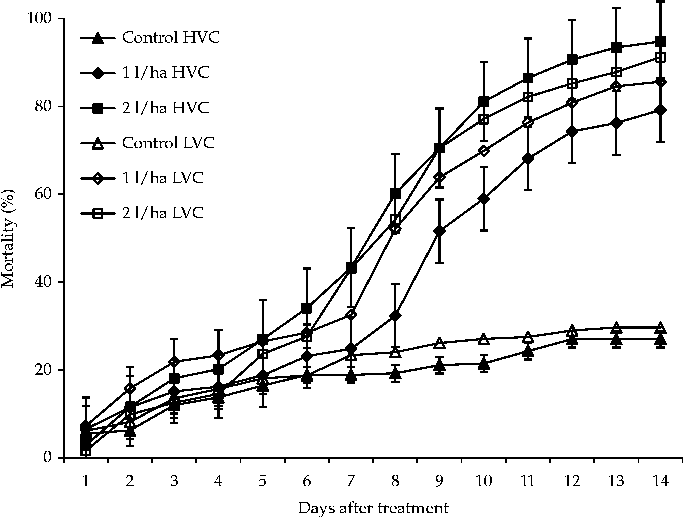
In spite of unfavourable weather conditions during the study period, M. acridum was effective. No significant influence (P>0.05) of the vegetation cover on the efficacy of M. acridum was observed. At 2 weeks after the treatment (Fig. 2), mortality rates were found to be 75, 79, 86 and 91%, with about 90% (1 l/ha), about 10% (1 l/ha), about 10% (2 l/ha) and about 90% (2 l/ha) vegetation cover, respectively (F= 1.320; P= 0.334). Samples collected from the large cages 24 h after the treatment showed no significant difference (P>0.05) between the treatments on both vegetation covers (Fig. 3). A total mortality of 90–100% after 1 week of monitoring was observed (F= 1.871; P= 0.213).
Cumulative mortality of desert locust larvae kept in large cages. HVC, high vegetation cover; LVC, low vegetation cover.
Mean percentage of mortality in the samples of larvae collected from large cages 24 h after the treatment and kept in small cages under shade. Mortality was corrected using Abbott's formula.
Larvae in the treated cages revealed clear and typical symptoms of infection by M. acridum (red and dry cadavers), as described by numerous authors. The speed of mortality was more obvious with the volume of 2 l/ha on the high vegetation cover (Fig. 2). At 10 days after the treatment, the mortality rate reached 81 and 58% in the 2 and 1 l/ha applied volume, respectively (P< 0.05). However, after 14 days, mortality levels were not significantly different anymore.
The untreated larvae remained active until the end of the monitoring period. The effect of M. acridum on the behaviour and activity of the treated insects was clearly observed from day 5. The time spent by the insect in basking increased in the treated larvae compared with the control group. Furthermore, a remarkable reduction in activity and feeding by the larvae resulted in low vegetation consumption, which was clearly observed in the treated plots.
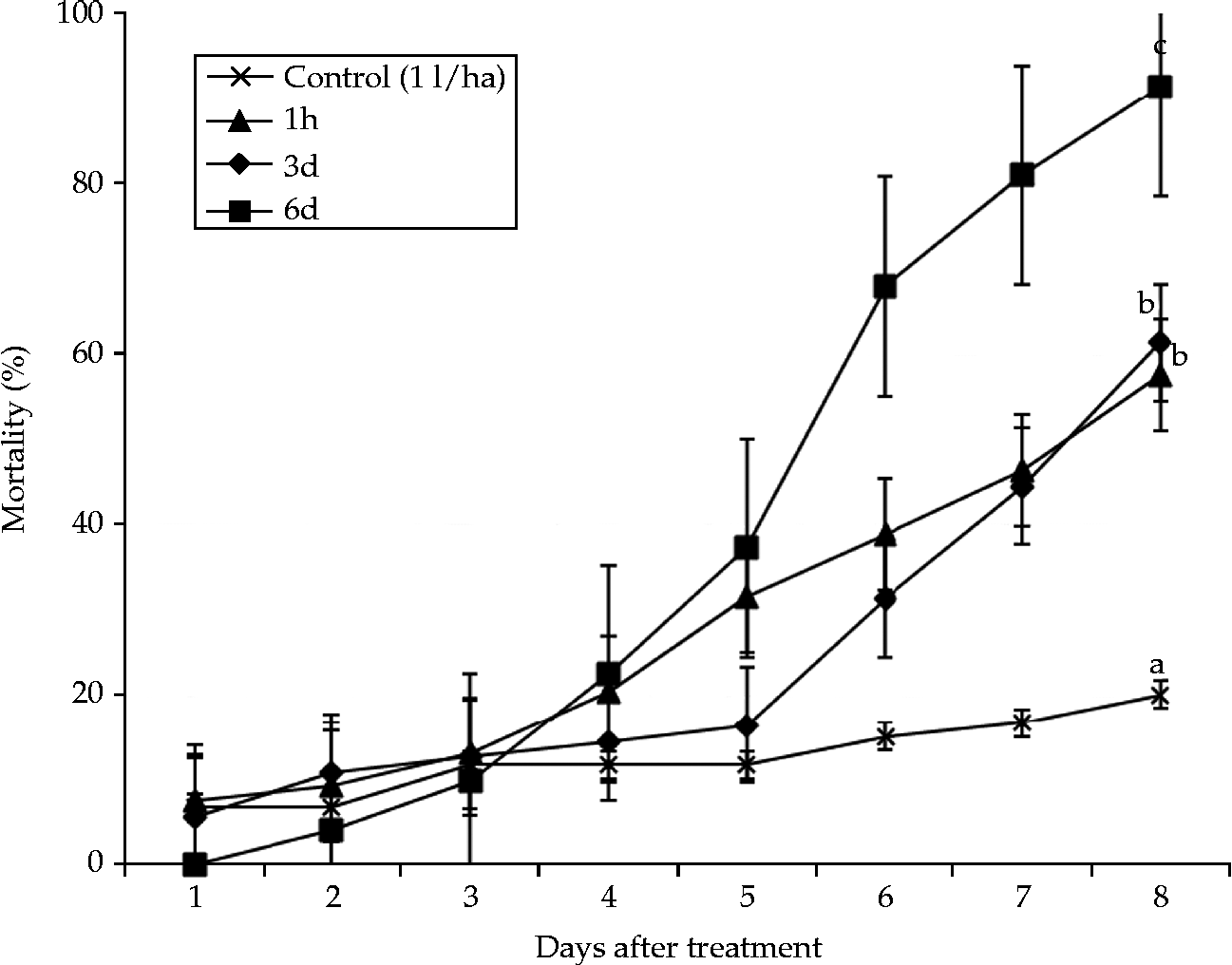
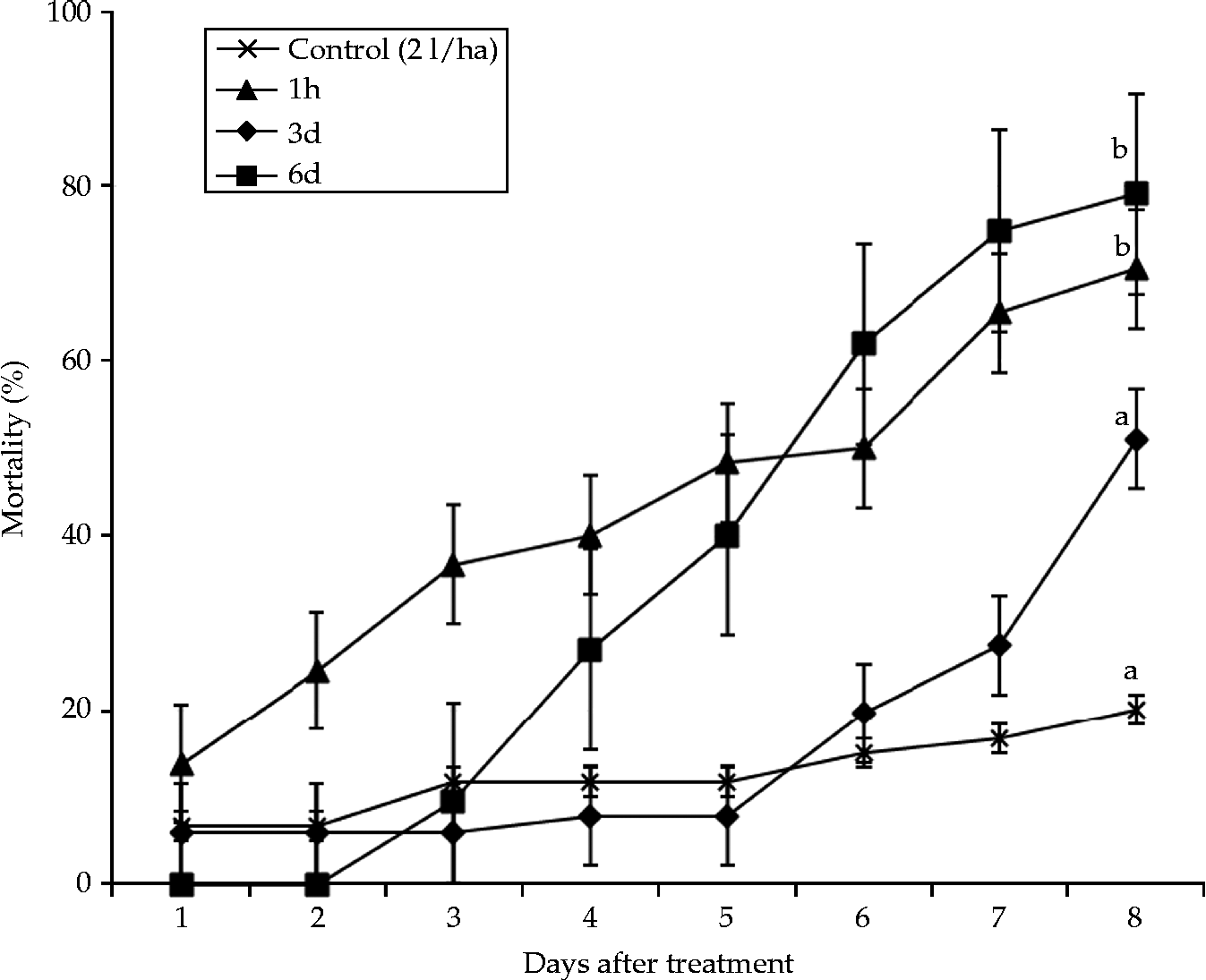
The conidia remained viable with good efficacy 6 days after the treatment under our experimental conditions. The untreated larvae introduced onto the treated vegetation after this period showed clear symptoms of infection by M. acridum, with mortality rates exceeding 80% (Figs 4 and 5). This clearly indicates that the conidia remained viable and effective under these conditions.
Mean mortality of untreated desert locust larvae kept on the vegetation treated with the 1 l/ha volume rate at different time periods after the treatment. Curves with the same letters are not significantly different (P< 0.05). d, days.
Mean mortality of untreated desert locust larvae kept on the vegetation treated with the 2 l/ha volume rate at different time periods after the treatment. Curves with the same letters are not significantly different (P< 0.05). d, days.
Discussion
The results of this study showed that vegetation cover did not significantly influence the efficacy of M. acridum. Even under hot conditions, vegetation apparently protected conidia against direct exposure to solar radiation. The conidia persisted and remained viable to infect new larvae, and increased the dose received by those already infected. In this study, we observed that if the larvae had enough contact with the treated vegetation (2 weeks), even with a low vegetation cover (about 10%), insects accumulated sufficient conidia by secondary pick-up from the contaminated vegetation.
As in field and semi-field conditions, not all the targeted larvae were in direct contact with product drift during the spring; thus, the secondary pick-up of conidia from the treated vegetation is the only way by which conidia can reach the larvae. In this case, conidia may persist for appreciable times in the treated areas. Larvae taken from the large cages and kept in the shade, and the ones kept on the treated vegetation on treatment days, both showed comparable mortality. Bateman et al. (Reference Bateman, Douro-Kpindo, Kooyman, Lomer and Ouambama1998) found no significant difference in the average survival period between locusts exposed directly and those picking up conidia exclusively from the contaminated vegetation. Van der Valk (Reference Van der Valk2007) concluded in his review on the efficacy of M. acridum against the desert locust that direct and residual effects are similar on the day of treatment.
Under natural field conditions, conidia have been found to appear to remain active in protected locations in the vegetation canopy (Thomas et al., Reference Thomas, Wood, Langewald and Lomer1997). A high vegetation cover may reduce the direct impact of the spray droplets on the insects (Van der Valk, Reference Van der Valk2007). Secondary pick-up of conidia from the treated vegetation may also be reduced because the product is diluted over a high vegetation volume. By contrast, in dense vegetation, the insect stays for a longer time in contact with the vegetation (Wilps, Reference Wilps2004), and thus accumulates more conidia.
In ecosystems where a direct contact between the spray and the insect is limited, such as tall and dense grass vegetation, contact with residual conidia is essential for effective control (Thomas et al., Reference Thomas, Wood, Langewald and Lomer1997). Thomas et al. (Reference Thomas, Blandford, Gbongboui and Lomer1998) showed that in short mixed-grass vegetation, the dose of conidia acquired through contact with the spray residue exceeds that from a direct contact with airborne spray droplets alone.
Despite the hot conditions during the study period, conidia persisted until the 6th day after the treatment, with a good effect on the untreated larvae exposed to the contaminated vegetation. Insects that were able to stay for 24 h came in contact with the contaminated vegetation. However, Van der Valk (Reference Van der Valk2007) suggested that with a half-life of 4 to 8 days, the insects should remain in the treated area for at least 2 days after the treatment for the fungus to attain its maximum efficacy. When used against Oedeleus senegalensis (Langewald et al., Reference Langewald, Ouambama, Mamadou, Peveling, Stolz, Bateman, Attignon, Blanford, Arthurs and Lomer1999) and Zonocerus variegatus (both Orthoptera: Acrididae) (Douro-Kpindou et al., Reference Douro-Kpindou, Gbongboui, Badou, Paa-Kwessi, Ackonor and Langewald2005), long persistence of M. acridum conidia on the vegetation has been observed.
With a thick vegetation cover, the amount of conidia attaching to the vegetation would be significant and conidia more protected against direct solar radiation. Vegetation also creates a microclimate more favourable for fungal growth. Temperatures recorded every 2 h from 07.00 to 21.00 h, in the open field, ranged between 23 and 48 °C. Under laboratory conditions, highest temperature limits of 37 to 39 °C have been reported to be optimal for fungal growth (Ouedraogo et al., Reference Ouedraogo, Fargues, Goettel and Lomer1997). Blanford and Klass (Reference Blanford and Klass2004) concluded that, under field conditions, the optimal temperature for fungal growth was between 27 and 30 °C.
The results of this study, conducted under semi-field conditions, confirm the robust efficacy of M. acridum conidia as a biopesticide against the larvae of the desert locust. The product was effective even with a low vegetation cover. Direct exposure of the conidia to solar radiation may have been limited by vegetation, resulting in good conidial persistence. These conidia may reinfect the treated larvae and infect the untreated ones that venture into the treated zones. Also, in semi-field conditions, the larvae might have less chance of basking. Thermoregulation behaviour has been shown to reduce the rate of mortality following infection (Blanford et al., Reference Blanford, Thomas and Langewald1998), because it helps to keep fungal growth in check (Ouedraogo et al., Reference Ouedraogo, Cusson, Goettel and Brodeur2003). To confirm the results of this semi-field study, we recommend that studies be conducted under natural field conditions where the insects are moving freely.
Acknowledgements
The authors are greatly indebted to the FAO, particularly James Everts for providing financial assistance, and Professor Magzoub Omer Bashir for assisting in the supervision of the work and the editing of the manuscript. The authors also acknowledge Christiaan Kooyman and H. Van der Valk for their valuable comments and observations. Thanks are also due to all ICIPE personnel at Port Sudan, Sudan, particularly the technicians Hayder Hanan Korena and Abdalrahim Bashir for their kind and friendly assistance.