

This report summarizes Perspectives on Politics’ journal operations and performance for 2025. This year marked the second full year under the leadership of Northwestern University’s Ana Arjona and Wendy Pearlman as co-editors-in-chief and Anne Wolf of the University of Oxford, Kathrin Bachleitner of the University of Oslo, and Sarah Bufkin of the University of Birmingham as book review editors. After adding Shmuel Nili of Northwestern University to serve as associate editor overseeing submissions in political theory in September 2024, the journal welcomed two more associate editors in September 2025, Mary McGrath and Chloe Thurston, both of Northwestern University, to manage editorial processes in American politics. The addition of these associate editors has helped the editorial team handle a growing number of submissions—Perspectives received 803 submissions in 2025, its largest volume ever— and brought valuable substantive and methodological expertise to the journal’s leadership. APSA’s Jennifer Boylan remained managing editor, crucial to all aspects of operating the journal on a day-to-day basis and working with Cambridge University Press. Finally, the Northwestern University team of doctoral-level editorial assistants underwent a transition, as Chloë Bernadaux, Lucas Câmara, and Ana Vedovato joined the editorial team while Elizabeth Good and Sarah Moore graduated from Northwestern and thus departed from Perspectives after two years of hard work and service to the journal. Jinxue Chen and Jack McGovern continued as editorial assistants.
Beyond the continued processing of regular submissions to the journal, 2025 saw the start of editorial work on the first call for papers (CFP) for a special issue under the current leadership team. With an initial deadline of August 1, 2025, extended to October 1, 2025, the CFP asked for submissions relating to the theme of “Political Science and the University.” The co-editors-in-chief recruited three guest editors for the special issue: Anja Neundorf of the University of Glasgow, Robert Pape of the University of Chicago, and Nicholas Tampio of Fordham University, and each has managed submissions in their respective subfields. We are thankful for their ongoing commitment to the special issue, which will be the first published by the journal since 2022.
The data on submissions and editorial processes in the sections that follow include discussion of regular submissions (articles and reflections), book reviews, and CFP submissions. The tables and figures outlining the data denote which category of manuscripts is being represented.
EDITORIAL PROCESSES
With a strong infrastructure and set of procedures in place from 2023 and 2024, the most important development for the internal processes of the editorial team last year was the rethinking and initial reworking of a new model for its editorial team structure. The foundational journal model centered on one editor-in-chief (from 2002-2017), or one editor-in-chief and one associate editor (from 2017-2023), who reviewed all submissions. Inheriting this model, the two Northwestern-based co-editors-in-chief handled all submissions from the start of their editorship in June 2023 through September 2024. During this time, however, the number of regular submissions increased from 484 in 2023 to 555 in 2024.
As the workload expanded, it became increasingly clear that it was not sustainable for the journal to be managed by only two editors. Indeed, the editorial team gathered data from 15 top-ranked journals in political science and calculated that the average was about 114 manuscripts per editor. At Perspectives, however, each co-editor-in-chief was handling about 225, nearly twice that number.
The co-editors-in-chief began studying other editorial team models and, in consultation with APSA, decided it was necessary to expand the editorial team to include associate editors. This was piloted first with the political theory subfield in fall 2024, bringing on Northwestern’s Shmuel Nili. In fall 2025, this was extended to American politics, when Mary McGrath and Chloe Thurston of Northwestern joined the team. Across subfields, associate editors follow the same internal processes developed and institutionalized by the current editorial team, which built on and formalized the policies and guidelines of prior teams. Associate editors also work with the editors-in-chief to further optimize policies and procedures and develop new approaches to meet the rising demands of editing the journal.
Given the trends we detail below, we expect editorial workload to continue to increase. This is in part due to how innovations in AI technology will enable advances in research, expedite research processes, and escalate submission volumes, while also making careful editorial scrutiny and judgment by subfield experts more important than ever. In this context, we believe that the new model best positions the journal for the long run and frees the editors-in-chief to pursue larger initiatives. Building on the proven success, cohesion, and improved operations of expert subfield associate editors, we plan to add additional associate editors in 2026.
As the initial step toward a potentially major change for Perspectives, these first associate editors have been hired from faculty members at Northwestern for both practical and substantive reasons. Logistically and bureaucratically, this was easiest because APSA had already signed a contract with Northwestern and the hiring of the first associate editor could thus be accomplished with a reallocation of the agreed-upon budget. Substantively, the fact that editors-in-chief, associate editors, and editorial assistants are already departmental colleagues, and being all physically located in the same place has helped us meet and work together to develop shared approaches and standards, which has greatly facilitated a smooth transition to a new model and promoted consistency in editorial decision-making. Should this model persist in the future, however, we believe that it would be fruitful to consider the possibility that editors-in-chief and associate editors are based at different institutions or perhaps even in different countries. This could increase the editorial team’s substantive expertise while also expanding diversity, inclusion, representation, and opportunity in journal leadership, with ripple effects for the discipline at large.
Other improvements to internal journal processes in 2025 include work to delineate, support, and streamline the work of editorial assistants, which became imperative after the first transition among the Northwestern team resulted in the need to onboard and train new doctoral-level members. This entailed several tasks. First, departing lead editorial assistant and Perspectives postdoctoral editorial fellow Sarah Moore prepared a detailed appendix to the team’s now 54-page Editorial Guidebook outlining the weekly, monthly, and quarterly duties of her position before leaving the journal. Her efforts have helped to smooth the handover to Jack McGovern as lead editorial assistant.Footnote 1 Second, with the rise in submissions particularly strong in comparative politics, the transition also afforded the opportunity to add a second editorial assistant in comparative politics. After initially focusing on manuscripts submitted in response to the CFP, this new editorial assistant has shifted to specialize in comparative politics submissions more generally since the fall. Finally, the editorial team further developed a bank of standardized language for desk rejection letters to facilitate and improve feedback to authors on the approximately ten most common concerns we see in manuscripts that we decide not to send for external review. This new resource, including a range of sample paragraphs, helped make drafting letters more efficient, enabling Perspectives to continue its tradition of providing detailed feedback to authors.
In addition, editors-in-chief Ana Arjona and Wendy Pearlman worked to publicize the internal processes of the journal and share tips for authors by participating in two panels at the 2025 APSA Annual Meeting in Vancouver, Canada: an AMA or “Ask Me Anything” with editors of other top journals and a panel titled “Publishing Your First Article: Tips and Best Practices.”
POLICY DEVELOPMENT
The biggest shift in the policies of the journal last year came in early 2025, when Perspectives reduced the required number of peer reviewers for research articles from four to three and lowered the minimum number of peer reviewers for reflection essays from three to two—while the editorial team continues to seek out more reviewers beyond the minimum when necessary, the editors-in-chief made the decision to both ease increasing demands on peer reviewers and expedite the external review process. Editors across subfields found that bottlenecks tended to arise when reviewers accepted invitations to review a manuscript but did not complete their referee reports or respond to repeated appeals for them to do so. Tracking down and waiting for late reviews from as many as four reviewers had thus become increasingly time-consuming for the editorial team and led to delays for authors. Perspectives had also been an outlier among peer journals in requiring such a large number of reviewers. Reducing the required number to three brings the journal in line with other top publications.
Beyond policies governing the external review process, Perspectives also implemented guidelines for handling new types of submissions in 2025. The journal began to accept review transfers from other journals, for example, following the announcement of the initiative at the American Political Science Review in February 2025. If an author has a paper rejected after external review at a participating journal, they can now opt to transfer an anonymized version of their paper and the set of completed reviews, identified with the names of the reviewers for the assessment of the editors, to Perspectives. Based on the reviews, a paper transferred to Perspectives can then be desk rejected, given a revise and resubmit decision, or more reviews can be solicited, or accepted. The policy aims to quicken the peer review process for authors and reduce the duplication of work for reviewers.
Another significant undertaking for the editorial team in 2025 was to develop, deliberate, refine, and launch a process and set of standards for assessment and possible publication of post-publication critiques (PPCs). In keeping with guidance from the Committee for Publication Ethics (COPE),Footnote 2 the journal began to welcome PPCs after extensive efforts at finalizing its policy over the past year and a half. The editors-in-chief spent considerable time researching norms across disciplines, consulting Cambridge University Press and the editorial board, and implementing feedback in the course of crafting the policy. As the size of the editorial team has expanded, the journal has also continued to take care to clarify other gray areas in editorial decision making. For example, for cases involving conflicts of interest with members of the editorial team, Perspectives has made its guidelines more robust. Likewise, for author appeals, the journal has specified grounds and standardized processes to systematize both the submission and consideration of such appeals.
Finally, Perspectives formalized the expectations of editorial board members in 2025. The journal instituted a policy of three-year terms, renewable for three terms, and began to transition long-serving members off the editorial board. We thank these members for their long-standing commitment to the journal. The editors-in-chief additionally outlined expectations for editorial board members to serve as external reviewers for the journal every six months and oversee, as needed, processes related to submissions in their areas of substantive or methodological expertise for which a conflict of interest for the editorial team arises. Based on careful consideration of the COPE guidelines, the editorial team also implemented a policy that manuscripts submitted by members of the editorial board represent conflicts of interest for the editorial team and ought to be handled, anonymously, by other members of the editorial board.
SPECIAL SECTIONS AND SPECIAL ISSUE CALL FOR PAPERS
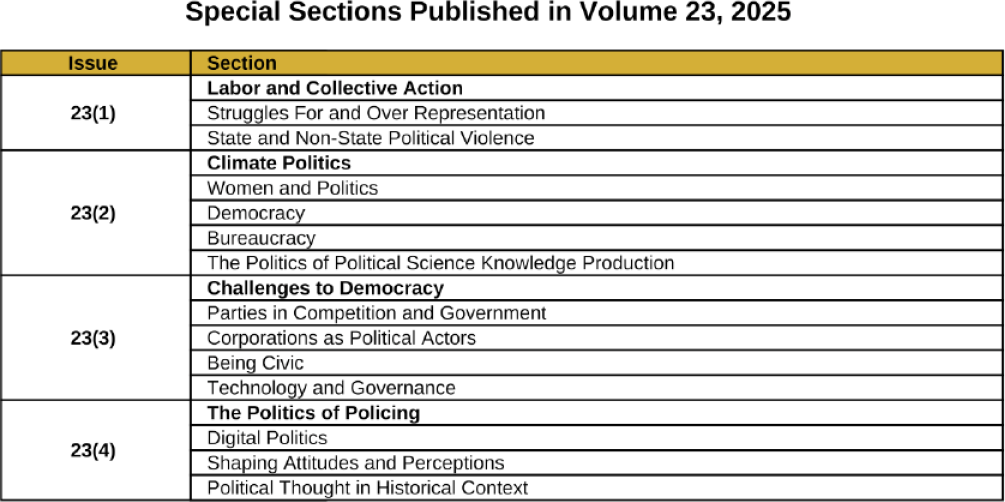
In 2025, Perspectives featured thematic programming across all four of its issues. Special sections are listed in Table 1, with sections highlighted on the cover of the issue in boldface. Articles and reflections are sorted into special sections by the editors-in-chief only after they are accepted and published on FirstView. The groupings are intended to illuminate for readers larger patterns in the latest substantive and methodological focal points of scholarly inquiry and place publications into fruitful and generative conversations with one another.

In addition to highlighting shared areas of scholarly interest for readers, the journal has notably taken steps in 2025 to cultivate research in topics that the editors-in-chief have judged to be of heightened importance in contemporary politics. In mid-2024, motivated by a series of recent political controversies involving universities around the world, the editors-in-chief sketched a call for papers (CFP) on the theme “Political Science and the University,” with topics including the impact of universities on social and political change, universities as a means of political control and global diplomacy, and the politics of higher education and higher education as politics. The editors-in-chief recruited three guest editors to lead all editorial decision-making, with Anja Neundorf of the University of Glasgow focusing on submissions in comparative politics, Robert Pape of the University of Chicago handling manuscripts in American politics and international relations, and Nicholas Tampio of Fordham University overseeing political theory manuscripts. The final CFP launched in October 2024, with a deadline for submissions set for August 1, 2025, which was later extended to October 1, 2025. By the end of the year, all submissions had been internally reviewed and papers had either been declined for publication, invited to be revised as a reflection, or were in various stages of external peer review.
SUBMISSIONS AND EDITORIAL DECISION-MAKING OUTCOMES
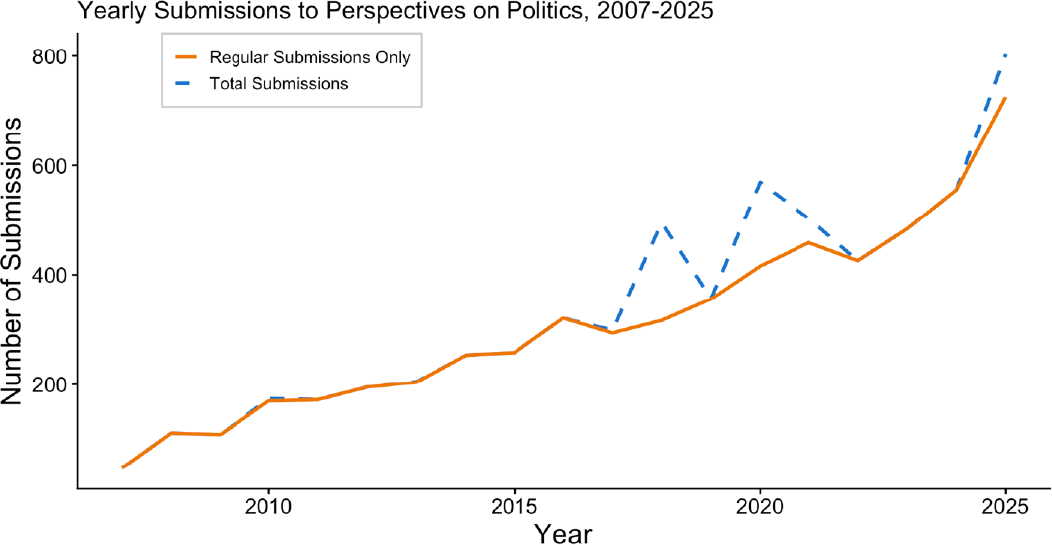
Perspectives received the largest number of submissions in its history in 2025. The journal received a total of 803 submissions (articles or reflections), surpassing the previous high of 569 submissions from 2020, when the last CFP was issued, by more than 150 manuscripts. The 2025 total included 78 articles or reflections submitted in response to the CFP on “Political Science and the University.” The remainder were 725 regular submissions, which represent roughly 30% growth over 2024’s 555 submissions and 70% growth since 2022, the year before the Northwestern editorial team took responsibility for the journal.
Figure 1 shows the growth in yearly submission volume to the journal since 2007. The dotted line illustrates the total number of submissions and the solid line denotes the number of regular submissions, excluding manuscripts submitted in response to a CFP. The steady upward trajectory highlights that submission volume has more than doubled over the past decade, with particularly high volume for the journal during years where a CFP was issued.
Figure 1

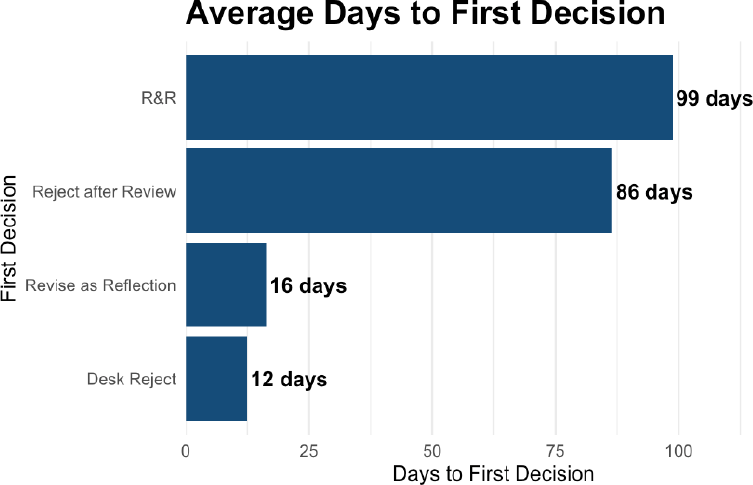
With the increase in submissions, the average number of days until a first decision has slightly increased for regular submissions (non-CFP manuscripts) reviewed by the editorial team. Figure 2 shows that authors typically received desk rejection letters in 12 days, a negligible change from the average of 11 days in 2024. Authors of research papers that were invited to be revised and resubmitted as reflection essays tended to be notified in 16 days, an increase of five days from 2024. This longer time is reflective of the work that the editorial team often dedicates to including, in these letters, suggestions for how authors might revise their works both to improve their overall quality and to better tailor them for the reflections format.
Though substantively small, the increase in the average time to a first decision for desk rejects in 2025, relative to 2024, is statistically significant (p < 0.05). The editorial team continues to meet to make internal review decisions weekly and send out substantively valuable desk reject letters as soon as possible. We believe that it is testimony to the editorial team’s hard work that it has needed an average of only one additional day to send out desk reject letters, given the large rise in the overall number of papers assessed in internal review each week, and the fact that the team is yet to compromise on its commitment to offering authors of desk-rejected papers recommendations for improvement.
Furthermore, despite the rising number of submissions, the average time to a first decision after external review has not significantly changed (p < 0.05). Authors receive notification of major or minor revisions in 99 days on average, and they can usually expect to be notified that their manuscript has been rejected after external review in 86 days, down from 107 days and 89 days in 2024. The journal continues to attract conscientious reviewers who complete the external review process in a timely manner, and the editorial team has developed effective policies and procedures for reminding late reviewers and reaching decisions as quickly as possible.
Figure 2

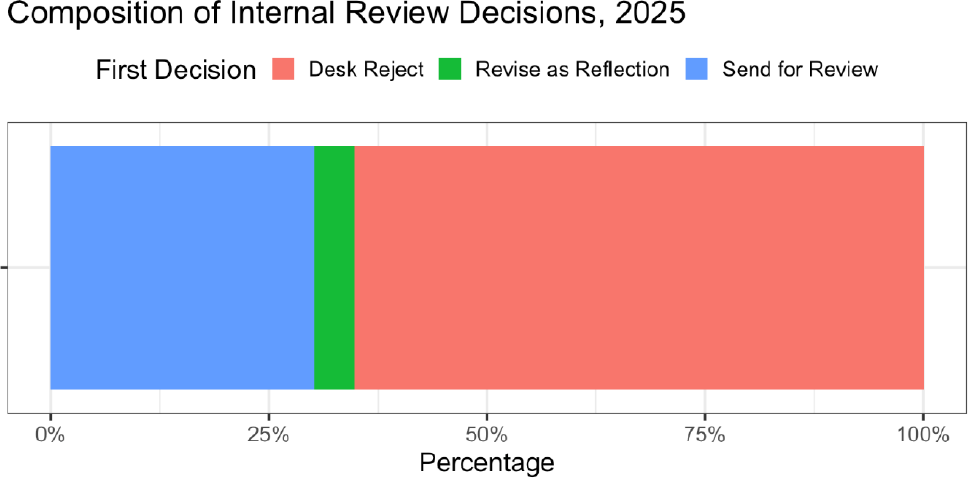
Turning to editorial decision-making outcomes, a higher proportion of manuscripts were declined without external review than in recent years. Among initial submissions made in 2025 that also received a first decision in 2025, 64% were declined without external review. The rate rose 10% from the rate in 2024, a significant and substantively large increase (p < 0.05)Footnote 3. Figure 3 shows the composition of internal review decisions on manuscripts submitted in 2025, including the share of manuscripts sent for external review and the share invited to be revised and resubmitted as a reflection alongside the desk rejection rate. 31% of submissions were sent for external review and 5% were invited to be revised as a reflection. The percentage sent for external review fell 8% from 2024 (p < 0.05), while the proportion invited to be revised as a reflection did not change. With the sharp rise in submissions to the journal, there has also been an increase in submissions that are a poor fit for Perspectives in terms of quality or scope. We anticipate that, in years to come, the increasing role of Generative-AI might also increase both the number of overall submissions and the number of poor-quality submissions. The editorial team is closely following conversations with other journal editors to monitor that situation and has begun to think through initial policy development in response.
Note: Consistent with our reporting from last year, these percentages are calculated based upon the pool of manuscripts that were submitted in 2025 for which a first decision was made in 2025.

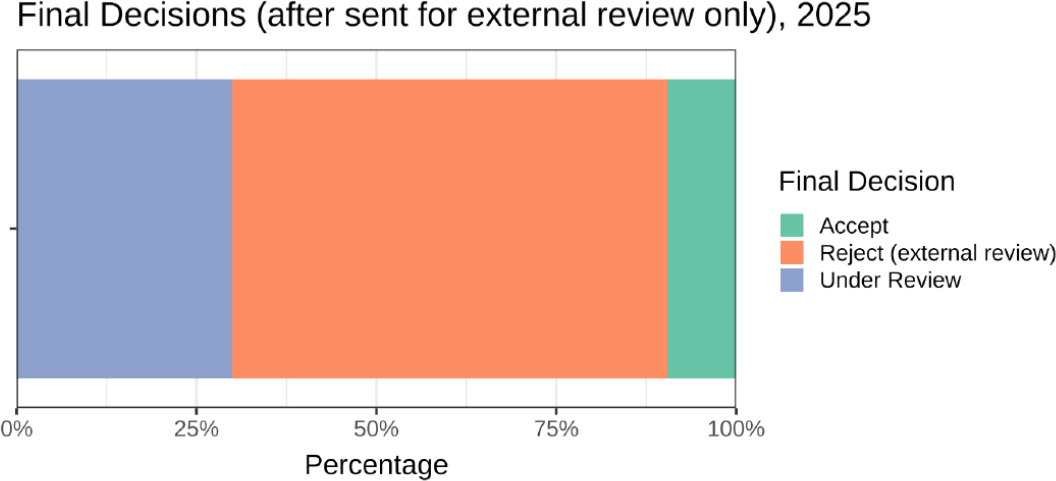
Among the manuscripts that were not declined at the internal review stage, 59% were declined after one or more rounds of external review, 10% were accepted for publication, and 30% remain under review. Figure 4 illustrates the breakdown of final decisions on manuscripts submitted in 2025, as of the writing of this report. The majority of submissions not declined at the initial stage are rejected after external review, though it is too soon to say how many of these manuscripts submitted in 2025 will ultimately be accepted. Examining only articles or reflections submitted in response to the CFP, the proportions of all decisions at the first and final stages of the editorial process are similar. 65% of manuscripts were declined without external review, 30% were sent for external review, and 5% were invited to be revised as a reflection. Of the submissions that were not declined by the editorial team, 61% were declined after external review, 12% have been accepted, and 27% remain under review.
Note: These percentages are calculated based upon the pool of manuscripts that were submitted in 2025 for which a first decision was made in 2025 and the paper was not desk rejected.

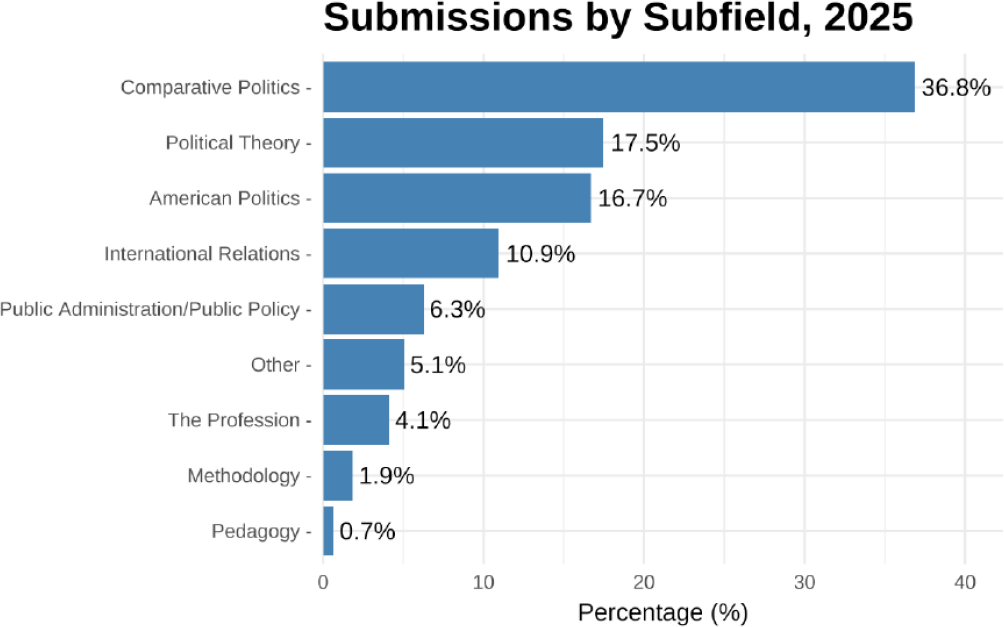
By subfield, the journal received by far the most submissions in comparative politics. Figure 5 shows that the number of submissions in comparative politics nearly doubled the volume of articles and reflections received in any other subfield. While approximately 36.8% of manuscripts were primarily intended to speak to comparative politics, 17.5% to political theory, 16.7% to American politics, and 10.9% to international relations. The remaining approximately 18.1%related to public administration or public policy; the profession, methodology, and pedagogy; or other topics. Editorial decision-making outcomes were not different by subfield, an encouraging sign during the first full year of the editorial team having an associate editor in political theory and in the initial months after adding two associate editors in American politics. In pairwise proportion tests, the desk rejection rate, the rate at which revise and resubmit decisions were awarded, and the percentage of accepted manuscripts by subfield was not significantly different across subfields (p < 0.05). The small number of manuscripts accepted every year by Perspectives, however, can make statistical tests of differences in acceptance rates less reliable.
Figure 5

BOOK REVIEWS
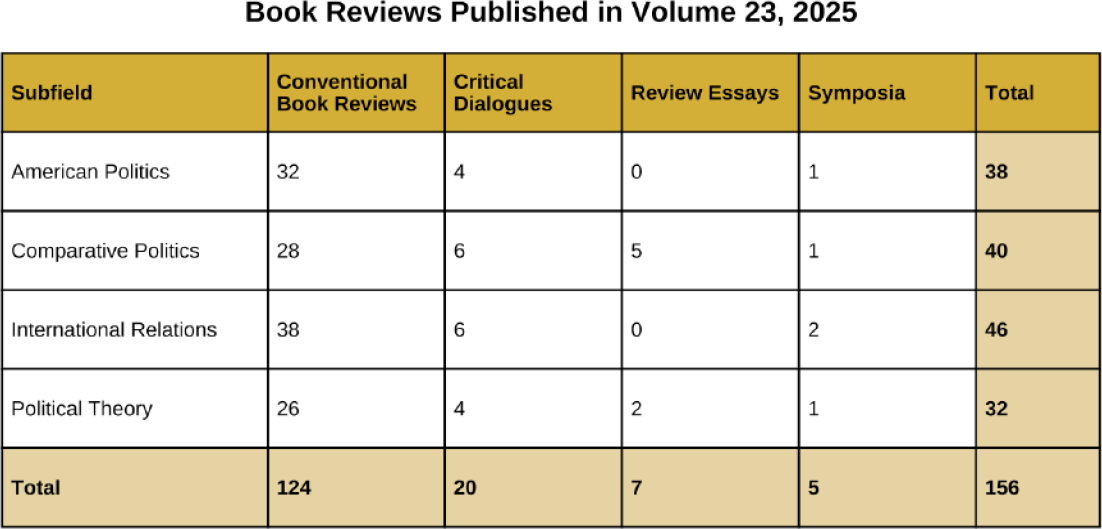
In 2025, the book review section published 156 reviews across all four subfields (American Politics, Comparative Politics, International Relations, and Political Theory)—a 71% increase on the number we published in 2024. In total, we reviewed 200 books across a variety of formats, including single and double reviews; Critical Dialogue exchanges; symposia; and book review essays. The team commissioned a greater number of Critical Dialogue exchanges and book review essays in Volume 23, as the editors intend for the review to be a place that stimulates scholarly dialogue and invites debate between the different subfields and methodological persuasions within the field. A more specific breakdown of the publication numbers can be found in Table 2.

The book review team continued with its practice of organizing the section around specific themes within the discipline. In each issue, the editors commissioned books that touched on similar questions or problems across the subfields. For instance, in 23(2), we reviewed books on how new technologies and non-state actors are changing security and conflict in the twenty-first century, and in 23(4), we brought together reviews on recent scholarship that addressed gender and sexuality in political science. In each issue, the book review section opened with an introductory editorial that put the books reviewed in conversation with one another and offered critical reflections on what this recent scholarship means for the discipline more broadly. In this way, the book review section continues to serve as a forum for critical engagement across the subfields and methodological traditions in political science.
JOURNAL STATUS IN THE DISCIPLINE
Still a relatively new journal, Perspectives’ standing in the discipline continued to improve in 2025. Various metrics show that the impact of the journal grew. At the writing of this report, Google Scholar’s most recent h5-index, which tracks citations of articles published in the last five complete years, lists Perspectives twelfth in political science. The ranking rose one place from the listing in 2023 and 2024, when Perspectives placed thirteenth, and two places from 2022, when the journal ranked fourteenth. The value of the h5-index was 53, meaning that 53 Perspectives articles published between 2020 and 2024 each received at least 53 citations, and the h5-median was 81, meaning that the median citation count among those articles is 81Footnote 4.
Figure 6

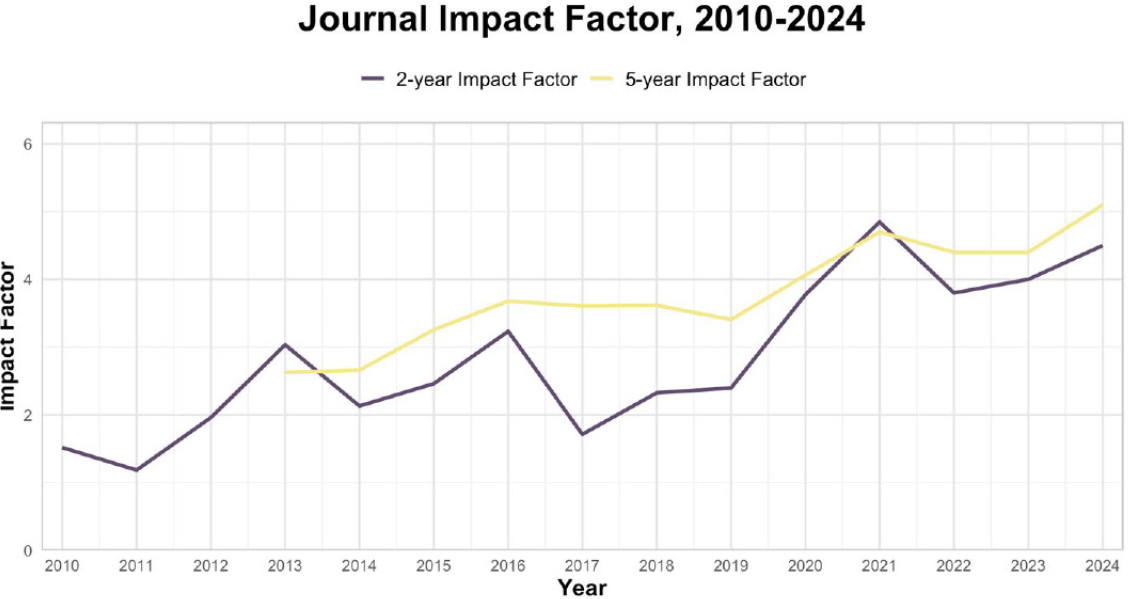
Clarivate-based measures show similar trends. The journal’s most recent two-year Journal Impact Factor (JIF2) is 4.5, and its five-year impact factor (JIF5) is 5.1, placing Perspectives in the mid-90th percentile of journals in the political science categoryFootnote 5. As shown in Figure 6, both impact-factor series display long-run improvement across the 2010-2024 period, with especially strong performance in the early 2020s. After peaking in 2021 and easing in 2022, the journal’s shorter-run impact factor recovered in 2023 and rose again in 2024, when the five-year measure reached its highest level in the journal’s history.
AUTHOR DEMOGRAPHICS
Before addressing author demographics, it is worth reemphasizing that our internal review process is strictly double anonymous; when editors make the initial decision to desk reject a paper, send it out for review, or invite an author to revise a research article as a reflection, they do not know the author’s identity or anything about the author’s identifying traits or affiliations. That said, at the time of manuscript submission, APSA asks authors to indicate their self-reported demographic characteristics, namely their gender identity, primary positions at their institution, how they would characterize their institution, and their racial or ethnic identity, with the aim of evaluating equity and inclusion in publishing. Self-reporting is limited to the categories provided by APSA; for gender and race, authors have the option to select “prefer not to answer.” The gender categories are Female, Male, Non-binary, and prefer not to answer. The options for race are European/Anglo White; Asian or Asian American; Latino/a; Middle Eastern or Arab American; Black, Afro-Caribbean, or African American; Non-European/Non-Anglo White; Native American, First Nations, or Indigenous Peoples; Other; or prefer not to answer.
In this section, we assess that data to compare our 2025 metrics to those of prior years. In terms of overall totals, 936 distinct authors submitted articles or reflections to Perspectives in 2025. The number is greater than 2024’s reported total of 885 distinct authors, another valuable indicator of the journal’s growth. The vast majority of authors submitted to the journal only once within the calendar year, while 46 authors submitted twice and seven submitted three times. Of all regular submissions to the journal, 79% were solo-authored and 21% were co-authored, with only 8% written by three or more authors.
Dating back to the previous editorial team, leadership of the journal values diversity in terms of gender, country of origin, and race and ethnicity among authors. 2025 saw progress in some areas, but along many dimensions, the authorship of submissions and publications remained the same. On one important measure, the proportion of women first authors among all regular submissions, the journal appears to have lost ground. While 45% of first authors submitting to the journal were women in 2024, only 37% were women in 2025, a significant difference (p < 0.05). Women first authors may have been more encouraged to submit in 2024 because Perspectives featured a special section titled “Women, Representation & Politics” in the March 2024 issue, raising the visibility of the journal for gender politics scholars, who are more often women. A comparable special section on “Women and Politics” appeared in the June 2025 issue of the journal, but it was not featured on the cover.
On other measures, the gender breakdown of submissions and publications to the journal seems to be stable. There was no change in the percentage of women authors submitting to Perspectives if all authors (rather than just first authors) are accounted for. 35% of all authors to the journal last year were women, while 57% were men, 7% preferred not to answer, and two authors identified as non-binary. Though the overall rate of women authors submitting to the journal did not decline, it continues to be less than 40%, the proportion of APSA’s membership who are women. In the past, the current editorial team has taken steps later in the editorial process to make increases in the number of published articles from women authors more visible, including publishing special sections on gender politics and considering the gender composition of authorship teams of manuscripts that have been accepted for publication when planning issues. We will continue to consider various ways to highlight the contributions of women authors going forward.
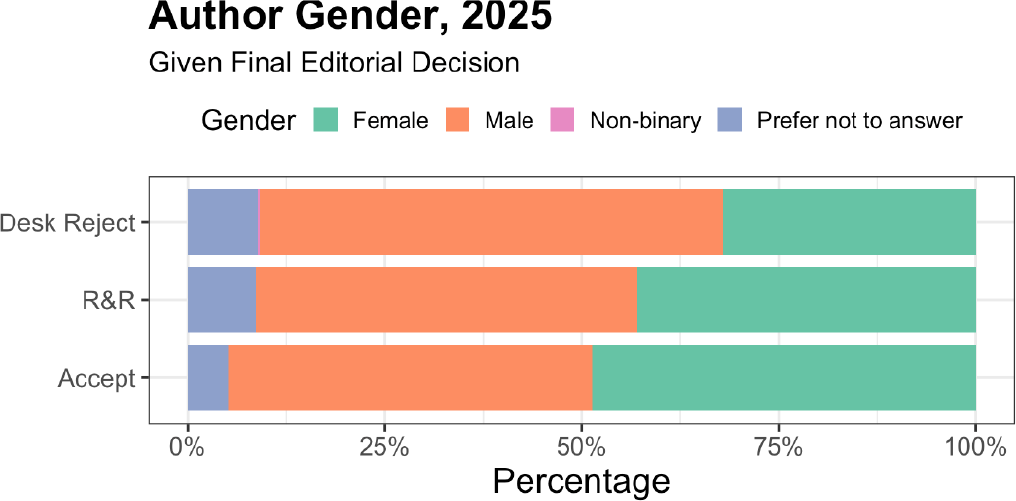
With regard to author gender, patterns of editorial decision outcomes on manuscripts tend to closely follow the pattern of overall manuscript submissions. Of articles and reflections submitted in 2025 which had a decision made in 2025, Figure 7 shows the distribution of desk rejects, R&Rs, and accepted manuscripts by author genderFootnote 6. 59% of desk rejects were authored by men, and 32% were authored by women, roughly the same as the distribution of submissions. In the later stages of the editorial process, the breakdown of manuscripts between men and women authors reaches closer to 50-50, meaning that disparities by gender at the time of submission decline after a paper is sent out for external review. Of R&Rs, 45% were written by women, and of accepted manuscripts, 48% were written by women. The reduction in disparities appears to be driven by small differences in decision-making outcomes by gender of the author (p < .1). The rates at which manuscripts were desk rejected, given R&Rs, or accepted are not significantly different for women and men authors at the standard 95% confidence level, though decision-making outcomes happened to be slightly superior for women authors at a 10% significance level.
By country of origin, the journal continued to make progress towards its long-standing goal of expanding its international reach. Perspectives saw its highest ever share of authors based outside the United States in 2025, with 58% of authors submitting to the journal coming from other countries. Authors came from 68 distinct countries, an increase of 11 from 2024. Figure 8 maps the locations of authors around the world, showing that the journal received submissions from every region last year.
Figure 7

Figure 8

Some disparities existed between US-based and non-US-based authors in final manuscript decision outcomes. Despite submitting a minority of articles and reflections to the journal, US-based authors accounted for 65% of manuscripts accepted in 2025. The disparity seems to stem from the early stages of the editorial process, when there is a significant difference between the rate at which US-based and non-US-based authors receive desk reject decisions (p < .05). While 51% of submissions from US-based authors were desk rejected, 61% of submissions from non-US-based authors were desk rejected. This may be due to inequalities in the resources at the disposal of American and non-American institutions, or because of differences in PhD training and socialization into the norms of the discipline across the globe. The outcomes for papers by authors based outside the United States tend to achieve greater parity with papers by authors from the United States after being sent out for external review, relative to the internal review stage. There is no difference in the rate at which these submissions receive R&Rs compared to articles and reflections from US-based authors, and US-based authors have only a slight edge in outcomes at the final stage of the editorial process (p < .05).
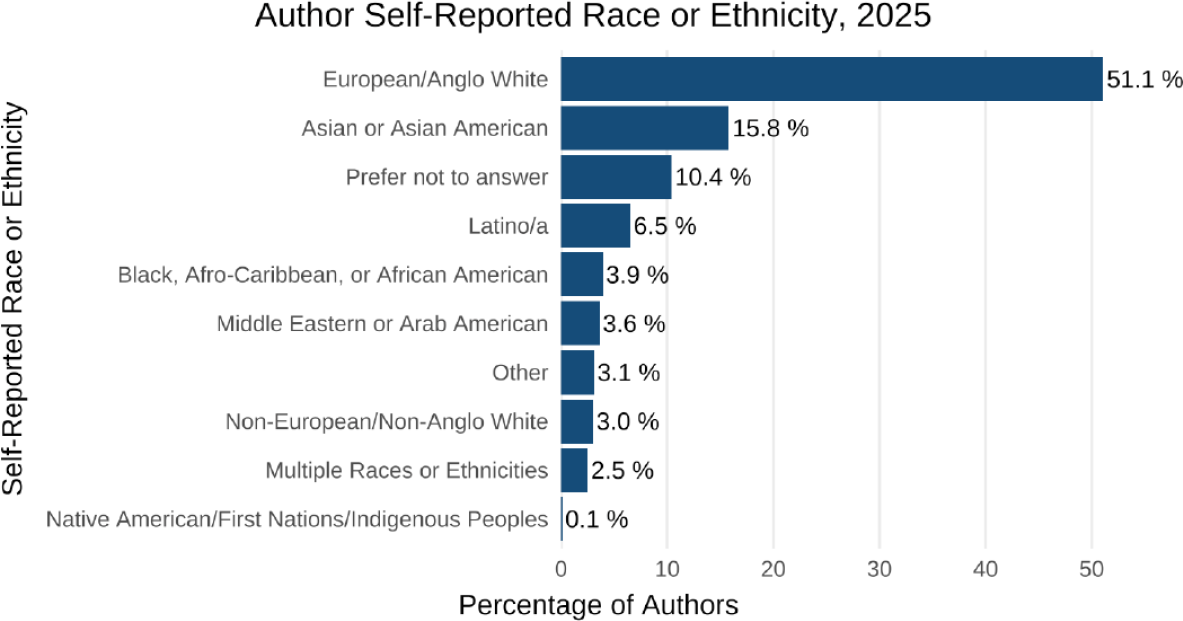
Finally, Perspectives values greater diversity in race and ethnicity among authors. Drawing on data from authors’ self-reporting of their racial and ethnic identity from the categories provided by APSA at the time of manuscript submission, Figure 9 shows that 51% of authors identified as “European/Anglo White” in 2025, followed by 16% “Asian or Asian American,” 7% “Latino/a,” and 4% “Black, Afro-Caribbean or African American.” Compared to 2024, the percentage of authors identifying as “European/Anglo White” is down from a reported 59% and represents a significant decrease (p < 0.05), but the decline might be the result of an increasing share of authors responding “Prefer not to answer” to the survey measure. When authors who preferred not to answer are excluded from the analysis, there is no significant difference between 2024 and 2025 in the proportion identifying as “European/Anglo White” (p < 0.05).
In terms of manuscript decision outcomes, similar to the variation between US-based and non-US-based authors, disparities between authors self-reporting as “European/Anglo White” and other authors seem to be concentrated at the early stages of the editorial process. 66% of all authors who did not identify as “European/Anglo White” received desk reject decisions on their manuscripts, compared to 57% of authors who did identify as “European/Anglo White,” a significant difference (p < 0.05). This may be connected to and in part a consequence of the problem of unequal resources and higher barriers to entry between institutions in the United States, Europe, and the Anglosphere and institutions elsewhere around the world. There were no significant differences in manuscript decision outcomes later in the review process. Authors who did and did not identify as “European/Anglo White” had the same likelihood of receiving an R&R or having their submissions accepted for publication.
Figure 9

CONCLUSION
The journal saw its busiest year ever in 2025, and much of the energy of the editorial team was directed towards meeting the challenge of an increasing workload and devising policies and processes to make its internal operations more sustainable in the long term. The editorial team moved towards a new model, where associate editors working under the editors-in-chief manage submissions in different subfields, and the first CFP since 2020 was issued, with guest editors recruited to oversee all editorial decision-making. The team of editorial assistants expanded from four to five, motivated by meeting the rising submission volume in comparative politics in particular.More authors than ever before submitted their work to Perspectives in 2025, and they came from a diverse range of countries and regions. While indicators are more mixed about whether the journal made progress towards greater diversity in terms of the gender and race of authors last year, the editorial team continues to work with APSA and Cambridge University Press to publicize the journal and consider ways to promote more submissions from scholars of underrepresented backgrounds. Despite the large rise in submissions, times to decisions for authors mostly did not change, especially during the external review process. With the important exception of an increasing desk rejection rate, editorial decision-making outcomes were also unaffected. Recent publications performed well across multiple metrics of impact in the discipline, with Perspectives showing a strong upward trajectory in 2025.
We look forward to 2026, when we hope to continue to grow the reach and impact of the journal, build on our efforts to make the journal more sustainable, and begin to publish on FirstView the first articles and reflections from our special issue on “Political Science and the University.”
Call for Mentors- APSA Mentoring Program
APSA invites you to serve as a mentor! We welcome mentors at all career levels and across all political science subfields. APSA staff successfully made over 100 matches during the 2025-2026 academic year. We are now looking for more of our members to serve as a mentor during the 2026-2027 academic year. We welcome mentors who are Master’s students, PhD students, junior faculty, senior faculty, retired, career experts, etc. Submit or update your mentor profile to be matched with a mentee in Fall 2026 here: https://www.apsanet.org/DIVERSITY/APSA-Mentoring-Program/Mentor-Application
The APSA Mentoring Program seeks to connect undergraduate, graduate students, and junior faculty from all backgrounds to experienced and senior members of the profession for professional development support on a wide range of academic and career topics. This includes research collaboration, CV support, graduate school advice and experience, and advice on the job market. Having support and guidance is key to the success for scholars in the profession.
The next enrollment period for individuals seeking a mentor will be in August 2026. If you have any questions about the program, please contact us at mentoring@apsanet.org.