




No CrossRef data available.
How Do Natural Resources Influence Civil War? Evidence from Thirteen Cases
Published online by Cambridge University Press: 09 March 2004
Abstract
Recent studies have found that natural resources and civil war are highly correlated. Yet the causal mechanisms behind the correlation are not well understood, in part because data on civil wars is scarce and of poor quality. In this article I examine thirteen recent civil wars to explore the mechanisms behind the resource-conflict correlation. I describe seven hypotheses about how resources may influence a conflict, specify the observable implications of each, and report which mechanisms can be observed in a sample of thirteen civil wars in which natural resources were “most likely” to have played a role. I find that two of the most widely cited causal mechanisms do not appear to be valid; that oil, nonfuel minerals, and drugs are causally linked to conflict, but legal agricultural commodities are not; and that resource wealth and civil war are linked by a variety of mechanisms, including several that others had not identified.For their comments on earlier drafts, I am grateful to Paul Collier, J. R. Deshazo, Pierre Englebert, Barbara Geddes, Anke Hoeffler, Macartan Humphreys, Philippe Le Billon, Roy Licklider, Dan Posner, Ken Shultz, and Libby Wood.
Information
- Type
- Research Article
- Information
- Copyright
- © 2004 The IO Foundation and Cambridge University Press
Recent studies have found that natural resources and civil war are highly correlated.1
For a review of recent findings on national resources and civil war, see Ross 2004.
There is little agreement among these and other scholars on why natural resources have these effects: most scholars have little to say about causal mechanisms—the processes that link “resources” to “conflict.” Journalists often claim that resources have “fueled” a given conflict, but are vague about how this occurred.
Identifying the mechanisms that link resources to civil war would make these theories more complete and persuasive: statistical correlations can only take one so far. Specifying the mechanism would also address three problems in the natural resources–civil wars literature. First, it could help resolve nagging concerns about endogeneity and spuriousness. The natural resource–civil war correlation, for example, might be the opposite of what it appears: civil wars might produce resource dependence by forcing a country's manufacturing sector to flee while leaving its resource sector—which is location-specific and cannot depart—as the major force in the economy by default. Even though most scholars employ lagged independent variables in their regressions, this method does not rule out reverse causality: because civil wars do not officially “begin” until they have crossed some threshold of violence, they might be preceded by years of low-level hostilities that drive off manufacturing firms, producing a higher level of resource dependence before the civil war is coded as commencing.
The natural resource–civil war correlation could also be spurious: both civil war and resource dependence might be independently caused by some unmeasured third variable, such as a weak rule of law. A state where the rule of law is weak might be unable to attract investment in its manufacturing sector, and hence would depend more heavily on resource exports; this state might also face a heightened risk of civil war through a different process. The result could be a statistically significant correlation between resource dependence and civil war, even though neither factor would cause the other.
Second, identifying the causal mechanisms could help settle disagreements among the statistical studies over which resources matter, and what dimensions of conflict they tend to influence. Collier and Hoeffler,7
for example, find that primary commodities of all types—including oil, minerals, and agricultural goods—are linked to the onset of war. Both Fearon and Laitin, and de Soysa dispute this claim8 and suggest that only oil matters. Collier, Hoeffler, and Söderbom suggest that primary commodities have no influence on the duration of conflict, a claim that is apparently contradicted by Doyle and Sambanis, and Stedman.9 Fearon, meanwhile, suggests that contraband commodities, such as diamonds and drugs, make wars last longer.10 A closer look at case studies may help resolve some of these contradictions.Finally, different mechanisms suggest different policy interventions. For example, if mining causes conflict because it produces grievances over environmental degradation and access to jobs, the solution might be greater community involvement on the part of mining firms. But if conflicts occur because mining provides extortion opportunities for rebel groups and warlords, the solution might be stricter mine site security and less community involvement. The United Nations (UN) Security Council, the World Bank, and the Group of 8 (G8) industrial nations have all been engaged in policy responses to the resource–civil war issue, making this concern highly salient.
Identifying the correct causal mechanisms, however, is not a simple endeavor. Some of the purported causal mechanisms have been carefully specified, but most have not. Once specified, it is not clear how these mechanisms can be tested. If one had sufficiently high-quality data for a large number of civil wars, one could use a large-N study, placing intervening variables on the right-hand side of regressions on war onset or war duration. Unfortunately, data on the requisite dimensions of conflict are scarce and typically of poor quality.
In this article I use a small-N approach to circumvent this problem. I begin by identifying seven causal mechanisms that might account for the resource–civil war correlation, and I suggest how they might be confirmed or disconfirmed in case studies.11
I also describe two further hypotheses that, unfortunately, cannot be confirmed or disconfirmed at the case study level.
My approach is based on a “most likely” research design, in which a scholar examines in depth a single case in which a hypothesized causal relationship is believed “most likely” to be found; if it is present, the hypothesis is pronounced “plausible,” and if not, it is deemed “falsified.”12
Similar to other small-N methods, the most likely approach has valuable properties: it pays close attention to the validity of concepts and to causal linkages; it helps account for variables that are difficult to measure; and it is sensitive to case-specific factors. The heightened attention to validity, however, has a cost: because the sample is biased, the findings cannot be generalized to some larger set of unexamined cases. Still, a systematic study of most likely cases can probe and refine the plausibility of existing hypotheses and generate new ones for future, out-of-sample tests.My analysis generates eight findings about the thirteen cases: (1) certain types of natural resources—oil, gemstones, and drugs—have indeed influenced the onset and duration of civil wars; (2) other types of primary commodities—in particular, legal agricultural commodities—did not have an effect on civil wars; (3) there was little or no evidence to support two of the most commonly cited causal mechanisms; (4) illicit drugs did not lead to the onset of conflict, although they did lengthen preexisting conflicts; (5) resources played a different role in the sample's three separatist conflicts than they did in the ten nonseparatist conflicts; (6) resources did not necessarily make conflicts longer or more severe—at times they appeared to shorten conflicts and promote cooperation among opposing sides; and (7) most civil wars in the sample were influenced by natural resources through several mechanisms simultaneously, which may help account for the analytical muddle of some earlier studies. (8) Finally, several unanticipated mechanisms linked resources and conflict in the thirteen cases: foreign intervention, futures contracts for war booty, and preemptive repression in resource-rich areas.
Hypotheses About Resources and Conflict
Below I describe seven testable hypotheses about the mechanisms that link natural resources and civil war. For the sake of completeness, I also discuss two further hypotheses that I am unable to test at the case study level. The nine mechanisms are listed in Figure 1. The first four hypotheses describe ways that resource wealth could lead to the onset of conflict; the next three suggest ways that resource wealth could influence the duration of a conflict; and the final two describe how resource wealth might influence the intensity of a conflict—that is, the casualty rate.13
I use the terms “resource wealth” and “resource dependence” interchangeably here. Most of the large-N studies measure the correlation between civil war and resource dependence, defined as the ratio of natural resource exports (including oil, gas, minerals, and agricultural commodities) to gross domestic product (GDP). Most scholars treat this as an indicator of the relative abundance of natural resource wealth in the economy. But resource dependence is a less-than-ideal indicator: it is sensitive to changes in the size of the nonresource sector, and the size of GDP; moreover, it fails to capture natural resources that are produced and consumed domestically, or exported illegally. Two of the cases in my sample (Afghanistan and Cambodia) were strongly influenced by illicit resources, even though they have low levels of resource dependence (see Table 1).
To avoid these problems in the case studies, I examine whether the conflicts were influenced by any type of domestically produced and commercially valuable natural resource, regardless of its legality or export status.

Hypothesized causal mechanisms
I include the hypotheses on conflict intensity because it is possible that the resource wealth–civil war correlation is produced solely (or partly) by an intensity effect. To become classified as a civil war, a conflict must pass a certain threshold, producing at least one thousand combat-related deaths over some period of time. The presence of resource wealth might turn low-intensity conflicts into high-intensity conflicts without influencing the total number of conflicts; this could produce a statistical correlation between resource dependence and the incidence of civil war by increasing the number of conflicts that cross the critical threshold. Similarly, if resource wealth increased the number of years in which the conflict crossed the thousand-death threshold without influencing the conflict's beginning and end dates, it could produce a spurious correlation between resource wealth and duration. Hence it is useful to explore whether resource wealth has an influence on the intensity of civil wars.
The nine hypotheses below were taken from other scholars' accounts of resource-based civil wars. Often these scholars discussed causal mechanisms briefly or indirectly; I have tried to turn their implicit hypotheses into explicit ones. Some of the mechanisms are linked to each other. By treating them as discrete mechanisms, I can specify them more clearly and test them more directly. None of the mechanisms are mutually exclusive, and most scholars cited below discuss multiple causal mechanisms.
Onset of Civil War
The presence of resource wealth might cause the onset of civil wars in four ways, three of which can be tested with case studies. Perhaps the most influential hypothesis on resources and conflict comes from the work of Collier and Hoeffler.14
I refer to this hypothesis as the “looting” mechanism. Collier and Hoeffler suggest that explanations for civil wars fall into two categories: those that focus on the motives or “grievances” of rebel organizations, and those that focus on their funding. The most significant funding opportunities for insurgents, they suggest, tend to come from exportable natural resources: if rebels can extract and sell resources, or extort money from those who do, then they are more likely to launch a civil war. Their explanation parallels Keen's argument that in the post–Cold War era, rebel groups have replaced the funding they once received from their superpower sponsors with money from looted natural resources.15The Collier-Hoeffler argument comes from their observation that natural resources offer rebel groups unusual funding opportunities, because resources typically produce rents and are location-specific. If rebels try to loot or extort money from manufacturing firms, the firms will relocate to a safe area or be forced out of business; but if rebels extort money from resource firms, the firms cannot relocate and can often make payments to rebels and still turn a profit. States whose economies are more heavily based on resource exports should, therefore, also face a higher risk of civil wars.
Collier and Hoeffler do not suggest that rebels launch a conflict in anticipation of resource wealth; rather, they argue that rebels use looted resource wealth in the prewar phase to buy arms and hire soldiers—thus funding the “start-up costs” of initiating a rebellion. This subsequently allows them to challenge government forces strongly enough to generate at least one thousand battle-related deaths, thus producing a conflict large enough to be classified as a “civil war.”
In their empirical tests, Collier and Hoeffler find that the effect of a country's primary commodity exports on its conflict risk is “both highly significant and considerable”; they state, “we have interpreted (this correlation) as being due to the opportunities such commodities provide for extortion, making rebellion feasible and even attractive.”16
Collier and Hoeffler 2002a, 16. Collier and Hoeffler estimate that the correlation between resource dependence and civil war is curvilinear, suggesting that the risk of civil war declines when resource dependence reaches exceptionally high levels, at which point “the increased tax revenue eventually augments the capacity of the government to defend itself sufficiently to offset the enhanced finances of the rebels.” Other scholars, such as Hegre, estimate the correlation to be linear. Hegre 2002.
The “looting” mechanism might be stated as the following:
H1: Primary commodities increase the probability of civil war by enabling nascent rebel groups to raise money either by extracting and selling the commodities directly, or by extorting money from others who do.
If this hypothesis is correct, then in case studies one should observe rebel organizations raising money before the start of the civil war, through the extraction and sale of natural resources, or from the extortion of resource firms.17
The looting mechanism suggests a second observable implication: if looting resource firms is easier, or more sustainable, than looting nonresource firms, one should observe rebel groups gaining a greater fraction of their financing from the resource sector (relative to its size in the economy) than from other economic sectors. This would be hard to test unless rebel organizations agree to have their finances audited.
The second possible mechanism—which has been widely cited by policy analysts and journalists—is a “grievance” mechanism. It suggests that resource extraction creates grievances among the local population, because of land expropriation, environmental hazards, insufficient job opportunities, and the social disruptions caused by labor migration; these grievances, in turn, lead to civil war. Klare, for example, suggests that “resource wars” are caused in part by logging or mining firms that are “ravaging the environment” and “driving off the people who have long inhabited the area or depriving them of any benefits from the appropriation of their traditional lands.”18
Klare 2001, 208.
See Gedicks 2001; Switzer 2001; Norimitsu Onishi, As Oil Riches Flow, Poor Village Cries Out, New York Times, 22 December 2002, A1. These theories might be seen as part of a larger literature arguing that grievances, often proxied by poverty or inequality, tend to influence the danger of civil war. See, for example, Muller and Weede 1990; Auvinen 1997; Dudley and Miller 1998.
H2: Resource wealth increases the probability of civil war by causing grievances over insufficiently compensated land expropriation, environmental degradation, inadequate job opportunities, and labor migration.
If resource exploitation leads to civil war through a grievance mechanism, one should observe the rebels criticizing resource firms or the resource sector in their propaganda; and one should see rebels make resource firms a target of their violence, apart from looting or extortion attempts. Of course, neither of these indicators would prove that insurgents are truly motivated by resource-related grievances. But these indicators would imply that the rebels believe that resource issues are salient concerns in the population they wish to mobilize, and that raising these issues will help them build support.
A third possibility is that resource wealth, if it is located on a country's periphery or in an area populated by an ethnic minority, will give local residents a financial incentive to establish a separate state, thus raising the risk of a civil war. Le Billon discusses this mechanism; Collier and Hoeffler offer it as well.20
It implies the following:H3: Resource wealth increases the probability of civil war by giving residents in resource-rich areas an incentive to form a separate state.
If this mechanism is valid, one should observe in case studies that (1) the conflict is a separatist war; (2) the conflict began after the separatist region was identified as having exploitable resource wealth; and (3) the rebel group discusses the unfair distribution of resource wealth in its propaganda. One would not necessarily observe rebels attacking resource firms in this instance, because they should in principle support resource extraction and may not wish to alienate companies working in the sector. To distinguish the second and third mechanisms from each other—because both entail local grievances around resource extraction—I look for evidence of the second mechanism only in nonseparatist conflicts, and the third mechanism only in separatist conflicts.
Fearon and Laitin, among others, have suggested a fourth mechanism: that resource wealth—in particular, oil—causes “state weakness,” which in turn increases the probability of civil war.21
The claim that oil wealth influences the character of the state has a long heritage among Middle East scholars: they commonly suggest that oil wealth relieves governments of the need to levy taxes, which in turn produces a state that is less responsive to its citizens.22See, for example, Mahdavy 1970; Beblawi and Luciani 1987; Chaudhry 1997. Although these scholars discuss oil, their arguments may apply to natural gas as well.
H4: Oil wealth increases the probability of civil war by weakening the state's bureaucratic capacity.
It is difficult to know what the observable implications of this hypothesis are at the case study level. The mechanisms that may link oil to bureaucratic weakness—and more problematically, bureaucratic weakness to subsequent conflict—could be diffuse and subtle. Advocates of this mechanism must further specify its logic before it can be tested with case studies.
Duration
Natural resource wealth may influence the duration of civil war, independent of its effects on the incidence of civil war. There are three mechanisms that could either lengthen or shorten a conflict, depending on how they occur; two of them have implications that can readily be observed in case studies.
The first mechanism, once again, is looting. Many observers—including scholars, nongovernmental organizations (NGOs), and analysts from international organizations—have suggested that resource wealth can lengthen a conflict if it enables the rebels to fund themselves and hence continue fighting instead of being crushed or forced to the negotiating table.25
See, for example, UN Panel of Experts 2000 and 2001; Sherman 2000; and the reports of Global Witness, a London-based NGO, available at 〈at www.globalwitness.org〉.
The mechanism entails two key assumptions: that the rebels are the weaker side; and that strengthening the weaker side tends to lengthen conflicts. In fact, there is evidence from interstate conflicts to support the latter claim: Bennett and Stam find that international conflicts tend to last longer when the two sides have more equal resources.26
If one assumes that when the weaker side in a civil war gains additional resources, the conflict will be lengthened, one must also assume that when the stronger side gains additional resources, the conflict will be shortened, by bringing about a quicker victory or settlement.27
This raises several important problems for the coding of case studies. First, a judgment must be made about the relative military strength of the two sides before the resource is exploited, to avoid the problem of endogeneity. Second, it is necessary to restrict the analysis to contested resources. Virtually all governments derive at least a fraction of their revenue from the sale of natural resources; but I only treat these as relevant if they are located in the contested terrain. For civil wars that are national in scope, I treat all resources as contested.
H5: Resource wealth tends to increase (decrease) the duration of civil wars when it provides funding to the weaker (stronger) side.
If this mechanism has occurred, there should be evidence that one side or the other has raised money from the resource sector—through looting, extortion, or other means—after the war began. If both sides raised funds from the resource sector simultaneously, I infer that the net effect has been to lengthen the conflict, based on the conjecture that combat is likely to continue as long as the weaker party does not run out of money.28
This is less likely to be true in separatist conflicts than in nonseparatist conflicts. As Fearon points out, separatist and nonseparatist conflicts appear to have substantially different characteristics: separatist conflicts tend to last longer, and often continue even when the separatist movement is at an overwhelming financial disadvantage. Fearon 2004.
Some scholars have suggested a second duration-related mechanism: that resource wealth discourages peace settlements, if wartime looting is sufficiently profitable for either soldiers or their commanding officers. Sherman, for example, suggests that
Rebel groups in Angola, Sierra Leone, Democratic Republic of Congo (DRC) and elsewhere enrich themselves through the sale or exchange of diamonds … economic interests not only shape the conflict, but, if the economic advantage of fighting outweighs that of peace, perpetuate it as well.29
Sherman 2000, 699.
Fearon makes a slightly different version of this argument, suggesting that the presence of lootable resources could exacerbate principal-agent problems within one or both of the armies by giving soldiers an incentive to accumulate personal wealth instead of obeying their commanding officers.30
This could make it harder for negotiators to forge a binding, enforceable settlement.Once again, this mechanism has a seldom-noticed corollary: if commanding officers believe that peacetime profits would be greater than wartime profits, it could help induce them to reach a settlement. Similarly, if soldiers believe that peace would be more profitable than war, they may refuse to fight and force their commanders to negotiate or surrender. In hypothesis form, this “incentive” mechanism and its corollary may be stated as the following:
H6: Resource wealth tends to increase (decrease) the duration of civil wars by offering combatants a financial incentive to oppose (support) a peace settlement.
This hypothesis is a slippery mechanism to observe in case studies. It should not be sufficient to observe that war is profitable for some combatants: this is virtually inevitable when combat takes place on resource-rich territory, and it hardly proves that the parties are deliberately lengthening the conflict. One must instead determine that one of two possible scenarios has transpired. First, high-level officers, who have the ability to negotiate (or block) a treaty, believe they would profit more if the war continues than if it comes to a negotiated end. If this is occurring, one should observe: (1) evidence that resource looting is generating personal profits for high-level officers; (2) evidence that officers would not be compensated in some comparable way by a proposed peace treaty; and (3) evidence that officers chose not to sign or adhere to an unprofitable peace accord. Conversely, if resource wealth is facilitating a peace accord, one should observe officers who support a peace agreement subsequently profit from—or attempt to profit from—the resource industry.
Alternatively, if resource wealth is lengthening a conflict through the incentives it creates for the rank and file, one should observe the following: (1) that at least one army in the conflict suffers from major discipline problems; (2) that disobedient soldiers are personally benefiting from resource looting; and (3) that these discipline problems have made it harder for that party to sign or adhere to a peace settlement.
If the same mechanism has shortened a conflict, one should again see: (1) that at least one army suffers from major discipline problems; (2) that disobedient soldiers are personally benefiting from resource looting; and (3) that these problems helped cause their army's defeat or forced it to sign a peace agreement that it might otherwise have opposed.
Finally, Fearon has suggested a third way in which resource abundance might lengthen separatist conflicts.31
Ibid.
The Fearon model includes the further suggestion that resource wealth discourages a peace settlement when it provides rebels with a source of wealth during combat. Because this is already covered by the “looting” and “incentive” hypotheses (H5 and H6), I do not include it here.
H7: Resource wealth tends to increase the duration of separatist civil wars by making it less likely that the government will adhere to a peace accord that gives the region fiscal autonomy.
Unfortunately, this final mechanism is hard to verify in case studies unless one knows a great deal about the perceptions and motivations of rebel leaders. For this reason, I do not attempt to test it in these case studies.
Intensity
Resource wealth might also influence the intensity of civil conflicts, producing more (or fewer) conflict-related deaths over time. Two mechanisms might bring this about. The most obvious mechanism is resource-related combat, in which opposing armies battle over resource-rich territory. Many observers of Africa's recent civil wars have suggested that combatants are “fighting for control” of a resource, implying the following:
H8: Resource wealth tends to increase the casualty rate during a civil war by causing combatants to fight for resource-rich territory that would otherwise have little value.
I look for evidence in each case of resource-related battles, over sites that had little or no intrinsic strategic value.
The second mechanism might reduce the intensity of civil wars. Keen describes a number of wars in which battlefield opponents laid down their arms and cooperated to extract resources;33
this suggests the following:H9: Resource wealth tends to decrease the casualty rate during a civil war by causing combatants to cooperate in resource exploitation.
If this type of cooperative plunder occurs, there should be reports of substantial wartime trade and cooperation in resource exploitation between the two sides. From this, one might infer that the presence of resource wealth has reduced the casualty rate.34
I am deliberately omitting a third possible mechanism: that resource looting enables one or both combatants to arm themselves with more lethal equipment and hence kill each other at a faster rate. It is not obvious that greater military spending produces more lethal combat; moreover, I am already assuming that resource revenues influence the duration of conflict, and do not wish to double-count.
Case Selection
The thirteen cases in the sample were selected from the Collier-Hoeffler list of thirty-six civil wars that began or continued between 1990 and 2000 (see Table 1).35
I made several amendments to the original Collier-Hoeffler list. Collier and Hoeffler treat the conflicts in four countries (Afghanistan, Angola, Liberia, and Sierra Leone) as making up two successive wars each. Collier and Hoeffler 2002a. For convenience, I treat each of them as a single conflict. This has no bearing on my results. I also—after consulting Collier and Hoeffler—changed their coding for Indonesia, replacing the East Timor conflict (which I regard as an invasion and temporary occupation of a separate country, and hence not a civil war) with the Aceh conflict (which meets their strict definition of a civil war, generating at least one thousand battle-related conflicts in a calendar year). I believe this corrects a miscoding in the original Singer-Small data set.
I do not wish to claim that the sample is exhaustive: there may be other conflicts where resource wealth has played an important but subtle—and perhaps, difficult to observe—role. In these thirteen cases, however, there was prima facie evidence that natural resources had influenced the conflict.
Civil wars in the 1990s

Civil wars linked to resource wealth, 1990–2000

I employ a broad definition of “natural resources,” encompassing oil, gas, gemstones, nonfuel minerals, timber, and agricultural commodities, including illicit drugs. While there are additional countries where commercially natural resources may have influenced low-level conflicts, the sample is limited to cases that meet the common definition of a civil war: a conflict between a government and an organized rebel movement that produces at least one thousand battle-related deaths.37
Low-level conflicts that may be linked to natural resources include the Bougainville rebellion in Papua New Guinea; the Cabinda conflict in Angola; the West Papua rebellion in Indonesia; the conflict in Senegal's Casamance region; and the independence movement in Western Sahara. For a more extensive discussion of these and other cases, see Le Billon 2001.
The thirteen cases vary by conflict type, and include three separatist wars (Sudan, Indonesia, and Burma) and ten nonseparatist wars (Afghanistan, Angola, Cambodia, Colombia, Republic of Congo, Liberia, Peru, Sierra Leone, and two successive wars in the Democratic Republic of Congo [DRC]).
If I were trying to determine whether resource wealth is correlated with civil war, this would be the wrong set of cases to look at, because in these cases such a link is likely because of the selection method. But this is not my concern: the resource dependence–civil war correlation has already been established by the large-N studies discussed above. What I wish to determine are the causal processes that link the variables together.
The “most likely” method of case selection enables me to carry out three types of analysis. First, if the causal mechanisms that others have proposed can be illustrated in these thirteen cases, I may deem them “plausible.” Second, and more powerfully, if a purported causal mechanism is not observed in this set of cases, I can infer that it is unlikely to be valid more generally. Similarly, by observing whether a mechanism is absent in all of the separatist or nonseparatist conflicts in the sample, I can make inferences about the mechanism's validity in each subcategory of conflicts. Finally, I can use the cases to develop new hypotheses about causal mechanisms.
The most-likely research design does not permit me to make cross-national inferences within my sample (except for comparisons between two subcategories of cases, the separatist and nonseparatist conflicts); nor can I make valid inferences for the larger population of states about the frequency, or relative weight, of the causal mechanisms I observe.
Because the sample only includes cases in which resource wealth is likely to have an effect on the onset or duration of a civil war, I am unlikely to find—and indeed, do not find—evidence that the resource–civil war correlation is spurious, or that civil wars cause resource dependence instead of the reverse. But by determining whether the resource wealth–civil war link is internally valid in a substantial number of cases, I can ease (or heighten) suspicions that the correlation is spurious or reversed.
Results from Case Studies
The causal mechanisms observed in the thirteen cases are summarized in Tables 3, 4, 5, and 6.38
I conducted one of the case studies—Indonesia—using primary sources and field work in June–July 2000. I based the other twelve case studies on secondary sources, including academic studies, interviews with country experts, UN reports, journalistic accounts, and reports from nongovernmental organizations. When data are missing or ambiguous, I note this in the text.
Summary of findings

Origins of conflict

Duration of conflict

Intensity of conflict

The most striking finding may be that there is no evidence in the sample of the looting mechanism, and little if any evidence of the grievance mechanism. There were several notable differences between separatist and nonseparatist conflicts. Resources also contributed to the onset, duration, and intensity of conflict in four ways that were not predicted by the seven hypotheses tested.
Incidence of Conflict: Evidence
Resource wealth contributed to the outbreak of conflict in five of the thirteen cases: in two cases (Indonesia and Sudan), resource wealth appeared to create an incentive for a separatist rebellion; and in three cases (Congo Republic, DRC II, and Sierra Leone) resources seemed to contribute to the outbreak of conflict in ways that were not predicted by the hypotheses (see Table 4). To account for these latter cases, I develop two new hypotheses in the following section.
There were no cases of the looting mechanism (H1) that Collier and Hoeffler suggest: in these thirteen cases, nascent rebel groups never gained funding before the war broke out from the extraction or sale of natural resources, or from the extortion of others who extract, transport, or market resources. If interpreted strictly, the Collier-Hoeffler looting mechanism gains no support from these cases. While there is abundant evidence that rebel groups engage in looting after a war begins (as discussed below), in this sample no rebel group funded its startup costs from the resource sector.
There was also no evidence that the grievance mechanism (H2) has led to civil war, although the case of Sierra Leone is ambiguous. In general, however, no nonseparatist civil wars were associated with complaints about land expropriation, environmental degradation, insufficient employment opportunities, or pressures caused by labor migration to resource-rich areas. This does not suggest that these grievances are illusory: they are real and ubiquitous. But they never appeared to contribute to the outbreak of a nonseparatist civil war.
There may be an exception to this pattern: the case of Sierra Leone, where the evidence is ambiguous. The war in Sierra Leone began in March 1991 when the Revolutionary United Front (RUF) first crossed the border from Liberia. The following January, RUF conducted operations in diamond-rich southeastern Sierra Leone; beginning in September 1992, RUF and government troops fought for control of the diamond-rich areas.
The case of Sierra Leone exhibits one of the indicators of a grievance-based conflict: RUF propaganda complained about resource exploitation, railing against “the raping of the countryside to feed the greed and caprice of the Freetown elite and their masters abroad.”39
RUF, quoted in Richards 1996, 27. Specialists disagree as to whether the RUF leadership actually believed these charges—see Richards 1996—or simply used this rhetoric for recruitment purposes—see Abdullah 1998. For the purposes of this analysis, however, this dispute is irrelevant.
On RUF's 1992 activities in the diamond-rich areas, see Richards 1996; Reno 1998; and Abdullah and Muana 1998.
The sample includes three separatist civil wars; in two of them (Indonesia and Sudan) there is evidence of the “separatist” mechanism (H3). The Indonesian civil war occurred in the northwest province of Aceh. The rebel group—widely known as GAM (Gerakan Aceh Merdeka, Aceh Freedom Movement)—started in 1976, shortly before a large natural gas facility began operations. GAM's 1976 “Declaration of Independence” denounced the Indonesian government for stealing Aceh's resource revenues, but GAM did not criticize the natural gas facility itself, or Mobil (now ExxonMobil), which operates the facility.41
Indeed, the founder of GAM, Hasan di Tiro, was a businessperson who failed in his effort to win a bid for a work contract at the natural gas facility. Robinson 1998.
The war in the Sudan began in 1983, when Sudanese President Gaafar Numeiry took a series of measures that upset the delicate balance between the predominantly Muslim north and the heavily Christian and Animist south; among these measures was his decision to place newly discovered oil in the country's south under the jurisdiction of the north, and to build an oil refinery in the north instead of the south. The Sudan People's Liberation Army (SPLA) subsequently complained that the north was stealing the resources of the south, including oil; demanded that work cease on a pipeline to take oil from the south to the refinery in the north; and in February 1984, attacked an oil exploration base, killing three foreign workers and bringing the project to a halt.43
See O'Ballance 2000; Anderson 1999.
To summarize, there is good evidence that natural resources helped initiate two of the three separatist conflicts in this sample; however, there is no evidence of a looting mechanism, and little or no evidence of a grievance mechanism. Resource wealth apparently led to conflict through two unanticipated mechanisms, which are discussed in the next main section. Illicit drugs were not linked to the origins of any of the thirteen wars.
Duration of Conflict: Evidence
Resource wealth appears to have influenced the duration of ten of the thirteen conflicts: it lengthened eight, shortened two, had a mixed effect in two, and had no effect in one (see Table 5). Once again, an unanticipated mechanism also influenced several conflicts.
While looting played no role in the initiation of these thirteen conflicts, it played a role in the duration of ten conflicts (H5). In other words, in these thirteen cases, rebel groups only started to loot resources after the conflicts began. In nine of the ten cases, the looted commodity was a type of resource that can be easily extracted, or cultivated, by small groups of unskilled workers—mostly gemstones (five cases), drugs (four cases), or timber (two cases).
In two cases, however, rebels have used extortion and kidnapping to raise money from a more difficult-to-loot commodity. In Colombia and Sudan, insurgents have been able to raise money by blowing up oil pipelines and ransoming kidnapped oil workers. In both cases, the rebels have capitalized on the precarious geography of their country's oil industry by sabotaging pipelines that stretch for hundreds of miles, crossing territory where they have a strong presence. In Colombia, two independent rebel movements bombed the pipelines ninety-eight times in 2000. Together, they have used these attacks to extort an estimated $140 million annually; this windfall has enabled one group, the National Liberation Army (ELN), to grow from fewer than forty members to at least 3,000.44
There was evidence in two cases (DRC II and Liberia) that resource wealth lengthened a conflict through an incentive mechanism (H6), giving combatants an economic incentive to avoid signing, or adhering to, a peace agreement. In three other cases (Congo Republic, Cambodia, and Burma), however, the incentive mechanism had the opposite effect, giving combatants an inducement to settle.
The Liberian civil war lasted from December 1989 to August 1996. Between June 1990 and August 1996 the combatants signed fourteen peace accords, thirteen of which failed. One important reason for these failures was that the warring parties—or at least, significant factions within them—feared they would lose access to Liberia's resource wealth. This fear reduced the incentive of the parties to comply with the terms of the agreements. The failure of the 1993 Cotonou accord—signed by the parties under heavy international pressure—provides one of the sharpest illustrations. Almost immediately after the agreement was signed, the signatories created nominally independent surrogate groups that—because they were not signatories—could carry on with profitable wartime looting. This practice contributed to the accord's collapse.45
See Alao et al. 1999; Ellis 1999.
In the war that plagued the DRC beginning in 1998—which has both the qualities of a civil war and an international war—the profitability of resource looting for foreign governments, rebel militias, and individual officers substantially reduced their incentive to end the conflict. Even though a peace accord was signed in Lusaka in July 1999, it was not implemented until 2002, in part because it forced foreign combatants to withdraw from the DRC, which hampered their ability to siphon off the country's remarkable resource wealth.46
See ICG 2000; and UN Panel of Experts 2001 and 2002. The foreign armies withdrew in 2002 only after making arrangements—by establishing joint ventures, and by using local militias that acted as their surrogates—to continue profiting from the DRC's mineral wealth. UN Panel of Experts 2002.
Conversely, the 1997 civil war in the Congo Republic may have been shortened by the combatants' agreement to share the oil revenues.47
Pierre Englebert, Pomona College, personal communication, October 2001.
The Cambodia civil war was also shortened after 1996 when the country's resource wealth gave a faction in the rebel group (the Khmer Rouge) an incentive to defect to the government. Until 1995, income from the sale of timber and gemstones had helped fund the Khmer Rouge and, hence, lengthened the civil war. But in 1996 Ieng Sary, one of the Khmer Rouge's top officials, surrendered to the government along with 4,000 soldiers under his command. As part of the surrender agreement, he was allowed to retain his troops and keep control of a gem-and-timber-rich area near the Thai border. The Khmer Rouge never recovered from his defection, and by 1998 the Khmer Rouge had collapsed, bringing about an end to the war.49
There was little evidence of an incentive mechanism in two cases where others suspect it exists: Angola and Sierra Leone.50
In both cases, rebel leaders generated enormous sums from resource looting; this may have led some observers to falsely infer that resource wealth caused the rebels to prefer war to peace. But in each case, peace negotiators anticipated this problem and drafted accords that would enable rebel leaders to continue getting rich—or get even richer—in peacetime. Both the 1999 Lomé accord in Sierra Leone, and the 1994 Lusaka Protocols in Angola, offered to place the rebel leader (Foday Sankoh in Sierra Leone and Jonas Savimbi in Angola) in charge of the country's natural resources under a unity government. Peace would also allow the minerals sector in each country to expand by enabling abandoned mines to reopen and new ones to develop, presenting the rebels with new opportunities for enrichment.51See Le Billon 1999; Vines 1999.
In sum, there is evidence to support both of the hypothesized mechanisms: the looting mechanism (H5) appeared to lengthen ten of the thirteen conflicts and the incentive mechanism (H6) ostensibly lengthened two. When both the looting and incentive effects are aggregated, resource wealth prolonged eight conflicts, shortened two, had a mixed effect in two, and had no impact in one.52
I determine the net effect as follows: if a case exhibited only conflict-lengthening, or conflict-shortening, effects, I judge the net effect as “longer” or “shorter,” respectively. If a case has both conflict-lengthening and conflict-shortening effects, I list the net effect as “mixed.”
Intensity of Conflict: Evidence
There was evidence of both hypothesized effects—resource battles and cooperative plunder—in the thirteen cases (see Table 6). Often, both mechanisms appeared in the same war. There was, once again, evidence of an unexpected mechanism influencing the intensity of conflicts. Collectively, resource wealth heightened the casualty rate in two wars, had no effect in three wars, and had a mixed impact in eight wars.53
I evaluate the net effect as follows: if a case exhibited only conflict-enhancing, or only conflict-reducing effects, I list the net effect as “worse” or “better,” respectively. If there are both conflict-enhancing and conflict-reducing effects, I judge the net effect to be “mixed.”
Resource battles (H8) occurred in nine of the thirteen cases, as combatants fought for control of areas rich in alluvial gemstones (Sierra Leone, Liberia, Cambodia), drug fields and processing plants (Peru, Burma), oil pipelines that traveled over disputed lands (Colombia, Sudan), mines (DRC I and II, Liberia), and commercially valuable forests (Cambodia, Liberia).
Yet in eight of these nine cases, combatants intermittently cooperated in exploiting the same resources they fought over (H9). In four cases (Sierra Leone, Liberia, DRC II, and Cambodia) there were long periods in which the major parties more or less ceased their combat and entered a kind of commercial equilibrium. Even in extraordinarily bitter wars such as the one in Sudan, profitable alliances were often struck between groups on opposing sides—in this case, to guard the pipeline and oilfields that the rebels had long opposed.54
The only war that featured resource battles but not cooperative plunder was in Peru, between the government and the hard-line Maoist group, Sendero Luminoso. Beginning around 1983, Sendero Luminoso controlled a large coca-producing area in Peru's Upper Huallaga Valley; they also periodically clashed with both government forces and a rival guerrilla group over control of the coca trade. Sendero Luminoso's failure to cooperate with the Peruvian military in coca production likely reflected both their highly disciplined and ideological character, and their ability to fly coca paste directly from the Upper Huallaga Valley to Colombia without passing through government-controlled territory or airspace.
Resource battles and cooperative plunder seem to be closely linked. In the eight cases where both occurred, it was impossible to judge which of these two effects had the greatest impact. I hence infer that they at least partially offset each other and produced a “mixed” effect on the intensity of combat.55
In five of these nine cases (Sudan, Sierra Leone, Liberia, DRC II, and Cambodia), resources appeared to help fracture rebel or government alliances based on ethnic, religious, or ideological grounds, and create new alliances based on commercial grounds. It was difficult to judge whether these fractures influenced the casualty rate; moreover, it is not possible to know if resource wealth leads to an unusually high rate of alliance fracture without examining alliance stability in comparable resource-poor conflicts.
Unexpected Mechanisms
In these thirteen cases, not all of the resource-conflict correlations could be accounted for by the seven hypothesized mechanisms; I also identified four additional mechanisms at work. Two influenced the onset of conflict, one influenced conflict duration, and one affected the intensity of conflict (see Figure 2).

Unanticipated mechanisms
In four of the thirteen cases, natural resource wealth helped trigger conflicts in two ways that were not predicted by the hypotheses. The first was by encouraging interventions from neighboring powers: in Sierra Leone, and the DRC II war, foreign forces decided to support nascent rebel groups against incumbent governments, in part, to gain access to natural resource wealth.
In Sierra Leone, Liberia's Charles Taylor helped organize and support the 1991 RUF invasion to gain access to Sierra Leone's diamond fields.56
Similarly, the Ugandan and Rwandan governments decided to organize, and fight alongside, rebels in the DRC partly because of the DRC's resource wealth. The UN Panel of Experts found that Uganda's decision to enter the war was influenced, in part, by at least three figures who were eager to profit from the occupation of resource-rich parts of the DRC.57 In Rwanda, the government's decision to back an incursion was influenced by the belief—which was subsequently proved correct—that resource looting would help offset the cost to the government of the invasion, which might have otherwise been prohibitive. Once inside the DRC, the Rwandan army established well-disciplined procedures for extracting Congolese resources and using them to fund the military effort.58Based on these two cases, a new hypothesis might be stated as the following:
H10: Resource wealth increases the likelihood of civil war by increasing the probability of foreign intervention to support a rebel movement.
The second and more surprising mechanism entailed the sale, by rebel groups, of what might be called “booty futures”—the right to exploit mineral resources that the seller has not yet captured. In three cases (Congo Republic, Sierra Leone, and possibly Liberia), rebel groups that had no resources to sell, but had a chance of securing them in combat, were able to sell future mineral rights to foreign firms or neighboring governments. The rebels then used the proceeds from the sale of booty futures to pay soldiers and buy arms, and thus gain the capacity to capture the promised resource.
The special danger of selling booty futures comes from its self-fulfilling properties. If the rebel group was unable to sell the future right to exploit the resource, it might not have the funds it needs to capture the resource itself. Selling the future right to the resource makes its seizure possible. Without the futures market, the rebel offensive—and perhaps the conflict itself—would be less likely.59
In principle, rebels could sell futures for any type of war spoils, not just mineral resources. In practice, minerals appear to be the only commodities for which future exploitation rights have been sold—perhaps because they are easier to exploit under wartime conditions.
In the Congo Republic, a former president, Denis Sassou-Nguesso, received $150 million from the French oil company, Elf-Aquitaine, to help him defeat the incumbent president, Pascal Lissouba, either by force or through a national election; the payment was clearly meant to ensure Elf's access to Congolese oil in a future Sassou government.60
Elf had lost its oil contract under the government of Lissouba, Sassou's rival.
Martine-Renée Galloy and Marc-Éric Gruénai, Fighting for Power in the Congo, Le Monde Diplomatique, November 1997.
Something similar occurred in Sierra Leone, when RUF launched its 1991 invasion. RUF received material support from a variety of sources; they included the Liberian leader, Charles Taylor, and a Sierra Leone businessperson who had recently been forced out of the diamond industry.62
There is circumstantial evidence that the RUF leadership traded this financial support for future diamond rights—in effect, using informal mining futures to purchase their assistance.63There may have been a similar sale of booty futures in Liberia, although the evidence is unclear. The Liberian civil war began on Christmas Eve 1989, when Taylor led one hundred troops from the NPFL into Liberia from neighboring Côte D'Ivoire. According to Ellis, just before the invasion Taylor met with business interests who hoped to gain access to Liberia's iron ore and timber; Taylor reportedly received “sympathetic attention” from them. Ellis is uncertain, however, whether these business interests actually helped finance Taylor's efforts. Ellis 1999.
The notion of “booty futures,” in hypothesis form, might be stated as the following:
H11: Resource wealth increases the probability of civil war by enabling rebel groups to sell future exploitation rights to minerals they hope to capture.
A third unanticipated mechanism—once again, the sale of booty futures—influenced the duration of three conflicts: Sierra Leone, Angola, and the DRC.
During the war in Sierra Leone, the government saved itself from defeat twice by selling off the right to exploit diamond fields that it did not yet control. In March 1995, RUF had taken control of the country's main diamond fields and advanced to within twenty miles of the capital. To stave off defeat, the government sold future mining rights to the Kono diamond fields—then in rebel hands—to Branch Energy, a South African company; the government then used the proceeds to hire a South African mercenary firm, Executive Outcomes, to beat back the RUF offensive and recapture the mortgaged diamond fields.64
Just two years later, a deposed president, Ahmad Tejan Kabbah, sold $10 million in diamond futures to a Thai banker; Kabbah used the revenues to hire Sandline, a London-based mercenary firm, to take back the capital and the diamond fields.65 In each case, the sale of future mineral rights helped prolong the conflict.The sale of booty futures also lengthened the Angolan conflict. In 1992–93, the rebel group UNITA waged an offensive that brought more than 70 percent of the country—including all of its diamond-rich areas and the northern oil town of Soyo—under its control. To fund a counteroffensive, the government sold off future exploitation rights to both oil fields (still under the government's control), and diamond areas (some of which were under rebel control). In one deal, the government hired International Defence and Security (IDAS), a private military services company, to retake the diamond fields near the DRC border; the government paid IDAS with a share of the contested diamonds.66
See Peleman 2000; Vines 1999.
In the 1996–97 conflict in the DRC, the sale of booty futures most likely shortened the conflict because it generally benefited the stronger side. In this conflict, the rebel organization—the Alliance of Democratic Forces for the Liberation of Congo/Zaïre (ADFL), led by Laurent-Desiré Kabila—received a huge resource windfall after it became clear that it was defeating the government in combat.67
The ADFL was led by the Rwandan army and backed by the Ugandan army, who were principally concerned with eliminating the threat created by the exiled Rwandan government in eastern Congo. The exiled Rwandan government was led by ethnic Hutus and was responsible for the 1994 Rwandan genocide. Kabila was a longtime political figure who had opposed Mobutu since the early 1960s.
The $885 million figure represented future investment. However, it is customary in large deals for the company to also pay a signing bonus, which would have augmented the AFDL's revenues. The Kabila government later reneged on the contract.
See Howard W. French, The Great Gold Rush in Zaire, New York Times, 18 April 1997, A6; Reed 1998.
For more details on this booty futures market, see Ross 2002.
These three cases suggest the following:
H12: Resource wealth tends to increase (decrease) the duration of civil wars by enabling the weaker (stronger) side to earn revenues by selling future exploitation rights to minerals they hope to capture.
In two of the cases (Indonesia and Sudan), a final unexpected effect appeared to link resource wealth with the intensity of combat; the mechanism might be called “preemptive repression.” In each case, a government facing a small, separatist rebellion in a resource-rich area acted strategically to protect its control of the resource, by using terror against the region's population. Had the region been resource-poor, the governments might have responded less harshly to these challenges, producing fewer casualties.
In the Indonesian case, the government imposed martial law, terrorized villages, and carried out egregious human rights abuses in Aceh between 1990 and 1998 to crush a small independence movement that had claimed that the government was unjustly appropriating Aceh's resource wealth.71
In 1990–91, the independence movement had between 200 and 750 active members. Ross 2003a.
In Sudan, the preemptive repression has been severe: beginning in the late 1990s, the government attempted to create a cordon sanitaire around a 936-mile pipeline that brings oil from the rebellious south to a port in the north. Since early 1999, the government has used summary executions, rape, ground attacks, helicopter gunships, and high-altitude bombing to force tens of thousands of people from their homes in the oil regions.73
There has often been a close correlation—both temporally and geographically—between oil exploitation and extreme repression. In one well-documented case, Lundin Oil (a Swedish firm) discovered a major oil reserve in April 1999 at Thar Jath; a month later, government troops displaced tens of thousands of people from the area. When fighting nonetheless erupted ten months later around the Thar Jath site, Lundin Oil suspended operations while government troops used aerial bombing, the burning of villages, and summary executions to depopulate a large area around the oilfield. Shortly after depopulation was completed, Lundin Oil resumed operations.74Preemptive repression only occurred in separatist conflicts, at least within this sample. This may be because governments are more willing to take repressive measures against peripheral minority groups than members of the majority population. Perhaps governments are more likely to expect trouble when resource exploitation occurs in regions with separatist aspirations than when it occurs in other regions. In either case, the Indonesian and Sudanese conflicts suggest a final hypothesis:
H13: Resource wealth tends to increase the casualty rate during a separatist civil war by giving the government an incentive to react to small challenges with unusually harsh countermeasures.
Conclusion
This article discusses several hypotheses about how resources may influence a conflict; specifies their observable implications; and reports which of these implications can be observed in a “most likely” sample of thirteen cases. This method facilitates three types of analysis: if the hypothesized causal mechanisms can be observed in these thirteen cases, they may be considered plausible; if they cannot, the mechanisms are unlikely to be valid more generally; and the cases may be used to develop new hypotheses.
Collectively, these three types of analysis have led to eight notable findings. First, there is good evidence in the thirteen cases that natural resource wealth is causally linked to civil conflict. I cannot dismiss the possibility that the natural resource–civil war correlation is, in part, spurious, or that causality runs in the opposite direction. Indeed, there is good evidence in at least one case (Angola) that the onset of civil war made the economy more dependent on resource exports.75
But in these thirteen conflicts, there is strong evidence that resource wealth has made conflict more likely to occur, last longer, and produce more casualties when it does occur.Second, while oil, nonfuel minerals, and illicit drugs appear to influence conflict, other types of primary commodities—notably legal agricultural commodities—seem to be unrelated to civil war, at least in these thirteen cases. Scholars have found statistical correlations between conflict and all types of primary commodities,76
minerals,77 oil,78 and lootable contraband.79 These cases suggest that the latter three categories are indeed causally linked to violent conflict, and that the primary commodities variable should be pared down to include only oil, nonfuel minerals (including gemstones), and (if possible) illicit drugs.The third finding is that two of the most widely cited causal mechanisms, the looting and grievance mechanisms, do not appear to be valid. There was no evidence in these thirteen cases that rebel groups funded their startup costs by looting natural resources or extorting money from resource firms. Nor was there evidence that grievances over insufficiently compensated land expropriation, environmental degradation, inadequate job opportunities, or labor migration contributed to the initiation of nonseparatist conflicts. This does not imply that such grievances are irrelevant; they may have contributed to the rise of low-level conflicts and separatist conflicts. But neither of these mechanisms explain the link between natural resource wealth and the ten nonseparatist civil wars in this sample.
The fourth finding is that in these thirteen cases, illicit drugs were not linked to the onset of conflict. In each of the four conflicts that occurred in major opium- and coca-exporting states (Afghanistan, Burma, Colombia, and Peru), rebel movements were uninvolved with the cultivation of or trade in drugs before the war began. In several cases (Burma and Colombia), the causal arrow ran in the opposite direction: the civil war led to drug production by creating a fertile region that fell outside the government's control for a significant number of consecutive growing seasons, offering the rebels ideal drug-producing conditions. In the other two cases (Afghanistan and Peru), drug production and civil war seemed to be independently associated with the weakness of the state's jurisdiction in remote rural areas, but neither one caused the other. In all four cases, however, the production of opium and coca—once it began—seemed to lengthen the conflicts by providing funding to the rebels, or to both sides simultaneously.80
On the different impacts of different natural resources, see Le Billon 2001; and Ross 2003b.
Fifth, resource wealth does not always make existing conflicts worse. While the net effect of resource wealth on conflict in this sample was harmful, the cases suggest that resources sometimes have contradictory and even peace-enhancing effects over the course of a civil war. Resource wealth appeared to bring about a quicker end to two wars. Claims that resource wealth tends to heighten the intensity of conflict may also be only partly correct. Observers often note that combatants fight for the control of natural resources, and that these battles appear to increase the war's overall casualty rate. But resources also lead to battlefield cooperation that may reduce the casualty rate. In nine of the thirteen cases examined here, combatants fought battles over resource wealth; in eight of these cases, combatants also laid down their arms (at other junctures) to cooperatively exploit these same resources.
The sixth finding is that resource wealth and civil war are not linked by a single mechanism, but a variety of mechanisms. Moreover, these mechanisms can influence a conflict's onset, duration, and intensity. No single mechanism appeared in more than nine of the thirteen cases. In twelve of the thirteen cases, resources had more than one type of effect on conflict. This multiplicity of causal linkages—and the absence of a single, ubiquitous mechanism—may help account for the analytical muddle, and contradictory findings, of earlier studies.
Seventh, resources appear to play a different role in separatist conflicts than in nonseparatist conflicts. Grievances over the distribution of resource wealth helped initiate two of the three separatist wars in the sample (Sudan, Indonesia), but grievances of all types played no role in the ten nonseparatist wars, except for the ambiguous case of Sierra Leone. These two separatist conflicts were also the only ones to face preemptive repression, which is a government's use of terror to suppress rebel movements that may interfere with resource exploitation. This implies that the geographical distribution of natural resources across a nation's territory may be important: if resource wealth is located in a region with separatist aspirations, it may help precipitate a war and increase the war's casualty rate.
Finally, the article describes four unforeseen mechanisms that link resource wealth to subsequent conflict. The first is that resource wealth may increase the danger that a foreign state will intervene on behalf of a nascent rebel movement; in both the Sierra Leone and DRC II conflicts, these interventions triggered long and costly civil wars. The second and third mechanisms concern the sale of booty futures—future exploitation rights to resources not under the seller's control—which may either initiate or prolong a conflict. The sale of booty futures is a tool of the weak against the strong: it can help provide aspiring rebel groups with the funds they need to launch attacks on governments; it can also give governments on the verge of defeat the ability to fund counterattacks. In this sample it contributed to the onset of at least two major wars (Sierra Leone and the Congo Republic) and the prolongation of three (Angola, Sierra Leone, and the DRC II).
The final unanticipated mechanism is preemptive repression. In two of the three separatist conflicts in the sample (Indonesia and Sudan), the government took exceptionally harsh measures against insurgencies, because they appeared to threaten the government's control of resource wealth. These four mechanisms—along with five of the seven mechanisms whose implications were tested in the sample—can help account for the frequency, duration, and intensity of civil wars in resource-rich states.
There are several ways that scholars might build on these findings to advance the natural resources–civil war research agenda. One way is by statistically testing the hypotheses discussed here, using a complete civil war data set. Thanks to leading scholars, there are now several excellent databases on civil wars.81
At least some of the hypotheses discussed in this article should be simple to test with existing data sets—for example, hypothesis H10, which suggests that resource wealth increases the likelihood of foreign intervention. Hypotheses that are difficult to test with existing data sets—such as those concerning resource battles, cooperative plunder, and booty futures—might be fruitfully explored with small-N studies that assess their validity in a different (and ideally, less-biased) sample of cases.A second avenue of future research concerns the influence of gemstones and narcotics on conflict. Gems and drugs were causally linked to nine of the thirteen conflicts in this study; yet these two resources are almost never included as explanatory variables in large-N conflict studies. There is, unfortunately, good reason for this: data on the production of gemstones and illegal narcotics is scarce and sometimes unreliable, because these items are often traded on the black market, and it is difficult to identify their countries of origin. Better cross-national data on gems and drugs would open the door to large-N testing and facilitate a critical advance in knowledge.82
Important steps in this direction have been made by Humphreys 2003; Lujala et al. 2003; Fearon 2003.
A third area for further study is how resources influence conflict intensity. In this thirteen-case sample, natural resources had an ambiguous effect on conflict intensity: in nine cases, it appeared to heighten the casualty rate by causing combat over resource wealth; but in eight of those nine cases, it may have reduced the casualty rate at other junctures by fostering cooperation among the warring parties. A large-N study on the determinants of conflict intensity, testing natural resources as an explanatory factor, would help assess the net effect of resource wealth on conflict. Existing data sets have limited information about conflict intensity; improved data could yield new insights on the role of resources.83
The Gleditsch et al. database classifies conflicts based on whether they caused a low, intermediate, or high number of combat-related deaths for each calendar year. Gleditsch et al. 2002.
Finally, more work should be done to address the problems of endogeneity and spuriousness. While there is good evidence that natural resources influenced civil war within this thirteen-case sample, it is still possible that the statistical correlation between resources and conflict is caused by endogeneity or spuriousness. Until these possibilities can be ruled out, a cloud of uncertainty will linger over the claim that natural resources increase the hazard, duration, and intensity of civil war.
References
REFERENCES
Abdullah, Ibrahim.
1998.
Bush Path to Destruction: The Origin and Character of the
Revolutionary United Front/Sierra Leone.
Journal of Modern African Studies
36 (2):203–35.Google Scholar
Abdullah, Ibrahim, and
Patrick Muana.
1998.
The Revolutionary United Front of Sierra Leone. In
African Guerrillas, edited by
Christopher Clapham,
172–94.
Bloomington:
University of Indiana Press.
Africa Confidential.
2001.
Chronology of Sierra Leone: How Diamonds Fuelled the Conflict.
Available at
〈http://www.africa-confidential.com〉. Accessed
September 1, 2001.
Alao, Abiodun,
John Mackinlay, and
‘Funmi Olonisakin.
1999.
Peacekeepers, Politicians, and Warlords: The Liberian Peace
Process.
New York:
United Nations University Press.
Amnesty International.
2000.
Oil in Sudan—Deteriorating Human Rights. Report AFR
54/001/2000.
London:
Amnesty International.
Available at
〈http://web.amnesty.org/library/print/ENGAFR540012000〉.
Accessed 9 September 2003.
Anderson, G. Norman.
1999.
Sudan in Crisis: The Failure of Democracy.
Gainesville:
University Press of Florida.
Auvinen, Juha.
1997.
Political Conflict in Less Developed Countries 1981–89.
Journal of Peace Research
34 (2):177–95.Google Scholar
Beblawi, Hazem.
1987.
The Rentier State in the Arab World. In
The Rentier State, edited by
Hazem Beblawi and
Giacomo Luciani,
49–62.
New York:
Croom Helm.
Bennett, D. Scott, and
Alan C. Stam III.
1996.
The Duration of Interstate Wars, 1816–1985.
American Political Science Review
90 (2):239–57.Google Scholar
Brown, MacAlister, and
Joseph J. Zasloff.
1998.
Cambodia Confounds the Peacemakers.
Ithaca, N.Y.:
Cornell University Press.
Buhaug, Halvard, and
Scott Gates.
2002.
The Geography of Civil War.
Journal of Peace Research
39 (4):417–33.Google Scholar
Chaudhry, Kiren.
1997.
The Price of Wealth: Economies and Institutions in the Middle East.
Ithaca, N.Y.:
Cornell University Press.
Christian Aid.
2001.
The Scorched Earth: Oil and War in Sudan.
Available at
〈http://www.christian-aid.org.uk/indepth/0103suda/sudanoil.htm〉.
Accessed 8 September 2003.
Collier, Paul, and
Anke Hoeffler.
1998.
On Economic Causes of Civil War.
Oxford Economic Papers,
50 (4):563–73.Google Scholar
Collier, Paul, and
Anke Hoeffler.
2002a.
Greed and Grievance in Civil War.
Working Paper CSAE WPS/2002-01.
Oxford:
Centre for the Study of African Economies.
Collier, Paul, and
Anke Hoeffler.
2002b.
The Political Economy of Secession.
Paper presented to the World Bank, Development Research Group,
December, Washington, D.C.
Collier, Paul,
Anke Hoeffler, and
Mans Söderbom.
2001.
On the Duration of Civil War.
Paper presented at the Workshop on Civil Wars and Post-Conflict
Transitions, World Bank Development Research Group, May, University of
California, Irvine.
de Soysa, Indra.
2002.
Paradise Is a Bazaar? Greed, Creed, and Governance in Civil War,
1989–99.
Journal of Peace Research
39 (4):395–416.Google Scholar
Doyle, Michael, and
Nicholas Sambanis.
2000.
International Peacebuilding: A Theoretical and Quantitative
Analysis.
American Political Science Review
94 (4):779–801.Google Scholar
Dudley, Ryan, and
Ross Miller.
1998.
Group Rebellion in the 1980s.
Journal of Conflict Resolution
42 (1):77–96.Google Scholar
Dunning, Thad, and
Leslie Wirpsa.
Forthcoming.
Andean Gulf? Oil and the Political Economy of Conflict in Colombia and
Beyond.
Geopolitics 9 (1).
Eckstein, Harry.
1975.
Case Studies and Theory in Political Science. In
Handbook of Political Science, Vol. 7, edited by
Fred Greenstein and
Nelson Polsby,
79–138.
New York:
Addison-Wesley.
Ellis, Stephen.
1999.
The Mask of Anarchy: The Destruction of Liberia and the Religious
Dimension of an African Civil War.
London:
C. Hurst.
Fearon, James D.
2004.
Why Do Some Civil Wars Last So Much Longer Than Others?
Journal of Peace Research 41 (3).Google Scholar
Fearon, James D., and
David D. Laitin.
2003.
Ethnicity, Insurgency, and Civil War.
American Political Science Review
97 (1):75–90.Google Scholar
Gedicks, Al.
2001.
Resource Rebels: Native Challenges to Mining and Oil Corporations.
Cambridge, Mass.:
South End Press.
Gleditsch, Nils Petter,
Peter Wallensteen,
Mikael Eriksson,
Margareta Sollenberg, and
Havard Strand.
2002.
Armed Conflict 1946–2001: A New Dataset.
Journal of Peace Research
39 (5):615–37.Google Scholar
Hegre, Håvard.
2002.
Some Social Requisites of a Democratic Civil Peace: Democracy,
Development, and Armed Conflict.
Paper presented at the 98th Annual Meeting of the American Political
Science Association, August–September, Boston.
Hirsch, John L.
2001.
Sierra Leone: Diamonds and the Struggle for Democracy.
Boulder, Colo.:
Lynne Rienner.
Humphreys, Macartan.
2003.
Natural Resource, Conflict, and Conflict Resolution.
Paper presented at the Santa Fe Institute/Javeriana University
“Obstacles to Robust Negotiated Settlements” workshop, May,
Bogota, Colombia.
Lujala, Päiva,
Nils Petter Gleditsch, and
Elisabeth Gilmore.
2003.
Diamonds in Civil War: A New Dataset and a First Test.
Paper presented at the Workshop on Political Violence and Primary
Commodities, McGill University, September, Montreal.
International Crisis Group.
2000. Scramble for the Congo: Anatomy of an
Ugly War.
ICG Africa Report No. 26.
Nairobi/ Brussels:
International Crisis Group.
International Crisis Group.
2002.
God, Oil, and Country: Changing the Logic of War in Sudan.
ICG Africa Report No. 39.
Brussels: International Crisis Group.
Karl, Terry Lynn.
1997.
The Paradox of Plenty: Oil Booms and Petro-States.
Berkeley:
University of California Press.
Keen, David.
1998.
The Economic Functions of Violence in Civil Wars.
Adelphi Paper 320.
London:
International Institute of Strategic Studies.
Klare, Michael T.
2001.
Resource Wars: The New Landscape of Global Conflict.
New York:
Metropolitan Books.
Le Billon, Philippe.
1999.
A Land Cursed by Its Wealth? Angola's War Economy
1975–1999.
Research in Progress No. 23.
Helsinki:
United Nations University/World Institute for Development
Economics Research.
Le Billon, Philippe.
2000.
The Political Ecology of Transition in Cambodia 1989–1999:
War, Peace and Forest Exploitation.
Development and Change
31 (4):785–805.Google Scholar
Le Billon, Philippe.
2001.
The Political Ecology of War: Natural Resources and Armed Conflicts.
Political Geography
20 (5):561–84.Google Scholar
Lintner, Bertil.
1999.
Burma in Revolt: Opium and Insurgency Since 1948.
Bangkok:
Silkworm Books.
Mahdavy, Hussein.
1970.
The Patterns and Problems of Economic Development in Rentier
States: The Case of Iran. In
Studies in Economic History of the Middle East from the Rise of
Islam to the Present Day, edited by
M. A. Cook,
428–67.
London:
Oxford University Press.
Minter, William.
1994.
Apartheid's Contras: An Inquiry into the Roots of War in
Angola and Mozambique.
London:
Zed Books.
O'Ballance, Edgar.
2000.
Sudan, Civil War, and Terrorism 1956–1999.
New York:
St. Martin's.
Peleman, Johan.
2000.
Mining for Serious Trouble: Jean-Raymond Roulle and His Corporate
Empire Project. In
Mercenaries: An African Security Dilemma, edited by
del-Fatau Musah and
J. ‘Kayode Fayemi,
155–68.
London:
Pluto Press.
Reed, William Cyrus.
1998.
Guerrillas in the Midst. In
African Guerrillas, edited by
Christopher Clapham,
134–54.
Bloomington:
Indiana University Press.
Reno, William.
1998.
Warlord Politics and African States.
Boulder, Colo.:
Lynne Rienner.
Richards, Paul.
1996.
Fighting for the Rain Forest: War, Youth, and Resources in Sierra
Leone.
Oxford:
James Currey.
Robinson, Geoffrey.
1998.
Rawan Is as Rawan Does: The Origins of Disorder in New Order Aceh.
Indonesia 66
(October):127–56.Google Scholar
Ross, Michael L.
2002.
Booty Futures: Africa's Civil Wars and the Futures Market for
Natural Resources.
Manuscript, University of California, Los Angeles.
Available at:
〈http://www.polisci.ucla.edu/faculty/ross〉.
Accessed 30 September 2003.
Ross, Michael L.
2003a.
Resources and Rebellion in Indonesia.
Manuscript, University of California, Los Angeles.
Available at:
〈http://www.polisci.ucla.edu/faculty/ross〉.
Accessed 30 September 2003.
Ross, Michael L.
2003b.
Oil, Drugs and Diamonds: The Varying Role of Natural Resources in
Civil War. In
The Political Economy of Armed Conflict: Beyond Greed and
Grievance, edited by
Karen Ballentine and
Jake Sherman,
47–70.
Boulder, Colo:
Lynne Rienner.
Sambanis, Nicholas.
2001.
Do Ethnic and Nonethnic Civil Wars Have the Same Causes? A
Theoretical and Empirical Inquiry (Part I).
Journal of Conflict Resolution
45 (3):259–82.Google Scholar
Sherman, Jake.
2000.
Profit vs. Peace: The Clandestine Diamond Economy of Angola.
Journal of International Affairs
53 (2):699–719.Google Scholar
Stedman, Stephen John.
2001.
Implementing Peace Agreements in Civil Wars: Lessons and Recommendations
for Policymakers.
IPA Policy Paper Series on Peace Implementation No. 1. New York:
International Peace Academy and Center for International Security and
Cooperation.
Switzer, Jason.
2001.
Armed Conflict and Natural Resources: The Case of the Minerals
Sector.
Report No. 12.
London:
International Institute for Environment and Development; Minerals, Mining
and Sustainable Development Project.
UN Panel of Experts.
2000.
Report of the Panel of Experts Appointed Pursuant to Security Council
Resolution 1306 (2000), Paragraph 19, in Relation to Sierra Leone.
S/2000/1195.
New York:
United Nations Security Council.
Available at
〈http://www.un.org/Depts/dpko/dpko/1195.pdf〉.
Accessed 8 September 2003.
UN Panel of Experts.
2001.
Report of the Panel of Experts on the Illegal Exploitation of Natural
Resources and Other Forms of Wealth of the Democratic Republic of Congo.
S/2001/357.
New York:
United Nations Security Council.
Available at
〈http://www.un.org/News/dh/latest/drcongo.htm〉.
Accessed 8 September 2003.
UN Panel of Experts.
2002.
Final Report of the Panel of Experts on the Illegal Exploitation of
Natural Resources and Other Forms of Wealth of the Democratic Republic of the
Congo.
S/2002/1146.
New York:
United Nations Security Council.
Available at
〈http://www.natural-resources.org/minerals/law/docs/pdf/N0262179.pdf〉.
Accessed 8 September 2003.
Vines, Alex.
1999.
Angola Unravels: The Rise and Fall of the Lusaka Peace Process.
New York:
Human Rights Watch.
World Bank.
2001.
World Development Indicators,
CD-ROM.
Washington, D.C.:
World Bank.
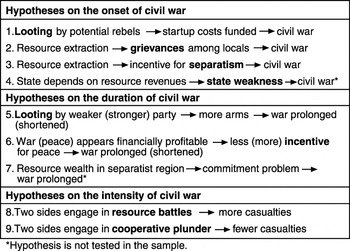
Hypothesized causal mechanisms
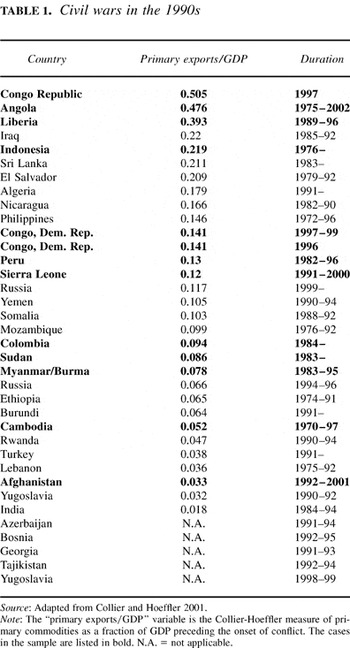
Civil wars in the 1990s
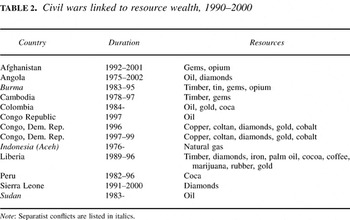
Civil wars linked to resource wealth, 1990–2000
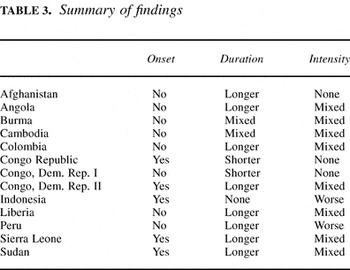
Summary of findings

Origins of conflict
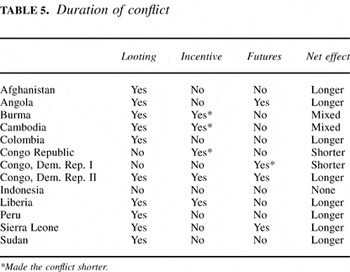
Duration of conflict
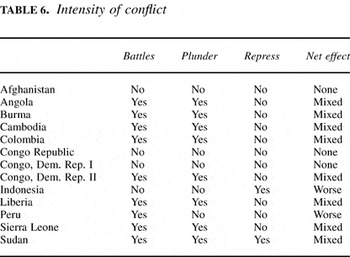
Intensity of conflict
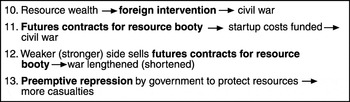
Unanticipated mechanisms
 You have
Access
- 402
- Cited by