Historians have long recognized the dramatic rise in parliamentary legislation passed at Westminster after the revolution of 1688–9. The annual meeting of parliament enabled propertied interests to lobby for more than 13,600 acts in the 112 years to 1800, being five times higher than the 2,700 acts passed in the 203 years from 1485 to 1688.Footnote 1 This article explores an additional development in parliamentary power that was of particular significance to the functioning of Britain as a multi-national state. In contrast to many lower courts that saw a collapse in their caseload during the eighteenth century, the revolution of 1688–9, and then the Union of 1707, caused the Lords to experience a great increase in its appeals business. Building on the work of Nicholas Phillipson and John Finlay who have demonstrated the disproportionately large number of Scottish legal cases at Westminster after 1707, this article systematically sets out the trajectory of some 8,500 appeals presented to the Lords from 1660 to 1875.Footnote 2 It presents reasons for the large number of Scottish cases, surveys the subjects of appeals via way of sampling and demonstrates the often limited and particular ends to which they were pursued, and maps the geography of cases from Scotland to 1800.
The relationship between Scotland and Westminster after the Union was portrayed in some older accounts as a limited and often hostile one, primarily reflecting the desire of Scottish interests to maintain a separate zone of autonomy from the English-dominated British state. Protected by articles in the Union treaties and acts of the Scottish parliament passed shortly before 1707 defending the status of the Presbyterian church, Scottish criminal and private law, and the convention of royal burghs (an assembly of burgh commissioners employed to levy taxes and resolve burgh disputes), Scottish interests withdrew into their own governing institutions for much of the eighteenth century. As has been argued, after 1707, Scotland had a ‘coherent and integrated set of structures, which were often able to shrug off or isolate themselves from London influence’.Footnote 3 Scottish interests looked to Edinburgh law courts, the convention, and individual burghs to resolve conflicts and advance schemes for economic improvement, not Westminster. It was the only reasonable response to being ‘in bed with an elephant’, with England dominant economically, demographically, and politically (through constituting the majority of members in parliament).Footnote 4 Change that did come from London was often in the form of coercive imposition or direct state subsidies from the central state, with little scope for local initiative by Scottish interests.Footnote 5
Recent histories have amended this narrative of withdrawal and disengagement, and rather demonstrated that after 1707 Scottish interests were primarily pursuing only a selective autonomy aimed at avoiding the erosion of the established institutional order in Scotland. There was certainly little legislative integration with the British state until after the final Jacobite rising of 1745, and neither the court of Session nor convention of royal burghs experienced substantial legislative reform until the nineteenth century.Footnote 6 The Union initially resulted in a marked fall-off in legislation relating to Scotland. General legislation regulating religion, poor relief, elections, and taxation shrank some 85 per cent between 1707 and 1727 compared to the activity of the Edinburgh parliament between 1689 and the Union. Local legislation relating to individual burghs and counties was less affected but still fell by 30 per cent.Footnote 7 Scottish interests also avoided petitioning on proposed legislation, presenting only 230 collective petitions between 1707 and 1755 compared to 5,500 from England and Wales.Footnote 8
However, following the Jacobite rising of 1745 Westminster passed an increasing amount of legislation relating to Scotland, and after 1760 Scottish interests and highland landowners gradually became more active as lobbyists in seeking legislation to promote the fisheries and linen industry.Footnote 9 Echoing their often defensive and limited legislation that sought to empower and legitimize local developments within Scotland were a growing number of legal appeals from the Session and Scottish Exchequer to Westminster. The legislative influence of the eighteenth-century Westminster parliament was only infrequently felt on Scottish social policy, urban improvement schemes, or the rural economy, as research by Bob Harris and Julian Hoppit has shown.Footnote 10 But this article demonstrates that the judge-made law of the House of Lords ensured that parliamentary influence was brought to bear on these issues. These appeals show that Scottish law was far from a point of divergence between the two nations, and instead complimented the profile of Scottish legislative engagement, awarding it greater geographic range and drawing in further subjects of dispute to arbitration at Westminster.Footnote 11 The first section demonstrates that Scottish appeals were large in number and that many dealt with issues under-represented in legislation such as burgh powers and religion; the second section establishes the number of decisions of Scottish courts that were altered at Westminster; the third section shows that appeals dealt with highland, island, and rural disputes in addition to those of Scotland's cities.
The data for this article is produced from the Lords journals. These minutes of proceedings list each case, the individuals involved, the dates of hearing, and the decision of peers. This information has been supplemented by the petitions of the appellants and plaintiffs that provide us with the social rank and residence of litigants, and the subject details of the case.Footnote 12 During this period, only civil causes could be appealed to the Lords.Footnote 13 Lay peers and bishops would pass judgement, but after the 1840s a convention developed that decisions would be deferred to supporting judges. It was not until the Appellate Jurisdiction Act of 1876 that law lords were introduced.Footnote 14 Significantly, although contemporaries were willing to describe the Lords as the ‘high court of judicature’ and ‘supreme’, peers only very rarely invalidated statutes, as to have done so would have been an open challenge to parliamentary supremacy.Footnote 15 Despite these caveats, it was the highest civil court for the British Isles and was a permanent feature in the legal system after 1688.
I
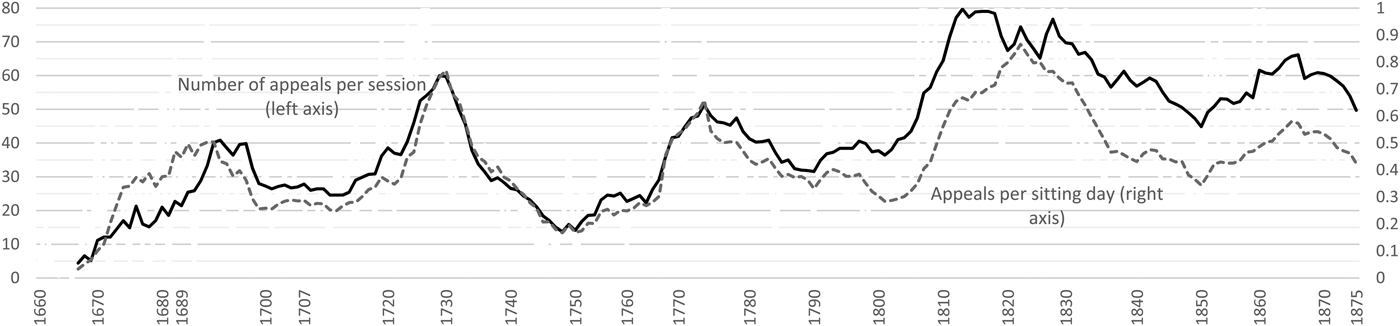
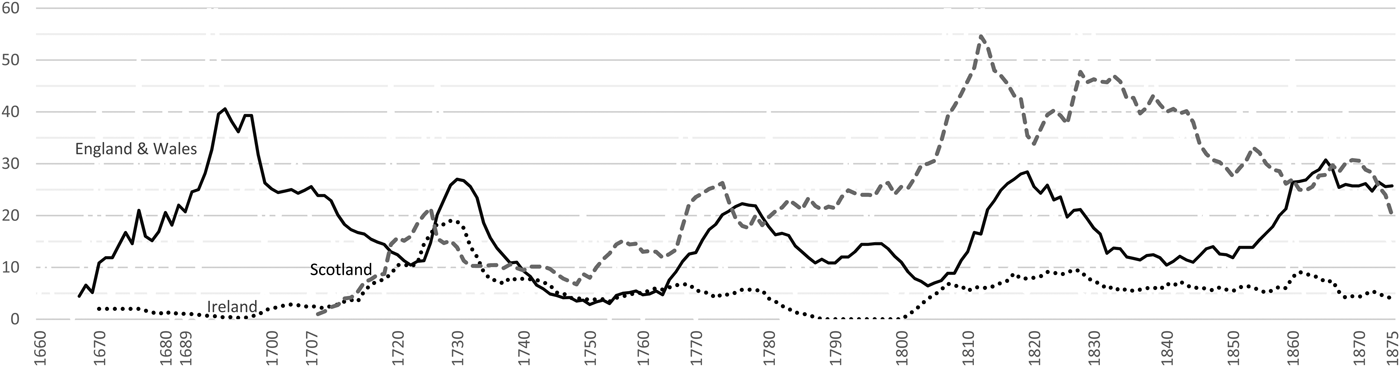
The result of counting appeals presented to the Lords from 1660 to 1875 are displayed in Figure 1. In Figure 2, the number of cases from each nation are shown. In order to show the general trend more clearly, in both figures the session totals of appeals are presented as a moving average. Echoing the pattern found by Julian Hoppit for the growth of parliamentary legislation, the overall number of appeals were low from 1660 to 1688, then increased greatly to peak in the 1720s, recovered from their mid-century low after 1760 and experienced a further and sustained rise after 1800.Footnote 16 This growth in cases reflected the increased frequency of parliamentary sessions after 1688–9. Fourteen appeals were presented on average each session during the Restoration, but from 1760 to 1800 this rose to twenty-two, and reached forty-two from 1800 to 1840. As sessions varied in length, the ratio of appeals presented to the number of days that peers sat is also plotted in Figure 1. From 1660 to 1688, the ratio is 0·2 and for 1760 to 1800 0·4. Business peaked between 1800 and 1840 at 0·6, and fell back to 0·5 in 1840–75.
Number of appeals, 1660–1875 per session and sitting day (seven session moving average)

Number of appeals from each nation, 1660–1875 (seven session moving average)

As Figure 2 shows, the expanding jurisdiction of the Lords was crucial to sustaining its caseload from the 1730s until the recovery of English appeals in the last quarter of the eighteenth century. Scottish appeals rapidly rose in both number and proportion after 1707, whilst English appeals experienced a cyclical decline and were usually smaller in number than Scottish appeals from 1740 to the 1860s. Rising legal costs in the English court of Exchequer had seen its number of new cases declining to 40 per cent of 1685 levels in 1735, and this pattern was echoed in Chancery, with the total number of new cases introduced each year contracting from 5,660 in 1685 to only 1,544 in 1785.Footnote 17 This decline fed through into the number and profile of English cases received on appeal in the Lords. The slight fall in the number of appeals after 1840 compared to the previous forty years was the result of the decline in Scottish cases, which fell from an average of 42 each session to 25 from 1800–35 to 1857–75. In total, from 1707 to 1800 there were some 1,400 Scottish appeals, 1,200 from England and Wales, and 500 from Irish courts. Scottish dominance continued between 1801 and 1875, with an additional 2,600 Scottish appeals to 1,400 from England and Wales, and a further 500 from Ireland. The repeal of the Declaratory Act in 1783 reasserted the supremacy of the Dublin parliament in judicial matters over that at Westminster, and resulted in a collapse of Irish appeals until the Anglo-Irish Union of 1801.Footnote 18 Few appeals came from North American courts during this period, a fact that enabled Benjamin Franklin to demonstrate American independence from the British parliament.Footnote 19
The rise in the number of appeals after 1689 reflected the presence of more frequent, longer, and predictable parliamentary sessions. Whilst the high demand to appeal was essential to increasing the caseload of peers, without procedural and organizational reform few cases would reach judgement. Irregular parliamentary sessions during the Restoration had limited the ability of peers to streamline the appeals process and limit the amount of vexatious litigation. The creation of a predictable parliamentary calendar and the increasingly stable length of Westminster parliamentary sessions after 1689 enabled peers to disallow appeals brought more than two years after the judgement of the lower court, and refuse unprosecuted appeals from being reintroduced in another parliamentary session. Peers also placed new barriers on appealing in the aim of reducing the number of vexatious appellants, allowing more time for genuine appeals. New standing orders of 1702 increased the costs of appealing by requiring the printing of case papers and for counsel to certify that the appeal was reasonable.Footnote 20 The lack of similar reforms in Scotland had meant that its parliament gave judgement on only nine of the fifty-three cases presented to it between 1689 and 1707.Footnote 21
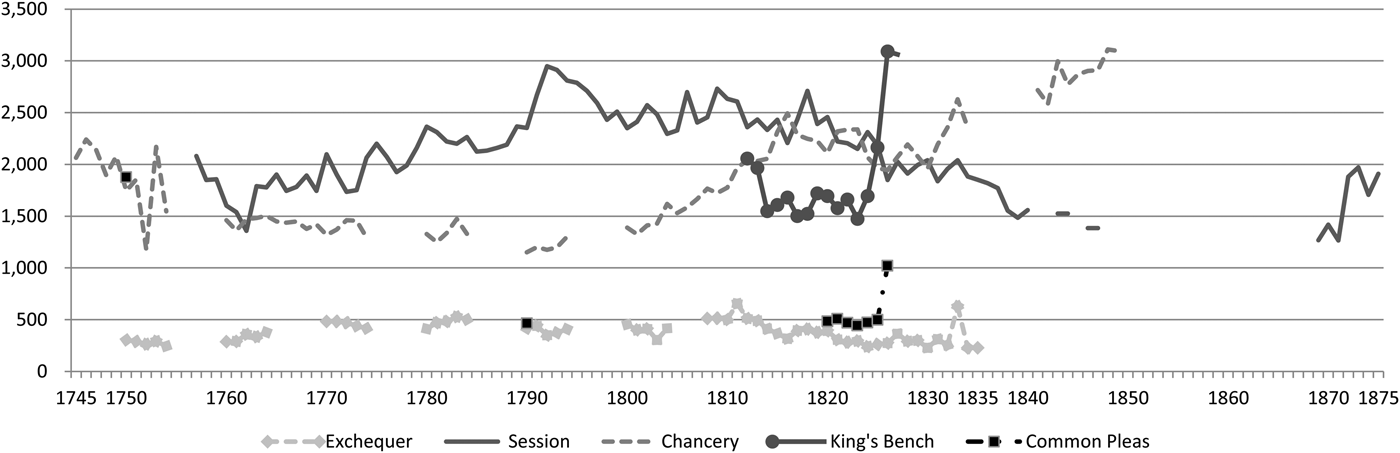
The presence of a disproportionate number of Scottish appeals in the ‘foreign’ jurisdiction of Westminster required that in addition to litigant demand, there existed the right and ability to appeal from the Session, and the reassurance that an English-dominated court would respect Scottish and local forms of law and not use appeals to enable a general English intervention into Scottish governing institutions. In the first instance, the procedures of the Session were responsible for enabling the high number of Scottish appeals between 1707 and its reform in the nineteenth century. Its judgements were often insufficiently explained, decided on the smallest majority of one judge, and were justified by different judges applying competing reasons.Footnote 22 The relative ease in appealing Session decisions enabled its far higher caseload compared to English central courts (shown in Figure 3) to be felt at Westminster. The combined caseload of the English courts of Chancery, Exchequer, King's Bench, and Common Pleas in 1750 was equal to one case in these courts to every 827 people. This compared to one case in the Session for 608 Scots in 1755 (the year of Alexander Webster's Scottish census), and rates increased to 524 Scots per case in 1790, which was the peak of its business in this period.Footnote 23
Cases presented to British law courts, 1745–1875

The gradual nineteenth-century decline in Scottish appeals resulted from the reform of Session procedures. Seven statutes passed between 1808 and 1830 helped reduce the number of appeals by introducing a review hearing of cases before leave to appeal from the Session was granted.Footnote 24 The costs of appealing to Westminster were also increased in an attempt to discourage speculative or delaying appeals through a new standing order of 1811, which required parties to deliver their printed cases within a month of their appeal being made.Footnote 25 These reforms restricted the ability and increased the costs of appealing to the Lords from the court, but the rising inefficiency that the Session dealt with its own caseload also meant that fewer cases reached judgement. Aside from its caseload falling 44 per cent between 1795 and 1831, the rate of judgement by Session judges halved between 1819 and 1839.Footnote 26 This declining caseload would have been starker if it had not been offset by the removal of cases from the Commissary, Exchequer, and Admiralty courts to the Session.Footnote 27
The nature of Session judgements and its high caseload provided a potential pool of Scottish appellants, and partially explains the higher number of Scottish cases compared to those from other nations. But it was additionally necessary for Westminster to prove itself capable of judging law from a jurisdiction that was ‘foreign’ to the majority of its members and to act in a circumspect fashion when intervening in Scottish law and society. The sixteen Scottish representative peers were greatly outnumbered by English peers that numbered 173 in 1700 and 267 in 1800, and during the eighteenth century even senior Scottish lawyers such as the lord advocate would often act as the junior to an English counsel.Footnote 28 Care was also required when navigating the Union treaty, for it declared Scottish private law unalterable unless for the ‘evident utility of the subjects within Scotland’, and the rights and privileges of the royal burghs were to ‘remain entire after the Union’. A Scottish act of 1706 placed further limitations upon parliament and the twenty-six bishops who sat in the Lords by stating that the place and status of the Presbyterian Kirk would remain for ‘all time coming’.Footnote 29
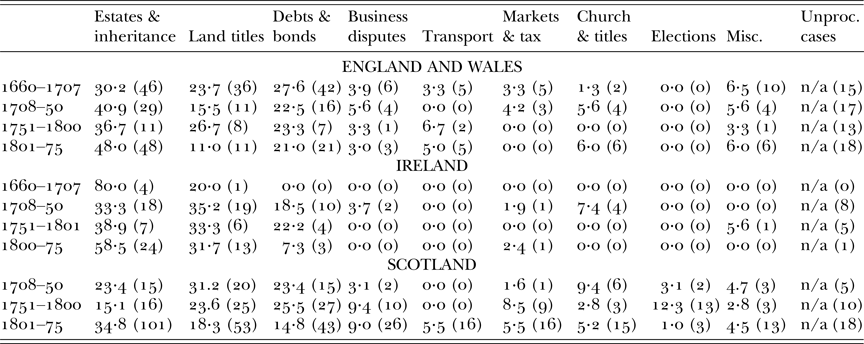
Although the issue of judging Scottish cases at Westminster seemed problematic in the context of the need to preserve Scottish legal distinctiveness, the subjects of appeals and the nature of the disputed law allayed many of these problems. The subjects of these appeals are shown in Table 1.Footnote 30 This data has been produced by examining twenty-six parliamentary sessions from 1660 to 1875. The one session in each decade that received the closest number of appeals to the average of that decade was investigated, producing a sample of 954 cases, or 11 per cent of the total number presented to the Lords.Footnote 31 This includes around 400 cases for Scotland and England and Wales, respectively, with the remainder from Ireland. Cases may be categorized several ways. In Table 1, ‘business disputes’ is restricted to physical goods, whilst cases over stocks and credit have been listed under ‘debts and bonds’. The category ‘miscellaneous’ contains a plethora of topics, ranging from policing to the regulation of theatres and the costs of litigation. ‘Markets and tax’ includes cases over public and local finance, trading privileges, and national economic regulations.
Subjects of appeals by nation in sample sessions, 1660–1875 (as percentage and number of prosecuted appeals)

Note: Raw numbers in brackets.
Sources: See n. 12.
This sample shows that at least 87 per cent of prosecuted cases from Ireland and 79 per cent in England and Wales dealt with disputes over debt, inheritance, and land titles in each of the four periods, but only between 64 and 78 per cent of Scottish prosecuted cases did so. This means that in the majority of appeals heard by peers, conflicts centred on the ownership of land, debtor–creditor relationships and contested wills and inheritances. Although significant for social relations and for maintaining economic and social inequalities, these appeals were primarily personal in nature and did not threaten to draw issues of public policy into conflict at Westminster and upset Scottish legal cultures or governing institutions. One significant case in this regard was Gray v. Hamilton (1709). Peers reversed the judgement of the Session that Scots law should judge a dispute over a contract created in England because the appeal had been entered in a Scottish court.Footnote 32 This decision confirmed that similar cases should continue to be governed by the jurisdiction in which the contract or bond had been entered into, removing one potential source of cross-fertilization or assimilation between the legal systems of the British Isles.
The subjects raised in the sampled cases do suggest that Scottish litigants brought more appeals concerned with issues of public policy than English, Welsh, or Irish appellants. But the nature of these cases continues to endorse the view that Scottish interests were primarily engaged with Westminster on particular and specific privileges and points of law, rather than seeking general reform. Cases dealing with the powers of royal burghs over taxation, market regulation, poor relief, and urban improvement schemes centred on disputes over localized and specific privileges. English boroughs were far from immune to legal conflict on these issues, but the sample suggests that they were less frequently involved in appeals to the Lords.Footnote 33 One reason why Scottish interests came in larger numbers and did not find it necessary to lobby for local legislation on the scale of English boroughs was that pre-1707 Scottish acts could be interpreted as having fallen into desuetude.Footnote 34 This was a process by which the development of a new practice could be argued to have overturned the meaning of the pre-existing statute. It was a significant mechanism, for it meant that English peers were not being asked to judge matters of Scottish law, but matters of fact. Resolution of these cases centred on establishing whether a particular custom had developed and the history of the enforcement of the statute. Secondly, this made legal innovation the result of local developments within Scotland.
This culture of specific improvements pursued by the desuetude process and the attempted protection for local particularisms and privileges characterized many burgh appeals.Footnote 35 A case challenging the power of Edinburgh magistrates to restrict the trade and price of tallow in 1714 following a two-decade long dispute between the fleshers, butchers, and candle makers of the city saw peers judge that the powers were now in desuetude and the revival of constraints by local byelaws was insufficient.Footnote 36 Underlining the limited nature of the judgement, Glasgow magistrates issued new regulations maintaining the privileges of candle makers as early as 1718.Footnote 37 A similar attempt to revive a local exemption from salt duties for newly exploited salt pans by the earl of Mansfield in Dumfriesshire in 1814 was also found by peers to have fallen into desuetude due to the privilege failing to be reasserted since the ending of Scottish salt duties in 1671.Footnote 38 Arguments that statutes from the fifteenth and sixteenth centuries limiting the use of fixed netting traps had fallen into disuse and could not be revived were invoked in favour of an appeal to introduce new fishing machinery on the Tay in 1816.Footnote 39 In the case, the appellants were seeking a geographically restricted judgement that would exempt their area of the Tay from the general acts governing the Scottish fisheries. They did this through claiming that their saltwater sections were in the firth, not the river. Pleading exemptions such as these was far easier than lobbying for wider reform because it avoided the clashing of interests that proposing a new national law would create – in this case with the duke of Atholl and the burgh of Perth, in whom the leasing of rights on the Tay were vested, and St Andrews, Montrose, Dumfries, and Dundee, whose opposition had led to the defeat of four proposed acts between 1823 and 1827.Footnote 40 Disputes over local customary practices within particular geographical boundaries also required peers merely to judge the presence of the custom. This they did in the ‘rabbit case’ of 1813, which followed a riot by golfers and inhabitants of St Andrews in defence of their claimed customary privilege to kill rabbits damaging the links. This custom had come into conflict with the right of the lessees to use their property as they wished, in this case by maintaining rabbit warrens.Footnote 41
Burghs primarily used appeals as a means to maintain and strengthen their local jurisdictions and defend their privileges from the encroachment of competing county bodies or landed elites. They therefore echoed the motivation for local legislation in England, as characterized by Paul Langford, in that they sought advantage over their local rivals rather than a greater national advance.Footnote 42 The deep-rooted interest of the burgh of Perth in the Tay fisheries illustrates this. In 1757, magistrates sought to maintain their privileges against Lord Gray by arguing that his fisheries were interfering with those belonged to the town.Footnote 43 Their concern for their fishing privileges were echoed a century later in an appeal of 1862 in which the burgh argued that another new machine in the Tay was impacting on their fishing grounds, but the so-called ‘Bermondsey boat’ was declared legal by the Lords.Footnote 44 The boat had been active since 1843, but increasing competition from the new Perth–Dundee railway after 1837 had undermined the burgh's finances and encouraged a redoubling of efforts to extract profits from their fisheries. Such concerns for maintaining or extending the jurisdictional boundaries and privileges of towns were also responsible for the growing litigation against railway companies in the nineteenth century. The burgh of Linlithgow in 1849 sued the Edinburgh and Glasgow Railway company for payment of tolls on all commodities passing through the burgh, in an attempt to revive ancient toll duties. Edinburgh fleshers had already claimed an exemption in the 1620s, but the article of Union protecting the privileges of the royal burghs was invoked in favour of the power. Despite winning their case twice in the Session, peers saw the burgh as having failed to maintain the levy on the travel of coaches through the town. The lack of a mechanism in the railway act to allow a toll keeper to come upon the railway and stop the train to collect the toll meant that any attempt to impose local duties would be seen as trespassing.Footnote 45
A similar process of local and partisan litigation was responsible for amending the constitutions of burghs and the shape of the electorate. A general revision of the laws governing the Scottish electorate waited until the 1832 Reform Act, and this left a number of weaknesses in the law that enabled more than 600 cases to come to the Session between 1796 and 1816.Footnote 46 The creation of ‘parchment barons’ (as opposed to real freeholders) caused much local partisan tension, in that their titles were empty paper grants made to enlist them as subservient voters by candidates.Footnote 47 This practice was the result of several deficiencies in pre-Union law over what constituted a meeting of freeholders, debates over the valuation of land as a qualification to vote, and the fact it was the freeholders themselves determining who was eligible to be on the roll at these meetings.Footnote 48 The bringing of cases disputing the qualifications of individual voters multiplied the number of suits, increased the costs of litigation, and strengthened local hostilities. These appeals were expressly partisan ones, and often reflected the attempts of burghs or individuals to maintain their independence against the intervention of competing landowner influence. Some thirteen cases came to the Lords in 1768 regarding the entering of new freeholders on the electoral roll for Angus.Footnote 49 This reflected the growing competition between the Strathmore and Panmure interests for the parliamentary seat, and the newly found patronage that came from the purchase of land by William Maule, the earl of Panmure and MP, and its distribution to create loyalist voters. The earl had been unopposed in the two previous elections, but the enfranchisement of new electors successfully carried the contest for him, with all but one case judged in his favour by peers. The collapse of a coalition in Renfrewshire in the 1810s established in order to challenge the McDowall interest that had held the seat since the 1790s also led to legal challenges over the enfranchisement of new life-renters that had resulted from their recent purchase of an estate.Footnote 50 Similar dynamics produced appeals in Aberdeenshire following the creation of twenty-six fictional voters and the collapse of an electoral truce between the duke of Gordon and the earl of Fife in 1790.Footnote 51 The decline of these disputes after 1832 certainly contributed to some of the fall in Scottish appeals, as Table 1 suggests.
This uncoordinated and limited application of Westminster parliamentary power largely avoided causing nation-wide controversies that the general revision of the constitutions and privileges of all Scottish burghs would have. One case before 1800 was fiercely contested by the convention precisely because it did threaten their collective privileges. The dispute centred on the monopoly power of royal burghs to conduct overseas trade. No legislation reforming this was passed until 1846, and the rights had been confirmed in Scottish acts of 1672, 1690, and 1693 and by the twenty-first article of Union protecting the rights of the royal burghs as they existed in 1707.Footnote 52 ‘Unfree’ towns had previously sought to undermine this exclusive privilege, and Glasgow had gone to law against the unfree merchants of Greenock and Linlithgow versus traders in Bo'ness during the 1670s.Footnote 53 In the eighteenth century, the increasing prosperity of Stromness compared to the royal burgh of Kirkwall in Orkney due to its links to the Hudson Bay Company produced demands for it to trade without reference to Kirkwall. This dispute entered the Session in 1743, and continued until the Lords in 1758 affirmed the right of Stromness and other unfree towns to trade independently from their neighbouring royal burghs.Footnote 54 The convention of royal burghs was responsible for sustaining the appeal, helping Kirkwall to fund the litigation in defence of its trade. The money it expended was the second greatest amount it had spent lobbying Westminster since the fisheries act of 1727, and surpassed only by its efforts to procure a linen act in the same year as the appeal.Footnote 55 This trade monopoly had been initially granted as a concession to the royal burghs in exchange for their payment of the Scottish land tax.Footnote 56 The increased tensions in Orkney were also the result of Kirkwall attempting to force neighbouring unfree traders to contribute to its quota of taxation. This was done without legislative reform, and occurred in line with the reference in the Union treaty that the levy would be collected as it was previously. However, the Lords refused to sanction the demand of burghs to seize the property of unfree merchants, and thus ensured that Scottish land tax administration suffered a degree of legal confusion and stagnation.Footnote 57 In addition to the economic significance of the case, the right to trade was also a matter of status for Stromness. The town commemorated the victory on its coat of arms when granted burgh status in 1817, and named a street in honour of the merchant Alexander Graham who had led the cause.Footnote 58
Given the generally cautious nature of appeals dealing with private law and the privileges of burghs, it is perhaps surprising that it was the status of the Presbyterian Kirk in which the judgements of the Lords had their most disruptive impact on Scottish society. The growing use of the English prayer book by Scottish Episcopalians following the revolution of 1688–9 had led to a backlash by the Presbyterian church which had sought to suppress such meetings, fearing that they incubated Jacobitism and presented a threat to the status of Presbyterianism that had only been recently re-established by the Scottish convention of 1689.Footnote 59 These prosecutions culminated in the action taken against James Greenshields in 1709, who had been practising the English liturgy in Edinburgh to serve an English congregation. His appeal received judgement in the Lords in 1710, who determined that no law of conformity existed in Scotland and that it was legal for a minster of the English church to practise in Scotland. For Presbyterians, this was an attack on the established national church and the Union itself, with the decision denounced in addresses from Edinburgh and Haddington.Footnote 60
For Episcopalians, the case provided a window in which they could pursue legislation that would better accommodate them with the British state. Their lobbying led to the passage of the Scottish Toleration Act and the reintroduction of lay landowner patronage over the appointment of ministers in 1711, the latter producing an enduring grievance of the Presbyterian Kirk. This led to annual protests by the General Assembly to the monarch, but when evangelical groups became the dominant group in the assembly during the 1830s they assumed a more confrontational approach towards the state. In 1834, the assembly passed the Veto Act that reinstated the right of parishioners lost in 1711 to reject a minister nominated by their patron.Footnote 61 In doing so, it was expected that civil courts would respect the right of the Kirk to regulate the appointment of its own ministers, but this was not the case. Increased tensions between lay landowners and the Kirk came to a head when Robert Young, the nominee of the earl of Kinnoul for the parish of Auchterarder in Perthshire, had gained the support of only three of his 3,000 parishioners. Three cases on the issue were taken to the Session and the Lords, who both determined that the Veto Act had infringed the rights of patrons as established by statute (though the Session was divided, eight to five).Footnote 62 The judgement went further than this, in ruling that the Kirk was not an unalterable part of the constitution and was rather subject to the power of a sovereign parliament. This escalation of the patronage controversy into a clash of jurisdictions and a clear statement that the Kirk held no supreme spiritual independence provoked the secession of around a third of Presbyterian clergy in order to found the Free Church of Scotland in 1843.Footnote 63 The legacy of the 1710 Greenshields case and the schism in the national church more than a century later was something that few other appeals could compare to, either in their consequences for Scottish society or for its governing institutions that were otherwise successfully entrenched between the Union of 1707 and the legislative reforms of the nineteenth century.
II
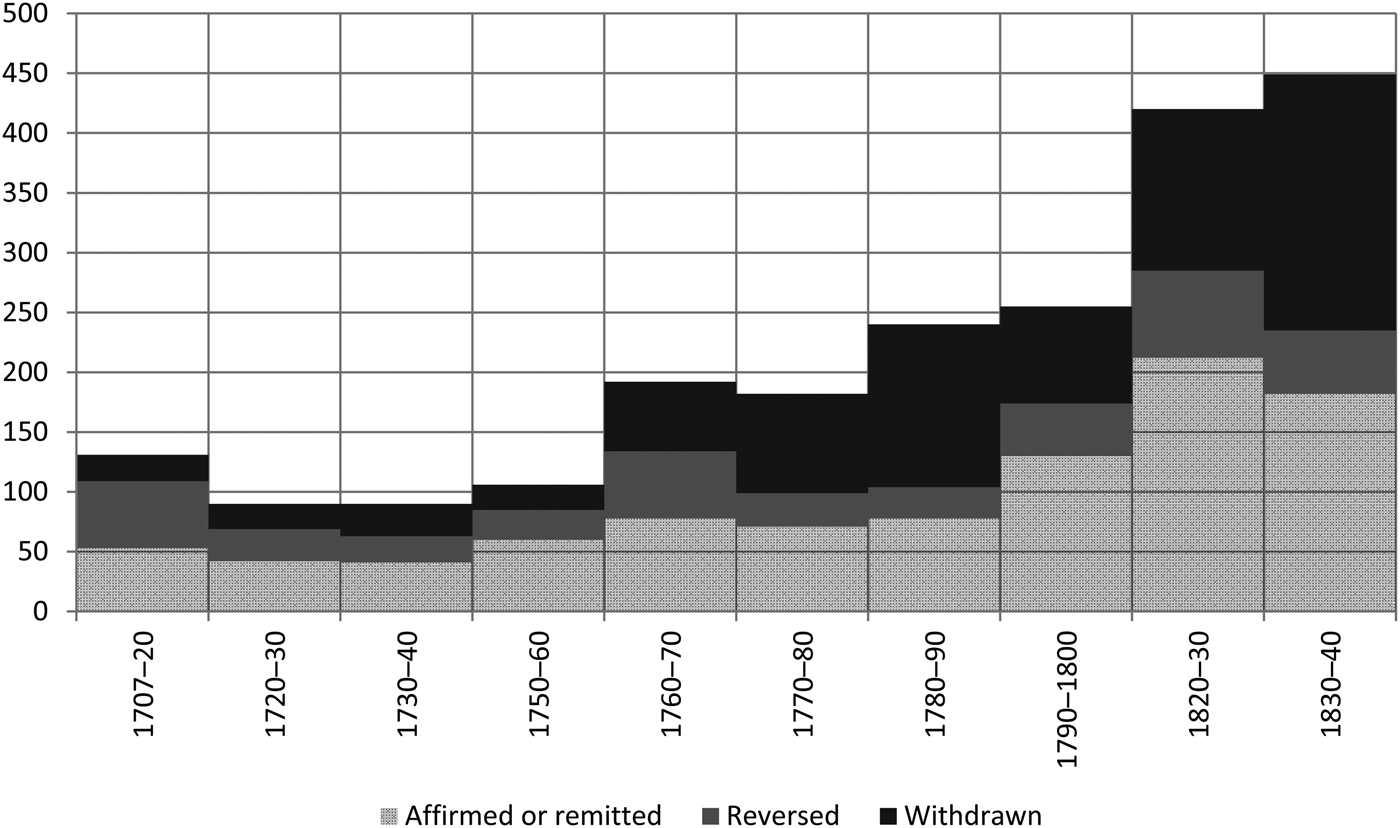
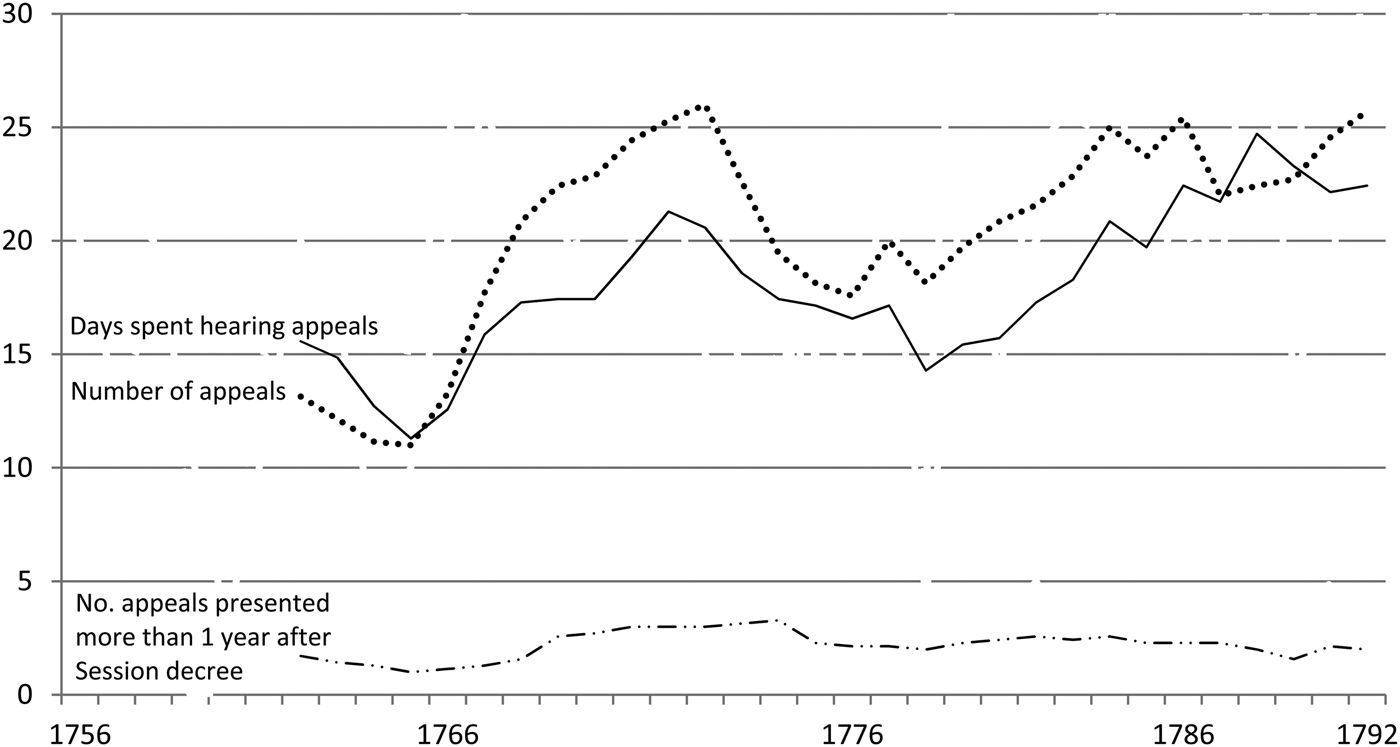
When seeking to establish the significance of this interaction between Scottish litigants and Westminster to the functioning of the Union, we also need to take account of the extent that the Lords altered or varied the decisions of Scottish courts. In this period, central state justice did not displace private forms of law designed to manage relations between individuals and neighbouring interests, with the right to appeal increasingly employed as a means to force compromise between the litigating parties. The striking aspect of the rise of appeals towards the end of the eighteenth century is that it coincided with increasing numbers of appellants formally withdrawing their cases before any hearings occurred (shown in Figure 4), and doing so with the permission of peers. Regularly, between 20 and 25 per cent of Scottish cases were withdrawn, but this reached 40 per cent in 1780–90 and 1830–40. This was not due to rising rates of inefficiency within the Lords, which dealt with its increased caseload effectively. Figure 5, based on data from a contemporary report, suggests that there existed a stable relationship between the number of appeals and time spent hearing them.
Decisions on Scottish appeals, 1707–1840

Relationship between the number of appeals and days spent hearing, 1756–1792 (seven session moving average)

Instead, appeals increasingly functioned as a threat to force negotiation or speed up an informal settlement. In doing so, appellants guaranteed that their engagement with Westminster could only affect the locality and particular individuals involved in the case. Between 1756 and 1793, nearly 80 per cent of formally withdrawn Scottish cases were done so with the consent of both parties, suggesting that appeals were employed as a means of arbitration.Footnote 64 The ‘mere dread of delays’ led to compromise. One appeal forced the defendant to ‘deliberately abandon one half of his claim’.Footnote 65 Others used the threat ‘in order to embarrass and wear out the petitioners, and to force them into a compromise’.Footnote 66 Edinburgh magistrates had decided not to challenge the returns of the election of 1817 any further than the Session, the suit having already lasted three years and cost £4,000, and Montrose magistrates were ‘for the sake of peace willing to acquiesce’ on a tithe case.Footnote 67 This meant that in some periods, for up to 40 per cent of Scottish litigants, the significance of the right to appeal lay in the ability to extract particular and personal concessions from the opposing party rather than seeking a wider reform of the law.
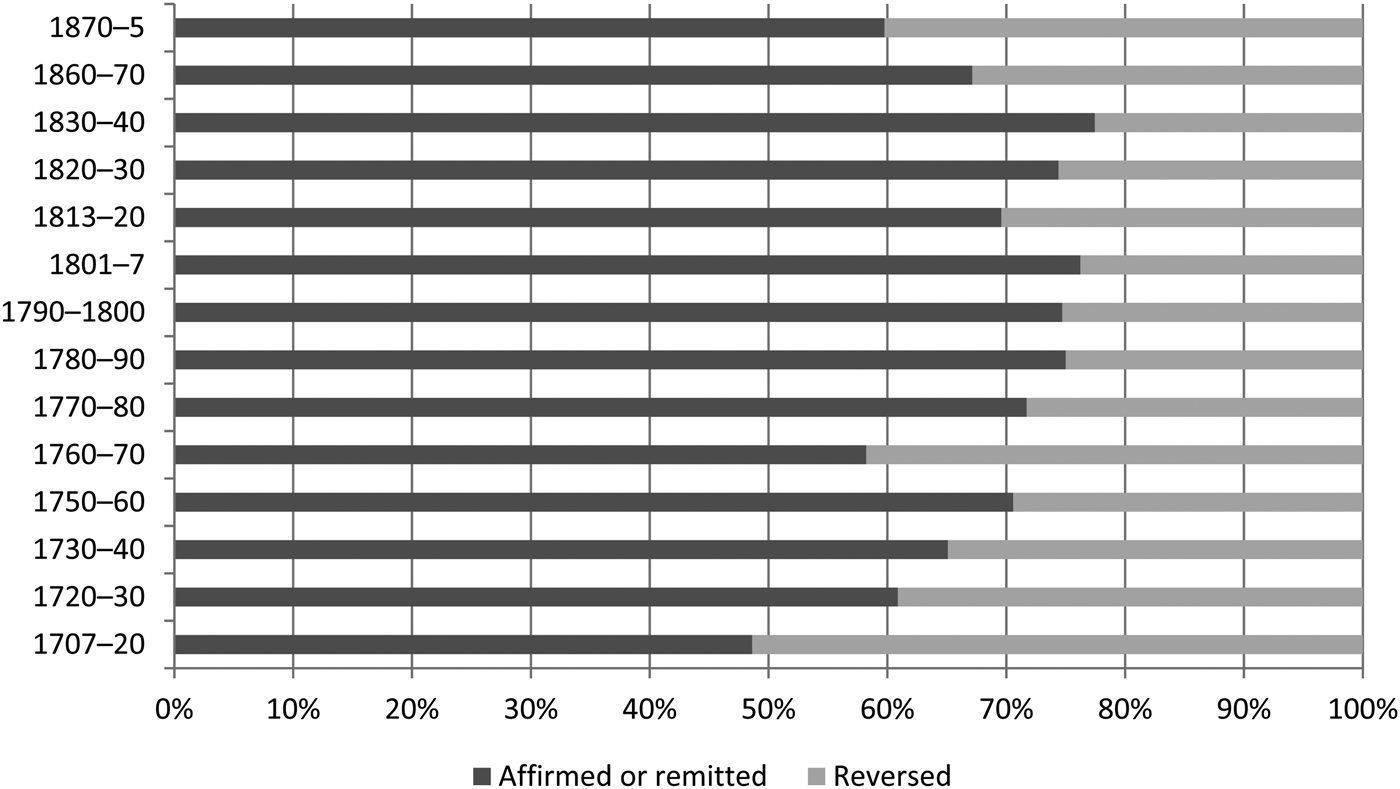
Despite the growth of appeals, the greater involvement of Scottish lawyers in lawsuits as they gained experience practising in the Lords, and the changing subject matter, Figure 6 shows that the rates in reversal of the cases that went to judgement remained remarkably consistent throughout this long period: between 30 and 40 per cent.Footnote 68 The exception to this is the initial period before 1720 when over 50 per cent of appeals from the Session were reversed, but this was due to the jurisdiction of the Session over twenty-five cases dealing with the forfeiting of Jacobite estates being declared as null and void.Footnote 69
Decisions on Scottish appeals that went to judgement, 1707–1875

This high number of reversals did not reflect any systematic mistreatment of appeals by non-Scottish peers. The proportion of Scottish appeals overturned was similar to that in other European courts whose jurisdiction contained multiple legal systems. The Castilian appellate court also reversed around a third of the cases that came before it.Footnote 70 These judgements delivered by peers were also overwhelmingly consensual in nature. In the 800 divisions in the Lords from 1714 to 1784, there were only fifty-one divisions on the 800 legal cases presented before 1733, and five in the remaining fifty-year period on some 1,500 cases.Footnote 71 Party and interest allegiances could influence the position that peers took on a case, but this did not occur on a regular basis. With regard to the Greenshields case, divisions did not occur on Anglo-Scottish lines because a number of Scottish peers were ‘violently for him’, whilst some fellow representative peers ‘walked out of the appeal…knowing there was nothing to be said’.Footnote 72 In the main, Scottish appeals remained limited and particular enough to avoid creating repeated tensions at the level of the British state. Instead, the motivating and resulting hostilities were contained within the locality from which the appeal came.
III
The particular nature of Scottish appeals limited their use as a mechanism to reform Scottish society at the level of the nation-state. Instead, the improvement of political economy and governance remained highly varied across the Scottish nation. This third section considers the geography of eighteenth-century Scottish appeals. The reach of British power was mixed in post-Union Scotland, and particular local dynamics and tensions remained the primary context in which appeals were motivated and contained.
At a general level, the emergence of a unified British state is frequently argued to have supported its early industrialization and mobilization of military power.Footnote 73 Britain after 1707 had a single parliament, and although it continued to contain different national legal systems and institutions, these were centralized in Westminster Hall for England and Wales, and in the Session and Exchequer for Scotland. But the composite nature of the state endured. Legal systems and parliaments were not universally drawn upon, with substantial geographic variation in their employment and effectiveness. Christopher Brooks and Henry Horwitz both showed that London litigants formed the majority of plaintiffs in the courts of Chancery and Exchequer, and that the eighteenth-century decline in litigation reflected a decline in cases from the English localities.Footnote 74 Although the business of the Session has not been mapped systematically, recent explorations suggest a similar absence of cases in highland and rural areas.Footnote 75 Hoppit has demonstrated that just nineteen English counties were collectively responsible for nearly 70 per cent of economic legislation passed at Westminster before 1800. General legislation did also not often apply outside England, with only 457 of the 1,552 public statutes passed between 1707 and 1754 believed to be ‘in force and use relative to Scotland’ in the period.Footnote 76
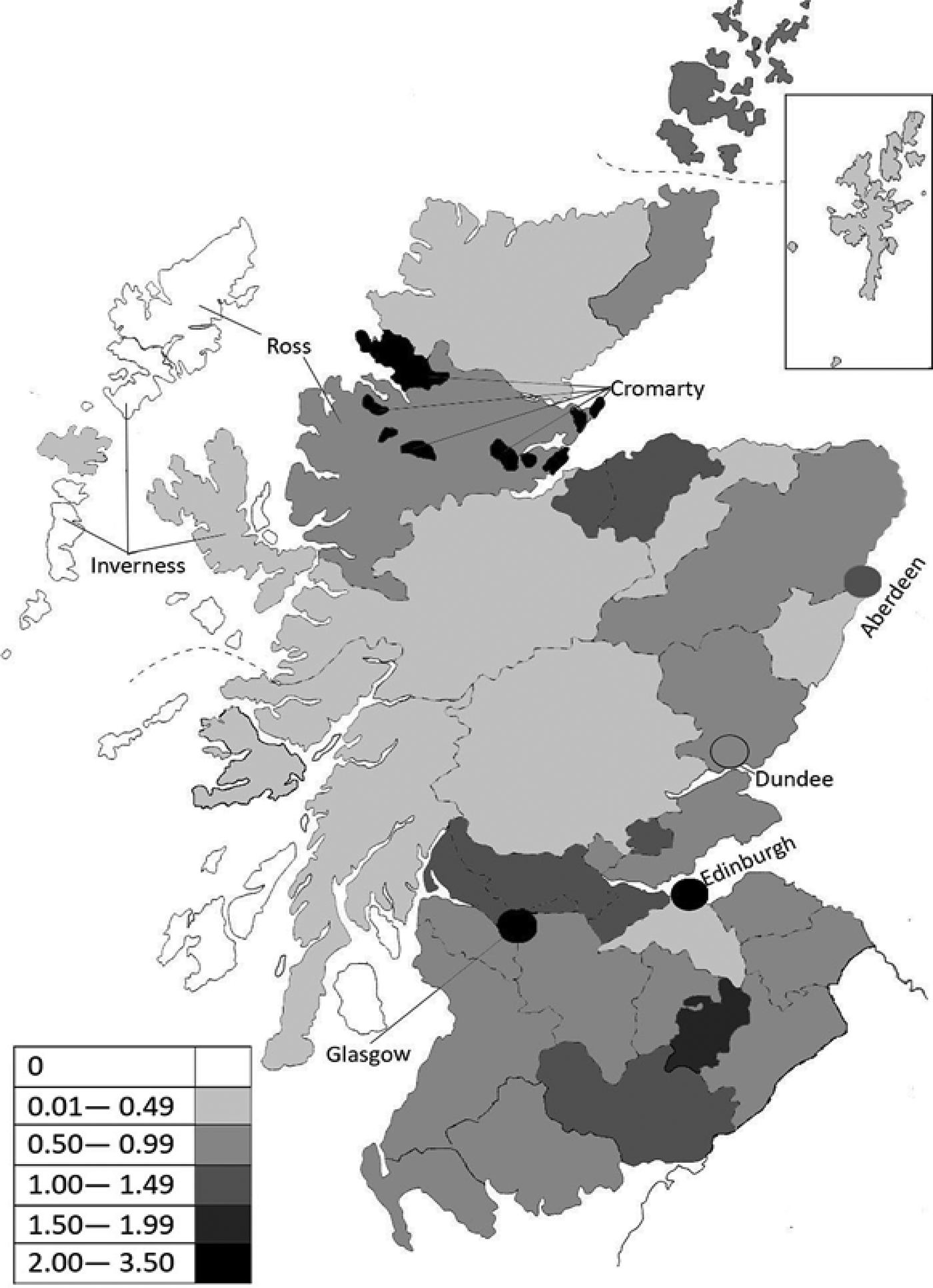
The reach of both parliamentary and legal power was therefore highly uneven. As Figure 2 showed, there was clearly a much greater resort to the Lords as the high court by Scottish interests. But as Figure 7 demonstrates, the pattern of appeals also varied within Scotland. Because counties varied in their physical size and population, appeals have been mapped per thousand inhabitants. This is as a proxy for their economic size which was a factor influencing appeals on economic, land, and credit issues. The map shows separately the four largest Scottish cities in 1800 – Edinburgh (including Leith), Glasgow, Aberdeen, and Dundee. The population figures are necessarily based on a snapshot, with Webster's census of 1755 providing the data. In contrast to the implementation of coercive penal polices or the collection of taxation, the British parliament experienced no difficulties in receiving appeals from relatively distant and inaccessible regions with low population densities and poor communication links. Appellants came from the geographic periphery, and only Bute sent no appeals before 1800. Islands sending appeals included Skye, Mull, North and South Uist, and those constituting the Northern Isles.
Distribution of Scottish appeals, per thousand inhabitants, 1707–1800

Despite the fact that appellants had chosen to bring the state in on their own terms, their engagement still demonstrates a desire and ability of interests to call upon the British state to umpire disputes in local societies. However, the geography of appeals endorses Hoppit's findings that many Scottish counties were disengaged from Westminster during the eighteenth century. The two counties most active in seeking statutes sent the largest number of appeals, with Lanarkshire lobbying for 34 economic bills and 113 appeals, whilst Midlothian pursued 19 bills and 236 appeals from 1707 to 1800. Counties such as Berwickshire or Peebles uninvolved in seeking economic legislation were also unengaged with the Lords as the high court (sending 9 bills and 21 appeals, and 4 bills and 6 appeals, respectively).Footnote 77 The traditional economic, population, and political centres of Scotland dominated. The largest number of appeals were from the four largest population centres: Edinburgh sent 200 appeals (a seventh of the pre-1800 total), Glasgow 64, Aberdeen some 59, whilst Dundee and the surrounding county of Angus sent 65. Some 16 cases relating to overseas trade, not currently included on the map, were likely to be linked to these cities.
Cromarty stands out from this pattern, with a higher per capita appeal rate than Glasgow, because of its small population of 5,100 in 1755. But this did not mean that Cromarty was drawing itself closer to the British state than other areas of the highlands. The county experienced a short and fierce period of litigation in the 1760s ‘owing to the madness of elections’ and attempts to enfranchise new voters.Footnote 78 The seat had only eighteen electors, and had evenly split between William Pulteney (who was MP from 1768) and Sir John Gordon (MP from 1754). This concentrated period of litigation bankrupted the Gordons and enabled the Pulteney interest to be returned without opposition in 1780.Footnote 79 No less than forty petitions were sent to the Session between 1765 and 1767 disputing the creation of new voters, and on a single day in 1770 Gordon lost three appeals in the Lords.Footnote 80 Further appeals over the qualifications of the electorate in parliamentary and burgh elections during the 1750s and 1790s (as the Pulteney regime unravelled when he moved seat to Shrewsbury) ensured that in the eighteenth century Cromarty interests primarily used Westminster as a place to umpire partisanship within the county.Footnote 81 Reflecting the subject profile of cases, disputes over inheritances, land titles, and debt constituted its remaining appeals. In echoing the high rate of withdrawal of Scottish appeals, peers were unable to deliver judgement on cases dealing with the salmon fisheries and the 1790 election before they were withdrawn.Footnote 82 Although a larger number of counties were engaged with Westminster via appeals rather than in the pursuit of legislation, the nature of these cases confirms the view that Scottish engagement with Westminster, especially in the eighteenth century, was intentionally localized, partial, and limited. Their presence rarely reflected, or enabled, a systematic reworking and improvement of Scottish law at the national level.
IV
Legal histories of eighteenth-century Europe have typically stressed the decline in the caseloads of most civil courts compared to the height achieved in the seventeenth century. However, this article has demonstrated the continuing buoyancy of the Lords as a result of the increased regularity and length of parliamentary sessions after 1689 and its expanding jurisdiction that enabled appeals from Scottish courts to compensate for the fall in English and Welsh cases coming from Westminster Hall. The presence of these appellants reflected the effective management of a high caseload by the Session in Edinburgh and the efficiency that peers dealt with their legal business in Westminster.
Scottish law and its legal institutions, as protected in the Union treaties, has often been seen as an important conduit for a separate Scottish national identity, and a mechanism by which Scottish society could insulate itself from the dominance of England within the post-Union state. In other areas of state policy, notably the raising of taxes, the implementation of the poor law, and the enforcement of the penal statutes of the Bloody Code, it has been shown that the central state frequently found it difficult to impose its laws and policies on the periphery.Footnote 83 In this, the British state was similar to many other European states in the early modern period in being multi-layered and directed by different interests to different ends.Footnote 84
But the physical distance of Westminster did not erode the legal or political power of the state to develop a hierarchical and shared legal forum for the whole of the British Isles. As Colin Kidd has demonstrated, Scottish legal communities certainly drew inspiration from English common law to support the enlightenment drive for economic and commercial improvement.Footnote 85 The nature of their interaction with the Lords underlines the extent that Scottish interests had a partial degree of autonomy: it was they who brought in the state here, co-opting it for their own ends and often for localized disputes; this would have not been the case with raising money to fund poor relief in Wales, imposing taxation, or building barracks in the highlands. These appeals created thousands of links between Scottish communities and Westminster, and echoed the similar practice of ‘propertied Englishmen’ to avoid national interventions in their local communities. Legal cases, for the most part, did not seek the fundamental reform of institutions explicitly protected in the Union treaties during the first century of the Union. Those few that did produced considerable opposition from the convention of royal burghs and led to a schism in Presbyterianism. The result was a piecemeal reform of Scottish institutions during the eighteenth century that only rarely altered the distinctive place of Scottish institutions, but did amend their exercise of power and that of landowners and magistrates through older Scots law.
Scottish autonomy during the eighteenth century was only a partial one. Local rivals and clashing interests did appeal to Westminster to umpire their conflicts, and in doing so remade and redefined long-standing privileges and powers of Scottish institutions. The expansion of the British state is often portrayed as the result of party conflict, parliamentary legislation, and the extension of executive power through the growth of the fiscal-military state. But together with the importance of thousands of local acts of parliament, the continuing relevance of lawsuits makes it clear that English and aristocratic power was far from the sole source of initiative or change. The political cultures and political economies of both Scottish and British society were thus far more multi-centred and locally conditioned than has so far been established.