Introduction
Anorexia nervosa (AN) is characterized by severe restriction of food intake resulting in inappropriately low body weight, accompanied by fear of weight gain (American Psychiatric Association, 2013). Dietary restriction is extreme in AN and its resistance to change is perplexing (Walsh, Reference Walsh2011). Individuals with AN are known to consume significantly fewer calories than healthy peers, with a marked reduction specifically in calories from fat (Schebendach, Mayer, Devlin, Attia, & Walsh, Reference Schebendach, Mayer, Devlin, Attia and Walsh2012; Sysko, Walsh, Schebendach, & Wilson, Reference Sysko, Walsh, Schebendach and Wilson2005). Both subtypes of AN (restricting and binge-eating/purging) are characterized by limiting caloric intake, though only one subtype experiences binge-eating and/or purging (Raatz et al., Reference Raatz, Jahns, Johnson, Crosby, Mitchell, Crow and Wonderlich2015). Even individuals actively engaged in treatment continue to choose low-calorie, low-fat foods (Schebendach et al., Reference Schebendach, Mayer, Devlin, Attia, Contento, Wolf and Walsh2008, Reference Schebendach, Mayer, Devlin, Attia and Walsh2012). It is unclear what biobehavioral mechanisms underlie the persistent maladaptive – even life-threatening (Arcelus, Mitchell, Wales, & Nielsen, Reference Arcelus, Mitchell, Wales and Nielsen2011) – decisions about food in AN. Are the mechanisms involved in restrictive food choice in AN specific to these individuals, or are similar mechanisms involved whenever restrictive eating is pathological, or even when healthy individuals choose low-fat foods in an attempt to lose weight?
A longstanding challenge in studying AN has been the twofold problem of quantifying restrictive eating and of comparing groups when the appeal of food likely varies across groups. First, if restrictive eating is conceptualized as the absence of eating, it is not amenable to experimental investigation because the action of interest is inaction. Yet, as demonstrated in recent studies, restrictive eating in AN can usefully be understood as making dietary choices that minimize high-fat food intake rather than as the absence of eating (Schebendach et al., Reference Schebendach, Mayer, Devlin, Attia, Contento, Wolf and Walsh2008; Schebendach et al., Reference Schebendach, Uniacke, Walsh, Mayer, Attia and Steinglass2019; Steinglass, Foerde, Kostro, Shohamy, & Walsh, Reference Steinglass, Foerde, Kostro, Shohamy and Walsh2015). Second, if individuals value outcomes very differently, it is necessary to create a context in which choices can be meaningfully compared (Kable & Glimcher, Reference Kable and Glimcher2007). Reward value of food in AN is currently not well understood, but it is clear that the experience of food is complex and different from that of healthy individuals (Lloyd & Steinglass, Reference Lloyd and Steinglass2018). Through examination of actual food choices and integration of individualized food valuations, using tools from neuroeconomics (Peters & Buchel, Reference Peters and Buchel2011; Rangel, Reference Rangel2013), appropriate comparison with healthy individuals is possible.
One experimental paradigm that solves these problems is a Food Choice Task (Foerde, Steinglass, Shohamy, & Walsh, Reference Foerde, Steinglass, Shohamy and Walsh2015). In the task, participants make a series of choices between food items – choices that have real consequences because one choice is to be consumed as a snack after the task. The task can be used to compare preferences across groups with differing food valuation because each person makes choices relative to their own individualized, neutrally-rated reference food item. Previous studies show that the task successfully captures the restriction of fat intake characteristic of AN (Steinglass et al., Reference Steinglass, Foerde, Kostro, Shohamy and Walsh2015), and that behavior on the task relates to actual food intake the following day (Foerde et al., Reference Foerde, Steinglass, Shohamy and Walsh2015). Moreover, food valuation and choices on the task do not differ between restricting and binge-eating/purging subtypes (Uniacke et al., Reference Uniacke, Slattery, Walsh, Shohamy, Foerde and Steinglass2020).
A prior study using the Food Choice Task during fMRI scanning found that there was a significantly greater association between dorsal striatal activity and decisions about food among patients with AN than among healthy controls (HC) (Foerde et al., Reference Foerde, Steinglass, Shohamy and Walsh2015). However, it is unclear whether these patterns of neural activity during food choice are specific to AN, or occur with restrictive food choice more generally. For example, changing eating with intent to lose weight (i.e., ‘dieting’) is extremely common in the absence of psychopathology. Clarifying food-based decision-making and its neural correlates across a spectrum of food restriction can improve understanding of the pathophysiology of AN.
In the present study, we aimed to assess whether food choice-related engagement of the dorsal striatum is specific to AN, or whether similar neural mechanisms are engaged by other forms of restrictive eating. We administered the Food Choice Task with fMRI to healthy individuals and acutely ill patients with AN, and to two additional groups who engage in dietary restriction: individuals with subthreshold (non-low weight) AN and normal-weight, dieting HC. We hypothesized that, in addition to the previously described differences between AN and healthy peers, restrictive eating behavior would increase across this spectrum, and that choice-related engagement of the dorsal striatum would increase in proportion to the degree of dietary restriction.
Materials and methods
Participants
One hundred and ten women across four groups, ages 18–40 years, were included: HC, dieting healthy controls (HC-D), ‘subthreshold’ anorexia nervosa (sAN) and AN. None of the participants had participated in our previous Food Choice studies. Women with AN (n = 35) were inpatients on the Eating Disorders Research Unit at the New York State Psychiatric Institute (NYSPI) who met DSM-5 criteria for AN at the time of admission. HC (n = 36) were women with a body mass index (BMI) of 18.5–25.0 kg/m2 and no history of psychiatric illness or recent dieting. The sAN group (n = 19) were treatment-seeking women with clinically significant restrictive eating who met criteria for an eating disorder and had a BMI of 18.5–25.0 kg/m2 for at least the 3 months prior to evaluation. In the sAN group, 12 individuals had Atypical AN (per DSM-5, Atypical AN is characterized by all features of AN except underweight) and seven had subthreshold AN. Twenty-one of the 35 individuals with AN met criteria for binge-eating/purging subtype (AN-BP), as did 17 of the 19 individuals with sAN. The study was not designed to compare AN restricting (AN-R) and AN-BP subtypes and sample sizes were too small for this purpose. HC-D (n = 20) were women with no psychiatric history, a BMI of 18.5–25.0 kg/m2, and self-reported restrictive eating behavior that had led to weight loss (range 3–35 lbs, mean = 16.8 lbs). Participants were predominantly Caucasian in all groups (HC, 75%; HC-D, 50%; sAN, 58%; AN, 69%) and the proportion was not significantly different (χ2 = 4.2, p = 0.24). Among AN, 23 individuals (66%) had a comorbid depressive (n = 13) or anxiety (n = 15) disorder (13 individuals met criteria for more than one comorbid illness). Among sAN, 13 individuals (68%) had a comorbid depressive (n = 6) or anxiety (n = 9) disorder, and seven met criteria for more than one comorbid illness.
Exclusion criteria were psychotropic medication (one sAN taking an SSRI was included), current substance use disorder, history of a neurological disorder or injury, contraindication to MRI, or pregnancy. Individuals were also excluded if they had a food allergy that would interfere with study procedures. All participants had an estimated IQ in the normal range (i.e., greater than 80), assessed by Wechsler Abbreviated Scale of Intelligence (WASI) (Wechsler, Reference Wechsler1999). Eating disorder diagnoses were assessed via Eating Disorders Assessment [EDA-5 (Sysko et al., Reference Sysko, Glasofer, Hildebrandt, Klimek, Mitchell, Berg and Walsh2015)] and comorbid diagnoses via Structured Clinical Interview for DSM-IV [SCID (First, Spitzer, Gibbon, & Williams, Reference First, Spitzer, Gibbon and Williams1998)]. Treatment at NYSPI is provided at no cost for those interested in and eligible for participation in research. HC, HC-D, and outpatients (i.e., sAN) were compensated $150 for their time.
This study was approved by the NYSPI Institutional Review Board and all participants provided written informed consent.
Procedures
Food Choice Task with fMRI
Task procedures have been published previously [(Foerde et al., Reference Foerde, Steinglass, Shohamy and Walsh2015), see online Supplementary Information for details]. In brief, a standardized lunch (~500 kcal) was provided, followed 2 h later by the Food Choice Task (online Supplementary Fig. S1) during fMRI scanning. Participants rated the healthiness and tastiness of 76 foods (38 high-fat, 38 low-fat) on a five-point scale. For each participant, a ‘Reference’ item was selected that they had rated as ‘Neutral’ on both healthiness and tastiness. Out of 110 participants, 105 participants had a reference food rated neutral on Healthiness (two AN and one HC-D had a reference food rated 4, one HC-D had a reference food rated 2) and 104 participants had a reference food rated neutral on Tastiness (three HC, one AN, one sAN had a reference food rated 4). One HC-D used only extreme ratings (1 and 5) and was given the default reference item of ‘saltines’ (see online Supplementary Table S1). In the Choice block, the Reference item was constant, and participants made a selection by indicating whether they ‘Strongly Preferred’ or ‘Preferred’ the Reference item or the other food using a five-point scale. To ensure that responses reflected true preferences, participants were instructed that they would be asked to consume one of their choices as a snack. For each participant, one Choice-block trial was randomly selected and a snack-sized portion of the item chosen on that trial was provided for consumption.
Multi-item meal
Laboratory meals were administered the day following the scan, according to standardized published procedures (Sysko, Steinglass, Schebendach, Mayer, & Walsh, Reference Sysko, Steinglass, Schebendach, Mayer and Walsh2018). Participants received a standardized breakfast and the 25-item buffet meal was administered 5 h later. Meal data from some participants were included in other publications (Schebendach et al., Reference Schebendach, Uniacke, Walsh, Mayer, Attia and Steinglass2019; Steinglass et al., Reference Steinglass, Glasofer, Walsh, Guzman, Peterson, Walsh and Wonderlich2018; Zambrowicz et al., Reference Zambrowicz, Schebendach, Sysko, Mayer, Walsh and Steinglass2019).
Additional assessments
Restrictive eating was assessed as a continuous measure via weight suppression [the difference in pounds between highest weight and current weight (Berner, Shaw, Witt, & Lowe, Reference Berner, Shaw, Witt and Lowe2013)] and the Three Factor Eating Questionnaire [TFEQ (Stunkard & Messick, Reference Stunkard and Messick1985)]. Working memory was assessed via Letter Number Sequence [LNS (Wechsler, Reference Wechsler1997)]. Other self-report measures included the Eating Disorder Examination, Questionnaire version [EDE-Q (Fairburn & Beglin, Reference Fairburn and Beglin1994)], Beck Depression Inventory [BDI (Beck & Steer, Reference Beck and Steer1993)], Spielberger State-Trait Anxiety Inventory [STAI (Spielberger, Gorsuch, Lushene, Vagg, & Jacobs, Reference Spielberger, Gorsuch, Lushene, Vagg and Jacobs1983)], and Temperament and Character Inventory [TCI (Cloninger, Przybeck, Svrakic, & Wetzel, Reference Cloninger, Przybeck, Svrakic and Wetzel1994)].
fMRI acquisition
Whole-brain imaging data were acquired on a GE 3T MR750 scanner with a 32-channel phased-array head coil. Structural images were collected using a high-resolution T1-weighted BRAVO pulse sequence (1 × 1 × 1 mm voxel size) for image registration. Functional images were collected using a gradient echo T2*-weighted echoplanar (EPI) sequence with blood oxygenation level-dependent (BOLD) contrast (TR = 2000 ms, TE = 19 ms, flipangle = 77, 3 × 3 × 3 mm voxel size, 45 contiguous axial slices, FOV = 19.2, interleaved acquisition). Each Food Choice Task run consisted of 240 volumes.
Data analysis
Demographic and clinical characteristics were compared between diagnostic groups using one-way ANOVA and pair-wise follow-up (Tukey) for continuous variables and χ2 analyses for nominal variables. Correlations were tested using Pearson's correlation. Tests were two-tailed unless otherwise specified. When assessing correlations across the full spectrum of participants, we performed partial correlations [pcor package in R (Kim, Reference Kim2015)] including BMI, as it differed across groups.
Food Choice Task behavior
Ratings and choices were analyzed using mixed 4 (Group) × 2 (Food-type) ANOVAs. For healthiness and tastiness, mean ratings for low-fat and high-fat food items were calculated. For the Choice phase, responses on the five-point scale were converted to binary ‘Yes’ or ‘No’ preferences for the trial-unique food v. the Reference item and neutral responses were omitted from analyses. The proportion of choice of the food over the Reference item was calculated separately for low-fat and high-fat foods.
To assess relationships between ratings and choices, binomial choice data were modeled with multilevel logistic regression [lme4 linear mixed-effects package for R (Bates, Maechler, & Bolker, Reference Bates, Maechler and Bolker2011)], in which participant choice (selection of the trial-unique food item over the reference food) was the dependent variable and (z-scored) healthiness and tastiness ratings entered as independent variables. Continuous outcome rating data from the healthiness and tastiness phases were modeled using multilevel linear regression. In all analyses, models included by-subject random intercepts and slopes and by-item (food images) random intercepts (Barr, Levy, Scheepers, & Tily, Reference Barr, Levy, Scheepers and Tily2013).
Multi-item meal
Four patients with AN and two with sAN experienced a binge episode during the laboratory meal. Because our focus was on restrictive eating behavior, meal data from these six individuals were excluded from analyses; participant's non-meal data were included in all other behavioral and fMRI analyses. One individual with AN declined to participate in the meal. Amount consumed was measured and kcal and macronutrient content calculated.
fMRI analyses
fMRI analyses (see Supplementary Information for details on image preprocessing) were carried out using FSL (http://fsl.fmrib.ox.ac.uk/fsl/) package version 6 (FMRIB's Software Library; Oxford Centre for Functional Resonance Imaging of the Brain, FMRIB) (Smith et al., Reference Smith, Jenkinson, Woolrich, Beckmann, Behrens, Johansen-Berg and Matthews2004). At the level of individual participants, each event was convolved with a canonical hemodynamic response function (except added confound regressors, see below) and entered into a general linear model (GLM). The temporal derivative of each regressor (except added confound regressors) was also included in the model. To account for any residual effects of subject movement, we included the six scan-to-scan head motion parameters estimated during motion correction as well as framewise displacement (FD) and RMS intensity difference from one volume to the next (DVARS) (Power, Barnes, Snyder, Schlaggar, & Petersen, Reference Power, Barnes, Snyder, Schlaggar and Petersen2012) as confound regressors. In addition, volumes with FD and DVARS exceeding a threshold of 0.5 were modeled out by adding a single time point regressor for each volume to be ‘dropped’ from analysis (Siegel et al., Reference Siegel, Power, Dubis, Vogel, Church, Schlaggar and Petersen2014). Runs for which more than 25% of volumes were dropped were excluded from analysis (one HC-D and one AN from each of the Choice, Health, and Taste phases). The number of dropped volumes did not differ between groups (p = 0.49). fMRI data were not available for one individual with sAN.
Parametric analysis of food choices and ratings were conducted (Foerde et al., Reference Foerde, Steinglass, Shohamy and Walsh2015). Each person's choices (and ratings) were normalized to their own response range; analyses were therefore not biased by overall differences in choice preferences. The GLMs for the choice and rating phases included the following regressors: onsets for each trial on which a response was made (i), onsets for each trial on which a response was made parametrically modulated by the (demeaned) rating on that trial (ii) and the (demeaned) response time on that trial (iii), and onsets for missed trials (iv). Regressors (i)–(iii) were modeled with duration equal to the response time on each trial, and regressor (iv) with duration equal to the trial length (4 s). Motion and confound regressors were included as outlined above.
Linear contrasts were performed on specific comparisons of interest. These contrasts were used for mixed-effects group analyses using FSL's FLAME 1 (FMRIB's local analysis of mixed effects) tool, using two-sample unpaired t tests. Whole-brain higher-level analyses were thresholded using clusters determined by Z > 3.1 and a whole-brain corrected, FWE cluster significance threshold of p = 0.05. Based on a previous study indicating the most robust involvement of the right anterior caudate in food choices (Foerde et al., Reference Foerde, Steinglass, Shohamy and Walsh2015), an anatomical region of interest (ROI) was obtained from the Harvard–Oxford probabilistic atlas included in FSL, thresholded at 25% probability and anterior to y = 0 (ROI is displayed in online Supplementary Fig. S7). To examine ventromedial prefrontal cortex (VMPFC), which is consistently implicated in value-based choice (Bartra, McGuire, & Kable, Reference Bartra, McGuire and Kable2013), we created an ROI based on Hare, Camerer, and Rangel (Reference Hare, Camerer and Rangel2009) [6 mm sphere centered on MNI coordinates = (3 51 3)].
Voxel locations (x-y-z values) are reported in the Montreal Neurological Institute (MNI) space. Results are displayed on a study-specific mean anatomical image resulting from averaging all participants' normalized high-resolution structural images.
Results
Clinical characteristics of participants are presented in Table 1. Psychological measures differed between healthy individuals and those with an eating disorder such that HC and HC-D did not differ from each other, and sAN and AN did not differ from each other. Weight suppression showed the expected stepwise increase across groups numerically (HC < HC-D < sAN < AN), though not all differences were statistically significant (Table 1).
Demographics and clinical characteristics of participants

AN, anorexia nervosa; BDI, Beck Depression Index; BMI, body mass index; EDE-Q, Eating Disorder Examination Questionnaire; HC, healthy control; HC-D, dieting healthy control; LNS, Letter Number Sequence; sAN, subthreshold anorexia nervosa; STAI(T), Spielberger Trait Anxiety Inventory; TCI, Temperament and Character Inventory; TFEQ-r, Three Factor Eating Questionnaire Restricting subscale.
a One AN declined to participate in the laboratory meal; four AN and two sAN reported binge-eating (one subjective, five objectives) at the meal and their data are not included.
Missing data: estimated IQ is missing from one AN, BDI is missing from one AN, TCI is missing from two sAN.
Food choice ratings
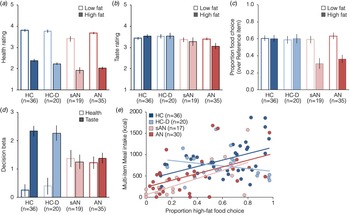
All groups rated the low-fat items as healthier than the high-fat items [F (1,106) = 942.05, p < 0.001], and there was a main effect of Group in overall health ratings [F (3,106) = 7.20, p < 0.001] with no interaction between Food-type and Group [F (3,106) = 1.41, p = 0.24; Fig. 1a]. Post-hoc Tukey tests showed that the sAN group rated food as significantly less healthy than HC (p < 0.001) and HC-D (p = 0.016) groups, but not the AN group (p = 0.23), and that the HC and AN groups differed (p = 0.023). Low-fat and high-fat items were well matched on tastiness (Fig. 1b), with no significant differences by food-type [F (1,106) = 1.19, p = 0.28] or interaction between group and food-type (p = 0.069). There was an overall group difference, but post-hoc tests did not reveal any pair-wise differences between groups (ps > 0.11).
Food ratings and choice across a spectrum of dietary restriction. (a) Low-fat items were rated as healthier than high-fat items across all groups and both groups of healthy individuals rated foods as healthier overall. (b) Ratings of tastiness did not differ between low-fat and high-fat items, indicating that they were well matched. (c ) Groups differed in their selection of high-fat foods, but not in the selection of low-fat foods, such that both eating disorder groups showed less preference for high-fat foods compared with both healthy groups. (d) Influence of healthiness and tastiness ratings on food choices was tested using logistic regression. All groups were compared to the AN group, whose food choices were significantly influenced by both healthiness and tastiness. The sAN group did not differ significantly from the pattern of the AN group, whereas the HC and HC-D groups' choices were influenced more by tastiness and less by healthiness. (e) Food intake in the lab was significantly associated with the proportion of high-fat choices in the Food Choice Task across diagnostic groups and within all groups except the HC-D group. Data were excluded from two sAN and four AN due to binge-eating during the Multi-item meal. Data from one AN are missing due to not completing the Multi-item meal.

Food choices
In the Choice phase, groups differed significantly in their food selection [F (3,106) = 3.47, p = 0.019; Fig. 1c] and there was a main effect of Food-type [F (3,106) = 33.94, p < 0.001]. A significant Group × Food-type interaction [F (3,106) = 13.07, p < 0.001] indicated that groups differed in their choice of low-fat v. high-fat foods. One-way ANOVAs indicated that groups did not differ in their selection of low-fat foods [F (3,106) = 0.30, p = 0.82], but differed in their selection of high-fat foods [F (3,106) = 9.19, p < 0.001]. Specifically, post-hoc Tukey tests indicated that sAN (p < 0.001) and AN (p < 0.001), but not HC-D (p = 1.0) differed from the HC group. The sAN (p = 0.004) and AN (p = 0.008) groups also differed from the HC-D group, but not from each other (p = 0.89). See online Supplementary Fig. S5 for individuals with AN restricting and binge-eating/purging subtypes.
Associations between health, taste, and choice
Behavioral mechanisms of dietary restriction were examined for each group relative to the AN group using multilevel logistic regression models. Food choices among individuals with AN were influenced by ratings of both healthiness (Est = 1.21, z = 5.89, p = 3.89 × 10⁻⁹) and tastiness (Est = 1.38, z = 7.77, p = 7.82 × 10⁻¹⁵; Fig. 1d). The sAN group showed a similar pattern and did not differ significantly from the AN group (Healthiness: p = 0.69; Tastiness: p = 0.67). In contrast, relative to the AN group, the HC and HC-D groups' choices were less influenced by healthiness (HC: Est = −0.96, z = −3.42, p = 0.0006; HC-D: Est = −0.799, z = −2.37, p = 0.018) and more influenced by tastiness (HC: Est = 0.95, z = 3.76, p = 0.00017; HC-D: Est = 0.85, z = 2.78, p = 0.0005).
Multi-item meal intake
One-way ANOVA showed significant group differences in laboratory meal intake (Table 1) with post-hoc Tukey tests showing significant differences between HC and both AN and sAN groups (ps < 0.005) but not between HC and HC-D (p = 0.70). The AN and HC-D groups did not differ in intake (p = 0.26), but sAN and HC-D did (p = 0.045). AN and sAN groups did not differ (p = 0.69).
Food intake in the lab was significantly associated with the proportion of high-fat choices in the Food Choice Task [r (103) = 0.51, p < 0.001]. Results did not change when data from binge meals (n = 6) were included. Within groups, the association was significant among HC [r (34) = 0.47, p = 0.003], sAN [r (15) = 0.62, p = 0.008], and AN [r (28) = 0.48, p = 0.007] but not among HC-D [r (18) = −0.24, p = 0.30] (Fig. 1e).
Comparison of AN v. HC
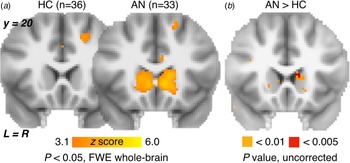
One aim of this study was to investigate neural mechanisms across a spectrum of dietary restriction, but we first sought to replicate our previous findings (Foerde et al., Reference Foerde, Steinglass, Shohamy and Walsh2015) implicating the caudate in food choice in AN. Thus we undertook whole-brain analysis of participants in just the HC and AN groups, revealing extensive engagement of the striatum in the AN group but not the HC group (Fig. 2a and b; online Supplementary Table S2). Because the current sample's behavior was more variable than the previous sample, we also considered a comparison constrained to a matched behavioral sample in the current dataset (see online Supplementary Methods), finding significantly stronger choice-related BOLD activity in the right caudate among individuals with AN compared with HCs (online Supplementary Fig. S2).
Neural systems engaged in food choice. (a) Regions correlated with choice values in a parametric analysis in HC (left) and AN (right), family-wise error (FWE)-corrected p < 0.05, whole-brain, cluster-forming threshold Z > 3.1. (b) Direct comparison between the HC and AN groups (uncorrected for multiple comparisons).

Choice-related engagement of the caudate across a spectrum of dietary restriction
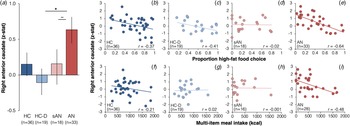
When choice-related brain activity was examined across the full spectrum, we found group differences in the a priori ROI in the right, anterior caudate (Fig. 3a). The HC [t (67) = −2.00, p = 0.049] and HC-D [t (50) = 2.68, p = 0.010] groups differed significantly from the AN group, and the sAN group showed a non-significant trend toward less engagement of the caudate region relative to the AN group [t (49) = 1.69, p = 0.097].
Engagement of caudate across the spectrum of dietary restriction and relationship with eating behavior. (a) Values extracted from the parametric choice analysis in our a priori anatomical ROI in the right anterior caudate. AN and sAN restricting and binge-eating/purging subtypes are shown separately for illustration purposes in online Supplementary Fig. S5. The AN group differed significantly from the HC and HC-D groups and showed a non-significant trend toward a difference with the sAN group, whereas the other groups did not differ. (b–e) Across all individuals, activity in the caudate ROI was significantly correlated with proportion high-fat food choices on the food choice task (controlling for BMI) and with actual food intake in a laboratory meal (controlling for BMI). (f–i) Correlations within each subgroup are shown for information purposes; statistical comparison of correlations was not carried out because it was not an a priori question of interest and to minimize the number of comparisons.

To determine whether these group differences in BOLD activity in the caudate were related to food-choice behavior, choice-related activity in the caudate ROI was compared with the proportion of high-fat choices and with the calories consumed in the laboratory meal. Across all individuals, caudate association with choices was significantly correlated with the proportion of high-fat food choices (r = −0.402, p = 0.00002, controlling for BMI) and with calories consumed in the multi-item meal (r = −0.24, p = 0.017, controlling for BMI), indicating an association between restrictive eating and caudate engagement (Fig. 3b–i; correlations are plotted separately for each subgroup for illustration purposes). Duration of illness was not significantly associated with the proportion of high-fat food choices or caudate engagement (online Supplementary Fig. S3).
Whole-brain analysis of choice-related BOLD activity across a spectrum of dietary restriction
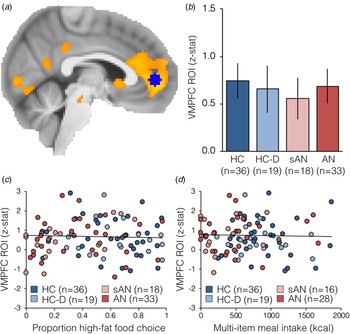
Whole-brain analyses characterizing the full pattern of neural results are presented in online Supplementary Table S1. Consistent with the studies of value-based decisions (Hare et al., Reference Hare, Camerer and Rangel2009; Rangel, Reference Rangel2013), we found choice-related engagement of the VMPFC in all groups (online Supplementary Table S1). To further compare groups, we performed targeted analysis within a VMPFC region obtained from an independent study (Hare et al., Reference Hare, Camerer and Rangel2009) and saw no differences between groups (all ps > 0.50; Fig. 4). We also assessed group differences in functional connectivity between the anterior caudate and VMPFC ROIs (see online Supplementary Data Analyses) and found that only the HC-D group differed from the other groups. This difference was driven by a few extreme values in the HC-D group (see online Supplementary Fig. S6).
Comparison of choice-related activity across groups in VMPFC. (a) Average activation across all groups (yellow/orange) with VMPFC ROI overlaid. (b) VMPFC ROI engagement during the Choice phase. VMPFC engagement during the Choice phase was not correlated with the proportion of high-fat food choices in the task (c) or with intake during the laboratory meal (d).

Discussion
Restriction of food intake occurs across a spectrum from non-pathological dieting to eating disorders. In this study, the spectrum was approached in hypotheses and analyses by including individuals in one of four groups. Participants did show progressive increases in weight suppression according to group (HC < HD < sAN < AN), with individuals with AN at one extreme and HC at the other. Largely consistent with a spectrum perspective, greater avoidance of high-fat foods in the Food Choice Task was associated with greater engagement of the dorsal striatum across the whole sample. On some measures, differences across groups suggested more categorical distinctions. For example, behavior on the Food Choice Task (including foods chosen and the influence of healthiness and tastiness on these choices) suggested a distinction between normal and disordered eating, such that the HC and HC-D groups performed similarly, as did the sAN and AN groups. These results underscore the value of direct measurement of food restriction to understand mechanisms of illness. In addition, current results suggest that, although there are some continuities across degrees of food restriction, the characteristics of both behavior and associated neural processing of individuals with AN lie at one end of an extreme and differ from those of HC.
The main findings in this study further support a role for dorsal frontostriatal systems in the pathophysiology of AN, specifically the anterior caudate. The involvement of this region in AN is consistent with other studies, which have shown abnormal engagement of the caudate in response to prediction errors (Frank et al., Reference Frank, DeGuzman, Shott, Laudenslager, Rossi and Pryor2018) and body image cues (Sweitzer et al., Reference Sweitzer, Watson, Erwin, Winecoff, Datta, Huettel and Zucker2018), as well as in passive responding to food cues (Rothemund et al., Reference Rothemund, Buchwald, Georgiewa, Bohner, Bauknecht, Ballmaier and Klingebiel2011) and in resting-state functional connectivity (Haynos et al., Reference Haynos, Hall, Lavender, Peterson, Crow, Klimes-Dougan and Camchong2019). The present study extends this by examining food choices directly. In the context of learning and decision making, the caudate has been implicated in some studies examining habitual v. goal-directed control of behavior (Gillan et al., Reference Gillan, Apergis-Schoute, Morein-Zamir, Urcelay, Sule, Fineberg and Robbins2015). We cannot disambiguate these processes in the current study, and behavioral inferences, such as whether food choice in AN preferentially uses mechanisms underlying habitual behavior, cannot be made on the basis of brain activation. It is clear, nonetheless, that the caudate region implicated in this study of food choice is important for action control and choice (Liljeholm & O'Doherty, Reference Liljeholm and O'Doherty2012). It is therefore interesting that the engagement of this region differs in AN and is particularly associated with restrictive food choices. Notably, the fMRI differences between groups were specific to the region and to choice as we did not find similar group differences in the caudate during ratings of healthiness and tastiness (online Supplementary Fig. S4) or group differences during the choice phase in the VMPFC, which is involved in food choice unrelated to restriction.
On one indirect measure of food restriction, body weight, the AN group was, by definition, distinct. It is possible that being underweight makes an important contribution to the neurobiology of AN. For example, a recent study found neural differences associated with prediction errors in AN early in the illness, suggesting that starvation – more than duration of illness – may significantly affect neural functioning (Frank et al., Reference Frank, DeGuzman, Shott, Laudenslager, Rossi and Pryor2018). A structural MRI study found that individuals with Atypical AN, who by definition were not underweight, did not show the same reduction in gray matter seen in AN (Olivo et al., Reference Olivo, Solstrand Dahlberg, Wiemerslage, Swenne, Zhukovsky, Salonen-Ros and Schioth2018), also hinting at the possible relevance of the level of starvation to disturbances in neurobiology. Some studies have reported that in the context of globally decreased gray matter volume, caudate volume was normal among underweight individuals with AN (King et al., Reference King, Geisler, Ritschel, Boehm, Seidel, Roschinski and Ehrlich2015; Yue et al., Reference Yue, Wang, Kaye, Kang, Huang, Cheung and Chan2018), thereby appearing as increased caudate volumes in AN relative to HC. Similarly, one study reported normal dorsal caudate volumes among ill, but not recovered AN, as compared with HC (Frank, Shott, Hagman, & Mittal, Reference Frank, Shott, Hagman and Mittal2013). Thus the dorsal striatum may be particularly affected by starvation. Translational research in rodents showing that dopamine in the dorsal striatum mediates eating behavior further contributes to this hypothesis about the pathophysiology of AN (Palmiter, Reference Palmiter2007; Reference Palmiter2008). A better understanding of the relationship between starvation and the caudate would be useful, though studying food choice in other underweight populations (e.g. cancer cachexia) is confounded by other effects of medical illness. Further investigation of different stages of illness in AN, especially among individuals shortly after illness onset, may additionally be informative (Steinglass, Glasofer, Dalack, & Attia, Reference Steinglass, Glasofer, Dalack and Attia2020).
In this study, restrictive eating in a non-eating disordered population was defined based on actual behavior (i.e. weight loss) rather than by restrained eating (measured by TFEQ-Restraint subscale). Food choice task studies that have included individuals high in restrained eating, regardless of successful weight loss, have shown, in some cases, greater valuation of healthier foods, and choices that are consistent with weight loss goals (Georgii, Schulte-Mecklenbeck, Richard, Van Dyck, & Blechert, Reference Georgii, Schulte-Mecklenbeck, Richard, Van Dyck and Blechert2020). In the present study, we find a slightly different pattern – the HC-D chose the high-fat snack options similarly to the HC, but consumed less in the laboratory meal, such that the two measures were not correlated in this group. It may be that there is a qualitative difference between restriction in healthy v. ill individuals, such that the HC-D are more willing to be flexible in their snack choices whereas those with AN and sAN are rigidly adherent to restrictive choices. However, the absence of a correlation within the small sample of HC-D should be interpreted with caution and points to the need for larger-scale studies. The finding does suggest that there may be value in more research into the brain and behavior mechanisms of successful dieters and the relationship between cognitive and behavioral restraint. Similarly, to extend this research to understand a broader spectrum, it would be interesting to consider the mechanisms of choice among individuals who have recovered from AN, when dietary restraint scores are commonly high even while stable weight is maintained.
Several limitations of this study warrant consideration. The smaller sample size in the sAN and HC-D groups is the most notable limitation, especially in the setting of four comparison groups. There was also heterogeneity within these groups that may have limited power to detect neural differences. For example, the sAN group included outpatients as well as inpatients. The patients with AN in this study had a mean age of 27 years but had already been ill for more than 9 years, on average. The presence of illness for this length of time limited our ability to detect behavioral and neural differences that may occur early in the course of illness. This study also has notable strengths. The design focused on active decisions about food, with real consequences (post-task snack). The choices on the task related to actual eating behavior across the whole group, and within all groups except the HC-D. Participants were not taking psychotropic medications, as the effects of these medications on neural circuitry are not well understood.
This study examined a neurocognitive process that exists across psychiatric diagnoses and health. This approach has provided valuable insights into psychopathology in other domains [e.g. anhedonia (Lambert et al., Reference Lambert, Da Silva, Ceniti, Rizvi, Foussias and Kennedy2018)]. In the current study, the relationship between choices on the task (and meal) and the dorsal striatal activation demonstrates the utility of examining behavior that can exist in normative and pathological forms. Additionally, these data show compelling differences between illness and health, highlighting a greater need to understand what may occur when behavior crosses a threshold to pathology. At the same time, these results identified variability across individuals within the AN group who all met criteria for the same illness. AN is often thought of as being a fairly stereotyped illness, yet this variability suggests that there may be some range, or heterogeneity, even among the acutely ill. Such within-group variability needs to be examined to test whether differences predict intervention response or prognosis. Advances in cognitive and computational neuroscience increasingly offer opportunities to probe such individual variability (Bennett, Silverstein, & Niv, Reference Bennett, Silverstein and Niv2019; Huys, Maia, & Frank, Reference Huys, Maia and Frank2016).
The AN group comprised restricting and binge-eating/purging subtypes. There were no differences between illness subtypes in this study in eating behavior or neural measures but the study was not designed to assess subtype differences. In a larger sample that combined data across studies (40 AN-R v. 46 AN-BP), no differences were found on any behavioral measures on the Food Choice Task (Uniacke et al., Reference Uniacke, Slattery, Walsh, Shohamy, Foerde and Steinglass2020), suggesting that examination of restriction across subtypes is reasonable. Nonetheless, binge-eating and/or purging behavior, which is unique to a subset of the AN and sAN groups, may affect neural systems in important ways that should be investigated in future studies.
In summary, the results of this study suggest that dorsal striatal activity guides persistent pathological restrictive food intake, and is especially prominent among individuals with AN. The continued demonstration of the role of dorsal striatum in pathological behavior in AN underscores the need to understand in greater detail how this area of the brain becomes linked to pathological food restriction in AN. It will be important, for example, to examine these brain and behavior mechanisms in adolescents, early on in the course of illness and to determine whether prolonged starvation may influence the neurobiology and whether these findings change with the restoration of normal weight.
Supplementary material
The supplementary material for this article can be found at https://doi.org/10.1017/S0033291720003542
Author contributions
K.F., B.T.W., D.S., and J.E.S. designed the experiments, and interpreted data with additional contributions from N.D.; J.S, L.D., and J.E.S. performed and supervised study procedures; K.F. and J.E.S. analyzed data; K.F. and J.E.S. wrote the manuscript; N.D., B.T.W., and D.S. contributed to shaping the manuscript and discussion.
Financial support
This study was supported by the National Institute of Mental Health R01 MH105452; R01 MH105452 S1; K24 MH113737.
Conflict of interest
Dr Steinglass receives royalties from UpToDate. Dr Walsh receives royalties and honoraria from Guilford Press, McGraw-Hill, Oxford University Press, UpToDate, British Medical Journal, Johns Hopkins Press and Guidepoint Global. Dr Daw, Dr Foerde, Dr Schebendach, and Dr Shohamy and Davis report no financial relationships with commercial interests.
Ethical standards
The authors assert that all procedures contributing to this work comply with the ethical standards of the relevant national and institutional committees on human experimentation and with the Helsinki Declaration of 1975, as revised in 2008.