Introduction
‘Kenya's official languages: English, Kiswahili, and silence. But there was also memory’, writes Yvonne Owuor in Dust.Footnote 1 One of the main issues feeding the controversies of memory and plaguing historical celebration in many African countries is indeed silence. Richard Werbner notes much of this controversy has to do with the format of celebration introduced into former European colonies in Africa after the First World War, a model that created tensions in the postcolonial period because of competing claims between individuals and groups.Footnote 2
Individuals considered national heroes have mostly been held in higher regard than collectives and groups. Yet, the academic literature on examples of heroism on the African continent lags behind in comparison to other regions of the globe. What is available tends to focus on high-ranking political figures, including Agostinho Neto, Amílcar Cabral, Jomo Kenyatta, Julius Nyerere, Kwame Nkrumah, Nelson Mandela, Robert Mugabe, Samora Machel, and Thomas Sankara.Footnote 3 Although work on these leaders is crucial to the historiography of the countries they ruled and helped liberate, the focus on politicians has resulted in the overlooking of other individuals who played a fundamental role in the liberation of African countries from colonial rule.Footnote 4
Popular culture offers a deeper repository for recognising and remembering heroes. In his 1972 song Les Immortels, the Congolese baritone Franklin Boukaka inserts into the hall of world liberators, alongside Che Guevera and Malcolm X, a set of figures that are typically not the most visible faces of these historical processes in Western historiography, including Ruben Um Nyobé, Félix Moumié, and Nguyen van Choi. One of the greatest examples of heroism in Angola, Hoji ya Henda, also features in Boukaka's song: ‘Mehdi, nzela na yo ya Hoji ya Henda’ (Mehdi, your way is that of Hoji ya Henda).Footnote 5
This article analyses the construction of the political memory of José Mendes de Carvalho ‘Hoji ya Henda’, one of Angola's most iconic national heroes. Exploring specific historical events and shifts in the regime of memory in Angola, I argue that the Angolan state uses Hoji ya Henda's memory to invoke a practice of virtue and morality that serves its political objectives of mobilising Angolan youth.Footnote 6 By analysing different iterations of political memories of Henda the article shows that heroes are both fixed and subordinated to official history but also puppeteered by political actors looking to influence and shape collective memory.
Literature on heroism in sub-Saharan Africa is largely produced in the fields of political history and anthropology. Wale Adebanwi underscores the political dimension of heroism, noting how in Yoruba society ‘heroism is constructed as much from the singular acts of individuals as from the sociocultural and political material that history furnishes the people’.Footnote 7 In the anthropological field, Filip de Boeck traces specific cultural elements of groups living around the border between Congo and Angola to show how mass-mediated heroes — like Rambo, Superman, and the cartoon Teenage Mutant Ninja Turtles — fit well with existing cultural templates and the overall social imagination of heroism.Footnote 8 This is an important point, for heroes, heroines, and heroism carry semiotic meanings and imaginaries that have much to do with the cultural worldview of specific communities. Yet, hero worship is also a broader phenomenon, entangled with globalised formats of celebration that emphasise historical immortality, as is typically exhibited in Western countries.
The state-led celebration of heroes in postcolonial Angola follows this globalised format. Western conceptions of historical heroism shaped these celebrations but so too did the heroic narratives employed by Soviet Marxism-Leninism. Western conceptions of heroism point to the notion of ‘great men’ in Thomas Carlyle's styling: the intellectual, moral, and masculine figure.Footnote 9 They generally follow Ernest Renan's view of a golden past fashioned by men of glory; imaginaries crafted to provide social and political capital to the idea of nation.Footnote 10 The independent Angolan state borrowed the generic heroism of the popular masses from Leninism — which it articulated in invocations of the heroic people of the Popular Movement for the Liberation of Angola (MPLA) — creating tension with the celebration of single figures.Footnote 11
Angola was one of the last countries in the sub-Saharan African region to gain its independence, having fought a protracted war against the Portuguese colonial state between 1961 and 1974. Although this war gave rise to heroic commanders, the processes of celebrating, remembering, and silencing these figures have remained largely unexplored in the country. What do Angola's heroes tell us about the values of Angolan society? How does the state use the history of heroes to channel popular sentiment?
The socialist values instilled by the MPLA during the First Republic (1975–92) had direct repercussions on the celebration of heroism and its use for political ends. The 1980s in particular were an extremely fertile decade in what concerned the organisation of Angolan society ‘under Lenin's silent gaze’.Footnote 12 Organising society meant creating a new idea of civic virtue firmly rooted in the morality of the Angolan revolution. The central ideological tenets of the revolution resided in the story of a relentless fight to emancipate Angolans from all types of domination and colonial rule. International imperialism was embodied in Apartheid South Africa's military incursions in support of its Angolan proxies — particularly the National Union for the Total Independence of Angola (UNITA) and, no less importantly, the bourgeois attitudes of neo-colonialism, tribalism, racism, corruption, alcoholism, and all kinds of dissidence.Footnote 13 To materialise this new civic virtue, the MPLA mixed Western configurations of hero celebration with the above mentioned heroism of the masses. This translated into state promotion of specific heroes as representations of parts of the party, notably including the Juventude do MPLA (JMPLA, Youth of the MPLA).Footnote 14 Thousands of articles published in newspapers, bulletins, and magazines — alongside statues, days of celebration, and songs — all worked to construct figures as heroes and, thus, create a moral imperative to follow their example. Hoji ya Henda embodies this process of hero-making in postcolonial Angola.
I argue that states manufacture heroes to consolidate power, as political leaders instrumentalise figures from the past to consolidate new ideologies and adjust socio-political moralities in the present. Configurations of morality are particularly apposite here. As Werbner argues, the political cannot be meaningfully studied apart from the moral.Footnote 15 That is, there is a concrete connection between the invocation of a memory and the agendas of moralisation of a population by a group in power. A tendency towards the manipulation of memory shapes the dominant narratives, and silences and marginalises the contributions of many people.Footnote 16 The political scientist Mweni wa Muiu asks, ‘how many times have people fought for liberation only to be replaced by others who became heroes at the dawn of freedom’?Footnote 17 I examine a corollary of this question: how many times have people fought for liberation only to have memories of their deeds subjected to shifting ideologies and political exigencies?
The article is organised in three sections. The first section provides a biography of the life of José Mendes de Carvalho, and explores his transformation into the legendary commander Hoji ya Henda. The second section examines the uses of Henda's memory in recent history (1975–91), interrogating how the ruling MPLA mobilised it depending on the changing political and military circumstances. I follow invocations of Henda's memory to this day, demonstrating how political planning and intention features not only the act of remembering but also the silencing of specific details of his life. The final section unpacks shifts in the political system of Angola and its impacts on the regime of memory after the turn to multiparty democracy in the country, with a specific focus on the end of the presidency of dos Santos and the beginning of João Lourenço's rule. The legend of Hoji ya Henda survived the shifts in the Angolan state's regime of memory and the MPLA appears to once again be summoning his memory to mobilise and moralise society.
This article draws from archival work conducted in Luanda between 2018 and 2020, mostly in the Lúcio Lara Archive at the Associação Tchiweka de Documentação (ATD), where I primarily consulted MPLA and JMPLA publications, pamphlets, speeches, and declarations. I conducted two interviews in January 2020 with friends and members of the family of Hoji ya Henda. The archive at the Angolan National Library was also surveyed to collect copies of Jornal de Angola between the years 1975 and 2017. I traced how, when, and in what circumstances Hoji ya Henda figured in Jornal de Angola, particularly on April 14, the Day of Angolan Youth, between those years. I did not interview Angolans to get at the popular imagination of Henda. Instead, I briefly consider photographs that circulated in social media outlets to read the attention people are paying to the new shifts in the regime of memory, mostly photos of MPLA propaganda. I focus primarily on the state as a producer of narrative and meaning, and on how different state actors at different moments in time highlight or marginalise the memory of Henda.
Becoming ‘Hoji ya Henda’
José Mendes de Carvalho ‘Hoji ya Henda’, his nom de guerre, was born in Ndalatando, formerly Salazar, on 29 July 1941.Footnote 18 José Mendes was part of an assimilated family — as opposed to indigenous, under Portugal's Native Statute — during Angola's colonial period under Portuguese rule.Footnote 19 His father, Agostinho Domingos de Carvalho was a nurse, one of a few black Angolans who possessed a professional diploma in a country where the vast majority of the African population, and a significant part of the European population, had no primary education whatsoever. Not much is known about his mother, Florinda de Carvalho, apart from being a stay-at-home mother and, alongside his father, an important figure within Protestant Methodist circles in the hinterland of Luanda.
The extended Mendes de Carvalho family had deep roots in Catete, a village 70 kilometres outside Luanda, one of the cradles of Angolan nationalism. José Mendes belonged to a family that was modern, assimilated, and culturally Protestant, the ingredients that have historically characterised the social background of many of the first Angolan nationalists that came to join the MPLA. After finishing primary school in Ndalatando around 1954, José Mendes went to Luanda to continue his studies, having stayed under the care of Agostinho Pedro Neto and Maria da Silva Neto, the parents of Agostinho Neto, who would later become the first president of Angola. At their house in Bairro Operário, a neighbourhood in Luanda historically rooted in Angolan nationalism and where clandestine activities were common, José Mendes also met Deolinda Rodrigues, one of the greatest heroines of Angola's anti-colonial struggle, and Roberto de Almeida, Deolinda's brother and a top MPLA militant. During his stay in Luanda, José Mendes became further entrenched in the vanguard of modern Angolan nationalism, surrounded by people acting clandestinely against the colonial regime who would become the most visible faces of the MPLA and of anticolonial nationalism in Luanda.
In the late 1950s the Portuguese political police, known as the International Police for Defence of the State (PIDE), began cracking down on nationalist activities in Luanda.Footnote 20 In 1959 the PIDE arrested various Angolan nationalists, an episode referred to as the Trial of the 50.Footnote 21 Members of José Mendes’ family, including his cousin António André Mendes de Carvalho ‘Uanhenga Xitu’, were arrested and sent to the infamous Tarrafal prison camp in Cape Verde where many nationalists from the Portuguese colonies were imprisoned.Footnote 22 José Mendes’ family and friends were increasingly targeted by the PIDE. After the independence of Congo in 1960, José Mendes fled Luanda together with Ismael Martins and Ilísio Figueiredo. Disguised as peasants looking for work in the northern plantations of Angola, the three men eventually reached Léopoldville, today Kinshasa, and joined the MPLA. As Ismael Martins remembers,
Our objective was to reach Leopoldville and join the ranks of a liberation movement… So we joined that which seemed more just and with clearer objectives in terms of mobilisation. That was the MPLA. We arrived at Kinshasa before the 4 of February, on 29 January 1961.Footnote 23
I asked Ismael Martins when José Mendes become Hoji ya Henda, an expression in Kimbundu language that loosely translates to lion heart, alluding to the qualities of courage and leadership that characterise his nom de guerre.
He was already Hoji ya Henda here in Luanda. Even during our escape, he had set himself as a man of the masses, a commander… [Tomás] Ferreira and Hoji ya Henda assumed themselves as military commanders. There was a group of young people selected to study in Czechoslovakia [among them Henda]. But those who wanted military education went to countries like Algeria. And that is where Hoji ya Henda went. That is the turning point when José Mendes de Carvalho became Commander Hoji ya Henda.Footnote 24
Henda had in fact received military training in Ghana and Morocco, two other countries also committed to support the liberation struggles in southern Africa. Nonetheless, Martins affirms that Henda was always regarded as a leader, a person whose courage and initiative to be on the front lines truly shaped his role in the MPLA's guerrilla struggle. He became a commander in Cabinda in 1964, the MPLA's Second Political and Military Region. Henda was promoted to Commander General of the Detachment of Guerrillas, the MPLA's military wing, when the unit was reconstituted from the former Popular Army for the Liberation of Angola during the First Conference of Cadres in 1964. He was 21 years old at the time. Henda was already a well-known and well-regarded commander and member of the MPLA's Directorate Committee when he went to the Eastern Front in 1966, the MPLA's Third Political and Military Region. It was there, on 14 April 1968, that his life was cut short. At the age of 26, Hoji ya Henda was killed in action after storming a Portuguese military compound in Karipande, in the province of Moxico, eastern Angola. The memorialisation of his example and commitment to the liberation of Angola began immediately after.
Three days after the attack on Karipande that resulted in Henda's death, the MPLA's official information outlet, the newspaper Victory or Death, announced that Henda had been killed in action. The communiqué ends with the following words:
His comrades lost a commander, but his heroic demise will be honoured and glorified by them, and, without a doubt, he will be sacralised as a great Hero of our People. The Angolan combatants solemnly swore at his grave to continue the national duty of the liberation of the Homeland, the best and only way to avenge his disappearance. The enemy will feel the weight of the implacable condemnation of our People. From the memory of Commander José Mendes de Carvalho the decisive victories of the liberation of our beloved homeland will bloom.Footnote 25
Paying homage to Commander Henda, the First Assembly of the MPLA in the Eastern Front, which took place over 25–28 August 1968, bestowed Hoji ya Henda with the title ‘Well-beloved son of the Angolan people and heroic combatant of the MPLA’. April 14 was declared Day of the Angolan Youth, a day of celebration that continues through the present. Two years after his death, on 14 April 1970, a ceremony was held in the midst of the anticolonial war, in Cabinda, where he had fought, to pay homage to his memory (Fig. 1, below).
Funeral of Hoji ya Henda in Cabinda, 1970, with an empty coffin.
Source: Photo provided by the ATD, part of the Lúcio Lara Archive.

Mbeto Traça, a general in the Angolan Armed Forces who fought in the liberation struggle, writes that the MPLA was never very efficient in honouring its heroes during the liberation struggle.Footnote 26 That was not the case with Hoji ya Henda. Henda was considered and honoured as a hero by both MPLA leaders and his comrades in arms even before the independence of Angola, and would become a national reference afterwards. For the MPLA, his example proved to be a powerful political weapon at a time it was not yet in control of the state mechanisms that allowed a more robust and perennial diffusion of memory. The invocation of heroes has utilitarian purposes. Nation states regularly instrumentalise the actions and feats of heroes to set the tone and narrative needed during a particular period. Hoji ya Henda was already well placed to occupy that role before independence and became more so with the MPLA in control of the state.
A hero's postmortem
Over the past 46 years, MPLA party and state publications have invoked Hoji ya Henda's memory hundreds of times, putting his memory to political use.Footnote 27 These numerous acts of remembrance reveal a pattern that is constant in both content and form, establishing Henda as a role model imbued with positive and praiseworthy characteristics, often translated into catchphrases repeated in public speeches, newspaper headlines, and political pamphlets and bulletins. ‘The humanism of Henda’, ‘Let's follow the example of Henda’, or ‘The heroic example of Henda’ were slogans constantly voiced by the MPLA and its youth organisation, the JMPLA, throughout the 1970s and 1980s.Footnote 28 Party publications described him as a great militant, a profile of a hero, a symbol of Angolan youth, a symbol of courage and bravery, and an irreplaceable militant. These praises were usually followed by tributes to his honesty, courage, loyalty, initiative to always be on the frontline, and other traits that others could aspire to follow.Footnote 29 For nearly two decades the memory of Henda was used to illustrate the moral imperative the state sought to instil in Angolans, particularly the youth. The state encouraged the citizenry to identify with Henda as a proxy for the MPLA's achievements, and particularly young people's role in the armed struggle. In the process, Henda came to inform the type of citizen the MPLA wanted to create, one aware of the perils of imperialism and bourgeois behaviour and above all committed to the Angolan revolution — an aspirational model which shaped how the state engaged with young people even when it failed to instil these values in youth broadly.
Soon after independence in November 1975, the memory and name of Hoji ya Henda were already being invoked in various products and practices of memory.Footnote 30 There was a committee called Comité Henda, which defined itself as ‘an organisation of revolutionary unity whose activity is framed on the work of propaganda and political agitation with the objective of elevating political consciousness’.Footnote 31 There was a Centre for Revolutionary Instruction Hoji ya Henda and a newspaper entitled Henda, the official information outlet of the JMPLA, of which Henda became patron.Footnote 32 But the memory of Henda also relates to a particularly difficult period for the MPLA in the aftermath of a coup attempt on 27 May 1977.Footnote 33 Many of the youth organisations created in Luanda after independence in support of the MPLA, including the Comité Henda, were organised in autonomous groups, neighbourhood and workers committees, to whom the MPLA owned ‘its political regeneration and supremacy, both militarily and in terms of popular and social mobilisation in Luanda in 1974/75’.Footnote 34 Many of these organisations came to support Nito Alves, a MPLA guerrilla fighter who gathered much popular support, including among well-known musicians, allegedly in attempt to dominate the base organisations of the MPLA and sideline Neto from the presidency of the movement.Footnote 35 This process culminated in the attempted coup, to which the state responded with a wave of repression. The repression victimised countless MPLA militants and particularly the youth, who had actively supported the MPLA since before they returned to Angola in 1974. Despite the association of Henda's name with the Comites Henda that supported Nito Alves, after the internal purge, the MPLA used Henda's memory to again rally the youth. One of the greatest honours bestowed upon Henda was the Medal of the Order of the National Hero, in 1977, nine years after his death and amidst the repression following May 27. What was particularly symbolic about this honour was that it was also bestowed upon President Neto during the same ceremony, the meeting of the MPLA's Central Committee on 2 December 1977. In a clear sign that the MPLA would use Henda's memory to signal the youth, he was honoured with the same distinction as Angola's ultimate hero, Agostinho Neto, whose date of birth on September 17 is celebrated as the Day of the National Hero.Footnote 36 In this way, Henda truly became a hallmark for liberation and devotion to Angolan independence, cited in a variety of outlets, across newspapers, political bulletins and posters, photographs, texts, opinion columns, and record covers.
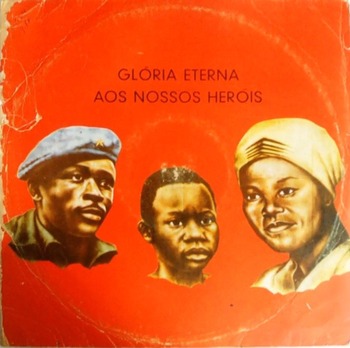
Besides Franklin Boukaka's Les Immortels, Angolan musician Santocas included a tribute to Hoji ya Henda in his record Glória Eterna aos Nossos Heróis (Fig. 2, above), as did Elias Diá Kimuezo.Footnote 37 More than 30 years later, Paulo Flores, one of Angola's most famous musicians, recorded a rendition to Hoji ya Henda in his 2012 album Ex-Combatentes Redux. The song titled Hoji ya Henda begins with the words ‘Hoji ya Henda/Grande herói da banda’ (Hoji ya Henda/Great hero of our country).
Album cover of Santoca's famous 1978 record Glória Eterna aos Nossos Heróis (Eternal Glory to our Heroes). Depicted in the cover, from left to right, are Hoji ya Henda, Augusto Ngangula, and Deolinda Rodrigues.

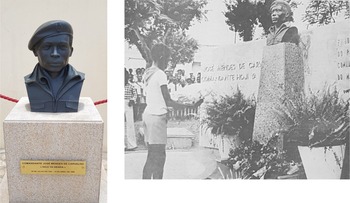
In Luanda, Henda's memory continues to be visible, although enjoying less exposure than it has in previous years. The Hoji ya Henda neighbourhood was named after him, as was the Hoji ya Henda Avenue, one of the largest in the city. A monument to Henda stood at the Ministry of Defence, but it was later dismantled. Only the bust remains, placed at the Fortaleza of São Miguel, the fortress overlooking the bay of Luanda (Fig. 3, below).Footnote 38
Bust of Hoji ya Henda at the entrance of the Fortaleza of São Miguel (on the left). The bust was previously part of a monument to Henda in front of the Ministry of Defence (on the right).
Sources: Photo by the author and ATM, cover photo of Jornal de Angola, 15 April 1978, respectively.

The invocation of Henda's memory became subordinated to the politics of power in the country, as well as to a set of rules Borges Coelho has termed the ‘liberation script’, which I have explored elsewhere for the Angolan case.Footnote 39 As Ducharme and Fine state, ‘celebration of the remembered past enhances collective commitment to those ideals’.Footnote 40 Collective commitment to the MPLA's ideals and engagement with Angola's political and military circumstances was exactly what the regime sought when invoking Henda's memory. Evidence, in song and state publications from the period, speak to this calculated articulation between memory and politics in the 1980s, twelve years after his death in combat.
The MPLA circulated Henda's image and invoked his example to mobilise young men for the war against South African invasion in support of UNITA. Angola was attacked by South Africa before independence in November 1975, as the apartheid regime was eager to control the chain of events that put in power what they termed a communist regime in what was once a bastion of white colonial rule in southern Africa. After 1979/1980, South African aggression against Angola and its support for UNITA steadily increased. In order to address the situation, the Angolan state had to mobilise the population through whatever means necessary. For example, on 14 April 1980, Afonso Van-Dúnem's speech reminded young Angolans of Henda's role in the fight against colonialism and imperialism, underscoring his relationship with the youth:
Commander Hoji ya Henda was and will always be the symbol of the Angolan youth, because he knew, with his honesty, courage, determination and spirit of sacrifice, how to assume the struggle of our youth, at the side of the MPLA, in the incessant war against colonialism and international imperialism.Footnote 41
Here the Minister of External Relations, Van-Dúnem, pit historical memory against ongoing imperialist aggression. While not possible to know how widely this speech circulated or how many people it mobilised, this idea of Henda was deployed again in the context of the fight against South African aggression that finally led to the battle of Cuito Cuanavale.Footnote 42 Fighting took place between November 1987 and March 1988, opposing the MPLA and the Angolan state, with Cuban and Soviet assistance, against the South African Defence Force, in support of UNITA. As tensions increased and military operations were drawn, the MPLA needed to galvanise and moralise the youth to fill in the ranks.Footnote 43 To that end, Henda's memory provided a narrative mechanism, an articulation of the moral imperative to defend the nation against the forces of imperialism that sought to destroy it, by asserting the role and responsibility of the youth as the inheritors of the predicates of the liberation struggle and of an Angola free from foreign intervention. An analysis of the official speeches in celebration of April 14, the day of the Angolan youth, published by Jornal de Angola between 1975 and 1990, show that in the years 1987–8, that is, at the time of the battle of Cuito Cuanavale, Henda's memory was used for a very specific objective, the mobilisation of the youth. The person who made the speech in preparation for the battle of Cuito Cuanavale was not the typical JMPLA or MPLA politician of previous years but the Minister of Defence himself, Pedro Maria Tonha ‘Pedalé’. Invited to speak at the JMPLA's Second Congress on 14 April 14 1987 under the slogan ‘the youth and the defence of the homeland’, Pedalé stated that the greatest responsibility for defending the country lay with the youth, called upon to defend the revolution and the memory of those who fell for independence and for the social progress of Angola. Pedalé spoke of episodes of ‘courage, abnegation and heroism’ which wrote ‘glorious pages in the history of the struggle of our people’, invoking the example of Hoji ya Henda whose ‘life trajectory and example of just combatant continues to serve as an inspiration to all our youth'.Footnote 44
One month after the battle of Cuito Cuanavale, on 14 April 1988, the Political Bureau of the MPLA published a lengthy declaration in celebration of the twentieth anniversary of the death of Hoji ya Henda. The date was articulated with the recent military episode of Angola:
For the occasion of the twentieth anniversary of the death in combat of Commander Hoji ya Henda and the Day of Angolan Youth, the Political Bureau of the Central Committee of the MPLA-Partido do Trabalho salutes the young combatants of the Popular Armed Forces for the Liberation of Angola (FAPLA), whose bravery and audacity in the combat against the South African invaders has been the guarantee of the defence of our revolutionary conquests, of our national sovereignty and territorial integrity. The Political Bureau of the Central Committee of the MPLA-Partido do Trabalho reaffirms that the youth in the Armed Forces, Security Bodies and Internal Order have always corresponded to the demands of the war of aggression that is imposed on us by the racist regime in Pretoria, understanding that the defence of the homeland constitutes a sacred, primary and honourable task.Footnote 45
The battle of Cuito Cuanavale resulted in a political stalemate between the MPLA and UNITA, leading both parties to the negotiating table. This process produced the New York Accords of 1988, eventually leading to Namibia's independence, and the Bicesse Accords of 1991, which culminated in Angola's first elections in 1992. These events opened the way to an important shift in the regime of memory: the end of single-party rule in Angola, which the MPLA abolished in its Third Extraordinary Congress in 1992, in favour of a democratic regime. With democracy and the return to civil war after the failure of the elections, the regime of memory changed, and with it the invocation of heroes. But not towards the inclusion of a plurality of figures. On the contrary, during the 1990s and especially in the 2000s, the state silenced and sidelined most of its heroes, which were in fact MPLA heroes. This practice had already achieved success in 1977 with the purging of famous MPLA heroes such as Jacob João Caetano ‘Monstro Imortal’ from Angolan history, given the role he and others had in the alleged coup d’état of 27 May 1977. By the early 2000s, even Agostinho Neto himself was relegated to the pages of history books, his example and political thought often forgotten in the new Angola.
A comprehensive survey of the covers and news articles of Jornal de Angola published on April 14 between 1975 and 2017 confirmed that the memory of Hoji ya Henda was also marginalised, displaced from its original point of memorialisation after the democratic transition, and subjected to the new dynamics of power in Angola.Footnote 46 With the exception of 1977, Hoji ya Henda figured in the April 14 edition of Jornal de Angola every year until 1991. It was only after the turn to multiparty democracy that Henda faded from Angola's state-owned newspaper.Footnote 47 Henda's memory, and that of most MPLA heroes came to be sidelined by a new regime of memory, one that sought to build the cult of personality of dos Santos and erect a new political and economic order that no longer reflected the values associated with Hoji ya Henda.Footnote 48 The next section explores the role of Hoji ya Henda in this new regime of memory.
Changing regimes of memory
The fading of Henda's memory from state narrative coincided with the shift towards democracy in Angola, which in turn enabled profound changes in the political economy of the country in the 1990s. The single-party socialist regime was replaced by a liberal market economy that grew into an oligarchic regime in the form of rentier capitalism, focused on exploring Angola's ample oil reserves. The shift towards market liberalism, initiated in the 1990s, was engineered to create a business class with political ties to the high echelons of MPLA power with the aim of jump-starting the primitive accumulation of capital. As this class began growing, Angola became one of the most unequal countries in the world: it nurtured very wealthy elites while the overwhelming majority of the population was left deep in poverty. Such a stark gap between the very wealthy and the very poor created problems that were moral in nature, and interpreted morally by the population, a challenge the regime had to respond to. How or whether to invoke the political values associated with Henda's memory to that end became problematic.
Barbara Korte and Simon Wendt contend that heroes ‘oscillate in terms of their social functions: they have the potential to stabilize the social order, but they also pose a risk to it when they become excessive or rebellious’.Footnote 49 Henda is one such case with the potential to stabilise but also to provide a rebellious narrative. The MPLA built his memory as an example of honesty, courage, loyalty, and defence of the liberation and emancipation of Angolans. A hero like many ‘whose dedication, willingness to sacrifice and valour are to be emulated’, the embodiment of the community's key moral values, to be venerated as extraordinary while unable to be judged by regular social standards.Footnote 50 But much of this was born out of the political and military circumstances of the 1970s and 80s, a time of war and political uncertainty, yet a period in which the MPLA promoted socialism and upheld the well-being of the community over that of the individual. Years after the end of the Angolan Civil War (1975–2002) the historical configurations of times past had little meaning to new generations of Angolans too young to remember the conflict. In the 2010s, the silences surrounding Henda coincided with a novel form of political opposition, the beginning of a wave of youth protests in Luanda. During that period the old narrative constructed around Hoji ya Henda could be easily appropriated by youth activists to point a finger at the regime's contradictions, a regime that was authoritarian and becoming increasingly dominated by a cult of personality of the former president dos Santos.Footnote 51 The moral heroism of Henda as constructed by the MPLA was much more in line with the demands of the youth than with the political and economic practices of the Angolan elite. Whilst in the past Henda had served to steer the youth by providing a moral matrix to create a narrative of social congruence and dedication to the country, amidst the rampant corruption and mismanagement of public funds in the 2010s, Henda's memory seemed distant from the corruption practised by elites, which left the country in grave socioeconomic conditions, thus curtailing the opportunities of the very youth Henda represented.Footnote 52 And yet, the youth did not look up to Henda as a role model, nor did they invoke his political values for opposition making. As a hero of the MPLA and a vehicle for state mobilisation, Henda was part of the problem. On its end, the MPLA also sidelined Henda and did not invoke his memory in the 1990s and 2000s. Instead, the party and state actively replaced his figure with that of dos Santos in the 2010s.
During the presidency of dos Santos, the most explicit homage to Hoji ya Henda was his reburial in 2015. Since upon his death Henda was hastily buried near the town of Karipande, it became necessary to provide a more dignified site for one of Angola's greatest and most lauded heroes. A tomb was erected with the support of the MPLA's Provincial Committee in Moxico in partnership with the National Secretariat of the JMPLA (Fig. 5, below).Footnote 53
Inauguration ceremony of the tomb of Hoji ya Henda completed in 2015, with people holding JMPLA flags and photographs of José Eduardo dos Santos.
Source: http://jornaldeangola.sapo.ao/politica/hoji_ya_henda_repousa_em_novo_tumulo

Yet, the inauguration of Henda's tomb served to contain his legacy, evidenced by the images of his burial scene which show people holding the photograph of the then president, dos Santos. The replacement of Henda's image with that of dos Santos at the reburial marked the culmination of a process which started in the 2010s, as evidenced in two interviews Sérgio Rescova, at the time the national secretary of the JMPLA, gave to Jornal de Angola on April 14 in 2011 and 2013. In the interview conducted in 2011, when asked how the JMPLA planned to commemorate April 14, Rescova stated that celebrations would take place in every province of the country and culminate with a national homage conducted by the youth of Angola to dos Santos. In the 2013 interview Sérgio Rescova stated that ‘Hoji ya Henda is in fact a reference in the history of Angola and in particular to the Angolan youth’. Yet, in the follow up question ‘Who is the main reference to the youth of Angola today?’, Rescova gave an unmistakably direct answer:
José Eduardo dos Santos is the figure of reference to the youth of Angola in this phase. Because his political activity inspires the youth. He assumed the destiny of the country very young, and dedicated all his youth to the cause of the Angolan people. And the youth of today know that the best moments of their daily lives are fruit of the peace which belongs to all Angolans. But we must undoubtedly highlight José Eduardo dos Santos as a helmsman, as an architect and engineer.
Rescova thus actively replaced Henda's long-held role as the patron of the youth and the hero traditionally celebrated on that day with dos Santos.Footnote 54 This type of aggrandisement of the former president lasted until the end of his rule in 2017. During an interview to Angolan public television TPA, in 2017, Rescova repeated that,
The youth of the JMPLA have no doubts when assuming as their main reference president José Eduardo dos Santos. And not because he is the president of the party. There are a number of achievements under his belt, and we accept very clearly that he is one of the main references to the youth of Angola.Footnote 55
Statements like Rescova's encouraged Angolan society to respect and salute the efforts of dos Santos, who became known as the ‘architect of peace’ for his role in ending the civil war and bringing peace to Angola. By 2017 this demanded that people overlook more than a decade of public fund mismanagement and corruption by the dos Santos regime.Footnote 56 The replacement of Henda embodies Anne Pitcher's concept of ‘organised forgetting’ in Mozambique.Footnote 57 At the ideological level, these are manoeuvres to distract the population from the effects of unemployment and inequality by suggesting narratives of mobilisation around figures aligned with the regime in power. In the early 2010s, and at the pinnacle of his cult of personality, that figure was dos Santos.
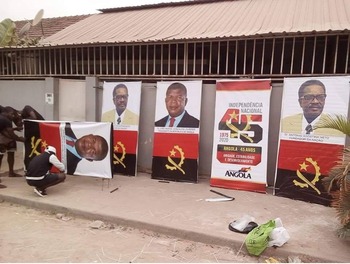
After leaving power, and particularly from 2018 onwards, dos Santos fell into disgrace. Former allies distanced themselves from him overnight. The former president and his family became politically toxic in Angola. The country had a new president who took aim at the rampant corruption of the country's elites, which many see as the main legacy of the dos Santos presidency. The impact this new political dispensation had on the regime of memory was surprisingly quick (see Fig. 6, below).
Preparations for the celebration of 45 years of Angolan independence in 2020, cancelled due to the Covid-19 pandemic. In the image only the photographs of Agostinho Neto and João Lourenço appear, evidently excluding José Eduardo dos Santos.
Source: Photograph circulating on social networks. Author unknown.

Lourenço's election as president in 2017 initiated a new political phase with a novel regime of memory. This current phase began with Lourenço's campaign to crack down on corruption in the country. To reassert MPLA legitimacy in the country, ease social protest, and attract the youth back into its fold, this campaign moralised to all sectors — and particularly the political and business class — and looked once again to historical memory.
With the presidency of Lourenço, Hoji ya Henda began slowly re-entering the narrative of JMPLA leaders. Contrasting the silence of the 1990s and 2000s, and his active replacement in the 2010s, Henda again reappeared in political discourse after 2017. In 2018 the JMPLA organised the first Youth Fair for Education, Technology and Culture (FEJETEC), with the aim of rewarding young people who distinguished themselves in the domains of education, culture, science, and technology. During the three-day event, the MPLA youth group presented various cases of success to the public, followed by the award of honourable mentions and a prize for merit named Hoji ya Henda.Footnote 58 In November 2019, on the occasion of the 57th anniversary of the foundation of the JMPLA, the first secretary of the MPLA in Lunda-Norte Ernesto Muangala saluted Hoji ya Henda and his example, reminding the audience of Henda's life and contribution to the organisation.Footnote 59 But most blatant instance of Henda's re-entry into Angolan political narrative is not an event or speech, but a photograph. Contrary to Fig. 6, where only Neto and Lourenço appear, the replacement of dos Santos’ portrait in the office of the JMPLA in Luanda took inspiration from the previous regime of memory, mixing old and new in a way both orthodox and unorthodox. A photograph circulating on social media shows three pictures framed on the wall of the JMPLA's national headquarters. Where one might expect the photographs of Angola's three presidents, instead we see the image of Hoji ya Henda between the first and current presidents of Angola, Neto and Lourenço on the left and right, respectively. Since Henda is the patron of the JMPLA, a picture of him on the organisation's walls is not surprising. The conspicuous change, however, is the absence of dos Santos.Footnote 60 To be sure, there was a picture of the former president in that particular office, as there were pictures of him in every party and public building. That it was replaced with a picture of Hoji ya Henda, a symbol of moral rectitude, at a time the country is looking to moralise society is hardly coincidental.Footnote 61 It shows that while the regime of memory in Angola keeps shifting, the memory of Hoji ya Henda continues to have a relevant role to play in the new political ideologies instilled by the presidency of Lourenço.
There is nuance in the notion stated in the introduction that heroes are puppeteered by politics. The political uses of the memory of Hoji ya Henda exhibit a middle ground between a tenuous albeit real link with official history, on one hand, and active political instrumentalisation, on the other. Indeed, as demonstrated here, the contents of the original memorialisation of a person remained in the historical and mnemonic canon. While memorialisation of a hero might be temporarily silenced or replaced to fit political circumstances, it can also be revived later in past formats and new narratives, since it never ceased to exist in society. Even when Hoji ya Henda's memory was silenced and replaced, its re-emergence long after his death shows that heroes continue to be available and, indeed, summonable at will. Hoji ya Henda is one of those heroes, always available as a ‘Grande herói da banda’ even when subordinated to circumstance and political whim.
Conclusion
Heroes remain an uncomfortable topic in southern Africa. Often subordinated to regimes of memory that are controversial and divisive, the most visible faces of processes of national liberation tend to fall into a partisan divide, both accepted and rejected by different segments of their society, yet historically and internationally recognised as people of great importance. But the memory of figures that are only recognised inside their countries, like that of Hoji ya Henda, plays a key role in the recent history of southern African countries. By exploring the political uses of the memory of Hoji ya Henda the article examined how his memory was invoked by the MPLA throughout recent history in Angola. Having showed how José Mendes de Carvalho became the legendary commander Hoji ya Henda, the article unpacked the uses of his memory in different political and military circumstances of recent Angolan history, underscoring how the construction of Henda as a role model came to define the way in which the MPLA choose to relate with Angolan youth. It then demonstrated how shifts in Angola's political system, both the turn to multiparty democracy in the early 1990s and a new presidency with an entirely new political agenda in the late 2010s, had an impact on the salience of the memory of Hoji ya Henda, moving from overwhelming presence to silence, then to replacement, and finally to resurgence.
The study of the official political memory of Henda showed that the original memorialisation of a person remains its primary mnemonic identification. It is neither an unproblematic, true rendering of the past, nor a complete invention, but rather one produced under contingent historical circumstances. This identification can be foregrounded or drawn back but always retains something of its original articulation. In Henda's case, the article clearly showed that even when subjected to processes of subalternisation or aggrandisement, the original contents of the historical memory of a national hero appeared to survive political use and misuse, particularly with heroes deemed moral examples and thus carrying very little controversy. Ever since Hoji ya Henda was deemed a moral hero after his death his mnemonic identity as a ‘Grande herói da banda’ has remained, perhaps because the social and political conditions the country endures continue to demand such a figure.
Acknowledgments
The research leading to these results has received funding from the European Research Council (ERC) under the European Union's Horizon 2020 research and innovation programme (Grant Agreement No 715593: ‘CROME – Crossed Memories, Politics of Silence: The Colonial-Liberation Wars in Postcolonial Times’). The author would like to thank two anonymous reviewers as well as the editors of The Journal of African History for their comments on the paper. The author would also like to thank the Associação Tchiweka de Documentação for providing access to the Lúcio Lara Archive, and João Pedro Lourenço at the National Library of Angola, from which some of the empirical data in this article was collected.