Introduction
Sexual reproduction is indispensable for achieving genetic diversity in the next generation. Many hermaphroditic species, mainly flowering plants, are known to possess a self-incompatibility (SI) system to avoid inbreeding. Approximately half of angiosperms have the SI system, in which highly polymorphic male and female SI-determining gene pairs reside in the S-locus (Takayama and Isogai, Reference Takayama and Isogai2005; Iwano and Takayama, Reference Iwano and Takayama2012). The respective SI system and protein pairs are variable in each family. In Brassicaceae, for example, when pollen self-SP11/SCR (S-locus protein 11 or S-locus cysteine-rich protein) is recognized by stigmatic SRK (S-locus receptor kinase) as self, pollen germination and pollen tube elongation are inhibited, resulting in self-sterility. In Papaveracea, when self-pollen PrpS (Papaver rhoeas pollen S) recognizes stigmatic PrsS (Papaver rhoeas stigma S) as self, Ca2+ influx occurs in the pollen, resulting in pollen apoptosis (Iwano and Takayama, Reference Iwano and Takayama2012; Sawada et al., Reference Sawada, Morita and Iwano2014). In contrast with flowering plants, most animals are dioecious. Markedly, ascidians are sessile hermaphroditic marine invertebrates. Among solitary ascidians, Ciona intestinalis type A (Phlebobranchiata), which was recently proposed to be renamed Ciona robusta (Brunetti et al., Reference Brunetti, Gissi, Pennati, Caicci, Gasparini and Manni2015), is a cosmopolitan species with several experimental benefits: a genome database is available (Brozovic et al., Reference Brozovic, Martin, Dantec, Dauga, Mendez, Simion, Percher, Laporte, Scornavacca, Di Gregorio, Fujiwara, Gineste, Lowe, Piette, Racioppi, Ristoratore, Sasakura, Takatori and Brown2016); readily fertilizable mature gametes are obtainable; fertilization experiments and genetic analyses are easy to perform; and genome editing experiments are applicable (Sawada et al., Reference Sawada, Morita and Iwano2014, Reference Sawada, Yamamoto, Yamaguchi, Yamada, Higuchi, Nukaya, Fukuoka, Sakuma, Yamamoto, Sasakura and Shirae-Kurabayashi2020). Conversely, Halocynthia roretzi (Stolidobranchiata) has different benefits from C. intestinalis type A: many aqua-cultured individuals can be purchased from fishermen; and readily fertilizable sperm and eggs can be easily collected into a Petri dish filled with seawater from dissected gonads of respective individuals, as described previously (Sawada et al., Reference Sawada, Yokosawa, Ishii and Hoshi1982).
Approximately a century ago, Thomas Hunt Morgan first reported that C. intestinalis sperm can fertilize VC-free eggs but not intact eggs of the same individuals (Morgan, Reference Morgan1910, Reference Morgan1923). He also found that self-sterile eggs become self-fertile by treatment with acidic seawater (pH 2.6) for 2–5 min or with proteases (e.g. 2% trypsin) for 30 min (Morgan, Reference Morgan1939). Furthermore, no induction of self-fertilization was observed by the same treatment of spermatozoa (Morgan, Reference Morgan1939). These results implied that a certain factor (presumably protein) on the VC, which is responsible for self-sterility, may be inactivated or degraded by acid or trypsin. Conversely, nonself sperm, but not self sperm, have also been reported to be able to tightly bind to the VC of glycerinated eggs, indicating that sperm binding to the VC is a process of self/nonself-recognition in gamete interactions (Rosati and De Santis, Reference Rosati and De Santis1978; Saito et al., Reference Saito, Shiba, Inaba, Yamada and Sawada2012). Interestingly, sperm binding to the VC of glycerinated eggs requires external Ca2+ in seawater (Casazza et al., Reference Casazza, De Santis and Pinto1984). Neither Mg2+ nor Mn2+ can replace Ca2+ in the ability of sperm to bind to the VC (Casazza et al., Reference Casazza, De Santis and Pinto1984). However, the effects of cations on self-sterility have not been well studied. We previously reported that external Ca2+ is necessary for self/nonself-recognizable binding of sperm to the isolated VC of self eggs (Saito et al., Reference Saito, Shiba, Inaba, Yamada and Sawada2012). We also showed that an acute and drastic increase in the sperm intracellular Ca2+ concentration ([Ca2+]i) occurs immediately after sperm binding to the isolated VC of self-eggs using the Ca2+ indicator Fluro-8H AM, which was revealed by live cell imaging under a fluorescence microscope. The increase in the sperm [Ca2+]i has never been observed in low-Ca2+ seawater (Saito et al., Reference Saito, Shiba, Inaba, Yamada and Sawada2012), suggesting that the increase in sperm [Ca2+]i is triggered by Ca2+ influx. In addition, as low-Ca2+ seawater reduced the sperm SI response, with effects such as drastic asymmetric movement or detachment from the VC, Ca2+ influx is most likely to be an initial SI response within sperm cells in C. intestinalis (Saito et al., Reference Saito, Shiba, Inaba, Yamada and Sawada2012). In this context, we investigated whether low Ca2+ in seawater can allow self-fertilization in C. intestinalis. In addition, we investigated the effects of Mg2+ and K+ on self-sterility in C. intestinalis as well as the effects of Ca2+ on self-sterility in another ascidian, Halocynthia roretzi.
Materials and methods
Animals, gametes and fertilization experiments
The ascidian Ciona intestinalis type A was obtained from NBRP (National BioResource Project). These animals were maintained in natural seawater or commercially available artificial seawater (ASW) (Tetramarin Salt Pro, Tetra) at ∼18°C for several days and fed Chaetoceros calcitrans (Sun-culture, Yamaha Motor Co., Ltd) ad libitum. The above ASW was used only for rearing ascidians. Sperm and eggs were collected as described previously (Saito et al., Reference Saito, Shiba, Inaba, Yamada and Sawada2012) and suspended in handmade ASW, containing 462 mM NaCl, 11 mM CaCl2, 9.4 mM KCl, 48 mM MgCl2, and 10 mM HEPES (pH 8.2), for fertilization experiments. Follicle cells of the eggs were removed by pipetting, and the VCs of the eggs were removed using 2% sodium thioglycolate, 0.02% actinase E and 37.5 mM NaOH as described previously (Nakazawa et al., Reference Nakazawa, Shirae-Kurabayashi and Sawada2019). Follicle-cell-free eggs or VC-free eggs were gently washed several times with ASW. Small volumes (usually 10 μl each) of egg suspension and 10-fold-diluted ‘dry sperm’ were added into a 48-well multidish plate filled with ASW or modified ASW in a final volume of 1 ml by previously mixing ASW with cation-free (either Ca2+-, Mg2+- or K+-free) ASW or respective cation-replaced ASWs (prepared by replacing Ca2+ with Mg2+ or by replacing K+ with Na+) (Table S1) at ratios of 100:0, 50:50, 10:90, and 0:100. As small volumes of sperm and eggs suspended in ASW were added to 1 ml of modified ASW, the final concentrations of cations in each assay were slightly variable, as indicated in Tables 1 and 2 and Figure 1. After 1 h, the fertilization rate was determined based on the first egg cleavage. The ascidian Halocynthia roretzi type C, which was aqua cultured in Onagawa Bay, Japan, was purchased from fisherman and maintained in an aquarium in the Research Center for Marine Biology, Graduate School of Life Sciences, Tohoku University. Sperm and egg collection and fertilization experiments were carried out in a final volume of 1 ml essentially according to previously described methods (Sawada et al., Reference Sawada, Yokosawa, Ishii and Hoshi1982).
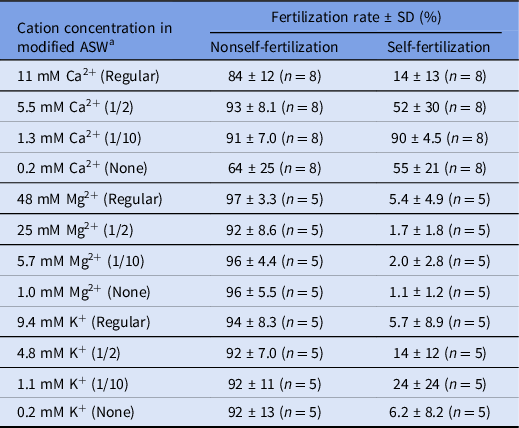
Effects of Ca2+, Mg2+, and K+ on nonself- and self-fertilization in C. intestinalis

a Regular ASW: 462 mM NaCl, 11 mM CaCl2, 9.4 mM KCl, 48 mM MgCl2, and 10 mM HEPES (pH 8.2).
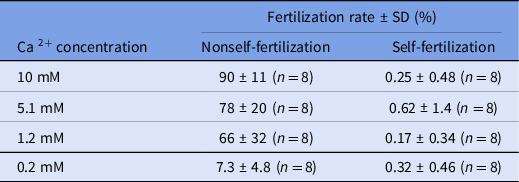
Effects of Ca2+ on nonself- and self-fertilization in H. roretzi

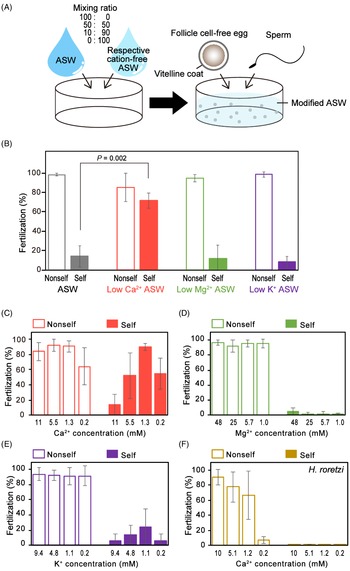
Effects of external cations on self- and nonself-fertilization. (A) Experimental procedure of the fertilization assay under the different ASW conditions. (B) Fertilization rate under ASW and low-Ca2+ (1/10), low-Mg2+ (1/10) and low-K+ (1/10) ASW from three independent individuals (n = 3) of C. intestinalis. The self-fertilization rate was significantly increased in low-Ca2+ ASW (P < 0.01, Student’s t-test). (C–E) Effects of external Ca2+ (n = 8), Mg2+ (n = 5), or K+ (n = 5) on the self- and nonself-fertilization rates of C. intestinalis. (F) Effects of Ca2+ on nonself- and self-fertilization in H. roretzi (n = 8). Data (% fertilization) are expressed as the mean value ± standard deviation (SD).

Results and Discussion
To investigate whether the Ca2+ concentration of seawater influences self-sterility in C. intestinalis, we first examined the effect of low-Ca2+ ASW (1/10) on self- and nonself-fertilization, as well as low-Mg2+ (1/10) and low-K+ (1/10) ASW (Figure 1A,B). As the VC is responsible for self/nonself-recognition, and also as follicle cells are dispensable for fertilization in C. intestinalis, together with judgement that fertilization (cleaved eggs) in follicle-free eggs is easier than that in intact eggs, follicle cell-free eggs were first used in this study. Under the conditions tested, the self-fertilization rate significantly increased with low-Ca2+ ASW but not low-Mg2+ or low-K+ ASW (Figure 1B). Therefore, we examined the effects of various concentrations of Ca2+ on self- and nonself-fertilization (Figure 1A). As shown in Table 1 and Figure 1C, the self-fertilization rate appreciably increased at approximately half the concentration of Ca2+ in regular ASW (5.5 mM Ca2+). Furthermore, self-fertilization was almost completely established using 10-times diluted ASW with Ca2+-free ASW (Table 1 and Figure 1C). Under these conditions, no practical decrease in the fertilization rate was observed in nonself combinations, although the fertilization rate appeared to slightly decrease at much lower Ca2+ concentrations, such as 0.2 mM. Similarly, the increase in self-fertilization rate under the low-Ca2+ concentration of ASW was observed using follicle cell-attached intact eggs and also under the conditions of osmotic pressure-adjusted ASW (Figure S1A,B). These results indicated that low Ca2+ (∼10-fold-diluted Ca2+) enabled the removal of the block to self-fertilization without any influence on successful fertilization. To ascertain why the fertilization rate decreased in 0.2 mM Ca2+, we performed the same experiments using VC-free eggs. The results showed that fertilization rate gradually decreased when lowering the Ca2+ concentration. In particular, at 0.2 mM, fertilization rate considerably decreased both in self and nonself-combinations (Figure S1C). Although we could not rule out other possibilities, one of the reasons why fertilization rate decreased at low (∼0.2 mM) Ca2+ may be due to the inhibitory effect of low Ca2+ on sperm–egg fusion. We previously reported that SI is mediated by three pairs of sperm PKD-like polymorphic transmembrane proteins (s-Themis-A, s-Themis-B, and s-Themis-B2) and fibrinogen-like polymorphic VC proteins (v-Themis-A, v-Themis-B, and v-Themis-B2), in which fertilization is strongly blocked in the same allelic pairs (or the same haplotypes) in A, B, and B2 (Harada and Sawada, Reference Harada and Sawada2008; Harada et al., Reference Harada, Takagaki, Sunagawa, Saito, Yamada, Taniguchi, Shoguchi and Sawada2008; Sawada et al., Reference Sawada, Yamamoto, Yamaguchi, Yamada, Higuchi, Nukaya, Fukuoka, Sakuma, Yamamoto, Sasakura and Shirae-Kurabayashi2020). As s-Themis-B and s-Themis-B2 contain a PKD channel at their C-terminus, which is a Ca2+-permeable cation channel, we investigated in detail whether other cations in ASW, such as Mg2+ or K+, may also be involved in the establishment of self-sterility. The results showed that low Mg2+ or low K+ had no significant effect on the rate of self- or nonself-fertilization (Figures 1D,E and S1A,B and Table 1), indicating that the decrease in external Ca2+, but not Mg2+ or K+, could remove the block to self-fertilization. The PKD channel has been reported to potentially transport several cations, but only Ca2+ may be able to trigger a self-recognition signal. In connection with this, it is notable that low K+ slightly increased the self-fertilization rate (Figures 1E and S1A). This might be due to hyperpolarization of sperm plasma membrane induced by low-K+ conditions (Schultz et al., Reference Schultz, Klumpp, Benz, Schürhoff-Goeters and Schmid1992), which can increase sperm motility in C. intestinalis (Izumi et al., Reference Izumi, Márián, Inaba, Oka and Morisawa1999). As shown in Figure S1B, when Mg2+ was partially replaced with Ca2+ to adjust the osmotic pressure, the self-fertilization rate slightly increased. Although the results are interesting, further studies are needed to explain these phenomena. To investigate whether the above features in C. intestinalis are the same in other ascidian species, we performed the same experiments using H. roretzi, which has a stricter SI system than C. intestinalis. However, the effect of low Ca2+ on self-fertilization was not observed in H. roretzi (Figure 1F and Table 2); self-sterility was not affected by changing the external Ca2+ concentration in ASW. As expected, 0.2 mM Ca2+ considerably decreased the fertilization rate. These results indicated that the mechanisms underlying self-sterility are distinctive between Ciona (Phlebobranch) and Halocynthia (Strolidobranch).
Although the detailed mechanism of the external Ca2+-mediated SI response is currently unclear, interestingly, self-pollen undergoes Ca2+ influx, which results in apoptosis, after the attachment of self-pollen to the pistil in Papaveraceae (Iwano and Takayama, Reference Iwano and Takayama2012). A similar self-recognition mechanism may exist between plants and animals. s/v-Themis-homologous gene pairs were detected in H. roretzi in the genome database. However, whether s/v-Themis-homologous genes are involved in self-sterility in H. roretzi is unknown as cultivation of cross-fertilized embryos to adults, which is necessary for genetic analysis, requires 3 years and is still unsuccessful in H. roretzi. Notably, however, the mechanisms of self-sterility of C. intestinalis appear to be different from those of H. roretzi, although both SI systems are abolished by acid or protease treatments. Potential Ca2+ influx via the C-terminal PKD channel in s-Themis may not be involved in self-sterility in H. roretzi.
Further studies are necessary to elucidate the molecular mechanism of self-sterility from the viewpoint of sperm Ca2+-mediated intracellular signal transduction in C. intestinalis.
Supplementary material
For supplementary material accompanying this paper visit https://doi.org/10.1017/S0967199422000144
Acknowledgements
We thank the NBRP of MEXT, Japan and all members of the Maizuru Fisheries Research Station and Yutaka Satou laboratory of Kyoto University and the Misaki Marine Biological Station of the University of Tokyo for providing C. intestinalis type A adults. We are indebted to the Director and staff of the Research Center for Marine Biology, Graduate School of Life Sciences, Tohoku University where part of this work was carried out. We also thank Dr Ikuo Wada and Dr Naokazu Inoue from Fukushima Medical University, and Dr Tomohiro Sasanami from Shizuoka university for supporting this work.
Financial support
This study was supported in part by JSPS KAKENHI Grant Numbers JP17H03672 (to H. S.), JP20K06621 (to H. S.) and JP17K15128 (to T. S.), and Fujiwara Natural History Foundation (to T. S.).
Conflicts of interest
None
Ethical standards
Not applicable.