


Introduction
This is an essay about moral anti-theodicy – objections to the practice of theoretical theodicy on moral grounds. Such objections have been presented by both atheists and theists. Therefore, this essay is not concerned with the attempt to solve or prove the problem of evil. Rather its aim is to assess anti-theodicy as a moral argument.
I have not given a fine-grained account of the great variety of theodicies on offer. The most important distinction in the essay is that of most or least ambitious theodicies, since this refers to the sort of explanation or reasons a theodicy tries to give (see Trakakis (Reference Trakakis2008), 162f.). Thus Hick and Plantinga are in the same ‘low-ambition’ category, although they disagree in several important ways. It turns out that the morality of theodicy depends significantly on how ambitious a theodicy is.
In part one I evaluate moral anti-theodicy with reference to some recent papers, exploring the critique of theodicies by assessing the charge that theodicies trivialize suffering. The argument leads us to consider in part two whether there can be a defence of theodicy as a sufficiently moral project, if there are good reasons for the sort of detachment from suffering such trivialization entails. Finally, in part three, a consideration of the qualitative difference between ambitious and less ambitious theodicies leads us to ask whether an anti-theodicist rejection of least ambitious theodicies (having significant parallels with Ivan Karamazov's ‘mutiny’) implies a moral commitment to philosophical pessimism.
My conclusions are that, first, ambitious theodicies always trivialize the experience of those who have suffered horrendously. Second, this (trivializing) detachment from suffering which such theodicies entail is partially defendable as an intellectual pursuit, yet self-defeating if pursued with the aim of helping others with religious doubt. This leads to a third conclusion, that anti-theodicy which too easily impugns the motives of theodicists is wrong, although theodicists who aim to help doubters do unwittingly harm those who suffer acutely. Fourth, anti-theodicy is over-demanding. Fifth, for the case of least ambitious theodicies, anti-theodicy demands pessimism and is therefore unacceptable as a moral principle. Sixth, even least ambitious theodicists who are theists should consider the further question whether giving reasons for God's permission of evil is likely to undermine theism's attraction and ability to offer comfort to those who suffer.
Part one: does theodicy trivialize suffering?
In what follows we shall characterize moral anti-theodicy generally as a charge about the trivialization of suffering, which seems to refer to a set of complaints regularly made against theodicy, such as that theodicy makes light of suffering, does not give horrific experiences due weight, and fails to take the devastating impact of great evils seriously. The heart of the issue is the nature of the relationship between the theoretical (‘third-person’) explanation of evil and the ‘first-person’ experience of evil.Footnote 1
Theodicists insist that they attempt to give God's reasons for allowing evil in good faith, and with a desire never to trivialize the suffering of others (see Hick (Reference Hick2010), 9). Both theodicists and anti-theodicists would agree that trivializing suffering is bad. However, they disagree about whether theodicy is an instance of such trivialization. Claiming that God has good reasons for allowing suffering, the theodicist says, does not have to entail a trivialization of suffering. Given this disagreement, we should explore what trivialization amounts to.
Trivialization as reinterpretation
To understand trivialization, consider this example: if a person makes considerable sacrifices and works hard to gain an apprenticeship with a manufacturing company, she will feel a sense of pride at having achieved her goal. However, if we imagine her overhearing a company boss talking about the vocational qualifications necessary to start an apprenticeship being ‘two a penny nowadays – you have to try hard to fail them’ then the apprentice would feel much put down. She would find the reinterpretation of her effort as having been – from another person's perspective – insignificant, very hurtful.
We could therefore understand a trivialization of someone's experience of effort or suffering as a reinterpretation of that experience in ways the person does not endorse. One could argue from here that theodicy trivializes suffering if it reinterprets suffering in a way the sufferer cannot accept.
However, there is an obvious objection to this move, since it would seem to commit us to a strict perspectivism which does not admit of any intersubjective judgements. We would have to say that everyone's version of events is true. This is an unacceptable consequence. We shall call this the perspectivism objection.
Furthermore, a hypersensitive person could, on undergoing mild and generally insignificant discomfort (for example the feeling of hunger before dinner), insist that her daily experience was terrible and could not be reinterpreted as on balance good or worthwhile. This is also an unacceptable consequence. This is the hypersensitivity objection.
The claim that theodicy trivializes if it reinterprets suffering in a way the sufferer cannot accept is vulnerable to both objections. In that manufacturing company, there may be vacancies because few young people have completed the very basic technical courses required. The boss may remember the days when qualifications necessary for an apprenticeship were higher and competition for places was tough. He might talk about the fall in standards when speaking to a colleague in Human Resources, and not intend the apprentice to overhear. It is doubtful we would consider him immoral.
If there are cases (according to the hypersensitivity objection) where we think it is right to discount a hypersensitive person's perspective to a degree and we also do not want to accept a strict perspectivism, then we are implying that some common-sense account of the gravity of experiences of suffering should be included in an account of which trivialization is immoral. But might then the debate between theodicists and anti-theodicists be characterized as a debate between people on a spectrum of empathy, with some opting for tough, honest words and others opting for silence?
This would be too simple. If we make use of some generally agreed account of how grave various experiences are, then there will be no disagreement that the subjective experience of horrendous evils can never be discounted or trivialized. Here are cases where the distinction between an over-sensitive or under-sensitive person pales into insignificance and their account of their experience is given priority and credence.
Therefore the focus of an anti-theodicy argument has to be specifically directed to the worst cases, including a reference to horrendous evils as the worst sorts of suffering in our world, ‘prima facie ruinous to the participant's life’ (Adams (Reference Adams1999), 166). A person unacceptably trivializes suffering if she reinterprets horrendous evils in a way the sufferer cannot accept.
This defends the right of victims of extreme suffering to have the last word – for their account to be taken seriously. This sort of objection to theodicies is well expressed by Adorno: ‘The need to lend a voice to suffering is a condition of all truth’ (Adorno (Reference Adorno and Ashton1973), 17f.; cited by Surin (Reference Surin1986), 84).Footnote 2
In the next section, we shall explore whether theodicies can be defended by the argument that the moral status of theodicies, whether it is the case that theodicies are insensitive and trivialize suffering, is contingent on their truth.
Simpson on not assuming implausibility
Simpson argues that a theodicy trivializes suffering if it is false. An agnostic about theodicies, open to the possibility that there may be a true or plausible theodicy, must also see that it is possible that a theodicy is not insensitive, which means it does not trivialize horrendous evils (see Simpson (Reference Simpson2009a), 162).
Simpson considers examples of a family friend who offers a sort of theodicy by suggesting putative goods which occur as the result of some suffering. I summarize two of them below (see ibid.):
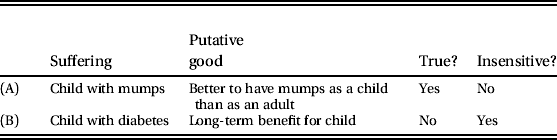
Simpson assumes for the sake of argument that in all examples the ‘theodicist’ might offer the ‘theodicy’ (putative goods) tactfully and at an appropriate moment, so that only the insensitivity of the content is considered.Footnote 3 In example (B), assuming there is a more appropriate moment to mention the putative good, the theodicist's response is ‘false, and all the more insensitive for being false’ (ibid.). Therefore, says Simpson, the insensitivity is dependent upon the falsehood of the putative good.
Simpson wants to relate these examples of a friend offering consolation to another example closer to theodicies and suggests the example (C):

Simpson comments: ‘even if it is couched in the nicest possible terms it remains appalling, because the content of the view itself is beyond the pale (and obviously untrue)’ (ibid.).
Simpson's response is revealing. The falsehood of the putative good seems to be a secondary consideration. The ‘view itself’ is appalling, i.e. inherently insensitive. The anti-theodicist would agree. Some theodicists would also agree, if they insist that theodicies must be ‘patient-centred’, i.e. the putative goods must benefit the sufferer, and not merely future generations or humanity's average utility. I suspect that this is why Simpson finds the view itself repugnant, although he does not elaborate.
However, Simpson insists that those who believe in the inherent insensitivity of such theodicies cannot say that all theodicies are inherently insensitive because there may still be a theodicy ‘that is more like the mumps example’ (ibid., 162–163) – which I note is patient-centred. Anti-theodicists must make the assumption that even future theodicies are incapable of being plausible (ibid., 167).
Simpson asks ‘which features of theodical discourse … could provide a suitable focus for a global argument against the plausibility of theodicies’ (ibid.). Under the next heading we will turn to consider this possibility, and it will be argued that for certain types of theodicies it is fair to assume they are inherently implausible.
A Humean argument from implausibility
In the examples Simpson to which refers, the difference between a sensitive and insensitive theodicy is contingent upon its plausibility. Simpson does not distinguish between the truth of a putative good and the plausibility of a putative good, because the plausibility is a measurement of the intersubjective judgement (common knowledge) of the veracity of such a good. Thus the mumps example is plausible and the diabetes example implausible.
Therefore the plausibility of putative goods said to emerge from evils is a matter of degrees. We can imagine a scenario somewhere between examples (1) and (2) where there is uncertainty whether a putative good emerges from a particular evil. The plausibility of that putative good would rest on the evidence offered by the medical community. This seems to be the assumption behind Simpson's train of thought. We could characterize this as a Humean argument, since it assigns plausibility to theodicies according to whether the putative goods are evident. Presumably, the prima facie plausibility of a ‘theodicy’ in this medical analogy would also depend on the particular evil. It would be easier to convince people of a putative good if it emerged from the common cold than if it were said to emerge from cancer.
Simpson is claiming that the anti-theodicist has to assume that there are and will be no theodicies whose reinterpretations of horrendous evils the sufferer will accept. However, since we are talking about horrendous evils, this seems sure. It beggars belief that there is a good entailed in a person's horrific experience, such that it is overall good and better (or at least not worse) for having undergone that suffering.
It might be objected that there is a theodicy which is true – whereby, through some logical connection between certain evils and goods emerging from that life of suffering, the person's life would be better overall than if her life had been spared the suffering. However, within this Humean (evidential) framework of plausibility, a theodicy which claimed to know of putative goods (as yet not evident in the life of the sufferer) which emerged from horrendous evils must be judged to be most certainly implausible. In a world containing horrendous evils, ambitious theodicies are inherently implausible for the sufferer and she experiences this theodicy as a trivialization of her suffering.
Søvik on not communicating theodicies
Søvik, like Simpson, thinks the attempt to morally discredit all theodicy already assumes theodicy's falsehood (see Søvik (Reference Søvik2008), 480). However, he also says that if theodicies are in danger of trivializing the sufferer's experience, it is crucial that theodicies are offered in the right contexts; ‘it is a matter of practical wisdom to find out what is needed when’ (ibid., 481).
Even if, in some situations, theodicies trivialize suffering, it does not follow that they trivialize in every situation. Theodicists should not offer theodicies in situations where someone could be hurt, but there is nothing wrong with theodicies generally: ‘the statements themselves are not immoral; in some settings they are right to communicate, in others they are wrong to communicate’ (ibid., 482).Footnote 4
Søvik makes the distinction between the theory and the misuse of a theory. If a theodicy has such trivializing effects when communicated in an inappropriate situation, then it is not the fault of the theodicy or the theodicist. Søvik gives the example of misused theories: how social Darwinism and nuclear weapons are misuses of biology and physics (see ibid.).
However, putting theodicy into the category of misused theories will not do. A closer comparison between scientific research and theodicy would be to ask whether certain types of biological research ensured animal welfare, or whether the research at CERN was good for the citizens of Geneva. Just as some scientific research might harm animals and humans, so theodicy impacts upon humans. Theodicy does not stay in a university laboratory, sealed off from those who have suffered horrendous evils. Theodicy is written and spoken in the public arena, in the world of ideas, and to propagate a theodicy is to communicate it at once to potentially everyone, because the theodicy of academic journals finds its way to the pulpits and popular religious books, providing religious communities with theodical narratives for interpreting horrendous evils. Therefore, contra Søvik, there is no strictly ‘theoretical context’ (Søvik (Reference Søvik2011), 386) to which one can turn and safely do theodicy. It follows from this that for ambitious theodicies, ‘if we would think it shamefully foolish and cruel to say such things in the moment when another's sorrow is most real and irresistibly painful, then we ought never to say them’ (Hart (Reference Hart2005), 100).
Do the least ambitious theodicies trivialize suffering?
John Hick points out that his own theodicy does not judge horrendous sufferings to be good as Phillips would charge. Regarding the horrendous evils of the twentieth century, Hick calls them ‘wrongs that can never be righted, horrors which will disfigure the universe to the end of time’ (Hick (Reference Hick2010), 361) and thinks no soul-making effect issues from such circumstances (see Hick (Reference Hick2007), 434f.).
The theodicist, according to Hick, makes the far less ambitious claim that ‘the entire person-making process, in this life and beyond, will ultimately have a fully justifying value to all’ (ibid., 438). Therefore, the theodicy is not a reinterpretation or justification of horrendous evils which individuals experience. Rather, it is the claim that those individuals, having experienced the unfathomable good of the eschaton, will be able to say that their life was good overall and feel that the creation of a world wherein horrendous suffering is a possibility is justified.
Much that we have said about the implausibility of theodicies for those suffering is rather relativized by the recognition of Hick's distinction. Asking about the plausibility of a putative good emerging from a particular evil is one thing. Asking about the plausibility of a positive judgement concerning human life considered as a whole is a question of a different order – an ultimate question!
Since a theodicy like Hick's holds on to a non-teleological understanding of horrendous suffering, it does not reinterpret suffering in a way directly at odds with the experience of suffering. Therefore it appears Hick escapes the charge of trivialization on one count. However, it still seems to be the case that one could characterize this as trivialization, because the meta-narrative is made central and the horrendous evils not attended to in the way that sufferers might demand. If the theodicist's attention is drawn away from the horrific experiences of evil towards ‘an overwhelming tide of “positive experience” that can be guaranteed to swallow up any and all specific negative experiences’ (Williams (Reference Williams and Phillips1996), 139), then the horrendous evils could be said to be reinterpreted in a way the sufferer cannot accept. Even the least ambitious theodicy is in danger of trivializing suffering, because it places that suffering within a larger positive framework. We will explore this possibility in part three. However, for now, let us survey our conclusions so far.
Conclusion: ambitious theodicies trivialize suffering
We started with the claim that theodicies do inherently trivialize suffering because theodicy entails the reinterpretation of suffering which a sufferer cannot accept. We upheld this conclusion against several objections: Simpson rightly recognizes the connection between anti-theodicy and plausibility, but he should concede that no theodicy claiming that goods will emerge from evils will be plausible to sufferers of horrendous evils.
Søvik suggests that theodicy, not being intended for practical contexts, should not be blamed when it is misused there. However, since theodicy is done in public, the theoretical/practical distinction is not relevant. Therefore, we concluded that ambitious theodicies, which claim God has good reason for allowing horrendous evils because he intends greater goods to emerge from those evils, will be implausible to people suffering acutely and therefore always be a trivialization of their experience – a reinterpretation they cannot accept.
Less ambitious theodicies do not reinterpret suffering as being advantageous in itself but promise that, from the perspective of the eschaton, life will be judged to be overall good. Whether this also amounts to a trivialization of evils – and, if so, whether this is immoral, will be explored in part three.
However, in part two we shall attend to a significant objection to the charge of trivialization, namely, that there is such a thing as a legitimate detachment from suffering which, despite its trivialization of suffering, cannot be said to be wholly immoral.
Part two: is theodicy a legitimate and useful detachment?
Some theodicists might defend their practice by claiming that such detachment is legitimate as an intellectual duty, and as a service to those seeking theoretical orientation.
Detachment as intellectual duty
Søvik says one can legitimately search for a true answer even though communicating a truth may not be the right thing to do in a certain situation. Since theodicy is about the search and not the communication, theodicy is not immoral (see Søvik (Reference Søvik2008), 482). Similarly, John Hick says that since the problem of evil presents itself as an intellectual problem, it belongs to the intellectual duty of a philosopher or theologian to think hard about the problem and seek to find a successful theodicy (see Hick (Reference Hick2010), 9f.). Peter van Inwagen goes beyond the defence of theodicy and accuses anti-theodicists of ‘intellectual dishonesty’ (van Inwagen (Reference van Inwagen and Wainwright2005), 190), demonstrated in a reluctance to think hard. Van Inwagen warns that since moral scorn for another's position gives one a feeling of being in the right, one can feel one is right without having made a good argument.Footnote 5
The theodicist insists that it is her moral and intellectual duty to pursue an objective, third-person, description of reasons why God might allow evil. The anti-theodicist believes it is her moral and intellectual duty to give the first-person perspective of sufferers credence and therefore stop explaining. It seems that the theodicist and anti-theodicist stand in very different philosophical traditions. Might it be possible to reduce this disagreement to saying that theodicists prefer the third-person, scientific approach, while anti-theodicists prefer the first-person, subjective approach?
We can test whether the anti-theodicist's position is indicative of such a wider set of assumptions by seeing if the anti-theodicist approves of a more general critique of the inappropriateness of scientific (third-person) discourse to give a true account of horrendous evils. The theodicist might object that the anti-theodicist would have no moral difficulties with a scientific account of a disease, even if the affliction was horrific. While it is clear that there are bad times to give a patient a scientific explanation, it does not preclude the scientific study of the disease in medical journals. Furthermore, sometimes a scientific explanation helps the person suffering to understand what is happening to him. Theoretical theodicy is no different, says the theodicist.
Proscribing scientific discourse generally because of the insensitivity a scientific explanation would entail in a specific context seems inadmissible. Might not the theodicist therefore legitimately suggest that theodicy is justified when confined to the right contexts?
We have already emphasized that theodical discourse is unlikely to be confined to academia and that it will shape the narratives of religious communities and thus their responses to horrendous evils. However, the same is true of medical explanations of terrible diseases. These explanations will shape the general knowledge concerning disease in public life. Yet, the theodicist might argue, no-one worries about the insensitivity of medical explanations. Generally opposing the detachment necessary to attempt to understand God's putative reasons for allowing evil would be as intellectually obtuse as opposing scientific research – a gross negligence of intellectual duty.
If the theodicist were to argue so, it might be objected that no-one worries about the intellectual pursuit of description of disease in medical research because the whole aim of the enterprise is to serve patients. In contrast, theoretical theodicy does not help sufferers. The theodicist's reply might be that theodicy can indeed be of help to people.
Detachment as benevolent existential orientation
According to many theodicists, theoretical theodicies are a comfort to believers. Forrest envisages a religious apologist pastorally motivated by concern for those whose doubts would rob them of religious comfort. For example, Forrest believes that while ‘insensitive theodicy insults the sufferer … sensitive theodicy can endow suffering with meaning’ (Forrest (Reference Forrest2010), 42).
Moreover, the theodicist might continue, to deny those suffering a theoretical explanation for the existence of evil – and to deny the existence of God, who gives a reason to hope that human life is not meaningless – could be said to be a great evil, leaving people stranded and alone with their suffering (see Davis (Reference Davis and Davis2001), 168f.). Assuming that religious beliefs make metaphysical claims, and noting that these claims are attacked philosophically, it is a disservice to those who gather comfort from their religious beliefs not to defend those religious beliefs from attack and to refuse to devise a theoretical theodicy (see Forrest (Reference Forrest2010), 42). ‘[M]aybe the person in sorrow did ask a theoretical question because she had some existential questions concerning whether she could still believe in God … . a theoretical answer … may have the good consequences of bringing comfort and hope’ (Søvik (Reference Søvik2008), 481).
It is true that many people find comfort in their religious beliefs. If one is able to believe that one's difficulties, illnesses, crises, and even impending death are part of a divine plan for personal flourishing, then this framework fosters optimism concerning the course of one's life and is arguably very empowering. If ‘God exists and A good eschaton is in the offing … then telling people those facts … is about as helpful a thing as we can do for them’ (Davis (Reference Davis2004), 271, cited in Simpson (Reference Simpson2009a), 164). Might not the theodicist's desire to be helpful to those seeking orientation justify her project?
Theodicy as self-defeating detachment
The anti-theodicist could argue that the detachment is self-defeating, i.e. theodicy, by virtue of being detached, is not able to deliver the existential assistance it aimed to provide. This undermines the theodicist argument made under the previous heading.
A case can be made that the existential benefits of a theodicy are contingent upon the nature of the God whose existence is supposedly vindicated by theodicies. Simpson imagines amoral theodicies which take God's Schadenfreude to be the reason for allowing evil and insists these would be instances of such a universally insensitive theodicy (see Simpson (Reference Simpson2009b), 343).Footnote 6 Such a theodicy will have offered a reason for God's permission of evil, and thus a framework of meaning within which one could understand evil, but this framework of meaning would offer no existential comfort.Footnote 7 Obviously, in that amoral theodicy, God would not be considered benevolent, and so this would not be a theodicy proper. However, similar difficulties occur in some theodicists’ attempts to justify God. For example, Forrest describes God as a tough-minded utilitarian, a moral monster by human standards, very unlike a loving heavenly father (see Forrest (Reference Forrest2010), 45f.). The existential comfort gained would have to be gained from the knowledge that the sufferings one experiences are part of the plan or permission of a thoroughgoing utilitarian deity with a detailed knowledge of all the variables of the hedonistic calculus. Perhaps some find security in such a perspective. However, in the face of horrendous examples of evil, it is hard to imagine this theodicy being comforting to the sufferer. As David Hart says, ‘It is a strange thing indeed to seek peace in a universe rendered morally intelligible at the cost of a God rendered morally loathsome’ (Hart (Reference Hart2005), 99).
Davis says he would only worship a God who is perfectly good and abhors theodicies which claim all evils are ‘disguised goods’. However, he thinks that theodicies which do ‘belittle’ suffering are good, and should be communicated to those suffering as ‘the best possible news that sufferers could hear’ (see Davis (Reference Davis and Davis2001), 169). However, while one can agree that the message, that ‘evil is not the whole story … and suffering will one day come to an end’ (ibid., 168), is good news for many sufferers of lesser evils, for those undergoing severe suffering, this good news may not help.
One might think of parents witnessing their child suffer greatly, daily, due to a chronic illness for which doctors can find no conceivable treatment or cure. For that child and those parents, the only story they can see is the horrendous one, and the end of the suffering is not in sight. Even the best news does not give meaning, for the daily struggle with the reality of that suffering engulfs and destroys any seeds of meaning.
The detachment of theodicy which finds a third-person explanation involves a God who finds (or is confined by) a logical reason for permitting evil. Therefore, borrowing Martin Buber's terminology (see Buber (Reference Buber and Kaufmann1970), 53f.), in theoretical theodicy, God's relationship with sufferers is portrayed as an Ich–Es relation, rather than an Ich–Du relation. Buber's schema distinguishes between the way we talk of people as objects (referring to them as he or she) and the way we talk to a person and say ‘you’ to them. He argues plausibly that only the Ich–Du relation is spoken with one's whole being, by which he means with emotion and full attention. There is a great difference between talking about someone and talking to them, addressing them. We can use this distinction to analyse the debate about anti-theodicy.
In the case of horrendous evils, as theodicists would agree, it is only the practical help and personal comfort in the heat and aftermath of severe suffering which is appropriate. It is only the personal attending to and companionship of other people (an Ich–Du relation) which could help at all.
In a theodicy, evils become ‘things’ for which God has reasons. God, having his reasons, must be portrayed as relating to evil in that detached, Ich–Es way, not fully attentive to the personal predicament of the sufferer. Any theoretical ‘help’, in the case of horrendous evils, does not become good news for the sufferer, because it will not comfort. Theodicy, even if it is legitimate as an intellectual enterprise, is self-defeating if it aims to be beneficial to sufferers.
Theodicy as selfish comfort
It follows from these observations about the lack of comfort theodicy can offer to sufferers of horrendous evils that the supposed benevolence could be portrayed as a selfish attitude on the part of those who suffer only minor or lesser evils. As we have seen, while theodicies might offer comfort to those suffering the discomforts of western life, it is difficult to see how theodicies can offer any comfort to those who have undergone horrific and degrading suffering, and such theodicies may be distressing to them. Therefore the theodicist, disregarding this (unintended) effect of theodicy, harms the sufferer of horrendous evils by her unthoughtfulness, even as she seeks to comfort her contemporaries.
Alternatively, the anti-theodicist may say that theodicies are ‘a lie told principally for our own comfort, by which we would try to excuse ourselves for believing in an omnipotent and benevolent God’ (Hart (Reference Hart2005), 100). Theodicy is thus seen to be a relief for those experiencing justificatory pressure from their non-religious peers. If we grant that theodicy makes the comfort of philosophical assurance available to western Christians suffering discomfort and setbacks, that same theodicy can be counted as selfish, since it compounds the suffering of those who have suffered horrendous evils.
The anti-theodicist making this sort of argument is suggesting that the theodicist (or grateful recipient of a theodicy) is herself detached from suffering so as to suspect a disregard for those who suffer horrendously.Footnote 8 The theodicist insists that her motives are to provide comfort. Thus the anti-theodicist implies the moral dishonesty (or at least unthoughtfulness) of the theodicist.
Is anti-theodicy over-demanding?
Even if we grant that the motives for producing theoretical theodicies, like anyone's motives for anything, are somewhat mixed, it does seem that a theodicist's declared aim to be a help is not obviously made in bad faith. If anti-theodicists were to insist on a hermeneutic of suspicion, theodicists might equally claim that anti-theodicists cannot take the moral high ground. Perhaps anti-theodicists are not being entirely honest with themselves, since anti-theodicy's moral maxim is over-demanding.
The anti-theodicist claims to be opposed to trivializing the suffering of others. Horrendous evils should be given their due weight. However, it might be objected, if we are to give horrendous evils their due weight, then this is over-demanding. To give truly horrendous evils their due weight, we should be constantly reminding ourselves of the weight of suffering involved. There would be no end to reading first-person accounts of the Holocaust, Rwanda, Srebrenica, and the most disturbing abuses. There would be no end to the stunned sadness such reading and remembering occasions. Presumably we would find it impossible ever to be content and enjoy life. Taking pleasure in something as insignificant as a favourite meal, or a special landscape, enjoying art or music, compared with the weight of the most horrendous evils, would be immoral. The most moral person would then be the most saddened, moved and even depressed (see Gawronski & Privette (Reference Gawronski and Privette1997) for the connection between empathy and depression).
This seems unacceptable – it must be that a certain amount of self-interest, expressed in a degree of detachment from others’ suffering, is legitimate. We need detachment to survive emotionally – we cannot be moved by everything. A moral principle which would demand a vast, indefinite amount of our attention, and thus conceivably leave no room for anything else in life, is an over-demanding principle which should not be accepted.Footnote 9
Furthermore, the theodicist might point out that the anti-theodicist does not take her own advice seriously. If theodicists are to be characterized as comfortably detached academics, aloof from the real needs of sufferers of horrendous evils, then anti-theodicists are no less comfortable, detached academics with the leisure to write at length about the immorality of theodicy. The anti-theodicist makes loud demands to give suffering its due weight, but it is a demand which she herself could never fulfil.
Conclusion: moral demands in conflict
Having considered these objections and counter-objections to the detachment which theoretical theodicy entails, we are faced with conflicting moral demands.
Anti-theodicy seems to rest on the moral rule that one should not trivialize evils but give the sufferer's experience due weight, and also that one should not seek one's own existential comfort without regard for the consequences such theoretical theodicy has for those undergoing suffering. The anti-theodicist calls us not to be selfish but to practise empathy.
The theodicist, in a charitable reading of her motives, practises the virtue of intellectual rigour in seeking to understand what God's reasons might be, believing him to have reasons for his actions. Furthermore, if the theodicist believes that theodicies will help people, then she is also morally motivated to find a successful theodicy.
The theodicist's virtues carry with them the danger of discounting the plight of those suffering worst, for the sake of helping the existentially disoriented or being intellectually rigorous. The anti-theodicist's virtues seem to carry with them the danger of being over-demanding because horrendous evils are what one might call a black hole for empathy – one could arguably never plumb the depths of the terror some people experience, and any attempt to do this would surely commit oneself to unceasing despair. In all this, both parties seek the moral high ground.
Having surveyed these conflicts it is clear that a moral valuation of the detachment of the theodicist is less than straightforward. Therefore, anti-theodicists should be wary of making easy and lazy criticisms of theodicists without considering that the positive motives expressed are genuine and their own motives complex, given the over-demandingness of the anti-theodicist position. However, the self-defeating nature of the detachment which theodicies entail when faced with horrendous evils, and the absence of a discernible theoretical context in which theodicies do not also, indirectly, address those suffering horrendously, should advise theodicists that their benevolently minded attempts to provide reasons for God's permission of evil are misguided, and, given their effect on those suffering acutely, harmful.
Part three: does moral anti-theodicy entail philosophical pessimism?
Let us recall that in part one, following the claim that ambitious theodicies always trivialize suffering, we considered the possibility that the least ambitious theodicies might escape the charge of trivialization. We asked whether there might be a qualitative difference between justifying horrendous suffering and justifying the creation of the world as a place containing conditions which make horrendous evils possible (as in the free-will defence). The latter case can be characterized as a justification of human life (if, for example, freedom is a necessary condition of human life).
The theodicist might insist that the onus is on the anti-theodicist to give reasons why our attention should be held captive by the experiences of horrendous evil, to the exclusion of recognizing the beauty and goodness of the world as a whole. Why should it not also be reprehensible to trivialize good experiences, by not giving them due weight?
Thus far it seems there are grounds for considering this conflict as about competing visions of the world. The overall positive or negative ‘picture’ within which one interprets evils is not merely a matter of evident goods which emerge from those evils, or a counting up of goods and evils, but a way of seeing the world. The theodicist insists that the good outweighs the bad. The anti-theodicist insists the bad is so weighty it could never be matched or overcome. This seems like an aesthetic impasse, and not simply a moral issue.
To test this possibility, we should pay attention to a classic moral anti-theodicy, expressed by Dostoevsky's character Ivan Karamazov, and explore its parallels with the free-will defence and with Schopenhauerian pessimism.
Ivan Karamazov's moral anti-theodicy
Ivan Karamazov recounts a series of examples of horrendous suffering, involving children, to his believing brother Alyosha with the purpose of exposing that faith to be inappropriate. One example imagines a young girl enduring her days in imprisonment and degrading abuse. Ivan challenges Alyosha to agree that if this child's suffering were the price necessary to make possible a heavenly paradise for all, accepting that price would be immoral. To agree to build a cosmos which, even though it ended in bliss, involved such innocent suffering would be to agree to undertake an immoral task:
Tell me yourself directly, I challenge you – reply: imagine that you yourself are erecting the edifice of human fortune with the goal of, at the finale, making people happy, of at last giving them peace and quiet, but that in order to do it it would be necessary and unavoidable to torture to death only one tiny little creature, that same little child that beats its breast with its little fist, and on its unavenged tears to found that edifice, would you agree to be architect on those conditions, tell me and tell me truly? (Dostoevsky (Reference Dostoevsky1993), 282)Footnote 10
Alyosha admits that he would not agree to be such an architect. Ivan sees himself therein justified: a moral person would not accept the job, yet the believer would worship the God who does that same job. Thus the believer's position is untenable, at once approving and disapproving of the architect's plan. There is no doubt that this moral objection has been powerful and influential, (see Sutherland (Reference Sutherland1977) ).
Ivan Karamazov and the free-will defence
Ivan's moral objection is related to the free-will defence since in the latter, God's creation of free creatures is claimed to necessarily entail such a logical limitation of his omnipotence (since creatures cannot be simultaneously free and determined) that the creation of humans entails the possibility that they will choose to do evil.Footnote 11
Thus conceived, God's decision to create the cosmos, including humans, entailed the possibility of horrendous moral evils. In Ivan's words, he chose to be that architect. There is a difference between Ivan's account and the free-will defence, since Ivan's characterization of God's decision involves the direct instrumentalization of a horrendous evil. However, in the free-will defence, (granting a weak characterization of omniscience with regard to future events), the horrendous evil is not ‘necessary and unavoidable’, but rather a possibility. Nevertheless, one might argue this difference is not significant. If we imagine that Ivan's attack in the passage quoted above talked of a bliss bought with the price of the state of affairs such that the torture of a child was a possibility, then God, portrayed as an architect taking risks into account, might equally well be deemed to have taken an immoral risk. The structural parallel between moral rejection of the free-will defence and Ivan's rejection of the architect's job is therefore nevertheless strong. Ivan rejects the architect's job and believes we should therefore reject the God who supposedly took on that job – for moral reasons.
Ivan Karamazov and Schopenhauer
Given the parallel between God's reasons in the free-will defence and in Ivan's characterization, it follows that Ivan shows great affinity with Schopenhauer. It is not that Ivan necessarily accepts Schopenhauer's glum description of pleasure as the mere absence of suffering or would agree with his striking claim that even any amount of suffering would mean it would be better if we humans had never been (see Janaway (Reference Janaway and Janaway2000) ). However, by rejecting the architect's job, Ivan effectively endorses a similar pessimism about this world as it is, since, according to Ivan, given the existence of one child who endured horrendous suffering, it would be better that the world had never been.Footnote 12
It is clear that Ivan, on the basis that the connection between humanity's bliss and horrendous evils could be a necessity, rejects humanity's bliss. Therefore, he would also, on the basis of a connection between humanity's existence and horrendous evils, reject humanity's creation.
If our analysis thus far has been correct, moral anti-theodicy is equivalent to philosophical pessimism. If the anti-theodicist is to criticize least ambitious theodicies on moral grounds, she should take this corollary into consideration.Footnote 13
The morality of moral anti-theodicy
The further question remains whether (assuming the free-will defence is true) the pessimism which moral anti-theodicy entails is itself moral.
Since moral anti-theodicy rejects the affirmation of life on moral grounds (we might call it ‘moral pessimism’, a morally demanded pessimism), two objections are pertinent. First, moral pessimism is over-demanding, asking that the moral outrage at incidences of suffering so colour our perception of all of reality as to render human existence on balance harm.Footnote 14 This is analogous to the over-demandingness we identified earlier: the sorrows of horrendous evils become a black hole for any joys we may experience. But why should such a moral maxim be justified in determining our way of seeing the world?
Second, a moral commitment to pessimism undermines the basis of that said commitment to pessimism. The moral position which objects so strongly to the horrendous evils which befall any child must be grounded in the deep conviction that that child's life should go well and that it is otherwise worth living. The anti-theodicist, to be so opposed to the suffering, must affirm the value of life greatly. Yet she would appear to jettison that value as soon as she expresses moral pessimism.Footnote 15
It cannot be immoral to affirm life. This deconstruction is a sort of reductio against moral anti-theodicy. It follows from this that it is self-contradictory for humans morally to criticize a theodicy which invokes an ‘all-or-nothing’ scenario and imagines God to be faced with the choice between creation (including the possibility of horrendous evils) and no creation. We might also argue that we have no reason to imagine that we should be able to pass judgement upon the morality of the creation of the universe, since such a judgement would encompass an estimation of all value in the universe, which is far beyond our capabilities.Footnote 16
This is not to say that least ambitious theodicies which posit an ‘all-or-nothing’ scenario are necessarily true, or that these are the only low-ambition theodicies available. However, it does suggest that for this sort of theodicy, a commitment to anti-theodicy could be better described as aesthetic rather than as straightforwardly moral, expressing different ways of seeing the world.Footnote 17
Theodicy as personal navigation
This is illustrated well by considering Hick's response to Ivan's challenge. Hick recognizes the weight of the objection that the horrendous suffering of one child would be too high a price to pay for the eschatological perfection of all things. He concedes that, being faced with horrendous evils himself, he might find himself sharing Ivan's response (see Hick (Reference Hick2010), 386). Nevertheless (writing in 1978), Hick says he has not faced such tragedy which causes despair and thus his experience makes credible for him a way of seeing the world which lets him believe there is hope and that life is ‘part of a long and slow pilgrim's progress’ (ibid.).
One could argue that Hick neglects to meet Ivan's challenge directly and see the implications for the project of theodicy it entails. Ivan does not give his negative answer as a result of his own suffering, but on account of reports of the severe sufferings of children quite unrelated to him. It is the possibility of human empathy, of beginning to understand the depths of an innocent child's sufferings, which precludes Ivan's acceptance of a cosmic redemption of suffering. Yet Hick does not bring this to bear in his theodicy, which, by his own admission, only makes sense of his personal experience.
This could be characterized by an anti-theodicist as selfish disregard of others. However, given what we have said about the over-demandingness of anti-theodicy, we should reject the condition that to be moral, we must enter into every other person's experience of suffering and give it due weight, since this is an impossible duty to fulfil.
Mark Scott, in conversation with sociologists of religion, characterizes theodicy as a ‘meaning-making’ activity (Scott (Reference Scott2009), 2), ‘the pursuit of cosmic coherence and personal meaning in the face of evil’ (ibid., 20). He emphasizes that theodicy is a personal process of navigation which is as unique as each person's biography (see ibid., 17).
The claim that one's personal navigation of evil and way of seeing the world should be dominated and determined by horrendous evils is over-demanding, and overlooks the fact that we are all personally involved in our theorizing and have vested self-interest. If we give credence to Scott's characterization, a religious anti-theodicist response such as Phillips's is no less a pursuit of coherence and meaning for the theorist before God than Hick's.
In defence of the anti-theodicist project, it would indeed be callous not to begin to give the sufferings of others due weight. We would not consider a person moral who gave the anti-theodicist imperative against the trivialization of suffering no serious thought and application. However, this does not make (least ambitious) theodicies immoral, for the reasons we have explored above.
Conclusion
My conclusions concerning ambitious theodicies are that such theodicies necessarily trivialize suffering – the putative goods said to emerge from evils are unacceptable to the sufferer because they are not evident and the notion of a separate theoretical context for theodicies is inconceivable.
Although it may be an intellectual virtue to be detached and pursue reasons for God's allowing particular evils, the ambitious theodicist who undertakes her study with the aim of assisting those made unsure of their religious beliefs by the problem of evil might find her benevolent effort to be in vain. While anti-theodicist suspicion of theodicist motives is uncharitable and backfires because it is morally over-demanding, ambitious theodicists do unwittingly cause sufferers harm by trivializing their suffering and therefore should consider desisting from the production of ambitious theodicies.
When considering least ambitious theodicies, which portray God's decision to create as an ‘all-or-nothing’ scenario, the moral parallel between anti-theodicy and pessimism renders anti-theodicy untenable as a moral position and means anti-theodicy might be better characterized as a way of seeing the world.
With a view to future work, I conclude that despite these theoretical considerations which morally vindicate least ambitious theodicists, such theodicists who agree with the arguments made in this essay should nevertheless consider exploring the question whether portraying God as a moral agent with reasons might not ultimately undermine theism's moral and aesthetic attraction and render the procured religious comfort unrecognizable to the sufferer.Footnote 18


